promoting access to White Rose research papers
White Rose Research Online [email protected]
Universities of Leeds, Sheffield and York
http://eprints.whiterose.ac.uk/
This is an author produced version of a paper published in Public Health Nutrition.
White Rose Research Online URL for this paper:
http://eprints.whiterose.ac.uk/75588/
Published paper:
Christian, MS, Evans, CE, Ransley, JK, Greenwood, DC, Thomas, JD and Cade, JE (2012) Process evaluation of a cluster randomised controlled trial of a school-based fruit and vegetable intervention: Project Tomato. Public Health Nutrition, 15 (3). 459 – 465.
Process evaluation of a cluster randomised controlled trial of a school based fruit and vegetable intervention: Project Tomato
M.S. Kitchen (PhD student), 1 C.E. L. Evans (Research Fellow),1 J.K. Ransley (Lecturer in Nutritional Epidemiology), D.C. Greenwood Senior( Lecturer in Medical Statistics)2, J.D. Thomas( Database Manager), J.E. Cade (Professor of Nutritional Epidemiology and Public Health)
1
Nutritional Epidemiology Group, Centre for Epidemiology and Biostatistics, University of Leeds, Room 8.001, The Worsley Building, University of Leeds, Leeds, UK, LS2 9JT, United Kingdom
2
Centre for Epidemiology and Biostatistics, University of Leeds, Room 8.001, The Worsley Building, University of Leeds, Leeds, UK, LS2 9JT, United Kingdom
Correspondence to: Meaghan Kitchen, Nutritional Epidemiology Group, Centre for Epidemiology and Biostatistics, University of Leeds, Room 8.001, The Worsley Building, University of Leeds, Leeds, UK, LS2 9JT, United Kingdom; Tel: 0113 343 8907
Fax: 0113 343 4877 [email protected]
Keywords: Fruit, vegetable, interventions, process measures, children, family meal, UK
ABSTRACT
Background Multi component interventions delivered at school may affect children’s dietary behaviour. Where intervention trials are not successful the reasons why need to be explored. This analysis evaluates the overall appreciation and implementation of an intervention designed to maintain fruit and vegetable intake in children aged 8-9 years.
Method A random sample was selected using schools as clusters across England; each group consisted of 27 primary schools. The intervention group received a multi-component
programme delivered in school by teachers and items sent home for parents/children. Of the 311 children that completed the trial, 261 children participated in the process evaluations. Dietary measurements were collected at baseline and follow-up. The intervention participants completed questionnaires on the intervention materials, to identify implementation and appreciation of the intervention, and other environmental mechanisms.
Results Implementation of the intervention was low, 21.3% of school items and 56% of home items were implemented. The intervention materials were well received by teachers, parents and children. Other mechanism that affect with fruit and vegetable intake, revealed parents who eat their main meal with their children 3-4 nights or 5-7 nights a week, on average had 48gram (95% CI: -15.4 to 111.7) and 34gram (95% CI: 6.4 to 62.0) respectively more fruit and vegetables intake, compared to parents who eat with their children less than three times per week.
Conclusion Implementation of the trial components was poor.However, the results identified the importance of parental environment and mealtime structure on children’s fruit and
INTRODUCTION
Children’s health and nutritional intake remain a national priority in the UK. Nutritional education programmes have been developed for schools, home and community settings in an attempt to improve children’s diets; however, it is still unclear which methodologies increase or maintain children’s fruit and vegetable consumption.
As part of the UK’s “5 A DAY” programme in 2004, the Department of Health launched the School Fruit and Vegetable Scheme (SFVS), aimed at increasing children’s fruit and vegetable consumption by providing a free piece of fruit or vegetable every school day for children in Reception to Year 2 (aged 4-6 years). Three academic studies have evaluated the SFVS1-3, suggesting that whilst the scheme appears to increase children’s fruit intake, this increase is only short-term. The flexible multi-component intervention, Project Tomato, was designed to tackle this issue, aiming to encourage children to maintain fruit and vegetable consumption once eligibility for the SFVS ceased.
The Project Tomato intervention focused on curriculum based activities and tasting sessions to improve children’s knowledge and awareness of dietary fruit and vegetables. However, the home environment and mealtime structure are vital components to a child’s eating pattern.4 The Project Tomato intervention incorporated fun activities for parents and children to do together at home; as parents play a direct role in their child’s eating behaviours and attitudes towards food.4 5
interventions are the most successful in terms of improving fruit and vegetable consumption, 9-17
supporting the design methodology used to create the Project Tomato intervention. With such complex interventions, identifying the combination of components that are the most effective at increasing children’s fruit and vegetable intake is difficult, illustrating the
importance of exploring the process evaluations for each study. Process evaluations are used to improve the understanding of successful or unsuccessful health interventions; to identify the key components that make an intervention successful, for boys, girls or both, and determine which environment/conditions lead to these particular components facilitating a successful outcome. 18 19
Despite the promising theory-based design of the Project Tomato intervention, it was not successful at maintaining children’s fruit and vegetable intake (unpublished data). The aim of the present study is to investigate the level of implementation and appreciation of the different elements involved in the Project Tomato intervention, to identify to which elements worked and which did not. As well as exploring other possible factors within the home environment that could be associated with fruit and vegetable intake.
METHODS
Population and study design
Process Evaluation
Twenty-four schools and 311 children completed the intervention. These schools were asked to complete a set of questionnaires on the intervention materials, sent to them at different periods during the intervention, for the teacher, parents or children to complete. The teachers were asked to complete a questionnaire about the school items, by ticking when they
completed a task/item and commenting on a rating scale for each item. For example with the teacher lesson plans teachers were asked to tick if they did or did not use the lesson plan, and then rate their appreciation of the lesson plan on a Likert scale of 1-5. The parent questionnaire asked the parents to tick boxes if their child had received different intervention materials (yes or no), and to confirm if they used these materials. Parents were also asked to comment on whether they sent their children to school with fruit or vegetables, along with other family eating pattern questions; for example how many nights a week they ate their main meal with their child at a table. How many days a week parents sent their children to school with a piece of fruit or vegetables was categorised into 0-1, 2-3, 4-5 per week, and how many nights a week they at their main meal together was categorised into 0-2, 3-4 and 5-7 nights per week. The children were asked to complete three questionnaires. Each questionnaire asked the children to comment on the intervention items sent in the three kit bags, using a Likert scale, with the children asked to tick one of the following options ‘love it, like it, don’t like it, hate it, don’t know.’ The children were also asked to tick if they had or had not used each item.
The intervention
The intervention was designed using the theories of maintenance of health behaviour as a basis.21 To apply the theories, underlying factors that have an effect on initiating and
maintaining change in people’s eating behaviour were described using the following acronym – FRAME: familiarisation, repetition, activities, modelling and environment7 20 21
intervention consisted of core and customised materials designed for the whole school, the Year 3 classroom and for the children to take home. The core elements consisted of the
following; the Project Tomato manual and 12 curriculum related lesson plans. The customised elements were: cooking (designed by the British Nutrition Foundation); growing club
information (designed by the Royal Horticultural Society), funding support; and information to set up a Project Tomato Team. The customised elements were tailored to meet each
school’s needs. The head teacher could decide which of these elements were included in their school’s package. The intervention also involved items designed for the parents and children to complete consisting of: three Project Tomato kit bags, two Project Tomato newsletters, and parent handouts. The duration of the intervention was 10 months from July 2007 to April 2008, and these materials were sent out at appropriate intervals throughout the school year.
Dietary Assessment
Dietary intake was collected using a 24 hour dietary assessment tool ‘Child And Diet Evaluation Tool, (CADET)’ diary.22 To complete the diary the participant has to tick each item consumed, under the appropriate meal time heading within the 24-hour period. For this analysis a National Foundation for Educational Research (NFER) field worker filled in the CADET diary for each child during school hours, and parents were asked to complete the evening and morning food consumption for their child.
Statistical analysis
Descriptive statistics for implementation and appreciation of school and home items were calculated for teachers, children and parents. Participants implementation and appreciation of either set of materials (school, home) was re-coded into variables with a range from 0 to 100 (zero meaning no items used or low implementation/appreciation; 100 meaning all items used/implemented or high appreciation). The total scores for implementation of school items; curriculum lessons, tasting sessions, cooking club and growing club were categorised into binary codes; no and yes. The total scores for implementation of parents was coded into tertiles; low, medium and high. The total scores for appreciation for all teachers, and parents was categorised into low and high.
To assess the association of different intervention materials (appreciation and implementation) on the difference in children’s total fruit and vegetable intake, a two level multilevel
regression model was used with total weight of fruit and vegetable as the predictor. This model took into consideration the hierarchical structures of the data caused by randomising by cluster (school).20 Two models were assessed, the first was unadjusted and the second was adjusted for age, gender, ethnicity and Index of Multiple Deprivation (IMD) score23. The mean and 95% confidence intervals were generated for all models.
RESULTS
The main outcome of the Project Tomato intervention has been reported elsewhere (Refer main paper). Of the 24 schools that completed the interventions, 79%, (19 teachers) completed the teacher questionnaire. The number of children that participated in the
(261) responded to one of the three children’s questionnaires. 38% (120) completed the parents’ questionnaire.
A sensitivity analysis conducted to determine differences between children who completed a process measure questionnaire and children who did not, this analysis revealed there were no differences for child or school characteristics.
[INSERT TABLE 1 HERE]
Implementation and Appreciation of the Intervention for Teachers
Of the 24 intervention schools that completed the process measures questionnaires, eight schools did not implement any of the school items stated above. On average, schools implemented 21 percent of all school items. Table 2 describes the mean implementation, appreciation, and 95 percent confidence intervals for the school items. School curriculum lessons and tasting sessions were the most widely implemented items, whilst the most appreciated items were the tasting sessions and the cooking club lessons.
[INSERT TABLE 2 HERE]
Implementation and Appreciation of the Intervention for Parents and Children
children 73% (N=101, 95% CI= 71 to 76). From the three child process measure
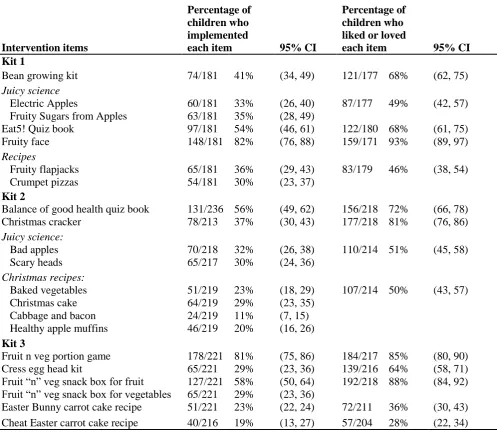
questionnaires, the children were asked to comment if they used each item sent to them in one of the three kit bags, the results are presented in Table 3. The items that were, on average, used the most were the fruit and veg portion game, fruit ‘n’ veg snack box for fruit, the Eat5! Quiz book, and the balance of good health quiz book. The children were also asked to rate each intervention item from the kit bags, on a five-point scale (love it, like it, don’t know, don’t like it, hate it) this was re-coded into love/like it and don’t know, don’t like or hate it. On average, the Project Tomato items that the children liked/loved the most were; the fruity face, the Christmas cake recipe, eat 5 balloon, project tomato pencils, portion game, and fruit “n” veg snack box.
[INSERT TABLE 3 HERE]
Intervention implementation and the association with total fruit and vegetable intake
A two level multilevel regression model was conducted to explore the relationship between children’s total follow-up fruit and vegetable intake and overall implementation of school items. The unadjusted and adjusted (gender, ethnicity, baseline intake and IMD score) models are presented in Table 4.
[INSERT TABLE 4 HERE]
vegetable intake, gender, ethnicity and IMD score. The unadjusted and adjusted models are presented in Table 4. Whilst Parents’ level of implementation was not significantly associated with improvements in fruit and vegetable consumption, after adjusting for possible
confounders, parents with a medium implementation of the intervention items were 40% more likely to have a higher fruit and vegetable intake, whereas parents with a high implementation level were 66% more likely to have children who consumed more fruit and vegetables
compared to parents who had a low implementation rating. This suggests that children of parents who had a high or medium intervention implementation consumed more fruit and vegetables compared to those with a low level of implementation.
Parents were also asked “How many days per school week do you send your child to school
with fruit or vegetables?” After adjusting for baseline fruit and vegetable intake, gender, ethnicity and IMD score, there was no significant difference in how many days per week children were sent to school with a piece of fruit or vegetable and their overall fruit and vegetable intake (N=111, 2-3days per week -6.1g 95% CI: -104.9 to 92.7, 4-5days per week 23.9g 95% CI: 25.0 to 72.3. p=0.3). Parents were also asked “How many nights a week do you
eat an evening meal with your child, at a table?” The multi-level regression model revealed that there was a significant relationship between eating at a table and children’s fruit and vegetable intake. Parent’s who ate their evening meal at a table 5-7 nights a week were 34g (95% CI: 6.4 to 62.0) and parents who ate their evening meal at a table with their children 3-4 nights a week were 48g (N=102 95% CI: -15.4 to 111.7, p=0.03) more likely to have children with higher fruit and vegetable intake than children who ate their evening meals with their parents zero to two nights per week, after adjustments were taken into consideration.
Table 5 shows that although the appreciation of various aspects of the project was high it was not significantly associated with change in children’s fruit and vegetable intake.
[INSERT TABLE 5 HERE]
DISCUSSION
The evaluation of the impact of the Project Tomato intervention indicated that a flexible multi-component intervention had little effect on maintaining or increasing children’s fruit and vegetable intake in the UK. The components designed and used in this programme are similar to those used in other multi-component interventions which have been shown to be effective 5 10 14 17 24 25
. However, implementation rate was a vital component in the success of these studies. Te Velde et al17 achieved long term change in children’s fruit and vegetable intake in the country that had the highest implementation rate. Similarly, a successful intervention reported by Story et al24 reported high adhesion to the intervention materials in their process evaluation.
nutritional interventions7. The intervention was designed to be pragmatic and not relying on external agencies for its delivery. This was deliberate, since had the intervention been successful the approach would have been readily transferable between schools. Whereas the majority of successful fruit and vegetable interventions have had external assistance in training, delivering and running of the intervention.9 10 12 13
Children’s and parents’ implementation levels of the home items provided a positive association with children’s fruit and vegetable intake. Whilst this difference was not significant, parents who implemented more intervention items were more likely to have children with higher fruit and vegetable consumption. The analysis identified the “fruit and veg portion game” as one of the most used and liked items by children and parents. This
activity involves each member of the household recording their daily intake of fruit and vegetables, to see who has eaten the most at the end of the week. It is a very simple concept that could easily be implemented, in public health initiatives.
Another important finding that was exploring other possible mechanisms associated with children’s fruit and vegetable intake was the meal time environment. Results revealed that parents who eat their main meal with their children at a table at least three times per week, on average have higher fruit and vegetable intake compared to parents who eat together less often. This suggests that programmes encouraging parents to eat together with their children at a table, may be a more effective way of increasing fruit and vegetable intake. These findings support previous research that parents’ influence is an important determinant of children’s diet 5 27
associated with higher fruit and vegetable intake from a study of women aged 18-65 years.29 Also Traveras et al,30 found that eating a family meal together was inversely associated with obesity in children aged 9 to 14 years old. Children need to see adults eating fruit and vegetables, to help demonstrate that eating fruit and vegetables is beneficial.6
Teachers, parents and children had high total appreciation scores for the different intervention materials. The results identified that there was no association between the teachers, parents or children’s appreciation scores and fruit and vegetable consumption.
Validity and reliability of the process measures questionnaires has not been tested, however this is a common weakness with health interventions, as limited resources are allocated to process evaluations5 13. Teachers, parents and children might be inclined to give socially desirable answers, leading to overestimation of the intervention effect.
Conclusion
The Project Tomato intervention was poorly implemented by teachers. The analysis revealed that the school items need improvement, to have a positive association with children’s diets. Future intervention research should design activities that involve little preparation time for the classroom teacher. This study also confirmed the importance of parents’ involvement, and the home environment. Further research should be conducted to review family eating behaviours and the mealtime environment to facilitate change in children’s dietary behaviours.
Interventions need activities that parents and children will enjoy together to change children’s diets. The next step in research into school interventions is to continue using and validating process evaluations to identify the best methods for conducting health interventions.
What is already known on this subject?
School based fruit and vegetable interventions can increase children’s consumption levels, however not all interventions are successful. Process evaluations can be used to improve our understanding of successful health interventions; to identify the key components that achieve an intervention successful, which theoretical constructs made a difference and what
environment/conditions lead to these particular components facilitating a successful outcome.
What does this study add?
Parents who eat their main meal with their children at a table at least 3 times per week, have higher fruit and vegetable intakes compared to parents who eat with their children less often.
Acknowledgements
University of Leeds
Dr Siobhan Hugh-Jones, Dr Fiona Jones, Dr Rebecca Lawton, Dr Sinead Boylan, and Miss Jennifer Lewis
National Foundation for Educational Research
Jennifer Jupp, Christine Webster, Frances Reed, Janice Walker and Ben Styles for their work at The National Foundation for Educational Research (NFER) in the sample selection, liaising with the schools and in the collection, entry and distribution of the data.
Completing Interests: None to declare.
Reference List
1. Wells L, Nelson M, Wells L, Nelson M. The National School Fruit Scheme produces short-term but not longer-short-term increases in fruit consumption in primary school children.
British Journal of Nutrition 2005;93(4):537-42.
2. Ransley JK, Greenwood DC, Cade JE, Blenkinsop S, Schagen I, Teeman D, et al. Does the school fruit and vegetable scheme improve children's diet? A non-randomised
controlled trial. Journal of Epidemiology & Community Health 2007;61(8):699-703. 3. Fogarty AW, Antoniak M, Venn AJ, Davies L, Goodwin A, Salfield N, et al. Does
participation in a population-based dietary intervention scheme have a lasting impact on fruit intake in young children? International Journal of Epidemiology
2007;36(5):1080-5.
4. Fisher JO, Mitchell DC, Smiciklas-Wright H, Birch LL. Parental influences on young girls' fruit and vegetable, micronutrient, and fat intakes. Journal of the American Dietetic Association 2002 102(1):58-64.
5. Wind M, Bjelland M, Perez-Rodrigo C, Te Velde SJ, Hildonen C, Bere E, et al.
changes in fruit and vegetable intake in 10- to 13-year old schoolchildren--the Pro Children study. Health Education Research 2008;23(6):997-1007.
6. French SA, Stables G. Environmental interventions to promote vegetable and fruit consumption among youth in school settings. Preventive Medicine 2003;37(6 Pt 1):593-610.
7. Knai C, Pomerleau J, Lock K, McKee M, Knai C, Pomerleau J, et al. Getting children to eat more fruit and vegetables: a systematic review.[see comment]. Preventive Medicine
2006;42(2):85-95.
8. Ciliska D, Miles E, Brien MA, Turl C, Tomasik HH, Donovan U. The effectiveness of community interventions to increase fruit and vegetable consumption in people four years of age and older. Ontario Ministry of Health Department. Canada, 1999.
9. Auld G, C O, Endinger E, M A. Outcomes from a school-based nutrition education program using resource teachers and cross-disciplinary models. . J. Nutr. Educ 1998; 30:268-280.
10. Perry CL, Bishop DB, Taylor G, Murray DM, Mays RW, Dudovitz BS. Changing fruit and vegetable consumption among children: the 5-a-Day Power Plus program in St. Paul, Minnesota. Am J Public Health 1998 88:603-9.
11. Baranowski J, Doyle C, Lin LS, Smith M, Wang DT. Gimme 5 fruit, juice, and vegetables for fun and health: outcome evaluation.[erratum appears in Health Educ Behav 2000 Jun;27(3):390]. Health Education & Behavior 2000;27(1):96-111.
12. Reynolds KD, Franklin FA, Binkley D, Raczynski JM, Harrington KF, Kirk KA, et al. Increasing the fruit and vegetable consumption of fourth-graders: results from the high 5 project. Preventive Medicine 2000;30(4):309-19.
13. Sahota P, Rudolf MC, Dixey R, Hill AJ, Barth JH, Cade J, et al. Randomised controlled trial of primary school based intervention to reduce risk factors for obesity.[see comment]. BMJ 2001;323(7320):1029-32.
14. Perry CL, Bishop DB, Taylor GL, Davis M, Story M, Gray C, et al. A randomized school trial of environmental strategies to encourage fruit and vegetable consumption among children. Health Education & Behavior 2004;31(1):65-76.
15. Cullen KW, Watson K, Baranowski T, Baranowski JH, Zakeri I, Cullen KW, et al. Squire's Quest: intervention changes occurred at lunch and snack meals. Appetite
2005;45(2):148-51.
16. Bere E, Veierod MB, Klepp K-I. The Norwegian School Fruit Programme: evaluating paid vs. no-cost subscriptions. Preventive Medicine 2005;41(2):463-70.
17. Te Velde SJ, Brug J, Wind M, Hildonen C, Bjelland M, Perez-Rodrigo C, et al. Effects of a comprehensive fruit- and vegetable-promoting school-based intervention in three European countries: the Pro Children Study. British Journal of Nutrition
2008;99(4):893-903.
18. Baranowski T, Anderson C, Carmack C. Mediating variables framework in physical activity interventions: How are we doing? How might we do better? . America Journal of Preventive Medicine 1998;15 (4): 266-297.
19. Steckler A, Linnan L. Process Evaluation for public health interventions and research
United States of America: Jossey-Bass, 2002.
20. Kitchen MS, Ransley JK, Greenwood DC, Clarke GP, Conner MT, Jupp JE. Study protocol: a cluster randomised controlled trial of a school based fruit and vegetable intervention - Project Tomato. BMC Health Services Research 2009;9(101).
22. Cade JE, Frear L, Greenwood DC, Cade JE, Frear L, Greenwood DC. Assessment of diet in young children with an emphasis on fruit and vegetable intake: using CADET--Child and Diet Evaluation Tool. Public Health Nutrition 2006;9(4):501-8.
23. Noble M, Wright G, Dibben C. Indices of Deprivation 2004: Report to the Office of the Deputy Prime Minister. London: Neighbourhood Renewal Unit. , 2004.
24. Story M, Mays RW, Bishop DB, Perry CL, Taylor G, Smyth M, et al. 5-a-day Power Plus: process evaluation of a multicomponent elementary school program to increase fruit and vegetable consumption. Health Education & Behavior 2000;27(2):187-200. 25. Tak NI, Te Velde SJ, Brug J, Tak NI, Te Velde SJ, Brug J. Ethnic differences in 1-year
follow-up effect of the Dutch Schoolgruiten Project - promoting fruit and vegetable consumption among primary-school children. Public Health Nutrition
2007;10(12):1497-507.
26. Bere E, Veierod MB, Bjelland M, Klepp KI. Outcome and process evaluation of a
Norwegian school-randomized fruit and vegetable intervention: Fruits and Vegetables Make the Marks (FVMM). Health Education Research 2006;21(2):258-67.
27. Blanchette L, Brug J. Determinants of fruit and vegetable consumption among 6-12-year-old children and effective interventions to increase consumption.[see comment].
Journal of Human Nutrition & Dietetics 2005;18(6):431-43.
28. Patrick H, Nicklas TA, Patrick H, Nicklas TA. A review of family and social determinants of children's eating patterns and diet quality. Journal of the American College of Nutrition 2005;24(2):83-92.
29. Crawford D, Ball K, Mishra G, Salmon J, Timperio A. Which food-related behaviours are associated with healthier intakes of fruits and vegetables among women?: Public Health Nutrition. 10(3)(pp 256-265), 2007. Date of Publication: Mar 2007., 2007. 30. Taveras EM, Rifas-Shiman SL, Berkey CS, Rockett HR, Field AE, Frazier AL, et al.
Table 1. Intervention demographic characteristics of the respondent and non-respondent participants: Process Measurement Questionnaires
Characteristics Completed a
questionnaire 95%CI
Did not completed a questionnaire
95%CI
Child characteristics
Age (years baseline) 7.0 (6.9, 7.0) 7.0 (6.9, 7.1)
%Sex (boys) 132/261 (51%) (45, 57) 28/50 (56%) (42, 70)
%Ethnicity (non-white) 33/246 (13%) (9, 18) 5/45 (11.0%) (2, 21)
Weight (kg baseline) 24.6 (24.1, 25.1) 24.8 (23.4, 26.3)
Height (cm baseline) 122.5 (121.9, 123.1) 123.3 (121.6, 124.9)
School characteristics % Free school meal
eligibility* 6.6 (6, 8) 17.6 (13, 25)
IMD score* 13.7 (12.5 , 15.1) 23.8 (18.9, 30.0)
Responded group n =261; non-responds group n = 50 *p<0.001
(% free school meals eligibility and IMD score are transformed using natural log)
Table 2 Teacher’s implementation and appreciation of the Project Tomato items (range 0-100)
Intervention items
Implementation Appreciation
Mean % 95% CI Mean % 95% CI
Curriculum lessons 45% (40, 50) 65.8% (61, 71)
Tasting Sessions 25% (21, 30) 85.7% (83, 87)
Cooking Club 8% (5, 10) 84.5% (81, 87)
Gardening Club 8% (6, 11) 46.7% (42, 51)
All school
intervention items 21% (19, 24) 65.7% (60, 71)
[image:19.595.80.519.391.536.2]Table 3. Children’s implementation and appreciation of home intervention items
Intervention items
Percentage of children who implemented
each item 95% CI
Percentage of children who liked or loved
each item 95% CI
Kit 1
Bean growing kit 74/181 41% (34, 49) 121/177 68% (62, 75)
Juicy science
Electric Apples 60/181 33% (26, 40) 87/177 49% (42, 57)
Fruity Sugars from Apples 63/181 35% (28, 49)
Eat5! Quiz book 97/181 54% (46, 61) 122/180 68% (61, 75)
Fruity face 148/181 82% (76, 88) 159/171 93% (89, 97)
Recipes
Fruity flapjacks 65/181 36% (29, 43) 83/179 46% (38, 54)
Crumpet pizzas 54/181 30% (23, 37)
Kit 2
Balance of good health quiz book 131/236 56% (49, 62) 156/218 72% (66, 78)
Christmas cracker 78/213 37% (30, 43) 177/218 81% (76, 86)
Juicy science:
Bad apples 70/218 32% (26, 38) 110/214 51% (45, 58)
Scary heads 65/217 30% (24, 36)
Christmas recipes:
Baked vegetables 51/219 23% (18, 29) 107/214 50% (43, 57)
Christmas cake 64/219 29% (23, 35)
Cabbage and bacon 24/219 11% (7, 15)
Healthy apple muffins 46/219 20% (16, 26)
Kit 3
Fruit n veg portion game 178/221 81% (75, 86) 184/217 85% (80, 90)
Cress egg head kit 65/221 29% (23, 36) 139/216 64% (58, 71)
Fruit “n” veg snack box for fruit 127/221 58% (50, 64) 192/218 88% (84, 92)
Fruit “n” veg snack box for vegetables 65/221 29% (23, 36)
Easter Bunny carrot cake recipe 51/221 23% (22, 24) 72/211 36% (30, 43)
Table 4. Implementation of the Project Tomato intervention for Teachers, Children and Parents and the association with total fruit and vegetable intake at follow-up.
Degree of implementation Coefficient 95% CI p-value Coefficient 95% CI p-value N
Teachers
All School intervention
items 7.34 (-24.5, 39.1) 0.63 -2.44 (-38.3, 33.4) 0.88 274
Curriculum lessons -0.84 (-34.4, 32.7) 0.95 -11.54 (-50.1, 26.9) 0.54 274 Tasting Sessions 3.56 (-32.4, 39.5) 0.83 -12.25 (-50.1, 25.5) 0.50 274 Children
Total Implementation 0.87 (-0.4, 2.1) 0.16 1.10 (-0.2, 2.4) 0.08 115 Parents
Total Implementation
Medium 48.63 (-56.4, 153.7) 40.78 (-67.9, 149.5)
High 56.42 (-35.4, 208.3) 0.34 66.10 (-71.4, 203.7) 0.58 57
Adjusted for baseline fruit and vegetable intake, gender, IMD, and ethnicity.
Table 5. Appreciation of the Project Tomato intervention for Teachers, Children and Parents and the association with total fruit and vegetable intake at follow-up.
Degree of appreciation Coefficient 95% CI p-value Coefficient 95% CI p-value N Teachers
Curriculum lessons 2.74 (-85.8, 91.3) 0.94 26.20 (-27.2, 79.6) 0.26 75 Tasting Sessions 38.52 (-6.7, 83.7) 0.08 33.12 (-24.5, 90.7) 0.23 145 Children
Appreciation score 1.51 (-0.6, 4.6) 0.31 0.99 (-1.4, 3.4) 0.38 101 Parents
Appreciation score
Medium -32.36 (-112.3, 47.6) -17.7 (-80.5, 45.0)
High -28.71 (-84.5, 27.1) 0.53 -39.3 (-97.4, 18.7) 0.36 112
[image:21.595.44.569.425.579.2]