This is a repository copy of
Photon detector system performance in the DUNE 35-ton
prototype liquid argon time projection chamber
.
White Rose Research Online URL for this paper:
http://eprints.whiterose.ac.uk/129116/
Version: Submitted Version
Article:
Adams, D.L., Alion, T., Anderson, J.T. et al. (75 more authors) (Submitted: 2018) Photon
detector system performance in the DUNE 35-ton prototype liquid argon time projection
chamber. arXiv. (Submitted)
[email protected] Reuse
Unless indicated otherwise, fulltext items are protected by copyright with all rights reserved. The copyright exception in section 29 of the Copyright, Designs and Patents Act 1988 allows the making of a single copy solely for the purpose of non-commercial research or private study within the limits of fair dealing. The publisher or other rights-holder may allow further reproduction and re-use of this version - refer to the White Rose Research Online record for this item. Where records identify the publisher as the copyright holder, users can verify any specific terms of use on the publisher’s website.
Takedown
If you consider content in White Rose Research Online to be in breach of UK law, please notify us by
Prepared for submission to JINST
Photon detector system performance in the DUNE 35-ton
prototype liquid argon time projection chamber
D. L. Adams4T. Alion24J. T. Anderson3L. Bagby8M. Baird∗24G. Barr17N. Barros18K. Biery8 A. Blake13E. Blaufuss15T. Boone6A. Booth24D. Brailsford13N. Buchanan6A. Chatterjee25 M. Convery21J. Davies24T. Dealtry13P. DeLurgio3G. Deuerling8R. Dharmapalan3Z. Djurcic3 G. Drake3B. Eberly21J. Freeman8S. Glavin18R. A. Gomes9M. C. Goodman3M. Graham21 A. Hahn8J. T. Haigh26J. Hartnell24A. Higuera11A. Himmel8J. Insler†14J. Jacobsen15T. Junk8 B. Kirby4J. Klein18V. A. Kudryavtsev20T. Kutter14Y. Li4X. Li23S. Lin6J. Martin-Albo‡17 N. McConkey20C. A. Moura1S. Mufson12T. C. Nicholls22J. Nowak13M. Oberling3J. Paley8 X. Qian4J. L. Raaf8D. Rivera18G. Santucci23G. Sinev7N. J. C. Spooner20M. Stancari8 I. Stancu2D. Stefan5J. Stewart4J. Stock19T. Strauss8R. Sulej16Y. Sun10M. Thiesse20 L. F. Thompson20Y. T. Tsai21M. Wallbank20T. K. Warburton§20D. Warner6D. Whittington¶12 R. J. Wilson6M. Worcester4E. Worcester4T. Yang8C. Zhang4on behalf of the DUNE
collaboration
1Universidade Federal do ABC, Santo André - SP, 09210-580, Brazil 2University of Alabama, Tuscaloosa, AL 35487, USA
3Argonne National Laboratory, Argonne, IL 60439, USA 4Brookhaven National Laboratory, Upton, NY 11973, USA
5CERN, European Organization for Nuclear Research 1211 Geneve 23, Switzerland, CERN 6Colorado State University, Fort Collins, CO 80523, USA
7Duke University, Durham, NC 27708, USA
8Fermi National Accelerator Laboratory, Batavia, IL 60510, USA
9Universidade Federal de Goias, Instituto de Fisica, Goiania, GO 74690-900, Brazil 10University of Hawaii, Honolulu, HI 96822, USA
11University of Houston, Houston, TX 77204, USA 12Indiana University, Bloomington, IN 47405, USA
13Lancaster University, Bailrigg, Lancaster LA1 4YB, United Kingdom 14Louisiana State University, Baton Rouge, LA 70803, USA
15University of Maryland, College Park, MD 20742, USA
16National Centre for Nuclear Research, A. Soltana 7, 05 400 Otwock, Poland ∗N
ow at the University of Virginia
†Now at Drexel University ‡Now at Harvard University
§Now at Iowa State University
¶Now at Syracuse University
17University of Oxford, Oxford, OX1 3RH, United Kingdom 18University of Pennsylvania, Philadelphia, PA 19104, USA
19South Dakota School of Mines and Technology, Rapid City, SD 57701, USA
20University of Sheffield, Department of Physics and Astronomy, Sheffield S3 7RH, United Kingdom 21SLAC National Acceleratory Laboratory, Menlo Park, CA 94025, USA
22STFC Rutherford Appleton Laboratory, Harwell Campus, Didcot OX11 0QX, United Kingdom 23Stony Brook University,Stony Brook, New York 11794, USA
24University of Sussex, Brighton, BN1 9RH, United Kingdom 25University of Texas (Arlington), Arlington, TX 76019, USA 26University of Warwick, Coventry CV4 7AL, United Kingdom
E-mail: J. Insler ([email protected]),A. Himmel ([email protected]),Z. Djurcic
Abstract:The 35-ton prototype for the Deep Underground Neutrino Experiment far detector was a single-phase liquid argon time projection chamber with an integrated photon detector system, all situated inside a membrane cryostat. The detector took cosmic-ray data for six weeks during the period of February 1, 2016 to March 12, 2016. The performance of the photon detection system was checked with these data. An installed photon detector was demonstrated to measure the arrival times
of cosmic-ray muons with a resolution better than32ns, limited by the timing of the trigger system.
A measurement of the timing resolution using closely-spaced calibration pulses yielded a resolution of 15 ns for pulses at a level of 6 photo-electrons. Scintillation light from cosmic-ray muons was
Contents
1 Introduction 1
2 The 35-ton prototype detector 2
2.1 Membrane cryostat 2
2.2 External trigger system 3
2.3 Time projection chamber 4
2.4 Photon detector system 4
2.4.1 Photon detector designs 4
2.4.2 Photon detector readout 6
2.4.3 UV light-based calibration system 8
3 Photon detector data handling 8
4 Photon detector performance 9
4.1 Optical hit finding 10
4.2 Timing resolution measurement 10
4.3 Photon detector response vs. position 14
5 Conclusion 14
1 Introduction
The Deep Underground Neutrino Experiment (DUNE) is a dual-site experiment with an international collaboration that will study neutrino oscillation physics, have the ability to observe neutrinos from core-collapse supernovae within our galaxy, study atmospheric and solar neutrinos, and search for nucleon decay. A beam of neutrinos with 2.5 GeV mean energy will be produced by the Long-Baseline Neutrino Facility (LBNF) at the Fermi National Accelerator Laboratory (Fermilab). It will be aimed through the Earth’s crust toward a 40 kiloton (kt) fiducial mass Liquid Argon Time Projection Chamber (LArTPC) far detector composed of four 10 kt modules situated 1300 km away from the source. This far detector will be located in the Sanford Underground Research Facility in Lead,
South Dakota. The neutrino beam produced at Fermilab will consist almost entirely ofνµ. A near
detector situated 574 m from the target will characterize the neutrino beam. The far detector (FD) will
measureνµdisappearance andνeappearance [1]. The sheer size of the far detector presents multiple
must operate in the dedicated field-free regions available in the interior of the detector. In order to prototype and test the necessary technologies and solutions, the DUNE 35-ton prototype detector was constructed and operated at Fermilab.
The DUNE LArTPCs will operate with electron drift times on the order of milliseconds. An
independent system is therefore required to provide measurements of the time of interaction, t0,
with resolution equal to or better than1 µs especially for non-beam interactions such as supernova
neutrino scatters, nucleon decay candidates, as well as atmospheric and solar neutrinos interactions [2].
Scintillation light is produced within a few microseconds of the interaction [3] and travels much more
quickly than the electrons can drift, so a photon detection system can meet thet0requirement.
The DUNE 35-ton prototype detector was a single-phase LArTPC with an integrated photon
detector system built to investigate the DUNE far detector design and components [2]. The experiment
was operated in two configurations. The first configuration operated between December 20, 2013 and
February 15, 2014, and had neither a time projection chamber (TPC) nor photon detectors (PD) [4]. It
used dedicated internal purity monitors [5] to measure the LAr purity achievable with a non-evacuated
membrane cryostat, a design envisaged for the DUNE FD. The cryostat and cryogenic purification system achieved a drift electron lifetime between 2.5 and 3.0 ms, as measured by the purity monitors,
which implied an equivalent O2contamination level of less than 100 ppt. This meets the requirement
for LAr purity needed for the DUNE FD [1]. The second configuration, which collected data between
February 1, 2016 and March 12, 2016, included a TPC with fully integrated photon detectors. Cosmic rays provided the signals needed to characterize the detector performance because the 35-ton prototype is not in a beamline. The second configuration’s main data-taking period ended when a leak allowed air to contaminate the LAr. Although subsequent data lacked scintillation light, a useful calibration dataset was obtained via the UV light-based calibration system.
This paper presents a description of the 35-ton prototype detector and the operation of its photon detector system, as well as measurements of the timing performance of the prototype photon detectors and a measurement of the dependence of the strength of scintillation light with the distance between the originating track and the anode plane.
2 The 35-ton prototype detector
The 35-ton prototype apparatus was located onsite at Fermilab. It comprised several subsystems, each
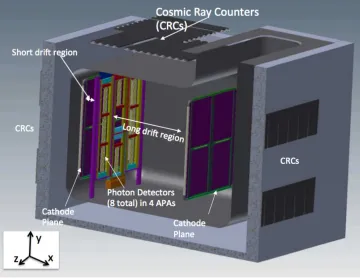
of which is described below. The full apparatus is depicted in Figure1.
2.1 Membrane cryostat
The membrane cryostat was made up of a corrugated stainless steel membrane surrounded by multiple layers of insulation and a reinforced concrete structure. The thickness of the insulation was about 0.4 m. The cryostat had inner dimensions of 4.0 m long, 2.7 m wide and 2.7 m high, for a total
volume of about 30 m3. The membrane cryostat was designed by the IHI corporation and constructed
Figure 1: Drawing of the 35-ton prototype detector, showing positions of Cosmic Ray Counters
(CRCs), Photon Detectors, APAs, CPAs and drift volumes. The length of "Long Drift" region
is 2.258m and that of the "Short drift" region is 0.302m. The APA and CPA planes were each approximately 2 m tall by 1.5 m wide. CRCs are also present on the near and far walls, which are not shown in the drawing.
2.2 External trigger system
The external walls of the cryostat were instrumented with 44 pairs of plastic scintillation counters to detect cosmic-ray muons entering and passing through the LAr volume. These muon counters were
developed by the CDF Collaboration and they were used during the Tevatron collider run [6] before
being installed on the 35-ton protoype. The positions of the muon counters are shown in Figure1.
In order to record data from throughgoing muons, coincidences between signals from pairs of muon counters on opposite walls of the cryostat were used to trigger detector readout.
Trigger decisions were made by the Penn Trigger Board (PTB), which was designed and built specifically for DUNE prototypes. The PTB was equipped with a MicroZed with a Zynq-7Z020
System on Chip (SoC) [7], gigabit Ethernet, 115 I/O ports, one GB of DDR3 RAM and a 33.33 MHz
data acquisition (DAQ) system for inclusion in the event data, to be used by the offline analysis.
2.3 Time projection chamber
The TPC inside the LAr-filled cryostat consisted of an anode plane and two cathode planes, one on either side of the anode plane. The anode plane contained four double-sided, modular Anode Plane Assemblies (APAs), and the cathode planes each contained one Cathode Plane Assembly (CPA). This arrangement formed two drift volumes, one between each cathode plane and the anode plane. High-energy particles passing through the LAr ionized argon atoms along their path, releasing electrons
which drifted towards the APAs in the electric fields (with a strength of250 V/cm during 35-ton
prototype running) maintained between the CPAs and APAs. The APAs had induction wires wrapped around them and vertical collection wires strung across them. When the drifting electrons reached the four APAs, they induced signals on the induction wires before being collected by the vertical collection wires. The induction and collection wire signals were read out by electronics mounted inside the LAr volume and were used to reconstruct the three-dimensional paths of the particles in the drift volumes. The APAs also contained central gaps in which the photon detectors were installed, as described below.
The TPC design and operation is described in greater detail here[8].
2.4 Photon detector system
[image:7.612.93.519.438.499.2]The photon detector system consisted of a collection of photon detectors located inside the APAs, the SiPM Signal Processors (SSPs) used to read out and process the signals from the photon detectors and the calibration system that produced and diffused ultraviolet (UV) light inside the cryostat to monitor the capabilities of the photon detectors.
Figure 2: Example schematic photon detector panel design, showing the light-guide bar and the
SiPMs of the IU or LBNL designs. The light-guide bar has dimensions of 50.8 cm × 2.54 cm ×
0.6 cm.
2.4.1 Photon detector designs
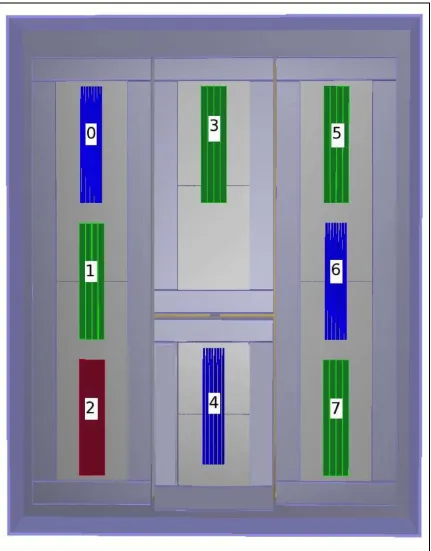
The 35-ton prototype detector contained eight separate photon detectors installed within the APAs. The photon detectors were constrained in their geometry to fit inside the APAs. The detectors shifted 128 nm scintillation light into the visible range using Tetraphenyl-butadiene (TPB). The shifted light traveled in light guides to silicon photomultipliers (SiPMs) mounted on one or both ends of each
detector. Figure2shows an example photon detector design, and the photon detector positions are
At the time of the APA construction, several different implementations of this general design were under consideration and were constructed for use in the 35-ton. However, by the time of operation, some of these designs were considered obsolete, and others had already been tested in standalone systems. For the 35-ton prototype, the emphasis was on testing the PD system as a whole. Separate measurements of the performance of the different designs were not performed.
Photon detectors 1, 3, 5 and 7 were assembled at Indiana University (IU) and used a light guide consisting of four acrylic bars produced by IU and MIT. Each bar was attached to three SiPMs, for a total of 12 SiPMs per detector unit. Two light guides were coated with TPB by dipping with a solution
of TPB dissolved in dichloromethane at 0.6% by weight [9]; other light guide bars were doped,
dip-coated, or flash-heated with either TPB or bis-MSB as described in [11]. The light guides converted
scintillation light entering them into photons of visible blue light with wavelength of approximately
430nm; total internal reflection caught a portion of the converted photons and conveyed them to the
three SensL C-series SiPMs [10] on the readout end.
Photon detectors 0, 4 and 6 were developed by Colorado State University (CSU). All 3 of the CSU detectors used an array of 32 custom 3 mm square TPB-doped wavelength-shifting (WLS) fibers grouped such that 4 fibers were directed onto the face of a 6 mm square SiPM. An additional detector was populated with polystyrene bars provided by Lawrence Berkeley National Laboratory and doped with TPB. Due to a cabling error in installation, photon detector 4’s readout was not connected; no data were acquired from it during the run.
Photon detector 2 was developed by Louisiana State University and used a TPB-coated acrylic light guide with three S-shaped WLS fibers embedded within it. The TPB converted the scintillation blue light with wavelength approximately 430 nm, a fraction of which was captured either directly or after reflections off of the internal surfaces of the acrylic fibers, which shifted the light to 490 nm (green) photons. The fibers guided the green photons to both ends of the detector, where they were
read out by SensL B-series SiPMs [12], one on each end. Since only two SiPMs were required, this
design had significantly fewer electronic channels compared to the other designs.
2.4.2 Photon detector readout
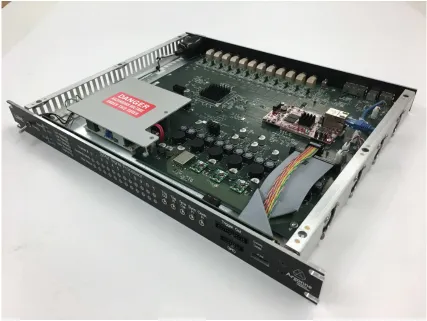
Each photon detector’s SiPMs were read out by rack-mounted SSP modules, which were designed and constructed by Argonne National Laboratory (ANL). Each SiPM corresponded to one readout channel. The photon detector system made use of seven SSPs in total, connected to the 66 active photon detector channels from all photon detectors except the inactive photon detector 4. There were no photon detector system front-end electronics in the LAr cold volume. The unamplified signals from the SiPMs were transmitted directly outside the cryostat for processing and digitization, with the advantage that the infrastructure required inside the cryostat was reduced (power, data cables, precision clocks, amplifiers and digitizers). The SSPs received the waveform output from the SiPMs as analog voltages over 20 m long cables. Each SSP included a separate power supply for each channel to provide up to 30 V of bias, controllable in 4096 steps of 7.324 mV, to each SiPM. The module also featured front-end charge injection for performing diagnostics, linearity monitoring and voltage
Figure 4: Aphotograph of a SiPM signal processor (SSP).
Each SSP channel contained a fully differential voltage amplifier and a 14-bit, 150 megasamples per second Analog-to-Digital Converter (ADC) that digitized the waveforms received from the SiPMs. In 35-ton running the ADC was run at 128 megasmples per second in order to match the timing of the NOvA system described below. The front-end amplifier was configured as fully differential with common-mode rejection and received the SiPM signals into a termination resistor that matched the characteristic impedance of the signal cable. The processing was pipelined and performed by a Xilinx
Artix-7 Field-Programmable Gate Array (FPGA) [13]. The digitized data were stored in pipelines
in the SSP for up to 2048 samples. The Artix-7 processed the digitized data from each channel with a leading edge discriminator to detect pulses. In the standard mode of operation the module performed waveform capture using either an external or an internal trigger. In the latter case, the module self-triggered on a waveform above a predetermined threshold. Because the Artix-7 FPGA was programmable and accessible, it was possible to explore different data processing algorithms and techniques. In order for pulses measured in the photon detector to be matched with corresponding readouts of the TPC, the front-end electronics attached a global timestamp from the NOvA timing
system [14] to the data as it was acquired through the SSPs and the TPC electronics. Quantities from
integrated sum were also output in headers.
A Xilinx Zynq FPGA, onboard the MicroZed SoC, handled the slow control (for monitoring and setting parameters) and data transfer. The SSP had two communication interfaces: USB 2.0 and 10/100/1000 Ethernet. The 1 Gb/s Ethernet supported full TCP/IP protocol and was used to ship the data off the module.
2.4.3 UV light-based calibration system
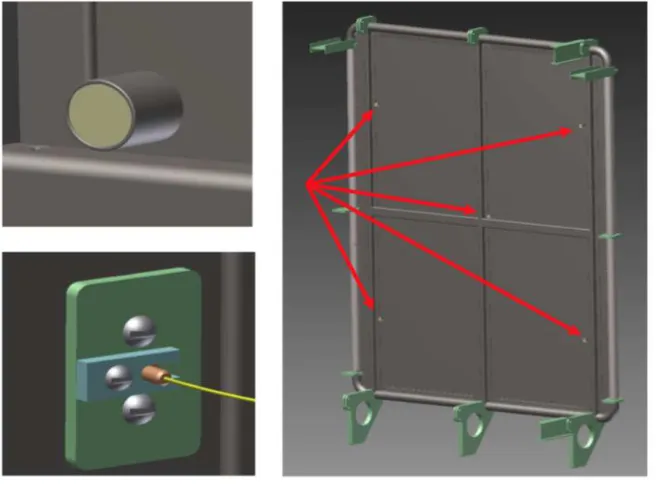
The photon detector’s calibration system was developed by ANL to verify photon detector dynamic range, SiPM gains and the timing resolution, as well as to evaluate multiple photon detectors’ relative efficiencies and to monitor the stability and response of the entire photon detector system as a function of time. It used a set of light-emitting diodes (LEDs) that emitted UV light at a wavelength of 280 nm. Light pulses were generated by a rack-mounted Light Calibration Module (LCM) that contained a set of five LEDs and driver circuitry which utilized an SSP motherboard for control and communication with the trigger and timing systems. The LCM operated outside of the liquid argon cryostat in a NIM crate alongside the SSPs. Each UV LED in the LCM was coupled to a quartz fiber-optic cable, which transmitted light via an optical feedthrough into the cryostat and the detector volume. Each fiber terminated in a diffuser mounted on the CPA in the long drift volume. The locations of the five
diffusers are shown in Figure5. This arrangement improved the uniformity of the illumination of the
APA. Because the TPB of the photon detectors shifted the wavelength of the 280 nm light similarly to
that of the 128 nm LAr scintillation light[15], the detector response should be similar.
The calibration system was tested by running the LCM to produce flashes of UV light in the detector volume and provide a trigger to read out the photon detectors and record the response to the light. Special calibration data sets were collected with this setup. The pulse width and the pulse amplitude were varied while flashing only the central diffuser; the other diffusers were also flashed in isolation with constant pulse width and amplitude to test the relative response of the system. Aside from verifying photon detector gains and dynamic range, the calibration system was used in double-pulse
modes to measure the timing resolution of the detector, shown in Figure6b.
3 Photon detector data handling
The SSP readout could be configured to read out data either upon receiving an external trigger or by self-triggering on the measured waveforms when the amplitude exceeded a threshold defined for each channel. The readout modes could operate together, as well. The SSP output included headers, which contained summary information such as the integrated sum, the peak sum and the baseline sum of the waveform computed by the SSP’s on-board signal processing, as well as the full waveform vectors.
Both the externally-triggered mode and the self-triggered mode were employed during data taking. Photon detector data was only written to disk if there was a coincident external trigger, if coincident TPC data was present, or if multiple SSPs had coincident self-triggered waveforms. In the
externally-triggered mode, waveforms with the maximum allowed 2048 samples (a time of about15.5 µs) were
Figure 5: Diffusers (top left-hand figure), which are mounted at five locations shown with arrows (right-hand figure) on the CPA, emit UV light brought in from the LCM via quartz fibers (lower left-hand figure).
and individual SSPs were found to vary within a small number of PTB ticks (32 ns). In the
self-triggered mode, the total data rate from the photon detectors needed to be reduced to avoid saturating the maximum data flow capabilities of the DAQ system. Shorter waveforms with 700 samples (about
5 µs) were saved, and an additional filtering software module was added to the DAQ system. The
primary contributors to the data rate were radiological contaminants and noise, which could produce signals multiple photo-electrons (PEs) in size, but localized to a single photon detector. The rate could thus be significantly reduced by requiring coincidences in multiple photon detectors. Because all of the channels for each photon detector were read out by a single SSP, this could be achieved by requiring coincident hits in multiple SSPs. Even with these mitigations, high noise in the integrated system required the photon detector readout threshold to be set to at least 2.3 PE.
4 Photon detector performance
4.1 Optical hit finding
The first step in the offline analysis of these data was the creation of "optical hits", which were
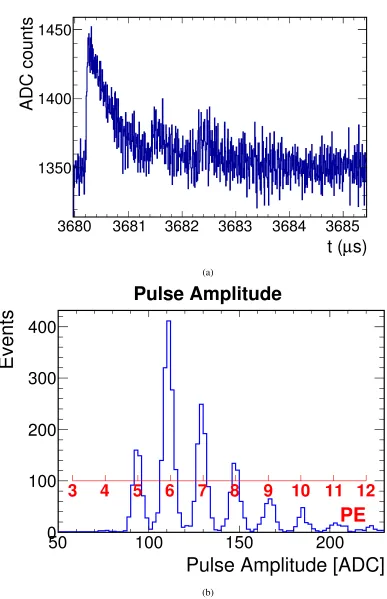
found by identifying peaks in the recorded waveforms. An example waveform is shown in Figure7a.
Information stored for each hit included the time, the width, the area and the amplitude. In order to find optical hits, the waveform was first processed by a pedestal-finding algorithm, which used the levels before and after the pulse (itself identified by a rapid rise in amplitude of the pulse) to calculate the pedestal.
The optical-hit-finder algorithm first subtracted this pedestal from each sample of the waveform. Then it looped through all of the samples in the waveform and searched for a value that exceeds a "primary" threshold. Once found, the algorithm defined a region of interest around that peak as the range during which the ADC values exceed a "secondary" threshold. The primary and secondary thresholds were fixed parameters. If the width of the region of interest was sufficiently wide, the optical hit was created and assigned the time of the peak value sample within the hit.
4.2 Timing resolution measurement
In order to measure the timing resolution of the photon detector system with respect to the muon
counters, the time difference (∆tµ) between the reconstructed optical hit times from the photon
detectors and the trigger time constructed by the PTB from the coincidence of two muon counter signals was computed. All runs containing photon detector data externally triggered by the muon counters as our data sample were used. To exclude the large noise present in the data, only hits with a peak of greater than an ADC count of about 100 above pedestal, corresponding to approximately 5.2
PE, were used. Looking at∆tµfor photon detector 3 (chosen for having the most consistent time offset
between the photon detector and muon systems over the full run), a narrow peak of width<100ns was
apparent. In single runs, all times showed up within a single bin, indicating that the time resolution of
the photon detector is better than the PTB tick length of 31.25 ns. This establishes that the resolution
surpasses the requirement for DUNE; by comparison the readout for the TPC is digitized with a period of typically 500 ns.
To further quantify the photon detectors’ timing resolution, a second measurement using the in situ calibration system was performed. Data were taken after the primary data run with the TPC powered down and with a high level of nitrogen present in the LAr, which effectively extinguished any
scintillation light. Figure7b displays the pulse amplitudes of a typical SSP channel. Distinct peaks
show a clear separation corresponding to different numbers of PE. Assuming linearity, SiPM gain was found to be approximately 18 ADC counts per single PE. With all the SiPMs operated at the same bias voltage the gain had a variance of about 5% among the channels. Calibration data were collected in the self-triggering mode and the hit-finding thresholds used in the standard analysis were ignored; instead, a threshold of 80 ADC counts above pedestal (approximately 4.5 PE) was applied. In our
timing resolution studies, pulses were required to haveNPE ≥ 6.
waveforms taken in this double-pulse mode is shown in Figure6a. In this example, both pulses were
s)
µ
t (
0
1
2
3
4
5
ADC counts
1300
1400
1500
1600
1700
(a)
0
50
100
150
200
>
PE
<N
0
0.005
0.01
0.015
0.02
0.025
s]
µ
[
ct
∆
σ
Time Resolution
[image:15.612.105.499.78.642.2](b)
Figure 6: (a) Typical example of double-pulse pairs emitted by calibration system and observed by photon detectors. The blue and pink curves are waveforms from two representative channels. (b)
double-s)
µ
t (
3680
3681
3682
3683
3684
3685
ADC counts
1350
1400
1450
(a)
Pulse Amplitude [ADC]
50
100
150
200
Events
0
100
200
300
400
Pulse Amplitude
PE
3
4
5
6
7
8
9
10 11 12
Pulse Amplitude
[image:16.612.98.485.89.688.2](b)
For each SiPM channel a few hundred double-pulse events were collected. Then the time difference
∆tC =t2−t1between two pulses was measured as a function of the number of PE observed at a given
SiPM. For this study, the pulse time was taken as the time at two thirds of the maximum pulse height at the leading edges of the first and second pulses. For each SiPM channel, the mean number of PE,
hNPEi, and the resolution (standard deviation) of∆tC =t2−t1, calledσ∆tC was calculated. Figure6b
showsσ∆tC as a function ofhNPEifor the 46 channels that were used for this study. Twenty channels
were excluded due to high noise or other problems. The time resolution was approximately4 ns for
50 PE pulses and worsened to approximately 15 ns for 6 PE pulses. This resolution is better than the
global timing resolution found with muons tagged by the external triggers in Section 4.2because the
photon detector system has a faster internal clock than the PTB.
4.3 Photon detector response vs. position
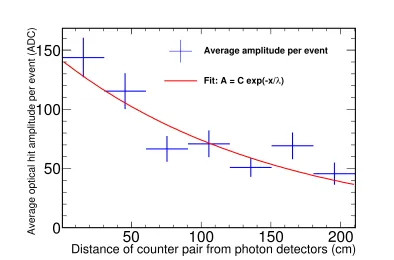
The amplitude of the observed light as a function of the distance between the track producing it and the anode plane was also studied in order to quantify the attenuation of scintillation light due to scattering, absorption, and geometrical effects in the 35-ton prototype detector. From the full data set of externally triggered events, events with muons that triggered one of the seven pairs of counters located directly opposite each other on the cryostat walls were selected. These are tracks that are traveling roughly
parallel to thez-axis of Figure1at varyingx positions. Events were required to have no more than
the two triggers from the muon counter pairs. The reconstructed optical hits were required to have an amplitude above a threshold of 100 ADC counts (approximately 5.2 PE) and were required to not be from one of the 10 noisy optical channels.
For each event that triggered a pair of muon counters, all reconstructed amplitudes of optical hits were summed; if no optical hit was present, the summed amplitude was set to zero. The summed amplitudes over all of the events with triggers were averaged, yielding an average measured light yield
per event. Figure8 shows the measured averages along with an exponential fit. The characteristic
length in this fit is 155±28 cm (statistical error only). This length includes geometrical effects,
scattering, absorption on the field cage and CPA walls, as well as absorption in the liquid argon. No attempt has been made to measure the impacts of these effects separately.
5 Conclusion
The data run of the 35-ton prototype detector demonstrated the use of the DUNE photon detector designs integrated into a LArTPC detector. Based on a data sample of all runs externally triggered by the muon counters containing photon detector data, the timing resolution was found to be better than 32 ns with measured muons for a single photon detector. The calibration system with UV diffusers was also tested and used in specialized runs such as the timing resolution measurement. A time resolution of 15 ns was found for pulses at a level of 6 PE from double-pulse calibration measurements. The photon detector system therefore exceeds the timing resolution requirements of the DUNE far detector,
demonstrating a timing resolution significantly better than 1µs. A characteristic attenuation length for
scintillation light of 155±28 cm (statistical error only) was found based on a sample of through-going
Distance of counter pair from photon detectors (cm)
50
100
150
200
Average optical hit amplitude per event (ADC)
0
50
100
150
Average amplitude per event)
λ
[image:18.612.109.503.78.338.2]Fit: A = C exp(-x/
Figure 8: Average optical hit amplitude per event vs. counter pair positions, fit with A = Ce−x/λ
whereAis avg. amplitude,λis the characteristic length,xis distance of the tracks from PDs andCis
a normalization constant. Error bars are statistical errors on mean hit amplitudes per bin.
Acknowledgments
This material is based upon work supported in part by the following: the U.S. Department of Energy, Office of Science, Offices of High Energy Physics and Nuclear Physics; the U.S. National Science Foundation; the Science and Technology Facilities Council of the United Kingdom, including Grant Ref: ST/M002667/1; and the CNPq of Brazil. Fermilab is operated by Fermi Research Alliance, LLC under Contract No. DE-AC02-07CH11359 with the United States Department of Energy. We would like to thank the Fermilab technical staff for their excellent support and the MIT Neutrino Group for supplying acrylic bar lightguides.
References
[1] R. Acciarriet al.(DUNE Collaboration), “Long-Baseline Neutrino Facility (LBNF) and Deep
Underground Neutrino Experiment (DUNE) Conceptual Design Report Volume 2: The Physics Program for DUNE at LBNF”, arXiv:1512.06148.
[2] R. Acciarriet al.(DUNE Collaboration), “Long-Baseline Neutrino Facility (LBNF) and Deep
[3] T.Heindl, T. Dandl, M. Hofmann, R. Krucken, L. Oberauer, W. Potzel, J. Wieser and A. Ulrich, “The scintillation of liquid argon,” EPL91, no. 6, 62002 (2010) doi:10.1209/0295-5075/91/62002
[arXiv:1511.07718 [physics.ins-det]].
[4] D. Montanariet al.“Performance And Results Of The LBNE 35 Ton Membrane Cryostat Prototype”. Physics Procedia 67 (2015): 308-313.
[5] M. Adamowksiet al.”The Liquid Argon Purity Demonstrator" JINST9, no. 07, P07005 (2014) doi:10.1088/1748-0221/9/07/P07005 [arXiv:1403.7236 [physics.ins-det]].
[6] C. Bromberg (CDF Collaboration), “Gain and threshold control of scintillation counters in the CDF muon upgrade for Run II,” Int. J. Mod. Phys. A16S1C, 1143 (2001).
[7] Xilinx. (2016). “Zynq-7000 All Programmable SoC Technical Reference Manual”. Retrieved from https://www.xilinx.com/support/documentation/user_guides/ug585-Zynq-7000-TRM.pdf.
[8] M. Wallbank,"Results from the 35-ton Liquid-argon Prototype using Cosmic Rays and Lessons Learned", in proceedings of "European Physical Society conference on High Energy Physics 5-12 July 2017",PoS(EPS-HEP2017)027.
[9] Z. Mosset al., ”A Factor of Four Increase in Attenuation Length of Dipped Lightguides for Liquid Argon TPCs Through Improved Coating”, arXiv:1604.03103.
[10] SensL. (2014). “C-Series Low Noise, Blue-Sensitive Silicon Photomultipliers Datasheet”. Retrieved from http://sensl.com/downloads/ds/DS-MicroCseries.pdf.
[11] D. Whittington, S. Mufson and B. Howard, “Scintillation Light from Cosmic-Ray Muons in Liquid Argon,” JINST11, no. 05, P05016 (2016) doi:10.1088/1748-0221/11/05/P05016 [arXiv:1408.1763 [physics.ins-det]].
[12] SensL. (2013). “B-Series Fast, Blue-Sensitive Silicon Photomultipliers Datasheet”. Retrieved from http://sensl.com/downloads/ds/DS-MicroBseries.pdf.
[13] Xilinx. (2017). “7 Series FPGAs Data Sheet: Overview”. Retrieved from
https://www.xilinx.com/support/documentation/data_sheets/ds180_7Series_Overview.pdf.
[14] A. Normanet al, “The NOνA Timing System: A system for synchronizing a long baseline neutrino experiment,” J. Phys.: Conf. Ser.396, (2012) 012034.