Reducing teacher
workload
Research report
March 2018
Ben White (Ashford Teaching Alliance)
Teacher Researchers:
Tanya Barwick, Esther Cook, Lesley Donald,
Sarah Forde, Stephen King,
Contents
Research topic 3
Review Group Recommendations 3
Approaches to reducing workload 4
Research Protocol 4
The research questions 6
Research Phases 6
Analysis of Research Data 6
Phase Two (Interviews focused on data use) 10
School Culture 15
Conclusion 17
Research topic
56% of respondents to the 2015 workload challenge review identified data management as a source of unnecessary workload.
‘No-one sets out to create burdensome data management systems. Decisions about the purpose and process for data management…are made to respond to real and perceived demands, many of which are positive and necessary. Yet the unintended consequences of these decisions often cause unnecessary workload for teachers and school leaders.’
Various demands are made of teachers in relation to data use and analysis. Crawford et al (2010) identified a differentiated demand model to illustrate the differences in and effects of types of job demand. They identified ‘challenge demands’ which are those seen as closely related to the core purpose of a worker, being associated with increased
worker engagement. Conversely, they identified ‘hindrance demands’ as those seen as a barrier to that which a worker deems to be their core purpose, associated with significant increases in burnout and decline in levels of engagement. This research therefore
suggests the importance of considering not just the time requirements of data-related demands, but how they are perceived by teachers.
This collaborative research project explored teacher workload issues relating to data management across the Kent and Medway Teaching Schools’ Network. The process was supported by NCTL and our university partner, University College London (UCL). The research tools were informed by recommendations in the workload review and Crawford et al’s theoretical model. It examined teachers’ perception of their data management workload in order to help to identify specific recommendations in relation to the data management aspect of the workload challenge.
Review Group Recommendations
The independent teacher workload group report: Eliminating unnecessary workload associated with data management (2016), called on all parties to reduce unnecessary data management tasks:
‘Above all else, any person or organisation involved in the production and use of data should start by having clear answers to three questions…Am I clear on purpose? Is this the most efficient process? Is the data valid?’(p.8)
A key recommendation from the review group was that schools, MATs and academy chains regularly conduct an audit of the data processing workload in their own context in order to generate contextually appropriate responses to the workload challenge.
1. Examining practitioner perception and institutional culture relating to data use and workload in a range of schools in order to identify specific recommendations to improve workload.
2. Developing tools and resources to support schools wishing to conduct their own audits.
Approaches to reducing workload
Two research tools were designed to identify school leaders’ and teachers’ understanding and perceptions of the purpose, process and validity of data use
demands. They were informed by the workload review reports, the differentiated demand resources model and the local expertise of the teacher-researcher team. Responses were collaboratively analysed in order to develop practical recommendations for reducing workload related to data management.
Our expectation was that analysis of the research data gained through questionnaire and subsequent interviews would help to highlight issues within and across schools. In turn, this would enable practical advice and guidance to be distilled which could be shared across the network.
The research processes were evaluated in two ways.
• Did this research enable practical recommendations to be generated for plausibly reducing workload without negatively impacting upon pupil attainment?
• How was the process itself perceived by the teachers as researchers? Was it seen as worthwhile? Did it lead to greater understanding of issues relating to workload and data use? Could it lead to practical and tangible improvements in the future?
Research Protocol
The research process, ethical considerations and tools were developed by the teachers as researchers team, in conjunction with our university partner (UCL). The data was then collaboratively analysed by the teacher research team (with support from IOE and
Education DataLab) in order to develop specific practical recommendations regarding teacher workload.
The research tools developed during this process include
1. Questionnaire to establish use of data in schools
This drew on key recommendations from the workload review reports. The questionnaire was refined following consultation with our university partner and a review session with the teacher research team. It included a range of closed and open questions.
The questionnaire was conducted via a convenience sample – each teacher in the team invited 5 responses from 6 schools to which they were geographically and/or
ratings. The questionnaire completion window lasted for ten days. Response rate was high (125 completed from 145 invitations across 25 schools). Research partners (IOE and Education DataLab) contributed qualitative and quantitative analyses respectively. These analyses informed a subsequent review process by the teachers-researcher group.
2. Follow-up semi-structured interview
This was prepared and conducted by the 6-member teacher research team interviewing 34 different teachers and leaders working in 14 different schools. Each of the teachers as researchers arranged interviews with schools to which they had professional links;
however, these interviews were conducted by other members of the research team unknown to the interviewees.
The interviews were semi-structured, digitally recorded and then professionally transcribed. Our research partner (UCL) and the teacher as researcher team each
completed individual thematic analyses of the transcripts and subsequently contributed to an evaluation workshop in which there was discussion and collaboration to distil and agree the themes.
3. Guidance and training materials for the ‘teacher as researcher’ team.
The training and guidance materials were provided by University College London.
Limitations of the data:
Whilst care was taken to engage with a range of staff across a full range of school types, the data set generated in this research related to a relatively small number of teachers and so is unlikely to represent the full range of experiences within the research
population.
The project has focussed primarily upon teacher perception of workload rather than employing alternative measures. As such, quantitative estimates of the time-demands of workload may be unreliable. The decision was taken to focus on teacher perception of workload on the grounds that, to a large extent, it is a matter of perception. The evidence from the questionnaire revealed that there was not a clear link between the length of time teachers reported to undertake data management work, and how they felt about doing this type of work. There were significant issues related to the way professionals
The research questions
• How do teachers and leaders perceive the data management element of their role? (With particular reference to its purpose, the processes involved and the validity of the data generated and used)
• How can teacher workload be improved without negatively impacting upon pupil outcomes?
The project also included a qualitative review of the collaborative research process itself. This issue was informed via analysis of a recorded group interview and individual written reports from each of the teacher researcher participants.
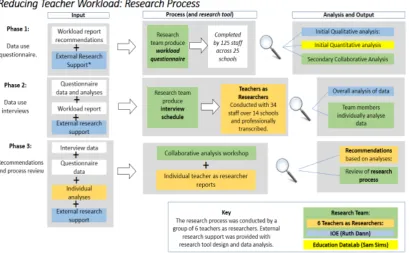
Research Phases
[image:6.595.92.502.315.568.2]The research project constituted three phases as outlined below
Figure 1: The research process
Analysis of Research Data
Phase One (Data Use questionnaire)
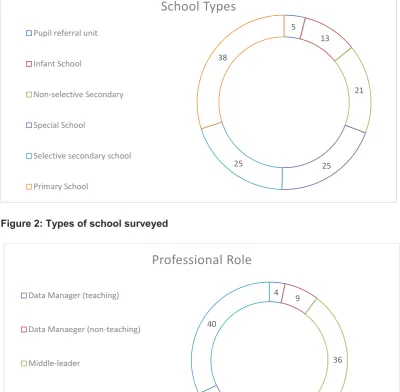
Figure 2: Types of school surveyed
Figure 3: Roles of respondees
Questionnaire Analysis: Key findings
• The frequency of reported engagement with data related tasks varied
considerably. However, the vast majority of respondents stated that the frequency with which they completed these tasks was ‘reasonable.’ (Figure 2)
• School leaders were more likely than teachers at the same school to state that the data management processes in their school were ‘extremely beneficial’ in relation to a range of criteria (Figure 3)
• Data management was not seen to be the biggest factor in relation to
respondents’ workload by most participants. Respondents stated that data played an important and useful role in relation to accountability, lesson planning and other work with pupils. However, there were a minority who stated that data tasks
5
13
21
25 25
38
School Types
Pupil referral unit Infant School
Non-selective Secondary Special School
Selective secondary school Primary School
4 9
36
36 40
Professional Role
Data Manager (teaching) Data Manaeger (non-teaching) Middle-leader
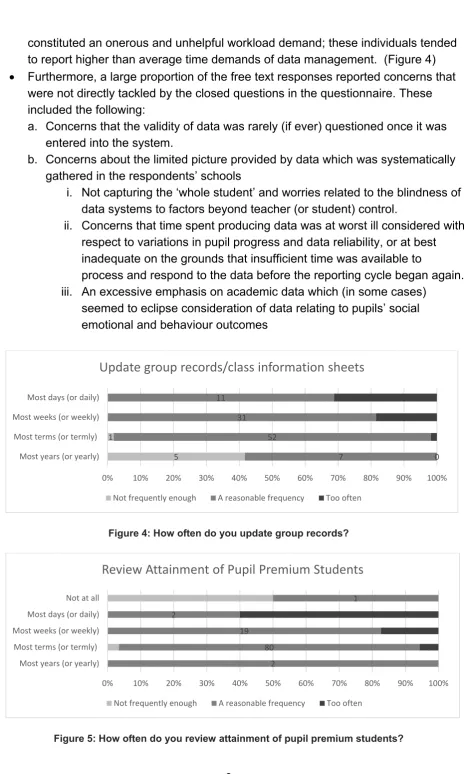
constituted an onerous and unhelpful workload demand; these individuals tended to report higher than average time demands of data management. (Figure 4) • Furthermore, a large proportion of the free text responses reported concerns that
were not directly tackled by the closed questions in the questionnaire. These included the following:
a. Concerns that the validity of data was rarely (if ever) questioned once it was entered into the system.
b. Concerns about the limited picture provided by data which was systematically gathered in the respondents’ schools
i. Not capturing the ‘whole student’ and worries related to the blindness of data systems to factors beyond teacher (or student) control.
ii. Concerns that time spent producing data was at worst ill considered with respect to variations in pupil progress and data reliability, or at best inadequate on the grounds that insufficient time was available to
process and respond to the data before the reporting cycle began again. iii. An excessive emphasis on academic data which (in some cases)
seemed to eclipse consideration of data relating to pupils’ social emotional and behaviour outcomes
[image:8.595.65.530.21.796.2]Figure 4: How often do you update group records?
Figure 5: How often do you review attainment of pupil premium students?
5 1 7 52 31 11 0 1 7 5
0% 10% 20% 30% 40% 50% 60% 70% 80% 90% 100% Most years (or yearly)
Most terms (or termly) Most weeks (or weekly)
Most days (or daily)
Update group records/class information sheets
Not frequently enough A reasonable frequency Too often
2 80 19 2 1 5 4 3
0% 10% 20% 30% 40% 50% 60% 70% 80% 90% 100% Most years (or yearly)
Most terms (or termly) Most weeks (or weekly)
Most days (or daily) Not at all
Review Attainment of Pupil Premium Students
Figure 6: How often do you record summative assessment data?
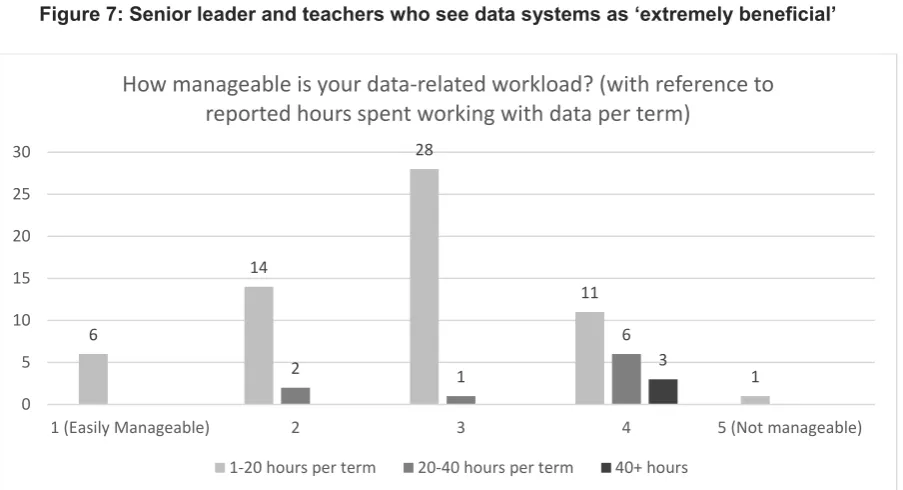
[image:9.595.63.531.76.740.2]Figure 7: Senior leader and teachers who see data systems as ‘extremely beneficial’
Figure 8: How manageable is your data-related workload
0 1 2 1 24 47 29 0 2 2 3
0% 10% 20% 30% 40% 50% 60% 70% 80% 90% 100% Most years (or yearly)
Most terms (or termly) Most weeks (or weekly)
Most days (or daily)
Record Summative Assessment Data
Not frequently enough A reasonable frequency Too often
43 39 25 24 22 20 18 17 55 65 41 47 27 33 37 30
0 10 20 30 40 50 60 70 Highlighting pupils who may require additional support
Providing a system for tracking all pupils Informing Feedback given to pupil
Encouraging consistency across a dept Informing Lesson Planning
Informing projections of future attainment Informing parents about their child’s attainment Informing the schools performance management system
The data systems in my school are 'extremely beneficial' for....
(percentages of each group)
Senior Leaders Teachers
6 14 28 11 1 2 1 6 3 0 5 10 15 20 25 30
1 (Easily Manageable) 2 3 4 5 (Not manageable)
How manageable is your data-related workload? (with reference to reported hours spent working with data per term)
[image:9.595.75.527.489.734.2]Phase Two (Interviews focused on data use)
The following summary draws on the collaborative synthesis of the thematic analysis (provided by the all members of the research team), the transcripts themselves and a recording of the data analysis workshop session. The primary research question was addressed directly and via three sub-questions.
How do teachers perceive the data management element of their workload?
1. In the main respondents did not see data related demands as the most prominent element of their workload. This response was generally justified in relation to time allocated to data management tasks. However, the majority of respondents voiced concerns about:
a. The purpose of data management tasks and/or
b. The validity of the data and related judgements made.
c. The role that statistical outcomes (not the analysis of the data as such) played as a partial, or complete, role in relation to their performance management reviews and pay increases.
2. A minority (6/34) of respondents described data management processes in their roles as excessively/unnecessarily time-intensive.
3. A proportion of respondents (6/34) identified concerns regarding their own capacity to interpret and manage statistical data.
What did teachers identify as positive aspects of data use in their context? Purpose of demands:
1. A large proportion of respondents referred to ways in which an increased emphasis upon data use helped them in their respective roles.
For example last year it was only sort of halfway through the year that I realised …about three really well-behaved, lovely girls, hadn’t actually made very much progress, and it made me really sit and reflect…Without collecting that data and analysing it in the way that I did those girls maybe would have slipped through the net. (Middle leader, primary school)
2. Respondents highlighted a number of ways in which data analysis helped make visible the specific aspects of learning and progress for which they were accountable. This included teachers, middle leaders and senior leaders but was more commonly expressed by those in leadership roles. Respondents tended to speak positively of the way in which data could reassure them (and others) by ‘showing progress.’
Data Process and resources:
a. Collaborative processes in which data points and descriptors were produced by staff themselves.
b. Support provided by data managers/designated teachers in processing data. In contrast, there were two schools where staff were expected to process data using pen and paper annotation despite the fact that a processed version already existed electronically.
c. Collective moderation time prior to (or concurrent with) data entry deadlines. d. Sufficient training relating to the purpose and significance of particular data
demands.
‘Maybe people need to be educated more in terms of why they’re collecting that data, and I think sometimes if you’re going through and doing things, a little bit like with your lesson planning or with your marking, for the sake of ticking a box of, ‘I’ve done it,’ then it will get very, very monotonous…as soon as you’re in that frame of mind then it can become overwhelming.’ (Teacher, primary school)
What did teachers identify as challenging or negative aspects of data use in their context?
Data Processes
1. Actively responding to (rather than actually entering) data through
teaching/interventions etc was seen as a significant challenge. Concerns were raised about the frequency of ‘data drops’ which highlighted pupils for ‘intervention’ who whose needs were not adequately addressed before the next cycle. In the absence of these direct responses there was no plausible means by which the analysis could impact teaching (and hence pupil progress) ahead of the next cycle.
2. Frustration was voiced in relation to changes to external assessment processes and criteria alongside wholesale changes to data management systems in their schools. In some instances, these local changes were seen as driven by external changes; in others, they were seen as additional to them.
3. Some responses reflected ‘gold-plating’ i.e. data being gathered just in case it might be needed in the future, (as mentioned in the workload report) though not by name. It was seen as placing as unnecessary drain on the finite resource of teacher time.
‘I could be supporting teaching and learning but instead I am…..not looking at what makes teaches better but I’m trying to draw a graph to prove that we’re a good school.’ (Senior Leader, Primary School)
to do this because I have to prove what I’m doing rather than just being able to get on with what I’m doing, if you see what I mean.’ (Classroom Teacher, Secondary School)
4. The data that teachers provided was often used in a range of ways. These included accountability measures; judgements about the quality of their teaching; the
monitoring of vulnerable individuals and groups and providing information useful to teaching and planning lessons. Respondents raised concerns about:
a. The validity of its use in relation to some of these purposes.
b. Conflict of interests – i.e. where performance development targets required a particular proportion of students to have made adequate progress as judged by the teacher in question.
c. Teachers’ own limited understanding of the data and how to analyse it.
d. Inadequate acknowledgement of the tentative and/or provisional nature of the data
‘If you make it overly complicated, or you try and drill too deep with it, you actually draw faulty conclusions...you lose half the staff who just switch off after a while. I think there is a risk with data.’ (Head teacher, secondary school)
‘From when I first started as an NQT to where I am now, the angst around data has become phenomenal. That’s how I feel - it has just become really phenomenal.’ (Teacher, Secondary School)
‘I think a lot of professionals are quite frightened by it [data management]… My world’s in metaphors, and data and boxes is challenging for me and I have to think really hard; it’s not my natural area of expertise. So, yeah, I think a lot of people need… I think it needs demystifying and simplifying for a lot of people.’(Senior leader, Secondary School)
Variation in responses relating to workload
As part of the analysis of the data, variations in responses – between schools, within schools and within the responses of individual staff – were examined.
Between schools
1. Staff reported varied approaches to most aspects of data management. Those likely to be linked to significant variation in relation to the time required to collect data include:
a. Number of reporting cycles – primarily between 3 and 6 for each class per year.
b. Type of data provided: numbers/grades, handwritten analyses, extended comments, class/group record sheets.
c. The work (and frequency of said work) associated with analysing the data i. Monitoring vulnerable groups
ii. Monitoring progress of a cohort or class.
d. There were differing views regarding who was expected to process data. Some senior leaders had the view that it was important for staff to gain ownership by analysing themselves. Some maintained that employing (or designating) a data manager/analyst saved time for the majority of staff and provided then with appropriate information.
Within Schools
Whilst responses were mainly positive, there were inconsistencies in relation to responses within specific schools
1. In two of the schools there were discrepancies regarding processes currently in place, particularly in relation to the frequency of ‘data drops’ and the work related to this task.
2. There were some discrepancies between teachers (and occasionally middle leaders) and senior leaders/headteachers in relation to the usefulness of data systems, echoing the differences highlighted in the questionnaire. In the main a. Leaders saw utility in the extent to which data systems allowed them to
identify and track pupil attainment - an end that, in respect of their remit and accountability, was seen as important.
b. Teachers saw limited utility in the extent to which data provided them with information additional to that which they already knew.
Both sides are expressed by one senior leader here (responding to a question about the usefulness of the school data management system)
‘As a leader it’s really good 'cause you can click on whatever you want and it will give you whatever you want, so it gives you really good reports, and if you want it summarised - the summaries are really good. As a teacher, it’s quite laborious and it has steps and statements, so the actual steps are difficult to… I don’t think they show progression particularly well, would be the best way to say it, I think. Useful for management roles if not the teacher.’ (Senior leader, primary school)
Personal tensions for individual respondents
1. Feelings of anxiety and/or validation in relation to what data ‘said’ clashed with concerns about the validity of data. Some respondents expressed anxiety that the data would reflect their efforts and efficacy as a teacher (or described positive feelings and reassurance when the data validated them) whilst also raising questions about the validity of the measure in question and expectations placed upon it.
in response to her own concerns that she might be ‘too lenient’ in her grading she had redoubled her emphasis on strict marking criteria.
3. In relation to the use of data to ‘close gaps’ there was a widespread acceptance of gap closing being important alongside frequent scepticism that the data recorded and analysed was suitable for informing teaching and learning.
School Culture
‘There’s just a massive focus on it, because data is like the evidence that you’re doing a good job, so you have to have it in your mind, you have to watch it, and if you don’t track your data, for all you know somebody’s fallen behind and it’s going to get you in trouble, you need to catch up, you need to make sure they’re achieving. Whereas I think before, in my first school, so four years ago, I remember tracking them but I can’t remember feeling so on edge when I looked at their scores probably.’ (Senior leader, primary school)
‘You can’t sit on your laptop and fill in the data whilst you’re teaching, so it obviously has to be before or after school, but then you have planning and resources to create and everything else, so it’s usually an evening job or a weekend job, so perhaps it feels like an extra thing to be doing. Maybe people begrudge it when it’s 8pm and they’re sitting doing data.’(Teacher, secondary school)
Whilst data tasks appear to place lesser demands upon teacher time than planning and marking, there were signs that they (and the culture around them) can have a
disproportionately high impact upon how teachers perceive their work. Furthermore, there is a risk that assessment data, once entered into the system, is uncritically accepted as valid and reliable. This issue can be further compounded when data for individual pupils is expected to progress in line with the aggregated trajectory for those with similar starting points.
It is important to ensure that gaps between what is expected of a data management system and what is realistically achievable and manageable for teachers are reduced wherever possible. Where the gap (as reported by interviewees) was greater,
interviewees were more likely to voice frustration in relation to data demands and their role as a teacher. It would be advisable for school leaders to consider the following questions regarding their data management processes and the culture around them. 1. How is the need to monitor learning from outside the classroom balanced against the
demands that this places upon the teachers to provide formal updates? What picture do you expect the data to present? Is this a statistically reasonable expectation? 2. Are particular data to be used as proof of good practice or as a resource for improving
practice?
3. Do staff feel confident in the methods and purpose of data management in your school? Do teachers and senior leaders have similar perceptions about the
usefulness of data management systems? If there are differences – are they due to limitations in how their purpose is communicated, a limitation in the process itself or merely the product of the different emphases of the job roles in question?
5. Is assessment data being used in a way that acknowledges their statistical limitations and their relatively narrow emphasis? What other data is available to help you
understand your students?
6. Are there processes in place whereby the validity of data (and expectations placed upon it) can be constructively reviewed?
7. Are there mechanisms in place for reviewing the reliability and utility of particular sets and uses of data?
Conclusion
The teacher as researchers group would recommend that schools conduct a data use audit as part of their ongoing monitoring of teacher workload. We would also make the following recommendations:
1. Data managers: Where possible ensure that a data manager is employed to complete data analysis processes and reduce demands placed upon multiple individuals where processes could be completed centrally and shared with relevant staff.
2. Training: Ensure that staff are trained fully in relation to data management processes and the statistical literacy required to interpret and use assessment data reasonably. 3. Streamline: If reporting cycles do not allow adequate time to identify and support
specific students before a process begins again then analytical work is unlikely to have an impact upon learning. Does more time need to be made available? Would lower frequency allow more meaningful follow up?
4. Encourage collaborative approaches to developing the finer detail of data
management and reporting systems. This can help encourage greater ownership by the collaborators as well as using their expertise to improve utility.
5. Challenge: Ensure that data is interpreted with appropriate caution. What
assessments are used to inform data entry? Do expectations of linear progress and/or performance management criteria have the potential to discourage accurate
reporting? Are concerns highlighted by data analysis reasonable? If so, how are they dealt with?
6. Audit: Regularly review culture around data use. If tasks are deemed a hindrance by teachers, consider whether they could be removed or whether their purpose and importance could be communicated more clearly.
Evaluation of research techniques and tools
The research process utilised three research tools that could be used by other groups of schools interested in reviewing and improving workload relating to data use. They are briefly outlined and reviewed below.
1. Workload questionnaire
This was relatively quick to administer and as completed electronically (using google forms) it was also quick to process. It did place demands (around 15 minutes) upon those asked to complete it, and required several hours in total developing the questions and reviewing responses. The data gathered provided a snapshot of practices and options across a range of schools. However, there was a discrepancy between verbal discussion of data management systems and the responses recorded electronically.
This provided greater scope to explore staff perceptions of data demands in their roles. The decision to record the interviews and transcribe them was integral to the
collaborative thematic analytical process – however it did increase cost. Interviewees were required to give up around 30 minutes of their time – though response rate suggests that they were happy to do so. Frank and considered responses may have been encouraged because the interviewers were fellow teachers from a school not directly linked to the interviewee’s. Developing the interview schedule, conducting the interviews and reviewing transcripts all placed considerable demands upon a small group of staff interested in carrying out research.
It may be possible to develop a lighter touch approach e.g. where a colleague (from another school) plays the role of ‘critical friend’ directly exploring the issue with a focus group including a range of staff.
3. Training teachers as researchers
© Crown copyright 2018
This publication (not including logos) is licensed under the terms of the Open
Government Licence v3.0 except where otherwise stated. Where we have identified any third party copyright information you will need to obtain permission from the copyright holders concerned.
To view this licence:
visit www.nationalarchives.gov.uk/doc/open-government-licence/version/3
email [email protected]
write to Information Policy Team, The National Archives, Kew, London, TW9 4DU About this publication: