by
David Whitley Dellinger
A thesis submitted as partial fulfillment of the requirements for the degree of Doctor of Philosophy at The Australian National University
Except where indicated otherwise, this thesis is the original work of the author.
I
IPREFACE
This dissertation is not intended as an exhaustive generative description of the structure of Akha,
'generating all and only the grammatical senten es' , but is a description of the grammatical facts of the
language so far ascertained. I do not disallow the probability that the rules given here will generate ungrammatical sentences; this grammar is not a rigidly
explici t sort of transformational grammar. Rather, I have sought to cou h my explanations in the framework of transformational theory, making i t as coherent and descriptively adequate as possible within the limitations of time and data, while attempting to emphasize
readability and usefulness to those who are interested primarily in the structure of Akha rather than
linguistic theory. To quote oam Chomsky (1965: 116), ' I t will be obvious to the reader that this
characterization is not intended as definitive in any sense'.
iv
substantial amount of Christian literature in the Akha language. There are available both Bible translations and Christian periodicals. One would naturally be
cautious of translations, though I understand that Paul Lewis wrote them via discussions and advisory meetings with a committee of Akha; thus, any deviations from native speech are probably minimal. The periodicals, I believe, were quite largely written by the Akha
themselves. Nevertheless, I have stuck to my texts alone since only for them am I certain of their provenience and completely cognizant of time, setting, social circumstances, personalities, etc.
My data is based on three stories and several conversations, the onversations constituting seventy-five per cent of my material. The conversations range over a good variety of topics such as funeral ceremonies, economics, sex, my linguistic research, cultural in- jokes (about the Thai people nd their own people) , and some everyday events. The stories con ern a Christian testimony, tiger hunting laws and a legendary Akha figure, Asaqsaq. I have not studied the stylistic differences between the stories and the conversations
and others. In particular, I have used Chomsky's Aspects of' the Theory of Syntax as my primary guide in
constructing the synta tic component, and Chomsky and Halle's The Sound Pa~tern of English as a similar guide for ~he phonological component. But deviations from the systems proposed therein have been employed. This
grammar presumes a rather thorough knowledge of
transformational grammar theory and of the onventions of writing rules in transformational grammar.
Explanations and discussions of these points are kept to a minimum and are reserved primarily for my
innovations.
In Aspe ts Chomsky has noted that only obligatory transformations are of interest linguistically. The optional ones are only stylistic and belong to a study of performance. In this sense, a descriptive grammar such as this one, whose primary aim is to reveal as much of the structure of a language as possible - in contrast to those whose primary aim is to study
variations, and uncommon ones as wel l . In this grammar, I describe a large number of optional
transformations .
vi
I have felt i t ad antageous to abandon the system of r omanization already in use among the missionaries. That system was a tually adapted from the Lahu alphabet originated by a missionary among the Lahu in China. The adaptati on was made for the very practical reason that most Akha men can speak Lahu, and many had already learned to read the Lahu Bible when work i n Akha first began. As mentioned above, there is quite a literature available in this romanization, and to that extent there is an argument f or sticking to the system.
But two easons can be offered for having worked out a new system. First of all, l i t t l e of the extant literature is available or known to s holar s, so its existence actually is not influential. But most important of all i s that the traditional r omanization ignores many systemi fa ts of Akha phonology and has, I beli eve, aused confusi n even for native Akha
speakers on some o .asions. The system was based on the assumption that Akha was monosyllabic, so every syllable is written separately. As a matter of fact, most nouns, many particles, some verbs, and some of
But i f the orthography were changed only to the extent of writing the syllables together, there would stil be inherent problems, because several sequences of vowels could be i nterpreted as either a digraph or a phoneme sequence. I n the old orthography, this ambiguity was partly avoided be ause the tone marks, written
individually af ter each syllable, unequivocally marked syllable boundaries for two of the tones. This s tyle seems a bit eccentri for two reasons. First, there is already a strong precedent among Western l i terary
languages for using dia r i t ics with.letters rather than independently . Second, i t is the usual linguistic
practi e to mark tones by using diacritics in conjunction with letters. Additionally, mid- tone
vowels (which are unmarked) would frequently have been ambiguous anyway, with a following contiguous vowel. To a oid this i t has been necessary to concoct new digraphs which would form unambiguous ombinations. Fortunately, Akha phonology is such that i t has been possible to create qui te a simple alphabet,
viii
vowel quality within the system, i t obvi ated having to mark glottalization independently. I have adopted three
symbols to mark these features - ' for l ow tone, ' for high t one, and ? for glottalization. These symbols have the disadvantage of not being on normal typerwiter
keyboards, but neither were the original four marks -V A
V ,
-My complete orthography is as follows, with romanization underlined, followed by my phonetic
symbol, followed by the IPA symbol.
! I
ix
When I wish to indicate that a particular consonant is unaspirated, I use after i t , e . g. ,
t ' . Some borrowings into the language have kept nasal endings or off- glides. To avoid ambiguity, I put an r before the endings - arm= a m , ~ = an, arng = aD, arw = aw , ~ = a/ .
In giving e amples f or the rules, the practice has been to give first the Akha (all Akha language material in the thesis is underlined), then underneath the Akha the meanings of major constituents, and finally a free translation. Some structural data is usually given in the Akha sentences, either by labelled brackets or by labels beneath the constituents. The intention has been to elimi nate as much labelling and glossing as possible to facilitate reading, while s t i l l leaving enough
information to understand how the examples are
exemplifying the rules. English glosses in the running text are placed in single quotes, e.g., haw 'cooked rice', while functional des riptions are not set off, e .g., mia
conveys emotion.
I want to express my deepest thanks to the
Australi an National University for the generous research scholarship that made possible this thesis. I also
X
my various colleagues for their stimulation and encouragement; Tom Dutton and Don Laycock who read part of this thesis and made helpful suggestions; Ted Hope who finally rescued me from my long-playing role as the 'Lone Ranger' in Southeast Asian linguistics by his arrival on the scene, and who offered many helpful ideas.
I must also express my appreciation to the Thai government, the Thai National Research Counci l and the Tribal Research Centre of Thailand for allowing me to undertake research in Thailand. And I could never
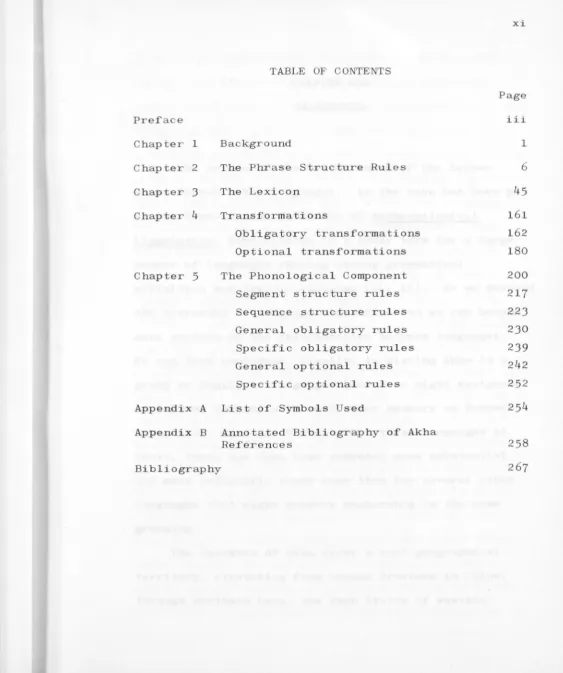
Preface Chapter 1 Chapter 2 Chapter 3
Chapter 4
Chapter
5
TABLE OF' CONTENTS
Background
The Phrase Structure Rules The Lexi on
Transformations
Obligatory transformations Optional transformations The Phonological Component Segment structure rules Sequence structure rules General obligatory rules Specific obligatory rules General optional rules Specific optional rules Appendix A List of' Symbols Used
Appendix B Annotated Bibliography of' Akha Ref'eren es
Bibliography
Page i i i
[image:11.610.29.592.42.714.2]CHAPTER ONE BACKGROUND
Akha is one of the better known of the lesser
known Sino-Tibetan languages. As the case has been put in the Sino-Tibetan fascicles of Anthropological
Linguistics, Sino-Tibetan is a cover term for a large number of languages showing strong grammatical
affinities and lexical cognates (AL: 11). As we descend the hierarchy of language classification we can become more certain of the relationships between languages. We can feel confident, finally, in placing Akha in a
group or family of languages (which we might designate as Lolo or Burman) with such other members as Burmese, Lahu, Atsi, Maru and Phunoi. For these languages at
least, there has been some somewhat more substantial and more scientific study done than for several other languages that might deserve membership in the same grouping.
I
2
Burma, down into northern Thailand. I t is doubtful whether any Akha have yet moved farther south than
Chiang Rai Province in Thailand, though they have
certainly settled below the Mae Kok, which has
previously been considered their southern limit (Young: l; Kickert: 1). But I also agree with Young that i t is highly unlikely that Akha have settled as far south as
Doi Suthep or Phrae as thought by Seidenfaden (1963:
120), because the Akha have come into Thailand only since the turn of the century, and have only been progressing south by slow leap-frog jumps.
There is no reliable census figure available for the Akha, just as is true of practically all the
minority ethnic groups dispersed through Southeast Asia.
Young (1966: 1) first thought there might be as many as 25,000 in Thailand but has since accepted the more
accurate count of the Bennington-Cornell survey (1964) of approximately 9,000. Lewis (1968b: 8) thinks there may be between J00,000 and half a million Akha in all.
Very l i t t l e has been published about the Akha. Even though the bibliography in Appendix B has around
sixty entries, the amount of information is extremely
J
Akha. A good number of them just excerpt material from some of the other sources. Some of the reports
apparently accept hearsay stories, and a lot of the 'facts' are questionable. Little of the reporting has been done by trained ethnographers or linguists. The most useful accounts are those by Bernatzik, Telford, and Roux and Tran
(1954).
Until .the last two years, the only linguistic material generally available had been collected by colonial administrators and adventurers, and only Roux's can be considered reasonably reliable.Paul Lewis was the first person with linguistic training to begin any studies at length in the Akha language. Unfortunately, his goals are translation, and he has had l i t t l e time for any extensive linguistic analysis or for publishing the material he has
gathered. Now he has rectified this by publishing an Akha-English Dictionary and a sketch of Akha phonology. Peter Wyss has also done some linguistic analysis of Akha, but again, his duties with literacy work among
the Akha have prevBnted any studies in depth. A description of Akha phonology by him is forthcoming.
academia is slowly losing access to these minority ethnic
and linguistic groups. Thailand is the only remaining
country where the Akha can be contacted, and the area of Thailand where the Akha are is already at the time of writing coming under pressure from dissident political
elements. There is no way of predicting how much longer
researchers will be able to reach the Akha.
The material for this thesis was gathered during
two field trips to Chiang Rai Province, in noFthern
Thailand. On the first, very short trip, I lived in the
Akha village of Lawlo, known to the Thai and the world
at large by the Thai name Saencai. On the second trip I
lived in Amphur Myang, Chiang Rai, and worked partly by trips to the field and partly by bringing informants to
work in Chiang Rai. I have collected both conversation
and stories, though most of my analysis is based on the
conversational texts.
quite varied.
The topics of discussion are
There are many topical areas in which I have hardly
ventured, and which remain as richly interesting topics
of research. Folklore (legends, proverbs); the language
and vocabulary of religion, the chants and prayers,
instructions for the children; technological vocabulary
5
want f r attention. Paul Lewis and Friedholm S holtz
have both worked in these areas, but to my knowledge
none of the results of their resear h i s a ailable in
published form. The language of songs would probably be
rewarding, too, for I believe much of the vocabulary of
songs may be archai
Finally, a definitive study of dialects cries for
attention. This parti ular problem will undoubtedly
remain as long as linguistics are cut off from the Akha
in Burma, and espe ially those in southern China. But
some strides forward could be made just by detailed
analysis of the situation in Thailand, and of the
provenience of the present Akha population in that
CHAPTER TWO
THE PHRASE STRUCTURER LES
In a transformational grammar (TG), there are three components - the syntactic component, the phonological component, and the semantic component. The phonological and semantic components are considered to be merely
interpretative, i.e., they do not make contributions to the meaningful structure of the language. They
interpret the product of the syntactic component. The semantic component interprets the product as its meaning based on the semantic and syntactic characteristics of
each lexical item, and on the grammatical relationships expressed in a sentence. The phonological component interprets a sentence as sound segments, based on the phonetic classificatory markings of each morpheme, and
the phonological rules of the language.
In this grammar of Akha, we will not be concerned with the semantic component at all, Attention will be focused solely on the syntactic and phonological
7
parts, the base component and the transformational
component. I t is the base component which actually
specifies the meaningful structure of the language; the
transformations (T rules) only make non-meaningful
The base changes in the order and shape of constituents.
component itself has two parts, the categorial
subcomponent and the lexicon. The categorial
subcomponent is the set of rules (phrase structure [PS]
rules) that derives the meaningful sentence structures.
The lexicon is merely a listing of the morphemes of the
language (Chomsky,
1965:
141). Attention will befocussed first on the PS rules.
The PS rules are an ordered set of rules which can characterize all the uniquely meaningful structures in
the language. I t is left to the T rules to describe
various differing structures which have the same function
as those given in the phrase structure rules. Even more
strictly speaking, only the PS rules can specify
meaningful grammatical relations and morphemes. The descriptions provided by the PS rules, i.e. , the
descriptions of the grammatical relationships of the
language, are called the deep structure of the language. The T rules then apply to order the constituents,
yielding a surface structure which provides no
In beginning a description of the grammar of a
language, the existence of sentences as the fundamental
building-block of discourse is assumed. Discourse is
constructed from one or more sentences; and sentences
can be analyzed into smaller components - lexical and
grammatical morphemes.
symbolized as:
This presumed entity is
#S#
S i s Sentence; # is a juncture marki ng the bounds of the
sentence. This juncture is a grammatical element, not
phonological (Chomsky, Halle and Lukoff,
1956: 67).
Though i t does frequently coincide with phonological
juncture, this is not necessarily so.
(PSl) s --+ #S# (Conj+ #S#)*
Norn (Neg)
Conj is Conjunction; Norn is Nominative; Neg is egative;
PP is Predicate Phrase; Q is Question; Imp is Imperative.
* indicates that the parenthesized element can be
repeated an infinite number of times.
This first rule provides two options for rewriting.
The first option of this rule is a rule for coordination,
succeeding S i s conjoined to the preceding one(s) by a
. t ' 1
conJunc ion. I t should be noted that Schane's study
does not cover all constructions involving conjoined
elements, but is restricted solely to those 'where a
single sentence containing two (or more) conjoined
constituents allows for a paraphrase of two (or more) separate sentences which are identical in every
respect except for the conjoinable members'. (Schane, 9
1966:
J).
For example, the study excludes sentences of' the type 'John and Bill played tennis together' whichcannot be paraphrased as a conjunction of' the two
constituents:
la) *John played tennis together. lb) *Bill played tennis together.
1
Schane suggested that there is a universal principle by which conjoined sentences are reducible to a single
sentence. He states, 'Two (or more) sentences can be
conjoined into a single sentence if' their total tree
structure is identical except for the structure dominated by one grammatical node; this node must be a major
~rammatical category which is not also a lexical category
LChomsky, 1965:
74
]
1 (Schane, 1966: 39); thenon-identical structures 'must exhibit at least one difference . . . within the same lexical category'. (p.39). A
transformation then deletes the identical part of one sentence leaving the identical part of' the other plus the conjoined constituents. For any language, there
The rules for conjunction in this paper are not intended as a rigorous study of this phenomenon in Akha. They only attempt to show that there are such conjoining
operations, and that the conjoined constructions can be related by various rules and transformations to other constructions. For the purposes of this grammar, i t can be assumed that such constructions as la) and lb) depend on subcategorial features of the formative 'together'; that after we have selected the conjoining option and have reduced the conjoined sentences to a single sentence with conjoined elements, we can select 'together' because i t is specified plus for the syntactic feature of 'plural or compound subjects'.
Some examples of coordinate constructions follow (the asterisks indicate hypothetical source sentences not actually occurring in my data). For an explanation of the functions of the different conjunctions see
L9
in the lexicon.2)
Conjoined Norn:
SD: *PP[Nom[ tow amya ~ ] VP[~ m:ia]] that Amya
I miss that Amya.
miss
Nom[nga ~ ]
J)
11
*PP[Norn[hujer jamaw ma?~] VP[~ rn1a]] that guy Jarnaw miss Norn[ nga ~ ]
I
I miss that guy Jarnaw.
SC: PP[tow arnya ~ Conj[hawow] hujer jarnaw ma?~ ~ ml.a] Norn[ nga ~ ]
I miss that Arnya and that guy Jamaw.
Conjoined S:
SD: * om[ dza ~ shl.] VP[ ta? kaw? mi.a] eat and die is the same To eat and die is the same.
*Norn[ ma dza shl.] VP[ ta? kaw? m1a] not eat and die is the same To not eat and die is the same.
SC: Nom[dza
~
shl. Conj[hawow] ma dza sh1] VP[ta? kaw? mia]Eating and dying, or not eating and dying, i t ' s all the same.
perfectly good sentence. There is really no problem in
accepting the Akha, either.
4)
Concatenated (conjoined) V:
SD:
SC:
*Nom[yawghana?u?] PP[Nom[na?caw?i yawna7 ter?er]
everybody black (things) only
V[ dmq maw?] Pgen[ ow nga]]
wear-want
Everybody wants to wear only black.
*Nom[yawghana?u?] PP[V[_~-~g.J Pgen[~ nga]]
everybody
Everybody walks.
Nom[yawghana?u?]
everybody
walks
PP[Nom[na?caw?i yawna? ter?er]
black (things) only
Pgen[~ nga]]
v[
dmq maw?J v[~J
wear-want walk
Everybody wants to wear only black to go.
This .sort of construction is an interesting
characteristic of Tibeto-Burman languages, viz., the
concatenation of two or more verbs, each functioning as,
and retaining the meaning of, a full-fledged verb. In
English, these expressions normally must be translated
infinitives, or expressions with participles. I t is
necessary to distinguish between strings of V, and
plus auxiliaries and secondary verbs (see PS7;
L
4
andL5
in the lexicon).lJ
Another sort of coordinate construction, containing
a reciprocal notion, is illustrated in the following
sentence.
5)
Nom[merja Conj[hawow] how~] Adv[adzer]Mae Chan
VP[ma
E
dzow]and here more
exchanging, doesn't exceed
Mae Chan and here don't exchange (pay) more than
each other.
Here, the coordinate construction introduces the
reciprocal notion 1each other'. The exact translation
remains somewhat ambiguous, but the Akha sentence
apparently expresses this comparative reciprocal idea.
Still another kind of coordi nate construction
involves sums. I f we have the following two sentences:
6a) The cow cost ~1000.
and want to give the total cost of the two, we can not state the two sums separately, as in 7a). We have to 7a) *The cow and calf cost ~1000 and ~500.
7b) The cow and calf cost ~1500.
give a total as in 7b). In Akha we postulate the two source sentences:
b) SD: *Nom[nyo ~ ] PP[Nom[ti pa]
cow (~)1000
VP[do? ~ nga
J.£]
J
cost (come out to be) The cow cost ~1000.
*Norn[ nyo
tl]
PP[ Norn[ nga ~ ] VP[ do? le nga ~ ] ]calf (~)500 cost
The calf cost ~500.
SC: Nom[nyo ma Conj[hawow] nyo
tl]
PP[Nom[ti pa nga ~ ] VP[ do? le nga ~ ] ]The cow and calf cost ~1500.
In 4) the concatenation of V was discussed as a type of conjoining. Possibly there is another aspect to the problem of V concatenation, viz., rank of
ordering of the V constituents in the string. Certainly
.
15
secondary verbs and the various categories of particles. One possibility would be to further categorize such items by means of PS rules, so that instead of having one category, e.g. , Pgen, one would have a string of categories, e.g., Pgen - (Pg1) (Pg2) . . . (Pgn). Somehow
this solution of establishing multiple categories seems
unsatisfactory because within each category, all the
members occur in the same environments with respect to
other lexical categories. I t is only when more than one of a category is present that i t is necessary to specify
further, viz., their preferential ordering among themselves. This can be coped with in terms of
selectional features by specifying each member with a
specifi rank in the hierarchy of ordering. Further
discussion of this problem can be found under
L6
andTlJ.
In the second option of PSl there are given the
categories for generating the traditional basic
sentence types. A declarative sentence would be
further dichotomy of each of the other three types of sentences is obtained.
Declarative sentences:
9)
Norn[abyer] PP[~ le mer]Abyer go back
Abyer has gone.
10) Norn[ a.yaw?] PP[le haw mer]
he go ever
He does go.
Interrogative sentences:
11) Norn[abyer] PP[~ 1e
~J
Q[1a]Abyer go back ?
Has Abyer gone?
12) Norn[ a.yaw?] PP[le haw mer] Q[ 1a]
he go ever ?
Does he ever go?
Imperative sentences:
lJ) Adv[rna uw ni] Adv[yawrnuwpaer] VP[rner ner] Irnp[aw]
in order not
to laugh
well teach
14) PP[nger] Imp[aw] speak
Speakt
Negative sentences:
15) Nom[abyer] Neg[ma]
Abyer not
PP[~ 1~ asl] go back yet Abyer hasn' t gone yet.
16) Nom[naw] Neg[ ma] PP[~ nyanya]
Q[
lo]you not know ?
Don't you know?
17
17) Adv[nga lo?er] Nom[guwgho?] Neg, Imp[ta] V[~]
my fashion fine don't pay
Don't pay a fine like I did.
(PS2) PP - (Tm) (Loe) VP
Tm is Time; Loe is Location; and VP is Verb Phrase. Tm usually occurs sentence-initially. The obligatory
transformation Tll shifts i t from sentence-medial to initial position. Loe occurs sentence-medially, and is normally marked by a series of locational markers
Sentences with Tm:
18) Tm[~] Nom[xew gha] VP[ajer ~ ~]
then he what do
Then what did he do?
19)
T m [ ~ ~ ] Loc[xew ba mersui ~ ] VP[paw kow? mer ter]now there Mae Saruai move-arrive
Now he has moved over there to Mae Saruai.
Sentences with Loe:
20) Nom[amya] Loc[jeha ~ ] Neg[ma] VP[i haw~]
Amya Chiang Rai not go ever
Amya has never been to Chiang Rai.
21) Loc[l okaw gama ~ ] Loc[lawkaq
car road spirit gate above
Nom[api] VP[jaw ~ ~ ]
Api be-stay
Api was waiting in the road above the spirit gate.
(PSJ) ( Pgen)
Adv is Adverb; Vb i s Verbal; Comp is Complement; Pgen is
General Particle; jV is a class of verbs similar in
19
makes a distinction between verbs with semantic content
(those which will derive from Vb) and the two members of the jV class which have no semantic content and perform
only a grammatical linking function between their
complements and their subject Norn.
The two members of the jV class are ja? and jaw
which have homophonous forms that derive from Vb. I am
not quite sure about ja? belonging in this class; jaw
may be the sole member. There is only one instance of ja? in a context that might be interpreted as a jV
function.
22) Vb[Loc[dawdaq paw] Nom[t:t jer] VP[new ~ ] ]
butt
jV[ ja?]
direction
Caus[m:ier]
there is; have because
one kind think
Because she's sexually excited (because she thinks
about the lower part) . . .
The structural analysis of this sentence is not clear,
Tentatively i t has been assumed that the segment labelled Vb is an idiom and functions as a Vb. If this is not
justified, or i f ja? is not actually a jV, then PSJ will
Additional examples of jV will be given under the
expansion of Comp.
Adv --+ Passive Ben
Inst
Ace Man Pur
Dur Caus Cond
Passive is an option that requires the obligatory application of the passive transformation; Ben is
Benefactive; Inst is I nstrumental; Ace is Accompaniment; Man is Manner; Pur is Purpose; Dur is Duration; Caus is Cause; ond is Conditional.
The options provided by this rule are due further extensive investigation. I t is doubtful whether they
are properly all to be introduced by the same symbol, or whether they are all to be introduced at the same level
in the grammar. There certainly seems to be some
differences between the semantic nature and transformational
21
is insufficient data to complete an analysis of all the constituents of this rule, so the rule is adopted as i t is, primarily to account for their occurrence in the language.
This approach to the description of adverbials is similar to McKay's Alternative 2 (1968:47) which he
. t 1
reJec s . This approach has difficulties, but then so does his Alternative 1 which is based on subcategorizing prepositions in terms of noun features, in lieu of
creating additional categories such as Pur, Caus, etc.
His Alternative 1 has the serious defect of violating the constraint on local transformations that relevant contexts are restricted to those of the immediately dominating node.
For further discussion and expansion of these
constituents, see TJ (passive); PS22 (Ben); PS19 (Inst); PS21 (Ace); PS5 (Man); PS2J (Pur); PS25 (Dur); PS24
(Caus); PS26 (Cond).
(PS5)
- {ManPl
ManwJMan
1
ManP is Manner Phrase; ManW is Manner Word. An
enumeration of the ManW can be found under Ll2. ManP is expanded at PS15. The following sentences are offered by way of comparison between the two
constituents derived above.
2J) Nom[abaw laqga] PP[ManW[mamai] VP[dza mer lo]] grandfather Laqga truly eats
Grandfather Laqga actually eats it.
24) PP[ManP[ c:i .. cu ni] VP[ jaw]] Norn[ naw ma?]
quietly be you
Be quiet (be there quietly)!
(PS6) Comp
Vstat is Stative Verb.
This rule specifies the types of complements that occur with jV. I t is interesting that the verbal
constituents that occur as complements are not just stative verbs (verb adjectives), but include other intransitives and the transitive verbs as well. ~.·- ~
25) S[Tm[anyo? ser?
~
.E.
2J
PP[na to]PP[Dur[ti cew la?xew] Comp[ b[toto]] jV[jaw]
in a long time
Pgen[nga ~ ~]
cal l be
When the buffalo was killed they called the
spirits; they called for a long time.
26) Adv[Neg[ma] Vstat[sa] V[jaw] Ptm[nger]
not happy be when
Pgen[xawi]] even
Even when you're not happy ...
(PS7) Vb - (Aux) VR (SecV) (Pverb)
2J
Aux is Auxiliary; VR is Verbic; SecV is Secondary Verb;
Pverb is Verb Particle.
Aux is a class of verbal elements that precedes and
modifies the verb nucleus. Except for two members, these
elements do not have homophonous forms which are V. This
is in contradistinction to SecV which do have homophonous
forms which are V. SecV, then, are bound forms which
occur post-verbally, modify the verb nucleus (v) and have homophonous forms which are V. Pverb also modify
This way of distinguishing between SecV and Pverb reflects a difference in nature which is important. Just from the definition as given i t might appear that
the distinction between the two is ontrived, but in fact the differen e between Pverb and SecV is generally more discernible than that between SecV and V. This is easily understandable from the fact that SecV are said
to have homophonous V 'cousins'. In fact , in the related situation in Lahu, Matisoff
(1967)
classifies SecV (his term, versatile verbs) as a subclass of verbs.The problem is that within the formal restrictions of TG, i t is not possible to show how a morpheme (which necessarily belongs to only one lexical category) can have two grammatical functions when its meaning, though retaining an apparent semantic relationship in both
cases, changes somewhat. In specific terms, a SecV (or Vin a subordinate, modifying function) generally does
not mean precisely the same as a homophonous verb nucleus. I f a separate lexical category is set up to account for
this modifying fun tion then the ability to relate the members of the SecV lass to their homophonous 'cousins'
25
function because such a feature would have to refer to contextual elements outside the purview of a local transformation.1
For lack of a completely satisfactory solution, a distinct category of Sec will be adopted as a means of at least accounting for this function. Since Aux, SecV and Pverb are extensively exemplified in the lexicon
(L5,
L4
andL7
respectively), no further comments will be made here.(PSS) VR
{
Norn + ~ } )V (Red)
S + ler Red is Reduplication; is I
erb; ~ is a marker which sometimes marks the direct object (first Norn to the left of Vin VR) and sometimes the indirect object (second Norn to the left of Vin VR), but not both (see T8 for a n d ~ deletion transformation); ler is a clause marker which marks an embedded Sas the object of some verb,
e, g., er I Say1 ,
Objects of the verb nucleus:
1
Since the time of writing i t has been learned that a notation has been introdu ed f or referring to the
immediately dominating node. This will eliminate many of the problems discussed here. Unfortunately, a source reference is not available for the origin of this
27) Nom[ada] PP[Nom[yapi] V[daw]] father opium smoke Father smokes opium.
28) PP[Nom[xew maw] Nom[adi ma? ka ~ ] V[~
E.£2
ner ] that animalPgen[~ ~ ] ]1
to our village also sold
He also sold that animal to our village.
Object clause:
29)
PP[Nom[S[Nom[nmqsi a ti kilo] Nom[ ti ba? ngatse]] one kilo of sesameler] V[er] Pgen[~
~
le] ] Tm[u?sew]say just now
Just now, she said one kilo of sesame is ~1.50. One of the grammatical features common perhaps to all Sino-Tibetan l anguages is reduplication of morphemes, especially of verbs, to express different semantic
features, for instance i ntensification and progressive action. Since reduplication does carry a semantic load and is more than just a phonological phenomenon, i t is
1 The order of obje ts is reversed in this sentence from
27
necessary that this feature be introduced somehow into the base component where all the meaningful features of
1
the language must be accounted f or. For this purpose, Red is introduced as a constituen~ of VR, and is
optionally chosen f or each of its occurrences.
Syntactic reduplicati n, as thus introduced in the PS rules, is not ever obligatory.
There is the question, that i f this same phonological phenomenon can express more than one semantic feature, how are these features to be distinguished in the grammar? Can all the meanings be derived from the single category Red, or do we need more than one Red, perhaps one for
each meaning? No solutions are proposed in this thesis; consequently, the constituent Red as written in the PS rules of this grammar is used primarily as a
representation of the fact of reduplication, and of the approximate level at which i t would have to be introduced into the grammar in any case.
In Akha, reduplication has at least the meaningful features of intensification, repetition and progression.
1
Intensification~
JO) Nom[ayaw? tl gha ter?er] PP[Adv[nymq gawgawgaw er] he one person only extremely melancholy VP[jaw ~ ]]
is
He is all alone extremely melancholy.
Jl) Nom[tsawha mya.m~] PP[~
_E!
nga?e]many, many people probably come, hunh? Many, many people will probably come, hunh?
Progression:
J2) Adv[ aj:i nya?
~
nger ~ ] VP[ jaw dzaqdzaq~
~ ] when we came collecting assessment When we came, they were collecting the assessment. JJ) Nom[cerpyu] Loc[berjer?] Adv[dermyaqmyaq ~ ]rice side sticking on
VP[tsaw? mer ter] stab
Sticking the rice on its side, they stabbed it.
Repeti tiom
J4) Loc[tow ~ ] Adv[nahanaha ~ ] VP[bo? gher
~
nga.£,]
there listening (over and write downover again)
There are two other kinds of redupli ation that need to be mentioned. One is a kind ~hat seems to be
inherent in a lexical en~FY, e.g., nowlaqlaq 'day of abstinence' , myamyai 'usually'. Though there is probably a historical source involving meaningful
reduplication for su h items, such wo ds have now become fixed and the redup ication is unmeaningful.
29
The other kind of reduplication is phrasal. For example, t l hmq t l hmq I a piece Cl t a time I j mer
E.£2
mer ~'teach and teach( ?) ' . Here again, since the reduplication is obviously meaningful, i t must be
handled in the baser les. Quite p ssibly i t can be handled under the schema for coordination, but its relation to other types of coordination has not yet been studied, nor what sort of rules would be required
to derive i t.
This discussion of reduplication has dealt with verb reduplication only, but i t should be noted that nouns are also subject to reduplication. The specific function of such redup ication is as yet undetermined because so few oc u ren es ha e been recorded, e .g.,
(PS9) Norn ... {
xa +
sl
NmlJ
Nml is Nominal; xa is a verb nominalizer.
The first option - xa + S - is a bit troublesome. The xa is an anomalous particle which defies treatment
as part of any other pattern. I t would be nice to be able to class i t with Aux, and in some respects i t patterns the same way. I t precedes the
V;
i t modifiesthe
V;
i t succeeds subject om and Tm. Clauses inwhich i t occurs function in such normal modes as object clauses and noun modifier clauses. But xa appears to be mutually exclusive with manner adverbials and all Aux. And whereas the Aux typically convey aspectual and modal ideas, xa seems to have a meaning best translated in English as 'that which, those'. Finally, (apparently) by virtue of the presence of xa in a clause, the clause
can function as a Norn in an equative type sentence. The amendment 'apparently' is added because there are
cases of clauses acting as om without benefit of xa, but these cases are never in equative sentences.
35)
Nom[Pass[adi nya? ~ ] xa P[mer ~ ] ] by us that which is teach VP[saqbo? bo? ner law ter]write down
31
36) Nom[Nom[nabaw] xa , VP[tso? ow] Nom[.Ji:!]]
ears those who have persons
PP[yawmuw naha de]
well listen
Those who have ears listen well.
The following sentence is especially interesting
because of its similarity to another.
37)
Nom[S[~ ma? xa.fug_
]
N[myaw]] Neg[ ta]as:
that which you do
VP[~ law yaw]
make offering again!
thing don't
That offering which you make don't do anymore!
This same general construction, minus xa, occurs
38) Nom[S[naw ma?
_fug ~ ]
N[myaw]] Norn[ tow a.pew]you do thing that ancestor
Neg[ ta] VP[~ law yaw]
don't make offering again!
That which you do, don't make offerings to
ancestors anymore.
In 38) we have just a 'relative clause' modifying
The complete nuances of the two constructions are not known, but i t appears they are distinguishable in this
sense: in 37) the clause would be strictly interpreted as 'the that-which-you-do thing' ; in
38)
i t would be'the you-do thing' .
I have interpreted the following sentence as an equative construction.
39) Nom[nga xa caq ~ ] Nom[gama t l kaq] that which I walk one road
That which I walk is one road (I live by only one creed).
The second option - Nml - expands in PSlO as a more universal type of nominal construction, a construction having a noun as head.
(PSlO) Nml _, ( S ) NP ( P gen) NP is Noun Phrase.
The S gives us the basis for embedding clauses to modify N, and, subsequently, by application of
transformations, a construction translatable in English as adjective+ noun. The embedded S provides, in
complements; Akha does not ha e su h a dichotomy in
derivation.
40)
41)
Nom[S[cerlaw daq ~ ] N[xmqrna]] VP[ci aw]
rice offering is there cup l i f t
He lifted the cup ith the rice offering ...
Nom[S[nmqsi ~
i
E_
]
[ tsawha]] Vstat[yawmyagoing to sell sesame people
xawi ]
so many
So many people who are going to sell sesame . . .
(PSll) NP _. N (Det) (Pnoun)
N is Noun; Det is Determiner; Pnoun is Noun Particle. Nouns can be modified by a following determiner,
such as a quantifying expression or a demonstrative
JJ
( see PS12, lJ) . If there are parti .les, they succeed
the determiners as indicated in the rule. However, i t
is in fact suspect from my data whether an NP having a
Det can also have particles. In the first place, the
data has very few instances of Det occurring with an N,
so instances of all three constituents occurring
together is even rarer. Det alone filling the function
of a Norn is common though. irtually the only occurrences
instances when Det is functioning as om without an N nucleus. Example 42) below is one of the Very few
exceptions, and even here the function seems to be more qualifying than quantifying, i.e., to be translated 'he
alone' rather than 'he one man', which might indicate
that the Det in this instance has a different source
than a quantifying Det.
42) Loc[xew ~ ]
NP[ N[ a.yaw?]
Det[ti gha] Pnoun[ter?er]]there he one person only
VP[jaw ~ ] live
He is living there alone.
43) Nom[N[ayuw?anyi dow] Pnoun[2_]] Tm[~]
brothers and sisters addressive now Norn[ nga] PP[ aka Y.§; gow? ow ma de]
I dress as (be) an Akha
Brothers and sisters, now I'm an Akha.
(PS12) Det - Dlmt + Clf
The classifiers of Akha will be subcategorized in the lexicon (L2) in terms of complex symbols. The
traditional method of subcategorizing classifiers in Sino-Tibetan languages is to list them, giving an
of objects they classify, and hen to describe their various syntactic functions.
will be used in this grammar.
Mu h the same approach lf are s trictly
35
subcategorized - all their syntactic contexts are given - by PS12. Al though Dlmt is further expanded by rule 13, the constituents of that expansion are not essential to the subcategorization of Clf, since any classifier can take either of the constituents of Dlmt.
Examples of Dlmt + Clf: how~
how tu
'here' 'here' tse ba? 'ten baht'
,
maw 'two animals'
( how ' this' + ~ ( how 'this' + tu
'place'
'place'
<
tse ' ten' + ba? 'baht' 'two' + maw 'animal' , tow gha 'that person'<
tow ' that' + gha 'person'(PS13) Dlmt
Dem is Demonstrative; Num is Number.
There are only two lexical categories that can precede Clf to form a Dlmt, either a Dem such as how
'this', xew 'that yonder' , or a Num such as tl 'one', tse 'ten', t i ~ 'one hundred' , nyl pa 'two thousand' Dem is a closed class of very limited membership (see
number of members (see LlO), but its membe s f orm
compounds with ea h other in an infinite number of combinations.
PS1J is actually a departure from the practice of describing only the constr ctions in the data. There is no Dem+ Num expression in the data; the rule
amounts to a hypothesis that there is such in Akha and that i t would have this form. The hypothesis is based on similar forms in closely related languages such as L1su. . 1
The use of ti 'one' with a classifier is common as an indicator of definite reference, i e., 'the man' as opposed to a general reference when a Det is absent, i.e., 'a man; some men; man'.
44)
1
Definite referen e.
VP[ghaw sa mia] pity
Nom[N[~J
children I pity those children.
Det[ti dow] Pgen[~]] one group
37
General reference:
45)
Cond[Nom[~J VP[jaw ~ ] ] VP[ajo? er new tser? ~ ]children there are how to decide
How do you decide, when there are children?
(PS14) Loe _, ml + Ploc
Clf
Ploc is Locative Particle.
Examples of some locative expressions are given
below:
46)
Nom[utsewutsew ~ ] Loc[Dem[~] Clf[~]]even coughing that place
V P [ ~ ~ ]
there is
There is even coughing there .
47)
Loc[N[~ mltsa] Clf[paw]] V P [ ~ ~ ~ ]Burma direction take-go
He's taking i t toward Burma.
48)
Loc[Nml[mitsa] Ploc[xewta?]] VP[jaw ~ ]earth
He is on Earth.
(PS15) ManP - V + ni
,
er
Aside from the manner words which are listed in
the lexicon under Ll2, other manner type adverbials are derived from verbs plus certain particles.
49)
ManP[V[sa?daw] ni] Neg[ma] VP[~ pyow?!
aw]shy not know-become
She has become unknowing of shyness (she has lost
her shyness).
50) Nom[yapayai ti gha] PP[ManP[V[lo?lo?] er] Yapayai one person watch
VP[jaw
E ~ ]
is there-stay
Yapayai was waiting there watching.
51 ManP[Vstat[yawkaw] er] VP[cer? aw] Nom[byer
!]
fast flee Abyer
Get out of here fast Abyer!
(PS16) Tm
-
{TmP}
TmW
TmP is Time Phrase; TmW is Time Word.
(PS17) TmP - S + Ptm Ptm is Time Particle.
Ptm are subcategorized under Ll6. Given below are examples of some time expressions .
52)
TmW[inaq] PP[du paql_ ~ ]
today going to bury
Today they are going to bury her.
SJ)
TmW[~] Nom[xew gha] PP[ajer ~.§;]
then he do what
Then what did he do?
54)
TmP[ S[ er ~l_]
Ptm[ na]] Norn[ a.caw]go tell when other
PP[sada ~ bl? le? nga]
must come give money
39
When you go tell them, the others must come give
you money.
(PS18) Vstat + V
The subclass of verbs which are strictly
subcategorized as [+yaw~-] are stative verbs, i.e., verbs usually translated in English by adjectives. The grammatical morpheme yaw is obligatory when Vstat are
with this subclass of verbs when Vstat function as a verb nucleus. This particular construction is the
result of a deletion transformation (T21) which deletes jV ( see PS J , 6 ) .
55)
Nom[api bye?smq guwlaq] PP[Vstat[yawhuw] Pgen[nga]] Grandmother Bye?smq's merit greatGrandmother Bye?smq's merit is great.
56)
Nom[N[tsawha] Vstat[yawmya] Pgen[xawi]]person many even
anything can't do
Even with so many people you can't do anything.'
(PS19) Inst _, NP {
aqner} ner InstP
aqner and ner are the instrumental particles used with NP; InstP is Instrumental Phrase.
The distribution of aqner with NP is limited to expressions with money and vehicles.
(PS20) I ns tP _, S + , awner
41
57)
Inst[NP[lo] aqner] VP[1 ~]car by
I'm going by car.
go
58)
Nom[how ~] PP[Inst[NP[nyitse ba?] aqner] VP[~~]59)
this ~20 for sell
This sells for ~20.
InstP[Nom[~ ma?] PP[V[fr!9.]] ,
awner PP[Inst[N[akuw
dog
you use by
aya? si] ~ ]]] Nom[tsawha
~ ~
iba] Neg[ma]pig blood with
VP[c:l. saw nya]
wash clean
sins of man not
You can't, by using blood of dogs and pigs, wash
away the sins of man.
(PS21) Ace - NP + ner
The followi ng sentences illustrate the accompaniment
adverbial:
60) PP[Acc[NP[naw] ~ ] ] Nom[asugha] PP[VP[1 ~]]
you with
Who' s going with you?
who go
61) Nom[byauw] Acc[NP[nga] ~ ] VP[ci aw cer? do?~]
honey me with l i f t and flee out
(PS22) Ben ~ NP + ghadu
Though Akha has this benefactive construction
similar to the benefactive 'for' in English, i t is not as common as its English counterpar t, the benefactive
in Akha being expressed by other constructions such as
with the Aux bi 'to let, cause' .
62) Tm[nyfuq] PP[Loc[aka
tl
m1xaq ~ ] Ben[NP[akatl
ow]63)
now to the land of the Akha
ghadu] VP[her do? la? o w ~ ] for bring out-come
Now he has brought to the land of the Akha something for the Akha.
Ben[NP[aduw] ghadu
,
' J
us for redeems
He redeems (our sins) for us.
Akha people
(PS2J) Pur ~ S + ni
Pur is illustrated by the f ollowing sentences:
64) Nom[nga] PP[Pur[S[xew gha ~ myaw ma bi
_fus]
ni]I him not let work so
VP[ ghawna bi na maw? nya] want to let rest
4J
65) Pur[S[ma uw] ni] Man[yawmuwpaer] VP[mer ner aw]
not laugh so well teach him!
Teach him well so we won't laugh!
(PS24) S
J
!Dier } lbadaner Caus _,The two Akha morphemes are both translated as
'because'. badaner has an allomorph badabaer.
66) PP[Caus[s[tow a.pi i bewsmq gher rubqsi
~
~ ] that Grandmother Bewsmq sell sesamebadab~ir] VP[ sh:i
~
~ ]because die
Bewsmq died because she sold sesame.
67) Caus[ S[ tow aka ma ngow] m:ier] VP[ ma naha si nya ~ ]
that person isn't Akha because doesn't understand
Because he isn't Akha, he doesn't understand.
(PS25) Dur
The first option of this rule is actually written
to account for only one expression. Additional
investigation of these duration expressions will reveal
a more general rule to account for this unique
68
)
Du [Det[ tl cew]long time in be cal ing the spirits They were calling the spiri ts for a long time.
69)
Dur[NP[ucl? nyi. mi] Conj[mai] NP[ushaw ti shaw] two nights plus one morningca 1
They called for two nights and a day.
(PS26) ond _, S + na ,
The parti le na is h mophonous with one of the Ptm
na
'when'. he ond parti le na is usually translatableas ' if ' .
70)
Nom[yawghana?H1?] Cond[S[ma mer] na]71)
everyone not tea h i f VP[ma sl nya nga]
don't know
Everyone, i f they ha en't been taught, don't know. ond[S [ ~ law gher] na] Tm[aka asasa nger naq
make tho e ff'erings i f last day moment
P[
sa ~ ] one day sufferCHAPTER THREE THE LEXICON
45
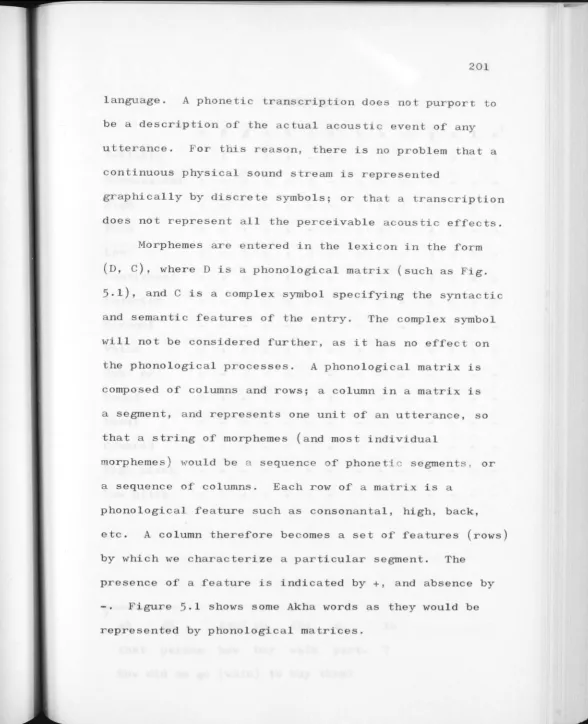
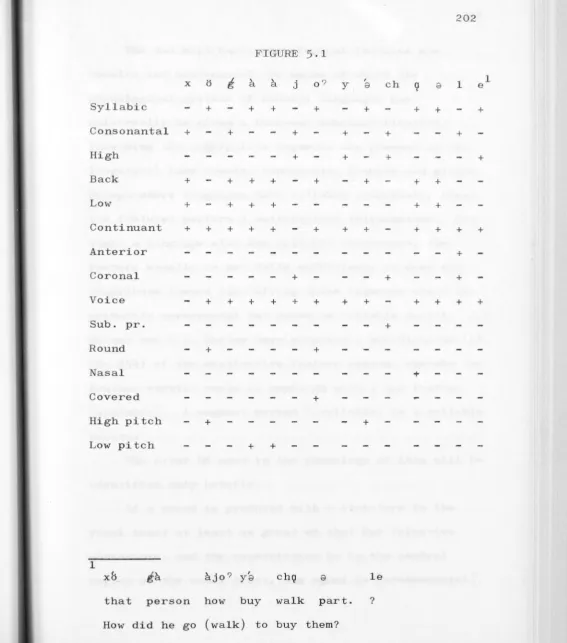
In the base component of a grammar, there must be a lexicon which contains all the lexical morphemes of the language ( i t wi l l lso contain most of the
grammatical morphemes). Entries in the lexicon are composed of various matrices. One matrix would be phonological in which an entry would be identified by
a series of phonological features serving in a
classificatory fashion. Such lexical representations will be discussed in more detail in Chapter
5,
dealing with the phonological component. Chomsky(1965)
has made concrete proposals for two other types of matricesin lexical entries, one to mark the syntactic features and one the semantic features of each entry. In more recent developments the distinction between the semantic
and syntactic components (especially the PS rules) has been growing less, and this dichotomy may eventually be
eliminated.
single sys tem of features will be adopted to provide subclassifi ation within various categor ies of
morphemes i n Akha. A system of syntactic and semant i features marked plus or minus is quite good theoretically, but as Chomsky has pointed out
(1965
:
esp. Chapter4
)
there are s t i l l serious problems in the details. Not the least of the problems lies in oping with
derivati onal morphology. This point will be onsidered further, after a brief di s ussion of derivation in Akha.
Akha, in common with most other Sino-Tibetan languages, has no inflectional system. Word order, particles (clitics ) and derivational processes f i l l the role played elsewhere by inflection. Apparently Akha,
also in common with many other Sino-Tibetan languages, had at one time very active and very interesting
derivational processes, many of which have become purely historical eflexes.
There is no extensive evidence available to show which morphological processes are s t i l l alive in the
morphology are all evident. Of these, compounding is almost assuredly s t i l l alive; affixation may be for some classes of affixes. Reduplication probably is s t i l l creative, too . I f any of the processes is completely non-creative today, i t is probably tone morphology - derivation by tone change.
In this grammar, no attempt has been made to formalize the rules for derivation, nor to provide
transformations for such processes as compounding, as Lees (1960) has done for English. The sketch of
morphology given here outlines all the more evident
processes, without regard to their state of activeness today, and uses both class identification of the various morphological constituents, and identification of the syntactic relationships expressed in lexical items to show how the lexical categories of Akha obtain fillers.
In tone morphology, one class of words (e.g., nouns) becomes another class (e.g. , verbs) by making
regular tone changes. In some hypothetical language,
not o cur, though there are numerous ouplets and triplets that show phono-semanti relationships .
In Akha we ha e ~he f ollo ing erb-noun couple~s whi h gi e eviden e of what was probably on e a
creative morphologi al pro ess:
,
'to face ' ~ 'side '
~
shi 'to die' shl 'blood'
,
1to e ' 'direction'
paw mo paw
dza 'to eat' dza 'f ood'
Most of the r est of the sets of words are merely
suggestive of processes that must ha e been
historical ly active. Within the category of verbs we
have tone change between o ds that seem to have some
relation semanti ally.
bl I to throw' bi 'to divide'
da ' to put, pla e ' da ' to lean against'
nger 'be empty' nger , 'to f orget' sa 'be dis~ essed' sa , 'be well'
~ ' to stab at' taq ' to cock a bow'
daq 'there is liqui d' daq 'there i s a hole '
daq 'be uno upied '
"
der ' to push' der 'to beat'
Glottalized- nonglottalized vowel disti nctions
frequently reflect the same sor t of semantic relatedness as does tone change. I n this case, quite frequently
the distinction seems to lie between transitivity and
intransitivity, though both verb types have both types of vowels.
taw tsa er cer baw ser si ta xa , ca bi
'to wait' 'be hot' 'be torn' 'to snatch'
' have something' 'to pour'
'to sharpen' 'to keep'
'be bitter'
'to saw'
' to utter' 'to throw'
taw? ca?
tser? cer? baw? ser? si? xa? ts a? bi?
'to follow! 'to boi l ' 'be torn' 'to flee' 'to touch' 'to pour out' 'to rub'
'be same'
'be difficult' ' to shave' 'to tell' 'to give'
Some miscellaneous examples of interesting omparisons are shown in the f ol lowing words.
2,Ya? 'build a boundary marker'
1a
'to come' tser 'to plow''be striped'
1a
elf. for vehiclescer? ' to :flee' tser? 'to ross'
'to redeem' xo? ' to return'
The process o:f a:f:fixation may well s t i l l be
active in Akha to the present time, in pa ticular the process o:f pre:fixation. Here again, the kinds o:f classes
o:f morphemes and words derived by a:f:fixation are
extensive. The most common pre:fix is /a/, certainly not
1
an atonal element, but not restricted to a particular tone :for derivation o:f any particular class o:f morphemes.
adzer
a uw?
'price ' 'extremely'
' l i t t l e bit'
<
<
<
'be good value'
dzer 'be extra'
cuw? 'be :few'
From the three verbs on the right, there is derived :first a noun, then two adverbs, on the le:ft. Note that the tone classes o:f /a/ overlap the morpheme
ategories. The additional :fol lowing three adverbs also re:fle t pre:fixation:
am:rag,i 'whenever' < asa.9.ni 'greatly' < ' , gradually' < a:i:a:i:aer
1
C:f. a.ho I vagina 1 , a.ho I ant' 'tree'.
~ time element ?
~ 'be small'
There are many erbs containing the prefix /a/,
only some of whose stems a e certainly s t i l l free (or able to occur without / a/). Some of these verbs
51
are onomatopoetic words (apparently) . I t may be that,
at least histori al y 9 / a/ was used as a verbalizer, or perhaps just for euphony; the f'ol lowing suggest
themselves as possible ases in point: abo?bo? -I to embroider'
< bo? s~1me
asasa 'be last' < sa same
adzuw?dzuw? I to itch'
< dzuw? same
alowlow I to copulate'
< cf. bowlow 1 penis 1
acow ow ' to sneeze' < onomatopoetic
aow ' to belch' < II
aha.how 'to yawn' < ?
In the category of nouns, the prefix /a/ again has widespread o curren e, though, again, i t is not clear
to what degree i t is a tive today. As with the verbs and adverbs, many of the stems with which /a/ combines are of unknown provenien e.
,
a? ' rope '
a < ca? 'rope'
a.caw 'other person' < caw ' companion 1
abyaq
adaq
'dumb woman'
'wing'
(
(
?
?
In one instan e, the semantic and grammatical role
played by the prefix /a/ remains quite clear - in the
formation of the interrogative words (see T4, P16).
aga 'where' ( ~ ' 'place'
a,jer 'what' ( jer 'kind'
amya? 'how much' ( mya 'be many'
' amyag 'when' ( ~ time element
asugha 'who ' ( gha 'person'
ajo? 'how' ( ?
Another prefix, with strict limitations on its use
and distribution, is yaw, which combines with stative
morphemes to form ,,;ords which function as verb nuclei,
as noun modifiers and as constituents in adverbial
expressions (see PS6, 15, 18; T14, 18).
yawbya? 'be striped' yawgu? 'be owardly'
' 'be hot'
.
' 'be loose 'yaw uw yawJe
' 'be old ' yawluw 'be light red'
yawew
In this form they an function as verb heads or
modifiers. With the adverbializer ' they form
noun
~.
5J
thus combine with er are probably a small, restri ~ed
class .
,
yawxa? er 'with dif'f'icul ty'
<
yawxa? 'be dif'f'i cul t'I I
'well'
<
, 'beyawmuw er yawmuw good '
yawkaw , er 'quickly'
<
yawkaw 'be f'as t ' , ,' greatly'
<
, 'be ( ? )ya~aw er ya!!Yaw much'
I t should be noted that yaw is the only derivational
morpheme introduced by the rules of' the syntactic
component (except f'or the / a/ that marks interrogative
morphemes) . All the othe morphemes written in the PS
rules are syntactic marker s. yaw is handled in this
manner because i t provides a means of' subcategorizing
one one kind of' and be ause its role in the grammar was easily ascertainable and a rule could be written.
Actually, /a/ in its arious functi ons and
oc urrences, and yaw, a e probably the only two true
af'f'ixes in Akha. They are the only derivational
onstituents that have virtually no semantic load, but
purely and simply a grammatical function, and which are
used exclusively in word f orming functions. The other
constituents that are onsidered here in the same line
between their various occurrences, but which a most certai nly at their beginning were very meaningful
elements strictly eng ged in compounding. Some of these other9 less common y occurring 'prefixes' are:
ba
baba 'cheek' basha?sha? 'bearded' na
nabaw 'ear' naxaw , 'forehead' namer 'nose'
mer
mershi 'belly' merla 'tongue'
merll'.1 ' l ip' mernuw? 'eye'
merka? 'chin strap' merci? 'moustache' merhu 'before'
1a?
la?law ' arm'
- - -
la?new 'finger'a1a? 'hand' 1a?be 'ring'
la?ci? ' to touch' 1a?di 'pants 1 1a?je 'm sical instrument with finger-like
r eeds'
Among the 'suffixing' constituents encountered are:
ka
aka 'space' lawka 'wall'