This is a repository copy of
The JPEG-blockchain framework for GLAM services
.
White Rose Research Online URL for this paper:
http://eprints.whiterose.ac.uk/142088/
Version: Accepted Version
Proceedings Paper:
Bhowmik, D., Natu, A., Ishikawa, T. et al. (2 more authors) (2018) The JPEG-blockchain
framework for GLAM services. In: 2018 IEEE International Conference on Multimedia &
Expo Workshops (ICMEW). 2018 IEEE International Conference on Multimedia & Expo
Workshops (ICMEW), 23-27 Jul 2018, San Diego, CA, USA. IEEE . ISBN 9781538641958
https://doi.org/10.1109/ICMEW.2018.8551519
© 2018 IEEE. Personal use of this material is permitted. Permission from IEEE must be
obtained for all other users, including reprinting/ republishing this material for advertising or
promotional purposes, creating new collective works for resale or redistribution to servers
or lists, or reuse of any copyrighted components of this work in other works. Reproduced
in accordance with the publisher's self-archiving policy.
[email protected] https://eprints.whiterose.ac.uk/ Reuse
Items deposited in White Rose Research Online are protected by copyright, with all rights reserved unless indicated otherwise. They may be downloaded and/or printed for private study, or other acts as permitted by national copyright laws. The publisher or other rights holders may allow further reproduction and re-use of the full text version. This is indicated by the licence information on the White Rose Research Online record for the item.
Takedown
If you consider content in White Rose Research Online to be in breach of UK law, please notify us by
THE JPEG-BLOCKCHAIN FRAMEWORK FOR GLAM SERVICES
Deepayan Bhowmik, Ambarish Natu, Takaaki Ishikawa, Tian Feng and Charith Abhayaratne
Department of Computing, Sheffield Hallam University, Sheffield, United Kingdom, S1 1WB
Australian Government, Australian Capital Territory, Australia
Waseda University, Shinjuku-ku, Tokyo, Japan, 169-0072
Electronic & Electrical Engineering, The University of Sheffield, Sheffield, United Kingdom, S1 4DE
[email protected], [email protected], [email protected],
[email protected], [email protected]
ABSTRACT
This paper proposes a JPEG-blockchain framework for trusted media transaction. The new distributed and tamper-proof framework intends to aid an emerging JPEG Privacy and Security standard. The blockchain network records any media transaction with necessary information related to intel-lectual property rights, access control rules and content signa-ture. The content signature, generated by compressed sensed samples or low-resolution, low bit-rate compression is used to verify the image integrity and authenticity. We propose that every blockchian record, linked to a uniquetransaction hash, is encapsulated within the metadata contained in the JPEG box structure. As an example use case we have chosen the GLAM (Galleries, Libraries, Archives and Museums) sector due to its emerging need. This paper presents the proof of the concept and reports preliminary infrastructural development.
Index Terms— JPEG Privacy and Security, Blockchain, GLAM, Compressive sensing, JPEG-Blockchain.
1
Introduction
The GLAM (Galleries, Libraries, Archives and Museums) sector deals with a huge number of digital images and confronted with issues including IPR (Intellectual Property Rights) for access and usage control; authenticity (fake im-ages and tampering); and information related to transaction histories [1]. A blockchain framework is proposed here to ad-dress such issues. The proposed framework ensures tamper-proof and authentic image transaction (e.g., loan to other GLAM for exhibition or copyright transfer) enriched with transaction trails [2]. This work also intends to compliment the work on-going within the JPEG Privacy and Security framework [3].
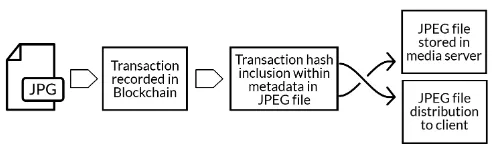
A functional overview of our JPEG-blockchain frame-work is shown in Fig. 1. We propose that any JPEG im-age file that needs its transactions, i.e., sharing, copyright transfer, borrow GLAM assets etc. to be recorded shall be
Fig. 1. Flow diagram of the proposed JPEG-blockchain.
part of a standard blockchain network (JPEG-Blockchain in this instance). Atransaction hashwill then be incorporated within existing standard metadata of JPEG files. Within the blockchain the transaction blocks will have information re-lated to copyright, ownership, transaction details and a sig-nature/hash of the image. We advocate the content signature is important to verify media integrity and authenticity. Fi-nally a copy of the image with updated metadata is stored in blockchain complaint media server and distributed to the client when a genuine transaction is validated. Detailed de-scription of the proposed architecture is discussed in Sec-tion 3. Main contribuSec-tions of this work are:
• A JPEG-blockchain framework for GLAM services
en-suring image integrity and authenticity.
• A proposition for standardization complementing
JPEG Privacy and Security framework.
• Content authentication using compressive sensing and
highly compressed low resolution image coding.
2
Background
2.1
JPEG Privacy and Security
[image:2.612.314.561.258.334.2]trust while sharing image content and metadata. Simultane-ously, it will allow the signalling of the associated policies. It targets technical solutions for resolving privacy and security issues, which are compliant with legacy technology in the do-main,i.e., both image coding as well as metadata standards that signal information such as access policies and IPR con-ditions. The work on JPEG Privacy and Security is currently in progress and is expected to become an international stan-dard in 2019.
2.2
Blockchain
Emergingblockchain [4] technology is an open distributed
ledger(database) that records every transactional details re-ferred asblocks. Each record or block is timestamped, linked to a previous block and resilient to modification of the data. Therefore blockchain is considered to be a trusted and secured mechanism for transactions between two or more entities in an efficient, verifiable and permanent way. Increasing inter-ests in this technology were noticed in recent years largely from industries and academia that intend to adopt the con-cept to provide a secure and publicly verifiable transaction mechanism. For example, Hyperledger is a recent umbrella project of open source blockchain and related tools to sup-port the collaborative development of blockchain-based dis-tributed ledgers1.
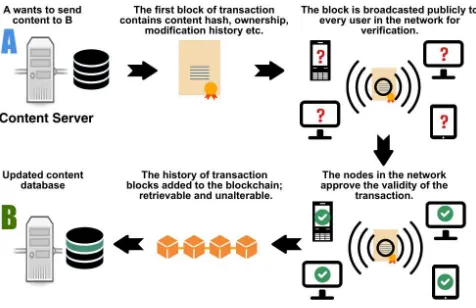
Blockchain technology allows transactions to be verified without using a central organisation to process the transac-tion [5]. Instead multiple nodes are used to form a consen-sus on whether a transaction is valid or not. An example of blockchain working principle is shown in Fig. 2 where a pay-ment is sent from A to B while other nodes verify the transac-tion. In case of a transaction failure or invalidation, the trans-action is not acknowledged. Eventually all nodes will verify and add the transaction to their copy of the ledger. Conceptu-ally it works by connecting or chaining blocks of information about the transactions and storing them together in a chrono-logical order and hence calledblockchain.
Beyond digital currency, this technology has major poten-tial usage in maintaining a record of any digital content. Cur-rent other potential application scenarios include multimedia transactions [2], hardware and software wallets, compliance and identity and a number of other financial and transaction management applications, such assmart contracts[6]. Essen-tially blockchain is relevant to anything that requires trans-action verification or a signature [4] leading to authenticity and trust. However, no major effort was noticed in multime-dia applications except a basic blockchain based digital rights management concept introduced by Fujimuraet al.[7] where the right information was added as part of blockchain transac-tion. Initial idea of a multimedia blockchain framework was recently proposed in [2]. Advancing the previous work, in this paper we propose a new framework within the scope of
1https://www.hyperledger.org/
Fig. 2. Overview of the blockchain working principle.
JPEG standard that keeps all records of the media transactions (e.g., ownership, licenses etc.) as well as offers mechanism for tamper-proof verifiable integrity of the media.
2.3
GLAM services
Novel interaction technologies such as tables, walls, com-bined with personal devices, enable many possibilities for personalized information delivery. The GLAM sector needs to deliver information in a personalized experience,i.e., both online and offline, one where the museum learns about the customer in order to present them with relevant information on each visit. This has the potential to increase return vis-its by tailoring the information presented in exhibvis-its and ex-panding on this, or giving a different perspective, in future visits. There are many emerging digital technologies that can be used for this, although may privacy and user interaction challenges arise.
The GLAM sector is dealing with images that have as-sociated Intellectual Property Rights (IPR). In this particular case, the access to the images needs to be controlled based on specific privacy policies or rules and IPR conditions. There-fore, mechanisms are needed to both specify the policies and enforce them. As an example, implementation of controlled access to images. One relevant issue here is who defines such policies. Two main options are either the museum or the im-age owner, assuming the case in which the imim-age owner is not the one that provides access to the image. In our exam-ple, the the museum could define the rules, but they should be based on the original intellectual property rights set by image owner. Such issues are well handled Within the Blockchain framework in a manner by which the image owner can create a smart contract with the museum to provide relevant access control to these images.
[image:3.612.318.556.72.226.2]A specific example of a rule to illustrate this could be only museum employees can view the painting photo album dur-ing this month. In this case, users are the museum employees, images are the specified photo album, action is view and con-text is this month.
The third and final issue we consider is where to store the rules and the images to which they apply. Images could be even referenced in their repository. Rules could be included as protected metadata in the image itself using JPEG Pri-vacy and Security signaling syntax or in external systems. Blockchain provides a sophisticated and advance approach to rule based content management.
3
The JPEG-blockchain framework
3.1
Expected features
JPEG Privacy and Security is a new standard which is de-fined for the family of JPEG standards to increase the relia-bility of encoded images and associated metadata. Expected features of the standard enable applications and services that have better protection ability of image content on digital pub-lishing, image sharing, and content distribution via the Inter-net. Those features are basically classified into two general categories: protection and authenticity. An important protec-tion feature is to utilize protecprotec-tion tools such as encrypprotec-tion and watermarking technologies to protect parts of any type of JPEG images and/or associated metadata independently. Re-garding the authenticity feature, it is an essential feature in many use cases to ensure and check the integrity of image data and/or embedded metadata. Together these features also enables trust among the users in the backdrop of emerging fake image/news related issues.
For the realisation of those expected features, the emerg-ing blockchain technology could provide a tractable and scal-able solution through a distributed and tamper-proof media transaction framework. In this work we propose a JPEG-blockchain framework that compliments the upcoming JPEG Privacy and Security standard by providing a decentralised ar-chitecture incorporating protection and authenticity, two main features of the standard. In the following subsections we de-scribe the architecture of this framework and how does that fit within the existing narratives of JPEG Privacy and Security.
3.2
JPEG-Blockchain architecture
The proposed distributed and tamper proof JPEG-blockchain framework consists of three parts: a)a blockchain network,
b) blockchain transaction consists of image information in-cluding copyright and content signature/descriptor andc) a proposition for standardization in JPEG privacy and secu-rity standard through JPEG box file format incorporating the blockchain transaction hash. A three-node example
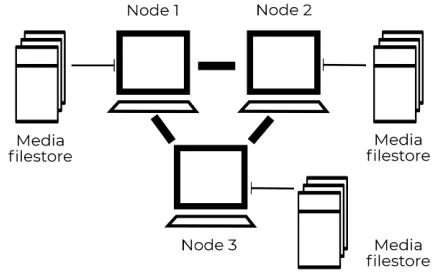
Fig. 3. Overview of the JPEG-blockchain network with three nodes. Media filestores are attached to individual nodes.
blockchain network is depicted in Fig. 3 showing media file-stores connected to individual nodes to store images. The proposed blockchain transaction information fields are shown in Fig. 4. Finally the linkage between blockchain and the ex-isting JPEG format (using box structure) is shown in Fig. 6 and discussed in Section 3.3.
3.2.1 The blockchain network
The proposed framework uses a standard blockchain infras-tructure and was amended to satisfy the requirements of the proposed framework. As a proof of concept realisation, we implemented a private three-node blockchain network as shown in Fig. 3.Geth, a tool provided by Ethereum2is used to
build this personal network. Essentially the network consists of a number of Ethereum Virtual Machines (EVM) ornodes
connected to every other node to create a mesh through a stan-dard access point/router. Each EVMs runs an individual copy of the entire blockchain and can performs various operations such as mining a block or validate a transaction. When a new block is added to one of the nodes, the blockchain updates and each node is synchronised.
In the proposed architecture, media file stores are attached to each node. These are used to store a copy of the media that are registered with the blockchain. The filestores are cre-ated using a relational database which contains a table with a number of fields related to image information including the blockchaintransaction hash. The interface allows to link the image related to a specific transaction. It is to be noted that the images are not synchronised across the nodes as that is unnecessary and consumes considerable bandwidth. Rather we rely on the transaction record (discussed in Section 3.2.2) that has sufficient information about the media asset.
3.2.2 The blockchain transaction
The second part of our architecture is the transaction block which carries all necessary information related to the
[image:4.612.328.547.75.212.2]Fig. 4. Proposed information content within a blockchain block for each transaction.
holders, copyrights and the image content. The proposed structure of each blockchain transaction is depicted in Fig. 4. We advocate the fields should include following components,
• A uniquetransaction hashfor every media transaction recorded in the blockchain. The transaction type cludes copyright transfer, IPR and access control in-formation for the assets owned by museums etc. This unique transaction hash is also the link between the blocks that are derived from the current one.
• Basic asset information including original file name, dimensions etc.
• Copyright information, e.g., ownership, digital rights and licensing,
• Contract informationrelating to ownership transfer, ac-cess control information/rules set by the museums or other entities within the GLAM sector,
• Content signature that ensures authenticity and in-tegrity of the asset and
• Content based identifier consisting visual descriptors which can be captured by the local and global features of the image.
The image signature can be chosen in one of the follow-ing ways: 1)compressive sensed (CS) samples and2)a low resolution low quality low data rate bit stream extracted from a JPEG 2000 bitsreatm. We advocate that using the content signature it is plausible to verify the integrity and the authen-ticity of the content by reconstructing an approximation of the original image [2]. For example, the blockchain contains the content hash which is used to reconstruct an approximate ver-sion of the original image. When a test image is received, the system will first generate a similar content hash followed by a reconstruction. A comparison between the original and test approximation information detects any tampering attempt and
(a) (b)
(c) (d)
Fig. 5. (a) Original image (b) tampered image (c) recon-structed image using original CS samples and (d) tampered region detection.
hence verify the integrity and authenticity of the received as-set. An example of tamper detection using compressive sens-ing based content hash is shown in Fig. 5. We briefly describe the proposed content hashing techniques within the scope of this framework.
CS samples: The compressive sensing theory proved that it is possible to reconstruct a signal with sparse representation from a reduced set of linear measurements compared to the minimum sampling-rate of Shannon-Nyquist theorem. The standard CS model for a given signalx ∈ Rn
in the sparse domain can be described as:
y=Φx (1)
whereΦis the sensing matrix withm×n, m≪n&y∈Rm
. The sparse signal is consisted of small number of non-zero coefficients. Hence, the dense imageIusually required a sparsifying transform,e.g., DFT, DCT or DWT with basis functionsΨto achieve a more compact energy distribution of the signal [8].
x=ΨI (2)
The reconstruction is usually a non-linear operation to recon-struct an approximation of the original signal. Since the op-timization constraints of reconstructions are different, some algorithms can reconstruct the image domain values without sparsifying the transform in Eq. (2). The approximate recon-struction (lossy) in this work is sufficient to detect tampering.
[image:5.612.69.284.71.199.2] [image:5.612.318.560.72.238.2]Fig. 6. Proposed blockchaintransaction hashinformation in-clusion within the metadata contained in a JPEG file.
Meaning Size(bits) Field name
Box
Length Box Type
Box Extended Length (optional)
Box Contents 32 32 0 or 64 Variable LBox TBox XLBox DBox
Fig. 7. Organization of box structure
and then compress by any image coding algorithm. For exam-ple Wuet al.[10] proposed a low bit-rate image compression via adaptive down-sampling which can be used as the content hash within the blockchain transaction. A reconstruction can be performed using a constrained least squares upconversion for authentication purposes.
Content based identifier: In addition to having provisions for image integrity verification, we propose that the transac-tion block includes a field for feature based visual descriptors for content based asset identification. This feature will enable fast visual search without accessing the original image. We suggest using a MPEG-7 like Compact Descriptors for Visual Search (CDVS) [11]. The descriptor can be low level local features such as compressed histogram of gradients [12], grid-based quantization coding [13] etc. or global descriptors,e.g., visual bag-of-words based signature aggregating the statistics of local descriptors [14]. We argue that the descriptor should be limited to a small number of bytes, hence suitable for a blockchain transaction.
3.3
Proposition for standardization in JPEG
Privacy and Security
Considering the blockchaintransaction hash is the primary linkage between the digital asset (JPEG images in this case), we propose to include this information within the metadata encapsulated in a JPEG file as shown in Fig. 6. Our emphasis is on the upcoming JPEG Privacy and Security standard as discussed in Section 2.1. Our proposition considers the box structure in JPEG as discussed below.
Box structure in JPEG A box-based file format defined in ISO/IEC 15444-1 known as JPEG 2000 Part 1 is high flex-ible and extensflex-ible since it provides a simple parsing mech-anism for file readers to extract necessary information. The
box-based file format is composed of a collection of boxes and each box consists of four elements as depicted in Fig. 7.
LBoxin Fig. 7 specifies the length of the box.TBoxdefines the type of information contained inDBoxfield. The value of
TBoxfield is typically described by 4CC defined in ISO/IEC 646,e.g., ‘jp2c (0x6A70 3263)’. If the size of a box length ex-ceeds the capacity of 32 bits representation,XLBoxfield can alternatively be used to store the extended length in capacity of 64 bits representation.
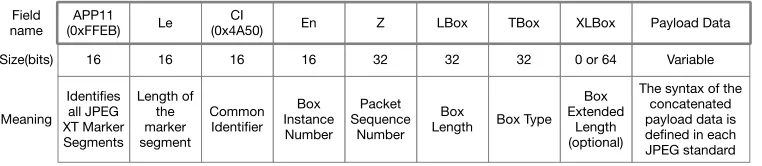
The box-based format has been extended by introducing the concepts of both marker segment and box format so that boxes can be integrated into an application marker defined in ISO/IEC 10918-1. More precisely,APP11marker is reserved as JPEG XT Marker in ISO/IEC 18477-1, which is a subset of ISO/IEC 10918-1. The binary structure of theAPP11marker segment for boxes are depicted in Fig. 8.
Since the size of marker segment is limited to 64KB, box contents would be divided into multiple fragments. If box contents are separated,Payload Datastores each of the fragments andZ counts the fragment number. File readers shall collect all the associated marker segments to concate-nate the box contents. More detailed definitions are described in ISO/IEC 18477-3.
Based on the flexible binary structure and backward com-patibility of the box based file format, we propose that a uniquetransaction hashis encapsulated within a box in our proposed blockchain framework. The box can be defined by combination of a new box type and a variable parameter for thetransaction hash. For instance, the box type of the trans-action hashcould be ‘BCTH (0x4243 5448)’ and the asso-ciated parameterH could specify the transaction hashas a variable binary field.
3.4
The JPEG-blockchain for GLAM
Our idea is to have a blockchain network with multiple nodes associated with the various galleries, libraries, archives and museums (termed asentity) across a region, country, conti-nent or universe. When a specific entity initiates a transaction,
i.e., passing digital asset to another entity, requires to record and verify the transaction in the blockchain. That implies the network JPEG-blockchain will record all transactions with relevant information including copyright, access control, con-tent signature (for authenticity), visual descriptor etc. and synchronise with all other nodes in order to validate the trans-action. Once validated the transaction will provide a unique
[image:6.612.80.272.75.138.2] [image:6.612.81.276.184.250.2]Meaning Size(bits) Field name IdentiÞes all JPEG XT Marker Segments Length of the marker segment Common IdentiÞer Box Instance Number Packet Sequence Number Box
Length Box Type Box Extended
Length (optional)
The syntax of the concatenated payload data is deÞned in each JPEG standard 16 16 16 16 32 32 32 0 or 64 Variable APP11
(0xFFEB) Le
CI
(0x4A50) En Z LBox TBox XLBox Payload Data
Fig. 8. Binary structure of JPEG XT marker segment
While this proposed architecture is aimed at GLAM sec-tor due to its emerging need as outlined in the beginning of this paper, the architecture is flexible and scalable to accom-modate any other sectors, e.g., stock image market, social media sharing / social network services, etc. We envisage a single distributed JPEG-blockchain network with multiple nodes across geographies. Due to its decentralised architec-ture (Section 2.2), no single entity or organisation can claim ownership of the network and hence offers a transparent and trusted single media transaction framework. The proposition for standardization within JPEG will provide a platform em-powering interoperability and compliance.
4
Conclusions
In this paper, we propose a new blockchain architecture for seamless and trusted media distribution in GLAM sector. The distributed architecture of this framework offers solution to GLAM sector issues related to digital rights management, ac-cess control and verification of integrity and authenticity of the media. We also proposed the linkage between the new blockchain architecture and emerging JPEG Privacy and Se-curity standard.
We demonstrate that while maintaining backward and for-ward compatibility with legacy image coding standards such as JPEG, the blockchain transaction hashcan easily be in-tegrated within the family of coding technologies standard-ized by the JPEG committee. The proposed solution is in the process of integration in the JPEG Systems Part 4 ‘Pri-vacy, Security and IPR features (ISO/IEC 19566-4) and Part 5 ‘JPEG Universal Metadata Box Format (JUMBF) (ISO/IEC 19566-5) standards. We illustrated, how the use of blockchain technology can be used for distributing digital media content effectively within the GLAM supply chain.
5
References
[1] F. Temmermans, T. Ebrahimi, S. Foessel, J. Delgado, T. Ishikawa, A. Natu, and P. Schelkens, “JPEG privacy and security framework for social networking and glam services,” EURASIP Journal on Image and Video Processing, vol. 2017, no. 1, p. 68, 2017.
[2] D. Bhowmik and T. Feng, “The multimedia blockchain: A distributed and tamper-proof media transaction framework,” in
Proc. IEEE Int’l conf. on Digital Signal Processing, 2017, pp. 1–5.
[3] ISO/IEC JTC 1/SC29/WG 1. Privacy and
se-curity final call for proposals. Available:
https://jpeg.org/items/20170403 cfp privacy security.html [Accessed: April 3, 2017].
[4] W. Mougayar, The Business Blockchain: Promise, Practice, and Application of the Next Internet Technology. John Wiley & Sons, 2016.
[5] J. Yli-Huumo, D. Ko, S. Choi, S. Park, and K. Smolander, “Where is current research on blockchain technology? A sys-tematic review,”PloS one, vol. 11, no. 10, p. e0163477, 2016.
[6] A. Kosba, A. Miller, E. Shi, Z. Wen, and C. Papamanthou, “Hawk: The blockchain model of cryptography and privacy-preserving smart contracts,” inSecurity and Privacy (SP), 2016 IEEE Symposium on. IEEE, 2016, pp. 839–858.
[7] S. Fujimura, H. Watanabe, A. Nakadaira, T. Yamada, A. Akutsu, and J. J. Kishigami, “BRIGHT: A concept for a de-centralized rights management system based on blockchain,” inIEEE 5th International Conference on Consumer Electron-ics - Berlin (ICCE-Berlin), 2015, pp. 345–346.
[8] J. Romberg, “Imaging via compressive sampling,”IEEE Signal Processing Magazine, vol. 25, no. 2, pp. 14–20, 2008.
[9] M. W. Marcellin, M. J. Gormish, A. Bilgin, and M. P. Boliek, “An overview of JPEG-2000,” in Proc. Data Compression Conference (DCC), 2000, pp. 523–541.
[10] X. Wu, X. Zhang, and X. Wang, “Low bit-rate image compres-sion via adaptive down-sampling and constrained least squares upconversion,”IEEE Trans. Image Processing, vol. 18, no. 3, pp. 552–561, 2009.
[11] L.-Y. Duan, J. Lin, J. Chen, T. Huang, and W. Gao, “Compact descriptors for visual search,”IEEE MultiMedia, vol. 21, no. 3, pp. 30–40, 2014.
[12] V. Chandrasekhar, G. Takacs, D. Chen, S. Tsai, R. Grzeszczuk, and B. Girod, “Chog: Compressed histogram of gradients a low bit-rate feature descriptor,” inProc. IEEE CVPR, 2009, pp. 2504–2511.
[13] B. Girod, V. Chandrasekhar, D. M. Chen, N.-M. Cheung, R. Grzeszczuk, Y. Reznik, G. Takacs, S. S. Tsai, and R. Vedan-tham, “Mobile visual search,”IEEE signal processing maga-zine, vol. 28, no. 4, pp. 61–76, 2011.
[image:7.612.120.501.72.155.2]