Rochester Institute of Technology
RIT Scholar Works
Theses
Thesis/Dissertation Collections
8-1-1999
Shades
Lisa Camire
Follow this and additional works at:
http://scholarworks.rit.edu/theses
This Thesis is brought to you for free and open access by the Thesis/Dissertation Collections at RIT Scholar Works. It has been accepted for inclusion in Theses by an authorized administrator of RIT Scholar Works. For more information, please [email protected].
Recommended Citation
ROCHESTER INSTITUTE OF TECHNOLOGY
SCHOOL OF PHOTOGRAPHIC ARTS AND SCIENCES
"shades"
A THESIS PAPER SUBMITTED TO THE FACULTY OF THE SCHOOL OF
PHOTOGRAPHICARTS AND SCIENCES IN CANDICACY FOR THEDEGREEOF
MASTER OF FINEARTS
BY
LISA A. CAMIRE
NEWYORK,NEW YORK
"shades"
Graduate Thesis
Master of Fine Arts
School of Photographic Arts and Sciences
Rochester Institute of Technology
By LisaA. Camire
August 1999
Thesis Board Members;
Elaine O'Neil, Thesis Chair, Professor, SPAS
date,_ - L .9
-t-
I
--,-7-t-1--L.'17r----r
7
Jeff Weiss, Associate Professor, SPAS ~!
date
7U1!J-I
Loret Gnivecki Steinberg, Associate Professor, SPASdate
q
/1
h'i
I
I
"shades"
Graduate Thesis
Master of Fine Arts
School of Photographic Arts and Sciences
Rochester Institute of Technology
By LisaA. Camire
August 1999
Thesis Board Members;
Elaine O'Neil, Thesis Chair, Professor, SPAS
date,_ - L .9
-t-
I
--,-7-t-1--L.'17r----r
7
Jeff Weiss, Associate Professor, SPAS ~!
date
7U1!J-I
Loret Gnivecki Steinberg, Associate Professor, SPASdate
q
/1
h'i
I
I
Copyright1999 byLisa A. Camire
CONTENTS
LIST OF ILLUSTRATIONS vii
ARTIST STATEMENT ix
Chapter
1. INTRODUTION 1
2. THE HISTORY OF PINHOLEPHOTOGRAPHY ... 4
3. THEORY 12
ILLUSTRATIONS
Figure page
1. Lisa A. Camire, shades,Untitled #1
, 30x30 TypeC,Pinhole
Photograph, 1994-1997 ... 1
2. Lisa A. Camire, shades,Untitled#6,30x30 TypeC, Pinhole
Photograph, 1994-1997 2
3. Lisa A. Camire, shades,Untitled#7,30x30 Type C,Pinhole
Photograph, 1994-1997 ... 5
4. Rainer Gemma Frisius from De Radio AstonomicaetGeometrico,
1545 ... .... 6
5. Lisa A. Camire, shades,Untitled#5,30x30 TypeC,Pinhole
Photograph, 1994-1997 9
6. Lisa A. Camire, shades,Untitled#10,30x30 TypeC,Pinhole
Photograph, 1994-1997 10
7. Lisa A.Camire,shades,Untitled#3,30x30 TypeC, Pinhole
Photograph, 1994-1997 13
8. Lisa A.Camire, shades,Untitled#2, 30x30 TypeC,Pinhole
9. Rorschach inkblot . 15
1 0. Lisa A. Camire, shades,Untitled#9, 30x30 TypeC,Pinhole
Photograph, 1994-1997 17
1 1. Lisa A. Camire, "shades",Installationleftwall, 1 997 . . x
12. LisaA. Camire, "shades",Installationdetailrightwall, 1997 . x
13. LisaA. Camire,"shades",Installation rightwall, 1997 . . x
14. MarcelandLisaCamire atthe openingof"shades",GalleryOpening,
October24, 1997 x
ARTIST STATEMENT
Humans have an instinctive need to redefine what they have seen and experienced
subjectively so as not to disrupt their perception of reality. When confronted with
sensory input that conflicts with preconceived notions, it is common to alter these
perceptions as they are being processed and later alter the memories which are left
behind. The perception of a shared experience may have a common thread but the
recollection willvary betweentwopeople.
One of the facets influenced most by subjective reality is in the viewing of the
aesthetic, "shades" is intended as a means of evoking the viewers'
sense of beauty,
"aestheticpleasureto themind". Ambiguity, abstraction andobscurity (cameraobscura)
furthershape these events/imagesintopersonalones.
"shades"
is comprised of ten 30 x 30 untitled pinhole/camera obscura type-C
photographs.
Lisa A. Camire
I.
[image:12.552.317.491.177.349.2]INTRODUCTION
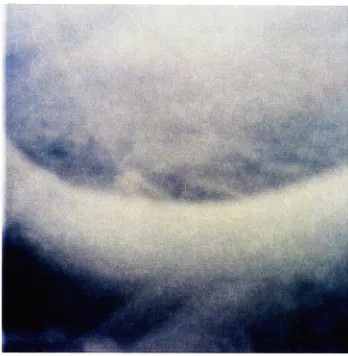
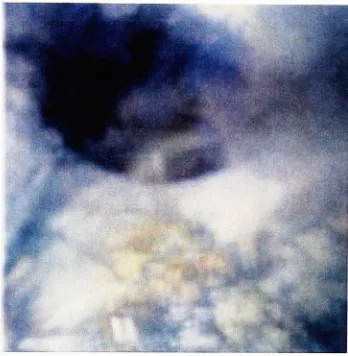
Fig. J."shades"
Untitled#1, 30x30typeC, pinholephotograph.
"shades"
is intended to evoke the viewer's sense
of beauty; to bring "aesthetic pleasure"
to the
mind. The methods used to stimulate this
perception ofbeautywere chosen for theirability
to produce a level ofambiguity in both form and
content. As such, these images contain no single
immediately recognizable subject. Photography's
traditional role has been as a medium of truth,
providingthemostobjective representationofthe
world around us. Rather than offer a record, my purpose was to intimate a subject's
existence. (Fig. 1) Mywork's abstract nature allows amuchmore personal interpretation
oftheworksbeauty anditssignificance.
The images for "shades"
were created using happenstance or stream of
consciousness. There are no storyboards normappingout ofideas, nor is ita mechanical
process, but an intuitive one. I bring my cameras on a walk through my thoughts,
stopping every so often in one spot long enough to expose the film. I am never quite
certain where I will go, orwhether ornotI will find something striking enoughto shoot
whenI arrive. Theendresultisnever a concrete representation ofthe actuallocation,but
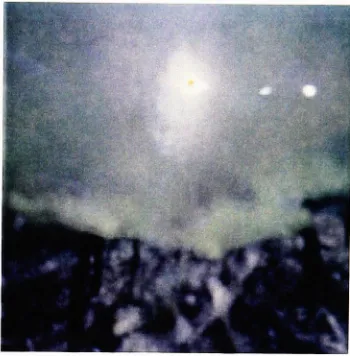
Fig. 2."shades"
Untitled#6,30x30typeC,
pinhole photograph. I set out with several-loaded cameras, a
changingbag, and film. Thecharacteristics ofthe
camera and type of pinhole I use engage my
attention. Each exposure may vary from one
secondto fiveminutes depending on the weather
conditions. I consciously and intuitively
calculate: the amount of"natural" shake created
by the wind or my hand movements and how
muchto allow duringeach image,whether ornot
to open and close the pinhole in direct view ofthe sun, creating an arc oflight through
theimage (Fig. 2),orhowthecolorswillblendtoformtheperceptionof subjectmatter.
Asthesubjectisthe"loadedpaintbrush"with whichI, as a pinholephotographer,
paint my canvas, its selection is critical. Pinhole photographers tend to adhere to a
particular genre such as figure studies, still life's, and domestic landscapes. The
consistent choice ofsubject mattertends, "toreduce the variables they are workingwith
to a few known elements: volume, perspective, the quality oflight and the surface of
objects."1
The experience oftaking a picture is allowedto become less mechanical and
moreintuitive. This is anecessityas duringthelong exposure, theendresult mustbe felt
ratherthan seen. In the analysis ofthe contact sheets, I searchfor that spark or surprise
thatinspiresme to take the imagethrough the finalprinting.
1
While intuition isa critical tool intheprocess ofcapturingthe imagesonfilm,the
selection of images to be shown is extremely deliberate. During the editing process I
evaluate the resulting imagery rendered by the raw visual information that I have
captured. Atthatpoint, I selectthose imagesthat communicatemost effectivelythe idea
of a subject's existence. As instrumental to the success of the end result as the initial
capturing of the images, this part ofthe process inherently holds more regard for the
viewer, as I am influenced by the knowledge that others will eventually interpret the
works. Through the selection I am able to begin an association which will guide the
viewer's thoughts, ideas, experiences, and memories. Instead of a subject photographed
at a specific time they are able to represent unrelated thoughts, emotions, and
expressions.Negativestoprintarenotchosen forwhattheymighthaverepresentedatthe
time of exposure, but instead, for what they are unto themselves, images which are
capable ofbringingtoalevel ofconsciousnessan awareness ofa memory.
Eric Renner, the creator of The Pinhole Resource, a periodical about pinhole
photography, states, "I've always been excitedto seejust whatmypinhole camera will
do,witha certain amountofhelpfromthosesourcesbeyond myconsciousfaculties, for I
neverfullyknowwhat's goingtobe intheimage
-there's the surprise Ilook forwardto!
It seems I amsomehow closer tomy own personby allowingtheimage to be something
over whichI don'thave full control."2
2
II.
THE HISTORY OF PINHOLE PHOTOGRAPHY
Pinhole photography,rendering ofsubjectonto paper unmitigatedbyoptical corrections,
has a history longer than the process of photography itself. Observation and
understandingofhow itevolvedin science andtheartswillhelptoelucidatehowpinhole
imageryhas been seen, titled, anddescribedbyartists and critics. Further,it is necessary
tounderstandhow itshistoryhasinfluencedmyown work.
Pinhole photography generates imagery without the benefit of lenses. A simple
pinhole replaces all ofthe more elaborate optics typically found in modern cameras. At
it's most basic, the camera is a light tight box with a pinhole sized aperture at one end
andfilmor photographic paperaffixed at theother. Pinhole camerascanbe made out of
almost anything, provided the environment can be made light tight. They can be of a
variety of sizes: a car, refrigerator, or mouth, and can utilize almost any material:
oatmeal, cardboard, or wood boxes, soda, tin or trashcans. The pinhole itself can be
inscribed in a variety of materials: metal, wood, or cardboard, with a number of
implements: laser,saw, orsafetypin.
Pinhole photographers generally make their own cameras. However, there are
plenty of services available that will provide components or pre-built cameras ranging
from deluxe, cherry wood, 4x5, bellowed cameras with laser generated pinholes to
pre-made oatmeal boxes with aluminum pinholes. Each camera varies and the degree of
photographer makes when deciding on the
balance between accuracy and atmosphere. "The
infinite depth of field, equally focused or fuzzy
fromextremecloseuptofar distance is afunction
ofthe lenslesspinhole
aperture..."3 (Fig. 3)
The term pinhole, originally coined pin
[image:16.552.315.489.71.249.2]holeby Sir David Brewster in 1856, andthe term
Fig. 3."shades"
Untitled#7, 30x30typeC,
camera obscura, coined by Johannes Kepler in pinhole photograph.
1571-1630, are often used in conjunction with
one another. A camerafromtheLatin meaningroom and obscura fromtheLatin meaning
dark, literally "darkroom", is a darkened enclosure with a pinhole or lens on one end
fromwhich lightenters andforms an image ofthe subject ontheopposite surface. Early
references to the camera obscura generally refer to a room, tent or box with a lens
aperture usedby artists to draw a landscape. The geographic region a person originates
from usually reflects the term used. For example, the English tend to use pinhole,
whereastheGermansrefertoapinholecameraas acamera obscura.
Moe Ti, ofChina wrote the earliest extant description ofthe development of a
pinholeinthe 5thcentury BC. He describedtheprojected, inverted imageof a manas"an
illuminatedpersonshiningasif shooting forth
rays".4
Itshouldnot,however,be assumed
that thiswasthe firstdiscovery ofpinhole optics,wherebyan image isprojectedthrough
3
P.C.Smith,"ComplexVision,"
Artin America,March1996,68.
4
MoeTi,"Mohist PinholeOptics",Pinhole Journal2: 1(April 1986) 2.,quotedin James R.Hugunin, "Notes TowardAStenopaesthetic",TheInternational PinholePhotographyExhibition (Santa Fe: Centerfor
a tiny hole and inverted on the opposite surface,
for history tells us that discovery goes back
thousands of years. Apinhole image can be seen
under the right conditions, occurring naturally:
Forexample, images ofthe sun or a solar eclipse
are projected onto the ground from a pinhole
createdbyleavesinacanopyoftrees. (Fig.4)
Fig.4. RainerGemma FrisiusfromDeRadio
AstonomicaetGeometrico,1545. Thisdrawingis
believedtobethefirstpublishedillustration ofa
pinhole camera obscuraobservinga solareclipse as reportedin "International Pinhole
PhotographyExhibition"
(SanteFe:Centerfor
theContemporaryArts,1989)p.25.
Pinhole optics in the sciences was years ahead ofitsuse in the arts. By 500 AD
pinhole optics werebeingusedto studythe summer solsticebutourfirstrecordofitsuse
by artists is not until the 15th century. Filippo Brunelleschi formed the basis for
structuring perspective in the visual arts through the use ofthe pinhole. In 1425, at age
47, Brunelleschi invented a pinhole perspective device, in which a pinhole camera
obscurawasusedto understandtheconcepts behindonepointperspective andtheuse of
a vanishing point. Using his training as a gold smith, Brunelleschi painted a silver
background toa paintedpanel allowingthepassingclouds tobecomepartofthepainting
as seenbytheviewer. The panel wasconstructedwithahole at thevanishingpoint. The
reflection ofthe image was viewed in a mirror through the hole, giving an illusion of
depth.
One of the earliest recorded artistic uses ofthe pinhole camera obscura was by
Leonardo DaVinci around 1500. DaVinci usedthe pinhole camera obscura as anartistic
aid in a variety of ways. For example, he projected images onto a translucent screen
placed perpendicular to the pinhole, intentionally distorting the image by angling the
[image:17.552.316.490.78.159.2]were oftenhidden inpaintings. Paintingscreatedthroughanamorphic pinhole projections
still exist in Rome. To see the undistorted image one must view it through a pinhole
angled in the same way. Today, anamorphic lenses are used for widescreen movie
theatres. When thefilm is shot, these lenses squeezethe image sideways untilit fits onto
an almost square film space, saving film, then at the theatre, a reverse anamorphic
projectionlensreversesthe effect, producingalongrectangularimage.
During the Renaissance, in an attempt to create a window to the world, artists
readily made use ofthe pinhole camera obscura. This was, most often, a dark room in
which light entered through a small hole in the wall. The light entering the hole was
projectedontotheoppositewall, creatingalaterallyreversed;upside downrepresentation
ofwhat was outside the pinhole camera obscura. The orientation is due to the fact that
any particular area of an object will reflect light in many directions. The aperture of a
pinhole camera filters most light rays except those of a specific angle. Lord Rayleigh
made an interesting early observation into the process in his 1881 essay "Pinhole
Photography". He stated,"the pinhole's sharpness canbe equalto thesharpness madeby
the lens ofthe human eye, but no sharper, a modern camera with many lenses makes
imagesmuch
sharper."5
From the 14th through the 19th centuries the camera obscuraunderwentcontinual
changes. The need to realistically capture the world demanded that technical
improvements be made, and by 1550 the lens and mirror were added, replacing the
simple pinhole in the camera obscura. The lens made the image brighter reducing the
5
LordRayleigh,"PinholePhotography"1881,quotedinEricRenner,"OnthePinhole itsHistoryScience
need for such lengthy exposures, while the mirror reflected the image down onto a
viewingsurface. Bothinnovations improved image quality.
During the nineteenth century several large-scale camera obscuras using
innovative lens technology for improved projections were built for education and
entertainment. Several of these remain today: The Camera Obscura at Royal Mile,
Edinburgh; the Giant CameraatCliffHouse, San Francisco; thecamera obscuraat Santa
Monica, California, and others. There was, and still is, a fascination with the
reinterpretation of the commonplace. The ordinary can become extraordinary when
portrayedinanunusualfashion.
Use ofpinhole cameras was pervasive until the early 1920's, as an inexpensive
wayto make photographs. In 1892alone4,000pinhole cameras weresoldin Londonand
over 100 articleswere written about thepinhole and photographyprior to 1900. As with
many forms of stylistic expression, pinhole photography's popularity has waxed and
waned. With the advent ofinexpensive cameras with lenticular optics early this century
and a change in taste away from the soft impressionistic images' pinhole cameras
generate, it wasn't until the I960', when our culture started questioning traditional
beliefs, that there was arevitalization ofpinhole imagery. Artists began to "evaluate the
assumptions of pure anddocumentaryphotography, toextendthemedium so thatcamera
imagesmightavail themselves of a range of meansinorderto expresssubjectivefeelings
and public and privaterealities."6
1
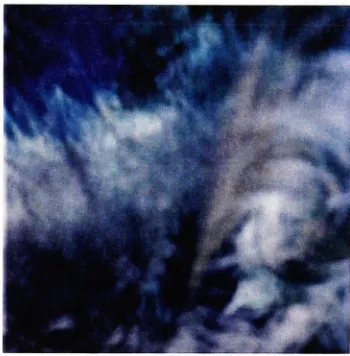
Fig. 5"shades"
Untitled#5, 30x30typeC,
pinhole photograph.
Pinhole characteristics echo the
Pictorialist's atmospheric imagery byutilizing the
movements'
penchant for emphasizing
romanticized pictorial qualities. Different
constructions of pinhole cameras, long exposure
times, concave film planes, multiple pinholes,
reciprocity failure, and focal length distortion aid
the artist in rendering these effects. Traces ofthe
sunmay arc through the sky, fast moving objects
will not be recordedthroughlong exposures, trees blowingturn into a green stroke (Fig.
5), colorisaltered,andfacialnuancesblend intocharacter studies.
During the 1800-1900s there
remained artists who chose to use their more
sophisticated cameras equippedwithmirrors andlensesto expose photosensitivematerial
inmuchthe samewaya pinholewould. Julia MargaretCameron,themostwidely known
Victorian portraitist sought out men and woman ofher acquaintance so that she might
record, in herwords, "faithfully, the greatness oftheinner as well as the features ofthe
outer
man."7
At her urging friends posed, sometimes heavily costumed in religious or
literary themes, for the undeniably long exposures necessitated by the albumen and
collodian glass plate processes and further extended by her technique. She was often
criticized forthe"slovenlymanipulation of anartphotographer"8,however "camera
7
BrianHill,"Julia MargaretCameron:A VictorianFamilyPortrait"
(London, 1973,127)quotedin Naomi
Rosenblum,AWorldHistoryofPhotography(NewYork:AbbevillePress, 1984),74.
8
Unknownauthor,"ReportoftheExhibitionCommittee",The PhotographicJournal (October16, 1865),
[image:20.552.317.492.74.252.2]portraits by the most critical of her
contemporaries, HenryPeachRobinson, and even
by Lewis Carroll (another who found her work
too intense for his taste) often seem bland in
comparison."9
Contemporary photographer Larry
Bullis'
philosophy on pinhole photography: "For me
Fig. 6."shades"
Untitled#10,30x30type
pinhole photography ismore likelytobe done for Cpinhole photograph.
the right reasons: intellectual, emotional,
physical, intuitive, sexual, but not greed, hatred, fear of ignorance. The pinhole is a
vehicle through which the essence of the act of imaging can be performed. It is
impossibletousea pinhole camerawithoutan active andfunctional intuitive
side."10
This
statement exemplifies the imagery, andthe act ofcreating "shades". My images relyon
the characteristics ofthe pinhole and it's intuitive process and are impossible to create
with conventional photography. Bymy utilizing softer focus, infinite depth offield, and
chromatic aberration I am able to depict scenes in which a rendering of the subject
photographed is subservient to the otherwise intangible physical and emotional realities
ofthe image.
While photographic impressionism was popular after WWI, the softer focus had
lost its appeal among contemporary photographers. Present day pinhole photographer
Martha Casanave expresses her dissatisfaction with conventional photography, "The
9
NaomiRosenblum,AHistoryofWomenPhotographers (New York: AbbevillePress, 1994),52.
10
LarryBullis,"OnthePinhole",The InternationalPinholeExhibition(Santa Fe:CenterforContemporary
Arts SantaFe, 1989),27.
[image:21.552.316.491.74.252.2]creative evolution, selection and revision thathappens with memory isprecludedby the
very impartiality and specificity of straight photography, the poet Stephen Spender said
'a memory once clearly stated ceases to be a memory'. These thoughts have prompted
my interest in the potential of pinhole photography to more closely approximate
memory."11
I believe the term "straight photography"
is used here to describe the
modernistphotographythatbecamepopularafterWWI: toosharpandtoodetailed forthe
Pictorialists'
atmospheric imagery and lacking in anything that would approximate a
memory,
"shades"
mightresemblemanyexperiencesyouhavehad, butnone specifically.
(Fig. 6) It requires the viewer to de-code the image using a collection of personal
memoriesforplacementinreality.
11
MarthaCasanave,"TheExhibitors",quotedin,JamesR.Hugunin "Notes Toward AStenopaesthetic",The International PinholePhotographyExhibition(Santa Fe: Center forContemporaryArtsSantaFe, 1989),8.
III.
THEORY
The AbstractExpressionists ofthelate 1940'sbelievedthatas artists,theywere onlyone
part of a combination of forces which came together to create a work of art. They
consideredtheirpsyche tobe the orchestrator ofthese forcesand that, "... the artist has
only 'a general
notion'
ofwhathe is about and provides 'the ultimate source of
energy'
for the creation ofthe object, but not much
more."12
The energy generated by their
subconscious works in conjunction with the surrounding environment, whose random
elements help shape the artists work. "... The artist is not the embodier ofa design but
rather one force among others, which working together determine a
pattern."13
This
pattern wasnotalwaysrealized, andthose paintingsthatdidnotcommunicatethe energy
and orchestrationproperlywereremovedintheeditingprocess.
The Dadaist and Surrealist movements used the antithesis of this selection
process. Ratherthan editing downto what theyconsidered thebestrepresentative ofthe
inner psyche of a particular series, the Dadaists and Surrealists worked under the
assumption that the selection process itselfwas capable ofrevealing the artist's inner
being. "The focus is not on recording the artist's 'psychophysical
action'
but on the
12
Allen Carlson."Appreciatingartandappreciatingnature",quotedin SalimKemalandIvanGaskell, Landscape,naturalbeautyandthearts(Cambridge:UniversityPress, 1993),209.
Ibid.
spontaneous working out ofthe unconscious, the
irrational."14
Artists such as Duchamp and Dali
used random selection itself as a subliminal
meansofexpression.
*
[image:24.552.321.497.75.252.2]i
Fig. 7."shades"
Untitled#3, 30x30typeC,
pinhole photograph.
Unlike the Dadaists, whose experiments
in the subconscious pushed random selection as
subject to the extreme, I made deliberate
decisions on the conditions under which I
exposed my film. Like the Abstract
Expressionists, I made aconscious flight from directrepresentationto the implicationof
emotion and thought through color and gesture. (Fig. 7) However, as there must be a
certain relevance to the viewer inorder tomaintain any level ofengagement, the levelof
abstraction employed requires the viewerto become an active participant. For beauty to
maintain enough relevance for the participant, whatremains after the original content's
deconstruction must inspire reinterpretation. The energyofthe artist is the element that
ties theworktothe interpreter.
Pinhole imageryhas been describedthroughoutphotography's history as evoking
a number of responses: sensuality, spirituality, andmystery amongthem. Theuse ofthis
medium aids in the abstraction of the subject yet allows the viewer to extract the
relevance. The interpreter of a work of abstract art imbues relevance through an
associative process; therefore any hint of commonality, including an awareness of
medium, will be used in making the association. Though the image might not be any
'Ibid.,210.
more ofa representation ofa subject than an abstractpainting, the very fact that it is a
"photograph"
is suggestive to the viewer, and heightens the desire to make a correlation
ofsomekind.
Derek Jarman's Blue is an example of suggestionbasedon medium. For
seventy-six minutes, the film displays
nothing but a blue screen. A soundtrack, in which the
director describes his experiences resulting from AIDS complications, including that of
blindness, accompanies this. The fact that the viewer is watching a movie evokes a
reaction ofintensedesperation to see something in theblue field. The spoken words are
suggestive, and one can almost see the objects and places he speaks of. A reviewer
comments, "This can getdizzying, nauseating or hypnotic
-depending on your sensory
makeupor yourattitudetowardsvisualdeprivation."15
We haveaninstinctiveneedtoredefinewhat wesee and experience subjectively
so asnot to disrupt ourperception ofreality. Whenconfrontedwith sensory inputwhich
conflicts withpreconceived notion, it is common to alter these disruptive perceptions as
they are being processed, and later alter the memories that were left behind. The
perception ofa shared experience may have a common thread, but the recollectionwill
vary.
Minimalist painter Agnes Martin is able to convey emotion and beauty to the
interpreter through line, pattern, and color. She believes "beauty and happiness,
expressions of the sublime and perfection ofreality, are the subject matter of art. Art
cannot depictperfection since perfection is immaterial; nor can art itself be perfect since
it ispart ofthephysical world. What art can express are abstract emotions ofbeautyand
15
DessonHowe, "Blue",TheWashingtonPost,11February1994.
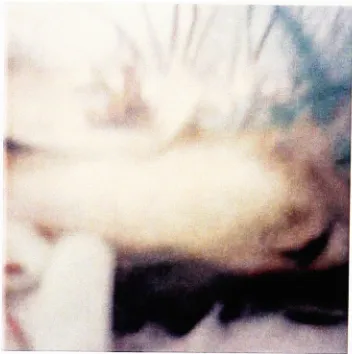
Fig.8."shades"
Untitled#2, 30x30typeC,
pinhole photograph.
happiness."16
In the Beauty and Mystery ofLife,
she states "It is commonly thought that the
intellectisresponsible for everythingthatismade
and done. It is commonlythought thateverything
that is canbe put into words. Butthere is a wide
range of emotional responses that we are not
consciously aware of... until theyare represented
inart
work."17
Our perception of experiences becomes a
defragmenting process for the psyche. Using what we remember, both consciously and subconsciously, of our past experiences, we take the individual components of those
memories to decode imagery. The more abstract the image, the more room there is for
interpretation as there is no literal meaning pointing us down the direct path the author
took.
As an example, I will refer to psychology
and the Rorschach tests for measuring
personality. Herman Rorschach developed the
famous inkblot personality tests, whereby a
subject is presented with ten to fifteen abstract,
ambiguous inkblot forms and is asked for
interpretation. How the inkblots are perceived
Fig.9. Rorschach inkblot.
16
BarbaraHaskell,"Agnes Martin: The AwarenessofPerfection",Agnes Martin (New York:Whitney
MuseumofAmericanArt, 1992),94.
17
AgnesMartin,"BeautyistheMysteryofLife",quotedinBarbaraHaskell,Agnes Martin (New York:
WhitneyMuseumofAmericanArt,1992),10.
[image:26.552.318.492.75.252.2] [image:26.552.315.490.445.585.2]reflects memories and experiences ofthe conscious and or unconscious mind, "shades",
like the Rorschachtests, is a means to relate to or rekindle amemory inthe mind ofthe
viewer.(Fig. 8 & 9)
Carl Jung and his followers believed that what we perceive is deeply rooted in
symbols, fantasies, dreams, delusions and myths. I choose from my psyche images that
reflectmy emotions anddesiresbyutilizingabstract representations ofmyunconscious I
give the viewer the ability to act as a voyeur ofmy experiences. In leaving the abstract
imagery in this exhibition untitled, and supplying only the title "shades", I refrain from
suggestive descriptionand allowinterpretationtobe free floating. Asa releaseofinternal
energyandadeliberate choice ofa"best example"
ofmy innerself, these imagesare, in
Jungianterms,givingamplification andintuitiveassociationto the shadowofmyself.
Pinhole Photography is an intuitive and emotional process. The dreamlike
qualities signified in pinhole images are reflected by exhibition titles such as "Altered
State", or "Reflections ofthe WorldofIllusion andFantasy". Reviews ofpinhole shows
speak ofthe work in terms of"stream ofconsciousness", "altered relationships oftime
andspace","illusivereality"
and"magneticallycharged
zones".18
The writings of pinhole photographer Barbara Ess, concerning her experiments
withsensory deprivationandtheneedtocontrastbetween memoryvs. experience,played
a major roll in my development of"shades". Ess' performances have illustrated that an
elimination of all immediate sensory input can produce an altered state ofbeing where
fragmentsof ourperceptionsarebasedon suggestedorreferencedsensory input. Her
'
Hugunin, 10.
Fig. 10..
"shades"
Untitled#9, 30x30typeC.
pinhole photograph.
images have been described as "walking the
magical borderline where the subjective view of
reality and its 'objective' existence merge
imperceptibly to form a vague but highly
intriguingtwilightzone."19
It is likely that the same sensory input
may stimulate similar, yetpersonalized, reactions
in twoindividuals. Thus, two people looking at a
completely abstract form may experience
thoughts, memories or emotions with a collective thread. In "shades"
I provide an abstract sensorial depiction ofan experience and ask the viewer to share the memory
eitherfrompersonal experience ortoelicitamemory fromthesuggestedcontent.
The imagery in this exhibition is not part ofthe experience thatwould contain a conscious memory, as the place and or subject can not readily be defined. Rather the
experience becomes an intuitive memory or a shared experience between the
photographer andtheviewer.Theresultsare thedreamlikeimageryof"shades".(Fig. 10)
The images areaestheticallybeautiful inpartbecause they draw from the organicbeauty
ofthelandscape,meldedwiththebeautyoftheexpressionofhumanthoughtor memory.
The title "shades" is derived from shade or in Greekskotosmeaning darkness. In mythology, theplural shades refers tothe shadowsthatgather duringdarkness. Further it can refer to spirits, or to indicate its similarity to apreviously encountered experience.
19
BarbaraEss,"BarbaraEss: BeyondtheGardenWall",quotedin SusanKrane,BarbaraEss: Beyondthe
GardenWall (Georgia:HighMuseumofArt,1992),8.
The title describes both the recording of tonal values and a more in-depth discourse
regarding the spiritual afterlife; a deja-vu of memory and experience, "shades" are
memoriesof experiences rekindledby theviewer's perceptions oftheabstract with which
theyarepresented.
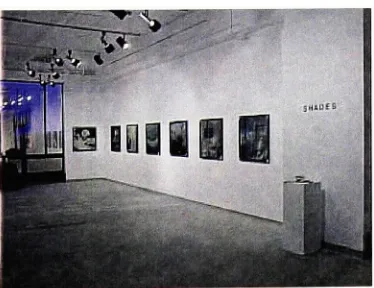
INSTALLATION
'shades"
openedOctober24th, 1997attheS.P.A.S. Gallery, RochesterInstituteof
Technology,One Lomb Memorial Drive,Rochester,NY.
*0
Fig. 11. "shades"
Installation left-wall. Fig.12. "shades"
[image:30.552.301.487.205.346.2]Installationdetailright-wall.
Fig. 13. "shades"
Installation fullshotof
[image:30.552.62.249.207.347.2]right-wall.
Fig. 14. MarcelandLisa Camireattheopening
[image:30.552.64.251.426.570.2] [image:30.552.302.489.429.568.2]SELECTED BIBLIOGRAPHY
Barg,Barbara. Eyesbehind Eyes: Barbara Ess Iam notthisBody. New York: Curt MarcusGallery, 1991.
Chave,Anna C. "Agnes Martin: Humility,The Beautiful Daughter...AllofHer Waysare
Empty."
In AgnesMartin,ed.BarbaraHaskell, 131-157. New York: Whitney Museum ofAmericanArt, 1992.
Carlson,Allen. "Appreciating artandappreciating
nature."
InLandscape,naturalbeauty
andthe arts,ed. Salim Kemal andIvan Gaskell, 199-227. Cambridge: Cambridge
University Press, 1993.
Crawford,Donald W. "Comparingnatural andartisticbeauty."InLandscape,natural beautyandthearts, ed. Salim KemalandIvanGaskell, 183-198. Cambridge: CambridgeUniversityPress, 1993.
Ess, Barbara. This is it? Barbara EssPhotographyInstallationandBooks.NewYork: The Queens MuseumofArt, 1993.
Haskell, Barbara. "Agnes Martin: TheAwarenessof
Perfection."
Agnes Martin. New
York: WhitneyMuseumofAmericanArt, 1992.
Howe,Desson, "Blue."TheWashingtonPost, 1 1 February 1994.
Hugunin, James R. "Notes Towarda
Stenopaesthetic."
In TheInternational Pinhole
PhotographyExhibition,OrganizedbyCCA, 7-11. Santa Fe: Center for
ContemporaryArtsofSantaFe, 1989.
Indiana, Gary. Barbara Ess isaCharacterinaNovelI amWriting.BarbaraEss
PhotographyInstallationandBooks. New York: The Queens MuseumofArt, 1993.
Krane, Susan.Barbara Ess: BeyondtheGarden Wall. Atlanta: High MuseumofArt,
1992.
Martin,Agnes. "SelectedWritings."
In AgnesMartin,ed. BarbaraHaskell, 9-31. New
York: WhitneyMuseumofAmericanArt, 1992.
Miller,John. Beauty:An Anthology. San Francisco: Chronicle Books, 1997.
Renner,Eric. "OnthePinhole: ItsHistoryin Scienceand
Art."
In The International PinholePhotography Exhibition,OrganizedbyCCA,24-27. Santa Fe: Center for
ContemporaryArtsofSantaFe, 1989.
Pinhole Photography:RediscoveringaHistoric Technique.Boston: Focal
Press, 1995.
Rosenblum,Naomi. A WorldHistoryofPhotography. New York: AbbevillePress, 1984.
. AHistoryofWomenPhotographers.New York: AbbevillePress, 1994.
Roskam,Mathilde. Barbara Ess. Madrid: Galeria LaMaquinaEspanola, 1990.
Shull,Jim. The HoleThing,AManualofPinholeFotography. New York: Morgan &
Morgan,Inc., 1974.
SLIDELIST
1. Lisa A. Camire, shades,Untitled#1, 30x30 Type C,PinholePhotograph,
1994-1997.
2. LisaA. Camire,shades,Untitled#2, 30x30 TypeC,PinholePhotograph,
1994-1997.
3. Lisa A.Camire, shades, Untitled#3, 30x30 TypeC, PinholePhotograph,
1994-1997.
4. Lisa A. Camire, shades,Untitled#4,30x30 TypeC, PinholePhotograph, 1994-1997.
5. Lisa A. Camire, shades,Untitled#5, 30x30 TypeC, PinholePhotograph, 1994-1997.
6. Lisa A. Camire, shades,Untitled#6, 30x30 TypeC, PinholePhotograph,
1994-1997.
7. Lisa A. Camire,shades,Untitled#7,30x30 Type C,PinholePhotograph,
1994-1997.
8. Lisa A. Camire, shades,Untitled#8,30x30 TypeC,PinholePhotograph,
1994-1997.
9. Lisa A. Camire,shades,Untitled#9,30x30 Type C,PinholePhotograph,
1994-1997.
10. Lisa A. Camire,shades, Untitled#10, 30x30 Type C,PinholePhotograph,
1994-1997.
Lisa A. Camire1994-1997
"shades"
Untitled#1,30x30
I
I
LisaA. Camire 1994-1997
H ' r-1
"shades"
Untitled#3,30x30
TypeC, Pinhole Photograph.
^v - >
h3 3 Ci
amire
iUntitle
inhole
aaw 5" *Q (o >0
o : g
Lisa A. Camire 1994-1997
"shades"
Untitled#5,30x30
TypeC,PinholePhotograph.
LisaA.Camire 1994-1997
"shades"
Untitled#6,30x30 TypeC,Pinhole Photograph
1
Lisa A. Camire 1994-1997
"shades"
Untitled#9,30x30 TypeC,Pinhole Photograph
Lisa A. Camire 1994-1997
"shades"
Untitled#10, 30x30 TypeC,Pinhole Photograph
Lisa A. Camire 1994-1997
"shades"
Untitled#4,30x30
TypeC,PinholePhotograph
Lisa A. Camire 1994-1997
"shades"
Untitled#7,30x30 TypeC, Pinhole Photograph
Lisa A.Camire 1994-1997
"shades"
Untitled#8, 30x30