Faculty of Mechanical Engineering
DEVELOPMENT AND ANALYSIS OF LOW COST
3D PRINTING MACHINE
Lim Guo Dong
Bachelor of Mechanical Engineering
DEVELOPMENT AND ANALYSIS OF LOW COST 3D PRINTING MACHINE
LIM GUO DONG
A thesis submitted
in fulfillment of the requirements for the degree of Bachelor of Mechanical Engineering
Faculty of Mechanical Engineering
UNIVERSITI TEKNIKAL MALAYSIA MELAKA
STUDENT’S DECRATION
I declare that this thesis entitled “Development and analysis of low cost 3D printing machine”
is the result of my own research except as cited in the references. The thesis has not been
accepted for any degree and is not concurrently submitted in candidature of any other degree.
Signature : ...
Name `` : ...
APPROVAL
I hereby declare that I have read this project report and in my opinion this report is sufficient in terms of scope and quality for the award of the degree of Bachelor of Mechanical Engineering.
Signature : ...
Supervisor’s Name : ...
DEDICATION
ACKNOWLEDGEMENT
First and foremost, I would like to express my deepest appreciation to my beloved supervisor, Ir. Dr. Mohd Rizal bin Alkahari from Faculty of Mechanical Engineering for his guidance and support throughout this project and specially for his confidence in me.
Next, I would also like to acknowledge with much appreciation to my co-supervisor, Dr Faiz Redza bin Ramli from Faculty of Mechanical Engineering for his contribution in stimulating suggestions and encouragement towards the completion of this thesis.
Furthermore, a special gratitude to Mr Hairul Nezam bin Wahid, the technician from Rapid prototyping and innovation laboratory Faculty of Mechanical Engineering who provide guidance in operating the relevant machine.
Moreover, I would also like to express my deepest gratitude to the panel in the project presentation, Dr Shamsul Anuar bin Shamsudin who has improved my presentation skills and thanks to his comments and advises given.
Last but not least, many thanks to my parents, siblings and friend for their endless support in completing this degree.
i ABSTRACT
ii ABSTRAK
Pembuatan tambahan yang juga dikenali sebagai percetakan 3D telah berkembang sebagai
trend baru dalam teknologi pembuatan dan salah satu elemen utama dalam Revolusi
Industri 4.0. Bagaimanapun, kos pencetak 3D komersial amat tinggi dan kebanyakannya
hanya mampu dimiliki oleh industri sahaja. Oleh itu, pencetak 3D sumber terbuka telah
menyediakan alternatif yang murah untuk orang ramai untuk memiliki pencetak 3D peribadi.
Objektif projek ini adalah untuk membangun dan membina pencetak 3D yang berkos rendah.
Selain itu, projek ini juga bertujuan untuk membandingkan prestasi pencetak 3D yang
dibangunkan dengan pencetak 3D komersial. Oleh itu, sampel bentuk kubus dicetak oleh
kedua-dua pencetak 3D sebagai spesimen yang akan dianalisis. Beberapa analisis telah
dijalankan termasuk analisis kekasaran permukaan, analisis ketepatan dimensi dan analisis
keliangan. Keputusan telah menunjukkan pencetak 3D yang dibangunkan memiliki
kelebihan dari segi kekasaran permukaan dan keliangan serta kelemahan dalam ketepatan
dimensi berbanding dengan pencetak 3D komersial. Ini menunjukkan pencetak 3D yang
dibangunkan mempunyai potensi untuk mengatasi pencetak 3D komersial dengan kos yang
iii
TABLE OF CONTENTS
PAGE DECLARATION
APPROVAL DEDICATION
ACKNOWLEDGEMENT
ABSTRACT i
ABSTRAK ii
TABLE OF CONTENTS iii
LIST OF TABLES v
LIST OF FIGURES vi
LIST OF ABBREVIATION viii
CHAPTER
1. INTRODUCTION
1.1Background 1
1.2Problem statement 3
1.3Objective 4
1.4Scope of project 4
1.5Summary 4
2. LITERATURE REVIEW
2.1 Introduction 5
2.2 Additive manufacturing 5
2.3 Open source 3D printer 7
2.4 Fused deposition modelling 9
2.5 Relevant studies 11
2.6 Summary 13
3. METHODOLOGY
3.1 Introduction 14
3.2 Design selection 16
3.3 Fabrication and purchasing of components 16
3.4 Assembly of mechanical and electronic components 17
3.5 Upload of programming code 18
3.6 Calibration process 19
iv
3.8 Analysis of specimen 24
3.9 Summary 27
4. MACHINE DEVELOPMENT
4.1 Introduction 28
4.2 Design chosen 28
4.3 Fabricated and purchased components 31
4.3.1 Fabricated components 32
4.3.2 Standard components 38
4.4 Assembled 3D printer 41
4.5 Edition of programming code 45
4.6 Calibration process 47
4.6.1 Calibration of motor movement 47
4.6.2 Leveling of heat bed 49
4.6 Summary 49
5. RESULTS AND DISCUSSION
5.1 Introduction 51
5.2 Surface roughness analysis 51
5.3 Dimensional accuracy analysis 54
5.4 Porosity analysis 58
5.5 Summary 61
6. CONCLUSION AND RECOMMENDATION 62
REFERENCES 64
v
LIST OF TABLES
TABLE TITLE PAGE
3.1 Printing parameters of specimens 22
3.2 Specifications of Creator Pro 3D printer 23
4.1 Comparison between 3D printers 29
4.2 Printing parameters for fabricated parts 33
4.3 List of fabricated parts 34
4.4 List of standard components 38
5.1 Table of results generated by Winroff software 52
5.2 Results of surface roughness 53
5.3 Dimension accuracy results for developed 3D printer 55
5.4 Dimension accuracy results for commercial 3D printer 56
5.5 Percentage error of dimensional accuracy analysis 57
5.6 Weights of specimens 59
5.7 Results of porosity 60
vi
LIST OF FIGURES
FIGURE TITLE PAGE
1.1 3 D printing product manufacturing in the material of 2
(a) metal (b) plastic (c) ceramic (d) cement
1.2 RepRap 3D printer 3
1.3 Commercial 3D printer 3
2.1 Survey on the 3D printing community 7
2.2 Schematic diagram of FDM process 10
2.3 Rectangular specimen 13
3.1 Flow chart of the methodology 15
3.2 Anet A8 3D printer 17
3.3 Wiring diagram (RepRap.org, 2017) 18
3.4 Arduino IDE software interface 19
3.5 Type-B USB cable 19
3.6 Pronterface software interface 20
3.7 Cura slicing software 21
3.8 FlashPrint slicing software 21
3.9 CreatorPro 3D printer 22
vii
3.11 3D non-contact profilometer 25
3.12 Points of measurement on the specimen’s surface 25
3.13 Digital vernier calliper 26
3.14 Measurements taken on each specimen 26
3.15 Measurement of weights by using electronic balance 27
4.1 CreateBot 3D printer 32
4.2 Warping problem 32
4.3 Assembled frame 42
4.4 Assembled frame with motors and mechanical parts 43
4.5 Connection of wire to Ramp 1.4 board 43
4.6 LCD display controller board 44
4.7 Completed 3D printer 44
4.8 Mechanical setting 45
4.9 Measurement of actual distance travelled by the extruder 48
4.10 Measurement of actual distance travelled by the heat bed 48
4.11 Measurement of actual distance travelled by the mark on filament 49
4.12 Adjustment of adjusting screw 50
5.1 3D profile of surface generated by Winroff software 52
5.2 Graph of surface roughness generated by Winroff software 52
5.3 Comparison between surface roughness 54
5.4 Comparison between percentage error 58
viii
LIST OF ABBREVIATION
3D Three Dimension
ABS Acrylonitrile Butadiene Styrene
AM Additive manufacturing
BOM Bill Of Material
CAD Computer-Aided Design
CATIA Computer Aided Three-dimensional Interative Application
CNC Computer Numerical Control
DLP Digital Light Processing
FDM Fused Deposition Modelling
FOSS Free and open source software
LCD Liquid Crystal Display
PLA Polylactic acid
RepRap Self-replicating Rapid Prototypers
SLA Stereolithography Apparatus
SLSL Selective Laser Sintering
STL Standard Tessellation Language
1 CHAPTER 1
INTRODUCTION
1.1 Background
In the past few decades, additive manufacturing has been emerged as a new and
advance technology which also act as a driven to the Industrial Revolution 4.0. According
to Obama in his speech at the National Additive Manufacturing Innovation Institute, additive
manufacturing has the possibilities to revolutionize the methods we make almost everything.
(Doug Gross 2013). Additive manufacturing which is also well known as 3D printing is a
cutting-edge technology where the product is fabricated through layer by layer
manufacturing technology (Wong & Hernandez, 2012). The additive manufacturing process
starts with the modelling of 3D model through computer-aided design (CAD) software and
being converted into STL file before proceeding to be printed by a 3D printer. 3D printing
technology is formerly known as rapid prototyping since three decades more ago. However,
as the 3D printing technology have been evolved and applied more widely to the small mass
production recently, it is more commonly known as additive manufacturing in the present.
Nowadays, 3D printing technology have been applied widely in various fields such as
research, engineering, medical industry, military, construction, architecture, fashion,
2
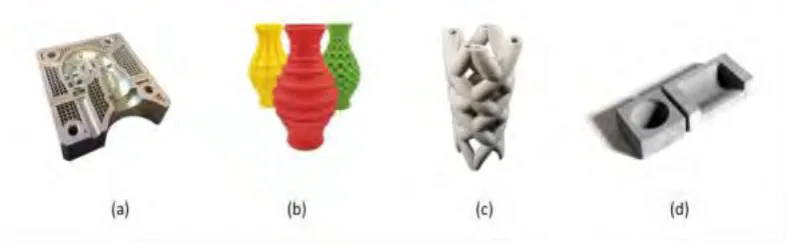
of the material also has been expanded where metal, plastic, ceramic and cement product as
[image:16.595.103.501.145.269.2]shown in Figure 1.1 can now be fabricated by using 3D printer.
Figure 1.1: 3D printing product manufacturing in the material of
(a)metal (b) plastic (c) ceramic (d) cement
Previously, 3D printing is a technology which was costly and only affordable by
large-scale manufacturing industry (Kostakis, Niaros, & Giotitsas, 2015). However, the 3D
printing is now more user-friendly and can be available at a lower price. People can also
build up their own 3D printer through various open source information provided by some
volunteer organization and community. One of the most famous open source 3D printer is
RepRap which core on inventing self-replicating manufacturing machine as shown in Figure
2 (RepRap.org, 2017). Besides, there are also other communities who committed to
contribute in open source 3D printer such as Make Your Own Ceramic 3D Printer
community which focus on designing Delta 3D printer for ceramic and other paste material
3
Figure 1.2: RepRap 3D printer
1.2 Problem statement
Open source 3D printer had provided a low-cost alternative for user to own a personal
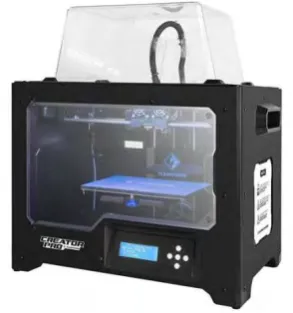
3D printer. However, commercial 3D printers as shown in Figure 1.3 are claimed to have a
better performance at a higher cost. Hence, low cost open source 3D printer with
performance close or better than commercial 3D printers have to be developed. Detail
analysis also should be conducted to compare the performance between the developed 3D
printer and commercial 3D printer.
[image:17.595.229.376.545.702.2]4 1.3 Objective
The objectives of this project are as follows:
1.To develop and construct a low-cost 3D printer based on Fused Deposition
Modelling (FDM) technology.
2.To analyse the performance of the 3D printer developed through comparison
with the commercial 3D printer.
1.4 Scope of project
The scopes of this project are:
1. The 3D printing machine utilized open source system and capable to print plastic
material.
2. Compare the performance of developed 3D printer and commercial 3D printer in
term of surface roughness, dimensional accuracy and porosity.
1.5 Summary
In short, development of low cost open source 3D printer with performance close or
better than the existing commercial 3D printer are the main idea of this project. By
conducting this project, users can own a 3D printer with better performance at a lower cost.
5 CHAPTER 2
LITERATURE REVIEW
2.1 Introduction
This chapter described the literature review done related to this project. Firstly,
additive manufacturing which is the main core of this project is introduced. Next, the
information related to open source 3D printer is searched and studied to acquire the relative
knowledge in development of a 3D printer. After that, the background, process and
advantages of Fused Deposition modelling (FDM) technology is elaborated. Finally, the
relevant researches carried out by other researchers is studied and described.
2.2 Additive Manufacturing
Nowadays, additive manufacturing (AM) which also well known as 3D printing have
been growth as a new and popular technologies in the field of design and low volume
production (Galantucci et al., 2015). The ASTM International Committee ASTM F2792-12a
on AM technologies defines AM as the process of joining materials to make objects from
three-dimensional (3D) model data, usually layer by layer as opposed to subtractive
6
it determines how each layer will be constructed directly from the CAD file and build up the
product by fusing a wide variety of material (Hwa, Rajoo, Noor, Ahmad, & Uday, 2017).
AM is initially recognized as rapid prototyping while it undergoes outstanding
progress within this last 30 years because of some of its benefits against other manufacturing
technologies. For example, AM have the advantages of capable to manufacture complex
geometries, less material wastage, considerably less time consumption and more user
friendly (Banoriya, Purohit, & Dwivedi, 2015). Recently, AM has been applied in
manufacturing of functional products in low volume while the precision and surface quality
is usually inferior as compared to those manufactured by machining. However, there are
advance machines which are already capable to fabricate parts that is close or exactly the
shape of the final product. Through some appropriate post processing, the differences of
material qualities and properties between the parts produced and the final products will be
further narrowed or eliminated (Chua, Leong, & Lim, 2003).
AM can be subdivided into several subcategories. According to American Society
for Testing and Materials (ASTM) in 2010, AM can be classified into 7 main categories
which are VAT photo polymerization, material jetting, binder jetting, material extrusion,
powder bed fusion, sheet lamination and directed energy deposition. On the other hand, the
material for AM also can be divided into four main types which are plastic, metal,
7 2.3 Open source 3D printer
In the past, owning a 3D printer is costly and only available at industrial level
(Petrovic Filipovic et al., 2011). However, the development of free and open source software
(FOSS) have given an alternative way to expensive and proprietary system which greatly
reduce research and development cost of 3D printer (Zhang, Anzalone, Faria, & Pearce,
2013). RepRap, Fab@home and Ultimaker are some example of open source websites that
provides design of small scale 3D printer. These websites are begun at the universities level
and supported by a large group of community for its continuous improvement (Sells, Smith,
Bailard, Bowyer, & Olliver, 2010). Among all the 3D printers used around the world,
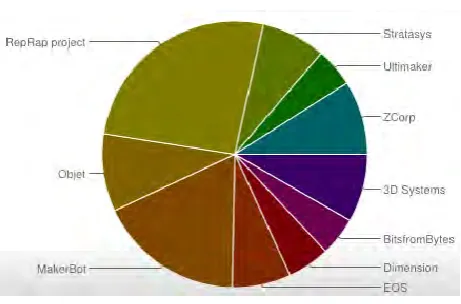
RepRap is the most popular 3D printer as shown in Figure 2.1 and it is awarded with the
most significant 3D-printed object in 2017 (RepRap.org, 2017). The increasingly uses of
[image:21.595.190.421.470.622.2]open source software had helped to reduce the software cost and cost of experimental science.
Figure 2.1: Survey on the 3D printing community (RepRap.org, 2017)
The RepRap community have successfully increased the popularity of 3D printing
8
The growth of the RepRap community had made the cost of owning a 3D printer become
much lower and more affordable by the public. Acrylonitrile butadiene styrene (ABS) and
polylactic acid (PLA) are the main materials used by the RepRap 3D printer as they have
lower melting point and more easily shaped (Tymrak, Kreiger, & Pearce, 2014). Nowadays,
a Prusa type 3d printer developed by RepRap can be available at a price below $1000 and
even cheaper if the users build the 3D printer themselves. This greatly increase the user based
of 3D printer owner (Gibson, Rosen, & Stucker, 2010).
The objectives of RepRap community are to encourage the public to design and build
3D printers by themselves. The RepRap 3D printer can be defined as a mechatronic device
which made up of a combination of stepper motor for 3D motion, frame and printed parts as
the support of the structure and an extruder used for melts the material to form the product.
It is designed to have the ability to self-duplicate as most of the parts can be printed by
another RepRap 3D printer. The operation of all the components of the RepRap printer is
coordinated and controlled by an open source micro-controller which is called Arduino
(Kentzer, Koch, Thiim, Jones, & Villumsen, 2011). Most of the RepRap 3D printers are
applying Fused Deposition Modelling (FDM) techniques where the thermoplastic filament
is heated and extruded through a nozzle to build up a part by using layer by layer
manufacturing technology (Romero et al., 2014).
In a nutshell, RepRap had provided the possibilities for the individual or public to
develop high value object produced at the mass production facilities (Gershenfeld, 2005).
9
household items and scientific instruments (Tymrak et al., 2014). It is also proved to be
useful in standard engineering, education, customizing scientific equipment, chemical
reaction ware, electronic sensors, wire embedding, tissue engineering and appropriate
technology-related product manufacturing for sustainable development (Wittbrodt et al.,
2013).
2.4 Fused Deposition Modelling
The FDM process was invented and patented by Scott Crump in 1988. After the
expiry of patents by Stratasys, the FDM become high accessible and adopted by most of the
users due to its lower cost of ownership as compared to other laser based AM technology
(Alabdullah, 2016). The FDM technology also has the benefit of simple maintenance and a
wide variety of materials with different mechanical properties available. FDM process offer
a lower economic and technological entry barrier to manufacturing one-off or small lots as
compared to traditional manufacturing such as injection moulding or machining (Mahmood,
Qureshi, & Talamona, 2018).
The FDM process start with the preparation of 3D drawings of the model by using
any computer aided design (CAD) software followed by slicing of CAD file to calculate a
path to extrude thermoplastic and generate the support material if necessary. The 3D printer
will then heat the thermoplastic to a semi-liquid state and deposits it in ultra-fine beads along
10
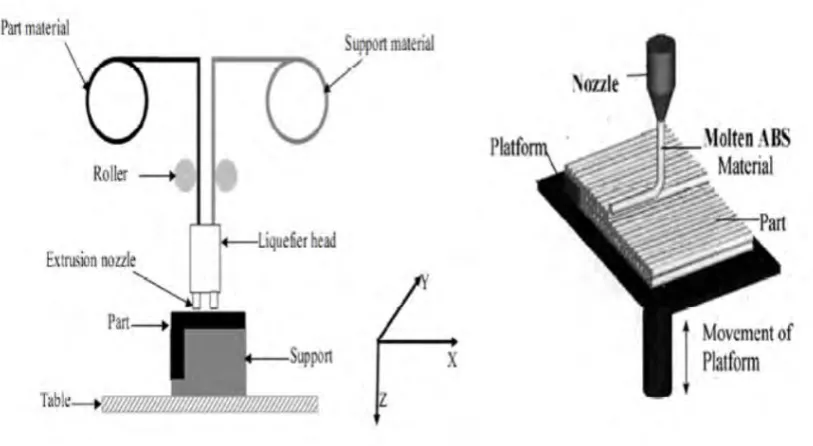
platform and post process will be applied to remove the support or improve the surface finish
(Surange & Gharat, 2016). The schematic diagram of the FDM process are shown in Figure
[image:24.595.100.507.182.405.2]2.2.
Figure 2.2: Schematic diagram of FDM process (Schmitt et.al., 2016)
According to Kuo et al. (2016), FDM technology have the advantages of clean,
simple-to-use, high processibility, low cost and facile manipulation which is suitable for both
household and industrial application. Besides, FDM process also have the advantages of easy
material change, low maintenance cost, quick production of thin parts, a tolerance equal to
±0.1 millimeters overall, no need for supervision, no toxic material, very compact size and
low operation temperature (Galantucci et al., 2015). Furthermore, FDM process has lower
energy consumption and lower total life cycle environmental impact as compared to SLA