Int. J. Electrochem. Sci., 7 (2012) 7253 - 7260
International Journal of
ELECTROCHEMICAL
SCIENCE
www.electrochemsci.org
Dye-Sensitized Solar Cell Utilizing Quasi One-Dimensional of
Highly Compact Vertical Array ZnO Nanorod
A.A. Umar1,*, M.Y.A. Rahman2,*, R. Taslim2, M.M. Salleh1
1
Institute of Microengineering and Nanoelectronics (IMEN), Universiti Kebangsaan Malaysia, 43600, Bangi, Selangor, Malaysia
2
College of Engineering, Universiti Tenaga Nasional, 43009, Kajang, Selangor, Malaysia *
E-mail: [email protected], [email protected]
Received: 9 May 2012 / Accepted: 12 June 2012 / Published: 1 August 2012
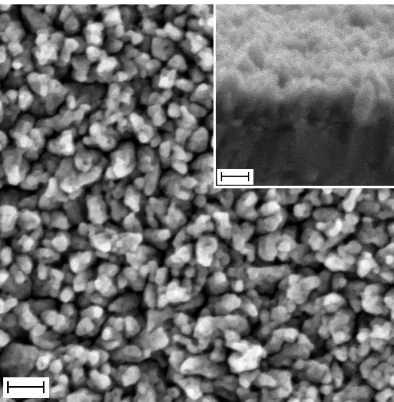
Highly compact quasi one-dimensional ZnO nanorods was synthesized for dye-sensitized solar cell of FTO/ZnO/electrolyte/platinum. ZnO nanorods were grown on FTO substrate at room temperature via ammonia assisted rapid hydrolysis process technique. The sample was grown throughout the substrate by multi-growth process for about 5-30 minutes. ZnO nanorods were characterized by FESEM with vertical array oriented with the average diameter and length of 48 nm and 220 nm, respectively. The (cis-bis(isothiocyanato)bis(2,2’-dicarboxylato)-ruthenium(II) bis-tertabutylammonium) (N719) dye was coated on the samples and utilized in the cell to improve its performance. The cell performance was tested in dark and under illumination of 100 mWcm-2 light. The cell exhibits photovoltaic effect with the Jsc of 0.45 mAcm-2, Voc of 0.56 V and FF of 24%.
Keywords: 1-D ZnO nanorod, Dye-Sensitized solar cell, N719 dye
1. INTRODUCTION
Researches on solar cell demonstrates a significant development since Gratzel introduced dye-sensitized TiO2 solar cell with the efficiency as high as 11% [1]. Since then, dye sensitized solar cell (DSSC) had a huge attention of many researchers to further improve the performance of the device. One of such options is by replacing TiO2 nanoparticle by nanorod, nanotube or nanowire [2-3], thereby eliminating the grain boundaries between nanoparticles [4].
utilizing ZnO nanorod with reasonably high performance, such as prepared by a one-step catalyst-free chemical-vapor deposition (CVD) method has demonstrated the conversion efficiency as high as 1.82% [6]. ZnO nanorod-based DSSC was prepared using another method, such as hydrothermal technique, has also been reported to produce the efficiency as high as 1.0%-1.69% [6-9]. Meanwhile, the DSSC utilizing ZnO nanorods prepared with a nucleation–dissolution–recrystallization growth technique has been reported to produce the efficiency as high as 1.32% [11]. The ZnO nanorods prepared using the technique as reported in [6] and other techniques [7-11] produced a dimension of several micron in length and diameter. The arrangement of the nanorod on the surface are relatively rare that exhibits high rod to rod separation. In other words, the number of nanorod over certain surface area is relatively low. Owing to the unique properties of ZnO nanorods in DSSC, the use of highly compact ZnO nanorods in the DSSC should presumably improve the performance of the cell.
Our previous work on ZnO nanorods that was grown from the current technique possesses good response in photoelectrochemical cell with the highest short-circuit current density, Jsc of 0.22 mAcm-2,the open circuit voltage, Voc of 0.44 V and the fill factor, FF of 30% [12]. In this work, we
demonstrate the dye sensitized solar cell of FTO/ZnO-dye/LiI-I2/platinum utilizing quasi one-dimensional highly compact ZnO nanorods prepared by a novel technique, namely, ammonia assisted rapid hydrolysis process at room-temperature [14]. The N719 dye (cis-bis(isothiocyanato)bis(2,2’-dicarboxylato)-ruthenium(II) bis-tertabutylammonium) was chosen to be coated on the ZnO nanorods since the TiO2 solar cell with this dye posses the conversion efficiency, η of 5.36% [15]. This paper describes the preparation of highly compact quasi one-dimensional ZnO nanorods by the above-mentioned technique. It also highlights the fabrication and performance study of the DSSC utilizing the ZnO samples prepared via this technique.
2. EXPERIMENTAL
ZnO nanoseeds on FTO surface were prepared by using an alcohol thermal seeding method adopting our previous method in preparing CuO nanowires and highly compact ZnO nanorod on FTO surface [13,14]. Briefly, the process is as follows: a thin layer of 0.01 M ethanoloic solution of zinc acetate dihydrate (Zn (CH3COO)2 2H2O, Across) on a clean FTO surface was firstly prepared by spin-coating process and annealed in air at 350oC for 1 hour. The room temperature growth process of ZnO nanorods from the nanoseeds was carried out by immersing the nanoseeds-attached FTO into a 0.01 M aqueous solution of zinc acetate dihydrate (Zn (CH3COO)2 2H2O, Aldrich). 100 µL of 30% Ammonia solution (NH3, Aldrich) was added into the reaction while being stirred with magnetic stirrer for 5 to 30 minutes, changing the growth solution every 5-6 minutes, and then the sample was annealed in air at 350 C for 30 hours.
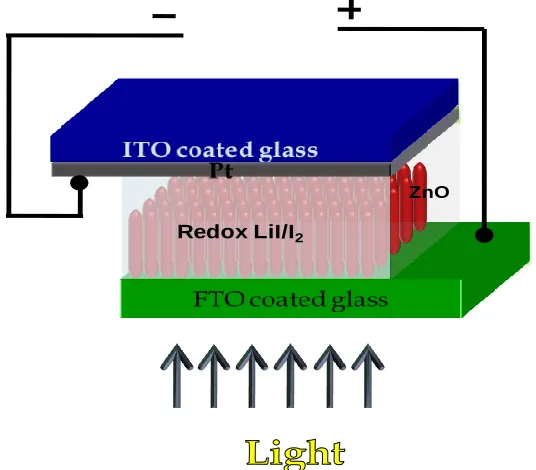
was placed on top and bottom of the clamped cell in order to avoid the cell from breaking. A 1.00 cm2 hole was made at the top of rubber band as an area of illumination. The structure of the cell is shown in Fig. 1.
The morphology of ZnO nanorods was characterized by a field emission scanning electron microscope (FESEM) model ZEISS SUPRA 55VP that was operated at an acceleration voltage of 3 kV. The optical property of ZnO nanorods on FTO surface was characterized using a double beam UV/VIS/NIR spectrophotometer model Lambda 900 Perkin Elmer. Photoluminescence (PL) was studied at room temperature with Perkin Elmer LS55 Luminescence Spectrometer. J-V curves in dark and under illumination were recorded by a Keithley high voltage source model 237.
Redox LiI/I2
[image:3.596.168.436.252.487.2]ZnO
Figure 1. Structure of the cell
3. RESULTS AND DISCUSSION
Figure 2. FESEM image of ZnO nanorods that was prepared via multiple growth-steps. Inset is the cross section of ZnO nanorod. Scale bar 100 nm
We measured room temperature PL properties of ZnO nanorods that was grown by this technique to study the typical spectra of ZnO crystal, which usually exhibits two strong emission peaks, near band edge (NBE) at 370-390 nm and green board-band at 510-550 nm, respectively. The ZnO nanorods was excited at 325 nm and an NBE peak U) peak of 380 nm and little peak around 500 nm were observed. The UV peak at room temperature is attributed to an NBE free exciton transition, namely, the recombination of a free exciton through an exciton–exciton collision. It has been suggested that high crystallinity is due to decrease of impurity and structural defects such as oxygen vacancy and dislocations. The green peak of ZnO is due to radiative recombination of a photo-generated hole with an electron attributed to an oxygen vacancy [15]. The amount of oxygen on the surface is expected to drastically change the green-band peak. The slight green emission that remained may have resulted from the surface defect as single ionized oxygen vacancy. It is generally agreed that the surface states play a crucial role in PL spectra of nanomaterials [17-18].
0 40 80 120 160
350 400 450 500 550 600 650 700
In
ten
si
ty
(a
.u
)
Wavelength (nm)
[image:4.596.204.401.70.271.2] [image:4.596.172.437.578.728.2]
Fig. 4 shows typical room-temperature optical absorption spectra of uncoated ZnO nanorods and ZnO nanorods coated dye of N179. Two-separated excitonic character appears, namely, A- and B-excitonic, in both spectrums. This normally appear only if the nanocrystals contains low defect density, in other word, high-crystallinity [14, 16]. It is also observed that the ZnO nanorods film coated dye shows the highest absorption compared with uncoated ZnO nanorods film at 320 nm.
0 0.5 1 1.5 2 2.5
320 400 480 560 640 720 800
A b so rb a n ce ( a .u ) wavelength (nm) No dye with dye A-Exciton B-Exciton
Figure 4. Typical UV-VIS optical absorption spectrum of ZnO nanorods and ZnO coated N179 dye
-0.50 -0.40 -0.30 -0.20 -0.10 0.00 0.10 0.20 0.30 0.40 0.50
-0.10 0.10 0.30 0.50 0.70 0.90
C u rr en t D en si ty (m A / c m 2) Voltage (V) Dark without dye with Dye
[image:5.596.157.465.183.429.2] [image:5.596.154.452.486.715.2]
The absorption decreases with the increasing wavelength for all samples until the wavelength of 380 nm. In the visible region (400 nm), the absorption of ZnO nanorods coated dye increases until the wavelength of 520 nm and started to decrease until wavelength 700 nm instead of the absorption of uncoated ZnO nanorods. This result is in good agreement with that previously reported [19] on the optical behaviour of ZnO nanorods film and Cds quantum dot on ZnO nanorods prepared by wet chemical process assisted methods. From the figure, the absorption peak was not observed for uncoated ZnO nanorods film but the peak occurs for coated ZnO nanorod film occurs at the wavelength of 520 nm and it is expected to give the best performance when utilized in a photoelectrochemical cell.
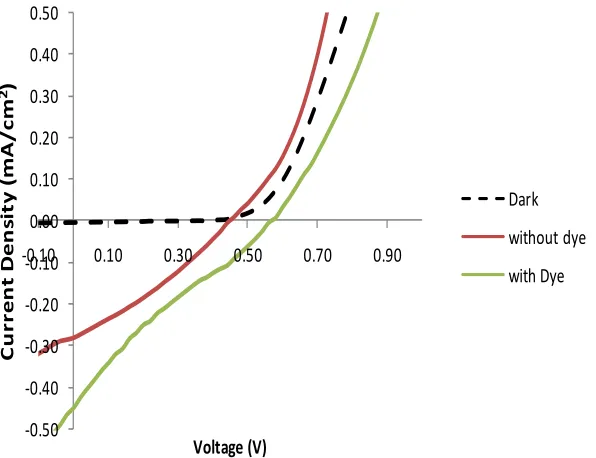
Table 1. Photovoltaic parameters of the solar cell with and without dye
Cell Jsc (mAcm-2) Voc (V) FF (%)
Uncoated ZnO 0.28 0.44 30
ZnO coated N719 dye 0.45 0.56 24
Fig. 5 shows the current density-voltage curve for the ZnO photoelectrochemical cell in dark and under illumination at room temperature. The device shows rectification property in which the current is dominant in one direction that is in forward bias [20]. Table 1 shows the photovoltaic parameter of the device utilizing ZnO nanorods that have been synthesized by the specified technique. There were two ZnO samples, namely, uncoated ZnO nanorod and ZnO coated N719 dye. It can be seen that the highest short-circuit current density, Jsc is 0.45 mAcm-2 and open circuit voltage, Voc is
0.56 V obtained from the cell utilizing ZnO nanorods coated dye and its Jsc was 60.7% higher than that
illumination. However, ZnO nanorod that was grown by the present technique is very promising technique since the preparation is simple, quick and economical.
4. CONCLUSIONS
We have successfully prepared ZnO nanorod with a simple method of ammonia assisted rapid hydrolysis process technique and fabricated a solar cell of FTO/ZnO-dye/electrolyte/platinum. The performance has been tested in dark and under illumination of 100 mWcm-2 light. The device shows rectification property and the photovoltaic effect under illumination, with the best Jsc of 0.45 mAcm-2, Voc of 0.56 V and FF of 24%. This result was 40% higher than the cell without dye as photo-sensitizer.
ACKNOWLEDGEMENTS
We acknowledge the support from the Universiti Tenaga Nasional and Ministry of Science and Technology and Innovation Malaysia under Science Fund 03-02-03-SF0196, TWAS COMSTECH No: 09-109RG/REN/AS.C_UNESCO FR: 32402J1214 and Universiti Kebangsaan Malaysia and Ministry of Higher Education of Malaysia under research grant UKM-GUP-NBT-08-25-086 and UKM-RRR1-07-FRGS0037-2009.
References
1. M. Gratzel, Nature, 414 (2001) 338.
2. M. Adachi, Y.Murata, I. Okada and S. Yoshikawa, J. Electrochem. Soc., 150 (2003) G488. 3. D¨urr, A. Schmid, M. Obermaier, S. Rosselli, A. Yasuda and G. Nelles, Nature Mater., 4 (2005)
607.
4. N. Kopidakis, K.D. Benkstein, J.van dL and A.J. Frank, J. Phys. Chem. B., 41 (2003) 11307. 5. L.Yang, Z. Zhang, S. Fang, X. Gao and M. Obata, Solar Energy, 81 (2006) 717.
6. M. H. Lai, M. W. Lee, Gou-Jen Wang and M. F. Tai, Int. J. Electrochem. Sci., 6 (2011) 2122. 7. I. Gonzales-Valls, Y. Yu, B. Ballesteros, J. Oro and M. Lira-Cantu, J. Power Sources, 196 (2011)
6609.
8. P. Charoensirithavorn and S. Yoshikawa, in: Dye sensitized solar cell based on ZnO nano arrays, The 2nd Joint International Conference on, “Sustainable Energy and Environment (SEE 2006), Bangkok, Thailand (2006).
9. M.F. Hossain, T. Takahashi and S. Biswas, Electrochem. Comm., 11, (2009) 1756.
10.C. Y. Jiang, X. W. S., G. Q. Lo, D. L. Kwong and J. X. Wang, App. Phys. Lett., 90 (2007) 263501. 11.Z. L. S. Seow, A. S. W. Wong, V. Thavasi, R. Jose, S. Ramakrishna and G. W. Ho,
Nanotechnology, 20 (2009) 045604.
12.R. Taslim, M.Y.A. Rahman, A.A. Umar and M.M. Salleh, Advanced Materials Research, 364 (2012) 293.
13.A.A. Umar and M. Oyama, Crystal & Growth Design, 7 (2007) 2404.
14.A.A. Umar, M.Y.A. Rahman, R. Taslim and M.M. Salleh, Nanoscale Research Letters, (2011), 6: 1.
16.G.H. Lee, Solid State Comm., 128 (2003) 351.
17.K. Vanhusden C.H. Seager, W.L. Warren, D.R. Tallant and J.A. Voigt, Appl. Phys. Lett., 68 (1995) 403.
18.J. Lee , J. Chung and S. Lim, Physica E, 42 (2010) 2143.
19.Lee W, Min S K, Dhas V, Ogale S B and Han S.-H, Electrochem. Comm., 11 (2009) 103. 20.M.Y.A. Rahman, M.M. Salleh, I.A. Talib and M. Yahya, Curr. Appl. Phys., 5 (2005) 599.