Automatic Group Learning
.
White Rose Research Online URL for this paper:
http://eprints.whiterose.ac.uk/129377/
Version: Accepted Version
Article:
Checco, A. orcid.org/0000-0002-0981-3409, Bianchi, G. and Leith, D.J. (2017) BLC:
Private Matrix Factorization Recommenders via Automatic Group Learning. ACM
Transactions on Privacy and Security, 20 (2). ISSN 2471-2566
https://doi.org/10.1145/3041760
Reuse
Unless indicated otherwise, fulltext items are protected by copyright with all rights reserved. The copyright exception in section 29 of the Copyright, Designs and Patents Act 1988 allows the making of a single copy solely for the purpose of non-commercial research or private study within the limits of fair dealing. The publisher or other rights-holder may allow further reproduction and re-use of this version - refer to the White Rose Research Online record for this item. Where records identify the publisher as the copyright holder, users can verify any specific terms of use on the publisher’s website.
Takedown
If you consider content in White Rose Research Online to be in breach of UK law, please notify us by
BLC: Private Matrix Factorization Recommenders via Automatic
Group Learning
Alessandro Checco, School of Computer Science and Statistics, Trinity College, Dublin, Ireland.
Giuseppe Bianchi, School of Engineering, Università di Roma “Tor Vergata”, Rome, Italy.
Douglas J. Leith, School of Computer Science and Statistics, Trinity College, Dublin, Ireland.
We propose a privacy-enhanced matrix factorization recommender that exploits the fact that users can often be grouped together by interest. This allows a form of “hiding in the crowd” privacy. We introduce a novel matrix factorization approach suited to making recommendations in a shared group (or nym) setting and the BLC algorithm for carrying out this matrix factorization in a privacy-enhanced manner. We demonstrate that the increased privacy does not come at the cost of reduced recommendation accuracy.
Additional Key Words and Phrases: Matrix Factorization, Recommender Systems, Privacy, Clustering
1. INTRODUCTION
In a classical recommender system a set of users rate a set of items and these ratings are then used to predict user ratings for those items which they have not yet rated, see Figure 1. The ratings supplied by each user are tagged with the user identity, e.g. via a browser cookie, and so the ratings are individually identifiable. This raises obvious privacy concerns, whereby an attacker observing the item ratings submitted by each user may learn information which the user does not wish to disclose. Such an attacker might observe the rating by sniffing the network path between a user and the recommender system or, more likely, may be the recommender system itself so that encryption of the network traffic does not constitute a defence.
It is well known that users can often be grouped together by e.g. interest in sport, type of movie or choice of partner, and indeed this underpins most advertising cam-paigns. While such grouping is often carried out manually, there has also been interest in automated inference of abstract groups and it is such unsupervised automated in-ference of abstract groups that we pursue in the present paper. Namely, we start with the observation that the existence of abstract group structure raises the potential to use a group identity when submitting ratings to a recommender system instead of an individual user identity, and in this way provide a form of “hiding in the crowd” privacy. One key challenge, which we fully resolve here, is to provide accurate recom-mendations to a user without requiring the user to disclose their personal ratings to the recommender system. This is essential to protect against the type of privacy disclo-sure attack considered here. Another challenge is the selection of appropriate abstract
(1,1,1) (1,4,3) (2,2,5) (2,3,2) user 1
user 2
(user, item, rating) tuples
recommender system
(a)
items
users
1 − 3 − − 5 2 − 3 − − 5 3 − − 4
(b)
Fig. 1. Illustrating classical recommender system setup. Each user submits ratings for a set of items, where
this set may be different for each user, the ratings being tagged with the user identity, see left-hand plot (a). The submitted (user,item rating) pairs can be gathered into a matrixR, see right-hand plot (b), and the aim of the system is to predict the missing values, indicated by−.
groups that yield good prediction accuracy while being shared by a sufficiently large number of users so as to provide a degree of privacy. In this paper we demonstrate that this is indeed possible for interesting, real data sets and consequently that the gain in privacy need not come at the cost of reduced recommender prediction accuracy.
In more detail, we introduce a set of artificial pseudo-identities, referred to as prox-ynyms(or, in short, nyms), with which users access the recommending service. These nyms differ from ordinary pseudonyms in that the same nym is shared by many users. From the point of view of the system, therefore, it receives a sequence of item ratings from each ofpnyms rather than fromnusers. To make this setup work two main tasks must be addressed: (i) each user must privately select an appropriate nym when sub-mitting ratings and (ii) the received collection of nym-item ratings must be capable of being used to make accurate predictions of the user ratings. Observe that these two tasks are coupled and must be solved in a joint manner i.e. the set of users selecting a nym must share enough in common to permit accurate predictions to be made when only nym-item ratings are observed. Further, unlike in the classical setup the same item may often be rated multiple times by a nym, since multiple users share the nym, and the nyms are not all equally “important” since one may be shared by many more users than another.
In order to make recommendations we build on existing matrix factorization ap-proaches in which the matrixRof user-item ratings (see Figure 1(b)) is decomposed
as a productUTV, where the row dimension of matrixU and matrixV is much less
than the numbers of users and items. The user-nym selection and nym-item matrix factorisation tasks can be viewed as decomposing then×muser-item rating matrixR
asPTU˜TV wheren×pmatrixPT maps from users to nyms. The elements ofP are
{0,1}valued andP is column stochastic (the columns sum to one) so that each user is
a member of a single nym (extension to multiple nym membership is of course possi-ble). One of our main contributions is the observation that by use of the BLC algorithm it is in fact possible to carry out thisP, U˜,V decomposition in a privacy-enhancing
manner, without the need for sophisticated cryptographic methods.
At the cost of introducing a more complex factorisation task, we find that prediction performance competitive with the state of the art can be obtained using this approach, especially when the user rating matrixRis sparse (as it usually is). That is, the
in-creased privacy does not come at the cost of reduced recommendation accuracy. Indeed, we show that it can yield improved accuracy over classical matrix factorisation. As al-ready noted, this is perhaps unsurprising since, when nyms are chosen appropriately, users sharing a nym can usefully leverage their shared ratings/preferences in a more direct way than in classical collaborative filtering, where such leverage can become apparent only when the dimension of the latent space is very small. Further, we find that the projectionP provides a useful form of regularisation that greatly reduces the
sensitivity of performance to the choice of hyperparameters. While more computation-ally demanding that the standard matrix factorisation approach, BLC is still efficient and highly scalable.
2. RELATED WORK
The potential for privacy concerns in recommender systems is well known, e.g. see [Lam and Riedl 2004; Calandrino et al. 2011; Shyong et al. 2006; Ding et al. 2010; Narayanan and Shmatikov 2006] and references therein.
Many existing approaches to making private recommendations are based on encryp-tion and multi-party computaencryp-tion [Guha et al. 2011; Li et al. 2011; Aïmeur et al. 2008; Nikolaenko et al. 2013; Canny 2002] and are essentially clean-slate designs (not back-ward compatible with existing recommender systems). In [Nikolaenko et al. 2013], a trusted cryptographic service provider performs an encrypted version of the ma-trix factorization task used to calculate recommendations. In [Aïmeur et al. 2008], the user data is split between the merchant and a semi-trusted third party; if these two actors do not collude, the cryptographic system proposed allows user recommenda-tions to be calculated without exposing private information. In [Li et al. 2011], content ratings and item similarity data are determined via distributed cryptographic multi-party computation, recommendations are then generated based on interest groups and further personalised at each user’s local machine. In the special case where the recom-mender system’s task is to select which adverts to display, another approach [Guha et al. 2011] is for the web system to supply a large set of possible adverts to the user and for the user’s browser to then privately make the recommendation decision as to which adverts are actually displayed. In [Canny 2002], a privacy-preserving scheme for a Singular Value Decomposition (SVD) based CF algorithm is introduced.
Another strand of work on privacy-enhanced recommender systems improves pri-vacy by perturbing ratings with noise. Initially proposed by [Agrawal and Srikant 2000] it is applied to collaborative filtering by e.g. [Huang et al. 2005; Kargupta et al. 2003; Polat and Du 2005].
Perhaps the closest to the present work is that of [Shokra et al. 2009] who propose a peer to peer system for submitting aggregated ratings to a central recommender system. In [Nandi et al. 2011] a middleware framework for supervised aggregation is discussed but recommender performance is not considered. In [Narayanan and Shmatikov 2006], a technique the distributed aggregation of online profiles is pre-sented, but it requires a certain level of trust and co-ordination between users, and being peer-to-peer, privacy and recommendation quality strongly depend on the user connectivity.
Clustering of users in recommender systems in general is not new. In [Ungar and Foster 1998; Xue et al. 2005; Hofmann 2004] a range of techniques (K-means and Gibbs sampling, a cluster-based smoothing system, and a cluster-based latent seman-tic model respectively) are proposed which cluster users and items in an unsupervised manner. However, these are not suited to implementation in a distributed and private manner. Clustering with matrix factorization methods has received much less atten-tion to date, with the notable excepatten-tion of [Ding et al. 2006], and subsequent work building on this, in which an orthogonal non-negative matrix tri-factorization method is introduced. In [Zhu et al. 2014] it is observed that users with a few ratings can leverage the presence of users with many ratings to improve prediction accuracy, and in [Xin and Jaakkola 2014] considers a semi-private variant where private users can leverage the presence of public users with many ratings.
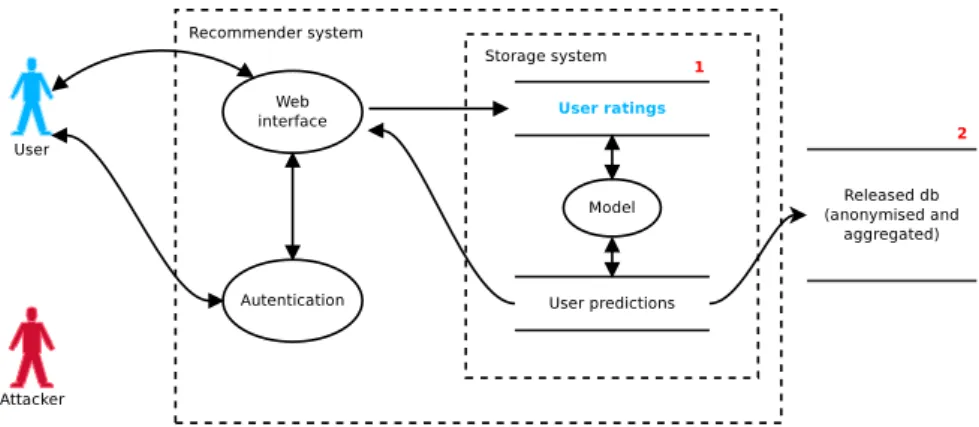
Fig. 2. Data flow diagram of the system scenario with two possible points of attack.
in the use of user preferences and/or social information, and in how such information is accounted when making recommendations for groups (or even settling disagree-ments between group members [Shang et al. 2011]). BLC isnota group recommender in the meaning above; it is anindividualmatrix factorization recommender that ad-ditionally clustersusers into groups to improve the recommender’s accuracy. In this sense, and putting aside our main privacy goal, BLC may be considered closer, in its scope, to content-boosted [Nguyen and Zhu 2013] or category/topic-based [Zhou et al. 2014; Wang et al. 2012] recommenders, and to a greater extent closer to information matching approaches [Gorla et al. 2013], which show that (probabilistic) matrix fac-torization approaches can be improved by adding information on content categories or user groups (which are built using user attributes or features). However, we stress that, unlike these works, wedo not exploit any exogenous information such as user preferences of item categories, and we do not boost the recommender with an a priori computed group structure, but we try tolearngroups through the own users’ ratings, and we do thiswhileperforming the matrix factorization.
3. THREAT MODEL
The privacy disclosure scenario we consider arises naturally from attacks which have already occurred on production recommender systems [Narayanan and Shmatikov 2006]. Figure 2 illustrates the setup. A user sends encrypted ratings and receives rec-ommendations through an authentication based system. The user ratings are kept in the system storage, where more manipulation is needed to generate the recommenda-tions. The recommender system can also decide to release an anonymised/aggregated version of the database. We imagine two main types of attack/threats1:
(1) The attacker has access to a leaked version of the user ratings database held by the recommender system.
(2) The recommender system can decide to release an anonymised version of the user ratings database.
It is important to notice that the sensitive asset here is the stream of pairs of unique IDs and ratings. Knowledge of these potentially places two sorts of information at risk: (i) the mapping from ID to true user identity (which may be of interest in its own right) and (ii) the ratings submitted by the user being targetted for attack. When a
single user is associated with each ID, then since the rating profile associated with each ID is often unique there is a risk that the association of a user with an ID may be inferred by de-anonymisation using external data [Datta et al. 2012; Aggarwal 2005]. In this case both the mapping from ID to user identity and the ratings submitted by a user are then simultaneously compromised.
With this kind of attack in mind, our interest is instead in the situation where mul-tiple users are associated with each ID. This changes matters significantly. Firstly, consider an attack that aims to learn the mapping from ID to true user identity. When an ID is shared bykusers then the collection of (item, rating) pairs associated with that ID is now a mixture of ratings from thekdifferent users. Provided the kusers sharing an ID submit sufficiently different sets of (item, rating) pairs then this attack can be expected to involve a harder inference task than when an ID is used by a single user. This is because the (item, rating) pairs submitted by the other users sharing the ID now act as “noise” that tends to mask the pattern of (item, rating) pairs submitted by the user being targetted. Of course, if the users sharing an ID submit sets of rat-ing which are too similar to each other then the protection against de-anonymisation provided by this direct mixing mechanism may be reduced, in which case additional measures can be envisioned e.g. inserting dummy ratings or other “noise” to increase diversity.
Secondly, when multiple users are associated with each ID then linking a user to an ID no longer immediately reveals that user’s ratings, or even the more limited in-formation consisting of the set of items rated by that user2. To see this, suppose for a particular item that onlynof the kusers sharing an ID have rated that item. Then an attacker does not learn whether the user of interest belongs to the set ofnusers who have rated that item or the set of k−n users who have not. It is only when all users sharing an ID rate a particular item, i.e.nequalskfor that item, that the attacker learns that the target user has rated that item. Even in that case the at-tacker does not learn the rating submitted by the user unless all users sharing the ID also rate the item identically. This direct “hiding in the crowd” mechanism might be further strengthened, if needed, by users additionally submitting a number of auto-mated/dummy (item,rating) pairs selected at random – then, even when an item rated by all users sharing an ID, any individual user has a degree of plausible deniability in that they can claim that their rating for that item was an automated/dummy one.
It can be seen that associating multiple users with each ID in a recommender sys-tem not only potentially makes the considered de-anonymisation attacks harder to carry out but also creates the foundation upon which a number of still stronger mech-anisms for enhancing privacy can be built. Supporting shared IDs, which we refer to as nyms, while still providing useful recommendations is also the main technical chal-lenge (inserting dummy ratings etc is relatively straightforward) and in the following sections we demonstrate that this can indeed be achieved.
3.1. Dishonest Users and Sybil Attacks
Attacks by dishonest users who submit false ratings in an attempt to manipulate the recommendations made by the system are outwith the scope of the present paper. Of course this is an important challenge for all recommender systems, but it is not specific to the approach presented here. That said, the use of shared IDs/nyms does potentially facilitate Sybil attacks and so we briefly describe one mechanism, based on the work
of [Chaum et al. 1990], by which such attacks can be disrupted while making use of nyms. In summary, each user mints a number of session tokens (with associated serial number), blinds them with a secret blinding factor and forwards them to the recommender system through a non-secure channel. The number of tokens available to a user is limited e.g. by requiring users to authenticate or make payment to the service in order to forward a token, or perhaps by limiting the number of tokens allowed within a certain time window. Note that during this phase the user might be identified to the system, e.g. to make a payment. The system then signs the tokens with its private key, without knowledge of the serial number associated with the tokens. On receiving the signed tokens back from the recommender system, the user can remove the blinding factor and use the tokens to submit ratings to the system anonymously. Double use of tokens is prevented by the system maintaining a database of the serial numbers of all tokens that have been issued.
4. MAPPING USERS TO NYMS
BLC decomposes the user-rating matrixRasPTU˜TV. The primary challenges are (i)
finding an appropriate assignment of users to nyms i.e. the selection of matrixP and
(ii) the calculation of this assignment in privacy-enhanced manner.
4.1. Statistical Model
As in classic matrix factorization approaches, let vectorUu∈Rdassociated with user
ucapture the users preferences in the latent feature space of dimensiond, and gather these vectors together to form matrixU ∈ Rd×n. Similarly, let vectorVv ∈Rd
asso-ciated with resource v capture its features in the latent space and we gather these vectors together to form matrixV ∈Rd×m. The rating of itemvby useruis Gaussian
random variable with meanUTuVvand the matrix of ratings of all items by all users
is therefore a Gaussian random variable with meanUTV.
Let us now depart from the usual setup by further assuming that users belong to distinct groups.
ASSUMPTION1 (NYMDECOMPOSITION). Matrix U can be decomposed as U =
˜
U P whereU˜ ∈Rd×pandP ∈Rp×n.
We can think of vector U˜g ∈ Rd, g = 1,· · ·, pas the preference vector associated
with a group of users. The preference vectors of the users belonging to that group can then be viewed as random variables with meanU˜g. We refer to each groupgas anym.
MatrixP then maps from nyms to users, withu’th columnPu∈RpofP defining the
mapping from the nyms to useru.
The rating supplied by userufor resourcevis a Gaussian random variableXRuv ∈R
with meanUT
uVv= (U P˜ u)TVvand varianceσ2. That is,
P rob(XRuv =Ruv|U˜,V;P)∼e
−φuv(Ruv)/σ2
whereφuv(Ruv) := (Ruv−PTuU˜ T
Vv)2. Gathering the user ratings into random matrix XZ ∈ Rn×m, let O ⊂ {1,· · ·, n} × {1,· · ·, m} denote the set of user-resource rating
pairs that are contributed by the users. LettingZO = {XRuv,(u, v) ∈ O} andRO =
{Ruv,(u, v)∈ O}, the conditional distribution over these observed ratings is,
P rob(ZO=RO|U˜,V;P) :=p(RO|U˜,V;P)∼
Y
(u,v)∈O
The posterior distribution is
p(U˜,V|RO;P) = p(RO|U˜,V;P)p(U˜)p(V)
p(RO)
and so the log-posterior is
logp(U˜,V|R
O;P) =− 1
σ2
X
(u,v)∈O
φuv(Ruv)−
1 σ2 ˜
U
trU˜TU˜− 1
σ2
V
trVTV +C (1)
whereCis a normalising constant and we have assumed Gaussian priors forU˜ andV
with zero mean and varianceσ2 ˜
Uandσ
2 ˜
V, respectively.
4.2. Private Nym-Based Matrix Factorization
Use of nyms aside, the log-posterior expression (1) is of the standard form widely used in the matrix factorization recommender literature. To find the matricesU˜,V
max-imising logp(U˜,V|RO;P) requires knowledge of the rating Ruv made by each user
and when this can be linked to the user identity, e.g. via a cookie, then this is evi-dently non-private. However, when the user ratings possess a nym structure we have the following key observation:
LEMMA4.1 (EQUIVALENCE OF LOG-POSTERIOR). Let
U(v) = {u : (u, v)∈ O}be the set of users rating itemv, andV = {v : (u, v)∈ O, u ∈ {1,· · ·, n}}the set of items for which ratings are observed. Suppose matrix Λ(v) := P
u∈U(v)PuP
T
u is non-singular. Then matricesU˜,V maximise log-posterior(1)if and only if they maximise
log ˜p(U˜,V|RO;P), i.e.
arg max
˜
U,V
logp(U˜,V|R
O;P) = arg max ˜
U,V
log ˜p(U˜,V|R
O;P) (2)
where
log ˜p(U˜,V|RO;P) =−
1 σ2
X
v∈V
(R˜v−U˜TVv)TΛ(v)(R˜v−U˜TVv)− 1
σ2 ˜
U
trU˜TU˜− 1
σ2
V
trVTV (3)
andR˜v=Λ−1(v)P
u∈U(v)RuvPu.
PROOF. Lettingψ:=− 1
σ2 ˜
U
trU˜TU˜− 1
σ2
Vtr
VTV, then
arg max
˜
U,V
logp(U˜,V|R
O;P) = arg max ˜
U,V
X
(u,v)∈O
(Ruv−(U P˜ u)TVv)2+ψ (4)
(a) = arg max
˜
U,V
X
(u,v)∈O
−2Ruv(U P˜ u)TVv+ ((U P˜ u)TVv)2+ψ
= arg max
˜
U,V
X
v∈V X
u∈U(v)
−2RuvPTuU˜ T
Vv+VTvU P˜ uPTuU˜TVv+ψ,
where(a)follows from the fact thatR2
uv does not depend on U˜ orV. Hence, letting
ˆ
Rv:=P
u∈U(v)RuvPuand using the fact thatΛ(v)is non-singular, we have that arg max
˜
U,V
logp(U˜,V|RO;P) = arg max ˜
U,V
X
v∈V
−2 ˆRTvU˜ T
Vv+VT vU˜
X
u∈U(v)
PuPT uU˜
T
Vv+ψ
= arg max
˜
U,V
X
v∈V
−2RˆT vU˜
T
(b) = arg max
˜
U,V
X
v∈V
ˆ
RTv(Λ(v)−1)TRˆv−2RˆTvU˜TVv
+ (U˜TVv)TΛ(v)U˜TVv+ψ (6)
= arg max
˜
U,V
log ˜p(U˜,V|R
O;P), (7)
where(b)follows from the fact thatRˆT
v(Λ(v)−1)TRˆvdoes not depend onU˜ orV.
The condition thatΛ(v)is non-singular requires that the set of users rating itemvis non-degenerate in the sense that every nym is used by at least one user (no zero rows inΛ(v)) and the vectors of user assignments to each nym are linearly independent (the nyms are distinct).
By Lemma 4.1, matricesU˜,V maximisinglog ˜p(U˜,V|RO;P)in (3) also maximises
the log-posterior (1). As we will discuss in more detail shortly, the importance of Lemma 4.1 is that finding matricesU˜,V maximising (3) only requires observations of
nym ratingsR˜vand matricesΛ(v),∀v. That is, doesnotrequire that individual user
ratings are observed by the recommender system.
Of particular interest is the special case where users are each assigned to a single nym, and so the columnsPuof matrixPhave a single non-zero element (corresponding
to the nym chosen) equal to 1. In this case matrix Λ(v) is a diagonal matrix with elementΛ(v)gg equal to the number of users who rate itemv using nymg and nym
rating vectorR˜v has elementg equal to the average of the ratings for element v by
users in nymg. Using Lemma 4.1 we then have:
THEOREM4.2 (PRIVATENYMFACTORIZATION). SupposeΛ(v)is diagonal. LetU¯
andV satisfy
˜
UT
g=
X
v∈V
Λ(v)ggR˜gvVTv
σ2 σ2 ˜
U
I+X
w∈V
Λ(w)ggVwVTw
!−1
(8)
VT
v =R˜ T vΛ(v)U˜
Tσ2
σ2
V
I+U˜Λ(v)U˜T
−1
. (9)
ThenU˜,V is a stationary point of (3).
PROOF. Recall that trVTV = P
v
P
i(Vvi)2 and so the derivative with respect to
vectorVv is2VT
v. Observe also that the derivative of(R˜v−U˜ T
Vv)TΛ(v)(R˜v−U˜TVv)
with respect to vector Vv is −2U˜Λ(v)(R˜v −U˜TVv). Hence, differentiating (3) with
respect toVvyields
2
σ2U˜Λ(v)(R˜v−U˜
T
Vv)− 2
σ2
V
Vv (10)
Setting this equal to zero and rearranging yields (9). Similarly, differentiating (3) with respect toU˜gand setting equal to zero yields (8).
It follows from Theorem 4.2 that to determine the matrices U˜, V maximising
log ˜p(U˜,V|RO;P) all that it is required for the recommender system to know is (i)
the average ratings for each nym-item pair (namely, matrixR˜) and (ii) the number of
Regarding the nym to user mappingP, observe that the log-posterior is separable
in the columns ofP,
max
P logp( ˜
U,V|RO;P) = min P
X
(u,v)∈O
(Ruv−PTuU˜ T
Vv)2
= X
u∈U
min
Pu X
v∈V(u)
(Ruv−PTuU˜ T
Vv)2, (11)
whereU = {u : (u, v) ∈ O, v ∈ {1,· · ·, m}}is the set of users providing ratings and, V(u) ={v: (u, v)∈ O}is the set of items rated by useru. Hence, we can find mapping
P for each useruindividually by solvingminP
u P
v∈V(u)(Ruv−PTuU˜ T
Vv)2. Provided
the nym-item factorization matricesU˜,V are made available to users by the
recom-mender system, this optimisation can be carried out privately by each user on their own computer using their locally stored ratingsRuv. There is no need to release the
individual user ratingsRuvto the recommender system or to other users.
4.3. BLC Algorithm
The foregoing observations suggest an iterative algorithm that seeks to maximise the log posterior (1) by alternating between the following two steps:
(1) Using the current estimates for the matrix of average nym-item ratingsR˜ and the
numberΛ(v)of users in each nym who rate itemv, estimateU˜,V via Theorem 4.2.
(2) Given the current estimates forU˜, V each user uprivately updates their column PuinP by solvingminP
u∈I P
v∈V(u)(Ruv−PTuU˜ T
Vv)2whereI ={ei, i= 1, p},ei
the vector for which elementiequals1and all other elements equal to0. This opti-misation can be trivially solved by simply calculating the objective for each element in (small) setIand selecting the lowest valued. The updatedR˜andΛ(v)are then
shared with the recommender system.
This two-stage process is given in more detail in Algorithm 1. At each iteration, each vectorU˜g of nymsgthat are used by at least one user is updated using the current
estimate ofV. ThenV is updated using the current value ofU˜. This is repeated until
the improvement in the log-posterior falls below toleranceǫ. The users then update their choice of nym privately in a distributed manner andR˜,Λ(v)are then updated
accordingly.
4.4. Convergence
Since each update in Algorithm 1 is either a descent step or minimisation step, the algorithm is convergent and, in particular, we have:
THEOREM4.3 (CONVERGENCE OFBLC ALGORITHM). Suppose U˜ andV remain
bounded. Then the sequence generated by the alternating updates(8)and(11) conver-gences to a point of −log ˜p(U˜,V|RO;P)that is stationary for U˜ and V and a local
minimum forP.
PROOF. See Appendix.
4.5. Discussion
4.5.1. Privacy-Preserving Calculation ofR˜,Λ(v).Once users have updated the columns of
Algorithm 1BLC Nym Recommender
loop
InitialiseE,∆← ∞,U˜ ← N(0, σ),V ← N(0, σ)
whileE∆> ǫdo{Block 1. System factorization}
forg= 1, . . . , p do
ifP
v∈VΛ(v)gg>0then
˜
UT
g←
P
v∈V
Λ(v)ggR˜gvVTv
σ2 σ2 ˜
U
I+P
w∈V
Λ(w)ggVwVTw
−1
end if end for
for allv∈ Vdo
VT
v ←R˜ T vΛ(v)U˜
T
σ2 σ2
V
I+U˜Λ(v)U˜T
−1
end for
ˆ
E←log ˜p(U˜,V|RO;P)
∆← |Eˆ−E|,E←Eˆ
end while
for allu∈ Udo{Block 2. User private nym choice}
Pu←minX
u∈I P
v∈V(u)(Ruv−XTuU˜ T
Vv)2
for allv∈ V(u)do
Λ(v) =P
u∈U(v)PuPTu end for
˜
Rv=Λ−1(v)P
u∈U(v)RuvPu∀v∈ V end for
end loop
This can be readily carried out in a privacy preserving manner and without the need for communication amongst the users.
To see this, consider first a simplified batch update where at each iteration users re-submit their ratings using their current choice of nym. Assuming users access the sys-tem via an appropriate anonymising connection, e.g. via Tor [Dingledine et al. 2004], then this update need not reveal the user identities. Given these ratings, the matrix
˜
Rof average item ratings by each nym can be immediately determined by the
rec-ommender system. The number of users sharing each nym can also be estimated, e.g. by counting the number of ratings for each item (assuming that each user submits at most one rating for each item, multiple ratings for an item provide an indication of the number of users sharing the nym). The extension of this to online submission of ratings is now straightforward. This setup is illustrated schematically in Figure 3.
4.5.2. Scalability.The BLC algorithm has favourable characteristics from the point of view of scalability. Firstly, the nym-item rating matrixR˜which needs to be factorized
is of dimensionp×m. In comparison, the user-item rating matrixRis of dimension
n×m. Hence, the work scales with the number of nymsprather than the number of usersnand we expect p ≪n(as we show in Section 5, in real scenariosn > 70 000 andp <200). Secondly, the nym-user mapping matrixP is of dimensionp×nbut each
column is updated by a separate user in a fully distributed manner, with no message passing or other co-ordination required between users. Hence, the update ofPis of the
U, V ~
system
(rating, nym) pairs
arg min Σv(Ruv - Xu
TUTV
u)
2
Xu
~ Pu
1. Privately select nym
2. Submit ratings using nym identity
user u
1. Estimate Λ(v) 2. Calculate ~R
3. Factorize ~R as UTV
Fig. 3. Illustrating partitioning of operations in Algorithm 1 into a private user component and a public
sys-tem component, with exchange only of nym-related information between both (no exchange of individually-identifying user data).
5. EXPERIMENTS USING SYNTHETIC DATA
We begin by using synthetic data sets where, by construction, we know ground truth regarding the number of nyms and so can evaluate the performance of the BLC algo-rithm against this. The setup considered in this section is intentionally tightly con-trolled so that we can vary one aspect at a time and study its impact. The performance with real ratings data will be considered later. We compare BLC with the classic matrix factorization algorithm [Koren et al. 2009].
5.1. Synthetic Data
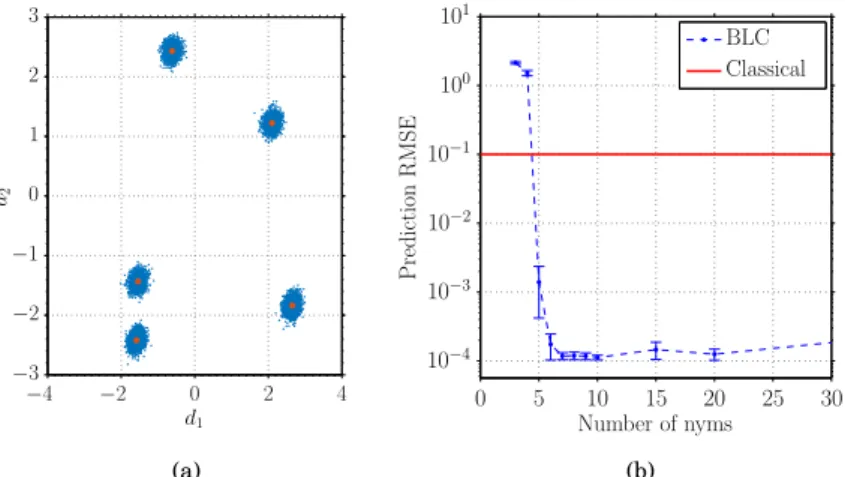
To generate a data set withpuser groups we i) select p points in theddimensional feature space as “group centres”, and ii) randomly drawn/psimulated users for each group, with position drawn from a Gaussian distribution with mean equal to the group position, and variable standard deviation. For instance, withp = 5 and a standard deviation equal to0.01, the users are tightly clustered around each of the group centres as illustrated in Figure 4a. We generate item matrixV by drawing its elements from a
Gaussian distribution, and thus obtain the full user-item matrixRasUTV. We then
remove entries u.a.r. fromRto reach a desired degree of sparsity.
5.2. Performance vs Number of Nyms
Figure 4b shows the Root Mean Square Error (RMSE) of the predicted ratings obtained using theP,U˜,V matrix factorization found by the BLC algorithm vs the number of
nyms. The data shown is the average over 50 datasets drawn randomly as described above and error bars indicating one standard deviation are indicated. In this first ex-ample there arem= 100items, the latent feature space is of dimensiond= 4, there aren= 10 000users,p= 5nyms and the users are clustered with standard deviation, 10−4 around the nym centres (i.e. tightly bunched) and50 %of the user-item ratings are missing values. It can be seen that as the number of nyms used by the BLC algo-rithm is increased there is a sharp reduction in the RMSE once at least 5 nyms are used. Of course this is not surprising, but illustrates the ability of the BLC algorithm to correctly infer nym structure from the user-item rating data.
Also shown in Figure 4b is the RMSE of the predicted ratings when classic matrix factorization is used (whereP is fixed to be then×nidentity matrix). It can be seen
that once the number of nyms used is 5 or greater, the RMSE of the BLC approach is consistently lower than that of the classic matrix factorization approach. That is, by taking advantage of the nym structure within the user ratings the BLC approach is able to make more accurate predictions since users sharing the same nym can leverage each others ratings.
d2
d1
−4 −2 0 2 4
−3 −2 −1 0 1 2 3
(a)
Classical BLC
P
re
di
ct
io
n
R
M
SE
Number of nyms
0 5 10 15 20 25 30
10−4
10−3
10−2
10−1
100
101
(b)
Fig. 4. (a) 2D projection of the positions in thed= 4dimensional latent space of the users (in blue) and
nyms (in red) (b) Prediction RMSE of BLC and classic matrix factorization vs. number of nyms.
n=10000 n=1000 n=100 n=10
P
re
di
tc
io
n
R
MSE
Missing values ratio
0 0.2 0.4 0.6 0.8 1 10−10
10−5 100 105
(a) BLC
n=10000 n=1000 n=100 n=10
P
re
di
tc
io
n
R
MSE
Missing values ratio
0 0.2 0.4 0.6 0.8 1 10−15
10−10 10−5 100 105
(b) Original matrix factorization
Fig. 5. Prediction RMSE vs. missing values ratio for BLC (a) with 5 groups and standard matrix
factoriza-tion (b), for different number of users.
100 randomly drawn datasets and error bars are omitted because their size is neg-ligible. It can be seen that as the number of users increases the prediction accuracy improves when the rating matrix is sparse. Forn= 1000or more users the prediction accuracy is insensitive to the fraction of missing values until this fraction exceeds95 %. The poorer performance with smaller numbers of users is due to the reduced statisti-cal multiplexing: the probability that an item has no ratings by any member of a nym becomes significant for sparse matrices with only a small number of users. Conversely, when there are larger numbers of users the nym structure allows users sharing a nym to leverage each others ratings to improve prediction accuracy when the ratings data is sparse.
BLC local 90% BLC 5 nyms 5% Classical 90% Classical 5% BLC 5 nyms, 90%
P
re
di
ct
io
n
R
MSE
Noise on latent space
10−3 10−2 10−1 100 101
10−4
10−2
100
102
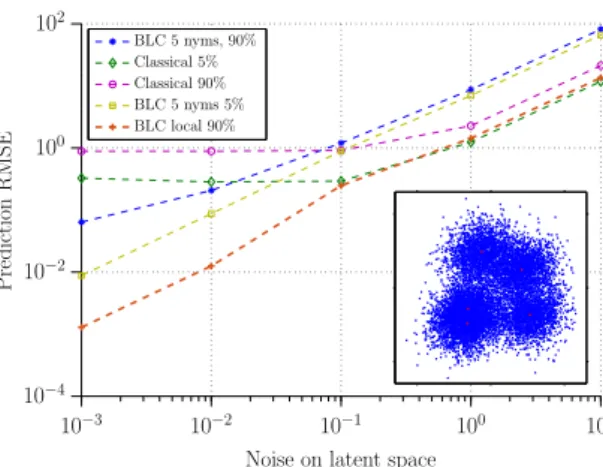
Fig. 6. RMSE of the predicted ratings vs. the standard deviation of users around the nym centres in the
latent feature space,n= 10 000users,p= 5,m= 100,d= 4and fraction of missing ratings5 %and90 %.
5.3. Challenging the Nym Assumption
In the previous section the users were tightly bunched around the nym centres in the latent feature space. We now relax this and explore the impact of increasing the standard deviation and so the spread around the centres. Figure 6 shows the RMSE of the predicted ratings vs. the spread of the users around the nym centres. The inset plot in Figure 6 shows a 2D projection of the positions in the latent space of the users (in blue) and nyms (in red) for a standard deviation of10about the nym centres. It can be seen that the prediction error with BLC increases roughly linearly with the standard deviation. The prediction accuracy is also largely insensitive to the sparsity of the ratings. For comparison, Figure 6 also shows the performance when the BLC algorithm is augmented using the extensions described in Sections 7.1 and 7.2. These extensions introduce adaptation of the number of nyms used, the number selected being shown in Figure 7. Note that as the standard deviation around the centres in the latent space increases we are degrading the original nym structure and so effectively increasing the number of groups and this is reflected in Figure 7. It can be seen that these extensions improve prediction performance, but do not change the qualitative behaviour, namely that the prediction error increases roughly linearly with the standard deviation around the centres in the latent space.
Also shown in Figure 6 is the corresponding data for the classic matrix factorization approach. For smaller values of standard deviation, where the data has a strong nym structure, it can be seen that BLC outperforms the classic approach in terms of pre-diction accuracy. However, as the standard deviation becomes large, so that the nym structure in the ratings is washed out, the prediction accuracy of the classic approach is better than that of the BLC approach unless the extensions in Sections 7.1 and 7.2 are used.
6. MEMORY AND TIME FOOTPRINT
in-N
um
b
er
of
ny
ms
Noise on latent space
10−3 10−2 10−1 100 101
101
102
103
Fig. 7. Boxplot and median showing the number of nyms corresponding to theBLClocaldata in Figure 6.
strumentation is important for understanding how memory and time consumption are affected by the different parameters of the algorithm.
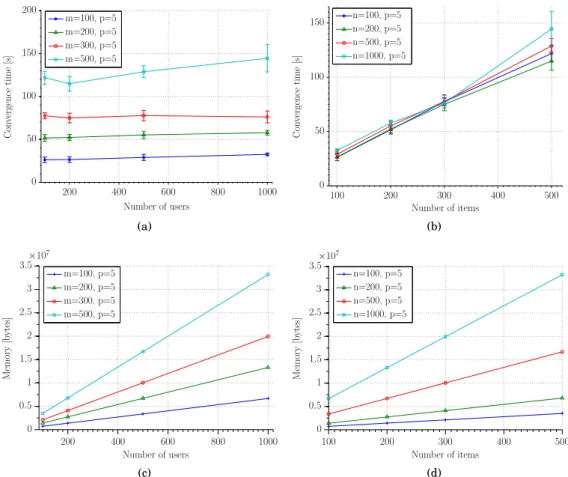
In Figure 8 an analysis of the time and memory footprint vsnandmis shown. The error bars are not shown when the standard deviation is negligible. While memory usage increases linearly with both number of users and items, the convergence time increases linearly only with the number items, and remains roughly constant as the number of users is varied.
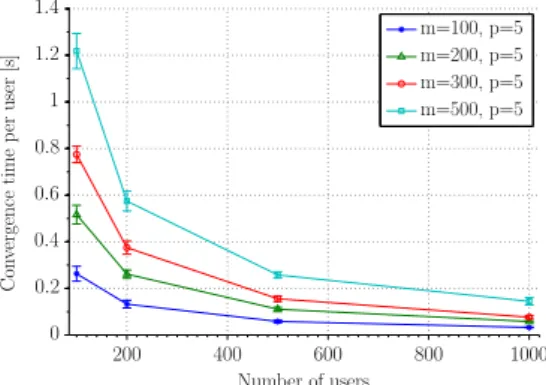
Importantly, we also analyse the scalability and performance when employing a warm start, i.e. the re-convergence performance with new but similar data drawn from the same population after initial convergence. In Figure 9(a) the convergence time to adjust to new data is analysed. The time to factorize a new group of users grows lin-early with the number of users or items, but it is reasonably small (6 sfor1000users and500items). Figure 9(b) shows the median time to run a matrix factorisation when up to 1 %of new users are added or when 1 %of existing ones change their rating: at worst the time to re-factorise is only around60 ms. Regarding scalability, from Fig-ure 10 it is clear that parallelisation has the potential to bring substantial benefits, for example if the factorization could be run in parallel client-side, since the convergence time per-user tends to a constant value.
7. EXTENSIONS TO BLC ALGORITHM 7.1. Selecting Number of Nyms
m=500, p=5 m=300, p=5 m=200, p=5 m=100, p=5 C on ve rg enc e ti m e [s ]
Number of users
200 400 600 800 1000 0 50 100 150 200 (a) n=1000, p=5 n=500, p=5 n=200, p=5 n=100, p=5 C on ve rg enc e ti me [s ]
Number of items
100 200 300 400 500
0 50 100 150 (b) m=500, p=5 m=300, p=5 m=200, p=5 m=100, p=5 M em or y [b yt es ]
Number of users
200 400 600 800 1000
×107
0 0.5 1 1.5 2 2.5 3 3.5
(c) n=1000, p=5 n=500, p=5 n=200, p=5 n=100, p=5 Me mo ry [b yt es ]
Number of items
100 200 300 400 500
×107
0 0.5 1 1.5 2 2.5 3 3.5
(d)
Fig. 8. Convergence time and memory usage vs number of users and number of items, for a synthetic
scenario with 5 clusters.
m=500, p=5 m=300, p=5 m=200, p=5 m=100, p=5 T im e [s ]
Number of users
200 400 600 800 1000 0 1 2 3 4 5 6 7 (a) m=500, p=5 m=300, p=5 m=200, p=5 m=100, p=5 T im e [s ]
Number of users
200 400 600 800 1000 0
0.02 0.04 0.06 0.08 0.1
(b)
Fig. 9. Convergence time for (a) a full iteration after warm start, and (b) a single factorisation after up to
m=500, p=5 m=300, p=5 m=200, p=5 m=100, p=5
C
on
ve
rg
enc
e
ti
m
e
p
er
us
er
[s
]
Number of users
200 400 600 800 1000 0
0.2 0.4 0.6 0.8 1 1.2 1.4
Fig. 10. Convergence time normalised by number of users vs number of users.
7.2. Local Recommendation
When users have access to the item profilesV, this allows increased flexibility in the
way in which user ratings are predicted. For example, one approach is to use the pre-dicted ratings(U P˜ u)TV for the nym selected by user u. Alternatively, user u might
exploit the information in their sole possession, i.e. the knowledge of their own private rating, to find the pointxˆ in the latent space that minimisesP
v∈V(u)(Ru,v−xˆTVv)2,
givenV and the ratings Ru,V(u)already made by useru. This least squares
optimi-sation can be solved locally by the user on their own computer, and so in a private manner. When the user has only rated a small number of items, this prediction is likely to be worse than the nym-based recommendation. However, we can combine the best from both worlds by solving a joint weighted least squared problem [Draper et al. 1966], in which userulocates their position in the latent space that also minimise the distance fromU˜·,g, wheregis the nym used by useru. More formally,
ˆ
x=
h
Ru,V(u)U˜T
g
i h
I|V(u)| 0
0 wId i
VV(u)IdT
1 σ2
L
Id+VV(u)Id
h
I|V(u)| 0
0 wId i
VV(u)IdT
−1 ,
whereIk is a diagonalk×kmatrix andw, σ2
Lare design parameters. Then the
recom-mendation is computed byxVˆ . We will refer to this enhanced algorithm by BLClocal. We test this technique in section 8.
7.3. Factorization Frequency
As illustrated in Figure 3, Algorithm 1 is partitioned into a private component run by each user u ∈ U and a public system component. Given (nym,rating) pairs supplied by the users the system component calculates nym rating matrixR˜ and factorizes it into U˜,V using an estimate of Λ(·). The user component run by user u selects the
nym to be used by useruusing the current value ofU˜,V. Rather than factorizingR˜
n=5000 n=1000 n=100 n=10
R
M
SE
Factorization period [users ratio]
0 0.05 0.1 0.15 0.2 10−15
10−10 10−5 100
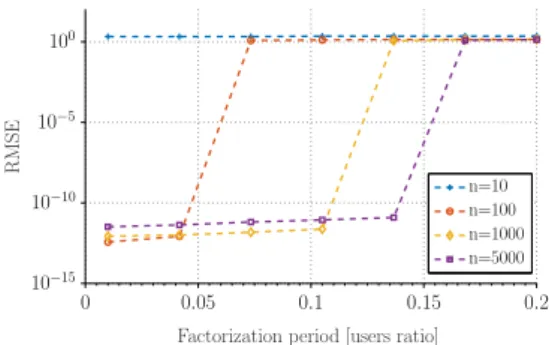
Fig. 11. Prediction RMSE vs. factorization frequency.
Table I. Dataset parameters.
Dataset Users Items Ratings Density Domain
Jester 73 421 100 4.1 M 0.5584 (−10,10) Movielens 71 567 10 681 10 M 0.0131 (1,5) Dating 135 359 168 791 17.3 M 0.0007 (1,10) Books 278 858 271 379 1.1 M 0.000 01 (1,10) Netflix 17 770 480 189 1.4 M 0.0001 (1,5)
drawn uniformly at random for every execution of Block 2 of Algorithm 1). It can be seen that, perhaps unsurprisingly, when we re-factorize after every individual user update we obtain the best performance, and performance decreases as the factorization frequency decreases. That is, there is a trade-off between computational effort and prediction accuracy. However, as the number of usersnincreases it can be seen that the performance cost becomes less, presumably because the absolute number of user updates between factorizations is increasing, and forn > 1000users a factorization period of10 %seems reasonable.
7.4. Cold Start
In all of the experiments, we simulate the problem ofcold start, by starting with no ratings and gradually filling the setOof observed ratings one user at a time. We cycle through a random permutation of the users untilOcontains the full training set. Every time a new user is added, all of their ratings are added toO. After the first permutation of users is completed, every time a user is selected it will potentially changeR˜,P and Λ(·), moving all its ratings to a different nym.
8. PERFORMANCE WITH REAL DATA
8.1. Jester, Movielens, Dating & Books Datasets
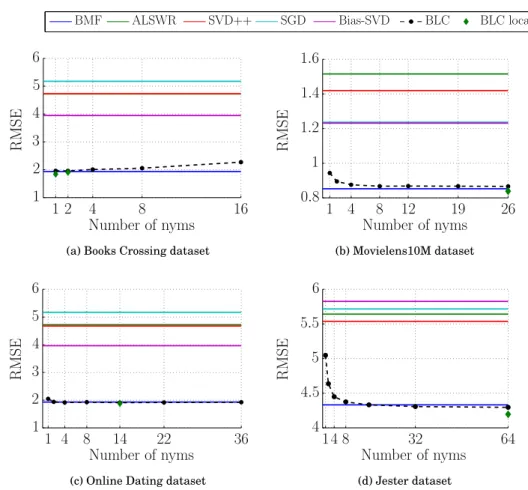
We follow the workflow and use the results of [Kannan et al. 2014]: the algorithms com-pared are ALSWR (alternating least squares with regularisation) [Zhou et al. 2008], SGD [Funk 2006], SVD++ [Koren 2008], Bias-SVD [Koren 2008] and BMF [Kannan et al. 2014] on the datasets summarised in Table I.
BLC local BLC
Bias-SVD SGD
SVD++ ALSWR
BMF
R
M
S
E
Number of nyms
1 2 4 8 16
1 2 3 4 5 6
(a) Books Crossing dataset
R
M
S
E
Number of nyms
1 4 8 12 19 26
0.8
1 1.2
1.4
1.6
(b) Movielens10M dataset
R
M
S
E
Number of nyms
1 4 8 14 22 36
1 2 3 4 5 6
(c) Online Dating dataset
R
M
S
E
Number of nyms
14 8 32 64
4 4.5
5 5.5
6
(d) Jester dataset
Fig. 12. Prediction RMSE vs number of nyms used compared with state-of-the-art algorithms.
average has been proven to be more effective that the state-of-the-art collaborative fil-tering techniques. We stress that in the following only the BMF algorithm has optimal performance because the other algorithms have many other parameters (other thand) that could be optimised, but that have been kept at their default values by the authors of the comparison. We did not tune the BLC regularisation parameters, instead keep-ing the variances of the priors large (1000) and relykeep-ing on the averagkeep-ing between the users sharing the same nym to control overfitting.
Figure 12 shows the RMSE of BLC vs. the number of nyms used and Table II sum-marises the RMSE values. It can be seen that BLC and BLClocalare competitive with the state of the art, with only minimal tuning (namely of the number of nyms). That is, privacy-enhanced recommendation need not come at the cost of reduced prediction accuracy.
Table II. Summary of the RMSE performance for the various algorithms and datasets considered, using validation sets from [Kannan et al. 2014].
Dataset BMF ALSWR SVD++ SGD Bias SVD
BLC BLC local
(nyms)
Jester 4.33 5.64 5.54 5.72 5.82 4.30 4.20 64 Movielens 0.85 1.51 1.42 1.24 1.23 0.87 0.83 26 Dating 1.93 4.72 4.68 5.17 3.96 1.91 1.88 14 Books 1.94 4.71 4.73 5.18 3.95 1.96 1.87 1
8.2. Another Comparison for Movielens 10M
We now compare BLC with another family of algorithms, based on nuclear norm regu-larisation, for the Movielens 10M dataset. The algorithms are as follows:
JSH. An extension of the Frank-Wolfe algorithm for optimising a function over the bounded positive semidefinite cone [Jaggi et al. 2010].
Soft-Impute. A soft singular value thresholding algorithm [Mazumder et al. 2010].
SSGD-Matrix-Completion. A more advanced algorithm based on stochastic subgradi-ent descsubgradi-ent [Avron et al. 2012].
GECO. A greedy method with optimality guarantees for low rank matrix factoriza-tion [Shalev-Shwartz et al. 2011].
For all of the algorithms, we report the RMSE from [Avron et al. 2012] in Table III. Also shown in this table is the median RMSE of BLC over 5 samples, using the same parameters of before and converging at8 nyms. It can be seen that, once again, the prediction accuracy of BLC is competitive with, if not superior to, the state of the art.
Table III. Performance comparison of algorithms for the Movielens 10M dataset, using validation sets from [Avron et al. 2012].
SSGD JSH Soft-Impute GECO BLC BLClocal
0.8555 0.8640 0.8605 0.8771 0.87200.8452
8.3. Netflix Dataset
Our evaluation would not be complete without showing results for the classic Netflix challenge datasets, for which all the algorithms listed above have been initially de-signed. Unfortunately, the Netflix validation set is no longer available. Following [Kan-nan et al. 2014], we therefore tested BLC against the validation set that was supplied as part of the training package (using the same1.4 Mratings training set described in Table I). As before, we used the latent space dimensiond = 20that yielded the best RMSE for the other algorithms in [Kannan et al. 2014] and we did not tune BLC pa-rameters. It can be seen from Table IV that BLC achieves the second best performance, using 128 nyms.
Table IV. Performance comparison of algorithms for the Netflix dataset, BLC paramters were untuned.
BMF ALSWR SVD++ SGD Bias-SVD Time-svd BLC BLClocal
Classical BLC local BLC
P
re
di
ct
io
n
R
MSE
Number of nyms
0 50 100 150 200
0.86 0.88 0.9 0.92 0.94 0.96 0.98
Fig. 13. RMSE vs number of nyms used for Netflix dataset.
In Figure 13, we compare BLC with the classic matrix factorization algorithm for a dense (26 %) subset of the Netflix dataset, obtained by selecting the top1000items and the top10 000users that rated them. These results are useful to further confirm that use of a small numberp = 100of nyms is sufficient to match the classic matrix fac-torization approach on this dataset, and for a larger number of nyms the performance surpasses that of the classic approach.
9. PRIVACY PERFORMANCE
As discussed in Section 3, the attacks of interest can be decomposed into two types: (i) attacks which seek to learn which nym a user belongs to, and (ii) attacks which seek to learn which items a user has rated, and what that rating is, given knowledge of the nym to which the user belongs.
With regard to (i), lacking additional side information the attacker can try to guess the correct nym using the information inΛ, i.e. exploiting the fact that some nyms might contain more users than others: the prevalent nym is the best bet for the at-tacker, and the more the user-nym distribution is far from the uniform distribution, the more chance the attacker has to correctly guess the nym used by an arbitrary user. In the worst case for the attacker (uniform distribution) the user can get an indistin-guishability probability of1/p, where pis the number of nyms i.e. we have a form of k-anonymity [Sweeney 2002] withk = p. In general, the probabilityPg of guessing
the right nym is equal to the number of users in the largest nym divided by the total number of users. Table V plotsPg for each of the datasets considered in the previous
section, with Figure 14 showing more detail for the Movielens dataset. For the online book dataset BLC converged with 1 nym, leading to a probability of guessing Pg of
100 %. But it is interesting to note that if we let the algorithm run until it is using 8 nyms,Pg decreases to15.24 %with a mere increase of1.2 %in the prediction RMSE.
All the other datasets have aPgof less than23 %. The use of nyms therefore provides
a reasonable level of protection against this first type of attack.
We now consider the second type of attack of interest, where an attacker seeks to learn which items a user has rated given knowledge of the nym to which the user belongs. We define the following privacy measure:
p(n, j) = PΛ(j)nn
v∈V
Table V. Indistinguishability performance for BLC algorithm: number of
nyms used and probabilityPgof guessing which nym contains a target
user.
Dataset Jester Movielens [Avron et al. 2012]
Dating Book Netflix
no. nyms 64 8 14 1 (8) 128 Pg[%] 3.5 22.17 19.4 100 (23.21) 2.71
N
um
b
er
of
us
er
s
Nym
1 2 3 4 5 6 7 8 0
5000 10000 15000
Fig. 14. Number of users per nym in Movielens dataset [Avron et al. 2012].
wherenis the nym index,jthe item index,Λ(j)nn the number of users in nymnwho
have rated itemjand P
v∈V
Λ(v)nnis the total number of users sharing nymn. It can be
seen thatp(n, j), which we refer to as theassociation probability, is an estimate of the probability that a user rated moviej, given that the user chose nymn. Hence, smaller values ofp(n, j)correspond to increased privacy in the sense that it is harder for an attacker to learn that a specific user in nymnrated itemj, whereas whenp(n, j) = 1 then every user in nymnhas rated itemj and so an attacker can be certain that a target user in nymnhas rated that item. Intuitively, we expect that as the number of users increases thenp(n, j)will tend to decrease and so privacy increase. Figure 15 shows the distribution over all the nyms of the association probability of the worst item. As expected, it can be seen that there is a downward trend with the number of users for both the Movielens and online dating datasets. When the number of users is more than around 10% of that in the dataset then the association probability is always less than 0.3 i.e. each user can deny that they rated any given item with probability at least 0.7 even when an attacker knows which nym the user belongs to. This seems like a substantial level of deniability, sufficient for most practical purposes. Figure 16 shows the impact of increasing the number of nyms used. It can be seen that using more nyms improves prediction accuracy but reduces the level of privacy, as might be expected. However, the reduction in privacy is relatively small, with the association probability remaining consistently below0.3.
Compared to the other algorithms considered in Section 8, BLC leads to an associa-tion probability decrease of at least 70% in all cases.
10. CONCLUSIONS
0.1 1 10 100 Number of users [%]
0.2 0.3 0.4 0.5 0.6 0.7 0.8 0.9 1 W or st as so ci at ion p rob ab il it y Movielens Online dating
Fig. 15. Boxplot of the association probability of the worst item vs. the number of users in the system for
the Movielens and Online dating datasets when using BLC.
1 2 4 8
Number of nyms 0.245 0.25 0.255 0.26 0.265 As so ci at ion p rob ab il it y 0.87 0.88 0.89 0.9 0.91 0.92 0.93 0.94 0.95 RM S E
Worst association probability RMSE
(a)
1 2 4 8 14
Number of nyms
0.25 0.3 0.35 0.4 0.45 0.5 As so ci at ion p rob ab il it y 1.9 1.92 1.94 1.96 1.98 2 2.02 2.04 2.06 R M S E
Worst association probability RMSE
(b)
Fig. 16. Association probability (left y axis) of worst item and RMSE (right y axis) of BLC for Movielens (a)
and Online dating (b) datasets. The distribution of the worst item association probability over the nyms is shown as a boxplot (left y axis) and the RMSE of the prediction is shown vs the number of nyms used by BLC.
for carrying out this matrix factorization in a privacy-enhanced manner. We demon-strate that the increased privacy does not come at the cost of reduced recommendation accuracy since, when nyms are chosen appropriately, users sharing a nym can leverage their shared ratings/preferences to make high quality recommendations.
REFERENCES
Charu C Aggarwal. 2005. On k-anonymity and the curse of dimensionality. InProceedings of the 31st inter-national conference on Very large data bases. VLDB Endowment, 901–909.
Rakesh Agrawal and Ramakrishnan Srikant. 2000. Privacy-preserving data mining. In ACM Sigmod Record, Vol. 29. ACM, 439–450.
Esma Aïmeur, Gilles Brassard, José M Fernandez, and Flavien Serge Mani Onana. 2008. ALAMBIC: a privacy-preserving recommender system for electronic commerce.International Journal of Information Security7, 5 (2008), 307–334.
Ludovico Boratto and Salvatore Carta. 2011. State-of-the-Art in Group Recommendation and New Ap-proaches for Automatic Identification of Groups. InInformation Retrieval and Mining in Distributed Environments. Studies in Computational Intelligence, Vol. 324. Springer, 1–20.
Joseph Calandrino, Ann Kilzer, Arvind Narayanan, Edward W Felten, Vitaly Shmatikov, and others. 2011. "You Might Also Like:" Privacy Risks of Collaborative Filtering. InSecurity and Privacy (SP), 2011 IEEE Symposium on. IEEE, 231–246.
John Canny. 2002. Collaborative filtering with privacy. InSecurity and Privacy, 2002. Proceedings. 2002 IEEE Symposium on. IEEE, 45–57.
David Chaum, Amos Fiat, and Moni Naor. 1990. Untraceable electronic cash. InProceedings on Advances in cryptology. Springer-Verlag New York, Inc., 319–327.
Anupam Datta, Divya Sharma, and Arunesh Sinha. 2012. Provable de-anonymization of large datasets with sparse dimensions. InPrinciples of Security and Trust. Springer, 229–248.
Chris Ding, Tao Li, Wei Peng, and Haesun Park. 2006. Orthogonal nonnegative matrix t-factorizations for clustering. InProceedings of the 12th ACM SIGKDD international conference on Knowledge discovery and data mining. ACM, 126–135.
Xuan Ding, Lan Zhang, Zhiguo Wan, and Ming Gu. 2010. A brief survey on de-anonymization attacks in online social networks. InComputational Aspects of Social Networks (CASoN), 2010 International Con-ference on. IEEE, 611–615.
Roger Dingledine, Nick Mathewson, and Paul Syverson. 2004.Tor: The second-generation onion router. Tech-nical Report. DTIC Document.
Norman Richard Draper, Harry Smith, and Elizabeth Pownell. 1966.Applied regression analysis. Vol. 3. Wiley New York.
S Funk. 2006. Stochastic gradient descent. (2006). http://sifter.org/simon/journal/20061211.html
Jagadeesh Gorla, Neal Lathia, Stephen Robertson, and Jun Wang. 2013. Probabilistic Group Recommenda-tion via InformaRecommenda-tion Matching. In22nd Int. Conf. on World Wide Web (WWW ’13). 495–504.
Saikat Guha, Bin Cheng, and Paul Francis. 2011. Privad: Practical Privacy in Online Advertising. In8th USENIX NSDI Symposium.
Thomas Hofmann. 2004. Latent semantic models for collaborative filtering.ACM Transactions on Informa-tion Systems (TOIS)22, 1 (2004), 89–115.
Zhengli Huang, Wenliang Du, and Biao Chen. 2005. Deriving private information from randomized data. In
Proceedings of the 2005 ACM SIGMOD international conference on Management of data. ACM, 37–48. Martin Jaggi, Marek Sulovsk, and others. 2010. A simple algorithm for nuclear norm regularized problems.
InProceedings of the 27th International Conference on Machine Learning (ICML-10). 471–478. Ramakrishnan Kannan, Mariya Ishteva, and Haesun Park. 2014. Bounded matrix factorization for
recom-mender system.Knowledge and information systems39, 3 (2014), 491–511.
Hillol Kargupta, Souptik Datta, Qi Wang, and Krishnamoorthy Sivakumar. 2003. On the privacy preserving properties of random data perturbation techniques. InData Mining, 2003. ICDM 2003. Third IEEE International Conference on. IEEE, 99–106.
Michal Kompan and Maria Bielikova. 2013. Group Recommendations: Survey and Perspectives.Computing and Informatics33, 2 (2013), 446–476.
Yehuda Koren. 2008. Factorization meets the neighborhood: a multifaceted collaborative filtering model. InProceedings of the 14th ACM SIGKDD international conference on Knowledge discovery and data mining. ACM, 426–434.
Yehuda Koren, Robert Bell, and Chris Volinsky. 2009. Matrix factorization techniques for recommender systems.Computer8 (2009), 30–37.
Shyong K Lam and John Riedl. 2004. Shilling recommender systems for fun and profit. InProceedings of the 13th international conference on World Wide Web. ACM, 393–402.
Dongsheng Li, Qin Lv, Huanhuan Xia, Li Shang, Tun Lu, and Ning Gu. 2011. Pistis: a privacy-preserving content recommender system for online social communities. InIEEE Int. Conf. on Web Intelligence and Intelligent Agent Technology, Vol. 1. 79–86.
Rahul Mazumder, Trevor Hastie, and Robert Tibshirani. 2010. Spectral regularization algorithms for learn-ing large incomplete matrices.The Journal of Machine Learning Research11 (2010), 2287–2322. Animesh Nandi, Armen Aghasaryan, and Makram Bouzid. 2011. P3: A privacy preserving personalization
middleware for recommendation-based services. InHot Topics in Privacy Enhancing Technologies Sym-posium.
Jennifer Nguyen and Mu Zhu. 2013. Content-boosted matrix factorization techniques for recommender sys-tems.Statistical Analysis and Data Mining6, 4 (2013), 286–301.
Valeria Nikolaenko, Stratis Ioannidis, Udi Weinsberg, Marc Joye, Nina Taft, and Dan Boneh. 2013. Privacy-preserving matrix factorization. InACM SIGSAC Computer & Communications Security (CCS’13). Mark O’Connor, Dan Cosley, Joseph A Konstan, and John Riedl. 2001. PolyLens: a recommender system for
groups of users. InECSCW 2001. 199–218.
Huseyin Polat and Wenliang Du. 2005. SVD-based collaborative filtering with privacy. InProceedings of the 2005 ACM symposium on Applied computing. ACM, 791–795.
Shai Shalev-Shwartz, Alon Gonen, and Ohad Shamir. 2011. Large-scale convex minimization with a low-rank constraint.arXiv preprint arXiv:1106.1622(2011).
Shang Shang, Pan Hui, Sanjeev R Kulkarni, and Paul W Cuff. 2011. Wisdom of the crowd: Incorporating social influence in recommendation models. In17th IEEE Int. Conf. on Parallel and Distributed Systems (ICPADS).
R. Shokra, P. Pedarsani, G. Theodorakopoulos, and J.P. Hubaux. 2009. Preserving Privacy in Collaborative Filtering through Distributed Aggregation of Offline Profiles. InProc RecSys.
K Shyong, Dan Frankowski, John Riedl, and others. 2006. Do you trust your recommendations? An explo-ration of security and privacy issues in recommender systems. InEmerging Trends in Information and Communication Security. Springer, 14–29.
Satish Narayana Srirama, Pelle Jakovits, and Eero Vainikko. 2012. Adapting scientific computing problems to clouds using MapReduce.Future Generation Computer Systems28, 1 (2012), 184–192.
Latanya Sweeney. 2002. k-anonymity: A model for protecting privacy.International Journal of Uncertainty, Fuzziness and Knowledge-Based Systems10, 05 (2002), 557–570.
Lyle H Ungar and Dean P Foster. 1998. Clustering methods for collaborative filtering. InAAAI workshop on recommendation systems, Vol. 1. 114–129.
Quan Wang, Zheng Cao, Jun Xu, and Hang Li. 2012. Group Matrix Factorization for Scalable Topic Modeling. In35th Int. ACM Conf. on Research and Development in Information Retrieval (SIGIR ’12). 375–384. Yu Xin and Tommi Jaakkola. 2014. Controlling privacy in recommender systems. InAdvances in Neural
Information Processing Systems. 2618–2626.
Gui-Rong Xue, Chenxi Lin, Qiang Yang, WenSi Xi, Hua-Jun Zeng, Yong Yu, and Zheng Chen. 2005. Scalable collaborative filtering using cluster-based smoothing. InProceedings of the 28th annual international ACM SIGIR conference on Research and development in information retrieval. ACM, 114–121. Guangyou Zhou, Yubo Chen, Daojian Zeng, and Jun Zhao. 2014. Group Non-negative Matrix Factorization
with Natural Categories for Question Retrieval in Community Question Answer Archives. InCOLING 2014, 25th Int. Conf. on Computational Linguistics: Technical Papers.
Yunhong Zhou, Dennis Wilkinson, Robert Schreiber, and Rong Pan. 2008. Large-scale parallel collaborative filtering for the netflix prize. InAlgorithmic Aspects in Information and Management. Springer, 337– 348.
Kai Zhu, Rui Wu, Lei Ying, and R Srikant. 2014. Collaborative filtering with information-rich and information-sparse entities.Machine Learning97, 1-2 (2014), 177–203.
PROOF OFTHEOREM4.3. We begin by observing that trU˜TU˜ is the Frobenius
norm ofU˜, and thus is convex in U˜u for allu and similarlytrVTV is convex inVv
for all v. We also have that P
v∈V(R˜v−U˜
T
Vv)TΛ(v)(R˜v−U˜TVv) is convex in Vv (it
is the usual least squares objective inVv). Since the Hessian of this function w.r.t. Uu is positive definite for all u, we also have that it is convex inUu. It follows that
−log ˜p(U˜,V|RO;P)is individually convex inU˜ andV.
Now consider the sequence U˜(k), V(k+1),k = 1,2, . . . generated by alternating
up-dates
(U˜(k)
g )T=
X
v∈V
Λ(v)ggR˜gv(V(k)
v )T
σ2 σ2˜ U
I+ X
w∈V
Λ(w)gg(V(k)
w V(wk))T
−1
(12)
(V(k+1)
v )T=R˜TvΛ(v)(U˜(k))T
σ2 σ2V
I+U˜Λ(v)(U˜(k))T
−1
(13)
By Theorem 4.2,U˜(k)is a stationary point of−log ˜p(·,V(k)|RO;P)and by convexity it