Int. J. Electrochem. Sci., 4 (2009) 20 - 29
International Journal of
ELECTROCHEMICAL
SCIENCE
www.electrochemsci.org
Construction and Analytical Application of Ion Selective
Bromazepam Sensor
Amirh S. Al Attas*
Department of Analytical Chemistry, King Abdul Aziz University, Girls´ College of Education, Kingdom of Saudi Arabia, P.O.Box 16531, Jeddah 21474
*
E-mail: [email protected]
Received: 29 October 2008 / Accepted: 5 December 2008 / Published: 20 December 2008
Construction and performance characteristics of a novel ion – selective membrane sensors for determining bromazepam drug are described. The sensor was based on the use of bromazepam – phosphotungestiate ion association complex as an electroactive material in poly (vinyl chloride) membrane plasticized with o- nitrophenyloctyl ether and ( dioctyl sebacate( DBS) as a solvent mediator. In aqueous solution of pH 3, the sensor displayed a stable for 4 weeks with reproducible potential and linear response for drugs over the concentration range 1x 0-2 – 1x10⁻⁴ M with Nernstian slope of 52.0 ± 0.1 mV/decade for detection limit of 3x10⁻⁵M. The response time was 10 - 20 s. The selectivity coefficients indicate excellent selectivity for bromazepam over many common cations (e.g., Na+, K+, Co2+, Sr2+ , Ag+1 , starch, maltose, glucose and lactose. The sensors are used successfully for the determining of bromazepam in pure form and pharmaceutical preparations with average recoveries of 99.20 , 97.80 and 99.64 %.
Keywords: Bromazepam, Bromazepam-phosphotungestiate ion pair complex, Ion selective electrode, Pharmaceutical preparations, PVC.
1. INTRODUCTION
method , each with advantages and disadvantages , including chromatography [10-25] electrochemistry [26-31] spectrophotometry [32-40] X-ray method [41], flow injection analysis (FIA) methods [42-44] Time-of-flight mass spectrometry (TOF-MS) offers new perspectives for forensic toxicology [45]. A simple micellar liquid chromatographic (MLC) procedure is reported for the determination of several benzodiazepines in serum [46] conventional reversed-phase liquid chromatography (RPLC) with aqueous–organic mobile phases and surfactants above the critical micellar concentration are routinely applied in the analysis of serum, which requires complex sample pretreatment for the removal of interferences and extraction of the analyst. [47-52] A sequential injection spectrophotmetric method for the assay of bromazepam anxiolytic drug has been reported [53] spectrophotometric and fluorimetric methods have been developed to determine diazepam, bromazepam and clonazepam (1,4-benzodiazepines) in pure forms, pharmaceutical preparations and biological fluid [54]. Newly developed solid contact ion-selective electrodes (SC-ISE) have been proposed for determining diazepam, bromazepam and clonazepam 1,4-benzodiazepines [55]. Direct potentiometry with chemical sensors provide valuable means of monitoring various analyst at low concentrations including drugs, because of their low cost, ease of use, selectivity and precise. In the present work, PVC membrane and conventional sensors based on BZ – phosphotungestate ion pair complex and plasticized with O-nitrophenyloctyl ether (O-NPOE) and Dibutyl sebacate (DBS) for the determination of bromazepam in pure solutions and pharmaceutical preparations were studied. The two sensors exhibited Nernstian slope with fast response time and excellent selectivity towards many organic and inorganic ions.
N
N
N
O
H
[image:2.612.249.359.382.523.2]Br
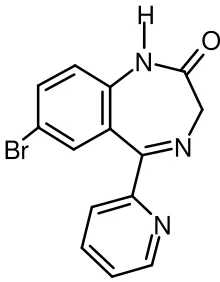
Figure 1. The structure of Bromazepam
2. EXPERIMENTAL PART 2.1. Equipment
2.2. Chemicals and reagents
All chemicals were of analytical grade. Deionized water was used for all aqueous solutions. Bromazepam, High molecular weight poly (vinyl chloride) powder (PVC), phosphotungstic acid (PTA) were obtained from National Organization for Drug Control and Research.Tetrahydrofuran (THF) was obtained from fluka. (DBS) Dibutyl sebacate and O-nitro phenyloctyl ether (0-NPOE) were purchased from Aldrich.
Some cation salts of the highest purity were used available. Standard (10-2 M) solutions were prepared with distilled water, dilute solutions (10-2 – 10-6 M) were freshly prepared by accurate dilution using potassium hydrogen phethalate buffer ( 10-2 M) of pH 3.
A standard solution of 10-2 M Bromazepam was freshly prepared by dissolving 0.3g of Bromazepam in 1.5 ml of 0.01 HCl and adjusted to pH 3 with dilute NaOH and the volume was completed to 100 ml by deionized water.
2.3. Electroactive Bromazepam – Phosphotungstic acid ion –pair
The electroactive material (BZ-PTA) was prepared by mixing 20 ml of 5x10⁻² M of both bromazepam and PTA solutions. The resulting precipitate was filtered off through a whatman filter paper No.42,washed with cold water several times, dried at room temperature and ground to fine powder. IR data of the precipitate agree with the formation of BZ-PTA ion pair complex.
2.4. Construction of the sensors
A (10 mg) portion of bromazepam-PTA complex was mixed in a glass Petri-dish (5 cm diameter) with 0.19 gm of PVC powder and 0.35 gm of nitrophenyloctyl ether, or dibutyl sebacate membrane. The cocktail was dissolved with 5 ml tetrahydrofuran (THF), covered with filter paper, left over night to allow slow evaporation of the solvent at room temperature. Sections of the resulting membrane were~ 0.1 mm thick cut out with a cork borer (10 mm diameter) and glued to polyethylene tubing.
The tube was then filled with internal filling solution consisted of equal volumes of 1 x 10⁻² M of bromazepam hydro-chloride and potassium chloride.
2.5. Sensor calibration
Aliquots (25 ml) of 10-6 – 10-2 M standard solution of bromazepam were transferred into 50 ml beakers and PVC - BZ - PTA sensor in conjunction with reference electrode were immersed in the solution .
2.6. Response time and effect of pH
Sensor life span was examined by repeated monitoring of the slope of bromazepam calibration curve. The potential reading was recorded after stabilization and the emf was plotted as a function of logarithm bromazepam concentration, the lower detection limit was taken at the point of intersection of the extrapolated linear segments of the bromazepam calibration curve.
The dynamic response of the sensors was tested by measuring the time required to reach a potential steady to within ± 1 mV after successive immersion of the sensor in different drug solutions each having a 10 fold difference in concentration. The sensors response for different drug concentrations were also tested at various pH values.
2.7. Determination of selectivity coefficient
Selectivity coefficients of the sensor was determined using the separate solution method (SSM) with 10-2 M solutions of bromazepam and interferent at pH 3 [56] and calculated from the rearranged Nicolsky equation.
log KpotBZ,M = [EM−EBZ/S]− log +
) /Z (Z M
M M BZ,
a log aBZ
Where:
EBZ :- is the potential measured in 10-2 M Bromazepam hydrochloride solution. EM :- is the potential measured in a 10-2 M solution of the interfering cations. S : slope of the electrode calibration plot.
2.8. Determination of Bromazepam in pharmaceutical preparation
The content of 10 tablets were weighed and finely powdered in a small dish, dissolved in a minimum volume of 10-2 M HCl solution and filtered off into 50 ml volumetric flask through Whatman filter paper No.42, diluted to the mark with 10-2 M KHP of pH 3 and shaken. The sensors in conjunction with double-junction Ag/AgCl reference electrode were immersed in 25 ml beaker 2.5 ml of the prepared solution was transefered to the beaker and completed to 10 ml by KHP buffer .The mV of the test solution was directly measured and compared with the calibration graph.
3. RESULTS AND DISCUSSION
3.1. Potentiometric measurements
3.1.1. Sensor characteristics
The prepared ion-pair complex was used as an electroactive material in the construction of a new sensor selective for BZ drugs. The ion pair incorporated in a membrane containing O-NPOE or DBS as plasticizer in PVC matrix and the performance characteristics of the proposed sensor was evaluated according to IUPAC recommendations [57].
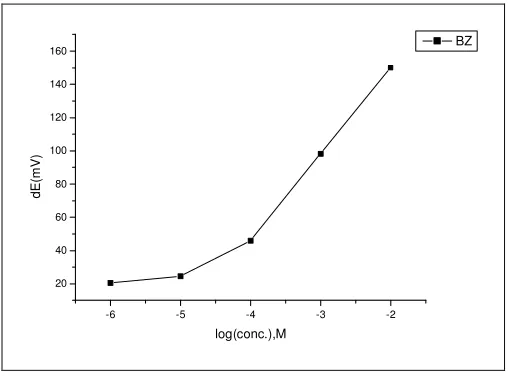
[image:5.612.126.486.278.421.2]The results are given in Table (1).The sensor displays a linear response for 10-4 – 10-2 M (BZ) with sub-Nernstian cationic slope of 52 mV/decade and the lower limit of detection of 3x10⁻⁵ M which is calculated at the point of intersection of the extrapolated segments of the two linear parts of the calibration curve of bromazepam.
Table 1. Potentiometric response characteristics of (BZ) sensor
PARAMETER BROMAZEPAM
Slope, (mV/decade) 52 ± 0.10
Linear concentration range,(M) 1x10⁻⁴ - 1x10⁻²
Intercept, (mV) 245.1± 0.5
Lower limit of detection, (M) 3 x10⁻⁵
Life time, (week) 4 weeks
Working pH, (pH) 3
Response time, (s) >20 sec
Standard deviation 0.244
Correlation coefficient,(r) 0.99999
The calibration curve of the sensor was found in Figure 2. The soaking solution must be changed and freshly prepared to prevent the leaching problems commonly experienced with polymeric membrane sensors containing, the significance of the solvent mediator is recognized in providing the best complexation environments.
-6 -5 -4 -3 -2
20 40 60 80 100 120 140 160
d
E
(m
V
)
log(conc.),M
BZ
[image:5.612.179.433.513.701.2]
It can reasonably be expected from the comparison of the composition of (BZ) membrane with different plasticizers, we found that in the case of O-NPOE the mobility of the ion-pair complex in the membrane or the amount in drug exchange equilibrium at the solution /membrane interface was improved, because ion selective can be assumed to be functions of these factors. [58]
.
3.1.2. Effect of pH
The sensor response for different BZ concentrations was tested at different pH values, the pH being adjusted using hydrochloric acid or sodium hydroxide solution. The potential results obtained revealed that at pH below 2 higher values were obtained due to the interference of H+ and above pH 3 precipita-tion occur thus pH 3 is considered the optimum pH at which BZ can be measured without any significant error. On the other hand upon testing different types of buffer solutions KHP buffer showed to be more suitable. Where in this buffer at pH 3 the sensor potentials were almost constant and stable to within ±1mV, day to day reproducibility of the sensor is about ±0.7mV for the same solution and the useful life time of the sensor is 4 weeks.
3.1.3. Response time
The time required to reach a steady potential within ±1mV, after successive immersion of the sensor in different concentrations of (BZ) solution. The average dynamic response time was found to be short, ranging from 10 – 10 – 20 s for concentrations 10-2, 10-3 & 10-4 M respectively. After 4 weeks, the calibration slope and the linear concentration range of response gradually decreased probably due to leaching of the ion-pair from membrane. The response time also increased.
3.1.4 .Effect of plasticizers
Potentiometric response of sensors based neutral ionophores is greatly influenced by the polarity of the membrane medium, which is in turn defined by the dielectric constants of the major membrane incorporating (BZ) with two different solvent mediat-ors having dielectric constants (DBS)
Є = 4.01 and (NPOE) Є = 23.6 which showed high sensitivity and near Nernstian slope, while DBS plasticizer showed anomalous or poor response to BZ.
3.1.5. Selectivity of the sensor
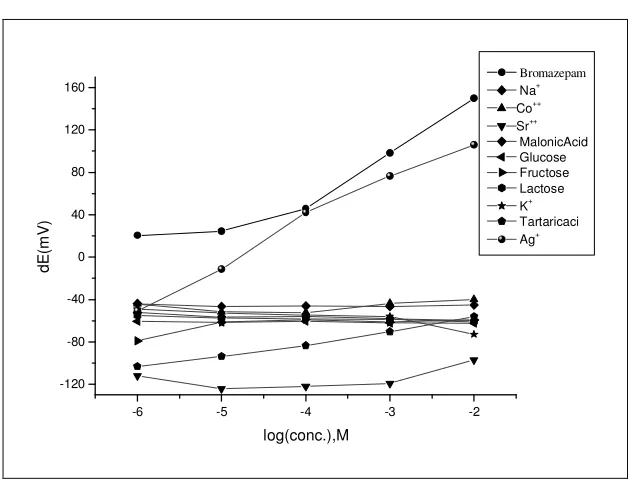
pot M BZ,
K
Table 2. Selectivity coefficient(KpotBZ,M) for(BZ)PVC(NPOE) matrix sensor
Interferent
Tartarate 0.50x10⁻³
Lactose 0.90x10⁻³
Fructose 0.85x10⁻³
Glucose 0.80x10⁻³
Malonate 0.90x10⁻³
Na+ 1.60x10⁻³
K+ 1.07x10⁻³
Co++ 1.80x10⁻³
Sr++ 0.06x10⁻³
Ag+ 0.30
-6 -5 -4 -3 -2
-120 -80 -40 0 40 80 120 160
d
E
(m
V
)
log(conc.),M
Bromazepam
Na+ Co++
Sr++
MalonicAcid Glucose Fructose Lactose K+
[image:7.612.148.464.297.540.2]Tartaricaci Ag+
Figure 3. Selectivity characteristics of (BZ)sensor
3.1.6. Determination of (BZ) in the pharmaceutical preparations
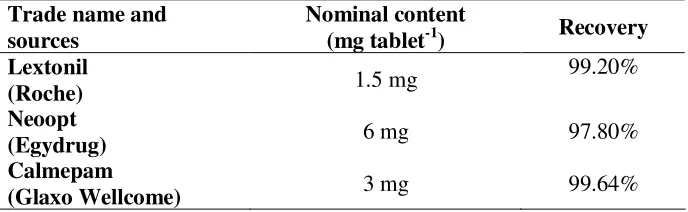
The proposed sensor was used for direct potentiometric determination of (BZ) in pharmaceutical powders. The results obtained with (BZ) test solution of the drug (lextonil- neoopt –
calmepam ) showed average recoveries of 99.2%, 97.8%, 99.64% ,respectively. As shown in Table 3.
[image:8.612.135.479.230.336.2]
compared with working range .The present work was validated for the use in drug quality control according to the quality assurance standards [59] using six batches (six determination each). The results showed that the range was10-4 -10-1M, the precision ± 0.5%, the accuracy 98. % ,and the repeatability CVw 0.5% and the between- day –variability CVb 0.7% . A calculation of the student's t- value at the 97% confidence level indicated no statistical difference between the calculated and theoretical values. This confirms the applicability of the sensors for the accurate routine analysis of bromazepam in various drug formalization.
Table 3. Determination of bromazepam in its pharmaceutical preparations
Trade name and sources
Nominal content
(mg tablet-1) Recovery Lextonil
(Roche) 1.5 mg
99.20%
Neoopt
(Egydrug) 6 mg 97.80%
Calmepam
(Glaxo Wellcome) 3 mg 99.64%
4. CONCLUSIONS
Direct potentiometrc measurements of bromazepam drug using BZ-PT –PVC based membrane sensor offer a simple and rapid monitoring procedure. The present sensor show useful sensitivity, reasonable selectivity, a fast static response, long term stability, and applicability over a wide pH range with a minimal sample pretreatment compared with many of the previously described procedure.
References
1. M.R. Ganjali, T. Razavi, R. Dinarvand, S.Riahi, P.Norouzi, Int. J. Electrochem. Sci. 3 (2008) 1543 2. R. R.Naik, E. Niranjana, B. E. K. Swamy , B. S. Sherigara , H. Jayadevappa, Int. J. Electrochem.
Sci. 3 (2008) 1574.
3. Sh S. Kalanur, J. Seetharamappa, G. P. Mamatha, M. D. Hadagali, P. B. Kandagal, Int. J. Electrochem. Sci. 3 (2008) 756.
4. D. Gaikwad, D.J. Shirale, P.A. Savale, K. Datta, P. Ghosh, A.J. Pathan, G. Rabbani , M.D. Shirsat, Int. J. Electrochem. Sci. 2 (2007) 488.
5. J. B. Raoof, R. Ojani , H.Beitollahi, Int. J. Electrochem. Sci. 2 (2007) 534. 6. S.M. Sultan. Analyst 117 (1992) 773.
7. S.M. Sultan and F.O. Suliman. Analyst 121 (1996) 617. 8. S.M. Sultan and A.H. El-Mubarak. Talanta 43 (1996) 569.
9. The Extra Pharmacopeia, 28th edn., Martindale, London (1982).
10.S.M. Amer, A.A. Moustafa, N.K. Ramadan, Egypt J. Pharm. Sci . 33 (1992)179.
11.M.C. Gastearena, E.Dios-Viéitez, M.M. Segura, M.J. Goñi, D. Renedo, Chromatographia Journal
35 (1993) 524.
12.L.J. Liu, Yaowu-Fenxi-Zazhi 13 (1993) 318.
13.J. Chen, D.R. Xi, G.Y. Hou, Yaowu-Fenxi-Zazhi 17 (1997) 415.
15.M. J. Bogusz , Journal of Chromatography B: Biomedical Sciences and Applications 748( 1) (2000) 3.
16.M. Oda, T. Kotegawa, K. Tsutsumi, Y. Ohtani, K. Kuwatani, K. Kubota, H. Imai, T. Okudaira, S.
Nakano, European Neuropsychopharmacology 12(3) (2002) 429.
17.B.E. Smink, J.E. Brandsma, A. Dijkhuizen, K.J. Lusthof, J.J. de Gier, A.C.G. Egberts, D.R.A. Uges, Journal of Chromatography B 811( 1,5 )( 2004) 13.
18.M. Chèze, M. Villain, G .Pépin, Forensic Science International 145(2-3) ( 2004) 123.
19.S. Dalibor, M.L. Lucia, D. Santos, S. Hana, S. Petr, M. Conceiçäo, B. S. M. Montenegro, N.A. Alberto, Talanta 68(2005) 214.
20.M. Villain, M. Concheiro, V. Cirimele, P.Kintz, Journal of Chromatography B 825( 1) (2005) 72. 21.M. Chèze, G. Duffort, M. Deveaux, G. Pépin, Forensic Science International 153( 1) (2005)3. 22.M. S. . Prado, M. Steppe, M. F.M. Tavares, E. R.M. Kedor-Hackmann, M. I. R.M. Santoro,
Journal of Pharmaceutical and Biomedical Analysis 37( 2) (2005) 273.
23.Q. Fan, X.H. Jiang, Q.Y. Deng, D. He, K. Zhu, J. Lei, P. Sun, Yaowu-Fenxi- Zazhi 26 ( 2006) 614 24.V.Kimiskidis, M.Spanakis, I. Niopas, D. Kazis, C.Gabrieli, F.I. Kanaze, D. Divanoglou, Journal of
Pharmaceutical and Biomedical Analysis 3( 2)(2007) 763.
25.A. S. Pereira, M. Schelfaut, F. Lynen, P.t Sandra, Journal of Chromatography A 1185( 1) (2008) 78.
26.E1. Ruiz Zarobe, B.M. Hernandez, E. Lorenzo Abad and L. Hernandez. Anal. Quim. 84 (1988)120.
27.L. M. A. Monzón, L. M. Yudi , Journal of Electroanalytical Chemistry 495, (2) (2001) 146. 28.X.X. Sun, H.Y. Aboul-Enein, Talanta 58 (2002) 387.
29.X.X. Sun, Fenxi-Ceshi-Xuebao 22 ( 2003) 1.
30.A. A. Salem, B. N. Barsoum, G. R. Saad, E. L. Izake, Jour Journalof Electroanalytical Chemistry 536( 1-2) (2002) 1.
31.A. A. Salem, B. N. Barsoum, E. L. Izake, Anal. Chim. Acta 498 (1- 2) ( 2003) 79.
32.A.F. Fartushnyi, E.B. Muzhanovskii, A.P. Sukhin, A.I. Sedov and E.B. Kvasov. Pharm. Zh. 5 (1986) 47.
33.P. Fiearra, A. Villari, R. Ficarra and G. Mondio. Farmaco 42 (1987) 241.
34.D. Lorenzo, M. Hernandez and L. Hernandez. Microchem. J. 37 (1988) 257.
35.F. Salinas, J.J. Berzas Nevado, A. Espinosa, Analyst 114 (1989) 1141. 36.M.A. Abounassif. J. Pharm. Belg. 44 (1989) 329.
37.R.D. Jee, Analyst 120 (1995) 2867.
38.N. Arnaud, and J. George, Analyst 126 (2001) 694.
39.C. Thirapom, P. Sanit, G. Kate, S. Weena, C. Orawon, Talanta 64 (2004) 1247. 40.Q. Jiang, N. Zhang, J. Pharm. and Biomedical Analysis 35 (2004) 1301.
41.S. Thangadurai, J.T. Abraham, A.K. Srivastava, M.N. Moorthy, S.K. Shukla, Y. Anjaneyulu, Anal. Sci 21 (2005) 833.
42.D. Parada, E. Lorenzo Abad, M. Hernandez and L. Hernandez. Microchem. J. 37 (1988) 257.
43.M. Valcarcel, M. Gallego and R. Montero. J. Pharm. Biomed. Anal. 8 (1990) 655. 44.R.E. Santelli, M. Gallego and M. Valcarcel. Talanta 38 (1991) 1241.
45.B. Aebi, R. Sturny-Jungo, W. Bernhard, R. Blanke and R. Hirsch, Forensic Science International
128 ( 2002) 84.
46.M. Capella-Peiró, D. Bose, A. Martinavarro-Domínguez, M. Gil-Agustí and J. Esteve-Romero,
Journal of Chromatography B 780 ( 2002) 241.
47.E. Tanaka, M. Terada, S. Misawa and C. Wakasugi J. Chromatogr. B 682 (1996) 173.
48.P. Odou, H. Robert, M. Luyckx, C. Brunet, T. Dine, B. Gressier, M. Cazin and J.C. Cazin , Biomed. Chromatogr. 11 (1997) 19.
49.G. Theodoridis, E.H.M. Koster and G.J. de Jong J. Chromatogr. B 745 (2000) 49.
50.K.M. van Rij, D. Compas, E.L. Swart, P.N.F.C. de Goede and D.J. Touw , Ther. Drug. Monit. 21
51.M.G. Khaledi J. Chromatogr. A 780 (1997) 3. 52.H. Nishi J. Chromatogr. A 780 (1997) 243.
53.S. M. Sultan, Y. A. M. Hassan and K .E. E. Ibrahim, Talanta 50 (1999) 84.
54.A. A. Salem, B. N. Barsoum and E. L. Izake, Spectrochimica Acta Part A 60 (2004) 771. 55.A. A. Salem, B. N. Barsoum and E. L. Izake, Anal. Chimi. Acta 498 ( 2003) 79.
56.W. Robert , C. Arthurk, F. A. Nils, R. Wolf, Clinchem. Lab 38 (2000) 363.
57.IUPAC, Analytical Chemistry Division Commission on Analytical Nomenclature, Pure Applied Chemistry 67 (1995) 507.
58.W. E. Morf, The Principles of Ion-Selective Electrodes and of Membrane Transport (1981).
59.J.K. Taylor, "Quality Assurance of Chemical Measurements",CRCpress, Florida ( 1987).