http://eprints.whiterose.ac.uk/111423/ Version: Accepted Version
Article:
Akhtar, M orcid.org/0000-0002-8135-362X and Ding, R orcid.org/0000-0002-6263-1524 (2017) Covalently cross-linked proteins & polysaccharides: Formation, characterisation and potential applications. Current Opinion in Colloid & Interface Science, 28. pp. 31-36. ISSN 1359-0294
https://doi.org/10.1016/j.cocis.2017.01.002
© 2017 Published by Elsevier Ltd. This manuscript version is made available under the CC-BY-NC-ND 4.0 license http://creativecommons.org/licenses/by-nc-nd/4.0/
[email protected] https://eprints.whiterose.ac.uk/ Reuse
Unless indicated otherwise, fulltext items are protected by copyright with all rights reserved. The copyright exception in section 29 of the Copyright, Designs and Patents Act 1988 allows the making of a single copy solely for the purpose of non-commercial research or private study within the limits of fair dealing. The publisher or other rights-holder may allow further reproduction and re-use of this version - refer to the White Rose Research Online record for this item. Where records identify the publisher as the copyright holder, users can verify any specific terms of use on the publisher’s website.
Takedown
If you consider content in White Rose Research Online to be in breach of UK law, please notify us by
Mahmood Akhtar, Rui Ding
PII: S1359-0294(17)30004-3 DOI: doi:10.1016/j.cocis.2017.01.002
Reference: COCIS 1093
To appear in: Current Opinion in Colloid & Interface Science
Received date: 30 October 2016 Revised date: 5 January 2017 Accepted date: 20 January 2017
Please cite this article as: Akhtar Mahmood, Ding Rui, Covalently cross-linked proteins & polysaccharides: Formation, characterisation and potential applications,Current Opinion in Colloid & Interface Science(2017), doi:10.1016/j.cocis.2017.01.002
ACCEPTED MANUSCRIPT
Covalently
cross-linked
proteins
&
polysaccharides:
formation,
characterisation and potential applications
Mahmood Akhtar* and Rui Ding
Food Colloids Group, School of Food Science & Nutrition, University of Leeds, West Yorkshire, LS2 9JT, UK
Abstract
This review presents recent research conducted on the development of various
protein-polysaccharide conjugates, their functional properties and industrial applications. These
conjugates are formed by the glycosylation of food proteins with carbohydrates via the
Maillard reaction and are capable of improving the functional properties of proteins. The
Maillard reaction facilitates covalent bonding between a reducing group of a carbohydrate
and an amino group of a protein under controlled conditions of temperature, time, pH, and
relative humidity. There is a great deal of interest in modifying the functional properties of
proteins and in the use of novel conjugates for various industrial applications. This review
discusses various methods and their implications for preparing and characterising these
conjugates. Furthermore, the physicochemical properties of conjugates such as solubility,
thermal stability, emulsifying activity, emulsion stabilising properties, gelling and foaming
properties are also analysed. A novel processing technology, spinning disc reactor, could be
an alternative process for the production of protein-polysaccharide conjugates, with
desirable functionality in different food systems.
KEYWORDS: Protein-polysaccharide conjugates, Maillard reaction, Glycation, Functional properties
1. Introduction
Proteins are important food ingredients due to their provision of the essential amino
acids that are not synthesized in the human body, despite these being necessary for cellular
metabolism. Proteins are amphiphilic molecules, which are able to adsorb strongly at the
oil-water interface as highly effective emulsifiers. They are commonly used in the food
ACCEPTED MANUSCRIPT
properties of proteins may be lost under acidic conditions, high ionic strength, high
temperature, and the presence of organic solvents, which limits their industrial applications.
Thus, if proteins could be converted into more stable forms they could be more versatile in
the food industry and elsewhere [4 , 5].
Polysaccharides are high-molecule-weight, highly stable, hydrophilic, and
biodegradable natural polymers which are usually used as thickeners to modify the viscosity
of the aqueous phase in order to stabilise emulsions. Generally, they have little oil-water
interfacial activity compared to proteins due to the lack of hydrophobic segments. However,
some natural polysaccharides, such as gum arabic (Acacia Senegal), have emulsifying
properties. Gum arabic is a highly branched carbohydrate polymer comprising ~2 wt%
covalently-bonded protein and it is this that is responsible for the surface activity of the gum
[6 ].
Protein-polysaccharide conjugates are produced via the Maillard reaction, first
reported by Maillard in 1912 [7]. It is a series of non-enzymatic browning reactions, which
occur naturally between the reducing end of a sugar and an amino acid. We can combine
the functional properties of proteins and polysaccharides by covalently linking proteins to
polysaccharides via the Maillard reaction to prepare novel protein-polysaccharide
conjugates [5, 8 -10 ]. The covalent bonding between proteins and polysaccharides may be
expected to lead to an enhancement of protein functionality both as emulsifiers and
stabilisers. The basic mechanism of the coupling is illustrated in Figure 1 [11 ].
High molecular weight glyco-conjugates possess the properties of the protein, strongly
adsorbing at the surface of oil droplets and also possess the hydrophilic properties of the
polysaccharide, in being highly solvated by the aqueous medium [12]. The conjugation
between proteins and polysaccharides provides much more improved steric stabilisation of
the emulsion droplets, as illustrated in Figure 2.
The functional characteristics of proteins can be enhanced by means of physical,
chemical or enzymatic treatments to obtain food ingredients for different applications [11 ,
13]. However, the use of modified proteins as food ingredients, when achieved by chemical
methods, is still limited due to some of the chemicals being, or perceived as being, harmful
ACCEPTED MANUSCRIPT
ovalbumin-dextran compound that exhibit improved emulsifying properties compared to
matrices containing pure ovalbumin [10 ]. Thus, the search for naturally occurring chemical
reactions remains necessary.
The main advantage of linking proteins to polysaccharides via the Maillard reaction is
enhanced solubility and functional properties of proteins over a wide range of
environmental conditions, such as low pH and high ionic strength [6 ]. For example, gum
Arabic, a natural glycoprotein, is generally used in the emulsification of citrus flavoured oil
for soft drink applications. It has been suggested that Gum Arabic could be replaced by
whey protein-maltodextrin conjugates as the emulsifier and stabiliser instead [9 ].
Well-prepared protein-polysaccharide conjugates can show substantial improvement in
emulsifying and stabilising properties compared to native proteins, under both low and
neutral pH conditions and with colouring agents. Furthermore, the conjugates exhibited
effective stabilisation of emulsions over several weeks even after extensive emulsion
dilution [9 ]. Recently, a comprehensive critical review has been published on food
protein-polysaccharide conjugates obtained via Maillard reaction [17]. The review discusses various
stages of the Maillard reaction and the products formed at each stage.
As shown in Figure 2, the conjugate-stabilised emulsion droplets have a thicker
stabilising layer than protein-stabilised emulsion droplets, when the molecular weight of
polysaccharide moiety is sufficiently large. In other words, the molecular weight of the
polysaccharide determines the thickness of the steric stabilising layer.
2. Preparation of protein-polysaccharide conjugates
Proteins used as functional ingredients in foods are derived mainly from animal
products, e.g., meat, eggs and milk, but plant proteins are increasingly used, e.g., from soy
protein and peas. Similarly, most research in preparing protein-polysaccharide conjugates
has been done on animal-derived proteins (caseins, whey, egg white) [18-20], though there
have been some investigations on conjugates derived from plant-based proteins [21-23].
In the case of polysaccharides, dextran and maltodextrin have been most commonly
used for preparing these conjugates [18, 24, 25] while other saccharides have also been
ACCEPTED MANUSCRIPT
Over the last 25 years, both dry and wet-heating methods have been used for
developing protein-polysaccharide conjugates. In 1990, ovalbumin-dextran conjugates were
prepared under controlled dry-heating method by a group of Japanese researchers [20].
Two years later, a similar method was adopted to synthesize hybrids between three
different proteins (11S globulin icia faba -casein) and dextran in
the Procter Department of Food Science, University of Leeds [28 ]. The researchers carefully
selected the incubation conditions of temperature, relative humidity (RH) 65% and reaction
time 3 weeks. In 2003, the key parameters for the dry-heating, such as the incubation
C
time was significantly reduced (2 hours) for preparation of conjugates [8].
The coupling of proteins and polysaccharides in aqueous solution via the Maillard
reaction was not considered until 2008 [29]. A few years later, more research was carried
out using a similar wet-heating methods to produce protein-polysaccharide conjugates
[30-32]. The main benefit of wet-heating was to maximise the contact between protein and
polysaccharide and eliminate the freeze-drying step prior to incubation, since freeze-drying
is energy and time consuming [30, 31]. However, the dry-heating method is more desirable
than wet-heating from an industrial point of view, due to ease of handling and long-term
storage [4 ].
In order to eliminate freeze-drying, new drying processing technologies have also been
be considered, such as spray drying and roller drying [4 ]. More recently, a novel approach,
utilising a spinning disc reactor (SDR), has been tested. The SDR offers a lean process with
significant benefits including removal of freeze drying and other process aids, significant
reductions in processing time, plus decreased energy use [33, 34].
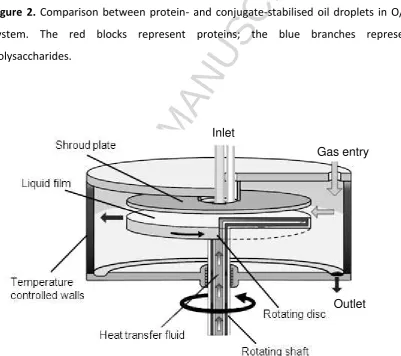
In the SDR, protein + polysaccharide solution is fed into the centre of a rotating disc, and is
forced towards the edge and onto the surrounding walls by centrifugal force. A schematic
diagram showing various pathways for the flow is presented in Figure 3. The disc can be
heated (or cooled) and the centrifugal force creates a very thin film (measurable in µm) [35],
giving high heat transfer coefficients between the disc and solutions [36].When the solution
leaves the spinning disc, it can be re-circulated providing a continuous process. The
residence time on the disc is short, of the order of 0.4 seconds, but it is possible to reduce
ACCEPTED MANUSCRIPT
has also been used for other food applications including production of concentrated apple
juice [37 ].
3. Characterisation of protein-polysaccharide conjugates
According to the literature, there are many techniques that have been used to confirm
the formation of conjugates including: spectrophotometry [19, 22, 38], gel electrophoresis
[8 , 18, 39], and chromatography [20, 25, 27].
Spectrophotometry is a rapid and useful technique for monitoring the browning
process of the Maillard reaction and its reaction products, in the wavelength range 270-500
nm [19, 22, 29, 30, 38, 40, 41]. Generally, Maillard browning process is monitored at 420nm,
though Zhu et al., (2008) reported a maximum absorbance peak at 304 nm for the formation
of the Schiff base. Spectrophotometry requires few pre-treatments before the
measurement and is probably the easiest and cheapest way to characterise
protein-polysaccharide conjugates but alone is not adequate to confirm the synthesis of conjugates.
During conjugate formation the concentration of free amino groups decreases as
they react with the saccharide reducing group. Therefore, the analysis of free amino groups
in the Maillard reaction products (MRPs) can provide more direct information on the extent
or the degree of conjugation. A significant number of studies have utilised the
2,4,6-Trinitrobenzenesulfonic acid (TNBS) method to determine the free amino groups in the
protein-polysaccharide mixture after the heat treatment [18, 19, 24, 40, 42-44]. The
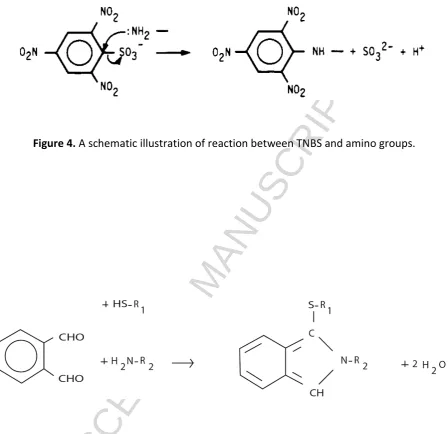
reaction is illustrated in Figure 4. The TNBS reagent reacts with the free amino groups to
form an orange coloured compound which can be analysed for by absorbance at 335 nm
[45]. The method is widely accepted for the determination of free amino groups during
protein hydrolysis. However, Nielsen et al., (2001) reported several disadvantages of this
method: it utilizes a toxic, high risk chemical; it is time-consuming and requires a dark
T -phthalaldehyde (OPA) which was then
tested/utilised by many researchers and is now widely accepted as a more accurate method
than the TNBS reaction for determining the free amino groups in protein-polysaccharide
mixtures [16, 31, 38, 41, 46]. Figure 5 [48] illustrates the reaction scheme, which it is easier
ACCEPTED MANUSCRIPT
(The OPA method is now used to monitor the proteolysis of milk proteins in dairy science
[47]).
Electrophoresis is another commonly used method to confirm the formation of
protein-polysaccharide conjugates, especially sodium dodecyl sulphate polyacrylamide gel
electrophoresis (SDS-PAGE) [8 , 9 , 38, 42, 49, 50]. The intensity of the bands due to pure
(un reacted) protein declines relative to that of the new bands due to the conjugates, in
positions of higher molecular weight. Chromatographic techniques are usually chosen to
assess the molecular weight (Mw) distribution of MRPs [20, 25, 30, 51, 52]. Size exclusion
high performance liquid chromatography (SE-HPLC) is the most popular approach to
investigating the Mw profile of MRPs. MRPs typically dissolved in a sodium phosphate buffer
are injected into a specific column at a controlled flow rate and the elution monitored by a
light scattered photometer at a selected wavelength, e.g., 214nm [24, 25]. The Mw of the
conjugates can be estimated based on the elution profiles against the standard protein
references [25]. Other approaches that have been applied to characterise
protein-polysaccharide conjugates include fluorescence measurement [26, 32, 40], circular
dichroism for their amino acid profiles [32, 38, 41], and matrix-assisted laser desorption
ionization-mass spectrometry (MALDI-MS) for structure characterisation of
protein-polysaccharide conjugates [26, 53 ].
4. Functional properties of protein-polysaccharide conjugates
4.1Solubility and thermal stability
To be effective as proteinaceous emulsifiers, sufficient solubility is a critical
requirement [54 ]. However, high solubility is usually difficult to achieve when
environmental conditions are harsh . For instance, when the pH of the aqueous phase is not
far from the isoelectric pH (pI) the solubility is markedly lower for most proteins. The
covalent coupling of proteins and polysaccharides can improve the solubility of native
proteins under unfavourable conditions, due to the attached hydrophilic polysaccharide
moieties. A number of researchers have demonstrated improvement in the solubility of
proteins after glycosylation [9 , 22, 31]. Akhtar and Dickinson (2007) reported that the
ACCEPTED MANUSCRIPT
around the isoelectric point (pI) [9 ]. Similarly, a considerable improvement in solubility of
soy proteins coupled with acacia gum was observed compared to the mixture of
protein-acacia gum without the Maillard reaction [31]. However, contradictory solubility results
were reported by Al-Hakkak and Al-Hakkak (2010) for egg white protein-pectin conjugates
[43].
Another important test for protein stability is resistance to denaturation. Thermal
treatment is inevitable in food processing, such as pasteurisation, which can lead to the
denaturation of proteins. Previously, many investigations suggested the improvement of
protein thermal stability when grafted to polysaccharides [19, 42]. Their results suggested
that a more stable structure was formed during the Maillard reaction, most likely due to
protein-protein interactions between denatured protein molecules being more hindered by
the attached polysaccharide molecules [11 ].
4.2Emulsifying properties
Generally, it is expected that protein-polysaccharide conjugates possess better
emulsifying properties than native proteins, particularly at a pH near the pI. A large number
of studies have been conducted to investigate the emulsifying properties of
protein-polysaccharide conjugates [8 , 20, 28 , 41, 42, 55-58 ]. The critical parameters that
significantly influence the emulsifying properties of the conjugates are the molecular weight
of polysaccharide and the ratio of proteins and polysaccharide, though this has been studied
to a lesser extent.
4.2.1 Influence of molecular weight of polysaccharide
Shu et al. (1996) reported that the emulsifying properties of lysozyme-galactomannan
conjugates were enhanced significantly by increasing the molecular weight of the
polysaccharide [42]. An optimum molecular weight of the polysaccharide was recognized to
be 6 kDa. Other researchers have argued that the emulsifying properties may not be
improved if the molecular weight of the attached polysaccharides is less than 6 kDa [11].
Furthermore, Akhtar and Dickinson, (2007) also confirmed that whey protein
isolate-maltodextrin (DE 19) (Mw =8.7 kDa) conjugates, exhibited better emulsifying properties than
the conjugates with maltodextrin (DE 2 and 47) [9 ]. Theoretically, larger sugar moieties
ACCEPTED MANUSCRIPT
compared to the proteins, it will reduce the adsorption of the conjugates onto the oil-water
interface detrimentally. Thus, an optimum Mw should exist for a particular type of
polysaccharide chain.
4.2.2 Influence of protein-polysaccharide ratio
Dickinson and Semenova (1992) investigated the effect of molar ratio of
protein-dextran hybrids [28 ]. Four years later, Shu et al. (1996) reported studies on lysozyme
attached with 1 and 2 mol galactomannan, which showed that conjugates synthesised with
a higher proportion of polysaccharides may have better emulsifying properties than that
with a relatively low proportion of polysaccharides [42]. Akhtar and Dickinson (2007) also
found a similar improvement of emulsifying properties of whey protein isolate: maltodextrin
conjugates by increasing the proportion of polysaccharide from 1:0.5 to 1:3 (w/w) [9 ].
However, recently Lam and Nickerson (2013) warned that if the content of polysaccharides
is above a certain level, the non-linked polysaccharides may destabilise emulsions due to
the depletion effect [59]. Therefore, it is critical to control the molar or the weight ratio of
proteins and polysaccharides for synthesising effective conjugates.
4.3Gelling and foaming properties
Protein-polysaccharide conjugates have also been explored for their gelling and
foaming properties compared to native proteins [16, 60, 61]. Matsudomi et al. [60]
compared the gelling properties of egg white-galactomannan conjugates with egg white
protein alone and showed an increase of gel strength and water retention capacity. More
recently, Spotti et al. [16] reported that WPI-DX conjugates significantly enhanced the
mechanical properties of the gels, which could be subjected to as high as 80% deformation
in a uniaxial compression test without fracture, far higher than the gel prepared by
non/unconjugated WPI-DX mixture [16]. Although majority of studies have shown that
protein-polysaccharide conjugates can have improved
-casein-dextran conjugates showed a negative effect [61 ].
ACCEPTED MANUSCRIPT
Practically, the attachment of polysaccharide molecules to specific sites on protein
molecules is extremely challenging, especially in the context of food. However, computer
simulation has been used to estimate the theoretical behaviours of such conjugates. The
interaction s1-casein- polysaccharide conjugates have been
investigated using the lattice-based self-consistent-field (SCF) theory, suggesting that short
polysaccharide chains covalently bonded to proteins may have detrimental effects on
colloidal stabilisation, especially when the attachment position is in the middle of the
protein [62 ].
6. Conclusions
In the search for better and more environmentally friendly emulsifiers and stabilizers,
the glycosylation of proteins via the Maillard reaction can enhance the functional properties
of native proteins and the conjugates produced have many potential uses in foods and
other, non-food applications, such as drug delivery systems for controlled release of
bioactive agents. New processing technologies, such as spinning disc reactor, are being
developed that could provide alternative methods for their production. There is a need for
further exploration of the fundamentals of Maillard reaction between proteins and
saccharides in order to achieve a better understanding of the structure and functional
properties of the conjugates formed.
Acknowledgments
It has been a great pleasure to work with Professor Eric Dickinson in the School of
Food Science & Nutrition on various research projects. MA would like to thank Prof.
Dickinson for introducing him to the area of protein-polysaccharide conjugates it has led
to our understanding of the formation and functional properties of the conjugates, for
ACCEPTED MANUSCRIPT
References:
1. Dickinson, E., Hydrocolloids as emulsifiers and emulsion stabilizers. Food Hydrocolloids, 2009. 23(6): p. 1473-1482.
2. Dickinson, E., Hydrocolloids and emulsion stability, in Handbook of hydrocolloids, G.W. Phillips, PA, Editor. 2009, Woodhead Publishing Ltd.: Cambridge. p. 23-47.
3. McClements, D., Food emulsions. Vol. 24. 1999, Boca Raton: CRC Press.
4 . Oliver, C.M., L.D. Melton, and R.A. Stanley, Creating proteins with novel functionality via the Maillard reaction: A review. Critical Reviews in Food Science and Nutrition, 2006. 46(4): p. 337-350.
This review shows a deeper understanding of modified properties of proteins especially from the processing conditions perspectives in the Maillard reaction. Moreover, it also suggests critical factors for designing functional conjugates via the Maillard reaction. 5. Liu, J., Q. Ru, and Y. Ding, Glycation a promising method for food protein modification:
Physicochemical properties and structure, a review. Food Research International, 2012. 49
(1): p. 170-183.
6 . Dickinson, E., Interaction of polysaccharides with adsorbed proteins, in An Introduction to Food Colloids, E. Dickinson, Editor. 1992, Oxford University Press: United States. p. 170. It establishes the foundation of covalently bonded protein-polysaccharide complex via the Maillard reaction by mimicing the natural mateiral gum arabic.
7. Maillard, L.C., The action of amino acids on sugar; The formation of melanoidin by a
methodic route. Comptes Rendus Hebdomadaires Des Seances De L Academie Des Sciences, 1912. 154: p. 66-68.
8 . Akhtar, M. and E. Dickinson, Emulsifying properties of whey protein-dextran conjugates at low pH and different salt concentrations. Colloids and Surfaces B-Biointerfaces, 2003. 31 (1-4): p. 125-132.
This research paper investigates the emulsifying properties of MRPs (Maillard reaction products) under unfavourable environmental conditions, and shows that the functional properties of modified proteins can be enhaced.
9 . Akhtar, M. and E. Dickinson, Whey protein-maltodextrin conjugates as emulsifying agents: An alternative to gum arabic. Food Hydrocolloids, 2007. 21(4): p. 607-616.
This paper is the practice of the fundenmental theory (Reference No. 6) and suggests that the conjugates have better emulsifying properties than natural gum arabic. This provides a strong evidence to support the theory and lays down a solid foundation for further research. 10 . Kato, A., K. Murata, and K. Kobayashi, Preparation and characterization of
ovalbumin-dextran conjugate having excellent emulsifying properties. Journal of Agricultural and Food Chemistry, 1988. 36(3): p. 421-425.
This paper was published at the very beginning of the research area on modifying proteins via dry-heat treatment. It also proposed the basic structure of conjugates preparation and characterisation techniques for further researches.
ACCEPTED MANUSCRIPT
This review provides a summary of previous research on the topic and proposes the general mechanism of conjugates formation. Importantly, it also suggests great potential of
conjugates for industrial application as a novel emulsifier and stabiliser.
12. Dickinson, E. and Y.B. Galazka, Emulsion stabilization by ionic and covalent complexes of beta-lactoglobulin with polysaccharides. Food Hydrocolloids, 1991. 5 (3): p. 281-296. 13. Du, Y., et al., Physicochemical properties and emulsion stabilization of rice dreg glutelin
conjugated with kappa-carrageenan through Maillard reaction. Journal of the Science of Food and Agriculture, 2013. 93 (1): p. 125-133.
14. Hattori, M., et al., Functional improvement of alginic acid by conjugating with beta-lactoglobulin. Journal of Food Science, 1996. 61(6): p. 1171-1176.
15. Nagasawa, K., et al., Role of the polysaccharide content and net charge on the emulsifying properties of beta-lactoglobulin-carboxymethyldextran conjugates. Journal of Agricultural and Food Chemistry, 1996. 44(9): p. 2538-2543.
16. Spotti, M.J., et al., Gel mechanical properties of milk whey protein dextran conjugates obtained by Maillard reaction. Food Hydrocolloids, 2013. 31(1): p. 26-32.
17. de Oliveira, F.C., et al., Food Protein-polysaccharide Conjugates Obtained via the Maillard Reaction: A Review. Critical Reviews in Food Science and Nutrition, 2016. 56(7): p. 1108-1125.
18. Kato, A., et al., Functional casein-polysaccharide conjugates prepared by controlled dry heating. Bioscience Biotechnology and Biochemistry, 1992. 56(4): p. 567-571.
19. Jiménez-Castaño, L., M. Villamiel, and R. López-Fandiño, Glycosylation of individual whey proteins by Maillard reaction using dextran of different molecular mass. Food Hydrocolloids, 2007. 21(3): p. 433-443.
20. Kato, A., et al., Funtional protein polysaccharide conjugate prepared by controlled dry-heating of ovalbumin dextran mixtures. Agricultural and Biological Chemistry, 1990. 54(1): p. 107-112.
21. Usui, M., et al., Enhanced bactericidal action and masking of allergen structure of soy protein by attachment of chitosan through Maillard-type protein-polysaccharide conjugation.
Nahrung-Food, 2004. 48(1): p. 69-72.
22. Qi, J.-R., X.-Q. Yang, and J.-S. Liao, Improvement of functional properties of acid-precipitated soy protein by the attachment of dextran through Maillard reaction. International Journal of Food Science and Technology, 2009. 44(11): p. 2296-2302.
23. Li, C., et al., Physicochemical Properties of Dry-Heated Peanut Protein Isolate Conjugated with Dextran or Gum Arabic. Journal of the American Oil Chemists Society, 2013. 90(12): p. 1801-1807.
24. Nakamura, S., A. Kato, and K. Kobayashi, New antimicrobial characteristics of lysozyme dextran conjugate. Journal of Agricultural and Food Chemistry, 1991. 39(4): p. 647-650. 25. Wong, B.T., et al., The Effect of Maillard Conjugation of Deamidated Wheat Proteins with
Low Molecular Weight Carbohydrates on the Secondary Structure of the Protein. Food Biophysics, 2009. 4(1): p. 1-12.
26. Medrano, A., et al., The effect of glycation on foam and structural properties of beta-lactoglobulin. Food Chemistry, 2009. 113(1): p. 127-133.
27. Gu, F.-L., et al., Structure and antioxidant activity of high molecular weight Maillard reaction products from casein-glucose. Food Chemistry, 2010. 120(2): p. 505-511.
28 . Dickinson, E. and M.G. Semenova, Emulsifying properties of covalent protein dextran hybrids. Colloids and Surfaces, 1992. 64(3-4): p. 299-310.
ACCEPTED MANUSCRIPT
29. Zhu, D., S. Damodaran, and J.A. Lucey, Formation of whey protein isolate (WPI)-dextran conjugates in aqueous solutions. Journal of Agricultural and Food Chemistry, 2008. 56(16): p. 7113-7118.
30. Zhu, D., S. Damodaran, and J.A. Lucey, Physicochemical and Emulsifying Properties of Whey Protein Isolate (WPI)-Dextran Conjugates Produced in Aqueous Solution. Journal of
Agricultural and Food Chemistry, 2010. 58(5): p. 2988-2994.
31. Mu, L., et al., Physicochemical Properties of Soy Protein Isolates-Acacia Gum Conjugates. Czech Journal of Food Sciences, 2011. 29(2): p. 129-136.
32. Niu, L.-Y., et al., Characteristics and functional properties of wheat germ protein glycated with saccharides through Maillard reaction. International Journal of Food Science and Technology, 2011. 46(10): p. 2197-2203.
33. Burns, J.R. and R.J.J. Jachuck, Recent advances on spinning disc reactor technology: Better Processes for Bigger Profits, in 5th International Conference on Process Intensification. 2003: Maastricht, The Netherlands.
34. Jachuck, R.J., et al., Process Intensification for Energy Saving. Applied Thermal Engineering, 1997. 17: p. 861-867.
35. Burns, J.R., C. Ramshaw, and R.J. Jachuck, Measurement of liquid film thickness and the determination of spin-up radius on a rotating disc using an electrical resistance technique. Chemical Engineering Science, 2003. 58(2245-2253).
36. Auoune, A. and C. Ramshaw, Process intensification: heat and mass transfer characteristics of liquid films on rotating discs. International Journal of Heat Mass Transfer, 1999. 42: p. 2543-2556.
37 . Akhtar M, C.P., Safriani N, Murray B, Clayton G, Concentration of Apple Juice Using Spinning Disc Reactor Technology. Journal of Food Processing & Technology, 2011. 2(108).
This research paper is not directly related to protein-polysaccharide conjugates. However, the use of the SDR (spinning disc reactor) provides a a novel continous and wet-heating process which has a great potential to optimise the preparation of protein-polysaccharide conjugates for industrial applications (see Reference No. 11).
38. Xu, C.-h., et al., Emulsifying properties and structural characteristics of beta-conglycinin and dextran conjugates synthesised in a pressurised liquid system. International Journal of Food Science and Technology, 2010. 45(5): p. 995-1001.
39. Li, Z., Y. Luo, and L. Feng, Effects of Maillard reaction conditions on the antigenicity of alpha-lactalbumin and beta-lactoglobulin in whey protein conjugated with maltose. European Food Research and Technology, 2011. 233(3): p. 387-394.
40. Li, Y., et al., Functional properties of Maillard reaction products of rice protein hydrolysates with mono-, oligo- and polysaccharides. Food Hydrocolloids, 2013. 30(1): p. 53-60.
41. Sun, W.-W., et al., Study on the rheological properties of heat-induced whey protein isolate-dextran conjugate gel. Food Research International, 2011. 44(10): p. 3259-3263.
42. Shu, Y.W., et al., Effects of the length of polysaccharide chains on the functional properties of the Maillard-type lysozyme-polysaccharide conjugate. Journal of Agricultural and Food Chemistry, 1996. 44(9): p. 2544-2548.
43. Al-Hakkak, J. and F. Al-Hakkak, Functional egg white-pectin conjugates prepared by controlled Maillard reaction. Journal of Food Engineering, 2010. 100(1): p. 152-159. 44. Álvarez, C., et al., Functional properties of isolated porcine blood proteins modified by
M Food Hydrocolloids, 2012. 28(2): p. 267-274.
45. Adlernissen, J., Determination of the degree of hydrolysis of food protein hydrolysates by trinitrobenzenesulfonic acid. Journal of Agricultural and Food Chemistry, 1979. 27(6): p. 1256-1262.
46. Markman, G. and Y.D. Livney, Maillard-conjugate based core-shell co-assemblies for
nanoencapsulation of hydrophobic nutraceuticals in clear beverages. Food & Function, 2012.
ACCEPTED MANUSCRIPT
47. Church, F.C., et al., Spectrophotometric assay using ortho-phthaldialdehyde fordetermination of proteolysis in milk and isolated milk-proteins. Journal of Dairy Science, 1983. 66(6): p. 1219-1227.
48. Nielsen, P.M., D. Petersen, and C. Dambmann, Improved method for determining food protein degree of hydrolysis. Journal of Food Science, 2001. 66(5): p. 642-646.
49. Liu, J.H., Q.M. Ru, and Y.T. Ding, Glycation a promising method for food protein modification: Physicochemical properties and structure, a review. Food Research International, 2012.
49(1): p. 170-183.
50. Laemmli, U.K., Cleavage of structural proteins during assembly of head of bacteriophage-T4. Nature, 1970. 227(5259): p. 680-&.
51. Kasran, M., S.W. Cui, and H.D. Goff, Covalent attachment of fenugreek gum to soy whey protein isolate through natural Maillard reaction for improved emulsion stability. Food Hydrocolloids, 2013. 30(2): p. 552-558.
52. Bund, T., et al., Chromatographic purification and characterization of whey protein dextran glycation products. Journal Chromatography, 2012. A(1244): p. 98-105.
53 . Corzo-Martinez, M., et al., Interfacial and foaming properties of bovine beta-lactoglobulin: Galactose Maillard conjugates. Food Hydrocolloids, 2012. 27(2): p. 438-447.
This paper clearly shows the enhancement of foaming properties of modified globular proteins especially in acidic environment close to the pI of the protein.
54 . Halling, P.J., Protein-stabilized foams and emulsions. Crc Critical Reviews in Food Science and Nutrition, 1981. 15(2): p. 155-203.
This reviews presents the critical importance of protein solubility in food colloidal systems such as emulsions and foams.
55. Tamnak, S., et al., Physicochemical properties, rheological behavior and morphology of pectin-pea protein isolate mixtures and conjugates in aqueous system and oil in water emulsion. Food Hydrocolloids, 2016. 56: p. 405-416.
56. Pirestani, S., et al., Effect of glycosylation with gum Arabic by Maillard reaction in a liquid system on the emulsifying properties of canola protein isolate. Carbohydrate Polymers, 2017.
157: p. 1620-1627.
57 . Chen, L., et al., Improved Low pH Emulsification Properties of Glycated Peanut Protein Isolate by Ultrasound Maillard Reaction. J. Agric. Food Chem., 2016. 64: p. 5531-5538.
This recent paper provides a brand new method to prepare conjugates via ultrasound Maillard reaction instead of tradational heat treatments.
58. Bi, B., et al., C -lactoglobulin-gum Acacia Seyal conjugates prepared via the Maillard reaction. Food Chemistry, 2017. 214(1): p. 614-621. 59. Lam, R.S.H. and M.T. Nickerson, Food proteins: A review on their emulsifying properties using
a structure-function approach. Food Chemistry, 2013. 141(2): p. 975-984.
60. Matsudomi, N., et al., Improvement of gel properties of dried egg white by modification with galactomannan through the Maillard reaction. Journal of Agricultural and Food Chemistry, 2002. 50(14): p. 4113-4118.
61 . Dickinson, E. and E. Izgi, Foam stabilization by protein-polysaccharide complexes. Colloids and Surfaces a-Physicochemical and Engineering Aspects, 1996. 113(1-2): p. 191-201. This paper highlights important factors for obtaining improved foaming properties of proteins: process time of preparation. Moreover, the type of protein is also critical for preparing conjugates.
62 . Akinshina, A., et al., Interactions between Adsorbed Layers of alpha(S1)-Casein with
Covalently Bound Side Chains: A Self-Consistent Field Study. Biomacromolecules, 2008. 9(11): p. 3188-3200.
ACCEPTED MANUSCRIPT
Figures
Figure 1. (A) The basic chemical reaction mechanism for the formation of
protein-polysaccharide conjugates via the Maillard reaction (B) the overview structure of the
conjugate [11].
[image:16.595.126.470.122.480.2]ACCEPTED MANUSCRIPT
Figure 2. Comparison between protein- and conjugate-stabilised oil droplets in O/W
system. The red blocks represent proteins; the blue branches represent
[image:17.595.72.434.78.224.2]polysaccharides.
Figure 3. A schematic diagram of an SDR. Inlet
Outlet Gas entry
[image:17.595.108.510.223.579.2]ACCEPTED MANUSCRIPT
Figure 4. A schematic illustration of reaction between TNBS and amino groups.
Figure 5. A chemical reaction of OPA with SH- and NH2- groups to form detectable
[image:18.595.92.501.73.195.2]ACCEPTED MANUSCRIPT
Graphical Abstract
Inlet
Outlet Gas entry
Whey Polysacchari
In
ACCEPTED MANUSCRIPT
Highlights
A novel process for preparing conjugates via Spinning Disc Reactor (SDR) has been presented.
Solubility of proteins and their functional properties can be improved significantly by coupling with polysaccharides.
Advances in protein-polysaccharide conjugates by dry and wet heating methods are