This is a repository copy of
Shortening QBF Proofs with Dependency Schemes
.
White Rose Research Online URL for this paper:
http://eprints.whiterose.ac.uk/118501/
Version: Accepted Version
Proceedings Paper:
Blinkhorn, J and Beyersdorff, O orcid.org/0000-0002-2870-1648 (2017) Shortening QBF
Proofs with Dependency Schemes. In: Theory and Applications of Satisfiability Testing –
SAT 2017 (Lecture Notes in Computer Science). International Conference on Theory and
Applications of Satisfiability Testing, 28 Aug - 01 Sep 2017, Melbourne, Australia. Springer
Nature , pp. 263-280. ISBN 978-3-319-66262-6
https://doi.org/10.1007/978-3-319-66263-3_17
© Springer International Publishing AG 2017. This is an author produced version of a
paper published in Theory and Applications of Satisfiability Testing – SAT 2017 (Lecture
Notes in Computer Science). Uploaded in accordance with the publisher's self-archiving
policy. The final publication is available at Springer via
https://doi.org/10.1007/978-3-319-66263-3_17.
Reuse
Unless indicated otherwise, fulltext items are protected by copyright with all rights reserved. The copyright exception in section 29 of the Copyright, Designs and Patents Act 1988 allows the making of a single copy solely for the purpose of non-commercial research or private study within the limits of fair dealing. The publisher or other rights-holder may allow further reproduction and re-use of this version - refer to the White Rose Research Online record for this item. Where records identify the publisher as the copyright holder, users can verify any specific terms of use on the publisher’s website.
Takedown
If you consider content in White Rose Research Online to be in breach of UK law, please notify us by
Shortening QBF Proofs with
Dependency Schemes
Joshua Blinkhorn and Olaf Beyersdorff
School of Computing, University of Leeds, UK
Abstract. We provide the first proof complexity results for QBF depen-dency calculi. By showing that the reflexive resolution path dependepen-dency scheme admits exponentially shorter Q-resolution proofs on a known family of instances, we answer a question first posed by Slivovsky and Szeider in 2014 [30]. Further, we conceive a method of QBF solving in which dependency recomputation is utilised as a form of inprocessing. Formalising this notion, we introduce a new calculus in which a depen-dency scheme is applied dynamically. We demonstrate the further po-tential of this approach beyond that of the existing static system with an exponential separation.
1
Introduction
Proof complexity is the study of proof size in systems of formal logic. Since its beginnings the field has enjoyed strong connections to computational complexity [8, 10] and bounded arithmetic [9, 17], and has emerged in the past two decades as the primary means for the comparison of algorithms in automated reasoning. Recent successes in that area, epitomised by progress in SAT solving, have motivated broader research into the efficient solution of computationally hard problems. Amongst them, the logic of quantified Boolean formulas (QBF) is an established field with a substantial volume of literature. QBF extends propo-sitional logic with the addition of existential and universal quantification, and naturally accommodates more succinct encodings of problem instances. This gives rise to diverse applications in areas including conformant planning [11,24], verification [1], and ontologies [16].
It is fair to say that much of the early research into QBF solving [13, 26, 33], and later the proof complexity of associated theoretical models [4–6], was built upon existing techniques for SAT. For example, QCDCL [12] is a major paradigm in QBF solving based on conflict-driven clause learning (CDCL [21]),the dom-inant paradigm for SAT. By analogy, the fundamental theoretical model of QCDCL, the calculus Q-resolution (Q-Res[15]), is an extension of propositional resolution, the calculus that underpins CDCL. Given, however, that the decision problem for QBF isPSPACE-complete, it is perhaps unsurprising that the im-plementation of QCDCL presents novel obstacles for the practitioner, beyond those encountered at the level of propositional logic.
according to a linear order imposed by the quantifier prefix. Whereas decision variables must be chosen carefully to ensure sound results, coercing the order of assignment to respect the prefix is frequently needlessly restrictive [19]. More-over, limiting the choice adversely affects the impact of decision heuristics. In contrast, such heuristics play a major role in SAT solving [18, 22, 27, 28], where variables may be assigned in an arbitrary order.
Dependency awareness, as implemented in the solver DepQBF [7], is a QBF-specific paradigm that attempts to maximise the impact of decision heuristics. By computing adependency scheme before the search process begins, the linear order of the prefix is effectively supplanted by a partial order that better ap-proximates the variable dependencies of the instance, granting the solver greater freedom regarding variable assignments. Use of the scheme is static; dependen-cies are computed only once and do not change during the search. Despite the additional computational cost incurred, empirical results demonstrate improved solving on many benchmark instances [19].
Dependency schemes themselves are tractable algorithms that identify de-pendency information by appeal to the syntactic form of an instance. From the plethora of schemes that have been proposed in the literature, two have emerged as principal objects of study. The standard dependency scheme (Dstd
[25]), a variant of which is used by DepQBF, was originally proposed in the context of backdoor sets. This scheme uses sequences of clauses connected by common existential variables to determine a dependency relation between the variables of an instance. Thereflexive resolution path dependency scheme (Drrs
[31]) utilises the notion of a resolution path, a more refined type of connection introduced in [32].
A solid theoretical model for dependency awareness was only recently pro-posed in the shape of the calculusQ(D)-Res[31], a parametrisation of Q-resolution by the dependency schemeD. Whereas the body of work on Q(D)-Resand re-lated systems has focused on soundness [2, 23, 31], authors of all three papers have cited open problems in proof complexity. Indeed, prior to this paper there were no proof-theoretic results to support any claims concerning the potential of dependency schemes in the practice of QBF solving.
In this work, not only do we provide the first such results, we also demonstrate the potential of dependency schemes to further reduce the size of proofs if they are applieddynamically. We summarise our contributions below.
1. The first separations for QBF dependency calculi. We use the
well-known formulas of Kleine B¨uning et al. [15] to prove the first exponential sep-aration forQ(D)-Res. We show thatDrrs
can identify crucial independencies in these formulas, leading to short proofs in the system Q(Drrs
)-Res. In contrast, we show that Dstd cannot identify any non-trivial independencies, allowing us to lift the exponential lower bound for Q-Res[3, 15] to Q(Dstd
2. A model of dynamic dependency analysis. We propose the new calculus
dyn-Q(D)-Resthat models the dynamic application of a dependency scheme in Q-resolution. The system employs a so-called ‘reference rule’ that allows new axioms, called reference clauses, to be introduced into the proof. The key insight is that the application of an assignment to an instance formula may allow the dependency scheme to unlock new independencies. As such, the reference rule alludes to an explicit refutation of the formula under an appropriate restriction, and is analogous to the recomputation of dependencies at an arbitrary point of the QCDCL procedure. We prove that dyn-Q(D)-Resis sound whenever the dependency schemeDis fully exhibited.
3. Exponential separation of static and dynamic systems. Our final
con-tribution demonstrates that the dynamic application of dependency schemes can shorten Q-resolution proofs even further, yielding an exponential improvement even over the static approach. Using a modification of the aforementioned for-mulas from [15], we prove that dyn-Q(Drrs
)-Res is exponentially stronger than
Q(Drrs )-Res.
2
Preliminaries
Quantified Boolean formulas. In this paper, we considerquantified Boolean
formulas (QBFs) inprenex conjunctive normal form(PCNF), typically denoted
Φ = Q.φ. A PCNF over Boolean variables z1, . . . , zn consists of a quantifier
prefix Q=Q1z1· · · Qnzn,Qi∈ {∃,∀}fori∈[n], in which all variables are quan-tified either existentially or universally, and a propositional conjunctive normal form (CNF) formulaφcalled thematrix. The prefixQimposes a linear ordering
<Φon the variables ofΦ, such thatzi<Φzjholds wheneveri < j, in which case we say thatzj is right of zi.
A literal is a variable or its negation, a clause is a disjunction of literals, and a CNF is a conjunction of clauses. Throughout, we refer to a clause as a set of literals and to a CNF as a set of clauses. We typically write x for existential variables, ufor universals, and z for either. For a literal l, we write var(l) =z
iffl=zor l=¬z, for a clauseCwe write vars(C) ={var(l)|l∈C}, and for a PCNFΦwe write vars(Φ) for the variables in the prefix ofΦ.
A (partial) assignment δ to the variables of Φ is represented as a set of literals, typically denoted {l1, . . . , lk}, where literal z (resp. ¬z) represents the assignment z 7→ 1 (resp. z 7→ 0). The restriction of Φ by δ, denoted Φ[δ], is obtained by removing fromφany clause containing a literal inδ, and removing the negated literals¬l1, . . . ,¬lkfrom the remaining clauses, while the variables of
δand their associated quantifiers are removed from the prefixQ. For assignments to single variables we may omit the braces; for example, we writeΦ[l] forΦ[{l}].
QBF resolution. Resolution is a well-studied refutational proof system for
may be derived from clausesC1∪ {x} andC2∪ {¬x} (variablexis the pivot). Resolution is refutationally sound and complete: that is, the empty clause can be derived from a CNF iff it is unsatisfiable.
There exist a host of resolution-based QBF proof systems – see [3] for a detailed account. Q-resolution (Q-Res) introduced in [15] is the standard refu-tational calculus for PCNF. In addition to resolution over existential pivots, the calculus has a universal reduction rule which allows a clause C to be derived from C∪ {l}, provided var(l) is a universal variable right of all existentials in
C. Tautologies are explicitly forbidden; one may not derive a clause containing bothz and¬z.
For a QBF resolution systemP, aPderivation of a clauseCfrom a PCNFΦ
is a sequenceC1, . . . , Cm of clauses in whichC=Cm, and each clause is either an axiom or is derived from previous clauses in the sequence using an inference rule. Arefutation ofΦis a derivation of the empty clause fromΦ.
A proof systemPp-simulates a systemQ(denoted Q≤pP) if each Q-proof can be transformed in polynomial time into aP-proof of the same formula [10]. The systemsPandQarep-equivalent (denotedP≡pQ) ifP≤pQandQ≤pP.
QBF models. LetΦ=Q1z1· · · Qnzn.φbe a PCNF over existential variables
V∃and universal variablesV∀. A model f forΦis a mapping from total assign-ments toV∀to total assignments toV∃that satisfies two conditions: (a) whenever
αandα′ agree on all universals left of a variablez
i, then f(α) andf(α′) agree on all existential variables left of (and including)zi; (b) for eachαin the domain off,α∪f(α) satisfies every clauseC∈φ(that is,C∩(α∪f(α))6=∅). A PCNF is true iff it has a model, otherwise it is false.
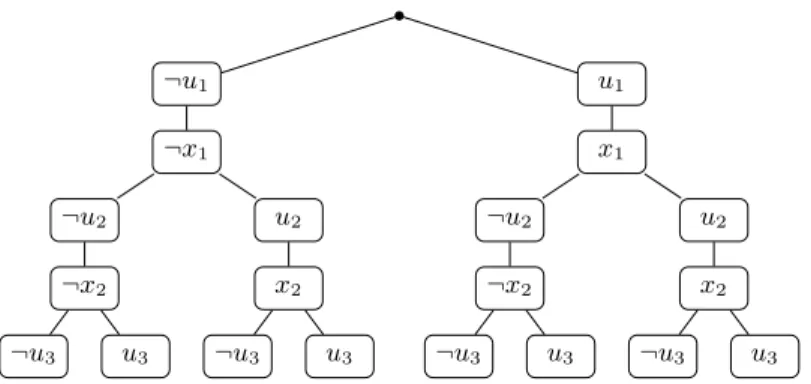
Following [26], a model can be depicted naturally as a tree, as shown in Figure 1. For each α in the domain of f, the literals of the set α∪f(α) are written in prefix order on a unique path from the root of the tree to some leaf. As such, a model can be uniquely identified with a set of 2|V∀| paths, each of
which is one of the sets α∪f(α). This is a convenient interpretation (cf. [2]), and we adopt this approach for all technicalities concerning QBF models.
3
Static dependency awareness in Q-resolution
In this section, we provide the necessary background for dependency schemes and their incorporation into Q-resolution. We recall the definitions of the standard [25] and reflexive resolution path [31] dependency schemes, and the definition of the dependency calculusQ(D)-Res.
3.1 Overview of dependency schemes
For the duration of this work, we deal only with the (in)dependence of existential variables on universal variables1. This is a convenience afforded by the fact that
1
u1
¬u1
x1
¬x1
u2
¬u2
u2
¬u2
x2
¬x2
x2
¬x2
u3
¬u3
u3
¬u3
u3
¬u3
u3
¬u3
Fig. 1. Tree depiction of a model for the PCNF with prefix ∀u1∃x1∀u2∃x2∀u3 and
clauses{u1,¬x1},{¬u1, x1}and{¬u1,¬u2, x2,¬u3}.
we deal with refutational calculi, in which the (in)dependence of universals on existentials does not feature. We therefore take the opportunity to work with tighter (and in some cases considerably simpler) definitions than those referenced in the literature.
A dependency scheme is presented as a function mapping PCNFs to binary relations. The binary relations represent variable dependencies. For an arbitrary PCNFΦ, thetrivial dependency relation captures the linear order of the quanti-fier prefix ofΦ, and is given byDtrv
(Φ) ={(u, x)∈vars∀(Φ)×vars∃(Φ)|u <Φx}. Formally, a dependency schemeDis a mapping from the set of all PCNFs that satisfiesD(Φ)⊆ Dtrv
(Φ) for each PCNFΦ. The existence of a pair (u, x)∈ D(Φ) should be interpreted as ‘existential x depends on universal u in Φ accord-ing to dependency scheme D’. We say that D′ is at least as general as D iff D′(Φ)⊆ D(Φ) for each PCNFΦ, and isstrictly more general if the inclusion is strict for some PCNF.
All non-trivial dependency schemes that have appeared in the literature to date are based in some way or another on connections between clauses in the matrix. In the standard dependency scheme Dstd, an existential xdepends on a universal u whenever a clause containing variable xis connected to a clause containing variable u, whereby clauses are connected iff they share a common existential variable that is right ofu. The absence of such a connection ensures that xis independent ofuaccording toDstd
.
Definition 1 (standard dependency scheme [25]). Let Φ = Q.φ be a
PCNF. The pair (u, x) ∈ Dtrv
(Φ) is in Dstd
(Φ) iff there exists a sequence of clauses C1, . . . , Cn ∈ φ with u ∈ vars(C1), x ∈ vars(Cn), such that, for each
i∈[n−1],vars(Ci)∩vars(Ci+1)contains an existential variable right ofu.
Axiom rule:axiom(φ)
C Cis a clause in the matrix φ.
Reduction rule:red(C, l)
C C\ {l}
– literallis universal.
– (var(l), x)∈ D(/ Φ) holds for each existential variablexin vars(C).
Resolution rule:res(C1, C2, x)
C1 C2
(C1∪C2)\ {x,¬x}
– variablexis existential. – x∈C1 and¬x∈C2.
– the resolvent is non-tautological.
Fig. 2.The rules of Q(D)-Res[31].Dis a dependency scheme andΦ=Q.φis a PCNF.
Definition 2 (reflexive resolution path dependency scheme [31]). Let
Φ=Q.φ be a PCNF, and let (u, x)∈ Dtrv(Φ). Then (u, x)∈ Drrs(Φ)iff there
is a sequence of clauses C1, . . . , Cn ∈ φ and a sequence of existential literals
l1, . . . , ln−1 for which the following four conditions hold:
(a) u∈C1 and¬u∈Cn,
(b) x= var(li), for somei∈[n−1],
(c) u <Φvar(li),li∈Ci and¬li∈Ci+1, for each i∈[n−1], (d) var(li)6= var(li+1)for eachi∈[n−2].
3.2 Dependency schemes in Q-resolution
The theoretical model for the use of dependency schemes in dependency-aware solving is captured by the calculusQ(D)-Res, introduced in [31]. The main idea is to generalise Q-Res by replacing the implicit reference to the trivial depen-dency scheme with an explicit reference to a strictly more general scheme. Note that Q-Res allows a universal variable uto be reduced only if it is right of all existentials in the clause, or, equivalently, whenever all existentials in the clause are trivially independent ofu. By contrast, inQ(D)-Resucan be reduced when-ever all existentials in the clause are D-independent ofu. We recall the rules of
Q(D)-Resin Fig. 2.
Soundness of the calculus Q(D)-Res is not guaranteed, and hinges on the choice of the dependency schemeD. Previous work has shown that the concept offull exhibition2
, which imposes a natural condition onD, is sufficient to prove
2
soundness inQ(D)-Res[29], and indeed in stronger dependency calculi for QBF [2]. Following [2], we say that a modelf exhibits the independence ofxonuiff, for eachαin the domain off, the assignment to xin f(α) remains unchanged when the assignment touinαis flipped.
Definition 3 (full exhibition [2,29]).A modelf for a PCNFΦis aD-model
iff, for each (u, x)∈ Dtrv(Φ)\ D(Φ), f exhibits the independence ofx on u. A
dependency schemeDis fully exhibited iff each true PCNF has a D-model.
Informally, full exhibition ensures that a true PCNF has a particular model in which existentials do not depend on the universals from which they are indepen-dent according to the dependency scheme. As in [29], we refer to such a model as a D-model. In Section 5, we show that full exhibition remains sufficient for soundness when a dependency scheme is applied dynamically, as opposed to the static application offered inQ(D)-Res.
It should be clear thatQ(D)-Resis simulated by Q(D′)-ReswheneverD′ is at least as general asD. We conclude this section by noting the following trivial simulations for Q(D)-Res.
Proposition 4. Q-Res≡p Q(Dtrv
)-Res≤p Q(Dstd
)-Res≤p Q(Drrs )-Res.
4
Exponential separation of
Q(
D
std)-Res
and
Q(
D
rrs)-Res
In this section, we prove thatQ(Drrs
)-Resis exponentially stronger thanQ(Dstd )-Res. Given that Q(Dstd
)-Res p-simulates Q-Res (Prop. 4), we thereby separate
Q(Drrs
)-ResandQ-Res, thus answering the question initially posed by Slivovsky and Szeider in [30].
The separating formulas are a well-studied family of PCNFs, originally in-troduced in [15]. We recall the definition of this formula family, which is referred to asΨ(n) throughout this paper.
Definition 5 (formulas of Kleine B¨uning et al. [15]). The formula family
Ψ(n) := Q(n).ψ(n) has prefixes Q(n) := ∃x1∃y1∀u1· · · ∃xn∃yn∀un∃t1· · · ∃tn
and matricesψ(n) consisting of the clauses
A={¬x1,¬y1},
Bi={xi, ui,¬xi+1,¬yi+1} Bi′={yi,¬ui,¬xi+1,¬yi+1} i∈[n−1],
Bn={xn, un,¬t1, . . . ,¬tn} Bn′ ={yn,¬un,¬t1, . . . ,¬tn},
Ci={ui, ti} Ci′={¬ui, ti} i∈[n].
We first show that the standard dependency scheme cannot identify any non-trivial independencies forΨ(n).
Proposition 6. For eachn∈N,Dstd(Ψ(n)) =Dtrv(Ψ(n)).
Proof. Letn∈Nand leti, j∈[n].
existential variablexk+1, which is right ofui, is in the set vars(Bk)∩vars(Bk+1). Therefore (ui, tj)∈ Dstd(Ψ(n)).
For each (ui, xj)∈ Dtrv(Ψ(n)) withi < j, the fact that (ui, xj)∈ Dstd(Ψ(n)) is shown similarly, using the sequence of clauses Bi, . . . , Bj. For the final case (ui, yj)∈ Dtrv(Ψ(n)) take the sequenceB′i, . . . , Bj′. ⊓⊔
The salient consequence of Prop. 6 is that every application of∀-reduction in aQ(Dstd
)-Resderivation fromΨ(n) is also available inQ-Res. As a result, the
Q-Reslower bound forΨ(n) lifts directly toQ(Dstd )-Res.
Theorem 7. The QBFs Ψ(n)require exponential-size Q(Dstd
)-Resrefutations.
Proof. It is known thatΨ(n) require exponential-sizeQ-Resrefutations [3,15]. By Prop. 6, anyQ(Dstd
)-Resrefutation ofΨ(n) is aQ(Dtrv
)-Resrefutation ofΨ(n). The result follows sinceQ-ResandQ(Dtrv
)-Resarep-equivalent, by Prop. 4. ⊓⊔
In contrast, the more general dependency scheme Drrs
can identify some crucial non-trivial independencies inΨ(n).
Proposition 8. For each n∈N and for eachi, j ∈[n], if i6=j then (ui, tj)∈/
Drrs (Ψ(n)).
Proof. Letn∈Nand leti, j∈[n] withi6=j. Suppose thatD1, . . . , Dk ∈ψ(n)
and l1, . . . , lk−1 are sequences of clauses and literals respectively, satisfying the four conditions of Definition 2 with respect to the pair (ui, tj)∈ Dtrv(Ψ(n)). By condition (b), the literal sequence contains a literal in the variable tj. Observe that, in the matrix ψ(n), the positive literaltj occurs only in the clauses Cj = {uj, tj} andCj′ ={¬uj, tj}. Hence, by condition (c), there is some clauseD in the clause sequence such thatD=Cj orD=Cj′. Sincetjis the only existential literal in D, the clause must be an endpoint of the sequence by condition (d), and hence we must haveD=D1or D=Dk. However, since i6=j, this implies that eitherui ∈/ D1 orui∈/ Dk, contradicting condition (a). ⊓⊔
According to Prop. 8, aQ(Drrs
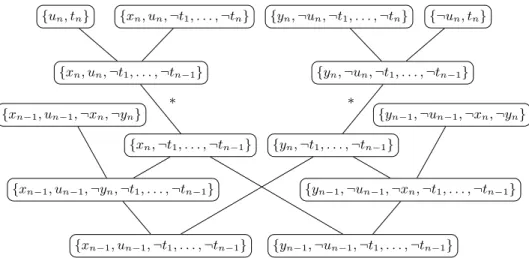
)-Resrefutation ofΨ(n) may contain∀-reduction steps that are disallowed in Q-Res. For example, under Drrs it is possible to remove literalunfrom the clause{xn, un,¬t1, . . . ,¬tn−1}. As we demonstrate in the proof of the following theorem, it is precisely this step (which is unavailable in
Q-Resdue to the presence of existentials right ofu) that permits the construction ofO(n)-sizeQ(Drrs
)-Resrefutations.
Theorem 9. The formulasΨ(n)have linear-size Q(Drrs
)-Resrefutations.
Proof. A portion of a linear-sizeQ(Drrs
)-Resrefutation ofΨ(n) is shown in Fig. 3. The clauses{xn−1, un−1,¬t1, . . . ,¬tn−1}and{yn−1,¬un−1,¬t1, . . . ,¬tn−1}are derived in a constant number of steps, and the task is reduced to the refutation ofΨ(n−1). The complete refutation is therefore linear in size.
According to Prop. 8, in aQ(Drrs
)-Resderivation fromΨ(n) the variableui may be removed from a clause D provided that the existential variables in D
that are right ofuiare contained in the set {t1, . . . , tn} \ {ti}. Such∀-reduction steps, which would be disallowed in Q-Res, are marked with an asterisk (∗) in
{un, tn} {xn, un,¬t1, . . . ,¬tn}
{xn, un,¬t1, . . . ,¬tn
−1}
{xn,¬t1, . . . ,¬tn−1}
{xn−1, un−1,¬xn,¬yn}
{xn
−1, un
−1,¬yn,¬t1, . . . ,¬tn
−1}
{xn
−1, un
−1,¬t1, . . . ,¬tn
−1}
{¬un, tn} {yn,¬un,¬t1, . . . ,¬tn}
{yn,¬un,¬t1, . . . ,¬tn
−1}
{yn,¬t1, . . . ,¬tn−1}
{yn−1,¬un−1,¬xn,¬yn}
{yn
−1,¬un
−1,¬xn,¬t1, . . . ,¬tn
−1}
{yn
−1,¬un
−1,¬t1, . . . ,¬tn
−1}
∗ ∗
Fig. 3.Portion of a linear size Q(Drrs
)-Resrefutation ofΨ(n). The∀-reduction steps marked with∗are forbidden inQ-Res, but are allowed inQ(Drrs)-Resdue to Prop. 8.
The following result is an immediate consequence of Theorems 7 and 9.
Theorem 10. Q(Drrs
)-Resis exponentially stronger than Q(Dstd )-Res.
5
Modelling dynamic dependency awareness
In this section, we introduce the dynamic dependency calculus dyn-Q(D)-Res
and prove that it is sound for a fully exhibited schemeD.
5.1 Dynamic dependencies in Q-resolution
We first define a particular kind of assignment to the variables of a PNCF that, in a clear sense, ‘respects’ the dependency schemeD.
Definition 11 (D-assignment). Let D be a dependency scheme and let δ be
a partial assignment to the variables of a PCNF Φ. Then δ is a D-assignment forΦiff, whenever δ assigns an existential literall, thenδ assigns all universal variables in the set {u|(u,var(l))∈ D(Φ)}.
We also define thelargest falsified clause of an assignment.
Definition 12 (largest falsified clause).Letδ=l1, . . . , lk be an assignment.
The largest falsified clause ofδ is{¬l1, . . . ,¬lk}.
Definition of the calculus. We definedyn-Q(D)-Resas the proof system that has the rules of Q(D)-Resin addition to the reference rule shown in Fig. 4. On an intuitive level, the reference rule is based on the following fact: Given a PCNF
Reference rule:ref(δ, π)
C
– δis aD-assignment forΦ.
– πis adyn-Q(D)-Resrefutation ofΦ[δ] – Cis the largest falsified clause ofδ.
Fig. 4.The reference rule of dyn-Q(D)-Res.Dis a dependency scheme andΦ=Q.φ
is a PCNF.
aD-assignmentδ, then adding the largest falsified clause ofδto the matrix ofΦ
preserves satisfiability3(note that this does not hold for an arbitrary assignment
δ). Therefore, if the calculus is capable of refuting Φ[δ], it should be able to introduce the largest falsified clause ofδ.
We refer to a clause derived by application of the reference rule as areference clause. As stated in the rule itself, a reference clause may only be introduced if an explicit refutation π of Φ[δ] can be given. This feature allows the size of a dyn-Q(D)-Resderivation to be suitably defined. We refer toπas areferenced refutation.
The power of the reference rule lies in the fact that the dependency scheme Dmay identify (orunlock) new non-trivial independencies in the restricted for-mula, meaning that it may be easier to refute the restricted formula Φ[δ] than to derive the reference clause fromΦdirectly. We note that the referenced refu-tation π, being a derivation from Φ[δ], can make use of these newly unlocked independencies. In this way, the calculus models the recomputation of depen-dencies during the QCDCL search procedure. We elaborate on this point in Subsection 5.3.
Reference degree. The reference degree of a dyn-Q(D)-Res derivation is 0 iff it does not contain any reference clauses (i.e. it is a Q(D)-Resderivation). For all other derivationsπ, the reference degree isd+ 1, wheredis the largest reference degree of a refutation referenced fromπ.
Proof size. The size of adyn-Q(D)-Resderivation πof reference degree 0 is the number of clauses in the proof. The size of a derivationπwith non-zero reference degree is a+b, where ais the number of clauses in π andb is the sum of the sizes of refutations referenced fromπ.
5.2 Soundness of dyn-Q(D)-Res
The task of proving thatdyn-Q(D)-Resis sound for a fully exhibited dependency schemeD(Theorem 15) can essentially be reduced to proving that the reference clauses derived from a true PCNF are satisfied by aD-model (Lemma 14).
3
In what follows, we find it convenient to introduce a notion of restriction for models. Let f be a model for a PCNF Φ, and let l be a literal with var(l) ∈ vars(Φ). If l is universal, then f[l] is obtained from f by removing all paths containing¬l and removing l from all remaining paths. If l is existential, then
f[l] is obtained from f by removing all occurrences ofl and ¬l from the paths off.
It should be clear thatf[l] is a model for Φ[l] if l is universal. The same is also true for an existential literallprovided that it is unopposed inf, by which we mean that its negation ¬l does not appear in any path inf. These facts are useful enough in the sequel to be the subject of the following proposition.
Proposition 13. Let Φbe a PCNF, letf be a model forΦand letl be a literal
with var(l)∈ vars(Φ). Then f[l] is a model for Φ[l] if either (a) l is universal, or (b) l is existential and unopposed inf.
We extend the restriction of a model to an arbitrary assignmentδ={l1, . . . , lk} in the natural way; that is,f[δ] is the result of the successive restriction off by the literals in δ. It should be clear that the order of successive restrictions does not matter.
We proceed to prove that a D-model of a PCNF Φ satisfies any reference clause derivable from it indyn-Q(D)-Res.
Lemma 14. LetDbe a dependency scheme, letf be aD-model for a PCNFΦ,
and let δ be a D-assignment for Φ. If Φ[δ] is false, then f satisfies the largest falsified clause of δ.
Proof. LetΦ=Q.φ, and letC be the largest falsified clause ofδ. We prove the contrapositive statement: iff does not satisfyC, then Φ[δ] is true.
The idea of the proof is to restrictf byδ, obtaining a model forΦ[δ]. The simplest way to do this is to restrict first by the universal subassignment of
δ, and then by the existential subassignment. To that end, let δ∀ := {l ∈ δ | var(l) is universal} and defineδ∃ similarly.
By successive application of Proposition 13 (a), it follows thatf[δ∀] is a model forΦ[δ∀]. We claim that every literal inδ∃is unopposed inf[δ∀]. We will therefore prove the result since, by successive application of Proposition 13 (b), it follows that (f[δ∀])[δ∃] =f[δ] is a model for (Φ[δ∀])[δ∃] =Φ[δ].
It remains to prove that the literals in δ∃ are indeed unopposed in f[δ∀]. Suppose thatf falsifiesC. Then there is some pathP inf that contains none of the literals inC. Since P contains a literal for every variable, it must therefore contain the negation of every literal in C. It follows, by definition of largest falsified clause (Def. 12), that δ⊆P. Then, by definition of model restriction, there is some path P′ =P\δ
To prove thatdyn-Q(D)-Resis sound, we must prove that one cannot derive the empty clause from any true PCNF. The proof is obtained by the addition of Lemma 14 to the literature’s existing proof of soundness forQ(D)-Res.
Theorem 15. The dynamic dependency calculusdyn-Q(D)-Resis sound ifDis
fully exhibited.
Proof. In [29] it is shown that Q(D)-Res is sound if D is fully exhibited. The result may be proved by induction on derivation depth in the following way (for a detailed proof cf. [2]): Let Dbe a fully exhibited dependency scheme, let
Φ:=Q.φbe a true PCNF and assumeπis aQ(D)-Resrefutation ofΦ. SinceD is fully exhibited, there exists a fully exhibiting modelfforΦ(with respect toD) that satisfies every matrix clause. Moreover, iff satisfies the antecedent clauses of any application of resolution or reduction, then f satisfies the consequent clause. We therefore reach a contradiction, sincef satisfies the conclusion of π, the empty clause.
Now, if we instead let π be a dyn-Q(D)-Res refutation, the above method can be lifted provided that the fully exhibiting model f satisfies every clause introduced by application of the reference rule. In this way, we prove soundness by induction on the reference degreedofπ.
The base case d = 0 is already established [29], since any dyn-Q(D)-Res
refutation of degree 0 is aQ(D)-Resrefutation. For the inductive step, letd≥1, and suppose that alldyn-Q(D)-Resrefutations of reference degree less thandare sound. Further, letCbe the first reference clause ofπ, introduced by application ofref(δ, π′). Sinceπ′ is adyn-Q(D)-Resrefutation ofΦ[δ] of reference degree at mostd−1,Φ[δ] is false by the inductive hypothesis. SinceCis the largest falsified clause ofδ, it is therefore satisfied byf, by Lemma 14. Successive application of the argument demonstrates thatf satisfies every reference clause inπ. ⊓⊔
As it is known thatDrrs is fully exhibited [2], the fact thatdyn-Q(Drrs )-Res
is sound is a corollary to Theorem 15. Since Drrs is strictly more general than Dstd, every dyn-Q(Dstd
)-Res refutation is a dyn-Q(Drrs
)-Res refutation, hence
dyn-Q(Dstd
)-Resis also sound.
Corollary 16. The calculidyn-Q(Dstd
)-Resanddyn-Q(Drrs
)-Resare both sound.
5.3 Motivations for dyn-Q(D)-Res
We chose to define aD-assignment in order to replicate the kind of assignment that is maintained by a QCDCL solver using a dependency scheme, whereby decision variables are assigned only after all others on which they depend. In line with our discussion in Section 3, we can relax the theoretical model so that only the (in)dependence of existentials on universals is considered, and hence universals may be assigned arbitrarily in aD-assignment.
The motivation fordyn-Q(D)-Resis this observation: If, by recomputing de-pendencies, the solver is able to refute the formula under its current assignment
system shares similarities with ‘Q-resolution with generalised axioms’ [20]. Re-garding proof complexity, a drawback of that calculus is that every false formula may be refuted in a single step. Our system resolves this difficulty, using the notion of referencing to accommodate a suitable definition of proof size.
In line with [20], we could have allowed assignments due to unit propagation and pure literal elimination in dyn-Q(D)-Res. This would allow additional ex-istential literals to be included in a D-assignment provided that they are valid assignments under Boolean constraint propagation. Doing so would result in a stronger version ofdyn-Q(D)-Res, since such a modification extends the set ofD -assignments for any instance. However, we prefer to the present simpler system, since propagation is not necessary for the separation in the following section.
Soundness of the system with propagation can be proved by an extension of our argument in Lemma 14. This is because existential literals that become unit under restriction are always unopposed in the restricted model, and hence Proposition 13 still applies. Existential literals that become pure can be assigned unopposed throughout the restricted model without falsifying any clauses.
6
Static vs dynamic dependency awareness in
Q(
D
)-Res
In this section, we investigate the relative proof complexities of Q(D)-Res and
dyn-Q(D)-Res. We prove an exponential separation whenDis the reflexive res-olution path dependency scheme. In contrast, the two systems are p-equivalent whenDis the trivial dependency scheme.
The latter result, while a perfectly natural conjecture, requires a non-trivial proof.
Theorem 17. Q-Resand dyn-Q(Dtrv
)-Resare p-equivalent proof systems.
Proof (sketch). Since dyn-Q(Dtrv
)-Restrivially p-simulatesQ-Res (Prop. 4), we need only prove the reverse simulation. We prove by induction on reference degree that any dyn-Q(Dtrv
)-Res derivation can be transformed into a Q-Res
derivation of the same size, in time linear in the size of the original derivation. To that end, letπbe a dyn-Q(Dtrv
)-Resderivation of a clauseC from a PCNF
Φof reference degreed.
Ifd= 0, thenπis aQ-Resderivation, so the base case is established trivially. For the inductive step, let d≥1, and let R be a reference clause in π derived by application of ruleref(δ, π′). Note that the reference degree ofπ′ is less than
d, and hence, by the inductive hypothesis,π′ can be transformed in linear time into a Q-Res refutation ρ of Φ[δ] with |ρ| = |π′|. A Dtrv
-assignment assigns variables strictly in block order and assigns no variable before the preceding block is fully assigned. As a result, adding the literals in R to each clause of
This last transformation can clearly be carried out in linear time and does not increase the size of the derivation.
Successive application of this method to all the reference clauses inπyields aQ-Resderivation ofCof size at most|π|. The complete transformation can be
carried out in time linear in|π|. ⊓⊔
The remainder of this section is devoted to the separation ofdyn-Q(Drrs )-Res
fromQ(Drrs
)-Res. The separating formulas are a modification ofΨ(n), for which we make use of the following operation.
Definition 18 (clause-matrix product). Let C be a clause and let φ be a
CNF matrix. The clause-matrix product C⊗φ is the CNF matrix with clauses
{C∪C′|C′∈φ}.
We modifyΨ(n) by adding two fresh existential variablesaandb, quantified at the very beginning and very end of the prefix, respectively. Taking two copies of the matrixψ(n), to each clause of the first copy we add literalsaandb, and to each clause of the second we add literals¬aand¬b. Finally, we add the clauses {a,¬b}and{¬a, b} so that the modified formulas are false.
Definition 19 (modification of the formulas of Kleine B¨uning et al.).
Let Ψ(n) :=Q(n).ψ(n)be the formulas of Kleine B¨uning et al. (as in Def. 5). We define the formula family
Ξ(n) :=∃aQ(n)∃b.({a, b} ⊗ψ(n))∪({¬a,¬b} ⊗ψ(n))∪ {{a,¬b},{¬a, b}}.
The purpose of variable b is to introduce sufficiently many Drrs connections between clauses, such thatDrrs can no longer identify any non-trivial indepen-dencies. This means that static application ofDrrs
cannot improve uponQ-Res. However, under either assignment to variable a, one copy of the matrix ψ(n) vanishes, and the connections due to b disappear with it. As a result, the re-stricted formulasΞ(n)[a] andΞ(n)[¬a] are sufficiently similar toΨ(n) to admit shortQ(Drrs
)-Resrefutations. Hence, dynamic application ofDrrs
yields shorter proofs.
To prove the lower bound for the static calculus, we first show thatDrrs (Ξ(n)) =Dtrv(Ξ(n)), from which it follows that anyQ(Drrs
)-Res refutation ofΞ(n) is also aQ-Resrefutation. We then show that anyQ-Resrefutation ofΞ(n) contains an embedded refutation ofΨ(n), which has size at least 2n [3, 15].
Theorem 20. The QBFsΞ(n)require exponential-size Q(Drrs
)-Resrefutations.
Proof. To see thatDrrs
does not identify any spurious existential dependencies forΞ(n) – or, equivalently, thatDrrs
(Ξ(n)) =Dtrv
(Ξ(n)) – we must show that, for each pair (v, z) ∈ Dtrv
(Ξ(n)), there exists a sequence of k clauses and a sequence ofk−1 literals satisfying the four conditions of Def. 2.
Let i, j ∈ [n]. For (ui, b) ∈ Dtrv(Ξ(n)), the clauses {a, b} ∪Bi,{¬a,¬b} ∪
B′
{a, b} ∪Bi,{¬a,¬b} ∪Bj,{a, b} ∪ {Bj−1},{¬a,¬b} ∪B′i and the literalsb, xj, b are suitable, and the case for (ui, yj)∈ Dtrv(Ξ(n)) is similar.
Now, letπbe aQ(Drrs
)-Resrefutation ofΞ(n), and letαbe the assignment {¬a,¬b}. Sinceαassigns only existential variables,π[α] is a refutation ofΞ(n)[α] that is no larger thanπ. Observe thatΞ(n)[α] =Ψ(n), hence the size ofπ[α] is at least 2n [3, 15], and we must have|π| ≥2n. ⊓⊔
The upper bound argument makes use of the construction of short refutations from the proof of Theorem 9. By referencing those refutations,dyn-Q(Drrs
)-Res
admits simpleO(n)-size refutations of Ξ(n).
Theorem 21. The formulasΞ(n)have linear-size dyn-Q(Drrs
)-Resrefutations.
Proof. We construct linear-sizeQ(Drrs
)-Resrefutations ofΞ(n)[¬a] andΞ(n)[a]. Sinceaand¬aareDrrs
-assignments forΞ(n), indyn-Q(Drrs
)-Resone can intro-duce the unit clauses {a} and {¬a} by application of the reference rule, from which the empty clause is derived by a single resolution step. As the two refer-enced refutations are of linear size, so is the complete refutation.
It remains to construct the referenced refutations ofΞ(n)[¬a] andΞ(n)[a]. We describe the case forΞ(n)[¬a] – the other case is similar.
Note that the formulaΞ(n)[¬a] may be obtained fromΨ(n) by adding the literal b to every clause, and then adding the unit clause {¬b} to the matrix. We make two observations. First, since the negative literal ¬b occurs only in a unit clause, such a modification of Ψ(n) cannot introduce any new existential Drrs dependencies; noDrrs path can go through variableb. As a result, Prop. 8 lifts from Ψ(n) to Ξ(n)[¬a]; that is, (ui, tj)∈ D/ rrs(Ξ(n)[¬a]) for each i, j∈[n] withi6=j. Second,Ψ(n) can be derived inO(n) resolution steps fromΞ(n)[¬a] simply by resolving the unit clause{¬b}with every other clause (there areO(n) clauses in Ξ(n)[¬a]). It follows that Q(Drrs
)-Res can refute Ξ(n)[¬a] in O(n) steps by first deriving the clauses of Ψ(n) and then replicating the refutation
given in the proof of Theorem 9. ⊓⊔
Our final result is immediate from Theorems 20 and 21.
Theorem 22. dyn-Q(Drrs
)-Resis exponentially stronger than Q(Drrs )-Res.
7
Conclusions
We demonstrated that the use of dependency schemes in Q-resolution can yield exponentially shorter proofs. In line with experimental results, we thereby pro-vided strong theoretical evidence supporting the notion that dependency schemes can be utilised for improved QBF solving. With further proof-theoretical results, we also demonstrated that the dynamic use of schemes has further potential for improved solving, beyond that of the static approach in existing implementa-tions.
References
1. Benedetti, M., Mangassarian, H.: QBF-based formal verification: Experience and perspectives. Journal on Satisfiability, Boolean Modeling and Computation (JSAT) 5(1-4), 133–191 (2008)
2. Beyersdorff, O., Blinkhorn, J.: Dependency schemes in QBF calculi: Semantics and soundness. In: Principles and Practice of Constraint Programming (CP). pp. 96–112 (2016)
3. Beyersdorff, O., Chew, L., Janota, M.: Proof complexity of resolution-based QBF calculi. In: International Symposium on Theoretical Aspects of Computer Science (STACS). Leibniz International Proceedings in Informatics (LIPIcs), vol. 30, pp. 76–89 (2015)
4. Beyersdorff, O., Chew, L., Mahajan, M., Shukla, A.: Feasible interpolation for QBF resolution calculi. In: International Colloquium on Automata, Languages, and Programming (ICALP). pp. 180–192 (2015)
5. Beyersdorff, O., Chew, L., Mahajan, M., Shukla, A.: Are short proofs narrow? QBF resolution is not simple. In: Symposium on Theoretical Aspects of Computer Science (STACS). pp. 15:1–15:14 (2016)
6. Beyersdorff, O., Chew, L., Sreenivasaiah, K.: A game characterisation of tree-like Q-resolution size. In: LATA. pp. 486–498. Springer (2015)
7. Biere, A., Lonsing, F.: Integrating dependency schemes in search-based QBF solvers. In: International Conference on Theory and Applications of Satisfiability Testing (SAT). pp. 158–171. Springer (2010)
8. Buss, S.R.: Towards NP-P via proof complexity and search. Ann. Pure Appl. Logic 163(7), 906–917 (2012)
9. Cook, S.A., Nguyen, P.: Logical Foundations of Proof Complexity. Cambridge Uni-versity Press (2010)
10. Cook, S.A., Reckhow, R.A.: The relative efficiency of propositional proof systems. Journal of Symbolic Logic 44(1), 36–50 (1979)
11. Egly, U., Kronegger, M., Lonsing, F., Pfandler, A.: Conformant planning as a case study of incremental QBF solving. In: Artificial Intelligence and Symbolic Computation (AISC’14). pp. 120–131 (2014)
12. Giunchiglia, E., Marin, P., Narizzano, M.: Reasoning with quantified boolean for-mulas. In: Handbook of Satisfiability, pp. 761–780. IOS Press (2009)
13. Giunchiglia, E., Narizzano, M., Tacchella, A.: Clause/term resolution and learning in the evaluation of quantified boolean formulas. Journal of Artificial Intelligence Research (JAIR) 26, 371–416 (2006)
14. Janota, M., Klieber, W., Marques-Silva, J., Clarke, E.M.: Solving QBF with coun-terexample guided refinement. Journal of Artificial Intelligence 234, 1–25 (2016) 15. Kleine B¨uning, H., Karpinski, M., Fl¨ogel, A.: Resolution for quantified boolean
formulas. Information and Computation 117(1), 12–18 (1995)
16. Kontchakov, R., Pulina, L., Sattler, U., Schneider, T., Selmer, P., Wolter, F., Za-kharyaschev, M.: Minimal module extraction from DL-lite ontologies using QBF solvers. In: International Joint Conference on Artificial Intelligence (IJCAI). pp. 836–841. AAAI Press (2009)
17. Kraj´ıˇcek, J.: Bounded Arithmetic, Propositional Logic, and Complexity Theory, Encyclopedia of Mathematics and Its Applications, vol. 60. Cambridge University Press, Cambridge (1995)
19. Lonsing, F.: Dependency Schemes and Search-Based QBF Solving: Theory and Practice. Ph.D. thesis, Johannes Kepler University (2012)
20. Lonsing, F., Egly, U., Seidl, M.: Q-resolution with generalized axioms. In: Interna-tional Conference on Theory and Applications of Satisfiability Testing (SAT). pp. 435–452 (2016)
21. Moskewicz, M.W., Madigan, C.F., Zhao, Y., Zhang, L., Malik, S.: Chaff: Engineer-ing an efficient SAT solver. In: Design Automation Conference (DAC). pp. 530–535 (2001)
22. Moskewicz, M.W., Madigan, C.F., Zhao, Y., Zhang, L., Malik, S.: Chaff: Engineer-ing an efficient SAT solver. In: Design Automation Conference (DAC). pp. 530–535 (2001)
23. Peitl, T., Slivovsky, F., Szeider, S.: Long distance Q-resolution with dependency schemes. In: International Conference on Theory and Applications of Satisfiability Testing (SAT). pp. 500–518 (2016)
24. Rintanen, J.: Asymptotically optimal encodings of conformant planning in QBF. In: National Conference on Artificial Intelligence (AAAI). pp. 1045–1050. AAAI Press (2007)
25. Samer, M., Szeider, S.: Backdoor sets of quantified boolean formulas. Journal of Automated Reasoning 42(1), 77–97 (2009)
26. Samulowitz, H., Bacchus, F.: Using SAT in QBF. In: International Conference on Principles and Practice of Constraint Programming (CP). pp. 578–592 (2005) 27. Shacham, O., Zarpas, E.: Tuning the VSIDS decision heuristic for bounded model
checking. In: International Workshop on Microprocessor Test and Verification (MTV). p. 75 (2003)
28. Silva, J.P.M.: The impact of branching heuristics in propositional satisfiability algorithms. In: Portugese Conference on Progress in Artificial Intelligence (EPIA). pp. 62–74 (1999)
29. Slivovsky, F.: Structure in #SAT and QBF. Ph.D. thesis, Vienna University of Technology (2015)
30. Slivovsky, F., Szeider, S.: Variable dependencies and Q-resolution. In: International Conference on Theory and Applications of Satisfiability Testing (SAT). pp. 269– 284 (2014)
31. Slivovsky, F., Szeider, S.: Soundness of Q-resolution with dependency schemes. TCS 612, 83–101 (2016)
32. Van Gelder, A.: Variable independence and resolution paths for quantified boolean formulas. In: International Conference on Principles and Practice of Constraint Programming (CP). pp. 789–803. Springer (2011)
![Fig. 2. The rules of Q(D)-Res [31]. D is a dependency scheme and Φ = Q . φ is a PCNF.](https://thumb-us.123doks.com/thumbv2/123dok_us/7732129.163032/7.918.200.726.168.451/fig-rules-q-res-dependency-scheme-φ-pcnf.webp)