White Rose Research Online URL for this paper:
http://eprints.whiterose.ac.uk/118348/
Version: Accepted Version
Article:
Abanin, DA and Papić, Z (2017) Recent progress in many-body localization. Annalen der
Physik, 529 (7). 1700169. ISSN 0003-3804
https://doi.org/10.1002/andp.201700169
(c) 2017, by WILEY-VCH Verlag GmbH & Co. KGaA, Weinheim. This is the peer reviewed
version of the following article: 'Abanin, DA and Papić, Z (2017) Recent progress in
many-body localization. Annalen der Physik, 529 (7). 1700169,' which has been published
in final form at [https://doi.org/10.1002/andp.201700169]. This article may be used for
non-commercial purposes in accordance with Wiley Terms and Conditions for
Self-Archiving.
[email protected] https://eprints.whiterose.ac.uk/
Reuse
Items deposited in White Rose Research Online are protected by copyright, with all rights reserved unless indicated otherwise. They may be downloaded and/or printed for private study, or other acts as permitted by national copyright laws. The publisher or other rights holders may allow further reproduction and re-use of the full text version. This is indicated by the licence information on the White Rose Research Online record for the item.
Takedown
If you consider content in White Rose Research Online to be in breach of UK law, please notify us by
Dmitry A. Abanin
Department of Theoretical Physics, University of Geneva, Geneva 1211 Switzerland
Zlatko Papi´c
School of Physics and Astronomy, University of Leeds, Leeds LS2 9JT, United Kingdom (Dated: June 7, 2017)
This article is a brief introduction to the rapidly evolving field of many-body localization. Rather than giving an in-depth review of the subject, our aspiration here is simply to introduce the problem and its general context, outlining a few directions where notable progress has been achieved in recent years. We hope that this will prepare the readers for the more specialized articles appearing in this dedicated Volume of Annalen der Physik, where these developments are discussed in more detail.
I. INTRODUCTION
The research into many-body localization (MBL) is driven by the desire to understand the effects of inter-actions between particles on the stability of the Ander-son insulator, a phase characterised by the absence of diffusion in low dimensional disordered systems.1–4 On a broader level, the study of MBL is part of a more gen-eral quest to understand possible outcomes of the quan-tum evolution ofgeneric many-body systems, i.e., those which contain interactions between particles as well as quenched randomness. (Most systems in nature indeed possess both of these features.) In the simplest instance, a many-body system can be assumed to be isolated from any thermal bath, therefore it evolves in time according to the well-known unitary evolution. The problem then reduces to understanding the general outcomes of this evolution and consequently the fate of such systems at long times.
The motivation to study isolated quantum many-body systems is not purely academic. Experimental advances of the past two decades have led to the realization of synthetic quantum systems, characterized by an unprece-dented degree of quantum control and tunability. A prominent class of such systems are ultracold atomic gases in optical lattices, which serve as a versatile plat-form for studying various aspects of many-body physics in a controlled setting (see Ref. 5). Unlike conventional solids, the systems of ultracold atoms are well-isolated from the environment and display a high degree of quan-tum coherence. This, along with their long intrinsic time scales and a remarkable set of available experimental tools, makes ultracold atomic systems an attractive labo-ratory for studying non-equilibrium quantum many-body phenomena. These experimental developments continue to stimulate a strong theoretical interest in the quantum dynamics of isolated many-body systems.
In order to describe quantum dynamics, throughout this article we will refer to thequantum quench – a sim-ple, yet general, probe that can be directly implemented in experiments with synthetic systems.6The system, pre-pared in an initial state |ψ0i at time t = 0, undergoes unitary evolution with its Hamiltonian H. The initial
state |ψ0i is typically a relatively simple (for example, non-entangled) state which can be easily prepared in ex-periment;7 from the point of view of generic Hamiltoni-ans, such states typically have high energy density and therefore can be considered to be far from equilibrium. One would like to understand whether unitary evolution results in equilibration and brings the system into an ef-fectively steady state at sufficiently long times. What is the nature of this steady state in different systems? How is it approached? Thus, a fundamental challenge that emerges is to classify many-body systems according to their non-equilibrium properties, such as, e.g., their behavior under a quench.
A well-known possible outcome of unitary evolution of an isolated quantum system is thermalization: at long times every sufficiently small subsystem reaches an effec-tively thermal Gibbs state.8–10Thermal states are largely featureless, meaning they can be completely specified by the values of several global conserved quantities, such as the total energy of the system and the total particle num-ber. Thermalization therefore erases the memory of the initial state|ψ0i. Intuitively, this will occur if the system can act as a heat bath for its (sufficiently small) subsys-tems. Thermalization requires that different parts of the system exchange energy efficiently, such that states with spatially non-uniform energy density can relax to mal states. Thus, energy transport is necessary and ther-malizing systems are expected to be conducting. Often, thermalizing quantum systems are referred to asergodic, because during their evolution they explore all config-urations allowed by the global conservation laws. The properties of states of ergodic systems and the meaning of thermalization in this context are discussed in Section II below (see also the Review11in this Volume).
of ergodicity, MBL phases cannot be described by the conventional statistical mechanics, and this has brought them into the focus of recent theoretical interest.
As we explain in Sections III – VI, significant progress in describing the properties of MBL phases has been achieved, in particular by applying concepts borrowed from integrable systems and quantum information the-ory. Most importantly, it has been realized that the er-godicity breakdown in MBL systems is the result of a new kind of integrability: the MBL phase is character-ized by a complete set of emergent quasi-local integrals of motion (“LIOMs” or “l-bits”).12,13 The existence of LI-OMs leads to a simple and universal description of MBL phases (see Section IV), which accounts for their lack of thermalization and several distinct dynamical properties. A more detailed overview of the LIOM picture of MBL phases can be found in articles14,15in this Volume.
Somewhat surprisingly, despite the absence of energy transport, quantum entanglement does spread in the MBL phase,16,17 and even the remote degrees of free-dom become entangled under quantum evolution. In a quantum quench setup described above, this leads to the equilibration of a system to a highly non-thermal state. The entanglement properties of MBL eigenstates as well as the spreading of entanglement can both be explained in the LIOM picture, as we discuss in Sections V and VI. The connections between dynamical properties and transport is reviewed in article18 of this Volume, while articles19–21investigate the dynamical signatures of MBL phases from the recent point of view of “out-of-time order correlators”.
The stability of MBL phases and the existence of a complete set of LIOMs at strong disorder has been the-oretically established in a few simple one-dimensional models22–26 (in one of them, even at the level of math-ematical rigour27). More recent theoretical efforts have focused on understanding the breakdown of the LIOM picture, as we discuss in Sections VII and VIII. A nat-ural setting to explore the breakdown of LIOMs is the transition between the MBL and ergodic phase. While the complete theory of this transition is currently lacking, important steps towards such a theory have been made by the recent real-space renormalisation group studies.28,29 Of particular importance is the understanding of the so-called rare region effects, which determine the physical properties of the system on either side of the transition. The results of these studies are reviewed in articles30–33 of the present Volume.
Alternatively, the character and existence of LIOMs can be strongly affected by the presence of symmetries in the model. It has been understood that symmetries place stringent constraints on whether MBL can occur.34 On the other hand, if the symmetry admits an MBL phase, the two can combine to stabilize certain kinds of topo-logical order at finite energy density.35,36More generally, quantum information, usually encoded in the low-energy properties of a system, could then remain “protected” at much higher temperatures, motivating the use of MBL
to enhance robustness of quantum information process-ing schemes.37
In Section IX we address the experimental status of MBL. Recently, several experimental systems have pro-vided complementary insights into MBL. For example, signatures of MBL have been observed in systems of ul-tracold atomic gases (in both one38and two39spatial di-mensions) and trapped ions.40Furthermore, experiments studying the dynamics of thermalization of spins on NV-centers in diamonds have appeared.41Our review of MBL experiments will be brief and we refer the interested read-ers to the original articles.
Finally, in Section X, we conclude by discussing sev-eral open questions and mention some directions that are not covered in depth by this article, such as the sta-bility of MBL in the presence of dissipation (see the article42 in this Volume), novel types of non-ergodic states (including possible MBL-like states in systems without quenched disorder), and new phases of matter in Floquet systems.43–47
II. EIGENSTATE THERMALIZATION HYPOTHESIS AND THE STRUCTURE OF
ERGODIC EIGENSTATES
Non-equilibrium properties of a many-body system are intimately related to the structure of its highly excited eigenstates. In principle, if the properties of the eigen-states and their corresponding energies are known, time evolution of an arbitrary initial state can be described. For example, in the quantum quench experiment, the initial state|ψ0ican be expanded in the system’s eigen-states, and the time evolution is determined by the coef-ficients in this expansion, weighted by the phase factors corresponding to the system’s eigenenergies. However, this in itself does not explain in a transparent way why thermalization happens. Indeed, since the time evolution is unitary, any information present in the system’s initial state remains preserved as time goes on. This naive point of view appears at conflict with one’s intuition and ex-perimental findings that many quantum systems indeed reach thermal equilibrium after sufficiently long time and appear to lose memory of their initial configuration.
Thermalization in ergodic systems is explained by a powerful conjecture regarding the nature of eigenstates – the eigenstate thermalization hypothesis (ETH).8–10 The ETH states that in ergodic systems, the individ-ual excited eigenstates have thermal expectation values of physical observables, which are identical to those ob-tained using the microcanonical and Gibbs ensembles. The expectation value of a physical observable associ-ated with an operator ˆO is given by the diagonal matrix element Oαα = hα|Oˆ|αi, where |αi is an eigenstate of
H, H|αi=Eα|αi. Further, to describe how the system
the basis of system’s eigenstates:48,49
Oαβ=O(E)δαβ+e−S(E)/2f(E, ω)Rαβ. (1)
The first term describes the diagonal part of the operator in the eigenstate basis, andO(E) is a smooth function of the energy. The second term describes off-diagonal ma-trix elements, andS(E) is the thermodynamic entropy at the average energyE = (Eα+Eβ)/2,f(E, ω) is a smooth
function ofEand the energy differenceω=Eα−Eβ.
Fi-nally,Rαβis a random number, which has zero mean and
unit variance. As we discuss below, the functionf(E, ω) determines the relaxation of the physical observable ˆO, and is different for different systems and observables. We note that the ETH ansatz (1) for the matrix elements has been verified in several low-dimensional models.50–53
The ansatz (1) reflects the fact that, in some ways, highly excited states of ergodic systems can be viewed as random vectors in the Hilbert space. Moreover, it predicts the behavior of temporal fluctuations of local observablesOt≡ hψ(t)|Oˆ|ψ(t)i. By denoting the infinite
time average as
¯
O= lim
t→∞
1
t Z t
0
dτ Oτ, (2)
it directly follows that (Ot−O¯)2=O(e−S). Thus,
inde-pendent of the initial state|ψ0i,Oteventually approaches
its equilibrium value ¯O, and then remains near that value most of the time. In order to find out how the system approaches the equilibrium value, one can calculate the conditional probability to measure Ot given the initial
valueO0. This probability49 is the Gaussian function of
Ot−C(t)O0, with a small varianceO(e−S). HereC(t) is
determined by the functionf in Eq. (1) and in particu-lar does not depend on the quantum state of the system. Thus, the behavior ofOtis nearly deterministic and its
approach to equilibrium is is controlled by the frequency dependence of the smooth functionf in Eq.(1).
Apart from explaining thermalization in isolated sys-tems, the ETH provides information about quantum en-tanglement in the eigenstates of ergodic systems. Let us consider an eigenstate|αiwith energyEα. We partition
the system into two subsystems, Aand B, and ask how strongly A is entangled with B in the state |αi. Pro-vided A is sufficiently small, such that B can act as an efficient thermal bath, all observables acting on the de-grees of freedom in A have thermal expectation values, with the effective temperature T determined by the en-ergy of the eigenstate|αi: Eα=hHiT. This implies that
the reduced density matrix ofA,
ραA= trB|αihα|, (3)
is equal to the thermal density matrix at temperatureT:
ραA=ρA(T) =
1
Ze
− H
kB T. (4)
The amount of entanglement between A and B in the state|αican be quantified, e.g., using the entanglement
entropy, which is the von Neumann entropy ofρα A:
Sentα (A) =−trA(ραAlnραA). (5)
The relation (4) then implies that the entanglement en-tropy, which depends on microscopic details of a quan-tum state, is equal to the thermodynamic entropy ofA, which is determined by the counting of states at temper-atureT. Generally, the latter scales proportionally to the volume of regionA, and therefore we conclude that the entanglement entropy of a system obeying the ETH also scales with the volume. This reflects the fact that ergodic eigenstates are highly entangled, and agrees with the in-tuition that the ETH eigenstates are similar to random vectors. As we will see below, non-thermalizing systems such as MBL systems have much lower entanglement in their eigenstates.
III. FROM SINGLE-PARTICLE TO MANY-BODY LOCALIZATION
The study of localization began when Anderson intro-duced the problem of a single quantum particle moving in a disordered crystal indspatial dimensions.1 A basic model which exhibits Anderson localization is the tight-binding model with the random chemical potential on each site:
H0=JX
hiji
c†icj+
X
i
µic†ici, (6)
wherec†, c are the creation/annihilation operators, J is
the amplitude to hop between nearest neighbor sites i
andj, andµiare independent random numbers with zero
mean and varianceW2, such that the typical value of|µ
i|
is of the orderW.
The essence of Anderson localization is that at suffi-ciently strong disorder, the character of the eigenstates changes: instead of extended Bloch waves in a clean crys-tal (W = 0), wave functions become exponentially lo-calized around some siteRα in the lattice: |ψα(r)|2 ∝ e−|~r−R~α|/ξ0, where ξ0 is the localization length. Such a
change of the wave functions leads to the disappearance of diffusion, and the system becomes the Anderson insu-lator.
there is a mobility edge: states near the band edges are localized, while states around the middle of the band are extended.
Many theory works over the few decades following Anderson’s paper focused on understanding various as-pects of single-particle localization. One fundamental challenge that stood out was to understand the effects of interactions on a system in which the single-particle states are localized. In particular, does localization sur-vive when a generic two-body interaction is introduced, and a finite density of particles is considered? This has been a long-standing open question in the field, which was posed already in the original Anderson’s paper in 19581and later considered by Fleishman and Anderson in 1980.2Recent theory works3,4have established a positive answer to this question: localization is indeed stable with respect to short-range and sufficiently weak interactions. Such a non-thermalizing phase is called the “many-body localized” (MBL) phase. In contrast to the Anderson insulator, which is realized in the special case when par-ticles do not interact with each other, the MBL phase can indeed be viewed as a phase of matter, i.e., it is robust under sufficiently weak but generic perturbations. The following Sections will highlight some further differences between the MBL phase and the Anderson insulator.
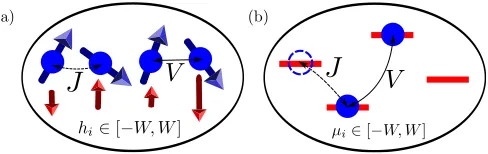
In addition to the arguments based on perturbation theory, the existence of the MBL phase has been fur-ther supported by extensive numerical simulations of one-dimensional spin and fermionic models.54,55Most of these studies have focused on a one-dimensional spin-1/2 XXZ model with a random field along thezdirection:
H =J
N−1 X
i=1
SixSix+1+S
y iS
y i+1
+V
N−1 X
i=1
SizSiz+1+
N
X
i=1 hiSzi.
(7) HereSα
i =σαi/2 is the Pauli operator acting on sitei(~=
1),J is the hopping amplitude, andV is the interaction strength (see Fig. 1(a)). The magnitude of the random field is usually chosen to be uniformly distributed hi ∈
[−W, W]. We have assumed an open chain withN spins.
The above spin system is equivalent to a model of interacting spinless fermions in a disordered 1d crystal (the mapping between two models is obtained using the Jordan-Wigner transform):
H =J
N−1 X
i=1
c†ici+1+h.c.+V
N−1 X
i=1
ρiρi+1+
N
X
i=1
µiρi, (8)
where we introduced the density operatorρi=c†ici−12.
The random field hi translates into the random
chem-ical potential µi for fermions, and the conserved total
magnetization in the spin model corresponds to a fixed fermionic filling (e.g., total Sz = 0 corresponds to half
[image:5.612.319.563.51.128.2]filling). Compared to the Anderson model (6), here the nearest-neighbor density-density interaction is intro-duced. We note that several other models have also
FIG. 1. (a) A popular model for MBL: a closed, one-dimensional spin 1
2 XXZ chain, with nearest neighbor hop-ping (J) and interactions (V), and a uniform random field
hi pointing along thez-axis. (b) In one dimension, the XXZ
model (a) is equivalent to a model of spinless fermions on a lattice interacting via nearest neighbor density-density inter-actions, in the presence of a random on-site chemical potential
µi.
been considered in the literature, e.g., models with bond disorder,34 disordered quantum Ising model,56 etc.
One important feature of finite lattice models like (7) or (8) is that their spectra are bounded. (For a discus-sion of MBL in systems with unbounded spectra, see the article57in this Volume.) This facilitated the microscopic investigations of MBL phases, in particular via numeri-cal diagonalization of small 1d systems. Numerinumeri-cal works have established that all states of the model (7) are in-deed many-body localized when disorder is sufficiently strong, W > Wc. For J = V (Heisenberg model),
crit-ical disorder strength was found to be Wc ≈ 3.5.55 In
most theory work preceding these numerical investiga-tions, the focus was on direct evaluation of the conduc-tivity in the MBL phase, with the goal of demonstrat-ing the absence of transport. Numerical simulations of lattice models have instead probed the existence of the MBL phase by examining the properties of individual many-body eigenstates. This approach was particularly useful in understanding the universal properties of MBL phases, as we review in the following Section.
IV. MANY-BODY LOCALIZATION: LOCAL INTEGRALS OF MOTION
A powerful insight into the physics of the MBL phase, brought about by the microscopic analysis of its eigen-states, has been the theory of “local integrals of motion” (LIOMs).12,13We now outline the main steps leading to this phenomenological description of MBL states. We as-sume strong disorder such that all of the MBL eigenstates are localized. For concreteness, let us consider model (7) withN ≫1 spins, although the arguments are applicable to a variety of models. In the classical limitJ = 0, the system is trivially localized because the eigenstates are simply product states, with each spin pointing either up or down, i.e.,|α0i=|{σz
i}i=|σ1zσ2z...σzNi,σiz=↑,↓. The
Hamiltonian commutes with thez-projection of spin at every site: [σz
i, H] = 0, and therefore there exists a
FIG. 2. In the MBL phase at sufficiently strong disor-der, there emerges an extensive number of LIOMs,τiz. Each
τz
i is a Pauli operator unitarily related to the original spins,
τz i =U σ
z iU
†, with support decaying exponentially away from
the sitei. Differentτiz commute with each other, as well as
with the Hamiltonian H. Each eigenstate of the system is completely specified by the simultaneous quantum numbers of all{τz
i}.
of motionσz
i with eigenvalues±1.
Next, let us turn on the coupling J >0, which leads to spin-flip processes, while keeping disorder sufficiently strong, W > Wc(J), such that all states remain MBL.
Intuitively, it is expected that MBL eigenstates |αi at
J >0 remain, in some sense, close to the product states
|α0i at J = 0. More precisely, an eigenstate |αi is re-lated to|α0i by a quasi-local unitary transformation U
which creates spin flips only between nearby degrees of freedom (the long-distance flips are exponentially sup-pressed). The quasi-local unitary transformation U di-agonalizes the Hamiltonian:
U†HU =Hdiag, (9)
whereHdiagis diagonal in the up-down basis|{σz i}i. The
transformation U can be constructed perturbatively in the small parameterλ=J/W ≪1.
Observing thatHdiag commutes with everyσz i
opera-tor, we can now introduce a set of integrals of motion for
H:
τiz=U σziU†. (10)
It is easy to see from (9) thatτz
i operators commute with
the Hamiltonian and with each other:
[τiz, H] = [τiz, τjz] = 0. (11)
Formally, such operators can be defined for any quantum system. However, the crucial property of the MBL phase is the quasi-locality of the transformationU, which makes
τz
i quasi-local operators – that is, their support is mostly
concentrated around one site and decays exponentially away from it, see Fig. 2. For example, in the model of Eq. (7), the explicit form ofτz
i is
τiz ≈σzi +
X
j,k
X
a,b=x,y,z
fiab;jkσjaσbk+. . . , (12)
where the weights decay exponentially with distance,
fiab;jk∝exp(−max{|i−j|,|i−k|}/ξ), (13)
and the dots. . .denote higher order (N ≥3) spin terms. Observe that certain terms in the expansion (12) may vanish for symmetry reasons (e.g., there is noσyi term, etc.).
The spatial decay of τz
i away from sitei can be used
to define a “many-body localization length”, which we denoted byξ above. Unlike the Anderson case, in MBL systems there could be several characteristic length scales that determine various properties of the MBL phase (moreover, these length scales will fluctuate depending on the eigenstate). For example, in Section VI we will encounter another length scale, ˜ξ, which is in principle different fromξ, and controls the dephasing dynamics in the MBL phase. These various length scales may also behave differently as the MBL phase is driven towards the transition to the thermal phase. In particular, some of the lengthscales, likeξ, might be expected to diverge at the transition point, while others (e.g., ˜ξ) could re-main finite (see Ref. 13for more details). Finally, in the thermal phase, U is highly non-local, there is no expo-nential hierarchy in thef coefficients in Eq. (12), and consequentlyτz
i are not very useful.
The operators τz
i are usually referred to as LIOMs12
or l-bits.13They are Pauli operators with eigenvalues±1, and form a complete set: specifying the values ofτz
i =±1
for alliuniquely specifies an eigenstate|αi=|{τz i}i. The
emergence of such quasi-local conservation laws provides an intuitive explanation for the ergodicity breaking in the MBL phase: indeed, under unitary evolution the expec-tation value of each τz
i is conserved, and therefore the
system retains the local memory of the initial state at arbitrarily long times.
The relation (10) defines the operators τz
i in terms of
the physical spin operators σα
i, α=x, y, z. In order to
express an arbitrary physical operator in terms ofτ-spins, we introduce the operatorsτix(y) asσxi(y) dressed by the transformationU:
τix(y)=U σ x(y)
i U†. (14)
Operatorsτα
i , α=x, y, z and their products form a
ba-sis in the operator space, and any physical operator can be expanded in this basis. It is worth noting that the relation between physical operators andτα
i operators is
quasi-local. By analogy, one can further define τi±, the
The local integrals of motion in the MBL phase are discussed in depth in reviews14,15 in this Volume.
V. ENTANGLEMENT AND CLASSICAL SIMULATIONS OF MANY-BODY LOCALIZED
STATES
At strong disorder, all eigenstates in the MBL phase are product states of LIOMs {τz
i}. Each LIOM τiz is
related to the physical spin at the sitei, up to spin-flip corrections which are exponentially suppressed in the dis-tance from i, see Eq. (12). In this Section, we explain that such a form of the eigenstates leads to strong con-straints on their entanglement properties, which in turn has implications for their simulations on classical com-puters.
Assuming the existence of LIOMs, it is intuitively clear that in a 1d MBL system, the entanglement entropySent
of the eigenstates is bounded by a constant. Consider a finite chain of length L bipartitioned in the middle. The only contributions to the entanglement entropy come from the terms in the expansion ofτz
i, see Fig. 2 and Eq.
(12), located near the bipartition, i.e., within the length
ξ introduced in Eq.(13). As we increase L to the ther-modynamic limit, we expect the entropy to saturate to a constant Sent(A) ≈ C when L & ξ. This was veri-fied in numerical simulations of several 1d models.12,36,56 In higher dimensions, the entropy of the subsystemA is proportional to the number of degrees of freedom at the boundary of the region,∂A. Thus, MBL eigenstates gen-erally obey a very low, boundary-law scaling of entangle-ment entropy.60The boundary-law should be contrasted with that of the (excited) eigenstates of ergodic systems, which exhibit a much larger, volume-law entanglement, as we saw in Section II.
The boundary-law entanglement of (excited) MBL eigenstates makes them similar to the ground states of 1d gapped systems. In the latter case, the spectral gap is responsible for the exponential decay of correlations.61–63 By contrast, in MBL systems the boundary-law for en-tropy is a consequence of the existence of LIOMs. This guarantees the boundary law scaling in arbitrarily high excited eigenstates, despite the fact that the splitting between the many-body energy levels vanishes exponen-tially (∼W L/2L in the spin-1/2 example).
Due to the boundary law, MBL states should be amenable to efficient classical numerical simulation. In-deed, it is known that states with such low entanglement can be represented in a compact way, using the number of parameters which scales polynomially with the num-ber of degrees of freedom (for a review, see, e.g., Ref.60). This implies that MBL eigenstates can be efficiently sim-ulated classically using tensor network formalism.64This observation has opened the door to studying MBL nu-merically in large systems.
Recent works65–69developed extensions of the density matrix-renormalization group (DMRG) algorithm,70
typ-ically used for ground states of 1d quantum systems, which allow one to obtain individual, highly excited MBL eigenstates. Further, it was argued that the existence of a complete set of LIOMs implies an efficient repre-sentation of all eigenstates with a single spectral tensor network.71Variational algorithms for diagonalizing MBL Hamiltonians using tensor networks have been recently developed.72,73
In addition to the entanglement entropy, some recent works have explored the structure of the entanglement spectrum74 in MBL69,75,76 and ergodic systems.77 The entanglement spectrum, i.e., the eigenvalue spectrum of the reduced density matrix, reveals further information about the system which may not be directly accessible in the entanglement entropy. While the entanglement spec-trum of ergodic states was found to obey the Marchenko-Pastur distribution77,78(in agreement with random ma-trix theory), in MBL states the entanglement spectrum obeys a power-law distribution with an exponent deter-mined by the localization lengthξ.69Thus, the entangle-ment spectrum reveals a difference between MBL states and ground states of various integrable (or even non-integrable) models,79 where the entanglement spectrum decays faster than a power law, even though the entropy in both cases may obey the boundary-law scaling.
VI. DYNAMICS IN MANY-BODY LOCALIZED PHASES
The existence of LIOMs underpins the non-trivial dy-namical properties of MBL phases. Here we review these properties, focusing mostly on the quantum quench setup. To understand the mechanism of the dynamics, we first note that the Hamiltonian takes a very simple form in terms of τ-operators: since H commutes with everyτz
i, it can only involveτizoperators and their
prod-ucts,12,13,80
H =X
i
˜
hiτiz+
X
ij
Jijτizτjz+
X
ijk
Jijkτizτjzτkz+. . . (15)
The couplings between remote LIOMs decay exponen-tially with the distance between them, e.g.,
Jij∝J0exp(−|i−j|/ξ˜), (16)
where ˜ξis a characteristic length scale that controls the dephasing dynamics, as we will see below. The exponen-tial decay of the interactions stems from the fact that in the physical basis,H is a sum of local terms, and σα i
operators are quasi-local in terms ofτ-operators. The Hamiltonian (15) describes simple dynamics ofτ -spins: each effective spin is precessing in the magnetic field hi,eff directed along the z axis, created by other
spins. Theτz
i component of the spin iis conserved
dur-ing the evolution. Importantly, the magnetic field hi,eff
the ith spin depends on the state of all other spins. If the system was prepared in a superposition of sufficiently many eigenstates (which is true for a generic initial state), this would generate entanglement between remote effec-tive spins. Two spins situated at a distancer from each other become entangled over a time which is inversely proportional to the interaction coupling them:
τent(r)∼ ~ J0e−r/ξ˜ =
~
J0e
r/ξ˜. (17)
Therefore, quantum correlations propagate logarithmi-cally in time,r(t)∝ln(J0t/~). This should be contrasted
with ergodic systems, where quantum correlations prop-agate linearly in time.81,82
In a quantum quench setup, the slow dephasing results in a logarithmic spreading of entanglement: if the system is prepared in an arbitrary non-entangled product state
|ψ0i, the (disorder-averaged) entanglement entropy of a subsystemAevolves as:13,16,17,80
Sent(t)∝ξ˜ln(J0t/~). (18)
This law of entanglement spreading is often viewed as one of the main characteristics of the MBL phase. At long times,Sentsaturates to a valueSent(∞), which is propor-tional to the volume of the subsystem A. Thus, at infi-nite time, the entanglement of an MBL system would be extensive, but typically smaller by some constant factor from the full thermal entropy of regionA (which would be reached in an ergodic system).
Further, the random phases generated during the evo-lution lead to theequilibrationof all local observables: at
t→ ∞,hψ(t)|Oˆ|ψ(t)i →O∞. It has been shown that the
approach of local observables to their equilibrium values occurs in a power-law fashion, with an exponent set by the parameter ˜ξ.83This provides an unambiguous signa-ture of the dephasing physics in the MBL phase. Thus, despite the absence of energy transport, MBL systems generally equilibrate, but to a highly non-thermal state, which has the memory of the initial conditions. It should be noted that the dephasing mechanism described above distinguishes the MBL phase from the non-interacting Anderson insulator, where no equilibration in the quan-tum quench setup occurs. We note that other ways of observing the logarithmic spreading of correlations have been proposed, including revivals of local observables,84 and modified spin-echo experiments.85
VII. MANY-BODY LOCALIZATION TRANSITION AND GRIFFITHS EFFECTS
Thus far we have discussed the properties of eigen-states and the dynamics in the MBL phase at strong disorder. How does the transition from the MBL to the ergodic phase occur, when disorder strength is reduced? The MBL transition is an unusual kind of a dynamical phase transition, across which the nature of eigenstates
changes dramatically: for example, the entanglement en-tropy of individual eigenstates changes its scaling from the boundary-law to the volume-law. In the vicinity of the transition, depending on the disorder realization, the system will be a mixture of localized and thermalizing subsystems. Thermalizing regions have the ability to thermalize the localized regions, which is, however, lim-ited due to their finite size.
The successful scaling theory of localization transitions in single-particle systems86 is based on a single parame-ter, the Thouless conductance,87which characterizes the response of eigenstates to the change in the boundary conditions. A natural possibility is that the MBL transi-tion, similarly, is a one-parameter scaling theory. Ref.88
introduced a possible many-body extension of the Thou-less conductance, which characterizes how the many-body eigenstates in the vicinity of the MBL transition respond to a local perturbation of the Hamiltonian. Nu-merical analysis88 shows that such a many-body Thou-less conductance, defined in terms of matrix elements of local operators, provides a good diagnostic of the MBL transition. In particular, it allows one to map out the position of the many-body mobility edge (the position of the MBL transition depends on the energy density), in agreement with numerical simulations.89 Related studies of the mobility edge are reported in articles90,91 of the present Volume. An open question is whether the MBL transition is indeed described by a single-parameter scal-ing, and further investigations are needed.
VIII. SYMMETRIES AND
LOCALIZATION-PROTECTED QUANTUM ORDER
In the preceding discussion, symmetry has not played a crucial role for the phenomenology or the existence of the MBL phase. (Models like XXZ do have the conservation of energy and total magnetization, but those can be bro-ken without destroying MBL.) We now consider the cases where symmetry has an impact on MBL and thermal-ization, and discuss the notion of localization-protected quantum order.
In ergodic systems, the individual eigenstates are effec-tively thermal, and therefore they exhibit ordering (e.g., break a symmetry of the Hamiltonian) only if ordering exists in the thermodynamic equilibrium. Since MBL eigenstates are not thermal, they can be ordered even if in the thermodynamic equilibrium the system is not ordered. This leads to an exciting possibility of using MBL to protect various kinds of quantum order, includ-ing symmetry-breakinclud-ing and topological order at finite energy density.35,36 This phenomenon was discussed in Refs. 35, 95, and 96 which considered MBL in random transverse-field Ising spin chains. Such systems are char-acterized by a global Z2 symmetry. Depending on the
system’s parameters, two MBL phases can emerge: a spin-glass-like phase, in which the eigenstates break the
Z2 symmetry, and a paramagnetic phase, in which the
eigenstates respect the symmetry. It was argued that the transition between the two distinct MBL phases in this model is described by the infinite randomness fixed point, similar to the ground state phase transition.95,96 Even more interestingly, MBL can protect certain kinds of topological35,36 and symmetry-protected topological order97 at finite energy density.
The character of MBL eigenstates, and the very ex-istence of the MBL phase, strongly depend on the kind of symmetries present in the system. Either symmet-ric or symmetry-breaking MBL phases are possible for the case when the symmetry group is Abelian (e.g.,Z2).
The case when the symmetry group of the Hamiltonian is non-Abelian is qualitatively different. Fordiscrete non-Abelian symmetries (such as the permutation groupSn),
MBL is possible, however the eigenstates must sponta-neously break the symmetry.34 Continuous non-Abelian symmetries appear to prohibit MBL altogether, as shown in recent works.98,99 Such systems are always thermaliz-ing, even though thermalization processes can be non-trivial and parametrically slow. Intuitively, non-Abelian symmetries are unfavorable for localization because the eigenstates come in degenerate multiplets; such degen-eracies lead to resonances and dictate that boundary-law entanglement scaling is violated.
IX. EXPERIMENTAL DEVELOPMENTS
On the experimental side, synthetic quantum systems, being isolated from environment, are ideally suited for probing the dynamics of isolated many-body systems, and investigating quantum thermalization and MBL. Re-cently, signatures of MBL have been observed in one-and two-dimensional systems of ultracold atoms in dis-ordered optical lattices,38,39 and also in small systems of trapped ions.40 These experiments, in essence, imple-ment a quantum quench setup, where the initial state is a charge-density-wave,38with occupation numbers alter-nating between 0 and 1 at odd or even lattice sites. The evolution of this state was monitored, and the memory of the initial density modulation at long times was inter-preted as indication of MBL. Another promising system for studying quantum many-body dynamics include spins in the NV-centers in diamond, where critical thermaliza-tion arising from long-range interacthermaliza-tions in this system has been observed.41Further, a recent experiment100 re-ported signatures of MBL and logarithmic spreading of correlations in a system of nuclear spins.
One of the main challenges for the experiments de-scribed above is that synthetic systems are not fully iso-lated from the environment, and there are slow extrinsic processes which affect the state of the system and typ-ically destroy MBL. Thus, such experiments cannot ac-cess intrinsic proac-cesses which are extremely slow. Despite this limitation, in the systems of ultracold atoms38,39the extrinsic processes are sufficiently slow such that clear signatures of MBL could be observed. The tunability of these systems can be utilized to study interesting aspects of quantum dynamics, including logarithmic spreading of entanglement and equilibration of local observables in the MBL phase, as well as the effects of symmetries and symmetry-protected order, in a controlled setting. These experiments have already entered a stage where the cor-responding model systems cannot be treated numerically using exact diagonalization, and they are expected to bring further interesting discoveries in the near future.
X. OUTLOOK AND SOME OPEN QUESTIONS
As we discussed above, a rather complete picture of the MBL phase has emerged in recent years, supported by both analytic and numerical results at sufficiently strong disorder. Key properties of MBL phases, which physically distinguish them from Anderson insulators as well as thermal phases, have been identified on the level of individual eigenstates or as a response to dynamical probes. However, despite rapid progress, several funda-mental questions remain open.
on this question will likely feed into better understand-ing of the stability of MBL phases in higher dimensions, particularly in 2d. Experiments in cold atoms39 are al-ready probing this question, but limitations to short time scales make it difficult to draw conclusions about the ex-istence of MBL in 2d. Similarly, in order to interpret experiments on NV centers, a better theoretical under-standing of the stability of MBL in the presence of long range (dipolar) interactions101,102is needed. Another set of questions of immediate experimental relevance con-cerns the stability of MBL phases in the presence of a bath.103–107
Going beyond the conventional MBL is the question on the possible existence of other non-thermalizing phases of matter. Is MBL the only mechanism to break ergodic-ity? Do eigenstates of non-ergodic systems necessarily have boundary-law entanglement? One possible route to making progress in this direction was suggested re-cently in Ref. 99. The basic idea is to consider different entanglement patterns of eigenstates, which emerge for (fine-tuned) “fixed-point” Hamiltonians, and then study their stability with respect to local perturbations. Such systems, if found, may exhibit a partial, rather than com-plete (as in MBL) set of quasi-local integrals of motion. In a different direction, Ref.108 argues the existence of an intermediate, delocalized, but non-ergodic phase, in a (single-particle) hopping problem on a random regular graph (RRG). A different study,109 on the other hand, argues that the delocalized states in this model are er-godic. We also note that while the hopping problem on RRG has certain similarities with the problem MBL, it is non-local, and locality appears to be a crucial aspect of MBL.
Understanding whether quenched disorder is a nec-essary ingredient for ergodicity breaking is another open problem. Recent works110,111 introduced several translation-invariant models which are expected to show some form of non-ergodicity, or at least slow thermal-ization. These models are constructed in such a way that most of the transitions/hopping processes which the particles can make, are off-resonant. Thus, the basic physical mechanism is quite similar to MBL. However, it was later argued that the translation invariance may inevitably lead to delocalization and thermalization, me-diated by rare resonant “bubbles” which are mobile.112 Studying such models numerically has proved to be chal-lenging113–115 because of severe finite-size effects, as dis-cussed in Ref. 116. More recently, a non-generic class of models are being investigated,117following the idea of mapping disorder to an ancillary degree of freedom.118,119
Even if it turns out that in generic models translation in-variance always leads to thermalization, it is clear that such models would provide interesting examples of slow thermalizing dynamics. Moreover, similar kinds of mod-els might realize a new kind of matter called “quantum disentangled liquids”.120–122 Such phases might occur in a system of two or more species of particles, where each species thermalizes, thus the system is not MBL, but there remain subthermal interspecies correlations in ar-bitrarily high energy densities.
Finally, we briefly mention another set of very recent developments, related to MBL and new phases of matter in the so-called Floquet systems, in which the Hamil-tonian is periodically varying in time. Such systems are naturally realized in experiments with synthetic systems; in particular, in recent years periodic driving has emerged as a useful tool for engineering interesting (e.g., topo-logical) band structures for ultracold atoms in optical lattices.123Energy conservation is broken in Floquet sys-tems, and generally they are expected heat up, absorb-ing energy from the drive and heatabsorb-ing up to a featureless infinite-temperature state.124–126 If this were always the case, no distinct “Floquet phases of matter” would ex-ist. However, it has been shown that MBL is possible in disordered Floquet systems, giving rise to a Floquet-MBL phase.127–129 In such a phase, the system fails to thermalize indefinitely: instead, it exhibits phenomenol-ogy similar to static MBL systems, including a complete set of LIOMs and slow spreading of entanglement. In a set of recent exciting developments, it was demonstrated that Floquet-MBL systems come in many flavors;43 in particular, a “Floquet time crystal” phase has been in-troduced.43–45 The signatures of this phase have been observed in recent experiments with NV-centers in di-amond46 and trapped ions.47 These developments have been recently reviewed in more detail in Ref.130.
XI. ACKNOWLEDGEMENTS
We would like to thank our collaborators, Thomas O’Brien, Anushya Chandran, Soonwon Choi, Eugene Demler, Sarang Gopalakrishnan, Wen Wei Ho, Fran¸cois Huveneers, Isaac Kim, Michael Knap, Chris Laumann, Misha Lukin, Alexios Michailidis, Pedro Ponte, Tomaz Prosen, Ivan Protopopov, Wojciech de Roeck, Miles Stoudenmire, Chris Turner, Guifre Vidal, Norman Yao, Marko Znidaric, and in particular Maksym Serbyn, for many interesting discussions and joint work on this sub-ject.
1
P. W. Anderson,Phys. Rev.109, 1492 (1958). 2
L. Fleishman and P. W. Anderson,Phys. Rev. B21, 2366 (1980).
3
D. Basko, I. Aleiner, and B. Altshuler,Annals of Physics
321, 1126 (2006).
4
I. V. Gornyi, A. D. Mirlin, and D. G. Polyakov, Phys. Rev. Lett.95, 206603 (2005).
5
I. Bloch, J. Dalibard, and W. Zwerger,Rev. Mod. Phys.
6
A. Polkovnikov, K. Sengupta, A. Silva, and M. Vengalat-tore,Rev. Mod. Phys. 83, 863 (2011).
7
S. Trotzky, Y.-A. Chen, A. Flesch, I. P. McCulloch, U. Schollwock, J. Eisert, and I. Bloch, Nat Phys8, 325 (2012).
8
J. M. Deutsch,Phys. Rev. A43, 2046 (1991). 9
M. Srednicki,Phys. Rev. E50, 888 (1994). 10
M. Rigol, V. Dunjko, and M. Olshanii,Nature452, 854 (2008).
11
S. Goldstein, D. A. Huse, J. L. Lebowitz, and R. Tu-mulka,Annalen der Physik , n/a (2017).
12
M. Serbyn, Z. Papi´c, and D. A. Abanin,Phys. Rev. Lett.
111, 127201 (2013). 13
D. A. Huse, R. Nandkishore, and V. Oganesyan,Phys. Rev. B90, 174202 (2014).
14
L. Rademaker, M. Ortuo, and A. M. Somoza,Annalen der Physik , n/a (2017).
15
J. Z. Imbrie, V. Ros, and A. Scardicchio, Annalen der Physik , n/a.
16
M. Znidaric, T. Prosen, and P. Prelovˇsek,Phys. Rev. B
77, 064426 (2008). 17
J. H. Bardarson, F. Pollmann, and J. E. Moore, Phys. Rev. Lett.109, 017202 (2012).
18
P. Prelovˇsek, M. Mierzejewski, O. Bariˇsi´c, and J. Her-brych,Annalen der Physik , n/a (2017).
19
X. Chen, T. Zhou, D. A. Huse, and E. Fradkin,Annalen der Physik , n/a (2016).
20
Y. Huang, Y.-L. Zhang, and X. Chen,Annalen der Physik , n/a (2016).
21
R. Fan, P. Zhang, H. Shen, and H. Zhai,Science Bulletin
62, 707 (2017). 22
A. Chandran, I. H. Kim, G. Vidal, and D. A. Abanin,
Phys. Rev. B91, 085425 (2015). 23
L. Rademaker and M. Ortu˜no, Phys. Rev. Lett. 116, 010404 (2016).
24
Y.-Z. You, X.-L. Qi, and C. Xu,Phys. Rev. B93, 104205 (2016).
25
V. Ros, M. M¨uller, and A. Scardicchio,Nuclear Physics B891, 420 (2015).
26
T. E. O’Brien, D. A. Abanin, G. Vidal, and Z. Papi´c,
Phys. Rev. B94, 144208 (2016). 27
J. Z. Imbrie, Journal of Statistical Physics 163, 998 (2016).
28
R. Vosk, D. A. Huse, and E. Altman, Phys. Rev. X 5, 031032 (2015).
29
A. C. Potter, R. Vasseur, and S. A. Parameswaran,Phys. Rev. X5, 031033 (2015).
30
F. Huveneers,Annalen der Physik , n/a (2017). 31
S. A. Parameswaran, A. C. Potter, and R. Vasseur, An-nalen der Physik , n/a (2017).
32
K. Agarwal, E. Altman, E. Demler, S. Gopalakrishnan, D. A. Huse, and M. Knap, Annalen der Physik , n/a (2017).
33
D. J. Luitz and Y. B. Lev, Annalen der Physik , 16003501600350.
34
R. Vasseur, A. J. Friedman, S. A. Parameswaran, and A. C. Potter,Phys. Rev. B93, 134207 (2016).
35
D. A. Huse, R. Nandkishore, V. Oganesyan, A. Pal, and S. L. Sondhi,Phys. Rev. B88, 014206 (2013).
36
B. Bauer and C. Nayak,Journal of Statistical Mechanics: Theory and Experiment2013, P09005 (2013).
37
Y. Bahri, R. Vosk, E. Altman, and A. Vishwanath, Na-ture Communications6, 7341 (2015).
38
M. Schreiber, S. S. Hodgman, P. Bordia, H. P. L¨uschen, M. H. Fischer, R. Vosk, E. Altman, U. Schneider, and I. Bloch,Science349, 842 (2015).
39
J.-y. Choi, S. Hild, J. Zeiher, P. Schauß, A. Rubio-Abadal, T. Yefsah, V. Khemani, D. A. Huse, I. Bloch, and C. Gross,Science352, 1547 (2016).
40
J. Smith, A. Lee, P. Richerme, B. Neyenhuis, P. W. Hess, P. Hauke, M. Heyl, D. A. Huse, and C. Monroe, Nat. Phys.12, 907 (2016).
41
G. Kucsko, S. Choi, J. Choi, P. C. Maurer, H. Sumiya, S. Onoda, J. Isoya, F. Jelezko, E. Demler, N. Y. Yao, and M. D. Lukin, ArXiv e-prints (2016), arXiv:1609.08216 [cond-mat.mes-hall].
42
R. Nandkishore and S. Gopalakrishnan, Annalen der Physik , n/a (2016).
43
V. Khemani, A. Lazarides, R. Moessner, and S. L. Sondhi,Phys. Rev. Lett.116, 250401 (2016).
44
D. V. Else, B. Bauer, and C. Nayak,Phys. Rev. Lett.
117, 090402 (2016). 45
C. W. von Keyserlingk, V. Khemani, and S. L. Sondhi,
Phys. Rev. B94, 085112 (2016). 46
S. Choi, J. Choi, R. Landig, G. Kucsko, H. Zhou, J. Isoya, F. Jelezko, S. Onoda, H. Sumiya, V. Khemani, C. von Keyserlingk, N. Y. Yao, E. Demler, and M. D. Lukin, ArXiv e-prints (2016),arXiv:1610.08057 [quant-ph]. 47
J. Zhang, P. W. Hess, A. Kyprianidis, P. Becker, A. Lee, J. Smith, G. Pagano, I.-D. Potirniche, A. C. Potter, A. Vishwanath, N. Y. Yao, and C. Monroe,Nature543, 217 (2017).
48
M. Srednicki, Journal of Physics A: Mathematical and General29, L75 (1996).
49
M. Srednicki, Journal of Physics A: Mathematical and General32, 1163 (1999).
50
E. Khatami, G. Pupillo, M. Srednicki, and M. Rigol,
Phys. Rev. Lett.111, 050403 (2013). 51
R. Steinigeweg, J. Herbrych, and P. Prelovˇsek,Phys. Rev. E87, 012118 (2013).
52
W. Beugeling, R. Moessner, and M. Haque,Phys. Rev. E91, 012144 (2015).
53
L. D’Alessio, Y. Kafri, A. Polkovnikov, and M. Rigol,
Advances in Physics65, 239 (2016). 54
V. Oganesyan and D. A. Huse,Phys. Rev. B75, 155111 (2007).
55
A. Pal and D. A. Huse,Phys. Rev. B82, 174411 (2010). 56
J. A. Kj¨all, J. H. Bardarson, and F. Pollmann, Phys. Rev. Lett.113, 107204 (2014).
57
I. V. Gornyi, A. D. Mirlin, M. Mller, and D. G. Polyakov,
Annalen der Physik , n/a (2017). 58
C. Monthus, Journal of Physics A: Mathematical and Theoretical49, 305002 (2016).
59
S. Inglis and L. Pollet, Phys. Rev. Lett. 117, 120402 (2016).
60
J. Eisert, M. Cramer, and M. B. Plenio,Rev. Mod. Phys.
82, 277 (2010). 61
M. B. Hastings and T. Koma,Communications in Math-ematical Physics265, 781 (2006).
62
B. Nachtergaele and R. Sims,Communications in Math-ematical Physics265, 119 (2006).
63
M. B. Hastings,Journal of Statistical Mechanics: Theory and Experiment2007, P08024 (2007).
64
F. Verstraete, V. Murg, and J. Cirac,
Advances in Physics 57, 143 (2008),
65
X. Yu, D. Pekker, and B. K. Clark,Phys. Rev. Lett.118, 017201 (2017).
66
S. P. Lim and D. N. Sheng, Phys. Rev. B 94, 045111 (2016).
67
V. Khemani, F. Pollmann, and S. L. Sondhi,Phys. Rev. Lett.116, 247204 (2016).
68
D. M. Kennes and C. Karrasch,Phys. Rev. B93, 245129 (2016).
69
M. Serbyn, A. A. Michailidis, D. A. Abanin, and Z. Papi´c,
Phys. Rev. Lett.117, 160601 (2016). 70
S. R. White,Phys. Rev. Lett.69, 2863 (1992). 71
A. Chandran, J. Carrasquilla, I. H. Kim, D. A. Abanin, and G. Vidal,Phys. Rev. B92, 024201 (2015).
72
F. Pollmann, V. Khemani, J. I. Cirac, and S. L. Sondhi,
Phys. Rev. B94, 041116 (2016). 73
T. B. Wahl, A. Pal, and S. H. Simon,Phys. Rev. X 7, 021018 (2017).
74
H. Li and F. D. M. Haldane,Phys. Rev. Lett.101, 010504 (2008).
75
C. Monthus,Entropy18, 122 (2016). 76
S. D. Geraedts, R. Nandkishore, and N. Regnault,Phys. Rev. B93, 174202 (2016).
77
Z.-C. Yang, C. Chamon, A. Hamma, and E. R. Mucciolo,
Phys. Rev. Lett.115, 267206 (2015). 78
V. A. Marcenko and L. A. Pastur, Mathematics of the USSR-Sbornik1, 457 (1967).
79
K. Okunishi, Y. Hieida, and Y. Akutsu,Phys. Rev. E59, R6227 (1999).
80
M. Serbyn, Z. Papi´c, and D. A. Abanin,Phys. Rev. Lett.
110, 260601 (2013). 81
G. D. Chiara, S. Montangero, P. Calabrese, and R. Fazio,
Journal of Statistical Mechanics: Theory and Experiment
2006, P03001 (2006). 82
H. Kim and D. A. Huse, Phys. Rev. Lett. 111, 127205 (2013).
83
M. Serbyn, Z. Papi´c, and D. A. Abanin, Phys. Rev. B
90, 174302 (2014). 84
R. Vasseur, S. A. Parameswaran, and J. E. Moore,Phys. Rev. B91, 140202 (2015).
85
M. Serbyn, M. Knap, S. Gopalakrishnan, Z. Papi´c, N. Y. Yao, C. R. Laumann, D. A. Abanin, M. D. Lukin, and E. A. Demler,Phys. Rev. Lett.113, 147204 (2014). 86
E. Abrahams, P. W. Anderson, D. C. Licciardello, and T. V. Ramakrishnan,Phys. Rev. Lett.42, 673 (1979). 87
J. T. Edwards and D. J. Thouless,Journal of Physics C: Solid State Physics5, 807 (1972).
88
M. Serbyn, Z. Papi´c, and D. A. Abanin,Phys. Rev. X5, 041047 (2015).
89
D. J. Luitz, N. Laflorencie, and F. Alet, Phys. Rev. B
91, 081103 (2015). 90
S. Bera, T. Martynec, H. Schomerus, F. Heidrich-Meisner, and J. H. Bardarson,Annalen der Physik , n/a (2017). 91
D.-L. Deng, S. Ganeshan, X. Li, R. Modak, S. Mukerjee, and J. H. Pixley,Annalen der Physik , n/a (2017). 92
K. Agarwal, S. Gopalakrishnan, M. Knap, M. M¨uller, and E. Demler,Phys. Rev. Lett.114, 160401 (2015). 93
Y. Bar Lev, G. Cohen, and D. R. Reichman,Phys. Rev. Lett.114, 100601 (2015).
94
D. J. Luitz, N. Laflorencie, and F. Alet, Phys. Rev. B
93, 060201 (2016). 95
D. Pekker, G. Refael, E. Altman, E. Demler, and V. Oganesyan,Phys. Rev. X4, 011052 (2014).
96
R. Vosk and E. Altman, Phys. Rev. Lett. 112, 217204 (2014).
97
A. Chandran, V. Khemani, C. R. Laumann, and S. L. Sondhi,Phys. Rev. B89, 144201 (2014).
98
A. C. Potter and R. Vasseur,Phys. Rev. B 94, 224206 (2016).
99
I. V. Protopopov, W. W. Ho, and D. A. Abanin, ArXiv e-prints (2016),arXiv:1612.01208 [cond-mat.dis-nn]. 100
K. X. Wei, C. Ramanathan, and P. Cappellaro, ArXiv e-prints (2016),arXiv:1612.05249 [cond-mat.dis-nn]. 101
A. L. Burin,Phys. Rev. B92, 104428 (2015). 102
N. Y. Yao, C. R. Laumann, S. Gopalakrishnan, M. Knap, M. M¨uller, E. A. Demler, and M. D. Lukin,Phys. Rev. Lett.113, 243002 (2014).
103
R. Nandkishore, S. Gopalakrishnan, and D. A. Huse,
Phys. Rev. B90, 064203 (2014). 104
D. A. Huse, R. Nandkishore, F. Pietracaprina, V. Ros, and A. Scardicchio,Phys. Rev. B92, 014203 (2015). 105
S. Johri, R. Nandkishore, and R. N. Bhatt,Phys. Rev. Lett.114, 117401 (2015).
106
R. Nandkishore,Phys. Rev. B92, 245141 (2015). 107
E. Levi, M. Heyl, I. Lesanovsky, and J. P. Garrahan,
Phys. Rev. Lett.116, 237203 (2016). 108
B. L. Altshuler, E. Cuevas, L. B. Ioffe, and V. E. Kravtsov,Phys. Rev. Lett.117, 156601 (2016).
109
K. S. Tikhonov, A. D. Mirlin, and M. A. Skvortsov,Phys. Rev. B94, 220203 (2016).
110
W. De Roeck and F. Huveneers, Communications in Mathematical Physics332, 1017 (2014).
111
M. Schiulaz and M. M¨uller, in American Institute of Physics Conference Series, American Institute of Physics Conference Series, Vol. 1610 (2014) pp. 11–23,
arXiv:1309.1082 [cond-mat.dis-nn]. 112
W. De Roeck and F. m. c. Huveneers,Phys. Rev. B90, 165137 (2014).
113
M. Schiulaz, A. Silva, and M. M¨uller,Phys. Rev. B91, 184202 (2015).
114
N. Y. Yao, C. R. Laumann, J. I. Cirac, M. D. Lukin, and J. E. Moore,Phys. Rev. Lett.117, 240601 (2016). 115
M. van Horssen, E. Levi, and J. P. Garrahan,Phys. Rev. B92, 100305 (2015).
116
Z. Papi´c, E. M. Stoudenmire, and D. A. Abanin,Annals of Physics362, 714 (2015).
117
A. Smith, J. Knolle, D. Kovrizhin, and R. Moess-ner, ArXiv e-prints (2017), arXiv:1701.04748v1 [cond-mat.dis-nn].
118
B. Paredes, F. Verstraete, and J. I. Cirac, Phys. Rev. Lett.95, 140501 (2005).
119
F. Andraschko, T. Enss, and J. Sirker,Phys. Rev. Lett.
113, 217201 (2014). 120
T. Grover and M. P. A. Fisher,Journal of Statistical Me-chanics: Theory and Experiment2014, P10010 (2014). 121
J. R. Garrison, R. V. Mishmash, and M. P. A. Fisher,
Phys. Rev. B95, 054204 (2017). 122
T. Veness, F. H. L. Essler, and M. P. A. Fisher, ArXiv e-prints (2016),arXiv:1611.02075 [cond-mat.dis-nn]. 123
A. Eckardt,Rev. Mod. Phys.89, 011004 (2017). 124
A. Lazarides, A. Das, and R. Moessner,Phys. Rev. E90, 012110 (2014).
125
L. D’Alessio and M. Rigol,Phys. Rev. X4, 041048 (2014). 126
P. Ponte, A. Chandran, Z. Papic, and D. A. Abanin,
Annals of Physics353, 196 (2015). 127
P. Ponte, Z. Papi´c, F. Huveneers, and D. A. Abanin,
Phys. Rev. Lett.114, 140401 (2015). 128
A. Lazarides, A. Das, and R. Moessner,Phys. Rev. Lett.
129
D. A. Abanin, W. D. Roeck, and F. Huveneers, Annals of Physics372, 1 (2016).
130
R. Moessner and S. L. Sondhi, ArXiv e-prints (2017),