ISSN 0252-8266
eurostat
ι
EUROSTATISTIK
Daten zur Konjunkturanalyse
EUROSTATISTICS
Data for short-term economic analysis
EUROSTATISTIQUES
Données pour l'analyse de la conjoncture
Monatlich D Monthly D Mensuel
i
Themenkreis / Theme /Thème
eurostat
OFICINA ESTADÍSTICA DE LAS COMUNIDADES EUROPEAS
DE EUROPÆISKE FÆLLESSKABERS STATISTISKE KONTOR
STATISTISCHES AMT DER EUROPÄISCHEN GEMEINSCHAFTEN
ΣΤΑΤΙΣΤΙΚΗ ΥΠΗΡΕΣΙΑ ΤΩΝ
ΕΥΡΩΠΑΪΚΩΝ ΚΟΙΝΟΤΗΤΩΝ
STATISTICAL OFFICE OF THE EUROPEAN COMMUNITIES
OFFICE STATISTIQUE DES
COMMUNAUTÉS EUROPÉENNES
ISTITUTO STATISTICO DELLE COMUNITÀ EUROPEE
BUREAU VOOR DE STATISTIEK DER EUROPESE GEMEENSCHAPPEN
SERVIÇO DE ESTATÍSTICA DAS COMUNIDADES EUROPEIAS
L2920 Luxembourg Tél. 43 011 Télex COMEUR LU 3423
B1049 Bruxelles, rue de la Loi 200 Tél. 299 11 11
Las publicaciones de Eurostat están clasificadas por temas y por series. La clasificación se encuentra al final de
la obra. Para mayor información sobre las publicaciones, rogamos se pongan en contacto con Eurostat.
Para los pedidos, diríjanse a las oficinas de venta cuyas direcciones figuran en la página interior de la
contracubierta.
Eurostats publikationer er klassificeret efter emne og serie. En oversigt herover findes bag I hæftet. Yderligere
oplysninger om publikationerne kan fås ved henvendelse til Eurostat.
Bestilling kan afgives til de salgssteder, der er anført på omslagets side 3.
Die Veröffentlichungen von Eurostat sind nach Themenkreisen und Reihen gegliedert. Die Gliederung ist hinten in
jedem Band aufgeführt. Genauere Auskünfte über die Veröffentlichungen erteilt Eurostat.
Ihre Bestellungen richten Sie bitte an die Verkaufsbüros, deren Anschriften jeweils auf der dritten Umschlagseite
der Veröffentlichungen zu finden sind.
Οι
εκδόσεις της Eurostat ταξινομούνται κατά θέμα και κατά σειρά. Η ακριβής ταξινόμηση αναφέρεται στο
τέλος κάθε έκδοσης. Για λεπτομερέστερες πληροφορίες σχετικά με τις εκδόσεις, μπορείτε να
απευθύ-νεσθε στην Eurostat.
Για τις παραγγελίες μπορείτε να απευθύνεσθε στα γραφεία πώλησης, των οποίων οι διευθύνσεις
αναγράφονται στη σελίδα 3 του εξωφύλλου.
Eurostat's publications are classified according to themes and series. This classification is indicated at the end of
the publication. For more detailed Information on publications, contact Eurostat.
Orders are obtainable from the sales offices mentioned on the inside back cover.
Les publications d'Eurostat sont classées par thème et par série. Cette classification est précisée à la fin
de l'ouvrage. Pour des informations plus détaillées sur les publications, contactez Eurostat.
Pour les commandes, adressez-vous aux bureaux de vente dont les adresses sont indiquées à la page 3
de la couverture.
Le pubblicazioni dell'Eurostat sono classificate per tema e per serie. Tale classificazione è precisata alla fine
dell'opera. Per informazioni più dettagliate sulle pubblicazioni rivolgersi all'Eurostat.
Per eventuali ordinazioni rivolgersi a uno degli uffici di vendita i cui indirizzi figurano nella 3
apagina della
copertina.
De publikaties van Eurostat zijn ingedeeld naar onderwerp en serie. Deze indeling is achter in het boek
opgenomen. Voor nadere informatie over de publikaties kunt u zich wenden tot Eurostat.
Gelieve bestellingen op te geven bij de verkoopbureaus, waarvan de adressen op bladzijde 3 van de omslag zijn
vermeld.
As publicações do Eurostat estão classificadas por tema e por série. Esta classificação está indicada no firn da
obra. Para mais informações sobre as publicações é favor contactar Eurostat.
EUROSTATISTIK
Daten zur Konjunkturanalyse
EUROSTATISTICS
Data for short-term economic analysis
EUROSTATISTIQUES
Données pour l'analyse de la conjoncture
Luxembourg: Office des publications officielles des Communautés européennes, 1995
© EGKS-EG-EAG, Brüssel · Luxemburg, 1995
Nachdruck — ausgenommen zu kommerziellen Zwecken — mit Quellenangabe gestattet.
© ECSC-EC-EAEC, Brussels · Luxembourg, 1995
Reproduction is authorized, except for commercial purposes, provided the source is acknowledged.
© CECA-CE-CEEA, Bruxelles · Luxembourg, 1995
Reproduction autorisée, sauf à des fins commerciales, moyennant mention de la source.
Vorwort
E
Mit der monatlich erscheinenden Veröffentlichung
Eurostatistik - Daten zur
Konjunkturanalyse
werden innerhalb kürzester Frist die neuesten statistischen Daten
über die Europäische Gemeinschaft als Ganzes (EUR12), über jedes Mitgliedsland
sowie über die Vereinigten Staaten und Japan bekanntgegeben.
Eurostatistik
enthält nicht die Gesamtheit des bei Eurostat verfügbaren statistischen
Materials, sondern eine Auswahl der relevantesten Reihen über die konjunkturelle
Entwicklung.
Schnelligkeit und Pünktlichkeit sind die wichtigsten Vorzüge dieser Veröffentlichung.
Aus diesem Grunde wurde sie im Umfang bewußt klein gehalten und enthält keine
Anmerkungen zur Methodik, die im übrigen in den spezialisierten Veröffentlichungen
von Eurostat zu finden sind.
Die in Eurostatistik veröffentlichten Daten stammen aus der Datenbank New Cronos.
New Cronos setzt sich zusammen aus dem alten Cronos sowie REGIO und ist nicht
mehr in Form von Zeitreihen, sondern in Form von multidimensionalen Tabellen
dargestellt. New Cronos ist somit eines der Produkte zur Verbreitung statistischer
Daten, das direkt aus der Eurostat - Referenzdatenbank gespeist wird. Darüber
hinaus sind die Daten in der Datenbank Eurocron verfügbar, die vom Host Eurobases
der Kommission angeboten wird.
Weitere Informationen über Eurostat und seine Produkte können bei folgender Stelle
angefordert werden:
Eurostat - Informationsbüro Data Shop
L-2920 LUXEMBURG 121, rue Joseph II
Telephon: (352) 4301 34567 Büro 3/235
Telefax: (352) 43 64 04 B-1049 Bruxelles
Inhaltsverzeichnis
Zeichen und Abkürzungen
KURZ NOTIERT
5
KONJUNKTURDATEN
1. Volkswirtschaftliche Gesamtrechnungen . .31
2. Beschäftigung
33
3. Arbeitslosigkeit
37
4. Industrielle Produktion
42
5. Meinungsumfrage in der Industrie
53
6. Industrieerzeugnisse
. 57
7. Einzelhandel
62
8. Landwirtschaftliche Erzeugnisse
64
9. Außenhandel
67
10. Verbraucherpreise
88
11. Landwirtschaftliche Erzeugerpreise . . . .
93
12. Löhne und Gehälter
95
13. Finanzstatistiken
96
14. Zahlungsbilanz
103
Anmerkung betreffend Grafiken und Tabellen:
Π Die Daten beziehen sich auf das Gebiet der
Bundesrepublik Deutschland vor dem 3.10.1990
einschließlich WestBerlin.
%
T/T-1%
T/T4%
T/T-12%
BALANCE%
1990=100
1000
MIO
MRD
Τ
TJ(GCV)
GWH
USD
ECU
SZR
ESVG
NACE
SITC
EUR
UEBL
ACP
Weniger als die Hälfte der verwendeten
Einheit
Prozent
Prozentualer Zuwachs eines
Vierteljahres gegenüber dem vorher
gehenden Vergleichszeitraum
(Monat,Vierteljahr.Jahr)
Prozentualer Zuwachs eines
Vierteljahres gegenüber dem
entsprechenden Vierteljahr des
Vorjahres
Prozentualer Zuwachs eines Monats
gegenüber dem entsprechenden Monat
des Vorjahres
Saldo zwischen den positiven
Antworten (Zunahme,Verbesserung der
Situation)und den negativen Antworten
(Abnahme,Verschlechterung der
Situation)der Konjunkturumfrage bei
den Unternehmern in der Gemeinschaft
Basisjahr
in 1000
Million
Milliarde
Metrische Tonne
Terajoule= 109KJ
Gigawattstunde = 106kWh
USDollar
Europäische Währungseinheit
Sonderziehungsrechte
Europäisches System
Volkwirtschaftlicher Gesamtrechnungen
Allgemeine Systematik der
Wirtschaftszweige in den Europäischen
Gemeinschaften
Standard International Trade
Classification
Mitgliedstaaten insgesamt
BelgischLuxemburgische
Wirtschaftsunion
EUROSTATISTIK: kurz notiert
Soweit nicht anders angegeben, beziehen sich die Angaben auf den Gebietsstand der Bundesrepublik Deutschland vor dem 3.10.1990; sie schließen
Berlin (West) ein.
Wechselkurse: Senkung der japanischen Zinssätze
Am 14. April senkte die Bank of Japan ihren amtlichen Diskontsatz um
0,75 % auf ein neues Rekordtief von 1 %. Die Zinssenkung ging einher
mit einem Ausgaben und Deregulierungspaket der japanischen Regie
rung. Mit diesen Maßnahmen sollte die japanische Wirtschaft angekurbelt
werden, die sich nur langsam von der Rezession erholt und die durch die
Aufwertung der japanischen Währung gegenüber dem Dollar um mehr als
20 % seit Jahresbeginn zusätzlichen Belastungen ausgesetzt ist.
Der japanische Yen schloß am 10. April auf den asiatischen Devisenmärk
ten mit 80,15 Yen gegenüber dem Dollar und verzeichnete damit einen
neuen Höchststand. Diese ausgeprägte Abwärtsbewegung der amerikani
schen Währung ist darauf zurückzuführen, daß die asiatischen Zentralban
ken Im Zuge der Diversifizierung Ihrer amtlichen Währungsreserven
verstärkt Dollar absetzen. Die japanische Zinssenkung bewirkte nur eine
geringfügige Erholung des Dollar, der am 19. April zum ersten Mal seit
Kriegsende unter die Marke von 80 Yen fiel, sich allerdings später wieder
etwas erholte und am 26. April mit 84,125 Yen schloß.
Die Schwäche des Dollar gegenüber der DMark war nicht ganz so
ausgeprägt wie die gegenüber dem Yen, denn es wurden keine Rekord
tiefs verzeichnet. Fast den gesamten Monat April hindurch lag der
Wechselkurs der amerikanischen Währung zwischen 1,36 DM und 1,40
DM, wenngleich dies gegenüber dem Jahresbeginn einen Wertverlust von
rund 17% darstellt.
Innerhalb der EU hat der Druck auf die Wechselkurse In den letzten
Wochen etwas nachgelassen, so daß sich einige Währungen gegenüber
der DMark wieder erholen konnten. Im Anschluß an die Ende März
vorgenommene Zinssenkung in Deutschland wurden in Belgien die
Leitzinsen zweimal zurückgenommen und liegen jetzt bei 4,75 %, das ¡st
der niedrigste Stand seit einiger Zeit. Nach einer gewissen Festigung in
den letzten Wochen mit Wechselkursen unterhalb der Marke von 3,50 FF
verlor der französische Franc nach der ersten Runde der Präsidentschafts
wahlen in Frankreich am 23. April geringfügig an Wert, erholte sich in den
darauffolgenden Tagen jedoch wieder und schloß am 26. April in London
bei 3,522 FF.
Die italienische Lira wies nach den Einbußen von Anfang März im April
wieder eine größere Kursstabilität auf und wurde gegenüber der DMark
mit 12301250 LIT gehandelt. Ein recht uneinheitliches Bild bot die
schwedische Krone: Ihr Kurs fiel Anfang April auf einen neuen Tiefststand
von 5,428 Skr gegenüber der DMark, zog dann wieder etwas an auf 5,22
Skr, bevor gegen Ende des Monats ein erneuter Rückgang auf 5,38 Skr
mit einem anschließenden Kursanstieg auf 5,308 Skr zu verzeichnen
war.
Am 25. April stand an der Spitze des Wechselkursmechanismus weiterhin
der holländische Gulden, gefolgt vom belgischen Franc, der DMark, dem
Schilling, der dänischen Krone, dem Escudo, der Peseta, dem französi
schen Franc und dem irischen Pfund.
Renditen von Staatsanleihen: Im März 1995 in vielen Ländern weiter
hin rückläufige Renditen
Die Renditen von Staatsanleihen waren im März in sechs der beobachte
ten Länder rückläufig. Die stärksten Rückgänge wurden in Japan verzeich
net, wo die Renditen erstmals seit Mal 1994 unter 4 % fielen, sowie In
Schweden, wo die Renditen von Staatsanleihen im März um 0,5 Prozent
punkte auf 10,2 % zurückgingen, und in den Niederlanden, die zusammen
mit Deutschland und Österreich die niedrigsten Renditen in der EU ohne
Luxemburg aufwiesen.
Steigende Renditen verzeichneten dagegen sowohl Italien als auch
Spanien mit einem Zuwachs von jeweils 0,7%, beides Länder, deren
Währungen im Monat März unter Druck gestanden hatten, was sich im
Falle der Peseta in Kursverlusten und im Falle der Lira in einem Rekordtief
gegenüber der DMark äußerte. In Spanien wurden im März zudem die
kurzfristigen Zinsen gesenkt.
In den Vereinigten Staaten waren die Renditen von Staatsanleihen im
März erneut rückläufig und fielen auf durchschnittlich 7,5 %, was in etwa
dem Jahresdurchschnitt von 1994 entspricht.
Geldvolumen: Langsames Wachstum der Geldmenge M2 in Italien
Die Wachstumsrate der Geldmenge M2 in Italien hat sich in den letzten
Monaten beträchtlich verlangsamt. Sie betrug im Dezember 1994 auf
Jahresbasis umgerechnet 1,7 % und im Januar 1995 nur noch 0,2 % und
lag damit erheblich unterhalb dem von der Banca d'Italia für 1994
vorgegebenen Zielkorridor von 57%. Das Geldmengenziel für 1995 ¡st
auf 5 % reduziert worden.
In Griechenland belief sich die Wachstumsrate der Geldmenge M3 für die
zwölf Monate bis Feburar 1995 auf knapp 20 % und hat sich damit
gegenüber der ersten Jahreshälfte 1994 erheblich beschleunigt. Die
Inflationsrate lag in Griechenland das ganze Jahr 1994 hindurch zwischen
10% und 11 %.
Im Vereinigten Königreich betrug die Wachstumsrate von M4 auf
Jahresbasis umgerechnet rund 4 % und lag damit am unteren Ende des
von der Bank of England vorgegebenen Zielkorridors von 39 %.
Amtliche WährungsreservemRiksbank trifft SwapAbkommen mit EWI
Die schwedische Riksbank hat am 11. April 20 % ihrer USDollar und
Goldreserven im Rahmen eines SwapAbkommens mit dem Europäischen
Währungsinstitut gegen Ecu eingetauscht. Sie hält damit derzeit gut 1
Mrd. ECU als amtliche Währungsreserve. Diese Maßnahme steht in
Zusammenhang mit dem Beitritt Schwedens zum Europäischen Wäh
rungssystem im Januar 1995. Österreich und Finnland hatten bereits
Mitte Januar entsprechende Schritte eingeleitet und halten nunmehr rund
2 Mrd. ECU bzw. 620 Mio. ECU als amtliche Währungsreserven.
Die belgische Zentralbank hat am 25. April 5 627 Feinunzen ihrer
Goldreserven verkauft, das sind ca. 22 % ihrer Goldbestände. Der Erlös in
Fremdwährungen diente der Aufstockung der belgischen Fremdwäh
rungsreserven um 30 %. Offiziellen Angaben zufolge sollte mit diesem
Schritt der Anteil des Goldes an den gesamten amtlichen Währungsreser
ven des Landes an die Verhältnisse In den Nachbarländern angeglichen
werden.
INFLATIONSRATE: Europäischen Union der 15 Verstärkter Preisauftrieb
im März 1995
Die jährliche Inflationsrate der Europïschen Union der 15 lag Im März
1995 bei 3,3%. Sie ist damit gegenüber dem berichtigten Wert des
Vormonats von 3,2 % leicht angestiegen.
Der Preisauftrieb, der seit Beginn des Jahres in Italien, Portugal und
Spanien zu beobachten ist, findet in diesem jüngsten Anstieg seinen ■
Niederschlag. Dennoch weist die EURate beachtliche Stabilität auf: Seit
Juli 1992 bewegt sie sich in einer Brandbreite von 3 % bis 4 %.
Belgien und Finnland hatten mit 1,7% die niedrigste Inflationsrate,
dahinter folgt Frankreich mit 1,8 %.
Für die Inflationsraten der Mitgliedsländer im März — mit entsprechenden
Vorjahreszahlen — ergibt sich folgende ansteigende Reihenfolge:
Belgien
Finnland
Frankreich
Deutschland*
Niederlande
Luxemburg
Osterreich
Dänemark
EUR 15
März 95 März 94
März 94
1,7%
1,7%
1,8%
2,3 %
2,3 %
2,3 %
2,4 %
2,5 %
3,3 %p
v1ärz93
2,3 %
0,4 %
1,5%
3,2 %
3,0 %
2,3 %
3,1 %
1,7%
3,1 %
Irland**
Schweden
Ver. Königreich
Portugal
Italien
Spanien
Griechenland
März 95
März 94
2,5 %
3,0 %
3,5 %
4,5 %
4,8 %p
5,1 %
10,3%
März
94
März 93
1,7%
1,8%
2,3 %
6,0 %
4,3 %
4,9 %
10,2%
Der Verbraucherpreisindex für die Bundesrepublik Deutschland bezieht sich weiterhin auf den Gebietsstand vor dem 3.10.90. In den neuen Ländern war der Preisindex im März um 1,9 % höher als vor Jahresfrist.
Feb 95 / Feb 94 und Feb 94 / Feb 93 Vorläufig
EUARBEITSLOSENQUOTE im März 1995 auf 10,8% gesunken
Die Arbeitslosenquote der Europäischen Union der 15 betrug im März
1995 saisonbereinigt 10,8%. Im Februar lag die Quote bei revidiert
10,9 %, Im März des Vorjahres bei 11,3 %.
10,7 % auf 9,2 %) und das Vereinigte Königreich (von 9,8 auf 8,5 %)
weisen ebenfalls starke Rückgänge aus. In Deutschland sank die
Arbeits-losenquote von 8,5 % auf 8 %.
Bei den Männern war der Rückgang der Arbeitslosigkeit im Jahresverlauf
mit 10,2 % auf 9,6 % ausgeprägter als bei den Frauen (von 12,8 % auf
12,6%). Eurostat vermutet daher, daß sich kurzfristige wirtschaftliche
Trends in geringerem Maß auf die Arbeitslosigkeit der Frauen
auswir-ken.
Nach den Schätzungen von Eurostat waren im März EU-weit etwa 17,9
Millionen Menschen arbeitslos. Dabei handelt es sich um eine
saisonbe-reinigte Zahl, die sich an den Kriterien der Internationalen
Arbeitsorgani-sation (ILO) orientiert.
Anmerkungen
Die Arbeitslosenquote und die Zahl der Arbeitslosen werden nach den
Empfehlungen der ILO und unter Berücksichtigung der unterschiedlichen
nationalen Methoden zur Erfassung der Arbeitslosigkeit geschätzt.
INDUSTRIEPRODUKTION
in
der
Europäischen Union der 15 erneut
gestiegen
Die positive Entwicklung der Industrieproduktion in der Europäischen
Union der setzte sich auch im Januar welter fort. Von November bis
Januar stieg der Konjunkturtrend (Produktionsindex saison- und
restebe-reinigt) im Dreimonatsvergleich um 1,3%.
Laut Eurostat zeigt sich auch weiterhin keine Abschwächung des
Auf-schwungs. Das Niveau des Produktionsindex (1990 = 100) betrug Im
Januar allerdings nur 100,1 Punkte. Der Abschwung der Jahre '92 und
'93 wurde durch den Aufschwung des letzten Jahres also gerade
ausgeglichen.
Auch in den USA ist der Aufschwung stabil. Die Industrieproduktion
erhöhte sich hier im gleichen Zeitraum um 1,2 %.
AUSSENHANDEL: In den ersten zehn Monaten
1994
stiegen die
Ausfuhren der Europäischen Union stärker
als die Einfuhren (+1,5
Prozentpunkte)
Im Oktober 1994 verzeichnete die Europäische Union einen
Handelsbi-lanzüberschuß von 1,4 Mrd. ECU gegenüber 3 Mrd. ECU im
Vergleichs-monat des Vorjahres. Dennoch lag das kumulierte Defizit für
Januar-Oktober 1994 bei 1,1 Mrd. ECU, also weit unter den 6,5 Mrd. ECU des
Vorjahres.
In den ersten zehn Monaten 1994 nahmen die Extra-EU-Ausfuhren mit
einer Steigerungsrate von 11,5% stärker zu als die Einfuhren (10%).
Diese Differenz ist der Hauptgrund für die Erholung der Handelsbilanz,
auch wenn sie geringer war als im entsprechenden Vorjahreszeitraum.
In der Zeit von Januar bis Oktober 1994 verzeichnete Deutschland nicht
nur den höchsten Extra-EU-Überschuß aller EU-Mitgliedstaaten (20,3
Mrd. ECU), sondern auch die höchsten Steigerungsraten gegenüber dem
entsprechenden Vorjahreszeitraum (6,3 Mrd. ECU).
Der italienische Handelsbilanzüberschuß erhöhte sich um 2,6 Mrd. ECU
auf 10,1 Mrd. ECU, während er 1993 bei 7,5 Mrd. ECU gelegen hatte.
Das Vereinigte Königreich hatte in den Monaten Januar bis Oktober 1994
von allen EU-Mitgliedstaaten das größte Handelsbilanzdefizit zu
verzeich-nen. Es belief sich auf 17,6 Mrd. ECU. Im Vergleich zum entsprechenden
Vorjahreszeitraum hat sich die Position des Vereinigten Königreichs leicht
verschlechtert (0,7 Mrd. ECU), obwohl die Ausfuhren stärker
zugenom-men haben als die Einfuhren (-0,8 Prozentpunkte).
Am meisten ausgeweitet hat sich zwischen Januar-Oktober 1994 und dem
Vergleichszeitraum des Vorjahres das Extra-EU-Defizit der Niederlande. Es
hat sich um 4,9 Mrd. ECU auf 15,6 Mrd. ECU vergrößert.
In der Zelt von Januar bis Oktober 1994 wies der Extra-EU-Handel der
BLWU und Irlands, verglichen Bei beiden verschlechterte sich die
außenwirtschaftliche Position in den ersten zehn Monaten 1994
gegen-über dem Vergleichszeitraum 1993. Das Defizit der BLWU stieg von 0,4
Mrd. ECU auf 0,9 Mrd. ECU, während In Irland der Überschuß leicht
zurückging.
Der Extra-EU-Handelsbilanzüberschuß Frankreichs hat sich zwischen dem
genannten Zeitraum 1993 und dem entsprechenden Zehnmonatszeitraum
1994 um 1,4 Mrd. ECU, von 6,7 Mrd. ECU auf 8,1 Mrd. ECU, erhöht.
Die außenwirtschaftliche Position Dänemarks und Portugals zeigte sich
zwischen Januar-Oktober 1993 und 1994 weitgehend stabil (Überschuß
von 2 Mrd. ECU bzw. Defizit von 2,3 Mrd. ECU).
Foreword
Β
Eurostatistics - data for short-term economic analysis is a monthly publication aimed
at providing, as rapidly as possible, the latest statistical data on the European
Community as a whole (EUR 12), each Member State, the United States and Japan.
Eurostatistics does not present all the statistics held by Eurostat, but a selection of the
most relevant series on the economic situation.
Speed of publication and punctuality are the main features of this publication; that is
why it is deliberately streamlined and does not contain any methodological notes,
which are given in Eurostat's specialized publications.
The data published in Eurostatistics are taken from Eurostat's on-line database, New
Cronos. New Cronos includes old Cronos and Regio, both represented not by
chronological series but through multi-dimensional tables. New Cronos is a
dissemination product directly from Eurostat's Reference Environment. The data are
also available via the Commission host Eurobases in the Eurocron database.
Further information on Eurostat and its products can be obtained from the following
addresses:
Eurostat - Information Office Data Shop
L-2920 Luxembourg 121, Rue Joseph II
Tel.: (352) 4301-34567 Office 3/235
Fax: (352) 43 64 04 B-1049 Bruxelles
Contents
Symbols and abbreviations
IN BRIEF
9
SHORT-TERM TRENDS
1. National accounts
31
2. Employment
33
3. Umeployment
37
4. Industrial production
42
5. Opinions in industry
53
6. Industrial products
57
7. Retail sales
62
8. Agricultural products
64
9. External trade
67
10. Consumer prices
88
11. Producer prices of agricultural products. . 93
12. Wagesand salaries
95
13. Financial statistics
96
14. Balance of payments
103
Note concerning graphs and tables:
Π Data for the Federal Republic of Germany,
including West-Berlin, as constituted prior to
3 October 1990.
0
%
T/T-1%
T/T-4%
T/T-12%
BALANCE%
1990=100
1000
MIO
MRD
Τ
TJ(GCV)
GWH
USD
ECU
ESA
SDR
NACE
SITC
EUR
UEBL
ACP
Data less than the unit used
Per cent
Percentage increase of one period
(month, quarter, year) on the
corresponding previous period
Percentage increase on the
corresponding quarter of the previous
year
Percentage increase on the
corresponding month of the previous
year
Balance between positive replies
(increase, improvement in the situation)
and negative replies (reduction,
worsening of the situation) in the
short-term-trends enquiry conducted among
heads of enterprises in the Community
Reference year
Thousand
Million
Thousand million
Tonne
Terajoule=109kj
Gigawatt hour (= 106kWh)
US dollar
European currency unit
European system of integrated
economic accounts
Special drawing right
General industrial classification of
economic activities within the European
Communities
Standard international trade
classification
EUROSTATISTICS: in brief
Unless otherwise stated, data for the Federal Republic of Germany, including West Berlin, as constituted prior to 3 October 1990.
EXCHANGE RATES: Reduction in Japanese interest rates
On April 14 the Bank of Japan announced a 0.75% reduction in its official
discount rate, which now stands at a record low of 1%. The rate reduction
was accompanied by a government package of public spending and
deregulation. These moves were Intended to boost the Japanese econ
omy, which is already recovering only slowly from recession, and is
further suffering from the yen's more than 20% appreciation against the
dollar so far in this year.
The yen had reached a new low in Asian trading on April 10, when it
traded at 80.15 against the dollar. This particular downwards move was
attributed to Asian central banks diversifying their foreign official reserves
away from the dollar. The dollar seemed to take little support from the cut
in Japanese rates, and on April 19 dipped below 80 for the first time in the
post-1945 period. However, it later strengthened slightly to close at
84.125 on April 26.
The dollar's weakness against the mark has not been quite as marked as
against the yen, since it has not touched historic lows, trading between
DM1.36 and DM1.40 for much of April, although this represents a
depreciation of around 17% since the start of 1995.
Within the EU, currency pressures have receded somewhat in recent
weeks, with several currencies strengthening against the mark. Following
the reduction in German rates at the end of March, official Interest rates
were reduced twice in Belgium, where the central rate now stands at
4.75%, its lowest level for some time. Having strengthened below the FF
3.50 level in recent weeks, the French franc weakened slightly after the
first round of the Presidential elections on April 23, but recovered in the
following days, to close in London on April 26 at FF 3.522.
After depreciating in early March, the Italian lire was rather more stable in
April, trading at around 1230-1250 to the mark. The performance of the
Swedish krone was rather mixed: it reached a further low against the
mark of Skr 5.428 in early April, then recovered somewhat to around Skr
5.22, before falling again to Skr 5.38 towards the end of the month and
then recovering to Skr 5.308.
On April 25 the Dutch guilder remained at the top of the ERM grid,
followed by the Belgian franc, mark, schilling, Danish krone, escudo,
peseta, French franc and punt.
GOVERNMENT BOND YIELDS: continuation of falling yields in many
countries in March 1995
The yield on government bonds fell In six of the countries surveyed In
March. The largest falls occurred in Japan, where yields fell below below
4% for the first time since May 1994, Sweden, where government bond
yields fell 0.5 percentage points in March to stand at 10.2%, and the
Netherlands, which together with Germany and Austria has the lowest
level of government bond yields in the EU with the exception of
Luxembourg.
However, yields increased by 0.7% in both Italy and Spain, countries
whose currencies were under pressure during March with the devaluation
of the peseta and all-time lows reached by the lire against the mark.
Spanish short-term interest rates were also increased in March.
In the United States government bond yields fell again in March, to an
average level of 7.5%, a roughly similar level to their average during the
whole of 1994.
MONEY SUPPLY: Slow M2 growth in Italy
The growth rate of M2 in Italy has slowed fairly dramatically in recent
months, to stand at an (annualised) rate of just 1.7% in December 1994
and 0.2% in January 1995. This is well below the Banca d'ltalia's 1994
target of M2 growth of 5-7%, which has been reduced to a target of 5%
for 1995.
The growth rate of M3 in Greece was just under 20% over the 12 months
to February, a substantially faster growth rate than that achieved in the
first half of 1994. Inflation in Greece stood at around 10-11% for the
whole of 1994.
In the UK M4 remains at an annualised rate of around 4%, towards the
bottom of the Bank of England's monitoring range of 3-9%.
FOREIGN OFFICIAL RESERVES: Riksbank enters ecu swap arrange
ments with the EMI
On April 11 the Swedish central bank, the Riksbank, announced that in an
agreement with the European Monetary Institute it was exchanging 20%
of its US dollar and gold reserves for ecus. This means that it now holds
just over 1 billion ecu of official ecu reserves. The Swedish move is
related to Sweden's membership of the European Monetary System,
which it joined in January 1995, and follows that of Austria and Finland in
mid-January, which hold around 2 billion and 620 million ecu of ecu
reserves respectively.
On April 25 the National Bank of Belgium sold 5.627 troy ounces of its
gold holdings. This figure represents around 22% of its total gold
holdings and the proceeds of the sale were received in foreign currency,
which allows a 30% increase in Belgium's foreign currency reserves.
Official sources indicated that the sale was intended to bring the share of
gold in its total foreign official reserves into line with that of neighbouring
central banks.
ANNUAL INFLATION: European Union of fifteen annual inflation up in
March 1995
European Union of fifteen annual inflation stood at 3.3% in March. This
was up slightly on February's revised 3.2%.
The rise reflects rising inflation in Italy, Portugal and Spain since the start
of this year. However, the European Union of fifteen rate still shows
considerable stability: since July 1992 it has remained within the range of
3% to 4%.
Belgium and Finland shared the lowest rate-1.7%. France was next with
1.8%.
March rates in Member States, In ascending order of inflation, with
corresponding figures for a year earlier, are as follows:
Belgium
Finland
France
Germany*
Netherlands
Luxembourg
Austria
Denmark
EUR 15
Mar 95
Mar 94
1.7%
1.7%
1.8%
2.3%
2.3%
2.3%
2.4%
2.5%
3.3% ρ
Mar
94
Mar 93
2.3%
0.4%
1.5%
3.2%
3.0%
2.3%
3.1%
1.7%
3.1%
Ireland**
Sweden
United Kingdom
Portugal
Italy
Spain
Greece
Mar 95
Mar 94
2.5%
3.0%
3.5%
4.5%
4.8%p
5.1%
10.3%
Mar
94
Mar 93
1.7%
1.8%
2.3%
6.0%
4.3%
4.9%
10.2%
* The CPI for Germany continues to reflect the geographical borders prior to 3 October 1990. Inflation in the new Lander in March was 1.9% compared with March 1994
** Feb 95 / Feb 94 and Feb 94 / Feb 93 ρ Provisional
Corresponding rates in some other non-EU countries were: United States
2.9% (2.5%), Canada 2.2% (0.2%), Japan -0.3% (1.3%), Switzerland
1.5% (1.3%), Norway 2.7% (1%) and Iceland 1.4% (2.6%).
UNEMPLOYMENT: European Union of fifteen seasonally-adjusted
unemployment down to 10.8% in March 1995
Eurostat estimates European Union of fifteen seasonally-adjusted unem
ployment in March 1995 at 10.8%. This compares with February's revised
10.9% and a rate of 11.3% in March 1994.
Biggest falls in the last year have been in Spain (24.3% to 23.2%-the
highest European Union rate), Finland (19.7% to 16.5%-second highest
European Union rate), Denmark (10.7% to 9.2%) and the United Kingdom
(9.8% to 8.5%). Germany fell from 8.5% to 8%.
The fall over the year has been more marked for men (10.2% to 9.6%)
than women (12.8% to 12.6%). Eurostat says this suggests female
unemployment is less influenced by short-term economic trends.
Eurostat estimates that around 17.9 million people were unemployed in
the European Union of fifteen in March 1995. This is a
seasonally-adjusted figure in line with ILO criteria.
Note
The unemployment rate and numbers of unemployed are estimated
according to ILO recommendations after taking account of the differences
between national methods of recording unemployment.
INDUSTRIAL OUTPUT: European Union of fifteen industrial production
up again in January 1995
E
tat comments that output continues to rise with no sign offaltering.
...ver, the January index (1990 = 100) was 100.1, which means the
1992-93 downturn has only just been made up for.
Recovery in the United States is also firm with a rise of 1.2% in
November-January.
EXTERNAL TRADE: European Union of twelve's exports increased more
than imports during the first ten months of 1994 (+1.5 percentage
points).
In October 1994 the European Union's external trade recorded a surplus
of ECU 1.4 billion compared to the ECU 3 billion registered in the same
month in 1993. Nevertheless, the cumulated deficit for January-October
1994 narrowed to ECU 1.1 billion from ECU 6.5 registered a year
earlier.
During the first ten months of 1994, the extra-EU exports increased more
than imports: respectively 11.5% and 10%. This positive gap was the
main reason for the trade balance recovery even if it has narrowed
compared to the same period in 1993.
In the period January-October 1994, Germany registered both the largest
extra-EU surplus among the EU member states (ECU 20.3 billion) and the
most important improvement compared to the same period a year earlier
(ECU 6.3 billion).
During the first ten months of 1994, the Italian trade balance improved its
surplus by ECU 2.6 billion, reaching ECU 10.1 billion from ECU 7.5 billion
recorded in 1993.
In the period January-October 1994, the United Kingdom was the
European Union country that experienced the largest trade deficit which
reached ECU 17.6 billion. The UK's trade position showed a slight
deterioration (ECU 0.7 billion) with reference to the same period of 1993,
even if the gap between the exports' and imports' growth rates was
positive (+0.8 percentage points).
The Dutch extra-EU deficit recorded the most important deterioration
between January-October 1993 and 1994 (ECU 4.9 billion) reaching ECU
15.6 billion.
In the first ten months of 1994, the external position of BLEU and Ireland
worsened if compared to the same period in 1993. The BLEU's deficit
went up to ECU 0.9 billion from ECU 0.4 billion, while the Irish surplus
was slightly reduced.
France's extra-EU trade surplus improved by ECU 1.4 billion between the
above mentioned period in 1994 and a year earlier (from ECU 6.7 billion
to ECU 8.1 billion).
Between the periods January-October 1993 and 1994, the external trade
positions of Denmark and Portugal were almost stable (respectively ECU
2 billion surplus and ECU 2.3 billion deficit).
From January to October 1994 Spain and Greece improved their trade
balances compared to the corresponding period a year earlier: both
countries reduced their extra-EU deficits respectively by ECU 0.2 billion
and ECU 1.1 billion. Among the EU countries Greece was the only which
experienced a negative rate of growth of its imports (-11.8% compared to
the previous year) while exports went up by 15.7%.
Avant-propos
Eurostatistiques - Données pour l'analyse de la conjoncture
est une publication
mensuelle qui a pour but de fournir dans les meilleurs délais les données statistiques
les plus récentes pour la Communauté européenne en tant qu'ensemble (EUR 12),
pour les pays membres ainsi que pour leurs principaux partenaires
extra-communautaires (États-Unis d'Amérique et Japon).
Eurostatistiques
ne publie pas d'une manière exhaustive toutes les statistiques
disponibles auprès d'Eurostat, mais les plus importantes parmi celles-ci.
Cette publication se veut rapide et facilement maniable. Pour cette raison, elle ne
comporte pas de notes méthodologiques, qui sont par ailleurs disponibles dans les
publications spécialisées d'Eurostat.
Les données publiées dans Eurostatistiques proviennent de la base de données New
Cronos. New Cronos se compose de l'ancien Cronos et de Regio, représentés non
plus sous forme de séries chronologiques mais de tableaux multidimensionnels. New
Cronos constitue en fait un des produits de diffusion émanant directement de
l'environnement de Référence. Ces données sont aussi disponibles dans la base de
données Eurocron, accessible par l'intermédiaire du serveur Eurobases de la
Commission.
De plus amples informations concernant Eurostat et ses produits peuvent être
obtenues aux adresses suivantes:
Eurostat - Bureau d'information Data Shop
L-2920 Luxembourg 121, Rue Joseph II
Tél. : (352) 4301-34567 Bureau 3/235
Fax: (352) 43 64 04 B-1049 Bruxelles
Tél.: (02)299 66 66
Fax: (02) 295 01 25
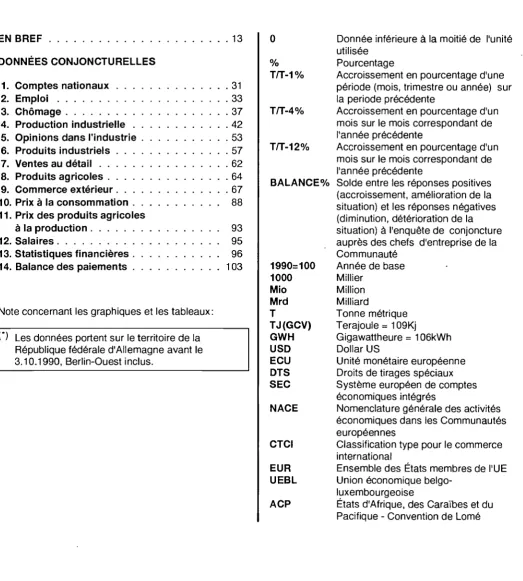
Table des matières
Signes et abréviations
EN BREF
13
DONNÉES CONJONCTURELLES
1. Comptes nationaux
31
2. Emploi
33
3. Chômage
37
4. Production industrielle
42
5. Opinions dans l'industrie
53
6. Produits industriels
57
7. Ventes au détail
62
8. Produits agricoles
64
9. Commerce extérieur
67
10. Prix à la consommation
88
11. Prix des produits agricoles
à la production
93
12. Salaires
95
13. Statistiques financières
96
14. Balance des paiements
103
Note concernant les graphiques et les tableaux:
Π Les données portent sur le territoire de la
République fédérale d'Allemagne avant le
3.10.1990, BerlinOuest inclus.
0
%
T/T-1%
T/T-4%
T/T-12%
BALANCE%
1990=100
1000
Mio
Mrd
Τ
TJ(GCV)
GWH
USD
ECU
DTS
SEC
NACE
CTCI
EUR
UEBL
ACP
Donnée inférieure à la moitié de l'unité
utilisée
Pourcentage
Accroissement en pourcentage d'une
période (mois, trimestre ou année) sur
la periode précédente
Accroissement en pourcentage d'un
mois sur le mois correspondant de
l'année précédente
Accroissement en pourcentage d'un
mois sur le mois correspondant de
l'année précédente
Solde entre les réponses positives
(accroissement, amélioration de la
situation) et les réponses négatives
(diminution, détérioration de la
situation) à l'enquête de conjoncture
auprès des chefs d'entreprise de la
Communauté
Année de base
Millier
Million
Milliard
Tonne métrique
Terajoule = 109Kj
Gigawattheure = 106kWh
Dollar US
Unité monétaire européenne
Droits de tirages spéciaux
Système européen de comptes
économiques intégrés
Nomenclature générale des activités
économiques dans les Communautés
européennes
Classification type pour le commerce
international
Ensemble des États membres de l'UE
Union économique belgo
luxembourgeoise
États d'Afrique, des Caraïbes et du
Pacifique Convention de Lomé
EUROSTATISTIQUES: en bref
Sauf indications contraires, les données portent sur le territoire de la République fédérale d'Allemagne avant le 3.10.1990, BerlinOuest inclus.
TAUX DE CHANGE: Baisse des taux d'intérêts japonais
Le 14 avril, la banque du Japon a annoncé une baisse de 0,75 % de son
taux d'escompte officiel qui s'établit désormais à 1 %, un record à la
baisse. Cette baisse de taux s'est accompagnée d'un train de mesures
gouvernemental concernant les dépenses publiques et la dérégulation.
Ces mesures ont pour objectif de relancer l'économie japonaise qui sort
lentement de la récession et continue de souffrir de l'appréciation du yen
contre le dollar déjà supérieur à 20 % pour l'année en cours.
Le yen a atteint un nouveau point bas sur les marchés asiatiques le 10
avril lorsqu'il s'est traité à 80,15 contre le dollar. Ce mouvement
particulier à la baisse est attribué aux banques centrales asiatiques qui
diversifient leurs réserves de change officiel en dehors du dollar. Celuici
n'a guère tiré partie de la réduction des taux japonais et le 19 avril il a
plongé audessous des YEN 80 pour la première fois depuis 1945.
Cependant, il s'est légèrement ressaisi pour clôturer à YEN 84,125 le 26
avril.
La faiblesse du dollar contre le mark n'a pas été aussi marquée que contre
le yen dans la mesure où il n'a pas touché de bas historiques, se traitant
entre DM 1,36 et DM 1,40 pendant la plus grande partie d'avril, bien que
cela représente une dépréciation d'environ 17 % depuis le début de
l'année 1995.
Dans l'UE, les pressions monétaires se sont légèrement relâchées au
cours des dernières semaines avec un raffermissement de plusieurs
monnaies contre le mark. Dans la foulée de la réduction des taux
allemands à la fin mars, la Belgique a baissé deux fois ses taux d'intérêts
officiels et le taux central s'établit désormais à 4,75 %, son plus bas
niveau depuis un certain temps. Après être revenu audessous de FF 3,50
ces dernières semaines, le franc français a légèrement faibli à l'issue du
premier tour des élections présidentielles le 23 avril, mais a récupéré les
jours suivants pour clôturer à Londres le 26 avril à FF 3,522.
Après s'être dépréciée début mars, la lire italienne s'est plutôt assagie en
avril se traitant autour de 12301250 contre le mark. Les performances de
la couronne suédoise ont été plutôt mitigées: elle a enfoncé un nouveau
bas contre le mark à SKR 5,428 au début d'avril, s'est ensuite raffermie
quelque peu autour de SKR 5,22, avant de rechuter à SKR 5,38 vers la fin
du mois pour se reprendre ensuite à SKR 5,308.
Le 25 avril, le florin néerlandais est resté accroché au sommet de la grille
du MTC suivi par le franc belge, le mark, le shilling, la couronne danoise,
l'escudo, la peseta, le franc français et la livre irlandaise.
RENDEMENTS DES OBLIGATIONS D'ÉTAT: Poursuite de la chute des
rendements dans de nombreux pays en mars 1995
Parmi les pays observés, le rendement des obligations d'État a baissé
dans six d'entre eux. Les plus fortes chutes ont eu lieu au Japon où les
rendements sont baissés audessous de 4 % pour la première fois depuis
mai 1994, en Suède, où les rendements des obligations d'État ont perdu
0,5 point en pourcentage en mars pour s'établir à 10,2%, et aux
PaysBas qui en compagnie de l'Allemagne et de l'Autriche détiennent le
niveau de rendement d'obligations d'État le plus bas de l'UE à l'exception
du Luxembourg.
Cependant, les rendements ont progressé de 0,7 % tant en Italie qu'en
Espagne, pays dont les monnaies ont traversé au cours de mars une
dépression entraînant la dévaluation de la peseta et des records histo
riques à la baisse de la lire contre le mark. Les taux d'intérêts à court
terme espagnols ont également été relevés en mars.
Aux étatsUnis, les rendements des obligations d'État ont rechuté en mars
à un niveau moyen de 7,5 %, pratiquement similaire à leur moyenne de
l'ensemble de 1994.
MASSE MONÉTAIRE: Ralentissement de la croissance de M2 en
Italie
Le taux de croissance de M2 en Italie s'est très sérieusement ralenti au
cours des derniers mois pour s'établir à un taux (annualisé) de tout juste
1,7% en décembre 1994 et de 0,2% en janvier 1995, ce qui est
nettement inférieur aux objectifs de croissance de M2 de 57 % fixés par
la banque d'Italie pour 1994 et réduits à 5 % pour 1995.
Le taux de croissance de M3 en Grèce a été à peine inférieur à 20 au
cours de la période des douze mois se terminant en février, un taux de
croissance nettement plus rapide que celui enregistré au cours du premier
semestre de 1994. L'inflation en Grèce s'est située aux alentours de
1011 % pour l'ensemble de 1994.
Au RoyaumeUni, M4 demeure à un taux annualisé d'environ 4 % ,
c'estàdire orienté vers le bas de la fourchette des objectifs fixés par la
banque d'Angleterre de 39 %.
RÉSERVES OFFICIELLES SUR L'ÉTRANGER: la Riksbank conclut des
accords de swap en écus avec ΓΙΜΕ
Le 11 avril, la Banque centrale suédoise, la Riksbank, a annoncé qu'aux
termes d'un accord avec l'Institut monétaire européen, elle échangeait
20 % de ses dollars US et de ses réserves en or contre des écus. Cela
signifie qu'elle détient désormais un peu plus d'un milliard d'écus de
réserves en écus officiels. Cette opération s'inscrit dans le cadre de
l'entrée de la Suède dans le système monétaire européen en janvier 1995,
faisant suite à l'entrée de l'Autriche et de la Finlande à la mijanvier qui
détiennent environ 2 milliards et 620 millions d'écus de réserves en écus
officiels respectivement.
Le 25 avril, la banque nationale de Belgique a vendu 5 627 onces troy sur
ses avoirs en or. Ce chiffre représente environ 22 % de ses réserves
totales en or et les produits de la vente ont été encaissés en devises ce qui
permet à la Belgique d'accroître de 30 % ses réserves en devises
étrangères. De source officielle, on apprenait que cette vente avait pour
objectif de ramener la part de l'or dans ses réserves totales sur l'étranger
dans les proportions similaires à celles des banques centrales voisines.
INFLATION ANNUELLE: Hausse de l'inflation annuelle dans l'Union
européenne des Quinze en mars 1995
L'inflation annuelle dans l'Union européenne des Quinze s'élève à 3,3 %
en mars 1995 selon les chiffres publiés par Eurostat. L'inflation est donc
en légère hausse par rapport aux 3,2 % (chiffre révisé) enregistrés en
février.
Cette augmentation reflète l'inflation en hausse en Italie, au Portugal et en
Espagne depuis le début de cette année. Cependant, le taux pour
l'ensemble de l'Union européenne est toujours très stable: depuis juillet
1992, il se maintient entre 3 % et 4 %.
La Belgique et la Finlande enregistrent le taux le plus bas avec 1,7 %. La
France arrive en deuxième position avec 1,8 %.
Voici les taux enregistrés en mars, classés par ordre croissant, pour
chaque Etat membre ainsi que les chiffres correspondants pour l'année
précédente:
mars 95 mars 94
mars 95 mars 94
Belgique
1,7%
2,3%
Irlande**
Finlande
1,7%
0,4% Suède
France
1,8%
1,5%
RoyaumeUni
Allemagne*
2,3 %
3,2 % Portugal
PaysBas
Luxembourg
Autriche
Danemark
EUR 15
2,3 %
3,0 % Italie
2.3 %
2,3 % Espagne
2.4 %
3,1 % Grèce
2,5%
1,7%
3,3 %p 3,1 %
mars 95 mars 94
mars 95
mars 94
2,5%
1,7%
3,0%
1,8%
3,5 %
2,3 %
4,5 %
6,0 %
4,8 %p
4,3 %
5,1 %
4,9 %
10,3%
10,2%
L'IPC pour l'Allemagne continue de refléter les frontières d'avant le 3 octobre
1990. En mars, l'inflation dans les nouveaux Lander était de 1,9 % comparé à
mars 1994.
** Fév 95 / fév 94 et fév 94 / fév 93
ρ
Provisoire
Les taux correspondants dans quelques autres pays non membres de
l'Union Européenne sont les suivants: ÉtatsUnis 2,9 % (2,5 %), Canada
2,2% (0,2%) Japon 0 , 3 % (1,3%), Suisse 1,5% (1,3%), Norvège
2,7 % (1 %) et Islande 1,4 % (2,6 %).
CHOMAGE: Le chômage dans l'Union européenne des Quinze en
baisse: 10,8 % en mars 1995
Le chômage dans l'Union européenne des Quinze, corrigé des variations
saisonnières, est estimé à 10,8 % en mars 1995. Ce taux est à comparer
aux 10,9% (taux révisé) enregistrés en février et aux 11,3% de mars
1994.
Entre mars 1994 et mars 1995, les plus fortes baisses sont observées en
Espagne (où le taux est passé de 24,3 % à 23,2 %, taux le plus élevé dans
l'Union européenne), en Finlande (de 19,7 % à 16,5 %, deuxième taux le
plus élevé de l'Union européenne), au Danemark (de 10,7 % à 9,2 %) et
au RoyaumeUni (de 9,8 % à 8,5 %). L'Allemagne est passée de 8,5 % à
8%.
ι
La baisse au cours des douze derniers mois est plus marquée chez les
hommes (leur taux de chômage est passé de 10,2 % à 9,6 %) que chez
les femmes (de 12,8% à 12,6%). Eurostat indique que ceci semble
confirmer la moindre sensibilité du chômage féminin à la conjoncture.
Eurostat estime qu'environ 17,9 millions de personnes sont au chômage
dans l'Union européenne des Quinze au mois de mars 1995. Ce chiffre,
corrigé des variations saisonnières, est établi en accord avec les critères
du Bureau International du Travail (BIT).
Remarque
Le taux de chômage et le nombre de chômeurs sont estimés selon les
recommandations du BIT après correction des différences entre les
méthodes nationales de recensement du chômage.
PRODUCTION INDUSTRIELLE : La production uindustrielle dans l'Union
européenne des Quinze encore en hausse en janvier 1995
La tendance de la production Industrielle dans l'Union européenne est à la
hausse: +1,3% de novembre à janvier par rapport aux trois mois
précédents.
Eurostat indique que la production continue de progresser sans montrer
aucun signe de ralentissement. Cependant, l'Indice de production en
janvier était de 100,1 (1990=100), ce qui signifie que la récession de
1992;1993 vient seulement d'être compensée.
Aux ÉtatsUnis, la reprise est également solide avec une progression de
1,2 % de novembre à janvier comparé aux trois mois précédents.
COMMERCE EXTERIEUR : Les exportations de l'Union européenne des
Douze ont augmenté davantage que les importations au cours des dix
premiers mois de 1994 (+1,5 points en pourcentage).
En octobre 1994, le commerce extérieur de l'Union européenne a
enregistré un excédent commercial de 1,4 milliard d'écus contre 3
milliards d'écus pour le même mois en 1993. Cependant, le déficit cumulé
pour janvieroctobre 1994 a été ramené à 1,1 milliard d'écus alors qu'il
était de 6,5 milliards d'écus un an auparavant. Au cours des dix premiers
mois de 1994, les exportations extraUE ont augmenté davantage que les
importations: respectivement 11,5 % et 10 %. Ce différentiel positif a été
la raison principale du redressement de la balance commerciale, même si
celuici s'est contracté, comparé à la même période de 1993.
Au cours de la période janvieroctobre 1994, l'Allemagne a enregistré
l'excédent extraUE le plus important des États membres de l'UE (1,3
milliard d'écus) et la hausse la plus forte par rapport à la même période
de l'année précédente (6,3 milliards d'écus).
Au cours des dix premiers mois de 1994, l'excédent de la balance
commerciale italienne s'est accru de 2,6 milliards d'écus, atteignant 10,1
milliards d'écus contre 7,5 milliards d'écus en 1993.
Au cours de la période janvieroctobre 1994, le RoyaumeUni a,parmi les
pays de l'Union européenne, enregistré le plus fort déficit commercial
(17,6 milliards d'écus). La position commerciale du RoyaumeUni s'est
légèrement détériorée (0,7 milliard d'écus) par rapport à la même période
de 1993, même si le différentiel entre les taux de croissance des
exportations et des importations était positif (+0,8 points en pourcen
tage).
Le déficit extraUE néerlandais a enregistré la plus forte détérioration entre
janvieroctobre 1993 et 1994 (4,9 milliards d'écus) atteignant 15,6
milliards d'écus.
Au cours de la période janvieroctobre 1994, le commerce extraUE de
l'UEBL et de l'Irlande a enregistré les plus forts taux de croissance des
États membres de l'Union européenne comparé à la même période une
année auparavant. Pour les importations, ces taux étaient respectivement
de 23,1 % et 21,3 %, tandis que les exportations enregistraient des taux
inférieurs (21,3 % et 16,3 % respectivement). Au cours des dix premiers
mois de 1994, la position extérieure de ces deux Etats membres s'est
détériorée par rapport à la même période de 1993. Le déficit de l'UEBL est
passé de 0,4 milliard d'écus à 0,9 milliard d'écus, tandis que l'excédent
irlandais s'est légèrement tassé.
L'excédent commercial extraUE de la France s'est accru de 1,4 milliard
d'écus entre la période susmentionnée de 1994 et à la même période de
l'année précédente (passant de 6,7 milliards d'écus à 8,1 milliards
d'écus).
Entre les périodes janvieroctobre 1993 et 1994, les positions du
commerce extérieur du Danemark et du Portugal étalent pratiquement
stables (respectivement 2 milliards d'écus d'excédent et 2,3 milliards
d'écus de déficit).
De janvier à octobre 1994, l'Espagne et la Grèce ont amélioré leur balance
commerciale par rapport à la période correspondante de l'année précé
dente: les deux pays ont réduit leur déficit extraUE respectivement de 0,2
milliard d'écus et de 1,1 milliard d'écus. Parmi les pays de l'UE, la Grèce a
été le seul à enregistrer un taux de croissance négatif de ses importations
(11,8 % par rapport à l'année précédente) tandis que ses exportations se
sont accrues de 15,7%.
SCHAUBILDER
GRAPHICS
2 1 0 q
8
7
6
5 4 3 2 1
—
- · " "
—
—
— · . ■ ■ '
1 I
ARBEITSLOSENQUOTEN
SAISONBEREINIGT
— - »
^, —
—
^"
··
Ι ι ι Ι ι ι Ι ι ι
Ι ΙEUR
Ι ! ι Ι ι
UNEMPLOYMENT RATES
SEASONALLY ADJUSTED
USA
" " ^ » « - ——
i i i i
■ ^ . ^
ι ι Ι ι ι Ι ι ι Ι ι ι
TAUX DE CHOMAGE
DESAISONNALISE
JAPAN
ι ι Ι ι ι Ι ι ι Ι ι
—
—
—
—
—
ι
1991
1992
1993
1994
15
14
13
12
11
10 9 8 7 6
—
—
—
,,,
—
ι ι !
ARBEITSLOSENQUOTEN
^ - ^ - mSGESAMT/SMSONBERHinGT — — — liAENNER/SAISONBEREOTGT
FRAUEN/SAISOHBERHNIGT
"
"'"
— • ^ " ™ — " " "
ι ι Ι ι ι Ι ι ι
^^~
ι ι Ι ι ι Ι ι
UNEMPLOYMENT RATES
EUR
TOTAL/SEASONALLY ADJUSTED WEN/SEASONALLY ADJUSTED TOKEN/SEASONALLY ADJUSTED
''"
^ — —
ι Ι ι ι
- - * " " "
ι ι Ι ι ι Ι ι
TAUX DE CHOMAGE
TOTAL/DESAISONNAliSE HOiniES/DESAISONNAUSE FEWMES/DESAISONNAIiSE
i l l ,
, „ , , « ' " " ' * · · H, , m ,
V
""·"··
ι ι Ι ι ι Ι ι ι Ι ι
—
—
—
—
—
1
— 7
1991
1992
1993
1994
ARBEITSLOSENQUOTEN
SAISONBEREINIGT
UNEMPLOYMENT RATES
SEASONALLY ADJUSTED
%
TAUX DE C H O M A G E
DESAISONN
ALISE
"IRL
■ï1991
1992
1993
1994
1991
1992
1993
1994
— I 12
— 10
1991
1992
1993
1994
5 0
4 0
3 0
2 0 '
1 0 ;
0L
ARBEITSLOSENQUOTEN
SAISONBEREINIGT
BELGIQUE - BELGIË
UNEMPLOYMENT RATES
SEASONALLY ADJUSTED
i l i i l i i l i i l n l i i l n i n i
1991
1992
1993
1994
50
40
30
20
10
DANMARK
-" i -" i l u l l I n I ' i l i i l i i ι
1991
1992
1993
1994
50
40
30
20
10
0
TAUX DE CHOMAGE DESAISONN ALISE
DEUTSCHLAND (*)
l u l l i i n i I 1 . i l . i l n l I l l
1991
1992
1993
1994
5 0
40"
30 ;
2 0
io-0L
ESPANA
' I I i i h , l i , I n i , i l , , I n i , , I n I ,
1991
1992
1993
1994
FRANCE IRELAND
i l n l n I n i I n l i i l i i l i i l i i l i i l i i l i i l i ι ' Ι ι ι Ι ι 11 ■ 11 ι■ I ' ι I ■ ι Ι ι ■ 11 ■ I ■ ■ 1■ι 11 ι 11 11■■ I ' ι 11 ι
1991
1992
1993
1994
1991
1992
1993
1994
5 0
4 0
30^
20
10J
0L
ITALIA
l I l l l M l l l I I l l l l l l l l l l . l l . l l l l l l l l l l l . l
1991
1992
1993
1994
NEDERLAND PORTUGAL
1 I I I I I I I I I I I I I I I 1 I I I 1 I I 1 I I I I 1 1 I I I I ' I 1 I h
1991
1992
1993
1994
' I n ' l u l l , l u l u l u l u I , i l , , I , , ! , ,
1991
1992
1993
1994
50r 40 30 20-10
UNITED KINGDOM
Q I " ' " I I , i l i . I . . I .
1991
1992
1993
1994
50 40 30 20 10'
USA
II 11 I I I ι '
n i l ' ' " I I i i l i , I Ι ι ι Ι ι ι Ι , , Ι ,
1991
1992
1993
1994
Moina de 25 ans Femmes