A thesis submitted for the degree of Doctor of
Philosophy of the Australian National University
THIS THESIS IS MY OWN ORIGINAL WORK
ACKNOWLEDGEMENTS
To my Supervisors:
D. A. Aitkin, L. F. Crisp and
Peter Loveday.
PRECIS
The Australian Senate has proved to be somewhat
of an enigma within the institutional framework of
Australian federalism.
It was the subject of intensive
debate at the Federal Conventions of the 1890s;
and
the Founding Fathers envisaged that it would perform
the dual functions of a House of Review and a States
House .
This thesis describes pre-federation expectations
about the Senate and Senators - expectations which even
at that time were somewhat naive and over-optimistic.
Detailed examination of both the membership and the
legislative record of the Chamber for a seventy-two
year period demonstrates that neither Senators nor the
activity of the Chamber fulfilled those expectations.
Most Founding Fathers expected that the Senate
would be a key focus for Federal-State interaction and
that Senators would promote and protect States' interests.
This has not been the case, partly because effective
power within the Australian federation has progressively
shifted from the State to the Federal level of government;
and partly because neither State nor Federal governments
have accepted that the Senate or the Federal Parliament
should be pursued or examined.
Nor have Senators regarded
the States House function as a, let alone the, important
area of Senate activity.
The Senate is seen to have performed more effectively
as a House of Review than as a States House.
Yet there
have been noticeable variations in the nature of Senate
scrutiny (of both legislation and of the executive) over
the seventy-two year period.
Acceptance of the conventions
of cabinet government has led to a general disinclination
by Senators to take full advantage of the extensive
legislative powers the Constitution grants to the Chamber.
A major explanation for the uneven record of the
Senate as a House of Review is the influence of party
politics.
Senators have seen themselves as pre-eminently
party men;
and their political allegiance has determined
the manner in which legislative review and executive
scrutiny has occurred.
Political parties have also
exacted a loyalty from Senators that competes with and
generally supercedes any committment to the welfare of
State interests.
Observers outside the Chamber have noted these
developments;
but rarely has criticism of the performance
of the Senate been accompanied by calls for the restructuring,
or even the abolition, of the Chamber.
To some degree
TABLE OF CONTENTS
Page
CHAPTER I : INTRODUCTION
Aims and Procedures
1
General Introduction to the Thesis
6
Brief Outline of the Content of the
Thesis
13
SECTION I :
FRAMING THE CONSTITUTIONAL PROVISIONS
FOR THE AUSTRALIAN SENATE
CHAPTER II : THE EMERGENCE OF BICAMERALISM AND
FEDERALISM
The Emergence of Bicameralism
20
A Federal Justification for Bicameralism
25
Bicameralism in the Australian
Colonies
32
Conclusion
50
CHAPTER III : PROVIDING FOR A FEDERAL BICAMERAL
LEGISLATURE IN AUSTRALIA
Introduction
51
Ready Acceptance of Federalism and
Bicameralism
55
The Composition of the Australian Senate
60
i) Equal State representation
61
ii) Election and term of Senators
64
iii) Qualifications for Senate electors
and Senators
67
iv) The 'nexus'
69
The Relative Power of the Senate and the
House of Representatives
70
Deadlock Machinery
76
Page
CHAPTER IV : UNFORESEEN PROBLEMS?
Introduction
82
Federalism and responsible
government
86
The Relative Power of Federal and State
Governments
95
The appearance and impact of disciplined
political parties
105
Inter-House Deadlocks
122
Conclusion
127
SECTION II : THE ACTIVITY OF THE SENATE AND SENATORS
BETWEEN 1901 AND 1972
CHAPTER V :
MEMBERS OF THE SENATE, 1901-1972
Introduction
135
Senators and MHRs 1901-1972;
a Collective
Portrait
141
The Party Composition of the Senate,
1901-1972
158
Members Who Served in Both
Federal Houses
173
Variations in Senate Personnel
Over Time
175
Senators in the Sixth and
Twenty-Seventh Parliaments
182
Page
CHAPTER VI :
AN OVERVIEW OF SENATE ACTIVITY, 1901-1972
Introduction
211
Sitting Days
211
Senate Initiation of Legislation
218
Fate of Legislation in the Senate
224
The Senate and Money Bills
230
General Debate
,
236
Question Time and Adjournment Debates
240
Petitions
242
Senate Committees
243
The Senate as a House of Review
258
The Senate as a States House
264
Conclusion
274
CHAPTER VII : OTHER INSTITUTIONAL AND ENVIRONMENTAL
CHANGES
Introduction
275
Franchise and Electoral Methods
276
Minor Party and Independent Representation
in the Senate
289
D.L.P. Representation and its Consequences
297
Rebels and 'new Blood' in the Senate
306
A Senator as Prime Minister
309
The Influence of the Clerk of the
Senate
310
Page
SECTION III : EVALUATION OF SENATE ACTIVITY
1901-1972
CHAPTER VIII : OBSERVERS' EVALUATIONS OF THE SENATE
AND SENATORS
Introduction
326
The Image of the Senate:
academics,
journalists and Parliamentarians
328
The Image of the Senate: the electorate
338
Conclusion
365
CHAPTER IX : ABOLITION OR REFORM OF THE SENATE?
Introduction
367
Abolition
367
Reform
376
Conclusion
387
CHAPTER X : CONCLUSIONS
Introduction
390
Senate Activity
390
Senators
396
Legislative functions and legislative
Effectiveness
407
The Senate as a House of Review or a
APPENDICES
I
II
A. RESEARCH PROCEDURES
B. AUSTRALIAN SURVEY PROJECT
WAVE II 1969
Questions 68-71
C. QUESTIONNAIRE
D. FIRST INTERVIEW SCHEDULE
E. FOLLOW UP INTERVIEW SCHEDULE
CONCLUSIONS ON ROLE CONCEPTION
ANALYSIS
III
:
SENATE ACTIVITY BY PARLIAMENT
1901-1972
BIBLIOGRAPHY
PRIMARY SOURCES
Page
418
421
424
437
439
441
449
476
TABLES
Table V : 1
Tab le V : 2
Table V:3 Table V:4
Table V:5
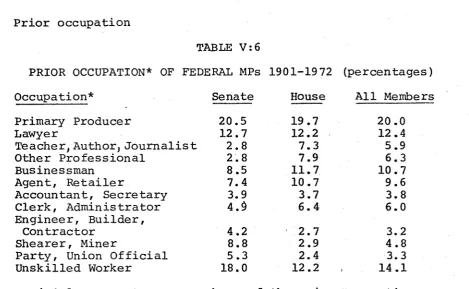
Table V:6
Table V:7
Table V:8
Table V:9
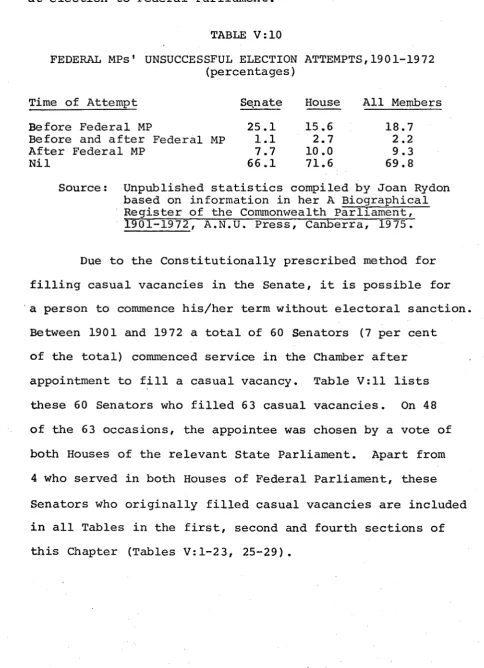
Table V:10
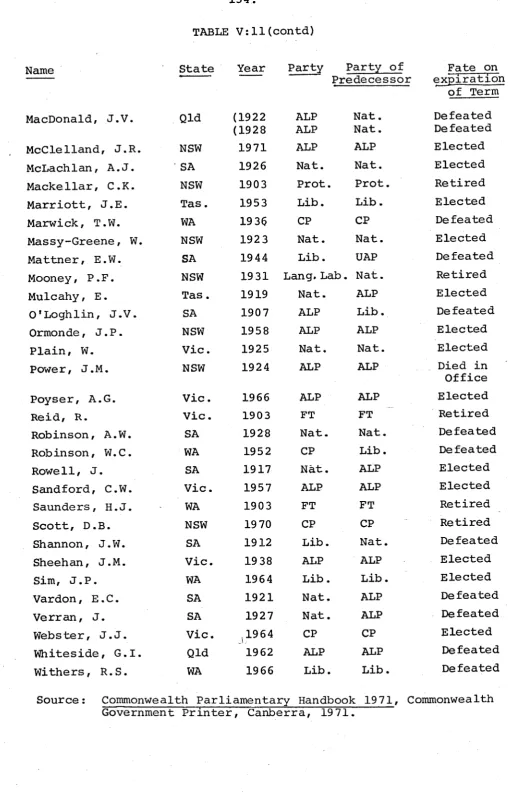
Table V :ll
Table V:12
Table V:13 Table V:14
Table V:15
Table V:16
Table V:17
Tab le V : 18
Senators' Place of Birth and State Represented, 1901-1972
W o m e n Candidates for the Senate, 1901-1972
Reli g i o n of Federal MPs, 1901-1972 Level of Ed u c a t i o n of F e d e r a l MPs,
1901-1972
Type of School A t t e n d e d by F e d eral MPs, 1901-1972
Prior O c cupation of Federal MPs, 1901-1972
Prior Poli t i c a l l y Relevant Experi e n c e of F e d e r a l MPs, 1901-1972
F e d e r a l MPs' State Par l i a m e n t a r y Experience, 1901-1972
Sequence of Federal MPs' P a r l i a m e n t a r y Experience, 1901-1972
F e d e r a l MPs' U n s u c c e s s f u l Elec t i o n Attempts, 1901-1972
Senators F i l l i n g Casual Vacancies, 1901-1972
M P s ' Age On Entry to and Departure from Federal Parliament, 1901-1972 Tenure of Federal MPs, 1901-1972 MPs' Reason for Leaving F e d e r a l
Parliament, 1901-1972
State of Parties in the Senate, 1901-1972
Reli g i o n of Senators, 1901-1972, by Party
Lev e l of E d u c ation of Senators, 1901-1972, by Party
Nu m b e r of Senators w i t h Degrees, by Party
Type of School A t t e n d e d by S e n a t o r s , 1901-1972, by Party
Page 142 143 144 145 146 147 149 150 151 152 153-4 155 155 157 159 163 16 4 164 Table V:19
Table V:20
Tab le V : 21
Tab le V : 2 2
Table V:23
Table V:24
Table V:25
Tab le V : 2 6 Table V:27
Table V:28 Table V:29
Table VI:1
Table V I : 2
Table V I : 3
Table V I : 4
Table VII:1
Table VII: 2
Table VII I : 1 Table V I I I : 2
Table V I I I : 3
Prior Occupation of Senators, 1901-1972, by Party
Prior Politically Relevant Experience of Senators, by Party
Senators' Age on Entry to and Departure from the Senate, 1901-1972, by Party Senators' Reason for Leaving the
Senate, 1901-1972, by Party
Federal MPs Who Have Served in Both Federal Houses
Level of Education of Senators Over Time
Prior Occupation of Senators Over Time Other Political Experience of
Senators Over Time
Age on Entry of Senators Over Time Prior Senate Tenure of Senators Over
Time
Average Sitting Days of Federal Parliament, by decade
Number of Bills Enacted, and House of Initiation, by decade
Fate of Bills in the Senate, by Parliament
The Party Composition of the Senate and of the Federal Ministry, 1901-1972 Number of Candidates per Seat at
Federal Elections, 1940-1970 Minor Party and Independent Senate
Candidates, 1943-1970
Gallup Poll Attitudes to the Senate Gallup Poll Attitudes to the Senate
by Sex
Gallup Poll Attitudes to the Senate by Party Preference
Page
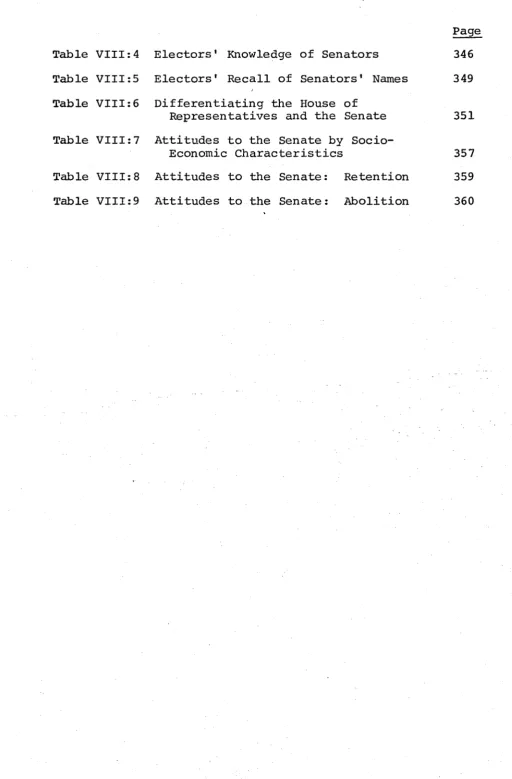
Table VIII:4
Electors' Knowledge of Senators
346
Table VIII:5
Electors' Recall of Senators' Names
349
Table VIII:6 Differentiating the House of
Representatives and the Senate
351
Table VIII:7 Attitudes to the Senate by
Socio-Economic Characteristics
357
[image:13.560.25.538.36.816.2]INTRODUCTION
Aims and Procedures
The o r i g i n a l m otivation fo r t h i s t h e s i s was a d e s ir e to t e s t out the a p p l i c a b i l i t y , to A u stra lia n F ederal Members of Parliam ent,' of the model of l e g i s l a t i v e r o le conceptions developed by John Wahlke, Heinz Eulau and o th e r American r e s e a r c h e r s . These p o l i t i c a l s c i e n t i s t s attem pted to provide a re se a rc h methodology which would enable an understanding of the behaviour of MPs by d isco v erin g t h e i r a t t i t u d e s and m o tiv a tio n s. The o r i g i n a l research s tu d y 1 - which has in s p ir e d a h o st of l a t e r p r o j e c t s 2 - in v e s tig a te d members of e ig h t American S ta te L e g is la tu re s . I f e l t t h a t the approach could be ap p lied to A u stra lia n Members; and t h a t Senators would be a p a r t i c u l a r l y i n t e r e s t i n g group to study given t h e i r C o n s titu tio n a lly p re s c rib e d r o le s as S ta te r e p r e s e n ta tiv e s and members of a House of Review.
A Q uestionnaire and Interview S chedules3 were
d ev ised, modelled on those of Wahlke e t a l w ith a p p ro p ria te changes to s u i t th e d i f f e r e n t p o l i t i c a l system. Between 1969 and 1971 I approached members of the Senate, who 1 J.C. Vfohlke e t al, The legislative System : Explorations in
legislative Behavior, John Wiley & Sons, New York, 1962. For example: M.E. Jewell & S.C. Patterson, The Legislative Process in the United States, Randan House, New York, 1966; D.R. Matthews, U.S. Senators and Their Werld, U. of North Carolina Press, Chapel Ilill, 1960.
g e n e r a l l y r e s p o n d e d favourably. Their answers p r ovided v e r y i n t e r e s t i n g i n f o r m a t i o n about their own p o l i t i c a l attitudes, a m b i t i o n s and views on the functions of the Senate. A n a l y s i s of r e s p onses acc o r d i n g to the Wahlke s c h e m a was, however, b o t h a t i m e - c o n s u m i n g and a largely u n r e w a r d i n g task. In brief, I concluded:
i) t h a t the categories of role o r i e n t a t i o n p r o f f e r e d b y W a h l k e et al h a d only limited a p p l i c a b i l i t y to these A u s t r a l i a n Senators;
ii) t h a t the categories w e r e useful m e r e l y as a c l a s s i f i c a t o r y , but not as an e x p lanatory, tool; iii) t hat there w e r e serious t e r m i n o l o g i c a l and
m e t h o d o l o g i c a l p r oblems w i t h the Wahlke et al a p p r o a c h w h i c h q u e s t i o n its value as a bas i s for c o m p a r a t i v e a n a l y s i s .4
C o n c u r r e n t l y w i t h this i n t e r v i e w i n g of Senators, I d e c i d e d to i n v e stigate the views of comm e n t a t o r s o u t side the Senate on the m e m b e r s h i p and functions of the
Chamber. Firstly, the reactions of a sample of the
A u s t r a l i a n e l e c t o r a t e w ere d e t e r m i n e d in a nswer to Q u e stions i n s e r t e d in the Second Wave (1969) of the
A u s t r a l i a n S u rvey Project. Secondly, I e x a m i n e d s e c o ndary sources for judgments on Senators and Senate p e r formance.
This c o m b i n a t i o n of approaches p r o v i d e d several i n t e r e s t i n g insights; for example, m a n y Senators
e x p l a i n e d t h e i r actions in terms of h o w they p e r c e i v e d
4
observers expected them to-behave;
and reference back
to the Constitutional prescriptions of Senate functions
was common.
Observers' judgments also referred to such
expected/desired functions, as well as reflecting on
the perceived performance of the Chamber - and on the
degree to which activity matched expectations.
To some
degree observers seemed to be comparing Senate performance
with an unrealizable ideal;
and Senators appeared to be
unduly apologetic about not living up to this ideal.
The views of the electorate were more realistic in terms
of expectations, and less censorious on the actual record
of the Senate (partly a reflection of lack of knowledge
about the Senate and its activity).
What I had originally seen as sufficient information
for a thesis was thus found to be wanting;
my research
had raised more questions than it had produced answers.
It was therefore necessary to collect further information.
An obvious starting point was detailed perusal of the
debates of the Federal Conventions of the 1890s, since
the views of the Founding Fathers had formed a reference
point for most evaluations of Senators and Senate activity
during the Twentieth Century.
did such variations occur? In seeking answers to these
questions, an immediate problem was the lack of detailed
scrutiny of Senate activity in secondary sources.
The
major reference was J.R. Odgers' Australian Senate Practice,5
intended to be an explanation of Senate procedures and
practice, which has little evaluative comment.
There
were a few other sources on specific aspects of Senate
activity6, and some general observations in other references.7
On many aspects of Senate performance absolutely no research
had been done;
and I therefore had to start from scratch
and work from the Senate Journals and Hansard.
Again I
was involved in a highly time-consuming (especially since
I had decided to study the period 1901 to 1971) - though
in this case very rewarding - exercise.
I submitted a thesis based on all of the above
lines of enquiry in June 1974. At the time of submission
it was apparent that the then Senate was exploring and
threatening to use its Constitutional power in a hitherto
unprecedented fashion.
Similar action occurred in 1975.
When requested to 'revise' the thesis in 1975, I considered
whether the terms of resubmission permitted or required
an extension of the previously adopted time span.
I was
advised that this could be outside the approved topic;
Published by the Coimonwealth Government Printer, Canberra; 1st
ed.
1953, 2nd ed. 1959, 3rd ed. 1967, 4th ed. 1972, 5th ed. to appear late 1976.6 A. Fusaro, "The Australian Senate as a House of Review: Another Look", Australian Journal of Politics and History, vol.12, 1966, reprinted
on C.
A. Hughes (ed.), Readings in Australian Government, University of Queensland Press, Brisbane, 1968. D. Solomon, "The Senate" in H. Mayer & H. Nelson (eds.), Australian Politics: a third reader, Cheshire, Melbourne, 1973. M. Mackerras, The Australian Senate X 9 65-1967: Who Held Control?, A.P.S.A. Monograph, No.9, Sydney, 1968.moreover, to so extend the period to include the events
of 1972-1975 could require a complete reorientation of
the nature of the thesis and might be foolhardy given
the lack (to date) of sufficient reliable information
on events during those years.
I have therefore merely extended the period to
cover the last year of the Twenty-Seventh Parliament
(1972).
I contend that this study of the Senate for
the years 1901 to 1972 can stand in its own right, as
well as serve as an historical background within which
the events of 1972-1975 can be viewed.
One important
by-product of the so-termed 'Supply crises' of 1974 and
1975 is, however, a greater questioning about the validity
(or wisdom) of predicting the future from a review of
past activities.
This revised version differs in the following
respects from my former thesis:
A.
the previous material has been re-organised and,
to some degree, edited;
B.
the analysis of Senators' role conceptions has
been omitted from the text (a brief summary of
the conclusions reached appears as an Appendix);
C.
the original Chapter on the Federal Convention
debates about the Senate has been expanded, and
additional background material on overseas and
Colonial legislatures up to 1900 is provided;
D.
the review of Senate activity has been greatly
expanded;
E.
a new Chapter on Senate personnel over the
seventy-two year period is included.
Chapters II, IV and V are wholly new;
Chapters
III, VI, VII, VIII and IX are, to varying degrees, revised,
re-organised and expanded presentations of material
contained in the original submission.
I found the task of revision somewhat difficult
given a lack of specific, consistent guidelines within the
examiners'
comments.
It was, however, apparent that a
more coherent and integrated presentation was required,
and that additional scrutiny of the activity of the
Chamber was necessary.
I hope that these suggestions
have been satisfied, and that this submission meets the
requirements of the examiners.
General Introduction to the Thesis
The Australian Senate was established by the Founding
Fathers of the Commonwealth Constitution in relation to
House, as first embodied in the American Senate.
The
structure and prescribed functions of the Australian
Federal Upper House are pre-eminently an embodiment of
the principles of federalism.
Thus the Constitutional
description of the Senate's place within the Australian
Federal system of government differs in significant
respects from the explicit functions of the House of
Lords within the British political system.
Nonetheless, given that the cabinet system of
government which provides the framework for British
political practice had been established in the Australian
Colonies prior to Federation and that this was also
implicitly enshrined in Australian Constitutions at
both the Colonial (later State) and Federal levels,
expectations that the activity of the Senate would be
in some ways similar to that of the British House of
Lords cannot be ignored when studying the Australian
Senate.
On the other hand, the upper house in a bicameral legislature operating under the conventions of cabinet government has, in the light of British experience from the Eighteenth Century, been generally regarded as sub
ordinate to the lower house (termed the house of government), especially in relation to influence on financial legis
lation. Irrespective of whether or not membership of the executive is open to legislators sitting in either house, the responsibility of cabinet is only to the lower house. Moreover, in constitutions following the British model, the powers of the upper house are usually limited or constrained; the upper house may be denied the right of initiation, or of amendment to, or of veto over,
specified classes of legislation (in particular, money bills) .
In the American model the separation of powers
means that the President is not responsible (in the British sense of the word) to the legislature. Hence the existence of a second chamber which is potentially more powerful
than the first is somewhat offset by the independence of legislature and executive. In one sense the struggle for power is thus less that of competition between rival
Most second chambers or upper houses follow one
of these models.
In the Australian Senate there is an
interesting fusion of the States House and the House of
Review functions;
Constitutionally the Senate is charged
with the task of representing/promoting/protecting State
interests and of reviewing legislative initiatives from
the Lower House.
Any tendency of the Australian Senate to develop
into a Chamber of the power and stature of the American
Senate - which a reading of the Commonwealth Constitution
suggests is possible, and which most of the Founding Fathers
desired and expected - was (at least until October-November
1975) thwarted by the cabinet system of government and by
the nature of partisanship within Australian politics.
These are the two vital constraining factors which together
effectively limit the degree to which the Senate can perform
as a House of Review and especially the degree to which
it can act as a States House.
There are other factors which have operated at
certain periods of the Senate's existence which have
affected the activity of the Chamber;
for example, the
calibre and motivations of Senators and their perceptions
of Senate goals and functions;
and the type of electoral
method used for the election of Senators.
Until 1974 the prevailing argument was that the
Senate's function was pre-eminently that of a House of
that delegates recognised the value of such a House of
Review.
However, practical considerations - the achieve
ment of a federal system with sufficient guarantees for
the smaller Colonies - forced the construction of a Senate
with the ultimate power to refuse Supply and hence, by
implication, to force the dissolution of a government.
Delegates from the smaller Colonies successfully argued
that to be an effective federal - that is, States - House
the Senate should have powers equal to those of the House
of the people.
Acceptance of the principle of directly
elected rather than nominated membership was another proffered
justification for not restricting the powers of the Senate.
The only concession made to the potential danger of
establishing so powerful a second chamber was the inclusion
in the Constitution of machinery for solving deadlocks.
The record of the Senate as a legislature demonstrates
that for the period 1901-1972 the Chamber itself chose to
adhere to the Review model.
Budgets were criticised and
requests for amendment of Money Bills were sent down to
the House of Representatives, but the ultimate action was
only threatened (and not very convincingly at that?).
The only two instances of use of the formal deadlock
machinery reflected Governments' desire to rid themselves
of a particularly intransigent Upper House (controlled by
Opposition members) rather than States' rights sentiments.
lack thereof, of the same party (or coalition) majority
in the two Federal Houses. Where a government also held
a majority of Senate seats, Senators appeared less intent
on review;
a hostile Senate, on the other hand, seemed
often to reject or amend legislation merely to harrass
a government.
The influence of partisanship is even more apparent
when one reviews the activity 'of the Senate as a States
House.
Rarely have Senators from a particular State or
States acted together irrespective of their party allegiance.
To some degree the poor record of the Senate as a States
House is a reflection of changes within Australian
federalism which largely deny the possibility of the
Senate performing this function.
The Senate's reactions to appropriation measures
in 1974 and 1975 demonstrated that carrying the constraint
of partisanship to the ultimate degree (opposition compen
sation for the lack of a Lower House majority) led to the
Senate abandoning a long-accepted, self-imposed constraint
on its activities.
Given party politics, the Senate's
assertion of this Constitutional power had far more
dramatic short-term consequences than were ever envisaged
by the Founding Fathers;
and may well have major reper
cussions on the future of Senate powers as a result of
some consequent moves to amend the Constitution.
Senate.
These have generally gained added fervour in
periods when the Senate has been seen as partisanly
intransigent.
Some critics go so far as to advocate
abolition of the Chamber.
Others have suggested
structural or technical changes (substituting functional
representation;
reforming as a house of committees;
altering the electoral method, term of office, size
of membership ;
some have argued for restricting the
powers of the Senate (purely in relation to financial
measures, or by generally allowing the Chamber only a
delaying power).
Until 1972 few such changes had been
instituted or suggested in Constitutional referenda.
Recent events may provoke greater acceptance for any
reform proposals.
However, it seems highly unlikely
that a move to abolish the Senate would be electorally
acceptable in the near future, at least.
The most successful initiators of change may well
be Senators themselves (as previously evidenced in their
extension of the Chamber's committee system in 1970).
They (like the Governor-General) are free to explore
the limits of the Constitutional boundaries of their
powers or (as in the 1940s and early 1950s) to take a
very narrow view of their rights and responsibilities.
As previously noted, however, political parties are
Brief Outline of the Content of the Thesis
Apart from the Introductory and Concluding Chapters,
the thesis is organised into three Sections.
SECTION I
The first Section presents the necessary background
information on the composition and powers of the Senate,
and on the expectations of Seriate performance aired by
those who drafted the Constitution.
Chapter II includes a brief exposition on the development
of and rationalisations for bicameralism and federalism,
both overseas and in the Australian Colonies, prior to
the Twentieth Century.
It describes the two types of
upper houses which the Founding Fathers of the 1890s
could consider as models for a future Australian federal
upper house:
the upper house as House of Review (the
British House of Lords), and as a States House (the
American Senate).
The pattern of inter-House relationships
in the Australian Colonies in the latter part of the
Nineteenth Century was not directly similar to that in
Britain;
and the division of the nation into separate
units which were progressively granted self-government
raised the possibility of the simultaneous relevance of
the American model of a federal upper house, wherein each
Colony could enjoy an equal voice.
Chapter III provides a resume of the Constitutional
provisions for the composition and powers of the Senate,
and of the arguments about these provisions at the
Australian Federal Conventions of 1891 and 1897-1898.
The discussion concentrates on the relevant strands of
debate at the Conventions, and is a brief summary of
majority and significant minority views on the Senate.
The final Constitutional provisions for the Senate are
seen to represent a blend of the House of Review and
States House models, and a unique combination of federalism
and cabinet government.
Chapter IV reflects on the material discussed in the
previous two Chapters, and points to various questions
which the Constitutional provisions for the Senate left
unresolved.
The four major areas discussed are:
the
compatibility (or lack thereof) of federalism and
responsible government;
the relative power of Federal
and State governments;
the effects of political parties
(especially the Australian Labor Party) within the Federal
Legislature;
and the machinery for resolving inter-House
deadlocks.
Few of the Founding Fathers recognised that
these would be, individually and collectively, major
problems in the Twentieth Century and that developments
SECTION II
The second Section analyses the membership and
performance of the Senate between 1901 and 1972.
Chapter V surveys Senate personnel for the seventy-two
year period.
Statistical information demonstrates that
there were some differences between the type of persons
who served in the two Federal Houses; however, such
differences do not necessarily demonstrate that Senators
have been, in Brycean terms, Members more suited to the
Review function because of their maturity or expertise.
Analysis of Senate personnel over time demonstrates some
changes similar to general changes amongst the electorate
in terms of, for example, educational qualifications and
prior occupation.
However, the most important differences
amongst Members of both Federal Houses over time can be
more successfully explained in terms of their party
allegiances.
More detailed analysis of a particular set of
Senators - those who were members of the Twenty-Sixth
and Twenty-Seventh Parliaments - provides interesting
evidence on the motivations and attitudes of certain
Senators.
general debate;
and committees.
The Chapter concludes
with a discussion of the effectiveness of the Senate as
either a House of Review or a States House, both in terms
of the opportunities and constraints which apply, and in
terms of Senators' evaluations of the record and possibilities.
Both of these Chapters are essentially descriptive.
Evaluative comments are almost exclusively those of Senators
interviewed between 1969 and 1971. The Section therefore
provides the necessary information upon which judgments
about the performance of the Senate can be formed.
Chapter VII seeks to provide additional explanations for
the changes in Senate personnel and in the nature and
tempo of Senate activity over time.
Some changes have
been internally inspired;
others were responses to changes
in the general political environment.
A highly important
factor has been the type of electoral method used for
Senate elections;
this has had marked effects on the
party composition of the Chamber, and the introduction
of proportional representation increased the possibility
of hostile or evenly balanced Senates.
Proportional representation enhanced the electoral
prospects of minor party and Independent Senators, which
generally found themselves in a 'balance of power' position
in the Chamber.
Other interesting developments in the
to the Prime Ministership.
It is also argued that the
current Clerk of the Senate, J.R. Odgers, has had an
influence on some Senators and has provided a legitimation
for some Senators' exploration of the limits of Senate
powers.
SECTION III
This Section discusses observers' evaluations of
Senators and Senate performance over the seventy-two year
period.
It demonstrates that, irrespective of the mis
givings many have had about the Chamber and its effective
ness, few have advocated reform; and that proposals for
restructuring the Senate have met with little success.
Chapter VIII presents the judgments of outside observers
(especially academics, journalists and MPs) on Senate
performance at certain points in time.
Such comments
reflect both the expectations of such observers (for
example, the degree to which they regard the States House
and House of Review functions as important or attainable)
and their assessment of Senate activity in the light of
these expectations and in more general terms.
Many
observers seem to be equally as idealistic and unobservant
as were the Founding Fathers.
The views of the electorate
(expressed in Gallup Polls and in answers to the Australian
Survey Project Questions) are perhaps more cynical and
Chapter IX discusses suggestions for reform or abolition
of the Senate.
The proponents of abolition have been
singularly inactive in terms of concrete attempts to
achieve this aim;
this is in part a sign of the difficulty
of achieval of such an aim, given the Constitutional
structure and the disinclination of the electorate to
sanction major change to that structure. A wide range
of reform proposals have been raised.
Their chances of
acceptance are, in theory at least, greater;
but few
such proposals have been enacted. Movements for reform
SECTION I
CHAPTER II
THE EMERGENCE OF BICAMERALISM AND FEDERALISM
T h e E m e r g e n c e of B i c a m e r a l i s m
J e r e m y B e n t h a m is c r e d i t e d 1 w i t h c o i n i n g the t e r m
b i c a m e r a l i s m to d e s c r i b e a l e g i s l a t u r e of tw o h o u s e s . In
t h e 1 9 7 0 s a p p r o x i m a t e l y f i f t y p e r c e n t of th e w o r l d ' s
l e g i s l a t u r e s ar e b i c a m e r a l in s t r u c t u r e , a l t h o u g h th e r e l a t i v e
c o m p o s i t i o n a n d p o w e r s of e a c h p a i r of c h a m b e r s v a r y m a r k e d l y . 2
T h e B r i t i s h P a r l i a m e n t a d o p t e d a b i c a m e r a l f o r m b y t he
e a r l y F o u r t e e n t h C e n t u r y and, w i t h th e b r i e f e x c e p t i o n of
u n i c a m e r a l i s m u n d e r C r o m w e l l in th e m i d S e v e n t e e n t h C e n t u r y ,
h a s r e t a i n e d the d i v i s i o n i n t o a H o u s e of C o m m o n s a n d a H o u s e
o f L o r d s (the f i r s t a n d s e c o n d , or l o w e r a n d u p p e r h o u s e s
r e s p e c t i v e l y ) . 3 J u s t w h y t h i s b i c a m e r a l , r a t h e r t h a n a
u n i c a m e r a l l e g i s l a t u r e e v o l v e d in B r i t a i n is a m a t t e r of s o m e
d i s p u t e . M a r r i o t t 4 a n d R o b e r t s 5 a r g u e t h a t a d o p t i o n of
b i c a m e r a l i s m w a s a c c i d e n t a l . P o l l a r d 6 s t a t e s t h a t d u r i n g the
A.W. Johnson, The Unicameral Legislature, University of Minnesota Press, Minneapolis, 1938, p.4, footnote 1.
See J. Blondel, Comparative Legislatures, Prentice Hall, New Jersey, 1973, pp.32-35, 144-153; M. Ameller (ed.), Parliaments, Cassell, London, 2nd rev. ed., 1966, pp.3-13.
The term 'House of Commons' was used as early as 1372; 'House of
Lords' not until the early Sixteenth Century.
J.A.R. Marriott, Second Chambers: An Inductive Study in Political Science, O.U.P., Oxford, 1910, p.3.
G.B. Roberts, The Functions of an English Second Chamber, Allen & Unwin, London, 1926, pp.24-28.
A.F. Pollard, The Evolution of Parliament, Longmans Green, London, 2nd rev. ed., 1926, p.74.
r e i g n s of E d w a r d and R i c hard II P a r l i a m e n t i n c r e a s i n g l y
b e c a m e a large and u n w i e l d y body, and that Ed w a r d III t h e refore s u m m o n e d lords and clergy to m e e t in one group, and knights a n d b u r g e s s e s in another. Both served the same func t i o n of a d v i s i n g the Monarch, w h o had complete di s c r e t i o n as to
s e l e c t i o n of those a t t e n d i n g and the date and d u r a t i o n of m e e t i n g s .
F r o m the late Th i r t e e n t h Century the B r i t i s h P a r l i a m e n t g r a d u a l l y a c q u i r e d ad d i t i o n a l functions as m o ves to curb the p o w e r of the M o n a r c h y i n t e n s i f i e d . 7 For example, in 1927 E d w a r d I w a s forced to concede P a r l i a m e n t a r y c o n s e n t for a p p r o p r i a t i o n ; by the m i d Fo u r t e e n t h Century P a r l i a m e n t was a t t a c h i n g co n d i t i o n s to m o n e y bills (specifying the p urposes for w h i c h the m o n e y w a s to be spent and also d e m a n d i n g redress of c e r t a i n g r i e v a n c e s 8 ) and slowly adopting a l e g i slative role in a d d i t i o n to its a d visory and judicial functions.
T h e s e mov e s c u l m i n a t e d in d e v e l o p m e n t of the no t i o n of m i x e d government, e x p l i c i t (for instance) in Char l e s I's reply to the N i n e t e e n P r o p o s i t i o n s a d d r essed to h i m on the eve of the f i r s t Civil War. H e n c e f o r t h p o l i t i c a l power was to be
d i v i d e d b e t w e e n the Monarch, the Lords and the Commons, each of w h i c h cou l d v e t o l e g i s l a t i o n and each of w h i c h had special
For full details see, for example, W.E. Hearn, The Government of England: its structure and its development, George Robertson,
Melbourne, 18#3; A. Todd: On Parliamentary Government in England: its origin, development and practical operation, Longmans Green, London, vol. 1, 1867, vol.2, 1869.
Origin of the convention of grievance debates on the second reading of appropriation Bills.
p o w e r s ( t h e M o n a rch y a s e x e c u t i v e c o u l d summon an d d i s s o l v e
P a r l i a m e n t , an d c r e a t e p e e r s ; t h e Commons h a d t h e p o w e r o f
i n i t i a t i o n o f s u p p l y ; and t h e L o r d s h a d j u d i c i a l f u n c t i o n s 9 ) .
T he e s s e n t i a l e l e m e n t i n t h e t h e o r y o f m ix e d g o v e r n m e n t i s
t h u s t h e n o t i o n o f e a c h c o m p o n en t c h e c k i n g a n d b a l a n c i n g t h e
o t h e r s , w i t h t h e H o u se o f L o r d s , r e p r e s e n t i n g t h e a r i s t o c r a c y ,
e s p e c i a l l y i m p o r t a n t i n m a i n t a i n i n g an e q u i l i b r i u m b e t w e e n t h e
v i c e s o f e x e c u t i v e t y r a n n y an d ' r u d e d e m o c r a c y ' . 10 I n t h e o r y
t h e H o u s e o f L o r d s s h a r e d e q u a l l e g i s l a t i v e p o w e r w i t h t h e
Commons u n t i l t h e e a r l y T w e n t i e t h C e n t u r y 1 1 , an d d u r i n g t h e
E i g h t e e n t h an d e a r l y N i n e t e e n t h C e n t u r i e s t h e p o w e r o f t h e
p e e r s e n t r e n c h e d i n t h e L o r d s w a s u s u a l l y p a r a m o u n t .12 B u t
t h e r e f o r m m o v e m e n ts o f t h e N i n e t e e n t h C e n t u r y , c u l m i n a t i n g i n
u n i v e r s a l f r a n c h i s e , l a i d t h e L o r d s o p e n t o a t t a c k a s a n
u n j u s t i f i e d b a s t i o n o f a r i s t o c r a t i c p r i v i l e g e . R a t h e r t h a n
s u b m i t t i n g t o a n y r e s t r u c t u r i n g o f t h e Cham ber a s a p a r t i a l l y
o r w h o l l y e l e c t e d b o d y , t h o s e who s u p p o r t e d r e t e n t i o n o f t h e
L o r d s c h a m p io n e d i t s r o l e a s a b r a k e u p o n a n d s a f e g u a r d a g a i n s t
r a d i c a l i s m a n d m a j o r i t y t y r a n n y . 13 The c o n s e r v a t i v e l y m in d e d
C.C. W eston, E n g lish C o n s titu tio n a l Theory and th e House o f L ords, 1 5 5 6 -1 8 3 2 , R outledge & Kegan P a u l, London, 1965, p p .2 -3 .
A .S . T u r b e r v ille , The House o f Lords in th e E ig h te e n th C entury, Faber & Faber, London, 1958, p .4 3 0 .
See b elow , pp. , f o r a surrmary o f th e p r a c t ic a l e x c li p s e o f th e Lords' power o v er money b i l l s .
W eston, o p . c i t . , p .4 . Probably because th e House was p r e t t y
q u ie s c e n t . But th e Duke o f W ellington s a id in 1818, "Nobody c a r e s a damn f o r th e House o f Lords; th e House o f Camions i s e v er y th in g in England, and t h e House o f Lords n othing "j quoted by
T u r b e r v ille , o p . c i t . , p .2 4 .
a r g u e d that since the acceptance of c o n s t i t u t i o n a l m o n a r c h y
the danger was no longer a b s o l u t i s m of the Crown, but
"government by ignorance and brute n u m b e r s " 14 in the House
o f Commons.
D uring this pe r i o d of gradual extens i o n s to the
f r a n c h i s e for el e c t i o n s to the Hou s e of Commons, the peers
s u c c e s s f u l l y r e s i s t e d any attempts to un d e r m i n e their House
,(and also slowed the pace of moves to a b o lish their pat r o n a g e
cover th e C o m m o n s 15). As T u r b e r v i l l e comm e n t s in r e l a t i o n to
-the 18 32 R e f o r m Act:
"The p a s sing of the great R e f o r m Bill is p o p u l a r l y and rightly rega r d e d as one of the chief turning points in our
c o n s t i t u t i o n a l h i s t o r y b e c ause it g r e atly e x t e n d e d the political influence of the
m i d d l e classes; but the a r i s t o c r a c y still
r e m a i n e d e x c e e d i n g l y powerful, their
i n f l uence r e m a i n i n g m u c h greater than they themse l v e s had anticipated, m u c h greater than their opponents had hoped w o u l d be the
case. The fundamental e x p l a n a t i o n was
that there could be no real r e v o l u t i o n in the d i s t r i b u t i o n of pol i t i c a l p o wer w i t h o u t a r e v o l u t i o n in the d i s t r i b u t i o n of real p r o p e r t y . . . " . 16
During the N i n e t e e n t h and the early T w e n t i e t h
C e n t u r i e s r a t i o n a l i z a t i o n s about the u t i l i t y of second
c h a m b e r s w ere further r e f i n e d in resp o n s e to r e c o g n i t i o n of
± h e 'inefficient' na t u r e of p a r l i a m e n t a r y p r o c e d u r e in the
H o u s e of Commons and the in c r e a s i n g power of the e x e c u t i v e —
n o w c a b i n e t - v i s - a - v i s both Houses of P a r l i a m e n t . 17 The
c l a s s i c statement of
W. Bagehot, The English Constitution, Collins, Fontana, ed., Landen, 1963, p.277."
15 A.H. Birch, Kepresentative & Responsible Government, Ch.4.
16 Cp.cit., p.407.
" F u n c t i o n s A p p r o p r i a t e to a Second Chamber" was p r o d u c e d by the B r y c e C o n f e r e n c e e s t a b l i s h e d in 1917 to c o nsider
p o s s i b l e r e f o r m of the Hou s e of Lords. Lord Bryce isolated four f u n c t i o n s :
(a) e x a m i n a t i o n and r e v i s i o n of legi s l a t i o n sent up from the lower house;
(b) i n i t i a t i o n of n o n - c o n t r o v e r s i a l legislation; (c) i n t e r p o s i t i o n of del a y in the process of
l e g i s l a t i o n so that p u blic op i n i o n can be e x p r e s s e d and, if need be, r e a cted to; (d) l e i s u r e l y d i s c u s s i o n of q u e stions of
n a t i o n a l i m p o r t a n c e .18
By the T w e n t i e t h C e n t u r y B r i t i s h Government, though still t r i p a r t i t e in formal structure, was r e c o g n i s e d as
e s s e n t i a l l y a s y s t e m in w h i c h c a b i n e t (drawn largely f rom the C o m m o n s t h o u g h w i t h a small c o m p o n e n t of peers) was
p r e d o m i n a n t , the M o n a r c h a c o n s t i t u t i o n a l c y pher and the Lords a r e s t r i c t e d 19 and r e s t r a i n e d check or curb on the House of C o m m o n s .
L e g i s l a t i v e scrutiny, o v e r s i g h t of the e x e c u t i v e and some i n i t i a t i o n of non - c o n t r o v e r s i a l legi s l a t i o n are now r e g a r d e d as the fun c t i o n s of a second chamber or House of Review.
Report on the Conference on Reform of the Second Chamber, London, 1917, pp.
See also Hearn, op.cit., pp.541-542. 19
In A m e l l e r 's t e r m s :
"In d e m o c r a t i c regimes the bic a m e r a l
s y s t e m is no longer e x p l ained by the need fo r a separate, aristocratic representation. N o w a d a y s the theoretical arguments for a
b i c a m e r a l sy s t e m are of two kinds: first
th e concern for a more stable b a l a n c e
b e t w e e n the Executive and the Legislature, t h e u n b r i d l e d power of a single chamber b e i n g r e s t r a i n e d by a second chamber
r e c r u i t e d on a different basis; s e c o n d l y
b y the d e sire to make the p a r l i a m e n t a r y m a c h i n e run if no t m o r e e f f i ciently at any r a t e m o r e smoothly by having a s o - c a l l e d
'revising' chamber to m a intain a careful c h e c k on the sometimes hasty dec i s i o n s of a fir s t c h a m b e r " . 20
H o w e v e r accide n t a l the emergence of a d i v i d e d
l e g i s l a t u r e w a s in Britain, b i c a m e r a l i s m was a d o p t e d by a
large n u m b e r of E u r o p e a n c o u n t r i e s 2 1 in the E i g h t e e n t h and
N i n e t e e n t h C e n t u r i e s - possibly me r e l y as an in c i d e n t a l a spect
of a s y s t e m these c o u n tries desired to emulate. B r i t a i n ' s
r e c o r d of s t a b i l i t y in government concurrent w i t h a d a p t a t i o n
to a n d a b s o r p t i o n of demands for a l l e viating the p o l i t i c a l
p o w e r of the a r i s t o c r a c y was admired t h r o u g h o u t Europe; and
the d e s i r e to achieve such evolutionary change led to im i t a t i o n
of the B r i t i s h p o l i t i c a l structure (including b i c a m e r a l i s m ) . 22
A F e d e r a l J u s t i f i c a t i o n for Bicamer a l i s m
In the B r i t i s h colonies b i c a m e r a l i s m has b e e n
a t t r i b u t e d to m ere imi t a t i o n of the mot h e r c o u n t r y , 23 and
20 Op.cit., p.8. See also Johnson, op.cit., pp.46-54.
21 For example, France, Spain, Italy, Austria, Belgium, Portugal, Holland.
22 See Roberts, op.cit., pp.28-35J Johnson, op.cit. p.5.
Marriott argues that bicameralism became a "constitutional fetish"; op.cit., p.5.
a g a i n to accident. In the United States the o r i g i n a l s ystem
of c o l o n i a l g o v e r n m e n t mirrored the British s y s t e m - a
g o v e r n o r a d v i s e d by an executive council, m e e t i n g w i t h a
n o m i n a t e d a s s e m b l y . 24 Disagreements b e t w e e n c o u n c i l l o r s and
a s s e m b l y m e n i n c r e a s e d after the introduction of p o p u l a r
e l e c t i o n of deputies, and the practice d e v e l o p e d of separate
a s s e m b l i e s , w i t h the gove r n o r and his e x e c u t i v e C o u ncil forming
a s e c o n d or upper house. In time the Upp e r House (unlike
the H o u s e of Lords) became elective, though its m e m b e r s w e r e
l a n d o w n e r s a n d there wa s a restricted (property) franchise.
B y the m i d - E i g h t e e n t h Century, w h e n p r o p o s a l s for a
fe d e r a l u n i o n w e r e u n d e r discussion, all b u t three of the
A m e r i c a n c o l o n i e s h a d bicameral l e g i s l a t u r e s . 25 D e l e g a t e s
to the P h i l a d e l p h i a Convention of 1787 cou l d thus look to
b o t h the B r i t i s h s y s t e m and to their own e x p e r i e n c e of
b i c a m e r a l i s m . 26 Moreover, the A m e r icans ha d also e x p e r i m e n t e d
w i t h u n i c a m e r a l i s m in the Confederate Congress, the
s h o r t c o m i n g s of w h i c h (similar to British e x p e r i e n c e of the
L o n g Parliament) had b e e n convincingly e x p o s e d by C o n v e n t i o n
d e l e g a t e J o h n Adams in his A Defense of the C o n s t i t u t i o n s of
of G o v e r n m e n t of the U n i t e d States of A m e r i c a .
24 One must note, however, that in the Eighteenth Century American
governors retained a large area of executive (though not personal) power re vetoing legislation, appointing judges, pr oroging
and dissolving parliament - wheras British monarchs had ceased to
exercise such power. See B. Bailyn, The Origins of American
Politics, Knopf, New York, 1970.
25 See Johnson, op.cit., pp. 19-25; Marriott, op.cit., p.95.
26 See Johnson, op.cit., p.26. And note Marriott's conments,
In the f i r s t vote on bicameralism a t the 1787 Convention, only delegates from Pennsylvania (under the
influence of Franklin) voted in the n e g a tiv e .27 During the four months of debate a t the Convention only four delegates p u b licly spoke ag ain st bicameralism.28 I t was otherwise accepted th a t i t was desirable to have a Senate or Upper House as a "a body which should ac t as a check or curb on the
(Lower) House."29 Delegate Randolph commented: "The object of t h i s 2d. branch i s to controul the democratic branch of the Nat. L e g is la tu re " 30, and Wilson in s is te d : " If the L eg islativ e a u th o rity be not re s tra in e d , there can be n e ith e r lib e r ty nor s t a b i l i t y 31; and i t can only be re stra in e d by dividing i t w ithin i t s e l f , in to d is t i n c t and independent b ran ch es."32
Madison concluded th a t Senators would be "the im partial umpires and Guardians of ju s tic e and general Good."33
31 May, 1787; M. Farr and (ed.)3 The Records of the Federal Convention of 1787, Yale U.P., New Haven, rev. ed.3 1966, Vol.l, pp.46-48. At the time Pennsylvania had a unicameral legislature. 28 According to Madison's notes, in Ibid. Patterson (16 June, Vol.l,
p.251); Lansing (20 June, Vol.l, p.336); Sherman (20 June, Vol.l, p.341); Martin (14 July, Vol.2, p.4) . See also the Anti federalist
"Centinel" No.l in C.M. Kenyon : The Antifederalists. Babbs-Merrill, Indianapolis, 1966, pp.2-14.
C. Warren3 The Making of the Constitution, Barnes & Noble, New York, 2nd ed., 1937, p.194. Cf. "Thomas Jefferson once asked President Washington at breakfast why he had agreed to a Second Chamber in Congress. According to the story, Washington asked him,
'Why did you pour that tea into your saucer?'. 'To cool i t ' , replied Jefferson. 'Just so', said Washington, 'we pour House legislation into the senatorial saucer to cool i t '." Quoted by A.M. McMullin, The Australian Senate: an Introduction, Government Printing Office, Canberra, 1969, p.5.
30 According to Madison's notes in Farr and, op.cit. , Vol.l, p.219. See also Hamilton, ibid, p.289; Madison, ibid, p.422; Morris, ibid,p.512. 31 For additional references to stability see Dickinson, ibid, p.86,
and Hamilton, ibid, p.288. 32 Ibid, p.254.
Some American delegates expressed a fear of m ajority tyranny, of the "turbulence and f o l l i e s of democracy34 (as l a t e r argued by J.S . Mill in r e la tio n to B r ita in ) . For th is reason they did not support electio n of members of the Upper House35 (though they approved of an elected Lower House) and the Convention eventually accepted a form of in d ir e c t e le c tio n of S en ato rs36 which, i t was f e l t , would also guarantee th a t Senators would be men of greater wisdom and a b i l i t i e s than members of the Lower House.37
During Convention debate on bicameralism in general, and on the membership and power of the Senate in p a r tic u la r , d elegates frequently re fe rre d to the B ritish p o l i t i c a l system and the House of Lords. Some favoured im itatio n of th i s ; fo r example, Dickinson:
34 Madison, ibid, p.51. For similar arguments see Randolph, op.cit. ; Lansing, p.337; Mason, p.339; Madison, p.421. See also Kenyon, op.cit. , pp. xci-xciii.
35 For example, see Dickinson, ibid, p.150; Sherman and Gerry, p.48; Sherman, p.154; Pinkney, p.155. Cf. criticism of indirect election by Antifederalists Lcwndes and "Cincinatus" in Kenyon, op.cit. , pp. lxi, 179.
36 The major reason for adoption of nomination of Senators by State Legislatures was the desire to buttress the States house function of the Senate. This desire was also reflected in the (unsuccessful) moves to enshrine State recall of Senators. See Kenyon, op.cit. , pp.lxxxiii, lxxxv.
See Farrand, op.cit. : Madison, p.233; Sherman, p.234; Elseworth, p.406. C.A. Beard, in his An Economic Interpretation of the Constitution of the United States, New York., 1929, argues that delegates were concerned to preserve the political influence of the upper propertied classes (to which most belonged) and supported election of Senators by State legislatures which were likewise
" w i s h e d the S e n a t e to c o n s i s t of the m o s t d i s t i n g u i s h e d c h a r a c t e r s , d i s t i n g u i s h e d for
t h e i r r a n k in life a n d t h e i r w e i g h t of p r o p e r t y , a n d b e a r i n g as a s t r o n g a l i k e n e s s to the
B r i t i s h H o u s e of L o rds as p o s s i b l e . . . " 38
O t h e r s a r g u e d t h a t the B r i t i s h s y s t e m w a s n o t a r e l e v a n t m o d e l b e c a u s e of the v e r y lack o f s u c h an h e r e d i t a r y or p r o p e r t i e d c l a s s . 39 T w o d e l e g a t e s c a s t i g a t e d t h e i r
c o l l e a g u e s for a t t e m p t i n g to i m i t a t e any p a s t o r e x i s t i n g
m o d e l of g o v e r n m e n t , on the g r o u n d s th a t p o l i t i c a l i n s t i t u t i o n s m u s t b e a n d are a p r o d u c t of the p a r t i c u l a r p e o p l e an d
c i r c u m s t a n c e s in the c o u n t r y c o n c e r n e d . 40
T h e r e w e r e , indeed, u n i q u e an d e x t r e m e l y p r a c t i c a l r e a s o n s for the a d o p t i o n o f a p a r t i c u l a r t y p e o f b i c a m e r a l i s m in th e A m e r i c a n F e d e r a l L e g i s l a t u r e . It s o o n b e c a m e a p p a r e n t a t the 1787 c o n v e n t i o n t h a t a d e a d l o c k w a s d e v e l o p i n g b e t w e e n r e p r e s e n t a t i v e s o f s m a l l e r and o f l a r g e r C o l o n i e s o n the
q u e s t i o n o f the s i z e o f t h e i r r e p r e s e n t a t i o n in th e L e g i s l a t u r e . D e l e g a t e s f r o m the s m a l l e r C o l o n i e s (mindful o f p a s t e x p e r i e n c e o f o p p r e s s i o n b y l a r g e r C o l o n i e s 4 1 ) p r o p o s e d e q u a l r e p r e
s e n t a t i o n o f e a c h S t a t e in the n e w U p p e r House; t h e l a r g e r S t a t e s i n s i s t e d on r e p r e s e n t a t i o n p r o p o r t i o n a l to p o p u l a t i o n . 42 38 Ibid, vol.I, p.150. See also Hamilton, pp.288-9, Morris, pp.512-514,
542; and in vol.II, Morris, p.202; Mercer p.205.
39 In Ibid, vol.I, see Wilson, p.153; Butter p.233; Sherman, p.234; Pinkney, pp.400-404; Franklin, p.451; Morris, p.545; and in vol.II, Mason, p.203; Randolph, p.279. The Anti federalists were particularly c c n o e m e d to attack "aristocracy" in the Senate. The Anti federalist Papers, Michigan State U.P., Michigan, 1965, pp.181, 188-191.
See Kenyon, op.cit., pp.lxxix, 105-7, 316. See also A. Borden (ed.). 40 Ibid, vol.I, Pinkney, p.402 and Franklin, p.451.
See comments in Ibid, vol.I, by Brearly, p.177; Sherman, p.196; Madison, pp.437-438, 445; Elseworth, p.469.
See Ibid, vol.I, comments by Franklin, p.198; Gerry, p.467; Wilson, pp.482-4; and in vol.II, Pinkney, p.4; Wilson, p.10.
C o n t i n u i n g debate on the m e t h o d of e l e c t i o n of m e m bers o f the two Houses r e i n f o r c e d this d ivision of o p i n i o n and in a vote on 21 J u n e 43 delegates from the three larger States voted in the n e g a t i v e - n o t in opposition to b i c a m e r a l i s m per se b u t to w h a t they termed "the a p p a r e n t i n f l e x i b i l i t y of the s m a l l e r S t a t e s " 44 on the nature of the State r e p r e s e n t a t i o n in the Senate.
Sherman, o r i g i n a l l y an o p p o n e n t of bicameralism, e x p r e s s e d the m o o d of the Convention when he argued:
"If the d i f f i c u l t y on the subject of r e p r e s e n t a t i o n can n o t be otherwise got over, he w o u l d agree to h ave two branches, and a p r o p o r t i o n a l r e p r e s e n t a t i o n
in one of them, pro v i d e d each State h a d an equal voice in the o t h e r . " 45
In vain M a d i s o n n o t e d t hat in the C o n f e d e r a t e Congress no small versus large State vot i n g blocs had o c c u r r e d - in his view, b e c a u s e there was no common inte r e s t b e t w e e n the large
S t a t e s 46 - and that the real division b e t w e e n States w o u l d be a N o rth versus South or slave versus free o n e . 47
43 Ibid, Journal, p.353.
44 Madison in ibid, vol.II, p.19.
45 Ibid, vol.I, p.343. See also Franklin, p.199. 46 Ibid, vol.I, pp.447-448.
47