www.electrochemsci.org
Carbon-coated Si-Cu/graphite Composite as Anode Material for
Lithium-ion Batteries
Pu Wang , Yanna NuLi∗, Jun Yang, Ying Zheng
Department of Chemical Engineering, Shanghai Jiao Tong University, Shanghai 200240, PR China
*E-mail: [email protected]
Received: 17 May 2006 / Accepted: 13 June 2006 / Published: 15 June 2006
The carbon-coated Si-Cu/graphite composite was obtained by mechanical milling of mixture of Si-Cu alloy and graphite followed by pyrolysis reaction of coal-tar pitch. XRD and SEM results showed Cu5Si alloy was formed after the intensive ball milling and SiC phase appeared after pyrolysis,
composite particles were encapsulated by carbon matrix and the surface become smooth and compact. The electrochemical results exhibited the introduction of carbon-coating process decreased reversible capacity but obviously improved cycle performance. The reduced capacity was related to the inactive SiC phase and the improved cycle performance is mainly attributed to the homogeneous distribution of nanosized Si in silicon–copper alloy and elastic carbon matrix.
Keywords: Lithium ion batteries; anode material; ball-milling; carbon-coating
1. INTRODUCTION
Several efforts have been exerted to improve the cyclability of silicon materials. It is believed that decreasing the particle size could improve the performance of silicon electrode, because this can lead to the decrease of macroscopic volume changes of the materials to avoid crack formation and consequent degradation [6-8]. However, the capacity fading upon cycling is still remarkable while merely decreasing the particle size. An effective approach to alleviate the volume change is to disperse the nanosized active silicon homogeneously in an inert matrix, such as Si-TiN, Si-TiC, Si-SiC, Si-C composites produced by mechanical milling [9-14]. Another approach was synthesizing metal silicide alloys using less active or inactive metal elements with active Si, such as Fe–Si, Co–Si, Ni–Si, Cr–Si, Ca–Si, Cu-Si and Mg–Si etc [15-21]. The ductile inactive phase buffers the volume change while lithium insertion and extraction. There are also some researches on carbon-coating by dispersing silicon particles homogeneously in the precursors, such as the solution of PVC, pitch or carbon gel followed by carbonization [22–23]. Those composite materials exhibit improved cycle performances with high capacity, which suggests that the cyclic characteristics of Si-based anode materials could be improved by well dispersing them into buffering matrix.
In this work, Si-Cu/graphite composite was synthesized by high energy mechanical milling. To further improve the electrochemical performance, the carbon-coating process was introduced. The microstructures and the electrochemical characteristics as anode material for lithium ion batteries were investigated. The objective of the investigation is to utilize the high buffering action of active graphite and inert Cu5Si alloy and low volume effect of C to improve the cycle life of Si active material.
2. EXPERIMENTAL PART
Planetary Mono Mill P-6 (Fritsch, Germany) with an 80ml hardened steel bowl filled with 15 hardened steel balls in the diameter of 10mm was used for milling. The Si-Cu alloy was prepared by mechanical milling the mixture of silicon and copper powders at the speed of 400rpm for 7 hours. The starting materials were Si (<100nm, >99% pure), Cu powder (99.99%), and weighted in molar ratio of Si: Cu = 2:1. The mixture was loaded in the hardened steel bowl and sealed in an argon filled glove box (MBRAUN). The as prepared Si-Cu alloy was annealed at 800 0C for 4 hours under a flow of argon and then ball-milling at 300rpm for 1 hour. The Si-Cu/graphite composite was fabricated by high energy mechanical milling of as formed annealed sample and graphite (1-2 m, Aldrich) with the weight ratio of 3:2. The resulted product was further disposed by mixing Si-Cu/graphite composite with coal-tar pitch with weight ratio of 1:0.4 using ball-milling at 300rpm for 1 hour then followed by pyrolysis reaction at the temperature of 900 0C in an argon flow for 2 hours. Si/graphite sample was fabricated by milling of graphite and Si with 40:60 wt.% at 450 rpm for 20 min.
X-ray diffraction (XRD) patterns were obtained using automated powder diffractometer with Cu K radiation (Rigaku D/MAX-2200). Morphologies of the samples were observed with scanning electron microscope (FEI SIRION 200).
diameter). The model cells were assembled in the argon filled glove box using metallic lithium as the counter electrode, 1M LiPF6 dissolved in the mixture of ethylene carbonate (EC) and dimethyl
carbonate (DMC) (1:1 in weight ratio) as electrolyte solution. The cells were tested at a constant current density of 0.2mA/cm2 with voltage cutoff of 1.4V/0.0V versus Li/Li+.
3. RESULTS AND DISCUSSION
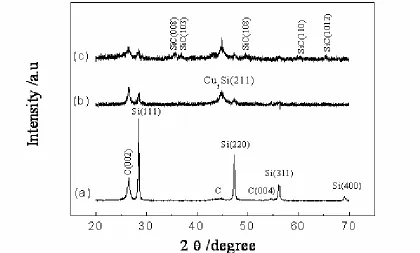
Figure 1 shows the X-ray diffraction (XRD) patterns of the Si/graphite, Si-Cu/graphite and carbon-coated Si-Cu/graphite composites, respectively. As shown in figure 1(a), the diffraction peaks at 2 = 28.40, 47.30, 56.10, 69.10 can be attributed to reflections of Si (JCPDS file 27-1402), 2 = 26.40 and 54.50 correspond to those of graphite (JCPDS file 41-1487), and the broad hump at 450 indicates that part of graphite is amorphized. After high energy mechanical milling for 7 hours, a mixture of Si and Cu5Si located at 2θ = 44.6 (JCPDS file 04-0841) is detected instead of a pure alloy, as shown in Fig.
1(b). New diffraction peaks appear at 2θ = 35.80, 36.90, 49.60, 60.30 and 65.40 after pyrolysis
[image:3.612.103.523.327.580.2]carbonization, which can be attributed to the reflection of SiC (JCPDS 73-2082).
Figure 1. The XRD patterns for (a) Si/graphite, (b) Cu/graphite and (c) carbon-coated Si-Cu/graphite composites.
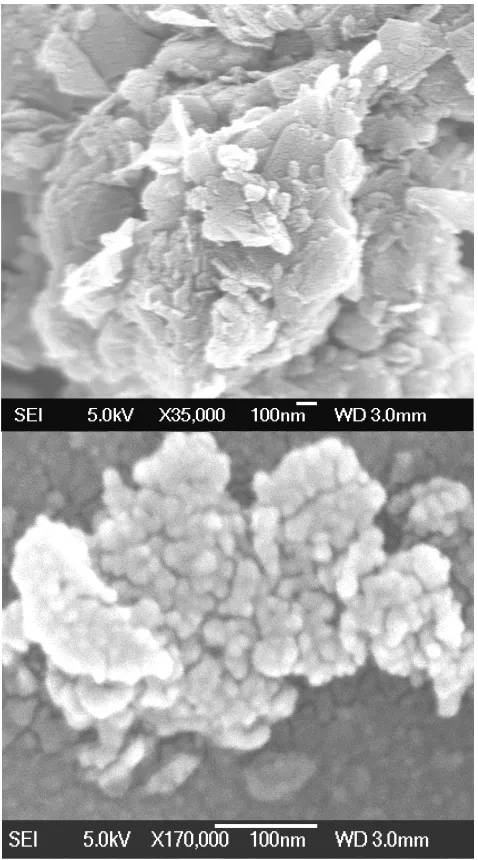
The SEM images of Si-Cu/graphite and carbon-coated Si-Cu/graphite composites are given in Figure 2 (a) and (b), respectively. The particles of Si-Cu/graphite composite tend to form large agglomerates, and fine silicon particles are probably pinned in inactive Cu5Si alloy via good ductibility
and affinity to Si of Cu5Si and the addition of graphite enhances the dispersion uniformity of particles.
more compact, leading to the formation of spherical particle with reduced specific surface area. By this way, Si particle expansion will be locked by elastic carbon and a good contact is ensured.
Figure.2. SEM images of (a) Si-Cu/graphiteand (b) carbon-coated Si-Cu/graphitecomposites.
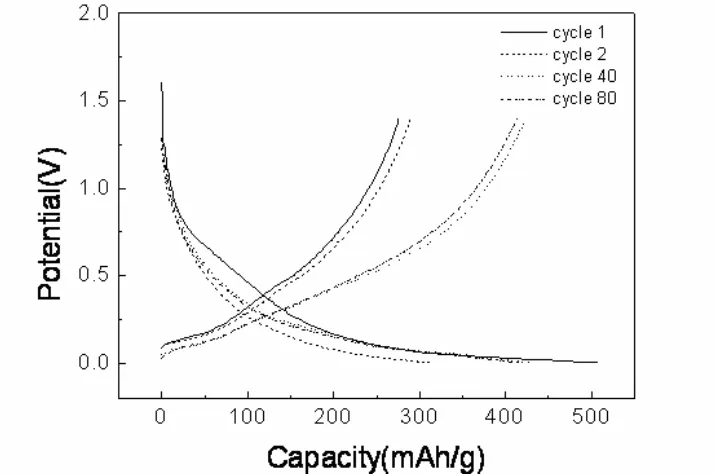
[image:4.612.196.435.147.577.2]LixSi. It can be noted that the subsequent insertion voltage trends present an obvious shift from the first
one and no obvious plateau is evolved, suggesting an irreversible transformation of silicon from a
[image:5.612.114.515.110.382.2]Figure 3. Electrochemical properties of Si-Cu/graphite compositeprepared by mechanical milling.
[image:5.612.128.486.428.665.2]crystal to amorphous phase. The lithium insertion capacity of the composite electrode is as high as 1021mAh/g with a relative low faradic yield of 51.3%. These irreversible capacities are mainly resulted from the large specific surface area by long-time ball-milling. Although mechanical milling/alloying has been shown to be a powerful technique to produce alloy powders with a homogeneous structure, the high initial irreversible capacity due to large surface area of electrode material is an inevitable limitation. As shown in the figure, the capacity in the tenth cycle is larger than that in first two cycles, which may be due the reason of active material is not completely utilized at the beginning. The discharge capacity decays quickly and remains to be 541 mAh/g at 30th cycle, suggesting Cu5Si alloy and graphite may be not enough effective to depress the large volume changes
[image:6.612.107.503.250.515.2]of active material.
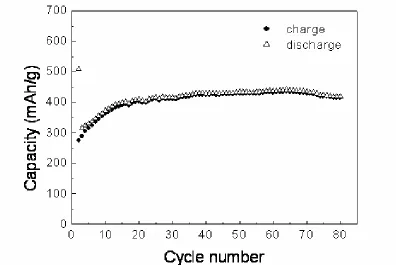
Figure 5. Capacity vs. cycle number performance for carbon-coated Si-Cu/graphite composite.
carbon-coating process reduce the surface area of particle therefore depress the irreversible side reaction. The ideal situation is that active Si particles are completely and compactly enclosed by the carbon matrix. The capacity of the composite increases continually before 40th cycle, suggesting some Si in the matrix of Si-Cu alloy and graphite is slowly utilized as the contact of active materials and electrolyte increased. Moreover, the composite shows a reversible capacity of over 410 mAh/g up to the 80th cycle, which indicates a good cyclability. As a dramatic volume variation of 300% accompanies to the lithium alloying process with Si to form Li4.4Si, it could pulverize the electrode,
inducing poor cyclability. The problem is improved by dispersing nanosized Si homogeneously in the matrix of Si-Cu alloy and graphite, especially, carbon-coating process using pyrolysis reaction of coal-tar pitch. Both of the factors achieve the reasonably improved interface affinity, buffer the significant volume expansion during discharge and charge and enhance connection for electronic and ionic conduction, thus improve the cyclability of composite electrode.
4. CONCLUSIONS
The Si-Cu/graphite composite was synthesized by mechanical milling of a mixture of silicon– copper alloy and graphite powders then a carbon-coating process was accomplished by adding coal-tar pitchto the composite and pyrolysis. The Si–Cu alloy particles comprised of an electrochemically active Si and inactive Cu5Si phases distributed uniformly in the matrix of graphite. The inactive phase
improves electronic conductivity and accommodates the large volume changes of Si during cycling. Graphite provides not only mechanical and conductivity support for the dispersed phase, but also possesses electrochemical reactivity towards lithium. By carbon-coating, particles were encapsulated by pyrolytic carbon, which enhance connection for electronic and ionic conduction and effectively suppressed the adverse volume effect of silicon upon cycling. As a result, the carbon-coated Si-Cu/graphite composite shows stable capacity retention during cycling. A further improvement is to increase the initial reversibility and restrain the formation of SiC.
ACKNOWLEDGEMENTS
This work is supported by the National Nature Science Foundation of China (project no. 20206016) and the Instrumental Analysis Center of Shanghai Jiao Tong University is acknowledged.
References
1. M. N. Obrovac, L. Christensen, Electrochem. Solid-State Lett. 7 (2004) A93. 2. T. D. Hatchard, J.R. Dahn, J. Electrochem. Soc. 151(2004) A306.
3. Y. Idota, T. Kubota, A. Matsufuji, Y. Maekawa, T. Miyasaka, Science 276 (1997) 1395. 4. M. Winter, J.O. Besenhard, Electrochim. Acta 45 (1999) 31.
5. J. Yang, Y. Takeda, N. Imanishi, O. Yamanoto, J. Electrochem. Soc. 146 (1999) 4009. 6. N. Dimov, S. Kugino, M. Yoshio,Electrochim. Acta 48 (2003) 1579.
8. Bong-Chull Kim, H. Uono, T. Sato, T. Fuse, T. Ishihara, M. Senna, Solid State Ionics 172(2004)33.
9. P. Patel, II-Seok Kim, P.N. Kumta, Materials Science and Engineering B 116 (2005) 347. 10. Y. Liu, K. Hanai, J. Yang, N. Imanishi, A. Hirano, Y. Takeda, Electrochem. Solid-State Lett. 7 (2004) A369.
11. Jae-Hun Kim, H. Kim, Hun-Joon Sohn, Electochem. Commun. 7 (2005) 557. 12. Y. Zhang, Z. W. Fu, Q. Z. Qin, Electochem. Commun. 6 (2004) 484.
13. Il-seok. Kim, G. E. Blomgren, P. N. Kumta, J. Power Sources 130 (2004) 275. 14. Il-seok. Kim, G. E. Blomgren, P. N. Kumta, J. Electrochem. Soc. 152 (2005) A248.
15. G. X. Wang, L. Sun, D. H. Bradhurst, S. Zhong, S. X. Dou, H. K. Liu, J. Power Sources 88 (2000) 278.
16. A. Netz, R.A. Huggins, W. Weppner, J. Power Sources 95 (2003) 119.
17. G. X. Wang, L. Sun, D. H. Bradhurst, S. Zhong, S. X. Dou, H. K. Liu. J. Alloys and Compounds 306 (2000) 249.
18. Y. N. NuLi, B. F. Wang, J. Yang, X. X. Yuan ,Z. F. Ma, J. Power Sources 153 (2006) 371. 19. W. J. Weydanz, M. Wohlfahrt-Mehrens, R.A. Huggins, J. Power Sources 81–82 (1999) 237. 20. J. Wolfenstine, J. Power Sources 124 (2003) 241.
21. G. A. Roberts, E.J. Cairns, J.A. Reimer, J. Power Sources 110 (2002) 424.
22. J. Yang, B. F. Wang, K. Wang, Y. Liu, J. Y. Xie, Z. S. Wen, Electrochem. Solid-State Lett. 6(2003) A154.
23. T. Hasegawa, S. R. Mukai, Y. Shirato, H. Tamon, Carbon 42 (2004) 2573.
© 2006 by ESG (www.electrochemsci.org)