Int. J. Electrochem. Sci., 3 (2008) 961 - 969
International Journal of
ELECTROCHEMICAL
SCIENCE
www.electrochemsci.org
Studies on PEM Fuel Cells Using Various Alcohols for Low
Power Applications
J. Arun kumar1, P. Kalyani 2,* and R. Saravanan1,
1
Institute of Energy Studies, Anna University, Chennai-600 025, India
2
Thiagarajar College of Engineering, Madurai 625 015, India
*
E-mail: [email protected]
Received: 10 April 2008 / Accepted: 28 May 2008 / Online Published: 30 June 2008
The Direct Alcohol Fuel Cell (DAFC) appears to be the most promising replacement for batteries in portable applications such as cellular phones, personal Digital Assistants (PDAs), digital cameras and laptop computers. The necessity, along with related consumer demand has been an impetus to incorporate direct alcohol fuel cells (DAFCs) to power these smart electronic devices. The present study deals with the investigation of various aliphatic alcohols such as ethanol, 1-propanol, 2-propanol and butanol with respect to methanol as fuels in polymer electrolyte membrane fuel cell (PEMFC). 2-Propanol emerges the prospective fuel candidate as the study shows.
Keywords: Methanol, 2-propanol, PEMFC, DAFC, D2PFC and DMFC
1. INTRODUCTION
issues of hydrogen. These limitations of hydrogen have necessitated researchers to try other fuels that are directly oxidizable. Direct oxidation fuel cells using liquid methanol as a fuel has already attracted intensive research worldwide [1-4]. Furthermore, the ever-increasing number of portable electronic devices which presently use batteries will inevitably lead to troubles in the recycling process and also batteries run out too fast and recharging seems to be inconvenient and time consuming from the user’s point of view. On contrary alcohol based fuel cell systems can be designed comparatively simple, also the operating times are extensive and the fuels can be easily produced, stored and transported without any risk of explosion. In recent years research activities in direct methanol fuel cell (DMFC) technology has increased remarkably because of potential advantages such as high-energy density, low operating temperature and the potential to eliminate moving parts. The most imminent commercial application of DMFC is as a power sources for portable electronic devices [5]. The challenges associated with the development of them includes poisoning of anode electro catalyst by CO or related species of methanol and crossover of methanol from the anode to cathode. The methanol, which enters the cathode directly through the membrane reacts with oxygen and reduces the efficiency of DMFC [6]. The above limitations of DMFC have prompted us to carryout studies using other alcohols such as ethanol, 1-propanol, 2-propanol and n-butanol and compare the performance with that of methanol. Only few studies have been reported so far on Direct Alcohol Fuel Cells, using fuels other than methanol.
2. EXPERIMENTAL PART
Single cells having an electroactive area of 25cm2 were invariably employed in our studies. Unsupported Pt-Ru (1:1 a/o) and unsupported Pt purchased from M/s. Arora Matthey Limited (India) were used as the anode and cathode electro catalysts, respectively. Catalyst loading of about 3 mg/cm2 was given to the cathode and the anode. By decal method Membrane and Electrode Assemblies were prepared by hot pressing the electrodes onto a Nafion-117 membrane at 1300C for 4 min.
Various alcohols were diluted to 1 M and fed by a peristaltic pump at the anode side of the cells at 25 ml/min rate and O2 (or air) at 1 LPM at the cathode side. Since our earlier studies with the similar
cell configuration, design and catalyst loading etc demonstrated better cell performance with DMFC (the results of which are communicated elsewhere), the same flow rate of about 25 ml/min for the alcohol fuel solutions and 1LPM for O2 (or air) was fixed in the present studies also. Experiments
were conducted at ambient temperature(280C) and 600C and at ambient pressure. Polarization profiles (current density vs. voltage) of the fuel cells fed with alcohol fuel solutions and O2 (or air) were
obtained by incorporating a current load using a DC electronic load bank.
3. RESULTS AND DISCUSSION
[image:3.612.152.466.121.360.2]
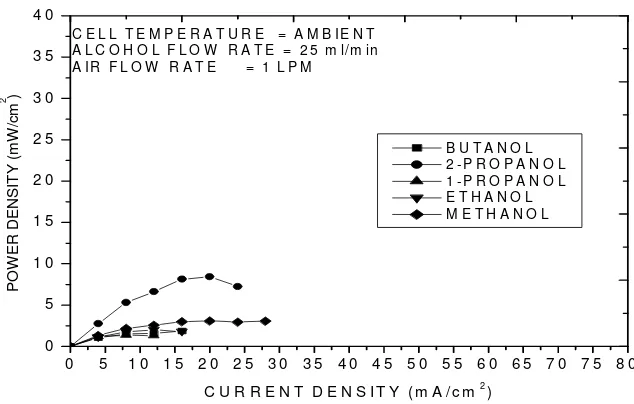
current density plots are also provided since it would give a comparative picture on the electrochemical activity of the alcohols taken for the study.
Figure 1. Polarization curves of alcohol fuel cells
0 5 1 0 1 5 2 0 2 5 3 0 3 5 4 0 4 5 5 0 5 5 6 0 6 5 7 0 7 5 8 0 0
5 1 0 1 5 2 0 2 5 3 0 3 5 4 0
C E L L T E M P E R A T U R E = A M B I E N T A L C O H O L F L O W R A T E = 2 5 m l/m in A I R F L O W R A T E = 1 L P M
P
O
W
E
R
D
E
N
S
IT
Y
(
m
W
/c
m
2 )
C U R R E N T D E N S I T Y ( m A / c m2)
B U T A N O L 2 - P R O P A N O L 1 - P R O P A N O L E T H A N O L M E T H A N O L
Figure 2. Power Density curve of alcohol fuel cells.
The OCP is 0.709 V and 0.588 V for 2-propanol and methanol respectively. The maximum power density achieved is 8.42 mW/cm2 and 3.08 mW/cm2 at a current density of 20 mA/cm2 for
2-0 5 10 15 20 25 30 35 40 45 50 55 60 65 70 75 80
0.0 0.1 0.2 0.3 0.4 0.5 0.6 0.7 0.8 0.9 1.0
C ELL TEM PER ATUR E = AM BIEN T ALC O HO L FLO W RATE = 25 m l/m in AIR FLOW R ATE = 1 LPM
C
E
L
L
V
O
L
T
A
G
E
(
V
)
C U R R EN T DE N S IT Y (m A /cm2)
[image:3.612.156.473.415.617.2]
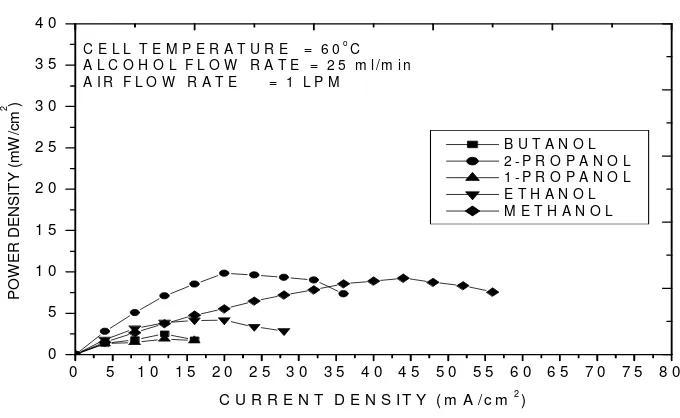
propanol and methanol respectively. The performance of the remaining alcohols is out of comparison due to poor kinetics of the anode reactions. From Fig.1, of all, the performance of 2-propanol is better as it has the highest cell voltage at the current of 20 mA/cm2. Performance of the fuel cells at 60oC is illustrated in Figs.3 & 4. From the plots we infer that the performance of all the alcohols has improved when compared with that observed at ambient temperature due to the enhanced catalytic activity and reduced polarization effects. The OCP is 0.757 V for 2-propanol and 0.611 V for methanol.
0 5 1 0 1 5 2 0 2 5 3 0 3 5 4 0 4 5 5 0 5 5 6 0 6 5 7 0 7 5 8 0 0 . 0
0 . 1 0 . 2 0 . 3 0 . 4 0 . 5 0 . 6 0 . 7 0 . 8 0 . 9 1 . 0
C E L L T E M P E R A T U R E = 6 0o
C A L C O H O L F L O W R A T E = 2 5 m l/ m in A I R F L O W R A T E = 1 L P M
C
E
L
L
V
O
L
T
A
G
E
(
V
)
C U R R E N T D E N S I T Y ( m A / c m2)
[image:4.612.140.473.179.378.2]B U T A N O L 2 - P R O P A N O L 1 - P R O P A N O L E T H A N O L M E T H A N O L
Figure 3. Polarization curve at 600C and air flow rate of 1 LPM.
0 5 1 0 1 5 2 0 2 5 3 0 3 5 4 0 4 5 5 0 5 5 6 0 6 5 7 0 7 5 8 0 0
5 1 0 1 5 2 0 2 5 3 0 3 5 4 0
C E L L T E M P E R A T U R E = 6 0oC A L C O H O L F L O W R A T E = 2 5 m l / m i n A I R F L O W R A T E = 1 L P M
P
O
W
E
R
D
E
N
S
IT
Y
(
m
W
/c
m
2 )
C U R R E N T D E N S I T Y ( m A / c m2)
[image:4.612.145.485.413.622.2]B U T A N O L 2 - P R O P A N O L 1 - P R O P A N O L E T H A N O L M E T H A N O L
Figure 4. Power Density curve at 600C and airflow rate of 1 LPM.
The experiment is then continued with oxygen as the oxidant.
0 5 1 0 1 5 2 0 2 5 3 0 3 5 4 0 4 5 5 0 5 5 6 0 6 5 7 0 7 5 8 0 0 . 0
0 . 1 0 . 2 0 . 3 0 . 4 0 . 5 0 . 6 0 . 7 0 . 8 0 . 9 1 . 0
C E L L T E M P E R A T U R E = A M B I E N T A L C O H O L F L O W R A T E = 2 5 m l / m i n O X Y G E N F L O W R A T E = 1 L P M
C
E
L
L
V
O
L
T
A
G
E
(
V
)
C U R R E N T D E N S I T Y ( m A / c m2)
[image:5.612.126.489.97.295.2]B U T A N O L 2 - P R O P A N O L 1 - P R O P A N O L E T H A N O L M E T H A N O L
Figure 5. Polarization curve at ambient temperature and Oxygen flow rate of 1 LPM
0 5 1 0 1 5 2 0 2 5 3 0 3 5 4 0 4 5 5 0 5 5 6 0 6 5 7 0 7 5 8 0
0 5 1 0 1 5 2 0 2 5 3 0 3 5 4 0
C E L L T E M P E R A T U R E = A M B I E N T A L C O H O L F L O W R A T E = 2 5 m l / m i n O X Y G E N F L O W R A T E = 1 L P M
P
O
W
E
R
D
E
N
S
IT
Y
(
m
W
/c
m
2 )
C U R R E N T D E N S I T Y ( m A / c m 2
)
B U T A N O L 2 - P R O P A N O L 1 - P R O P A N O L E T H A N O L M E T H A N O L
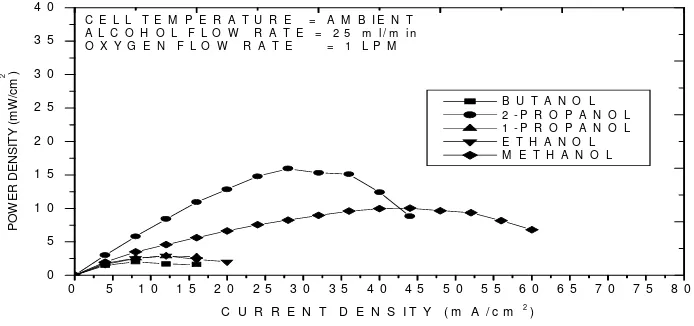
Figure 6. Power Density curve at ambient temperature and Oxygen flow rate of 1 LPM.
It is understood from the polarization curve (Fig. 5) that the performance of all the alcohols improve when using oxygen as the oxidant. Typically, the OCP is 0.798 V and 0.608 V for 2-propanol and methanol respectively. The maximum power density obtained by the cell is 15.932 mW/cm2 at a current density of 28 mA/cm2 for 2-propanol and 10.032 mW/cm2 at a current density of 44 mA/cm2 for methanol. The performance of butanol, 1-propanol and ethanol has improved considerably by using oxygen as oxidant but still relatively less compared to 2-propanol and methanol as shown in Fig. 6.
[image:5.612.134.481.350.513.2]
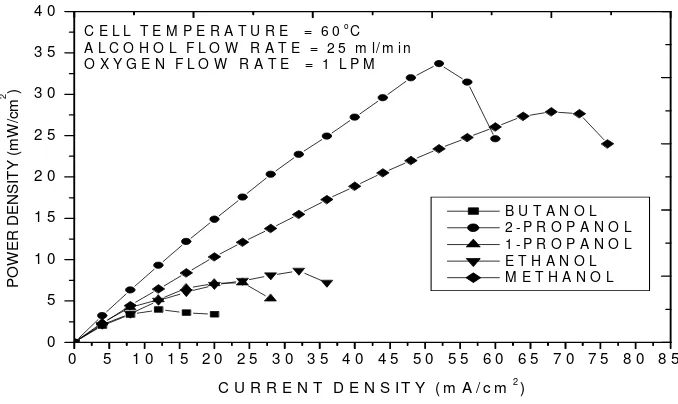
reduction of Ohmic and activation polarization [7]. The experiments best data show a performance of 0.648V at a current density of 52 mA/cm2, which corresponds to a power density of about 34 mW/cm2 for 2-propanol as fuel and 0.41V at a current density of 68 mA/cm2, which corresponds to a power density of about 28 mW/cm2 for methanol as fuel. The cathode appears less susceptible to poisoning by CO from 2-propanol at higher oxygen pressures [8].
0 5 1 0 1 5 2 0 2 5 3 0 3 5 4 0 4 5 5 0 5 5 6 0 6 5 7 0 7 5 8 0 8 5 0 . 0
0 . 1 0 . 2 0 . 3 0 . 4 0 . 5 0 . 6 0 . 7 0 . 8 0 . 9 1 . 0
C E L L T E M P E R A T U R E = 6 0oC A L C O H O L F L O W R A T E = 2 5 m l/ m in O X Y G E N F L O W R A T E = 1 L P M
C
E
L
L
V
O
L
T
A
G
E
(
V
)
C U R R E N T D E N S I T Y ( m A / c m2)
[image:6.612.140.472.191.393.2]B U T A N O L 2 - P R O P A N O L 1 - P R O P A N O L E T H A N O L M E T H A N O L
Figure 7. Polarization curve at T=600 C and Oxygen flow rate = 1 LPM
0 5 1 0 1 5 2 0 2 5 3 0 3 5 4 0 4 5 5 0 5 5 6 0 6 5 7 0 7 5 8 0 8 5 0
5 1 0 1 5 2 0 2 5 3 0 3 5 4 0
C E L L T E M P E R A T U R E = 6 0o
C A L C O H O L F L O W R A T E = 2 5 m l / m i n O X Y G E N F L O W R A T E = 1 L P M
P
O
W
E
R
D
E
N
S
IT
Y
(
m
W
/c
m
2 )
C U R R E N T D E N S I T Y ( m A / c m2
)
B U T A N O L 2 - P R O P A N O L 1 - P R O P A N O L E T H A N O L M E T H A N O L
[image:6.612.137.476.474.676.2]
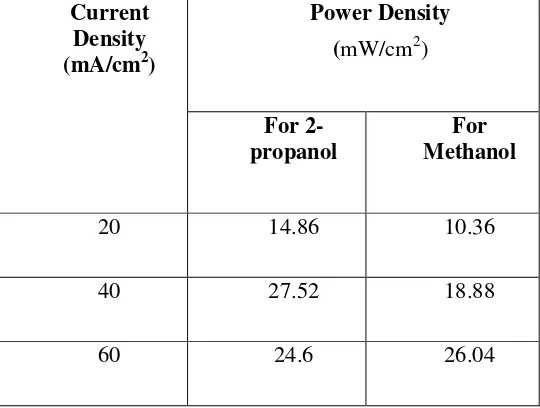
From all the above performance curves it is well understood that the performance of 2-propanol is better for lower values of current density and it is also inferred that though the cell voltage of methanol is less compared to 2-propanol its value is more stable at higher current densities. The empirical equation that governs the oxidation reactions of alcohols is given by.
CnH2n+1OH + (2n-1) H2O nCO2 + 6nH+ +6ne- (1)
Equations (2) and (3) are the oxidation reactions of 2-propanol and methanol which are in-line with equation (1)
CH3CHOHCH3 +5H2O 3CO2 + 18H+ +18e- (2)
CH3OH + H2O CO2 + 6H+ +6e- (3)
For each methanol molecule, 6 electrons are produced, while for each 2-propanol molecule, 18 electrons are produced. In other words, for a complete oxidation of each 2-propanol molecule, three times as large a current should be observed compared to a complete oxidation of each methanol molecule. Therefore, the amount of 2-propanol crossing through the membrane is less than 1/7 of that of methanol based on the cross over currents [9]. This reduced 2-propanol crossover should greatly increase fuel cell efficiency.
0 5 1 0 1 5 2 0 2 5 3 0 3 5 4 0 0 .0
0 .1 0 .2 0 .3 0 .4 0 .5 0 .6 0 .7 0 .8 0 .9 1 .0
C
E
L
L
V
O
L
T
A
G
E
(
V
)
T IM E (M IN U T E S )
2 0 m A /c m2 4 0 m A /c m2 6 0 m A /c m2 C E L L T E M P E R A T U R E = 6 00C
2 - P R O P A N O L F L O W R A T E = 2 5 m l/m in O X Y G E N F L O W R A T E = 1 L P M
Figure 9. Performance of 2-propanol with time at current densities of 20, 40 and 60mA/cm2 for T=600C and Oxygen flow rate = 1 LPM
Table 1. Comparison of power density at 20, 40 and 60mA/cm2 for 2-propanol and methanol at T=600C and Oxygen flow rate = 1 LPM.
Power Density
(mW/cm2)
Current Density (mA/cm2)
For 2-propanol
For Methanol
20 14.86 10.36
40 27.52 18.88
60 24.6 26.04
[image:8.612.148.467.83.282.2] [image:8.612.172.442.404.608.2]
The major challenges of this approach are anode poisoning by deep oxidation and by acetone buildup, and 2-propanol crossover. The development of anode catalysts and anode structures that are immune to these deficiencies is the more consequential of these challenges. These issues presented in this article are under further investigation. As a result of these strengths and problems, D2PFCs (Direct 2-propanol Fuel Cells) are limited in the power they can produce, but can still store a lot of energy in a small space. Moreover, the toxicity level of 2-propanol is far less compared to its counterpart methanol and any leakage of the fuel can be easily identified by its characteristic smell.
4. CONCLUSIONS
The performance of various alcohols as fuel solutions is studied in polymer electrolyte membrane fuel cell and the results strongly imply that 2-propanol is a much better candidate than butanol, 1-propanol, ethanol and even methanol at lower current densities. It is also inferred that the performance of DMFC is better when compared to other alcohols including 2-propanol even at higher current densities. The paper also suggests that direct alcohol fuel cells utilizing 2-propanol and other alcohols as a fuel will be a versatile power source to energize mobile and other portable electronic kits in near future with a considerable improvement in the economic viability of the catalysts, membrane and graphite plates.
ACKNOWLEDGEMENTS
The authors thank the staff members of Centre for Energy Research, SPIC Science Foundation (Tuticorin, India) for permission and for providing all necessary facilities for carrying out the research work.
References
1. S.Wasmus, A.Kuver, J. Electroanal. Chemistry, 461 (1999) 14.
2. B.D. McNicol, D.A.J. Rand, K.R. Williams, J. Power Sources, 83 (1999) 15. 3. M. Baldauf, W. Preidel, J. Power Sources , , 84 (1999) 161.
4. C.Lamy, A.Lima, V.LeRhu, F.Delime, C.Countanceau, J.M Leger, J. Power Sources, 105 (2002) 283.
5. J. Larminie, A. Dicks, Fuel Cell Systems Explained, Wiley, New York 2000.
6. K. Kordesch, G. Simader, Fuel Cells and their Applications, VCH, Weinheim, New York, 1996 7. Guo-Bin Jung, Ay Su, Cheng-Hsin Tu, Fang-Bor Weng, J. Fuel Cell Sci and Technol., 2 (2005) 81 8. Dianxue Cao, Steven H. Bergens, J. Power Sources, 124 (2003) 12.
9. Zhigang Qi ,Arthur Kaufman, J. Power Sources, , 112 (2002) 121.