This is a repository copy of
Service-Oriented Reference Architecture for Smart Cities
.
White Rose Research Online URL for this paper:
http://eprints.whiterose.ac.uk/113342/
Version: Accepted Version
Proceedings Paper:
Clement, SJ orcid.org/0000-0003-2918-5881, Mckee, DW orcid.org/0000-0002-9047-7990
and Xu, J orcid.org/0000-0002-4598-167X (2017) Service-Oriented Reference Architecture
for Smart Cities. In: 2017 IEEE Symposium on Service-Oriented System Engineering
(SOSE 2017). SOSE 2017, 06-09 Apr 2017, South San Francisco, California, USA. IEEE ,
pp. 81-85. ISBN 978-1-5090-6320-8
https://doi.org/10.1109/SOSE.2017.29
© 2017 IEEE. Personal use of this material is permitted. Permission from IEEE must be
obtained for all other uses, in any current or future media, including reprinting/republishing
this material for advertising or promotional purposes, creating new collective works, for
resale or redistribution to servers or lists, or reuse of any copyrighted component of this
work in other works.
[email protected] https://eprints.whiterose.ac.uk/
Reuse
Unless indicated otherwise, fulltext items are protected by copyright with all rights reserved. The copyright exception in section 29 of the Copyright, Designs and Patents Act 1988 allows the making of a single copy solely for the purpose of non-commercial research or private study within the limits of fair dealing. The publisher or other rights-holder may allow further reproduction and re-use of this version - refer to the White Rose Research Online record for this item. Where records identify the publisher as the copyright holder, users can verify any specific terms of use on the publisher’s website.
Takedown
If you consider content in White Rose Research Online to be in breach of UK law, please notify us by
Service-Oriented Reference Architecture for Smart
Cities
S. J. Clement, D. W. McKee, Jie Xu
School of Computing University of Leeds Leeds, UK
{s.j.clement, d.w.mckee, J.Xu}@leeds.ac.uk
Abstract—The trend towards turning existing cities into smart cities is growing. Facilitated by advances in computing such as Cloud services and Internet of Things (IoT), smart cities propose to bring integrated, autonomous systems together to improve quality of life for their inhabitants. Systems such as autonomous vehicles, smart grids and intelligent traffic management are in the initial stages of development. However, as of yet there, is no holistic architecture on which to integrate these systems into a smart city. Additionally, the existing systems and infrastructure of cities is extensive and critical to their operation. We cannot simply replace these systems with smarter versions, instead the system intelligence must augment the existing systems. In this paper we propose a service oriented reference architecture for smart cities which can tackle these problems and identify some related open research questions. The abstract architecture encapsulates the way in which different aspects of the service oriented approach span through the layers of existing city infrastructure. Additionally, the extensible provision of services by individual systems allows for the organic growth of the smart city as required.
Index Terms—Cloud, SOA, Services, Smart-City, Architecture, Autonomous-Systems
I. INTRODUCTION
Smart cities is the new goal for integrated System of Systems (SoS) facilitated by developments in technologies spanning domains of autonomous vehicles, Internet of Things (IoT), smart manufacturing, healthcare, defence and aerospace, as well as the financial industry. There also remains an ongoing concerted effort to develop techniques to handle the explosion of Big Data streams [2], [3] that must be processed in a timely manner [4]. However, there remains no formal definition for how Smart Cities are going to evolve from current existing infrastructure, both physical and digital. This paper presents the current trends in smart cities research and highlights some of the key challenges that remain. We also present a reference architecture for developing smart cities.
The computational infrastructure for a smart city will be based on a combination of distributed computing paradigms, enabling the use of: low power IoT devices [5], Cloud comput-ing virtualisation [6], [7], and the use of localised processcomput-ing with Edge computing [8]. This will combine the IoT’s objec-tive of integrating components and devices as services [9] with the computational power of Cloud and HPC. Smart cities by their very nature must also consist of smart networks that are dependable and fault tolerant. This requires continued work in software defined networks (SDNs), specifically in tandem
with scheduling and managing Micro-Service (µS) execution across computational infrastructure.
Furthermore IoT for smart cities requires context-aware computation allowing intelligence to be incorporated and augment the System of Systems (SoS) with amodel of reality [1], [5]. This automated integration will require a sharedmodel of realitythat aggregates the different perspectives on reality as seen by the different domains and systems. This model of reality can then be used with the Internet of Simulation (IoS) to facilitate decision support where traditional machine learning methods are inadequate [10]. Furthermore the existing standards for service-orientation and system integration are not sufficient, as they do not capture the additional detail that would be required, and not uniform, meaning that they are not currently integrable [11]. The successful integration of all these systems and devices will allow IoT to grow to become the Internet of Anything IoA and Everything (IoE) [12].
In parallel to the evolution of smart cities is the industrial revolution of Industry 4.0 which is integrating and automating the manufacturing value chain [13], [14]. This is driven by the adoption of IoT devices in the manufacturing process, known as Industrial IoT [15], as well as data collection from au-tonomous systems both within factories and the marketplace. This therefore facilitates the creation ofsmart factorieswhich are able to adapt to changing market demands [16] and have a level of self-awareness allowing a level of self-optimisation of daily operations [17].
Another emerging area of research is that of cooperative robotics which have been enhanced with the computational power of Cloud computing [18]. This domain spans both smart cities as well as smart manufacturing whereby the Cloud is used to facilitate robot interaction [18]–[20] and provide services to those robots [21]–[23], at the same time as allowing the robots to provide services including assembly-line operations and maintenance within a city [24].
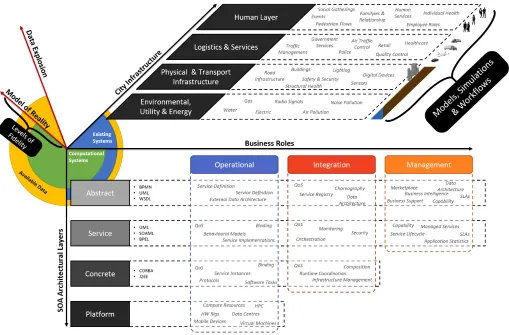
Fig. 1. A reference architecture for smart cities incorporating the viewpoints of the traditional city infrastructure, services and business roles. [1]
directions that require significant attention in order for smart cities to become a reality.
II. RE-FACTORINGCITYARCHITECTURE
The structure of cities can be defined in terms of urban artefacts, their geographical location and area, as well as their ownership [25]. As shown in figure 1, the city and its infra-structure already exist as complex governmental, economic and social systems that has continually evolved over time. These span domains including utilities, communications, gov-ernment, transport, emergency services and retail. Often these systems are operate independently or at best in a producer-consumer model; very little information is shared between them and there is almost no cooperation. For cities to continue to develop towards the smart city vision, these systems will require more automation and intelligence and more interaction. Some of these systems are cyber-physical and already facilitate some level of integration with IoT. However, the majority of the city systems are purely physical or in the case of the city population are human elements. The challenge of creating a smart city involves re-factoring the city in a non-intrusive fashion, not just existing software services [26]. As city systems become smarter and as they are integrated there will also be emergent behaviours and properties to be managed. The concept of T-changes will provide a strong basis
for ensuring that all systems evolve in a manner that ensures compatibility and from the populations perspective should be seamless, for example allowing for new IoT-enabled systems and methods to replace legacy systems as a vertical change [27].
Finally as shown in Figure 1 both SOAs and cities in general have a layered nature. By building on the core strengths of service-orientation, particularly loose-coupling, it is pos-sible to iteratively service-orient a city enhancing individual elements with digital functionality and exposing them as services within the relevant domain, such as the electrical grid. Subsequently systems that already utilise those facilities will be able to be augmented with additional intelligence now available to them and then themselves be exposed as services. In the next section a architecture for smart cities is proposed.
III. SMART-CITIESARCHITECTURE
with computing and communication infrastructure as well as social capital. Batty et al. [30] provide a more sociological viewpoint on the smart city, emphasising its human aspects and the ability for its systems to improve the quality of life of its residents. Another definition of the smart cities identifies six characteristics in order to rank a city’ssmartness. These are: economy, mobility, environment, people, living and governance [31]. Others rely on a more concrete definition, referencing the automation of city infrastructure through large-scale computing.
Computing is entering the era of massive-scale distributed systems enabling automated cyber-physical systems such as those expected in smart cities. A primary component of these systems is the IoT [9] which makes available a network for sensing and measuring city infrastructure using low-cost devices. This allows for extensive data collection resulting in large, comprehensive datasets [32], [33]. A combination of Cloud [34], Edge [35] and Fog [36] computing as well as high performance computing (HPC) [37] provides the infrastructure to process the data generated by the devices [38] and uses data this to provide intelligence to systems [39]. This is facilitated by a growth in the network infrastructure, especially in wireless technologies such as 5G and LTE [40].
Given this growth in computing infrastructure the potential systems aggregated within a city are numerous. Zanella et al. [41] identify a number of domains in which IoT andsmart systems can provide beneficial services for the city. These include: the structural health of buildings; waste, air quality and noise management; traffic reduction; energy consumption monitoring; parking; lighting; and building automation. Intel-ligent systems are also being considered for the underlying infrastructure of the city, for example, moving energy gener-ation, storage and distribution towards a managed, intelligent, distributed power grid [42], [43].
Mobile robotic platforms are also of interest in the smart city, the most prominent being driverless vehicles [44], [45], as well as the emerging domain of autonomous passenger-carrying aerial vehicles [46]. Though often independent sys-tems, the possibility of interconnecting vehicles together into an Internet of Vehicles or a Vehicular Cloud [47] could allow for the sharing of sensor data and even allow the city systems to perform holistic traffic management. Repair, maintenance and inspection could also be performed using robotic platforms [48], [49].
Figure 1 captures many of the dimensions of the smart city [1] and forms the basis of our reference architecture. The traditional city architecture layers of environment, infra-structure, logistics and human elements are not expected to change within the smart city. Instead these systems already in place are augmented by a computing infrastructure based around SOA principals. In the smart city these computing elements and business roles are expected to traverse across several levels of city architecture from the utilities through to the service provisions.
[image:4.612.317.564.51.242.2]Just as current cities are an evolution of independent but in-teracting systems, the smart city must evolve from a traditional
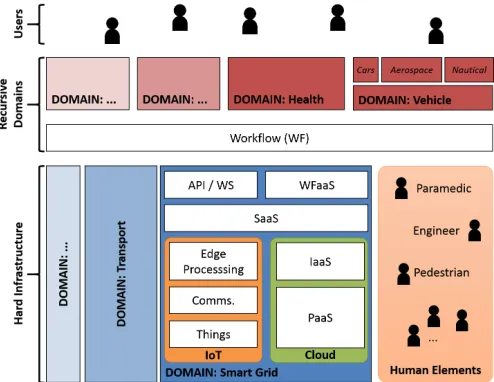
Fig. 2. Smart IoT-based systems providing infrastructure in specific domains interface with cloud computing and provide services for use by the city.
city. The intelligence and automation expected must grow with the city and build on other systems. For this reason, we expect the computational systems in the city to each provide a set of services that may be utilised by other systems. The model of reality included in figure 1 is expected to be a basis of the intelligence of the city, utilising simulation so that system can predict future outcomes and react accordingly. As this simulation data is added to the data being generated by IoT systems, we expect a data explosion, where it will be vital to process data selectively in order to deal with the expected data flow [1].
A. Smart City Services
the reuse of existing functionality for new purposes; reducing the cost of development.
With each connected system in the city providing ser-vices and micro-serser-vices in the SOA sense [51], increasingly complex systems can be created which utilise the existing infrastructure. Business models around the use of services, provided both by private and public enterprise could result in a service economy being the cornerstone further city devel-opments [52]. Workflows can be used to compose multiple services, possibly provided by different systems, together into a single process which can be executed [53]. These workflows could result in complex behaviour such as reacting to triggers or controlling data flows [54], [55] and allow the system to scale as demand increases. One such example of a workflow might be a collection of simulations that model the behaviour of some system and provide decision support or what-if analysis [10].
Figure 2 shows a detailed view of the layers of the reference architecture demonstrating this. Here independent systems in separate domains can build upon each other by utilising services provided. As an example here, a smart grid is utilising IoT devices and Software as a Service (SaaS) on a cloud platform with Infrastructure as a Service (IaaS) and Platform as a Service (PaaS). The thingsgenerate data that is processed at the edge of the cloud before being handled by the SaaS. Utilising the services provided, workflows can be constructed for use internally or presented as another service (i.e. Workflow as a Service (WFaaS)). These services and an API can be exposed to the wider city systems where they can be combined into workflows used by other hard infrastructure systems such as transport or smaller application domains. As these services are utilised in more safety critical systems both service and workflow level Quality of Service (QoS) will become vital [56], [57].
IV. CONCLUSION ANDFURTHERWORK
The interest in smart cities is growing and the need for ever more complex and intelligent systems is fuelling this growth. The next generation of IoT or connected systems being proposed are, at the moment, independent. These systems take time to build and therefore cannot instantly replace the existing infrastructure. They also require many similar functions. In this paper we proposed a reference architecture for the smart city based around SOA concepts; integrating IoT, Cloud and Edge technologies with existing city infrastructure. We proposed a service-oriented approach tp the development of new systems which can augment the existing systems in the city at all levels (figure 1). A detailed view of one such example was provided using an abstract smart-grid as a case study.
The benefits of the service-oriented approach are the ability for services to be continually evolved and added organically to the smart city. These services do not necessarily need to be only based on infrastructure and could be provided by for-profit autonomous systems as another revenue stream. For example, autonomous vehicles could provide local mapping data as a service to be utilised by other robotics platforms.
There could also be multiple suppliers of robotic maintenance platforms being provided as services which may in turn utilise Cloud services for planning and coordination.
Though the presented reference architecture should allow systems to scale to the sizes required by a city, there are still many open research problems if the service-oriented approach is adopted. As systems move towards automation, there is a point at which the human components of the system must interact with machines. Therefore, there is need to understand human to machine service attributes such as service definitions and QoS. Additionally, redundancy and security of these systems will be vital to the stable operation of the smart city. If there is an interdependency between multiple systems then without some form of redundancy, whether explicit of automated, the whole city may become vulnerable to a disruption of a single system. Additionally, the network and computing infrastructure of the city becomes an even more vital component. Given the number of devices and services operating in a full implementation of a smart city there must be an ubiquitous, high-speed, wireless network supporting a large computing infrastructure. Both the network and computing infrastructure needs to be able to transmit and process the massive amount of data being generated by the city [1]. There is potential for information of interest to be lost in the noise of many data streams due to the curse of dimensionality. Therefore intelligent, automated data analytic methods are required in addition to the physical platforms.
REFERENCES
[1] D. Mckee, S. Clement, and J. Xu, “Massive scale automation in cyber-physical systems: Vision & challenges,” in 13th International Symposium on Autonomous Decentralized Systems (ISADS). IEEE, 2017.
[2] P. Zikopoulos, C. Eatonet al.,Understanding big data: Analytics for enterprise class hadoop and streaming data. McGraw-Hill Osborne Media, 2011.
[3] X. Wu, X. Zhuet al., “Data mining with big data,”ieee transactions on knowledge and data engineering, vol. 26, no. 1, pp. 97–107, 2014. [4] P. Garraghan, S. Perkset al., “Tolerating Transient Late-Timing Faults
in Cloud-Based Real-Time Stream Processing,” in2016 IEEE 19th Int. Symp. Real-Time Distrib. Comput. IEEE, may 2016, pp. 108–115. [5] R. Buyya and A. V. Dastjerdi, Internet of Things: Principles and
Paradigms. Elsevier Science & Technology, 2016.
[6] P. Mell and T. Grance, “The NIST definition of cloud computing,” 2011. [7] L. F. Bittencourt, O. Rana, and I. Petri, “Cloud computing at the edges,”
inCloud Computing and Services Science. Springer, 2016.
[8] W. Shi, J. Caoet al., “Edge computing: Vision and challenges,”IEEE Internet of Things Journal, vol. 3, no. 5, pp. 637–646, Oct. 2016. [9] J. Gubbi, R. Buyyaet al., “Internet of things (iot): A vision, architectural
elements, and future directions,”Future Generation Computer Systems, vol. 29, no. 7, pp. 1645 – 1660, 2013.
[10] D. Mckee, S. Clement et al., “The internet of simulation, a special-isation of the internet of things with simulation and workflow as a service (sim/wfaas),” in11th IEEE International Symposium on Service-Oriented System Engineering (SOSE 2017). IEEE, 2017.
[11] D. McKee, D. Websteret al., “Towards a Virtual Integration Design and Analysis Enviroment for Automotive Engineering,” in2014 IEEE 17th Int. Symp. Object/Component/Service-Oriented Real-Time Distrib. Comput. IEEE, jun 2014, pp. 413–419.
[12] I. Bojanova, G. Hurlburt, and J. Voas, “Imagineering an internet of anything,”Computer, vol. 47, no. 6, pp. 72–77, jun 2014.
[14] H. Kagermann, W. Wahlster, and J. Helbig, “Recommendations for implementing the strategic initiative industrie 4.0: Final report of the industrie 4.0 working group,” Frankfurt, Tech. Rep., 2013.
[15] L. D. Xu, W. He, and S. Li, “Internet of things in industries: A survey,”
IEEE Transactions on Industrial Informatics, vol. 10, no. 4, pp. 2233– 2243, nov 2014.
[16] M. Hermann, T. Pentek, and B. Otto, “Design principles for industrie 4.0 Scenarios,” in2016 49th Hawaii International Conference on System Sciences (HICSS). IEEE, 2016.
[17] J. Lee, B. Bagheri, and H.-A. Kao, “A cyber-physical systems archi-tecture for industry 4.0-based manufacturing systems,”Manufacturing Letters, vol. 3, pp. 18–23, 2015.
[18] R. Doriya, S. Mishra, and S. Gupta, “A brief survey and analysis of multi-robot communication and coordination,” inProc. Communication Automation Int. Conf. Computing, May 2015, pp. 1014–1021. [19] A. Chibani, Y. Amiratet al., “Ubiquitous robotics: Recent challenges
and future trends,”Robotics and Autonomous Systems, vol. 61, no. 11, pp. 1162–1172, nov 2013.
[20] B. Kehoe, S. Patilet al., “A survey of research on cloud robotics and automation,”IEEE Trans. Autom. Sci. Eng., vol. 12, no. 2, pp. 398–409, Apr. 2015.
[21] M. Waibel, M. Beetzet al., “RoboEarth,”IEEE Robotics & Automation Magazine, vol. 18, no. 2, pp. 69–82, jun 2011.
[22] R. Arumugam, V. R. Entiet al., “Davinci: A cloud computing framework for service robots,” in2010 IEEE International Conference on Robotics and Automation, May 2010, pp. 3084–3089.
[23] L. Riazuelo, J. Civera, and J. Montiel, “C2tam: A cloud framework for cooperative tracking and mapping,”Robotics and Autonomous Systems, vol. 62, no. 4, pp. 401–413, apr 2014.
[24] A. Vick, V. Vonseket al., “Robot control as a service — towards cloud-based motion planning and control for industrial robots,” in2015 10th International Workshop on Robot Motion and Control (RoMoCo), Jul. 2015, pp. 33–39.
[25] A. Rossi, P. Eisenmanet al.,The architecture of the city. MIT press Cambridge, MA, 1982.
[26] D. Webster, P. Townend, and J. Xu, “Restructuring web service interfaces to support evolution,” inService Oriented System Engineering (SOSE), 2014 IEEE 8th International Symposium on. IEEE Computer Society, 2014, pp. 158 – 159.
[27] V. Andrikopoulos, S. Benbernou, and M. P. Papazoglou, “On the Evolution of Services,” IEEE Transactions on Software Engineering, vol. 38, no. 3, pp. 609–628, may 2012.
[28] P. Neirotti, A. D. Marcoet al., “Current trends in smart city initiatives: Some stylised facts,”Cities, vol. 38, pp. 25–36, jun 2014.
[29] A. Caragliu, C. D. Bo, and P. Nijkamp, “Smart cities in europe,”Journal of Urban Technology, vol. 18, no. 2, pp. 65–82, apr 2011.
[30] M. Batty, K. W. Axhausen et al., “Smart cities of the future,” The European Physical Journal Special Topics, vol. 214, no. 1, pp. 481– 518, 2012.
[31] R. Giffinger and H. Gudrun, “Smart cities ranking: an effective instru-ment for the positioning of the cities?”ACE: Architecture, City and Environment, vol. 4, no. 12, pp. 7–26, 2010.
[32] A. Bazzani, B. Giorgini et al., “Now casting of traffic state by gps data. the metropolitan area of rome,” in2011 Proceedings of the 34th International Convention MIPRO, May 2011, pp. 1615–1618. [33] M. Cordts, M. Omranet al., “The cityscapes dataset for semantic urban
scene understanding,” inThe IEEE Conference on Computer Vision and Pattern Recognition (CVPR), June 2016.
[34] M. Armbrust, A. Foxet al., “A view of cloud computing,” Communi-cations of the ACM, vol. 53, no. 4, pp. 50–58, 2010.
[35] P. Garcia Lopez, A. Montresoret al., “Edge-centric computing: Vision and challenges,”ACM SIGCOMM Computer Communication Review, vol. 45, no. 5, pp. 37–42, 2015.
[36] F. Bonomi, R. Militoet al., “Fog computing and its role in the internet of things,” inProceedings of the first edition of the MCC workshop on Mobile cloud computing. ACM, 2012, pp. 13–16.
[37] M. AbdelBaky, M. Parasharet al., “Enabling high-performance com-puting as a service,”Computer, vol. 45, no. 10, pp. 72–80, oct 2012. [38] J. Manyika, M. Chuiet al., “Big data: The next frontier for innovation,
competition, and productivity,” McKinsey Global Institute, May 2011. [39] Y. LeCun, Y. Bengio, and G. Hinton, “Deep learning,”Nature, vol. 521,
no. 7553, pp. 436–444, 2015.
[40] S. Chen and J. Zhao, “The requirements, challenges, and technologies for 5g of terrestrial mobile telecommunication,”IEEE Communications Magazine, vol. 52, no. 5, pp. 36–43, may 2014.
[41] A. Zanella, N. Buiet al., “Internet of things for smart cities,” IEEE Internet of Things Journal, vol. 1, no. 1, pp. 22–32, 2014.
[42] V. C. Gungor, D. Sahin et al., “A survey on smart grid potential applications and communication requirements,”IEEE Transactions on Industrial Informatics, vol. 9, no. 1, pp. 28–42, 2013.
[43] M. Brenna, M. Falvoet al., “Challenges in energy systems for the smart-cities of the future,” in 2012 IEEE International Energy Conference and Exhibition (ENERGYCON). Institute of Electrical and Electronics Engineers (IEEE), sep 2012.
[44] T. Luettel, M. Himmelsbach, and H.-J. Wuensche, “Autonomous ground vehicles: Concepts and a path to the future,”Proceedings of the IEEE, vol. 100, no. Special Centennial Issue, pp. 1831–1839, may 2012. [45] Z. Xiong, H. Shenget al., “Intelligent transportation systems for smart
cities: a progress review,”Science China Information Sciences, vol. 55, no. 12, pp. 2908–2914, nov 2012.
[46] M. Francisco, “Organ delivery by 1,000 drones,” Nat. Biotechnol., vol. 34, no. 7, pp. 684–684, jul 2016.
[47] M. Gerla, E.-K. Leeet al., “Internet of vehicles: From intelligent grid to autonomous cars and vehicular clouds,” in2014 IEEE World Forum on Internet of Things (WF-IoT). IEEE, 2014.
[48] H. Peel, G. Morganet al., “Inspection robot with low cost perception sensing,” in33rd International Symposium on Automation and Robotics in Construction (ISARC 2016). IAARC, August 2016.
[49] I. Gatsoulis, M. Mehmood et al., “Learning the repair urgency for a decision support system for tunnel maintenance,” inECAI 2016: 22nd European Conference on Artificial Intelligence, ser. Frontiers in Artificial Intelligence and Applications, G. Kaminka, M. Foxet al., Eds., no. 285. Amsterdam, Netherlands: IOS Press, August 2016, pp. 1769–1774. [50] A. Gaur, B. Scotneyet al., “Smart city architecture and its applications
based on IoT,” Procedia Computer Science, vol. 52, pp. 1089–1094, 2015.
[51] M. P. Papazoglou, “Service-oriented computing: Concepts, character-istics and directions,” inWeb Information Systems Engineering, 2003. WISE 2003. Proceedings of the Fourth International Conference on. IEEE, 2003, pp. 3–12.
[52] J. S. Metcalfe and I. Miles,Innovation systems in the service economy: measurement and case study analysis. Springer Science & Business Media, 2012, vol. 18.
[53] D. Hollingsworth and U. Hampshire, “Workflow management coalition: The workflow reference model,”Document Number TC00-1003, vol. 19, 1995.
[54] N. Russell, A. H. M. ter Hofstede et al., Workflow Data Patterns: Identification, Representation and Tool Support. Springer Berlin Heidelberg, 2005, pp. 353–368.
[55] N. Russell, A. H. Ter Hofstede, and N. Mulyar, “Workflow controlflow patterns: A revised view,” 2006.
[56] M. Jaeger, G. Rojec-Goldmann, and G. Muhl, “QoS aggregation for web service composition using workflow patterns,” inProceedings. Eighth IEEE Int. Enterp. Distrib. Object Comput. Conf. 2004. EDOC 2004.
IEEE, pp. 149–159.
[57] J. Cardoso, A. Sheth, and J. Miller, “Workflow Quality of Service,” in