Message-based MVC Architecture for
Distributed and Desktop Applications
By Xiaohong Qiu
B.S. Beihang University, 1991 M.S. Syracuse University, 2000
DISSERTATION
Submitted in partial fulfillment of the requirements for the
degree of Doctoral of Philosophy in Computer Science in the Graduate School of Syracuse University
May 2005
Approved __________________________________ Professors Kishan Mehrotra and Geoffrey C. Fox
Abstract
The goal of this dissertation is to develop a paradigm for the next generation of
software applications with a clear architecture that unifies desktop and Internet
applications. It is aimed at addressing the issues of leveraging existing software assets
and incorporating advanced capabilities including collaboration and universal access. As
the overall Web systems design on top of the Internet is extremely complex, we divide
the task into two separate layers: message-based distributed application architecture and
underlying messaging infrastructure linking services together as part of a distributed
operating system.
This dissertation presents a new approach to building applications as Web Services in
a message-based Model-View-Controller (M-MVC) architecture. The premise of this
research is that distributed and Web applications which provide services and interface to
end users ought to be centered on message exchange. This encourages good design and is
an embodiment of the fundamental communication pattern of human interactions. The
research investigates a universal modular design with publish/subscribe messaging
linkage service model that converges desktop applications, distributed applications, and
Internet collaboration. This approach allows: maximum reusability of existing
components; flexible messaging scheme with high scalability; and automatic and
effective collaboration with interactivity of rich media Web content for diverse clients
Acknowledgement
My research work of the dissertation started in 2000 and ended in 2005 and built on
earlier work while I was studying for my Masters degree. This is an extraordinary
experience in my life. I feel great thankfulness to the people who have given me this
opportunity to exploit my potential to meet challenges and fulfill my research objectives.
Especially, I would like to sincerely thank Dr. Geoffrey C. Fox for his insight and
vision that enables me to involve into leading-edge research work. Professor Wei Li at
Beihang University first showed me the excitement of quality research. I would like to
thank Dr. Kishan Mehrotra, who has been supportive to my work and encourages me for
making good progress.
I appreciate all the people first at NPAC at Syracuse University and then in the
Community Grids Lab at Indiana University who created a great atmosphere for research.
Finally, I feel great gratitude to my parents and son. Without their devotion and
i
Table of Contents
1 Introduction...1
1.1 Motivation... 5
1.2 Statement of problems and insights ... 8
1.3 Why message-based MVC?... 11
1.4 Design features of M-MVC and collaborative paradigms... 21
1.5 Contributions... 27
1.5.1 Research achievements ... 27
1.5.2 Significance of research... 28
1.6 Summary of the dissertation ... 33
1.6.1 Scope of research ... 33
1.6.2 Research questions... 34
1.6.3 Methodology... 36
1.6.4 Organization of the dissertation ... 39
2 Survey of Technologies...42
2.1 Event-based programming ... 42
2.1.1 Concept of event-based programming ... 42
2.1.2 Event models and publish/subscribe mechanism... 44
2.1.3 Summary ... 50
ii
2.2.2 Communication mechanism ─ method-based versus message-based
approach... 54
2.2.3 Decomposition strategies ... 57
2.2.4 Interactive patterns... 56
2.2.5 Summary ... 58
2.3 Messaging ... 58
2.3.1 Why messaging? ... 58
2.3.2 Messaging middleware ... 63
2.3.3 Summary ... 64
2.4 NaradaBrokering... 65
2.5 DOM ... 67
2.5.1 DOM, HTML, and XML ... 67
2.5.2 DOM structure ... 69
2.5.3 DOM event model... 71
2.5.4 Summary ... 75
3 M-MVC Architecture...76
3.1 Characteristics of distributed applications ... 77
3.1.1 Human computer interaction... 77
3.1.2 Distributed application and user interaction ... 78
3.1.3 Summary characteristic of events and distributed applications... 80
iii
3.3 Message-based MVC (M-MVC) ... 86
3.3.1 Comparison of MVC model and Web Service pipeline model ... 86
3.3.2 Generalization of MVC and Web Service pipeline model ... 89
3.3.3 Summary ... 92
3.4 SMMV and MMMV Interactive patterns ... 92
3.5 Related Work on MVC ... 94
3.6 M-MVC and messaging infrastructure with publish/subscribe scheme ... 101
3.7 M-MVC and Web Services... 103
4 Monolithic SVG experiment...106
4.1 Summary of SVG... 106
4.2 Summary of Batik SVG browser ... 108
4.2.1 User interface of SVG browser... 108
4.2.2 Architecture and implementation of SVG browser ... 111
4.3 Intercepting events in Batik SVG browser ... 114
4.4 Properties and structure of events ... 119
4.4.1 Classes of events ... 119
4.4.2 SVG browser events ... 122
4.5 Conclusions... 124
5 Collaborative SVG...125
5.1 Collaboration framework ... 125
iv
5.4 SMMV collaborative Web Service model... 131
5.5 MMMV Collaborative Web Service model... 132
6 MVC decomposed SVG experiment...135
6.1 Analysis of decomposition of Batik SVG browser... 135
6.2 Architecture of decomposed SVG browser in M-MVC paradigm ... 139
6.3 Analysis of user interface generated events... 141
6.4 Hierarchical event structure ... 143
6.5 Implementation ... 145
7 Performance and Analysis...152
7.1 Test scenarios... 152
7.2 Timing considerations... 155
7.2.1 Timing model... 155
7.2.2 Measurement units ... 157
7.2.3 User-perceived performance constraints... 158
7.2.4 Performance optimization... 159
7.2.5 Semantics of timing points... 160
7.3 Performance measurement and analysis ... 161
7.4 Summary ... 180
8 Architecture of Collaborative Message-based MVC...182
8.1 Lessons learnt... 182
v
9 Conclusions and Future Research Issues...187
9.1 Thesis summary ... 187
9.2 Answers to initial research questions... 189
9.2.1 Can MVC be implementedin a message-based fashion?... 189
9.2.2 What principles are there to govern the decomposition of a given application into MVC components? ... 189
9.2.3 What is the performance of the message-based MVC and what factors influence it?... 189
9.2.4 How does M-MVC depend on the operating system, the application, machines and network?... 190
9.2.5 What is the relationship of collaboration and Web services with MVC paradigm?... 191
9.2.6 What is the way to define state and state changes in collaborative applications? ... 191
9.2.7 How easy is it to convert an existing application to message-based MVC? ... 192
9.2.8 What are the architectural and implementation principles to be used in building applications from scratch in a message-based MVC paradigm? ... 192
9.3 Future research... 192
vi
Appendix B Internet and Web applications ... 196
Appendix C Network infrastructure... 198
Appendix D Overview of Web application architecture... 204
Appendix E DOM ... 211
Appendix F Overview of SVG ... 212
F.1 Two types of computer graphics... 212
F.2 SVG and the thesis project... 214
F.3 Essential features of SVG ... 218
F.4 An example of interactive SVG application ... 224
F.5 Summary ... 226
Appendix G Overall architecture of Batik ... 227
Appendix H Detailed analysis of Batik ... 228
Appendix I JavaScript event vs. AWT event... 242
vii
List of Figures
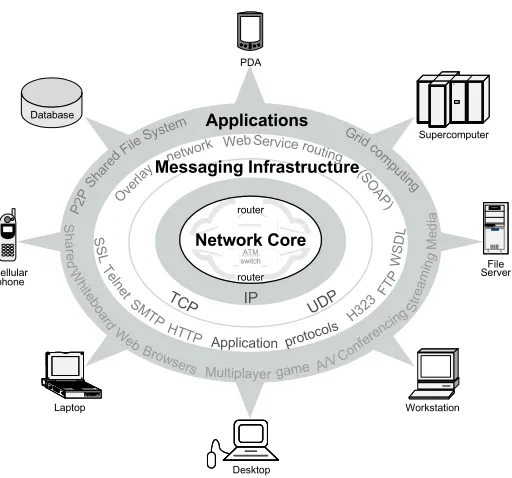
1.1 Architecture of network system ... 13
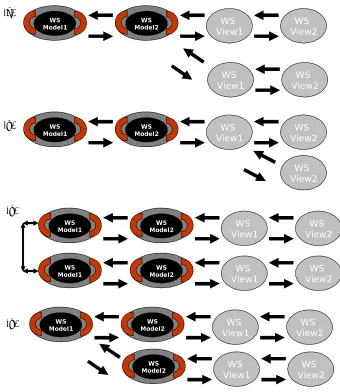
1.2 M-MVC model... 22
1.3 Collaboration paradigms deployed with M-MVC model ... 23
1.4 Message-based MVC and messaging infrastructure... 25
2.1 The general event/listener model ... 43
2.2 Java delegation event model ... 45
2.3 Topic-based Publish/Subscribe model... 46
2.4 JMS Point-to-Point model... 48
2.5 MVC model ... 53
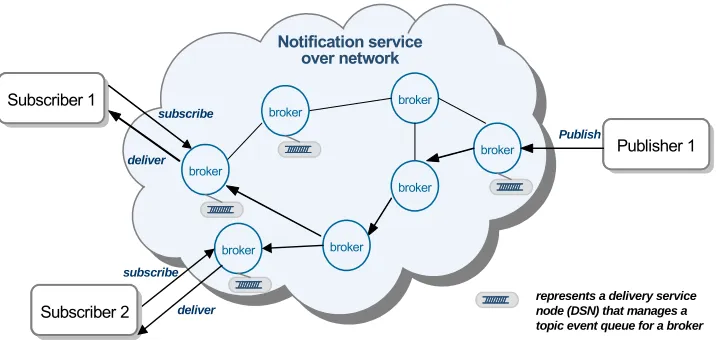
2.6 Architecture of Publish/Subscribe model based on NaradaBrokering event broker notification service ... 66
2.7 A XML document rectLinking.svg with hyperlink element... 70
2.8 DOM tree representation of rectLinking.svg document ... 71
2.9 Interface of EventTarget ... 73
2.10 Event handler registration and event flow of DOM in a case of rectLinking.svg document... 74
3.1 Double-linked multiple-stage pipeline model of Web applications ... 84
3.2 Comparison of MVC and three-stage Web Service pipeline... 87
3.3 Variations of M-MVC decomposition... 90
viii
interactive patterns between Model and View... 95
3.6 Message forwarding and reply between sender and receiver ... 97
3.7 Struts/J2EE architecture... 98
3.8 Message-based Publish/Subscribe with broker intermediary ... 102
3.9 Bi-directional interaction in M-MVC with Publish/Subscribe scheme ... 102
3.10 Web Services composition of M-MVC application, SOAP, and NB ... 104
4.1 Architecture of interactive SVG application... 107
4.2 Screen shot of Batik SVG browser ... 108
4.3 Architecture of Batik SVG browser... 111
4.4 Making SVG collaborative by sharing of intercepted events ... 115
4.5 Collaborative SVG Event processing chart ... 123
5.1 Shared Output Port Collaborative Web Service Paradigm modified from a figure in [Fox03]... 125
5.2 Shared Input Port Collaborative Web Service Paradigm modified from a figure in [Fox03]... 126
5.3 Monolithic collaboration... 130
5.4 Architecture of SMMV collaborative Web Service model... 132
5.5 Architecture of MMMV collaborative Web Service model ... 133
ix
broker intermediary... 136
6.2 Decomposition of SVG browser in stages of pipeline... 139
6.3 Three among the different ways of decomposing SVG between client and Web Service... 140
6.4 Hierarchical event composition ... 144
6.5 Decomposed SVG Browser in M-MVC paradigm... 145
6.6 Implicit and explicit state... 149
6.7 Event flow chart of SVG applications ... 150
7.1 Single Model and View linked by messaging broker ... 154
7.2 Performance testing and timing points ... 155
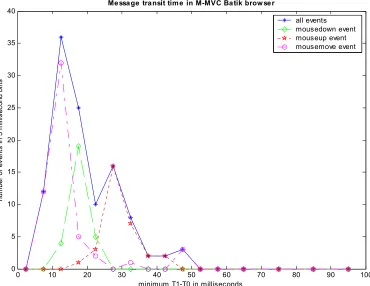
7.3 Histograms of the elapsed time T1(first event to return)-T0 corresponds to test case 1 of Table 7.1 and the row labeled 1 in table 7.3... 166
7.4 Histograms of the elapsed time T1(first event to return)-T0 corresponds to test case 2 of Table 7.1 and the row labeled 2 in table 7.3... 168
7.5 Histograms of the elapsed time T1(first event to return)-T0 corresponds to test case 2 of Table 7.1 and the row labeled 3 in table 7.3... 170
7.6 Histograms of the elapsed time T1(first event to return)-T0 corresponds to test case 2 of Table 7.1 and the row labeled 4 in table 7.3... 172
7.7 Histograms of the elapsed time T1(first event to return)-T0 corresponds to test case 2 of Table 7.1 and the row labeled 5 in table 7.3... 173
x
7.10 Distribution of the mean of mousemove events ... 178
7.11 Distribution of the mean of mousedown events ... 178
7.12 Distribution of the standard deviation of mouseup events... 179
7.13 Distribution of the standard deviation of mousemove events... 179
7.14 Distribution of the standard deviation of mousedown events... 180
B.1 ARPANET and its application... 198
C.1 Network system in layered stack ... 199
C.2 Email application on ARPANET over an abstract communication channel ... 199
C.3 Internet versus OSI Architecture ... 201
C.4 Internet topology as network of networks ... 203
D.1 Basic structure of World Wide Web... 205
D.2 Comparison of two, three, and four tier model... 207
D.3 A Web Service stack... 211
E.1 IDL definition of Node interface ... 212
F.1 Research presentation web site using Macromedia Flash... 215
F.2 Scaling of SVG document ... 219
F.3 Graphical represnetation of rectangle.svg document... 220
F.4 A SVG file rectangle.svg in XML format ... 221
F.5 SVG DOM tree representation of rectangle.svg document ... 223
F.6 A simple interactive SVG application of toggling rectangle ... 225
F.7 An interactive SVG example with scripting in rectOnClick.svg document ... 226
xi
H.2 Data flow... 230
H.3 openLink ... 231
H.4 openLink (rendering) ... 232
H.5 GraphicsNode Event (DOM-Bridge-GVT event flow) ... 233
H.6 EventDispatcher... 234
H.7 Handling of DOM Event... 235
H.8 Batik component paint1 ... 236
H.9 Batik component paint2 ... 237
H.10 Batik Component Paint ... 238
H.11 Graphics Node ... 239
H.12 Graphics Node Paint ... 240
H.13 Updatemanager ... 241
xii
List of Tables
3.1 Typical distributed applications and properties of user interaction, system
behavior, and communication... 79
3.2 Definition of typical events of Web applications ... 80
3.3 Summary of typical Web applications and characteristics ... 82
3.4 Variants of MVC applications ... 100
4.1 Events for monolithic SVG collaboration applications ... 116
6.1 AWT Mouse Events... 141
6.2 The relationship between a user interaction vs. AWT mouse events in SVG applications ... 142
7.1 Testing environment settings ... 155
7.2 System configurations... 155
7.3 Average performance... 162
7.4 Immediate bouncing back event ... 162
7.5 Basic NB performance in 2 hops and 4 hops... 162
7.6 Reproducibility Performance tests... 176
7.7 Average over 15 tests for three NB settings ... 177
Chapter 1
Introduction
“Everything should be made as simple as possible, but not simpler.”
— Albert Einstein [A. EINSTEIN]
Software architecture has always been a focal point of research for building
computer-based systems. Architectural design decisions are commonly made based on a
comprehensive evaluation and understanding of existing technologies and evolution,
social requirements, application functionality and behavior, and vision of the future.
Einstein’s advice is still enlightening today and works well for building software systems.
A good architecture not only comes from supplying a viable solution that accommodates
the latest developments and adapts to the needs of a fast-changing world, but also abides
by fundamental principles such as simplicity, reusability, scalability, portability,
Simple is never simplistic. Systems that are made too simple can not promise
sufficient functionalities while those made too complicated tend to dramatically increase
development and maintenance cost. Due to CPU and network bandwidth constraints,
traditional software systems were built with closely coupled structure. As they lacked
interoperability and reusability, individual system becomes increasingly complex.
As asserted by Alfred Chuang [A.CHUANG], "Application development represents
the future … Integration is about the past." Bridging the gap of development and
integration requires for a new method of linking today’s idea to legacy software so that it
won’t become “a roadblock to innovation, instead of a building block on which the future
can be built.”
While it's clear that Service Oriented Architecture (SOA) [SOA] and its current
implementation ─ Web services [WEBSERVICE] technology will have profound impact
on next generation of distributed applications by providing the interoperable platform that
maximizes the reusability of existing software assets, many aspects of this platform and
how to deploy service-enabled applications within this framework still require significant
research and development.
At the core of the new trend, interoperability and convergence allow development
of diverse loosely coupled applications that can be distributed and accessed in a
synchronous or asynchronous manner, from any client, across the network. Taken
individually, the imperatives such as reusability, interoperability, scalability, and ubiquity
are not new. What is new, however, is the need to execute all of them at once with a real
time collaborative access experience and in an alignment with the latest (Web) service
My work is motivated by understanding the nature of application design in terms of
system composition, interoperation, and communication; evaluating its impact on
performance; how these factors are deployed in different application domains including
desktop applications, distributed applications, and Internet collaboration; ultimately
seeking a unified solution that bridges the technology gaps.
This dissertation proposes a message-based Model-View-Controller (M-MVC)
architecture to building of service-enabled applications. This work looks into some
intrinsic design concepts of desktop system (MVC [MVC]), event-based messaging
system (NARADABROKERING [NARADABROKERING]), distributed system (Web
Services [WEBSERVICE]), and Internet collaboration (Web Service pipeline model
[Fox03]). We pursue a generalization of the existing models targeted at simplicity in
building message-based applications and offer a systematic approach that seamlessly
unify distributed and desktop applications.
As a relatively novel approach, it supplies a universal modular design for next
generation of software applications with an underlying messaging architecture that links
services together. It emphasizes a message centric approach of building distributed
applications that enables both interoperability and scalability, which reflects our
perspective of the Internet and Web pertaining to Internet being the network core,
messaging infrastructure as a layer of distributed operating system, and Web applications
supplying diverse services to heterogeneous end users.
Our exploration is conducted in design space of system composition (between
service and heterogeneous client graphics user interface), communication (with
components enabling general collaborative patterns), and reusability (integration with
legacy desktop applications). This approach allows the deployment of M-MVC as a
paradigm of distributed applications with above essential system features that fulfill our
design goal.
In support of the primary design purpose, we have carried out experiments with
Batik Scalable Vector Graphics application [BATIK] for prototyping and performed a
series of performance measurements to test the effectiveness of our approach. Since
graphics user interface (GUI) plays an important role in enhancing human-computer
interaction and dominates interactive style applications, a graphics enriched open source
system like Batik provides us with an excellent environment for the investigation of
critical M-MVC properties. Especially, low-latency visual responses and compute
intensive rendering mechanism are highly demanding for the architecture of distributed
applications over the network. The aim is, in a coherent and quantitative manner, to
analyze the relationship of visual interactivity and system behavior and to identify factors
that affect overall performance of the message-centered approach.
Note that we uses distributed applications in a broader context than Web
applications with the former deploying on general network systems that may or may not
be based on the Internet protocols. However, since Internet-based Web applications are
dominant in the development of distributed applications, this thesis typically uses these
two terminologies interchangeably without distinction unless it is important to point out
the difference.
The remainder of the chapter outlines a complete picture of the thesis research.
technology evolution; the thesis approach to messaging centric design applied to the
M-MVC model of Web application development and message-based collaborative
paradigms (SMMV and MMMV). Section 1.5 summarizes the contributions of this thesis.
Section 1.6 contains a summary of the research scope to highlight core technology
constituents, research questions, and experimental methodology. It poses a set of research
questions that guided our work; our answers to these questions are given in chapter 9.
Section 1.6 finishes with a roadmap of the rest of thesis which contains a detailed
technology analysis, system design and prototyping, performance evaluation, and
conclusions.
1.1
Motivation
Since the first electronic computer ENIAC [ENIAC1945] was built, many
innovative technologies have emerged as imposing forces in facilitating the revolution of
advanced computation and information processing at an accelerated speed. While Von
Neumann’s stored-program architecture [VONNEUMANN] still greatly influences the
building of most modern digital computers, the development of network and Internet
technologies has revolutionarily promoted computational power through interconnecting
scattered resources into a worldwide repository. Today, Internet and Web technologies
have evolved into a unique global information infrastructure that reshapes our society
pervasively throughout every branch. Traditional computing-intensive applications in
science and engineering fields have developed into an Information Technology (IT)
industry with extended services embracing computing, information management and
“computation core”, which comprise the core computational components or
functionalities of the software systems.
Moore’s law [MOORE] implies that computer processing performance will
continue to improve. In addition, networks will also continue to increase in bandwidth
[GILDER] with however latency for long-distance linkages remaining higher than that
needed for interactive use. Thus, inevitable infrastructure improvements will tend to
create a unique opportunity but a great challenge for the deployment of a new application
architecture that better utilizes CPU power and the existing physical network’s
infrastructure in providing sophisticated services (e.g. Internet collaboration enabling
virtual enterprises and large-scale distributed computing) and multi-media rich interface
to end users from heterogeneous environments with properties such as scalability,
reusability, interoperability, ubiquity, reliability, high performance and cost effectiveness.
Recently, individual technologies and systems such as J2EE [J2EE], .NET
[DOTNET] and XML [XML] have contributed diverse solutions to Internet applications.
Technology innovations promise a better future with continuous newly added features
including ubiquity and collaboration. In reality, applications become increasingly
complex and a single application or platform solution can not meet all needs. The
developments and technology gap has brought the industry into a crossroad for changes
because it is no longer affordable to develop software infrastructure in a conventional
isolated (stove-piped) path. The benefits of productivity, efficiency and adaptability
demand for overall system design enabling software interoperability and convergence.
Web Services [WEBSERVICE] defines standard interoperable interfaces for
XML-based (SOAP) messages over a network. Vendors provide standards-complied software
implementations with programmable platforms enabling applications to be defined,
published, and used as Web Services. Web Services are a particular realization of a
Service oriented architecture (SOA) [SOA] which proposes that applications be built with
a decoupling of core business logic and database from the presentation layer, and use
Web Services technology to interoperate between the application logic and the
presentation layer. In essence, SOA and Web Services provide a generic and dynamic
distributed framework. Interoperability entails reusability of existing software assets.
Convergence closes the technology gap between different environments. Historically,
object oriented technologies like CORBA [CORBA] attempted to solve this problem but
CORBA is considered to be too closely coupled to provide a scalable distributed platform.
It is expected that there will be substantial increase in migration from traditional
approach to SOA in the design of future web-based distributed application. While Web
Services technology allows development of loosely coupled applications that can be
distributed and accessed as a collection of services, from any client, across the network; it
does not define a complete service enabled application development paradigm. Neither
does it define possible state and transition of a service (i.e. the nature of the input
messages inducing state change or the output messages reflecting state change), nor how
these factors affect GUI framework (although Portlets and WSRP are important
developments discussed later). There still needs to be substantial research to find a
1.2
Statement of problems and insights
Deployment of software applications is greatly influenced by supporting
functionalities of operating systems, which are in turn driven by the advancements of
underlying hardware subsystems in architecture and capabilities. The impact has many
dimensions that range from software architecture design, development and adoption of
programming language, and optimization of system performance with advanced
algorithms.
Rapid growth of network and Internet technologies has brought fundamental
changes in the new generation of computer technology. Particularly, continuous
improvement of computer CPU speed and network bandwidth enables design and
implementation of new software architecture with satisfactory performance that support
many capabilities previously impossible.
In this section we offer some assessment about recent developments, current
problems, and forward-looking features that we think will have a significant impact on
software design and engineering. Among many connected technical issues, we choose
five to summarize the situation:
First, the Internet provides a global information infrastructure for the sharing of
resources over heterogeneous environments. The communication subsystem of the
Internet has evolved into stability with the UDP [UDP] and TCP/IP [TCP/IP] network
stacks dominating the communication protocol domain [S. Shi] and forming a low-level
network protocol layer on top of the hardware network core.
Second, the work of constructing distributed operating system over the Internet is
current effort focuses on building of messaging infrastructure tailored for supporting
disparate applications. It involves software level routing intelligence, which goes beyond
the best-effort services (e.g. transmission of bit streams) provided by the stateless
hardware network core, and addresses issues including notification services, reliability,
Quality-of-Service, security, adaptability for multiple topologies (e.g. unicast [UNICAST]
and muticast [MULTICAST]) and scalability over heterogeneous platforms (wired,
wireless, and virtual private network (VPN) [VPN] subsystems), and customized
communication services for specific applications.
Third, software systems become increasingly distributed, complex, media rich,
interoperable, integrated, collaborative, and heterogeneous. This trend demands system
designs enabling flexibility and adaptability for fast change, expansion and incorporation
of existing assets in the operational systems. However, the devising of architecture for
Web applications is still an unfinished challenge. Particularly, lacking of an agreed
paradigm accommodating for increasing complex problems caused large amount of
isolated applications being repetitively constructed. Over the decades, the Internet
operating environment exhibits an architectural evolvement based on models including
client/server, multi-tier, peer-to-peer, a variety of distributed systems (e.g. RMI [RMI],
CORBA [CORBA], DCOM [DCOM], J2EE [J2EE] and .NET [DOTNET]), and Grids
[GRIDS] system. One latest development is service-oriented architecture (SOA) [SOA]
linked with loosely coupled messages for scalability and interoperability among existing
computer systems. Web Services [WEBSERVICE] supply software platforms for
building applications as services. Application developers need to meet the challenge ─
Fourth, the deployment of Web applications show diverse directions but have
common features ─ namely, user interfaces and services for the sharing of information
and resources over Internet infrastructure (see table 3.1 and 3.2). The “sharing” can be
done asynchronously and synchronously at every possible stage along the deployment
pipeline. The original World Wide Web proposed sharing of HTML document using
HTTP protocol over the Internet (ref. Appendix D). The objects that need to be
synchronized may range from Web contents (e.g. video, audio and raw data streams),
user interactions (e.g. editing operations on shared whiteboard document), distributed
programs (e.g. distributed large-scale simulation components), to team participants who
are involved in development or management. The “sharing” can be organized through
unicast or multicast style of group communication to form ad hoc communities (e.g. P2P
network sharing of MP3 files) and virtual organizations or enterprises (e.g. Grids
supporting of structure and unstructured societies). Therefore, in the most general sense,
collaboration is the core problem and service of Web applications although people often
use the terminology “collaboration” to only apply to real-time synchronous Web
applications with compelling time constraints.
Finally, next generation of Web client should enable pervasive accessibility, which
has two implications: its ubiquitous availability to clients from heterogeneous platforms
(e.g. Windows, Linux, UNIX, Macintosh, PalmOS, and Symbian [SYMBIAN]) that
accommodate to thin client demands; its uniform Web interface that provides a platform
1.3
Why message-based Model-View-Controller?
The primary purpose of Message-based Model-View-Controller (M-MVC) is to
provide a high-level application architecture that converges desktop application and
distributed application with automatic collaboration and universal access support, so as to
simplify the development of possible new generation of interactive applications.
M-MVC can be viewed as a distributed MVC paradigm, although it is not directly
extended from single user model to multiple users heterogeneous platforms. Rather, it is
rooted in a loose coupling (message centric) distributed architecture with extensions to
unify the legacy MVC approach.
Emerging (Web) service oriented architecture naturally fits into M-MVC paradigm,
as Web Services (ref. Appendix D) facilitate interoperability of applications as services.
We identify that the Model (or “computation core”) and the View of M-MVC correspond
to the service and presentation in SOA model respectively, and their linkage with loose
coupled messages can be achieved by publish/subscribe interface from underlying
messaging middleware, which plays an increasing central role in the development of
application as services with interoperability and scalability.
There is much confusion between the service, resource, and object. W3C [W3C]
first popularized the term “resource” and used it for any electronic entity. The term object
tends to refer to a software resource accessed by RPC and whose internals (class structure)
are effectively exposed by the RPC (RMI, CORBA IDL) mechanism. “Services”are
intrinsically loosely coupled; they can be associated with particular resources as in the
WSRF [WSRF] framework; they can have opaque implementation of capabilities which
this thesis, we use the word “resource” in W3C manner to represent any electronic entity.
For instance, one can use resource to refer to a small data set for transaction, a
computation process, or a large database component. In a broad sense, a legacy desktop
(or client) application is also viewed a resource. In fact, a principle goal of the thesis is to
integrate such resources as valuable services into generic distributed system model.
We have a blueprint of the Internet and Web. As illustrated in figure 1.1, we take
the view that everything is a resource; no matter it is in form of information (e.g. raw data,
text file, bitmap image, MP3 music, video/audio stream, and program), physical device
(e.g. computer, printer, fax machine and sensor), and even human resource. All of the
distributed resources are linked together through local area network (LAN) [LAN] and
further interconnected to other networks via wide area network (WAN) [WAN], which
forms the largest internetworking infrastructure ─ Internet (see fig. C.4). Web, which is
built on top of the Internet ─ physical network core, provides communication channels
for the interactions with message streams. Web applications add sophisticated services
and interface for the “sharing” of services, objects, or resources for end users. Fig. 1.1
The growing demand for intensive interoperation and communication highlights the
increasing importance of messaging ─ a ubiquitous solution embraces all forms of
communication. A message may contain information of diverse formats (e.g. text, media,
and raw data). A messaging service, as we discuss here, is a generic communication
mechanism that facilitates the exchange of loose-coupled messages among the distributed
objects or applications. Distributed resources or software components are wrapped with
(Web) service interface and immersed in a sea of messages.
From a technical perspective, there are some distinctive features. Traditional
distributed object model employs exchanging coupled-messages with explicit or implicit
shared context, which may be implemented by distributed version of method calls and
returns, such as those in RPC-based and RMI-based platforms. Message-based approach
produces light-weight loosely coupled services supporting asynchronous messages
[image:30.612.198.454.67.306.2]linkage (e.g. one-way transmission from sender to receiver). The messages are contracts
Figure 1.1 Architecture of network system
File Server Laptop Cellular phone PDA Desktop Workstation Database IBM Supercomputer S ha red W A N Network Core router router ATM switch IP
TCP UDP
rather than direct coupling, which enable software level routing mechanism to provide
platform independent communication paradigms (e.g. publish/subscribe) with excellent
scalability. Further more, XML-based interface and specifications such as Simple Object
Access Protocol (SOAP) [SOAP], Web Services Description Language (WSDL)
[WSDL], and Universal Description, Discovery, and Integration (UDDI) [UDDI] that
provide a generic interoperable platform among heterogeneous systems, which increase
interoperability, reusability, and discovery of existing software components.
From an architectural view, a virtual distributed operating system is formed as an
intermediary layer over the conventional bit-level Internet infrastructure (physical
network and protocols such as IP, TCP UDP, HTTP, and SSH). Community Grids Lab’s
current effort NaradaBrokering [NARADABROKERING] focuses on building of
messaging infrastructure over IP and provides assurance of communication services
(reliability, QoS, security, firewall tunneling, event notification, publish/subscribe,
overlay, and peer-to-peer) tailoring for the support of diverse applications. The separation
of top level application architecture from underlying messaging infrastructure simplifies
the deployment overhead of applications and significantly increases application
portability.
The overall innovation and advancement in computer technologies provides a great
opportunity and foundation for deploying sophisticated distributed applications (e.g.
Internet collaboration enabling virtual enterprises and large-scale distributed computing).
Over the decade, the architecture of network-based applications keeps evolving ─ from
earlier client/server, to multi-tier, middleware, peer-to-peer and overlay models. There’re
relationship between client graphics user interface (GUI) and server side application
behavior. Typical examples are JSP [JSP] and Java Server Faces (JSF) [JSF] for J2EE (or
similarly ASP for .Net), JSR-168 [JSR168] and WSRP [WSRP], and REST [R. Fielding].
Each example addresses issues in the scope of our targeted problem. However, one
still needs a paradigm with a highly flexible architecture that spans the spectrum of
platforms, programming languages, applications, and communication protocols so as to
accommodate to rapid changes of individual technologies and adapting to sophistication,
and cost-effective requirements in real world.
This motivates us to look into some intrinsic design concepts of client system
(MVC [MVC]), event-based messaging system ([NARADABROKERING]), distributed
system (Web Services [WEBSERVICE]), and Internet collaboration (double-linked
multiple-stage pipeline model [Fox03]). We pursue a generalization of the existing
models aimed at simplicity of building applications with following properties:
separation of application architecture from underlying messaging infrastructure
for generality and portability
proposing message-based MVC (M-MVC) approach to address the problem of
traditional tightly coupled Model, View, and Controller classes for scalability and
universality
extending M-MVC architecture to legacy desktop applications so as to have a
uniform Web Services model with messaging linkage for reusability and
interoperability
providing a paradigm with automatic collaboration and universal access
employing publish/subscribe scheme, which is provided by the messaging
infrastructure, for the exchange of messages among system components to
enhance group collaboration capability
As in any new approach, there will be many subtle factors that may not be
addressed by general architectural consideration. So, we choose to build a prototype with
a forward-looking architecture and conduct systematic experiments to explore and
identify general principles and key implementation issues associated with this approach.
Here, we list the major observations and analysis of the state-of-art in the evolving areas
of software design, which form the starting point of our work. We build up our key idea
in four stages:
We believe that Web applications ought to be built on messages to achieve
important features such as scalability and interoperability. Method-based linkage of
program components is obviously important and often the best approach. However such
linkage implies tight coupling which handicaps both modularity and distribution. One can
build distributed systems with RPC [RPC] like method-based models such as RMI,
CORBA, and COM. However although these platforms can be used in closely coupled
and self-contained applications, they do not perform well on Internet scale distributed
systems.
Computer messaging can be compared with information dissemination between
people. Messaging provides a mechanism facilitating the fundamental communication
pattern of human interactions. The messaging approach is consistent with important
principles in network design. Namely, scalability is more pressing than optimality in
Internet structure, which is built on diverse interconnected autonomous subsystems and
subject to flexible expansion. Further more, interoperability for systems from different
platforms is an equally important design trait to pursue. Messages offer an abstraction
accommodating diverse system data format, which conveys critical exchanged data and
information for exchanging.
Historically, messages passing mechanism has been successful in parallel
computing [PARALLELCOMPUTING], a tightly coupled distributed model, with
satisfactory system performance for applications of sophisticated connectivity and
synchronization issues. Moore's Law says that computer processing speeds double every
18 months [MOORE] but Gilder's Law implies that network bandwidth rises even faster
than this [GILDER]. People’s ability to interact remains roughly constant. These trends
continue and the difference of performance improvements continuous to widen, implying
that explicit messaging gets more attractive especially for user interfaces (model-view
interaction) where one gains from both computer and communication performance
increases.
The message-based approach is an indispensable part of the big picture of Web
system design. The latter requires a clear abstraction of an intermediate messaging layer
so as to hide the complexity and diversity of services that reconcile the differences
between underlying platforms and top level applications. Specifically, it decomposes a
Web system into physical networks or Internet, messaging infrastructure, and Web
application, as illustrated in figure 1.1. The system architecture includes hardware
network core, whose primary function is reliable transmission of binary bits over distance,
of IP [IP] that offers critical routing protocols for the communication of large
heterogeneous inter-networks; the messaging infrastructure sphere provides intelligence
over IP, which includes a suite of traditional layered network protocols such as TCP
[TCP], UDP [UDP], and a variety of application protocols; the outer sphere that provides
application services to end users. We will cover related constituent components in detail
in section 2. Abstraction of the messaging infrastructure as a separate layer of Web
system has great significance. As discussed in the earlier section, the trend of Web
application development shows increasingly complexity in functionalities. It demands for
service aggregation with scalability, interoperability, reliability and pervasive
accessibility. Messaging and IP layers essentially form the core of distributed operating
system with rich communication services. This separation can greatly reduce the
deployment overhead of Web applications. More importantly, it reduces their dependency
on the details of underlying connectivity topologies and platforms and thus helps
application portability.
Service oriented architecture with loosely coupled messages linkage can
maximize its capability by using advanced messaging services of the underlying
infrastructure. We expect service oriented architectures will have a continuing
important role in Web applications deployment by preserving flexibility, scalability,
interoperability, and reusability over the Internet model of diversity and arbitrary
complexity. The history of Internet and Web technology saw the evolution of Web
applications with architectures dominated by centralized client-server system with
traditional point-to-point (unicast) connection, decentralized self-organizing peer-to-peer
and RPC-model (e.g. CORBA) derives from method-based system calls for tightly
coupled single CPU system (e.g. desktop applications) but with remote procedure calls to
support the distributed objects. Client-server and P2P models are suitable for solving
problems with features applicable to their patterns but real world problems can be
arbitrarily complicated. Examples can be seen in parallel applications with decomposition
in high dimensionality. On the other hand, RPC-like model deals well with distributed
objects or components for reusability but do not scale well. Message-based Web Service
model provides a unified approach that incorporates messaging flexibility with
components distribution. It accommodates to the diverse and scaling nature of the
Internet and also promotes Web applications development with Web Services for
reusability, interoperability, and scalability.
Message-based Model-View-Controller (M-MVC) provides a paradigm for
next generation of software applications. It emphasizes a universal modular service
model with messaging linkage converging desktop application, Web application, and
Internet collaboration; it suggests a uniform platform for next generation Web client.
Model-View-Controller (MVC) [MVC] is a fundamental architecture of Graphical User
Interface (GUI) [Krasner+Pope] with system decomposition into triad of Model, View,
and Controller for modularity. As a design paradigm, it is nothing new in the
object-oriented programming world. What has served to rejuvenate the MVC concept again,
however, is the realization that the pattern is particularly well-suited to addressing many
of the fundamental problems inherent in building Web or distributed applications (e.g.
An aspect of distributed applications that requires research attention is the user
interface. A well designed user interface is required if an effective use of the service is to
be achieved [Abdullah+Gay]. A user friendly interface provides visual cues that facilitate
navigation and effective access to available services. In client/server applications, Web
browsers have provided relatively simple but effective human/computer interfaces for
HTML content. In new generation of Web applications, GUI is expected to supply more
intensive human/computer interactions both in richness of multimedia contents and
versatility of communication. This puts high demands for a coherent architecture from
user interface to autonomous Web Services. Although SOA or Web Services provide
universal APIs for applications as services, however, they themselves do not address
system decomposition and user interface issues. Thereby, application developers have to
determine which component should reside in the service versus client interface. Further
more, next generation client interface promise ubiquitous accessibility, but common
client interfaces such as IE and Netscape Web browsers are not sufficient to deal with the
variety of client profiles (e.g. thin client interfaces for mobile devices). MVC, as a
paradigm for interactive applications, has a simple system division of computation and
presentation into two components: the Model and the View. This model makes it
impossible for the system process being controlled in a fine grained fashion for
distribution, especially for complex systems. For example, recent research shows
increasing demand for multi-tier architecture with separate business logic at back end
[LWLH]. To address the issues of the integration of legacy applications, M-MVC
proposes a generalization of the classic MVC model (ref. section 2.2) and the Web
messages linkage. In this architecture, system is decomposed of multiple stages and each
stage forms a modular component with input/output linked to event messages for
communication. As such, the decomposition of the Model and the View becomes a
flexible and systematic approach based on different combinations of multiple pipeline
stages, and messaging linkage facilitates for system division and distribution.
1.4
Design features of M-MVC and collaborative paradigms
As key to this dissertation, we propose "explicit message-based MVC" as an
approach that systematicly utilizes MVC in a message-based fashion with replacement of
conventional method-based model and exploiting it with Web Services architecture in
provision of a unified general approach of message-based service model for Web
applications.
One prominent feature of the architecture with M-MVC is that the deployment is
centered on distributed applications but devised for seamless integration of legacy
desktop applications and automation of emerging important features including Internet
M-MVC decomposes an interactive Web application using a flexible and
fine-grained double-linked multistage pipeline model (ref. section 3.2) with natural event
interactions. Theoretically, any part of an application with natural event interactions may
form an object or stage with messaging linkage along the pipeline. The events, which
represent the change of state, propagate along the path as messages that interconnect a
dynamic graph of a finite state machine. In M-MVC architecture, we exploit the
model-view compositions based on a variety of flexible combination strategies of these stages.
This scheme provides many possibilities for building of Web applications with thin client
interface facilitating universal access. We select a simple example ─ the three-stage
pipeline (see fig. 1.2) to illustrate our design concept with raw UI events forming the
View component; high level UI events and semantic events comprising the Model
component (a Web Service); message-based events that play the role of the Controller
linking the Model and the View components.
The major distinctions between MVC model and M-MVC model reflect different
vision of system composition. A canonical MVC structure encompasses Model, View,
Figure 2 MMVC model Messages contain control information
Figure 1.2 M-MVC model
Input port Output port
Event as messages
Rendering as messages
User Interface
Raw UI Display Semantic
High Level UI
Model Web Service
and Controller ─ three independently existed and tightly coupled component classes at
application level. However, modern architecture emphasizes scalability and
interoperability. A refined Web service pipeline structure (ref. section 3.2) provides
building blocks that accommodate dynamic, diverse, distribution and coordinative nature
at Internet scale. M-MVC remedies the gap and argues that a basic system interaction is
accomplished by a series of transformation along pipeline stages between the two ends of
View and Model. M-MVC regards that Model (service) and View (user interface) are
distributed components of an application that are connected by messages in the
background infrastructure as part of distributed operating system (see fig. 1.4). There’s
no single Controller class, rather its semantics are contained within control messages and
processing is combined with various services along the pipeline stages.
From the beginning of our research on a generic model for building Web
applications, Internet collaboration and ubiquity have been considered as important
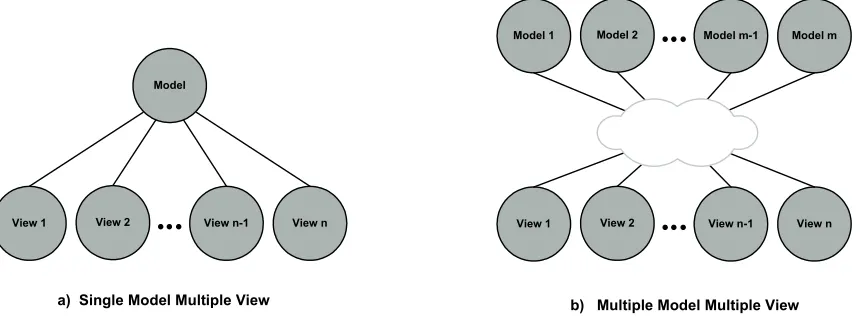
features to be integrated into the system design. We separately propose two interactive
patterns ─ Multiple Model Multiple View (MMMV) and Single Model Multiple View
(SMMV) for the general architecture of collaboration as Web Service model. The two
master client View NaradaBrokering NaradaBrokering other client View Model
as Web Service
other client View other client View Broker Broker master client View other client View other client View other client View NaradaBrokering NaradaBrokering Model
as WS as WSModel as WSModel as WSModel
Broker
Broker BrokerBroker BrokerBroker
Figure 1.3 Collaboration paradigms deployed with M-MVC model
graphics in fig. 1.3 illustrate how SMMV and MMMV are deployed with M-MVC
architecture, which facilitates assembly of either visual components (Views) or
aggregation of Web Services (Models) through messaging services (e.g.
NaradaBrokering [NARADABROKERING]).
SMMV and MMMV patterns extend the concepts of corresponding shared output
port and shared input port models of the event-based collaboration framework [Fox03]
and provide uniformed collaborative paradigms in publish/subscribe scheme for both
desktop and distributed applications. While multiple clients join in a collaborative session,
it is necessary to assign “master role” to one client at each time. By sharing events from
the “master client”, all participants behave in a consistent and coordinated manner.
SMMV is comprised of different client interfaces that share of the same model
component. Shared display and Instructor led learning applications have SMMV structure.
MMMV allows each client interface drive its own model, which is adaptable for more
sophisticated applications and various user interfaces. SMMV and MMMV support both
asynchronous and synchronous scenarios.
Figure 1.4 shows conceptual architecture for M-MVC applications. There are two
key elements: the structure of M-MVC itself and its relationship with the messaging
Firstly, application architecture constitutes a separate layer from underlying
communication infrastructure. Model (Web Service) and View components are
distributed in the application layer. Communication services (e.g. publish/subscribe and
reliable messaging), which are provided by messaging brokers, form the infrastructure
layer.
Secondly, as opposed to the tight coupling MVC triad (see fig. 2.5), M-MVC
demonstrates a framework with three dimensional expansions. Each Model and View
component can extend along the pipeline to form different stages of transformation (e.g.
layout styling filter in View and multiple tier component such as separate business logic
in Model) for system interaction and synchronization; and expand horizontally at each
View components are achieved via interfacing with messaging layer brokers that route
event messages (e.g. control information) over the networks.
The heart of problems that modern architecture faces is increasing complexity of
applications in versatile environment. As a case, fig 1.4 shows how M-MVC can be used
to model Portal [PORTAL] applications. “View1” is equivalent to Portal UI such as
JetSpeed [JETSPEED] that aggregates portlets user interfaces (“View0”, “View1m”, and
“View2”). A filter component for Web page layout styling might be needed as depicted
by “View11”. Portlets such as “Model0”, “Model1”, and “Model2” are consists of
different services that ultimately access various computing and database storage
resources that are distributed at the edge of the Internet (ref. fig. 1.1).
Note that distributed components, which include (Web) Services (Model) and User
interface (View) modules, are linked by messages through messaging brokers with a
variety of communication services. By registering with Publish/Subscribe services,
different clients dynamically join and leave the system while services are integrated on
demand. The approach also facilitates an automatic collaboration framework that can run
either in a client/server mode or in a peer-to-peer mode, depending on the run time
binding of messaging service with JMS or JXTA profile.
In this dissertation, we provide practice and experience that help to expedite the
process of message-based Web application deployment and supply feedback for the
construction of underlying messaging infrastructure, which is needed as this area is still
immature and one expects substantial evolution. In summary, M-MVC emphasizes a
combination of messaging flexibility as well as component modularity for the modeling
building distributed applications around messages, and briefly described some design
features of M-MVC in support of Web Service composition and major collaboration
patterns ─ SMMV and MMMV. A complete set of discussions on M-MVC that embraces
its design, implementation, and performance evaluation are provided in subsequent
chapters 2 to 7.
1.5
Contributions
1.5.1 Research achievements
The main contribution of this dissertation is to offer a comprehensive solution to
building applications centered on messages. It is the first research as far as we know that
systematically utilize Model-View-Controller (MVC) [MVC] paradigm for distributed
application deployment in a message-based fashion. It enables the provision of a
universal paradigm with a service model converging desktop applications, distributed
applications and Internet collaboration. This work has following implications:
Proposing an “explicit Message-based MVC” paradigm (M-MVC) as the general
architecture of Web applications [QCF-06-03].
Demonstrating an approach of building “collaboration as a Web service” through
making decomposition of M-MVC collaborative [QCF-07-03]. As an example,
we present architecture for three types of collaboration ─ monolithic, thin client,
and interactive client.
Bridging the gap between desktop and Web application by leveraging the existing
desktop application with a Web service interface through “M-MVC in a
application into a distributed system by modifying the architecture from
method-based MVC into message-method-based MVC.
Proposing Multiple Model Multiple View MMMV and Single Model Multiple
View collaboration SMMV as the general architecture of “collaboration as a Web
service” model [Qiu+Jooloor].
Identifying some of the key factors that influence the performance of
message-based Web applications especially those with rich Web content and high client
interactivity and complex rendering issues [QPU].
Future work includes extending our ideas, tools and architectural principles to
other Web applications such as collaborative whiteboard and datavisualization.
1.5.2 Significance of research
We propose a different approach of "explicit message-based MVC" (M-MVC)
paradigm for application deployment, which delineates our design concept of building
Web applications centered on messages. It encompasses our investigation of the
interoperating relationship among constituent components of applications ─ from tightly
coupled desktop application to loosely coupled distributed system. The most challenging
part of the research work is a unified solution that reconciles the different architectural
principles derived from the disparate system objectives of integrating MVC, messaging,
Web Services, and collaboration models. M-MVC replaces opaque method-based events
at application (Java) run-time level with exposed messages, and changes the tight
connections of conventional method-based MVC model to a loosely coupled messaging
We now provide further definitions of system features: message-based Controller,
thin client as the View, and Web Service as the Model. M-MVC offers a framework with
a double-linked multiple-stage pipeline architecture to refine MVC decomposition; we
define MMMV and SMMV collaboration models using a publish/subscribe scheme
supplied by the underling messaging infrastructure. As a general architecture, it
emphasizes a modular service model with messaging linkage for reusability, scalability,
interoperability, and automatic collaboration with universal accessibility. We can identify
four generally important aspects:
Firstly, it provides a mechanism to make a desktop application as a Web service to
allow maximum reusability.
This is done through converting a desktop application into a distributed system with
modification of architecture from traditional method-based MVC to M-MVC in a
publish/subscribe scheme, where computation core or Model naturally becomes a
Web service. Conventionally, Web and desktop applications are developed with
different architecture. Nevertheless, integration of legacy client side systems or
existing components into up-to-date Web development is one of the crucial aspects
of the technology evolution. This approach suggests that desktop applications with
a good modular design can be modified to Web services, which greatly maximizes
the reusability of existing components for Web application development. The
architectural changes bring up issues that cause a challenge to the system. The
experience also helps in finding the principles of building Web applications from
Secondly, it allows us to have a different view of building distributed applications
around messages to achieve scalability and interoperability.
The architecture of traditional Web applications deployment is built on individual
platforms evolving underlying point-to-point model (e.g. client/server and
multi-tier), multicast model (e.g. peer-to-peer overlay network), and RPC-like distributed
system (e.g. RMI, CORBA, DCOM, J2EE and .NET). This dissertation has adopted
a different approach ─ a loosely-coupled message centric design with separation of
Web systems into application architecture and messaging infrastructure layer. A
message-based Web application with M-MVC architecture comprises three
functional modules: thin client interface represents “view”; computation core stands
for “model” which becomes a Web Service; messages, which convey abstracted
context information from both components and facilitate synchronization between
them, play the role as “Controller”. This approach enables a universal paradigm of
Web applications that applies to any of the above platform architectures, which is
also adaptable to wireless network, VPN [VPN], and future development of other
possible connecting topologies. This follows from our layered stack with a
messaging middleware providing a communication channel that handles underlying
network protocols and services over heterogeneous topologies. The higher level
Web applications focus on the deployment of presentation and interface services to
end users with high scalability and interoperability.
Thirdly, this paradigm provides a uniform architecture that bridges the gap
Theoretically, any part of an application with nature events linkage can become
splitting points of the View from the Model, which forms a multi-stage pipeline.
However, traditional deployment of Web clients commonly mix presentation with
content, which made it hard to build a general architecture of uniform client
interface with rich Web content for service-oriented model. The M-MVC model
exploits a further separation of the rendering from the logic components of
traditional Web client, which enables a thin client structure. A thin client design
allows a desktop application to form a local service part of the Web application,
which also provides remote services to other Web services. Therefore, it facilitates
the seamless unification of desktop and Web application. This scheme is also
critical for universal and pervasive access. Particularly, it suggests a uniform
approach to build next generation Web client with desktop and web applications
sharing a common portlet (WSRP [WSRP], JSR168 [JSR168])-based architecture.
These ideas can unify PDA and desktop, as well as Linux, MacOS, Windows and
PalmOS applications to achieve pervasive accessibility.
Fourthly, this approach makes automatic collaboration ─ MMMV and SMMV
collaboration pattern provides the general model of collaboration as a Web Service.
Multiple Model Multiple View (MMMV) and Single Model Multiple View
(SMMV) present a generic collaboration approach that derived from our
message-based MVC architecture of Web applications. MMMV and SMMV accommodate
respectively instructor-led learning and participatory learning models. The trend of
Web applications deployment demands for the design of architecture in provision of
services. From a client’s point of view, it requests for accessing to a variety of
services (e.g. email, search engine, and web browser); from the perspective of a
service, it holds commitment to supporting of heterogeneous client interface. As a
response to the trend, we demonstrate that M-MVC, as a paradigm of
message-based service model, has features of both messaging flexibility and component
distribution and is a suitable architecture for complex problems with many-to-many
interactions. More importantly, our work suggests that one need not develop special
“collaborative” applications. Rather any application developed as a Web service
with M-MVC model can be made collaborative using the tools and architectural
principles discussed in this thesis. This could motivate the development of new
desktop applications that preserve interoperability and sophisticated rendering
effect while gaining many capabilities (e.g. collaboration) not present in today’s
systems such as OpenOffice and Microsoft Office.
An additional contribution of this thesis is a taxonomy for event-driven
message-based collaboration. It covers a summary of features of event-message-based collaboration
applications, discussions of main design concepts embracing system composition (service,
client interface, and session control components), event structure and interactive pattern,
interfacing with messaging infrastructure in explicit publish/subscribe scheme, and
classification of monolithic and Web Service collaboration models. The key concepts
have applied in our system with scalable vector graphics content but are applicable to
other collaboration systems such as shared display, shared data visualization, audio/video
1.6
Summary of the dissertation
1.6.1 Scope of Research
This dissertation builds on design concepts from different areas of computer
technology: desktop system, parallel system, distributed system, Internet collaboration,
and Web system. Our investigation comprises the following aspects:
Model-View-Controller (MVC) [MVC], a fundamental paradigm that separate
system into triad of Model, View, and Controller, which is originated from
desktop system and becomes a design pattern of object-oriented programming
Messaging [NARADABROKERING] [JMS] [WSNOTIFICATION]
[WSEVENT], a flexible and scalable message-based communication mechanism
adaptable for complex problems with high dimensionality
Document Object Model [DOM], a component-based structure for distributed
system with a generic event mode; Scalable Vector Graphics (SVG) [SVG], an
application of DOM specification
The Web Service pipeline model of Internet collaboration [Fox03], an
event-driven message-based collaboration framework that can be deployed in a clear
publish/subscribe scheme with the messaging infrastructure [NaradaBrokering]
support.
Web services [WEBSERVICE], an implementation of emerging service oriented
architecture for Web applications
The detailed technical points and their utilization in the implementations are presented in

![Fig. 5.1 Shared Output Port Collaborative Web Service Paradigm modified from a figure in [Fox03]](https://thumb-us.123doks.com/thumbv2/123dok_us/8135166.243276/142.612.175.478.468.670/shared-output-port-collaborative-service-paradigm-modified-figure.webp)
![Fig. 5.2 Shared Input Port Collaborative Web Service Paradigm modified from a figure in [Fox03]](https://thumb-us.123doks.com/thumbv2/123dok_us/8135166.243276/143.612.192.475.344.555/shared-input-port-collaborative-service-paradigm-modified-figure.webp)