Management are heavily based on public sentiment and have applicability of Sentiment Analysis. Researchers have developed various machine learning models for this task. In last few years those models have proved their performance. Yet there are problems like multi-class sentiment mapping, short text sentiment analysis which need further attention. In this paper sentiment analysis and allied problems attempted using latest machine learning model, CapsNet, is discussed. Recently CapsNet has emerged as a powerful and efficient model for various domains. Its various variants applied for sentiment analysis and related tasks are studied and analyzed here. Purpose of this work is to highlight the role of CapsNet in the area of sentiment analysis. Also, very brief discussion about Convolutional Neural Networks (CNN) is done as CNN is immediate predecessor of CapsNet. Various latest CapsNet models have outperformed state of the art machine learning models for sentiment analysis.
Key words: sentiment analysis, opining mining, CapsNet, Convolutional Neural Networks, CNN
I. INTRODUCTION
Sentiment Analytics plays main role in decision making. Politics, stock market, movie rating, product rating and many more domains have seen exceptional impact of public sentiment time to time. Decision makers of these domains have track sentiments from public or private media for last few years. Machine learning text analytics and Natural Language processing are being used effectively for helping such decision makers.
In this paper, latest most effective models of machine learning in this area are studied and compared. Also, latest model of CapsNet is discussed in detail. In-depth comparison of various models for intelligent selection for task at hand is provided in this work. In first part use of Convolutional Neural Networks (CNN) for text analytics is discussed. Convolutional Neural Networks are popular deep learning tool for image, video and text analysis. They have been used in various application domains with great performance. Later CapsNet is discussed here.
CapsNet is discussed here as latest model proposed in Machine Learning and its application in text analytics. CapsNet was first introduced in 2016 by G Hinton [1]. Since then it has shown its efficient implementation in various
Revised Manuscript Received on April 12, 2019.
B.Tulasi Kumari, CSE Dept., CSE Dept., Koneru Lakshmaiah
Education Foundation (K L University) Guntur, AP, India.
D. Rajeswara Rao, CSE Dept., Koneru Lakshmaiah Education
the art results for sentiment analysis.
II. LITERATURE REVIEW
In sentiment analytics has been popular amongst researchers [2] . This has been applied in various fields like popularity analysis [3], product review [4][5], adverse drug event extraction [6], stock market prediction [7], and political review [8]. So, here latest Convolution based machine learning techniques are discussed. These techniques are applied on various domains and also on sentiment analytics.
A. Convolutional Neural Networks (CNN)
LeCun proposed this model for the first time as LeNet [9]. Then subsequently it was modified and used in various applications. Most popular and successful variations are AlexNet, and ResNet. Also, in this section latest CNN architectures are discussed.
B. AlexNet
AlexNet or ImageNet is an upgraded version of LeNet [10][11]. It had attached ReLU activation for each Convolution as well as fully connected layer. Also, this architecture is deeper than original one. It was designed in two pipelines so that it can be parallely be trained on multiple CPUs or GPUs. Stochastic Gradient Descent with momentum was used here for error back propagation. Overall, this architecture drastically reduced error in object detection and classification. Figure 1 describes AlexNet in details.
C. ResNet
Fig. 1 AlexNet details as given in [3]
D. Latest CNN Architectures for Text Processing
In [15], character and sentence based properties of text are used for sentiment analysis. Here very small text messages or one line statements are considered as input. Because of small size they require special handling. Here proposed technique surpasses others in positive negative classification, as well as in fine grained classification.
Novel activation function is discussed in paper [16]. Here, activation function is made closer to biological activation function. Also, it is compared with state of the art neural network setups. This activation function significantly contributes to improvement in neural network performance. This activation function also addresses sparsity in signal zero.
Work [17] proposes totally novel approach on text handling. Each character is considered separately here. It has been proved here that even character approach can give state of the art results. Work compares results of popular text models like Bag of Words with TFIDF, thesaurus [18] and Word Embeddings [19]. Still proposed framework is found be comparable with them. Another question classification task using CNN is handled in [20].
Deep convolutional approach is used for speech recognition [21]. Traditional Hidden Markov Approach is considered for comparison with proposed system. Also, limitations of decision trees to solve this problem are explained here. Input text features and speech features are correlated to find patterns. In results, Hidden Markov Models with various alpha values and Deep Neural Network with 4 layers and varying number of neurons are compared. Deep Neural Network is found to be better. Also, p-value is significant for the given test. Another work based on features extracted from text is [22].
Another work describes how CNN can be used for text classification. In work [23], text data with information about term order is processed using CNN. This work has presented details of how to use text as input to CNN. It also describes text pooling in CNN. Additionally work [24] discusses similar problem of sentence classification.
Text recognition from natural images using CNN is presented in [25]. It works on regional processing. Various regions from image segments are processed and
ranked for recognition of text. Highest ranked regions are used for text recognition. Uniqueness of this work is use of complete synthetic training data. Detailed experiments are done here to show effectiveness of proposed system.
In work [26], sensitivity analysis of one layer CNN is done with details. It deals with problem of hyper parameter tuning. Experiments are focused on sensitivity of CNN model towards various parameters. Even effect of pooling strategy, dropout rate is studied here. One major observation here is about filter region size, which affects performance vividly.
Query intent classification is handled by work [27] and recommendations which are based on context of document [28].
III. CAPSULE NETWORK:
Capsule Networks (CapsNet) were introduced recently as novel architecture in Neural Networks [1]. Sequence of multiple convolutional kernels bundled together is known as a capsule. Capsule Networks consists of large number of these capsules. Each capsule operates at local level of features. Global understanding of features is done by communication between various capsules using routing paths. Figure 2 gives details of CapsNet.
In work [29] aggression and toxicity in comments of social networking sights is discussed. Here CapsNet is used for solving this problem in dataset. As stated by authors CapsNet outperforms all others by great margin. Additionally it notes that CapsNet requires minimal preprocessing. This has resulted in minimal training time and easy applicability in production environments. Similar task is handled in for online platforms [30].
Another application of CapsNet is done for handwritten word recognition in work [31]. This work deals with historical text. Historical handwritten text has unique challenges to be addressed. There are defects and damages to be addressed by processing system. Here words from such text are identified individually.
Fig. 2 Details of Sample CapsNet layers based on description in [1] Next is challenging task of detection of emotions from
text which contains no direct word having emotional bias. Here model needs to identify hidden emotion within text. This is achieved by work [33] using CapsNet and word embeddings. Words from text are connected to their related words or synsets or embeddings and emotions from them are extracted. This cumulatively forms emotion of text. This work has successfully implemented CapsNet for this purpose.
Further in [34] CapsNet is applied for sentiment classification on wordtovec embedded text. Here original text is applied with wordtovec embeddings and then given to CapsNet for sentiment detection. Authors note that CapsNet was able to classify even ambiguous text. Here CapsNet is compared with CNN for classification task and was found superior.
Another interesting work is done by authors of [35]. They have used CapsNet based embeddings and named model as CapsE. These embeddings are used for knowledge building and personalization of tasks like searching. Here each capsule is of three columns containing subject, relation and object. This enables easy relating of input text to various other words. This approach has proved its potential on benchmark datasets.
In work [36] a new routing approach for CapsNet is proposed. Then it is applied for text classification. Extensively results are compared on seven benchmark datasets. Also this work deals with text reconstruction. CNN, CapsNet with dynamic routing and proposed CapsNet with static routing are compared using list of words they generate as related to "good" and "bad". Also static routing is proved to have better efficiency. Latest architecture also includes new type of k-means coding as in [37]. Another routing approach is [38].
Knowledge sharing amongst models built for multiple tasks is a growing trend now. This concept improves efficiency of models. Here in [39] a single CapsNet model, MCapsNet, is trained for multiple tasks on text. Task includes sentiment analysis, and sentense classification, also.
Shallow training models are lately becoming popular due to very short training time and resource demands. Here in [40] Capsule network models are trained based on semantic rules. They are found to have comparable efficiency based on shallow training. Here this concept is applied on cross domain sentiment classification.
Work [41] attempts to detect user intent in Chatbot setup. Here attempt is to detect user intent from start of an interaction with Chatbot. Proposed system here has two capsules one is dedicated for intent detection. This approach has proved successful on two benchmark datasets.
IV. REVIEW RESULTS
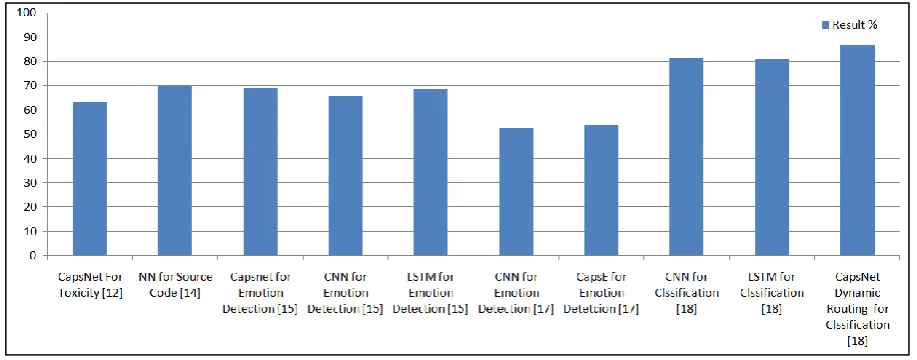
In this section result of various CapsNet and CNN based models and latest models for Sentiment Analysis Task are compared. These results are directly taken from literature. It can be clearly seen that for Sentiment Analysis Task CapsNet is having comparable or rather better results than other models.
Fig. 3 Results comparison based on Literature Reviewed
V. CONCLUSION
This work focuses on application of CapsNet in Emotion Detection and Sentiment Analysis. Here, various models proposed for this problem are discussed and their results are compared. CNN which is considered as predecessor of CapsNet is also discussed with related latest models for Sentiment Analysis. CapsNet has emerged as promising Neural Network model for Sentiment Analysis through various literatures surveyed. CapsNet shows state of the art results in comparison to other models like Neural Network (NN), Long Short Term Memory (LSTM), Convolutional Neural Network (CNN).
In future CapsNet has lot of potential applications in Sentiment Analysis and Emotion Detection. Its efficiency can further be improved by right input representation and reducing complexity of routing.
REFERENCES:
1. Sabour, Sara, Nicholas Frosst, and Geoffrey E. Hinton. "Dynamic
routing between capsules." Advances in Neural Information Processing Systems. 2017.
2. Lu, Yujie, et al. "Are Deep Learning Methods Better for Twitter Sentiment Analysis?." Proceedings of The 23rd Annual Meeting of Natural Language Processing (Japan). 2017.
3. Li, Yujiao, and Hasan Fleyeh. "Twitter Sentiment Analysis of New
IKEA Stores Using Machine Learning." 2018 International Conference on Computer and Applications (ICCA). IEEE, 2018.
4. Ray, Paramita, and Amlan Chakrabarti. "Twitter sentiment
analysis for product review using lexicon method." Data Management, Analytics and Innovation (ICDMAI), 2017 International Conference on. IEEE, 2017.
5. Liu, Zihang, et al. "Discovering Opinion Changes in Online
Reviews via Learning Fine-Grained Sentiments." Collaboration and Internet Computing (CIC), 2016 IEEE 2nd International Conference on. IEEE, 2016.
6. Moh, Melody, et al. "On adverse drug event extractions using twitter sentiment analysis." Network Modeling Analysis in Health Informatics and Bioinformatics 6.1 (2017): 18.
7. Pimprikar, Rohan, S. Ramachandran, and K. Senthilkumar. "Use
of machine learning algorithms and twitter sentiment analysis for stock market prediction." Int. J Pure Appl. Math 115 (2017): 521-526.
8. Thanvi, Pranithi R., et al. "Sentiment Analysis for Political Reviews using AAVN Combinations." International Research Journal of Engineering and Technology 4.04 (2017).
9.
10. Krizhevsky, Alex, Ilya Sutskever, and Geoffrey E. Hinton.
"Imagenet classification with deep convolutional neural networks." Advances in neural information processing systems. 2012. 11. Yuan, Zheng-Wu, and Jun Zhang. "Feature extraction and image
retrieval based on AlexNet." Eighth International Conference on Digital Image Processing (ICDIP 2016). Vol. 10033. International Society for Optics and Photonics, 2016.
12. He, Kaiming, et al. "Deep residual learning for image
recognition." Proceedings of the IEEE conference on computer vision and pattern recognition. 2016.
13. He, Kaiming, et al. "Identity mappings in deep residual
networks." European conference on computer vision. Springer, Cham, 2016.
14. Lai, Siwei, et al. "Recurrent Convolutional Neural Networks for Text Classification." AAAI. Vol. 333. 2015.
15. dos Santos, Cicero, and Maira Gatti. "Deep convolutional neural networks for sentiment analysis of short texts." Proceedings of
COLING 2014, the 25th International Conference on
Computational Linguistics: Technical Papers. 2014.
16. Glorot, Xavier, Antoine Bordes, and Yoshua Bengio. "Deep sparse
rectifier neural networks." Proceedings of the fourteenth international conference on artificial intelligence and statistics. 2011.
17. Zhang, Xiang, Junbo Zhao, and Yann LeCun. "Character-level
convolutional networks for text classification." Advances in neural information processing systems. 2015.
18. Ismail, Heba M., Boumediene Belkhouche, and Nazar Zaki.
"Semantic Twitter sentiment analysis based on a fuzzy thesaurus." Soft Computing (2018): 1-14.
19. Giatsoglou, Maria, et al. "Sentiment analysis leveraging emotions and word embeddings." Expert Systems with Applications 69 (2017): 214-224.
20. Dachapally, Prudhvi Raj, and Srikanth Ramanam. "In-depth
Question classification using Convolutional Neural Networks." arXiv preprint arXiv:1804.00968 (2018).
21. Ze, Heiga, Andrew Senior, and Mike Schuster. "Statistical
parametric speech synthesis using deep neural networks." Acoustics, Speech and Signal Processing (ICASSP), 2013 IEEE International Conference on. IEEE, 2013.
22. Zhang, Taohong, et al. "Text Feature Extraction and Classification
Based on Convolutional Neural Network (CNN)." International Conference of Pioneering Computer Scientists, Engineers and Educators. Springer, Singapore, 2017.
23. Johnson, Rie, and Tong Zhang. "Effective use of word order for text categorization with convolutional neural networks." arXiv preprint arXiv:1412.1058 (2014).
24. Kim, Yoon. "Convolutional neural networks for sentence
classification." arXiv preprint arXiv:1408.5882 (2014).
31. Heil, Raphaela, Ekta Vats, and Anders Hast. "Exploring the Applicability of Capsule Networks for Word Spotting in Historical Handwritten Manuscripts."
32. Charisiadis, Christos. "Data Mining on Source Code." (2018).
33. Rathnayaka, Prabod, et al. "Sentylic at IEST 2018: Gated
Recurrent Neural Network and Capsule Network Based Approach for Implicit Emotion Detection." arXiv preprint arXiv:1809.01452 (2018).
34. Wedajo, Fentaw Haftu, Bekmirzaev Shohrukh, and Tae-Hyong
Kim. "Sentiment Classification on Text Data with Capsule
Networks." 한국정보과학회 학술발표논문집 (2018):
1060-1062.
35. Nguyen, Dai Quoc, et al. "A Capsule Network-based Embedding
Model for Knowledge Graph Completion and Search
Personalization." arXiv preprint arXiv:1808.04122 (2018). 36. Kim, Jaeyoung, et al. "Text Classification using Capsules." arXiv
preprint arXiv:1808.03976 (2018).
37. Ren, Hao, and Hong Lu. "Compositional coding capsule network with k-means routing for text classification." arXiv preprint arXiv:1810.09177 (2018).
38. Lin, Ancheng, Jun Li, and Zhenyuan Ma. "On Learning and
Learned Representation with Dynamic Routing in Capsule Networks." arXiv preprint arXiv:1810.04041 (2018).
39. Xiao, Liqiang, et al. "MCapsNet: Capsule Network for Text with Multi-Task Learning." Proceedings of the 2018 Conference on Empirical Methods in Natural Language Processing. 2018. 40. Zhang, Bowen, et al. "Cross-domain Sentiment Classification by
Capsule Network with Semantic Rules." IEEE Access (2018). 41. Xia, Congying, et al. "Zero-shot User Intent Detection via Capsule
![Fig. 1 AlexNet details as given in [3]ranked for recognition of text. Highest ranked regions are](https://thumb-us.123doks.com/thumbv2/123dok_us/8209929.262959/2.595.72.526.50.235/alexnet-details-given-ranked-recognition-highest-ranked-regions.webp)
![Fig. 2 Details of Sample CapsNet layers based on description in [1]](https://thumb-us.123doks.com/thumbv2/123dok_us/8209929.262959/3.595.55.547.53.312/fig-details-sample-capsnet-layers-based-description.webp)