MODELLING RELIGIOUS SIGNALLING
A thesis submitted for the degree of Doctor of Philosophy at the Australian National University
Carl Joseph Brusse
February 2019
for
ACKNOWLEDGEMENTS
I owe a great debt to my supervisory panel members past and present: Kim Sterelny, Justin Bruner, Rachael Brown, and Ben Fraser, for their deeply insightful commentary and gentle corrective during the various phases of this project. In particular, Kim very much provided both the inspiration for this project and the impetus for venturing to return to philosophy for this PhD candidature. I would not have entered into this without his encouragement, and I certainly would not have made it out the other side without his support and mentorship. Thank you, Kim, for your judgment and generosity, and for your astute, necessity-sensitive application of patience (or lack thereof) when required. Justin too deserves special mention for patiently schooling me in evolutionary game theory and signalling games (despite my sometimes bizarrely misguided intuitions), and in suggesting and contributing to my first simulation projects and our joint paper at the 2016 PSA, published in Philosophy of Science.
Being at the School of Philosophy at the ANU, the number of faculty and grad students (local and visiting) who have taken the time to listen and offer valuable insights would be too long to record here. A few of the locals who deserve special mention are Ste Mann, Chris Lean, Ron Planer, Anton Killin, Heather Browning, David Kalkman, Alex Sandgren, Dominie Dessaix, Donald Nordblom, Ross Pain, and Ten-Herng Lai. I would especially like to acknowledge Matt Spike for the many hours he spent sitting next to me, helping me get my most recent simulations to work. Other philosophers from here and elsewhere whose insights I have mined include Paul Griffiths, Emily Parke, Brett Calcott, Toby Handfield, Russell Grey, Kevin Zollman, Pierrick Bourratt, Colin Klein, Seth Lazar, Geoffrey Brennan, and Alan Hájek. Given the interdisciplinary features of this project, I have also been lucky enough to benefit from the intellectual generosity of many expert scholars in the science of religion, especially Joseph Bulbulia, Aiyana Willard, Eleanor Power, Martin Lang, Quentin Atkinson, John Shaver, and two anonymous reviewers from Religion, Brain and Behavior.
funded ‘shut up and write’ sessions organised by PARSA, and informal sessions organised by myself and others, including Adam Bugeja and Hanh Nguyen. The comradery and productivity of the group writing environment was a revelation.
ABSTRACT
The origins of human social cooperation confound simple evolutionary explanation. But from Darwin and Durkheim onwards, theorists (anthropologists and sociologists especially) have posited a potential link with another curious and distinctively human social trait that cries out for explanation: religion.
This dissertation explores one contemporary theory of the co-evolution of religion and human social cooperation: the signalling theory of religion, or religious signalling theory (RST). According to the signalling theory, participation in social religion (and its associated rituals and sanctions) acts as an honest signal of one’s commitment to a religiously demarcated community and its way of doing things. This signal would allow prosocial individuals to positively assort with one another for mutual advantage, to the exclusion of more exploitative individuals. In effect, the theory offers a way that religion and cooperation might explain one another, but which that stays within an individualist adaptive paradigm.
My approach is not to assess the empirical adequacy of the religious signalling explanation or contrast it with other explanations, but rather to deal with the theory in its own terms – isolating and fleshing out its core commitments, explanatory potential, and limitations. The key to this is acknowledging the internal complexities of signalling theory, with respect to the available models of honest signalling and the extent of their fit (or otherwise) with religion as a target system. The method is to take seriously the findings of formal modelling in animal signalling and other disciplines, and to apply these (and methods from the philosophy of biology more generally) to progressively build up a comprehensive picture of the theory, its inherent strengths and weaknesses.
The first two chapters outline the dual explanatory problems that cooperation and religion present for evolutionary human science, and surveys contemporary approaches toward explaining them. Chapter three articulates an evolutionary conception of the signalling theory, and chapters four to six make the case for a series of requirements, limitations, and principles of application. Chapters seven and eight argue for the value of formal modelling to further flesh out the theory’s commitments and potential and describe some simple simulation results which make progress in this regard.
C
ONTENTS1. Cooperation and Religion: evolutionary approaches ... 14
1.1. Explaining costly behaviour ... 17
1.2. The problem of religion: maladaptation and cultural evolution ... 33
1.3. Timelines of emergence ... 50
1.4. Summary and context ... 60
2. Big Gods ... 63
2.1. Overview of the big gods model: theory and mechanisms ... 63
2.2. Predictions and evidence ... 66
2.3. Connecting the conceptual and the empirical ... 74
2.4. Conclusions ... 79
3. Rationale for a signalling theory of religion ... 81
3.1. The Signalling theory as an explanation ... 83
3.2. Mechanism, endogeny, and scalability ... 86
3.3. Functionalism and the scope for explanation ... 89
3.4. Summary ... 92
4. Signalling theory for religious signalling ... 95
4.1. Signals and signalling systems ... 95
4.2. Honesty in fakeable and unfakeable signals ... 104
4.3. The problem with ‘costly signalling’ ... 108
4.4. Why signalling theory matters ... 115
5. Signalling Models for Religious Signalling ... 121
5.1. The sender-receiver framework ... 121
5.2. More complex models & equilibria ... 130
5.3. Summary: how details can help ... 138
6. Signalling theory applied ... 141
6.1. Human applications in general ... 141
6.2. Applications in the early religious signalling literature ... 153
6.3. Mapping models to target systems ... 161
6.4. Modelling templates for religious signalling ... 166
6.5. Where we are up to ... 174
7. What formal modelling can add ... 176
7.1. Simulations as evidence and prediction ... 177
7.2. Under what conditions will signalling and cooperation co-evolve? ... 180
7.3. Asymmetry and deviation from ideal signal form games ... 189
7.4. The evolution of signal form ... 198
7.5. Summary of chapter 7 ... 201
8. Simulating religious signalling: results and discussion ... 203
8.1. Methods ... 203
8.2. Sender-receiver asymmetry ... 206
8.3. Discussion ... 223
8.4. Limitations and further questions ... 228
1.
Cooperation and Religion: evolutionary approaches
This dissertation is about a class of evolutionary explanations, signalling theories of religion, which promise to explain two features of human society that are otherwise surprising when seen through the lens of evolutionary theory. One feature is our high level of social trust and cooperation, even between strangers, and often in the absence of clear and immediate benefits. The other is the prevalence of socialised religion, whereby people submit to seemingly arbitrary demands and restrictions – again, without obvious immediate material reward, and at some cost. Both are unexpected. Even if human beings had been preconfigured to find hypersociality and religion subjectively attractive, the grim logic of game theory and selection at the individual level dictates that these behaviours and these favourable pre-configurations should whither on the vine (or be nipped in the bud). Indeed, our closest great ape relatives exhibit little evidence of such frivolities. But these features appear to be universal and stable in traditional human societies, forming what might be dubbed (by hypothesis) a socio-religious phenotype. The evolution of such a phenotype would demand a more sophisticated naturalistic explanation, and the signalling theory is an explanatory approach that would bind the two phenomena particularly closely; by interpreting religious behaviour as a signal that facilitates cooperation and cohesion within a community.
However, the signalling theory of religion is also burdened by being an interdisciplinary hybrid; and it draws on formal, theoretical, and empirical resources that are diverse and subtle. Disciplinary priorities tend to skew more heavily toward one of those three at the expense of the other two, meaning that some of those subtleties can be easy to miss. For example, formal and theoretical resources with respect to signalling as an evolutionary theory (i.e. in the abstract) have progressed in recent decades, so one overarching goal in what follows is to draw out some lessons from that work and re-apply them to religious signalling theory. The approach I take is a reappraisal of what modern signalling theory has to offer and the development of a conceptual and modelling-based toolkit, tailored to religion as a target of explanation.
possible applications of a signalling theory of religion and its associated predictions and explanatory potential. Chapters seven and eight turn to formal modelling; demonstrating the potential of formal analyses for answering questions about what the signalling theory of religion can explain, and for generating testable predictions.
The rest of chapter one is divided into three parts. Because religious signalling theory is characterised by the link between cooperation and religion, both of these need a firm backgrounding. Section 1.1 is a conceptual review of the cooperation problem, to better pin down what sociality means and survey some of the theoretical approaches that have been taken to it. Section 1.2 does the same for what is now generally referred to as the science of religion. In both cases I will be arguing for a way of organising the leading options in the literatures, in a way that will be most relevant and useful for the middle part of the dissertation. In the case of religion for example I will focus on a mechanistic understanding of explanatory theories, understood within an evolutionary framework, and in relation to the relevance of different explanatory mechanisms to the cooperation problem. Section 1.3 then pivots to considers the archaeological evidence with respect to origins: what we say about the timing and sequence of social and religious traits in the evolution of humans and their societies. These details speak to the theoretical approaches already laid out, and to the viability of religious signalling as a significant explanatory mechanism. Chapter one therefore seeks to outline and impose some sort of order upon three voluminous bodies of literature. To avoid turning it into long lists of authors and contributions, I err on the side of elaborating distinctions and frameworks, rather than providing comprehensive literature surveys.
One key distinction developed by the end of this chapter will be that between explanatory mechanisms and theories in the full-blown sense. The thesis is primarily about mechanisms. Religious signalling as I will investigate it is primarily a research tradition that identifies a family of explanatory mechanisms with various implementation options and potential utilities. In the second chapter I conclude this backgrounding work by way of contrasting it with a full-blown theory that has been recently developed and defended by several scientists of religion: the Big Gods theory. The Big Gods theory is an impressive explanatory construct, which I deconstruct and critique using the tools from chapter one.
mechanisms as a unified and scientifically interesting explanatory kind. The characterisation is a functionalist one, and I investigate the implications of that while backgrounding the details of how different signalling mechanisms might fulfil the role. Those details begin to appear in chapter four, which outlines broad distinctions between major families of signalling models – their strengths, limitations, and evolutionary differences. The notion of costly signalling is introduced here with caution, as the notion of costly signalling has a confused and confusing history of usage in the social sciences. This chapter ends with a taxonomy of the families of modelling options for religious signalling theory – index signalling and varieties of differential cost-benefit signalling – and an argument that the differences between these need to be taken seriously in application to real-world phenomena. The investigation of these differences is continued in chapter five, via making explicit the game theoretic formalisations of differential cost-benefit signalling models. Alternative payoff structures significantly impact the likelihood of signalling, and the parameter ranges (such as signal cost, and prior probability of cooperation) over which signalling is an evolutionarily stable strategy. Details matter.
In chapter six we return to consider the application of this work to religious signalling theory. Via discussion of the early literature on religious signalling theory, I show that the distinctions between modelling approaches are often important. The differences highlighted in the previous chapters mean that different signalling models connect to differing strategic profiles: contexts in which we need to distinguish what is at stake for senders and receivers. I therefore develop a number of ‘templates’ for applying signalling models to rituals and other religion-relevant settings – these are suggestions for better connecting models to target systems.
The overall intent of this dissertation is therefore not to validate or refute religious signalling theory as the (or even ‘a’) explanation of religion, but rather to investigate the nuances of its explanatory potential, and to validate interdisciplinary connection-building between formal, philosophical, and applied approaches to the human sciences. I will be concluding that the modelling options for religious signalling mechanisms are far more varied than generally understood, but that they all come with applicability conditions and limitations that must be respected on a case-by case basis. There is, in other words, a predictable trade-off between generality and explanatory power, but (at least at the theoretical level) the inclusion of signalling mechanisms in co-evolutionary explanations of human cooperation and sociality looks promising.
1.1.
Explaining costly behaviour
The relevant literature here is vast and ranges across many disciplines: biology, anthropology, economics, psychology, sociology, philosophy, and others. For example, the psychology of how adherence to values and norms becomes internalised, and/or how one’s social identity ‘fuses’ with that of the group, such that these effects can override selfish imperatives will be part of any full explanation. No doubt it will also appeal to historical or contextually particular causes (the evolution of this or that brain region, contingencies of the Pleistocene climate, or in the particulars of the agricultural revolution, etc). As this is a PhD thesis rather than an encyclopaedia, the coverage here will be mercenary. In the spirit of the proximate-ultimate distinction, I will be tackling cooperation from the perspective of evolutionary theories which might help explain the proximate psychological (etc) mechanisms associated with social/religious behaviour. I will be largely taking those ‘social preferences’ (as (Bowles and Gintis 2011) calls them) as given as features of our evolved cooperative psychology, and will be concentrating on a systematic overview of the relevant theoretical approaches. The initial discussion will therefore be highly abstract, without many particulars or colourful examples of cooperative and/or religious behaviour in humans. Only in section 1.3 will a (highly selective) survey of the human historical/evolutionary evidence be introduced, in order to compare against the theoretical background, and to provide background the discussion of signalling theory in later chapters. First theory, then anomaly.
1.1.1. Framing the cooperation problem
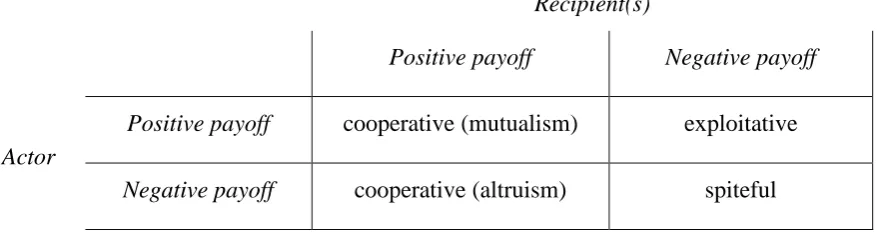
Following (W. D. Hamilton 1964a; 1964b) we can define altruism and cooperation in the abstract; to distil the problem, set the relevant terms, and frame the possible responses to it (West, Griffin, and Gardner 2007). Table 1-1 shows a modified version of Hamilton’s 2x2 matrix by which a social action can be categorised (a social action being one which has cost/benefit impacts on both the actor and at least one other individual – the recipient(s)). The top left cell classifies actions which benefit both the actor and her interaction partner(s). The cell below that includes actions which benefit the interaction partner(s) but are detrimental to the actor. Both classes of action might be labelled ‘cooperation’ but the later type of cooperation is ‘altruism’ in the technical sense; the conferring of benefit on others at personal cost to oneself, which cries out for a better explanation. Both cells on the top row are equally unproblematic: mutualist cooperation benefits the actor the same as exploitative behaviour1. The remaining cell is ‘spite’: acting in a way that harms the recipient while also at a cost to oneself. Genuinely spiteful behaviours, if commonly observed and not the result of error, are just as problematic for first-order evolutionary explanation as altruism.
Table 1-1 Categorisation of social behaviours according to payoff valence, positive (benefit) or negative (cost), for actor and recipient(s) (after (Hamilton 1964a)).
Recipient(s)
Positive payoff Negative payoff
Actor
Positive payoff cooperative (mutualism) exploitative
Negative payoff cooperative (altruism) spiteful
It is therefore the bottom row of the table which poses the prima face problem for evolutionary and/or game-theoretic explanations of human social behaviour, because both altruism and spite appear to exist in human societies. Especially in forager societies, we pool or share food and other resources, and act according to norms of generosity and self-restraint (the opportunity costs from refraining to exploit are effectively a form of altruism). We also often enforce our internalised norms via third-party punishment when minding our own business would be more
1 As well as active predation, exploitation, betrayal, and so-forth, this category also technically includes passive
profitable, i.e. by going out of our way to punish or berate the guilty at our own expense, perhaps risking backlash or reprisal. Because such behaviour may promote cooperation, it is sometimes called ‘altruistic punishment’ (Robert Boyd et al. 2003). The relative importance of these two types of behaviours (and the relationship between them) is a matter of active debate2, but for our purposes we can treat them as of the same, explanatorily problematic, kind for a fitness-based account of evolution.
With the problem stated this way, there are several ways of approaching the problem and explaining these phenomena. Most broadly, we can either look elsewhere for explanations (i.e. outside of fitness-based evolutionary explanations) or seek to re-frame the cited real-world phenomena so that altruism and spite behaviours collapse into mutualism and exploitation. 1.1.2. Inclusive fitness and kin selection
One potential re-framing strategy is via Hamilton’s notions of inclusive fitness and/or neighbour-modulated fitness (W. D. Hamilton 1964a; 1964b)3. A trivial case of altruism which conforms to this explanation is parenting. On the face of it, parenting involves the dramatic surrender of a considerable share of one’s resources and future potential, in order to create new human beings. But of course, this is naïve: psychological altruism and evolutionary altruism are not the same thing (Sober and Wilson 1999; Stich 2016) and maximising biological fitness is not co-extensive with this sort of crude rational egoism. Fitness-maximising actions are those which maximise one’s chances of having the most descendants, and so securing the survival and onward fitness of one’s own children is not altruism at all from evolutionary perspective, it is an act of evolutionary self-interest. Even a transfer of resources to my children which lowers my ‘narrow’ personal future fitness to some degree (in terms of having further children) but improves theirs to a much greater degree, can be a net benefit to my overall fitness. Inclusive fitness generalises this idea of an overall fitness to include other blood relatives: I can improve my inclusive fitness by paying a personal fitness cost in order to improve the fitness of close relatives, not just direct descendants. The condition for such an action being
2 See for example (K. Jensen 2010), and a series of papers by Patrick Forber and Rory Smead on the classification
of social behaviour, and how spiteful behaviour can lead to fairness (Forber and Smead 2014a; 2014b; 2015; 2016).
3 As with most writers, I will concentrate on inclusive fitness rather than neighbour-modulated fitness. For a clear
‘fitness-rational’ is the famous Hamilton’s rule inequality 𝑟𝑟𝑟𝑟 >𝑐𝑐, i.e. the benefit b to the recipient multiplied by the fractional relatedness r of the recipient to the actor must exceed the personal cost c to the actor4. Thus, Haldane’s supposed quip5 that he would sacrifice himself to save the lives of eight cousins (r = 0.125) or two brothers (r = 0.5). If an ostensive costly donation to one’s kin satisfies this condition, then (in terms of inclusive fitness) it is actually mutualism, not altruistic cooperation. Inclusive fitness becomes evolutionarily significant if an altruistic behaviour is more common among kin due to its heritability, and kin (and the trait) are positively assorted for some reason. Under these conditions – when the altruist trait benefits others who share it – selection can favour the evolution of that trait. This is kin selection. Inclusive fitness and kin selection are popular tools in biology which many biologists will defend as providing great insight (Abbot et al. 2011), but it is not clear how explanatory they are in the case of the human societies we are interested in. As we shall see, while forager societies often place great emphasis on being able to trace kinship connections, they are also often divided up into highly mixed interaction groups, making questionable a primary reliance on kin selection. For ostensive altruism to evolve by kin selection, there must be something that biases the positive assortment of relatives. If an actor is no more likely to interact with a close relative than a phylogenetic stranger, then there is no inclusive fitness incentive for cooperative behaviour. The two possibilities to secure positive assortment are i) viscously structured populations where offspring do not widely disperse, so are considerably more likely to interact with parents and siblings than they would in a mixed population, or ii) kin recognition: the ability to recognise (via observable traits) who is kin and who is not, with a preference to interact (cooperatively) with them. Studies of kin and non-kin interactions in
4 A more descriptively general form of the equation might be ∑ 𝑟𝑟𝑏𝑏𝑟𝑟>∑ 𝑟𝑟
𝑐𝑐𝑐𝑐. I.e. the sum of beneficiary
relatedness-times-benefit should exceed the sum of the donor relatedness-times-cost, considering every cost-paying donor and benefit-absorbing recipient (both types in relation to the agent whose action is being assessed). This allows calculation of actions which impose costs on others as well as the actor, and which can benefit more than one recipient. In the spirit of Haldane-meets-trolley problems, it would then be fitness-rational to throw no more than eight cousins onto the tracks to save two brothers, if no other means were available. The more familiar formulation is the special case of an act where there is a single beneficiary and the only donor is the actor (who is self-related at r = 1).
Note also that Hamilton’s rule also makes sense of spiteful actions: relatedness can be negative if the recipient is less related to the actor than the population average (represented by r = 0), predicting that it might pay to expend one’s own resources on damaging the fitness of non-kin competitors (especially in a smaller population where a greater relative advantage is obtained).
5 See (Birch 2017, 1–4) for an entertaining overview of the mythos surrounding Haldane, Hamilton, and the early
humans support the idea of closer cooperation with kin to some degree, but the evidence is mixed and the significance of Hamilton’s rule, inclusive fitness, and kin selection is disputed (Nowak, Tarnita, and Wilson 2010; Birch and Okasha 2015). And in larger societies neither assortment mechanism is adequate to explain the common practice of cooperation with non-kin.
1.1.3. Strategies and reciprocity
Another re-framing strategy is via diachronic, contextual, ‘holistic’ or, ‘life-strategy’ reframing of the problem cases (call this the holistic strategy). On this view, instead of individual acts of generosity, punishment, or norm-following, it is human capacities and dispositions for these behaviours (over an extended time) that are the proper units of selection. On this longer-term view, a community of unconditional co-operators look less like altruists in the technical sense. The benefits conferred on others at a cost on a short timescale are reciprocated by others following the strategy, meaning that when viewed on a whole-life timescale, their unconditional cooperation strategy is mutualism not altruism. But this is a naïve redescription and the basic problem remains: the first member of that kumbaya community to turn exploitative would receive a much greater payoff and therefore be evolutionarily favoured. A population following unconditional cooperation strategies can be invaded by agents following unconditional ‘exploit’ strategies and is therefore unstable. The natural next step is to consider conditional strategies and reciprocity.
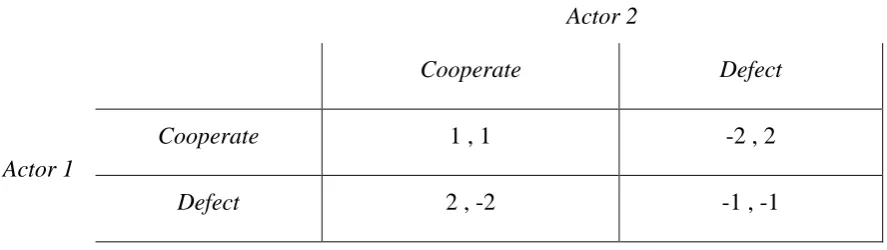
> spite > altruism6. That is to say, a player benefits most by defecting on a co-operator, with mutual cooperation being second most valuable, mutual defection third, and being defected on while cooperating the least preferred. This ordering means that the only stable combination of strategies is mutual defection, since it is better to defect on both cooperation and defection. Originated with game theorists in the RAND corporation in the 1950s with the name coined by Albert Tucker (Tucker 1983; Poundstone 1993), the prisoner’s dilemma has become the standard formal representation of the cooperation problem and linked (accurately or otherwise) to social dilemmas such as the tragedy of the commons (Hardin 1968).
Table 1-2 Payoff matrix for the Prisoner’s Dilemma: standard form game for two actors
Actor 2
Cooperate Defect
Actor 1
Cooperate 1 , 1 -2 , 2
Defect 2 , -2 -1 , -1
A well-established literature exists with respect conditional cooperation strategies in the cooperation problem; originating (for our purposes at least) with Trivers’ model of reciprocal altruism (Trivers 1971) and Axelrod’s demonstration of the relative viability of a ‘tit-for-tat’ strategy in simulations of repeated interactions (Axelrod 1980a; 1980b). Axelrod’s computerised tournaments pitted different strategies against each other over many iterations of a prisoner’s dilemma game. In a single iteration of the prisoner’s dilemma game, the best move is to defect (as no matter what the other player’s move is, defecting delivers the superior payoff). But in the iterated prisoner’s dilemma a different dynamic is introduced which can permit a cooperative equilibrium path (previously known via the so-called ‘folk theorem’). Tit-for-tat is a strategy where a player begins by cooperating, but in subsequent rounds conditionalizes on the behaviour it received in the round prior. Tit-for-tat does marginally worse than ‘always defect’ in head to head matchups (as it will be exploited in the first round). But if
6 Note that the number values here have been chosen to emphasise the similarity to Hamilton’s categorisation
two tit-for-tat players meet then they will do as well out of each other as two ‘always cooperate’ players would – while the ‘always cooperate’ players would be brutally exploited by ‘always defect’. Surprisingly, in open competition between various strategies (some of them far more complex), it is hard to beat tit for tat in terms of overall performance. And, though there are differences here that are important in other contexts, the notion of reciprocal altruism is broadly analogous: a strategy which is sophisticated enough to recognise cooperation and reward it with further cooperation can do better under certain conditions.
It is possible then that in a competition of many potential strategy types over an extended timeframe, conditional cooperation strategies might do better than constant defection/exploitation, even in extremely competitive strategic situation approximating the prisoner’s dilemma. It is even tempting to see this as a model for the evolution of behaviour-guiding cooperative norms and social preferences: conditional strategies that were constructed out of various social attitudes and dispositions because they paid off for their adherents over some relevant evolutionary timeframe.
But there are well-known formal details here which throw spanners in the works (see (Bowles and Gintis 2011) for a more thorough overview). First, tit-for-tat and similar strategies are not robust to error, because if one of a pair of tit-for-tatters mistakes the other’s action for defection then they will collapse to mutual defection. Second, in a finite sequence of games there is an incentive to defect in the last round of the game, but if such behaviour is available as a strategy then this incentivises even earlier defection (you want to the first to defect, not the last), collapsing the cooperative equilibrium. In other words, cooperation is stabilised by some ways that players might conditionalize behaviour on the game context, but other ways (beneficial to the player) will destabilise it. Games of more than two players (n-player games) are unstable for similar reasons, as any defection by some players can likewise trigger a cascade of further defection (you don’t want to be the last one cooperating).
(i.e. withholding cooperation or productive labour in a collective project) should just undermine cooperation, especially in n-player games. Such tactics can work in real human societies because they can shame the offenders back to good behaviour. But shame as a robust moral emotion (or more generally, a normative social disposition) is akin to the propensity to punish defectors by being exactly the sort of proximate mechanism we are trying to explain as conditional strategies. Strategies need to be incentivised somehow to be explicable in evolutionary terms. This is not to say that punishment strategies are a dead end, and they are the subject of ongoing formal and empirical research, e.g. (Robert Boyd, Gintis, and Bowles 2010; Bowles et al. 2012). But such studies show that will have to be highly specific and targeted (especially in the n-player game) and preferably coordinated, requiring a high degree of sophistication and supporting social infrastructure. This suggests that punishment may play a greater role in stabilising mature cooperative societies, rather than bootstrapping them into existence.
These are some of the standard problems with reciprocity and conditional strategies as explanations of cooperative societies, some of which will reappear in application to the human evolutionary timeline in section 1.3. Real-world conditional strategies that support cooperation would have to be quite sophisticated and multi-layered, as well as more forgiving than would be ideal for short term payoff maximisation, making their robustness against exploitative invasion less certain.
applied, with an unpredictable connection between endorsed principles and actual behaviour7. So, unless unsophisticated social strategies are conceived of loosely enough to be realised by basic temperament (i.e. a probabilistic disposition for annoyance and retaliation), it is dubious to suppose that they are highly robust, developmentally or genetically entrenched selected effects. We should not be too precious here with respect to demanding all the details, but the applicability of game theoretic strategies to human behavioural strategies is an open question. A tentative corollary of this is that the more powerfully specific the supposed strategy, the less plausible it is to project its evolution onto real populations. Arbitrarily complex strategies can be codified and vertically transmitted generation-to-generation (like alleles) only in computer simulations. Treating strategies as basic units of selection is a simplifying idealisation that should be kept in mind before we move from studying the dynamics of games themselves (an interesting academic pursuit in its own right) to drawing explanatory lessons for human social evolution. And a stronger potential concern can be pressed as well: while we can study idealised models of precise, neatly defined strategies subject to selection pressures, it is questionable whether humans really have consistent and robustly action-guiding strategies, as opposed to ostensive principles on one hand, and patterns of behaviour on the other. So, it is even more questionable that they might all at once be sufficiently powerfully specific, sufficiently stable over time, and sufficiently heritable to be subject to selection. Addressing such worries is by no means impossible, and the literature on the psychology and evolution of norms might be of great relevance here8. But there is a thicket of questions with regard to how formal strategic models might be best applied to human reality.
1.1.4. Group selection
For our purposes, it will help to think of inclusive fitness and strategic/reciprocity as ‘reframing’ approaches. Each alters the accounting system for cost and benefit and shifts the
7 See for example the literature on the classic ‘good Samaritan’ experiments (Darley and Batson 1973). Mutation
rates are often included in the update dynamics in models of strategy evolution to account for imperfect conservation of strategies over time. However these tend to be quantitative: e.g. there being a chance of an alteration in the agent’s likelihood of cooperating or not conditional on some relevant variable (see (Gintis, Smith, and Bowles 2001) for one good example of this). The point here is that strategy conservation in real agents should also depend in a qualitative way on the psychological and epistemic dependencies of that strategy, with some being more fragile than others, with mutation having a ‘collapse’ bias.
8 Especially on the psychology of norms e.g. (Sripada and Stich 2006), and on the nature and potential evolutionary
operational focus of evolution away from the agent’s immediate ostensive actions and payoffs. For kin selection, the focus is extended to include the payoffs of relatives. Reciprocity/conditionalization shifts it from acts to strategies and/or extends the payoff time horizon. Each approach has potential, but this comes with complications and limitations especially in the real-world context.
A similar move to acknowledge (in the broad respect of reframing the first-order problem) is to appeal to group or multi-level selection theory, which has it that altruistic individuals proliferate not due to their individual fitness, but due to the fitness of the group they are a part of relative to competing groups. Fitness accrues at the group level, either directly distributed among its members to turn losses into gains (so-called multi-level selection 1, or MLS-1 (Heisler and Damuth 1987)), or alternately driving the propagation of groups as higher-level individuals (MLS-2). If anything, group selection is far more complex and controversial than kin selection and reciprocal altruism. For example, MLS-1 is often seen an occasionally-useful heuristic but mathematically equivalent to standard fitness considerations (Kerr and Godfrey-Smith 2002), or better folded into a more general conception of inclusive fitness and social evolution (Birch 2017). MLS-2 is a more radical proposal, but problematically so in that it posits adaptation at the group level, not just selection (Gardner and Grafen 2009), and a degree of group unity over time that appears implausible, at least in the human case (see 1.3). For either version to work, there must also be i) significant inter-group competition, and ii) robust disincentive against group members who are insufficiently altruistic, perhaps via problematically costly punishment (Williams 1966)9. Recent work on multi-level selection has also focused on the conditions for it in major evolutionary transitions such as the evolution of multicellular life (Okasha 2006; Clarke 2014), with some theorists following on from original suggestions in (Szathmáry and Smith 1995) that the evolution of distinctively human forms of sociality constitute a more recent transition (Powers, Schaik, and Lehmann 2016). How literally to take this characterisation is controversial.
Group selection in general has also seen more conventional use in a number of explanatory projects with respect to human sociality, notably (Boehm 1999), (Wilson 2003), and (Bowles and Gintis 2011). Wilson for example argues that altruistic punishment can be an “altruism
9 Indeed, it is with Williams’ influential objections to early group selection that the cost-shifting/circularity of
amplifier” by being cheap with respect to costs paid vs costs inflicted; though it is far from clear how this should be modelled (Okasha 2003). It also appears to assume an asymmetry in retaliation capability (as an equal ability to punish the punishers will tip the scales back again). Bowles and Gintis instead make a strong case via formal modelling for the viability of a complex group selection process to explain social preferences. More specifically, their view is that group selection drove the evolution of a form of parochial altruism: altruistic behaviours directed at in-group members, and spite-like behaviours directed at outsiders. The idea is that biological and cultural traits for in-group cooperation co-evolved as the flipside of outgroup hostility; in a competitive group selection process where the more cohesive groups wiped out the less cohesive groups (and their members). Cohesiveness was thereby selected for despite the individual costs involved in looking toward group welfare rather one’s own. The reason that I will not be considering this view further is that it seemingly requires a level of competition and conflict between ancient human forager groups that is empirically suspect (Sterelny 2016). Group selection remains an intriguing possibility, especially if inter-group competition over cohesion might be reimagined in a more indirect manner10, but it is one that I will be largely leaving to one side.
A related debate I will merely acknowledge is that about the independence or otherwise of group selection from kin selection and reciprocal altruism. As already noted, (Birch 2017) argues for a framework (based on Hamilton’s rule) that would encompass MLS1 group and kin selection, and the formal equivalence of these (under certain assumptions) is well understood11. In contrast, (Sober and Wilson 1999) describe reciprocal altruism and kin selection as special cases of group selection, though this arguably relies on an unjustifiably broad conception of groups (M. Barrett and Godfrey-Smith 2002). As Barrett and Godfrey-Smith note, each mechanism works by engineering the correlation of behaviours: by kin preference/limited
10 For example, (Robert Boyd and Richerson 2009) also identify imitation and selective migration as potent
mechanisms of cultural group selection, and stress that even violent conflicts can be reasonably bloodless, with losers merely intimidated into retreat or assimilated by the winners. Another mechanism might be differential vulnerability of small-world economies to collapse under environmental stress; e.g. when drought strikes, or the game dries up. For obligate co-operators such as humans in forager societies, having one’s group disintegrate under such conditions (or just fail to function efficiently) is bleak prospect. Such relative intrinsic robustness might be just as effective as relative capacity for warfare in generating differential prospects for groups, and incentivising looking after one’s own.
11 Though see also Birch’s defence of the applicability conditions for group vs kin selection descriptions of social
dispersal, group structured populations, or strategy conditionalization. This is a key point: the positive assortment of co-operators is crucial for the endogenous12 evolutionary explanation of cooperation. Whether there are deeper connections is not a subject for now.
1.1.5. Strategic context
[image:29.595.75.527.401.488.2]To conclude this section on responses to the cooperation problem we can consider one final reframing strategy: to reframe the cooperation problem itself. In the discussion of the conditional strategies I introduced the prisoner’s dilemma as a strategic model of the cooperation problem, and pointed out that imagining ad hoc, exogenous punishment of defectors counts as ‘cheating’ by altering the stipulated model. Likewise, it is cleating to take as given any other evolutionarily improbable cooperation-stabilising mechanisms, like complex social institutions or predilection for altruistic/spiteful punishment. But it is not cheating to question whether the prisoner’s dilemma is the most appropriate model for the predominant strategic contexts of ancestral human environments.
Table 1-3: Comparison of three payoff matrices for modelling strategic social interaction
(a) Prisoner’s dilemma (b) Stag hunt (c) Coordination
C D C D C D
C 1 , 1 -2 , 2 C 2 , 2 -2 , 1 C 1 , 1 -1 , -1
D 2 , -2 -1 , -1 D 1 , -2 -1 , -1 D -1 , -1 1 , 1
Table 1-3 reproduces the prisoner’s dilemma in abbreviated form (1-3a) and contrasts it with the two other common 2-player games, the Stag Hunt (b) and a coordination game (c). The row player and column player have the same moves available, labelled C and D. In the coordination game there is no conflict of interest and the players prefer the same outcomes, where their behaviours complement each other. There are two equilibria in this game: both play C, and both play D. The common illustration is choosing which side of the road to pass on: it doesn’t matter which side is chosen, as long as both players make the same choice. The stag hunt shares
12 Exogenous explanations might include actual punishment of defectors by God, or selective breeding by
features of both the coordination game and the prisoner’s dilemma13. As in the prisoner’s dilemma, it makes sense to interpret C and D as ‘cooperate’ and ‘defect’ because defecting is always costly for the other agent. But unlike the prisoner’s dilemma, defecting only makes things better for the player if the other player defects: the rational response to cooperation is cooperation. Like the cooperation game then, the stag hunt has two stable equilibrium end-states C-C and D-D, but with the cooperative (mutualism) equilibrium being more valuable. The stag hunt is the game which the prisoner’s dilemma turns into if exploitation is significantly punished, or in some other way moved one place down in the preference ranking of outcomes. Brian Skyrms has argued that the stag hunt has been unfairly overlooked in the formal literature as a potential model for cooperation problems (Skyrms 2003). First, prisoner’s dilemma situations can be transformed into stag hunts in a number of ways (other than directly modifying the payoff structure), including by the iterated play of prisoner’s dilemma games under certain conditions14. Because it is rational to cooperate when you expect your partner to cooperate, the robustness of the cooperative equilibrium requires trust to win out over risk-aversion. Skyrms demonstrates several formal results, for example: in interactions between strangers we should not expect the cooperative equilibrium to do significantly better than the defection equilibrium, but in interactions between neighbours, cooperation is much more likely (eventually). Behavioural ‘nudges’ that we can reasonably imagine being delivered by simple social institutions (i.e. that upregulate trust) could therefore make a significant difference in collapsing populations toward cooperation and be strongly incentivised for that.
So, while escaping the prisoner’s dilemma is usually seen as the gold standard for cooperative explanations, it would make a real difference if this turned out to be setting the bar too high with respect to the actual evolutionary history of human cooperation. We know that human beings did learn to cooperate, and (assuming the learning was a fitness-driven evolutionary process) it is reasonable to suppose that they did so unaided by freak exogenous intervention. If so, then perhaps part of the way out of the human cooperation puzzle (within the adaptive
13 The term stag hunt comes from an example story by Rousseau: two hunters each have the choice between
working in concert with the other to hunt a stag, or ‘going it alone’ to catch a hare (meaning the other is left with nothing, if they embark on the stag hunt alone).
14 For example, the threat of retaliation by a vindictive partner (aka the ‘shadow of the future’) can change lower
evolutionary paradigm) is to re-evaluate the problem we are trying to solve; by looking in more detail at the mapping between strategic models and the human evolutionary past.
The question then becomes about the strategic environments our evolutionarily-recent human ancestors lived within – with respect to our cooperative social preferences (however these are specified) and how they might have evolved in response. There too many gaps and moving parts here to allow for much more than speculation, but we can make a few observations and gesture at a potential argument. To prefigure section 1.3 somewhat, an interesting feature of the prisoner’s dilemma is that the examples associated with it tend to be rather ‘Holocene’ in character, compared to the hunting interpretation of the stag hunt. E.g. the tragedy of the commons is a problem because moving on to greener pastures (as foragers do) is not an option. Even the eponymous interpretation of the prisoner’s dilemma (two prisoners facing the choice whether or not to rat each other out to the authorities) implies layers of norms, hierarchies, and other social institutions that might be quite alien to human enculturated within Pleistocene social worlds.
Any such empirically fleshed-out account would need to have a narrative skeleton roughly as follows. First, conventions naturally arise in coordination games of mutual interest. These conventions breed a certain degree of trust, which bleed over into stag hunt-style situations to beneficial effect. Further conventions and assurance devices would be beneficial in this sort of social environment, such as socially shaming the risk averse as cowards as a weak form of punishment, in an environment where it is beneficial to evolve a sensitivity to shame15. Such social infrastructure in turn rewards closer, more economically entangled lives – potentially addressing the ‘other’ cooperation problem of generating benefit (see Calcott 2008). This makes prisoner’s dilemmas more common, which incentivises more stringent social infrastructure, and so-on, up to a point where institutional mechanisms are sufficient to stabilise cooperation in an environment where prisoner dilemmas predominate.
Key to any such approach would be a move already discussed: appealing to the blurring effects of evolutionary time horizons, lack of information, or lack of strategic specificity. The grain at which selection acts will therefore be crucial. On one hand, if selection were highly specific, then it may not matter much whether prisoner dilemmas or stag hunts were more common because distinct stag-hunt strategies would not ‘bleed over’ into cooperation in prisoner’s dilemmas. On the other hand (metaphorically speaking), if evolution does not know which games you are going to play and the contexts in which you play them, it is unlikely to be able to optimise your strategies to each class of games you actually face in the moment. The best it can do is provide some kind of satisficing toolkit. Likewise, agents unsure whether they are in a stag hunt or a prisoner’s dilemma (or unable to switch strategies on so rapid a timescale) will tend to evolve strategies which hedge their bets and do acceptably well in the prevailing strategic mix of that environment.
While this explanatory possibility is highly speculative, it demonstrates the need to carefully consider the mapping between evolutionary models and the actual evolutionary facts as we know them.
15 As, unlike in the prisoner’s dilemma, there is a more valuable cooperative equilibrium in the stag hunt which it
1.2.
The problem of religion: maladaptation and cultural evolution
The previous section was entirely focused on sociality and the traditional cooperation problem, neglecting religiosity as a distinct problem. To a certain degree, explanations of the costliness of religion will mirror many of the same moves we have just seen. Acts of religious devotion often include donations to the religious community: barn-raising in Amish communities, tithing, or other transfers of resources from the individual to the community (with religious authorities taking a cut), or from individual to individual. But many other costly forms of religious expression are not just costly to the actor, but also yield no discernible benefit for anyone at all. Giving up one’s foreskin to the community is not a donation (at least not one of any significant material value). Yet circumcision is a relatively widespread religious rite in religious societies both developed and traditional, and extreme forms of ritual, non-therapeutic mutilation (with attendant risks of infection or long-term impairment) are not uncommon. Stunning, widely-discussed examples of this include the male initiation rites traditionally practiced by many Aboriginal Australian peoples involving penile subincision: cutting open the underside of the penis to convert the urethra into an open channel (Pounder 1983). More prosaically, simply attending a long religious ritual is an opportunity cost with respect to how that time might have otherwise been spent, but these are loss-making exercises with no material upside to anyone. Likewise, acquiescing to seemingly arbitrary restrictions on dress, diet, and behaviour removes options that might be potentially valuable (especially when subsistence is marginal) but pay no communal fitness dividend.
The actual costs or benefits (overt and hidden) of individual examples can be disputed, of course. Circumcision may be protective against disease. Donations toward functionally useless religious infrastructure might be economically and culturally stimulating, with indirect benefits. Food taboos might have roots in sensible hygiene practices. But it is hard to deny that much religious activity seems straightforwardly wasteful, irrespective of how the payoffs are framed.
scientific approaches to understanding religion propose maladaptive explanations, some of which dovetail with maladaptive explanations of cooperation. I turn to these after a quick acknowledgement of an elephant in the room: the fact that what constitutes religion is disputed. 1.2.1. Religion’s demarcation problem
Religion is a many-faceted phenomenon, and it tends to get described by researchers in ways that say as much about their own research questions as they do about the phenomena. That is certainly the case for early attempts at pinning it down. For example, for William James, religion was: “The feelings, acts, and experiences of individual men in their solitude, so far as they apprehend themselves to stand in relation to whatever they may consider the divine” (James 1902). Emile Durkheim famous defined religion as “a unified system of beliefs and practices relative to sacred things, that is to say things set apart and forbidden - beliefs and practises which unite into one single moral community called a church, all those who adhere to them.” (Durkheim 1912). Note the difference in focus; even if these authors were not famous founding figures in their modern academic fields, it should be obvious that Durkheim was a sociologist and James a psychologist. The classes of target systems which each give the name ‘religion’ (the psychological phenomenon and the social phenomenon) reflect the academic context, methodological toolkit, and objects of study which each are familiar with. Wield a hammer and every problem looks like a nail.
‘concealed’ but also part of the natural world (Gall 1999). Some religions such as Jainism vehemently oppose the notion of powerful divinities, portraying what ‘supernatural’ entities as exist in their cosmologies as mortal and more akin to humans than the Abrahamic notion of God. If we loosen the notion of ‘spiritual’ entities to include such entities, and others such as souls or karma, then a ‘supernaturalist’ definition along the lines of Tylor’s would be more inclusive. But there is a danger in this case that ‘spiritual’ or ‘supernatural’ just comes to mean something not attested to by modern science, inviting comparison to Hempel’s dilemma and other well-worn philosophical problems with defining physicalism and the physical (Ney 2008; Stoljar 2010). Just in terms of mismatch with common sense, this would also be potentially problematic because the ether and phlogiston were clearly not religious concepts, but nor (arguably) are beliefs in psychics, UFOs or the occult. Religious belief-systems might be loosely described as ‘bad science’, to the extent that they try to explain the world as it appears by positing concealed forces and/or entities, but they are more than just bad science. Or at least that’s the presumption of a positive demarcation project for religion regarding supernaturally flavoured descriptive content. The ultimate ‘test’ question for this approach is whether ‘naturalistic religion’ makes sense, or whether putative cases of it (which might include Confucianism, some forms of Jainism or Buddhism, and some contemporary ‘Christian’ sects such as non-theistic Quakerism) are simply descriptive confusions.
As noted by (Dawes and Maclaurin 2013) among others, there is very little commonality in content between all the things which get described as religions. Perhaps not surprisingly, many scientists of religion downplay the importance of belief to religion, and defend the view that ritual and other pragmatic patterns of behaviour are more important (Sosis and Kiper 2014) as well as (not coincidentally) more stable and empirically tractable. For example, (Rappaport 1999) argues that ritual is a) constitutive of religion, b) socially fundamental in terms of relating people to one another, and c) in many cases responsible for creating the sacred, not just responding to it (e.g. by sanctifying objects, people, etc). On this approach, religion is foundational to traditional human social life, and the proper study of religion and its social significance is captured by the study of such rituals, big and small. It is tempting to think that a modern science of religion as ritual might simply pin down the subject matter by surveying it thoroughly. I.e., look at all the forms taken by “religious life” (broadly construed), and let a more precise grasp of what we’re talking about just fall out of the commonalities and family resemblances which are discovered. But it we should be equally sceptical that such a change in focus will find many characteristic universals across (for example) Roman Catholicism, Jain ritual, foragers religions, and cargo cults. Religion is weird in the sense that it is both pervasive and incredibly diverse. Like language, all human cultures seem to have it, but it’s hard to find any common core between them16. It is not clear if there is anything unifying at all about all the things we might want to call religion, other than our disposition to call them by that name, and certainly it is difficult to come up with a set of necessary and sufficient conditions which picks out all and only the things we tend to want to hang the name on.
Several fall-back approaches are possible of course. One is to bite some arbitrary bullets: Jainism is not a religion, Marxism is, etc. Another is to give up on ‘religion’ and instead study beliefs in deities, or sacred values, as their own separate, operationalizable domains of inquiry. A more hopeful option is to give up on necessary and jointly sufficient conditions for religion, and make do with ‘fuzzy’ characterisation rather than demarcation (Sosis 2009). Indeed, this is entirely compatible with studying religion as a social phenomenon ala Durkheim, but some sort of principled choices will need to be made with respect to inclusions, at least to pick out representative case studies. A popular version of this is a ‘dimensional’ approach: to specify a of indicative features, such that all undisputed cases of religion have some of those features to
some degree. An influential example of this can be seen in (Smart 1989), however the dimensions cited here (e.g. practical/ritual, mythic/narrative, experiential/emotional) are so broad that they (by the author’s own admission) apply just as well to any powerful world-view: religious or secular. At the very least, such approaches are obliged to allow (or ignore) borderline cases of religion and are resigned to a degree of ambiguity about the limits of the concept. Another fall-back is to give up on the term religion altogether and focus on one or more of the indicative traits as interesting targets of scientific study themselves. In this way, study of (for example) religious ritual and its role in created ‘identity fusion’ with a group (Whitehouse and Lanman 2014) can be continuous with the study of ritual and fusion in the context of warfare (Whitehouse 2018a) or football hooliganism (Xygalatas 2018).
So it is doubtful that religion (as a scientifically interesting concept) is satisfactorily captured by focusing just on a certain phenomenon17, as religion and religiosity are more than any of these individually. But outright eliminativism about religion is impractical, at least for current purposes. It would be tempting to cheat and stipulate a working definition along the lines that religions are those parts of cultures toward which resources are uselessly expended (though this of course would face its own over-generation problem). But this is not required. In evaluating a theory like the signalling theory of religion and the role it might have played in the evolution of human society, it is not strictly necessary to have a cut and dried description of religion. Siding with Sosis and others, it can be good enough that we can recognise it in paradigm cases and tolerate the existence of borderline cases.
But we can (and should) say more than this, because there are two ways of being ‘borderline’. First, there can be borderline cases by vagueness: e.g. how highly a cultural practice or belief system scores along a set of characteristic features/dimensions (supernaturalism, ritual, etc). But there is also ambiguity: exactly which dimensions should be included in that characterising set? A paradigm religion like Roman Catholicism will score highly on all plausible sets of characteristics and so be recognised as such. But it may be being so-recognised for different reasons; and focusing on the evolution of different feature-set configurations (and traits that enable them) might still lead in different directions. This means that we still need empirical reality to be such that there is an actual ‘cluster kind’ (whatever the cluster might be) for us to
17 Which (to recap) might include cognitive capacities, social predilections, belief contents, propensities to believe,
be latching onto. This broadly coheres with the Quinean notion of ‘family resemblance’. I.e. we can identify religious practices as such not by exhibiting necessary and sufficient traits/conditions from some list of religious traits, but because subsets of such traits tend to go together. The justification of ‘religion’ as a concept comes because every culture exhibits a substantial subset of these traits (despite no core, essential feature that they all share) at a level above what might be expected if they were just random cultural tropes, and (crucially) because these traditions are more similar to each other than they are to other cross-culturally recognisable traditions (such as foraging practices or athletic traditions). If so, something being ‘religious’ would depend on intrinsic features to some degree but mostly on extrinsic context: the fact that religious feature subsets reliably recur and persist, and in a way that ‘stick out’ as being salient and distinctive. Whether this means that ‘religion’ constitutes a natural kind is a question I won’t address.
Other than these metaphysical and empirical assumptions, there will be other limitations on scope with respect to investigating religious signalling theory. For the most part, I will be talking about religions as public phenomena – belief is important, but only insofar as it influences participation in religious practice and the integration of that practice into social life. So, rituals, behavioural norms, and associated social infrastructure will be the focus. But the assumption will be that certain ‘supernatural’ beliefs are especially apt for playing a facilitating role. I.e. while I follow (Bloch 2008) and others in seeing religion as deeply integrated into social life, I don’t assume that is all there is to say about it. Part of what tends to make religious practices distinctive and potent is that they are packaged up with cosmologies which are used to justify the practices but are themselves epistemically intractable, in that they include ‘exotic’ entities and forces outside of evidence and everyday experience. It is not just that the ritual is done, it is that it is accompanied by a story (believed by all or not) about why the ritual is important; a story which reaches beyond the mundane. This is the (admittedly hand-wavy) notion of religion and religiosity that I will be proceeding with.
1.2.2. Evolutionary explanations of religion: adaptive, mismatch, and by-product
ways of carving up the space of evolutionary explanations, all of which require a certain amount of shoehorning with respect to borderline cases and hybrids.
As summarised by (Sosis and Kiper 2014), one initial way of splitting the literature is into two main disciplinary streams: the approaches of cognitive scientists, and the those of researchers who use the tools of behavioural ecology. According to Sosis and Kiper, evolutionary cognitive science approaches tend to see the proclivity toward religious beliefs, commitments, and behaviours as the un-selected by-products of other cognitive traits that were positively selected for. Classic expositions of such approaches can be found in (Atran 2002) and (Boyer 2001). Atran for example frames the preface of his book with the question “stone age minds for a space age world?”, and surveys possibilities around the idea that religion is a cognitive by-product of other cognitive systems (by-by-product views are common enough that (Powell and Clarke 2012) call this the ‘standard model’). Behavioural ecology instead focuses on religious behaviour and how its costs and benefits can be made sense of in an economic or evolutionary sense. While this distinction loosely reflects the focal aspect difference between James and Durkheim (i.e. between religion as a psychological or social phenomenon), it is possible for the disciplinary and focal distinctions to cross-cut. We can have behavioural ecology explanations of beliefs via practices, or cognitive science approaches to the forms that religious practices take.
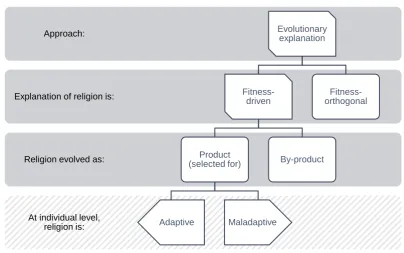
We can break down the possibilities according to categorical answers to several questions; as shown in figure 1-1. Staying agnostic about the primary religious phenomena to explain, evolutionary approaches will either explain them as the result of fitness-driven adaptations, or as fitness-orthogonal processes. Examples of the latter include drift and (some forms of) cultural evolution. Examples of the first type are natural selection and sexual selection at the individual level, or kin selection or multi-level selection. The next question (for fitness-driven explanations) is whether the religious traits were directly selected-for, and are therefore the products of these processes, or are just by-products of other selected traits.
Figure 1-1: A conceptual breakdown of evolutionary explanations for religion
I will treat the question of whether the religious traits are individually adaptive in their current/observed/relevant18 environment is one that cross-cuts with the other distinctions, rather than representing a further branch of classification with respect to origin explanation. Mismatch explains why a trait is costly, but not why it is. It can be due to selection having acted at a level other than the individual, to environmental change since the trait was selected for. Contingent environmental change can also generate a mismatch between fitness-produced
18 Given the context of enquiry, ‘current environment’ might usefully be extended back to something more distant
but ethnographically proximate; ignoring post-industrial modernisation or looking at ‘traditional’ societies to screen out the effects of significant cross-cultural contamination.
At individual level, religion is: Religion evolved as: Explanation of religion is:
Approach: Evolutionary explanation
Fitness-driven
Product (selected for)
Adaptive Maladaptive
By-product
traits and their environment, or a match for by-products and orthogonally evolved traits (though this is less likely). In principle then there are six possible classifications for religion; three (pure) evolutionary origin types – product, by-product, and orthogonal – which might be adaptive or maladaptive at the individual level (evolutionary products also decompose by mechanism of selection). This is my preferred way of organising the terms in the literature, such as adaptation/adaptive (sometimes used co-extensionally), by-product, and maladaptive (sometimes used for both maladaptive products, and orthogonally generated traits).
Here then are a few of the main explanatory themes in the literature, according to this schema:
Adaptive product
• Signalling theory: religious ritual is a costly/honest signal that helps solve the
cooperation problem by improving positive assortment (see chapter 3 onward).
Maladaptive product
• Group selection: religion (broadly speaking) is a group-level adaptation that improves
group fitness by helping solve the cooperation problem (Wilson 2003; Haidt 2013).
• Social technology: religious ritual evolved via cultural group selection to induce
cohesion/binding with the group and its priorities (Whitehouse 1995; Whitehouse and Lanman 2014).
Maladaptive by-product
• Hyperactive agency detection disorder (HAAD): there is an otherwise fitness-enhancing cognitive bias toward the attribution of agency (since false positives are less dangerous than false negatives). Religious beliefs are by-products of this over-sensitivity (Guthrie 1995; J. L. Barrett 2000; Atran 2002).
• Precaution systems: ritualised behaviour is produced by a (generally)
fitness-improving cognitive/neurological system which evolved to trigger/automate precautionary behaviours. Religious rituals (and their justificatory constructions) are by-products of this (Boyer 2001; Boyer and Liénard 2006).
• Existential crisis: as a by-product of expanding cognitive capacities, humans came to
fear their own mortality and seek comfort or meaning not forthcoming from the natural world (Freud 1927; Bergson 1932).
Maladaptive orthogonal
Some of these explanatory approaches have already been discussed in passing (and others will be raised in what follows) and some interpretation is also required in mapping them to my categories. But a comprehensive overview of them is not vital to the research project in any case. More important is the relative positioning of signalling theory, which is one of the few theories to uncontrovertibly posit an individual fitness benefit for religious behaviour. One other notable claim to individual fitness benefits has been made by Dominic Johnson, who argues that the self-restraint from ‘bad’ behaviour caused by fear of supernatural punishment was actually individually adaptive (Johnson 2015; Johnson and Bering 2006; Johnson and Krüger 2004). But this explanation appeals (in part) to changes in the human strategic context such as the emergence of language, arguably a game-changer with regards to the ability of cheaters to avoid detection and spiteful punishment. Johnson argues that fear of divine punishment helped avoid such traps, i.e. HAAD-style cognitive biases spawned false beliefs, but these turned out to be adaptive given independent contingent changes in the state of ancestral human behavioural ecology. Therefore, although Johnson himself describes the view as relying on individual fitness (and a proper re-interpretation would require more detailed attention) it is at least arguable that it might better be classified as a rare ‘adaptive by-product’ theory under my schema. Kim Sterelny in (Sterelny 2017b) offers a less ambiguous and more sophisticated evolutionary narrative based on individual fitness, where a series of interactions between fitness, behavioural ecology, and human idiosyncrasies propel the phased ‘ratchetting up’ of religious and social activity (more about this in section 1.3).