Introduction to Data Compression
Guy E. Blelloch
Computer Science Department
Carnegie Mellon University
October 16, 2001
Contents
1 Introduction 3
2 Information Theory 5
2.1 Entropy . . . 5
2.2 The Entropy of the English Language . . . 6
2.3 Conditional Entropy and Markov Chains . . . 7
3 Probability Coding 9 3.1 Prefix Codes . . . 10
3.1.1 Relationship to Entropy . . . 11
3.2 Huffman Codes . . . 12
3.2.1 Combining Messages . . . 14
3.2.2 Minimum Variance Huffman Codes . . . 14
3.3 Arithmetic Coding . . . 15
3.3.1 Integer Implementation . . . 18
4 Applications of Probability Coding 21 4.1 Run-length Coding . . . 24
4.2 Move-To-Front Coding . . . 25
4.3 Residual Coding: JPEG-LS . . . 25
4.4 Context Coding: JBIG . . . 26
4.5 Context Coding: PPM . . . 28
This is an early draft of a chapter of a book I’m starting to write on “algorithms in the real world”. There are surely many mistakes, and please feel free to point them out. In general the Lossless compression part is more polished than the lossy compression part. Some of the text and figures in the Lossy Compression sections are from scribe notes taken by Ben Liblit at UC Berkeley. Thanks for many comments from students that helped improve the presentation.
c
5 The Lempel-Ziv Algorithms 31
5.1 Lempel-Ziv 77 (Sliding Windows) . . . 31 5.2 Lempel-Ziv-Welch . . . 33
6 Other Lossless Compression 36
6.1 Burrows Wheeler . . . 36
7 Lossy Compression Techniques 39
7.1 Scalar Quantization . . . 39 7.2 Vector Quantization . . . 41 7.3 Transform Coding . . . 42
8 A Case Study: JPEG and MPEG 42
8.1 JPEG . . . 43 8.2 MPEG . . . 46
9 Other Lossy Transform Codes 49
1
Introduction
Compression is used just about everywhere. All the images you get on the web are compressed, typically in the JPEG or GIF formats, most modems use compression, HDTV will be compressed using MPEG-2, and several file systems automatically compress files when stored, and the rest of us do it by hand. The neat thing about compression, as with the other topics we will cover in this course, is that the algorithms used in the real world make heavy use of a wide set of algo-rithmic tools, including sorting, hash tables, tries, and FFTs. Furthermore, algorithms with strong theoretical foundations play a critical role in real-world applications.
In this chapter we will use the generic term message for the objects we want to compress, which could be either files or messages. The task of compression consists of two components, an encoding algorithm that takes a message and generates a “compressed” representation (hopefully with fewer bits), and a decoding algorithm that reconstructs the original message or some approx-imation of it from the compressed representation. These two components are typically intricately tied together since they both have to understand the shared compressed representation.
We distinguish between lossless algorithms, which can reconstruct the original message exactly from the compressed message, and lossy algorithms, which can only reconstruct an approximation of the original message. Lossless algorithms are typically used for text, and lossy for images and sound where a little bit of loss in resolution is often undetectable, or at least acceptable. Lossy is used in an abstract sense, however, and does not mean random lost pixels, but instead means loss of a quantity such as a frequency component, or perhaps loss of noise. For example, one might think that lossy text compression would be unacceptable because they are imagining missing or switched characters. Consider instead a system that reworded sentences into a more standard form, or replaced words with synonyms so that the file can be better compressed. Technically the compression would be lossy since the text has changed, but the “meaning” and clarity of the message might be fully maintained, or even improved. In fact Strunk and White might argue that good writing is the art of lossy text compression.
Is there a lossless algorithm that can compress all messages? There has been at least one patent application that claimed to be able to compress all files (messages)—Patent 5,533,051 titled “Methods for Data Compression”. The patent application claimed that if it was applied recursively, a file could be reduced to almost nothing. With a little thought you should convince yourself that this is not possible, at least if the source messages can contain any bit-sequence. We can see this by a simple counting argument. Lets consider all 1000 bit messages, as an example. There are
different messages we can send, each which needs to be distinctly identified by the decoder. It should be clear we can’t represent that many different messages by sending 999 or fewer bits for all the messages — 999 bits would only allow us to send
distinct messages. The truth is that if any one message is shortened by an algorithm, then some other message needs to be lengthened. You can verify this in practice by running GZIP on a GIF file. It is, in fact, possible to go further and show that for a set of input messages of fixed length, if one message is compressed, then the average length of the compressed messages over all possible inputs is always going to be longer than the original input messages. Consider, for example, the 8 possible 3 bit messages. If one is compressed to two bits, it is not hard to convince yourself that two messages will have to expand to 4 bits, giving an average of 3 1/8 bits. Unfortunately, the patent was granted.
there is some bias on the input messages so that some inputs are more likely than others, i.e. that there is some unbalanced probability distribution over the possible messages. Most compression algorithms base this “bias” on the structure of the messages – i.e., an assumption that repeated characters are more likely than random characters, or that large white patches occur in “typical” images. Compression is therefore all about probability.
When discussing compression algorithms it is important to make a distinction between two components: the model and the coder. The model component somehow captures the probability distribution of the messages by knowing or discovering something about the structure of the input. The coder component then takes advantage of the probability biases generated in the model to generate codes. It does this by effectively lengthening low probability messages and shortening high-probability messages. A model, for example, might have a generic “understanding” of human faces knowing that some “faces” are more likely than others (e.g., a teapot would not be a very likely face). The coder would then be able to send shorter messages for objects that look like faces. This could work well for compressing teleconference calls. The models in most current real-world compression algorithms, however, are not so sophisticated, and use more mundane measures such as repeated patterns in text. Although there are many different ways to design the model component of compression algorithms and a huge range of levels of sophistication, the coder components tend to be quite generic—in current algorithms are almost exclusively based on either Huffman or arithmetic codes. Lest we try to make to fine of a distinction here, it should be pointed out that the line between model and coder components of algorithms is not always well defined.
It turns out that information theory is the glue that ties the model and coder components to-gether. In particular it gives a very nice theory about how probabilities are related to information content and code length. As we will see, this theory matches practice almost perfectly, and we can achieve code lengths almost identical to what the theory predicts.
Another question about compression algorithms is how does one judge the quality of one ver-sus another. In the case of lossless compression there are several criteria I can think of, the time to compress, the time to reconstruct, the size of the compressed messages, and the generality—i.e., does it only work on Shakespeare or does it do Byron too. In the case of lossy compression the judgement is further complicated since we also have to worry about how good the lossy approx-imation is. There are typically tradeoffs between the amount of compression, the runtime, and the quality of the reconstruction. Depending on your application one might be more important than another and one would want to pick your algorithm appropriately. Perhaps the best attempt to systematically compare lossless compression algorithms is the Archive Comparison Test (ACT) by Jeff Gilchrist. It reports times and compression ratios for 100s of compression algorithms over many databases. It also gives a score based on a weighted average of runtime and the compression ratio.
2
Information Theory
2.1
Entropy
Shannon borrowed the definition of entropy from statistical physics to capture the notion of how much information is contained in a and their probabilities. For a set of possible messages ,
Shannon defined entropy
as,
! #" $
where
is the probability of message
. The definition of Entropy is very similar to that in statistical physics—in physics is the set of possible states a system can be in and
is the
probability the system is in state
. We might remember that the second law of thermodynamics basically says that the entropy of a system and its surroundings can only increase.
Getting back to messages, if we consider the individual messages
&%
, Shannon defined the
notion of the self information of a message as
'
(
)*+, " $
.-This self information represents the number of bits of information contained in it and, roughly speaking, the number of bits we should use to send that message. The equation says that messages with higher probability will contain less information (e.g., a message saying that it will be sunny out in LA tomorrow is less informative than one saying that it is going to snow).
The entropy is simply a weighted average of the information of each message, and therefore the average number of bits of information in the set of messages. Larger entropies represent more information, and perhaps counter-intuitively, the more random a set of messages (the more even the probabilities) the more information they contain on average.
Here are some examples of entropies for different probability distributions over five messages.
/ 0,1 -!243 1 -!253 1 -,253 1 -$ !253 1 -$ !256 798:1 -!2 8:+, 4"<;.= 8>1 -$ !2 8:+! 4"? $ -2 =@1 -BA 2 -!2 / 0,1 -253 1 -$ !253 1 -$ !243 1 -$ !243 1 -$ !26 1 -2 8C+, 4" =D;98>1 -$ !2 8:+! 4"? 1 -2 = $ -2 / 0,1 -BA 243 1 -1!E ,253 1 -1,E !243 1 -1,E ,2F3 1 -1!E 26 G1 -HA 2 8:+, 4" ; 7 I=D;98>1 -1!E !2 8:+! 4" $ E J
bits/char
bits KL+,
M
EN 7
entropy 4.5
Huffman Code (avg.) 4.7 Entropy (Groups of 8) 2.4 Asymptotically approaches: 1.3
Compress 3.7
Gzip 2.7
[image:6.612.204.411.69.214.2]BOA 2.0
Table 1: Information Content of the English Language
1
-7O=
$
$
-7
Note that the more uneven the distribution, the lower the Entropy.
Why is the logarithm of the inverse probability the right measure for self information of a mes-sage? Although we will relate the self information and entropy to message length more formally in Section 3 lets try to get some intuition here. First, for a set ofPQ
R
equal probability messages, the probability of each is
$S
P . We also know that if all are the same length, then+, 4"P bits are required
to encode each message. Well this is exactly the self information since '
R
TU+, 4"
VXW
U! 4"P .
Another property of information we would like, is that the information given by two independent messages should be the sum of the information given by each. In particular if messagesY and Z
are independent, the probability of sending one after the other is
Y[
Z\ and the information
contained is them is
'
Y[Z\]^ $
Y[
Z\
_+ $
Y[
=`+ $
Y[
'
Y.a=
'
Z\
-The logarithm is the “simplest” function that has this property.
2.2
The Entropy of the English Language
We might be interested in how much information the English Language contains. This could be used as a bound on how much we can compress English, and could also allow us to compare the density (information content) of different languages.
One way to measure the information content is in terms of the average number of bits per character. Table 1 shows a few ways to measure the information of English in terms of bits-per-character. If we assume equal probabilities for all characters, a separate code for each character, and that there are 96 printable characters (the number on a standard keyboard) then each character would take KL+,
M
E!N9
A
bits. The entropy assuming even probabilities is +,
M
EQbE
-E bits/char.
Date bpc scheme authors May 1977 3.94 LZ77 Ziv, Lempel
1984 3.32 LZMW Miller and Wegman 1987 3.30 LZH Brent
1987 3.24 MTF Moffat 1987 3.18 LZB Bell
. 2.71 GZIP .
1988 2.48 PPMC Moffat . 2.47 SAKDC Williams
Oct 1994 2.34 PPMc Cleary, Teahan, Witten
1995 2.29 BW Burrows, Wheeler 1997 1.99 BOA Sutton
[image:7.612.174.443.70.271.2]1999 1.89 RK Taylor
Table 2: Lossless compression ratios for text compression on Calgary Corpus
Note that so far we have not taken any advantage of relationships among adjacent or nearby characters. If you break text into blocks of 8 characters, measure the entropy of those blocks (based on measuring their frequency in an English corpus) you get an entropy of about 19 bits. When we divide this by the fact we are coding 8 characters at a time, the entropy (bits) per character is 2.4. If we group larger and larger blocks people have estimated that the entropy would approach 1.3 (or lower). It is impossible to actually measure this because there are too many possible strings to run statistics on, and no corpus large enough.
This value 1.3 bits/char is an estimate of the information content of the English language. As-suming it is approximately correct, this bounds how much we can expect to compress English text if we want lossless compression. Table 1 also shows the compression rate of various compressors. All these, however, are general purpose and not designed specifically for the English language. The last one, BOA, is the current state-of-the-art for general-purpose compressors. To reach the 1.3 bits/char the compressor would surely have to “know” about English grammar, standard id-ioms, etc..
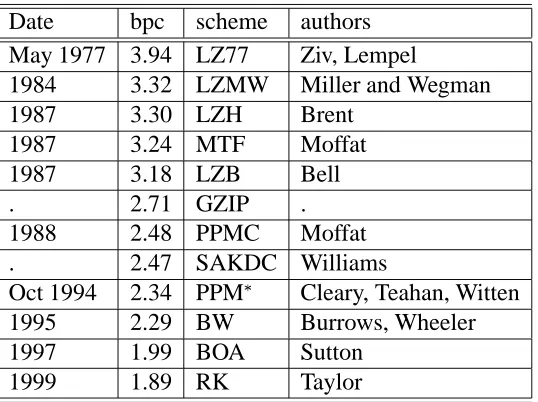
A more complete set of compression ratios for the Calgary corpus for a variety of compressors is shown in Table 2. The Calgary corpus is a standard benchmark for measuring compression ratios and mostly consists of English text. In particular it consists of 2 books, 5 papers, 1 bibliography, 1 collection of news articles, 3 programs, 1 terminal session, 2 object files, 1 geophysical data, and 1 bit-map b/w image. The table shows how the state of the art has improved over the years.
2.3
Conditional Entropy and Markov Chains
Often probabilities of events (messages) are dependent on the context in which they occur, and by using the context it is often possible to improve our probabilities, and as we will see, reduce the entropy. The context might be the previous characters in text (see PPM in Section 4.5), or the neighboring pixels in an image (see JBIG in Section 4.3).
The conditional probability of an event d based on a context e is written as
Sw i Sb i P(w|w) P(b|b) P(w|b) P(b|w)
Figure 1: A two state first-order Markov Model
(unconditional) probability of an eventd is related by
djUk>l m eh
d4fgeh , wheren is the set
of all possible contexts. Based on conditional probabilities we can define the notion of conditional self-information as'
d4fgeh^+, "
Vporqts
lLu of an event
d in the contexte . This need not be the same as
the unconditional self-information. For example, a message stating that it is going to rain in LA with no other information tells us more than a message stating that it is going to rain in the context that it is currently January.
As with the unconditional case, we can define the average conditional self-information, and we call this the conditional-entropy of a source of messages. We have to derive this average by averaging both over the contexts and over the messages. For a message set and context set n ,
the conditional entropy is
Tfvnwx l mx eh yza (
fez{+! 4" $
fgeh
-It is not hard to show that if the probability distribution of is independent of the context n then |
Tfvn}
, and otherwise |
Tf~n} |
. In other words, knowing the context can only
reduce the entropy.
Shannon actually originally defined Entropy in terms of information sources. An information sources generates an infinite sequence of messages
3 % 04[ 3 -h--3 6
from a fixed message set . If the probability of each message is independent of the previous messages then the system
is called an independent and identically distributed (iid) source. The entropy of such a source is called the unconditional or first order entropy and is as defined in Section 2.1. In this chapter by default we will use the term entropy to mean first-order entropy.
Another kind of source of messages is a Markov process, or more precisely a discrete time Markov chain. A sequence follows an order
Markov model if the probability of each message (or event) only depends on the
previous messages, in particular
f 3 --h-3 ( f 3 -h-h-3 3 where
R is the '
message generated by the source. The values that can be taken on by0
3 -h-h-3 6
are called the states of the system. The entropy of a Markov process is defined by the conditional entropy, which is based on the conditional probabilities
( f 3 -h-h-3 .
Figure 1 shows an example of an first-order Markov Model. This Markov model represents the probabilities that the source generates a black ( ) or white ( ) pixel. Each arc represents
a conditional probability of generating a particular pixel. For example
&fz is the conditional
probability of generating a white pixel given that the previous one was black. Each node represents one of the states, which in a first-order Markov model is just the previously generated message. Lets consider the particular probabilities
fO -1 $ , &fO -M,M , fgh) -HA , \fgh
is not hard to solve for
h
$S
7
$
and
OG7!1
S
7
$
(do this as an exercise). These probabilities give the conditional entropy
7,1
S
7
$
-1
$
+,
$S
-1
$
=
-M,M
+,
$S
-M,M
]=
$S
7
$
-BA +,
$S
-BA ]=
-7]+!
$S
-7
-$
1
A
This gives the expected number of bits of information contained in each pixel generated by the source. Note that the first-order entropy of the source is
7!1
S
7
$
+,
7
$S 7,1x=
$S
7
$
!
$S 7,1
1,E
which is almost twice as large.
Shannon also defined a general notion source entropy for an arbitrary source. LetY
denote the set of all strings of lengthP from an alphabet Y , then theP
order normalized entropy is defined as
$
P
h#5
{+! $
w-(1)
This is normalized since we divide it byP —it represents the per-character information. The source
entropy is then defined as
/+
hj
-In general it is extremely hard to determine the source entropy of an arbitrary source process just by looking at the output of the process. This is because to calculate accurate probabilities even for a relatively simple process could require looking at extremely long sequences.
3
Probability Coding
As mentioned in the introduction, coding is the job of taking probabilities for messages and gen-erating bit strings based on these probabilities. How the probabilities are generated is part of the model component of the algorithm, which is discussed in Section 4.
In practice we typically use probabilities for parts of a larger message rather than for the com-plete message, e.g., each character or word in a text. To be consistent with the terminology in the previous section, we will consider each of these components a message on its own, and we will use the term message sequence for the larger message made up of these components. In general each little message can be of a different type and come from its own probability distribution. For example, when sending an image we might send a message specifying a color followed by mes-sages specifying a frequency component of that color. Even the mesmes-sages specifying the color might come from different probability distributions since the probability of particular colors might depend on the context.
3.1
Prefix Codes
A code n for a message set is a mapping from each message to a bit string. Each bit string is
called a codeword, and we will denote codes using the syntaxn0 (
3
3
"
3
"
3h h h3
¡
3
¡
6
. Typically in computer science we deal with fixed-length codes, such as the ASCII code which maps every printable character and some control characters into 7 bits. For compression, however, we would like codewords that can vary in length based on the probability of the message. Such vari-able length codes have the potential problem that if we are sending one codeword after the other it can be hard or impossible to tell where one codeword finishes and the next starts. For exam-ple, given the code 0
¢
3
1
3
3
01
3
e
3
101
3
£
3
011
6
, the bit-sequence 1011 could either be decoded as aba, ca, or ad. To avoid this ambiguity we could add a special stop symbol to the end of each codeword (e.g., a 2 in a 3-valued alphabet), or send a length before each symbol. These solutions, however, require sending extra data. A more efficient solution is to design codes in which we can always uniquely decipher a bit sequence into its code words. We will call such codes uniquely decodable codes.
A prefix code is a special kind of uniquely decodable code in which no bit-string is a prefix of another one, for example 0
¢
3
1
3
3
01
3
e
3
000
3
£
3
001
6
. All prefix codes are uniquely decodable since once we get a match, there is no longer code that can also match.
Exercise 3.1.1 Come up with an example of a uniquely decodable code that is not a prefix code.
Prefix codes actually have an advantage over other uniquely decodable codes in that we can decipher each message without having to see the start of the next message. This is important when sending messages of different types (e.g., from different probability distributions). In fact in certain applications one message can specify the type of the next message, so it might be necessary to fully decode the current message before the next one can be interpreted.
A prefix code can be viewed as a binary tree as follows
¤
Each message is a leaf in the tree
¤
The code for each message is given by following a path from the root to the leaf, and ap-pending a 0 each time a left branch is taken, and a 1 each time a right branch is taken.
We will call this tree a prefix-code tree. Such a tree can also be useful in decoding prefix codes. As the bits come in, the decoder can follow a path down to the tree until it reaches a leaf, at which point it outputs the message and returns to the root for the next bit (or possibly the root of a different tree for a different message type).
In general prefix codes do not have to be restricted to binary alphabets. We could have a prefix code in which the bits have 3 possible values, in which case the corresponding tree would be ternary. In this chapter we only consider binary codes.
Given a probability distribution on a set of messages and associated variable length code n , we
define the average length of the code as
¥L¦
nwx
ory§¨
u
zm
¥
O
where
¥
© is the length of the codeword . We say that a prefix coden is an optimal prefix code
if ¥L¦
nw is minimized (i.e., there is no other prefix code for the given probability distribution that
3.1.1 Relationship to Entropy
It turns out that we can relate the average length of prefix codes to the entropy of a set of messages, as we will now show. We will make use of the Kraft-McMillan inequality
Lemma 3.1.1 Kraft-McMillan Inequality. For any uniquely decodable code n ,
oB§¨ u m 4ªro«¨ ux¬ $ 3 where¥
© it the length of the codeword . Also, for any set of lengths such that
ªr® 4ª ¬ $ 3
there is a prefix code n of the same size such that
¥ R x ¥ R ' $ 3 -h-h-fvTfv .
The proof of this is left as a homework assignment. Using this we show the following
Lemma 3.1.2 For any message set with a probability distribution and associated uniquely
de-codable code n ,
| ) ¬ ¥ ¦ nw
Proof: In the following equations for a message
}%
,
¥
refers to the length of the associated
code inn .
| ] ¥L¦ n}/ a +, " $ yz¯ ¥ ° +, " $ ¥ ( (± °
+, 4" $
D+! 4" ªror u ± +, F" 4ªror u ( ¬ +, 4" 4ª²oB u ¬ 1
The second to last line is based on Jensen’s inequality which states that if a function³ is concave then k R R ³ R ¬ ³ k R R R
, where the
R are positive probabilities. The logarithm function is
concave. The last line uses the Kraft-McMillan inequality. ´
This theorem says that entropy is a lower bound on the average code length. We now also show an upper bound based on entropy for optimal prefix codes.
Lemma 3.1.3 For any message set with a probability distribution and associated optimal prefix
code n ,
-Proof: Take each message and assign it a length ¥ µKL+, V¶oB u
N . We have
yz 4ª²oB u I·~¸g¹º¼» ½¾²¿BÀÂÁ ¬ x¸g¹º » ½¾²¿BÀ $
Therefore by the Kraft-McMillan inequality there is a prefix code n©Ã with codewords of length
¥ . Now ¥L¦ n à / oB§¨ u m#Ä ¥ O oB§¨ u m Ä
,KL+, $
N ¬ oB§¨ u m Ä $
=D! $
$ = oB§¨ u m#Ä ( +, $ ( $ = |
By the definition of optimal prefix codes,¥ ¦
nw ¬ ¥¦ n à . ´
Another property of optimal prefix codes is that larger probabilities can never lead to longer codes, as shown by the following theorem. This theorem will be useful later.
Theorem 3.1.1 If n is an optimal prefix code for the probabilities 0
3 " 3 -h-h-3 6 then RTÅ Æ
implies that¥
e R ¬ ¥ e Æ . Proof: Assume ¥ e R Å ¥ e Æ
. Now consider the code gotten by switchinge
R and e Æ . If ¥L¦ is the average length of our original code, this new code will have length
¥ Ã ¦ ¥ ¦ = Æ ¥ e R ] ¥ e Æ I= R ¥ e Æ ] ¥ e R (2) ¥L¦ = Æ R ¥ e R ] ¥ e Æ (3)
Given our assumptions the
Æ R ¥ e R ¥ e Æ
is negative which contradicts the assumption
that
¥¦
is an optimal prefix code. ´
3.2
Huffman Codes
class on information theory at MIT in 1950. The algorithm is now probably the most prevalently used component of compression algorithms, used as the back end of GZIP, JPEG and many other utilities.
The Huffman algorithm is very simple and is most easily described in terms of how it generates the prefix-code tree.
¤
Start with a forest of trees, one for each message. Each tree contains a single vertex with weight
R
R
¤
Repeat until only a single tree remains
– Select two trees with the lowest weight roots (
and
" ).
– Combine them into a single tree by adding a new root with weight
=C
" , and making
the two trees its children. It does not matter which is the left or right child, but our convention will be to put the lower weight root on the left if
.Ç
_ " .
For a code of sizeP this algorithm will requireP
$
steps since every complete binary tree with
P leaves hasP
$
internal nodes, and each step creates one internal node. If we use a priority queue withÈ
+! ÉPÊ time insertions and find-mins (e.g., a heap) the algorithm will run inÈ
PË+, TPÊ time.
The key property of Huffman codes is that they generate optimal prefix codes. We show this in the following theorem, originally given by Huffman.
Lemma 3.2.1 The Huffman algorithm generates an optimal prefix code.
Proof: The proof will be on induction of the number of messages in the code. In particular we will show that if the Huffman code generates an optimal prefix code for all probability distributions of P messages, then it generates an optimal prefix code for all distributions of PQ=
$
messages. The base case is trivial since the prefix code for 1 message is unique (i.e., the null message) and therefore optimal.
We first argue that for any set of messages there is an optimal code for which the two
mini-mum probability messages are siblings (have the same parent in their prefix tree). By lemma 3.1.1 we know that the two minimum probabilities are on the lowest level of the tree (any complete bi-nary tree has at least two leaves on its lowest level). Also, we can switch any leaves on the lowest level without affecting the average length of the code since all these codes have the same length. We therefore can just switch the two lowest probabilities so they are siblings.
Now for induction we consider a set of message probabilities of sizePQ=
$
and the corre-sponding treeÌ built by the Huffman algorithm. Call the two lowest probability nodes in the tree
and Í , which must be siblings in Ì because of the design of the algorithm. Consider the tree
Ìjà gotten by replacing
and Í with their parent, call it Î , with probability 4Ï
4Ð
=
5Ñ
(this is effectively what the Huffman algorithm does). Lets say the depth ofÎ is
£
, then
¥L¦
Ì©Ò ¥L¦
Ì
Ã
I=
5Ð £
=
$
I=
5Ñ £
=
$
]
4Ï
£
(4)
¥
¦
Ì
Ã
I=
Ð
=
Ñ
-(5)
To see that Ì is optimal, note that there is an optimal tree in which
and Í are siblings, and that
wherever we place these siblings they are going to add a constant
5Ð
=
4Ñ
any prefix tree on with the pair andÍ replaced with their parentÎ . By the induction hypothesis ¥L¦
ÌjÃB is minimized, sinceÌjà is of sizeP and built by the Huffman algorithm, and therefore ¥L¦
ÌO
is minimized andÌ is optimal. ´
Since Huffman coding is optimal we know that for any probability distribution and associated
Huffman coden
¬
¥L¦
n}
¬
I=
$
-3.2.1 Combining Messages
Even though Huffman codes are optimal relative to other prefix codes, prefix codes can be quite inefficient relative to the entropy. In particular
could be much less than 1 and so the extra
$
in
|
I=
$
could be very significant.
One way to reduce the per-message overhead is to group messages. This is particularly easy if a sequence of messages are all from the same probability distribution. Consider a distribution of six possible messages. We could generate probabilities for all 36 pairs by multiplying the probabilities of each message (there will be at most 21 unique probabilities). A Huffman code can now be generated for this new probability distribution and used to code two messages at a time. Note that this technique is not taking advantage of conditional probabilities since it directly multiplies the probabilities. In general by grouping
messages the overhead of Huffman coding can be reduced from 1 bit per message to
$S
bits per message. The problem with this technique is that in practice messages are often not from the same distribution and merging messages from different distributions can be expensive because of all the possible probability combinations that might have to be generated.
3.2.2 Minimum Variance Huffman Codes
The Huffman coding algorithm has some flexibility when two equal frequencies are found. The choice made in such situations will change the final code including possibly the code length of each message. Since all Huffman codes are optimal, however, it cannot change the average length. For example, consider the following message probabilities, and codes.
symbol probability code 1 code 2
a 0.2 01 10
b 0.4 1 00
c 0.2 000 11
d 0.1 0010 010
e 0.1 0011 011
Both codings produce an average of 2.2 bits per symbol, even though the lengths are quite different in the two codes. Given this choice, is there any reason to pick one code over the other?
For some applications it can be helpful to reduce the variance in the code length. The variance is defined as
l
zmx
ez
¥
eh] ¥L¦
n}
"
0 1
0 1 0 1
0 1
b
d e
[image:15.612.263.352.69.167.2]c a
Figure 2: Binary tree for Huffman code 2
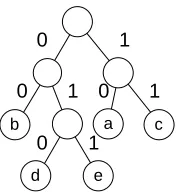
turns out that a simple modification to the Huffman algorithm can be used to generate a code that has minimum variance. In particular when choosing the two nodes to merge and there is a choice based on weight, always pick the node that was created earliest in the algorithm. Leaf nodes are assumed to be created before all internal nodes. In the example above, afterdandeare joined, the pair will have the same probability ascanda(.2), but it was created afterwards, so we joincand
a. Similarly we selectbinstead ofacto join withdesince it was created earlier. This will give code 2 above, and the corresponding Huffman tree in Figure 2.
3.3
Arithmetic Coding
Arithmetic coding is a technique for coding that allows the information from the messages in a message sequence to be combined to share the same bits. The technique allows the total number of bits sent to asymptotically approach the sum of the self information of the individual messages (recall that the self information of a message is defined as+! 4"
VXW).
To see the significance of this, consider sending a thousand messages each having probability
-M,M!M
. Using a Huffman code, each message has to take at least 1 bit, requiring 1000 bits to be sent. On the other hand the self information of each message is+,
"
VXW
-1,1
$
;!; bits, so the sum of this
self-information over 1000 messages is only 1.4 bits. It turns out that arithmetic coding will send all the messages using only 3 bits, a factor of hundreds fewer than a Huffman coder. Of course this is an extreme case, and when all the probabilities are small, the gain will be less significant. Arithmetic coders are therefore most useful when there are large probabilities in the probability distribution.
The main idea of arithmetic coding is to represent each possible sequence of P messages by a
separate interval on the number line between 0 and 1, e.g. the interval from .2 to .5. For a sequence of messages with probabilities
3
-h-h-3
, the algorithm will assign the sequence to an interval of
size Ó
RBÔ¯
R, by starting with an interval of size 1 (from 0 to 1) and narrowing the interval by a
factor of
R on each message
'
. We can bound the number of bits required to uniquely identify an interval of size
, and use this to relate the length of the representation to the self information of the messages.
In the following discussion we assume the decoder knows when a message sequence is com-plete either by knowing the length of the message sequence or by including a special end-of-file message. This was also implicitly assumed when sending a sequence of messages with Huffman codes since the decoder still needs to know when a message sequence is over.
We will denote the probability distributions of a message set as 0
$
3
-h-h-3
(Õ
6
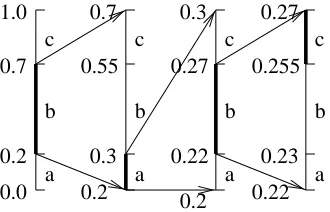
b c a b c a b c a b c a 0.3 0.255 0.0 0.2 0.7 1.0 0.27 0.23 0.22 0.27 0.3 0.7 0.55
[image:16.612.224.389.71.177.2]0.2 0.2 0.22
Figure 3: An example of generating an arithmetic code assuming all messages are from the same probability distribution ¢ , Ö -2 and eÖ
-7 . The interval given by the message sequence
¢
¶e is ×
-,2!243 A .
define the accumulated probability for the probability distribution as
³ +Ø Æ RBÔ¯ ' Ø $ 3 -h--3 Õ -(6)
So, for example, the probabilities0
-53 -253 -7 6
correspond to the accumulated probabilities0,1
3 -53 -BA 6 . Since we will often be talking about sequences of messages, each possibly from a different proba-bility distribution, we will denote the probaproba-bility distribution of the'
message as0
R $ 3 --h-3 R Õ R 6 , and the accumulated probabilities as 0,³
R $ 3 -h-h-3 ³ R (Õ R 6
. For a particular sequence of message values, we denote the index of the '+
message value as Ù
R. We will use the shorthand
R for R Ù R and³ R for ³ R Ù R .
Arithmetic coding assigns an interval to a sequence of messages using the following recur-rences ¥ R Ú ³ R ' $ ¥ R =Û³ RFÜ R $ ' ¬ P R Ú R ' $
R Ü
R $ ' ¬ P (7) where¥
is the lower bound of the interval and
is the size of the interval, i.e. the interval is given
by × ¥ 3 ¥ =
. We assume the interval is inclusive of the lower bound, but exclusive of the upper
bound. The recurrence narrows the interval on each step to some part of the previous interval. Since the interval starts in the range [0,1), it always stays within this range. An example of generating an interval for a short message sequences is illustrated in Figure 3. An important property of the intervals generated by Equation 7 is that all unique message sequences of length P will have non
overlapping intervals. Specifying an interval therefore uniquely determines the message sequence. In fact, any number within an interval uniquely determines the message sequence. The job of decoding is basically the same as encoding but instead of using the message value to narrow the interval, we use the interval to select the message value, and then narrow it. We can therefore “send” a message sequence by specifying a number within the corresponding interval.
The question remains of how to efficiently send a sequence of bits that represents the interval, or a number within the interval. Real numbers between 0 and 1 can be represented in binary fractional notation as
- " Ý
-h-h-. For example
means that the sequence is repeated infinitely. We might therefore think that it is adequate
to represent each interval by selecting the number within the interval which has the fewest bits in binary fractional notation, and use that as the code. For example, if we had the intervals ×v1
3 -7!7, × -7!7 3 E A
, and ×
-E
A
3
$
we would represent these with
-1 $ $S ;5 , -$ $S , and -$!$ 7 S
;5 . It is not hard
to show that for an interval of size
we need at most ÞKß+!
"
N bits to represent such a number.
The problem is that these codes are not a set of prefix codes. If you sent me 1 in the above example, I would not know whether to wait for another 1 or interpret it immediately as the interval ×
-7!7 3 E A .
To avoid this problem we interpret every binary fractional codeword as an interval itself. In particular as the interval of all possible completions. For example, the codeword
-1
$
1 would
rep-resent the interval × $S
;
3
7
S
? since the smallest possible completion is
-1
$
1 1&
$S
; and the largest
possible completion is
-1 $ 1 $ à7 S
?á . Since we now have several kinds of intervals running
around, we will use the following terms to distinguish them. We will call the current interval of the message sequence (i.e ×
¥ R 3 ¥ R = R
) the sequence interval, the interval corresponding to the
proba-bility of the'
message (i.e., ×~³
R 3 ³ R = R
) the message interval, and the interval of a codeword the
code interval.
An important property of code intervals is that there is a direct correspondence between whether intervals overlap and whether they form prefix codes, as the following Lemma shows.
Lemma 3.3.1 For a code n , if no two intervals represented by its binary codewords
%
n
overlap then the code is a prefix code.
Proof: Assume codeword
¢
is a prefix of codeword , then is a possible completion of
¢
and therefore its interval must be fully included in the interval of
¢
. This is a contradiction. ´
To find a prefix code, therefore, instead of using any number in the interval to be coded, we select a codeword who’s interval is fully included within the interval. Returning to the previous example of the intervals ×v1
3
-7!7 , ×
-7!7
3
E
A
, and ×
-E
A
3
$
, the codewords
-1!1#×v1 3 -!2 , -$ 1!1#× -253 -E !2 , and -$,$ × -HA 243 $
are adequate. In general for an interval of size
we can always find a codeword of length :KL+, 4"
N=
$
, as shown by the following lemma.
Lemma 3.3.2 For any ¥
and an
such that ¥
3 |â 1 and ¥ = $
, the interval represented by taking the binary fractional representation of ¥
=
S
and truncating it to K>+! 4"
N©=
$
bits is contained in the interval ×
¥ 3 ¥ = .
Proof: A binary fractional representation with¥
digits represents an interval of size less than ª
since the difference between the minimum and maximum completions are all 1s starting at the
¥
=
$
location. This has a value 4ª
ãá . The interval size of a :KL+, "
NË=
$
bit representation is therefore less than
S
. Since we truncate
¥
=
S
downwards the upper bound of the interval represented by the bits is less than
¥
=
. Truncating the representation of a number to :KL+, "
NF=
$
bits can have the effect of reducing it by at most
S
. Therefore the lower bound of truncating
¥
=
S
is at least¥
. The interval is therefore contained in × ¥ 3 ¥
=
. ´
We will call the algorithm made up of generating an interval by Equation 7 and then using the truncation method of Lemma 3.3.2, the RealArithCode algorithm.
Theorem 3.3.1 For a sequence of P messages, with self informations
3 -h-h-3
the length of the
arithmetic code generated by RealArithCode is bounded by
=
k
RBÔ¯
R, and the code will not be
Proof: Equation 7 will generate a sequence interval of size äÓ
RBÔ¯
R. Now by Lemma 3.3.2
we know an interval of size
can be represented by
$
=åKyQ+,
N bits, so we have
$
=åKyQ+,
N
$
=åKQ!
"
æ
RBÔ¯
R
N
$
=åK
RBÔ¯ Q! "
R
N
$
=åK
RBÔ¯
R
N
=
RBÔ¯
R
The claim that the code is not a prefix of other messages is taken directly from Lemma 3.3.1. ´
The decoder for RealArithCode needs to read the input bits on demand so that it can determine when the input string is complete. In particular it loops forP iterations, whereP is the number of
messages in the sequence. On each iteration it reads enough input bits to narrow the code interval to within one of the possible message intervals, narrows the sequence interval based on that message, and outputs that message. When complete, the decoder will have read exactly all the characters generated by the coder. We give a more detailed description of decoding along with the integer implementation described below.
From a practical point of view there are a few problems with the arithmetic coding algorithm we described so far. First, the algorithm needs arbitrary precision arithmetic to manipulate
¥
and
. Manipulating these numbers can become expensive as the intervals get very small and the number of significant bits get large. Another problem is that as described the encoder cannot output any bits until it has coded the full message. It is actually possible to interleave the generation of the interval with the generation of its bit representation by opportunistically outputting a 0 or 1 whenever the interval falls within the lower or upper half. This technique, however, still does not guarantee that bits are output regularly. In particular if the interval keeps reducing in size but still straddles .5, then the algorithm cannot output anything. In the worst case the algorithm might still have to wait until the whole sequence is received before outputting any bits. To avoid this problem many implementations of arithmetic coding break message sequences into fixed size blocks and use arithmetic coding on each block separately. This approach also has the advantage that since the group size is fixed, the encoder need not send the number of messages, except perhaps for the last group which could be smaller than the block size.
3.3.1 Integer Implementation
For this algorithm we assume the probabilities are given as counts e $ 3 e 3 -h--3 e Õ 3
and the cumulative count are defined as before (³
' xGk R Æ Ô e +Ø
). The total count will be denoted
as Ìã ¡ Æ Ô¯ e Ø
-Using counts avoids the need for fractional or real representations of the probabilities. Instead of using intervals between 0 and 1, we will use intervals between ×v1
-+-ç $ (è where ç (i.e., is a power of 2). There is the additional restriction that
ç
Å
;Ì . This will guarantee that no
region will become too small to represent. The larger
ç
is, the closer the algorithm will come to real arithmetic coding. As in the non-integer arithmetic coding, each message can come from its own probability distribution (have its own counts and accumulative counts), and we denote the
'
message using subscripts as before.
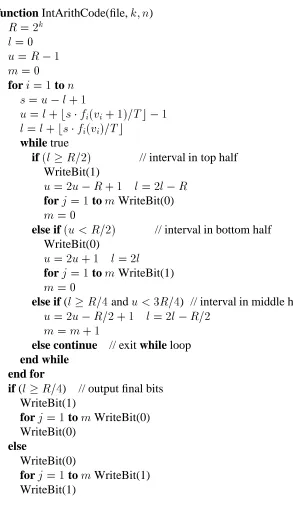
The coding algorithm is given in Figure 4. The current sequence interval is specified by the integers
¥
(lower) andé (upper), and the corresponding interval is×
¥
3
éê=
$
. The size of the interval
is thereforeé:
¥
=
$
. The main idea of this algorithm is to always keep the size greater than
ç
S
; by expanding the interval whenever it gets too small. This is what the inner while loop does.
In this loop whenever the sequence interval falls completely within the top half of the region (fromç
S
to
ç
) we know that the next bit is going to be a 1 since intervals can only shrink. We can therefore output a 1 and expand the top half to fill the region. Similarly if the sequence interval falls completely within the bottom half we can output a 0 and expand the bottom half of the region to fill the full region.
The third case is when the interval falls within the middle half of the region(from
ç
S
; to7
ç
S
; ).
In this case the algorithm cannot output a bit since it does not know whether the bit will be a 0 or 1. It, however, can expand the middle region and keep track that is has expanded by incrementing a count
Õ
. Now when the algorithm does expand around the top (bottom), it outputs a 1 (0) followed by
Õ
0s (1s). To see why this is the right thing to do, consider expanding around the middle
Õ
times and then around the top. The first expansion around the middle locates the interval between
$S
; and 7
S
; of the initial region, and the second between 7
S
? and
2
S
? . After
Õ
expansions the interval is narrowed to the region
$S $S ¡ë h3 $S = $S ¡ë
. Now when we expand around
the top we narrow the interval to
$S 43 $S = $S ¡ë
. All intervals contained in this range will
start with a
$ followed by Õ 1 .
Another interesting aspect of the algorithm is how it finishes. As in the case of real-number arithmetic coding, to make it possible to decode, we want to make sure that the code (bit pattern) for any one message sequence is not a prefix of the code for another message sequence. As before, the way we do this is to make sure the code interval is fully contained in the sequence interval. When the integer arithmetic coding algorithm (Figure 4) exits theforloop, we know the sequence interval ×
¥ 3
éFè completely covers either the second quarter (from
ç S ; to ç S
) or the third quarter (from ç S to 7 ç S
; ) since otherwise one of the expansion rules would have been applied. The
algorithm therefore simply determines which of these two regions the sequence interval covers and outputs code bits that narrow the code interval to one of these two quarters—a 1
$
for the second quarter, since all completions of1
$
are in the second quarter, and a
$
function IntArithCode(file, P ) ç ¥ ã1 é9 ç $ Õ G1 for ' $ toP GéÖ ¥ = $ é9 ¥ =åì ³ R Ù R = $ S ÌTíj $ ¥ ¥ =åì ³ R Ù R S ÌTí while true if ¥ â¼ç S
// interval in top half
WriteBit(1) é: é ç = $ ¥ ¥ ç for Ø $ to Õ WriteBit(0) Õ G1 else if éQ ç S
// interval in bottom half
WriteBit(0) é: é\= $ ¥ ¥ for Ø $ to Õ WriteBit(1) Õ G1
else if (¥ âç
S
; andé>î7
ç
S
; ) // interval in middle half é: é ç S = $ ¥ ¥ ç S Õ Õ = $
else continue // exit while loop
end while end for if ( ¥ âGç S
; ) // output final bits
[image:20.612.76.369.129.648.2]WriteBit(1) for Ø $ to Õ WriteBit(0) WriteBit(0) else WriteBit(0) for Ø $ to Õ WriteBit(1) WriteBit(1)
After outputting the first of these two bits the algorithm must also output bits corresponding to previous expansions around the middle.
The reason that
ç
needs to be at least;{Ì is that the sequence interval can become as small as
ç
S
;=
$
without falling completely within any of the three halves. To be able to resolve the counts
n
'
,Ì has to be at least as large as this interval.
An example: Here we consider an example of encoding a sequence of messages each from the same probability distribution, given by the following counts.
e $ $ 3 e $ 1 3 e 7 1
The cumulative counts are
³ $ )ã1 3 ³ $ 3 ³ 7 $!$ and Ìïä7 $
. We will chose
U? , so that
ç
!2
E . This satisfies the requirement that
ç
Å
;Ì .
Now consider coding the message sequence7
3
$
3X53
7 . Figure 5 illustrates the steps taken in coding
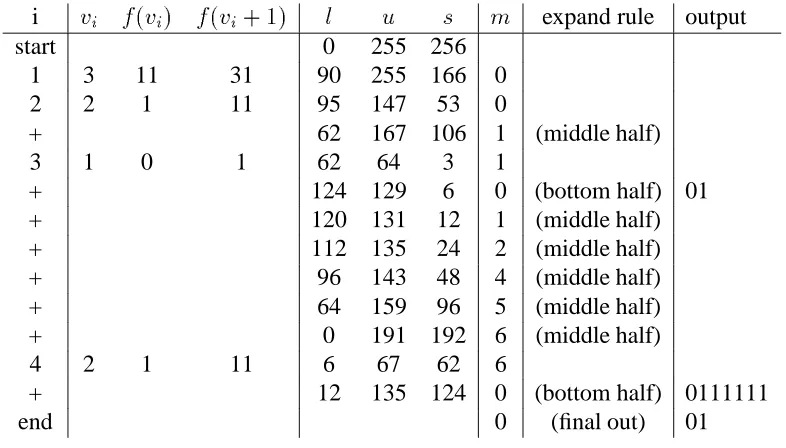
this message sequence. The full code that is output is01011111101which is of length 11. The sum of the self-information of the messages is
+, "
1 S 7 $
x=`+, "
$ 1 S 7 $
=D+, "
$S
7
$
x=D! "
$ 1 S 7 $ jã? -? 2 .
Note that this is not within the bound given by Theorem 3.3.1. This is because we are not generating an exact arithmetic code and we are loosing some coding efficiency.
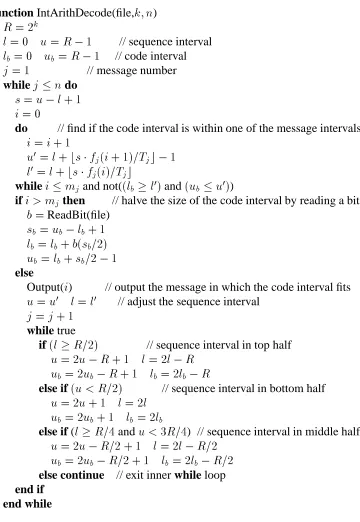
We now consider how to decode a message sent using the integer arithmetic coding algorithm. The code is given in Figure 6. The idea is to keep separate lower and upper bounds for the code interval (¥Lð
andé
ð
) and the sequence interval (¥
andé ). The algorithm reads one bit at a time and
reduces the code interval by half for each bit that is read (the bottom half when the bit is a 0 and the top half when it is a 1). Whenever the code interval falls within an interval for the next message, the message is output and the sequence interval is reduced by the message interval. This reduction is followed by the same set of expansions around the top, bottom and middle halves as followed by the encoder. The sequence intervals therefore follow the exact same set of lower and upper bounds as when they were coded. This property guarantees that all rounding happens in the same way for both the coder and decoder, and is critical for the correctness of the algorithm. It should be noted that reduction and expansion of the code interval is always exact since these are always changed by powers of 2.
4
Applications of Probability Coding
To use a coding algorithm we need a model from which to generate probabilities. Some simple models are to count characters for text or pixel values for images and use these counts as probabil-ities. Such counts, however, would only give a compression ratio of about;
-HA S ?& -2 M for English text as compared to the best compression algorithms that give ratios of close to
i Ù
R
³ Ù
R
³ Ù
R
=
$
¥
é expand rule output
start 0 255 256
1 3 11 31 90 255 166 0
2 2 1 11 95 147 53 0
+ 62 167 106 1 (middle half)
3 1 0 1 62 64 3 1
+ 124 129 6 0 (bottom half) 01
+ 120 131 12 1 (middle half)
+ 112 135 24 2 (middle half)
+ 96 143 48 4 (middle half)
+ 64 159 96 5 (middle half)
+ 0 191 192 6 (middle half)
4 2 1 11 6 67 62 6
+ 12 135 124 0 (bottom half) 0111111
[image:22.612.110.503.83.307.2]end 0 (final out) 01
Figure 5: Example of integer arithmetic coding. The rows represent the steps of the algorithm. Each row starting with a number represents the application of a contraction based on the next message, and each row with a + represents the application of one of the expansion rules.
transforming the data before coding (e.g., run-length coding, move-to-front coding, and residual coding), or directly using conditional probabilities based on a context (JBIG and PPM).
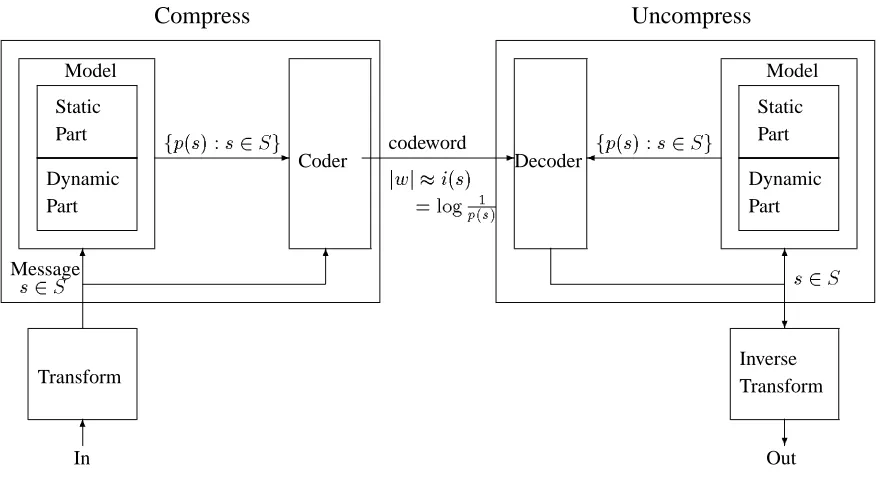
An issue to consider about a model is whether it is static or dynamic. A model can be static over all message sequences. For example one could predetermine the frequency of characters and text and “hardcode” those probabilities into the encoder and decoder. Alternatively, the model can be static over a single message sequence. The encoder executes one pass over the sequence to determine the probabilities, and then a second pass to use those probabilities in the code. In this case the encoder needs to send the probabilities to the decoder. This is the approach taken by most vector quantizers. Finally, the model can be dynamic over the message sequence. In this case the encoder updates its probabilities as it encodes messages. To make it possible for the decoder to determine the probability based on previous messages, it is important that for each message, the encoder codes it using the old probability and then updates the probability based on the message. The advantages of this approach are that the coder need not send additional probabilities, and that it can adapt to the sequence as it changes. This approach is taken by PPM.
function IntArithDecode(file,a3 P ) ç ¥ ã1 éÞ ç $
// sequence interval
¥Lð G1 é ð ç $
// code interval
Ø
$
// message number
while Ø ¬ P do GéÖ ¥ = $ ' G1
do // find if the code interval is within one of the message intervals
' ' = $ éFÃ ¥ =åì ³ Æ ' = $ S Ì Æ íj $ ¥ Ã ¥ =äì ³ Æ ' S Ì Æ í while' ¬ Õ Æ and not( ¥ ð â ¥ Ã and é ð ¬ é Ã ) if' Å Õ Æ
then // halve the size of the code interval by reading a bit
Ë ReadBit(file) ð Gé ð ¥ð = $ ¥Lð ¥Lð =Û ð S é ð ¥Lð = ð S $ else Output('
) // output the message in which the code interval fits
é:GéFÃ
¥
¥
à // adjust the sequence interval
Ø Ø = $ while true if ¥ â¼ç S
// sequence interval in top half é: é9 ç = $ ¥ ¥ ç é ð é ð ç = $ ¥Lð ¥Lð ç else if éQ ç S
// sequence interval in bottom half é: éÖ= $ ¥ ¥ é ð é ð = $ ¥Lð ¥Lð
else if (
¥
âç
S
; and é:^7
ç
S
; ) // sequence interval in middle half é: é9 ç S = $ ¥ ¥ ç S é ð é ð ç S = $ ¥Lð ¥Lð ç S
else continue // exit inner while loop
[image:23.612.81.441.122.644.2]end if end while
ñ
Transform
ò
ò
ñ ñ
ó
ñ
ô
ô
codeword
õö4÷øùIú¶øüûOý¯þ
øüûOý
Message
In
Compress
Coder ÿÿ ÷øù
J
Static
Dynamic Part
Part Model
õö4÷øùIú¶øüûOý¯þ
Inverse
øüûOý
Transform
Uncompress
Out Decoder
Static
Dynamic Part
[image:24.612.87.528.82.326.2]Part Model
Figure 7: The general framework of a model and coder.
4.1
Run-length Coding
Probably the simplest coding scheme that takes advantage of the context is run-length coding. Although there are many variants, the basic idea is to identify strings of adjacent messages of equal value and replace them with a single occurrence along with a count. For example, the message sequenceacccbbaaabbcould be transformed to (a,1), (c,3), (b,2), (a,3), (b,2). Once transformed, a probability coder (e.g., Huffman coder) can be used to code both the message values and the counts. It is typically important to probability code the run-lengths since short lengths (e.g., 1 and 2) are likely to be much more common than long lengths (e.g., 1356).
An example of a real-world use of run-length coding is for the ITU-T T4 (Group 3) standard for Facsimile (fax) machines"
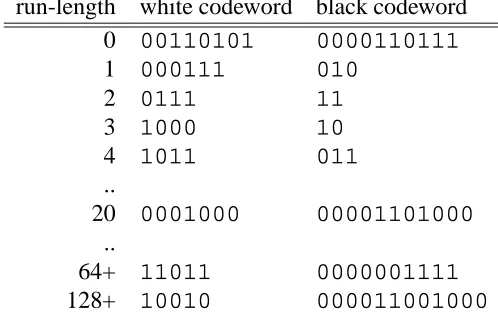
. At the time of writing (1999), this was the standard for all home and business fax machines used over regular phone lines. Fax machines transmit black-and-white images. Each pixel is called a pel and the horizontal resolution is fixed at 8.05 pels/mm. The vertical resolution varies depending on the mode. The T4 standard uses run-length encoding to code each sequence of black and white pixels. Since there are only two message values black and white, only the run-lengths need to be transmitted. The T4 standard specifies the start color by placing a dummy white pixel at the front of each row so that the first run is always assumed to be a white run. For example, the sequencebbbbwwbbbbbwould be transmitted as 1,4,2,5. The T4 standard uses static Huffman codes to encode the run-lengths, and uses a separate codes for the black and white pixels. To account for runs of more than 64, it has separate codes to specify multiples of 64. For example, a length of 150, would consist of the code for 128 followed by the code for 22. A small subset of the codes are given in Table 4.1. These Huffman codes are based
run-length white codeword black codeword
0 00110101 0000110111
1 000111 010
2 0111 11
3 1000 10
4 1011 011
..
20 0001000 00001101000
..
64+ 11011 0000001111
[image:25.612.180.429.88.250.2]128+ 10010 000011001000
Table 3: ITU-T T4 Group 3 Run-length Huffman codes.
on the probability of each run-length measured over a large number of documents. The full T4 standard also allows for coding based on the previous line.
4.2
Move-To-Front Coding
Another simple coding schemes that takes advantage of the context is move-to-front coding. This is used as a sub-step in several other algorithms including the Burrows-Wheeler algorithm discussed later. The idea of move-to-front coding is to preprocess the message sequence by converting it into a sequence of integers, which hopefully is biases toward integers with low values. The algorithm then uses some form of probability coding to code these values. In practice the conversion and coding are interleaved, but we will describe them as separate passes. The algorithm assumes that each message comes from the same alphabet, and starts with a total order on the alphabet (e.g., ×
¢
3
3
e
3
£
3
--h-è). For each message, the first pass of the algorithm outputs the position of the
character in the current order of the alphabet, and then updates the order so that the character is at the head. For example, coding the character e with an order ×
¢
3
3
e
3
£
3
-h-h-è would output a 3 and
change the order to ×ve
3
¢
3
3
£
3
-h-h-è. This is repeated for the full message sequence. The second pass
converts the sequence of integers into a bit sequence using Huffman or Arithmetic coding.
The hope is that equal characters often appear close to each other in the message sequence so that the integers will be biased to have low values. This will give a skewed probability distribution and good compression.
4.3
Residual Coding: JPEG-LS
values. The idea of residual coding is that the encoder tries to guess the next message value based on the previous context and then outputs the difference between the actual and guessed value. This is called the residual. The hope is that this residual is biased toward low values so that it can be effectively compressed. Assuming the decoder has already decoded the previous context, it can make the same guess as the coder and then use the residual it receives to correct the guess. By not specifying the residual to its full accuracy, residual coding can also be used for lossy compression Residual coding is used in JPEG lossless (JPEG LS), which is used to compress both grey-scale and color images.Ý
Here we discuss how it is used on gray scale images. Color images can simply be compressed by compressing each of the three color planes separately. The algorithm compresses images in raster order—the pixels are processed starting at the top-most row of an image from left to right and then the next row, continuing down to the bottom. When guessing a pixel the encoder and decoder therefore have as their disposal the pixels to the left in the current row and all the pixels above it in the previous rows. The JPEG LS algorithm just uses 4 other pixels as a context for the guess—the pixel to the left (W), above and to the left (NW), above (N), and above and to the right (NE). The guess works in two stages. The first stage makes the following guess for each pixel value.
9
3
!
C3
¬
" #
3
9$
93
=
otherwise
(8)
This might look like a magical equation, but it is based on the idea of taking an average of nearby pixels while taking account of edges. The first and second clauses capture horizontal and vertical edges. For example if
Å
and
¬
this indicates a horizontal edge and
is used as the guess. The last clause captures diagonal edges.
Given an initial guess
a second pass adjusts that guess based on local gradients. It uses the three gradients between the pairs of pixels
3
,
3
, and
93%
. Based on the
value of the gradients (the difference between the two adjacent pixels) each is classified into one of 9 groups. This gives a total of 729 contexts, of which only 365 are needed because of symmetry. Each context stores its own adjustment value which is used to adjust the guess. Each context also stores information about the quality of previous guesses in that context. This can be used to predict variance and can help the probability coder. Once the algorithm has the final guess for the pixel, it determines the residual and codes it.
4.4
Context Coding: JBIG
The next two techniques we discuss both use conditional probabilities directly for compression. In this section we discuss using context-based conditional probabilities for Bilevel (black-and-white) images, and in particular the JBIG1 standard. In the next section we discuss using a context in text compression. JBIG stands for the Joint Bilevel Image Processing Group. It is part of the same standardization effort that is responsible for the JPEG standard. The algorithm we describe here is JBIG1, which is a lossless compressor for bilevel images. JBIG1 typically compresses 20-80% better than ITU Groups III and IV fax encoding outlined in Section 4.1.
&
O O O
O O
O O
O
O
? A
O O
O O O
O O
O
O ?
A
[image:27.612.232.379.180.332.2](a) (b)
Figure 8: JBIG contexts: (a) three-line template, and (b) two-line template. ? is the current pixel andY is the “roaming pixel”.
O O
O O
O
? A
O O
O O
O
? A
O O
O O
O O
O O
O O
? A
? A
Figure 9: JBIG contexts for progressive transmission. The dark circles are the low resolution pixels, the 0s are the high-resolution pixels, the A is a roaming pixel, and the ? is the pixel we want to code/decode. The four context configurations are for the four possible configurations of the high-resolution pixel relative to the low resolution pixel.
JBIG is similar to JPEG LS in that it uses a local context of pixels to code the current pixel. Unlike JPEG LS, however, JBIG uses conditional probabilities directly. JBIG also allows for pro-gressive compression—an image can be sent as a set of layers of increasing resolution. Each layer can use the previous layer to aid compression. We first outline how the initial layer is compressed, and then how each following layer is compressed.
The first layer is transmitted in raster order, and the compression uses a context of 10 pixels above and to the right of the current pixel. The standard allows for two different templates for the context as shown in Figure 8. Furthermore, the pixel marked Y is a roaming pixel and can
be chosen to be any fixed distance to the right of where it is marked in the figure. This roaming pixel is useful for getting good compression on images with repeated vertical lines. The encoder decides on which of the two templates to use and on where to place Y based on how well they
compress. This information is specified at the head of the compressed message sequence. Since each pixel can only have two values, there are
possible contexts. The algorithm dynamically generates the conditional probabilities for a black or white pixel for each of the contexts, and uses these probabilities in a modified arithmetic coder—the coder is optimized to avoid multiplications and divisions. The decoder can decode the pixels since it can build the probability table in the same way as the encoder.