Abstract: Signatures have been accepted in commercial transactions as a method of authentication. Digitizing credentials reduce the storage space requisite for the same information from a few cubic inches to so many bytes on a server. The most frequent use of offline signature authentication is to reduce the turnaround time for cheque clearance. In this paper, machine learning classifiers are used to verify the signature using four image based features. BHsig260 dataset (Bangla and Hindi) has been used. We used signatures of 55 users of Hindi and Bangla each. .Six classifier i.e. Boosted Tree, Random forest classifier (RFC), K-nearest neighbor, Multilayer Perceptron, Support Vector Machine (SVM) and Naive Bayes classifier are used in the work. In the paper, the results of Writer independent model show that accuracy of Hindi off-line signature verification is 72.3 % using MLP with the signature sample size of 20 and that of Bangla is 79 % using RFC with the signature sample size of 23.In user dependent model, for some users, we achieved accuracy of more than 92 % using KNN and SVM.
Index Terms:. Forensic Handwriting Expert (FHE), UTSig (University of Tehran Persian Signature), K-nearest neighbor (K-NN), Writer Dependent (WD), Writer Independent (WI).
I. INTRODUCTION
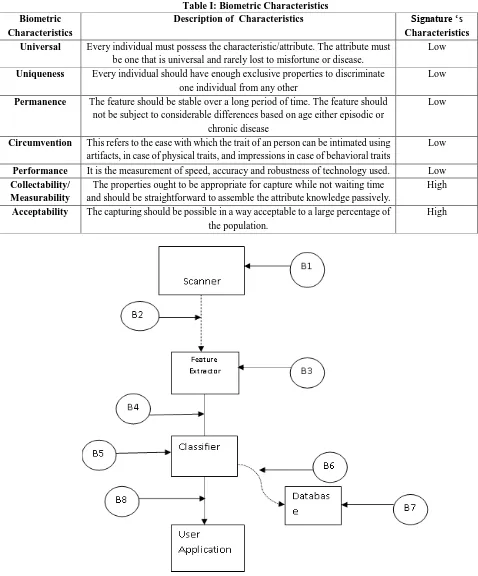
Biometric is a discipline to recognize an individual based on their distinctive physiological (iris, retina, fingerprint, face, hand geometry etc.) and behavioral (voice, keystroke, signature, gait, etc.) traits. Table I shows the Biometric Characteristics and Signature’s characteristic [1].
No particular biometric is projected to efficiently meet all the provisions imposed by all applications. Digitizing credentials reduce the storage space requisite for the same information from a few cubic inches to so many bytes on a server. Benefits of OSV are storability, accessibility and searching ability. Offline signature is a scanned image of handwritten signature. In online signature verification, a sequence of point is considered as signature. The format of signature file used in First international signature verification competition (SVC) is shown in Table II [2]. Each signature file contains the seven fields. The first line of each signature file contains information about total number of captured points .Number of lines in signature file are equal to the total number of captured points as mentioned in first line of the signature file. There
Revised Manuscript Received on September 06, 2019
Kamlesh Kumari ,Research Scholar, Department of Computer Science Engineering , M. M (D.U), Mullana,Ambala
Dr.Sanjeev Rana, ,Professor, Department of Computer Science Engineering , M. M (D.U), Mullana,Ambala
are various tools available for Forensic document examination e.g. Forensic Language-Independent Analysis System for Handwriting Identification (FLASH ID) [3], D-Scribe [4], iFOX (Interactive Forensic Examination) [5]. Traditionally, such automated tools are very limitedly used by FHEs. FHEs are not at ease with result produced by these tools. Handwritten signature of a human are affected by the diseases e.g. Parkinson’s disease [6], psychosis [7], dysgraphia [8]. There are two types of attack in biometric system [9] i.e. direct attack and indirect attack. Direct attack includes point B1 as shown in fig 1. Information regarding internal working of system is required in this case. Indirect attack includes point B2, B3, B4, B5, B6, B7 and B8. For this type of attack to happen, internal knowledge of system is required.
B1: Scanner Attack
B2: Attack on the transmission medium between scanner and feature extractor
B3: Trojan horse sends a number of elected features to classification module.
B4: The intruder steals biometric template and resends them to the classification module later.
B5: The classification component is replaced with a Trojan horse which can produce the high or low matching score. B6: The intruder modifies dataset where all the signature templates are stored.
B7: The attack on the transmission medium between database and classification module. The intruder either alters the data or steals replays
B8: The attack on the transmission medium between classifier and user application. The intruder either alters the data or steals replays.
Aim and objectives
The aim and objective of the paper is mainly to compare the performance of Bangla and Hindi signature verification using Boosted Tree, Support Vector Machine (SVM) and K-nearest neighbor (KNN) w.r.t number of signers and sample size. It compares the accuracy of Bangla and Hindi signature verification with CEDAR and UTsig dataset. Besides that it also analyzes the performance of Bangla and Hindi signature verification using Support Vector Machine (SVM) and K-nearest neighbor (KNN) for user dependent model. The performance analyses has been carried out WI model (Bangla
and Hindi) using Multilayer Perceptron,
Towards Improving Offline Signature
Verification Based Authentication Using
Machine Learning Classifiers
Random forest classifier and Naïve Bayes classifier
Table I: Biometric Characteristics
Fig.1: Attack Points in offline signature Authentication
Table II: Format of online signature file Number of Signature Points
X-Coordinate Y-Coordinate Time Stamp Button Status Azimuth Altitude Pressure
2933 5678 31275775 0 1550 710 439
Biometric Characteristics
Description of Characteristics Signature ‘s
Characteristics Universal Every individual must possess the characteristic/attribute. The attribute must
be one that is universal and rarely lost to misfortune or disease.
Low
Uniqueness Every individual should have enough exclusive properties to discriminate one individual from any other
Low
Permanence The feature should be stable over a long period of time. The feature should not be subject to considerable differences based on age either episodic or
chronic disease
Low
Circumvention This refers to the ease with which the trait of an person can be intimated using artifacts, in case of physical traits, and impressions in case of behavioral traits
Low
Performance It is the measurement of speed, accuracy and robustness of technology used. Low Collectability/
Measurability
The properties ought to be appropriate for capture while not waiting time and should be straightforward to assemble the attribute knowledge passively.
High
Acceptability The capturing should be possible in a way acceptable to a large percentage of the population.
High
Classifier Feature Extractor Scanner
Database
User Application
B1
B2
B3
B5
B4
B6
Table III: Methods used by researchers in OSV
Reference Features Dataset Type Classifier Number of
Training Signatures samples Mersa, Omid, et
al. [18]
Transfer learning from handwriting (ResNet-8)
UTSIG,GPDS-SYNT HETIC,MCYT-75
WD SVM 5,7,10
Younesian, Taraneh, et al.[19]
7 × 7 × 2048 Feature Size CNN (ResNet)
UTSIG WD SVM
Kumari and Rana [20]
Euler number, mean ,Average object area, entropy, standard deviation and area
CEDAR WD
WI
KNN, SVM and Boosted Tree.
5,10,15,20
Kumari and Rana [22]
Euler number, mean ,Average object area, and area
UTSIG WI KNN,
SVM and Boosted Tree.
5,10,15,20
Kumari and Rana [21]
Euler number, mean ,Average object area, and area
BHSig260(55 users each for Hindi and Bengali)
WD WI
KNN, SVM and Boosted Tree.
5,10,15,20
Pradeep et al.[23]
Gaussian Weighting Based Tangent Angle, cylindrical shape context
GPDS synthetic signature, MCYT-75, UTSig
WD SVM 9,10,12
The paper is organized as follows: Section I describes the Introduction. Section II depicts Overview of prior work. Section III presents the Methodology. Section IV portrays Experimental results. Section V depicts the Comparison with other database and lastly Section VI presents Conclusion.
II. OVERVIEW OF PRIOR WORK
C. Subhash et al. [10] used GPDS dataset and used five signatures of ten persons each. In the work they used neural network as a classifier and five statistical features. They have obtained an FAR of 2.8% and an FRR of around 2%.Maged M.M. Fahmy proposed online signature verification using neural network and used DWT for feature extraction in [11]. Pen moving angle is derived from pen position in the work. Two types of experiment are performed in the work (1) In the first experiment, all the DWT features of pen moving angle and pen position are used (2) In second experiment, Twenty five DWT features of pen position and pen moving angle. Six neural networks are used in the work and final result is obtained considering the score of each NN.
Mcyt-75 database is used in [12]. KAZE features from foreground and background of handwritten signature image are extracted and fused with fisher vector. The result shows better performance. Dolfing’s and Stellenbosch data set were
used in [13].Dolfing’s data set contains static signatures and Stellenbosch contains dynamic signature.DRT is used for feature extraction and HMM as classifier. The works shows that EER is 12.2 % for Amateur forgeries.
Pixel Matching Technique (PMT) is used for off line signature verification in the work by Indrajit Bhattacharya et al. [14].The result shows that PMT methods achieves 0.12 FRR. A new approach for online signature authentication using X and Y coordinates is proposed by the author in [15].
Japanese handwritten signatures are used for research
purpose. Two on line signature dataset i.e. SUSIG and MCYT
were used in [16].Work proposed in the research use user dependent features and used user dependent classifier.
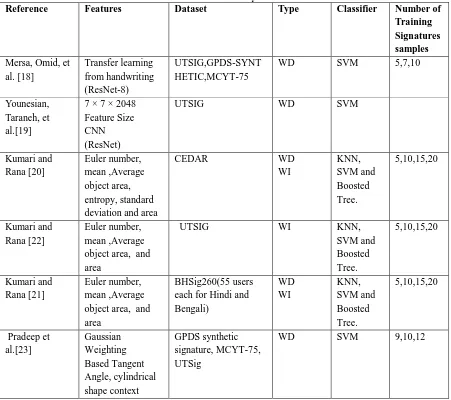
Generations of Offline Handwritten Signatures Based on Online handwritten signature Samples using deep learning is proposed by Melo, Victor KSL, et al. [17].Table III shows the Dataset , Number of training signature samples ,features ,machine learning method and model used for classification
by researchers.
Research work reported by Donato et al. [25] shows that writing area of handwritten signature affects the velocity. To analysis this concept, five dissimilar dynamic signature acquisition areas were considered in the work. Levy et al. [26] proposes Handwritten Signature data collection using Wrist-Worn Devices. DCT coefficients as features were used in the work.
Offline Chinese Signature verification using data fusion is proposed in [27].In this work, SVD ((singular value decomposition) and Pseudo-Zernike invariant moments features are used. Two back propagation network are used and connected to produce output. First BP network accepts seventeen features and second BP accepts 40 features. Result shows that FAR (False acceptance rate) is 5.71. By combining the advantage of Multi-Loss in CNN and Snapshot Ensemble, a framework based on MLSE is proposed for feature extraction and ensemble of SVM is used for classification in [28].
III. METHODOLOGY
Signature verification process is divided into three phases in our work:
(1) Data collection, (2) Feature Extraction and (3) Classifier used
A. Database Detail
In our research work, Hindi and Bangla Signature from BHsig260 dataset [29] are used. For experimental work, we used Hindi signatures of 55 users i.e. user 101 to user 155 and Bangla signature from user 46 to user 100.
B. Feature Extraction
The following four features are used in our research work. Average Object Area:-It is the ratio of the total area
covered by all the objects in the image to the total number of objects.
Euler Number: It is the difference between number of objects in the scanned signature image and the total number of holes present in those objects. Area: It is defined by total number of on pixels in
signature image.
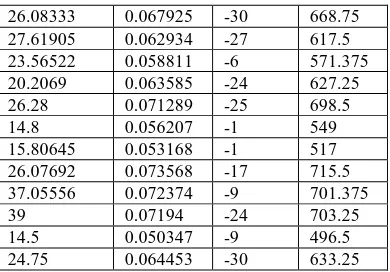
Mean: Average of pixel values of the entire image. Feature extraction based on difference of handwritten signature image is performed. The deviation of features values of authentic and fake signatures of one writer for different samples are shown in table IV and table V.
Table IV: Authentic Hindi Signature pairs (Features) Average
Object Area Area
Euler Number
Mean
12.16667 0.047526 -2 465.625
12.82353 0.047309 1 461.5
28.42857 0.064779 -30 638.625
24.92 0.0676 -10 657.625
27.61905 0.062934 -20 615.625 27.52381 0.062717 -27 615.5
37.22222 0.0727 -32 712.625
29.95238 0.068251 -20 666.625 35.41176 0.065321 -18 636.25
31.85 0.069119 -33 678.25
33.28571 0.075846 -29 740.5
26.08333 0.067925 -30 668.75 27.61905 0.062934 -27 617.5 23.56522 0.058811 -6 571.375 20.2069 0.063585 -24 627.25
26.28 0.071289 -25 698.5
14.8 0.056207 -1 549
15.80645 0.053168 -1 517
26.07692 0.073568 -17 715.5 37.05556 0.072374 -9 701.375
39 0.07194 -24 703.25
14.5 0.050347 -9 496.5
24.75 0.064453 -30 633.25
Table V: Fake-authentic Hindi Signature pairs (Features)
Average
Object Area Area
Euler Number
Mean
24.41379 0.076823 -16 745.125 26.16667 0.068142 -27 665.75 18.88235 0.069661 -7 679.125
20.72727 0.074219 5 716.5
20.70968 0.069661 -2 674.625
31 0.077365 -7 746.25
47.58824 0.087782 -21 848.25 21.25714 0.080729 -15 783.375 15.18182 0.072483 -17 709.375
29.36 0.079644 -8 768.125
20.14286 0.076497 -11 743.75 31.34783 0.078234 -38 769.75 21.28125 0.073893 -9 716.875 35.68421 0.073568 -32 722.75
28.5 0.068034 -19 665.625
25.74074 0.075412 -12 731 30.22727 0.072157 -16 700.75 27.54167 0.071723 -14 698.25 23.15625 0.080404 -15 779.625
17.89474 0.073785 -1 715
31.92 0.086589 -16 836.875
33.05 0.071723 -20 700
30.84615 0.087023 -13 839.125
C. CLASSIFIER
The following six classifiers are used in our work:
A. SVM
SVM is also used for fingerprint classification in [30].In SVM, Gamma value in SVM influence shapes of decision boundary either wiggy or straight. The decision boundary in SVM is near to data point for high value of Gamma and far away to data point for low value of Gamma. Penalty parameter is also known as cost in SVM. It determines the influence of misclassification on objective function. More data points will be chosen as support vectors for high value of penalty parameter. Less data points will be chosen as support vectors in the model. Variance and bias are also dependant on the penalty parameter. Over fitting and under fitting of the model depends on variance and bias. So, high
[image:4.595.336.531.48.184.2]Train function of SVM use optimization technique to identify support vectors according to following equation.
c=
∑
a
ik
(
s
i,x
)
+
b
B. Boosted Tree
Boosting is ensemble technique to create a set of predictors. In this scheme, classifiers are learned one after the other with early classifiers fitting simple models to the observations and then analyzing observations for errors. When a observation is misclassified by a classifier, its weight is increased so that subsequently classifier is more likely to classify it correctly. By combining the whole set
[image:5.595.318.545.241.396.2]at the end converts weak classifiers into better performing model. This process uses comparatively little time or memory as compared to another aggregation technique. Fig. 2 shows the Framework of Ensemble method.
Fig. 2 Framework of Ensemble
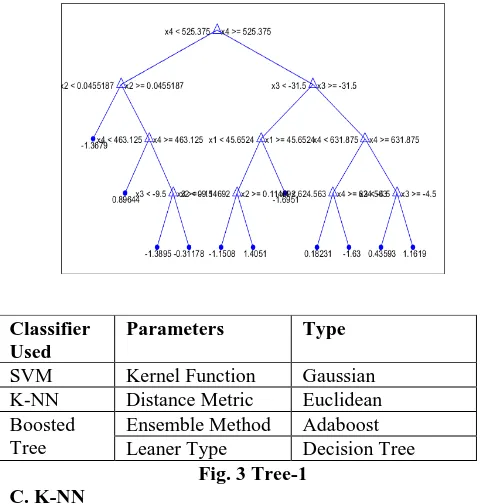
In our research work, four features are used .So four variables i.e. x1, x2, x3 and x4 are used to represent four features. Tree generated by Boosted tree are shown in Fig. 3 .
[image:5.595.53.260.281.404.2]Fig. 3 Tree-1 C. K-NN
Table VI: Parameters used in classifie
K-Nearest Neighbor is a non-parametric machine learning classifier. It is also used for gait recognition in [31].The distances metric used in K-NN are Chi square, cosine similarity measure, Euclidean distance and Minkowsky.
Euclidean distance as distance metric is generally used in K-NN. The K-NN classifier, to categorize an unknown data represented by a point in the attribute space calculates the distances between the point and points in the training data set. The value of K in K-NN is an integer value. Classification results depend on the value of K and distance metric used.
D.Multilayer Perceptron (MLP)
MLP is the category of a feed forward neural network. For training, back propagation is used in MLP. Back propagation is a supervised learning technique It is used for classification of observations that are not linearly separable.MLP consists of at least three layers i.e. input layer, hidden layer and output layer as shown in Fig. 4.
[image:5.595.42.285.471.723.2]Input Layer Hidden Layer Output Layer
Fig. 5 MLP
Fig. 4 MLP E. Random forest classifier (RFC)
For calculating the root node, gini index or information gain is not used in random forest classifier (RFC) as in decision tree classifier. Selection of the root node will happen randomly. Final decision of RFC is based on voting where majority decides the class. Application areas of RFC are banking for finding the loyal customer, stock market to identify the stock behavior, E-commerce, medicine and handwritten character recognition in [32].
F.Naive Bayes
Naive Bayes classifier uses the concept of Bayes’Theorem. Naive bayes classifier assume that each feature in the database is independent to each other and each feature in the database equal contributes for accuracy. But in real world scenario, it is not true.
IV.
EXPERIMENTAL RESULTS Matlab and Weka Tool are used for experimental work.
Using SVM
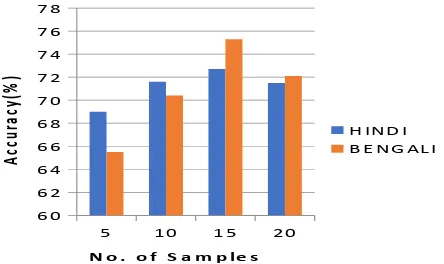
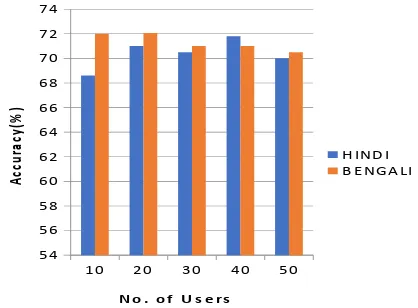
With sample size of fifteen, accuracy of Bangla is 75.3% and accuracy of Hindi is 72.7%. For ten signers, the accuracy of Bangla is 80.2 % and Hindi is 70 %. In both cases, accuracy of Bangla signature verification is high as shown in Fig. 5 and Fig. 6.
Classifier Used
Parameters Type
SVM Kernel Function Gaussian
K-NN Distance Metric Euclidean
Boosted Tree
Ensemble Method Adaboost
5 1 0 1 5 2 0 6 0
6 2 6 4 6 6 6 8 7 0 7 2 7 4 7 6 7 8
H IN D I B E N G A L I
N o . o f S a m p le s
Ac
cu
ra
cy
(%
)
Fig. 5 Hindi and Bangla Signature Verification using SVM
10 20 30 40 50 54
59 64 69 74 79 84
H IN D I B E N G AL I
N o . o f U s e rs
A
c
c
u
ra
c
y
(%
[image:6.595.332.524.51.180.2])
Fig. 6 Hindi and Bangla Signature Verification using SVM
B. UsingK-NN
[image:6.595.64.286.53.185.2]With sample size of fifteen, Accuracy of Bangla is 73.8% and accuracy of Hindi is 64%.For ten signers, the accuracy of Bangla is 73.7 % and Hindi is 67.4 %.In both cases, accuracy of Bangla signature verification is high as shown in Fig. 7 and Fig. 8.
5 1 0 1 5 2 0
0 1 0 2 0 3 0 4 0 5 0 6 0 7 0 8 0
H IN D I B E N G A L I
N o . o f S a m p le s
A
c
c
u
ra
c
y
(%
)
Fig. 7 Hindi and Bangla Signature Verification using KNN
1 0 2 0 3 0 4 0 5 0 5 4
5 9 6 4 6 9 7 4 7 9
H IN D I B E N G A L I
N o . o f U s e r s
A
c
c
u
ra
c
y
(%
[image:6.595.53.286.193.417.2])
Fig. 8 Hindi and Bangla Signature Verification using KNN
C . UsingBoosted tree
With sample size of fifteen, Accuracy of Bangla is 74.2 and accuracy of Hindi is 71.6%.For ten signers, the accuracy of Bangla is 76.7 % and Hindi is 68.5 %.In both cases, accuracy of Bangla signature verification is high as shown in Fig.9 and Fig. 10.
5 1 0 1 5 2 0
6 0 6 2 6 4 6 6 6 8 7 0 7 2 7 4 7 6
H IN D I B E N G A L I
N o . o f S a m p le s
Ac
cu
ra
cy
(%
[image:6.595.318.540.261.635.2])
Fig. 9 Hindi and Bangla Signature Verification using Boosted tree
1 0 2 0 3 0 4 0 5 0
5 4 5 9 6 4 6 9 7 4 7 9
H IN D I B E N G A L I
N o . o f U s e r s
A
cc
ur
ac
y(
%
)
Fig. 10 Hindi and Bangla Signature Verification using Boosted tree
D. Using Random forest
[image:6.595.322.543.302.457.2] [image:6.595.60.261.587.740.2]5 1 0 1 5 2 0 6 0
6 2 6 4 6 6 6 8 7 0 7 2 7 4 7 6
H IN D I B E N G A L I
N o . o f S a m p le s
A
cc
u
ra
cy
(%
[image:7.595.324.533.49.203.2])
Fig. 11 Hindi and Bangla Signature Verification using Random Forest
10 20 30 40 50 54
59 64 69 74 79 84
H IND I B ENG ALI
N o . o f U s e rs
A
c
c
u
r
a
c
y
(
%
[image:7.595.65.278.52.196.2])
Fig. 12 Hindi and Bangla Signature Verification using Random Forest
E. Using MLP
With sample size of fifteen, Accuracy of Bangla is 72.48.With Sample size of twenty accuracy of Hindi is 72.3%.For twenty signers, the accuracy of Bangla is 72.06 % and Hindi is 71%.In both cases, accuracy of Bangla signature verification is high as shown in Fig.13 and Fig. 14
5 1 0 1 5 2 0 6 2
6 4 6 6 6 8 7 0 7 2 7 4
H IN D I B E N G A L I
N o . o f S a m p le s
A
c
c
u
ra
c
y
(%
)
Fig. 13 Hindi and Bangla Signature Verification using MLP
1 0 2 0 3 0 4 0 5 0
5 4 5 6 5 8 6 0 6 2 6 4 6 6 6 8 7 0 7 2 7 4
H IN D I B E N G A L I
N o . o f U s e r s
A
cc
ur
ac
y(
%
)
Fig. 14 Hindi and Bangla Signature Verification using MLP
F. Using Naive Bayes
With sample size of Twenty, Accuracy of Bangla is 71.With Sample size of twenty accuracy of Hindi is 69%.For thirty signers, the accuracy of Bangla and Hindi is 70%.In both cases, accuracy of Bangla signature verification is high as shown in Fig. 15 and Fig. 16
5 1 0 1 5 2 0
6 5 6 6 6 7 6 8 6 9 7 0 7 1 7 2
H IN D I B E N G A L I
N o . o f S a m p le s
A
c
c
u
ra
c
y
(%
[image:7.595.337.524.331.473.2])
Fig. 15 Hindi and Bangla Signature Verification using NB
10 20 30 40 50 54
56 58 60 62 64 66 68 70 72
H IND I B ENG ALI
N o . o f U s e rs
A
c
c
u
r
a
c
y
(
%
[image:7.595.334.521.510.682.2])
[image:7.595.65.275.573.709.2]BENGALI HINDI
User SVM KNN SVM KNN
1 72 73 82.6 95.7
2 69.6 69.6 71.7 69.6
3 91.3 100 84.8 89.1
4 84.8 89.1 58.7 73.9
5 78.3 89.1 76.1 82.6
6 54.3 63 97.8 100
7 76.1 71.7 73.9 78.3
8 67.4 76.1 78.3 82.6
9 93.5 93.5 76.1 87
10 84.8 87 71.7 80.4
11 80.4 84.8 78.3 78.3
12 67.4 80.4 84.8 89.1
13 69.6 69.6 63 73.9
14 89.1 87 71.7 80.4
15 95.7 100 73.9 89.1
16 91.3 100 82.6 89.1
17 71.7 82.6 84.8 87
18 80.4 76.1 47.8 58.7
19 80.4 80.4 76.1 93.5
20 65.6 69.6 63 73.9
21 97.8 100 69.6 73.9
22 91.3 91.3 84.8 95.7
23 80.4 80.4 84.8 76
24 84.8 91.3 87 89
25 87 93.5 89.1 93.5
26 67.4 67.4 80.4 93.5
27 56.5 52.2 69.9 69.6
28 84.8 93.5 60.9 76.1
29 73.4 78.3 67.4 73.9
30 69.6 78.3 71.7 78.3
31 80.4 89.1 58.7 67.4
32 60.9 63 45.7 54.3
33 58.7 73.9 80.4 87
34 80.4 87 67.4 69.6
35 91.3 89.1 76.1 82.6
36 65.2 60.9 82.6 84.8
37 71.7 87 71.7 78.3
38 89.1 100 69.6 76.1
39 78.3 78.3 65.2 73.9
40 93.5 100 69.6 56.5
41 78.3 84.8 71.7 69.6
42 87 93.5 78.3 84.8
43 76.1 84.8 76.1 73.9
44 89.1 91.3 73.9 80.4
45 43.5 58.7 93.5 100
46 84.8 95.7 89.1 97.8
48 82.6 84.8 89.1 97.8
48 77.8 84.8 84.8 84.8
49 84.8 91.3 87 97.8
50 91.3 100 84.8 95.7
51 73.9 84.8 89.1 93.5
[image:8.595.64.274.54.708.2]V
.
COMPARISON WITH OTHER DATABASETable VII: Comparison of accuracy
Database Accuracy Classifier Ref.
CEDAR 87.4 SVM [20]
UTSig 64 SVM [22]
BHsig260(Hind i)(user 1 to user 55)
80 SVM [21]
BHsig260(Hind i)(user 101 to user 155)
72.3 MLP Prop
osed
BHsig260(Beng ali) user 1 to user 45)
72 SVM [21]
BHsig260(Beng ali) user 46 to user 100)
79 Random
Forest
Prop osed
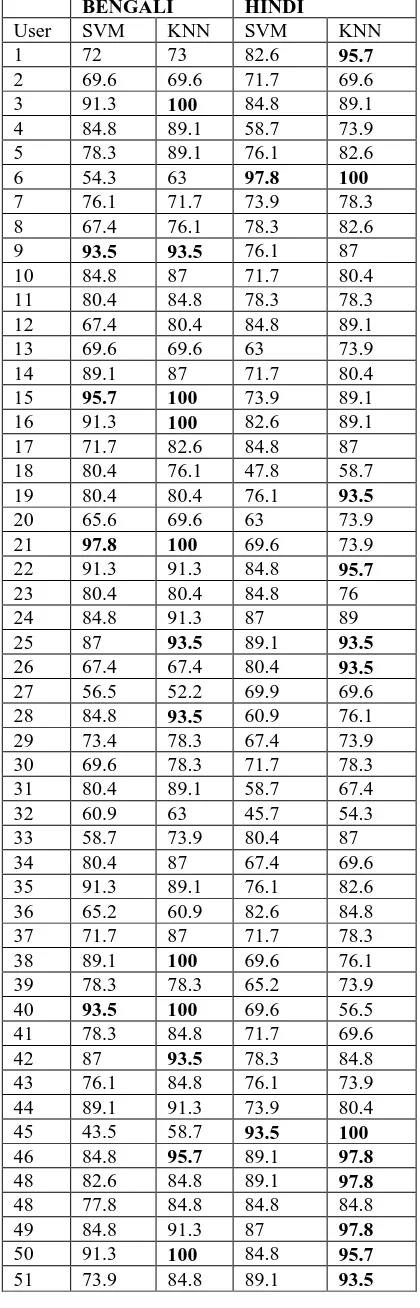
In this work, we obtained best results for Bangla signature verification using RFC and for Hindi signature verification using MLP as shown in table VII. It is also observed that for user dependent model, for some users we achieved accuracy of more than 92 % using K-NN and SVM as shown in table VII. Feature extraction based on difference of handwritten signature image does not straightforwardly expose information about the original scanned signatures, so scheme is resilience against security attack.
VI.
CONCLUSION
Six classifier Boosted Tree, Random forest classifier, K-nearest neighbor, Multilayer Perceptron ,Support Vector Machine, Naive bayes classifier, are used in the work. Performance analysis of classifiers for Hindi and Bangla signature verification using four features has been presented. Feature extraction based on difference of handwritten signature image does not straightforwardly expose information about the original scanned signatures, so scheme is resilience against security attack. Best results are obtained by using
RFC and MLP for Bangla and Hindi signature verification respectively. In future, we apply RFC and MLP on CEDAR dataset or any other dataset to analyze the performance.
REFERENCES
1. M. C. Tatepamulwar and D. V. P. Pawar, "Comparison of Biometric Trends Based on Different Criteria," Asian Journal of Management Sciences, vol. 2, no. 3, pp. 159-165, March 2014.
2. Yeung, Dit-Yan, et al. "SVC2004: First international signature verification competition." International conference on biometric authentication. Springer, Berlin, Heidelberg, 2004
4. Schulte-Austum, M. "D-Scribe." Presentation at Measurement Science and Standards in Forensic Handwriting Analysis Conf. 2013. 5. Arrisueno, Gladys. "Measurement Science and Standards in Forensic
Handwriting Analysis Conference Webcast." (2013).
6. Tucha, O., et al. "Kinematic analysis of dopaminergic effects on skilled handwriting movements in Parkinson’s disease." Journal of neural transmission 113.5 (2006): 609-623.
7. Caligiuri, Michael P., et al. "Handwriting movement kinematics for quantifying extrapyramidal side effects in patients treated with atypical antipsychotics." Psychiatry Research 177.1-2 (2010): 77-83 8. Danna, Jérémy, et al. "Handwriting sonification for the diagnosis of
dysgraphia." Recent progress in graphonomics: Learn from the past–Proceedings of the 16th conference of the international graphonomics society. Tokyo: Tokyo University of Agriculture and Technology Press, 2013.
9. O. Alaswad, A. H. Montaser and F. E. Mohamad, "Vulnerabilities of Biometric Authentication “Threats and Countermeasures”," International Journal of Information & Computation Technology, vol. 4, no. 10, pp. 947-958, 2014.
10. Subhash, Chandra, Maheshkar Sushila, and Srivastava Kislay. "Offline Signature Verification Using Artificial Neural Network." Proceedings of the 4th International Conference on Frontiers in Intelligent Computing: Theory and Applications (FICTA) 2015. Springer, New Delhi, 2016.
11. Fahmy, Maged MM. "Online handwritten signature verification system based on DWT features extraction and neural network classification." Ain Shams Engineering Journal 1.1 (2010): 59-70.
12. Okawa, Manabu. "Synergy of foreground–background images for feature extraction: Offline signature verification using Fisher vector with fused KAZE features." Pattern Recognition 79 (2018): 480-489. 13. Coetzer, Johannes, Ben M. Herbst, and Johan A. du Preez. "Offline
signature verification using the discrete radon transform and a hidden Markov model." EURASIP Journal on applied signal processing 2004 (2004): 559-571.
14. Bhattacharya, Indrajit, Prabir Ghosh, and Swarup Biswas. "Offline signature verification using pixel matching technique." Procedia Technology 10 (2013): 970-977.
15. Durrani, Mehr Yahya, Salabat Khan, and Shehzad Khalid. "VerSig: a new approach for online signature verification." Cluster Computing (2017): 1-11.
16. Manjunatha, K. S., et al. "Online signature verification based on writer dependent features and classifiers." Pattern Recognition Letters 80 (2016): 129-136.
17. Melo, Victor KSL, et al. "Deep learning approach to generate offline handwritten signatures based on online sample s." IET Biometrics (2018).
18. Mersa, Omid, et al. "Learning Representations from Persian Handwriting for Offline Signature Verification, a Deep Transfer Learning Approach." arXiv preprint arXiv:1903.06249 (2019) 19. Younesian, Taraneh, et al. "Active Transfer Learning for Persian
Offline Signature Verification." arXiv preprint arXiv:1903.06255 (2019).
20. K.Kumari, S.Rana, “Offline Signature Verification using Intelligent Algorithm” International Journal of Engineering & Technology, 2018, pp. 69-72.
21. S.Rana, A.Kumar, K.Kumari, “Performance Analysis of off-line signature verification,” International Conference on Innovative Computing and Communication, ICICC, 2019
22. Kamlesh Kumari, Sanjeev Rana “Off-Line Persian Signature Verification: An Empirical Evalution”, International Journal of Innovative Technology and Exploring Engineering (IJITEE),RTCAIT,2019(accepted)
23. Narwade, Pradeep N., Rajendra R. Sawant, and Sanjiv V. Bonde. "Offline Handwritten Signature Verification Using Cylindrical Shape Context." 3D Research 9.4 (2018): 48.
24 Rakesh, K., and Rajarshi Pal. "Detecting Background Line as Preprocessing for Offline Signature Verification." Mining Intelligence
and Knowledge Exploration. Springer, Cham, 2014. 164-171. 24. Donato, Impedovo, Giuseppe Pirlo, and Fabrizio Rizzi.
"Characteristics of Constrained Handwritten Signatures: An
Experimental Investigation." 17th Biennial Conference of the International Graphonomics Society. 2015.
25. Levy, Alona, et al. "Handwritten Signature Verification Using Wrist-Worn Devices." Proceedings of the ACM on Interactive, Mobile, Wearable and Ubiquitous Technologies 2.3 (2018): 119.
26. Zuo, Wen-ming, and Ming Qi. "A novel data fusion scheme for offline chinese signature verification." International Conference on Natural Computation. Springer, Berlin, Heidelberg, 2005.
27. Masoudnia, Saeed, et al. "Multi-Representational Learning for Offline Signature Verification using Multi-Loss Snapshot Ensemble of CNNs." Expert Systems with Applications (2019).
28. https://goo.gl/9QfByd
29. Yao, Yuan, Paolo Frasconi, and Massimiliano Pontil. "Fingerprint classification with combinations of support vector machines." International Conference on Audio-and Video-Based Biometric Person Authentication. Springer, Berlin, Heidelberg, 2001.
30. Derlatka, Marcin. "Modified kNN algorithm for improved recognition accuracy of biometrics system based on gait." IFIP International Conference on Computer Information Systems and Industrial Management. Springer, Berlin, Heidelberg, 2013.
31. L. P. Cordella, C. D. Stefano, F. Fontanella and A. S. d. Freca, "Random Forest for Reliable Pre-classification of Handwritten Characters," 2014 22nd International Conference on Pattern Recognition, Stockholm, 2014, pp. 1319-1324
AUTHORS PROFILE
Kamlesh Kumari is working as Programmer in Kurukshetra University since 2006. She has 8 publications in International/National Journals and Conferences. .Presently, pursuing Ph.D (CSE) from M.M. (Deemed to be University).Mullana, Ambala.She is GATE qualified.