Abstract: Data warehouse is a central storage facility that stores information from many sources which can be in structured or unstructured format, queries this information for retrieval based on certain input facts and delivers the outcome analysis to many analysts, to meet decision support and business intelligence requirement. Not much research has been carried out in this research area in the past few years. In this research paper, we are discussing the data warehouse architecture and the testing techniques that are used for best suited to be used for the data warehouses. Literature for the testing techniques is integrated at one place and the outcome is to focus on security issues while performing data warehouse testing.
Index Terms: Database, Data Warehouse, Data Warehouse
Testing, Database Testing, Software Testing
I.
INTRODUCTION
Data warehouse are decision support systems used for
reporting and data analysis to enable the users (Executives,
Managers and Analysts) to make effective and efficient
decisions faster. Data warehouse technology has been
successfully deployed in many industries for eg: financial
services (for claims analysis, risk analysis, credit card
analysis, and fraud detection), manufacturing industry (for
order shipment and customer support analsis), retail industry
(for
user
profiling
and
inventory
management),
transportation
industry
(for
fleet
management),
telecommunications (for call analysis and fraud detection),
utilities (for power usage analysis) and healthcare (for
outcomes analysis).
A data warehouse consolidates the historical data, which
helps the organization to analyze its business and predict the
outcomes based on the trend analysis. It helps the executives
to organize, understand and use their data to take strategic
decisions. Data warehouse systems help in the integration of
diversity of application systems.
The banking sector over the years, has accumulated large
amount of customer data and operational data which is a
valuable asset of the banks and this data when analysed
efficiently can be used for report generation and for
performing statistical analysis for various meta data collected
to meet the needs of the bank customer analysis [1-2]. Thus
the banking data warehouse technology shall help the banks
to expand their business scope, improve customer service
levels, strengthen internal management, help them further in
development of healthy banks and also help them to be
successful as compared to their competitors [3].
Revised Manuscript Received on June 15, 2019. Sonali Mathur, Vikram Bali, JSSATE, UP, India
S.L. Gupta, OMAN
Payal Pahwa, BPIT, Rohini, India.
II.
PROCEDURE FOR PAPER SUBMISSION
Databases are designed to make transactional systems run
efficiently. Databases basically are called as OLTP (Online
Transaction Processing Systems). They are not used for
analytics. On the other hand, the primary usage of data
warehouses are they are used for analytics. Therefore, data
warehouse thus, can be called OLAP (Online Analytical
Processing) database. The data warehouse takes the data from
all the databases and creates a layer dedicated to data
analytics. The databases are therefore designed to handle
only transactions whereas data warehouses are designed to
handle analytical processing of data.
Database consist of collection of data that is organized for
storage, retrieval and accessibility of operations. Data
warehouse on the other hand, integrates copies of transaction
data from various sources and uses them for analytical
purpose.
Each database is constrained to run on a single application
whereas data warehouse accommodates data storage for any
number of applications thereby stating that one data
warehouse consists of infinite applications and infinite
databases.
OLTP databases must be up every time as failure in the
system will lead to chaos. The database is linked to the
front-end application. OLAP databases are scalable and not
linked to the front-end databases. Data is refreshed from the
source system as needed and results in historical trend
analytics and help in making business decisions.
OLTP database are optimized for performing read write
operations for single point transactions. Performing large
analytical queries is not preferred. OLAP databases are
optimized for efficiently and effectively reading and
retrieving large data sets and aggregating the data. The data
warehouse are designed to handle large analytical queries.
The structure of the OLTP database is very complex as it
consists of large number of joins because the data is
normalized, and it is structures as there is no data duplication.
On the other hand, the structure of OLAP database is not very
complex and denormalized to enhance analytical query
response time to specially facilitate analysis and reporting.
Submit your manuscript electronically for review.
III.
COMPARISON TABLE
DATABASE
DATAWAREHOUSE
They are OLTP (Online
Transaction
Processing
Systems)
They are OLAP (Online
Analytical
Processing
Systems)
Data Warehouse Testing and Security: A
Conspectus
It consists of collection of
data
It consists of collection of
copies of transaction data
It stores data on single
application
It stores data from number of
applications
Data is used for storage,
retrieval and accessibility
of operations
Data is used for analytical
processing
They
are
linked
to
front-end
applications;
thus failure needs to be
handled properly
They are not linked to
front-end applications and are
scalable
They are designed to
perform
single
point
transactions
They are designed to handle
large analytical queries
The structure is complex
and normalized
The structure is not complex
and denormalized
Real time data processing
is done
Data is refreshed from source
systems when required
IV.
DATA WAREHOUSE ARCHITECTURE
A data warehouse is a “subject-oriented, integrated,
timevarying, non-volatile collection of data that is used
primarily in organizational decision making [4]. A data
warehouse is used by organizations to provide efficient data
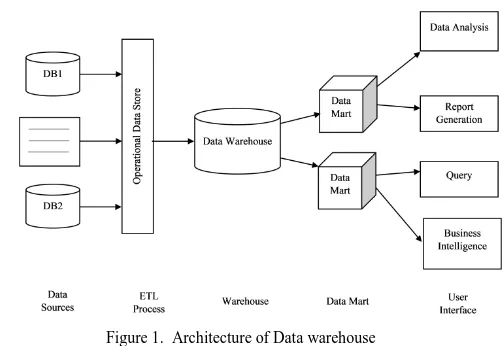
analysis to decision makers [5]. Figure 1 shows a typical
three tier architecture of data warehouse where at the first
level the data is gathered from various data sources (any
organization databasee.g: CRM, Bank, ERP Systems, etc.)
and transformed into the desired format through Extract,
Transform and Load (ETL) Process at the second level. Then
the desired data is stored in the data warehouse. At the third
level, data analysis is performed using decision support
systems and reports are generated for the users for the
purpose of strategic decision making.
The three-tier architecture of data warehouse [6] can be
explained as:
1. Enterprise Warehouse – It is the bottom tier of a data
warehouse consisting of database server consisting of
relational database system. The data is gathered from
operational data sources and other external databases and
data is extracted using application program interfaces known
as gateways. A gateway is database management system and
allows the client program to execute code. It consists of
details comprising of all information about subjects related to
the entire organization.
2. Data Mart – It is the middle tier of a data warehouse
consisting of OLAP Server performing OLAP operations.
The data mart is a subset of data warehouse and contains
information related to a specific department or group of
users.
[image:2.595.306.558.56.229.2]3. Virtual Warehouse – It is the top tier of a data warehouse
which consists of query, reporting, analysis or data mining
tools. Analytical analysis is carried out and reports are
generated for the users to forecast strategic business
decisions.
Figure 1. Architecture of Data warehouse
V.
SOFTWARE TESTING VS DATA WAREHOUSE
TESTING
In a data warehouse, the data passes through several stages,
wherein each stage certain changes are made in the data
before it finally reaches the user in the form of a chart, table
or a report. Thus, at every stage of the data warehouse data
should be tested to guarantee accuracy and preserve the
quality of data. Data warehouse consisting of high-quality
data is termed as a good data warehouse. Thus, before we see
what testing techniques can be best applied to the data
warehouse, let us see how software testing is different from
data warehouse testing.
The difference between Software testing and Data
warehouse testing [8] is represented in Table 1as shown
below:
SOFTWARE TESTING
DATA WAREHOUSE
TESTING
It is a carried out prior to
deployment of software.
It
is
carried
out
post
deployment
of
the
application.
It focuses on testing of
each
use
case
which
contains various test cases
[7].
It is focused on querying the
test data loaded by the ETL
process.
It is source code specific.
It is content specific.
Focus is on generation and
testing of test cases.
Focus is on query triggered
operation in testing.
Tester bridges the gap
between
informal
specifications and formal
verification in software
testing [7].
As volume of data is large it is
not
possible
in
data
warehouse testing.
It is carried out through
user interface.
It is primarily carried out on
business logic
Instant or overnight result
is generated by execution
of transactions.
Execution of transactions
take a long time due to large
volume of data.
It is user triggered as the
input is given by the user
and individual transactions
are processed.
It is system triggered due to
Extraction,
Transformation
and Loading process [9].
Software defects found
later
in
development
lifecycle
increases
the
development cost.
The testing process ends
with the development life
cycle.
The testing process continues
after system delivery.
Either
manual
or
automated
testing
is
carried out on the test data.
Only automated testing is
done on the test data.
Thus, it can be seen that software testing basically focuses
on see and test whereas data warehouse testing is an
automated testing where smart scripts are written to validate
business. Thus, due to volume of data, processing may take
time but the outcomes are efficient and effective as the
reports are used for decision making purposes.
VI.
DATA WAREHOUSE TESTINGTECHNIQUES
With data being the most important factor in driving critical
business decisions, testing the data warehouse becomes a
critical process. Data in the data warehouse is integrated from
numerous sources. The data source affects the data quality, so
data profiling and data cleaning must be carried out. Data
Warehouse testing consists of Extract, Transform and Load
(ETL) testing to validate that the data has been transformed
and loaded as expected and Business Intelligence (BI)
testing to validate that the data shown in the reports is
accurate [10]. Data Warehouse testing is very important
because the business relies upon this data to make key
decisions. Bad data and issues in Data Warehouse can lead to
failures of the Data Warehouse projects because lack of trust
in the data and consequently low usage.
Unlike software testing where a software is tested with the
intent of finding errors, data warehouse testing is carried out
to ensure that the data has been loaded from the source to the
destination after business transformation is accurate. It also
involves the verification of data at various middle stages that
are being used between source and destination.
Much literature is available on what testing technique are
best best suited for the various stages of the data warehouse
testing. In this section, we shall be integrating all the testing
techniques to help us analyse the essential techniques that
should be carried out at various stages of the data warehouse.
Refer-ence
Publis hed date
Testing Technique Proposed at Backend (DS ->
ODS -> DW)
Testing Technique Proposed at Frontend
(DW -> DM -> UI)
Conclusion
[12] 2007 Requirements Testing Unit Testing
Integration Testing User acceptance Testing
Unit testing is essential to be done at the backend to check the integration of data along with User Acceptance testing at the frontend to see that query analysis is as per the user requirements [17] 2007 Unit Testing.
Technical Shakedown Testing System Testing
Integration Testing Operation readiness Testing User acceptance Testing
Unit testing is essential to be done at the backend to check the integration of data along with User
Acceptance testing at the frontend to see that query analysis is as per the user requirements [13] 2008 Unit Testing Integration
Testing User acceptance Testing Performan ce Testing
Unit testing is essential to be done at the backend to check the integration of data along with User Acceptance testing at the frontend to see that report generated are satisfactory. [18] 2008 Data
Validation Testing Oneshot/Retr ospective Testing View Testing
Prospectiv e Testing Regression Testing
Data validation testing is essential to be done at the backend to check the integrity of the data along with Regression testing at the frontend to check the data functions correctly after the changes has been made. [11] 2009 Functional
Testing Usability Testing Stress Testing
Performan ce Testing Security Test Recovery Test Regression Test
Functional testing is essential to be done at the backend to check the data is compliant as per the business requirements along with Security testing at the frontend to check the data is protected and functionality is
maintained. [19] 2009 Multidimensi
onal database testing Data pump (ETL) testing
Metadata Testing OLAP testing.
[9] 2010 Extraction Testing Transformati on Testing Load Testing Stress and Volume Testing
Adhoc Query Testing End to End Integrated Testing Security Testing Parallel Testing
ETL testing is essential to be done at the backend to check the data validation along with Security testing at the frontend to check the data is protected and functionality is
maintained. [15] 2010 Unit Testing Integration
Testing System Testing User acceptance Testing
Unit testing is essential to be done at the backend to check the integration of data along with User Acceptance testing at the frontend to see that query analysis is as per the user requirements [16] 2011 End to End
Testing Row Count Testing Field Size Testing
Report Testing
End to End testing is essential to be done at the backend to check the data has been loaded along with Report testing at the frontend for report and query analysis. [20] 2012 Functional
Test Usability Test
Security Test Performan ce Test Maintaina bility Test
Functional testing is essential to be done at the backend to check the data is compliant as per the business requirements along with Security testing at the frontend to check the data is protected and functionality is
maintained. [21] 2013 New Data
warehouse Testing Migration Testing Change Request
Report Testing
New data warehouse testing is essential to be done at the backend as complete transformed data is
loaded along with Report testing at the frontend for report generation and query analysis as per user business requirements .
[22] 2015 ETL Testing Security Testing Regression Testing
ETL testing is essential to be done at the backend to check the data validation as bank database is voluminous along with Security testing at the frontend to check the data is protected and functionality is
maintained. [23] 2015 ETL Testing Automated
Testing
Testing ETL (Extract, Transform, and Load) procedures is an important and vital phase during testing of Data warehouse as it affects the quality of data, so automated testing improves data quality in less time, cost and attains good data quality. [25] 2016 New Data
warehouse Testing Migration Testing Change Request
Report Testing
[24] 2018 End to End Testing
Regression Testing
End to end testing at the backend helps to verify that the data warehouse system meets its design specification s and other requirements and Regression Testing at the frontend to support agile and iterative development processes.
Contrary, on the other hand, data warehouse testing when
compared with the software testing techniques that are
carried out for testing of the software, the literature available
is integrated in the table given below.
Refer-ence
Publis hed date
Software Testing Technique Proposed at
Backend (Database)
Software Testing Technique Proposed at
Frontend (GUI)
Conclusion
[26] 2010 Correctness Testing Performance Testing Security Testing Stress Testing Reliability Testing
Unit Testing Regression Testing
Performance and Security Testing are essential to be
performed for checking data validation at the backend whereas Regression testing is performed at the frontend to check the application performance .
[27] 2012 Correctness Testing Performance Testing Security Testing Reliability Testing
Manual Testing Unit testing Integration testing Acceptanc e / Validation testing System testing
Security Testing aims to verify that protection mechanisms built into a system thus it is essential to be performed at backend whereas to check the functionality of a system System Testing is performed at the front end. [28] 2014 Performance
Testing Security Testing Reliability
User Acceptanc e Testing
Security Testing aims to verify that protection mechanisms
Testing built into a system thus it is essential to be performed at backend whereas to check the User acceptance Testing is performed at the front end so that the software is completely accepted by the user. [29] 2016 Performance
Testing Security Testing Reliability Testing System testing
Unit testing Integration testing
Security Testing aims to verify that protection mechanisms built into a system thus it is essential to be performed at backend whereas to check the functionality of a system System Testing is performed at the front end. [30] 2018 Performance
Testing Security Testing Load Testing Stress Testing
Unit Testing Fuzz Testing Regression Testing System Testing
VII.
DISCUSSION
[image:6.595.315.560.49.266.2]In software systems, Front-end Testing is testing or
verifying the frontend functionality, GUI, and Usability. The
main aim of Frontend testing to make sure that every user is
well-protected from bugs. Figure 2 represents the most
frequently software testing techniques used at the frontend.
User Acceptance testing is done at the front end so check that
the application made is as per the user requirements.
Figure 2.Frequently used Software Testing Techniques at Frontend
On the other hand, Backend testing is defined as a type
of testing that checks the server side or Database. It is also
known as Database Testing. The data entered in the front end
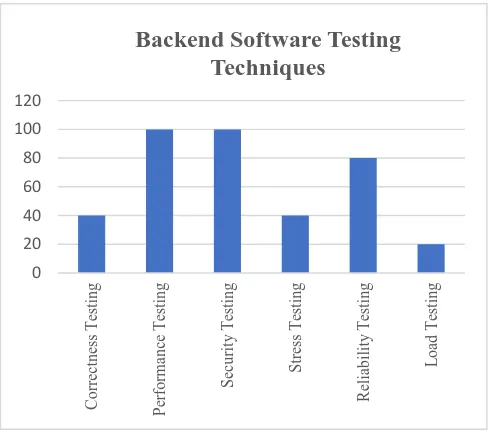
will be stored in the back-end database. From the literature
gathered, it can be concluded that Performance and Security
Testing are performed at the backend as shown in Figure 3
which also represent the frequently used backend software
testing techniques.
Figure 3.Frequently used Software Testing Techniques at Backend
[image:6.595.46.292.187.409.2]In data warehouse systems, in the frontend testing,
regression, security or report testing takes place to check the
generated query or report analysis is as per the customer
requirements. Figure 4 represents the most frequently used
front end testing techniques for a data warehouse.
Figure 4.Frequently used Data Warehouse Testing Techniques at Frontend
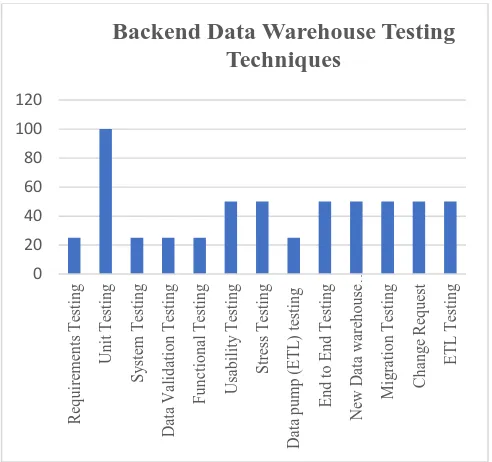
The backend testing data warehouse is tested using mainly
ETL Testing to check for data validation and there is no loss
in quality of data during the
ETL process. Figure 5
represents
the
most
0 20 40 60 80 100 120 U n it T est in g R eg re ssi o n T est in g M an u al T est in g U se r A cc ep ta n ce T est in g S y st em t est in g In te g ra ti o n t est in g F u zz T est in g
Frontend Software Testing
Techniques
0 20 40 60 80 100 120 C o rr ec tn ess T est in g P er fo rman ce T est in g S ec u ri ty T est in g S tr ess T est in g R el ia b il it y T est in g L o ad T est in gBackend Software Testing
Techniques
0 20 40 60 80 100 120 In te g ra ti o n T est in g U se r ac ce p ta n ce T est in g P er fo rman ce T est in g P ro sp ec ti v e T est in g R eg re ssi o n T est in g M et ad at a T est in g O L A P t esti n g . A d h o c Q u er y T est in g S ec u ri ty T est in g P ar al le l T est in g R ep o rt T est in g M ai n ta in ab il it y T est [image:6.595.314.560.422.649.2]frequently used testing techniques at the backend testing of a
data warehouse.
Figure 5.Frequently used Data Warehouse Testing Techniques at Backend
VIII.
CONCLUSION
In this paper, we have integrated the literature available
over the years, about the testing techniques which are being
used for testing in the data warehouse. As the architecture of
the data warehouse has evolved, thus the testing techniques
will also evolve according to the architecture of the data
warehouse. In future, we would like to apply the frequently
used techniques in a proposed architecture featuring more on
the security aspects of data in data warehouse testing. Apart
from maintaining high quality of data in a data warehouse,
the security of the data should also be focused to get a secure
data at the target in the data warehouse.
REFERENCES
1. Färber F, Cha S K, Primsch J, et al. SAP HANA database, “Data management for modern business applications[J]”, ACM Sigmod Record, 2012, 40(4): 45-51.
2. Chen C L P, Zhang C Y, “Data-intensive applications, challenges, techniques and technologies: A survey on Big Data[J]”, Information Sciences, 2014, 275: 314-347.
3. Ranjan J.,“Business intelligence: Concepts, components, techniques and benefits[J]”, Journal of Theoretical and Applied Information Technology, 2009, 9(1): 60-70.
4. W. H. Inmon, ”Building the data warehouse” (the 2nd edition) [M], New York: Wiley Computer Pub., 1996.
5. J. A. Senn, “Information technology in business: principles, practices, and opportunities”, Prentice-Hall, Inc., 2000
6. [Online]http://dataminingzone.weebly.com/uploads/6/5/9/4/6594749/c h4_dw_architecture.pdf, (2013) April 9.
7. Sneed M. Harry, “Testing a Data Warehouse – an Industrial Challenge”, in proceedings of the Testing: Academic & Industrial Conference on Practice and Research Techniques, IEEE Computer, p. 203-210, 2006 8. Gupta S L, Pahwa P, and Mathur S, “Classification Of Data Warehouse
Testing Approaches”, in International Journal Of Computers & Technology, vol. 3, no. 3a. pp. 381–386, 2012.
9. Executive-MiH, “Data Warehouse Testing is different”, 2010 10. online
https://panoply.io/data-warehouse-guide/data-warehouse-testing-101/
11. M. Golfarelli and S. Rizzi, "A Comprehensive Approach to Data Warehouse Testing," in ACM 12th international workshop on Data warehousing and OLAP (DOLAP '09) Hong Kong, China, 2009. 12. K.Brahmkshatriya, “Data warehouse testing”,
http://www.stickyminds.com, 2007.
13. A. van Bergenhenegouwen, “Data warehouse testing”, http://www.ti.kviv.be, 2008.
14. R. Cooper and S. Arbuckle, “How to thoroughly test a data warehouse”, In Proc. STAREAST, Orlando, 2002.
15. Breue T., “Turning data into Dollars”, XLNT Consulting, 2010 16. Ceres E., 2011, “Data Warehouse Testing: Why QA projects need
Automation”, white paper published for Real-Time Technology Solutions.
17. Mookerjea A. and Malisetty P., 2008, “Data Warehouse/ETL Testing: Best Practices”, www.pureconferences.com.
18. S. Bhat, "Data Warehouse Testing - Practical," in www.Stickminds.com, 2007.
19. P. Tanuška, O. Moravčík, P. Važan, and F. Miksa, "The Proposal of Data Warehouse Testing Activities," in 20th Central European conference on Information and Intelligent Systems, Varaždin, Croatia, 2009, pp. 7-11. 20. Golfarelli, M. and Rizzi, :Data Warehouse Testing: A Prototype based Methodology”, in Information and Software Technology Journal, Elsevier, Vol 53, Issue 11, Pg. 1183-1198, 2011
21. K.Vishnu Vandana , V.Sujatha, “ETL Testing in Data Warehousing”, in International Journal of Engineering Sciences Research, Vol 04, Special Issue 01, 2013
22. C. Wenzhe, “The Application of Data Warehouse Technology in Modern Finance”, in International Conference on Advances in Mechanical Engineering and Industrial Informatics (AMEII), 2015 23. S. B. Dakrory, T. M. Mahmoud, A. A. Ali, “Automated ETL Testing on
the Data Quality of a Data Warehouse”, in International Journal of Computer Applications (IJCA), Vol 131 – No.16, 2015
24. Online
https://dzone.com/articles/building-an-end-to-end-data-warehouse-testi ng-stra
25. P. Kumar, Dr. A. Saxena, “Advance Techniques Procedure and Challenges for Data Warehouse or ETL Testing”, in International Journal Of Core Engineering & Management (IJCEM) Volume 2, Issue 10, 2016
26. Mohd. E. Khan, “Different Forms of Software Testing Techniques for Finding Errors”,in International Journal of Computer Science (IJCSI) Issue, Vol. 7, Issue 3, No 1, 2010
27. A. A. Sawant, P. H. Bari, P. M. Chawan, “Software Testing Techniques and Strategies”, in International Journal of Engineering Research and Applications (IJERA), Vol. 2, Issue 3, 2012
28. A.Bansal, “A Comparative Study of Software Testing Techniques”, in International Journal of Computer Science and Mobile Computing, Vol.3 Issue.6, 2014
29. S. R. Jan, S. T. U. Shah, Z. U. Johar, Y. Shah1, F. Khan, “An Innovative Approach to Investigate Various Software Testing Techniques and Strategies”, in IJSRSET, Vol 2, Issue 2, 2016
30. A Takanen, JD Demott, C Miller, A Kettunen, “Fuzzing for software security testing and quality assurance”, 2018.
31. G. O. Young, “Synthetic structure of industrial plastics (Book style with paper title and editor),” in Plastics, 2nd ed. vol. 3, J. Peters, Ed. New York: McGraw-Hill, 1964, pp. 15–64.
32. W.-K. Chen, Linear Networks and Systems (Book style). Belmont, CA: Wadsworth, 1993, pp. 123–135.
33. H. Poor, An Introduction to Signal Detection and Estimation. New York: Springer-Verlag, 1985, ch. 4.
34. B. Smith, “An approach to graphs of linear forms (Unpublished work style),” unpublished.
35. E. H. Miller, “A note on reflector arrays (Periodical style—Accepted for publication),” IEEE Trans. Antennas Propagat., to be published. 36. J. Wang, “Fundamentals of erbium-doped fiber amplifiers arrays (Periodical style—Submitted for publication),” IEEE J. Quantum Electron., submitted for publication.
37. C. J. Kaufman, Rocky Mountain Research Lab., Boulder, CO, private communication, May 1995.
38. Y. Yorozu, M. Hirano, K. Oka, and Y. Tagawa, “Electron spectroscopy studies on magneto-optical media and plastic substrate interfaces(Translation Journals style),” IEEE Transl. J. Magn.Jpn., vol. 2, Aug. 1987, pp. 740–741 [Dig. 9thAnnu. Conf. Magnetics Japan, 1982,
p. 301].
39. M. Young, TheTechincal Writers Handbook. Mill Valley, CA: University Science, 1989.
40. (Basic Book/Monograph Online Sources) J. K. Author. (year, month, day). Title
(edition) [Type of medium]. 0
20 40 60 80 100 120
R
eq
u
ir
eme
n
ts
T
est
in
g
U
n
it
T
est
in
g
S
y
st
em T
est
in
g
D
at
a
V
al
id
at
io
n
T
est
in
g
F
u
n
ct
io
n
al
T
est
in
g
U
sab
il
it
y
T
est
in
g
S
tr
ess
T
est
in
g
D
at
a
p
u
mp
(
ET
L
)
te
st
in
g
En
d
t
o
En
d
T
est
in
g
N
ew
D
at
a
w
ar
eh
o
u
se
…
M
ig
ra
ti
o
n
T
est
in
g
C
h
an
g
e
R
eq
u
est
ET
L
T
est
in
g
Volume(issue). Available: http://www.(URL)
41. J. Jones. (1991, May 10). Networks (2nd ed.) [Online]. Available: http://www.atm.com
42. (Journal Online Sources style) K. Author. (year, month). Title. Journal
[Type of medium]. Volume(issue), paging if given. Available: http://www.(URL)
43. R. J. Vidmar. (1992, August). On the use of atmospheric plasmas as electromagnetic reflectors. IEEE Trans. Plasma Sci. [Online]. 21(3). pp. 876—880.Available:
http://www.halcyon.com/pub/journals/21ps03-vidmar
AUTHORS PROFILE
Dr. Vikram Bali has received his B.Tech (CSE) from REC, Kurukshetra, M.E. (CSE) from NITTTR, Chandigarh and Ph.D from Banasthali Vidyapith, Rajasthan. He has more than 18 years of rich academic experience. He is a Professor & Head of Department (CSE) at JSS Academy of Technical Education, Noida. He is life time member of Indian Society for Technical Education (ISTE), Computer Society of India (CSI) and Institution of Engineers (IE). He has contributed 21 Research papers in International Journal and 7 Research papers in National Conferences/ proceedings and Edited Books. He has also attended Faculty Enablement programme organised by Infosys and NASSCOM. He has been the member of board of studies of different Indian Universities and member of organizing committee for various national and international seminar/conferences. He has written books on Fundamental of "Cyber Security and Laws", “Software Engineering" and “Operating System”. He is reviewer to many International Journals of repute like Inderscience and IGI Global. His research interest includes Software Engineering, Cyber Security, Automata Theory, CBSS and ERP.
She is B.Tech (CSE) M.E. (CSE). She has more than 10 years of rich academic experience. He is a faculty at JSS Academy of
Technical Education, Noida. She is life time member of Indian Society for
Technical Education (ISTE), Computer Society of India (CSI) and
Institution of Engineers (IE). she has contributed 15 Research papers in International Journal and 7 Research papers in National Conferences/