Rochester Institute of Technology
RIT Scholar Works
Theses
Thesis/Dissertation Collections
1987
Implementing intersection calculations of the ray
tracing algorithm with systolic arrays
Andrea Stankus
Follow this and additional works at:
http://scholarworks.rit.edu/theses
This Thesis is brought to you for free and open access by the Thesis/Dissertation Collections at RIT Scholar Works. It has been accepted for inclusion
in Theses by an authorized administrator of RIT Scholar Works. For more information, please contact
.
Recommended Citation
Roch
ester
I
n s
t i t
u
t e
of
T
e
c h
n
c
l cq
v
School
of
Computer
Sc
ien
ce
a
nd
Tec
h
n o l o
q v
I
m
p l e
me
n
t
i
n
g
Int e ~ seLt ionC
al c ulati o n s
o
f
th
E:.
R
elY
T
r ac: i r
lg
Al
g orit h
m
w
i th
S
y s t o l
i
c::
Ar
ra
y
s
b
y
Andr
ea
St
an
kus
M
a
y
13
,
1
9
8
7
A
t
ll
e s l
s
s
ub mitt
ed
t
o
Til
e
F
a
c ul
l y o
f
th
e
S
choe l
of
C
Onlp u t l?l-
S
c
iep
ce
a
n d
T
e c hno l o g
y
in
p
ar
t
ial
f
i l f i llmen t
of
t
h l::
r-eq
u
i
r
em
en
t
s
f
o r
the deq
r e
c
-
0"
Mast e
r
a
f
Sci
enc e
in Cc
mou't.er-
Sc
ieuc
e
Ap
proved
B
y:
_ _ _ _ _ _ _ __ n
m
~
-
_
hl
r
lli r:r
Dr"
.
Do
n c
.
l<:l L.
Kr
-eh er
(
:d
'C
~
ij
)
GL.lY
J
oh n
s
on
Title of The I mp 1ementi ng Intersec:11 on Calcul ations
of the
Ray
Tracing
Algorithm withS ystolie Ar r ays
I Andr e a S ta nku. ?> hereb y grant per m :i. ssion to Wallace
Memorial
Library,
- r r"'T"r J j..-.- -.. j-u._4^ who1e o r in pa rt.commercial use or profit. of RIT.
Any r epr odu ctio
to reproduce my thesis in
ACKNOWLEDGEMENT
I want to express my sincere thanks arid appreciation
to Professor Gerald Johnson for
taking
the time to reviewand critique this paper as it was
being
developed. I alsowant to thank my committee?
Guy
Johnson,
Andrew Kitchenarid Don Kreher for
helping
to define the final form ofABSTRACT
Ray
tracing
is one technique that has been used tosynthesize realistic images with a computer.
Unfortunately,
thistechnqiue,
when implemented insoftware, is slow and expensive. The? trend in
computer-graphics has been toward the use of special purpose
hardware,
to speed up the calculations, and,hence,
thegeneration of the synthesized image. This paper describes
the design and the operation of a systolic based
architecture, tailored to speed up the intersection
calculations, that must be performed as a part of the ray
TABLE OF CONTENTS
INTRODUCTION
1,1 STATEMENT OF PROBLEM 1
1.2 LITERATURE REVIEW 5
1.3 RAY TRACING IMPLEMENTATION 11
IMPLEMENTING RAY TRACING WITH TECHNIQUES FROM
IMAGE PROCESSING 13
2.1 DETAILED DESCRIPTION OF THE OFERATION OF
RAY TRACING ALGORITHM 13
2.2 INTRODUCTION TO SYSTOLIC ARRAYS 17
2.3 APPLICATION OF SYSTOLIC ARRAYS TO RAY TRACING 22
2.3.1 RAY TRACING AS A HIDDEN SURFACE REMOVAL
TECHNIQUE 22
2.3.1.1 POLYGON APPROXIMATION 22
2.3.. 1.1.1 ANALYSIS OF USE OF SYSTOLIC
2.3.1.2 QUADRIC SURFACES
2.2.1.2.1 ANALYSIS OF USE OF SYSTOLIC
ARRAYS 40
2.3.1.3 COMPOSITE SURFACES 43
2.3.1.3.1 CSG SOLIDS 43
2.3.1.3.2 HETEROGENEOUS SCENE 45
RAY TRACING WITH GLOBAL ILLUMINATION 52
2.3.2.1 POLYGON APPROXIMATION 6?
2.3.2.1.1 ANALYSIS OF USE OF SYSTOLIC
ARRAYS 7 2
23.2.2 QUADRIC SURFACES 80
ARRAYS 82
2.3.2.3 COMPOSITE SURFACES 83
2.3.2.3.1 HETEROGENEOUS SCENE 83
2.4 ANALYSIS OF THE APPLICATION OF SYSTOLIC ARRAYS TO
RAY TRACING 84
3. SUMMARY AND CONCLUSION 92
4. SUGGESTIONS FOR FURTHER RESEARCH 94
REFERENCES- 102
BIBLIOGRAPHY 1 1 1
ASSEMBLY-LIKE SOURCE LISTING 140
LIST OF FIGURES
1 RAY TRACING USED TO IMPLEMENT HIDDEN SURFACE REMOVAL 2
2 RAY TRACING USED WITH A GLOBAL ILLUMINATION MODEL. 14
3 SYSTOLIC BASED ARCHITECTURE FOR IMPLEMENTING
RAY TRACING AS A HIDDEN SURFACE REMOVAL ALGORITHM 26
4 HIGH LEVEL DESCRIPTION OF A SINGLE SYSTOLIC CELL 28
5 HIGH LEVEL DESCRIPTION OF A SEPARATE CELL PROCESSOR 29
6 EXAMPLE OF THE TIMING OF THE INTERSECTION CALCULATIONS
FOR A SYSTOLIC ARRAY 34
7 HIGH LEVEL DESCRIPTION OF A SYSTOLIC BASED ARCHITECTURE
TO SUPPORT A HETEROGENEOUS SCENE 4 8
8 TIMING DIAGRAM FOR INTERSECTION CALCULATIONS FOR THE
ARCHITECTURE IN FIGURE 7 49
9 CALCULATION OF THE STARTING ADDRESS OF THE INSTRUCTION
SEQUENCE USING THE SURFACE IDENTIFIER 51
10 SYSTOLIC BASED ARCHITECTURE TO IMPLEMENT THE
INTERSECTION CALCULATIONS FOR RAY TRACING 57
11 LINEAR REPRESENTATION OF A BINARY TREE PRODUCED BY AN
ALGORITHM IMPLEMENTED ON A SYSTOLIC ARRAY 64
12 EXAMPLE OF AN ENTRY IN THE LOOKUP TABLE USED BY THE
SINGLE SEPARATE CELL. TO CALCULATE THE REFLECTION
REFRACTION RAYS 69
13 SEPARATE CELL FOR DETERMINING THE REFLECTION AND
REFRACTION RAYS 72
14 FICTORIAL DEPICTION OF THE TIMING OF A DAI A STREAM
THROUGH A SYSTOLIC ARRAY 74
15 PICTORIAL DEPICTION OF THE. TIMING OF A DATA STREAM
RECIRCULATING THROUGH A SYSTOLIC ARRAY 75
16 PICTORIAL DEPICTION OF THE TIMING OF A DATA STREAM
RECIRCULATING THROUGH A SYSTOLIC ARRAY WITH BUILDING
CHAr'TL'R 1
N! <L il ION
1 . 1 S 1'
A '~
E M E;'-iT 0' l"
R 0 BLE !vi
a L-H.U.' '..,:-i!" i.'Ji .
!r ; I .+
iS'-i'iqn an
r o n cj i l i
aly-ir: of diSc^>?it parr^,,, e^p-i.te
of Lite part qi: :,'. ckI /., The us:
expects tc tie able to see tne result:: of c
on the updated proau:t in the- '.-a me so^sion
known as ray tr'c.cinu (RAY CASTING) can oc incor
CAD/CA1'
oacka.c.io." to fal i '.'.itate trie r
such a part CrLUNOtLU The fundamer
:i p 1e O'i ray tracing i 3 to il1 low a r ay
o-ji in a dj : ectioi". opposite i
Jir ecit^or; of the light ray tr- find any inttrv^i
obj'
cL:=. Thv? inter veninc: ol.,jet L:., arc immediate
I j uhI and arsr thereto1 e visible to the vieur D^
"enGcrnii
acri: n
rl-^noe
H '.eunr'!.. que
*i -.,*
, i
iICjfit
I., n(
--,r:in : t- 1
. mpi SiTiei'ii ray '*-' a cine as: a n:
.,.gur 1. , T
4-'!
i)!!!ina.'i. -in;our
n '_.'
r; r i: +r cm er':...:":
c!':;'.- c.1 a ray
'
t:.'. s:.i!'
-;ac.;..
that arB
reflected,
absorbed,
and/or(Side View)
Rl
-does not intersect any object in the scene;
corresponding pi* el is intensified to the background color.
R2
--intersects the back and front planes of block
El;
the closest plane is visible and its color is used tointensify
the corrsponding plane.R3
-intersects blocks El and
B2;
since B2 is closer to the viewer, the color of its front plane is used tointensify
the corrsponding pixel.FIGURE 1: RAY TRACING USED TO IMPLEMENT HIDDEN SURFACE REMOVAL
refracted
b/
the object. The path of each of the spawnedra.yz:- is calculated and followed
by
the raytracing
a. surface.
Ray
tracing
may be further augmentedby
theinclusion of other visual features such as shadows,
texture and
transparency
CR0GE85]. Inaddition,
ray-tracing
may be used in c o nju n ct io n wi t hi str u ctur a1analysis packages as a part of a CAD/CAM system in
order-to determine the physical properties of a discrete part,
such as, weight and center of gravity
L'PLUNSS,
WYVILS6,R0TH82].
The problem with ray
tracing
is that it iscomputationally intensive. Traditional ray
tracing
is abrute force technique that must calculate the
intersection of each ray, starting from the eye of the
viewer through each pixel involved with image synthesis
with surface of each object ERQGES5 3.
Up
to 957. or moreof the time of the algorithm may be spent calculating the
intersections CWHIT803. With the addition of a global
illumination model and any other visual
features,
notonly the computational time but also the computational
complexity increases. Different techniques in terms of
hardware and software have be?en devised to reduce the
co mputat io n a1 t im e a nd cost, of t he a1 ga ri t hrr, : bou nd ing
boxes and spheres, extended to hierar chially related
groups of objects in a scene
CWHITBO,
WEBHB4 3 ; efficientspecific types of surfaces CSEDE84
3;
use of VLSI specialpurpo s e chups to ca.1c u1ate t hie points of intersectio n
CR0GE853;;
vector and parallel computer architecturesCPLUNB53;;
extending the ra>.y to a beam swept overpo1y go n a1 s la
<-fa c e s C HEC K 8 4.] ; e x
pa nd ing t hc r ay to a cone
over an area of spatial coherence
CAMAN843;
implementing
ray
tracing
in microcodeCH00K843;
using a threedimensional digital differential analyzer CFUJIS6J.
The large number of pixels used and the independence?
of each pixel
intensity
calculation, makes raytracing
amenable to the expertise and techniques used in image
processing in order to reduce the computational time and
cost.
Image processing is concerned with the manipulation
and extraction of information from existing pictorial
data LPAVI823.
Ray
tracing,
on the otherhand,
is anexample of image synthesis or picture generation under
computer control. Although the two areas may appear
"opposite"
each other, these- two areas have much) in
common. Both have the problem of representing the picture
inte r n aI 1 y, a nd st.o ring a nd r etrie virig t hia s e
representations. If raster devices 3.rs used, then both
image processing (IP) and computer graphics (CG) view the
and both would benefit from efficient manipulation of
those values to generate/extract useful information. One
of the hardware architectures that image processing has
adopted and used successfully sa-b systolic srt&yz,.
Systolic arrays are an efficient means for performing
repeated pixel calculations of an image. This same
architecture can be incorporated in the implementation of
traditional ray
tracing,
to perform the repeatedcalculations for certain representations of the scene.
1.2 LITERATURE REVIEW
The technique of ray
tracing
was first su.gguestedby
Appel CAPPE683 and successfully implemented in
MAGI,
asolid modeler EG0LD71J.
Ray
tracing
with a globalillumination model was first implemented
by
WhittedCWHIT803 and
Kay
CKAY793. A ray of light reaching the eyeof the observer, arid the continuation of the ray, is;
followed in revet se direction to determine which objects
the ray intersects. If the ray inter-sects the objects, at
more than one surface point or intersects more than one
object, the intersection points art: sorted
by
theirdistance from the viewer, in order to find the object
that is closest to the viewer,, The closest intersection
point :i.v.- thiat
closest to the viewer. The properties of the closest
surface are used to
intensify
the corresponding pixel. Ifa global
illumination
model isincorporated,
thecorresponding pixel is intensified
by
the amount ofreflected light reaching the user from the intersection
point Thie intensii t y of t he p ix e1 is; d ependent on t he
illumination model, the position of the viewer, the
surface orientation and what, other paramemters the model
simulates. When a global illumination model is
implemented with a ray
tracing
algorithm, the surface andmaterial properties of the intersected surface are taken
into consideration. For example, transparent and
translucent surfaces refract the light rays and allow
varying degrees, of visibility of any posterior objects. A
solid opaque object with a matt surface is a perfect
diffuser,
reflecting the same amount of light in alldirections. A smooth metallic surface reflects light
differently
in each direction and produces specularhighlights. Reflected and refracted rays spawned from the
inte r s e ct io n point a r e c a1c u1ated and followe cl b y t hie r ay
tracing
algorithm to determine which surfaces these raysintersect and to determine their contribution towards the
inten sity of thie c o r r e spond ing p ix el. Thes e spa w n ed r a y, s,
calculated and followed
by
the raytracing
algorithm,that reachi the observer and pass through a pixel of the
display
are the rays initially followed. Traditional raytracing
implemented the ray path and the spawned rayswith a tree structure
IIWHIT80,
KAY793. The tree istraversed
by
the shader, implemented in software, to
determine the contribution of light at each intersection
point using the attributes of the surface as well as the
1 ighti ng model
Ray
tracing
has generated some of the most realisticsynthesized images to date CPLUN853. The realism depends
on the sophi stication of the illumination model and on
the resulting spectral distribution of light spread o^er
the scene. Earlier implementations of ray
tracing
usedglobal illumination models based em extensions of the
Bui-tuong
model forintensity
calculationsCEfUI75,
KAY79B3.
Bui-tuong
's model simulated diffuse surfaces ofan ambient light source, a single light source located at
infinity,
specular highlights and reflection. Extensionsto the global illumination model include simulating
tr ai"i s;pa r e nt a. nd tr a. n s1u c e nt s u rfaces a. n cl light wi t h in t hio
scene
CKAY79A,
KAY79B3. Further improvements include1 imi t inq t hie a r e a i 1 1u min a c ed b y a co n c e ntr ated 1 i g h t
source from a
particular-direction CBUI753.
Later,
rough surfaces, model multiple light sources and
multi-colored light more accur ately C WARN83, T0RR67,
BLIN7SA,
C00K82AJ. Other illumination models increasedrealism
by
imitating
a lens camera and scattered lightCC00K82A,
P0TM82A,
P0TM82B, HALL82A3. These illuminationmodels yielded different visual attributes such as
refraction and
transparency
CKAY79A,
KAY79B, HALL833 ,shadows
CAPPE68,
KAY79A,
KAY79B,
C00K82, NEWE72,MEYE75,
CR0W77,
VERB84,
B0UC70, KELL70,WILL78,
ALBE78 3 andspecular highlights
CATHE7SB,
G0UR71 ,BUI75,
WARNB3,T0RR67,
BL.IN77,
R0TH82 3.Different surfaces and classes of objects have been
synthesized using ray
tracing
such as; planar polygonaland analytical surfaces
CG0LD71,
APPE68, KAY79A,KAY79B,
WILL.7B,
FUSS823;
bipolynomial parametric surfacesCWILLB3,
CATM743;
general algebraic surfacesCHANR83];
surfaces with superimposed
density
distributionsCBLINS23;
fractal surfacesCKAYS3,
F0UR80,CARP7S3;
surfaces of simple swept objects
[SEYBB33;
swept spheresCWIJK34B3;
swept planar cubic spline^CWIJK84B3;
ft eeform surfaces described as Steiner patches
LSEDE843;
freeform b-spline surfaces LSWE86J; biquadratic surfaces
CSTEI843;
stochastic surfaces[FQURB2]?
volume densitiescylinders EBRQN853. Other features or effects rendered
with ray
tracing
are terrain CCDQU843, texture CWILLB3,BLIM76,
CARP783,
and rough surfacesCDUFF79,
BLIN783.Since ray
tracing
is a point samplingtechnique,
ascene rendered using this technique is subject to
aliasing LWHIT803. The visual effects of aliasing are
jagged lines that are especially noticeable with diagonal
lines and with the boundaries between adjacent solid
areas of different colors. One method of alleviating this
problem is
by
recursivelytaking
the average of fourneighboring pixels of closely valued intensities or
by
subdividing until four such pixels are found or until the
resolution of the
display
has been reached CWHIT803.Another approach is to put the entire picture through a
low-pas:>s filter"
CWHIT803. Other solutions to the aliasing
problem include extending thie ray to a beam (BUNDLE OF
RAYS)
intersecting
polygonal surfacesby
exploitingspatial coherenu?, and extending the ray to a cone
CW1LL78,
C00K833.Solving
the aliasing problem has leadto t hie imp 1e111entat io n of b1u rred m otion w 1 1hi r ays tr a cinq
CCASA853. In addition, ray
tracing
has been used tor e nde r te r r ain data, a nd hias bee n inco rpo r ated into s oI id
m odeler s, e spe cia11 y fo r c o n-^tr u ct iv e s olid modelers
WYVI863. As part of a. CAD system ray
tracing
in the solidmodeler is used to calculate the phyiscal properties of
objects, such as mass, volume and center of gravity in
order to facilitate finite element analysis./
Ray
tracing
itself,
and especially with theincorporation of shader s for realistc rendering, is
computationally intensive and expensive. The cost
being
due to calculating the intersections between rays and
surfaces. Different solutions, in terms of software,
hardware and firmware have been devised to reduce the
computational cost of executing some form of the
ray-tracing
algorithm. Software solutions have looked forways of reducing the
number-of intersection calculations.
One solution is to encompass the object
by
abounding
boxor sphere. If the ray does not intersect the
bounding
volume then the object is ignored for this ray;
otherwise, the intersection calculation with
bounding
volume is performed CWHIT803. This idea has been extended
to groups of objects and to hierarchies of
bounding
volumes for an entire scene lRUIBO, WEGHS4, GLAS84J.
Other techniques include subdividing the objects space as
a
hierarchy
of cubes or octants, called an octree?,extending the ray to a
beam,
extending the ray to a cone,u sing c eI 1u1a r de c o mposi t io n, u sing a n adap t i v e tr e e wi t hi
depth control EJ0NE71 ,
KAJI82,
C00K33,
HALLS3,
ULLM533 ,and using a directed acyclic graph (DAG) to represent the
solid CWYVI86J. A ray
tracing
system that uses a threedimensional digital di f ferentai 1 analyzer (3DDDA) has
been implemented [FUJI 863. Hardware solutions that reduce
the computational time
by
increased processor power andspeed have been proposed and/or implemented. For example,
a multi-processor architecture that can be reconfigured
to handle subsets of the objects, or subsets of the rays,
has been sugguested EDIPP843. Another proposed solution
is to decompose the image into subregions that map onto a
three dimensional array of independent processors
CNISH833. Special purpose hardware for ray traced
animation has been implemented CCLEA833.
Other-multiprocessor architectures have been proposed
EWEIN81,
FUCH813. A number of VLSI based architectures have been
discussed in order to reduce computation time
ER0GE35,
PLUN85,
FUCHBiJ. The implementation of the raytracing
algorithm on a parallel array architecture required a
reanaiysis of the algorithm EPLUN853.
1.3 RAY TRACING IMPLEMENATION TECHNIQUES
A more detailed description of tne basic ray
tracing
aI go r
-:i.thm is g ive n in detai 1 l n t hie in a in bo d y of t h is
te xt. A fter t hat, a hard w a r e im pie m e 1 11ation tec hi niqu e
used
by
image processing (IP) to reduce computationalcost and
time,
is discussed. This technique comes fromVLSI
technology,
and is applied to the basic raytracing
algorithm. An analysis to determine the effectiveness of
this technique is followed
by
a discussiondescribing
thelimitations of applying the IP technique to the
ray-tracing
algorithm.CHAPTER 2
IMPLEMENTING RAY TRACING WITH TECHNIQUES FROM
IMAGE PROCESSING
2.1 DETAILED DESCRIPTION OF OPERATION OF RAY
TRACING ALGORITHM
Ray
tracing
is the only hidden surface removalalgorithm that allows the use of a global illumination
model for realistic synthesis of images
[WHIT80,
ROGE353.The appropriateness of ray
tracing
with the use of aglobal illumination model can be demonstrated
by
anexample of a situation that can be encountered
during
image synthesis. A scene includes a solid object that
partially obscures a metallic surface from the viewer. In
order for this scene to be rendered realistically, a
portion of the hidden surface of the siolid object must be
partially reflected on the metallic surface behind the
the solid object. Rays
deflecting
from the? hidden surfaceof the solid must be followed to see where, and
if,
they
s
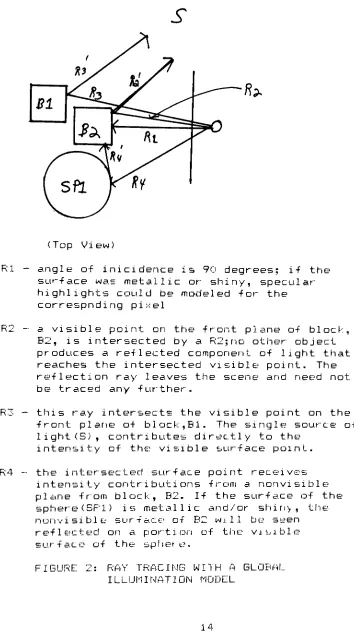
Rl
(Top
View)
-angle of inicidence is 90
degrees;
if thesurface was metallic or shiny,
specular-highlights could be modeled for the
correspnding pixel
-a visible point on the front plane of
block,
B2,
is intersectedby
a R2;no other abject produces a reflected component of light thatreaches the intersected visible point. The
reflection ray leaves the scene and need not.
be traced any further.
R3 this ray intersects the visible point on the
front plane of
block,
Bl. The single source oflight(S),
contributesdirectly
to theintensity
of the visible surface point.R4 the intersected surface point receives
intensity
contributions from a nonvisible pi ame fromblock,
B2. If the surface of thesphere(SPl) is metallic and/or shiny, the
nonvisible surface of E<2 will be seen
reflected on a portion of the visible
surface of the sphere.
FIGURE 2: RAY TRACING WITH A GLOBAL ILLUMINATION MODEL
[image:22.528.87.441.19.658.2]The global illumination model, using the
intersection information from the ray
tracing
algorithm,determines the
intensity
of the corresponding pixels.Ray
tracing
can support a variety of shading models and avariety of geometrical descriptions of the? objects in the
scene.
In traditional ray
tracing,
for each ray reachingthe viewer and
intersecting
a pixel on the screen(SCANNING LEFT TO RIGHT AND TOP TO
BOTTOM),
a tree isbuilt. The nodes of the tree represent the ray-surface
intersections,and the branches represent any spawned,
reflected and/or refracted rays that might be modeled in
the shader. The
intensity
of a pixel is dependent on theintensity
of light transmitted from the correspondingpoint on thie visible surface of an object to the viewer.
Among
the contributing components that are modeledby
theillumination model, are the reflected and refracted light
i-ays t hat r e a chi t hat point. Contri but io n s of these 11 g h t
rays are based on the laws of optics [WHITSO, ROGE853.
The refraction and reflection rays are traced to their
r e spe ctj ve sources. These sources can be ot her surfac e s ,
or the light, source
(S),
and are assumed to be pointsources. If these -sources are other surfaces then the
to those point surfaces are also traced. This
tracing
ofthe two light ray types continues until the light source
is reached, or until the rays follow paths out of the
scene. These rays are traced backwards to the light
source (S) from the viewer. The shader then traverses the
tree from the leaves to the root using the contributions
from the reflected and refracted surfaces, to determine?
the
intensity
of the pixel. The calculations performed,and the information maintained in the data structures
depend on the illumination model
being
implemented.Regardless of thie illumination model used, the ray
tracing
algorithm must be able to extract the geometricalinformation from the internal representation of the
objects, and determine the points, of intersection.
Different internal representations include approximation
by
polygons. The polygon is representedby
an implicitform of a. planar equation. In many implementations, the
ray is represented as a parametric equation. The two
points on the ray are the position of the
viewer-(PI) and
the pixel of current interest (P2) . The ray can be
defined as thus:
R =
RX
RY
RZ
P 1 -i- ( F2
= FIX + AT
= P1Y + BT
- P1Z + CT
P 1 ) T
A :r P2X -P 1 X
B == F2Y - F 1Y
C == P2Z - P 1 Z
The values for t are non-negative. This anchors the
ray at the viewer. Values less than zero are behind the
viewer and indicate intersection with objects not in the
scene. The parametric equations for x,y,z (RX,RY,RZ) are
substituted into the implicit form of the
planar-equation, and then solved for t. The value for t is
substituted into the parametric equations for RX,RY,RZ to
determine the actual intersection point. To make sure
that the intersection is within the bounded plane, a
bounds test is performed. This same technique can be
applied to surfaces defined
by
quadric equations.Here,
the quadratic formula is used to solve for t. A complex
root indicates no intersection. Reduction in time to do
intersection calculations with traditional ray
tracing
may be achieved by:
1-reducing the number of
intersection
calculations--a software solution; or
2-using special-purpose hardware to shorten the time in
performing the intersection calculations EGLAS843.
2.2 I N T R 0 D U C T ION TO G Y S T 0 L I C A R R A Y S
Ray
tracing,
like many image? processing operationsperformed o n pictures, is c o mputat io n a1 J. y inte n s i v e.
Calculations must be performed for each pixel. Special
pu r
-po s e a r chi i te ctu res have bee>n bui 1 1 to e xped i te thie I P
enhancement techniques EFU 823. Some of these special
purpose architectures are described
briefly
here. TheCLIP4 is 96 x 96 array of parallel processors that
perform local neighborhood calculations, such as shrink
and expand. The processors can be reconfigured
by-different types of neighbor connections (I.E. 6-CQNNECTED
OR 3-CONNECTED) . The mpp (MASSIVELY PARALLEL
PROCESSOR),
built
by
Goodyear Aerospace Co. for NASA ,consists of 256processing elements, which may contain up to 32
processing units. The MPP was designed to perform IP
functions,
such as feature extraction, patternrecognition, and relaxation. The ILLIAC IV is a SIMD
architecture with one central control unit, and 64
processing units, and was designed to handle a range? of
problems. The IF'
appl ications include clustering, pattern
classification arid texture analysis.
Picap
II is a MIMDarchitecture that allows up to 64 x 64 neighborhoods in
performing pattern recognition calculations on multiple
images. Measurements are automatically performed on a
field of data that is 512 x 640 to reduce the input. The
measurements include histogram collection, gray scale?
range
determination,
and x-y extent determination. Inaddition, there are dedicated processors for performing
filtering, generating graphical overlays, and for
labeling
and template matching CFU--823.Also,
extensionsto existing programming languages have been implemented
to reflect these new architectures, and to facilitate the
development of algorithms to take? advantage of the new
architectures. For the
CLIP4-array processor, an
extension of Pascal , i. e. Pascal pi, has been implemented
[UHRB23. Applications that have been implemented using
this language include performing calculations in
IF',
pattern recognition and scene description. Constructs of
the language include parallel assignment, condition, and
i /o statements as well as; parallel proceedures, allowing
for-the simultaneous processing of array elements, as
well as sets of arrays. The data types of these arrays
are
binary,
gray scale, or nonnumeric.Also,
thecapability exists to access relative locations in a two
dimensional array in order to perform operations, such
as, windowing and masking C DUFFS XI , UHR843. PPL (PICTURE
PROCESSING LANGAUGE) developed for the
F'icap
I and Pi capII is also an extension of Pascal. Features of the
language to facilitate the image
pi-ocessing computation:.
in c1ude bi n ary p ictur e, p icture, and te mp 1ate eiem ent as
data, types. Picture operators include? parallel arithmetic
operations on 3x3 neighborhoods [DUFFS! 3. One of the
languages includes Pixal (PIXEL MANIPULATION ALGORITHMIC
LANGUAGE) , also targeted for the
CLIP4,
is an extension
of Algol60. D<*ta types specific to IF include grey,
binary,
mask and frame. Control structures tailored forIF'
include parallel assignment statements, parallel
comparisons between masks, and submatrici es of a two
dimensional array, and parallel arithmetic operations.
Pixal has been used to implement parallel
thinning
andobject extraction algorithms [DUFF81 , FU823,,
IP has recently found
help
for its calculations fromthe VLSI (VERY LARGE SCALE INTEGRATION)
technology
in theform of systolic based architectures CKUNGB23.
Currently,
VLSI on a single chip is a two dimensional
technology,
that
is,
architectures are designed and laid out in a twodimensional grid. Problems arise when there is too much
crossover of communications paths between the cells
[JALA853. To reduce crosstalk it is neccessary to have
short and regular paths on the chip, in order to reduce
the initial design cost and delays
during
execution.These two dimensional architectures are easier and
cheaper to manufacture when the cells/components
of-the
chip are of regular shapes with regular interconnections.
The s.i~ravs may be one dimensional or two ci i.moiisionaJ ,
depending
on the algorithm to be implemented.Systolic a chiteetui es exploit t:it-?se constraints to
make algorithms, that can also exploit tnese constraints
a specialised architecture that embeds much of the
algorithm in the hardware. Applications for systolic
architectures have included IP operations, matrix
arithmetic operations, data base manipulations, speech
recognition systems, vision, and stero vision systems
LK1JNG82,
MEAD80,
FRIS85,
GUER85, SYMA850. The designprinciples of systolic architectures are descr 1nod belcu
A single cell is replaced by an array of cells CKUNG82 3.
T h isi a1 1c? w s t.hie t hir o ug h put to be in c r e a s e ci wiehio ut
increasing
the? memory bandwidth. One of the? goals ofsystolic architectures is to decompose complex problems
into simple and regular pieces that can map onto regular
simple, arid relatively fast cells. These cells per form
the specialized calculations, and have the same? design.
The throughput of the system is tnen improved
i.y
alsoimplementing
concurrency to the extent permittedby
thealgorithm. In a systolic archi tec tun
>.._-, tnie :.s
accomplished
by
"pumping"
i.ho data through the cells.
Once art input value has been useci in a calculation, the
data is passed on to the next cell. The next cell is
algorithm dependenc This; circulating of data imposes a
regui. ar flow of data throughout the system, arid enables
the simultaneous execution of many cells. The regular
njiiimunicdtion paths for the data reduce the overhead
of the systolic architecture is; to balance the
computational bandwidth with the I/O bandwidth. Once a
data item has entered the array, the data is reused. The
data are input to the
boundary
ceils of the array[KUNG823.
Therefore,
the criteria used to determinewhether an algorithm is amenable to execution on a
systolic based architecture appear to be the following:
1- the algorithm is compute bound rather than
I/O bound (.I.E,THE NUMBER OF
NUMBER OF I/O DATA
ELEMENTS);
I/O bound (.I.E,THE NUMBER OF OPERATIONS EXCEED THE
2-the algorithm must execute in real-time
(I.E.,
WHILE THE USER VIEWS THE IMAGE ON THESCREEN);
3- the calculation are regular and can be;
defined with simple recurrence relations;
4- the design
of the components on the chip to implement
the algorithm aie regular
(I.E. ,MINIMIZE CROSSTALK AND DESIGN COSTS) [JALAS53.
1.3 APPLICATION OF SYSTOLIC ARCHITECTURES FOR RAY TRACING
2.3.1 RAY TRACING AS A HIDDEN SURFACE REMOVAL TECHNIQUE
2.3.1.1 POLYGON APPROXI MAT I ON
The ray
tracing
algorithm can be adapted to takeadvantage of the VLSI systolic technology.
Starting
withray
tracing
as a visible surface algorithm, and with thesolid objects in a scone approximated with polygons, the
the? traditional ray
tracing
algorithm can be reducedby-adapting the algorithm
to,
andby,
running the algorithm,on, a systolic: based architecture?. The ray
tracing
algorithm meets the criteria stated in the previous
section (SECTION 1.2). The ray
tracing
algorithm iscertainly compute bound with each pixel ray
being
compared to each polygon in the scene. Back plane culling
could be used to remove those polygons that are
obviously-hidden from the? viewer. The picture must be generated in
real-time, especially when ray
tracing
is a part of asolids modeler of a CAD/CAM workstation. Although there
are no recurrence relations, the same calculations are
done repeatedly for each pixel in the screen,
for-each
plane in the scene. For ray-plane
intersections,
thecalculations are strai ghtf orward. Since the cells must
perform the same calculations, and the pixels are scanned
in an incremental order, the? design of the cells should
be the same. The interconnections-, between the cells;
should be linear rather than
diagonal,
vertical, orhorizontal as in IP- This type of connection is certainly
regular. The number of pixels that need to be intensified
or shaded is proportional to an area on the surface of
the graphical
display
device. The area is normallyrectangular. The complexity of the scene and of the
objects would determine the
approximate the objects. The systolic architecture to
implement the ray
tracing
algorithm is based on thecalculations that must, be performed. The calculations
that must be performed are the intersections of a
directed line segment with planes. The general form of a
p 1an ar equation is :
AX +
BY + CZ + D =: 0
The parametric form of the x,y,z components of the ray
are: (VIEWER POSITION DENOTED BY XO,YO,ZO)
X (T) = XO + ET Y(T) = YO + FT Z (T) = ZO + GT
The right side? of the equations are substituted into the
plane equation:
A(XO + ET) + Bi'YO + FT) + C(ZO + GT) + D -0
Then the equation is solved for ts
t = -(AXO + BYO + CZO + D) / AE + BF + CG
WHERE: AE + BF + CG is NOT EQUAL TO ZERO
The value of t can be checked to make sui e that it
is positive, and that the point of intersection is in
front of the viewer. If positive, the value of t is
s ubsti tuted back: into the par
-a m etnc: equations for t he
x,y,z components of the ray. A rectangular bounds test is
performed for each
bounding
plane to make sure that theintersection point is within the bounded planes that are
part of the object. The
following
set of equations mustbe? simultaneously satisfied,,
XMIN
YMIN
ZMIN
X <> XMAX
Y <= YMAX
Z <== ZMAX
For visibility calculations, the pixel can be
intensified to the color of the polygon, or to the
background, if there are no valid intersections. The
colors available are dependent on the capabilities of the
graphics processor in the
display
terminal. Normal1/,
some method is provided to specify the varying
intensities of red, green and blue to generate the
desired color for the pixel. The data for calculating
t,
the coefficients of the plane, the? position of the
viewer, and the current pixel to be
intensified,
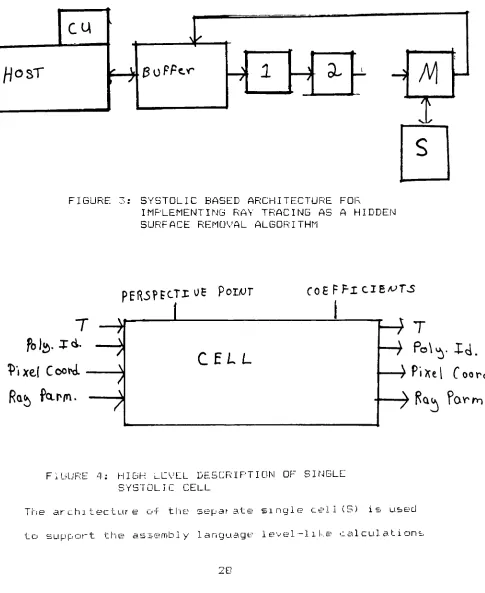
arereadily available. A systolic array of
linearly
connectedcells that can support the calculations is shown in
Figure 3. The number of cells (M) is equal to the number
of polygons in the scene. The inputs and the outputs of
the cells are the pixel coordinates, the line parameters
of the ray, a t parameter value, and a polygon
identifier. At the start of the intersection calculation,
used to calculate the t for the cell. If the calculated t
value is negative, the value is
ignored,
and the input t value, the input polygonidentifier,
the pixelcoordinate, and the ray line parameters a.re sent to the next cell. If the calculated t value is the same as the
input t value, the calculated t value is
ignored,
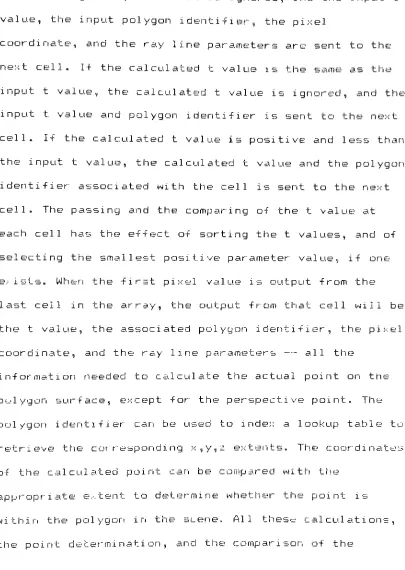
and the input t value and polygon identifier is sent to the next cell. If the calculated t value is positive and less than [image:34.528.64.469.69.639.2]the input t value, the calculated t value and the polygon
identifier associated with the cell is sent to the next cell. The passing and the comparing of the t value at
each cell has the effect of sorting the t values, and of
selecting the smallest positive parameter value, if one
exists. When the first pixel value is output from the
last cell in the array^ the output from that cell will be
the t value, the associated polygon
identifier,
the pixelcoordinate, and the ray line parameters all the?
information needed to calculate the actual point on the
polygon surface, except for the perspective point. The
polygon identifier can be used to index a
lookup
table toretrieve the corresponding x ,y,z extents. 3"
he? coordinates
of the c a1c u1 a.te ci point ea. n be co m pared withi the
ap p
|-opr i.ate e,-.te nt to dete r min e whet her thie point i s
within the polygon in the scene. All these calculations, the point determinat
ion,
and the c o m parison of thec oordinate s wi t hi the e :;te nts, c a n hie pe i
-far m ed
by
aseparate, single cell. Depicted as S in Figure 3. The
output of this cell is the intersection point and the
polygon identifier , or a not valid intersection
indicator-. This i1 1fo r m at io n is cir c u1ated t hir o ug h t he
systolic array, or sent
directly
to the interface buffer,Figure 3 depicts a high level representation of the
supporting architecture. The operations performed
indicate a need for local memory to sitore? intermediate
results.
The architecture of a cell is based on the assembly
language levellike
calculations found in Appendix D
Figure 4 shows the architecture designed to support the
FIGURE 3: SYSTOLIC BASED ARCHITECTURE FOR
IMPLEMENTING RAY TRACING AS A HIDDEN
SURFACE REMOVAL ALGORITHM
T
M
pol^jd.
}
P'ixe[
Coo*!.
Ra^
far/n.
pEdSPEtTioe
p0Lur
coefficientsMt
P'Uel
Coord.
Irm.
FIGURE 4: HIGH LEVEL DESCRIPTION OF SINGLE
SYSTOLIC CELL
Trie architecture of the separate single cell(S) is used
to sup port thie a. s s e mb1 y langu age 1e v e1
-11 1-.e calcu1ations
[image:36.528.30.515.75.668.2]found in Appendix D. Figure
the single separate cell.
shows the archiecture of
S'm^lc
JcpavQ-ir.
Cell
fWfecfii/e
FIGURE 5: HIGH LEVEL DESCRIPTION OF A
SEPARATE CELL PROCESSOR
One consequence of using the systolic based architecture
is the necessary mapping of the algorithm onto this
hardware. A high level description of the algorithm is
gi ven here:
PICK A PERSPECTIVE POINT
FOR. EACH PIXEL IN THE VERTCAL DIRECTION
FOR EACH PIXEL IN THE HORIZONTAL DIRECTION
FOR EACH FOLYGOM IN THE SCENE
DETERMINE RAY PARAMETERS
CALCULATE INTERSECTION POINT
END FOR
END FOR
END FOR
The language in which tins algorithm is implemented
must be enhanced, or designed, to accommodate the net-,)
code that must be generated. This implies that the
compiler designer must be
knowledgeable
about theunderlying auxiliary systolic architecture. The scanning
of the
display
1eftto-right ,
top--to-bottom , suggests a
data type in the language that is automatically accessed
in the same manner, and is rectangularly shaped. As this
data structure is scanned, the pixel coordinates can be
generated with the ray parameters, and sent to the
systolic array.
Normally,
a special purpose architecture,like the systolic arrays, is connected to a
traditional,
general purpose?, host computer. Based on the above
algorithm, and on the calculations that must be
performed, the parameters that, must be made available at
the? time the systolic array iss ready to perform the
intersection calculations are shown here:
. STARTING PIXEL LOCATION
. NUMBER OF PIXELS IN THE HORIZONTAL AND VERTICAL
DIRECTIONS
. POINT OF VIEW
. POLYGON IDENTIFIER
. COEFFICIENTS OF PLANE EQUATION
T hie 1a st ite m in the list will depe nd o n t hie
internal description of the objects in the scene. The
inter n a1 de sc ri pcion is depe ndent on the m at. hiem a11 c a1
-functions used to depict the scene objects,, For the
the planar coefficients, the x,y,z extents, and the
polygon identifiers quickly from the internal data
structure. The interface between the host and the
systolic array is a memory buffer with separate input anc
output ports, between the host and the buffer , and the
array and the buffer. Before the calculations
begin,
theplanar coefficients must be preloaded into the cells, as
well as, the x,y,z extents, and the perspective point
into the
lookup
table,
and the single separate cell,respectively. An entry of the
lookup
table is as shownhere:
Poll).
-i
K
1)
Z
tXTBWS
Fitfei
Locaf'/or)
The format of the data stream coming from the
buffer-would be:
A1B1C1D1X1Y1Z1P0LY1
. . . . AMBMCMDMX-MYMZMPOLYM*Where the '#'
is an end-of-datastream indicator". The
instructions to be executed should also be preloaded
EUME0853. The format of the data stream should be:
I1+I2-+I3+. . . +IK
Where?:
k
-number of instructions
+
-an interi n struct! on indicator
--
end-of-instruction stream indicator
Ther^e instructions could be sent through the cells
like the
data,
or be broadcastby
the hostdirectly
tothe cells. The microcode should be extremely fast. The
instructions need only be loaded canoe. The idea of
loading
instructions suggests howi systolic arrays can betailored tc? accommodate different, surface-ray
calculations. This would also require the preloading and
circulating of different data values. Once the necessary
corresponding ray paramemters must be? generated, and sent
through the systolic array. For hidden
surface removal,
the pixel parameters need only be sent through the
systolic array once. There will be an initial
delay
untilthe first t value is output from the last cell.
Then,
thea r
-r ay she u1 d o ut put t values at r equ1a. r inte r v a1s.
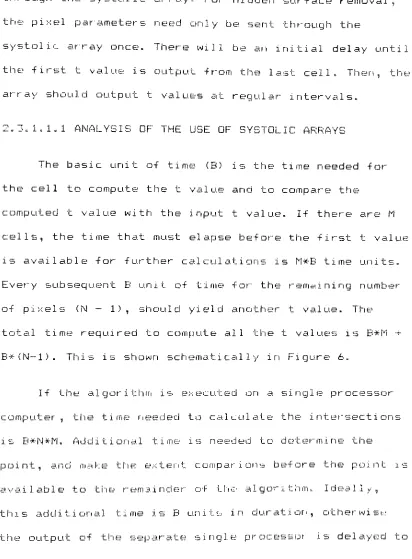
2.3.1.1.1 ANALYSIS OF THE USE OF SYSTOLIC ARRAYS
The basic unit of time (B) is the time needed for
the cell to compute the t value and to compare the
computed t value with the input t value. If there are M
cells, the time that must elapse before the first t value
is available for further calculations is M*B time units.
Every
subsequent B unit of time for the remaining numberof pixels (N
-1) , should yield another t value. The?
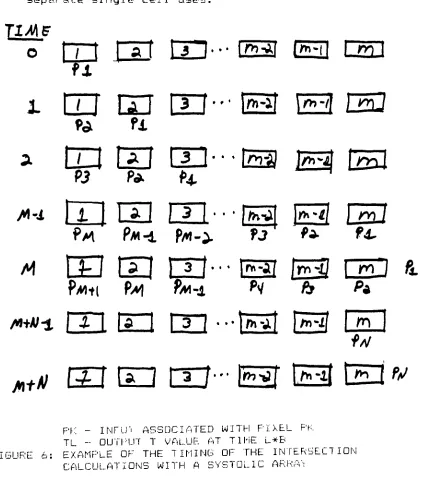
total time required to compute all the t value's is B*M -r
B*(N-1). This is shown schematically in Figure 6.
If the
algorithm-1 is executed on a single
processor-computer , the time needed to calculate the intersections
is Ef*N*M. Additional time is needed to determine the
po
int,
a n ci it iahe t he e xter11 c o mpa rions before t he point i savailable to trie remainder of the algorithm.
Ideally,
this additional time is B units in
duration,
otherwise.' [image:41.528.60.472.61.620.2]the next multiple of B. The
delay
requires the queuing ofthe pixel coordinates, the ray parameters, the t value,
and the? polygon identifier. The number of entries in the
queue is proportional to the number of B units the
separate single cell uses.
o
fT~t
psi
rri"-
p^
geeo
Hvfi
i
tZJ
DlJ
CEJ-"
\EH
\EI
CS2
*
tn izj
tx3---isa
a
ta
Pi
P*
*
^
/1-1
Pm
Pm-i
P/h->
?j
'*
f4.
m
ES
CEJ
nEJ-"
ESI
Ie3
rFn
&
P/Mtl
PaI
Bm-i
pv
&
**
^
GET
CO
CH-S
E3
S
w
PK _ IMFU"' ASSOCIATED WITH PIXEL F'K
TL - OUTPUT T VALUE AT TIME L*B
FIGURE 6: EXAMPLE OF THE TIMING OF THE INTERSECTION
[image:42.528.54.475.131.608.2]2.3.1.2 QUADRIC SURFACES
Quadric surfaces are exemplified
by
the conicsections ( I E. ,CIRCLE,
ELLIPSE,
PARABOLA,
AND HYPERBOLA)extended to three dimensions. A quadric surface is of the
form:
DX-**2 + BY*-*2 + FZ**2 + GXY + HXZ + IYZ + YX +
KY + L.Z + M = 0 (1)
This expression is also an implicit equation, in
which thie parametric components of the ray can be
substituted for x,y,z.
Recalling
the parametric, form oft he r ay :
X (T) ^ XO + A*T
Y(T) = YO
-i-B*T
Z (T) = ZO + C*T
Subst
ituting
into equ at ion ( 1 ) :D(XO
T-A*T)**2 -i- EI*
(YO + B*T)*2 -+ F-*(20 + C*T)**2
I-MYO + A*-T)#(ZO + C*T) +
J*(XO + A*T)
+-K*(YO + B*T) + L*(ZO + C*T) + M = 0
Expand! ng:;
D* (Y 0* *2 + A**2T*-2
+-2*X 0 A*T ) +
E*<Y0**2 + B**2T**2 + 2*Y0#B*T>
->-F-*(Z0**2 + C**2T**2 + 2*Z0*C*T) +
G*iXO*YO + T*(XO*B + YO*A) + A*B*T**2) +
H*(XO*YO + T*(XO*C
h-ZO*A) + A*C*T**2) +
I*(YO*ZO + T*(YO*C + ZO*B) + B*C*T**2) +
J*(.XO + A*T) + K*(YO + B*T) + L*(ZO + C*T) + M = 0
And collecting like powers of t yields:
T**2 (D*A**2 + E*B**2 + F*C-<-#2 -+
G*A*B + H*A*C + I*B*C ) +
T*(2*D*A*X0 -i- 2*E*B#Y0 +
2*F*C*Z0 + G*(XO*B + YO*A.> +
H*(XO*C + ZO*A) + I*(YO*C +Ze*B..' +
J*A + f>B + L*C ) +
(D*Xu**2 + E*Y0**2 + F*Z0**2 + G*XO*YO + H*XO*ZO + I*YO-*ZO +
J*XO + K*YO + L*ZO -+ M )
= 0 (3)
Equation (3> is in the form:
A '
-*T-*-*2
-i-B *T -i- C
-0;
The values of t can be solved
for"
by
using the quadraticT - ( -B
' -r/~
( B '**-2
-4*A *C')**l/2 ) / 2*A
The coefficients are based on the perspective point,
and the ray parameters and coefficients of the quadric
surface. Complex values of t indicate no intersection
with the surface, and can be ignored.
Again,
negative tvalues can also be
ignored,
because the intersectionpoint is not within the scene. Since there are two t
values generated, the smaller positive t value is chosen.
The t value is put back into the ray component equation
to determine the point on the surface. A bounds test is
made to ensure that the point is, within the? sight of the
vi
ewer-.
The architecture supporting the intersection
calculations, is a one dimensional array of connected
cells, one cell for each surface in the scene. The
systolic array communicates with the host via an
interface buffer.
Preprocessing
prior to the intersectioncalculations include? generating the pixel. cca
dinuteb,
and computing the ray parameter and surface? coefficients.
The pixel coordinates are generated a second time when
the coordinates are sent through the array. The inputs
its ray parameters, a t value, and a surface identifier
The two t values are generated through the quadratic
fo r mula. Ea chi c e1 1 pe rfo r m s t he a s s e mI:?I y 1angauge
level-like operations found in Appendix D.
The supporting architecture is shown in Figure 3.
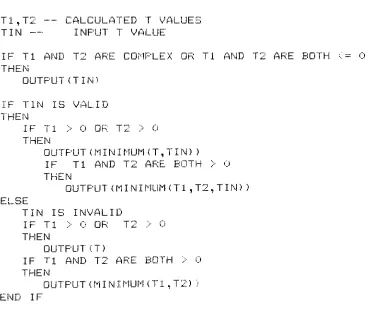
The determination of which t value is sent to the next
cell is shown in the high level algorithm here:
T1,T2 CALCULATED T VALUES
TIN INPUT T VALUE
IF Tl AND T2 ARE COMPLEX OR Tl AND T2 ARE BOTH -> 0
THEN
OUTPUT (T IN)
IF TIN IS VALID
THEN
IF Tl > 0 OR T2 > 0
THEN
OUTPUT( M I N I MUM ( T,T I N ) )
IF Tl AND T2 ARE BOTH > 0
THEN
OUTPUT (MINI MUM ( T 1 ,T2,T I N ) )
ELSE
TIN IS INVALID
IF Tl > 0 OR T2 > 0
THEN
OUTPUT (T)
IF Tl AND T2 ARE BOTH > 0
THEN
OUTPUT( M I N I MUM ( T 1 ,T2 ) )
END IF
The output from the last cell includes trie smallest
positive t
value-if there is one--the corresponding
[image:46.528.73.453.231.550.2]parameters. The separate single cell performs the same
basic calculations as for polygon approximation. The t
veUue is substituted into the parametric ray equations to
determine the point on the surface, the surface
identifier is used to index a
lookup
table to retrievethe x,y,z extents. The x,y,z coordinates are compared
with the extents. The output of the separate? single cell
is an intersection point and a surface identifier, or"
an
intersection point and an invalid surface indicator.
Again,
the output can be circulated through the cell, orsent
directly
to the interface buffer. The algorithm thatmust be mapped onto the? systolic array is shown below:
PICK A PERSPECTIVE POINT
FOR THE NUMBER OF PIXELS IN THE VERTICAL DIRECTION
FOR THE NUMBER OF PIXELS IN THE HORIZONTAL DIRECTION
DETERMINE THE RAY PARAMETERS
FOR EACH SURFACE IN THE SCENE
PERFORM RAY-SURFACE INTERSECTION
CALCULATION
END FOR
DETERMINE SURFACE POINT
COMPARE WITH SURFACE EXTENTS
END FOR
END FOR
The aI gor
-11hm as s uin es a ho moge? n e o u s seen e; that is,
all the objects in the scene are represented as quadric
start of the intersection calculations is similar to the
information that must be available for polygon
approximation of a scene. The list of information is:
. STARTING PIXEL COORDINATE
. NUMBER OF PIXELS IN THE HORIZONTAL AND VERTICAL
DIRECTIONS
. PERSPECTIVE. POINT
. INITIAL SURFACE IDENTIFIER AND T VALUE
. COEFFICIENTS OF THE QUADRIC SURFACE
The initial surface identifier is an invalid one,
and the t value is negative. These initial values are
implementation
dependent,
and indicate that the ray doesnot intersect any object in the scene. Once the? ray has
circulated through the? systolic array, the surface
identifier and t value will either still indicate that.
the ray does not intersect any object in the scene, or
the closest
intersecting
surface and the? parametricintersecting
t value?. The instructions to perform theintersection calculations are loaded
during
the?preprocessing of the surface coefficients, using the same
fo r
-ni at a s de s c r i be cl for- po1 y gon ap pr o xim at io n of a s c e n e.
The coefficients are broadcast to the appropriate ceils.
Again,
there will be an initial delay until the first tv alue is a v aiIab1e.
2.3.1.2.1 ANALYSIS OF USE OF THE SYSTOLIC ARRAYS
The basic unit of time (B) is based on the computing
of the t values with the quadt atric
formula,
and thecomparing of the t values for the smallest positive
value. The qu adi~
ic s u rfaces a re mo r e c o mp 1e x t hia. n thie
planar polygons, and require more time to determine the t
value to output to the next cell. The variability in time
comes from the square root calculation and the comparison
of the t values. The? square root can be calculated
by
using an iterative algorithm, or retrieved from alookup
table. The number of iterations can not be predetermined,and is based on the desired number of digits of accuracy.
The
lookup
table removes this variability, but requires the generation of a globally accessible data structure.The other source of variability with respect to time is
the comparison of the t values. Upon the selection of the
t value to be input to the next cell, the cell may be
idle until the B unit of time has elapsed.
The intial
delay
until the first t value isavailable is as before: M*B, where M is the number of
cells <ICE., THE NUMBER OF"
QUADRIC SURFACES). The
subsequent t values are available every B units for the
remaining pixels (N-l). The total time that must elapse
before all the t value's are available is:
M-fc-B +
(N -1)*B = B*(M + N
-1).
The time needed to perform the actual point calculations,
and the extent comparisons, is the same length as for the
polygons. If the time to make these calculations is
L,
the time that must elapse before the surface point is
available to the remainder of the algorithm is M*B + L.
The total time that must elapse before all the points are
available to the algorithm in the host is:
M*B + L + (N-l) (E + L) = B*(M + N -1)
For execution on a single processor computer-the
analysis i- as follows. Thie total time that must elapse
before the first t parameter is available is M*B + L. The
total time that must elapse before all the intersection
points are available issN*(M*B + L) == N*M*B + N*L.
Calculations are based on the
following
high levelaIgorithm:
FOR ALL THE PIXELS(N)
FOR ALL THE OBJECTS (M)
CALCULATE THE INTERSECTION POINT (B)
END FOR
DETERMINE ACTUAL SURFACE POINT (L)
END FOR
Since the time to determine the actual surface point
is the same as for polygon approximation of the scene,
and the basic unit of time to perform the t calculations
is
longer,
the number of input t values to the separatesingle cell that must be queued should be smaller than
for polygon
approximation,
or non-existent.2.3.1.3 COMPOSITE SOLIDS
2.3.1.3.1 CONSTRUCTIVE SOLID GEOMETRY SOLIDS
Ray
tracing
has been used to synthesize objectsbuilt
by
solid modelers, in particular,by
constructivesolid geometry (CSG) modelers
[R0TH82,
WYV.I86,
CASA85,F'LUN853. A constructive solid modeler (CSG)
modeler-builds up an object from a set of primitive solids that
are combined hierarchi al1 y in a
binary
tree with booleanoperators. The primitive objects
typically
are:block,
sphere, cylinder,
torus,
and cone. The regularizedboolean operators are union,
intersection,
andd i f ference.
The
binary
tree consists of the primitive solids ast hie 1e a v e s , and t he in te rior nod es a. r e t he bo o1e a n
operators. The root node represents the final object.
Ea cI"i l nte rio r
-n ode r epr e s e nts a boa1e a n oper at ion, o r a
ri g id bod y m otion s u ch a s tr an s1at ion a nd r otat
ion,
t hatis -app lie d to the c o r
i-e spo nd ir ig s ub tr e e. W hen a object is
rendered with ray
tracing,
each ray must traverse thebinary tree,
representing the object, starting at theroot. The intersections of the straight line ray with the
primitive objects, making
up the composite object, are
c aleu1ated , and t hie r ay is s ubclivided into regions t hat
are outside, on, or inside the boundaries of the solids.
The ray is; a parametric equation of a line? anchored at
the viewer, and directed toward the scene. When the
inter-section calculations with a solid primitive have
been performed, the results are combined with the results
of the other branch from the same parent node, according
to the boolean operator in thie parent node. This
information along with an ^identification of the
intersected surface is maintained in a global data
structure?. The results of one level are combined and
returned to the next higher level in the tree? until the
r oot i s r eached.
The sides of a block are usually represented as six
half planes. The sphere, cylinder, and cone are examples
of quadric surfaces; the torus is represented
by
aquartic polynomial. The different representations
imply-that different calculations are needed to accommodate the
different surface
types,
and these calculations require adifferent amount of time.
Also,
the hierarchicalrelationships among the primitive solids must be
maintained. Both of these
features
of CSG solids precludethe
beneficial
use of a onedimensional
systolic array toperform the
intersection
calculations,, The uniformitycriteria for qualification for execution on a systolic
array can not. be? met.
2.3.1.3.2 HETEROGENEOUS SCENE
A scene consisting of surfaces of different
mathematical (ANALYTICAL) representations can be rendered
with a systolic based architecture to facilitate the
intersection calculations,, The systolic based
architecture consists of a number of one dimensional
arrays. Each cell of the systolic array calculates the
intersection for a particular surface type. The length of
eachi array is equal to the? number of objects in the scene
with the same mathematical representation. Each cell of
the array is preloade?d with the corresponding
instructions to perform the? intersection calculations,
and with the coefficients of one object in the scene? with
the representation corresponding to the array. The basic
unit of
time,,
the? time to perform one intersectionc a1c u
lation,
is cli f fer e nt fo r e a chi a.r r ay. T hi is c! if fe r e n c ein time for the intersection calculations must be
resolved before the systolic based architecture can be
used.
The systolic arrays should be arranged in
decreasing
or
increasing
time to perform the intersectioncalculations. If the arrays are sorted in increasing time
to perform the intersection calculations, the circulated
t values, and ray parameters generated from one
array-will queue up waiting to circulate through the next
slower array. The length of the queue depends on the
relative slowness of one array with respect to a previous
array,, This arrangement of the arrays ensures that each
array is in continuous operation, once the the values
enter the array, but also requires more memory to hold
the qu eued inputs. T hie a1 1e r n at iv e ar r a nge m e nt 1 s to
order the arrays in
decreasing
time of the intersectioncalculations. The subsequent arrays require a shorter
time interval to calculate the ray-surface intersections.
As a consequence, the subsequent arrays will not be
continuously active?. The previous arrays will generate? t
values at. a rate slower than the next array, and,
therefore,
no memory is needed to hold intermediateresults. The? time interval between consecutive? inputs to
an array should become shorter, as subsequent arrays
became active, and consequently each array must have its