Abstract: The purpose of this research is to know the influence of learning strategy and independence ability of student learning outcomes and the interaction of these two variables on student achievement in basic theory of tafsir. This research is an experimental research with 2x2 factorial design in collage STAI Alhikmah, Pasar Minggu which involves 100 students divided into four groups each of 25 samples. The results showed that; 1). In general, it was found that applying e-learning, the average score was higher than that of applying conventional strategies. 2). There is a difference in applying conventional strategies for students who have higher abstractive thinking skills. 3). Multiple student scores using conventional strategies are higher than conventional strategies for students with low self-reliance, and 4). There is an interaction between e-learning strategy and independence ability. Therefore, it is concluded that conventional strategy and independence ability have a significant influence on student learning outcomes in Tafsir subjects.
Keywords: Learning Strategy of E-Learning, Learning Independence, Learning outcomes
INTRODUCTION
The formulation of this research problem is, (1) Is there any difference of learning result of Tafsir student using e-learning e-learning strategy with students using conventional learning? (2) Is there any influence of interaction between learning strategy and learning independence to learning result of Tafsir? (3) For students who have high learning independence, does the learning outcomes using e-learning differ from students using conventional learning strategies? (4) For students who have low independence, does the learning result of interpretation using e-learning differ from students using conventional learning strategy?
This research is useful, (1) For the implementation lecturers will be implemented an effective learning strategy to be used in optimizing learning outcomes. In addition, in relation to the independence in student learning towards the tafseer course, it is expected to know which learning strategy is appropriate for each attitude of student self-reliance. This is considered necessary for lecturers if they want to implement the learning process. (2) For other researchers, the results of this study are expected to be used to broaden the horizon of information and can be used as a reference for conducting further research. (3) For the institution, the result of this research is expected to be used
Revised Manuscript Received on April 15, 2019.
Suhada, Educational Technology Study Program, State University of Jakarta, Indonesia.
Zulfiati Syahrial, Educational Technology Study Program, State University of Jakarta, Indonesia.
Yufiarti, Educational Technology Study Program, State University of
as input for e-learning learning strategy can be distributed alternative.
As a theoretical foundation that supports this research, will present some theoretical description in the learning and learning dimension of this research variables are learning outcomes, interpretation courses, e-learning learning strategies and learning independence.
Learning outcomes is as a capacity or ability gained from the learning process that includes the five elements of intellectual skills, verbal information, cognitive strategies, cognitive skills, and attitude or value (Gagne ,1882: 25). Furthermore, learning outcomes is a change of behavior that has characteristics: 1) New behavior in the form of actual ability, 2) The new behavior is applied in a relatively long time, and 3) New behavior is obtained through a business (Snelbacker, 1974: 11).
Sudjana argues that learning outcomes are the abilities students have after receiving their learning experience (Sudjana, 2011: 22). Learning outcomes are characterized by changes in behavior. Although not all behavioral changes are the result of learning, all learning activities are accompanied by behavioral changes. Changes in behavior can be observed and can be measured as a result of learning as a result of planned and systematic learning.
More on interpretation, Etymologically, tafseer means explaining (حاضيلاا), explaining (نيبتلا), showing (راهظلاا), uncovering (فشكلا) and detailing (ليصفتلا). Tafseer comes from masdar isim from wok (ليعفت). The word exegesis is taken from the Arabic رسف رسفي اريسفت which means to explain. This is the meaning in oral al arab with فشك ىلطغملا (opening something closed). The interpretation of the language interpretation written by Ibn Mahdzur is to open and explain the difficult intent of a lafaz. This sense is also termed by the scholars of interpretation with حاضيلإا و نييبتلا (explain and explain). In the Indonesian dictionary the word "tafseer" is defined by the description or explanation of the verses of the Qur'an (1997: 253).
Learning strategy can be defined as planning that contains about a series of activities designed to achieve certain educational goals. Learning strategy is an action plan (series of activities) including the use of methods and the utilization of various resources or strengths in the learning that are structured to achieve a particular goal, in this case is the purpose of learning. Learning strategy is a learning activity that must be done learners and learners so that learning objectives can be achieved effectively and efficiently.
The Effect of Learning Strategy E-Learning
and Student's Independence in Learning to
Learning Results of Learning Tafsir
Conventional learning is the usual learning done by the learners in general. Conventional or traditional learning generally has a particular specificity, this conventional learning method is preferred over memorization rather than understanding, emphasizing numeracy, prioritizing outcomes rather than processes, and teacher-centered teaching. The method used by a learner using conventional methods focuses only on learning materials, for that the deepening of the material done by the learners must be mastered properly and mature also consider the number of learners who are taught.
RESEARCH METHOD
This research uses experimental method with design by level 2 x 2. Field experiment is research study in real situation (reality) by manipulating one independent variable or more in condition controlled to one or more dependent variable. The experimental research design by level has two independent variables and one dependent variable. The first independent variable is a learning strategy consisting of two factors, namely e-learning strategy and conventional learning strategy, the second independent variable (attribute variable) is the independence of learning consists of high learning independence and low learning independence. Whereas the dependent variable is the result of learning Tafsir.
Matrix The research design is factorial design by level 2 x 2, in the table below:
Strategy (A)
Independence (B)
A1 A2 ∑ A1
B3 A1 B1 A2 B1 B1
B2 A1 B2 A2B2 B2
∑ B1 A1 A2 Total
Information:
A1 = Experiment class affecting learning strategi of e-learning
A2 = Control class using conventional learning strategy
B1 = High learing independence B2 = Low learning independence
A1B1 = E-learning strategy witn high learning independence
A2B1 = Coventional strategy with high learning independence
A1B2 = E-learning strategy with low learning independence
A2B2 = Conventional strategy with low learning independence
The population of this study consisted of 9 classes of students in the fourth semesters of the Madrasah Ibtidaiyah School of Education (PGMI) School of Islamic High School (STAI) Alhikmah Jakarta who received Tafseer. The student conditions are as follows:
No Kelas Semester Jumlah
1. IV A 25
2. IV B 25
3. IV C 25
4. IV D 25
5. IV E 25
6. IV F 25
7. IV G 25
8. IV H 25
9. IV I 25
Total 225
Research on fourth semester students is done because they have completed the same subject, that is, Tafsir, Education Statistic, Hadith, Learning Planning of PAI, Evaluation of Learning, Learning PAI MI, Learning Media, Classroom Action Research.
The sampling of the research is done gradually, as follows: (a) Conducting randomly drawn samples. Classes that will be subjected to the treatment of the use of e-learning media that is the fourth semester students A and IV B for the learning group using e-learning and IV semester C and IV D for the learning group using conventional. (b) Further measurements of the level of learning independence in all students who become the sample class to determine the students included in the independence of learning high and low based on instruments made by researchers. (c) The results of the students' independence learning are then sorted from a high score to a low score. (d) In the second stage each group was chosen into two, namely: a group consisting of students who have high learning independence and a group of students who have low learning independence and from the scores obtained then ranked. A total of 27% -30% of the upper groups were stated as groups that had high learning independence while 27% -30% of the lower groups were stated as groups that had low thinking skills. Taking 27% -30% of the upper group and lower group respectively is based on Popham's opinion which suggests that the high and low groups are determined by choosing 27% -30% of all participants. A total of 16 upper and lower group students, from the experimental group and the control group were sampled. Therefore, the sample composition is as follows.
Table: Composition of Research Objects by Type of Behavior and Differences Learning independence.
Independe nce
Learning Strategi
E-Learning
strategy
Convention al Learning
Strategies ∑
High learning
independence 16 16 32
Low learning
independence 16 16 32
∑ 32 32 64
semester IV A and IV B experiments strartegi e-learning, and 2). Class IV semester C and IV D conventional learning strategies. The course chosen in this research is Tafsir because this course can represent theoretical course.
RESEARCH RESULT AND DISCUSSION The data described in this chapter is the Tafsir learning result data obtained from the learning result test that measures cognitive ability. In general data of student learning result can be presented in table 4.1 below:
Table: Recapitulation of Tafseer Learning Results
No Class interval
absolute frequency
Relative frequency (%)
1.
29 – 30 2 6,252.
31- 32 7 21,883.
33 – 34 10 31,254.
35 – 36 7 21,885.
37 – 38 4 12,506.
39 – 40 2 6,25Total 32 100
Furthermore, the research results are presented in the form of frequency distribution table, histogram and calculation result of mode, median from each observation group.
Learning Outcomes of Student Group's Tasks Learning with Conventional Learning Strategies. The data collected on the learning outcomes of students studying with conventional learning strategies showed that the average score of learning outcomes was 32.58 with standard deviation 3.39. The empirical range between 27-39 and the theoretical score range 0 to 40, while mode 33 and median 33 frequency distribution of the results of the data are presented in the table below:
Table: Distribution of Student Results Learning Frequency Learning by Using Conventional Learning Strategies.
No Class interval
absolute frequency
Relative frequency
(%)
1.
26 – 27 2 6,252.
28 – 29 3 9,383.
30 – 31 6 18,754.
32 – 33 12 37,305.
34 – 35 6 18,756.
36 – 37 3 9,38Total 32 100
Based on the above table shows that 11 students (34,38%) are below average, 12 students (37,5%) are on average and 9 students (28,13%) are above average. The achievement of this score is given that the level of achievement of learning achievement of Tafseer in this group is good enough, it means that achievement of learning goal reaches 65,63%.
Student Group Learning Outcomes Learned With E-Learning Strategy From the data collected about student learning outcomes learning with E-Learning learning strategy shows that the average score of learning outcomes
is 31,82 with standard deviation 2,45. The empirical range between 28-37 of the theoretical score range is 0 to 40, while mode 31 and median 32. The frequency distribution of the data is presented in the table below.
Table: Distribution of frequency of learning outcomes of student groups learning by using E-Leaning
No Class Interval
Class frequency
Relative frequency (%)
1.
27 – 28 3 9,382.
29 – 30 6 18,753.
31 – 32 10 31,254.
33 – 34 7 21,885.
35 – 36 5 15,636.
37 – 38 1 3,13Total 32 100
Based on the information from this table it can be seen that 9 students (27,13%) are below average, 10 students (31,25%) are on the average level and 13 students (38,26%) are above average. the scoring of this score gives an illustration that the level of achievement of learning achievement of Tafseer in this group is good enough, it means that the achievement of learning objectives reaches 70%.
Learning Outcomes of Students Group's High Independence Groups. From the data collected, student learning outcomes with High Independence showed a mean score of 35,21 learning outcomes with standard deviation 2,18. The empirical range between 30 - 39 of the range of 0 to 40 scores, has a mode of 33 and median 34. The distribution of frequency is presented in the following table.
Table: Frequency Distribution of Learning Outcomes of Student Groups with High Self-Reliance.
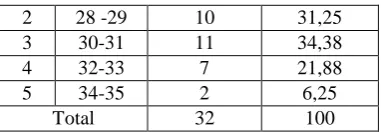
Based on the information above table 4.4, it appears that 9 students (28,13%) are below average, 10 students (31,25%) are on average and 13 students (41,63%) are above average. The achievement of this score gives an illustration that the level of achievement of learning achievement of Tafseer in this group is good enough, it means that the achievement of learning goal reaches 73%.Learning Outcomes Student Group Students who have Low Self-Reliance. From the results of data processing obtained learning outcomes of students who have Low Independence. shows the average score of learning outcomes 29,82 with standard deviation 2,10. The empirical range is between 27-34 from the theoretical range range 0 to 40, then the mode number 28 and the median 30. The frequency distribution of the results data is presented in the table below:
Table: Frequency Distribution of Learning Outcomes of Student Groups with Low Self-Reliance.
No Class interval
absolute frequency
Relative frequency
(%)
2 28 -29 10 31,25
3 30-31 11 34,38
4 32-33 7 21,88
5 34-35 2 6,25
Total 32 100
From Table 4.5 it appears that 12 students (37,5%) were below average, 11 students (34,38%) were on average and 9 students (28,13%) were above average. The achievement of this score gives an illustration that the level of achievement of learning achievement of Tafseer in this group is good enough, it means that achievement of learning goal reaches 52,58%.
Learning Outcomes Highly Self-Reliance Student Groups who are learning with Conventional Learning strategies. From the data collected on student learning outcomes that have high independence who learn with conventional learning strategy shows that the average score of learning outcomes 29,76 with standard deviation 2,09. The empirical range between 32-39 from the theoretical score range 0 to 40, medium mode 35 and media 35. Frequency distribution of the data collection results can be seen through the table below:
Table: Frequency Distribution of Higher Learning Student Group Learning Outcomes with Conventional Learning Strategies
No Class interval
absolute frequency
Relative frequency (%)
1 31-32 2 12,50
2 33-34 4 25,00
3 35-36 5 31,25
4 37-38 3 18,75
5 39-40 2 12,50
[image:4.595.74.265.48.115.2]Total 16 100
Table shows that 6 students (37,50%) are below Average, 5 students (31,25%) are on average and 5 students (31,25%) are above average. The achievement of this score gives an illustration that the level of achievement of learning achievement of Tafsir in this group is quite good, it means that achievement of learning goal reach 62,50%.
Student group learning outcomes that have high independence learning with E-Learning learning strategy. From the data collected about student learning outcomes that have High Independence and learning by using E-Learning learning strategy shows that the average score of learning outcomes of 30,86 with standard deviation 2,35. The empirical range is between 30-37 from the theoretical score range 0 to 40, while mode 31 and median 33. Frequency distribution of learning result data is presented in table
Table: Frequency Distribution of Learning Outcomes of Highly IndependenceStudent Groups who learn with E-Learning Stretegies
No Class interval
absolute frequency
Relative frequency (%)
1 28-30 2 12,50
2 30-31 6 37,50
3 32-33 4 25,00
4 34-35 3 18,75
5 36-37 1 6,25
Total 16 100
Table shows that 2 students (12,50%) are below Average, 6 students (37,50%) are on average and 8 students (50%) are above average. The achievement of this score gives an illustration that the level of achievement of learning achievement of Tafsir in this group is quite good, it means that achievement of learning goal reach 87,50%.
Learning Outcomes Student Groups Who Have Low Independence who learn with Conventional Learning Strategy. The data collected on student learning outcomes that have Low Independence and are taught using Conventional learning strategies show that the average score of learning outcomes is 29.96 with standard deviation 2.09 . The empirical range between 27 - 33 of the range Theoretical score 0 to 40 while 30 madus median 30. Frequency distribution of the results of these data can be presented through the following table:
Table: Frequency Distribution of Learning Outcomes Student Groups Who Have Low Independencewho learn with Conventional Learning Strategies.
No Class Interval
Absolute Frequency
Relative Frequency (%)
1 27 - 28 6 37,50
2 29 – 30 5 31,25
3 31 – 32 3 18,75
4 33 – 34 2 12,50
Jumlah 16 100
From the table shows that 6 students (37,50%) are below average, 5 students (31,25%) are on average and 5 students (31,25%) are on below average. Score figures illustrate that the level of learning achievement of Tafseer in this group is quite good, because the learning objectives reach the proportion of 62,50%.
[image:4.595.310.544.48.96.2]Learning Outcomes Student Groups that have Low Independence who learn with E-Learning Learning Strategy. From the data collected about the learning outcomes of students who have Low Independence and learning by using E-Learning learning strategy shows that the average score of learning outcomes 30.96 with standard deviation 2.35. The empirical range between 28-35 from the theoretical score range 0 to 40, medium mode 28 and median 31. The frequency distribution of the results data is submitted to table 4.9 below:
Table: Frequency Distribution of Learning Outcomes Student Groups that Have Low Independence who learn with E-Learning Learning Strategy
No Class interval
absolute frequency
Relative frequency
(%)
1 26-28 2 12,50
[image:4.595.308.546.335.435.2]3 31-32 5 31,25
4 33-34 4 25,00
5 35-36 2 12,50
Total 16 100
Based on the above table it can be seen that 5 students (31,25%) are below average, 5 students (31,25%) are on average level, and 6 students (37.50%) are at the highest level. This score gives an illustration that the level of achievement of learning of Tafsir in this group is quite good, it is indicated the achievement of learning objectives reaching 68,75%.
This research proposes hypothesis testing about the mean difference of the eight sample groups, ie group of samples (A1), (A2). (B1), (B2). (A1 B1), (A2B1) (A1 B2), and (A2 B2). To test the null hypothesis of the absence of difference between the rates in the sample - the study sample used two-way ANAVA variation analysis which then continued with Tukey's Test to determine which main effect was higher. The result of data analysis using ANAVA test from score of learning result of Tafseer is presented in Table 4.14, for Tukey test is presented in the table below. From the calculation of ANAVA - two path data for source variance between columns seen that the price of F count was smaller F table (F arithmetic = 2.15 <F table = 3.94). This means that H0 received or H1 is rejected. So it can be said that there can be no significant effect difference between groups of students who are learning by using conventional learning strategy and group of students who learn by using e-learning learning strategy.
Table Anava - Two Lines 2x2 For Results Student Tafsir STAI Ahikmah Jakarta At The Significance Level α = 0.05. Information:
Varians Source
The sum of squares
Degree of Freedom
average squared
F Cou
nt
F table
Beetwen Columns (A)
10,24 1 10,24 2,15 3,94NS
Between Lines(B)
324,00 1 324,00 67,9 5
3,98**
AB interaction s
67,24 1 67,24
errors in the group
457,76 96 4,77
Total 859,24 96
* = Significant ** = Very Significant NS = Non Significant
ANAVA calculation data - two paths for sources of interaction variance seen that the price of F arithmetic is greater than the price of F thick or 14.10> 3.94. This means that H0 is processed and H1 is received. Thus it can be concluded that the interaction between learning strategies with abstract bepikir ability can make a difference to the learning outcomes Interpretation of the interaction between learning strategies with Independence.
CONCLUSION
Based on the results of hypothesis testing and discussion of research results can be concluded that Overall student learning outcomes that get E-learning is higher than the student learning outcomes that get conventional learning strategy. There is an interaction between learning strategies and abstract thinking skills that make a difference to the results of learning Tafsir.Untuk students who have high independence use of computer-mediated learning strategy provides higher learning results Tafsir than the user conventional learning strategy.For students who have low independence of the use of strategies Conventional learning provides a lower learning outcomes than the use of e-learning e-learning strategy to test this hypothesis has been obtained data analyzed by mengguanakan analysis of variation (ANAVA) 2 lines.
REFERENCE
1. Asfahani, Al-Raghib al-. Mu’jam Mufradat Alfazh
al-Qur’an. Bairut: Dar al-Fikr
2. Budiningsih, C. Asri. 2005. Belajar dan Pembelajaran. Jakarta: Rineka Cipta.
3. Brookfield, Stephen D. 1986. Understanding and
Facilitating Adult Learning. Sans Fransisco: Jossey-Bass Publishers.
4. Gagne, Robert M. 1988 Prinsip-prinsip Belajar untuk Pengajaran. Alih Bahasa Abdillah hanafi dan Abdul Manan (Surabaya: Usaha Nasional)
5. Gagne, Robert M. And Briggs, Leaslie J. 1882.
Principles Of Instructional Design. San Diego: Harcourt Brace Jovanovich Collage Publisher.
6. Henderson, Allan J. 2003. The e-learning Question and
Answer Book. New York: AMACOM
7. Jaya Kumar C. 2002. Koran Dewan Masyarakat, vol. 40. Jakarta: Dewan Bahasa dan Pustaka.s
8. Ma’luf, Louis. al-Munjid fi al-Lughat wa al-A'lam. Bairut: Dar al-Masyriq, tth.
9. Nurhadi, et,al. 2004. Pembelajaran Kontekstual dan Penerapannya dalam KBK. Malang: UNM Press.
10. Nursalam. 2001. Pendidikan dalam Keperawatan.
Jakarta: Penerbit Salemba
11. Robbins, Stephen P & Judge, Timothy A.
2010. Organizational Behavior. New Jersey: Prentice
Hall.