promoting access to White Rose research papers
White Rose Research Online
[email protected]
Universities of Leeds, Sheffield and York
http://eprints.whiterose.ac.uk/
This is a copy of the final published version of a paper published via gold open access
in
Archives of Disease in Childhood
.
This open access article is distributed under the terms of the Creative Commons
Attribution-NonCommercial Licence (
https://creativecommons.org/licenses/by-nc/3.0/
)which permits unrestricted use, distribution, and reproduction in any
medium, provided the original work is properly cited. You may not use the work for
commercial purposes.
White Rose Research Online URL for this paper:
http://eprints.whiterose.ac.uk/85375
Published paper
Mellon, A. and Murdoch-Eaton, D. (2015)
Supervisor or mentor: is there a difference?
Implications for paediatric practice
. Archives of Disease in Childhood. Doi:
Supervisor or mentor: is there a difference?
Implications for paediatric practice
Andrew Mellon,
1Deborah Murdoch-Eaton
21
City Hospitals Sunderland NHS Foundation Trust, Sunderland, UK
2The Medical School, University
of Sheffield, Sheffield, UK
Correspondence to
Professor Deborah Murdoch-Eaton, Dean of Medical Education, The Medical School, University of Sheffield, Beech Hill Road, Sheffield S10 2RX UK;
d.murdoch-eaton@sheffield. ac.uk
Received 15 October 2014 Revised 26 March 2015 Accepted 27 March 2015
To cite:Mellon A, Murdoch-Eaton D.Arch Dis ChildPublished Online First: [please includeDay Month Year] doi:10.1136/ archdischild-2014-306834
ABSTRACT
The formal roles of educational and clinical supervisor focus on education planning and goal setting against required training elements. Assessment of performance is integral to these roles that necessarily involve some elements of developmental support to trainees. Mentoring is increasingly seen as a desirable route to support doctors in training. Definitions vary, but core expectations of mentors are that they encourage personal development and offer psychosocial support to a trainee within a longitudinal relationship. A key question is whether a supervisor is the appropriate individual to act as a mentor to an individual trainee. The supervisor’s role as an assessor of performance can pose challenges and potential conflicts when providing support relating to other personal needs of trainees along their career paths. It is apparent from the literature that mentoring is a multifaceted role, with different actions required of mentors and supervisors. There is evidence that mentorship can affect specialty choice, academic output and commitment to organisations. Addressing the challenges posed by an ideal of providing mentoring to all trainees is potentially as important as ensuring supervisors of competence. The potential benefits for the profession are of enhancing the development and retention of trainees of high calibre within the paediatric discipline.
INTRODUCTION
The story of mentorship and supervision within medical training in particular is relatively short. Medical care is becoming ever more complex; expectations of the public have increased, litigation rates have risen, there has been increasing pressure to train doctors more quickly while legisla-tion has placed restriclegisla-tions on working hours.1 Formalisation of supervision within roles for medical trainers is a relatively new construct. Development of curricula, training standards and certification of training has led to a need for assess-ment with formal observation of performance and assurance of competence. What does this replace? In the past, supervision was informal but posed important questions;“Can I trust this individual to run my ward/clinic/take/look after ‘my’ patients safely without me being present?” Training fol-lowed an apprenticeship model, with long hours allowing informal observation of how individuals coped with pressure and challenge. Feedback was variable. This model assumed that good trainees were produced by a combination of the passage of time, watching those with greater expertise, per-sonal reading and then by doing and improving with relatively unsupervised practice.
WHAT IS MEANT BY‘EDUCATIONAL’AND
‘CLINICAL’SUPERVISION?
The definition, development and expectations of supervisory roles within training programmes have been gradual and stepwise. Supervision refers to
‘management by overseeing the performance oper-ation of a person’.2 Both clinical and educational supervision are formal roles, characterised by their accountability on behalf of the training system, and ultimately the regulatory bodies with responsibility for accreditation of training.2 3 The term ‘ educa-tional’supervision is distinct from‘clinical’ supervi-sion, and both are separate from the day-to-day interactions of trainees with clinical staff in the workplace, recognising that this is also commonly referred to as clinical supervision.
Educational supervision involves supporting an individual trainee with agenda setting and planning in the context of a training programme. It incorpo-rates oversight of progress in light of independent assessments of the trainee’s clinical performance.2
Clinical supervision of a particular trainee draws upon the training agenda agreed with an educa-tional supervisor to identify and support the provi-sion of required training. This role can require coaching or teaching skills, as well as direct assess-ment of clinical performance. Reliable evidence is ideally collected in authentic and meaningful situa-tions (often the workplace) and contributes to the face validity of any assessment process.2 The dichotomy between the competence-based assess-ment and support aspects of supervision can add a certain tension to these roles.3 4 It is known in other educational contexts, for example, Problem-Based Learning, that content expertise is not always the most valuable element an educator brings to the role.5In postgraduate settings, supervisors are expected to have appropriate knowledge of the area of performance to provide reliable evidence of a trainee’s clinical performance to an authorising organisation. There is evidence that content expert-ise, that is, experience and expertise within the pro-fessional area or discipline, does not correlate strongly with a trainer’s ability to assess a trainee’s clinical performance and provide useful feedback.4 Qualities of integrity and honesty are integral to supervisory role models, and trainees expect super-visors to be reliable and fair in their judgements of clinical performance.6 The impact of feedback is influenced by trainee perception of the process. Time availability to undertake effective supervision is identified as a key feature that relates to positive in-training evaluation by trainees.7 Engagement with feedback includes a strong emotional compo-nent. Common responses to perceived criticism, for example, withdrawal, denial and falling
performance, underscore how important processes are that aim to develop self-awareness and reflection in using feedback in the most effective ways. Supervision roles have become increasingly task-focused around designated activities. There is often a sense that educational supervision can fail to encourage and capture some of the important but less tangible interactions and discus-sions that underpin medical training and clinical performance, and which support a trainee’s professional development.8 Consequently, mentoring is becoming more frequently discussed as a model for supporting this element within training.9–11
WHAT IS MEANT BY MENTORING?
The Royal College of Paediatrics and Child Health (UK) has recently published a mentoring strategy using a definition of mentoring as “a process by which an experienced, highly regarded, empathic person (the mentor) guides another individ-ual (the mentee) in the development and re-examination of their own ideas, learning and personal and professional develop-ment”.11The principal themes of this strategy are“mentorship available to all; effective and appropriate training; safety and responsible mentoring; and accreditation of skills”. Another key recommendation is that such formal mentoring schemes should be“independent of their appraisal process so as to avoid risks of mentor bias during assessments, confidentiality breach and role confusion”.
Expectations of participants within a mentoring relationship are essentially less prescribed than within a supervisory relation-ship and require negotiation around what contributes to a suc-cessful mentoring relationship. Encouraging supervisors to use mentoring skills appears to have merit not withstanding these differences. In a major review of mentoring and supervision, Rabbe identified two major dimensions in most models: work-related developmental and psychosocial support functions.12 Most models of mentoring do not include assessment of per-formance, although they may aim to support self-assessment.13 Mentoring involves more than just providing answers or ad hoc help, and a longitudinal relationship around personal develop-ment is assumed.14However, there may be a life cycle for these relationships beyond which they become less useful and become a hindrance to development.15 Mentoring relationships may change over time for better or for worse, as can occur in any form of human relationship. Mentors and mentees need to be aware of this and consider asking the question “Is this still adding value to the mentee?”from time to time.
The Egan model describes a mentor as‘a skilled helper’and has a framework that supports identification of issues of import-ance to the mentee, before guiding them to recognise what ele-ments are key to their situation and helping them find solutions.13 16 Others take a broader view of mentoring as“a dynamic reciprocal relationship in a work environment between two individuals where, often but not always, one is an advanced career incumbent and the other is a less experienced person. The relationship is aimed at fostering the development of the less experienced person”.14Mentoring may be formal or infor-mal, exploring perceptions and reactions to incidences, as well as personal thoughts, feelings, intentions and plans in response to the experience.12
Ambrosetti and Dekkers have reviewed the literature around mentoring (in teacher training) to clarify what it is that mentors do and its value within a mentoring relationship.17Their recog-nition of mentoring as a complex of different activities begins to define what may be core elements to mentoring in any profes-sion. Key components to the mentoring role identified include
supporter, role model, facilitator, assessor, collaborator, trainer, friend, protector, colleague, evaluator and communicator.
Ebyet al18have identified positive or negative outcomes from particular approaches to mentoring in medical academic set-tings. Positive outcomes occur when there is perceived support from employing organisations. The experience, commitment and altruism of mentors favour positive outcomes and include early responses to poor professional behaviour and sanctions for poor engagement with support processes. Interestingly mentors may be more likely to continue in the role where they perceive support from the organisation but less likely to continue when systems become more tightly regulated.
MENTORING OR COACHING?
The terms ‘coaching’ and ‘mentoring’ are often used inter-changeably. Definitions used in the literature are broad and identify many identical aspects within the roles, for example, focusing on a learner/worker’s agenda or encouraging self-reflection.19–21 The literature for both coaching and mentoring identify various skills and processes overlapping with what would be considered good practice for clinical and educational supervisors. While both terms generally address functions of workplace-based support intended to aid individual develop-ment, coaching uses processes directed at specific performance development ( perhaps measured) of the coached individual.14 21 Another common view of coaching is that it does not require expert knowledge on the part of the coach about the perform-ance required as the skills in promoting self-development of the subject are the key focus of the role.13Mentoring has a general development focus around the interaction between a more experienced individual and a less experienced one in a particu-lar setting, and steers away from measuring performance change, although considering such change to be a desirable outcome of self-improvement.11 Adoption of a coaching as opposed to a mentoring approach may be driven by other factors, for example, coaching has been adopted within business with an expectation of measuring changes in performance.19 This highlights a need for clarity of outcomes expected within a defined context from a coaching or a mentoring relationship.
SATISFACTION WITH MENTORING: TAKING A LEAD
There is broad agreement that mentoring is a service for mentees. 10 20 Mentoring can be a mixed role described as a
“reciprocal relationship” in which“work towards specific pro-fessional and personal outcomes for the mentee” is the overall goal.17Published work in thisfield reflects the widely accepted recognition of potential conflicts of interest between roles of mentor and supervisor.22 One universal element of successful mentoring is that of ownership.6 23“Mentees should take the initiative for cultivating the relationship with their mentors (taking the driver’s seat)”,22and this again is different from the role and accountability of a supervision relationship.
Having a choice of a mentor who chooses and initiates the mentoring relationship and perceived closeness at work may be important to a mentee.12A‘satisfying quality of the relationship’ with a mentor acting as role model may provide quite a signifi -cant incentive to stay both within the mentoring relationship and within that professional setting. Personality and other intrinsic traits may additionally influence on how well indivi-duals engage with mentoring. Many studies describe formal mentoring relationships, and as one-to-one relationships; however, mentoring can also be effective within near-peer men-toring and in peer groups and with more than one mentor.24
2 Mellon A,et al.Arch Dis Child2015;0:1–6. doi:10.1136/archdischild-2014-306834
Review
group.bmj.com on April 21, 2015 - Published by
Thus from the evidence available, who might best undertake mentoring for paediatric trainees? It would appear to be a mistake to propose particular individuals as being best suited to offer mentoring to particular mentees.23 25 26Being at a certain career stage may enable a newly appointed specialist to be more empathic with a trainee closer in age or situation. At the same time, their outlook may be more strongly based on their own recent experience with the result that outcomes could potentially be less personal and appropriate to the mentee. Given how important it appears to be for their own progress that individuals take responsibility for committing to actions designed to address their personal learning and developmental needs, it seems to be equally important that the mentor identifies prior experiences they are bringing to the role in order to avoid such biases directly driving outcomes from their mentoring relationships.7
Certain characteristics do appear as positives in mentors.23 27 The presence of these, in addition to a clear understanding of and preparation for the role, would seem to be a key factor in matching mentor to mentee. Accepting that not all mentoring relationships will flourish and change may be needed makes sense. There is some evidence to suggest that a previous positive experience of mentoring is a powerful marker for success in subsequent mentoring and that multiple positive experiences enhance job satisfaction and other aspects of career progres-sion.23 27 The practical implications for practice include identi-fying a selection of mentors, and ensuring these are prepared to allocate time to the role, have an interest in professional devel-opment within the workplace setting and may be able to offer a longer-term relationship are important.
MENTORING AND SUPERVISION AS SOCIAL MECHANISMS WITHIN ORGANISATIONS
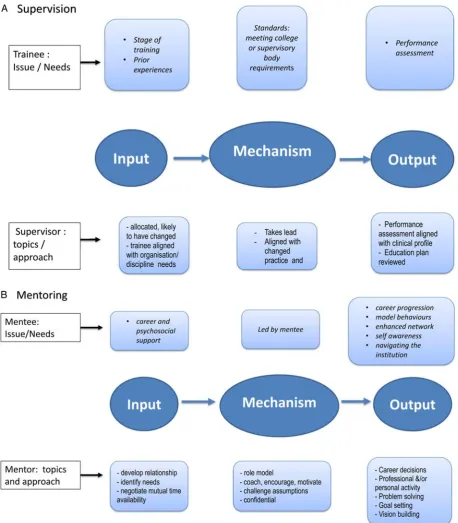
Social exchange theory explores complex interactions between individuals at work, considering rules that govern the inter-dependence and mutual obligations that arise in these settings.28 This paradigm has been used to explore the impact of mentor-ing upon motivation and job satisfaction,12 and gives insight into how mentoring as a role is important within paediatric practice. A diversity of individual expectations within mentoring and supervision relationships, and within organisations promot-ing mentorpromot-ing schemes, is recognised.16 24One way of consider-ing mentorconsider-ing is as a complex‘social mechanism’that responds to varied inputs.29 This, for example, will include the mentee agenda, stage and experience, and additionally, the context and setting. Mentor and mentee will mediate an individualised form of interaction leading to identified outputs, for example, actions a mentee commits to, or clarity of thinking about a way to address an issue.29 Understanding how these inputs may vary and defining expected outputs must alter the mechanism required to mediate these actions. This is illustrated infigure 1.
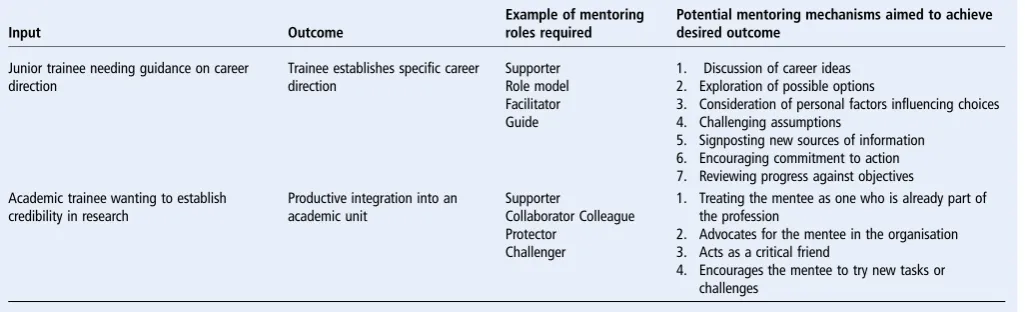
Overtly considering the processes and influences involved pre-vents mentoring being seen either as a single fully characterised activity or as an unexplainable so-called ‘black box’ function. The recognition of those mechanisms involved should deter-mine the actions required of the mentor, rather than the desig-nation as ‘mentor’ per se determining the role in some unspecified way (table 1).
Some organisations may choose to use a particular approach to frame the mentoring interaction (eg, the Egan model), whereas others may wish to be less prescriptive and encourage different approaches to mentoring provision.16Clarity of expec-tations is essential to prepare all those involved, and areas for consideration include mentor training, preparatory material for mentees and guidance for introductory mentoring sessions to
establish frameworks around the individualised purpose of this mentoring relationship. Checklists or templates to document the outcomes may be helpful, particularly at early stages in the men-toring process.
WHY MIGHT MENTORING BE PARTICULARLY IMPORTANT IN THE DISCIPLINE OF PAEDIATRICS? EVIDENCE FOR IMPACT
The paediatric profession needs to recruit and retain high-quality trainees within the workforce, and to encourage and support paediatric academic development. Mentorship is reported to be an influential factor in the selection of a specialty, overlapping with the influence of role models during under-graduate training, and with significant value within medical aca-demic faculties.30Pearlman demonstrated a correlation between the presence of a mentor and enhanced likelihood of entering an academic neonatal career.27A formal mentoring programme was associated with increased self-perception and confidence of participants within their academic roles, and some evidence of impact upon career progression, administrative competencies and research output.27Mentoring had a net positive impact on overall faculty performance with impact on different aspects of work. Illes assessed academic mentoring effect on junior faculty performance; evidence of improvement was demonstrated in research productivity in >50% of mentees, about 25% in teach-ing performance and <10% in relation to patient care.31
As much of the literature identifies schemes in which mentor-ing is designed to support non-clinical aspects of trainmentor-ing, it would be hard to state that mentoring can be shown to have a positive impact on clinical outcomes such as patient safety. However, two of the largest evaluations of mentoring in trainees identify positive outcomes and perceptions of their specialty from a mentoring relationship. Within an internal medicine resi-dence programme in the USA, identification of a mentor was significantly positively associated with trainee perception of excellent career preparation.32 A survey of 506 (14%) of all orthopaedic residents in the USA identified about 50% involved with a mentor in some way.33 Mentorship was ranked highly with value seen in career, research and education areas. Formal programmes rated highest, and self-selection of mentors led to greater satisfaction with the experience.
Not all reported outcomes from mentoring apply equally to all mentees and potential biases may arise within mentoring schemes.34 Gender-related questions around the potential impact of effective mentoring relationships cannot be avoided. Surveys of medical students and doctors have indicated that more men than women have mentors, and were also three times as likely as women to describe a relationship with the mentors as a positive experience that influenced their careers.9 35 36
A quarter of women identified a lack of mentor as one of the most negative of experiences within their academic medical careers.35Although gender alone cannot account for the variety of situational factors relating to their working lives, there is some evidence that women tend to benefit less than men from mentoring relationships.35 Historically, there has been a risk of mentors making judgements as to whether trainees have ‘the right stuff to advance’.36 This poses interesting questions as to whether factors such as gender might be important aspects to consider in a mentoring relationship to provide a balance of support and challenge.
SHOULD SUPERVISORS BE MENTORS?
able to be a mentor to a trainee?” and “Does a trainee need a separate mentor and supervisor?”There is value in considering desirable organisational outcomes, such as retention of trainees within specialty and within geographical areas, as this may infl u-ence the skill set required of mentors within a given pro-gramme. If we wish to move from a culture of supervisors being predominantly evaluators of quality of performance to incorpor-ate more of the developmental role of mentors, there are inevit-ably going to be training implications of that decision for those undertaking the role.
[image:5.595.69.528.45.569.2]There are examples of mentoring developing differently for different mentee groups.17 In school education, mentors may undertake elements of assessment that within medicine would be seen as the role of a supervisor. In other settings, mentoring has been specifically separated from line management or super-visory roles to avoid the potential for direct workplace-situated conflicts of interest between a mentor and a mentee. This has been the most frequent model within medicine.37Although fre-quently seen as being provided from within a professional group, there are models of mentoring that would see the role as
Figure 1 Models of supervision (A) and mentoring (B) showing illustrative examples of issues to be addressed from the perspective of the trainee, key roles of the supervisor or the mentor and potential outcomes.
4 Mellon A,et al.Arch Dis Child2015;0:1–6. doi:10.1136/archdischild-2014-306834
Review
group.bmj.com on April 21, 2015 - Published by
one using a generic skill set that can be applied by a trained individual from outside both the professional group and the specific workplace.13
Discussion might focus on whether these roles should be undertaken simultaneously or whether paediatric trainees need to have separate supervisors and mentors. If there is a desire to bring mentoring more into the remit of supervisory roles, where would this best sit? Within clinical rotations it might seem logical that clinical supervision is confined to the specific work-place situation of a trainee and is more focused on the perform-ance in that context. As mentoring is seen as a longer-term relationship over a period of training that is not solely related to the workplace situation directly, it may suggest that mentorship should remain distinct from clinical supervision. Educational supervision can be a longer relationship that takes an overview of training with a trainee. It might be that this role would be better suited to formally incorporating elements of mentoring.
The different views of mentoring, coaching and supervision reflect relative differences in three key functions that may be brought together in these roles: support of a trainee’s agenda, performance assessment and developmental feedback. How these functions come together will have an influence on how both mentor and mentee interact and the nature of the end product—the mentoring relationship and its outcomes. It is a bit like considering the difference between an omelette and a scrambled egg; they use the same ingredients but the way you put those ingredients to use produces two quite different out-comes, even though you can still see they are fundamentally both‘cooked egg’.
CONCLUSIONS
With the overlap between some aspects of effective supervision and mentoring, a clear understanding of expectation within role descriptions of supervisors and mentors is needed. Gender, age, time available for mentoring or supervision and whether the relationship is selected or allocated are all recognised to impinge upon impact of mentoring. Supervisors using skills in mentoring may provide a useful and practical way to introduce mentoring concepts to trainees. However, separating out supervisory roles from mentorship and ensuring availability of time and opportunity for mentoring to take place might be the ideal to aspire to.
Considering mentoring as being a mix of different activities applied responsively in different situations, and used within dif-ferent roles, may represent the most realistic way of providing
such support to the widest range of trainees. A separate option for trainees, and particularly those entering academia, to iden-tify individuals with time and training in mentoring to work with them outside the formal supervision would most clearlyfit recent recommendations.11
A key role of any effective mentoring relationship is to over-come gaps between perception and realities in a mentee’s per-spective on their present situation and facilitate self-authorship of change. Evidence suggests that mentees gain benefits in terms of academic progress, career progress and, to a lesser extent, clinical progress. Some mentoring models aim to provide direct-ive advice while others will encourage self-discovery and problem solving, and the latter approach is recommended in recent guidance on medical mentoring in the UK.37This would seem tofit best with aims of encouraging direction and self-awareness in relation to professional development.
In addressing these questions about the role of mentoring, the authors have challenged their own perceptions. Rather than consider what we already know about mentoring and recom-mend faith in the potential benefits, our reading of the literature leads us to consider that within paediatrics we have an oppor-tunity to consider mentoring as having a broad scope. It is important to take a disciplined view to introducing such a costly intervention, given the time involved in establishing and devel-oping an effective mentoring relationship, even when that is supporting a successful trainee let alone the resource implica-tions of managing a trainee in difficulty.
As healthcare organisations, we are expected to be ‘good’— good at caring for patients, good at using resources, good at supporting staff development. Healthcare organisations are likely to fail to be good when staff are unsupported, feel lacking in control of their working lives, not listened to or overly con-trolled.38Mentoring at its best can provide a means of develop-ing self-reliance and resilience, and help counter these tendencies. Transition periods during careers are times when resilience is particularly valuable and a follow-on from offering mentoring for trainees would be to consider the value of offer-ing mentoroffer-ing as a support in the early years after completion of training. We face increasing expectations as new specialists to set personal development goals and engage with processes for appraisal and revalidation of credentials. For recently trained paediatricians, to work with a‘skilled helper’would seem to be at least worthy of consideration.16
Competing interests None.
[image:6.595.44.557.66.222.2]Provenance and peer reviewCommissioned; externally peer reviewed. Table 1 Two examples of mentoring processes illustrated using the social mechanism approach
Input Outcome
Example of mentoring roles required
Potential mentoring mechanisms aimed to achieve desired outcome
Junior trainee needing guidance on career direction
Trainee establishes specific career direction
Supporter Role model Facilitator Guide
1. Discussion of career ideas 2. Exploration of possible options
3. Consideration of personal factors influencing choices 4. Challenging assumptions
5. Signposting new sources of information 6. Encouraging commitment to action 7. Reviewing progress against objectives Academic trainee wanting to establish
credibility in research
Productive integration into an academic unit
Supporter
Collaborator Colleague Protector
Challenger
1. Treating the mentee as one who is already part of the profession
2. Advocates for the mentee in the organisation 3. Acts as a critical friend
REFERENCES
1 Greenaway D.Securing the future of excellent patient care. Final report of the independent review. London: 2013. http://hdl.voced.edu.au/10707/324803 (accessed 13 Oct 2014).
2 National Association of Clinical Tutors (UK).The workplace learning environment in postgraduate medical training. Appendix 2: Roles and responsibilities of an educational Supervisor. London, 2013. http://www.gmc-uk.org/Final_Appendix_2__ Roles_of_Supervisors.pdf_53817452.pdf%09 (accessed Jan 2015).
3 Kogan JR, Holmboe ES, Hauer KE. Tools for direct observation and assessment: a systematic review.JAMA2009;302:1316–26.
4 Watling CJ, Lingard L. Toward meaningful evaluation of medical trainees: the influence of participants’perceptions of the process.Adv Heal Sci Educ2012;17:183–94. 5 Kaufman DM, Holmes DB. The relationship of tutors‘content expertise to
interventions and perceptions in a PBL medical curriculum. 1998;32:255–61. 6 Sambunjak D, Straus SE, Marusic A. A systematic review of qualitative research on
the meaning and characteristics of mentoring in academic medicine.J Gen Intern Med2009;25:72–8.
7 Watling CJ, Lingard L. Toward meaningful evaluation of medical trainees: the influence of participants’perceptions of the process.Adv Heal Sci Educ2012;17:183–94. 8 Tsouroufli M, Payne H. Consultant medical trainers, modernising medical careers
(MMC) and the European time directive (EWTD): tensions and challenges in a changing medical education context.BMC Med Educ2008;8:31.
9 Buddeberg-Fischer B, Herta K-D. Formal mentoring programmes for medical students and doctors--a review of the Medline literature.Med Teach2006;28:248–57. 10 Epstein RM, Hundert EM. Defining and assessing professional competence.J Am
Med Assoc2002;287:226–35.
11 RCPCH (UK).Standards for mentoring programmes & schemes. London:2014. http://www.rcpch.ac.uk/sites/default/files/page/MentoringStandards(August 2014)_0. pdf (accessed Jan 2015).
12 Raabe B, Beehr TA. Formal mentoring versus supervisor and coworker relationships: differences in perceptions and impact.J Organ Behav2003;24:271–93. 13 Connor M, Pokora J.Coaching and mentoring at work—developing effective
practice. Open University Press (McGraw-Hill Education), 2007.
14 Healy CC, Welchert AJ. Mentoring relations: a definition to advance research and practice.Educ Res1990;19:17–21.
15 Kram KE. Phases of the mentor relationship.Acad Mangement J1983;26:608–25. 16 Egan G.The Skilled Helper: a problem management and opportunity development
approach to helping. 7th edn. Pacific Grove, CA: Brooks Cole, 2002. 17 Ambrosetti A, Dekkers J. The Interconnectedness of the Roles of Mentors and
Mentees in Pre-service Teacher Education Mentoring Relationships.Aust J Teach Educ2010;35:42–55.
18 Eby LT, Allen TD, Evans SC,et al. Does mentoring matter? A multidisciplinary meta-analysis comparing mentored and non-mentored individuals.J Vocat Behav
2008;72:254–67.
19 Megginson D, Clutterbuck D.Techniques for coaching and mentoring. Elsevier (Butterworth Heinemann), 2005.
20 Sambunjak D, Marusic A. What’s in a name?JAMA2009;302:2591–2. 21 Garvey B. The mentoring/counseling/coaching debate: Call a rose by any other
name and perhaps it’s a bramble?Dev Learn Organ2004;18:6–8.
22 Garr RO, Dewe P. A qualitative study of mentoring and career progression among junior medical doctors.Int J Med Educ2013;4:247–52.
23 Higgins M. The more, the merrier? Multiple developmental relationships and work satisfaction.J Manag Dev2000;19:277–96.
24 Higgins MC, Kram KE. Reconceptualizing mentoring at work: a developmental network perspective.Acad Manag Rev2001;26:264–88.
25 Cho CS, Ramanan RA, Feldman MD. Defining the ideal qualities of mentorship: a qualitative analysis of the characteristics of outstanding mentors.Am J Med
2011;124:453–8.
26 Straus SE, Chatur F, Taylor M. Issues in the mentor-mentee relationship in academic medicine: a qualitative study.Acad Med2009;84:135–9.
27 Pearlman SA, Leef KH, Scissione AC. Factors that affect satisfaction with neonatal-perinatal fellowship training.Am J Perinatol2004;21:371–5. 28 Cropanzano R, Rupp DE, Mohler CJ,et al. Three roads to organizational justice.
Eds: J D Ferris, R Gerald. In:Research in personnel and human resources management Volume 20. Emerald Group Publishing Limited, 2001:113. 29 Hedström P, Swedberg R, Stockholm U.Social mechanisms: n analytical approach
to social theory. Cambridge: Cambridge University Press, 1998.
30 Sambunjak D, Straus SE, MarusićA. Mentoring in academic medicine: a systematic review.JAMA2006;296:1103–15.
31 Illes J, Glover GH, Wexler L,et al. A model for faculty mentoring in academic radiology.Acad Radiol2000;7:717–24.
32 Ramanan RA, Taylor WC, Davis RB PR. Mentoring matters. Mentoring and career preparation in internal medicine residency training.J Gen Intern Med
2006;21:340–5.
33 Flint JH, Jahangir AA, Browner BD,et al. The value of mentorship in orthopaedic surgery resident education: the residents’perspective.J Bone Jt Surg Am
2009;91:1017–22.
34 Palepu A, Carr PL, Friedman RH,et al. Minority faculty and academic rank in medicine.Acad Med1998;280:767–71.
35 Bickel J, Wara D, Atkinson BF,et al. Increasing women’s Leadership in academic medicine: report of the AAMC project implementation committee.Acad Med
2002;77:1043–61.
36 Bickel J. How men can excel as mentors of women.Acad Med2014;89:1100–2. 37 Department of Health (UK).Mentoring for doctors (Signposts to current practice for
career grade doctors). London, 2004.
38 Francis R. Report of the Mid Staffordshire NHS Foundation Trust Public Inquiry (executive Summary). 2013. http://www.midstaffspublicinquiry.com/sites/default/files/ report/Executive summary.pdf
6 Mellon A,et al.Arch Dis Child2015;0:1–6. doi:10.1136/archdischild-2014-306834
Review
group.bmj.com on April 21, 2015 - Published by