The fight against protectionism
A call for greater coordination between the
EFrA
countries in response to the growing threat ot protectionism in world trade has been made by Mr. Per Kleppe. Addressing the Consultative Committee for the first time in his capacity as Secretary-General or EFTA, Mr. Kleppe underlined the importance of maintaining andexpanding the liberal trading system. Here follows an extract from his statement: . "While it is import t to fight against the new protectionist tendencies within a global context this fight cannot be conducted only within organisations such as GATT and OECD. The fight has to go on in all organisations, including our own. As I see it, this will be the main task in the coming ye rs for our organisations.
"EFI'A countries are more dependent than most other countries on a liberal, global trading system, and we should take every opportunity to fight the new protectionist tendencies wherever we meet them, not only with words, but lso by practical deeds. This means, however, that our internal EFTA exercise can only be part of a wider struggle. Much of the work of EFI'A as an o rgani-sation has to be directed towards third countries. In fact, already now, about two-thirds of the activities of the Associ -ation deal with such relations with third countrie .
"It can of course be said that relations with third countries are not the task of EFl'A as an organisation. Formally, this is true, and most of the activities of EFTA countries in relation to third countries take place in other bodies without being dealt /
-Ta-ble-of·, -oont-ents
The fight. against proteotionism l
Consultative Committee 2
Employment in EFI'A 3
EFI'A's balance of trade improves 4
EFrA trade with USA 6
Romania joins PIC 7
EC's 25th Anniversary 8
New Deputy Secretary-General for EFI'A 9
Coming meetings 9
The contents of the EFI'A Reporter do not necessarily reflect the views of the EFl'A Council or of individual EFTA governments. Articles may be reproduced without special permission. The editor would be grateful to receive a copy of any reproductions or items based on this material. Editor: David Egli
Press and Information Service of the European Free Trade Association
with within an EFTA context. But in many cases it might be use-ful from the point of view of the individual EFI'A countries to join with other EFTA countries in order to defend certain inter-ests in other international bodies. Separated, we are each of us too small to be looked upon as very significant in the internat-ional context. Together, the EFI'A countries form a very
import-ant trading block. Our total imports and exports are substantial
in the global context. It will be difficult for the bigger nat-ions to overlook EFTA if we unite, not in an organisational mann-er, but as regards the opinions we express and the pressure we are able to make on the bigger countries or in the international organisations.
"Let me take the GATT as an example. Each EFI'A country is a member of the GATT, but in the past rounds of GA'.rl' negotiations they have always tried to compare notes and to reach common pos-itions. I see a great virtue in pursuing this method, not nec-essarily for all questions coming up in the GATT, but for most of them, especially since the forthcoming GATT ministerial meeting will not deal with individual tariffs and their details but rath-er with principles. The point is not to fight for individual national interests at this stage, but rather for the global in-terest which is expressed by all countries in maintaining and, in important respects, improving the free trade system.
"Some countries maintain that the GATT is too formalistic. It may be so from the point of view of the bigger countries which often use the strength of their economies or the political power to fight for their economic interests. From the point of view of the smaller countries_which do not have the same power, the formal character of the GATT rules is an advantage. It provides them with defences which the big countries do not need to the same extent."
Consultative Committee meeting
EFI'A's Consultative Committee met in Geneva on 10th and 11th March for the first part of its 46th meeting which will resume in Helsinki on June 3rd in the presence of EF'I'A minist.ers. The
current EFTA ministerial chairman, Finland's foreign trade mini-ster, Mr. Esko Rekola, chaired the meeting. Mr. Rekola stressed the importance of the preparatory work achieved in two main areas for discussion in Helsinki:
by several delegations, for a certain coordination of economic policies. He also paid tribute to the understanding expressed on the trade union side for the need to contribute to
anti-inflation-ary policies and to structural adjustments in order to encourage investment and thereby reduce unemployment.
Earlier, a delegation of the Consultative Committee met a del-egation from the Economic and Social Committee of the EC and ex-changed views on employment in Europe. A revival of investment, curbs on costs, higher productivity and a more appropriate train-ing of young people were among the measures mentioned as necess-ary for an improvement in employment prospects in Europe.
Employment in the EFI'A countries
Between 1973 the year of the first major oil pr.Lce increase -and 1980 the number of persons employed increased in all EFrA countries except Switzerland.
In Norway there were 260,000 more persons employed at the end of that period, an increase of some 15 per cent, while unemploy-ment rose by no more than 7,000. In Sweden the additional num-ber of people in jobs was 353,000, a rise of about 9 per cent, while the unemployment figure dropped by 12,000 between 1973 and 1980.
At the other extreme, employment in Switzerland was 191,000 lower in 1980 than in 1973 - a fall of about 6 per cent - and unemployment had risen from less than 1,000 to 6,000.
In all EFI'A countries the population of working age (between 15 and
64
years) grew during the eight-year period, the biggest increases occurring in Iceland and Portugal and the smallest in Sweden. The growth in Iceland was entirely the result of demo-graphic factors. In Portugal the return of Portuguese citizens from the former colonies after1973
was one of the main reasons :for the increase in the working age population.In the four Nordic countries the labour force increased by more than the working age population, the contrast being partic-ularly marked in Norway and Sweden. The principle reason in these two countries was the increase in the number of women in employment.
POPULATION, LABOUR FORCE AND · EMPLOYMEN'l' 1n ~
(1,000 persons; annual average growth rate& in per cent)
Austria Finland Iceland Norway Portuqal ~ Switzerlan 1973 1980 1973 1980 1973 1978 197j 1980 121! 11.!Q_ 1973 1980 1973 1980
Working age population,
15 - 64 years 4,626 4,804 3,133 3,235 127.0 138.5 2,477 2,577 5,717 6,161 5,267 5,328 4,103 4,213
Labour force
Employment
Unemployment
3,043 3,128 2,245 2,346 90.2 101. 2 1,680 1,947 4,048 4,331 3,977 4,318 3,203 3,018
3,010 3,070 2,194 2,236 89.8 100.8 1,654 1 I 91 4 I, 3 I 96 2 4,000 3,879 4,232 3,203 3,012
Annual growth rates,
in%:
33 58 51 11 0 0.4 0.4 26 33\ 86 331 98 86 0
Working age population
Labour force
Employment 0.54 0.39 0.28 0.46 0.63 0.27 1. 75 2.33 2.34 0.57 2.13 2. 11 1.25
1 • 13
0.16
0. 16
1. 18
1. 25
0.38
-0.85
Sourees: OECD, national stat1st1os and EFI'A Secretariat estimates
Austria Finland Iceland Norway Portugal Sweden Switzerland
Total EFTA EEC
OECD
f 1978
r/J 1974
UNEMPLOYMENT AS A PERCENTAGE OF TOTAL LABOUR FORCE
1973 1., 2.3 0.4
1. s
2. 1 t,
2.5
o.o
1 • 6
3.0 3.2 1980 1.9 4.7 0.41'
1. 7
7.6 2.0 0.2 3.2 6. 1 5.8
Significant. improvement or EFrA 's real balance or trade in 1981
-0.87
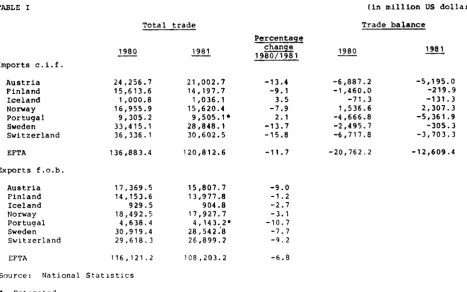
Near stagnation of output in the EFl'A area as well as a gain in market shares of EFrA countries resulted in a sizeable improvement
of EFTA's real balance of trade in.1981. According to prelimin-ary figures and latest estimates, real exports of goods of the EFI'A countries rose by some
2t
per cen.t at a time when the VQlume of world trade appears to hav~ slightly declined - while EFTA's real imports fell by around 2!- per cent. The real balance of trade improved ip most EFTA countries.Real exports grew fastest, by some 5 per cent, in Austria and Switzerland while they declined by between 1 and
1t
per cent inlooking at the balance of trade in nominal tenns and expressed in US dollars (Table I). As a result of the sharp appreciation of the US dollar, by more than 1~ in effective terms, foreign trade. of the EFI'A area contracted in value terms in 1981 as was also the case in a number of the other industrial countries. However, the fall in the value of imports was nearly twice as much as that of exports,also pointing to the improvement of the external pos-ition of the EFTA countries as a group. The combined EFTA trade deficit narrowed by some 8 billion US dollars to rough]J'l21 bill-ion US dollars.
EFTA COUNTRIES' TRADE IN 1980 AND 1981
TABLE I (in million US dollars)
Trade balance Total trade
1980 1981
Percentage change
1980/1981
Imports c. i. f •
Austria 24,256.7 21,002.7
Finland 15,613.6 14,197.7
Iceland 1,000.8 1,036.1
Norway 16,955.9 15,620.4
Portugal 9,305.2 9,505.1*
Sweden 33,415.1 28,848.1
Switzerland 36,336.1 30,602.5
EFTA 136,883.4 120,812.6
-13.4 -9.1 3.5 -7.9 2. 1 -13.7 -15.8 -11. 7 -6,887.2 -1,460.0 -71. 3 1,536.6 -4,666.8 -2,495.7
-6, 717. 8
-20,762.2
-5,195.0 -219.9 -131.3
2,307.3 -s, 361. 9 -30S.3
-3,703.3
-12,609.4
Exports f .o.b.
Austria 17,369.5 15,807.7 -9.0
Finland 14,153.6 13,977.8 -1. 2
Iceland 929. 5 904 .a -2.7
Norway 18,492.5 17,927.7 -3. 1
Portugal 4,638.4 4,143.2* -10.7
Sweden 30,919.4 2s,s42:a -7.7
Switzerland 29,618.3 26,899.'2 -9.2
EFTA 116, 121 , 2 108,203.2 -6.8
Source: National Statistics
* Estimated
The balance of trade improved in all EFTA countries except Portugal and Iceland. Because of the rise in oil prices, Norway's trade
account closed with a sizeable surplus.
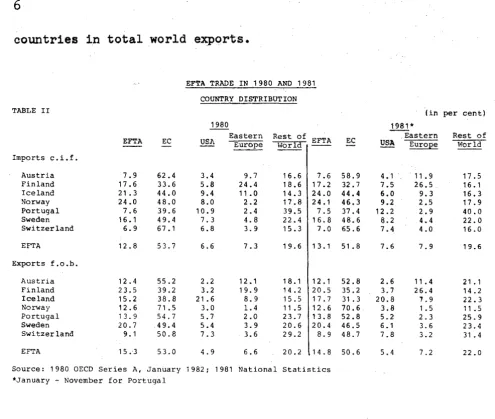
[image:5.560.30.497.332.623.2]countries ~n total world e:Jq>qrts.
EF'l'A TRAOE IN 1980 AND 1 981
COUNTRY DISTRIBUTION
TABLE II (in per cent)
1980 1981*
Eastern Rest of EFTA
EC .Eastern Rest of
EFTA EC US1'. Europe World USA Europe World
Imports c. i . f.
Austria 7.9 62.4 3.4 9.7 16.6 7.6 58.9 4. 1 . . 11 • 9 17 .5 Finland 17.6 33.6 5.8 24.4 18.6 17.2 32. 7 7.5 26.5 . 16. 1
Iceland 21 • 3 44.0 9.4 11.0 14.3 24.0 44.4 6.0 9.3 16.3
Norway 24.0 4 8. 0 8.0 2.2 17 .8 24 .1 46.3 9.2 2.5 17. 9
Portugal 7.6 39.6 10.9 2.4 39.5 7.5 37. 4 12.2 2.9 40.0
Sweden 16. 1 4 9. 4 7.3 4.8 22.4 1 6. 8 48.6 a.2 4.4 22.0
Switzerland 6.9 67. 1 6.8 3. 9 15.3 7.0 65.6 7.4 4.0 16.0
EFTA 12. 8 5 3. 7 6.6 7.3 1 9. 6 1 3. 1 51. 8 7.6 7. 9 19.6
Exports f.o.b.
Austria 12. 4 55.2 2.2 12.1 18 .1 12.1 52.8 2.6 11. 4 21 . 1 Finland 2 3. 5 39.2 3.2 19. 9 14. 2 20.5 35.2 3.7 26.4 14.2 Iceland 15.2 38.8 21. 6 8.9 15 .5 17. 7 31 . 3 20.8 "I'. 9 22.3 Norway 12.6 71 . 5 3.0 1.4 11 • 5 12. 6 70.6 3,8 1. 5 11. 5 Portugal 1 3. 9 54.7 5.7 2.0 23.7 1 3. 8 52.8 5.2 2.3 25. 9
Sweden 20.7 . 49.4 5.4 3.9 20.6 20.4 46.5 6.1 3.6 2 3. 4
Switzerland 9. 1 50.8 7.3 3.6 29.2 8.9 48.7 7.8 3.2 31 • 4
EFTA 15 .·3 53.0 4.9 6.6 20.2 14. 8 50.6 5. 4 7.2 22.0
Source: 1980 OECD Series A, January 1 982; 1 981 National Statistics *January - November for Portugal
EFl'A trade w.i th. the USA
The USA is EFI'A's most important trade partner outside the European Communities. The EFTA countries import from the United States more than twice as much as from Japan. EF'rA exports to the USA are more than three and a half times as high as those to Japan.
During the 1970s EFI'A imports from the United States expanded somewhat raster than EFTA total imports, whereas exports to the USA grew less than EFI'A's total exports. As a result the share of the USA in EF'I'A imports rose from
6.2
per cent in1972
to6.6
per cent in 1980 while the share of exports to the USA in EFI'A
exports fell from
7.3
to4.9
per cent.Manufactured goods account for nearly three-quarters ot EFI'A imports from the USA. But they only contributed about two-thirds to the growth or the EFI'A countries' imports from the USA between
1972
and1978.
Imports of food grew considerably faster than those of manufactures, mainly because of a sharp inc·rease in t'oodimports into Portugal.
During
1979
and1980
EFTA imports from the USA accelerated,while the growth of exports slowed markedly, especially in
1980.
As a result the EFI'A trade deficit with the USA increased from $1 billion in
1978
to$3.4
billion in1980.
This is largelyI I
[image:6.562.44.540.58.477.2]E!'TA COmrrtlIES' TRADE WI'l'B THE ORrrED S'!'AftS
Million US dollars Annual 2!rcenta9! change
.!lli 1972 1978 1979 198()
1972 1lli .!121 1980
ma
1979 1980 Tml!.eErts c. i. f .
Austria 168.8 486.6 642.7 820.2 857.8 19.3 32. 1 27.6 4.6
Finland 141. 7 395.7 574.8 907.8 1,061.2 18.7 45.3 57.9 16.9
Iceland 18.7 47.9 53.8 93.9 62.4 17.0 12.3 74.5 -33.5
Norway 270.3 775 .9 987.2 1,357.8 1,440.9 19.2 27.2 37.5 6. 1
Portugal 197. 9 616.9 764.1 1,016.6 1,025.5* 20.9 23.9 33.0 10.s• Sweden 582.5 1,506.7 2,076.3 2,435.8 2,372.6 17 .2 37.8 17.3 -2.6 Switzerland 584.9 1,786.4 1;837.9 2,458.2 2,279.1 20.5 2.9 33.8 -7.3
EFTA 1,964.8 5,616.1 6,936.8 9,090.3 9,099.5 19. 1 23.5 31 . 0 0 .1
Exports f.o.b.
Austria 175.7 365.6 393.7 378.8 408.8 13.0 7.7 -3.8 7.9
Finland 142. 2 338.0 476.3 447.5 516.8 15.5 40.9 -6.0 15.5
Iceland 58.7 187.7 221.4 200.5 188 .4 21.4 18.0 -9.4 -6.0
Norway 2 36. 7 538.3 544.7 552.5 674.0 14.7 1 .2 1.4 22.0
Portugal 138. 8 170.0 199.9 264.3 187. 4 * 3.4 17 .6 32.2 -22.3* Sweden 621.1 1,377.8 1,639.1 1,658.9 1,742.7 14. 2 19.0 1. 2 5. 1 Switzerland 605.3 1,692.3 1,818.9 2,150.9 2,102.7 18.7 7.5 18. 3 -2.2
EFTA 1,978.5 4,669.7 5,294.0 5,653.4 5,820.8 15.4 13.4 6.8 3.0 Sources: 1972 - 1980 OECD Ser. A; 1981 National Statistics
* January - November for Portugal
In 1981 EFl'A exports to the USA continued to expand in dollar
terms, while EFI'A's total imports and exports declined with the downswing in demand. The further value growth in EP'l'A/US trade was caused by the sharp appreciation of the dollar. On the other hand, the appreciation of the dollar together with a weaker rel-ative cyclical position of the EFI'A countries resulted iri a slight reduction (to nearly $3.2 billion) in EFrA's trade deficit with the USA.
Romania Joins Pharma.ceu.tical __ -1nSJ?!etien Conveat1en in Ma1
Romania will join the Pharmaceutical Inspect1-on Convention
(PIC) in May. It will be the thirteenth country to do so and
the second from Eastern Europe : Hungary has been a member s.ince
1976.
All the EFTA countries, including Liechtenstein, aremem-bers aa well as Denmark, Ireland and the United Kingdom. The
Federal Republic or Germany ia expected to accede to the Convent--ion in the near future.
The Convention was signed in 1970 and came into force the rollowing year. Its main purpose is to ensure the mutual recog-nition or inspections relating to the manufacture of.pharmaoeut• ical products aimed at rac111tating international trade 1n these products while at the same time protecting public health through
aspects or' the Convention are the training of inspectors- and the
work ':undertaken 1n cooperation with the contracting states for the
wider application of high standards-- of manufacturing.
A working-group was recently set up under the Convention to draft
guidelines for packaging and labelling of pharmaceutical products,
4
clearly an extremely important area both for those handling
pharma-ceutical products as well as the buying public. ·
This month the Convention secretariat, serviced by EFTA, is issuing a booklet on a recent seminar in Budapest. Entitled "Appli_cation of GMP rules in the control laboratory" it draws on expertise both from Hungary and other manber countries. Individ-ual copies are obtainable free of charge from the EFI'A Secretariat.
EC's 25th Anniversary
EFI'~ Secretary-General, Mr. Per Kleppe, sent the following letter to Mr. Gaston Thorn, President of the Commission of the European Communities:
"Sir
,
On the occasion of the 25th Anniversary of the signing of the Treaties of Rome, I wish to convey to you my warmest
congratul-ations and to extend my best wishes for your important task of pursuing the Community's objectives.
Inspired by the same wish of contributing to the construction of Europe by means of a steady expansion of economic activity, fair competition and free trade, the Community and EFI'A can be proud of their achievements. The European free trade system established between our seventeen countries is an outstanding example of the results of our combined efforts. The Community and EF'l'A are to-day each other's biggest trading partners. The interdependence in Europe is further strengthened by the number of agreements, co-operation programmes and other links that have emerged over the past decades.
The informal contacts between the services of the Commission and the EFrA Secretariat also constitute a valuable reflection of the positive and friendly spirit prevailing in EFTA-Community re-lations. We appreciate very much this co-operation, which I am confident will prove as fruitful in the future as it has been in the past.
involved with EFTA matters since
1965 •.
In1974
he 'beaame DeputyHead of the Austrian Permanent Delegation in Geneva and has since
then taken part in praatically all EFI'A activities. He holds the
Pank of Minister.
Mr. Faustenhammer replaces Mr. Magnus Vahlquist who served as
Deputy Secretary-General since
1978
and became ActingSecretary-General in the latter part of
1981
prior to the arrival of Mr.Per Kleppe.
Mr. Vahlquist, who has been working with EFI'A for more than
nine years, is returning to the Swedish Foreign Service. Before becoming Deputy Secretary-General he served at the Permanent
Swedish Delegation in Geneva and from
1976
as Director of theSecretary-General's office.
FORT"rlCOMING MEETINGS
April 1982
26
27
27 - 31
May 1982
4 - 5
11 - 12
13
18 - 19
27
27 - 28
June 1982
3
4
EFI'A Industrial Development Fund for Portugal: Steering Committee
Gas Appliances Scheme: Participating Approval Bodies
Committee of Origin and Customs Experts
Committee of Members of Parliament of the EFTA countries (Basle)
Pharmaceutical Inspection Convention (PIC): Working Group on Packaging and Labelling
PIC - Committee of Officials
Committee on Pharmaceutical Evaluation Reports
(PER) (Vienna)
Pressure Vessels Scheme: Participating Authorities
Bilateral Customs Committees (Brussel~)
Consultative Committee meeting with Ministers (Helsinki)
EF'l'A Councils: ministerial meeting (Helsinki)
All meetings take place in Geneva unless otherwise indicated