SSUE 4 OCTDEC 2013
Revolution in the Wings
Recent developments in
Open Access Research
AUSTRALIAN DEMOCRACY IN
THE WAR ON TERROR
AUSTRALI A S REGULATORY
PANOPTICON
Subscribe and pay online at
www.aips.net.au/aq-magazine/subscribe
The subscription period is based on the calendar year: January to December - 4 issues per annum. Back copies will be forwarded.
Subscription Rates
Rates include GST. *GST does not apply on overseas subscriptions.Postage included in rate. Airmail used for overseas distribution. 2013 AQ Individual and schools subscription $22
2013 AQ Individuals (Overseas) $35* Organisations (Australia) $132
Individual Digital Subscription (through $14.99 Organisations (Overseas – Asia & Oceania) $145*
www.ilovemagazines.com.au) Organisations (Overseas – Other than Asia) $165*
AIPS Membership includes AQ subscription $88 AIPS Membership Overseas includes AQ subscription $110*
Australian Institute of Policy and Science
PUBLISHER OF AQ — AUSTRALIAN QUARTERLY
The Australian Institute of Policy and Science is an independent not-for-profit organisation first
established in 1932 to further informed public debate on political issues.
Science, technology and innovation have an important contribution to make to contemporary social, economic, political, securi ty and also ethical and cultural issues. Whether it is about climate change, water, renewable energy, nano technology, health advancement or food security, over the coming decades many of the challenges facing us will require scientific and creative input into policy making, a scientifically lite rate community and greater public engagement with science and technology.
Today, the Australian Institute of Policy and Science is dedicated to responding to these challenges and to partnering with o thers to:
Increase public engagement in science and ensure people have a voice in decisions that affect them Promote excellence in research, innovation and the promotion and communication of science Inform and influence policy and policy-making through expert comment and input
AQ
CONTENTS
VOL 84 ISSUE 4 OCT-DEC 2013COVER IMAGE: © shefkate - Fotolia.com
O C T– DE C 2 013 A U STRAL I AN QU A RTERLY
1
IM
A
G
E
C
R
E
D
IT
S
:
Pl
ea
se
s
ee
a
rti
cle
p
la
ce
m
en
ts
18
3
12
20
3
Revolution in the Wings
Recent developments in
Open Access Research
ARTHUR SALE12
Australian Democracy
in the War on Terror
MICHAEL CROWLEY
20
Cancer in
General Practice
Accompanying Patients
Along the Journey
AMANDA TILLMANN26
Australia’s Regulatory
Panopticon
GLEN LEWIS
32
References
19
AQ Q&A
A WORD
ell the majority has spoken: a new government has been sworn in and Federal Labor are licking their wounds. Yet the victory was not as clear cut as Tony Abbott’s team would have wished for, with a rag tag bunch of senators set to hold the balance of power after next year’s Senate change-over. Whatever your opinion of the outcome, it’s probably a sure bet to say that everyone is glad the election is over and that we hope both sides of government commit to improving the level of productive debate.
Only days ago, Tony Abbott announced his front bench, with the disturbing revelation that for the first time since 1931 there is to be no federal science portfolio, instead being lumped in with Industry. Troubling times for a country that will need to transition away from a resource-based economy and toward a knowledge-based economy.
This edition AQ continues its spotlight on Open Access Research, with Emeritus Professor Arthur Sale’s dissection of recent developments around the globe, which are paving the way for free and universal access to the world’s knowledge banks.
With the gift of hindsight we look back to the Howard years surrounding the declaration of the War on Terror. Were our political responses to those turbulent years dictated by logic, considered intelligence or simply by fear? Michael Crowley interrogates how the make-up, and individual motivations of the parliament may have influenced the legislation of the time. I’m also proud to showcase the winner of this year’s Australian Cancer Council Essay Competition, Amanda Tillmann, who won the chance to represent Australia at a cancer and oncology summer school in Vienna. With rising cancer survival rates, Amanda’s winning essay examines the role of local GPs in a patient’s cancer journey.
Ever tried to get your head around some of the regulatory agency acronyms that often litter the business pages? Australia has a complex system of business regulation, spread across numerous agencies. But what is slipping through the cracks, and who is really the prisoner of Australia’s regulatory panopticon?
To keep up with AQ all year round, find AQ: Australian Quarterly on Facebook and Twitter (@AQjournal) and join the conversation.
Grant Mills
Editor
Erratum: AQ would like to acknowledge an error in the April-June 2013 edition. In all references to the ‘Getting the Measure of Australians’ article, Associate Professor Verna Blewett’s name was misspelt. AQ apologises for the error.
NOTES FOR CONTRIBUTORS
AQ welcomes submissions of articles and manuscripts on contemporary economic, political, social and philosophical issues, especially where scientific insights have a bearing and where the issues impact on Australian and global public life. All contributions are unpaid. Manuscripts should be original and have not been submitted or published elsewhere, although in negotiation with the Editor, revised prior publications or presentations may be included. Submissions may be subject to peer review. Word length is between 1000 and 3000 words. Longer and shorter lengths may be considered. Articles should be written and argued clearly so they can be easily read by an informed, but non-specialist, readership. A short biographical note of up to 50 words should accompany the work. The Editor welcomes accompanying images. Authors of published articles are required to assign copyright to the Australian Institute of Policy and Science, including signing of a License to Publish which includes acceptance of online archiving and access through JSTOR (from 2010) or other online publication as negotiated by the Australian Institute of Policy and Science. In return, authors have a non exclusive license to publish the paper elsewhere at a future date. The inclusion of references and endnotes is the option of the author. Our preference is for these to be available from the author on request. Otherwise, references, endnotes and abbreviations should be used sparingly and kept to a minimum. Articles appearing in AQ are indexed ABC POL SCI: A Bibliography of Contents: Political Science and Government. The International Political Science Abstracts publishes abstracts of political science articles appearing in AQ. Copyright is owned by the Australian Institute of Policy and Science. Persons wishing to reproduce an article, or part thereof, must obtain the Institute’s
permission. Contributions should be emailed to: The Editor at [email protected]
AQ
Australian Quarterly
E DI TO R: Grant Mills
ASSISTANT EDITOR: Camille Thomson
DESIGN AND PRODUCTION: Art Graphic Design, Canberra
PRINTING: Union Offset SUBSCRIPTIONS: www.aips.net.au/aq-magazine/ subscribe ENQUIRIES TO: Camille Thomson, Acting Executive Director, AIPS,
PO Box M145,
Missenden Road NSW 2050 Australia
Phone: +61 2 9351 0819
Fax: +61 2 9351 0758
Email: [email protected]
Website: www.aips.net.au/ aq-magazine/ Facebook: www.facebook.com/
AQAustralianQuarterly ISSN 1443-3605
AQ (Australian Quarterly) is published by the Australian Institute of Policy and Science.
This project is supported by the Commonwealth Government through a grant-in-aid administered by the
Department of Finance and
Deregulation. ACN 000 025 507
The AIPS is an independent body which promotes discussion and understanding of political, social and scientific issues in Australia. It is not connected with any political party or sectional group. Opinions expressed in AQ are those of the authors.
DIRECTORS OF THE AUSTRALIAN INSTITUTE OF POLICY AND SCIENCE: Richard G McLean (Chair) Leon R Beswick Andrew Goodsall Maria Kavallaris Janelle Kyd Ross McKinnon Peter M McMahon Peter D Rathjen Lance Twomey Robert Wells
2
AUSTRALIAN QUARTERLY OC T–DEC 2013Recent developments in
Open Access Research
ARTICLE BY: EMERITUS PROFESSOR ARTHUR SALE
Research advances because scientists, social scientists,
researchers and scholars generally share their work,
right? Well actually no, or rather it is a half-truth. For
about 200 years, the research literature has been largely
restricted behind a pay-barrier. Prior to that, research
articles were shared freely through correspondence,
though seminal books like
The Origin of Species
did not,
because of print cost. Since then, research has been
restricted with the invention of the print journal and
recovery of costs via subscriptions imposed on readers.
ost researchers in the West are oblivious to this, because their universities or labs pay for the subscriptions they need, totalling many millions of dollars per institution. Articles look free to them. But no university can afford to buy all of the world’s research literature, so researchers don’t know what they can’t or don’t see. Worse, less developed countries are discriminated against because they can see even less, and we also suffer because we cannot see what they are doing either.
Research is in a mess. A revolution is in the wings.
The Internet could solve this problem tomorrow, but it doesn’t. The story of this article is that of recent advances...
Almost as soon as it became obvious that the Internet was going to go global, and the World Wide Web was invented, some researchers realized that it offered, amongst its other opportunities, the possibility of transforming the publication of scholarly research. The dissemination costs would disappear, and it might be possible for scholarly articles to be provided free to any researcher wanting to read them. Paper journals might disappear.
OC T–DEC 2013 AUSTRALIAN QUARTERLY
3
IM
A
G
E
:
©
ep
So
s.d
e/
Fli
ck
r
REVOLUTION IN THE WINGS
The European response is
very varied.
Some jurisdictions have strong open access policies, others are targeted to the very best researchers, and some have none. It has been argued that the (post-WW2) German Constitution prohibits a mandatory open access policy, deriving from rejection of controls on academics in the Nazi era. The EU has several committees and bodies working on open access policies and there is a lot of activity and a lot of success stories. Part of the problem is the EU itself, part Francophone and other language issues, and part simply lack of unity.
This became known as ‘Open Access’. Yet problems began appearing. One of these was the scholarly publishing industry. Although of tiny proportions compared to the cost of the research itself, the industry had tradition on its side, and was and is determined to protect its monopoly rent profits.
After more than a decade, during which many other ICT services have transformed our society, the open access dream has not yet come to fruition. The reasons for this are complex, and this is not the place to canvass them, apart from this brief summary:
The scholarly publishing industry has resisted open access. Profitability of the scholarly publishing industry exceeds many other companies con-sidered to be leaders in technology.
Many researchers are reluctant to pres-sure the publishing industry, bypass them, or change their own traditional practices. Disinterest in dissemination of research is common.
Research institutions have been reluc-tant to require their researchers to make their publications open access, partly because of tradition, and partly because senior administrators are
usually ex-researchers firmly grounded in the same obsolete practices.
The open access proponents have not been united— instead they are divided on the differences between
libre and gratis OA, Green and Gold preferred routes to OA, discipline dif-ferences, and bemused by copyright.
United Kingdom
The United Kingdom’s Joint Information Systems Committee (JISC) has had a long record of supporting open access, funding the development of EPrints software, and therefore indirectly leading to the devel-opment of other open access software initiatives such as DSpace, OpenDOAR, OpenDOAJ. The seven UK research councils had policies somewhat similar to those now applying in Australia, until the publication of the Finch Report1,2. This turned British policy on its head.
The Finch Report tried to change the UK’s previous policy and recommended that publication in journals providing open access (across the board, or on an item-by-item basis) was the preferred way forward. About £60M/year was estimated to be required, which would be taken out of existing research funds. The Research
4 AUSTRALIAN QUARTERLY OCT–DEC 2013
Research is in a mess.
REVOLUTION IN THE WINGS
Councils UK (RCUK) was required to adopt the policies. This policy harked back to the first era of open access activism: simplistic, was skewed by publisher lobbying, and aroused a storm of protest from open access activists.
Basically, what Dame Finch’s working group recommended was that
1.The future of scientific publication was in journals with open access (on the Internet)—the so-called Gold Road to open access.
2.Since recovering costs from readers was precluded, publishers would recover costs from authors, author research grants, or author institutions.
3.The RCUK would provide transitional funds from its research funding to meet these fees for grant recipients, anticipat-ing that when Open Access journals were universal, institutional funds no longer needed for journal subscriptions could be diverted to this purpose.
4.The so-called Green Road (deposit of ancillary copies of publications in open repositories) was described in the report as inadequate.
The effects were predictable, and were widely discussed:
If there is more money available to them (though less for actual research), subscription scholarly publishers will ensure that they capture as much as
possible. The net effect is to boost the already high profitability of scholarly publishers with no long term change certain.
Open access journals are encouraged, but since their impact will be low they will make little difference to the scholarly publishing scene
in the next decade. The Finch Report looked likely to delay the transi-tion to open access rather than accelerate it.
The UK produces 6% of the world’s research, so this funding would be seen as icing on the cake for global publishers. UK research might become more open, but UK researchers would still have to pay for sub-scriptions. The
Finch Report is reliant on the improbability that the major research-producing countries (USA, China) adopt the same model.
Researchers will not switch instantly to open access journals with author-side fees, preferring to stay with established subscription-based publishers (currently the majority) because of their perceived higher impact. This will
inflate the costs of research publication for the UK significantly, and over at least a decade.
In short, the Finch Report could have wasted UK research funds. The Report did not adequately take into account how a
technological revolution might be achieved, but took a wild leap into the pos-sibilities, heavily influenced by the publisher lobby. Australia should not, and has not, followed its lead.
However to balance this up, open access journals are indeed a possible long-term future of scientific publication. The Finch Report realized that. Where they fell down is in the analysis of what had already happened, and the nature of the paradigm change that is needed.
The House of Lords
The House of Lords Science & Technology Committee examined the UK’s response to open access, the Finch Report, and what the RCUK had done. The report
Many researchers are reluctant to pressure the
publishing industry, bypass them, or change
their own traditional practices.
Disinterest in
dissemination of research is common.
OC T–DEC 2013 AUSTRALIAN QUARTERLY
5
OPEN ACCESS EVENT: On 16th Oct 2013 ANU will host a lecture by Prof Aidan Byrne, CEO of the
ARC, and Prof Warwick Anderson, CEO of the NHMRC, discussing their organisations’ Open Access policies. The lecture will be recorded and available on the ANU Youtube Channel from the 21st October (http://www.youtube.com/user/ANUchannel)
The Finch Report
did not adequately
take into account
how a technological
revolution might be
achieved, but took
a wild leap into the
possibilities, heavily
influenced by the
publisher lobby.
Australia should not,
and has not, followed
REVOLUTION IN THE WINGS
was recently released3, and it yielded few surprises. The Lords Committee (under Lord Krebs as chair) thought that the RCUK actions were dubious, as were the Finch Committee findings. They recommended examining whether other countries were following the UK emphasis on the Gold Road or had adopted it (they haven’t) and suggested that the Finch recommendations were probably counter-productive. They called for more discipline analysis, endorsed the move to making public research open access, and called for greater scrutiny and regular implementation review. The consequent changes to the RCUK guidelines went a long way to nullifying the bad effects of the Finch Report.
No other country is contemplating, let
alone implementing, a scheme like that recommended in the Finch Report so that will be reduced in emphasis; discipline dif-ferences will be revealed; and the emphasis on flexibility and a whole-of-country approach will be emphasized, with reviews every two years. The RCUK has responded to the House of Lords Committee report.
The House of Commons
On 3 September, the House of Commons Business, Innovation & Skills Committee4 produced its Report on OA. This is extremely sensible and advised what many OA propo-nents have been advocating for a decade: all research funded via government funds should be deposited in an institutional
The UK will be examined carefully and probably be
important in shaping Australian policy.
6
AU STRA LI AN Q UART ERLY O C T– DE C 2 013Recent German news
A Bill12 has been introduced into the
Bundestag which seeks to change its copyright act so as to provide for ‘secondary publication’, which may
be interpreted as open access. The following is a translation of the relevant paragraph of Section 38 of the Bill.
(4) Even if copyright was transferred exclusively to the publisher, the author of a scientific contribution, which stems from at least half publicly funded research and teaching activities and published in a periodical which is at least published twice yearly, has the right to make the accepted manuscript version of the contribution publicly available [on the Internet] after the expiration of twelve months after the first publication, provided this serves no commercial purpose and the source of the original publication is indicated. A deviating agreement to the disadvantage of the author is invalid.
IM
A
G
E
:
©
cu
dm
or
e-Fli
ck
REVOLUTION IN THE WINGS
The Harvard Policy has been widely copied in the USA
, for
example by the multi-campus University of California, but
seems to not have an example in Australia.
repository (computer database) immediately after publication, and made freely available not later than 6 months for the sciences and 12 months for the humanities. Emphasis on OA journals should be downgraded to equality with other routes. This report has attracted much praise from the OA community. The publisher community has not yet had time to respond.
It is quite hard to determine what the impact of this will be, but as the UK has been the leader in OA policy on most issues, it will be examined carefully and probably be important in shaping Australian policy.
The USA response
In the ‘land of the free’, coordinated responses to open access opportunities are rare and not to be expected very often. However the NIH (National Institute of Heath) policy requires deposit of NIH-funded articles in PubMed by no later than six months.
The ‘Harvard policy’ model is worth dis-cussing. It is not a mandate in that deposit of an article is not required, but it reverses the onus for non-deposit onto the author. If he or she does not make their article open access after a reasonable period (usually six months), they are required to have sought prior permission. Thus authors are free to use any publication outlet they choose, under any conditions, but it is clear that they are expected to make the article open access, or to seek prior permission as to why not. The article can be published in an open access journal, via a fee-for-OA
IMAGE: © BrokenCities/Flickr
hybrid journal or via conventional subscrip-tion journals. No matter: the freedom is there; but you have to ask for it.
The effect is remarkable. Authors take the Harvard policy as endorsement by their employer that open access is desirable and has official endorsement, and most comply. The reversal of the onus to deposit is suf-ficient, since it takes more work to apply for exemption than it does to deposit the article for open access. The Harvard Policy has been widely copied in the USA, for example by the multi-campus University of
California, but seems to not have an example in Australia.
The USA has also made two massive shifts which are reverberating in Australia. Firstly both the Democrats and the
Republicans sponsored a Bill (known by the acronym FASTR) in both the Congress and the US Senate5 (US Congress, 2013). This Bill requires all federal agencies spending more than $100M/year in extramural research to arrange for all associated publicly funded publications to be made available free to the public in a repository, as soon as possible but no later than six months after publication. Though nothing is certain in US politics, it seems possible that FASTR will pass, perhaps in a modified form.
Immediately afterwards, President Obama issued a directive6 (effective immediately) to all federal agencies spending more than $100M/year on R&D, to produce a plan in six months that ensured that for all associated publicly funded publications
USA agencies
Agencies covered by the Presidential directive are:
National Science Foundation (NSF) – the equivalent of ARC, Department of Education - including federally funded universities, EPA (Environment Protection Agency), NASA, USDA, HHS (NIH, CDC, FDA, ARHQ) - Health, DOC (NIST, NOAA) – geography, oceans, meteorology, Department of the Interior (USGS) – geology, mapping, Department of Defense (DoD), Department of Energy (OE), Department of Transportation (FAA, FHWA), Department of Homeland Security, Department of State and U.S. Agency for International Development (USAID), and the Smithsonian Institute.
REVOLUTION IN THE WINGS
8
A USTR AL IA N Q U ARTERL Y O C T– DE C 2 013W h a t i s A u s t r a l i a d o i n g i n t h e f a c e o f a l l t h i s
c h a n g e ? A c t u a l l y , A u s t r a l i a i s m o v i n g r a t h e r
s l o w l y a n d a c t i n g a s a
b e l a t e d f o l l o w e r o f t r e n d s
r a t h e r t h a n a l e a d e r .
to be made available free to the public in a repository, as soon as possible, but no later than twelve months after publication (US President, 2013). [refer: SIDEBAR 4]
Though there are differences between the two statements, they indicate a tri-partisan approach by the two legislative houses and the executive government. It is hard to over-estimate the effect of this development. Maybe half the world’s recent research could become publicly accessible within a year after publication, and the Internet will become the ‘commons’ of the world for scientific and scholarly publication.
Australia
What is Australia doing in the face of all this change? Actually, Australia is moving rather slowly and acting as a belated follower of trends rather than a leader. But, two major developments have taken place in the last twelve months. Firstly the
National Health & Medical Research Council
(NH&MRC) announced a policy that all publications arising from one of their project grants would have to be placed in an institutional repository and made open access, no later than twelve months after
China is predicted to overtake the USA in publications in a few decades. Chinese institutions are enthusiastic about open access of their articles, and those of others, and there is no Communist Party dislike of them. Language remains a problem: Chinese
Chinese response
language is the only remaining major competitor for English in scientific circles. However, it is difficult to discern a Chinese policy direction in open access, apart from the desire to regulate the social side of the Internet, and it is not clear what an eventual Chinese response to OA might be. China supports few open access journals.REVOLUTION IN THE WINGS
publication. This policy took effect from 1 July 2012, effective immediately, and was stated as being influenced by public demand to see the results of publicly funded medical research.
The second of Australia’s two research councils, the Australian Research Council (ARC) initially resisted a change, but has now brought in a similar policy,8 effective on new project grants awarded after 1 January 2013. The ARC policy has several examples of poor wording, but the follow-ing is pretty clear:
All new project grants are subject to the policy.
The ARC policy precedes publisher agreements for publications deriving from grants accepted after 1 January 2013, and thus over-rides such agree-ments if there are conflicts, as there is documented acceptance of a prior contract by the researcher and the administering institution.
In all cases metadata for each article arising from the research must be placed in the institutional repository as soon as possible.
The full text should be deposited as soon as possible, and made open access as soon as possible, but no later than twelve months after publica-tion. Either the Accepted Manuscript (AM) or the Version of Record (VoR) is acceptable.
In rare cases such as a third party IP interest, or inclusion of cultural data (such as secret Aboriginal business), the article may be restricted but has to be justified in the Grant Final Report.
If the full-text is already open access, for example in an OA journal, then it does not need to be re-deposited, and a link to the OA version will suffice for the repository.
The policy is deemed to apply to books as well as journal and confer-ence articles.
The effect of these policy shifts have not yet been tested, but two things are beginning to take place around Australia.
All universities will be working to track recipients of research grants and to ensure that the Chief Investigators are aware of their responsibilities. Guidelines will be drawn up and circulated to advise authors what to do in their negotiations with publishers.
All Australian universities have institu-tional repositories in 2013. The policies will have a broad impact on research in universities, since although the number of ARC and NH&MRC grants is small compared to their research-active staff, the most active researchers are usually involved in them, and a single grant brings in many ancillary researchers. The impact
on Cooperative Research Centres (CRCs) will also be significant. One can also expect CSIRO to examine the policies carefully.
Secondly, some of the more perceptive universities will take these new policies as indicative, and may be motivated to
develop their own mandatory policies applying to all staff and all research. The number of effective deposit mandates is at present rather small, probably because senior university administrators are almost universally old-school researchers and out of touch with trends.
It is to be expected that such policies will adopt consensus of the ARC and NH&MRC policies. More effective policies are possible, but a major benefit that
universities would see would be unifying their procedures.
This change is long overdue, but its advent is welcome. Its most important effect will not be the numbers of articles directly affected by the changes, but a sea-change in Australian attitudes, including an urgent need to educate researchers regarding dissemination and copyright. This will inevitably lead to discussion and use of open access journals, and similar issues regarding traditional publishers who offer an open access option at extra cost.
THE POLICIES
WILL HAVE
A BROAD
IMPACT ON
RESEARCH IN
UNIVERSITIES.
Getting in on the discussion
Australia has established a new listserv to communicate on OA issues, following two or three earlier listservs that have declined to low traffic levels after interest failed to produce results. This listserv is run by Dr Danny Kingsley at ANU, and can be viewed
REVOLUTION IN THE WINGS
Who cares how the publisher tail on the research
dog is funded?
We still have journals, they still do the
same thing, maybe they do it cheaper, so why does
where the money comes from matter?
Training of PhD candidates will be affected; directly in the case of those funded by research grants. It remains to be seen if the Department of Education, Employment and Workplace Relations (DEEWR) will amend the guidelines for PhD scholarships, but in any case the majority of universities already have put in place effective proce-dures for making all theses and dissertations open access, with an optional short student-requested embargo of at most two years, usually to enable them to publish journal articles or a book from the thesis.
A strange feature of the ARC and NH&MRC policies are the imposition of a
maximum embargo period of one year. This is longer than is used elsewhere (usually 6 months), and presumably is a consequence of representations by publishers. An alternate view suggests that it may be due to the annual reporting cycle of the Higher Education Research Data Collection (HERDC) in Australia.
ANALYSIS
Despite being predicted a decade ago, open access to all research articles is still not available. Why? The reasons are complex, but the short answer is simply
that the conditions for a paradigm revo-lution9 were not present. In other areas affected by the internet, rapid change has occurred. The reason is to be sought in the super-profits reaped by the scholarly journal publishers. They pay nothing for their input, pay relatively little for their processing, and have a captive clientele. The financial bonanza is not to be given up easily. Publishers have been resisting the Internet consistently, to string out their super-profits as long as possible. The end result is however predictable: open access will become the norm. This has been aided by the complaisance of researchers, who are socialised into being not interested in dissemination, just in research.
The Green Road
The Green Road, as described by Stevan Harnad10, is based on researchers
depos-iting their publication as open access, regardless of, or taking cognisance of, publisher legal impositions. The hope is that when sufficient significant authors adopt deposition of their publication in a
repository, traditional publishers will have to adapt their business models. There will be less incentive to pay journal subscriptions, which have increased far faster than the cost of living index over decades.
Since voluntary adoption of this activity consistently failed, attention turned to mandatory deposit – in other words, researchers are required by their institu-tions to deposit as part of the employment contract. Few Australian universities have adopted such mandatory policies, though
IMAGE: © Daino_16/sxc
10
A USTR ALI A N Q U ARTERL Y O C T–DE C 201 3REVOLUTION IN THE WINGS
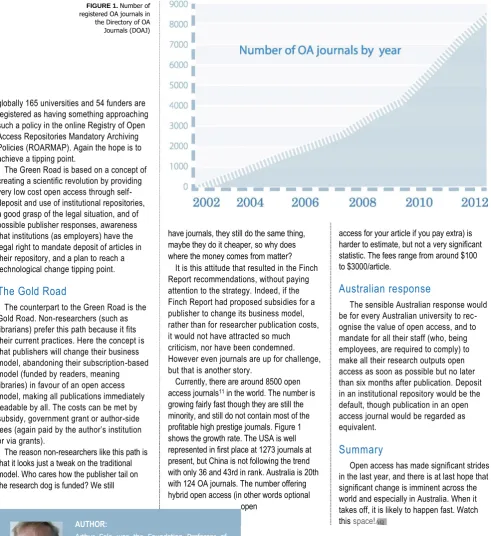
FIGURE 1. Number of
registered OA journals in the Directory of OA Journals (DOAJ)
globally 165 universities and 54 funders are registered as having something approaching such a policy in the online Registry of Open Access Repositories Mandatory Archiving Policies (ROARMAP). Again the hope is to achieve a tipping point.
The Green Road is based on a concept of creating a scientific revolution by providing very low cost open access through self-deposit and use of institutional repositories, a good grasp of the legal situation, and of possible publisher responses, awareness that institutions (as employers) have the legal right to mandate deposit of articles in their repository, and a plan to reach a technological change tipping point.
The Gold Road
The counterpart to the Green Road is the Gold Road. Non-researchers (such as librarians) prefer this path because it fits their current practices. Here the concept is that publishers will change their business model, abandoning their subscription-based model (funded by readers, meaning libraries) in favour of an open access model, making all publications immediately readable by all. The costs can be met by subsidy, government grant or author-side fees (again paid by the author’s institution or via grants).
The reason non-researchers like this path is that it looks just a tweak on the traditional model. Who cares how the publisher tail on the research dog is funded? We still
have journals, they still do the same thing, maybe they do it cheaper, so why does where the money comes from matter?
It is this attitude that resulted in the Finch Report recommendations, without paying attention to the strategy. Indeed, if the Finch Report had proposed subsidies for a publisher to change its business model, rather than for researcher publication costs, it would not have attracted so much criticism, nor have been condemned. However even journals are up for challenge, but that is another story.
Currently, there are around 8500 open access journals11 in the world. The number is growing fairly fast though they are still the minority, and still do not contain most of the profitable high prestige journals. Figure 1 shows the growth rate. The USA is well represented in first place at 1273 journals at present, but China is not following the trend with only 36 and 43rd in rank. Australia is 20th with 124 OA journals. The number offering hybrid open access (in other words optional
open
access for your article if you pay extra) is harder to estimate, but not a very significant statistic. The fees range from around $100 to $3000/article.
Australian response
The sensible Australian response would be for every Australian university to rec-ognise the value of open access, and to mandate for all their staff (who, being employees, are required to comply) to make all their research outputs open access as soon as possible but no later than six months after publication. Deposit in an institutional repository would be the default, though publication in an open access journal would be regarded as equivalent.
Summary
Open access has made significant strides in the last year, and there is at last hope that significant change is imminent across the world and especially in Australia. When it takes off, it is likely to happen fast. Watch this space!AQ
OCT–DEC 2013 AUSTRALIAN QUARTERLY
11
AUTHOR:
REFERENCES
Revolution in the Wings –
Recent developments in Open Access Research
1 UK Government (2012). The Finch Report. http://www.
researchinfonet.org/wp-content/uploads/2012/06/Finch-Group-report-FINAL-VERSION.pdf. Accessed 22 January 2013. 2 UK Government (2012). Executive Summary of the Finch Report.
http://www.researchinfonet.org/wp-content/uploads/2012/06/
Finch-Group-report-executive-summary-FINAL-VERSION.pdf. Accessed 22 January 2013.
3 UK Government (2013). The Implementation of Open Access. http://
ow.ly/hWw0f.
4 UK Government (2013). House of Commons – Business, Innovation and Skills Committee: Open Access.
http://www.pub-lications.parliament.uk/pa/cm201314/cmselect/cmbis/99/9902. htm
5 US Congress (2013). Fair Access to Science and Technology Research Act of 2013. http://doyle.house.gov/sites/doyle.house.gov/files/
documents/2013%2002%2014%20DOYLE%20FASTR%20FINAL. pdf.
6 US President (2013). Increasing Access to the Results of Federally
Funded Scientific Research. http://www.whitehouse.gov/sites/
default/files/microsites/ostp/ostp_public_access_memo_2013. pdf
7 NH&MRC (2013). Dissemination of Research Findings. http://www.
nhmrc.gov.au/grants/policy/dissemination-research-findings. Accessed 22 January 2013.
8 ARC (2013). ARC Open Access Policy. http://www.arc.gov.au/
applicants/open_access.htm. Accessed 22 January 2013. 9 Kuhn, TS. (1962). The Structure of Scientific Revolutions. University
of Chicago Press. ISBN-13: 978-0226458083. 10 Harnad, Stevan (2013). Posting to the GOAL listserv, 23
December 2012.
11 DOAJ (2013). DOAJ by Country. http://www.doaj.org/doaj?func=b
yCountry&uiLanguage=en. Accessed 22 January 2013. 12 German Government (2013). Stellungnahme zum Entwurf eines
Gesetzes zur Nutzun verwaister Werke und zu wei-teren Änderungen des Urheberrechtsgesetzes und des
Urheberrechtswahrnehmungsgesetzes. http://www.boersenverein.
de/sixcms/media.php/976/Stellungnahme_Dritter_Korb_
Endfassung.pdf