HealthyGrowth
From niche to volume with integrity and trust
FULL CASE STUDY REPORT
EKO Žemaitija
- Lithuania
Virgilijus Skulskis, Vilija Girgždienė
Lithuanian Institute of Agrarian Economics
March 2015
The authors acknowledge the financial support for this project provided by transnational funding bodies, being partners of the FP7 ERA-net project, CORE Organic II.
Archived
at
2
1 Introduction ... 4
2 Case-study approach: materials and methods ... 5
3 Lithuania – The national context ... 6
4. Overview of the case ... 7
4.1 Presentation and trajectory ... 7
4.2 Basic facts ... 10
4.3 Stakeholder network ... 13
5. Analytical perspectives 1-6... 14
5. 1 Organisation and governance (Task 1) ... 14
5.2 Business and management logics: the process behind ensuring economic performance and efficiency in mid-scale food value chains (Task 2) ... 17
5.3 The balance/trade-off between quality differentiation and volume and economic performance (Task 3) ... 20
5.4 Communication of values and qualities among the members of the food chain (Task 4) ... 23
5.5 Quality dimension of primary production and mediation through the chain (Task 5) ... 28
5.6 Resilience of the value chain and the initiative/business – long term perspective, change and social-ecological links (Task 6) ... 28
6. Future orientation of the initiative/business and the value chain ... 31
7. Verification of the results and concluding reflections ... 32
References ... 33
3
4 1 Introduction
In Lithuania greater benefits encouraged the establishment of many organic farms and their cooperatives, but in the long run they have been ‘infected’ with the organic idea and have persisted even the support has been decreased. Whereas members of the organic cooperative ‘EKO Žemaitija’ primarily interested in the idea of ecology itself, and only then established a cooperative.
[image:4.595.70.526.338.673.2]The cooperative ‘EKO Žemaitija’ is situated in the Telšiai district, western part of Lithuania called Žemaitija (Samogitia). The main its activities are collection of organic raw milk and supply to the milk processing enterprise as well as manufacturing of dairy products. In the end of 2013 distribution of organic dairy products covered mainly the Žemaitija region: small local shops and local markets in Telšiai, Mažeikiai, Gargždai and Klaipėda city and supermarket Maxima in Klaipėda. In 2014 the cooperative produced 14 kinds of dairy products, the distribution area expanded to the biggest cities of the country (retail chains Maxima, Rimi, TAU in Vilnius and Kaunas).
5 2 Case-study approach: materials and methods
The case-study analysis combines public information and structured interviews with representatives of the dairy products supply chain. For the public representation of ‘EKO Žemaitija’ was used information from different publicly available sources such as the webpage of the cooperative, newspaper articles, internet information, TV broadcast, etc. (see Appendix 1). The self-representation of ‘EKO Žemaitija’ is based on a questionnaire survey on the farmers’ opinion about the cooperative management and on structured interviews with the people involved into the supply chain, i.e. with the administrative manager of the cooperative, member of the Cooperative Board, and short interviews with sale assistants at small retail shops in Telšiai and Klaipėda.
The survey on farmers opinion was carried out at the end 2013 at the request of the Board of Cooperative with purpose to analyse the opinion of members of organic dairy cooperative ’Eko Žemaitija’ on its performance. The results of this survey are based on the opinion of 79% of cooperative members who answered the presented questions about their attitudes towards the cooperative performance and their expectations from the cooperative. The majority of the respondents are experienced organic farmers: nearly half of them have been engaged in organic farming for more than 8 years and more than one third have been farming organically for 5–7 years. As concerns the educational level, more than half of the respondents have professional–vocational education and more than one third graduated from the university. Some more than half of the respondents are of age between 40 and 60 years. The results based on aggregated data of this survey on cooperative members’ opinion were presented at the general annual meeting of the cooperative ‘EKO Žemaitija’ (14 February 2014) where representatives of the milk and dairy products supply chain participated as well (see Appendix 2). Later the results of this research were generalised and published as a scientific paper:Skulskis V., Girgždienė V., Mikelionytė D. (2014). Performance evaluation results of the organic dairy cooperative (in Lithuanian) // Management theory and studies for rural business and infrastructure development, Vol. 36(2). P. 407–415 (see Summary in Appendix 3.
The main structured questions for interviews with the administrative manager and the board member of the cooperative were prepared in advance in accordance with the planned project tasks. The main interviews were taken face-to-face at the cooperative in spring 2014. During the course of the study, especially in mid-2014, the cooperative ‘EKO Žemaitija’ experienced rapid and very important changes in its performance that caused the need to update information, so the respondents not once were asked additional questions by phone This method of interviews allowed to collect necessary information and to get accurate data about the performance of the analysed value chain.
Short interviews with sale assistants at small retail shops in Telšiai and Klaipėda were done in August 2014. They revealed some insights from the consumers’ perspective towards the organic dairy products of ‘EKO Žemaitija’.
6 3 Lithuania – The national context
[image:6.595.73.525.295.519.2]The first organic farms in Lithuania were certified in 1993. In 1997–2003 the certified area and the number of organic farms was growing slowly. Since 2004 EU support for organic area encouraged to convert to organic farming, therefore, in the 2004–2007 period the number of organic farms and certified organic area were going up rapidly. The number of farms reached peak in 2007. Lower EU support had an influence on the number of organic farms. Since 2008 it is noticed a decreasing tendency of the number of organic farms but the certified area is slowly expanding. According to Statistics Lithuania, in 2013 the certified utilised agricultural area (UAA) covered 166.5 thousand hectares. Over the 6-year period of 2008–2013 the area of certified area increased by 36% whereas the number of organic farmers went down by 8%. In 2013, as compared to 2012, the certified area expanded by 6% and the number of farmers went up again by 2%.
Figure 2. Certified utilised agricultural area (thou. ha) and number of organic farms in Lithuania in 2008-2013
Source: Data of Statistics Lithuania.
The share of certified organic area in the total country’s UAA has been slowly growing up. In 2008, the share of the UAA of the certified organic farms constituted 4.6% of the total UAA area and reached 5.8% in 2013 (Statistics Lithuania). According to this indicator, Lithuania is behind the average in the EU-28 only by 0.2 percentage points and is considerably ahead of such countries, like Bulgaria, Ireland and Romania, though is strongly lagging behind Austria, Sweden, Estonia and Latvia (Eurostat data).
Lately the decreasing number of organic farms caused their consolidation. The average size of the certified farm in 2013, as compared to 2008, increased from 43.8 to 65.2 ha, or by 49%. However, in 2013 the largest share (46.6%) made up family farms up to 30 hectares. The groups of farms of 31–50 ha, 51–100 ha and 101–300 ha accounted for similar shares, i. e. about 16%. The farms of 301–500 ha made up 2%. The smallest part (only slightly more than 0.5%) occupied the farms larger than 500 ha (Statistics Lithuania).
122,2 129,1 143,6
152,4 156,5 166,5 2792 2664 2653
2582 2495 2555
0 500 1000 1500 2000 2500 3000
0 50 100 150 200 250
2008 2009 2010 2011 2012 2013
thou. ha
7
For the last several years changes in certified crop structure have been insignificant. In 2013 more than half (63%) of the certified area was covered by grain crops (cereals 44.6%, leguminous 12.1% and cereal-leguminous mixed crops 6.3%). Cereals are in demand not only in Lithuania, but also are exported to other EU countries. A number of larger and competitive organic farms for the supply of organic products have entered into direct contracts with foreign partners; other farmers sell their products through intermediaries. In 2013, only 36.7% of the total number of organic farms was certified as organic animal farms. Organic farms usually certify cattle. According to the data of the national certification body ‘Ekoagros’, in 2013 were certified 34.2 thousand of bovine animals (of which nearly 10 thousand dairy cows), 19.1 thousand sheep, 6.2 thousand poultry, 0.8 thousand goats and 0.4 thousand pigs. The largest amounts of organic raw milk are purchased by dairy companies and processed into yogurt, cheeses and other dairy products. However, Lithuania still remains an exporter of organic raw products. A significant part of beef cattle is exported. The produced amounts of organic pork and poultry meat are small.
Organic food market in Lithuania during the 2008/2009 economic crisis remained relatively stable with regular organic food consumers; lately it again tends to grow. Unfortunately, there is no reliable data about production and consumption volumes of organic food products in Lithuania.
4. Overview of the case
Product types: Raw milk and dairy products
Main actor: Cooperative ‘EKO Žemaitija’
Number of members: 47 farmers
Number of employees: 17 (including processing) (2014)
Distribution channels: processor JSC ‘Pieno žvaigždės’ (supply of raw milk), direct sales, small local shops, retail chains ‘Maxima’, ‘Rimi’, TAU
Sales revenue: close to 2 Mio. € (2014)
4.1 Presentation and trajectory
8
together they had a better position to negotiate with processors for a higher price on milk supplied” (Research on the cooperative members’ opinion).
The present cooperative ‘EKO Žemaitija’ started its activity on 14 February 2006. Initially 22 organic farmers became members of the cooperative. The main initial goal was to collect organic milk from the farmers – members of the cooperative and to supply it to milk processing enterprises. Over time, there have been some changes in the number of cooperative members and in the cooperative farm structure.
The main principles of the cooperative were to pay the same price for all milk suppliers, regardless of what the amount of milk a farmer sold and place a farm was located as well as to pay one of the highest price for milk in the country. ‘EKO Žemaitija’ unifying organic dairy farms was useful not only for cooperative members but also for consumers. The farmers sold their production at a higher price, and the consumers had a possibility to buy organic milk and dairy products.
Searching for partners for milk supply the cooperative faced problems because Lithuanian milk processors were not interested in a proposal to collaborate. The first members of the cooperative – the greatest enthusiasts of organic farming – contributed themselves in this process and made a commercial proposal to milk processing companies to supply organic raw milk. Unfortunately, geographically the nearest milk processor did not respond to the proposal even after personal contacts. There were many discussions, consultations and negotiations by phone and face-to-face with other organic milk processors. As a result, the cooperative succeeded: JSC ‘Pieno žvaigždės’ interested in organic raw milk and even leased a milk transporter for one year. “We sent commercial offers to processing companies proposing our organic raw milk. Only the AB “Pieno žvaigždės” responded. Unfortunately, AB “Žemaitijos pienas”, the nearest company to our cooperative which would have been the best partner, did not respond. Although we personally talked with them but we did not find a common language.
Therefore, we transport raw milk to the AB “Pieno žvaigždės”. This company even leased a
milk truck. The beginning was difficult” – says the member of the Cooperative Board. So far the
cooperative ‘EKO Žemaitija’ supplies organic raw milk to the same milk processor.
Over 9 years of the existence of ’EKO Žemaitija‘, the number of cooperative members has increased more than twice: at present in total 47 organic farmers are members of the cooperative; their age is 35-60 years.The cooperative was able to expand the activities using EU and national support for modernization and partial compensation of administrative costs available for recognised agricultural cooperatives. It helped to buy a new truck for milk collection from farmers, to equip the office (computer and other necessary means) and later to obtain and equip milk processing facilities.
In 2011 the cooperative started implementation of a new idea ‘from farm to table’ and began to sell milk directly to consumers in Telšiai city.
9
[image:9.595.72.526.171.587.2]Dairy products are produced from the best quality milk and do not contain any preservatives, so they are always fresh and healthy. Cottage cheeses are handmade and made according to the ancient grandmothers’ recipes. The cooperative’s future dream is to achieve the status of Lithuanian culinary heritage for some kinds of dairy products. Milk and dairy products produced at the cooperative are fully organic, certified by the national certification body ‘Ekoagros’.
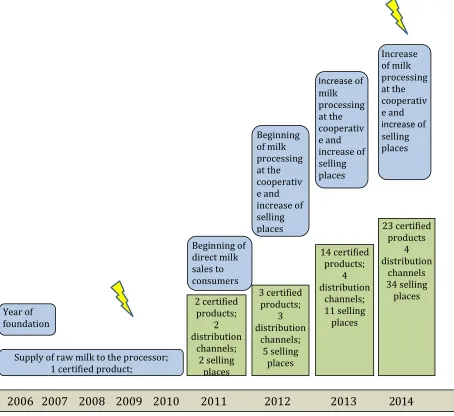
Figure 3. Time line of the cooperative ‘EKO Žemaitija’ development
Initially for a few years the cooperative only collected raw milk from the farmers and supplied it to the processor, so it was only one product and only one distribution channel. But in 2011, it was decided to supply milk directly to consumers and sell it in the regional centre Telšiai as well as to supply it to Telšiai hospital. Later the cooperative bought a building and began its reconstruction in order to process milk and produce dairy products. As a result, in 2012 the assortment has become wider. These changes in expansion of production and assortment were driven by a lack of organic dairy products on the market.
Beginning of milk processing at the cooperativ e and increase of selling places Beginning of direct milk sales to consumers
Increase of milk processing at the cooperativ e and increase of selling places Year of foundation 2 certified products; 2 distribution channels; 2 selling places 3 certified products; 3 distribution channels; 5 selling places 14 certified products; 4 distribution channels; 11 selling places
Supply of raw milk to the processor; 1 certified product;
23 certified products 4 distribution channels 34 selling places Increase of milk processing at the cooperativ e and
increase of selling places
10
The cooperation with organic milk producers (farmers) and organic raw milk supply to the milk processing enterprise JSC ‘Pieno žvaigždės’ is based on official long-term contracts and the cooperation with other cooperative members is based on written agreements.
Milk processing and production of dairy products at the cooperative created a few new working places for local people.
Since the beginning of the establishment the cooperative has a decision making power but milk purchase price depends on the market situation and the most power on it has the processor ‘Pieno žvaigždės”, thus, the income of cooperative members mainly depends on the processor. Usually the final decisions are made after discussions with the processor at working meetings. For example, after the Russian embargo for certain agri-foods from the EU in August 2014, purchase prices on raw milk were lowered to all milk producers, including organic raw milk. However, ‘EKO Žemaitija’ negotiated with the processor and finally the decision on the reduction of raw milk purchase price was partly better than was initially proposed by ‘Pieno žvaigždės’.
Intermediary and retailers has no power in decision-making process.
4.2 Basic facts
The price paid for organic raw milk supplied is set by the milk buyer and is higher than that for conventional milk. Unfortunately, changes in producer prices and consumer prices during the observed period are not available.
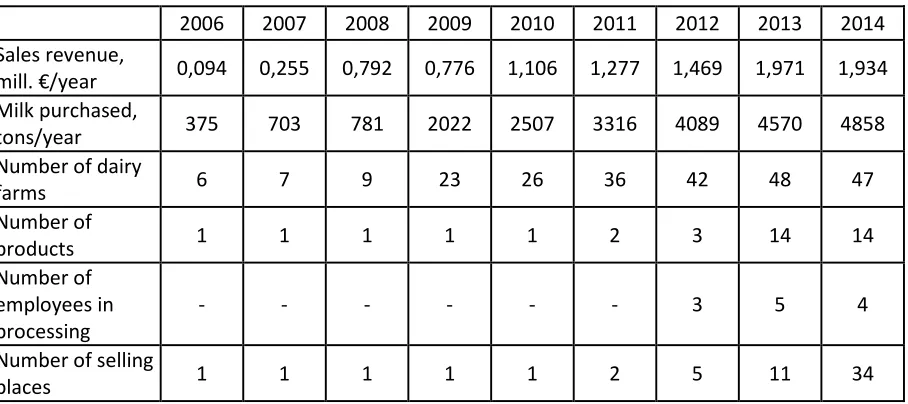
[image:10.595.74.528.543.745.2]Over the period of 2006–2014 the number of organic farms producing raw milk increased from 6 to 47, i. e. nearly 8 times. Simultaneously, the amount of produced milk was growing up steadily. Sales revenue had a similar tendency, except the year 2009, when due to the 2008’s economic crisis the purchase price for organic raw milk was reduced by the processor, and the year 2014, when the processor lowered the purchase price due to the Russian embargo (Table 1, Figure 4).
Table 1. Quantitative indicators of the cooperative ‘EKO Žemaitija’ performance
2006 2007 2008 2009 2010 2011 2012 2013 2014 Sales revenue,
mill. €/year 0,094 0,255 0,792 0,776 1,106 1,277 1,469 1,971 1,934 Milk purchased,
tons/year 375 703 781 2022 2507 3316 4089 4570 4858 Number of dairy
farms 6 7 9 23 26 36 42 48 47
Number of
products 1 1 1 1 1 2 3 14 14
Number of employees in
processing - - - 3 5 4
Number of selling
places 1 1 1 1 1 2 5 11 34
11
0 1000 2000 3000 4000 5000 6000
2006 2007 2008 2009 2010 2011 2012 2013 2014 Purchased amount (metric tons/year)
0,0 0,5 1,0 1,5 2,0
[image:11.595.73.529.73.219.2]2006 2007 2008 2009 2010 2011 2012 2013 2014 Sales Revenue ( million €/year)
Figure 4. Dynamics of milk purchased (tons/year) and sales revenue (million €/year)
Source: Data provided by the cooperative ‘EKO Žemaitija’.
[image:11.595.71.528.405.601.2]Besides the supply of organic raw milk to the milk processing enterprise, since 2012 the cooperative is engaged in the manufacturing of dairy products. In 2014, nearly 10% of the milk produced was processed into different dairy products at the cooperative. The cooperative produced pasteurised milk, sour cream, butter, yogurt, kefir, curd, kastinys (a Samogitian ancient dish made of sour cream, sour milk and butter with seasonings that tastes like butter or rich sour cream with seasonings), and different kinds of cottage cheese.
Figure 5. Organic dairy products manufactured by ‘EKO Žemaitija’
In 2014 in total the cooperative employed 17 people (administration, drivers, etc.), of which 4 processing workers.
12
0 1000 2000 3000 4000 5000 6000
0,00 0,50 1,00 1,50 2,00 2,50
2006 2007 2008 2009 2010 2011 2012 2013 2014
Milk produced, tons/year Sales revenue,
mio. €/year
Sales revenue, mio. €/year Milk produced, tons/year 2012
Beginning of milk processing at the
[image:12.595.74.516.74.375.2]cooperative
Figure 6. Growth process of the cooperative ‘EKO Žemaitija’
(based on sales revenue and milk produced)
Source: Data provided by the cooperative ‘EKO Žemaitija’.
In 2014, ‘EKO Žemaitija’ has undergone significant changes related to processing of organic raw milk at the cooperative and sales of manufactured dairy products in new markets/cities. The amount of processed milk in 2014 reached nearly 10% of the milk produced by the cooperative members.
13
Rimi Lietuva has special shelves under the label ‘Vikis’ for certified food products and a wide range of such products. Marketing system ‘TAU’ has 19 PCs, mainly in the north-western part of Lithuania that is closer to the cooperative ‘EKO Žemaitija’.
The other kind of changes related to distribution channels was reduction of direct sales. Due to very hot summer in 2014, daily direct sales of ‘Eko Žemaitija’ products were stopped because the cooperative could not ensure meeting the necessary requirements of sanitary and hygiene. The cooperative has no special mobile food vending vehicle since it is too expensive. After the dairy products of ‘EKO Žemaitija’ were introduced into big retail chains, that foster sales of natural and organic products, arose some doubts if daily direct sales will be restarted because the latter marketing channel for the cooperative has become labour-intensive and more expensive: the cooperative needs to hire a sale assistant, suffer logistics costs, etc. Weather conditions also limit direct sales opportunities because there are difficulties meeting the necessary requirements of sanitary and hygiene. Aiming to keep contacts with consumers and to attract new ones, the cooperative continue direct sales in fairs, exhibitions or other local and national events.
4.3 Stakeholder network
[image:13.595.75.535.390.669.2]The stakeholder network of the ‘EKO Žemaitija’ presented in Figure 7.
Figure 7. The stakeholder network of the case ‘EKO Žemaitija’
The stakeholders network consists of farmers, cooperative ‘EKO Žemaitija’ with milk processing branch, milk processor JSC ‘Pieno žvaigždės’, intermediary CJSC ‘Jomarko prekyba’, retailers (small local shops, retail chains Maxima, Rimi, Tau), direct sales, consumers.
Cooperative ‚EKO
Žemaitija‘
Farmers (Dairy)
Consumers
Consumers Retailers
Small local shops
Direct sales
Retail chains MAXIMA &
RIMI;
PCs ‚TAU‘
Milk processor JSC ‚Pieno
žvaigždės‘
Intermediary CJSC ‚Jomarko prekyba‘ Milk
14
5. Analytical perspectives 1-6
5. 1 Organisation and governance (Task 1)
Since the establishment of the cooperative the management structure has remained the same, i.e. the Administration and the Board (5 members) of the cooperative. Members of the Board have changed very little (only one change), and the administration structure also remained almost the same. The Board of the cooperative represents the interests of the farms of various size groups almost equally: the Board includes 3 farmers representing farms of different size. It happened naturally without any particular decision.
Since the beginning a short-term strategic decision was to collect and sell raw milk to the processor, but a long-term ambition was greater – milk processing at the cooperative. The cooperation with organic milk producers (farmers) and organic raw milk supply to the milk processing enterprise JSC ‘Pieno žvaigždės’ is based on official long-term contracts and the cooperation with other cooperative members is based on written agreements that include milk supply and collection terms.
In the contract with JSC ‘Pieno žvaigždės’ are included terms for minimal milk amount that the cooperative ‘EKO Žemaitija’ undertakes obligation to supply and the processor to purchase. The major change in contracts is the fluctuating purchase price of raw milk paid by the processor that depends on many reasons (season, supplied amount, changes of average prices in the market, etc.).
Without a doubt, the most important are the contract with JSC ‘Pieno žvaigždės’ (organic milk buyer) and contracts with milk producers. The most powerful and leading partner is JSC ‘Pieno žvaigždės’ since on it depends the price of milk supplied, and thus, the earnings of milk producers. The main partner JSC ‘Pieno žvaigždės’, in respect of ’EKO Žemaitija‘, plays a key role as organic milk buyer, but the cooperative itself is engaged in the logistics and milk collection. The relations with the milk buyer as well as with the packaging and milk bottling tare suppliers are merely business relationships.
At the beginning the cooperative had some 10 members – organic farmers who specialised in plant-growing, but they were not able to develop successfully production and produce sufficient amounts of organic products for distribution to the market through the cooperative. The majority of these farms have changed their specialisation. At the moment only 2 farmers - the members of the cooperative - are not active in milk production but apply the knowledge they acquired at the cooperative and use some services provided by the cooperative.
15
the period of 2007–2008 the number of new cooperative members was larger (some 10 each year).
“Since the establishment of the cooperative, no farmers have withdrawn their membership, they all are together. The age of cooperative members is 35-60 years. They keep from 3 to 70 cows and supply daily from 50 kg to 2 tons of raw milk. Mainly the cattle kept are of the Lithuanian Black and White breed, and daily amount of milk is 4-5 thousand kilograms. Milk yields are relatively low, but bearing in mind that we produce organic milk and have to follow very strict requirements, it is quite a good result," - says the administrative Directorof the cooperative.
Because the number of cows kept by members of the cooperative varies, the amounts of milk supplied also are different. According to one of the main principles of the cooperative, the same price should be paid to all milk suppliers, regardless of what the amount of milk they sell. “For a few years of operation the cooperative “EKO Žemaitija” was faithful to the principles declared at the beginning of the establishment. One of them says that the price paid for bought in raw milk is the same, regardless of the amount of milk supplied and the farm location. Another principle declares that the cooperative pays one of the highest prices for raw milk in the country” – says the Administrative Director.
But after large organic milk suppliers joined the cooperative, this principle is no longer obtained. Conventional milk suppliers are differentiated according to the amount of milk sold, so the differentiation is applied and for organic milk suppliers. At the cooperative there are three categories of milk purchase price that depend on the amount of milk that farmer produce: up to 300 litres, 301–1000 litres and over 1000 litres. The price differentiation according to the produced amount of raw milk makes a conflict situation among the cooperative members. In the beginning of 2014 nearly one fifth of the cooperative members were unsatisfied with the price for the milk supplied. On the other hand all cooperative members are satisfied or very satisfied with the settlement terms for the purchased milk and milk pick-up order from the farm; they positively rate milk quality evaluation (Research on the cooperative members’ opinion).
The Russian embargo on certain European agri-products in August 2014 was a reason for all Lithuanian milk processors, including the processor ‘Pieno žvaigždės’, to reduce the purchase price of raw milk. But after discussions with ‘Pieno žvaigždės’, ‘EKO Žemaitija’ negotiated a smaller reduction and a better purchase price as well as a later reduction application date than other milk suppliers. This fact shows that the cooperative remains an important organic milk supplier.
The main strategic trend of the cooperative to start milk processing and production of dairy products of higher value-added was implemented coherently and steadily in the last few years. Milk processing at the cooperative was started in 2012 and the range of manufactured products has increased. Production of dairy products of higher value-added can lower the risk of income loss if the processor reduces milk purchase price.
16
EU and national support available under the Lithuanian Rural Development Programme for cooperative development cover up to 40% of the total project eligible costs. But dairy farms or their cooperatives implementing integrated project of production of primary agricultural product and milk processing can expect support by 10% larger. Additional 10% are available for farming in less-favoured areas. Thus, in total the State support for the cooperative ‘EKO Žemaitija’ can cover up to 60% of eligible costs if they are not reimbursed through other channels.
In 2011 the cooperative decided to apply for EU investment support in order to purchase milk processing equipment. An investment project for construction of new processing facilities was prepared and ‘EKO Žemaitija’ applied for EU support under the measure ‘Modernisation of agricultural holdings’ of the Lithuanian Rural Development Programme. The cooperative could expect available financial support up to 60% of the total project eligible costs. In 2013 the project for processing of 5 tons of organic milk per day was approved. According to the support implementation rules, the cooperative had to invest nearly half of that sum and to finish implementation of the project by November 2014. Unfortunately, the cooperative had no sufficient own funds to be invested since they were not accumulated in advance, and a loan from a bank was too big a risk because of high interest rates. Therefore, at the cooperative annual meeting on 14 February 2014 it was acknowledged that preparing the project the necessary funding sources were not sufficiently evaluated and the project itself was too optimistic and risky. As a result, a strategic change in the decisions was made and the implementation of this project has been stopped. On the other hand, at the moment the market for organic products of ‘EKO Žemaitija’ is rather small. There were controversial opinions inside the value chain, but after discussions during the annual general meeting of the cooperative members, in which participated representatives of the processor, a final decision was taken: to modernise processing facilities and technologies slower but investing only own funds.
EU and national funds had a very significant impact on the development of the cooperative ‘EKO Žemaitija’ activities, starting with the purchase of premises, reconstruction of manufacturing facilities to the equipment of processing workshop. The majority of property the cooperative acquired employing the EU or national funds.
The cooperative also was subsidised by the Labour exchange through a variety of programmes as well as supported by the Ministry of Agriculture for the promotion of the sales of high-quality agricultural products.
17
Such product attributes as organic, animal welfare, fair trade are very important striving for the cooperative’s aim to get a good position in the local market of dairy products in the near future as well as later in the country’s market.
Unfortunately, not all members of the cooperative are equally altruistic implementing green ideas. In the opinion of Administration and some Board members, only less than half of cooperative members are entirely devoted to the spread of organic philosophy. For some other members of the cooperative organic farming support payments play more important role than green ideas.
The Administrative Director and Chairman of the Board are very active defending the interests of the cooperative and taking part in the deliberations/considerations and discussions at the political level.
The cooperative ‘EKO Žemaitija’ maintain and strengthen the cooperation with local public institutions, such as the national certification body ‘Ekoagros’, regional and local authorities, because they have a very significant influence on the ensurance of the cooperative future development. Sometimes this cooperation might seem as insignificant but for the cooperative and its members it is very important, e.g. in winter time it is necessary to have roads cleaned or to get some other small services. Usually dairy products serve as a compensation for such small services.
The Lithuanian association of organic agriculture ‘Gaja’ has some positive influence on the performance of the cooperative since the members of the cooperative participate at the events organised by ‘Gaja’, get some knowledge, additional information, learn about organic farming news, etc.
The cooperative ‘EKO Žemaitija’ also participates at national fairs and other events selling its products, propagating green ideas.
Neither the Lithuanian Association of Organic Agriculture ‘Gaja’ nor any other civil societyis involved in the cooperative governance.
5.2 Business and management logics: the process behind ensuring economic performance
and efficiency in mid-scale food value chains (Task 2)
‘EKO Žemaitija’ is a legally registered cooperative. The performance of the cooperative is profitable. Total sales revenue fully covers all costs of the cooperative. ’EKO Žemaitija‘ has own office premises, processing facilities, milk truck, cooling equipment, etc. as well as has no liabilities for the State or debts for banks.
The cooperative received EU and national support for setting-up and for acquisition of milk truck (under the Rural Development Programme for 2007–2013).
18
channels (big retail chains with special shelves for farmers’ products) and creation a dynamic organisation that is prepared to meet the challenges.
The recruitment of specialist with knowledge of marketing and a strong focus on the realisation of products strengthened the internal management.
In general, the managers of the cooperative understand the importance of professional specialists, so learning plays an important role in the performance of the cooperative: a training course is organised for the processing workers, farmers are encouraged to participate in the courses under the LEADER programme, on intranet they can share their own experience, etc.
The cooperative officially does not declare its motto, but the initiative “From field to table” could be considered as a motto because the ‘EKO Žemaitija’ ambition to process raw milk at the cooperative and produce final dairy products was implemented.
The most important business objectives are profitability making sure that the revenue exceeds the costs of doing business and solid financial base that allows the management team to prepare for long-term projects and answers short-term needs (e.g. wages, payable accounts, etc.) of the cooperative. Profit is used to strengthen the technical basis of the cooperative and ensure modernisation of its business. The financial basis consists of own funds of the cooperative and state support. In the opinion of 85% of respondents-cooperative members, financial stability of their respondents-cooperative is important or very important (Research on the cooperative members’ opinion).
In the opinion of the cooperative members, the most important objective is to maximise profit in order to develop processing of raw milk at the cooperative. Other important objectives that were not ranked by respondents are: to expand sales; to ensure high quality; to develop assortment; to ensure the basic needs of members of the cooperative (Research on the cooperative members’ opinion).
Absolutely all cooperative members appreciate the prestige of the cooperative and rate it as important or very important for successful business development. Also trust, transparency and fairness are valued in the cooperative (Research on the cooperative members’ opinion). The Board of the cooperative understands the importance of transparency, communication, fairness, trust, responsibilities, contracts/formal agreements for the internal organisation, but the steps done are very small.
19
Usually the main changes in the purchase price of raw milk experience the cooperative members (milk suppliers), thus creating preconditions for the further development of activities, modernisation of technical basis, etc. The cooperative contributed financially only in 2009 when part of its profit was used to smooth farmers’ income loss that emerged because of the 2008 economic crisis.
In the opinion of the HealthyGrowth-team, the most important instruments supporting the cooperation between chain partners are forward contracting of supply volumes and clear responsibilities on each level.
The competitiveness of raw milk supplied and of produced dairy products is very important for the continuity of the cooperative activities.
According to the Rules of ‘EKO Žemaitija’, profit among the members is distributed depending on their shares and the turnover of the cooperative. But for the meantime, the total amount of profit goes for investment. In the opinion of the members of the cooperative, the development of cooperative investments is important or very important for 92% of the respondents (Research on the cooperative members’ opinion).
Starting a new business it is a normal thing that at the first stage of its development all attention is focused on growth. Only in the beginning of 2015 the issue about the distribution of profit among the members of the cooperative was discussed. This shows that the cooperative members are clearly distinguished and maintains the selected priorities. As an example of a successful growth, it can be the producer-consumer cooperative EVG Landwege EG in Germany. ‘Eko Žemaitija’ might study its experience and lessons learned facing challenges, and some steps might be adapted in Lithuania.
The sales revenue of the cooperative and farmers’ income depend on the fluctuating price of raw milk paid by the processor that depends on many reasons (season, supplied amount, changes of average prices in the market, etc.). The interdependency of business partners is quite high and makes a risk if the processor has suffered any economic failures or decided to change its strategy of organic production. In that case ‘EKO Žemaitija’ would face big challenges for the selling of raw milk to other large processing enterprise or the use of raw milk at the cooperative while modernisation of technical base is not implemented.
The relations with the milk buyer as well as with the packaging and milk bottling tare suppliers are merely business relationships that are based on contracts.
20
5.3 The balance/trade-off between quality differentiation and volume and economic performance (Task 3)
Lithuanian market for organic food products during the 2008/2009 crisis period remained relatively stable and kept its regular consumers. Recently it has had a growing tendency and each year increases at least by one-tenth, but still remains relatively low and takes a very small part of the Lithuanian food market. The market of organic dairy products is not saturated yet, though the supply of some products is high, e.g., yogurts, some kinds of cheeses. Large dairy enterprises dominate in the production of yogurts (AB ‘Pieno žvaigždės’) and ripened cheeses (AB ‘Žemaitijos pienas’). Smaller producers, such as the cooperative ‘EKO Žemaitija’, strive to produce niche dairy products that differentiate from the products of other organic producers. The possibility of small producers to enter the market or keep or strengthen their positions in the market is higher if they put efforts producing the products that have additional values and differentiate from other producers of similar products. They produce dairy products that have an exceptional quality, are made according to old regional recipes, etc. ‘EKO Žemaitija’ understands itself as a small market player that has the potential for a rapid growth. So far the demand for some organic dairy products is higher than the supply.
Since organic raw milk is produced and part (nearly 10% in August 2014) of it is processed at the cooperative, the time period between production of milk and dairy products is shorter than producing the same kinds of organic products at big milk processing enterprises. Milk is cooled to 4°C and processed within two hours.
Dairy products are produced from the best quality milk and do not contain any preservatives, so they are always fresh, healthy, have excellent taste and high quality. "Everyone who tries our products enjoys their taste and quality”. Natural yoghurt is one of the most popular products of the cooperative. “It is not food but medicine”, - says the administrative manager of the cooperative. Such ingredients as caraway, raisins, etc. are bought but they make up a very small share in produced cheeses.
The cooperative has no large industrial technological lines for processing; therefore, all dairy products by ‘EKO Žemaitija’ are handmade that adds additional value recognised by the consumers. Besides, usually consumers have more trust in products produced by small producers. These conclusions are based on observations, experience, and knowledge of the cooperative. The demand on the products by ‘EKO Žemaitija’ shows that consumers are satisfied with their quality.
Currently, maintaining the quality of the produced dairy products and keeping prestige of the cooperative strategic activities of ‘EKO Žemaitija’ are very important. A great attention is paid to such quality attributes as taste and freshness following old regional recipes. One kind of cottage cheese already is made according to old regional recipe and is named after the place where it is produced: Organic cheese ‘Ryškėnai’. This unique recipe allows offering consumers the product of an exceptional taste. The cooperative’s has a future ambition to get the certificate of Lithuanian culinary heritage for this kind of fresh curd cheese. Production of culinary heritage products could help the products of ‘EKO Žemaitija’ to be different from the other organic chains.
21
or supermarkets. Besides, part of milk and many dairy products are sold in Žemaitija region thus lower transportation costs also have a positive influence on prices. Consumers get a fair price for the products that have specific qualities.
At the cooperative dairy products are produced from the best quality organic milk every day according to the descriptions of technological processes and recipes. All necessary requirements of technological processes are met, temperature register is filled up. Technological processes are supervised by the production manager and administrative manager. All materials used in the processing of milk are controlled by the national certification body ‘Ekoagros’, and dairy products are strictly controlled by the State Food and Veterinary Service. Such ethical value as ‘organic’ also depends on the farmers' awareness and fairness that builds consumers’ trust and confidence.
[image:21.595.98.499.371.672.2]Since mid-2014 a few kinds of dairy products, including two kinds of cottage cheese, sour cream, curd, kefir, yogurt, are supplied to the retail chains Rimi and Maxima where special shelves for natural fresh products produced according to the traditional recipes by farmers and small producers are arranged. These shelves also contain certified products (organic or of exceptional quality), in which technology any food additives are not used. In general, these shelves are like a small farmers market inside the supermarket and have special labels. In the retail chain Rimi abovementioned products are sold under the label ‘Vikis’.
Figure 8. Farmers’ products sold under the label ‘Vikis’ in the Rimi retail chain Source: http://krautuvelevikis.lt/
22
Figure 9. Farmers’ products under the label ‘Linkėjimai iš kaimo’ in the Maxima retail chain
Source: http://www.maxima.lt/prekiu-zenklai/linkejimai-is-kaimo/
The products that are on special shelves have an advantage since they cannot be confused with or mistaken for conventional products. They have certificates issued by national institutions or organizations such as Lithuanian Culinary Heritage Foundation, certification body ‘Ekoagros’ (organic products and products of exceptional quality) and bear special marks on labels. The products that do not have abovementioned certificates can be put on these shelves only with the permission of the State Food and Veterinary Service and the confirmation that the farm/producer and products meet the requirements for provided food quality standards.
Special shelves for farmers’ products in retail chains have already earned the recognition of consumers. Such way of selling has an advantage, because consumers always can buy fresh and exclusive products of Lithuanian farmers in one place for a longer period of time – opening hours of supermarkets are longer than in traditional farmers markets. Quite often (it depends on producer) there is a possibility to taste products. Besides, in supermarkets consumers can buy all necessary products they need. Supermarkets have good product storage conditions such as cooling equipment as well.
23
[image:23.595.82.466.166.299.2]among the organic producers and dominate in labels of many organic products in Lithuania. Besides, it is not excluded that the labels for organic products create the same group of designers. This similarity is not important for regular consumers who are satisfied with the taste and quality of these products, but this small shortcoming does not help to attract new consumers.
Figure 10. Labels of ‘EKO Žemaitija’ products: organic yogurt and organic cheese ‘Ryškėnų’
Source: http://www.ekozemaitija.lt/produktai.
The farmers and the cooperative are interested in producing the higher value-added products of high quality, since they increase sales revenue and profit. Intermediary CSJC ’Jomarko prekyba’ distribute products to such big cities as Vilnius and Kaunas where exist larger markets for organic products of ’EKO Žemaitija’. In mid-2014 consumers possibilities to buy these products expanded to 28 selling places and in the end of October they were available at 34 selling places in different cities. The demand on the products by ‘EKO Žemaitija’ shows that consumers are satisfied with their quality. There are very rare cases when the supplied amount of products is not sold.
The produce and supply of organic milk and dairy products to the consumers obligate to meet the requirements producing safe and healthy products, and preventing non-compliance in all stages of the products movement.
5.4 Communication of values and qualities among the members of the food chain (Task 4)
Upstream and downstream communications between stakeholders in the case ‘EKO Žemaitija’ are presented in Figure 11.
The communication between the Administration and the Board of the cooperative is usually at quarterly meetings and live discussions where they deal with the information about cooperative activities: milk procurement and processing, product distribution, investments, modernisation, discuss current issues.
e-24
mails is practised between the Administration and the members of the cooperative (news, other information, and feedback) as well as among members of the cooperative (not very actively). Since mid-2014, in order to improve internal communication, an internal network for cooperative members was introduced on ‘EKO Žemaitija’ website. However, farmers use intranet not actively yet. It can be assumed that the main reasons for the low use of it are that the intranet in the cooperative is still a novelty, and, on the other hand, perhaps for the older age of the head of administration and some members of the Board.
Downstream
U
p
st
rea
m
Farmers Cooperative Processor Direct sales Intermediary Retailer Consumer
Farmers
Cooperative
Minimal quantity
Minimal quantities,
price everyday;
purchasing quantities, price Processor
Quality Direct sales
Intermediary
quality
Retailer quality
Consumer quality
Contracts or written agreements Communication by phone Personal communication Feedback (different kinds)
[image:24.595.72.535.198.620.2]Communication per mail
Figure 11. Communications between stakeholders in the case ‘EKO Žemaitija’
The way of communication among the members and other interested stakeholders is different: phone calls, meetings, negotiations are going on depending on the needs and situation.
25
The communication among the cooperative and retailers is often by phone or e-mail, lately dominate e-mails. The products to small shops are supplied by ‘EKO Žemaitija’ daily according to orders. After interviews with retailers it can be said that all interviewed small retailers were satisfied with existing communication with the cooperative and had no complaints as concerns distribution of necessary amount or ordered kinds of products. Retail prices for ‘EKO Žemaitija’ products set retailers. Usually all products of ‘EKO Žemaitija’ distributed to retailers are sold. Cases when the products remain unsold are very rare. Who suffers loss in this case depends on the seller's location: in Telšiai the cooperative itself takes them back while in Klaipėda losses suffers retailer. Usually small retailers pay for products supplied in 1–2 weeks. In the opinion of small shop retailers in Telšiai and Klaipėda, the cooperative as a partner is reliable, supplies products in time, necessary amounts and assortment, the quality of products is good. The retail prices of organic and conventional dairy products in small shops are similar. Sale assistants in small periphery shops think that many consumers see no difference between the dairy products produced on organic and conventional farms. One of the reasons could be that consumers are not sufficiently informed about advantages of organic products and, therefore, they do not want to pay a higher price for such products.
Cooperation with an intermediary‘Jomarko prekyba’ supplying products to retail chains lasts not long but ‘EKO Žemaitija’ has not heard any complaints yet as well as so far there have not been any case of product returning back to the cooperative.
The cooperative’s website (http://www.ekozemaitija.lt/), printed advertisements such as flyers or brochures, advertisements on other web pages (e.g. http://www.galatum.lt/lt/ekozemaitija), local radio, broadcasts on national television as well as direct interaction at the selling places are the main communication ways with consumers. The most common communication with consumers is face-to-face at selling places of dairy products. The cooperative advertises its products at the selling places, fairs, local radio, makes presentations, explain their values, discuss with consumers the taste, quality and prices of products, listen to consumers’ comments, i.e. get feedback directly, analyses it and reacts on it. In 2013 for advertising of products at fairs or different events ‘EKO Žemaitija’ prepared and published a leaflet with the calendar for 2014. It served as a presentation of information about products and selling places and advertising of products. Unfortunately, there was no special scientific research on the impact of such information presentation or advertising on sales, but in the opinion of administrative manager of the cooperative, all kinds of advertising had a positive effect.
An informal way of communication dominates in farmers markets, fairs, exhibitions and other events. Since the cooperative has insufficient funds for other means of advertising, direct sales are important source of information that is passed from the mouth-to-mouth and is effective attracting new consumers. In retail chains the logo of the national certification body ‘Ekoagros’ as well as national and EU organic logos allow consumers to identify organic products.
26
At the moment the telephone and especially electronic feedback is not popular and consumers use such means of communication very seldom. The cooperative gets on average only 1 phone call per week from consumers, usually with compliments.
Also consumers have a possibility to send feedback, comments or suggestions by e-mail, but such form of feedback is used very rare, on average 1–2 e-mails per year. One of the reasons could be that older consumers in provinces do not use e-mail. Another possible reason is that there is a necessity to update leaflet more often, because lately many changes in distribution has been going on, especially about new selling places. It is expected that in future feedback will be more often and relations with consumers will become stronger. A bad example could be sad that the cooperative for some time did not pay enough attention to maintain and update properly and in time its website. The title ‘News’ was deleted after HealthyGrowth-team remarks on the necessity to update information. Currently it has no special title for news and consumers or stakeholders cannot quickly draw attention to the latest information about new selling places, products, etc. and notice easily changes. Also the website of ‘EKO Žemaitija’ has no counter that means that the administration of the cooperative does not know how many people visit its homepage. The problem of the abovementioned shortcomings is that the cooperative has no specialist with sufficient IT knowledge, therefore, have to strengthen the abilities of the employees in order to maintain and update its website.
Besides official meetings, sometimes are going on informal meetings both at the cooperative office and other places, stakeholders meet at fairs or other events. Such meetings within the cooperative are usually used to discuss current issues, activities, to exchange opinions or other information. Tangible benefits of informal meetings have not been identified, but it is likely that the members of the cooperative deal with the topical issues related to the prices for raw milk, services provided by the cooperative, etc., that sometimes are transferred to the official level. Different fairs or other events are useful for all stakeholders since they can share the news, information, opinions. Such meetings or events sometimes have the effect of modifying/changing the decisions related to the activities of the cooperative but there is not possible to assess the importance of informal communication means on the performance of the cooperative or sales.
The cooperative and the entire analysed chain are still young establishments, so there is no specially trained ‘food ambassadors’ yet, not including people working at direct sales or sellers at small shops who can give feedback about the products. But in future their role should be strengthened.
On 19 and 26 September 2014 the cooperative participated at the autumn fairs of organic products in Vilnius organized by the non-profit organization ‘Tatulos Programa’ where ‘EKO
Žemaitija’ presented its organic dairy products; consumers from the capital city had a possibility to taste and to buy the Samogitian products.
On 20 September 2014 the cooperative participated at the regional event ‘Move together’ in Telšiai. ‘EkoŽemaitija’ was among the sponsors of the event.
27
the 2014 exhibition took part 111 companies and organisations, about 200 small farmers, manufacturers and sellers not just from all over Lithuania, but also from neighbour countries such as Poland, Latvia, Estonia, etc. Total area of the exhibition was 2.7 ha. Nearly 50 thousand visitors attended the exhibition. The aim of the cooperative ‘EKO Žemaitija’ was to advertise its dairy products and to meet many new people who might become the consumers of its organic dairy products in future.
According to the data of the Department of Statistics of the Republic of Lithuania, at the beginning of 2014, all manufacturing and service enterprises with the staff of 10 and more employees used computers and the Internet in Lithuania. 74.5% of enterprises had a website. Electronic social media (e.g. Facebook, Twitter, YouTube, Picasa) were used for working purposes by 35.5% of enterprises. Although Lithuania is ahead many European countries as concerns the development of information technologies, the online communication measures in the cooperative ‘EKO Žemaitija’ are not very important and their benefits are minimal yet because of its older members who have no needs and the necessary skills to use it. Currently the most popular type of communication within the cooperative ‘EKO Žemaitija’ and among the stakeholders in the entire chain is going via telephone.
The cooperative ‘EKO Žemaitija’ has QR code with its contact information.
Figure 12. QR code of the cooperative ‘EKO Žemaitija’
Unfortunately, current labels of dairy products by the cooperative has no the QR code. Maybe the cooperative had made a significant quantity of labels that still has been used. So far the QR code is also unused on leaflets or other advertising material.
It is difficult to say which of existing forms of communication the stakeholders prefer or would prefer to use in future if they had sufficient funds because such questions were not foreseen among the proposed questionnaire, so they were not presented to farmers, administration or retailers during interviews. In the opinion of the administrative manager of the cooperative, electronic communication means are not popular enough yet. The reason could be that in regional small shops consumers are elder people and they are not good users of innovative electronic means (this is an opinion of sale assistants in small visited shops). Consumers in cities are younger (also an opinion of sale assistants, e.g. in Klaipėda their age is 30–40 years), so innovative tools should be more popular. It is likely that in the nearest future the online communication tools will gain a wider significance as online ordering and delivery system is being developed.
28
5.5 Quality dimension of primary production and mediation through the chain (Task 5)
All dairy products of ‘EKO Žemaitija’ are organic and belong to the same value chain.
The cooperative ‘EKO Žemaitija’ joins together only organic farmers, who produce only organic raw milk that is processed at the cooperative, so there is no possibility to be mixed organic and conventional products as it might happen in other milk processing companies that produce both types (organic and conventional) of products.
Quality assurance is very important at the cooperative: a great attention is paid on the quality of both raw milk and products manufactured. For the quality of milk supplied the farmers are responsible themselves. All farms of the cooperative are certified and controlled by the national certification body ‘Ekoagros’ and meet the stringent requirements of organic farming. Traditional raw milk quality tests are made constantly but such an important duty as sampling is left for drivers collecting milk. The quality and the price of milk supplied depend on testing results. For the better quality the buyer of organic milk pays a higher price. For the period 2014–2015 the national certification body ‘Ekoagros’ issued the certificate to ‘EKO Žemaitija’ for the production of 23 organic dairy products. All final products are controlled by the State Food and Veterinary Service.
Milk processing company ‘Pieno žvaigždės’ has a separate line for processing of organic raw milk, and its quality assurance system ensures the quality of manufactured dairy products. The dairy products of ‘EKO Žemaitija’ are sold directly to consumers, distributed in small local shops or placed on special shelves in supermarkets of the retail chains that they were not confused with conventional ones and consumers could easily find them.
Currently on the product labels dominate the logo of the cooperative ‘EKO Žemaitija’ because it has no own brand. Only one kind of cottage cheeses has its name ‘Ryškėnų’ cheese. Other products do not have specific names. The cooperative identifies itself with the products to the greatest extent, as it emerged due to farmers’ dissemination of eco-friendly philosophy, thus, this identification is important.
5.6 Resilience of the value chain and the initiative/business – long term perspective, change and social-ecological links (Task 6)
The 2008 economic crisis had no direct influence on the cooperative performance, but it responded to the farmers because ‘Pieno žvaigždės’ reduced the price for raw milk. First of all it was caused by lower milk purchase prices on the international market. The economic crisis lowered demand on food products and reduced consumer purchasing power by lowering real income as well. As a result, Lithuanian processors also paid less for milk supplied, thus, farmers’ income was lower. The cooperative itself smoothed the emerged situation and covered part of lost farmers’ income. Therefore, in 2009 net profit of the cooperative dropped by 8%. Despite the difficulties encountered, the cooperative itself managed to survive and even to buy premises and equipment for milk processing.
29
every year. The 2011–2013 period was the most successful: the purchase price of milk went up by 62% due to increased quantities of milk and a lower cost price. This growth had a positive impact on the income from sales, and over the same period farmers’ income increased by 64%.
A new wave of changes has begun in 2014. At the annual general meeting in mid-February a decision to hire a marketing specialist and to expand selling territory was taken. Since March the cooperative has a new head of the processing department who also performs the functions of a marketing specialist. The results are obvious: the cooperative has introduced its dairy products into important retail chains and gradually expands the number of selling places. In October 2014 dairy products of ‘EKO Žemaitija’ were available not only in the Žemaitija region but also in such large cities as Vilnius, Kaunas, Šiauliai. In total, the number of selling places increased up to 34.
In 2014 was a call for applications under the European School Milk Programme ‘Milk to children’. It covers not only milk, but also yogurt, cheese, buttermilk and other healthy dairy products that are important to good nutrition and a balanced diet. ’EKO Žemaitija’ had a good chance for a new distribution channel, but, unfortunately, missed it because in advance it did not pay enough attention to this possibility and had no necessary prepacking equipment. On the other hand, this Programme is coordinated by the Lithuanian Agricultural and Food Products Market Regulation Agency but the operating system of administration does not encourage participation of small producers because of a long working capital
turnover (in total, all procedures take nine months).
The large milk processing company ‘Žemaitijos pienas’ won the tender for the supply of milk
and dairy products to schools and kindergartens, and began to canvass organic farmers for the supply of organic raw milk promising a higher price for raw milk. The cooperative ‘EKO
Žemaitija’' has faced a new challenge but has no real instruments to keep organic farmers,
so meetings or discussions are organised and the farmers are asked not to leave the cooperative only appealing to the signed agreements and obligations to the cooperative. The cooperative cannot raise prices to individual farmers for raw milk, because this could cause some disagreement among the cooperative members or even lead to the possibility of blackmailing.
In August 2014 the cooperative faced new challenges. Due to the Russian embargo for some EU agri-foods, raw milk purchase prices, in general, have dropped considerably. Despite the fact that ‘EKO Žemaitija’ was able to negotiate for a better reduction (by 2%), the price of milk purchase went down nearly by 20%. It is expected that the increased processing of raw milk at the cooperative will create more value-added that will let to smooth farmers losses. During the negotiations the purchase price of raw milk was adjusted with farmers.
The cooperative unifies organic farmers. Organic farming as a method of agricultural production is based on principles aimed at a sustainable cultivation of farmland and food production. It is a holistic, eco-systematic approach and the preservation and enhancement of soil fertility. It is based on a minimal use of off-farm inputs and on management practices which restore, maintain and enhance ecological harmony. This method of agricultural production contributes to the protection of the environment and agro-biodiversity as well as to the sustainable development.
30
In the opinion of the cooperative administration, in future they would like to invest more into processing of dairy products at the cooperative. The processed dairy products creates higher value-added thus a greater profit and lowers risks. On the other hand, the processor ‘Pieno žvaigždės’ does not need more milk in summer; it feels a lack of raw milk only in winter time. Therefore, it should be some kind of farmers’ encouragement to produce larger amounts of raw milk during that period.
The cooperative has no ambitions to increase significantly the number of its members. Economic crises have the most important negative impact on the successful development of the cooperative.
There are some threats/risks that make the business of the cooperative ‘EKO Žemaitija’ vulnerable:
1. A sudden reduction of the purchase price of raw milk by the decision of processor ‘Pieno žvaigždės’. This reduction can be related to changes in the global and local markets.
2. The cooperative entered into the retail chains ‘Maxima’ and ‘Rimi’ but not necessary this step will be successful in future. So far there is too short a period of sales in these retail chains that could be possible to make final conclusions. It was noticed that the products of ‘EKO Žemaitija’, being on special shelves in retail chains, have a small negative shortcoming because labels of similar colours do not add a positive evaluation. A similar problem is related to the logo of the cooperative ‘EKO Žemaitija’. Although its dairy products are popular among large part of Lithuania's population, some consumers confuse them with the products by powerful milk processing company AB ‘Žemaitijos pienas’ that also produces organic dairy products. Visually the logos are different and of different colours, but names sound similarly.
3. Economic/political crises. The cooperative survived the economic crisis in 2008/2009. In August 2014 the introduction of the Russian embargo on EU agri-foods had an impact on the performance of ‘EKO Žemaitija’ also since purchase prices of raw milk were reduced nearly by 20%.
4. A threat of losing organic milk suppliers has appeared after ‘Žemaitijos pienas’ has successfully won a tender for the supply of milk and dairy products to educational establishments.
5. The potential threat that may become a risk is the older age of some leading people (the Administrator of the cooperative and some members of the Board) because so far there are no clear leaders among the younger members of the cooperative that were capable to take over the leadership.
The partners in the entire chain are reliable, so it is unlikely that the food value chain would break up.
31
6. Future orientation of the initiative/business and the value chain
In the nearest future (in 1–2 years) more than half of the cooperative members plan to increase milk production up to 10%, but no one thinks about the reduction of milk production. As a result, the production of organic milk at the cooperative is expected to be growing up (Research on the cooperative members’ opinion).
As concerns future milk collection and supply, the cooperative expects a successful cooperation with a key partner JSC ‘Pieno žvaigždės’ supplying larger amounts of organic raw milk. A future growth strategy is discussed with the cooperative members and the milk processor ‘Pieno žvaigždės’. JSC ‘Pieno žvaigždės’ feels a lack of organic raw milk in the winter time. Striving to encourage milk production and supply in winter, both the processing company and the cooperative have plans to promote the farmers. Such discussions have already been started at the Board of the Cooperative, but the main problem is not fodder for cattle but a scheme of insemination of dairy cows. Although current intention to expand production of dairy products using EU support and credits has been dropped, the cooperative still sets out ambitious plans to modernise infrastructure and technologies and process up to 5 tons per day. It is expected that the new project will be implemented over a period of three years investing only available own funds.
Developing new products, the cooperative is working closely with the Food Institute of Kaunas University of Technology and has a future plan to employ a food technologist.
As regards internal organisation and management, the cooperative needs renewal, since in addition to the enthusiasm it is necessary to have top-level managers with conceptual skills and competencies in long-term thinking, well-trained specialists with modern knowledge, active support from the members, and improved management style.
As concerns markets, the cooperative expects to sell its organic products not only regionally, i.e. to have a stronger position in the local market, but also expand the distribution of organic dairy products in the whole Lithuania’s territory establishing new selling places and strengthening distribution channels as well as to become more famous because of the good quality dairy products.
”Successful performance requires a lot of work, a lot of thinking, you need to take an interest in everything, to monitor developments, to participate in exhibitions, to seize every even the smallest opportunity, to plan all the activities in such a way that everything were done in time and properly”, - administrative manager speaks about the future vision of the cooperative. “Learning must be a lifelong endeavor, as new things constantly emerge that need to be understood. And, in general, there are untapped resources for our cooperative. As the shelves for organic products remain sparse, they must be filled. We are ready to do that.”
As concerns local development, the cooperative has no plans to be more involved in direct local activities or support them, but intend take part and sell its organic dairy products at different local events as had done so far.