Strongly Overdamped Dissipative Particle Dynamics for
Fluid-Solid Systems
N. Phan-Thien
1, N. Mai-Duy
1,2,∗, B.C. Khoo
1, and D. Duong-Hong
31
Department of Mechanical Engineering, Faculty of Engineering,
National University of Singapore, Singapore.
2
Computational Engineering and Science Research Centre,
School of Mechanical and Electrical Engineering,
University of Southern Queensland, Toowoomba, QLD 4350, Australia.
3
Welch Allyn Singapore Pte. Ltd.,
438B Alexandra Road, #01-03 Alexandra Technopark, Singapore 119968
Submitted to
Applied Mathematical Modelling
, 5/Feb/2015; revised,
8/Nov/2015;
revised (2), 4/Dec/2015
Abstract In this paper, a numerical scheme is used to study strongly-overdamped
Dissi-pative Particles Dynamics (DPD) systems for the modelling of fluid-solid systems. In the
scheme, the resultant set of algebraic equations for the velocities are directly solved in an
iterative manner. Different test problems, e.g., viscometric flows, particulate suspensions
and flows past a periodic square array of cylinders, are used to verify the proposed method.
In the simulation of particulate suspensions, a new simple model for massless suspended
particles is presented. A DPD fluid in the overdamped limit is shown to possess several
attractive properties including much faster dynamic response and near-incompressibility.
Keywords: Dissipative Particles Dynamics, strongly overdamped systems, compressibility,
dynamic response, particulate suspension
1
Introduction
Dissipative Particles Dynamics (DPD) is a particle-based method originally designed for the
simulation of complex fluids on mesoscopic length scale [1-5]. In DPD, a fluid is modelled by
a system of particles interacting with each others through pairwise forces. These particles are
supposed to model the fluid behaviour (viscous, or otherwise dictated by the specification of
the microstructure connectivity) when seen in a representative volume. Objects suspended
in the fluid, e.g., rigid particles and droplets, can also be represented by DPD particles with
appropriate forms of interactions. These features make the DPD method (and its variants)
very attractive in the modelling of complex fluid systems. DPD has been used with varying
degrees of success to simulate various problems: particulate suspensions, emulsions, polymer
solutions, polymer melts, red blood cell modelling, etc.
In [6], the equivalent Poisson ratio of a DPD fluid (a measure of compressibility) in the
absence of conservative forces was estimated as 0.24, and measured in a simulated four-rolled
mill at a value of 0.48 (at best), less than the incompressible limit of 0.5. This compressibility
nature of a DPD fluid implies that unwanted effects due to compressibility of a DPD flow
will occur, and special care is needed in interpretation of the flow results, especially at
high Re number. The Mach number, which is the ratio of a characteristic velocity of the
fluid to its sonic velocity, can also be used to estimate the effects of compressibility. The
fluid flow may be considered weakly compressible (or nearly incompressible) when the flow
Mach number is less than 0.3. Another past issue is the Schmidt number, the ratio of the
diffusion of momentum to the diffusion of mass in a fluid, governing the dynamic response
of a fluid. For a standard-parameter DPD fluid, the Schmidt number is of the order unity.
For a real water-like fluid, the Schmidt number is O(103), and there is the need to improve
on the dynamic behaviour of the DPD system. By some slight modifications to its standard
parameters, a DPD fluid could be designed to have a Schmidt number of O(103) [7].
The Reynolds (Re), Mach (M) and Schmidt (Sc) numbers are defined as [5]
Re= mnUL
η ; M =
U cs
, c2s =
kBT
m +
π 15
anr4
c
m ; Sc=
η
where U is a flow characteristic velocity, L a flow characteristic length, m the mass of the
particle, n the number density, η the dynamic viscosity, cs the speed of sound, kBT the
Boltzmann temperature (mean kinetic energy of the particles), a the repulsion coefficient,
rc the cut-off radius for the particles interactions, and D the fluid diffusion coefficient. It
is therefore possible to control the three quantities Re, M and Sc collectively by means of
m. A strongly overdamped system results with the limit of m → 0; the limit corresponds
to Re → 0, M → 0 and Sc → ∞. This limit also corresponds to the inertial time scale
mγ−1 →0 (γ the coefficient characterising the strength of the dissipative force, refer to (3)
below). It is noted that highly overdamped Brownian dynamics systems and their behaviour
have been extensively studied and well established, but no such studies exist for overdamped
DPD systems. In [8,9], the use of low mass was proposed in the DPD modelling of slow
(creeping) flow in which high sonic speed, low Reynolds and high Schmidt numbers are
achieved altogether. This comes at the expense of solving stiff stochastic differential
equa-tions for which exponential time differencing (ETD) schemes may be more efficient than
standard solvers. In [10], the overdamped limit for a simple DPD system was investigated,
where DPD particles are of the same type and the imposed boundary conditions are all
periodic. The resultant system matrix has zero row and zero column sums, corresponding to
a loss of second-order time derivatives, and a multiplicity of solutions (each solution differs
from the other by a rigid-body motion). It was shown that a possible and practical
itera-tive solution scheme is to add to the original system the eigenvectors weighted by the inner
product formed from the eigenvectors and the solution vector (which is in fact the constraint
of zero center of mass velocity) - this later step was recognised as a Wielandt’s deflation
technique.
The present work is an extension of our previous study of strongly-overdamped DPD, with
included movable and stationary solid bodies, also modelled using a subset of DPD particles.
It will be shown that the velocity constraints on stationary particles render a unique solution
to the system without the need for Wielandt’s deflation. Emphasis will be placed on: (i) the
effects of using frozen particles on the flow; (ii) the effects of including physical constraint of
constant velocity of the mass centre in the DPD system; and (iii) the modelling of massless
suspended particles. Basic DPD equations in the overdamped limit are given in Section 2.
in Section 4. Section 5 gives some concluding remarks.
2
DPD equations for strongly overdamped systems
The DPD equations can be written as
dri
dt =vi, (2)
mi
dvi
dt =
N
X
j=1,j6=i
aijwCeij − N
X
j=1,j6=i
γwD(eij ·vij)eij + N
X
j=1,j6=i
σwRθijeij, (3)
where i= (1,2,· · · , N), N is the number of particles, mi, ri and vi the mass, position and
velocity vector of the ith particle, t the time, vij = vi −vj, eij = rij/rij (rij = ri −rj,
rij =|rij|), aij, γ and σ are constant parameters, wC, wD and wR are the weight functions
that vanish ifrij ≥rc, and θij a Gaussian white noise (θij =θji) with stochastic properties
hθiji= 0, (4)
hθij(t)θkl(t′)i= (δikδjl+δilδjk)δ(t−t′),withi6=k and j 6=l. (5)
The first term on the right side of (3) is the conservative force (Fij,C), the second the
dissipative force (Fij,D) and the last the random force (Fij,R). The equilibrium and detailed
balance (Fluctuation-Dissipation theorem, [2]) of the system requires
wD(rij) = (wR(rij))2, (6)
kBT =
σ2
2γ, (7)
where kBT is the Boltzmann temperature (mean kinetic energy of the particles). In this
study, we take the weighting functions in the form wC(rij) = 1 − rij/rc and wD(rij) =
(1−rij/rc)1/2. It is noted that the exponent in the expression for wD is taken to be 1/2
instead of 2 to increase theSc number by a factor of 10 and thereby improve on the dynamic
response of the DPD fluid [7]. The DPD forces are centre-to-centre and thus both linear
that DPD particles interact through a soft potential, the simulation can be carried out on
length and time scales far beyond those associated with molecular dynamics (MD). Viscous
interactions are accounted for by dissipative forces depending on the relative velocity of the
particle.
Calculation of mean quantities
The flow domain is divided into bins which are used to collect local data. The
assuming-ergodic flow properties are calculated by time averaging over all sampled data in each bin.
The fluid density and linear momentum are, respectively, defined as
ρ(r, t) = *
X
i
mδ(r−ri)
+
, (8)
ρ(r, t)u= *
X
j
mvjδ(r−rj)
+
. (9)
The stress tensor is found for a microscopic system of particles by the Irving-Kirkwood
method
T=−n *
X
i
mViVi+1 2
X
i
X
j6=i
rij(Fij,C +Fij,D) +
, (10)
where Vi = vi −u is the peculiar velocity of particle i with respect to the mean field
velocity u and h.i denotes the ensemble average. The sums on the right side of (10) denote
the contributions to the stress from the momentum transfer of DPD particles and from the
interaction forces, respectively. The pressure can be defined as the trace of the stress tensor
p=−1
3trT. (11)
It is noted that these mean quantities satisfy conservation laws:
∂
∂tρ(r, t) +∇ ·(ρ(r, t)u(r, t)) = 0, ∇=∂/∂r, (12)
and
∂
∂t (ρu) +∇ ·(ρuu) = ∇ ·T. (13)
(12)-(13). Adopting this particle-based point of view, DPD particles may be thought of as a
model of a behaviour (e.g., viscous compressible fluid), not merely particles of some exclusion
sizes. More details can be found in [5,11], for instance.
Strongly overdamped DPD systems: In the overdamped limit (m/γ2 → 0), equation
(3) reduces to a balance of forces
N
X
j=1,j6=i
γwDeijeij ·(vi−vj) = N
X
j=1,j6=i
aijwCeij + N
X
j=1,j6=i
σwRθijeij. (14)
3
Proposed numerical procedure
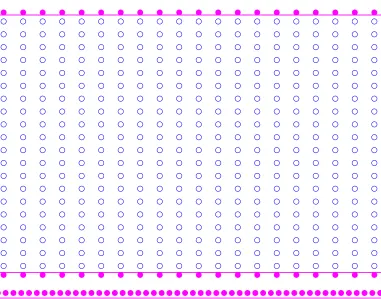
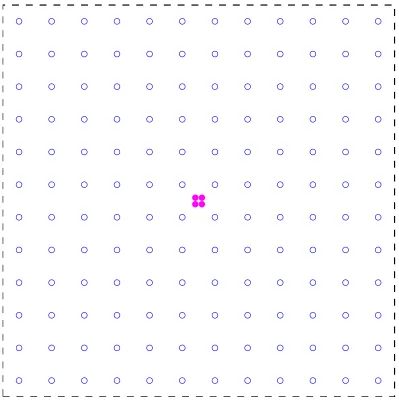
Consider a DPD system as shown in Figure 1. In the wall regions, as represented by two
boxes, top and bottom, the wall particles, numbered Nw, are frozen. We can arbitrarily
number the DPD particles consecutively as i = 1, . . . , Ns, Ns + 1, . . . , N, where Ns is the
number of DPD particles representing the fluid (the solvent), and N = Ns+Nw the total
number of DPD particles. Initially, the fluid particles are distributed uniformly, and their
velocities are generated randomly with a zero sum in all directions.
We construct the DPD system by lettingi taking values from 1 to Ns in (14)
Av=f, (15)
where A is the system matrix, v the column vector of unknown velocity vectors and f the
column vector of right hand force vectors and part of the original left hand matrix multiplied
by known velocity vectors:
A= PN
j=2γwDe1je1j −γwDe12e12 · · · −γwDe1Nse1Ns −γwDe21e21 PNj=1,j6=2γwDe2je2j · · · −γwDe2Nse2Ns
... ... . .. ...
−γwDeNs1eNs1 −γwDeNs2eNs2 · · ·
PN−1
j=1 γwDeNsjeNsj , (16)
v= (v1,v2,· · · ,vNs)
T
f = PN
j=2a1jwCe1j +
PN
j=2σwRθ1je1j
PN
j=1,j6=2a2jwCe2j +PNj=1,j6=2σwRθ2je2j
... PN−1
j=1 aNsjwCeNsj + PN−1
j=1 σwRθNsjeNsj + PN
j=Ns+1γwDe1je1jvj PN
j=Ns+1γwDe2je2jvj ...
PN
j=Ns+1γwDeNsjeNsjvj . (18)
Since the known velocity vectors, corresponding to the wall particles, on the left side of (14)
are moved to the right side (the last term in (18)), the row and column sums of the system
matrix A are no longer zero and consequently, the problem of multiple solutions due to a
rigid-body motion is no longer a concern. It can be seen that A is a sparse matrix because
the construction of rows of this matrix involves only particles within the interaction zone.
Below are two iterative schemes for solving the system Av = f. They are applicable for
2D and 3D space. In Scheme 2, the Wielandt’s deflation method is utilised to reduce the
spectral radius (faster convergence). In this regard, Scheme 2 is expected to be more efficient
than Scheme 1.
3.1
Scheme 1
We decompose the system (15) into
Iv+Kv=f, (19)
where I = PN
j=2γwDe1je1j 0 · · · 0
0 PNj=1,j6=2γwDe2je2j · · · 0
..
. ... . .. ...
0 0 · · · PNj=1−1γwDeNsjeNsj , (20) and K=
0 −γwDe12e12 · · · −γwDe1Nse1Ns
−γwDe21e21 0 · · · −γwDe2Nse2Ns
... ... . .. ...
−γwDeNs1eNs1 −γwDeNs2eNs2 · · · 0
The inverse ofI can be computed in the following form
I−1 = PN
j=2γwDe1je1j
−1
0 · · · 0
0 PNj=1,j6=2γwDe2je2j
−1
· · · 0
... ... . .. ...
0 0 · · · PNj=1−1γwDeNsjeNsj
−1 . (22)
Multiplying both sides of (19) byI−1 results in
v+Hv=b, (23)
where H = I−1K and b = I−1f. To solve (23), a simple Picard’s iteration scheme can be
used
vli =−Hivl−1+bi, (24)
wherei= (1,2,· · · , Ns),
Hi = N
X
j=1,j6=i
γwDeijeij
!−1
−γwDei1ei1,· · · ,−γwDei(i−1)ei(i−1),0,−γwDei(i+1)ei(i+1),· · · ,−γwDeiNseiNs
, (25)
and
bi =
N
X
j=1,j6=i
γwDeijeij
!−1 N
X
j=1,j6=i
aijwCeij + N
X
j=1,j6=i
σwRθijeij + N
X
j=Ns+1
γwDeijeijvj
! .
(26)
The iterative process stops when the following convergence measure is satisfied
norm(vl−vl−1)<10−7norm(vl), (27)
where the notation norm is used to denote the Euclidean distance.
A first-order Euler algorithm is employed here
rki+1 =rki +vki∆t, (28)
where ∆t=tk+1−tk.
Now we investigate the effects of frozen particles in the wall regions on the flow. Consider
the ith wall particle (i= (Ns+ 1,· · · , N)). Its motion is governed by
mdvi dt =
N
X
j=1
(Fij,C +Fij,D+Fij,R) +Fi,W, (29)
where Fi,W is the constraint (reaction) force from the ground/base. Since the particle i is
frozen (vi =0), the constraint force on it is computed as
Fi,W =−
N
X
j=1
(Fij,C +Fij,D+Fij,R). (30)
The total force exerted on the DPD system from the base is thus given by
e
F=
N
X
i=Ns+1
Fi,W =− N
X
i=Ns+1
N
X
j=1
(Fij,C+Fij,D+Fij,R) = Ns X i=1 N X j=1
(Fij,C+Fij,D+Fij,R).
(31)
It can be seen that the total force exerted on the fluid region from the walls is also Fe.
The centres of mass of the fluid interior and the wall particles are given by
mNsRsc = Ns X
i=1
mri, mNwRwc = N
X
i=Ns+1
mri. (32)
Note that (i) the centre of mass of the whole DPD system is
NRc =NsRcs+NwRwc; (33)
and (ii) the three centres are initially located at the origin with zero velocities.
In the present system, there are two types of forces, the DPD and reaction forces. The
which are forces exerted on the frozen forces from the ground/base, do not cancel out. As a
result, the mass centre of the system/fluid region will not move at constant (zero) velocity
any longer. Consider a domain of 10×10 in reduced units (10×12 if the two wall regions
are included) as shown in Figure 1. We employ the standard DPD parameters: aij = 18.5,
n = 4, σ = 3, rc = 1 and kBT = 1, and take ∆t = 0.005. The number of particles in the
fluid region are 400. In each wall region, there are two boundary layers on which 20 and
50 uniformly-distributed fixed particles are employed. The total number of particles used
are thus 540. It is observed that (i) velocity components of the mass centre are oscillatory
with zero mean and magnitude in the range of -15 to 15 for the x component and of -8 to
8 for the y component; (ii) the location of the mass centre moves far away from its original
position and displacements in the x direction are much larger than in the y direction (for
2500 time steps, −0.6< xcm <1.2 and −0.1 < ycm <0.1); and the total of reaction forces
also fluctuates with zero mean. It appears that the reaction forces are transmitted into the
fluid region, just like “external forces”, producing some fluid motion, which is a consequential
artefact of the wall constraints.
3.2
Scheme 2
In this scheme, the DPD system incorporates the physical constraint of constant velocity of
the centre of mass in order to enhance the efficiency of the iterative solving process as well
as to offset against the fluid motion induced by constraint forces.
We now introduce the relative motion of the particles
xi =ri−Rcs, i= (1,· · · , Ns). (34)
Differentiating equation (34) with respect to time twice and making use of (3), (32), (30)
and (31) yield
mx¨i = N
X
j=1,j6=i
(Fij,C +Fij,D+Fij,R)−
1 Ns
e
F. (35)
This relative motion of fluid DPD particles (equivalent to describing the motion in a frame
is now guaranteed to have their centre of mass in this moving frame stationary. It should
be emphasised that the new force term in (35) is only present with wall particles, when a
transmission of forces from the wall to the fluid region occurs. If there are no wall particles,
these reaction forces are zero, and this mentioned force field vanishes. The sum of all forces
exerted on the DPD system completely vanishes.
Let the fluid density and linear momentum in the moving frame, respectively, be defined as
ρ(x, t) = *
X
i
mδ(x−xi)
+
, (36)
ρ(x, t)u= *
X
j
mx˙jδ(x−xj)
+
. (37)
Note thatr=x+Rsc and ri =xi+Rsc, and thus r−ri =x−xi. Equation (8) becomes
ρ(r, t) = *
X
i
mδ(r−ri)
+ =
* X
i
mδ(x−xi)
+
=ρ(x, t). (38)
Note thatr =x+Rsc andrj =xj+Rsc, and thusvj =x˙j+R˙sc andr−rj =x−xj. Equation
(9) becomes
ρ(r, t)u= *
X
j
mvjδ(r−rj)
+
= *
X
j
mx˙jδ(x−xj)
+ +
* X
j
mR˙scδ(r−rj)
+
=ρ(x, t)u+ *
X
j
mR˙scδ(r−rj) +
, (39)
where the second term on the right side of (39) can be regarded as the side effect of freezing
the wall particles. One expects this term to approach zero as the number of time steps used
for the time averaging process increases (in the case when periodic boundary conditions are
applied, this can be demonstrated to be zero). The velocityuto be determined is the wanted
part of the velocity u.
Note that ri = xi +Rsc, rj = xj +Rsc, vi =x˙i+R˙sc and u =u+hR˙sci, and thus rij = xij
andVi =vi−u=Vi+
˙
i in the relative motion. Equation (10) can be rewritten as
T=−n *
X
i
mViVi+
1 2
X
i
X
j6=i
rij(Fij,C +Fij,D)
+ ,
=−n *
X
i
mViVi+
X
i
mR˙sc − hR˙sci R˙sc− hR˙sci+ 1 2
X
i
X
j6=i
xij(Fij,C +Fij,D)
+ .
(40)
Owing to the facts that (i) R˙sc − hR˙sci is not spatial dependent and (ii) only the pressure
gradient (not the pressure itself) matters in the momentum balance equation, the stress
tensor computed in the moving frame is in fact the stress tensor (10) modulo an un-important
isotropic pressure term. Expressions (38), (39) and (40) are valid for any value ofm.
With the presence of frozen wall particles, the motion of DPD particles in reference to
the centre of mass is a better means of representation of the flow as the artefacts of the
wall constraints are absent. The centre of mass of the present system has constant (zero)
velocities. Hereafter, for the sake of simplicity, notations for the position, velocity, etc., in
the moving frame are taken to be the same as those in the fixed frame. Furthermore, the
DPD formulation can now be reformulated with the help of Wielandt’s deflation method
[12,13] to deflate the largest value of the eigenvalues of the matrixH and thus to reduce the
spectral radius (faster convergence)
v+Hv+ǫx[v,ǫx] +ǫy[v,ǫy] +ǫz[v,ǫz] =be, (41)
where [·,·] denotes the natural inner product of two vector elements in the underlying space,
ǫx = Ux,Ux, ...,Ux)T pNsUx, Ux = (1,0,0)T, U2
x =Ux·Ux, (42)
ǫy = (Uy,Uy, ...,Uy)T pNsUy, Uy = (0,1,0)T, U2
y =Uy ·Uy, (43)
ǫz = (Uz,Uz, ...,Uz)T pNsUz, Uz = (0,0,1)T, U2
z =Uz·Uz, (44)
and
e
b=b+I−1(− 1
Ns
e
F,· · ·,− 1
Ns
e
F
| {z }
Ns
The last three terms on the left of (41) represent the constraint of zero velocity of the centre
of mass [10] and therefore they do not contribute to the governing equation.
To solve (41), a simple Picards iteration scheme can be used
vil=−Hivl−1−ǫxhvl−1,ǫxi −ǫyhvl−1,ǫyi −ǫzhvl−1,ǫzi+bei, (46)
wherei= (1,2,· · · , Ns). Note that equation (23) of Scheme 1 and equation (46) of Scheme
2 can be constructed and solved in parallel to enhance the computational efficiency.
Numerical results obtained show that the velocity field has a zero sum (i.e.,<10−8) in each
direction as the scheme is designed to do so. Also, as expected, the centre of mass is observed
to be stationary (i.e. |xc|,|yc|<10−10).
4
Numerical examples
The proposed two schemes are verified in 2D flows: Couette flows, flows past a periodic square
array of cylinders and particulate suspensions. The flows are modelled using a DPD system
in two dimensions with the following standard parameters: aij = 18.5, n= 4, σ = 3,rc = 1
andkBT = 1. Cutoff radius and Boltzmann temperature are commonly normalized to unity.
Repulsion parameter aij is chosen from the requirement that the DPD fluid is supposed to
have the same isothermal compressibility to that of water. For the modelling of single phase
systems, DPD is known to possess a scale-free property over the whole mesoscopic range.
The larger the number of fluid molecules packed into a DPD particle (larger DPD particle),
the higher the coarse graining level will be. With an appropriate scaling scheme, numerical
results from solving the DPD equations of motion can be independent to the number density
chosen. The noise level σ = 3 is recommended as its larger values may render the system
unstable. Under these values, fast simulations (∆t = O(10−3)−O(10−2)) can be achieved
[4]. In the present work, we employ a time step in the range of 0.005 to 0.01 and observe that
the temperature is maintained constant. In solving the velocity DPD equation, the Picards
4.1
Couette flow
This example is chosen to study the performance of Scheme 1 and Scheme 2. Consider a flow
in the space between two horizontal parallel plates, Lx×Ly = 10×10. The two plates are
sliding in opposite directions of a speed U = 10. We impose periodic boundary conditions
on the left and right boundaries of the flow domain and the velocity U = (±U,0)T on the
wall frozen particles. Before the simulation is started, the DPD particles are allowed to
equilibrate from a uniform configuration and initial velocities are chosen in such a way that
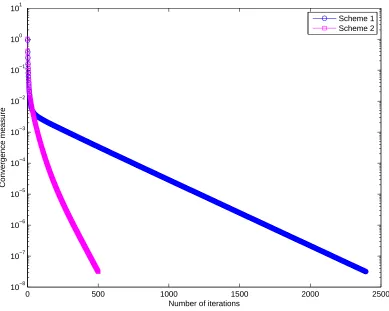
their sums in all directions are zero. Both Scheme 1 and Scheme 2 are employed. Figure 2
shows Scheme 2 converges much faster than Scheme 1 for a given time step. With a given
tolerance of 10−7, the Picard algorithm typically requires about 2100 iterations for Scheme
1 and about 450 iterations for Scheme 2. The ratio of the CPU time required for Scheme 1
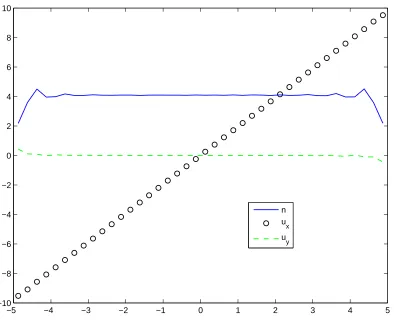
to that of Scheme 2 is about 3.65. Figure 3 displays the distribution of number density and
velocities on the flow cross section by Scheme 2. It can be seen that an approximately linear
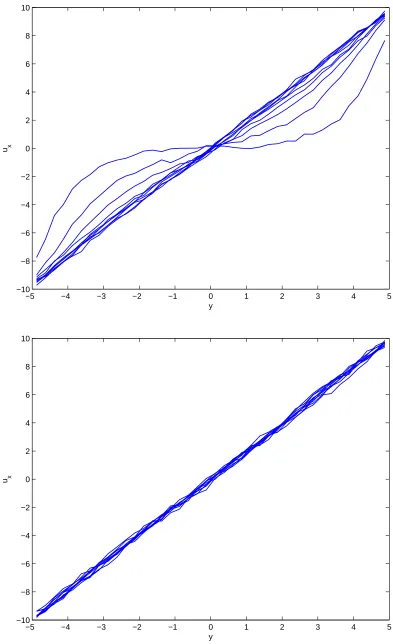
velocity profile is obtained. In Figure 4, we compare the development of the x−component
velocity profile between two cases: m = 0 (overdamped) and m = 1 (standard), revealing
that the DPD fluid in the overdamped limit has a much faster dynamic response.
4.2
Flow past a periodic square array of fixed cylinders
This example is chosen to investigate compressibility of the overdamped DPD system.
Be-cause of periodicity, one can replace the infinite domain with a finite one containing only
one cylinder to analyse the flow (Figure 5). Assume that the motion of a fluid is driven by
a pressure drop in the x direction. Using Fourier series, Hasimoto [14] derived an analytic
expression for the drag on a cylinder in a periodic arrangement,
F = 4πηU
ln(h/a)−1.3105 +· · ·, (47)
where U is the mean velocity in the x direction, a the cylinder radius and h the
centre-to-centre distance between two adjacent cylinders. If the denominator is approximated by the
cylinders.
Figure 5 shows an initial configuration of the DPD system for the reduced domain. We take
the domain size as 6×6 and model a cylinder by using 4 fixed basic DPD particles placed
at vertices of the square whose side length is 0.1. Boundary conditions are all periodic on
the outer faces of the computational domain. Figure 6a shows a contour plot of the radial
component of the repulsive/conservative force field caused by fixed particles representing the
cylinder, i.e., P4i=1aij(1−rij/rc)eij ·eoj (o the centre of the cylinder). Figure 6b shows an
exclusive zone of circulate shape generated in no flow simulation, where image resolution
is based on 10×10 bins per unit area. It is thus possible to use a few DPD particles to
represent a cylinder, which appears to be more effective and efficient than the way of placing
much larger numbers of DPD particles on the surface of a cylinder (further discussion will
be given in the next example). We utilise the radial distribution function
g(q) = 1
N/A s
2πq∆q, (48)
to measure the exclusion size, whereA is the area of the domain containing N particles and
sis the number of particles in a circular shell of widthq →(q+ ∆q) at a distanceqfrom the
centre of the cylinder. Using ∆q= 0.01, an exclusion zone of radiusa ≈0.25 corresponding
to the area, where g(q)<0.001, is estimated.
To verify the proposed method, we apply an external forceP= (P,0)T to each particle inside
the simulation domain and then measure the total force on the cylinder exerted by the solvent
particles. Consider P in the range of 0.1 to 1 with an increment of 0.1. Figure 7 shows the
drag forces obtained by the analytic solution (47) and present simulation. Note that the
present drag forces are computed at m = 0 and thus at Re = 0. A very good agreement is
achieved for small mean flow velocities (small external forces). At large external forces, the
computed values are a bit lower than the analytic ones, probably due to compressibility that
will be numerically investigated next.
As remarked earlier, the Mach number is dependent on the particle mass, mean flow velocity,
and investigate the variation in number density, measured through
1 Nb
v u u
tN
b X
i=1
(ni−n)2, (49)
where Nb is the number of bins in the fluid region and ni the calculated number density in
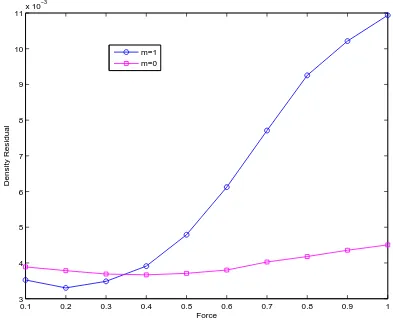
bin i. This may be regarded as a measure of compressibility. Results obtained are shown
in Figure 8. With increasing external force, the residual in number density of the unit mass
case grows much faster than in the case of zero mass (for the external force increasing from
0.1 to 1, this compressibility measure increases by 3.10 times form= 1 and only 1.16 times
form = 0). Regarding the variation in divergence of velocity (∇.u), the behaviour is similar.
As the external force changes from 0.1 to 1, the increase in ∇.u is 4.60 times for m= 1 and
only 1.41 times form= 0. The overdamped limit clearly promotes incompressibility.
4.3
Particulate suspensions
A suspended particle of spherical/circular shape can be modelled using a single DPD particle
[15-19,8] or a set of frozen DPD particles [20-23]. The single particle model involves three
groups of DPD parameters: the first group associated with the interactions between
solvent-solvent particles, the second with solvent-solvent-colloidal particles and the third with
colloidal-colloidal particles. They all need be defined in advance; more effort is required for the second
group, particularly for the case of polydispersed suspensions (colloidal particles having a size
distribution). The frozen particle model requires a relatively large number of DPD particles
on the surface to represent a colloidal particle, resulting in systems of larger size for a given
volume fraction. The position and velocity of a colloidal particle are advanced according to
the Newton-Euler equation. The present work is concerned with the modelling of massless
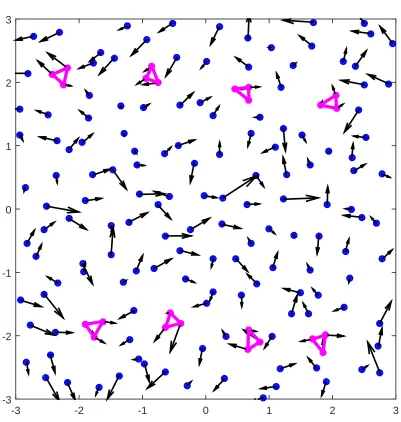
suspended particles (cylinders). We propose to use a set of only three basic DPD particles
(referred to here as “constituent particles”) to represent a colloidal particle, in which they are
connected together via springs(Figure 9a). The stiffness of springs is chosen to be large but
still maintaining the fluctuating motion part of these DPD particles (constituent particles).
Consequently, the motion of a colloidal particle is also updated using DPD equation, which
denote a pair of constituent particles of a colloidal particle. The velocity DPD equations for
the particlesα and β become
N
X
j=1,j6=α
(Fαj,C+Fαj,D+Fαj,R)−H(rαβ−rαβ)
rαβ
rαβ
= 0, (50)
N
X
j=1,j6=β
(Fβj,C+Fβj,D+Fβj,R) +H(rαβ−rαβ)
rαβ
rαβ
= 0, (51)
where H is the stiffness of springs and rαβ the reference length (the initial length of the
spring). The proposed model only involves DPD parameters of the fluid case and one extra
parameter, namely the stiffness of springs, which can be easily chosen. Constituent particles
of the colloids are basically the same as solvent particles since they are all subject to the
same values of DPD parameters including the thermodynamic temperature. In this regard,
the volume fraction can be simply defined as φ = N0
c/(Ns +Nc0), where Ns is the number
of basic particles used to represent the solvent phase and N0
c the number of basic particles
used to model the colloidal phase.
Our computational domain is taken as 6×6. With n= 4, there are 144 free DPD particles
used to represent the fluid phase. An illustration of the spatial configuration of the DPD
system at an instant time is shown in Figure 9b. We employ a shear rate in the range of
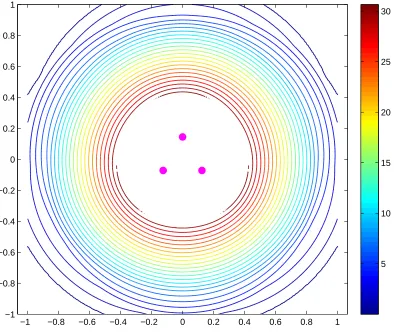
0.25 to 33 and spring stiffness H = 1000. Figure 10 displays the radial component of the
conservative force field generated by three basic particles that are located at the vertices
of an equilateral triangle with rαβ = 0.25. We utilise expression (48) to measure the size
of particles, resulting in a nearly zero size (a < 0.01) for a solvent particle and a ≈ 0.2
for a colloidal particle (Figure 11). We observe that the spring forces on the constituent
particles of the colloidal particle are oscillatory with zero mean and they thus do not make
any contributions to the stress tensor. The self diffusion D is measured by means of mean
squared displacement (MSD)
D= 1
4tlim→∞
d
dth|ri(t)−ri(0)|
2i, (52)
which is calculated in ensemble-average sense for the solvent particle and time-average sense
latter. The self diffusion is seen to reach a stable stage very quickly. In the solvent case, the
MSD curves contain some fluctuations, probably due to the combination of zero mass (i.e.,
no inertial forces) and small particle size. The P´eclet number is defined as P e = ˙γa2/D,
where ˙γ,a and Dare the shear rate, radius and diffusion coefficient of a suspended particle,
respectively. This number measures the relative importance of dissipative (hydrodynamic
contribution) and random (random contribution) forces.
For 2D dilute suspensions, the relative/reduced viscosity, which is the ratio of the effective
viscosity of the suspension to that of the suspending fluid, has been shown to be [24]
ηr = (1 + 2φ), (53)
whereφis the volume fraction. We employ several sets of colloids: (1,2,3,4,6,8),
correspond-ing to volume fraction in range of 0.0204 to 0.1429. Figure 12 shows good agreement between
the present relative viscosities and those predicted by (53) asφapproaches zero. We observe
a decrease in viscosity with increasing P´eclet number (i.e., shear thinning) for low values of
φ as shown in Figure 13.
5
Concluding remarks
We investigate the behaviour of strongly overdamped DPD systems in modelling the
inter-action between fluid and solid objects. Two iterative numerical schemes are proposed for
solving the resultant sparse DPD system at each time step. With the presence of frozen
particles in wall regions, a relative representation of particle motion with respect to the
centre of mass is a better means to model the flow - in this representation, the artifacts
due to the reaction forces are eliminated. In addition, the inclusion of the physical velocity
constraint of the mass centre into the DPD system significantly enhances the efficiency of the
iterative solving process. Solid objects of circular shape can be modelled using 3 or 4 basic
DPD particles only. Results obtained for flows in periodic arrays of cylinders and particulate
suspensions at a dilute/semi-dilute regime and zero Reynolds number agree well with those
improves the dynamic response of the DPD fluid, allowing creeping flows of complex fluids
(suspension, emulsion, polymer solution, polymer melt, etc.) to be effectively modelled.
Acknowledgement
This work is supported by The Agency for Science, Technology and Research (A*STAR)
through grant #102 164 0145. N. Mai-Duy also would like to thank the Australian Research
Council for an ARC Future Fellowship (FT0990768).
References
1. P.J. Hoogerbrugge, J.M.V.A. Koelman, Simulating microscopic hydrodynamic
phe-nomena with dissipative particle dynamics, Europhysics Letters. 19(3) (1992) 155-160.
2. P. Espa˜nol, P. Warren, Statistical mechanics of dissipative particle dynamics,
Euro-physics Letters. 30(4) (1995) 191-196.
3. P. Espa˜nol, Hydrodynamics from dissipative particle dynamics, Phys. Rev. E. 52
(1995) 1734-1742.
4. R.D. Groot, P.B. Warren, Dissipative particle dynamics: Bridging the gap between
atomistic and mesoscopic simulation, J. Chem. Phys. 107 (1997) 4423.
5. C. Marsh, Theoretical aspect of dissipative particle dynamics (PhD Thesis), University
of Oxford, 1998.
6. D. Pan, N. Phan-Thien, N. Mai-Duy, B.C. Khoo, Numerical investigations on the
compressibility of a DPD fluid, Journal of Computational Physics. 242 (2013)
196-210.
7. X.J. Fan, N. Phan-Thien, S. Chen, X. Wu, T.Y. Ng, Simulating flow of DNA suspension
using dissipative particle dynamics, Phys. Fluids. 18(6) (2006) 063102.
8. N. Mai-Duy, D. Pan, N. Phan-Thien, B.C. Khoo, Dissipative particle dynamics
9. N. Phan-Thien, N. Mai-Duy, D. Pan, B.C. Khoo, Exponential-time differencing schemes
for low-mass DPD systems, Computer Physics Communications. 185(1) (2014)
229-235.
10. N. Mai-Duy, N. Phan-Thien, B.C. Khoo, A numerical study of strongly overdamped
Dissipative Particle Dynamics (DPD) systems, Journal of Computational Physics. 245
(2013) 150-159.
11. N. Phan-Thien, Understanding Viscoelasticity: An Introduction to Rheology, second
Edition, Springer-Verlag, Berlin, 2013.
12. E. Bodewig, Matrix Calculus, North-Holland Publishing, Amsterdam, 1956.
13. N. Phan-Thien, S. Kim, Microstructures in Elastic Media: Principles and
Computa-tional Methods, Oxford University Press, New York, 1994.
14. H. Hashimoto, On the periodic fundamental solutions of the Stokes equations and their
application to viscous flow past a cubic array of spheres, Journal of Fluid Mechanics.
5(2) (1959) 317-328.
15. W. Dzwinel, D.A. Yuen, A two-level, discrete-particle approach for simulating ordered
colloidal structures, Journal of Colloid and Interface Science. 225(1) (2000) 179-190.
16. V. Pryamitsyn, V. Ganesan, A coarse-grained explicit solvent simulation of rheology
of colloidal suspensions, J. Chem. Phys. 122 (2005) 104906.
17. W. Pan, I.V. Pivkin, G.E. Karniadakis, Single-particle hydrodynamics in DPD: A new
formulation, EPL. 84(1) (2008) 10012.
18. W. Pan, B. Caswell, G.E. Karniadakis, Rheology, microstructure and migration in
Brownian colloidal suspensions, Langmuir. 26(1) (2010) 133-142.
19. M. Whittle, K.P. Travis, Dynamic simulations of colloids by core-modified dissipative
particle dynamics, J. Chem. Phys. 132 (2010) 124906.
20. J.M.V.A. Koelman, P.J. Hoogerbrugge, Dynamic simulations of hard-sphere
21. E.S. Boek, P.V. Coveney, H.N.N. Lekkerkerker, P. van der Schoot, Simulating the
rheology of dense colloidal suspensions using dissipative particle dynamics. Phys. Rev.
E. 55(3) (1997) 3124-3133.
22. N.S. Martys, Study of a dissipative particle dynamics based approach for modeling
suspensions, J. Rheol. 49 (2005) 401.
23. S. Chen, N. Phan-Thien, B.C. Khoo BC, X.-J. Fan, Flow around spheres by dissipative
particle dynamics, Phys. Fluids. 18(10) (2006) 103605.
24. J.F. Brady, The Einstein viscosity correction in n dimensions, International Journal of
0 500 1000 1500 2000 2500 10−8
10−7 10−6 10−5 10−4 10−3 10−2 10−1 100 101
Number of iterations
Convergence measure
[image:23.595.88.477.43.354.2]Scheme 1 Scheme 2
Figure 2: Couette flow: Scheme 2 converges much faster than Scheme 1. Given a tolerance of 10−7, the Picard algorithm typically requires about 2100 and 450 iterations for Scheme 1
−5 −4 −3 −2 −1 0 1 2 3 4 5 −10
−8 −6 −4 −2 0 2 4 6 8 10
n ux
[image:24.595.87.481.43.366.2]uy
Figure 3: Couette flow, Lx×Ly = 10×10, ∆t = 0.01: variations of number density and
−5 −4 −3 −2 −1 0 1 2 3 4 5 −10
−8 −6 −4 −2 0 2 4 6 8 10
y
u x
−5 −4 −3 −2 −1 0 1 2 3 4 5
−10 −8 −6 −4 −2 0 2 4 6 8 10
y
[image:25.595.86.479.60.704.2]u x
−1 −0.8 −0.6 −0.4 −0.2 0 0.2 0.4 0.6 0.8 1 −1
−0.8 −0.6 −0.4 −0.2 0 0.2 0.4 0.6 0.8 1
5 10 15 20 25 30 35 40 45 50 55
−3 −2 −1 0 1 2 3
−2.5 −2 −1.5 −1 −0.5 0 0.5 1 1.5 2 2.5
[image:27.595.87.481.51.729.2]0 1 2 3 4 5 6
0 1 2 3 4 5 6 7 8 9 0
20 40 60 80 100 120 140 160 180
Mean velocity
Drag force
[image:28.595.89.478.44.359.2]Hasimoto, 1959 Present DPD
0.1 0.2 0.3 0.4 0.5 0.6 0.7 0.8 0.9 1 3
4 5 6 7 8 9 10 11x 10
−3
Force
Density Residual
[image:29.595.85.478.45.372.2]m=1 m=0
-3 -2 -1 0 1 2 3 -3
[image:30.595.82.483.256.678.2]-2 -1 0 1 2 3
−1 −0.8 −0.6 −0.4 −0.2 0 0.2 0.4 0.6 0.8 1 −1
−0.8 −0.6 −0.4 −0.2 0 0.2 0.4 0.6 0.8 1
[image:31.595.87.481.47.379.2]5 10 15 20 25 30
0 0.1 0.2 0.3 0.4 0.5 0.6 0.7 0.8 0.9 1 0
0.2 0.4 0.6 0.8 1 1.2 1.4
Distance
RDF
0 0.1 0.2 0.3 0.4 0.5 0.6 0.7 0.8 0.9 1 0
0.5 1 1.5
Distance
[image:32.595.83.479.73.709.2]RDF
−0.021 0 0.02 0.04 0.06 0.08 0.1 0.12 0.14 0.16 1.05
1.1 1.15 1.2 1.25 1.3 1.35 1.4
Volume fraction
Relative viscosity
[image:33.595.87.476.46.351.2]DPD Theories
10−1 100 101 102 2.6
2.7 2.8 2.9 3 3.1 3.2 3.3 3.4 3.5 3.6
Pe
Viscosity
φ=0.02
φ=0.06
φ=0.11
[image:34.595.88.475.42.357.2]φ=0.14