INTRODUCTION
Anthropogenic climate change is having a dra-matic effect on marine ecosystems worldwide (Wern-berg et al. 2016, Hughes et al. 2017). Increased sea
surface temperatures have already affected the metabolism, behaviour, phenology and distribution of species across a range of taxa (Scheffer et al. 2001, Johansen et al. 2014, Byrne et al. 2017, Pecl et al. 2017). Ocean acidification (OA) — altered seawater
© Inter-Research 2018 · www.int-res.com *Corresponding author: [email protected]
Ocean warming has greater and more consistent
negative effects than ocean acidification on the
growth and health of subtropical macroalgae
Alexia Graba-Landry
1, 2,*, Andrew S. Hoey
2, Jordan K. Matley
3,
Hannah Sheppard-Brennand
1, Alistair G. B. Poore
4, Maria Byrne
5,
Symon A. Dworjanyn
11National Marine Science Centre, Southern Cross University, PO Box J321, Coffs Harbour, NSW 2450, Australia 2ARC Centre of Excellence for Coral Reef Studies, James Cook University, Townsville, QLD 4811, Australia 3Centre for Marine and Environmental Studies, University of the Virgin Islands, St. Thomas, VI 00802, USA
4Evolution and Ecology Research Centre, School of Biological, Earth and Environmental Sciences, University of New South Wales, Sydney, NSW 2052, Australia
5Schools of Medical and Life and Environmental Sciences, University of Sydney, Sydney, NSW 2006, Australia
ABSTRACT: Macroalgae are the major habitat-forming organisms in many coastal temperate and subtropical marine systems. Although climate change has been identified as a major threat to the persistence of macroalgal beds, the combined effects of ocean warming and ocean acidification on algal performance are poorly understood. Here we investigate the effects of increased tempera-ture and acidification on the growth, calcification and nutritional content of 6 common subtropical macroalgae; Sargassum linearifolium, Ulva sp., Amphiroa anceps, Corallina officinalis, Delisea pulchraand Laurencia decussata. Algae were reared in a factorial cross of 3 temperatures (23°C [ambient], 26°C and 28°C) and 3 pH levels (8.1 [ambient], 7.8 and 7.6) for 2 wk. The highest (28°C) temperature decreased the growth of all 6 macroalgal species, irrespective of the pH levels. In contrast, the effect of decreased pH on growth was variable. The growth of Ulvasp. and C. offici-nalisincreased, L. decussatadecreased, while the remaining 3 species were unaffected. Interest-ingly, the differential responses of macroalgae to ocean acidification were unrelated to whether or not a species was a calcifying alga, or their carbon-uptake mechanism — 2 processes that are pre-dicted to be sensitive to decreased pH. The growth of the calcifying algae (C. officinalisand A. anceps) was not affected by reduced pH but calcification of these 2 algae was reduced when exposed to a combination of reduced pH and elevated temperature. The 3 species capable of uptake of bicarbonate, S. linearifolium, L. decussataand Ulvasp., displayed positive, negative and neutral changes in growth, respectively, in response to reduced pH. The C:N ratio for 5 of the 6 species was unaffected by either pH or temperature. The consistent and predictable negative effects of temperature on the growth and calcification of subtropical macroalgae suggests that this stressor poses a greater threat to the persistence of subtropical macroalgal populations than ocean acidification under ongoing and future climate change.
KEY WORDS: Carbon-concentrating mechanisms · Primary production · Climate change · Coralline algae · Macroalgae
chemistry as a result of uptake of atmospheric CO2 emissions — is also predicted to alter the growth, cal-cification, reproduction and behaviour of many mar-ine species (Langdon et al. 2000, Ross et al. 2011, Byrne et al. 2013, Watson et al. 2017). Ocean warm-ing and acidification are both increaswarm-ing at unprece-dented rates (IPCC 2014), hence understanding their combined impacts on the performance and growth of marine organisms will be key to predicting future changes in marine communities (Byrne 2011, Przes-lawski et al. 2015).
The effects of climate change on an ecosystem may be the most pronounced when they directly affect the health of the foundation species (Wernberg et al. 2012). For example, increasing sea surface tempera-tures have already lead to increased frequency of global coral bleaching events (Hughes et al. 2017, 2018), and the loss of habitat-forming kelp and macroalgae (Wernberg et al. 2016), and seagrasses (Orth et al. 2006). Macroalgae are foundation species in many shallow temperate and subtropical marine systems, providing habitat for a diversity of species (Steneck 2013). Any changes to the abundance and composition of macroalgae may have direct and/or indirect effects on ecosystem diversity and/or ecolog-ical processes that could cascade through the entire ecosystem (Wernberg et al. 2010). Ocean warming and OA have already been shown to alter the growth (Madsen & Sand-Jensen 1994, Zou 2005, Gao & Zheng 2010), competitive ability (Campbell et al. 2011, Diaz-Pulido et al. 2011, Hofmann et al. 2012) and resilience to storms (Wernberg et al. 2010) of many macroalgae.
Macroalgae are predicted to be particularly sensi-tive to increasing temperature as their rates of bio-chemical and physiological processes are largely de-termined by environmental temperature, similar to ectotherms (Davison 1991, Brown et al. 2004). Within a species’ thermal tolerance range, the rates of physi-ological processes and traits (e.g. growth) typically in-crease with temperature until they reach a thermal optimum, after which rates rapidly decrease (Brown et al. 2004). The effect of temperature on organism performance will therefore depend on the species’ thermal tolerance range and how close the organism’s current environmental temperatures are to their ther-mal optima (Tewksbury et al. 2008). Changes in envi-ronmental temperature have already been shown to influence growth (Gutow et al. 2016), photosynthesis (Mertens et al. 2015), respiration (Carr & Bruno 2013), distribution (Wernberg et al. 2016), antibacterial chemical defence (Campbell et al. 2011) and competi-tive ability (Wernberg et al. 2010) across a range of
in-dividual macroalgal species. However, few studies have considered how these effects of temperature are influenced by ocean acidification.
Johnson & Carpenter 2012, Kamya et al. 2017). To add further complexity to this problem, photosynthe-sis and calcification have been shown to be positively linked (Digby 1977, Hofmann & Bischof 2014). The fixation of CO2 during photosynthesis increases the pH of surrounding seawater, thereby increasing the calcite saturation state to favour CaCO3deposition in the tissues (Digby 1977). In addition, CO2 is a by-product of calcification, thereby stimulating photo-synthesis (McConnaughey 1991). Lastly, there is also evidence that coralline algae may be able to use HCO3−and CO2for calcification, leading to potential shifts between calcification and net dissolution as CO2 and HCO3− concentrations increase under OA conditions, as both processes will be affected by these changes. Until recently, coralline algae have been thought to be particularly vulnerable to dissolu-tion under OA condidissolu-tions (Kuffner et al. 2008) as they deposit the highly soluble high-Mg calcite within their intercellular spaces and surface of the cell (Lit-tler 1976). However, recent evidence suggests that at least some calcified algae may be able to regulate their internal and surface pH to buffer against the effects of OA (crustose coralline algae: Hofmann et al. 2016, Cornwall et al. 2017a).
To date, the majority of research investigating the effects of OA on coralline algae have reported re-duced growth (e.g. Ragazzola et al. 2012, James et al. 2014), calcification (e.g. Gao & Zheng 2010, Kamenos et al. 2013) and increased dissolution (e.g. Reyes-Nivia et al. 2014) of individuals, and reductions in overall abundance (e.g. Kuffner et al. 2008, Ordoñez et al. 2014) and recruitment (e.g. Porzio et al. 2013). However, a few studies have reported potential disso-lution while rates of growth, calcification and/or pho-tosynthesis have remained unaffected or even in-creased in response to OA (e.g. Egilsdottir et al. 2013, Kamenos et al. 2013, Noisette et al. 2013), suggesting that calcification and dissolution may be most sensitive to OA. Therefore, calcification and dissolution may be the most sensitive of the aforementioned physiological processes. In tropical crustose coralline algae, changes in relative concentrations of aragonite versus dolomite within the tissues have been reported in response to OA (Diaz-Pulido et al. 2014). Further, the magnitude of responses of coralline algae to OA can also be influ-enced by diffusive boundary layers (Cornwall et al. 2014) and the rate of declining pH (Kamenos et al. 2013). Due to the complex interaction between photo-synthesis, calcification and dissolution in response to OA and its interaction with other environmental vari-ables, the response of these processes to a changing ocean is still poorly understood.
Relatively few studies have examined the potential interaction between increasing temperature and OA on marine macroalgae across a range of co-occurring species (Wernberg et al. 2012). This is important, as these 2 factors are occurring simultaneously (IPCC 2014). Therefore, understanding the combined ef -fects between ocean warming and acidification on macroalgae may provide insight as to how these 2 factors may impact the composition of foundation species in a community (Kroeker et al. 2013b, Ola -barria et al. 2013). Increasing temperature and OA may also interact to affect the palatability of algal tis-sue to herbivores, and given that the abundance of primary producers is very strongly regulated by her-bivory in marine systems (Poore et al. 2012); any changes to the tissue traits are likely to affect the strength of top-down control of algal abundance. The objective of this study was to investigate the effects of simultaneous OA and warming on the growth, cal-cification, carbon metabolism and tissue quality (C:N ratio and calcification) of 6 co-occurring subtropical macroalgae from a climate change ‘hotspot’ in south-eastern Australia. Sea surface temperatures in this region are predicted to increase by > 4°C, which is the upper range of predicted warming of 2.6 to 4.8°C for the worlds oceans for 2100 (Hobday & Lough 2011, IPCC 2014).
MATERIALS AND METHODS
Study species and collection sites
Experimental treatments and sample preparation
Algae were placed in individual aquaria within 30 min of collection, rinsed with filtered seawater and cleaned of visible fauna and epiphytes. Algae were cut into similar lengths of 2 to 4 cm composed largely of meristematic tissue, weighed by blotting the sample dry, and placed in individual 100 ml con-tainers with 40 ml fresh filtered seawater. Algae were negatively buoyant and sank to the bottom of the containers. The large size of S. linearifolium,D. pul-chraand L. decussataallowed 9 pieces of meristem-atic tissue to be sourced from each thallus. This allowed the same individual ‘clone’ to be replicated across all treatments. For the remaining 3 species, each replicate was taken from a separate individual thallus. Average ± SE initial wet weights of experi-mental thalli were: 0.024 ± 0.001 g for S. lineari-folium, 0.0299 ± 0.0009 g for Ulvasp., 0.046 ± 0.002 g for A. anceps, 0.046 ± 0.002 g for C. officinalis, 0.055 ± 0.005 g for D. pulchra and 0.040 ± 0.002 g for L. decussata across all pH and temperature treatment combinations. Each sample was randomly allocated to one of 9 pH and temperature treatments.
A factorial cross of 3 temperatures (23°C [ambient], 26°C and 28°C) and 3 pH levels (8.1 [ambient], 7.8, and 7.6) was used, yielding 9 experimental treatments. These temperature treatments are commensurate with projections for warming (2.6 to 4.8°C) and acidifi-cation (0.3 to 0.5 pH units) of southeastern Australian waters by the year 2100 (Hobday & Lough 2011, IPCC 2014). Each algal species was subjected to increased temperature and acidification in all combinations of treatments with 5 replicates per treatment. The algae were gradually introduced to increased temperature and pH treatments over a 2 d period (temperature: 2.5°C per day; pH: 0.25 pH units per day) and then held at the target treatment levels for 2 wk.
The experimental pH of flowthrough seawater was regulated using a CO2-injection system and
temper-ature was regulated with 300 watt bar heaters (Aqua One) within header tanks (60 l for CO2, which fed to
smaller, 30 l temperature header tanks), which then fed experimental seawater at a flow rate of ~0.13 ml s−1to individual rearing containers (for full details see
the Supplement at www. int-res. com/ articles/ suppl/ m595 p055 _ supp. pdf). The system was illuminated at 30 µmol photons m−2s−1supplied by 3 twin 36-watt
‘cool white’ fluorescent lights for a 16 h night:8 h day photoperiod. The experimental light level was equiv-alent to midday light measurements at 1−2 m water depth at the Charlesworth Bay collection site — 29.8 (±1.92 SE, n = 10) µmol photons m−2s−1.
Temperature, pH (NIST scale) and salinity were measured daily in all seawater treatments using a portable multi-probe (Hach HQD) by randomly choosing 5 individual rearing containers per pH and temperature treatment per day. The pH probe was calibrated daily using high-precision buffers (pHNIST4.0, 7.0 and 10 at 20°C, ProScitec). Total pH
scale (pHT) of the experimental seawater was
determined using seawater TRIS buffer using the millivolt scale (Dickson 1993). For measurements of total alkalinity, water samples (100 ml) were col-lected daily and filtered with a 0.45 µm syringe filter, and preserved using saturated mercuric chloride (HgCl2) solution. Total alkalinity was mea
-sured by potentiometric titration using an automatic titrater at 24.17 °C (± 0.25 SE) (Metrohm 888 Titran -do), calculated using the Gran method and com-pared with Dickson total alkalinity standards. Par-tial pressure of CO2 ( pCO2) and calcite saturation
states (ΩCa) were calculated using the CO2SYS MS Excel Macro (Pierrot et al. 2006; Table S1 in the Supplement) using the dissociation constants of Merbach (1973) as refitted by Dickson & Millero (1987) from measures of salinity, temperature, pHT
(total scale) and total alkalinity.
Over the 2 wk experimental period, the pH treat-ments averaged 8.074 (± 0.002 SE, n = 225), 7.786 (± 0.002 SE, n = 225) and 7.599 (± 0.003 SE, n = 225) pHNIST. Temperature treatments averaged 22.82°C
(± 0.040 SE, n = 225), 26.0°C (± 0.047 SE, n = 225) and 28.39°C (± 0.086 SE, n = 225). Carbonate chemistry parameters for the treatments are presented in Table S1 in the Supplement.
Algal growth
Algal growth as a relative growth rate (RGR) was quantified as the increase in wet mass as a percent-age of the initial mass of each alga. Each alga was weighed every other day for the 2 wk experimental period by gently blotting dry with paper towel and recording the wet mass to the nearest microgram (µg). Individual thalli of each species were of similar length and weight at the beginning of the experi-ment. Any indications of stress, in particular bleach-ing of algal tissue, were noted. Growth of S. lineari-folium, C. officinalis, D. pulchra and L. decussata
CCMs and pH drift
The ability of the algae to use bicarbonate for photo synthesis was determined by a pH drift experi-ment (Hepburn et al. 2011). In a pH drift experiexperi-ment, macroalgae in a closed system will alter DIC concen-trations during photosynthesis, and thereby alter the alkalinity of the seawater. If the macroalgae raise the pH above 9 where there is very little CO2, this is indicative that the algae use HCO3−only for photo-synthesis (Cornwall et al. 2012). If the macroalgae are unable to raise the pH above 9, this indicates that CO2is a carbon source for photosynthesis, and can be indicative of CO2-only users or CO2 + HCO3−users (Diaz-Pulido et al. 2016). For the drift experiment, fresh algae were collected by hand from the same collection sites. Only non-coralline algae were used in this analysis as calcification and photosynthesis are linked, and these 2 processes both together and independently alter seawater alkalinity and DIC con-centrations. Therefore, a pH drift analysis is inappro-priate for determining carbon-use strategies in calci-fying algae. Nine replicates (~0.8 g wet weight) of each alga (excluding A. anceps and C. officinalis) were placed in individual 40 ml airtight glass vials filled with seawater of ambient pH 8.1. To ensure that photosynthesis was not light limited, the vials were placed in random order directly in front of a flu-orescent light of 120 µmol photons m−2s−1for 24 h (Hepburn et al. 2011). A pilot study determined 24 h as the optimal time to measure maximal pH. Initial and final pH of the seawater was measured using a portable pH meter (Hach HQD Portable Multiprobe ± 0.02 pHNISTfrom factory calibration). After 24 h, the algae were removed and the seawater was left to sit in the open containers for a further 24 h, after which the pH was recorded. Treatments in which the pH of the water returned to, or approached, ambient condi-tions (pHNIST= ~8.1) after 24 h (i.e. the seawater had re-equilibrated with the atmosphere) indicated that algal exudates or processes other than photosynthe-sis did not interfere with changes to seawater pH (Hepburn et al. 2011).
Tissue quality and carbon:nitrogen ratio
At the end of the growth experiment, the algal tis-sue was freeze dried in preparation for elemental analyses. The coralline algae (C. officinalis and A. anceps) were treated with 2 ml of 1.0 M HCl to remove carbonates, rinsed with distilled water and then re-dried. Total carbon (%) and nitrogen (%)
content were then measured using an Environmental Analytic Isotope Ratio Mass Spectrophotometer (IMRS; Flash EA 112 and Delta V Plus) connected by an Interface at 1020°C (Conflo IV). Precision esti-mates using laboratory STD AT2 were better than 0.2 ‰ for both nitrogen and carbon. As Ulva sp. released spores in the 26°C and 28°C temperature treatments, it was excluded from analysis for carbon and nitrogen.
Calcification rate
Calcification rates of the coralline algae, C. offici-nalis and A. anceps, were estimated using the ‘alkalinity anomaly technique’ (Chisholm & Gattuso 1991). Fresh thalli were collected and incubated in pH and temperature treatments for 2 wk as de -scribed above. Following the incubation period, approximately 0.2 g of each algal species were placed in individual 40 ml airtight containers con-taining experimental seawater and no air (3 pH × 3 temperature treatments) with 3 replicates per treat-ment, for each species. Small amounts of dissolution occur in the dark when respiration occurs instead of photosynthesis. Therefore, closed containers were left for 24 h in water baths to regulate tem-perature and under 16 h night:8 h day of 20− 30 µmol photons m−2s−1light to allow for the meas-urement of a daily calcification rate. Initial and final measurements of total alkalinity of the experi-mental seawater were measured as described above. The production of calcium carbonate by the thalli was calculated as:
ΔCaCO3= (TAi–TAf) × 0.5 × 1000 × V× T−1× W−1
where, ΔCaCO3 is the rate of CaCO3 production (µmol h−1 g−1), T
Ai and TAf are the initial and final total alkalinity (mmol l−1) respectively, Vis the vol-ume of seawater in the closed containers (l), Tis time (h) and Wis wet weight of the algae (g).
Statistical analyses
and pH as fixed factorial factors and genetic clones (i.e. replicates from the same plant) as a random blocking factor using the ‘nlme’ package (Pinheiro et al. 2017). The proportion of variance explained by random effects were calculated for each species by approximating fitted values for fixed effects and extracting variance components for random effects and the residuals. Linear mixed models were only used for 3 of the 5 species because
clones were not used for Ulvasp., A. anceps or C. officinalis (and thus there was no random effect of clone). Statistical tests were conducted in the R environment (R Develop -ment Core Team 2016). If replicates among treatments were unbalanced, a restricted maximum likelihood framework was used (as opposed to maximum likelihood) for mixed effects tests. Marginal sums of squares (type III SS) were used to partition model components when treatments were unbalanced for lin-ear models with only fixed effects (i.e. C. officinalis, A. ancepsand Ulva sp.). For all tests, model residuals were examined for homogeneity of variance and normality using diag-nostic plots (e.g. residual vs. fitted plot and Q−Qplot, respectively), and were transformed ac cordingly if needed (see Tables 1–3 for specific transformations). When significant differences among treatments were detected, post hoc Tukey pairwise tests among means were conducted with the ‘glht’ function in the ‘mult-comp’ package (Hothorn et al. 2008). When an interaction between treatments was significant, multiple comparisons were conducted using the ‘multcompView’ package.
RESULTS
Algal growth
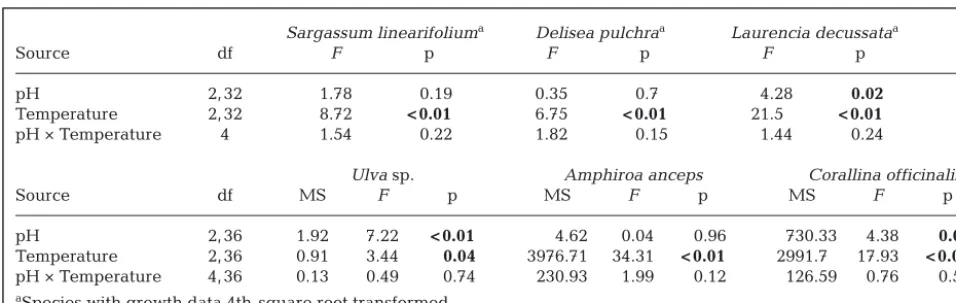
All algae increased in mass over the 2 wk experimental period across all treatments. The RGR of Amphiroa ancepswas the least variable (aver-age RGR ± SE range: 9.31% ± 1.71 to
45.31% ± 4.52) and relative growth of Sargassum lin-earifoliumwas the most variable (25.82% ± 19.46 to 232.21% ± 82.93) across all pH and temperature treatments (Fig. 1). Algal growth was significantly lower in the 28°C temperature treatment than the ambient (23°C) treatment for all algal species, with these declines consistent among pH treatments (Fig. 1, Table 1). Overall, the reductions in growth
pH: ns
Temp: 23°C = 26°C > 28°C
pH: ns
Temp: 23°C = 26°C > 28°C pH: 8.1 < 7.6
Temp: 23°C > 26°C > 28°C
pH: 8.1 = 7.8 < 7.6
Temp: 23°C > 28°C
(d)
Sargassum linearifolium(HCO3– only)
(f)
Ulva sp. (HCO3–)(e)
Delisea pulchra(CO2 + HCO3–)
8.1
(c)
Laurencia decussata(HCO3– only)
7.8 7.6
8.1 7.8 7.6
8.1 7.8 7.6
8.1 7.8 7.6
0 100 200 300 400
0 50 100 150 200 250
Growth (%)
pH treatment
0 20 40 60 80 100 0 50 100 150 200 250
Temperature
23°C 26°C 28°C pH: ns
Temp: 23°C = 26°C > 28°C
pH: 8.1 < 7.6
Temp: 23°C = 26°C > 28°C
(a)
Amphiroa anceps(calcifier)
8.1
(b)
Corallina officinalis(calcifier)
7.8 7.6 8.1 7.8 7.6
0 20 40 60 80 100 120
[image:6.612.232.542.201.664.2]0 20 40 60 80 100
Fig. 1. Percent growth of all algal species in each of the 9 combinations of pH (8.1, 7.8 and 7.6) and temperature (23°C, 26°C and 28°C) after 2 wk (with the exception of Ulvasp., after 8 d, and A. anceps, after 9 d). Data are means ± SE, n = 14 or 15. Negative growth in the pH 7.8/28°C treatment was excluded.
ranged from a 30% decline in Corallina officinalisto a 95% decline in Ulva sp. between the 23°C and 28°C treatments (Fig. 1). Bleaching of the tissues of Delisea pulchra, A. ancepsand Laurencia decussata were observed in the 28°C treatments.
In contrast to temperature, the effects of pH on algal growth varied among species (Fig. 1, Table 1). The relative growth rates of Ulvasp. and C. offici-nalis increased with decreasing pH, while the re -lative growth rate of L. decussata decreased (Fig. 1b,c,f). There was no detectable effect of pH on the growth of S. linearifolium, A. anceps and D. pulchra (Fig. 1, Table 1). For the 3 algal species in which individual clones were used across treat-ments, the within-clone variability (i.e. the random effect) for algal growth was low (S. linearifolium: 7% of model variation; D. pulchraand L. decussata: <1% of model variation).
Tissue quality and carbon:nitrogen ratio
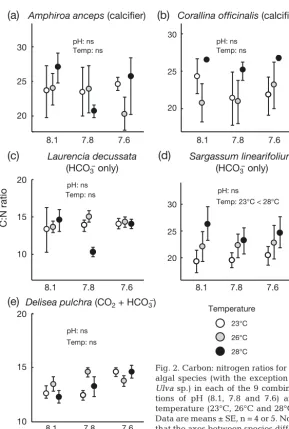
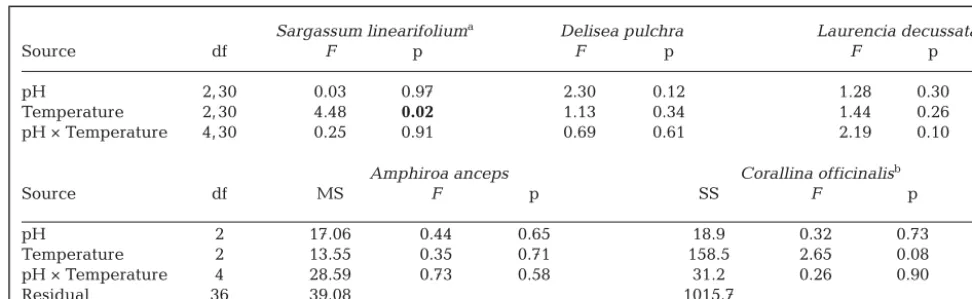
Carbon:nitrogen ratios for each macroalgal species were relatively insensitive to changes in pH and tem-perature (Fig. 2, Table 2). The only exception was the higher C:N ratio of S. linearifoliumin the 28°C treat-ment compared with the 23°C treattreat-ment (Fig. 2d, Table 2). This change was driven by an increase in carbon content of S. linearifolium with temperature (F2, 30 = 11.80, p = 0.0002, Tukey’s post hoc: 23°C < 26°C = 28°C; Table S2 in the Supplement); no changes in the nitrogen content of S. linearifolium were detected (Figs. S2 & S3, Tables S3 & S4 in the
Supplement). In addition, increasing temperature led to increases in the absolute nitrogen and carbon con-tent of A. ancepsand C. officinalis(Figs. S1 & S2 in the Supplement), resulting in no change to the C:N ratio (Fig. 2). The within-clone variability (i.e. the random effect) associated with C:N ratios was low for D. pulchra and L. decussata (<1% of model varia-tion), but high for S. linearifolium (64% of model variation).
CCMs and pH drift
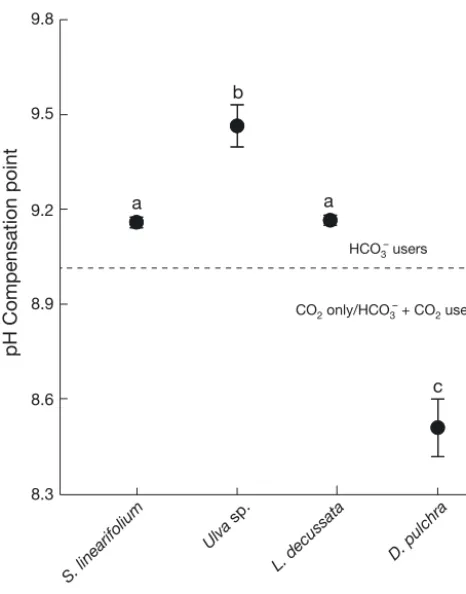
The pH compensation points of S. linearifolium, Ulva sp. and L. decussata were all > 9.0, indicating that these species use HCO3− as their main carbon source. The pH compensation point of D. pulchra was < 9.0, indicating that it does not directly take up HCO3−and uses CO2for photosynthesis (Fig. 3, F5, 51= 63.95, p < 0.01).
Calcification rate
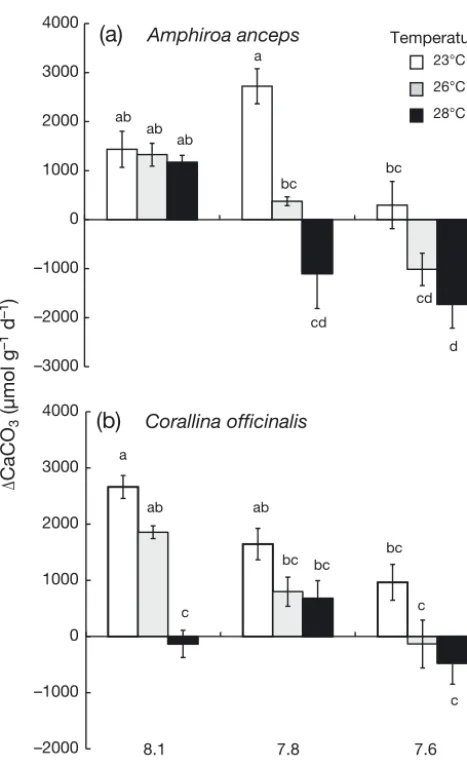
The effect of water temperature on the calcification rates of both A. ancepsand C. officinaliswas not con-sistent among pH treatments (a significant Tempera-ture × pH interaction, Table 3). For A. anceps, calcifi-cation rate was similar across all temperatures within the highest (8.1) pH treatment, but decreased signif-icantly with temperature within the 2 lower pH (7.8 and 7.6) treatments (Fig. 4a). For C. officinalis, calci-fication rates decreased with increasing temperature Sargassum linearifoliuma Delisea pulchraa Laurencia decussataa
Source df F p F p F p
pH 2, 32 1.78 0.19 0.35 0.7 4.28 0.02 Temperature 2, 32 8.72 < 0.01 6.75 < 0.01 21.5 < 0.01 pH × Temperature 4 1.54 0.22 1.82 0.15 1.44 0.24
Ulvasp. Amphiroa anceps Corallina officinalis Source df MS F p MS F p MS F p
[image:7.612.59.537.152.303.2]pH 2, 36 1.92 7.22 < 0.01 4.62 0.04 0.96 730.33 4.38 0.02 Temperature 2, 36 0.91 3.44 0.04 3976.71 34.31 < 0.01 2991.7 17.93 < 0.01 pH × Temperature 4, 36 0.13 0.49 0.74 230.93 1.99 0.12 126.59 0.76 0.56 aSpecies with growth data 4th-square root transformed
Table 1. Analyses of the growth (%) of each algal species in the pH and temperature (3 pH × 3 temperature treatments with 5 replicates each). For Ulvasp. Amphiroa ancepsand Corallina officinalis, growth was analysed with analyses of variance with temperature and pH as fixed factorial factors. For Sargassum linearifolium, Delisea pulchraand Laurencia decussata, growth was analysed with linear mixed models with temperature and pH as fixed factorial factors and individual thallus as a random factor. Significant treatment effects (p ≤0.05) are in bold. Note that S. linearifoliumis missing one observation due to a death in
within the pH 8.1 treatment, but did not differ among temperatures in the pH 7.8 and 7.6 treatments (Fig. 4b, Table 3). Calcification rates of A. anceps were negative at 28°C in the pH 7.8 and pH 7.6 treat-ments, and at 26°C in the pH 7.6 treatment, indica-ting dissolution of calcite. Similarly calcification rates of C. officinaliswere negative at 28°C in the pH 7.6 (Fig. 4b).
DISCUSSION
Increasing sea surface temperatures and OA are widely viewed as 2 of the major threats to habitat-forming marine species; however, the relative impact of these stressors on macroalgae in the subtropics is
largely unknown. We showed that increas-ing water temperature suppressed the growth of 6 species of macroalgae in the subtropics and that these effects were inde-pendent of OA (i.e. decreasing pH). In con-trast, the effects of increasing pCO2varied among species, with growth increasing in Ulva sp. and Corallina officinalis, decreas-ing in Laurencia decussata, and not chang-ing in Sargassum linearifolium, Amphiroa anceps and Delisea pulchra. Interestingly, the differential responses of macroalgae to decreasing pH were unrelated to the pres-ence of calcification in the algal tissues, or their mechanism of carbon uptake, 2 pro-cesses that are predicted to be sensitive to decreased pH (Hurd et al. 2009, Diaz-Pulido et al. 2016, Cornwall et al. 2017a). Calcium carbonate began dissolving from calcified macroalgae at low pH (7.6), but growth was either unaffected or enhanced at this pH level. These findings illustrate the complex-ities of the responses of marine macroalgae, both among species and between physiolog-ical processes, to changing environmental conditions.
Rearing macroalgae at 28°C (i.e. 5°C above ambient) for 2 wk reduced growth by 30−95% compared with conspecifics reared at ambient temperatures. This decline in growth with increasing temperature is con-sistent with previous experimental studies that show significant reductions in biomass (5−35% reductions) of most subtropical macroalgae in response to short-term (2− 3 wk) exposure to elevated (3−4°C above ambient) temperatures (Poore et al. 2016, Provost et al. 2017). Such short-term increases in temperature are typical of marine heatwaves, although + 5°C is extreme. For example, the 2016 El Niño led to seawater temperatures off of Muttonbird Island in the Coffs Harbour region being 1.8–3.5°C above the long-term average for 20 d in late Febru-ary and early March 2016 (thermistor data provided by the NSW Department of Primary Industries). Warming of 2−4°C above long-term averages off the Western Australian coast caused an ecosystem shift from habitat-forming kelps to a tropical/subtropical system dominated by algal turf communities and corals (Wernberg et al. 2016). The differential effects of elevated temperatures on macroalgae reported in previous laboratory and field studies and the present study (i.e. lethal vs. sublethal) are most likely
attrib-8.1 7.8 7.6
8.1 7.8 7.6
8.1 7.8 7.6
25
20 30
(d)
Sargassum linearifolium(HCO3– only)
pH: ns
Temp: 23°C < 28°C
8.1 7.8 7.6 8.1 7.8 7.6
(a)
Amphiroa anceps (calcifier)pH: ns
20 30
10 20
pH: ns
(e)
Delisea pulchra (CO2 + HCO3–)10 15 20
pH: ns
(c)
Laurencia decussata(HCO3– only)
Temp: ns
Temp: ns
Temp: ns
Temp: ns
23°C
26°C
28°C
pH Treatment
C:N ratio
25
15
Temperature
pH: ns
(b)
Corallina officinalis (calcifier)25 30
[image:8.612.38.327.75.504.2]20
Fig. 2. Carbon: nitrogen ratios for all algal species (with the exception of Ulvasp.) in each of the 9 combina-tions of pH (8.1, 7.8 and 7.6) and temperature (23°C, 26°C and 28°C). Data are means ± SE, n = 4 or 5. Note that the axes between species differ;
uted to the duration of exposure to elevated temper-atures (i.e. 10 wk heatwave vs. 2 wk experimental period). Importantly, short-term marine heatwaves are predicted to increase in severity and frequency as greenhouse gas emissions continue to increase (Harley et al. 2006), with future suppression of growth and survivorship of macroalgae within their current ranges, and shifts in their geographic distri-butions likely. Understanding the impacts and devel-oping strategies to mitigate the effects of ocean warming on macroalgae is a matter of urgency.
The responses of the 6 macroalgal species to OA were variable, and did not conform to expectations based on the presence of calcification in the algal tissues or the presence of a CCM. Macroalgal taxa that have a CCM are predicted to either benefit or be unaltered by increased pCO2 depending on the metabolic costs of running a CCM (e.g. Zou 2005, Wu et al. 2008, Hepburn et al. 2011, Raven et al. 2011). While the growth of 2 of the HCO3−-using species (S. linearifolium and Ulva sp.) conformed to expectations and is consistent with previous studies (Axelsson et al. 1995, Wu et al. 2008), the reduced growth of L. decussata (the third HCO3− user) under low pH was counter to expectations. Carbonic anhydrase (CA) is an important enzyme for CCMs, converting HCO3− and H+ ions to CO2 and H2O for CO2 to then be used for photosynthe-sis. It has been suggested that in some instances, the production of CA can be suppressed if the algae are grown in a high pCO2environment, ren-dering the algae less efficient at carbon uptake
(Gao et al. 1993). However, in other instances, such as in coralline species, CA activity can be stimulated in a high pCO2 environment as found in C. officinalis (Hofmann et al. 2013). It has also been shown that CA assists in calcification of coralline species and may facilitate synergistic in -teractions between photosynthesis, calcification and growth (Hofmann & Bischof 2014). Therefore, a more detailed understanding of the type(s) of CCMs and their energetic costs, how they relate to calcification processes, and the plasticity in re -sponse to changing pCO2 is needed to predict the likely responses of individual species to OA.
OA is expected to be particularly deleterious for calcifying species such as C. officinalisand A. anceps with the reduced carbonate saturation state of increased pCO2making it more energetically costly for calcareous species to calcify and subsequently grow (Diaz-Pulido et al. 2014). Species from the order Corallinales are the only calcifying macroalgae to deposit the highly soluble high-Mg calcite in both the cell surface and in the cell walls (Littler 1976), which makes them most vulnerable to dissolution in OA conditions (Hofmann & Bischof 2014). OA had a neg-ative effect on calcification in both calcifying species of this study, but the effects on the growth of these species differed. Reduced calcification in response to increased pCO2 has been reported across a wide range of coralline algae (Kroeker et al. 2010, Hof-mann & Bischof 2014) and is exacerbated by in -creased temperature with warming further reducing calcification and causing dissolution (Martin & Gat-Sargassum linearifoliuma Delisea pulchra Laurencia decussata
Source df F p F p F p
pH 2, 30 0.03 0.97 2.30 0.12 1.28 0.30
Temperature 2, 30 4.48 0.02 1.13 0.34 1.44 0.26
pH × Temperature 4, 30 0.25 0.91 0.69 0.61 2.19 0.10
Amphiroa anceps Corallina officinalisb
Source df MS F p SS F p
pH 2 17.06 0.44 0.65 18.9 0.32 0.73
Temperature 2 13.55 0.35 0.71 158.5 2.65 0.08
pH × Temperature 4 28.59 0.73 0.58 31.2 0.26 0.90
Residual 36 39.08 1015.7
aC:N data for S. linearifoliumwas transformed (x−1.5)
[image:9.612.56.542.143.293.2]bMarginal sums of squares (Type III SS) were used to partition model components for C. officinalis
Table 2. Analyses of the C:N ratio of each algal species (with the exception of Ulvasp.) for the pH and temperature treatments (3 pH × 3 temperature treatments with 4 or 5 replicates each) (details of predictor variables as in Table 1). Significant treatment effects (p ≤0.05) are in bold font and associated post hoc Tukey’s tests are presented. Note that the residual df differs slightly among species due to a loss of replicates during stable isotope processing (34 for Corallina officinalis, 34 for Delisea pulchra
tuso 2009), as found here. In our study, the absolute growth (change in mass) was positive, albeit small, across all treatments; ranging from 0.0034 g (± 0.0008 SE) in the pH 8.1 and 28°C treatment to 0.0137 g (± 0.0025 SE) in the pH 7.6 and 26 °C treatment in A. anceps and 0.0082 g (± 0.0012 SE) in the pH 8.1 and 28°C treatment to 0.0322 g (± 0.0022 SE) in the pH 7.8 and 26°C treatment in C. officinalis(Fig. S3 in the Supplement). Interestingly, the treatments that yielded the highest growth rates (i.e. increase in mass) of the calcifying species also resulted in the
highest rates of calcium dissolution (Fig. 4, Fig. S3), suggesting that organic matter accumulation was greater than the rate of dissolution (Hofmann & Bischof 2014). Previous studies investigating the effects of OA on Corallina have reported mixed results, with some reporting declines in both mass and calcification (C. officinalis: Hofmann et al. 2012; C. sessilis: Gao & Zheng 2010), while others have reported no change to growth and photosynthesis, but increased dissolution (C. officinalis: Yildiz et al. 2013; C. elongata: Egilsdottir et al. 2013). The differ-ent responses of these species is difficult to resolve and requires further investigation, but could relate to differences in experimental protocols and environ-mental conditions (e.g. light) among studies, or spe-cies-specific differences in the ratio of CaCO3 and other organic matter (Hofmann & Bischof 2014). For example, absence of growth could be attributed to a reduction in CaCO3caused by dissolution (as growth is mostly determined by change in mass) or the increasing energetic demand in maintaining calcifi-cation under reduced calcite saturation states (Yildiz et al. 2013). This is possible as photosynthesis and calcification have been shown to not only be posi-tively linked, but also temperature-dependant pro-cesses leading to the potential for growth and calcifi-cation even if dissolution is present (Digby 1977, Hofmann & Bischof 2014).
Although OA reduced calcification of both coral -line species in our study, it is important to recognise that some coralline algae have been shown to be able to calcify, even under moderate OA conditions (pH 7.7−7.8) predicted for the year 2100 (Kamenos et al. 2013, 2016). This may be due to the diffusion boundary layer that can form in some species as a result of flow and metabolic processes, and subse-quently buffers the corrosive effect of decreased pH (Cornwall et al. 2014). Alternatively, some coralline algae are able to increase the pH in the microenvi-ronment between their surface and the seawater (Hofmann et al. 2016) and at the site of calcification
Corallina officinalis Amphiroa anceps
Source df MS F p MS F p
pH 2 4.24 × 10⁻⁶ 16.15 < 0.01 1.06 × 10⁻⁷ 22.24 < 0.01
Temperature 2 6.76 × 10⁻⁶ 25.77 < 0.01 9.49 × 10⁻⁶ 19.83 < 0.01
pH × Temperature 4 9.81× 10⁻⁵ 3.74 0.02 2.42 × 10⁻⁶ 5.05 < 0.01
[image:10.612.56.289.79.376.2]Residual 18 2.62 × 10⁻⁵ 4.79 × 10⁻⁵
Table 3. Analyses of variance for the effects of pH and temperature on calcification rates (µmol g−1d−1) of Corallina officinalis and Amphiroa anceps(3 pH × 3 temperature treatments with 3 replicates each). Significant treatment effects (p ≤0.05) are in
bold. Contrasts between main effects were explored with relation to interactions among treatment levels (see Fig. 2)
8.3 8.6 8.9 9.2 9.5 9.8
S. linearifolium
Ulva sp.
L. decussata D. pulchra
Species
HCO3– users
pH Compensation point
c a
a
b
CO2 only/HCO3 –
[image:10.612.62.537.640.721.2]+ CO2 users
Fig. 3. pH compensation points for non-calcifying algal spe-cies maintained in a closed system for 24 h. Data are means ± SE, n = 9. Treatments that share a letter do not differ in
within the calcifying fluid (Cornwall et al. 2017a). These processes appear to be context, species and mechanism specific (Roleda et al. 2012, Cornwall et al. 2017a), but may explain why growth and calcifi-cation for both study species were decoupled. The variability in growth and calcification responses of both calcifying species to acidification is consistent with other studies (e.g. Hofmann et al. 2012, Comeau et al. 2013). Calcification is a key algal trait that allows persistence of coralline algae in heavily grazed systems and so reduced calcification is likely to have important consequences in a changing envi-ronment (Bü den bender et al. 2011, Hofmann et al. 2012).
Understanding how other changes to plant tissue quality, such as increases in the C:N ratio, potentially making algae less palatable to herbivores, will also be important for predicting the ecosystem wide impacts of a changing ocean. The C:N ratio of most algae in this study was unaffected by both tempera-ture and OA. The only exception was S. linearifolium in which the C:N ratio increased with temperature. However, the fixed effects of the analysis did not account for much of the variation. The lack of change to the C:N ratio in these 6 species may be due to the short duration of this study, and quantifying potential longer-term changes to the nutritional quality will be important for understanding the likely outcomes of plant−herbivore interactions. Many other studies have reported no change to %C, %N or the C:N ratio in response to increased temperatures (e.g. Simon-son et al. 2015) or a combination of pH and tempera-ture (e.g. Poore et al. 2013, Mensch et al. 2016). How-ever, Brown et al. (2014) reported an increase in the C:N ratio of Macrocystis pyrifera in response to an increase in temperature (+ 3°C) and OA (1500 µatm) after a 4 wk experimental period. As herbivores strongly determine algal abundance in coastal sys-tems (Poore et al. 2012), it is important to consider how changes to both herbivore grazing rates and algal palatability may be affected by climate change (Kroeker et al. 2010). The control of primary produc-ers by herbivores is predicted to be stronger with increased temperature (O’Connor 2009), and consumption rates have been shown to decrease (Siika -vuopio et al. 2007, Falkenberg et al. 2014), increase (Cummings et al. 2011) or be unaffected (Gooding et al. 2009) by increasing pCO2. Few studies have in -vestigated whether these changes are best explained by effects on the consumers or producers.
Predicting the effects of ocean warming and acidi-fication is also complicated by potential interactions between these 2 stressors (e.g. Wernberg et al. 2012, Koch et al. 2013, Kroeker et al. 2013a, Przeslawski et al. 2015). Our results suggest that although pH and temperature acted independently on macroalgal growth, the effects of pH on the calcification rate of the 2 coralline algae did vary with temperature. As calcification scales positively with temperature (Mar-tin et al. 2006), increasing temperature may buffer the negative effects of OA (Byrne et al. 2013). How-ever, it seems that for calcareous algae, warming exacerbates the negative effects of pH on calcifica-tion (Anthony et al. 2008, Diaz-Pulido et al. 2012, Sin-utok et al. 2012, this study). This might be because warming increases the rate of dissolution of algal CaCO3(e.g. Reyes-Nivia et al. 2013). Coralline algae
–3000 –2000 –1000 0 1000 2000 3000 4000
–2000 –1000 0 1000 2000 3000 4000
(b)
Corallina officinalis(a)
Amphiroa anceps8.1 7.8 7.6
ab ab ab
a
bc
cd
bc
cd
d
a
ab
c
ab
bc bc bc
c
c
Temperature
23°C
26°C
28°C
pH treatment
CaCO
3
(µmol g
–1
d
–1
[image:11.612.54.288.77.461.2])
Fig. 4. Calcium carbonate (CaCO3) production of (a) Amphi-roa ancepsand (b) Corallina officinalisin each of the 9 com-binations of pH (8.1, 7.8 and 7.6) and temperature (23°C, 26°C and 28°C) in a closed system over 24 h. Data are means ± SE, n = 3. Treatments that share a letter do not differ in post hoc tests. Note that the scales of the axes between
are composed of high-Mg calcite, a highly soluble form of CaCO3, which is predicted to become under-saturated in the ocean worldwide as a result of pre-dicted warming for the year 2100 (Kuffner et al. 2008, Martin & Gattuso 2009). This is important for calcare-ous algae because of the role CaCO3 plays in their ecology. Coralline algae are critical to coastal ecosys-tems as they provide structure, habitat, food, induce larval settlement and metamorphosis of a variety of different species, and play key roles in carbonate deposition (Nelson 2009). As coralline algae also range from polar to tropical habitats and from deep to shallow zones, the synergistic interaction between pH and temperature on calcification seen in this study could be detrimental to ecosystems worldwide (Nelson 2009).
In summary, increasing ocean temperatures appear to pose a greater threat than OA to the growth and persistence of subtropical macroalgal assemblages. Elevated water temperatures had consistent negative effects on macroalgal growth, while the effects of OA were species specific. Counter to expectations, changes in macroalgal growth in response to reduced pH were not related to the presence of calcium car-bonate in the algal tissues, or inorganic carbon physi-ology. The results of this study further reinforce the point that macroalgal responses to climate change are species, process and mechanism specific, making it difficult to draw generalities in predicting likely future trajectories. Clearly, further research is needed to understand how marine macrophytes and other marine habitat-forming organisms will be affected by ocean warming and acidification, and how these changes may influence trophic interactions (O’Connor 2009, Kroeker et al. 2013a, Poore et al. 2013) and the structure of communities (Asnaghi et al. 2013, Ferrari et al. 2015). Given the fundamental role that primary producers play in marine food webs and nutrient cy-cling, the development of an accurate prediction model for future climate change impacts is critical.
Acknowledgements. We thank Dr. Brad Eyre at the Centre for Coastal Biogeochemistry, Southern Cross University, for the use of the Stable Isotope Laboratory. Temperature data for this region was sourced from the Integrated Marine Observing System (IMOS). IMOS is a collaborative research infrastructure supported by the Australian Government. Thank you to Hamish Malcolm from the NSW DPI for pro-viding seawater temperature data for Muttonbird Island. Thank you to Kris Cooling for assisting with specimen and data collection for this study. This study was supported in part by the New South Wales Environment Research Trust and the Centre for Coastal Biogeochemistry Honours Schol-arship. We thank the editor and 3 anonymous reviewers for comments that improved the manuscript.
LITERATURE CITED
Anthony KRN, Kline DI, Diaz-Pulido G, Dove S, Hoegh-Guldberg O (2008) Ocean acidification causes productiv-ity loss and bleaching in coral reef builders. Proc Natl Acad Sci USA 105: 17442−17446
Asnaghi V, Chiantore M, Mangialajo L, Gazeau F, Francour P, Allioane S, Gattuso P (2013) Cascading effects of ocean acidification and warming in a rocky subtidal com-munity. PLOS ONE 8: e61978
Axelsson L, Ryberg H, Beer S (1995) Two modes of bicarbon-ate utilization in the marine green macroalga Ulva lac-tuca. Plant Cell Environ 18: 439−445
Brown JH, Gillooly JF, Allen AP, Savage VM, West GB (2004) Toward a metabolic theory of ecology. Ecology 85: 1771−1789
Brown MB, Edwards MS, Kim KY (2014) Effects of climate change on the physiology of giant kelp, Macrocystis pyrifera, and grazing by purple urchin, Strongylocentro-tus purpuraStrongylocentro-tus. Algae 29: 203−215
Büdenbender J, Riebesell U, Form A (2011) Calcification of the Arctic coralline red algae Lithothamnion glacialein response to elevated CO2. Mar Ecol Prog Ser 441: 79−87 Byrne M (2011) Impact of ocean warming and ocean acidifi-cation on marine invertebrate life history stages: vulner-abilities and potential for persistence in a changing ocean. Oceanogr Mar Biol Annu Rev 49: 1−42
Byrne M, Foo S, Soars NA, Wolfe KDL, Nguyen HD, Hardy N, Dworjanyn SA (2013) Ocean warming will mitigate the effects of acidification on calcifying sea urchin larvae (Heliocidaris tuberculata) from the Australian global warming hot spot. J Exp Mar Biol Ecol 448: 250−257 Byrne M, Ross PM, Dworjanyn SA, Parker L (2017) Larval
ecology in the face of changing climate — impacts of ocean warming and ocean acidification. In: Carrier TJ, Reitzel AM, Heyland A (eds) Evolutionary ecology of marine invertebrate larvae. Oxford University Press, New York, NY, p 251−272
Campbell AH, Harder T, Nielsen S, Kjelleberg S, Steinberg PD (2011) Climate change and disease: bleaching of a chemically defended seaweed. Glob Change Biol 17: 2958−2970
Campbell JE, Craft JD, Muehllehner N, Langdon C, Paul VJ (2014) Responses of calcifying algae (Halimedaspp.) to ocean acidification: implications for herbivores. Mar Ecol Prog Ser 514: 43−56
Carr LA, Bruno JF (2013) Warming increases the top-down effects and metabolism of a subtidal herbivore. Peer J 1:e109
Chisholm JRM, Gattuso JP (1991) Validation of the alkalinity anomaly technique for investigating calcification and photosynthesis in coral reef communities. Limnol Oceanogr 36: 1232−1239
Cornwall CE, Hepburn CD, Pritchard D, Currie KI, McGraw CM, Hunter KA, Hurd CL (2012) Carbon-use strategies in macroalgae: differential responses to lowered pH and implications for ocean acidification. J Phycol 48: 137−144 Cornwall CE, Boyd PW, McGraw CM, Hepburn CD and oth-ers (2014) Diffusion boundary layoth-ers ameliorate the neg-ative effects of ocean acidification on the temperate coralline macroalga Arthrocardia corymbosa. PLOS ONE 9: e97235
Cornwall CE, Revill AT, Hall-Spencer JM, Milazzo M, Raven JA, Hurd CL (2017b) Inorganic carbon physiology underpins macroalgal responses to elevated CO2. Sci Rep 7: 46297
Comeau S, Edmunds PJ, Spindel NB, Carpenter RC (2013) The responses of eight coral reef calcifiers to increasing partial pressure of CO2do not exhibit a tipping point. Limnol Oceanogr 58: 388−398
Cummings V, Hewitt J, Van Rooyen A, Currie K and others (2011) Ocean acidification at high latitudes: potential effects on functioning of the Antarctic bivalve Laternula elliptica. PLOS ONE 6: e16069
Davison I (1991) Environmental effects on algal photosyn-thesis: temperature. J Phycol 27: 2−8
Diaz-Pulido G, Gouezo M, Tilbrook B, Dove S, Anthony KRN (2011) High CO2enhances the competitive strength of seaweeds over corals. Ecol Lett 14: 156−162
Diaz-Pulido G, Anthony KRN, Kline DI, Dove S, Hoegh-Guldberg O (2012) Interactions between ocean acidifica-tion and warming on the mortality and dissoluacidifica-tion of coralline algae. J Phycol 48: 32−39
Diaz-Pulido G, Nash MC, Anthony KRN, Bender D, Opdyke BN, Reyes-Nivia C, Troitzsch U (2014) Greenhouse con-ditions induce mineralogical changes and dolomite accu-mulation in coralline algae on tropical reefs. Nat Com-mun 5: 3310
Diaz-Pulido G, Cornwall C, Gartrell P, Hurd C, Tran DV (2016) Strategies of dissolved inorganic carbon use in macroalgae across a gradient of terrestrial influence: implications for the Great Barrier Reef in the context of ocean acidification. Coral Reefs 35: 1327−1341
Dickson AG (1993) pH buffers for sea-water media based on the total hydrogen-ion concentration scale. Deep Sea Res I 40: 107−118
Dickson A, Millero F (1987) A comparison of the equilibrium constants for the dissociation of carbonic acid in seawater media. Deep-Sea Res A 34: 1733–1743
Digby P (1977) Photosynthesis and respiration in the coralline algae, Clathromorphum circumscriptum and Corallina officinalisand the metabolic basis of calcifica-tion. J Mar Biol Assoc UK 57: 1111−1124
Egilsdottir H, Noisette F, Laure MLN, Olafsson J, Martin S (2013) Effects of pCO2on physiology and skeletal miner-alogy in a tidal pool coralline alga Corallina elongata. Mar Biol 160: 2103−2112
Falkenberg LJ, Connell SD, Russel BD (2014) Herbivory mediates the expansion of an algal habitat under nutri-ent and CO2enrichment. Mar Ecol Prog Ser 497: 87−92 Ferrari MCO, Munday PL, Rummer JL, McCormick MI and
others (2015) Interactive effects of ocean acidification and rising sea temperatures alter predation rate and predator selectivity in reef fish communities. Glob Change Biol 21: 1848−1855
Gao K, Zheng Y (2010) Combined effects of ocean acidification and solar UV radiation on photosynthesis, growth, pig -mentation and calcification of the coralline alga Corallina sessilis(Rhodophyta). Glob Change Biol 16: 2388−2398 Gao K, Aruga Y, Asada K, Kiyohara M (1993) Influence of
enhanced CO2on growth and photosynthesis of the red algae Gracilaria sp. and G. chilensis. J Appl Phycol 5: 563−571
Gooding RA, Harley CDG, Tang E (2009) Elevated water temperature and carbon dioxide concentration increase on the growth of a keystone echinoderm. Proc Natl Acad Sci USA 106: 9316−9321
Guinotte JM, Fabry VJ (2008) Ocean acidification and its potential effects on marine ecosystems. Ann N Y Acad Sci 1134: 320−342
Gutow L, Rahman MM, Bartl K, Saborowski R, Bartsch I, Wiencke C (2014) Ocean acidification affects growth but not nutritional quality of the seaweed Fucus vesiculosus (Phaeophyceae, Fucales). J Exp Mar Biol Ecol 453: 84−90 Gutow L, Petersen I, Bartl K, Huenerlage K (2016) Marine meso-herbivore consumption scales faster with tempera-ture than seaweed primary production. J Exp Mar Biol Ecol 477: 80−85
Harley CD, Randall Hughes A, Hultgren KM, Miner BG and others (2006) The impacts of climate change in coastal marine systems. Ecol Lett 9: 228−241
Hepburn CD, Pritchard DW, Cornwall CE, McCleod RJ, Beardall J, Raven JA, Hurd CL (2011) Diversity of carbon use strategies in a kelp forest community: implications for a high CO2ocean. Glob Change Biol 17: 2488−2497 Hobday AJ, Lough JM (2011) Projected climate change in
Australian marine and freshwater environments. Mar Freshw Res 62: 1000−1014
Hofmann LC, Bischof K (2014) Ocean acidification effects on calcifying macroalgae. Aquat Biol 22: 261−279
Hofmann LC, Yildiz G, Hanelt D, Bischof K (2012) Physio-logical responses of the calcifying rhodophyte, Corallina officinalis (L.), to future CO2 levels. Mar Biol 159: 783−792
Hofmann LC, Straub S, Bischof K (2013) Elevated CO2levels affect the activity of nitrate reductase and carbonic anhy-drase in the calcifying rhodophyte Corallina officinalis. J Exp Bot 64: 899−908
Hofmann LC, Bischof K, Baggini C, Johnson A, Koop-Jakob-sen K, Teichberg M (2015a) CO2and inorganic nutrient enrichment affect the performance of a calcifying green alga and its noncalcifying epiphyte. Oecologia 177: 1157−1169
Hofmann LC, Fink A, Bischof K, Beer D (2015b) Microsensor studies on Padinafrom a natural CO2seep: implications of morphology on acclimation to low pH. J Phycol 51: 1106−1115
Hofmann LC, Koch M, de Beer D, Mercado J, Mcgraw C, Hunter KA (2016) Biotic control of surface pH and evi-dence of light-induced H+ pumping and Ca2+-H+ exchange in a tropical crustose coralline alga. PLOS ONE 11: e0159057
Hothorn T, Bretz F, Westfall P (2008) Simultaneous inference in general parametric models. Biom J 50: 346−363 Hughes TP, Kerry JT, Álvarez-Noriega M, Álvarez-Romero
JG and others (2017) Global warming and recurrent mass bleaching of corals. Nature 543: 373−377
Hughes TP, Anderson KD, Connolly SR, Heron SF and oth-ers (2018) Spatial and temporal patterns of mass bleach-ing of corals in the Anthropocene. Science 359: 80−83 Hurd CL, Hepburn CD, Currie KI, Raven JA, Hunter KA
(2009) Testing the effects of ocean acidification on algal metabolism: considerations for experimental designs. J Phycol 45: 1236−1251
Hurd CL, Cornwall CE, Currie K Hepburn CD, McGraw CM, Hunter KA, Boyd PW (2011) Metabolically induced pH fluctuations by some coastal calcifiers exceed pro-jected 22nd century ocean acidification: a mechanism for differential susceptibility. Glob Change Biol 17: 3254−3262
Dokken DJ, Mach KJ and others (eds) Climate change 2014: impacts, adaptation, and vulnerability. Contribu-tion of Working Group II to the Fifth Assessment Report of the Intergovernmental Panel on Climate Change. Cambridge University Press, Cambridge, p 10–16 IMOS (Integrated Marine Observing System) (2018)
Aus-tralian National Mooring Network (ANMN) Facility — Temperature and salinity time series. https:// portal. aodn. org. au/ search? uuid = 7e 13b 5f 3-4a 70-4e 31-9e 95-335efa 491 c5c. Accessed 26 Apr 2018
Israel A, Hophy M (2002) Growth, photosynthetic properties and Rubisco activities and amounts of marine macro-algae grown under current and elevated seawater CO2 concentrations. Glob Change Biol 8: 831−840
James RK, Hepburn CD, Cornwall CE, McGraw CM, Hurd CL (2014) Growth response of an early successional assemblage of coralline algae and benthic diatoms to ocean acidification. Mar Biol 161: 1687−1696
Johansen JL, Messmer V, Coker DJ, Hoey AS, Pratchett MS (2014) Increasing ocean temperatures reduce activity patterns of a large commercially important coral reef fish. Glob Change Biol 20: 1067−1074
Johnson MD, Carpenter RC (2012) Ocean acidification and warming decrease calcification in the crustose coralline alga Hydrolithion onkodesand increase susceptibility to grazing. J Exp Mar Biol Ecol 434-435: 94−101
Johnston AM, Raven JA (1990) Effects of culture in high CO2 on the photosynthetic physiology of Fucus serratus. Eur J Phycol 25: 75−82
Kamenos NA, Burdett HL, Aloisio E, Findlay HS and others (2013) Coralline algal structure is more sensitive to rate, rather than the magnitude, of ocean acidification. Glob Change Biol 19: 3621−3628
Kamenos NA, Perna G, Gambi MC, Micheli F, Kroeker KJ (2016) Coralline algae in a naturally acidified ecosystem persist by maintaining control of skeletal mineralogy and size. Proc R Soc B 283: 20161159
Kamya PZ, Byrne M, Mos B, Hall L, Dworjanyn SA (2017) Indirect effects of ocean acidification drive feeding and growth of juvenile crown-of-thorns starfish, Acanthaster planci. Proc R Soc B 284: 20170778
Koch M, Bowes G, Ross C, Zhang XH (2013) Climate change and ocean acidification effects on seagrasses and marine macroalgae. Glob Change Biol 19: 103−132
Kroeker KJ, Kordas RL, Crim RM, Singh GG (2010) Meta-analysis reveals negative yet variable effects of ocean acidification on marine organisms. Ecol Lett 13: 1419−1434
Kroeker KJ, Kordas RL, Crim R, Hendricks IE and others (2013a) Impacts of ocean acidification on marine organ-isms: quantifying sensitivities and interaction with warming. Glob Change Biol 19: 1884−1896
Kroeker KJ, Micheli F, Gambi MC (2013b) Ocean acidifica-tion causes ecosystem shifts via altered competitive interactions. Nat Clim Change 3: 156−159
Kuffner IB, Andersson AJ, Jokiel PL, Rodgers KS, Mackenzie FT (2008) Decreased abundance of crustose coral -line algae due to ocean acidification. Nat Geosci 1: 114−117
Langdon C, Takahashi T, Sweeney C, Chipman D and oth-ers (2000) Effect of calcium carbonate saturation state on the calcification rate of an experimental coral reef. Global Biogeochem Cycles 14: 639−654
Littler M (1976) Calcification and its role among macro-algae. Micronesica 12: 27−41
Madsen T, Sand-Jensen K (1994) The interactive effects of lights and inorganic carbon on aquatic plant growth. Plant Cell Environ 17: 955–962
Martin S, Gattuso JP (2009) Response of Mediterranean coralline algae to ocean acidification and elevated tem-perature. Glob Change Biol 15: 2089−2100
Martin S, Castets MD, Clavier J (2006) Primary production, respiration, and calcification of the temperate, free-living coralline alga Lithothamnion coralloides. Aquat Bot 85: 121−128
McConnaughey T (1991) Calcification in Chara corallina: CO2 hydroxyliation generates protons for bicarbonate assimilation. Limnol Oceanogr 36: 619−628
Mensch B, Neulinger SC, Graiff A, Pansch A, Kunzel S, Fis-cher MA, Schmitz RA (2016) Restructuring of epibacter-ial communities on Fucus vesiculosus forma mytili in response to elevated pCO2and increased temperature levels. Front Microbiol 31: 434
Merbach C, Culberson CH, Hawley JE, Pytkowicz RM (1973) Measurement of apparent dissociation constants of car-bon acid in seawater at atmospheric pressure. Limnol Oceanogr 18: 533–541
Mertens NL, Russel BD, Connel SD (2015) Escaping herbi -vory: ocean warming as a refuge for primary producers where consumer metabolism cannot pursue. Oecologia 179: 1223–1229
Nelson WA (2009) Calcified macroalgae — critical to coastal ecosystems and vulnerable to change: a review. Mar Freshw Res 60: 787−801
Noisette F, Egilsdottir H, Davoult D, Martin S (2013) Physio-logical responses of three temperate coralline algae from contrasting habitats to near-future ocean acidification. J Exp Mar Biol Ecol 448: 179−187
O’Connor MI (2009) Warming strengthens an herbivore− plant interaction. Ecology 90: 388−398
Olabarria C, Arenas F, Viejo RM, Gestoso I and others (2013) Response of macroalgal assemblages from rockpools to climate change: effects of persistent increase in tempera-ture and CO2. Oikos 122: 1065−1079
Ordoñez A, Doropoulos C, Diaz-Pulido G (2014) Effects of ocean acidification on population dynamics and commu-nity structure of crustose coralline algae. Biol Bull 226: 255−268
Orth RJ, Carruthers TJ, Dennison WC, Duarte CM and oth-ers (2006) A global crisis for seagrass ecosystems. Bio-science 56: 987−996
Pecl GT, Araújo MB, Bell JD, Blanchard J and others (2017) Biodiversity redistribution under climate change: im -pacts on ecosystems and human well-being. Science 355: eaai9214
Pierrot D, Lewis E, Wallace DWR (2006) MS Excel program developed for CO2system calculations. ORNL/CDIAC-105a, Carbon Dioxide Information Center, Oak Ridge National Laboratory, US Department of Energy, Oak Ridge, TN
Pinheiro J, Bates D, DebRoy S, Sarkar D, R Core Team (2017) nlme: linear and nonlinear mixed effects models. R package version 3.1-131. R Foundation for Statistical Computing, Vienna. https:// CRAN. R-project. org/ package = nlme
Poore AGB, Campbell AH, Coleman RA Edgar GJ and others (2012) Global patterns in the impact of marine her bivores on benthic primary producers. Ecol Lett 15: 912−922 Poore AGB, Graba-Landry A, Favret M, Sheppard
-direct effects of ocean acidification and warming on a marine plant−herbivore interaction. Oecologia 173: 1113−1124
Poore AGB, Graham SE, Byrne M, Dworjanyn SA (2016) Ef-fects of ocean warming and lowered pH on algal growth and palatability to a grazing gastropod. Mar Biol 163: 1−11 Porzio L, Garrard S, Buia M (2013) The effect of ocean acid-ification on early algal colonization stages at natural CO2 vents. Mar Biol 160: 2247−2259
Provost EJ, Kelaher BP, Dworjanyn SA, Russell BD and oth-ers (2017) Climate driven disparities among ecological interactions threaten kelp forest persistence. Glob Change Biol 23: 353−361
Przeslawski R, Byrne M, Mellin C (2015) A review and meta analysis of the effects of multiple abiotic stressors on marine embryos and larvae. Glob Change Biol 21: 2122−2140
R Development Core Team (2016) A language and environ-ment for statistical computing. R Foundation for Statisti-cal Computing, Vienna
Ragazzola F, Foster LC, Form A, Anderson PS, Hansteen TH, Fietzke J (2012) Ocean acidification weakens the structural integrity of coralline algae. Glob Change Biol 18: 2804−2812
Raven JA (1997) Inorganic carbon acquisition by marine autotrophs. Adv Bot Res 27: 85−209
Raven JA, Giordano M, Beardall J, Maberly SC (2011) Algal and aquatic plant carbon concentrating mechanisms in relation to environmental change. Photosynth Res 109: 281−296
Reyes-Nivia C, Diaz-Pulido G, Kline D, Guldberg OH, Dove S (2013) Ocean acidification and warming scenarios increase bioerosion of coral skeletons. Glob Change Biol 19: 1919–1929
Reyes-Nivia C, Diaz-Pulido G, Dove S (2014) Relative roles of endolithic algae and carbonate chemistry variability in the skeletal dissolution of crustose coralline algae. Bio-geosciences 11: 4615−4626
Roleda MY, Boyd P, Hurd CL (2012) Before ocean acidifica-tion: calcifier chemistry lessons. J Phycol 48: 840−843 Ross PM, Parker L, O’Connor WA, Bailey EA (2011) The
impact of ocean acidification on reproduction, early development and settlement of marine organisms. Water 3: 1005−1030
Scheffer M, Carpenter S, Foley JA, Folke C, Walker B (2001) Catastrophic shifts in ecosystems. Nature 413: 591−596
Siikavuopio SI, Mortenson A, Dale T, Foss A (2007) Effect of carbon dioxide exposure on feed intake and gonad growth in green sea urchin Strongylocentrotus droe-bachiensis. Aquaculture 266: 97−101
Simonson EJ, Metaxas A, Scheibling RE (2015) Kelp in hot water: II. Effects of warming seawater temperature on kelp quality as a food source and settlement substrate. Mar Ecol Prog Ser 537: 105−119
Sinutok S, Hill R, Doblin A, Kühl M, Ralph PJ (2012) Microenvironmental changes support evidence of photo-synthesis and calcification inhibition in Halimedaunder ocean acidification and warming. Coral Reefs 31: 1201−1213
Steneck RS (2013) Sea urchins as drivers of shallow benthic marine community structure. In: Laurence JM (ed) Sea urchins: biology and ecology. Elsevier, London p 195−207
Tewksbury JJ, Huey RB, Deutsch CA (2008) Putting the heat on tropical animals. Science 320: 1296−1297
Watson SA, Fields JB, Munday PL (2017) Ocean acidification alters predator behaviour and reduces predation rate. Biol Lett 13: 20160797
Wernberg T, Thomsen MS, Tuya F, Kendrick GA, Staehr PA, Toohey BD (2010) Decreasing resilience of kelp beds along a latitudinal temperature gradient: poten-tial implications for a warmer future. Ecol Lett 13: 685−694
Wernberg T, Smale DA, Thomsen MS (2012) A decade of climate change experiments on marine organisms: pro-cedures, patterns and problems. Glob Change Biol 18: 1491−1498
Wernberg T, Bennett S, Babcock RC, de Bettignies T and others (2016) Climate-driven regime shift of a temperate marine ecosystem. Science 353: 169−172
Wu H, Zou D, Gao K (2008) Impacts of increased atmos-pheric CO2concentration on photosynthesis and growth of micro- and macro-algae. Sci China C Life Sci 51: 1144−1150
Yildiz G, Hofmann LC, Bischof K, Dere S (2013) Ultraviolet radiation modulates the physiological responses of the calcified rhodophyte Corallina officinalis to elevated CO2. Bot Mar 56: 161−168
Zou D (2005) Effects of elevated atmospheric CO2 on growth, photosynthesis, and nitrogen metabolism in the economic brown seaweed, Hizikia fusiforme (Sargas-saceae, Phaeophyta). Aquaculture 250: 726−735
Editorial responsibility: Emily Carrington, Friday Harbor, Washington, USA