Oncogenic Human T-Cell Lymphotropic Virus Type 1 Tax
Suppression of Primary Innate Immune Signaling Pathways
Jinhee Hyun,aJuan Carlos Ramos,bNgoc Toomey,bSiddharth Balachandran,cAlfonso Lavorgna,dEdward Harhaj,dGlen N. Barbera
Department of Cell Biologyaand Department of Medicine,bSylvester Comprehensive Cancer Center, University of Miami Miller School of Medicine, Miami, Florida, USA; Fox Chase Cancer Center, Philadelphia, Pennsylvania, USAc; Department of Oncology, Johns Hopkins School of Medicine, Baltimore, Maryland, USAd
ABSTRACT
Human cell lymphotropic virus type I (HTLV-1) is an oncogenic retrovirus considered to be the etiological agent of adult
T-cell leukemia (ATL). The viral transactivator Tax is regarded as the oncoprotein responsible for contributing toward the
trans-formation process. Here, we demonstrate that Tax potently inhibits the activity of DEx(D/H) box helicases RIG-I and MDA5 as
well as Toll-dependent TIR-domain-containing adapter-inducing interferon-

(TRIF), which function as cellular sensors or
me-diators of viral RNA and facilitate innate immune responses, including the production of type I IFN. Tax manifested this
func-tion by binding to the RIP homotypic interacfunc-tion motif (RHIM) domains of TRIF and RIP1 to disrupt interferon regulatory
fac-tor 7 (IRF7) activity, a critical type I IFN transcription facfac-tor. These data provide further mechanistic insight into
HTLV-1-mediated subversion of cellular host defense responses, which may help explain HTLV-1-related pathogenesis and oncogenesis.
IMPORTANCE
It is predicted that up to 15% of all human cancers may involve virus infection. For example, human T-cell lymphotropic virus
type 1 (HTLV-1) has been reported to infect up to 25 million people worldwide and is the causative agent of adult T-cell leukemia
(ATL). We show here that HTLV-1 may be able to successfully infect the T cells and remain latent due to the virally encoded
product Tax inhibiting a key host defense pathway. Understanding the mechanisms by which Tax subverts the immune system
may lead to the development of a therapeutic treatment for HTLV-1-mediated disease.
T
he vertebrate innate immune system is critical for the early
detection and control of infection by microorganisms.
Recog-nition of an infection proceeds via detection of the infectious
agent by pattern recognition receptors (PRRs), an important class
of which are the Toll-like receptors (TLRs) (
1
,
2
). TLRs recognize
pathogen-associated molecular patterns (PAMPs), such as
single-and double-strsingle-anded RNA (ssRNA single-and dsRNA), via their
extra-cellular leucine-rich region (LRR) and activate signaling cascades
through a cytoplasmic Toll/interleukin-1

(IL-1

) homology
(TIR) domain that culminates, through using intermediate
mol-ecules such as MyD88, TNF receptor-associated factor 3 (TRAF3),
and/or TIR domain-containing adapter-inducing interferon-

(TRIF), in the activation of NF-
B- and interferon regulatory
fac-tor 3/7 (IRF3/7)-dependent antimicrobial gene expression,
in-cluding type I interferon (IFN). For example, TLR3 is an
interfer-on-inducible TLR expressed in a wide variety of tissues that can
recognize viral dsRNA species and trigger TRIF-dependent
transcrip-tional activation of type I IFN (
3–6
). In contrast, TLR7 and TLR8 are
specific to plasmacytoid dendritic cells (pDCs) and can potently
in-duce IFN production following recognition of viral single-stranded
species via MyD88/TRIF-dependent signaling (
7–9
).
Recently, the caspase recruitment domain (CARD)-containing
DEx(D/H) box helicases RIG-I and MDA5 have emerged as
criti-cal, TLR-independent detectors of viral infection (
10–12
). These
helicases are activated by cytosolic RNA intermediates produced
during viral replication. Mitochondrial IPS-1 (also called MAVS,
VISA, or Cardif) has been shown to be essential for RIG-I- and
MDA5-mediated establishment of an antiviral state (
13–16
).
While the molecular mechanisms underlying IPS-1-mediated
activation remain to be fully clarified, evidence indicates
impor-tant downstream roles for Fas-associated protein with death
do-main (FADD), receptor-interacting protein 1 (RIP1), TRAF3, and
NF-
B essential modifier (NEMO) (also known as I
B kinase
gamma [IKK-
␥
]) in similarly activating NF-
B- and
IRF-3/7-de-pendent IFN induction (
17–19
). The importance of these
path-ways in mediating effective host defense is emphasized by the
growing number of virus types that have evolved ways to suppress
the function of these molecules.
HTLV-1 is the prototypic deltaretrovirus, a subgroup of
Ret-roviridae
(
20
). Infection of T lymphocytes by HTLV-1 can result in
adult T cell leukemia (ATL), a severe, fatal lymphoma (
21
,
22
). In
addition to ATL, HTLV-1 has also been implicated in a tropical
spastic paraparesis/HTLV-1-associated myelopathy (TSP/HAM),
a neurodegenerative disorder (
23
). Approximately 1 to 3% of
HTLV-1-infected individuals develop ATL or TSP/HAM
follow-ing a lengthy period of viral persistence (
24
). The Tax protein
encoded by HTLV-1 is thought to be the crucial mediator of
ma-lignant T cell transformation by HTLV-1 and is independently
capable of transforming both rodent fibroblasts and human T
lymphocytes (
25–28
). Although primarily a nuclear protein, a
proportion of Tax localizes to the cytoplasm and exerts its
growth-Received29 August 2014 Accepted6 February 2015 Accepted manuscript posted online18 February 2015
CitationHyun J, Ramos JC, Toomey N, Balachandran S, Lavorgna A, Harhaj E, Barber GN. 2015. Oncogenic human T-cell lymphotropic virus type 1 Tax suppression of primary innate immune signaling pathways. J Virol 89:4880 –4893. doi:10.1128/JVI.02493-14.
Editor:S. R. Ross
Address correspondence to Glen N. Barber, [email protected].
Copyright © 2015, American Society for Microbiology. All Rights Reserved.
doi:10.1128/JVI.02493-14
on November 7, 2019 by guest
http://jvi.asm.org/
promoting properties by engaging a wide variety of signaling
cas-cades (
29
). For example, via stimulation of CREB, NF-
B, and
serum response factor (SRF) transcription factors, Tax can
trans-activate a diverse array of cellular genes, including those encoding
proliferative cytokines, cytokine receptors, costimulatory
mole-cules, and cell survival proteins (
30–32
). In addition to its ability
to modulate cellular gene expression at the transcriptional level,
Tax can also interfere with the cell cycle and promote cell growth
by direct interactions with, for example, cyclin-dependent kinase
complexes and centrosomal components (
33
,
34
).
During a screen for virally encoded regulators of host defense,
we observed that HTLV-1 Tax could potently inhibit innate
im-mune signaling events triggered by dsRNA. This included the
in-hibition of TRIF-dependent TLR pathways, as well as RIG-I/
MDA5-dependent TLR-independent pathways and the recently
discovered STING pathway essential for DNA-mediated innate
signaling (
35
,
36
). Tax achieved this by preventing effective IRF7
function required for the transcriptional induction of type I IFNs
as well as other innate immune genes. However, NF-
B pathways
were not suppressed and essentially exhibited greater activity in
the presence of Tax. ATL cells exhibited defects in innate signaling
function and, as such, were sensitive to vesicular stomatitis virus
(VSV)-mediated oncolysis. Our data demonstrate that in addition
to its well-described roles in cell survival and cell growth control,
Tax can also modulate the host innate immune response to favor
virus replication and oncogenesis.
MATERIALS AND METHODS
Cells, recombinant virus, reagents, and antibodies.HeLa cells, 293T cells, BHK cells, and mouse embryonic fibroblasts (MEFs) were grown in Dulbecco’s modified Eagle medium (DMEM) supplemented with 10% fetal bovine serum (FBS) and antibiotics. Jurkat Tet-on Tax, Jurkat E6.1, and primary ATL cells were grown in RPMI 1640 medium with 10% FBS, 2 mM glutamine, and antibiotics. Strain Indiana of VSV-GFP (green
flu-orescent protein) and VSV⌬M were previously generated in our lab.
Poly(I·C) (1g/ml) was purchased from Invivogen. Doxycycline (1g/
ml), G418, and Polybrene were obtained from Sigma. The QuikChange
site-directed mutagenesis kit was from Stratagene. Murine IFN-␣and
IFN-enzyme-linked immunosorbent assay (ELISA) kits were acquired
from PBL. Polyclonal VSV antiserum was produced from BALB/c mice after they were immunized against wild-type VSV. Monoclonal anti-Tax antibody was a gift from E. Harhaj. Other antibodies used in this study were FLAG (Sigma), IRF3, IRF7, and Myc (Santa Cruz Biotechnology), pIRF7 and hemagglutinin (HA) (Cell Signaling), TBK1 (Abcam), and RIP1 (BD Science, Abcam).
Transfections and viral infections.Transfections were done using Lipofectamine 2000 (Invitrogen) in Opti-MeM, a serum-free medium (Invitrogen) according to the manufacturer’s manual. MEF transfection was carried out using the Amaxa MEF Nucleofectin kit 1 according to the manufacturer’s recommendations (Amaxa Biosystems). Jurkat transfec-tions were performed with Fugene HD (Roche) as described by the man-ufacturer.
Viral infection and titer analysis were performed as described previ-ously. Briefly, 70% of confluence cell cultures were infected with recom-binant virus at the indicated multiplicity of infection (MOI) with serum-free medium. After 1 h of incubation, the plates were rinsed with phosphate-buffered saline (PBS) twice and replenished with complete medium. BHK cells were employed for VSV-GFP viral titers.
Plasmids and mutagenesis.Expression vectors FLAG, GFP, and
HA-tagged human RIG-I, MDA-5,⌬RIG-I,⌬MDA5, IPS1, TBK1, and RIP1
were previously generated in G. N. Barber’s lab. FLAG-RIP1 variants were created by PCR (Invitrogen) using the EcoR I/HindIII enzyme site and site-directed mutagenesis kit (Stratagene). The following oligonucleotides
were used for construction of RIP1 mutants: CTCATGATCATGGCGAC AGTGTACAAGGG and CCCTTGTACACTGTCGCCATGATCATGAG for K45A, CCGAATTCACCATGGACTACAAGGACGACGACGATAA GATGCAACCAGACATGTCCTT and GGAAGCTTTTAAGGTGTTTA TCCGTCA for KD-ID, CCGAATTCACCATGGACTACAAGGACGACG ACGATAAGATGCAACCAGACATGTCCTT and GGAAGCTTTTAGT CCTCTTCTACACTTTCTT for KD, CCGAATTCACCATGGACTACAA GGACGACGACGATAAGGTGAAGAGTTTAAAGAAAGA and GGAA GCTTTTAAGGTGTTT ATCCGTCA for ID, CCGAATTCACCAT GGACTACAAGGACGACGACGATAAGGTTGTGAAGAGAATGC AGTC and GGAAGCTTTTAGTTCTGGCTGACGTAAATC for ID-DD, CCGAATTCACCATGGACTACAAGGACGACGACGATAAGCCAATC AGGGAAAATCTGGG and GGAAGCTTTTAGTTCTGGCTGACGTA AATC for DD, CCGAATTCACCATGGACTACAAGGACGACGACGAT AAGTCAATTAGAAGAAAGTGTAG and GGAAGCTTTTATATGACT TGGAATTGGCCTG for ID12, CCGAA TTCACCATGGACTACAAGG
ACGACGACGATAAGGGACAGGCAGACGAAACAGC and GGAA
GCTT TTAGTCCTCTTCT ACACTTTCTT for ID 23, TATGGCAGCC GCATAGGCCAATTCCAAG and CTTGGAATTGGCCTATGCGGCTG CCATA for dID2. The following other plasmids were obtained from the sources shown in parentheses: HTLV Tax, Gal4-Luc, Gal4-IRF3, and Gal4-IRF7 (E. Harhaj), FLAG-TRAF3, HA-TRAF3, and FLAG-TANK (G. Cheng), Myc-IRF7 and Myc-RIP1(S. Ning), FLAG-IRF3, FLAG-IRF7,
and IFN-Luc (J. Hiscott), PRD II Luc and PRD-III-I Luc (T. Maniatis),
and IRF3 (superactive mutant) and IRF7 (superactive mutant) (Invivo-gen).
Real-time PCR.Total RNA was isolated using the RNeasy RNA ex-traction kit (Qiagen), and cDNA synthesis (Invitrogen) was performed
with random primers using 1g of total RNA. Real-time PCR was
per-formed using a LightCycler 2.0 instrument and the TaqMan Gene Expres-sion assay (Life Technologies). TaqMan probes mIFNb (Mm00439546) and hIFNhb (Hs00185375) were used for experiments. Each sample was normalized to internal control 18S rRNA.
Reporter gene assays and coimmunoprecipitations.For reporter gene assays, 293T cells were placed in 24-well plates and transiently trans-fected with 50 ng of luciferase reporter plasmid, 10 ng of pRL-TK, and 100 to 200 ng of expression plasmids by using Lipofectamine 2000 (Invitro-gen). For Jurkat cells, 500 ng of reporter plasmid, 100 ng of pRL-TK, and
1g of expression plasmid were used in the experiments. After 24 or 36 h,
the cells were ruptured with cell culture lysis buffer (Promega) and lucif-erase activity was measured using a luminometer (TD 20/20; Turner De-signs). All luciferase assay results were presented as fold induction values. For coimmunoprecipitations, expression vectors were transfected into 293T cells for 36 h, cells were lysed in EBC10 (50 mM Tris [pH 8.0],
150 mM NaCl, 0.1% NP-40, 50 mM NaF, 1 mM Na3VO4, 1 mM
dithio-threitol [DTT]) or radioimmunoprecipitation assay (RIPA) buffer (Pierce) with protease inhibitors (100 mM phenylmethylsulfonyl fluoride [PMSF], leupeptin, aprotinin, pepstatin). Lysates (1 mg) were
precipi-tated with 1g of FLAG monoclonal antibody (MAb; Sigma) overnight at
4°C. All precipitates were washed with lysis buffer 5 times, and proteins
were released by 2⫻sample buffer after boiling and analyzed by
SDS-PAGE.
Immunofluorescence and ELISAs.Jurkat T cell or primary ATL cells
were seeded on glass coverslips coated with poly-L-lysine in 12-well plates
and centrifuged at 2,000⫻gfor 5 min. Cells were washed with PBS and
fixed with 1% paraformaldehyde for 10 min. After permeabilizing cells with 0.2% Triton X-100 for 10 min, the cells were blocked in PBS contain-ing 10% serum for 1 h and stained with Tax or other indicated bodies for 1 h. The cells were washed with PBS 3 times. Secondary anti-bodies Alexa-Fluor 555-conjugated donkey anti-mouse IgG and Alexa Fluor 488-conjugated donkey anti-rabbit IgG (Life Technologies) were
used at 1:500 to 1:1,000 dilution. Nuclei were stained with 4=
,6-di-amidino-2-phenylindole (DAPI; Invitrogen). Finally, samples were mounted using ProLong gold antifade reagents (Invitrogen).
Supernatants from 293T cells were transfected with expression
plas-HTLV-1 Tax Suppression of Host Defense
on November 7, 2019 by guest
http://jvi.asm.org/
mids encoding HTLV-1 Tax and the active form of RIG-I (amino acids [aa] 1 to 284). To determine the secreted IFN amounts, ELISAs were performed according to the manufacturer’s instructions (PBL Interferon Source).
Native PAGE gel.Native PAGE gel analysis was carried out after 293T cells were transfected with the indicated plasmids or treated with poly(I·C) for 6 h and cells were lysed with native lysis buffer (50 mM Tris-Cl [pH 8.0], 1% NP-40, 150 mM NaCl, 100 mg/ml leupeptin, 1 mM PMSF, 5 mM orthovanadate). The lysates were subjected to nondenatur-ing electrophoresis.
Yeast two-hybrid analysis.The Matchmaker yeast two-hybrid system 3 (BD Biosciences Clontech, CA) was used for two-hybrid assays. Full-length HTLV-1 Tax or human RIP1 was inserted into pGBK7 (bait vec-tor), and other genes encoding FADD, IPS, RIG-I variants, and MDA-5 variants were cloned into pGADT7 vector. A molar ratio of 2:1 of pGBKT7
and pGADT7 (Clontech) was used for cotransformations in
Saccharomy-ces cerevisiaestrain AH109. The transformed colonies were plated on syn-thetic defined (SD)-Trp plates for pGBKT7 selection or SD/-Leu/-Trp plates for cotransformed yeast clones containing pGBKT7 (DNA bait) and pGADT7 (AD/library) plasmids. After several days of incubation at 30°C, several single colonies from cotransformed clones were “patched” onto SD/-Leu/-Trp plates and following sufficient growth (1 to 2 days) were streaked onto SD/-Leu/-Trp (low-stringency plates), SD/-His/-Leu/-Trp (medium-stringency plates), and SD/-Ade/-His/-Leu/-SD/-His/-Leu/-Trp (high-stringency plates) to investigate any potential interaction between the viral “bait” and the library/host protein.
Poly(I·C)-agarose precipitation.To determine whether endogenous RIG-I, MDA-5, RIP1, FADD, or PKR interacted with poly(I·C)-agarose,
HeLa cells (1⫻107per condition) either were left untreated or were
treated with hIFN-(100 U/ml) for 18 h and with poly(I·C) for a further
3 h. Cells were then lysed in B II (20 mM Tris-HCl [pH 7.4], 150 mM NaCl, 0.2% Nonidet P-40, 8% glycerol, and protease inhibitors). Lysates were precleared by brief sonication, centrifugation, and incubation with agarose beads for 1 h. They were then incubated with poly(I·C)-agarose (Amersham) for 4 h, washed extensively with cold lysis buffer II, resolved by SDS-PAGE, and detected by standard immunoblotting using the indi-cated antibodies.
RESULTS
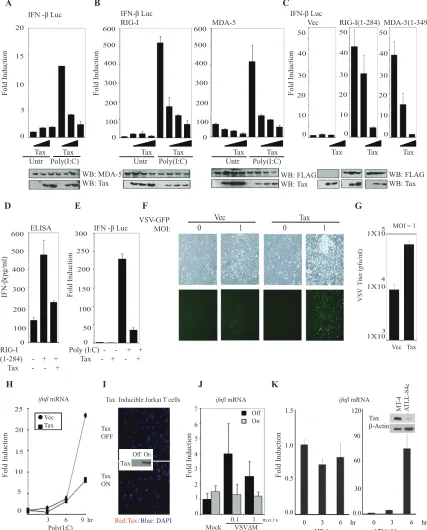
Tax inhibits induction of type I IFN by poly(I·C).
An evaluation
of HTLV-1 Tax’s effects on intracellular signaling indicated that
Tax could potently inhibit the ability of dsRNA to trigger
activa-tion of the IFN-

promoter in HeLa cells (
Fig. 1A
). Previous data
have indicated that RIG-I and MDA5 are key cellular sensors
re-sponsible for recognizing viral RNA species and for invoking the
production of type I IFN (
10
,
37
). To extend this analysis, we
cotransfected 293T cells with expression vectors encoding either
full-length RIG-I or MDA-5, together with increasing amounts
Tax. Such cells were subsequently transfected with dsRNA and
assayed for IFN-

promoter induction. This study indicated that
cells overexpressing Tax displayed a significant dose-dependent
impairment in dsRNA-induced RIG-I- or MDA-5-mediated
acti-vation of the IFN-

promoter (
⬃
80% reduction) (
Fig. 1B
). It has
also been demonstrated that the CARDs of RIG-I and MDA-5
alone have been shown to constitutively activate the IFN-

gene in
the absence of poly(I·C) or viral stimulation (
10
,
13
). Accordingly,
we observed that Tax was also able to potently inhibit type I
IFN-dependent signaling and IFN-

protein production mediated by
the CARDs of RIG-I and MDA-5 alone (
Fig. 1C
and
D
). Similar
effects were observed in Tax-expressing Jurkat T cells (
Fig. 1E
).
This analysis would indicate that HTLV-1 Tax inhibits the
pro-duction of type I IFN by preventing the downstream function of
the CARDs of RIG-I and MDA5.
The inhibition of innate immune responses has been shown to
render nontransformed cells permissive to virus infection (
38
).
Thus, we next evaluated whether Tax expression could increase
the permissiveness of murine embryonic fibroblasts (MEFs) to
vesicular stomatitis virus (VSV) infection, a virus known to be
sensitive to the antiviral effect of IFN (
39
). Primary C57BL/6
MEFs overexpressing Tax or control cells transfected with an
empty vector were next infected with different multiplicities of
infection (MOIs) of recombinant VSV expressing GFP. These
periments indicated that infected MEFs overexpressing Tax
ex-hibited significantly greater cytolysis and GFP fluorescence than
control cells (
Fig. 1F
). In agreement with these observations, we
noticed that approximately 10-fold more progeny virus was
re-covered from the supernatants of infected MEFs overexpressing
Tax (
Fig. 1G
). Overexpressed Tax in primary C57BL/6 MEFs also
inhibited endogenous
ifnb
gene transcription in response to
poly(I·C) (
Fig. 1H
). To what extent Tax could inhibit the
induc-tion of type I IFN was further evaluated using Tax-inducible T cell
lines (Jurkat). Following Dox withdrawal, Tax expression was
seen to increase as deduced by immunofluorescence and
immu-noblot analysis (
Fig. 1I
; expression is shown in red). To confirm
that Tax impedes the induction of type I IFN, we infected T cells,
Tax induced or noninduced, with a VSV mutant virus (VSV
⌬
M)
defective in viral matrix (M) activity (an alanine substitution at
position 51, which is unable to prevent host IFN mRNA export
and translation) (
40
). This analysis indicated a decrease in
VSV
⌬
M-induced IFN-

mRNA production in the presence of
Tax (2- to 5-fold;
Fig. 1J
). Finally, HTLV-1-infected human cells
in which Tax was expressed at high levels (MT-4) did not robustly
respond to type I IFN induction following transfection with
poly(I·C). This was in contrast to cells that expressed low levels of
Tax (ATLL-84c), which remained able to trigger type I IFN
pro-duction following stimulation of the RIG-I/MDA5 pathway (
Fig.
1K
). Taken together, these results demonstrate that Tax can
in-hibit RIG-I- and MDA-5-triggered type I IFN signaling and
ren-der cells susceptible to virus infection.
Tax inhibits RIG-I-activated IRF3/7, but not NF-
B,
signal-ing.
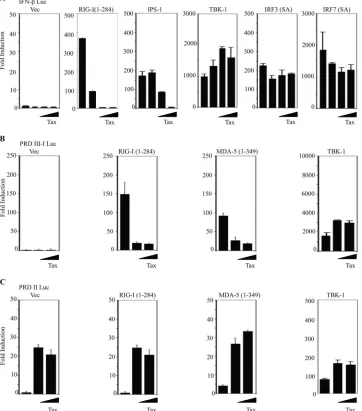
We next evaluated where in the RIG-I pathway Tax exerted its
suppressive influence. Our experiments indicated that Tax could
inhibit the activation of the IFN-

promoter by IPS-1, as well as
RIG-I/MDA5 (
Fig. 2A
). However, Tax could not inhibit
heterolo-gously expressed TBK-1 or constitutively active IRF3 (SA) or IRF7
(SA), suggesting that Tax’s inhibitory effects were upstream of
IRF3/7. RIG-I-and MDA-5-dependent antiviral gene expression
has been shown to require the coordinated activation of both the
IRF3/7 and the NF-
B classes of transcription factors (
41
).
There-fore, we next evaluated the effect of Tax on specific activation of
either IRF3/7 (PRD III-I)- or NF-
B (PRD II)-dependent
ele-ments from the human
ifnb
gene by the CARDs of RIG-I and
MDA-5. These experiments indicated that Tax was able to
po-tently inhibit RIG-I CARD- and MDA-5 CARD-dependent
acti-vation of PRD III-I in a dose-dependent manner (
Fig. 2B
). In
contrast to its effect on IRF3/7-dependent signaling, and in
agree-ment with previous reports, we found that Tax alone potently
activated NF-
B-dependent signaling, as measured by
stimula-tion of the PRD II-Luc reporter plasmid (
Fig. 2C
). These results
suggest that Tax can selectively inhibit IRF3/7-dependent antiviral
signaling mediated by RIG-I and MDA-5.
Tax interacts with RIP1.
Our results and those of others
sug-gest that RIP1 and FADD are essential downstream components
Hyun et al.on November 7, 2019 by guest
http://jvi.asm.org/
IFN -β Luc
Tax Tax Untr Poly(I:C)
A B
C
Vec 0 1
Tax Tax Untr Poly(I:C)
Tax Tax Untr Poly(I:C)
Tax Tax Tax
Tax 0 1
VSV-GFP MOI:
IFN-β(pg/ml)
RIG-I
(1-284) - + + Tax - - +
ELISA VSV T iter (pfu/ml) 1Χ10 1Χ10
5 MOI = 1
D E F
G
H I J K
5 4 WB: MDA-5 WB: Tax WB: FLAG WB: Tax WB: FLAG WB: Tax
Tax Inducible Jurkat T cells
Tax OFF
Tax ON
Red:Tax/Blue: DAPI Tax
Off On
3
1Χ10 Fold Induction Fold Inductio
n Fold Induction 600 0 500 400 300 200 100 300 0
Poly (I:C) - - + + Tax - + - +
IFN -β Luc
Fold Induction 250 200 150 100 50 600 0 500 400 300 200 100 600 0 500 400 300 200 100 Vec Tax Fold Inductio n 25 20 15 10 5 0 50 40 30 20 10 0 50 40 30 20 10 0 50 40 30 20 10 0 20 0 15 5 10
IFN-β Luc IFN-β Luc
RIG-I MDA-5 Vec RIG-I(1-284) MDA-5(1-349)
4
ifnβ mRNA
1 0 3 2 7 6
0.1 1 m.o.i s
Mock VSV∆M Off On
Fold Inductio
n
ifnβ mRNA
0 3 6 hr 0 3 6 hr 1.5 1.0 0.5 0.0 0.0 30 120
MT-4 ATLL-84c
Fold Induction
ifnβ mRNA
90
60
Vec Tax
MT -4 A TLL-84c Tax β-Actin
FIG 1HTLV-1 Tax inhibits RIG-I and MDA-5 signaling. (A) An IFN--Luc reporter plasmid was transfected in HeLa cells with or without increasing amounts of an expression vector encoding Tax for 24 h. The cells were transfected with poly(I·C) (5 mg/ml), and luciferase activity was measured. The expression of
endogenous MDA-5 and ectopic Tax were detected by immunoblotting (IB) analysis. (B) IFN--Luc reporter plasmids were transfected in 293T cells with
expression vectors encoding either FLAG-RIG-I or FLAG-MDA-5 and with empty vector or Tax. Cells were then treated as described for panel A. (C) Luciferase reporter assays were performed in 293T cells as described for panel B using FLAG-RIG-I variants (aa 1 to 284) or FLAG-MDA-5 variants (aa 1 to 349), and
increasing amounts of Tax. (D) ELISAs were performed to detect production of endogenous IFN-protein in 293T cells after transfecting with FLAG-RIG-I
(1-284) and Tax. (E) Luciferase reporter assays were performed in Jurkat T cells after transfecting IFN--luc, Tax, and poly(I·C) (5 mg/ml). (F) Viral replication
of VSV-GFP was detected in primary C57BL/6 MEFs after transfecting with either an empty vector or Tax for 24 h. Photomicrographs were taken 24 h postinfection. (G) Standard plaque assays for viral progeny output were performed from the supernatants from cells treated as described for panel F. (H)
Real-time PCR analysis ofifnmRNA level in primary C57BL/6 MEFs that were transfected with either an empty control vector or Tax for 24 h and treated with
poly(I·C) for the indicated periods. (I) Immunofluorescence (IF) assays were used to detect expression of Tax (red) in Tax-inducible Jurkat T cells after treating
with doxycycline (1g/ml) for 24 h. (J) Real-time PCR analysis forifnmRNA transcription in Tax-inducible Jurkat T cells after the infection of VSV⌬M for 6
h. (K) Real-time PCR analysis was performed to evaluate mRNA levels ofifnin MT-4 cells or ATLL-84c cells that were treated with VSV⌬M (MOIs⫽1) for the
indicated times. Tax expression was also tested in those cell lines by immunoblotting using anti-Tax antibody. Error bars indicate⫾standard deviations (SD).
on November 7, 2019 by guest
http://jvi.asm.org/
[image:4.585.76.503.37.567.2]required by RIG-I and MDA-5 to trigger type I IFN production
(
17
,
42–44
). In an effort to obtain mechanistic insight into the
ability of Tax to inhibit RIG-I- and MDA-5-dependent signaling,
we performed protein binding experiments to identify potential
interactions between Tax and RIG-I and MDA-5 and/or FADD
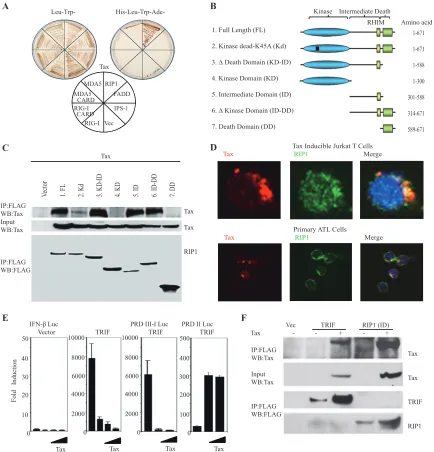
and RIP1. Principally, yeast two-hybrid experiments revealed a
robust and specific interaction between RIP1 and Tax but not with
RIG-I/MDA5 and Tax (
Fig. 3A
). To determine the domains of
RIP1 involved in interactions with Tax, we performed
coimmu-noprecipitation experiments with Tax and a variety of RIP1
vari-ants as depicted in
Fig. 3B
. This analysis indicated that an
inter-mediate domain (ID) including the RIP homotypic interaction
motif (RHIM; amino acids [aa] 301 to 558) of RIP1, previously
described as being essential for RIP3 interaction, was necessary
and sufficient for its interaction with Tax (
Fig. 3B
and
C
) (
45–47
).
Confocal analysis also indicated that RIP1 could colocalize with
Tax in Jurkat Tax-inducible and in primary ATL cells (
Fig. 3D
). Of
interest is that a RHIM domain has recently been found in the TLR
pathway adaptor protein TRIF (also referred to as TICAM) (
46
,
48
,
49
). TRIF facilitates TLR3 and -4 activation of innate signaling
processes by dsRNA and lipopolysaccharide (LPS), respectively.
TRIF partially achieves this by utilizing RIP1 through RHIM
as-sociation to regulate NF-
B and IRF3/7 activity. We thus
evalu-ated the effects of Tax on TRIF function and found that Tax was
able to inhibit IRF3/7-dependent PRDIII-I promoter activation
by TRIF but not NF-
B signaling (
Fig. 3E
).
Coimmunoprecipita-tion experiments subsequently confirmed that Tax could indeed
bind to TRIF (
Fig. 3F
). Thus, Tax binds to regions within the
RHIM domains and prevents TLR-dependent and -independent
IRF3/7 but not NF-
B signaling.
FIG 2HTLV-1 Tax selectively inhibits IRF3/7 signaling. (A) Luciferase reporter assays were performed in 293T cells with IFN--luc, FLAG-RIG-I(1-284), full-length IPS-1, TRIF, TBK1, IRF3 (superactive mutant), or IRF7 (superactive mutant), with increasing amounts of Tax. (B) Luciferase reporter assays were performed in 293T cells after transfecting IRF3/7-responsive PRDIII-I-luciferase plasmid, expression vectors encoding either FLAG-RIG-I(1-284), FLAG-MDA-5(1-349), or full-length TBK1, and increasing amounts of Tax. (C) The luciferase reporter assays illustrated in panel B were performed in 293T cells with
NF-B-responsive PRDII-luciferase plasmid. Error bars,⫾SD.
Hyun et al.
on November 7, 2019 by guest
http://jvi.asm.org/
[image:5.585.113.475.74.485.2]RIP RHIM association with Tax and RIG-I.
Our findings that
Tax potently inhibits RIG-I/MDA-5- and TRIF-activated
signal-ing prompted us to examine in greater detail the mechanistic
con-sequences of this association. As a start to these studies, we treated
HeLa cells with or without IFN-

and subjected lysates to dsRNA
affinity chromatography. These experiments verified that both
en-dogenous RIG-I and MDA-5 were able to associate with dsRNA
(
Fig. 4A
). The interactions were more evident when endogenous
RIG-I or MDA-5 was precipitated from IFN-treated cells, since
these molecules are themselves IFN-inducible proteins.
Interest-ingly, we observed that RIP1 could be precipitated by
poly(I·C)-agarose in a manner that was enhanced by previous IFN
treat-ment, suggesting that RIP1 could bind poly(I·C) directly or was
being recruited to an IFN-stimulated dsRNA-dependent complex
by molecules such as RIG-I and MDA-5 (
Fig. 4A
). However, RIP1
possesses no discernible RNA-interacting motifs and did not
as-sociate with dsRNA when produced alone in rabbit reticulocyte
lysates (data not shown). To extend these studies, we transfected
1. Full Length (FL)
2. Kinase dead-K45A (Kd)
3. ∆ Death Domain (KD-ID)
4. Kinase Domain (KD)
5. Intermediate Domain (ID)
6. ∆ Kinase Domain (ID-DD)
7. Death Domain (DD)
1-671
1-671
1-588
1-300
301-588
314-671
589-671 Kinase Intermediate Death
Leu-Trp- His-Leu-Trp-Ade-
IP:FLAG WB:Tax Input WB:Tax
IP:FLAG WB:FLAG
Tax
Tax Inducible Jurkat T Cells
Tax RIP1 Merge RIG-I Vec
V
ector 1. FL 2. Kd 3. KD-ID 4. KD 5. ID 6. ID-DD 7. DD
RHIM Amino acid
RIG-I IPS-1 MDA5 FADD
CARD
Tax
Tax
RIP1 CARD
MDA5 RIP1 Tax
Vec TRIF RIP1 (ID) Tax - - + - +
Tax
Tax
TRIF
RIP1 IP:FLAG
WB:Tax
Input WB:Tax
IP:FLAG WB:FLAG
Tax Tax IFN-β Luc PRD III-I Luc PRD II Luc Vector TRIF TRIF TRIF
30
0
Tax Tax
Fold I
nduction 40
10 50
20
6000
0 8000
2000 10000
4000
6000
0 8000
2000 10000
4000
300
0 400
100 500
200
A
B
C
D
E F
Primary ATL Cells
Tax RIP1 Merge
FIG 3HTLV-1 Tax interacts with RIP1. (A)S. cerevisiaestrain AH109 was cotransformed with Tax, together with the indicated prey plasmids. Only cells coexpressing Tax and RIP1 grew under high-stringency selection conditions, indicating interaction. (B) Schematic diagram of RIP1 and RIP1 deletion mutants. (C) Coimmunoprecipitation (Co-IP) analyses were performed in 293T cells after cotransfecting Tax and FLAG-tagged RIP1 mutants using anti-FLAG antibody. IB analysis detected the indicated proteins. (D) IF assays detected expression of Tax (red) and RIP1(green) in Tax-inducible Jurkat T cells or primary ATL cells
after treating with doxycycline (1g/ml) for 24 h. (E) Luciferase reporter assays were performed in 293T cells after transfecting IFN--luc, PRD-III luciferase,
or PRD-II luciferase reporter plasmids, expression vectors encoding FLAG-TRIF, and increasing amounts of Tax. (F) Co-IP analyses were performed in 293T cells after cotransfecting expression plasmids encoding Tax and the FLAG-TRIF or FLAG-RIP1 variant (aa 301 to 588). After 36 h, the cell lysates were pulled
down using anti-FLAG antibody and IB analysis was performed using anti-Tax antibody. Error bars,⫾SD.
HTLV-1 Tax Suppression of Host Defense
on November 7, 2019 by guest
http://jvi.asm.org/
[image:6.585.76.510.67.519.2]FIG 4RIP1 associates with RIG-I in the presence of dsRNA. (A) HeLa cells were treated with or without IFN-for 18 h and poly(I·C) for 3 h, and the lysates were subjected to poly(I·C) to dsRNA affinity chromatography. Precipitated poly(I·C) agarose was resolved by SDS electrophoresis analysis. Indicated antibodies were used for IB. (B) Co-IP analyses were performed in 293T cells transfected with HA-RIP1, either FLAG-RIG-I variants (full length, aa 1 to 284, or aa 219 to 925) or FLAG-MDA5 variants (full length, aa 1 to 357, or aa 236 to 1026). The lysates were immunoprecipitated (IP) with anti-FLAG antibody, and immunoblot analysis was performed with anti-HA antibody. (C) Yeast two-hybrid assays were used to detect the GAL4 binding domain (BD)-conjugated full-length RIP1, which strongly interacts with full-length FADD in yeast. Weak interaction of RIP1 and RIG-I (aa 1-200) or MDA-5 (aa 101-200) was also detected in the yeast two-hybrid system. The GAL4 activation domain was fused to full-length FADD, RIG-I variants (top left, aa 1-200; top right, aa 1-100; bottom left, aa 101-200), and MDA-5 variants (top left, aa 1-200; top right, 1-100; bottom left, aa 101-200). (D) Co-IP analyses were performed in 293T cells after overexpressing plasmids encoding HA-RIG-I (aa 1 to 284) and FLAG-RIP1 deletion variants. The lysates were immunoprecipitated with-anti FLAG antibody and IB analysis was performed with anti-HA antibody. (E) 293T cells were transfected with HA-RIG-I(1-284) and the FLAG-intermediate domain of RIP1(301-588), either with or without the expression vector encoding Tax. The cell lysates were immunoprecipitated, and IB analysis was performed with the indicated antibodies. (F)
Luciferase reporter assays were performed in 293T cells after transfecting IFN--luc expression vectors, plasmids encoding either FLAG-RIG-I(1-284) or
FLAG-MDA-5(1-357), and increasing amounts of an expression vector encoding full-length RIP1 or an intermediate domain of RIP1(301-588) for 36 h. (G)
Luciferase reporter assays were performed in 293T cells after transfecting IFN--luciferase expression vectors, plasmids encoding either FLAG-RIG-I(1-284) or
FLAG-MDA-5(1-357), and increasing amounts of plasmid encoding FADD or the death effector domain of FADD (aa 1 to 97) for 36 h. (H, I) IFN--Luciferase
reporter plasmids were transfected in 293T cells with expression vectors encoding either RIG-I(1-284) along with expression vectors encoding full-length RIP1
or FADD and increasing amounts of plasmid encoding Tax. Thirty-six hours later, the cells were subjected to luciferase reporter assay. Error bars,⫾SD.
on November 7, 2019 by guest
http://jvi.asm.org/
[image:7.585.77.505.41.554.2]HA-tagged RIP1 into 293T cells along with FLAG-tagged versions
of RIG-I or MDA-5. These coimmunoprecipitation experiments
indicated that while RIP1 was able to weakly associate with
full-length RIG-I and MDA-5, it bound with significantly greater
affinity to the CARDs of RIG-I and MDA-5 (
Fig. 4B
). Taken
to-gether, these results suggest that RIP1 may be recruited to
RIG-I-and MDA-5-containing complexes upon activation by viral RNA.
These findings were confirmed using a yeast two-hybrid assay
ap-proach, which indicated a robust association of RIP1 and FADD
(His-Leu-Trp-Ade [HLTA]-deficient media) and a weaker
associ-ation of RIP1 with the CARDs of both RIG-I and MDA5
(HLT-deficient media) (
Fig. 4C
).
To extend these studies, we cotransfected 293T cells with
var-ious domains of RIP1 in the presence of the CARDs of RIG-I or
MDA5. This study again indicated that the ID domain of RIP1
associated with the CARD of RIG-I (
Fig. 4D
). Of interest was that
while both Tax and the CARD of RIG-I bound to the ID of RIP1,
Tax did not inhibit RIG-I/RIP1 interactions, indicating that TAX
and RIG-I bind to different regions of the ID (
Fig. 4E
).
Significantly, further analysis indicated that RIP1 was able to
potently synergize with the CARDS of both RIG-I and MDA5 to
induce activation of the type I IFN promoter (
Fig. 4F
). A similar
approach indicated that the RIP1 ID regions alone were able to
manifest the observed synergy with the CARDS of RIG-I and
MDA5 (
Fig. 4F
). A similar effect was observed with FADD (
Fig.
4G
). However, the presence of Tax was able to block the
synergis-tic effects of RIP1 or FADD with RIG-I, which would otherwise
augment the induction of the type I IFN promoter (
Fig. 4H
and
I
).
Our data thus indicate that the CARDs of RIG-I associate with
RIP1, which in turn associates with FADD to facilitate the
activa-tion of the type I IFN promoter. Tax associaactiva-tion with RIP1 is able
to prevent the induction of this pathway.
Tax prevents RIP1 innateosome activation of IRF7.
Our data
indicate that Tax binds to the ID domain of RIP1 to prevent
down-stream NF-
B-independent innate immune signaling processes.
We therefore investigated whether Tax prevented RIP1 binding to
required signaling partners to disrupt innateosome complex
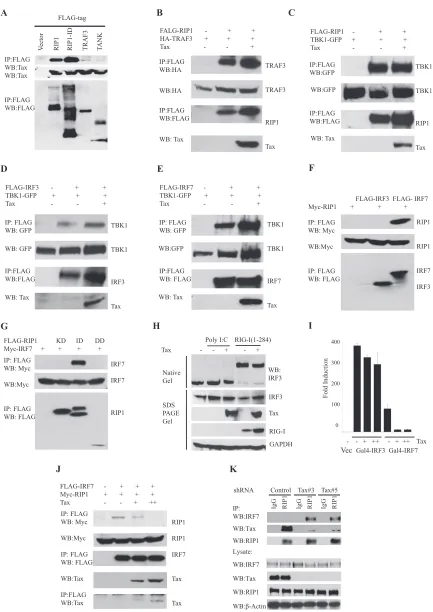
for-mation. Principally, while coimmunoprecipitation analysis
indi-cated that Tax could bind to RIP1, we did not see any appreciable
Tax binding to downstream type I IFN signaling components
such as TRAF3 or TANK (
Fig. 5A
and
B
). Neither did Tax prevent
complex association with RIP1 or TBK1 (
Fig. 5C
). Moreover, Tax
did not appear to inhibit TBK-1’s association with IRF3 or IRF7
(
Fig. 5D
and
E
). Indeed, Tax seemed to slightly enhance the
asso-ciation of some of these innate signaling components, such as
TRAF3, perhaps to augment NF-
B activity. However, we
con-firmed that RIP1 bound efficiently to available IRF7, as has been
shown previously (
50
) (
Fig. 5F
), but not IRF3. This association
was noted to involve IRF7 binding to the ID of RIP1, similar to Tax
(
Fig. 3F
and
5G
). Tax did not appear to influence IRF3 activity, as
emphasized by analyzing IRF3 dimerization and translocation
(
Fig. 5H
). However, Tax did impede IRF7 function as shown by
GAL4-IRF7 assays (
Fig. 5I
). Given that Tax could bind to RIP1 via
the ID, we therefore investigated whether Tax could block RIP1/
IRF7 association. Indeed, this coimmunoprecipitation analysis
confirmed that Tax could in fact repress RIP1/IRF7 interactions,
an effect that likely explained the repressed IRF7 activity (
Fig. 5J
).
Analysis of HTLV-1-transformed C8166 cells, which express
en-dogenous Tax, further confirmed that Tax can indeed inhibit
RIP1/IRF7 interactions likely by preferentially associating with
RIP1 rather than IRF7 (
Fig. 3
and
5K
).
Our data also indicate that the CARDs of RIG-I as well as IRF7
associate with the ID of RIP-1, a region that exhibits constitutive
activity (
Fig. 1D
and
5G
). Results further show that Tax can block
IRF7 association with RIP1 and IRF7 activity (
Fig. 5I
to
K
).
How-ever, Tax did not robustly inhibit RIG-I binding to RIP1 (
Fig. 4E
).
To examine the molecular mechanisms in more detail, we
exam-ined which regions of the RIP1 ID associated with Tax, RIG-I or
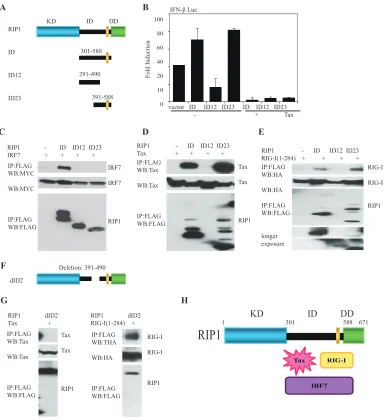
IRF7. The ID (aa 301 to 558) or portions of the ID (aa 291 to 490
[ID12] or aa 391 to 582 [ID23]) were cloned into expression
vec-tors (
Fig. 6A
). We principally noted that ID23 alone but not ID12
exerted the ability to stimulate the production of type I IFN
(sim-ilar to the ID), events that were suppressed in the presence of Tax
(
Fig. 6B
). We noted that IRF7 did not strongly bind to ID12 or 23,
perhaps due to the fact that both regions were required for
stabi-lizing the interaction (
Fig. 6C
). However, we observed that ID12
was not expressed robustly. In contrast, we did observe that Tax
strongly interacted with ID23 (aa 391 to 582) (
Fig. 6D
). The
CARDs of RIG-I were similarly found to associate with ID23 (
Fig.
6E
) but did not appear to inhibit RIP1/RIG-I interactions,
sug-gesting that Tax may bind to a different portion of ID23. To
de-termine this, we created a RIP1 deletion variant lacking aa 391 to
490 (dID2, aa 391 to 490) (
Fig. 6F
). This construct was developed
since generating smaller portions of ID23 resulted in poor
expres-sion. Our analysis indicated that Tax did not bind robustly to dID2
in contrast to RIG-1, which exhibited evident binding (
Fig. 6G
).
We thus conclude that IRF7 may bind to the region of aa 301 to
588 of RIP1 and Tax to the region of aa 391 to 490 while RIG-1
associates with a region representing aa 491 to 588 (
Fig. 6H
). This
association is presumably sufficient to prevent RIP1 binding to
IRF7, which eliminates IRF7 activity and type I IFN induction.
IRF7 is required for the robust activation of predominantly the
type I IFN alpha genes rather than the beta interferon gene, which
principally uses IRF3 to initiate its transcription after infection of
the cell (
51
). This is because IRF7 is itself type I IFN inducible and
not robustly expressed in uninfected cells. Following induction,
IRF7 facilitates further IFN-

induction, with IRF3, while
ro-bustly stimulating alpha interferon production in a
positive-feed-back manner. Analysis of poly(I·C)-treated or RNA virus-infected
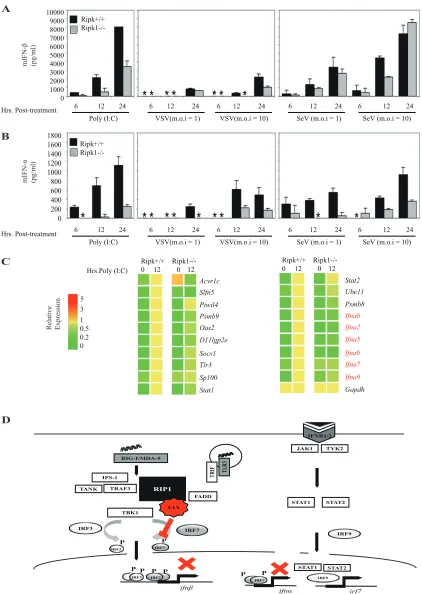
wild-type (WT) or RIP1-deficient MEFs confirmed a more
signif-icant requirement for IRF7 in IFN-
␣
induction than in IFN-

induction (
Fig. 7A
to
C
). Since IRF7 is the “master regulator” of
type I IFN induction, our data indicate that Tax suppression of
this activity potently inhibits RIG-I- and TRIF-dependent
signal-ing (
52
).
DISCUSSION
HTLV-1 is a delta-type retrovirus currently responsible for 10 to
20 million infections worldwide (
24
). In contrast to the other
im-portant human retroviral pathogen, HIV, which proliferates by
direct production of progeny virions, HTLV-1 increases its copy
number primarily by inducing the proliferation of infected cells
(
51
). Thus, promotion of immortalization and transformation of
the infected cell thus appears to be a primary step in viral
propa-gation (
53
). Leukemogenesis of ATL has been suggested to be a
multievent process involving both the disabling of cellular tumor
suppressor and apoptotic processes and the engagement of
prolif-erative and antiapoptotic signaling (
54
). Tax has been reported to
be involved in all these events and possesses an essential role in
HTLV-1 Tax Suppression of Host Defenseon November 7, 2019 by guest
http://jvi.asm.org/
A B C
F
V
ector
IP:FLAG WB:Tax WB:Tax
IP:FLAG WB:FLAG
FLAG-tag
IP:FLAG WB:GFP
IP:FLAG WB:FLAG
WB:GFP
WB: Tax
TBK1
TBK1
RIP1
Tax FLAG-RIP1 - + + TBK1-GFP + + + Tax - - +
RIP
1
RIP1-ID TRAF3 TA
N
K
IP: FLAG WB: GFP
IP:FLAG WB:FLAG WB: GFP
WB: Tax
TBK1
TBK1
IRF7
Tax IP: FLAG
WB: GFP
IP:FLAG WB: FLAG WB:GFP
WB: Tax
FLAG-IRF7 - + + TBK1-GFP + + + Tax - - +
IRF7
IRF7
RIP1 IP: FLAG
WB: Myc
WB:Myc
IP: FLAG WB: FLAG
FLAG-RIP1 KD ID DD Myc-IRF7 + + + +
FALG-RIP1 - + + HA-TRAF3 + + + Tax - - +
IP:FLAG WB:HA
IP:FLAG WB:FLAG WB:HA
WB: Tax
TRAF3
TRAF3
RIP1
Tax
FLAG-IRF3 FLAG- IRF7 Myc-RIP1 + + +
RIP1
RIP1
IRF7
IRF3 IP: FLAG
WB: Myc
WB:Myc
IP: FLAG WB: FLAG TBK1
TBK1
IRF3
Tax FLAG-IRF3 - + + TBK1-GFP + + + Tax - - +
FLAG-IRF7 - + + + Myc-RIP1 + + + + Tax - - + ++
RIP1
RIP1
IRF7
Tax
Tax IP: FLAG
WB: Myc
WB:Myc
IP: FLAG WB: FLAG
WB:Tax
IP:FLAG WB:Tax
WB:Tax IP: WB:IRF7
WB:RIP1
shRNA Control Tax#3 Tax#5
Lysate:
WB:RIP1 WB:IRF7
WB:Tax
WB:β-Actin
IgG RIP1 IgG RIP1 IgG RIP
1
400
300
200
100
0
- - + ++ - + ++ Tax Vec Gal4-IRF3 Gal4-IRF7
Fold Inductio
n
Tax - - + - +
WB: IRF3
IRF3
Tax Poly I:C RIG-I(1-284)
RIG-I
GAPDH Native
Gel
SDS PAGE Gel
FIG 5Tax abrogates RIP1 and IRF7 interaction. (A) Co-IP analyses were performed in 293T cells after overexpressing Tax and FLAG-RIP1, FLAG-intermediate domain of RIP1 (aa 301 to 588), FLAG-TRAF3, or FLAG-TANK, using anti-FLAG antibody. IB analyses were done with the indicated antibody. (B) Co-IP analysis was done in 293T cells using expression plasmids encoding FLAG-RIP1 or HA-TRAF3 and either with or without Tax. (C) Co-IP analyses were performed as described for panel A using expression vectors encoding FLAG-RIP1, TBK-GFP, and Tax. (D, E) Co-IP analyses were performed as described for panel A using expression vectors encoding FLAG-IRF3 or FLAG-IRF7, TBK-GFP, and Tax. (F) Co-IP analyses were done in 293T cells as described for panel A
Hyun et al.
on November 7, 2019 by guest
http://jvi.asm.org/
[image:9.585.76.509.64.676.2]ATL pathogenesis (
55
). In addition to modifying cellular growth
signals to provide proliferative advantages to infected cells,
effec-tive counteraction of host immune responses is also essential for
successful infection and viral spread. Indeed, in later stages of
leukemogenesis, silencing of Tax expression appears to be
advan-tageous for cells capable of maintaining a transformed phenotype
without Tax, because Tax is a target of the host acquired immune
system. In addition to acquired immune responses to HTLV-1
using plasmids encoding Myc-RIP1 and FLAG-IRF3 or FLAG-IRF7. (G) Co-IP analysis in 293T cells as described for panel A using plasmids encoding full-length Myc-IRF7 and FLAG-RIP1 mutants: kinase domain (aa 1 to 300), intermediate domain (aa 301 to 588), or death domain (aa 589 to 671). (H) Native PAGE gel analysis for IRF3 dimerization in 293T cells with transfection of an empty vector or expression vector encoding HA-RIG-I (aa 1 to 284), either with or without
plasmid encoding Tax. The cells were stimulated with poly(I·C) (1g/ml) for 4 h, and the lysates were subjected to IB with the indicated antibodies. (I) Luciferase
reporter assays were performed in 293T cells after transfecting with GAL4 binding luciferase plasmid and an expression vector encoding GAL4-conjugated full-length IRF3 and full-length IRF7 with increasing amounts of Tax. (J) Co-IP analysis in 293T cells after overexpressing plasmids encoding Myc-RIP1 and FLAG-IRF7 with an increasing amount of Tax. IB analysis was done with the indicated antibodies. (K) Depletion of Tax with shRNAs restores RIP1-IRF7 interaction in HTLV-1-transformed cells. Co-IP analysis was done in C8166 cells after lentiviral transduction of control or Tax short hairpin RNAS (shRNAs)
(Tax#3 and Tax#5) for 5 days. IB was performed after IgG control or RIP1 IP with the indicated antibodies. Error bars,⫾SD.
A B
F
RIP1 - ID ID12 ID23 IRF7 + + + +
IP:FLAG WB:MYC
WB:MYC
IP:FLAG WB:FLAG
IRF7
IRF7
RIP1
RIP1 - ID ID12 ID23 Tax + + + + IP:FLAG
WB:Tax
WB:Tax
IP:FLAG WB:FLAG
Tax
Tax
RIP1 RIP1
ID
ID12
ID23
KD ID DD
RIP1 - ID ID12 ID23 RIG-I(1-284) + + + +
IP:FLAG WB:HA
WB:HA
IP:FLAG WB:FLAG
longer exposure
RIG-I
RIG-I
RIP1 IFN-β Luc
Fold Induction
100 80 60 40 20 10 0
vector ID ID12 ID23 ID ID12 ID23 - + Tax
dID2
301-588
291-490
391-588
Deletion: 391-490
RIP1 dID2 Tax +
IP:FLAG WB:Tax
WB:Tax
IP:FLAG WB:FLAG
RIP1 dID2 RIG-I(1-284) +
IP:FLAG WB:THA
WB:HA
IP:FLAG WB:FLAG Tax
Tax
RIP1
RIG-I
RIG-I
RIP1
RIP1
KD ID DD
Tax RIG-I
IRF7
1 301 588 671
FIG 6Tax preferentially inhibits activity of IRF7. (A, B) Schematic figures of intermediate domain of RIP1 variants (A) and IFN--Luc (B) reporter assays examined in 293T cells using expression vector encoding RIG-I(1-284), RIP1 (ID, aa 301 to 588), FLAG RIP1(ID12, aa 291 to 490), or FLAG-RIP1(ID23, aa 391 to 588), either with or without Tax. (C, D, E) Co-IP analysis in 293T cells after expressing FLAG-RIP1 (ID, aa 301 to 588), FLAG-RIP1 (ID12, aa 291 to 490), or FLAG-RIP1(ID23, aa 391 to 588), and either Myc-IRF7, Tax, or HA-RIG-I (aa 1 to 284). Thirty-six hours later, cell lysates were immunopre-cipitated, and IB analysis was performed with the indicated antibodies. (F) Structure of dID2 (deletion, aa 391 to 490) of RIP1. (G) Co-IP assay revealed that intermediate domain aa 391 to 490 of RIP1 was essential for Tax association to RIP1 but not for HA-RIG-I(1-284). 293T cells were transfected with ID2 of FLAG-RIP1 (deletion, aa 391 to 490), and either Tax or HA-RIG-I(1-284) for 36 h. The lysates were pulled down with anti-FLAG antibody, and IB was performed
with anti-Tax antibody. (H) Schematic model of RIP1-interacting proteins and Tax. Error bars,⫾SD.
HTLV-1 Tax Suppression of Host Defense
on November 7, 2019 by guest
http://jvi.asm.org/
[image:10.585.101.486.65.485.2]mIFN-α (pg/ml)
Ripk+/+
6 12 24 6 12 24 6 12 24 6 12 24 6 12 24
Hrs.Poly (I:C) 10000
9000 8000 7000 6000 5000 4000 3000 2000 1000 0
Poly (I:C) VSV(m.o.i = 1) VSV(m.o.i = 10) SeV (m.o.i = 1) SeV (m.o.i = 10) Ripk+/+
Ripk1-/-Ripk+/+
Ripk1-/-1800 1600 1400 1200 1000 800 600 400 200 0 mIFN-β (pg/ml)
Hrs. Post-treatment
6 12 24 6 12 24 6 12 24 6 12 24 6 12 24
Poly (I:C) VSV(m.o.i = 1) VSV(m.o.i = 10) SeV (m.o.i = 1) SeV (m.o.i = 10) Hrs. Post-treatment
Ripk+/+ Ripk1-/-0 12 Ripk1-/-0 12
Ripk+/+ Ripk1-/-0 12 Ripk1-/-0 12
Acvr1c
Slfn5
Piwil4
Psmb9
Oas2
D11lgp2e
Socs1
Tlr3
Sp100
Stat1
Stat2
Ube11
Psmb8
Ifnab
Ifna2
Ifna5
Ifna6
Ifna7
Ifna9
Gapdh
1 0.5 0.2 0 5 3
Relative Expression
A
B
C
D
TLR
3
RIG-I/MDA-5
TBK1 IPS-1
TRAF3 RIP1
TANK
TRIF
IRF3 IRF7
ir f 3 r f f 3 3
P P
ifnβ
IFNR1/2 JAK1 TYK2
STAT1 STAT2
irf7
FADD
P P
ifnα P P
P
STAT1 STAT2
IRF9
IRF9
P
IRF7 IRF7
IRF3
TAX
IRF7 IRF3
FIG 7RIP1 is involved in the induction of IFN-␣. (A, B) ELISA measurements of IFN-and IFN-␣with supernatants of RIP1⫹/⫹and RIP1⫺/⫺MEFs after
stimulation with poly(I·C), VSV, or SeV at MOIs of 1 and 10. Error bars, SD. (C) Microarray analysis of dsRNA-inducible genes were performed in RIP1⫹/⫹and
RIP1⫺/⫺MEFs after treatment with poly(I·C) for 12 h. (D) A model of Tax suppression of innate immune signaling. RNA sensor RIG-I, MDA-5, or TLR3
recognizes and activates IPS-1 or TRIF, forming a complex with molecules TRAF3, FADD, and RIP1. This leads to phosphorylation of TBK1, which
phospho-rylates the transcription factor IRF3 for primary IFN-induction. Secreted IFN-binds to IFN receptors and inducesifn␣andirf7through JAK/STAT signaling.
HTLV-1 viral protein Tax strongly binds to RIP1 to impede IRF7 function and type I IFN signaling.
Hyun et al.
on November 7, 2019 by guest
http://jvi.asm.org/
[image:11.585.81.503.64.658.2]infection, however, powerful innate mechanisms that recognize
and limit viral replication exist.
Here, we show that HTLV-1 Tax potently inhibits antiviral
signaling by one of these important mechanisms. Signaling by the
RNA helicases RIG-I and MDA-5 has recently emerged as pivotal
for the production of type I IFNs in response to cytosolic viral
RNA species (
10
,
11
). Although the exact signaling events
down-stream of RIG-I and MDA-5 remain unclear, it appears that IPS-1,
TRAF3, FADD, and RIP1 participate in the activation of IRF3/7
(
13
,
17
,
18
,
43
). In this study, we demonstrate that HTLV-1 Tax
inhibits the production of type I IFN by the RNA helicases RIG-I
and MDA-5. Tax was found to interact with RIP1, a kinase
previ-ously shown by our group and others to possess a role in the
production of type I IFN and protection against virus infection.
We further show that RIP1 associates with the CARDs of RIG-I
and MDA-5 and confirm its essential role in signaling
down-stream of these helicases. Specifically, we show that RIP1 is
indis-pensable for the robust production of IFN-
␣
and other secondary
genes after dsRNA stimulation of virus infection. RIP1 interacted
with the CARDs of RIG-I and MDA-5 via its ID. Overexpression
of RIP1 synergized with the CARDs of RIG-I and MDA-5 to
acti-vate IFN, an event which was inhibited by Tax coexpression. TRIF
has also been shown to exhibit an RHIM domain and was similarly
able to bind to Tax in our studies. TRIF facilitates endosomal
TLR3 signaling mediated by dsRNA species. Thus, Tax inhibits
TRIF function as well RIG-I/MDA5 and so evades two major
an-tiviral host defense pathways (
55
).
Following recruitment to RIG-I/MDA5, the molecular events
linking RIP1 to the induction of type I IFN genes are somewhat
less clear. Recent data show that the transcription factor IRF7 is
the “master regulator” of type I IFN production and is essential for
IFN-
␣
production (
52
). In most cell types, IRF7 is a short-lived
protein whose levels are controlled by an autocrine loop involving
primary IFNs (such as IFN-

and IFN-
␣
4) and whose activation is
governed by virus-dependent phosphorylation via cellular TBK-1.
Thus, RIP1 and TRIF likely govern IFN-
␣
production via control
of IRF7. Our data indicate that this event is prevented by Tax
binding to RIP1/TRIF and impeding IRF7 activity.
While our findings suggest Tax binding to RIP1 as a
mecha-nism for inhibition of RIG-I and MDA-5, they do not preclude
other mechanisms of innate immune evasion by this key viral
oncoprotein. For example, our data indicate that, at higher
con-centrations, Tax also inhibits activation of type I IFN by activated
IRF3/7, presumably by competition for transcription cofactors
such as CBP/p300 (
56
).
Because of their pivotal role in antiviral host defense, innate
immune viral recognition pathways are often targeted for
inhibi-tion by viruses. For example, the V protein encoded by
paramyxo-viruses can interact with and inhibit both Mda5 and Stat1
signal-ing (
11
). In a growing list of such proteins, data demonstrate that
the P protein encoded by Borna disease virus can bind to and
inactivate TBK-1, the NS3/4a protease encoded by hepatitis C
vi-rus can cleave and disable IPS-1, and the vaccinia vivi-rus A52R and
N1L proteins interfere with both TLR-dependent and
-indepen-dent signaling (
13
,
57
,
58
). Additionally, our recent findings show
that the FADD-interacting poxviral protein MC159 can inhibit
RIG-I- and IPS-1-dependent activation of
Ifnb
(
42
). In summary,
our results imply that the suppression of RIP1 facilitated innate
immune antiviral signaling as a further important role for Tax in
the promotion of leukemogenesis.
ACKNOWLEDGMENTS
We thank H. Ishikawa, N. Shembade, and K. Parvatiyar for technical support and G. Cheng and T. Maniatis for plasmid constructs. We also thank J. Ahn and D. Gutman for assistance with the manuscript submis-sion.
These studies were supported by NIH grant U01AI083015. The con-tent is solely our responsibility and does not necessarily represent the official views of the National Institutes of Health.
REFERENCES
1.Janeway CA, Jr, Medzhitov R.2002. Innate immune recognition. Annu
Rev Immunol20:197–216.http://dx.doi.org/10.1146/annurev.immunol
.20.083001.084359.
2.Kawai T, Akira S. 2010. The role of pattern-recognition receptors in
innate immunity: update on Toll-like receptors. Nat Immunol11:373–
384.http://dx.doi.org/10.1038/ni.1863.
3.Alexopoulou L, Holt AC, Medzhitov R, Flavell RA.2001. Recognition of double-stranded RNA and activation of NF-kappaB by Toll-like receptor
3. Nature413:732–738.http://dx.doi.org/10.1038/35099560.
4.Yamamoto M, Sato S, Mori K, Hoshino K, Takeuchi O, Takeda K, Akira S. 2002. Cutting edge: a novel Toll/IL-1 receptor domain-containing adapter that preferentially activates the IFN-beta promoter in
the Toll-like receptor signaling. J Immunol169:6668 – 6672.http://dx.doi
.org/10.4049/jimmunol.169.12.6668.
5.Oshiumi H, Matsumoto M, Funami K, Akazawa T, Seya T. 2003. TICAM-1, an adaptor molecule that participates in Toll-like receptor
3-mediated interferon-beta induction. Nat Immunol4:161–167.http://dx
.doi.org/10.1038/ni886.
6.Yamamoto M, Sato S, Hemmi H, Hoshino K, Kaisho T, Sanjo H, Takeuchi O, Sugiyama M, Okabe M, Takeda K, Akira S.2003. Role of adaptor TRIF
in the MyD88-independent toll-like receptor signaling pathway. Science301:
640 – 643.http://dx.doi.org/10.1126/science.1087262.
7.Lund JM, Alexopoulou L, Sato A, Karow M, Adams NC, Gale NW, Iwasaki A, Flavell RA.2004. Recognition of single-stranded RNA viruses
by Toll-like receptor 7. Proc Natl Acad Sci U S A101:5598 –5603.http://dx
.doi.org/10.1073/pnas.0400937101.
8.Heil F, Hemmi H, Hochrein H, Ampenberger F, Kirschning C, Akira S, Lipford G, Wagner H, Bauer S. 2004. Species-specific recognition of
single-stranded RNA via toll-like receptor 7 and 8. Science303:1526 –
1529.http://dx.doi.org/10.1126/science.1093620.
9.Diebold SS, Kaisho T, Hemmi H, Akira S, Reis e Sousa C.2004. Innate antiviral responses by means of TLR7-mediated recognition of
single-stranded RNA. Science303:1529 –1531.http://dx.doi.org/10.1126/science
.1093616.
10. Yoneyama M, Kikuchi M, Natsukawa T, Shinobu N, Imaizumi T, Miyagi-shi M, Taira K, Akira S, Fujita T.2004. The RNA helicase RIG-I has an essential function in double-stranded RNA-induced innate antiviral
re-sponses. Nat Immunol5:730 –737.http://dx.doi.org/10.1038/ni1087.
11. Andrejeva J, Childs KS, Young DF, Carlos TS, Stock N, Goodbourn S, Randall RE.2004. The V proteins of paramyxoviruses bind the IFN-inducible RNA helicase, mda-5, and inhibit its activation of the IFN-beta
promoter. Proc Natl Acad Sci U S A101:17264 –17269.http://dx.doi.org
/10.1073/pnas.0407639101.
12. Kato H, Takeuchi O, Sato S, Yoneyama M, Yamamoto M, Matsui K, Uematsu S, Jung A, Kawai T, Ishii KJ, Yamaguchi O, Otsu K, Tsujimura T, Koh CS, Reis e Sousa C, Matsuura Y, Fujita T, Akira S. 2006. Differential roles of MDA5 and RIG-I helicases in the recognition of RNA
viruses. Nature441:101–105.http://dx.doi.org/10.1038/nature04734.
13. Kawai T, Takahashi K, Sato S, Coban C, Kumar H, Kato H, Ishii KJ, Takeuchi O, Akira S.2005. IPS-1, an adaptor triggering RIG-I- and
Mda5-mediated type I interferon induction. Nat Immunol6:981–988.
http://dx.doi.org/10.1038/ni1243.
14. Seth RB, Sun L, Ea CK, Chen ZJ.2005. Identification and characteriza-tion of MAVS, a mitochondrial antiviral signaling protein that activates
NF-kappaB and IRF 3. Cell122:669 – 682.http://dx.doi.org/10.1016/j.cell
.2005.08.012.
15. Xu LG, Wang YY, Han KJ, Li LY, Zhai Z, Shu HB.2005. VISA is an adapter protein required for virus-triggered IFN-beta signaling. Mol Cell
19:727–740.http://dx.doi.org/10.1016/j.molcel.2005.08.014.
16. Meylan E, Curran J, Hofmann K, Moradpour D, Binder M, Barten-schlager R, Tschopp J.2005. Cardif is an adaptor protein in the RIG-I
HTLV-1 Tax Suppression of Host Defense
on November 7, 2019 by guest
http://jvi.asm.org/
antiviral pathway and is targeted by hepatitis C virus. Nature437:1167–
1172.http://dx.doi.org/10.1038/nature04193.
17. Balachandran S, Thomas E, Barber GN. 2004. A FADD-dependent
innate immune mechanism in mammalian cells. Nature432:401– 405.
http://dx.doi.org/10.1038/nature03124.
18. Oganesyan G, Saha SK, Guo B, He JQ, Shahangian A, Zarnegar B, Perry A, Cheng G.2006. Critical role of TRAF3 in the Toll-like
receptor-dependent and -inreceptor-dependent antiviral response. Nature 439:208 –211.
http://dx.doi.org/10.1038/nature04374.
19. Zhao T, Yang L, Sun Q, Arguello M, Ballard DW, Hiscott J, Lin R.2007. The NEMO adaptor bridges the nuclear factor-kappaB and interferon
regulatory factor signaling pathways. Nat Immunol8:592– 600.http://dx
.doi.org/10.1038/ni1465.
20. Watanabe T, Seiki M, Yoshida M.1983. Retrovirus terminology. Science
222:1178.
21. Poiesz BJ, Ruscetti FW, Gazdar AF, Bunn PA, Minna JD, Gallo RC.
1980. Detection and isolation of type C retrovirus particles from fresh and cultured lymphocytes of a patient with cutaneous T-cell lymphoma. Proc
Natl Acad Sci U S A77:7415–7419.http://dx.doi.org/10.1073/pnas.77.12
.7415.
22. Yoshida M, Miyoshi I, Hinuma Y.1982. Isolation and characterization of retrovirus from cell lines of human adult T-cell leukemia and its
implica-tion in the disease. Proc Natl Acad Sci U S A79:2031–2035.http://dx.doi
.org/10.1073/pnas.79.6.2031.
23. Nakayama D, Katamine S, Kanazawa H, Shibuya N, Kawase K, Moriu-chi R, Miyamoto T, Hino S. 1990. Amplification of HTLV-1-related sequences among patients with neurological disorders in highly endemic Nagasaki: lack of evidence for association of HTLV-1 with multiple
scle-rosis. Jpn J Cancer Res 81:238 –246. http://dx.doi.org/10.1111/j.1349
-7006.1990.tb02556.x.
24. Arisawa K, Soda M, Endo S, Kurokawa K, Katamine S, Shimokawa I, Koba T, Takahashi T, Saito H, Doi H, Shirahama S.2000. Evaluation of adult T-cell leukemia/lymphoma incidence and its impact on
non-Hodgkin lymphoma incidence in southwestern Japan. Int J Cancer85:319 –
324. http://dx.doi.org/10.1002/(SICI)1097-0215(20000201)85:3⬍319::AID -IJC4⬎3.0.CO;2-B.
25. Akagi T, Ono H, Shimotohno K.1995. Characterization of T cells
im-mortalized by Tax1 of human T-cell leukemia virus type 1. Blood86:4243–
4249.
26. Tanaka A, Takahashi C, Yamaoka S, Nosaka T, Maki M, Hatanaka M.
1990. Oncogenic transformation by the tax gene of human T-cell leukemia
virus type I in vitro. Proc Natl Acad Sci U S A87:1071–1075.http://dx.doi
.org/10.1073/pnas.87.3.1071.
27. Ruben S, Poteat H, Tan TH, Kawakami K, Roeder R, Haseltine W, Rosen CA.1988. Cellular transcription factors and regulation of IL-2
receptor gene expression by HTLV-I tax gene product. Science241:89 –92.
http://dx.doi.org/10.1126/science.2838905.
28. Ballard DW, Bohnlein E, Lowenthal JW, Wano Y, Franza BR, Greene
WC.1988. HTLV-I tax induces cellular proteins that activate the kappa B
element in the IL-2 receptor alpha gene. Science241:1652–1655.http://dx
.doi.org/10.1126/science.2843985.
29. Smith MR, Greene WC.1990. Identification of HTLV-I tax trans-activator mutants exhibiting novel transcriptional phenotypes. Genes Dev
4:1875–1885.http://dx.doi.org/10.1101/gad.4.11.1875.
30. Boxus M, Twizere JC, Legros S, Dewulf JF, Kettmann R, Willems L.
2008. The HTLV-1 Tax interactome. Retrovirology5:76.http://dx.doi.org
/10.1186/1742-4690-5-76.
31. Harhaj EW, Harhaj NS. 2005. Mechanisms of persistent NF-kappaB
activation by HTLV-I tax. IUBMB Life57:83–91.http://dx.doi.org/10
.1080/15216540500078715.
32. Grassmann R, Aboud M, Jeang KT.2005. Molecular mechanisms of
cellular transformation by HTLV-1 Tax. Oncogene24:5976 –5985.http:
//dx.doi.org/10.1038/sj.onc.1208978.
33. Suzuki T, Kitao S, Matsushime H, Yoshida M. 1996. HTLV-1 Tax protein interacts with cyclin-dependent kinase inhibitor p16INK4A and
counteracts its inhibitory activity towards CDK4. EMBO J15:1607–1614.
34. Neuveut C, Low KG, Maldarelli F, Schmitt I, Majone F, Grassmann R, Jeang KT.1998. Human T-cell leukemia virus type 1 Tax and cell cycle
progression: role of cyclin D-cdk and p110Rb. Mol Cell Biol18:3620 –
3632.
35. Ishikawa H, Barber GN.2008. STING is an endoplasmic reticulum
adap-tor that facilitates innate immune signalling. Nature455:674 – 678.http:
//dx.doi.org/10.1038/nature07317.
36. Ishikawa H, Ma Z, Barber GN. 2009. STING regulates intracellular DNA-mediated, type I interferon-dependent innate immunity. Nature
461:788 –792.http://dx.doi.org/10.1038/nature08476.
37. Merrick WC, Kemper WM, Anderson WF.1975. Purification and char-acterization of homogeneous initiation factor M2A from rabbit
reticulo-cytes. J Biol Chem250:5556 –5562.
38. Komuro A, Bamming D, Horvath CM.2008. Negative regulation of
cytoplasmic RNA-mediated antiviral signaling. Cytokine 43:350 –358.
http://dx.doi.org/10.1016/j.cyto.2008.07.011.
39. Belkowski LS, Sen GC. 1987. Inhibition of vesicular stomatitis viral
mRNA synthesis by interferons. J Virol61:653– 660.
40. Fontoura BM, Faria PA, Nussenzveig DR.2005. Viral interactions with the nuclear transport machinery: discovering and disrupting pathways.
IUBMB Life57:65–72.http://dx.doi.org/10.1080/15216540500078608.
41. Panne D.2008. The enhanceosome. Curr Opin Struct Biol18:236 –242. http://dx.doi.org/10.1016/j.sbi.2007.12.002.
42. Balachandran S, Venkataraman T, Fisher PB, Barber GN.2007. Fas-associated death domain-containing protein-mediated antiviral innate
immune signaling involves the regulation of Irf7. J Immunol178:2429 –
2439.http://dx.doi.org/10.4049/jimmunol.178.4.2429.
43. Michallet MC, Meylan E, Ermolaeva MA, Vazquez J, Rebsamen M, Curran J, Poeck H, Bscheider M, Hartmann G, Konig M, Kalinke U, Pasparakis M, Tschopp J.2008. TRADD protein is an essential
compo-nent of the RIG-like helicase antiviral pathway. Immunity28:651– 661.
http://dx.doi.org/10.1016/j.immuni.2008.03.013.
44. Rajput A, Kovalenko A, Bogdanov K, Yang SH, Kang TB, Kim JC, Du J, Wallach D.2011. RIG-I RNA helicase activation of IRF3 transcrip-tion factor is negatively regulated by caspase-8-mediated cleavage of the
RIP1 protein. Immunity34:340 –351.http://dx.doi.org/10.1016/j.immuni
.2010.12.018.
45. Feng S, Yang Y, Mei Y, Ma L, Zhu DE, Hoti N, Castanares M, Wu M.
2007. Cleavage of RIP3 inactivates its caspase-independent apoptosis
pathway by removal of kinase domain. Cell Signal19:2056 –2067.http:
//dx.doi.org/10.1016/j.cellsig.2007.05.016.
46. Meylan E, Burns K, Hofmann K, Blancheteau V, Martinon F, Kelliher M, Tschopp J.2004. RIP1 is an essential mediator of Toll-like receptor
3-induced NF-kappa B activation. Nat Immunol5:503–507.http://dx.doi
.org/10.1038/ni1061.
47. Vandenabeele P, Declercq W, Van Herreweghe F, Vanden Berghe T.
2010. The role of the kinases RIP1 and RIP3 in TNF-induced necrosis. Sci
Signal3:re4.http://dx.doi.org/10.1126/scisignal.3115re4.
48. Cusson-Hermance N, Khurana S, Lee TH, Fitzgerald KA, Kelliher MA.
2005. Rip1 mediates the Trif-dependent toll-like receptor 3- and 4-in-duced NF-{kappa}B activation but does not contribute to interferon
reg-ulatory factor 3 activation. J Biol Chem280:36560 –36566.http://dx.doi
.org/10.1074/jbc.M506831200.
49. Hoebe K, Janssen EM, Kim SO, Alexopoulou L, Flavell RA, Han J, Beutler B.2003. Upregulation of costimulatory molecules induced by lipopolysaccharide and double-stranded RNA occurs by Trif-dependent
and Trif-independent pathways. Nat Immunol4:1223–1229.http://dx
.doi.org/10.1038/ni