0000077494
Interactive robot using speech recugnition system / Radin Md Firdaus Radin Mohd Ali.
INTERACTIVE ROBOT USING SPEECH RECOGNITION SYSTEM
Radin Md Firdaus bin Radin Mohd Ali
Bachelor of Mechatronic Engineering
UNIVERSITI TEKNIKAL MALAYSIA MELAKA
FACULTY OF ELECTRICAL ENGINEERING
INTERACTIVE ROBOT USING SPEECH RECOGNITION
SYSTEM
Name : Radin Md Firdaus Bin Radin Mohd Ali
Course : Bachelor of Electrical Engineering (Mechatronic) Matrix No. : B010610132
Date : 1 2 ~ May 2010
"I hereby declared that I have read through this report entitle Interactive Robot using speech recognition system and found that it has comply the partial filfillment for awarding the degree of Bachelor of Electrical Engineering ( Mechatronics ) "
Signature
Date
INTERACTIVE ROBOT USING SPEECH RECOGNITION SYSTEM
RADIN MD PIRDAUS BIN RADIN MOHD AL'I
A report submitted submitted in partial fulfillment of requirements for the degree of Bachelor in Electrical Engineering ( Mechatronics )
Faculty of Electrical Engineering
I declare that this report entitle Interactive Robot using speech recognition system is the result of my own research except as cited in the references. The report has not been accepted for any degree and is not concurrently submitted in candidature of any other degree.
Signature
Dedicated to my be loved parents,
Radin MohdAli bin Radin Sumadi & Rohani binti Abdul Wahid,
my siblings a n d f r i e d
ACKNOWLEDGEMENT
Alhamdulillah, praise be to Allah, the Cherisher and Sustainer of world, most Gracious, most
Merciful Lord.
In preparing this report, I was in contact with many people and academicians. They have
contributed towards my understanding and thought. In particular, I wish to express my sincere
appreciation to my project supervisor, Mr. Ahmad Idil bin Abdul Rahman for encouragement, guidance critics, friendship, advices and motivation.
My fellow postgraduate students should also be recognized for their support. My sincere
appreciation also extends to all my colleagues and others who have provided assistance at various occasions. Their views and tips are useful indeed. Unfortunately, it is not possible to
list all of them in this limited space.
Finally, I am gratefbl to all my family members, for supporting steadfastly and their
ABSTRACT
With the development in engineering and technology field, voice or speech recognition
has been invented and applied in this modern world such as automatic telephone operation and
digit voice controlled. Currently, this latest technology has been applied in the embedded
system in such ways to make the possibility of human robot interaction (HRI). The most
common and old style in robot or machine operation is by using buttons which this method is
called as voice user interface (VUI). This is because all command is made by pressing
keyslbuttons or by responding verbally to the interface. Somehow, most of the available robots
or machines in the market only using buttons as their main interface rather than using voice or
speech recognition interface. Thus, the big potential of speech recognition interface is seen
powerfbl in transferring the amount of information and of its natural way in communication
between humans. There is high probability in f h r e ; an interactive robot can be a teacher for
toddlers in early stage of learning and also as a therapy for autism in this world. Basically, this
"Interactive Robot" project which using the speech recognition system consists of two parts,
hardware development and s o h a r e development. Implementation and works of this project
are summarized into a flow chart to see the overall progression of the project. This Interactive
Mobile Robot is not only reply back what is being asked, but it also can do some simple mechanism such as moving forward, moving backward, turning left, and turning right. Thus
this Interactive Mobile Robot is developed using the speech database which being stored in the
random access memory (RAM) inside the integrated voice chip microprocessor. The success
of speech recognition is when the recorded databases are matching between the spoken speech
and the bookmark databases recorded in the voice chip microprocessor. Therefore the
hardware component is developed by using voice chip microprocessor, PIC 16F877A
microcontroller, and a hardware model robot. Then the actions or output at the Mobile Robot
is determined by the s o h a r e develop in the PIC 16F877A and also in the voice chip microprocessor. Last but not least this Interactive Mobile Robot is able to communicate
ABSTRAK
TABLE OF CONTENTS
CHAPTER TITLE
ACKNOWLEDGEMENT ABSTRACT
TABLE OF CONTENTS LIST OF TABLES LIST OF FIGURES LIST OF APPENDIXES
INTRODUCTION
1.1 Background
1.2 Problems Statement 1.3 Objective of Project 1.4 Scope of Project
1.5 Outline of Progress Project
PAGE
v vi
-
vii viii-
xi xii xiii-
xivLITERATURE REVIEW 6
2.1 Introduction 6
2.2 Speech Recognition System 6
2.2.1 History and Methodology of Speech 7 - 8 Recognition System Technology
2.2.2 Concept of speech recognition system 9 - 10
2.2.3 Types of utterances 11 -12
2.3 Microprocessor voice chip 13
2.3.1 ISD 2560 microprocessor voice chip 13 - 14 2.3.2 VP- 1 000A microprocessor chip 14 - 15
2.3.3 VRStampModule(RSC4128 15 - 16
2.4 Hardware specification 16
2.4.1 ISD 2590 voice chip processor 16
-
23 2.4.2 PIC16F877A (PIC microcontroller chip) 24 - 25 2.4.3 Mobile ROBOT Built (mechanism purpose) 26-
3 12.5 S o h a r e specification 3 2
2.5.1 Proteus ISIS Lite 32 - 33
2.5.2 MicroC compiler 33 - 34
TITLE PAGE
3 METHODOLOGY
3.1 Introduction
3.2 Hardware Development
3.2.1 Main Schematic Circuit 3.2.2 Control board (serial circuit) 3.3 Software Development
3.3.1 Playback / Record Process (ISD 2590 & PIC16F877A) 3.3.2 MATLAB R2006a
(A) Integration Voice Process
(B) GUI Analogy Input Data Medium 3.3.3 Proteus ISIS Lite Professional
3.3.4 Speech Recognition Integration
RESULT AND DISCUSSION 53
4.1 Overview 4.2 Result
4.2.1 ISD 2590 & PIC16F877A Interface Circuit 54
-
56 (Main Circuit)4.2.2 PWM DC Motor Control Circuit 57 - 58 4.2.3 MATLAB Speech Recognition Training 59
-
61And Testing
4.2.4 GUI Representation as Input Data Medium 62 - 64
4.3 Discussion & Analysis 65
CHAPTER TITLE
RECOMMENDATION AND CONCLUSION 5.1 Introduction
5.2 Discussion of the Project
5.3 Suggestions for Future Works
5.4 Conclusion
REFERENCES
APPENDICES
LIST OF TABLES
TABLE TITLE
2.0 Comparison Speaker Dependent & Speaker Independent 2.1 Comparison Text Dependent & Text Independent
2.2 Comparison Isolated Word & Continuous Word 2.3 ISD 2590 Pin Description
2.4 ISD 2590 Operational Modes
LIST OF FIGURES
FIGURE TITLE
. .
,Xlll
PAGE
1 .O Overall Scope of Project 2.0 Speech Recognition Milestone
General Speech Recognition Process ISD 2590 microprocessor
VP- 1000A microprocessor
VR Stamp module microprocessor ISD 2590 Block Diagram
ISD 2590 Pin Configuration PIC 16F877A microcontroller
PIC 16F877A microcontroller PIN Output Mobile Robot Model
Construction of wheels direction & motion 12V DC Motors
PWM signals of varying duty cycles
Block Diagram of mechanical & electrical components L293D Motor Driver Block Diagram
L293D Motor Driver Pin Connections Proteus ISIS Lite Professional
MicroC compiler MATLAB R2006a
Flowchart of Methodology Flowchart of Methodology ISD Pin Configuration
PIC 16F877A Push Button Control Circuit ISD 2590 Circuit
MAX232 circuit
Record / Playback Software Flowchart Source Code
Voice Ceptrum Steps GUI Operating System
Model-View-Controller Concept Proteus Lite Professional Simulation
Flowchart of full Speech Recognition System Flowchart of full Speech Recognition System Push Button Simulation
Recording mode simulation Playback mode simulation DC Motor Simulation System Flow
Yule Walker PSD estimate of three different Utterances of the word "TWO
Distribution of the first dimension of MFCC feature vectors for the digit 'one'
Overlay of estimated Gaussian components (red) and overall Gaussian mixture model (green)
Interface to final application
GUI Block Diagram Representation Callback Pushbutton Data
LIST OF APPENDICES
APPENDIX TITLE
A Gantt chart for EYP 2
B Coding
C Datasheets
CHAPTER 1
INTRODUCTION
1.1 Background
Speech recognition system has become popular when the idea of developing the human and robot interaction (HRI) as a reality these days. The success of other user interfaces such as graphical user interface (GUI), web user interface (WUT), and many more has invented the idea to develop the speech based interface which being called speech user interface (SUI). Thus in this project, the Interactive Mobile Robot will be developed to communicate interactively with the user and the user are freely to command the robot to do movement as being programmed in the software.
Finally, this project is developed as an effort to make the communication between human and robot become possible. In addition, it will become more interactive and interesting because a robot can communicate and understands what is being spoken to them. Therefore, people will slowly accept this human and robot interaction (HRI) which can create a normal view in human life [9].
1.2 Problems Statement
There are three problems statement being carried out in this project:
1. Most of the machines and humanoid or intelligent robots available in the market need us to operate manually by pressing button or keypad and therefore there is the need of using speech recognition. Thus this old style method might be burden dyslexic and disabilities people to make data entry instead of speech recognition which can recheck the data being entered or using fblly verbal command.
2. The available robots in the market specifically programmed doing a single task without giving feed back (using speech interaction). In this way, the completeness or perfection of the work done by the machine robot is not known as there are no verifications from the robots itself.
1.3 Objectives of project
There are three objectives that hoped be achieved in this project:
1. To develop an interactive robot which is able to interact in 2 way communication (accept orders & do actions or reply back using speech). This is due to speech recognition system concept by processing the input signal and outputting by doing actions or speech words sound.
2. To build up a natural behavior network system in order robots are capable to verify the completeness of the task using speech. Verifications fiom the machine robot are important as if there are failures or problems while doing the task and thus human will be alerted on this problem.
1.4 Scope of Project
[image:21.521.52.492.105.412.2]+v
+
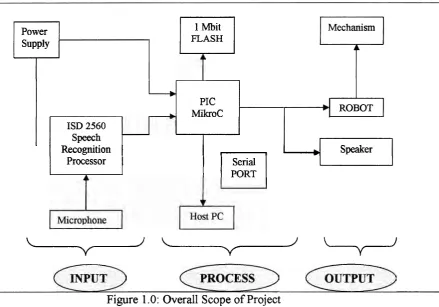
Figure 1 .O: Overall Scope of Project
The Figure 1.0 above shows the Overall Scope of Project which being covered in this Interactive Mobile Robot project using the speech recognition system. The input part consists of power supply, microphone as a main input signal, and also the storage voice data in the ISD 2590 (speech recognition processor). First of all, voices data are recorded in the speech recognition processor, ISD 2590 as command inputs to the system. Then, the input signal from the ISD 2590 is then being interfaced with the
PIC
16F877A Microcontroller to process the input signal data via the serial port host PC by synchronizing the signal wave voice. Thus the output data will be transformed in term of voices and gestures which has been programmed in the PIC 16F877A when there are any voices command input. In addition, the serial port host PC can show the input voice signal in words via the HyperTerminal once an input voice is given before it is processedMechanism Power
to give outputs.
1 Mbit
A
Supply FLASH
PIC
MikroC ROBOT
ISD 2560
Speech Recognition
Processor Serial
Speaker
1.5 Outline of Progress Report
This progress report consists of five chapters. The first chapter of this progress is
discussing the basic thing of this project like background, problems statement, objectives,
and also the scope. This chapter will review on the objectives that is hoped can be achieved from the statement of the problems. Then the second chapter will be starting
with the theory and literature review that has been research and studied that has been
done so far. In this chapter also, it discusses the use and the theory of hardware and
s o h a r e components. The theory is more on the comparison of the available hardware
components available in the market and which of them the best to be used. Next in Chapter 3, the methodology of this project will be discussed and explained which consists of two major part; software development and software development. In Chapter 4, the current or preliminary result is being discussed and explained as well as the expected
result which the result being expected at the end of this project. Finally in Chapter 5,
discussion, suggestion, and conclusion is being reviewed in this chapter. All problems
occurred during the progression in completing the project is discussed in the discussion
part. Then in suggestion and conclusion part, improvement for fbture project being
CHAPTER
2LITERATURE REVIEW
2.1 Introduction
Generally, a literature review is a summary body of the beginning research which
it is being aim to review the critical points of the whole body. It is done as to convey related knowledge and established ideas on a topic and also the strengths and weaknesses
of the research project. In this project, literature review has been conducted in order to
obtain the information on the current technology available and the methodology being
used by other researchers on the same topic or field all around the world. Basically, this
chapter provides the summary of literature reviews key points related to the speech
2.2 Speech Recognition System
Recently, there are two main types application of speech recognition system available in the market which are PC Based System and Embedded System or being called "stand alone system" which not interfacing with the PC (personal computer). As this technology grows rapidly, there are several of products for the PC Based System and also the Embedded System which come out with various features and characters [7]. This part will discuss about history, methodology, available products exist in the market, specifications, and its functions for both systems but in this project, it will be focused more on the embedded system speech recognition.
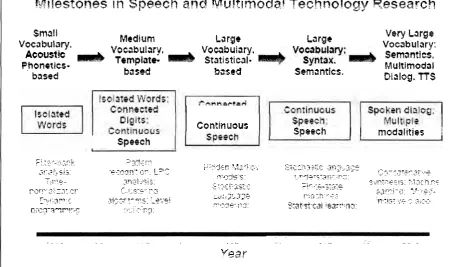
2.2.1 History and Methodology of Speech Recognition System Technology
fgilestones
in
Speech
a-std
~ ! ~ ! b i r l ? o d a ~
T@chnu!oqy
-.
R.esea!-c!?
Smaf t Medium Large Large Very Large
Vocabulary.
Vocabulttrv. Vowbuiary, Vocabulary:
AcDustic . . . ~ ~ ~ ~ iStatistical. ~ r ~ : Seman:icr,
qhonet ict- Multjmodai
based based based Semantics. Dialog. PTS
Concinueus
S p e c h modalities
Speech
~ ~ ~ , ~ . ~ . - . : : ) . ~ * ~ ~ , =:.-,-$.- .>..,:. ,-\-, . . ..
i2,-'.-lzc ?.> :
.;
,-;,; -,-= !, - : - . - - . * - . 2 - -,:.-,-. .- ., , 2!;r; -,,-. -?, >.-,,= -
?...<.:.-I!-\.: z : , ! . , L?:; :-I.. ' - 3 . .,. .,:!..,..
.-:, L ,,.>.!>. . .
, . - . . .. -
.
-.,-,-.>-IC'~: , r . r # - ..: - .-: .t ..>-:-!'2t,..*
- : ;:-,I.+- >?3.,?1 !.:i s: . . - ., -, ,-? . , , L +!I,: ,!-.::I
-.
, .
:?.-,,- I-.r:<=+ .7 -,.- .-;--..---.
.?,;{-,,:;-;c:!<. - . . . ..
3 . .., :<!. .I.:. 1 -. . . ,. 8 .- :. .. - , L L < . . ~
;-.,y:.-;:i z.3: ,:y )- - - ' , . . - . 5 . ,:-.- . ,-, >: ?,
-.. - -.- : - '. ;a;<-
>;.', : .>.., .! .." ?-.. :-> - h. ,. .: :
b . . . . . .
-,- .*.c * 7r,.. - . ' + T . * , : . . , ... , , . . .
r.., . ,..)
- / . : ..?. :1 .3 i'-. ..I> . . :. -. <'I.<
.,-.. -!.-.
.--<:,:!e' :::::: ;L'.?t.~i.,.,~: :c?'.' I.*. , ! :,,.: . .;? '-: :7 :-,>::
.. . -. .L, . . > .- - ~ , . , .j: .
r:,-;.l-?"?",,';r.
. ~ . . . I ' ;.- <>',,! :. I-:;?:
. . . .
. . .-
: . - . . . .. .. ~ . - . .
[image:24.522.35.492.423.690.2]Year