Polyprotein-Driven Formation of Two Interdependent Sets of
Complexes Supporting Hepatitis C Virus Genome Replication
Rafael G. B. Gomes,aOlaf Isken,bNorbert Tautz,bJohn McLauchlan,c Christopher J. McCormicka
Division of Clinical and Experimental Sciences and Institute for Life Sciences, Faculty of Medicine, University of Southampton, Southampton, UKa; Institute of Virology and Cell Biology, University of Lübeck, Lübeck, Germanyb; MRC-University of Glasgow Centre for Virus Research, Glasgow, UKc
ABSTRACT
Hepatitis C virus (HCV) requires proteins from the NS3-NS5B polyprotein to create a replicase unit for replication of its ge-nome. The replicase proteins form membranous compartments in cells to facilitate replication, but little is known about their functional organization within these structures. We recently reported on intragenomic replicons, bicistronic viral transcripts expressing an authentic replicase from open reading frame 2 (ORF2) and a second duplicate nonstructural (NS) polyprotein from ORF1. Using these constructs and other methods, we have assessed the polyprotein requirements for rescue of different lethal point mutations across NS3-5B. Mutations readily tractable to rescue broadly fell into two groupings: those requiring ex-pression of a minimum NS3-5A and those requiring exex-pression of a minimum NS3-5B polyprotein. Acis-acting mutation that blocked NS3 helicase activity, T1299A, was tolerated when introduced into either ORF within the intragenomic replicon, but unlike many other mutations required the other ORF to express a functional NS3-5B. Three mutations were identified as more refractile to rescue: one that blocked cleavage of the NS4B5A boundary (S1977P), another in the NS3 helicase (K1240N), and a third in NS4A (V1665G). Introduced into ORF1, these exhibited a dominant negative phenotype, but with K1240N inhibiting replication as a minimum NS3-5A polyprotein whereas V1665G and S1977P only impaired replication as a NS3-5B polyprotein. Furthermore, an S1977P-mutated NS3-5A polyprotein complemented other defects shown to be dependent on NS3-5A for res-cue. Overall, our findings suggest the existence of two interdependent sets of protein complexes supporting RNA replication, distinguishable by the minimum polyprotein requirement needed for their formation.
IMPORTANCE
Positive-strand RNA viruses reshape the intracellular membranes of cells to form a compartment within which to replicate their genome, but little is known about the functional organization of viral proteins within this structure. We have complemented protein-encoded defects in HCV by constructing subgenomic HCV transcripts capable of simultaneously expressing both a mu-tated and functional polyprotein precursor needed for RNA genome replication (intragenomic replicons). Our results reveal that HCV relies on two interdependent sets of protein complexes to support viral replication. They also show that the intragenomic replicon offers a unique way to study replication complex assembly, as it enables improved composite polyprotein complex for-mation compared to traditionaltrans-complementation systems. Finally, the differential behavior of distinct NS3 helicase knockout mutations hints that certain conformations of this enzyme might be particularly deleterious for replication.
E
xposure to hepatitis C virus (HCV) often results in chronic infection and can lead to liver-related mortality and morbid-ity. Intensive research efforts since the discovery of the virus have translated into improved patient care, with the recent advent of direct acting antiviral (DAA) therapy now providing high cure rates, particularly in genotype 1 (gt1)-infected patients (1). How-ever, certain aspects of viral replication remain poorly under-stood, including how viral proteins associate with each other and host proteins to form the platforms that support replication of the viral genome.HCV has a single-stranded, positive-sense RNA genome of 9.6 kb in length that contains a single open reading frame (ORF) flanked by 5=and 3=untranslated regions (UTRs) (2). Translation of the ORF is driven by an internal ribosome entry site (IRES) within the 5=UTR (3), resulting in the production of a polyprotein that is cleaved co- and posttranslationally by host- and virus-en-coded proteases to give rise to the mature viral proteins. The latter two-thirds of the polyprotein encompass the NS3-5B replicase unit (NS3, NS4A, NS4B, NS5A, and NS5B), which provides the viral proteins that are sufficient for genome replication (4). NS3 is the protease responsible for NS3-5B processing and also provides
essential helicase activity, encoded within its C-terminal domain (5). It is anchored to the endoplasmic reticulum (ER) membrane both by an amphipathic helix and by its protease cofactor NS4A (5). RNA polymerase activity is provided by NS5B (6). The func-tions of NS4B and NS5A are less well understood, although both proteins bind RNA (7,8).
In infected cells, viral RNA synthesis occurs in virus-induced
Received31 July 2015 Accepted21 December 2015
Accepted manuscript posted online30 December 2015
CitationGomes RGB, Isken O, Tautz N, McLauchlan J, McCormick CJ. 2016. Polyprotein-driven formation of two interdependent sets of complexes supporting hepatitis C virus genome replication. J Virol 90:2868 –2883.
doi:10.1128/JVI.01931-15.
Editor:J.-H. J. Ou
Address correspondence to Christopher J. McCormick, [email protected].
Supplemental material for this article may be found athttp://dx.doi.org/10.1128
/JVI.01931-15.
Copyright © 2016 Gomes et al. This is an open-access article distributed under the
terms of theCreative Commons Attribution 4.0 International license.
on November 7, 2019 by guest
http://jvi.asm.org/
cytoplasmic compartments referred to as membranous webs or membrane-associated foci (MAF) (9). Morphologically, these compartments appear as a collection of ER-derived single- and double-membrane vesicles (10). Current evidence points to the double-membrane vesicles as the site for polymerase activity and hence RNA replication (11). Expression of polyproteins encoding NS3-5A or NS3-5B leads to the formation of MAF-like structures in the absence of replication (10). Double-membrane vesicles are also present in cells expressing NS5A alone (10), and both drugs and mutations that target NS4B and NS5A disrupt MAF architec-ture (12–15); this suggests that NS4B and NS5A are key structural components of these assemblies.
Genetic complementation of mutations that block replication offers a way to gain insight into the functions of viral NS proteins in RNA replication. From early studies with gt1b replicons, most mutations in the HCV replicase were refractile to rescue, except for a few mutations in the low-complexity sequence 1 (LCS1) region between domains 1 and 2 in NS5A (16). Subsequent anal-ysis using replicons encoding strain JFH-1 (gt2a) sequences, which give higher levels of replication, revealed that mutations in other NS5A regions as well as NS4B mutations could be rescued, albeit less efficiently than LCS1 mutations (14,17). The range of mutations that can be rescued has recently been extended to in-clude NS3, NS4A, and NS5B by using Venezuelan equine enceph-alitis virus (VEEV) replicons to express high levels of NS3-5B (18). All of the above approaches have relied on supplying func-tional counterparts of proteins intransthat are expressed from separate transcripts to rescue defective NS3-5B replicase units. Recently, we reported an alternative system to complement dele-terious mutations using intragenomic HCV replicons that carry two ORFs (ORF1 and ORF2), each driven by separate IRES ele-ments. Thus, the complementing viral proteins are provided in transfrom distinct translation units but encoded incisfrom the same RNA molecule. Two advantages of our system were that (i) complementing proteins were translated to a level similar to that of their nonfunctional counterpart and (ii) functional and non-functional polyproteins could be translated in close apposition. Using this approach, enhanced rescue of defective NS5A contain-ing an S2208I mutation could be achieved by expresscontain-ing an NS3-5A cassette in ORF1 compared to expressing NS5A alone (19). Enhanced rescue of this defective NS5A also correlated with the ability of NS3-5A to target the protein to MAF. However, despite the efficiency with which NS3-5A targeted NS proteins to the MAF, both its ability and the capacity of helper viruses ex-pressing NS3-5B to complement NS4B defects remained limited. In this study, we set out to understand why rescue of certain mutations remained limited, despite efficient targeting of NS pro-teins to the MAF by NS3-5A using the intragenomic replicon sys-tem (19). By extending the capacity of ORF1 to express NS3-5B, our data reveal the existence of genetically distinguishable com-plexes that support HCV RNA replication.
MATERIALS AND METHODS
Cell lines.Generation of the SGR-JFH1neo replicon cell line (where SGR is subgenomic replicon) has been described, as has propagation of this cell line and naive Huh7.5 cells (19,20).
Plasmid vectors.The production of pFBM-based baculovirus con-structs for expression of JFH1 NS34A, green fluorescent protein (GFP)-tagged versions of JFH1 NS5A expressed either alone or in the context of NS3-5A and NS3-5B, pSGR-FLAG constructs containing G1911A and
S2208I mutations, and intragenomic replicon-containing plasmids pRep_R2NS5AV5/NS3-5BFLAG and pRep_R2NS3-5AV5/NS3-5BFLAG
with either a functional ORF2 or an ORF2 containing S2208I and G1911A have been described (19).
To extend intragenomic replicon ORF1 to express aRenilla -foot-and-mouth disease virus 2A (FMDV2A)-NS3-5B polyprotein containing a V5 epitope tag at the COOH terminus of NS5A, two 1,000-bp DNA strings (Invitrogen) representing an entire synonymous codon-altered NS5B se-quence⫹NS5A5B boundary and flanked at the 3=end by a stop codon, PmeI site and M13(⫺20) primer site were synthesized. These DNA strings along with LIT_Ren-2A-based vector containing the codon-altered NS3-5AV5sequence (LIT_Ren-2A-NS3-5AV5) (19) were used as the templates
in 3 separate PCRs involving primer pairs 1⫹2, 3⫹4, and 5⫹6 (see Table S1 in the supplemental material). All three products were combined in a second PCR with primers 1 and 6, and the resulting DNA was cloned back into LIT_Ren-2A-NS3-5AV5 via SalI and PmeI restriction sites, forming LIT_Ren-2A-NS3-5BV5 [for the codon-altered NS3-5B(5AV5)
sequence, see GenBank accession numberKR140016]. The Ren-2A-NS3-5BV5 expression cassette from this vector was cloned into existing
pRep_R2NS3-5AV5/NS3-5BFLAG-based vectors via BglII and PmeI
re-striction sites to generate pRep_R2NS3-5BV5/NS3-5BFLAG constructs,
where ORF2 either was functional or contained the⌬GDD, G1911A, or S2208I mutation. The terminology in the main body of text used to describe the transcripts generated from these constructs is wtNS3-5B/
wtNS3-5B, wtNS3-5B/⌬GDDNS3-5B, etc. (where wt is wild type).
To produce intragenomic replicons expressing 2A-NS34A, Ren-2A-NS5A5B, and Ren-2A-NS5B cassettes, LIT_Ren-2A-NS3-5BV5was
used as a template in a PCR with primers 7⫹8, 9⫹6, and 10⫹6, respectively. The resulting NS coding regions were transferred to a LIT_Ren-2A-based vector using RsrII and PmeI restriction sites to pro-duce NS34A, LIT_Ren-2A_NS5A5B, and LIT_Ren-2A-NS5B. The expression cassettes from these vectors were cloned into exist-ing intragenomic replicon-containexist-ing plasmids via BglII and PmeI restriction sites.
Introduction of the L1157A mutation into pSGR-FLAG (19) was through exchange of an Acc65I-SpeI restriction fragment with that con-tained within the pCITE-NS3-3=/JFH1 vector containing this same muta-tion (2). Introduction of the S1977P mutation into pSGR-FLAG was through exchange of an NsiI-RsrII restriction fragment with that present in pFBM(NS3-5AGFP)S1977P. Introduction of the other lethal mutations
into pSGR-FLAG relied on a two-step PCR using either JFH1 cDNA or pSGR-FLAG as the template. Appropriate flanking primers were used in combination with internal mutagenic primers 11 ⫹12 (for PP1220-1GG), 13⫹14 (for K1240N), 15⫹16 (for V1665G), 17⫹18 (for Y1706A), 19⫹20 (for S1977P), 21⫹22 (for P2008A), 23⫹24 (for GDD⬎GAA), 25⫹26 (T1299A), and 27⫹28 (G2313A). [Note that for the G2323A mutation, a JFH1 template with a small number of silent substitutions was used. This contained a change to the BamHI site within NS5A to GGGTCC and substitutions in a 10-nucleotide poly(C) tract adjacent to the mutagenized codon to allow an effective overlapping primer design. Fragments generated were cloned into pSGR-FLAG via ClaI and SpeI (K1240N), ClaI and NsiI (PP1220-1GG⫹T1299A), NsiI and RsrII (V1665G⫹Y1706A⫹P2008A⫹S1977P), SfiI and SnaBI (GDD⬎GAA), or BamH I and RsrII (G2313A). Transfer of mutations from pSGR-FLAG into ORF2 of intragenomic replicon-containing plasmids took advantage of a set of unique restriction sites in a region of sequence identity shared by the two constructs, between the start of the encephalomyocarditis virus (EMCV) IRES through to the end of the 3=UTR.
Mutations in ORF1 of plasmids containing the intragenomic replicons were introduced by a two-step PCR approach using LIT_Ren-2A-NS3-5AV5and/or LIT_Ren-2A-NS3-5BV5as the templates. Appropriate
flank-ing primers were used in combination with internal mutagenic primers 29⫹30 (for K1240N), 31⫹32 (for S1977P), 33⫹34 (for GDD⬎GAA), 35⫹36 (for T1299A), 37⫹38 (for G1911A), and 39⫹40 (for V1665G).
on November 7, 2019 by guest
http://jvi.asm.org/
The resultant DNA was cloned back into LIT_Ren-2A-NS3-5AV5and/or
LIT_Ren-2A-NS3-5BV5via either RsrII and MluI (K1240N), NdeI and
SalI (G1911A⫹S1977P), SalI and PmeI (GDD⬎GAA), or NotI⫹MluI (T1299A) restriction sites. The same approach was used to introduce the K1240N mutation into LIT_Ren-2A-NS34A, but with the PCR product being cloned back into this plasmid via RsrII and PmeI sites. The expres-sion cassettes from these vectors were cloned into existing intragenomic replicon-containing plasmids via BglII and PmeI restriction sites. In the case of the V1665G mutation, cloning was directly into the intragenomic vector via NotI⫹MluI.
To generate monocistronic replicons, pSGR-FLAG was used as a tem-plate in a PCR with primers 41 and 42, and the resulting product was cloned into pRep_R2NS3-5AV5/NS3-5BFLAGvia the two RsrII sites
pres-ent within the vector to generate pJFH1-mono (the DNA template for transcription of JFH1-mono). Both pRep_R2NS3-5BV5/NS3-5BFLAGand
pJFH1-mono were used as the templates in a two-step PCR with primer pairs 43⫹44 and 45⫹46. The resultant DNA, produced in the second-round reaction with primers 43 and 46, was cloned into pJFH1-mono via AscI and SalI sites to generate the pDVR/JFH1@7667-mono.
Sequence analysis.Analysis of the synonymous codon-altered se-quence to establish the CpG and UpA motif frequencies was performed using Simple Sequence Editor software (21).
Transient replication assays.Generation of T7 RNA transcripts and their electroporation into Huh7.5 cells or into Huh7.5 cells previously transduced with baculovirus has been described (19). For all assays except those looking at thetrans-dominant impact of K1240N on replication, cells were electroporated with 2g of RNA transcript. In the case of the latter set of assays, 1g of replication-competent JFH1-mono was trans-fected with 4g of either yeast tRNA or the replication-defective bicis-tronic SGR replicon. Cell lysates were harvested in 1⫻passive lysis buffer (Promega) up to 96 h posttransfection, and luciferase activity was mea-sured. Firefly andRenillaluciferase activities were measured using the Bright-Glo Luciferase Assay system (Promega) and Renilla Luciferase As-say kit (Biotium) according to the manufacturers’ recommendations. For graphical representation, the background signal from mixing passive lysis buffer only with luciferase reagent was subtracted from the raw data val-ues. On some occasions where different experiments containing multiple experimental groups were performed in parallel, control experimental groups were shared between experiments (indicated in figure legends).
Western blot analysis.Transfer of proteins to membranes and subse-quent detection have been described (19). The antibodies used were anti-NS3 (BioFront), anti-glyceraldehyde-3-phosphate dehydrogenase (anti-GAPDH; Chemicon), anti-V5 (gift from R. Randall, University of St. Andrews), anti-FLAG (Biolegend), and anti-GFP (Biolegend).
Indirect immunofluorescence.Seventy-two hours posttransfection, cells were fixed with methanol at⫺20°C for 30 min, rehydrated with phosphate-buffered saline (PBS), and blocked with PBS containing 2% fetal calf serum (PBS/FCS) for 10 min. Cells were then probed with an-ti-V5 and anti-FLAG antibodies for 1.5 h at room temperature, washed extensively with PBS/FCS, and finally incubated with anti-mouse-Alexa Fluor 594 and anti-rat-Alexa Fluor 488 for 1 h at room temperature. All antibody incubations were carried out in PBS/FCS. Cells were washed with PBS/FCS followed by PBS, rinsed with H2O, and then mounted with
Vectashield (Vector Laboratories) that contained DAPI (4= ,6-diamidino-2-phenylindole) to stain nuclei. Images were captured with a Zeiss LSM 710 confocal microscope.
Northern blot analysis.Cellular RNA, extracted using TriFAST re-agent (Peqlabs), was run on a formaldehyde-agarose gel and transferred by capillary action to a positively charged nylon membrane using standard procedures. DNA probes were biotinylated using the PlatinumBright la-beling kit (Kreatech). Hybridization was performed using Ultrahyb (Am-bion) according to the manufacturer’s instructions, and bound probe was detected using the Bright Star detection kit (Ambion) and film-based exposure.
RESULTS
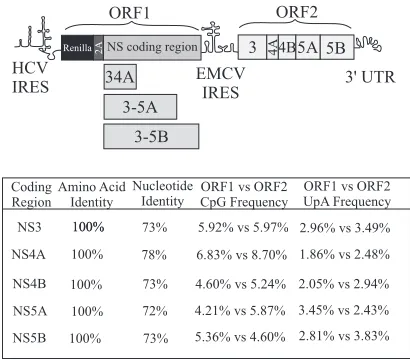
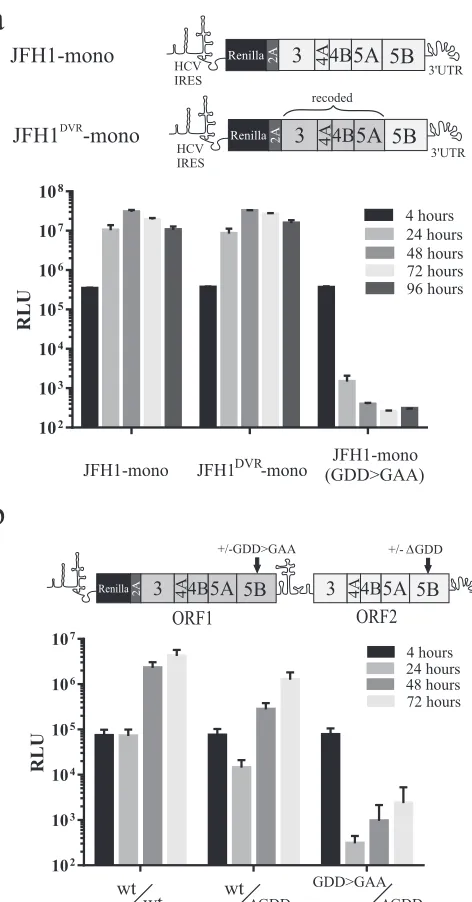
Replication of HCV RNA from two copies of the NS3-5B repli-case unit in a single RNA molecule.We recently described the use of intragenomic replicons as a novel system to perform HCV com-plementation assays (Fig. 1) (19). Using these constructs, we showed that the intracellular distribution of a V5-tagged NS5A, expressed from ORF1 as an NS3-5A polyprotein, extensively over-lapped a second copy of a FLAG-tagged NS5A produced from an ORF2-encoded replicase. Along with additional experimental data, the results were consistent with NS3-5A directing mature protein products from the polyprotein to MAF but did not ac-count for why expression of NS3-5A from ORF1 allowed rescue of constructs carrying only the NS5A S2208I mutation in ORF2 and not an NS4B G1911A mutation (the numbers refer to the position of the residue in the JFH1 polyprotein). One possible explanation was the existence of more than one type of NS protein complex within MAF such that NS3-5A, being an incomplete component of the full NS3-5B replicase, contributed to the formation of only some of these complexes. Two alternative explanations were that linking the ORF1 polyprotein to aRenilla luciferase-foot-and-mouth disease virus (FMDV) 2A fusion protein or the use of a recoded NS sequence in ORF1 impacted on polyprotein function. To examine these two possibilities, monocistronic replicons in which the NS3-5B replicase was expressed as aRenilla-FMDV2A fusion protein were generated (Fig. 2a). For one replicon, the NS protein coding region was derived from JFH1 (JFH1-mono), but for the other it was chimeric, consisting of the NS3-5A recoded region fused to JFH1 NS5B (JFH1DVR-mono). Expressed polypro-teins also encoded the same FLAG-tagged (JFH1-mono) and V5-tagged (JFH1DVR-mono) versions of NS5A present in ORF2 and ORF1 of the intragenomic replicon construct, the former already
Renilla 2ANS coding region 3 4A4B5A 5B
HCV
IRES 34A EMCVIRES 3' UTR
3-5A
3-5B
ORF1 ORF2
Coding Region
Amino Acid Identity
Nucleotide Identity
ORF1 vs ORF2 CpG Frequency
ORF1 vs ORF2 UpA Frequency
NS3
NS4A
NS4B
NS5A
NS5B 100% 100%
100%
100%
100%
100% 73%
78%
73%
72%
73%
5.92% vs 5.97%
6.83% vs 8.70%
4.60% vs 5.24%
4.21% vs 5.87%
5.36% vs 4.60%
1.86% vs 2.48%
2.05% vs 2.94%
3.45% vs 2.43%
2.81% vs 3.83% 2.96% vs 3.49%
FIG 1Schematic representation of the intragenomic HCV replicons used in this study. The HCV IRES in the 5=UTR drives translation of ORF1, which encodes the indicated NS polyproteins expressed as part of aRenilla-foot and mouth disease (FMDV) 2A fusion protein. An encephalomyocarditis virus (EMCV) IRES drives translation of the NS3-5B replicase in ORF2. When pres-ent, NS5A is expressed from ORF1 as a COOH-terminal V5 epitope-tagged protein. Constructs express NS5A from ORF2 as a FLAG-tagged protein. Cod-ing regions in ORF1 downstream fromRenilla2A represent recoded NS se-quences incorporating synonymous sequence alterations compared to the au-thentic viral counterpart sequence present in ORF2. The table compares the amino acid and nucleotide sequences as well as the CpG and UpA frequencies in ORF1 (synthetic sequence) and ORF2 (authentic viral sequences).
on November 7, 2019 by guest
http://jvi.asm.org/
[image:3.585.318.523.66.246.2]having been shown not to affect replicative function (19). The two replicons showed equally robust replication when trans-fected into cells, whereas a polymerase-defective control monocistronic construct containing a GDD⬎GAA mutation [JFH1-mono(GDD⬎GAA)] did not replicate (Fig. 2a). These data verify that neither the linking of a luciferase reporter to NS3-5B using FMDV 2A nor the use of recoded NS3-5A se-quence interferes with RNA replication. They also demonstrate that the presence of the V5 tag in recoded NS5A does not impair replicase function.
To determine whether intragenomic replicons could be adapted for identifying distinct replication complexes (RCs), we then extended NS3-5A in ORF1 to encode NS3-5B such that the synthetic NS5B sequence, similar to the upstream NS3-5A seg-ment, also contained synonymous changes across its coding re-gion. The strategy to introduce synonymous changes was aimed at limiting the possibility of recombination with NS3-5B in ORF2 and had the added advantage of preventing duplication ofcis -acting RNA elements (CREs) present in ORF2 (22,23). Transfec-tion of the resultant wtNS3-5B/wtNS3-5BRNA into Huh7.5 cells gave robust replication (Fig. 2b). To test whether the codon-modified NS3-5B sequences in ORF1 could direct replication, the GDD motif in the NS5B RNA polymerase in ORF2 was deleted (⌬GDD). The resultant intragenomic construct (wtNS3-5B/ ⌬GDDNS3-5B) gave luciferase activity at 72 h that was only about 3-fold lower than that of the replicon with wt sequences in ORFs 1 and 2. Combining another polymerase knockout mutation (GDD⬎GAA) in ORF1 with the⌬GDD mutation in ORF2 (giving GDD⬎GAANS3-5B/⌬GDDNS3-5B) blocked replication (Fig. 2b). These data demonstrate that it is possible to express two func-tional copies of the HCV NS3-5B replicase unit from a single RNA molecule.
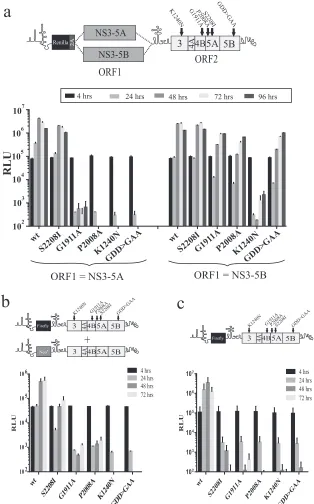
Mutations in NS3, NS4B, and NS5A that are refractile to res-cue with NS3-5A.To examine the effect of introducing other le-thal mutations into ORF2 of the intragenomic replicon, con-structs expressing either wt NS3-5A or NS3-5B from ORF1 and a series of NS3-5B replicases carrying single lethal mutations from ORF2 were made (Fig. 3). The first two of these mutations were the S2208I NS5A and G1911A NS4B mutations from our previous study (19), in which only S2208I could be complemented by NS3-5A expressed from ORF1. The third was another mutation in NS5A (P2008A), previously reported to be rescued bytrans -plementation and chosen because it belonged to a different com-plementation group from the S2208I mutation (17). The final mutation was K1240N, located in the Walker A motif of the NS3 helicase and which blocks helicase activity by preventing nucleo-side triphosphate (NTP) binding.
This series of replicons and relevant polymerase-defective con-trol constructs (wtNS3-5A/GDD⬎GAANS3-5B) were transfected into Huh7.5 cells, and luciferase activity was monitored over a 96-h period (Fig. 3). Replication was slightly lower for wtNS3-5B/ wtNS3-5Bthan for wtNS3-5A/wtNS3-5B, which may have been due to the increased length of the RNA from incorporating NS5B se-quences into ORF1 of wtNS3-5A/wtNS3-5B. As predicted, wtNS3-5A/ GDD⬎GAANS3-5Bdid not replicate, as the RNA expresses only a nonfunctional virus-encoded RNA polymerase. Similar to the re-sults from wtNS3-5B/⌬GDDNS3-5B shown in Fig. 2, wtNS3-5B/ GDD⬎GAANS3-5Balso showed robust replication. Results with the constructs containing other mutations in ORF2 revealed dif-ferences in replication between the experimental groups (Fig. 3a). For the series of constructs expressing NS3-5A from ORF1, only the one carrying S2208I showed robust replication, whereas rep-lication of constructs carrying all other mutations (G1911A, P2008A, and K1240N) was absent. When ORF1 expressed NS3-5B instead, the relative replication of the construct with S2208I in ORF2 was enhanced compared to its wt counterpart, but more noticeable were the differences in replication for those constructs carrying the other mutations in ORF2. Constructs with P2008A and G1911A mutations replicated as well as had been observed for wtNS3-5B/GDD⬎GAANS3-5B. In theory, this was consistent with
Renilla 2A
3
4A4B5A 5B
JFH1-mono
Renilla 2A
3
4A4B5A 5B
JFH1
DVR-mono
a
Renilla 2A
b
ORF1 ORF2
HCV
IRES 3'UTR
recoded HCV
IRES 3'UTR
102 103 104 105 106 107 108
RL
U
4 hours 24 hours 48 hours 72 hours 96 hours
JFH1-mono JFH1DVR-mono (GDD>GAA)JFH1-mono
102 103 104 105 106 107
RL
U
4 hours 24 hours 48 hours 72 hours
3 4A4B5A 5B
3 4A4B5A 5B
+/-GDD>GAA +/- GDDΔ
wt
wt wtΔGDD
GDD>GAA
ΔGDD
FIG 2Replication of constructs expressing NS3-5B as aRenilla-FMDV 2A fusion protein. Replication was assessed using both monocistronic (a) and intragenomic (b) replicon constructs. The schematic above each graph indi-cates the regions of NS3-5B encoded by the recoded and authentic JFH1 cod-ing sequences for each construct. Data represent the means⫾standard devi-ations (SD) from two independent experiments (a) and means⫾standard errors of the means (SEM) from three independent experiments (b).
on November 7, 2019 by guest
http://jvi.asm.org/
[image:4.585.47.283.68.519.2]the ability of ORF1 NS3-5B simply substituting for the functional replicase produced from ORF2 NS3-5B. However, the same phe-nomenon was not observed for the K1240N mutation, as replica-tion of this construct was markedly impaired, with luciferase ac-tivity barely detected even at 72 and 96 h posttransfection. Thus, while replication of intragenomic constructs carrying functional NS3-5B in ORF1 and defective NS3-5B in ORF2 might in part
depend on a replacement of the ORF2 replicase by that encoded by ORF1, polyprotein mixing and composite RC formation appeared to occur also.
To compare how levels of rescue might differ usingtrans -com-plementation, a stable replicon cell line expressing functional NS3-5B was transfected with a bicistronic subgenomic replicon encoding a firefly luciferase reporter in ORF1 and a functional or
3 4A4B5A 5B
Renilla 2A
NS3-5B
ORF1
NS3-5AORF2
K1240N G191 1A P2008AS2208I
GDD>GAA
wt
S2208I G1911A P2008A K1240N
GDD> GAA
102 103 104 105 106
RL
U
4 hrs 24 hrs 48 hrs 72 hrs
a
3 4A4B5A 5B
Firefly
G191 1A K12
40N P200
8A S220 8I
GDD >GA
A
3 4A4B5A 5B
NeoR
+
Firefly 3 4A4B5A 5BG191 1A K124
0N P200
8A S220 8I
GDD >GA
A
wt
S2208I G1911A P2008A K1240N GDD>
GAA
102 103 104 105 106 107
RL
U
4 hrs 24 hrs 48 hrs 72 hrs
b
c
ORF1 = NS3-5A
ORF1 = NS3-5B
wt
S2208I G1911A P2008 A
K1240N GDD>
GAA wt S2208I
G1911A P2008A K1240N GDD>
GAA 102
103
104
105
106
107
RL
U
4 hrs 24 hrs 48 hrs 72 hrs 96 hrs
wt
S2208IG191 1A
P2008AK1240N
GDD>GAA
107
106
105
104
103
102
wt
S2208IG191 1A
P2008AK1240N
GDD>GA A
RLU
4 hrs 24 hrs 48 hrs 72 hrs 96 hrs
FIG 3Assessing the capacity of ORF1 polyproteins to support replication of intragenomic replicons with different defects in ORF2 and recue of the same defects bytrans-complementation. (a) Replication assay data of intragenomic replicons expressing functional NS3-5A or NS3-5B in ORF1 and expressing NS3-5B carrying a lethal mutation in ORF2 as defined in the schematic above the graph. (b and c) These mutations were introduced into bicistronic replicons expressing firefly luciferase in ORF1, and the capacity of these constructs to replicate was assessed in a stable neomycin-resistant (Neor) helper replicon cell line (b) or in naive Huh7.5 cells (c). Data represent the means⫾SD from two independent experiments.
on November 7, 2019 by guest
http://jvi.asm.org/
[image:5.585.135.449.68.572.2]mutated (NS3K1240N, NS4BG1911A, NS5AP2008A, NS5AS2208I, and NS5BGDD⬎GAA) NS3-5B polyprotein in ORF2. Consistent with reports from other studies, robust rescue of only NS5AS2208Iwas observed, with levels of luciferase activity being approximately 10% of those levels seen for the functional control construct (Fig. 3b). Other mutations were rescued either at a low level (NS4BG1911A and NS5AP2008A) or not at all (NS3K1240N and NS5BGDD⬎GAA). As expected, none of the mutated transcripts replicated when transfected into naive Huh7.5 cells (Fig. 3c).
NS3 helicase mutation K1240N is dominant negative.The inability to rescue the NS3 K1240N mutation in ORF2 using structs in which ORF1 expressed wt NS3-5B was potentially con-sistent with the formation of composite NS protein complexes where the mutation in the NS3 helicase had a dominant negative effect on replication. To test this, the K1240N mutation was
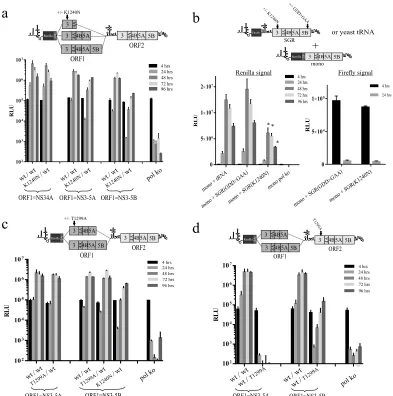
intro-duced into ORF1 of the intragenomic replicon carrying a func-tional NS3-5B in ORF2 and the impact on replication was assessed (Fig. 4a). To maximize the utility of the intragenomic system, the constructs examined included those expressing NS34A, NS3-5A, and NS3-5B from ORF1, with these polyproteins containing both wt sequences and the K1240N mutation.
From monitoring luciferase levels in cells transfected with the var-ious constructs, K1240NNS34A/wtNS3-5Bhad levels of replication com-parable to those of its counterpart expressing functional NS34A from ORF1 (Fig. 4a). In contrast, expressing the K1240N mutation from NS3-5A ORF1 (K1240NNS3-5A/wtNS3-5B) gave a noticeable drop in replication of approximately 10-fold in the first 48 h compared to wtNS3-5A/wtNS3-5B, although replication recovered to some extent at later time points. The impact of expressing K1240N from the NS3-5B ORF1 was even greater, with replication levels⬃20- to 30-fold lower 3 4A4B5A 5B
Renilla2A
ORF1
ORF2 +/- K1240N
ORF1=NS34A ORF1=NS3-5A ORF1=NS3-5B wt K1240N wt K1240N wt K1240 N
pol k o 102 103 104 105 106 107 U L R 4 hrs 24 hrs 48 hrs 72 hrs 96 hrs K1240N / wt wt/ wt
K1240N / wt wt/ w
t
K1240N / wt
wt/ wt pol ko
3 4A
3 4A4B5A
3 4A4B5A 5B
3 A44B5A 5B
Firefly +/- K
1240N
Renilla2A3 A44B5A 5B
+/- G DD>G
A A
or yeast tRNA
+
* * *
mono + tRN
A
mono + SGR
(GDD >GAA
)
mono + SGR
(K12 40N)
mono pol k
o 0
5 106 1 107 2 107
U L R 4 hrs 24 hrs 48 hrs 72 hrs 96 hrs mono + SGR
(GDD >GAA
)
mono + SGR
(K124 0N)
0
5 104
1 105
U
L
R
4 hrs 24 hrs
Renilla signal Firefly signal
SGR mono wt T129 9A wt T129 9A K124 0N
pol k o 102 103 104 105 106 107 UL R 4 hrs 24 hrs 48 hrs 72 hrs 96 hrs ORF1=NS3-5A ORF1=NS3-5B T1299A / wt wt/ w
t
T1299A / wt wt/ w
t
K1240N / wt
pol ko wt K
1240
N wt
1240 N
pol k o 102 103 104 105 106 107 UL R 4 hrs 24 hrs 48 hrs 72 hrs 96 hrs
3 A44B5A 5B
Renilla2A
ORF1
ORF2 T1299A
3 4A4B5A
3 4A4B5A 5B 3 4A4B5A 5B
Renilla2A
ORF1
ORF2 3 4A4B5A
3 4A4B5A 5B
+/- T1299A
wt T129
9A
pol k o
ORF1=NS3-5A ORF1=NS3-5B
wt /
T1299A
wt / wt wt K pol ko T129
9A
wt /
T1299A
wt / wt
a
b
c
d
FIG 4Impact of single helicase point mutations K1240N and T1299A on replicon replication. Schematics above the graphs provide details of the constructs used and the positioning of mutations within them. Replication assays either employed a single intragenomic replicon construct per experimental group transfected into Huh7.5 cells (a, c, d) or involved cotransfection of two separate RNAs into naive Huh7.5 cells to assess whether K1240N was dominant negative intrans(b). Results shown from the latter assay also include the firefly signal at 4 and 24 h derived from the replication-defective constructs used. Data represent the means⫾SD (a, c, d) or means⫾SEM (b) from 2 and 3 independent experiments, respectively. Wheren⫽3, values significantly different from the control group (mono⫹tRNA) are highlighted with an asterisk (P⬍0.05; 2-tailedttest). Note: the assay performed to obtain the data in panel d was run in parallel with another described in the legend toFig. 8e, and so they share control groups.
on November 7, 2019 by guest
http://jvi.asm.org/
[image:6.585.96.489.66.462.2]than those of the comparable control construct during the first 48 h and remaining low over the course of 96 h.
To establish whether a K1240N mutated polyprotein could suppress replication when expressed from a separate RNA, JFH1-mono was cotransfected into Huh7.5 cells with either yeast tRNA or bicistronic subgenomic replicons carrying a firefly luciferase reporter gene in ORF1 and K1240N- or GDD⬎GAA-mutated NS3-5B in ORF2 (Fig. 4b). Monitoring firefly luciferase activities in the cells 4 h and 24 h posttransfection showed that the two bicistronic replication-defective transcripts were present at broadly similar levels and exhibited similar rates of decay. Despite this, the replication of JFH1-mono was significantly inhibited in the presence of K1240N NS3-5B (replication was⬃30 to 55% of that of the tRNA group over 24 to 96 h). In contrast, inhibition was not seen in the presence of GDD⬎GAA-mutated NS3-5B, indicating that reduced replication imposed by K1240N was not due to competition between NS proteins for limited host cell factors (24).
Intragenomic replicon replication of constructs carrying the T1299A helicase mutation differs from those carrying the K1240N mutation.Kazakov et al. (18) recently proposed NS3 helicase activity to becis-acting on the basis that several mutations blocking NS3 helicase activity could not betrans-complemented using various systems expressing NS3-5B. However, the fact that K1240N imposed atrans-dominant negative phenotype on repli-cation offered a potential alternative explanation as to why rescue of helicase mutations had not been observed. It was therefore im-portant to examine whether another mutation, T1299A, which disrupts helicase binding to the phosphate backbone of nucleic acid and used in the aforementioned study, might also be domi-nant negative. Hence, T1299A was introduced into ORF1 in a series of intragenomic replicons, and the impact it had on ORF2 replicase activity was assessed by comparing the replication of these constructs with that of their counterparts expressing func-tional polyprotein from ORF1. Remarkably, replication was un-affected by the presence of T1299A, irrespective of whether it was expressed from ORF1 NS3-5A or NS3-5B polyproteins (Fig. 4c). In contrast, a control transcript expressing K1240N from NS3-5B ORF1 did show suppressed replication.
If T1299A was not dominant negative, as our data suggested, this provided an opportunity to examine the extent to which ORF1 could replace the cis-acting role of ORF2. Therefore, T1299A was introduced into ORF2 of an intragenomic replicon expressing functional NS3-5A or NS3-5B from ORF1. Transfec-tion of these transcripts into Huh7.5 cells revealed that while rep-lication was not supported by ORF1 expressing NS3-5A, replica-tion was detected with the construct expressing funcreplica-tional NS3-5B from ORF1 (Fig. 4d). We conclude that while NS3 heli-case activity is likely to be acis-acting function of the replicase, mutations disrupting this activity can manifest additional pheno-types, as seen with K1240N exerting a dominant negative effect on replication. We further conclude that ORF1 NS3-5B can substi-tute forcis-acting functions normally provided by the authentic NS3-5B replicase expressed from ORF2.
Establishing that NS4B, NS5A, and NS5B mutations depend on NS3-5B for rescue.The data above indicated that NS3-5B ex-pressed from ORF1 of an intragenomic replicon was capable of replacing thecis-acting functions of ORF2. To further exploit the potential of the intragenomic replicon system, mutations were introduced into wtNS3-5B/wtNS3-5Bin different combinations and
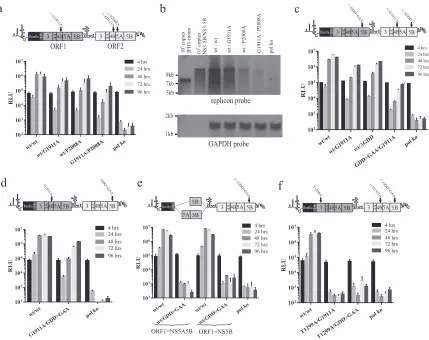
permutations. Initially, we placed the NS4B G1911A mutation in ORF1 and the NS5A P2008A mutation in ORF2 to create G1911ANS3-5B/P2008ANS3-5B. RNA from this construct and other controls was transfected into Huh7.5 cells, and replication was assessed by measuring luciferase activity (Fig. 5a). The pattern of reporter activity for wtNS3-5B/wtNS3-5B, wtNS3-5B/G1911ANS3-5B, and wtNS3-5B/P2008ANS3-5Bwas identical to that seen inFig. 3. Interestingly, G1911ANS3-5B/P2008ANS3-5Balso replicated at levels that were only about 3-fold less than that for either wtNS3-5B/ G1911ANS3-5B or wtNS3-5B/P2008ANS3-5B, in contrast to GDD⬎GAANS3-5B/⌬GDDNS3-5B, which did not replicate. North-ern blot analysis (Fig. 5b) revealed that RNA identical in length to in vitro-transcribed wtNS3-5B/wtNS3-5Btranscripts was clearly pres-ent in cells 72 h after transfection with wtNS3-5B/wtNS3-5B, wtNS3-5B/ G1911ANS3-5B, and wtNS3-5B/P2008ANS3-5B. A similar-sized band, albeit at a very reduced level, was also seen in cells transfected with G1911ANS3-5B/P2008ANS3-5B. No obvious band of this size was observed in cells transfected with the polymerase knockout con-trol intragenomic replicon. As neither G1911A nor P2008A could be rescued by NS3-5A, we conclude that composite complexes must have formed from the mixing of two defective NS3-5B poly-proteins.
Rescue of replication is proposed to occur through the ex-change of NS proteins between individual polyprotein-derived complexes (18). However, published data suggest that rescue of NS5B defects instead depends on strand exchange, a process where the viral RNA transfers from an NS5B-containing complex derived from one NS3-5B ORF to another NS5B-containing com-plex derived from a second NS3-5B ORF (18). Under such cir-cumstances, NS3-5B provided intransis able to rescue polymerase defects only if it itself carries no lethal mutations. Our intrag-enomic replicon system provided an opportunity to examine the rescue of defective NS5B under conditions where two polypro-teins were translated from the same RNA. Therefore, constructs in which the NS4B mutation G1911A was combined with the polymerase knockout mutation GDD⬎GAA were made, to give GDD⬎GAANS3-5B/G1911ANS3-5B(Fig. 5c). This construct replicated at lower levels than wtNS3-5B/wtNS3-5B or single-mutated control constructs wtNS3-5B/G1911ANS3-5Band wtNS3-5B/ GDD⬎GAANS3-5Bbut still generated a luciferase signal 100-fold higher than that of the replication-defective construct GDD⬎GAANS3-5B/⌬GDDNS3-5B. The two mutations were subse-quently switched between ORF1 and ORF2, resulting in the gen-eration of G1911ANS3-5B/GDD⬎GAANS3-5B. Again, low but de-tectable levels of replication were seen in cells transfected with this replicon (Fig. 5d). The fact that both GDD⬎GAANS3-5B/ G1911ANS3-5Band G1911ANS3-5B/GDD⬎GAANS3-5Breplicate fur-ther supports the view that ORF1 and ORF2 within the intragenomic replicon are each capable of contributing replicasecis-acting func-tions. To confirm that rescue of a polymerase defect incisrequired NS5B to be expressed in the context of a polyprotein, intragenomic replicons were made expressing NS5B or NS5A5B in ORF1 and en-coding either a functional or polymerase-defective replicase in ORF2 (Fig. 5e). Upon transfection into Huh7.5 cells, only those constructs encoding a functional NS3-5B in ORF2 replicated, indicating that rescue of polymerase activity is indeed dependent on expression of functional NS5B in the context of a polyprotein, most probably NS3-5B.
Having established that G1911A and GDD⬎GAA were depen-dent on NS3-5B for rescue, we combined these mutations in ORF2
on November 7, 2019 by guest
http://jvi.asm.org/
with the helicase mutation T1299A in ORF1. Interestingly, trans-fection of the resulting transcripts into Huh7.5 cells revealed that neither combination of mutations supported intragenomic replicon replication (Fig. 5f). Thus, despite evidence that com-posite replication complexes are formed between NS3-5B ex-pressed from both ORFs, it appears that neither G1911A- nor GDD⬎GAA-mutated NS3-5B can substitute for thecis-acting role of a T1299A mutated polyprotein. The implications of this are discussed later, but these data suggest that each NS3-5B polyprotein that contributes to functional NS3-5B-dependent complex formation requires helicase activity.
Overall, our results show that complementation of some mu-tations in the NS3-5A region is indeed dependent on NS3-5B. The data also further support the notion that ORF1 can substitute for ORF2cis-acting interactions and that helicase activity provided both incisand intransis critical for NS3-5B-dependent complex formation.
Lethal mutations in NS3 and NS4A that can be rescued in the intragenomic system exist.The above data indicated that all NS3 mutations that blocked helicase activity were refractile to comple-mentation. To determine whether this was representative of all mutations in NS3 and its cofactor NS4A, we selected four further
mutations in these proteins that were lethal to replication but did not cause defective polyprotein processing (25–28). Two muta-tions were in NS3, mapping to the protease domain (L1157A) and hinge region between the protease and helicase domains (PP1220-1GG), respectively. The other two mutations were situated at ei-ther end of NS4A (V1665G and Y1706A), the former locating to and disrupting NS4A transmembrane dimerization and the latter representing an essential conserved residue within the acidic do-main of NS4A.
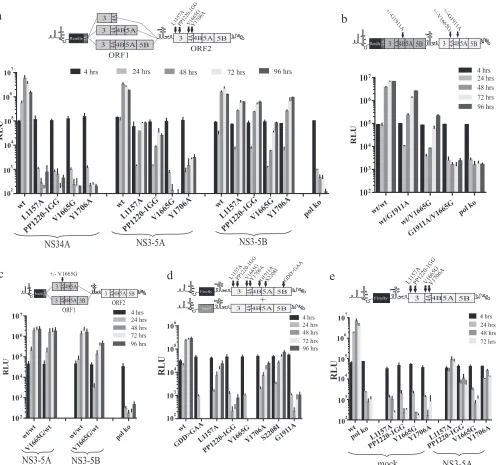
The mutations were introduced into ORF2 of intragenomic replicons that expressed NS34A, NS3-5A, or NS3-5B from ORF1. All constructs expressing NS34A were replication defective (Fig. 6a). In contrast, three of the constructs (L1157A, PP1220-1GG, and Y1706A) replicated when ORF1 expressed NS3-5A instead; luciferase values indicated that L1157A was rescued most effi-ciently, followed by PP1220-1GG and then Y1706A. When ORF1 expressed NS3-5B, replication occurred for all four mutations. For L1157A, PP1220-1GG, and Y1706A, levels of replication were broadly comparable, while they were lower but still detectable for V1665G. To establish whether the latter mutation was rescuable in an NS3-5B-dependent manner, the mutation was introduced into ORF2 of an intragenomic construct expressing an NS4B
G1911A-Renilla 2A 3 4A4B5A 5B 3 4A4B5A 5B +/ -GDD +/-G191 1A +/-GDD>GAA
Renilla2A3 4A4B5A 5B 3 4A4B5A 5B GDD >G A A G191 1A
3 4A4B5A 5B
Renilla2A 5A 5B 5B GDD>GAA ORF1=NS5A5B ORF1=NS5B
e
d
Renilla2A ORF1 ORF23 4A4B5A 5B 3 4A4B5A 5B
+/-P2008A +/-G19 11 A +/-G191 1A
a
b
9kb 5kb 7kb 2kb 1kb GAPDH probe replicon probe wt/wt wt/G19 11A wt/P20 08A G1911 A/P2008A polko
102 103 104 105 106 107 RL U 4 hrs 24 hrs 48 hrs 72 hrs 96 hrs wt/wt wt/G1 911A wt/GD D GDD> GAA/G
1911A polko
102 103 104 105 106 107 RL U 4 hrs 24 hrs 48 hrs 72 hrs 96 hrs
c
10 copies
7 JFH 1-mono 10 cop ie s 7 NS 3 -5 B/N S 3 -5 B wt / w t
wt / G191
1A
wt / P2008A G191
1A / P2008A po l k o wt/wt T1299 A/G191 1A T1299 A/GDD
>GAA polko
102 103 104 105 106 107 RL U 4 hrs 24 hrs 48 hrs 72 hrs 96 hrs
Renilla 2A 3 4A4B5A 5B 3 4A4B5A 5B +/-GDD>GAA +/-G191 1A T1299A
f
wt/wt G1911A /GDD>GAA polko
102 103 104 105 106 107 RL U 4 hrs 24 hrs 48 hrs 72 hrs 96 hrs wt/wt wt/GD D>GA A wt/wt wt/GD D>GA A polko 102 103 104 105 106 107 RL U 4 hrs 24 hrs 48 hrs 72 hrs 96 hrs
FIG 5Analysis of mutations using the intragenomic replicon and assessing their dependency on NS3-5B for rescue. The selection of mutations was on the basis that they were refractile to rescue with ORF1 NS3-5A when present in ORF2 but tolerant when ORF1 instead expressed NS3-5B. These mutations were introduced into intragenomic replicons in various combinations, and replication assays were performed. Schematics above each graph (a, c, d, e, f) provide details of the constructs used and the positioning of mutations within them. Also shown are Northern blot data (b) using total cellular RNA taken from a replication assay (a). Data represent the means⫾SD from two separate experiments. pol ko, polymerase knockout.
on November 7, 2019 by guest
http://jvi.asm.org/
[image:8.585.79.508.66.406.2]mutated NS3-5B from ORF1. For comparison, constructs ex-pressing wt NS3-5B from ORF1 and V1665G- or G1911A-mu-tated NS3-5B from ORF2 were included. Transfection into Huh7.5 cells revealed that for those constructs carrying only a single mutation in ORF2, V1665G had a more inhibitory effect on replication than did G1911A (Fig. 6b). The replicon carrying G1911A in ORF1 and V1665G in ORF2 did not replicate. The fact that wtNS3-5B/V1665GNS3-5Breplicated at a noticeably lower level than wtNS3-5B/G1911ANS3-5Bsuggested that V1665G might exert a
dominant negative phenotype. To establish whether this was the case, the mutation was introduced into NS3-5A or NS3-5B ex-pressed from ORF1 (Fig. 6c), and the replication of these intrag-enomic constructs was compared to the equivalent constructs expressing functional NS3-5A and NS3-5B from ORF1. Inter-estingly, the presence of V1665G in ORF1 suppressed replica-tion compared to equivalent constructs expressing funcreplica-tional polyprotein, but only when ORF1 encoded NS3-5B. It therefore appears that V1665G is dominant negative but, unlike the 3 4A4B5A 5B
Renilla 2A
ORF1 ORF2
3 4A
3 4A4B5A 3 4A4B5A 5B
L1157APP1220-1G
G
V1665GY1706A
3 4A4B5A 5B Firefly
L1157APP1220-1G G V1665GY1706A mock NS3-5A wt/wt wt/G1 911A wt/V1 665G G1911 A/V166 5G polko 102 103 104 105 106 107 RL U 4 hrs 24 hrs 48 hrs 72 hrs 96 hrs
Renilla 2A 3 4A4B5A 5B 3 4A4B5A 5B +/-V1665G +/-G191 1A +/-G191 1A wt/wt V1665
G/wt wt/wt
V1665
G/wt polko
102 103 104 105 106 107 RL U 4 hrs 24 hrs 48 hrs 72 hrs 96 hrs 3 4A4B5A 5B Renilla 2A
ORF1
ORF2
3 4A4B5A
3 4A4B5A 5B
+/- V1665G
b
c
NS3-5A NS3-5B
d
e
NS34A NS3-5A NS3-5B
2 3 4 5 6
7 4 hrs 24 hrs 48 hrs 72 hrs 96 hrs
wt L1157A PP1220-1G G V1665GY1706A wt L1157A PP1220-1G G V1665GY1706A wt L1157A PP1220-1G G
V1665GY1706A pol ko
107 106 105 104 103 102 RL U
4 hrs 24 hrs 48 hrs 72 hrs 96 hrs
6 7 106 103 102 RLU 107 105 104 4 hrs 24 hrs 48 hrs 72 hrs wt
pol koL1157A PP1220
-1GG
V1665GY1706AL1157A PP1220
-1GG V1665GY1706A
wt
GDD>
GAAL1157A
PP122
0-1GGV1665GY1706AS2208IG1911A
102 103 104 105 106 RL U 4 hrs 24 hrs 48 hrs 72 hrs 96 hrs L1157A PP1220-1G G V1665GY1706AS2208IG191 1A wt GDD>G AA 106 103 102 RLU 105 104 4 hrs 24 hrs 48 hrs 72 hrs 96 hrs 3 4A4B5A 5B Firefly
3 4A4B5A 5B
NeoR
+
L1157APP1220-1G G
V1665GY17
06A G19 11A S22 08I GDD> GA A
a
FIG 6Rescue of lethal mutations in NS3 and NS4A that disrupt processes other than NS3 helicase activity. Genetic complementation of genetic defects was assessed in a variety of ways, including use of intragenomic replicons transfected into Huh7.5 cells (a, c) or using bicistronic replicon expressing firefly luciferase from ORF1 transfected into either a helper replicon cell line (d) or into naive Huh7.5 cells transduced with either baculovirus expressing NS3-5A or -galacto-sidase (mock control) (e). Intragenomic replicons were also used to assess whether V1665G, which appeared refractile to rescue with NS3-5B, was dominant negative (c). Schematics above each graph provide specific details of the constructs used and the positioning of mutations within them. Data represent the means⫾SD from two separate experiments.
on November 7, 2019 by guest
http://jvi.asm.org/
[image:9.585.47.545.67.532.2]K1240N NS3 helicase mutation, manifests this phenotype only when expressed in the context of a full-length replicase.
To compare the levels of rescue with that seen usingtrans -complementation, all four mutations were introduced into a bi-cistronic subgenomic replicon encoding a firefly luciferase re-porter in ORF1. A stable cell line expressing a functional replicon was transfected with these constructs along with control con-structs carrying the GDD⬎GAA, G1911A, and S2208I mutations to allow comparisons to be made with earlier experiments (Fig. 6d). Other than GDD⬎GAA and V1665G, all mutations showed some degree of complementation. For the NS3 mutation L1157A and NS4A mutation Y1706A, levels of rescue were only slightly less than that observed for the NS5A mutation S2208I. In contrast, rescue of the other NS3-5A dependent mutation in NS3, PP1220-1GG, was lower and comparable to that seen for the NS3-5B-dependent mutation G1911A in NS4B. None of the mutated con-structs replicated when transfected into naive Huh7.5 cells (data not shown). It was interesting that Y1706A was rescued as effi-ciently as L1157A given the limited extent to which the former mutation was rescued by NS3-5A when expressed from ORF1 of an intragenomic replicon. We therefore transfected the same fire-fly replicon constructs into Huh7.5 cells transduced with baculo-virus expressing NS3-5A (Fig. 6e). While the data confirmed that rescue of L1157A, PP1220-1GG, and Y1706A required expression of a minimum NS3-5A polyprotein, these levels were reasonably comparable for L1157A and Y1706A, similar to the situation using helper replicons.
We conclude that as in NS5A, there are mutations in NS34A capable of being rescued by a minimum NS3-5A precursor whereas others are not. The rescue of mutations dependent on a minimum NS3-5A polyprotein is possible when this protein is expressed in cis from ORF1 or in trans from a separate mRNA.
Blocking NS4B5A cleavage impacts only on functions within complexes dependent on NS3-5B expression.Since cleavage be-tween NS4B and NS5A by NS3/4A is slower than at other bound-ary sites in the NS3-5B polyprotein, we and others have proposed that the presence of an NS4B5A precursor within a complex des-tined to form the RC might serve as a checkpoint to prevent pre-mature membrane deformation events linked to RC maturation (29,30). Given our data suggesting that NS3-5A and NS3-5B pro-vide differential access to different NS protein complexes sup-porting replication, we were interested to know the impact that blocking cleavage of NS4B5A would have in the context of the intragenomic replicon system.
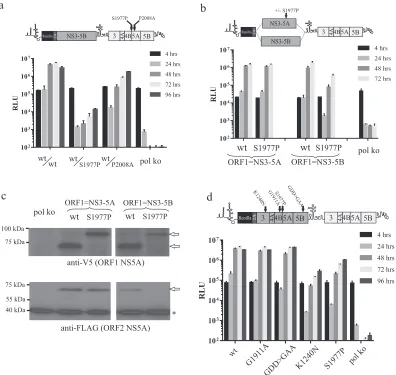
In the first instance, an NS5A mutation, S1977P, designed to block NS4B5A boundary cleavage, was introduced into ORF2 of an intragenomic replicon expressing NS3-5B in ORF1. Transfec-tion of this construct into Huh7.5 cells showed that, compared to a control construct carrying the NS5A P2008A mutation in ORF2, replication was considerably impaired (Fig. 7a). S1977P was then introduced into NS3-5A or NS3-5B expressed from ORF1 of an intragenomic replicon (Fig. 7b). As was observed for the K1240N and V1665G mutations, NS3-5B expressed from ORF1 carrying the S1977P mutation measurably impaired replication (Fig. 7b). Similar to the V1665G mutation but unlike the K1240N mutation, S1977P failed to inhibit replication when expressed from ORF1 in the context of NS3-5A. Western blot analysis confirmed the presence of uncleaved NS4B5A from ORF1 in cell extracts from cells transfected with S1977PNS3-5A/wtNS3-5Band S1977PNS3-5B/
wtNS3-5B(Fig. 7c). These data suggested that S1977P had domi-nant negative activity, albeit only when expressed in the context of NS3-5B. This was verified by comparing the impact that K1240N, S1977P, G1911A, and GDD⬎GAA mutations in ORF1 had on replication (Fig. 7d). Critically, only K1240N and S1977P mark-edly suppressed replication, while the other mutations exhibited little or no effect.
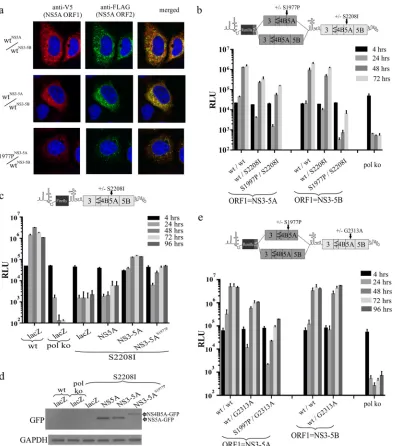
Two possible explanations might account for the failure of NS3-5A carrying the NS5AS1977Pmutation to inhibit replication. The first was that complexes formed by NS3-5A tolerated the pres-ence of an uncleaved NS4B5A precursor, unlike those formed by NS3-5B. The second possibility was that the mutation had pre-vented integration of NS4B5A into NS3-5A-dependent com-plexes. As the latter event might have allowed dissociation of NS4B5A from the MAF, confocal analysis was employed to exam-ine the location of the NS4B5A precursor from S1977PNS3-5A/ wtNS3-5B with respect to the functional NS5A expressed from ORF2. Results showed that extensive overlap of signals was evi-dent (Fig. 8a).
To further investigate the impact of S1997P on NS3-5A-depen-dent complex formation, we took advantage of our earlier obser-vation that rescue of the NS5A S2208I mutation occurred ex-tremely efficiently using NS3-5A, reasoning that if S1977P NS3-5A still formed NS3-5A-dependent complexes, it might be able to rescue the latter mutation. Intragenomic constructs carry-ing S1977P-mutated NS3-5A and NS3-5B in ORF1 were therefore further modified to carry the S2208I mutation in ORF2. Remark-ably, despite being unable to produce mature NS5A, an NS3-5A polyprotein carrying S1977P expressed from ORF1 could rescue replication when ORF2 contained the S2208I mutation (Fig. 8b), albeit 3- to 4-fold less efficiently than when ORF1 expressed func-tional NS3-5A. In contrast, the construct expressing S1977P-mu-tated NS3-5B from ORF1 and S2208I-muS1977P-mu-tated NS3-5B in ORF2 barely replicated. To verify this result,trans-complementation of the S2208I mutation was examined under conditions where func-tional NS5A, funcfunc-tional NS3-5A, and S1977P-mutated NS3-5A were provided by baculovirus transduction (Fig. 8c). While wt NS3-5A was most effective at rescuing the S2208I mutation, ex-pression of S1977P-mutated NS3-5A also resulted in a substantial level of rescue that was severalfold higher than that seen using NS5A alone. Western blot analysis (Fig. 8d) established that NS5A expression was greatest in NS5A- and lowest in NS3-5AS1977P -transduced cells, indicating that expression levels do not account for the improved rescue of S2208I with NS3-5AS1977Pversus NS5A alone.
To extend our analysis to another defect in NS5A, we selected a further mutation (G2313A) belonging to an intragenic comple-mentation group different from that of S2208I and P2008A (17). This mutation was introduced into ORF2 of a series of intrag-enomic constructs expressing either wt NS3-5A, S1977P-mutated NS3-5A, or wt NS3-5B from ORF1. Transfection of the RNAs into Huh7.5 cells revealed that NS3-5A was able to efficiently rescue G2313A and that this still occurred, albeit at slightly lower levels, when ORF1 instead carried an S1977P-mutated NS3-5A (Fig. 8e). On the basis of these combined results, we conclude that at least some NS5A functions operate within an NS3-5A-dependent com-plex that is physically distinct from that formed by NS3-5B/ NS3-5B interactions.
on November 7, 2019 by guest
http://jvi.asm.org/
DISCUSSION
Our results demonstrate that the truncated polyprotein NS3-5A, although able to target NS protein components to MAF, can com-plement only certain replication defects contained in the same coding region. As replication depends on homo- and heterotypic interactions between different NS proteins within NS3-5B (18, 31–36), functional NS-NS protein complex formation would ex-plain this observation. Our proposal is that the inability to rescue certain mutations by NS3-5A is due to this precursor participating in the formation of only a subset of complexes formed by NS3-5B/ NS3-5B interactions. Evidence supporting this conclusion comes from several observations. First, two mutations in the NS3-5A coding region were not complemented by NS3-5A but were effi-ciently rescued by NS3-5B. While this rescue, in theory, could be due to NS3-5A being less efficient at forming the same complexes as NS3-5B, experimental data suggest otherwise. We identified one mutation (PP1220-1GG) whose defect was rescued by
5A, yet the same mutation showed comparable rescue to the NS3-5B-dependent defects G1911A and P2008A using helper virus. Second, despite the fact that the three dominant mutations, K1240N, V1665G, and S1977P, inhibited replication to broadly similar levels when expressed in the context of NS3-5B, only K1240N inhibited replication when expressed as an NS3-5A pre-cursor. Finally, expression of the dominant negative mutation, S1977P, in the context of an NS3-5A precursor enabled rescue of two NS5A mutations belonging to different intragenic groupings. Given that all three mutations are on the same protein, it seems probable that S1977P expressed from NS3-5A must be selectively incorporated into an NS5A-containing complex disabled by ei-ther S2208I or G2313A, while being excluded from anoei-ther com-plex for which S1977P itself is lethal.
Rescue of replication-defective mutations in positive-strand RNA viruses has typically employedtrans-complementation sys-tems, where the functional protein or polyprotein is expressed 4A4B5A 5B
Renilla2A NS3-5B 3
S1977P P2008A
wt/wt wt/S19
77P wt/P200
8A GAA/
GDD
102
103
104
105
106
107
RL
U
4 hrs 24 hrs
48 hrs 72 hrs 96 hrs
wt
wt wtS1977PwtP2008A pol ko
3 4A4B5A 5B
Renilla 2A
NS3-5B NS3-5A
+/- S1977P
5Awt/N
S3-5B
wt
S197 7P/NS3
-5B
wt
5Bwt/NS
3-5B
wt
S197 7P/NS3
-5B
wt
pol ko
102
103
104
105
106
107
RL
U
4 hrs
24 hrs 48 hrs 72 hrs
wt S1977P wt S1977P
ORF1=NS3-5A ORF1=NS3-5B
pol ko
wt/w t
G191
1A/wt GAA/wt K124
0N/wt S197
7P/wt GAA/
GDD
102
103
104
105
106
107
RL
U
4 hrs 24 hrs 48 hrs 72 hrs 96 hrs
Renilla 2A 3 4A4B5A 5B 3 4A4B5A 5B
S1977P G191
1A K1240N GDD>GAA
wt S1977P wt S1977P
ORF1=NS3-5A ORF1=NS3-5B
anti-V5 (ORF1 NS5A)
anti-FLAG (ORF2 NS5A)
100 kDa
75 kDa
75 kDa
55 kDa 40 kDa
wt G191
1A
GDD>GAAK1240N S1977P pol ko
a
b
c
d
pol ko
*
FIG 7Effects of blocking NS4B5A boundary cleavage on intragenomic replication. Schematics provide details of the constructs used and the positioning of mutations within them. Cleavage of the NS4B5A boundary was blocked by the S1977P mutation. The impact that this had on intragenomic replicons when it was introduced into ORF2 (a) and ORF1 (b) is shown, with cell lysates taken from the latter experiment 72 h posttransfection also analyzed by Western blotting (c). Arrows indicate the position of NS5A and the uncleaved NS4B5A precursor. An asterisk indicates the position of a cross-reacting cellular protein detected by the anti-FLAG antibody. Data from a replication assay comparing the abilities of different mutated NS3-5B ORF1s, including that of S1977P, to suppress replication of intragenomic replicons carrying functional ORF2 (d) are also provided. Data represent the means⫾SD from two separate experiments. Note: the assay performed to obtain data in panel b was run in parallel with that described inFig. 8b, and so the two share control groups.
on November 7, 2019 by guest
http://jvi.asm.org/
[image:11.585.96.492.69.444.2]from an RNA separate from the one being rescued. While our study is not the first to produce two copies of an NS protein from a replication-competent RNA, it is the first to express an entire duplicated replicase. The use of similar constructs has proven problematic in the past. Rescue experiments that relied on the placement of duplicated NS coding regions in poliovirus found that the duplicated sequence was rapidly lost (37), presumably because of selective pressures arising from the use of infectious virus with larger-than-unit-sized genomes and the subsequent packaging constraints that this imposed. In addition, the use of
virus rather than replicons meant that these selection pressures operated across an entire cell population rather than within indi-vidual transfected cells. By using replicons carrying the second copy of the NS polyprotein as a recoded sequence, we have studied replication under transient conditions where recombination, if it occurs, makes little or no contribution to the overall assay read-out. Supporting this view, we found that constructs expressing functional NS3-5A from ORF1 and NS3-5B from ORF2 failed to generate a replication signal when ORF2 carried mutations K1240N, V1665G, G1911A, and P2008A, despite the fact that a
FIG 8Impact of blocking NS4B5A cleavage on NS3-5A function. (a) Intragenomic replicons with a functional NS3-5B encoded in ORF2 and expressing either NS5A, NS3-5A, or an S1977P-mutated NS3-5A from ORF1 were transfected into Huh7.5 cells. Confocal microscopy visualized the extent of ORF1 V5-tagged NS5A and ORF2 FLAG-tagged NS5A colocalization 72 h posttransfection. (b and e) Intragenomic replicon replication assays detail the ability of an S1977P-mutated polyprotein expressed from ORF1 to complement either the NS5A S2208I (b) or NS5A G2313A (e) defect in ORF2, the schematics above the graphs indicating further details of the constructs used. (c)Trans-complementation of a firefly luciferase-expressing bicistronic replicon carrying the S2208I mutation is assessed using Huh7.5 cells transduced with baculovirus expressing either-galactosidase (lacZ) or GFP-tagged versions of NS5A, NS3-5A, and NS3-5A carrying the S1977P mutation. Western blot analysis of cell lysates taken 72 h posttransfection shows levels of baculovirus-transduced expression (d). Graphical data represent the means⫾SD from two separate experiments.
on November 7, 2019 by guest
http://jvi.asm.org/
[image:12.585.98.493.64.510.2]single recombination event had the potential to generate replica-tion-competent monomeric transcripts. Northern blot analysis of replication assays 72 h posttransfection also showed that the rep-licon transcripts present in cells were the same size as the input transcripts. The tight temporal and spatial control of expression obtained from producing the two replicases from the same RNA makes the intragenomic replicon system a potentially valuable tool for studying replication of other positive-strand RNA viruses. That NS3-5B expressed from either ORF is able to assumecis -acting roles in replication adds further value to the system, as it provides opportunities to look at replication complex formation in ways that have not been possible until now.
RNA replication depends not only on viral polyprotein expres-sion but also on the interactions between these polyprotein com-ponents and RNA elements present in the genome. In HCV, the NS3-5B coding region lies adjacent to the 3=UTR and contains cis-acting RNA elements within its 3=end that make essential kiss-ing loop interactions (22,23,38). Remarkably, there is no require-ment for the NS3-5B coding region to overlap the kissing loop structure (38), although until now it has been unclear whether there is a spatial relationship between the NS3-5B ORF and the 3=
end of the genome. By demonstrating that NS3-5B expressed from ORF1 of an intragenomic replicon can support replication when ORF2 carries thecis-acting NS3 helicase mutation T1299A (18), our data indicate that a considerable distance between the poly-protein ORF and the 3=UTR can be tolerated. This conclusion is further supported by our finding that intragenomic constructs expressing two NS3-5B polyproteins, each with separate muta-tions in NS4B (G1911A) or NS5B (GDD⬎GAA), still replicate, irrespective of which ORF the two mutations are placed in. Based on studies by others (18), such combinations would not be toler-ated if ORF1 did not assumecis-acting functions normally pro-vided by the authentic replicase encoded by ORF2.
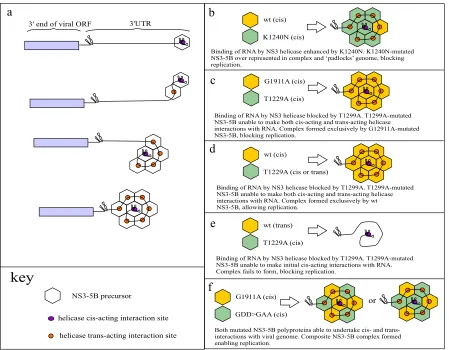
As our data showed that ORF1 is able to substitute for the cis-acting role of ORF2, it was surprising to see that intragenomic constructs carrying thecis-acting NS3 helicase mutation T1299A in ORF1 were unable to tolerate the presence of the NS4B G1911A mutation in ORF2. This was despite the fact that neither of these mutations was dominant negative and data from both this study and others showing that the function blocked by G1911A is not cis-acting (14). Given that NS3-5A expressed from ORF1 of an intragenomic replicon cannot rescue T1299A in ORF2 and that G1911A requires NS3-5B for rescue, it seems likely that bothcis -acting andtrans-acting events blocked by these two mutations localize to an NS3-5B-containing complex from which NS3-5A is excluded. Based on this conclusion and other observations, we propose the following model, in which formation of this complex involves an association of multiple copies of an NS3-5B precursor shortly after their translation. First, polyprotein association is cat-alyzed by an initial binding event between acis-acting replication element (CRE) within the RNA genome and NS3 helicase, as has been suggested by others (18). However, subsequent assembly re-quires the presence of NS5B as a structural component, both in the polyprotein that makes thecis-acting contact with the viral RNA and in the polyproteins that engage intranswith this initialcis -acting complex. This requirement for NS5B has similarities to the model put forward by Kazakov et al. (18), who suggested that the protein provided a structural component forcis-dependent inter-actions but did not identify a similar role for it intrans. A further distinguishing feature of our model is that incorporation of
NS3-5B into this growing complex also requires the newly arriving polyproteins to display NS3 helicase RNA binding activity. In other words, NS3 helicase has both essentialcis- andtrans-acting roles in NS3-5B-dependent complex formation.Figure 9 illus-trates this as well as how the assembly of such a complex would be influenced by the different mutations used in this study. Impor-tantly, some of the predictions made by our model can account for the findings of others. It has been shown that replication of viral transcripts expressing NS3-5A inciscannot be supported by ex-pression of NS3-5B intrans(18), despite the fact that replication of minigenomes that fail to express viral proteins can be supported by expression of a viral replicase (39). Our model offers the pos-sibility that NS3-5A expressed incisis capable of making nonpro-ductive interactions with CREs in the viral genome, thus frustrat-ing the assembly of the NS3-5B-dependent complex. Perhaps relating to this mode of action, we identified one mutation, NS4AY1706A, that was rescued far more effectively when NS3-5A was expressed intransfrom a separate RNA than inciswhen ex-pressed from ORF1 of an intragenomic replicon. Identifying mu-tations in ORF2 NS3-5B that weaken its ability to outcompete ORF1-expressed NS3-5A for binding to CREs could provide use-ful information about protein-protein and protein-RNA contacts made during complex assembly. While the NS4AY1706residue is relatively conserved, it does lie adjacent to another more-variable residue (position 1708 in JFH1) previously implicated in orches-trating physical interactions between NS4A and all other NS pro-teins within the NS3-5B polyprotein (32). It would be interesting to see whether mutations of residues such as those identified by covariant amino acid analysis alter the ability of different polypro-teins expressed incisto compete for CREs.
A general feature of the mutations dependent on NS3-5A for rescue compared to those dependent on NS3-5B was the greater extent with which they weretrans-complemented by a helper rep-licon. The reduced levels of stringency for rescue fit with a pro-posal by Fridell and colleagues that NS5A supports functions both inside and outside the replication complex (16). Importantly, they speculated that mutations blocking NS5A function outside and inside the replication complex included S2208I and P2008A; these mutations disrupted NS3-5A- and NS3-5B-dependent complex activity, respectively, in our hands. Compartmentalization of NS3-5A- and NS3-5B-dependent complex functions is certainly a possibility that warrants consideration. Assuming that exchange of individual NS proteins within complexes occurs (18), without compartmentalization it is difficult to envisage why some muta-tions in the NS3-5A region show dependence on NS3-5B for res-cue whereas others in the same NS protein are efficiently resres-cued by NS3-5A. Furthermore, the proposed role that cleavage of the NS4B5A boundary has in enabling NS5A-driven double-mem-brane formation (29, 30), coupled to the fact that the S1977P mutation, which blocks boundary cleavage, is only dominant neg-ative as an NS3-5B precursor, is consistent with NS3-5A-depen-dent complexes being excluded from the RC. Our attempts to see whether discrete compartmentalization occurs have so far been restricted to confocal microscopy analysis. Given the size of the double-membrane vesicles in MAF, the structures thought to con-tain the functional replication complexes, it is perhaps not sur-prising that we failed to observe separation of NS3-5A- versus NS3-5B-dependent complexes (data not shown). Further physical and electron microscopy studies are planned.
An unexpected outcome of our study was thetrans-dominant
on November 7, 2019 by guest
http://jvi.asm.org/
negative phenotype displayed by one NS3 helicase mutation (K1240N) but not by another (T1299A). While both mutations block helicase activity, this occurs through disruption of different sites within the enzyme. NS3K1240Ndisrupts the Walker A motif, responsible and required for ATP binding and hydrolysis, whereas NS3T1299Ablocks RNA helicase binding by disrupting the TxGx motif, involved in phosphate backbone interactions (40). Disrup-tion of the Walker A motif would also have the likely consequence of locking the enzyme in an ATP-free open state, potentially in-creasing its propensity to bind RNA compared to wild-type NS3 (41). Thus, one possible reason for NS3K1240Ndisplay