INTRODUCTION
Colonial organisms are composed of repeated modules that are genetic clones of an original found-ing unit. One of the most important advantages of coloniality is that inter-module physiological integra-tion can allow for resource translocaintegra-tion among mod-ules and colony-wide coordinated responses to stim-uli (Mackie 1986, Oren et al. 2001, Fine et al. 2002). Physiological integration can homogenize the distri-bution of resources acquired through prey capture and symbiont photosynthesis and allow for a more
© The authors 2018. Open Access under Creative Commons by Attribution Licence. Use, distribution and reproduction are un -restricted. Authors and original publication must be credited. Publisher: Inter-Research · www.int-res.com
*Corresponding author: [email protected]
FEATURE ARTICLE
Physiological integration of coral colonies
is correlated with bleaching resistance
Timothy D. Swain
1, 2, Emily C. Bold
1, Phillip C. Osborn
1, Andrew H. Baird
3,
Mark W. Westneat
4, Vadim Backman
5, Luisa A. Marcelino
1, 2,*
1Department of Civil and Environmental Engineering, Northwestern University, Evanston, IL 60208, USA 2Integrative Research Center, Field Museum of Natural History, Chicago, IL 60605, USA
3ARC Center of Excellence for Coral Reef Studies, James Cook University, Townsville, QLD, 4811, Australia 4Department of Organismal Biology and Anatomy, University of Chicago, Chicago, IL 60637, USA
5Department of Biomedical Engineering, Northwestern University, Evanston, IL 60208, USA
ABSTRACT: Inter-module physiological integration of colonial organisms can facilitate colony-wide coor-dinated responses to stimuli that strengthen colony fitness and stress resistance. In scleractinian corals, whose colonial integration ranges from isolated polyps to a seamless continuum of polyp structures and functions, this coordination improves re sponses to injury, predation, disease, and stress and may be one of the indications of an evolutionary origin of
Symbiodinium symbiosis. However, observations of
species-specific coral bleaching patterns suggest that highly integrated coral colonies may be more suscep-tible to thermal stress, and support the hypothesis that communication pathways between highly inte-grated polyps facilitate the dissemination of toxic byproducts created during the bleaching response. Here we reassess this hypothesis by parameterizing an integration index using 7 skeletal features that have been historically employed to infer physiological integration. We examine the relationship between this index and bleaching response across a phylogeny of 88 diverse coral species. Correcting for phyloge-netic relationships among species in the analyses re-veals significant patterns among species characters that could otherwise be obscured in simple cross-species comparisons using standard statistics, whose assump tions of independence are violated by the shared evolutionary history among species. Similar to the observed benefits of in creased coloniality for other types of stressors, the results indicate a sig -nificantly reduced bleaching response among coral species with highly integrated colonies.
KEY WORDS: Colony integration · Colony form · Coral bleaching · Phylogenetically corrected analysis
Stylized representation of the phylogeny and morphologies that allowed detection of decreased thermal bleaching with greater polyp integration (coloniality).
Photos: Gary Parr
effective colony-wide response to injury, predation, disease, and stress (Pearse & Muscatine 1971, Rinke-vich & Loya 1983, Fang et al. 1989, Gladfelter et al. 1989, Oren et al. 1997, Fine et al. 2002, Roff et al. 2006). In scleractinian corals there is a wide diversity of integration among modules, ranging from species whose colonial modules (polyps) are connected only by non-living skeleton to species whose polyps are an almost indistinguishable continuum of structures and functions (Coates & Oliver 1973, Coates & Jack-son 1987). In extant coral taxa, this diversity occurs as a continuum of physiological integration (rather than discrete extremes) that is challenging to directly quantify. Evidence of physiological integration in corals has historically been inferred from skeletal features that reflect pathways of (or barriers to) com-munication between polyps and indicate a degree of reliance upon, or coordination between, other polyps within the colony for basic life functions (Coates & Oliver 1973, Coates & Jackson 1987, Soong & Lang 1992). Communication pathways include skeletal features that allow the gastrovascular cavities of neighboring polyps to be continuous, such as skeletal voids (perforate skeleton, commonly found in genera such as Acropora, Montipora, and Porites; van
Woe-sik et al. 2013) that allow tissue to transverse through the skeleton (Yost et al. 2013), or inter-polyp align-ment of septa (continuity of costosepta, such as the confluent costosepta of Favites abditaor Favites hal-icora; Huang et al. 2014) that demonstrate alignment
of mesenteries and may allow tissue connections to continue above the surface of the skeleton (Coates & Oliver 1973, Coates & Jackson 1987). Inferences of reliance and coordination among polyps include polymorphic calices that reflect differential functions of polyps and division of labor among colonial mod-ules (polymorphic polyps, such as the apical polyps of
Acropora at the growing tips of branches that are
larger, have fewer tentacles, lower Symbiodinium
density, and no gonads compared to the axial polyps; Oliver 1984, Hemond et al. 2014) and complex colony morphologies that require coordinated skeletal con-struction to maintain colony dimensions, symmetry, and balance (growth form, such as branching Acrop-ora palmataor Seriatopora caliendrum; Madin et al.
2016) (Coates & Oliver 1973, Coates & Jackson 1987). These characters constitute morphological evidence of physiological integration (inferred), rather than direct measurements of interpolypoidal movements of materials or chemical signals (experimentally de -termined; e.g. Gladfelter et al. 1989, Oren et al. 2001, Roff et al. 2006). However, these inferences also rep-resent the extent of currently available data for
cross-species comparative analysis, as experimen tal evi-dence is confined to a few exemplar species.
The evolution of highly integrated coral colonies is also hypothesized to be an indicator of the origin of the symbiosis with the photosynthetic endosymbiotic dinoflagellates representing the genus Symbiodinium.
Coates & Jackson (1987) identified a pattern in corals where multiserial colonial forms with small, highly integrated corallites are almost exclusively symbio -tic, whereas species that have solitary or uniserial colonial forms with large, poorly integrated corallites are almost exclusively asymbiotic, suggesting that in-creased colony integration is one of the indications of an evolutionary origin of Symbiodinium symbiosis.
Although the pattern is imperfect (Frankowiak et al. 2016) and is not the product of a linear evolutionary progression toward increased colonial integration and symbiosis, but is due to a more complex history of repeated acquisition and loss of coloniality and sym-biosis that were not always concurrent (Barbeitos et al. 2010), it remains a conspicuous motif among extant species. Symbiodiniumphotosynthesis is the primary
source of fixed carbon for reef-building corals (Mus-catine 1990), and dis asso ciation of Symbiodiniumand
coral hosts through thermal stress (bleaching) can re-sult in decreased growth, regeneration, reproduction, and competitive abilities, and increased incidence of disease, predation, and mortality (Brown 1997, Jokiel 2004, Jones 2008, McClanahan et al. 2009). Although increased physiological integration may indicate an evolutionary origin of Symbiodiniumsymbiosis, highly
integrated colonies are also hypothesized to be among those most susceptible to bleaching. Baird & Marshall (2002) identified a pattern of heightened bleaching and mortality among coral species whose colonies dis-play high physiological integration (inferred from morphology). They hypothesized that highly integra -ted polyps were incapable of isolating damage, or the products of damage (e.g. reactive oxygen species), to areas of the colony that were directly affected by stress, effectively homogenizing the colonywide re -sponse and increasing its susceptibility to bleaching. In contrast, colonies where polyps function as inde-pendent units were thought to have greater resistance to bleaching by localizing damage and polyp death (Baird & Marshall 2002).
As global temperatures continue to increase under climate change, the disruption of coral− Symbio-dinium symbio ses has become an urgent focus of
response has become critical to predicting and miti-gating future bleaching events. Here we assess the physiological integration bleaching hypothesis of Baird & Marshall (2002) using 88 coral species whose coloniality ranges from solitary to highly integrated. We identified 7 skeletal features that have been his-torically employed to infer physiological integration and used them to parameterize a speciesspecific in -tegration index and examine its relationship to bleach-ing response within a phylogenetic framework.
MATERIALS AND METHODS
We collected coral colony integration characters from museum specimens, literature, or trait databases (values and their sources are reported in Supplement 1 at www. int- res. com/ articles/ suppl/ m586 p001 _ supp. xls) and assessed their relationship to bleaching response using phylogenetically corrected linear and logistic regression analyses. This analysis targeted 88 coral species previously characterized for light scattering properties of their skeletons (Mar celino et al. 2013) and bleaching response (Swain et al. 2016c).
We used the coral Bleaching Response Index (BRI) values of Swain et al. (2016c) as our metric for bleaching response. The BRI is based on taxon-specific bleaching and mortality records collected during mass coral bleaching events from 1982−2006 and was calculated as the mean percent tissue area affected by bleaching across all sites and years where a taxon was observed during these events (Swain et al. 2016c). Bleaching response values for species with fewer than 3 reports of bleaching and mortality in Swain et al. (2016c) were used here as the mean of responses across the genus (Supplement 1).
Adapting characters discussed by Coates & Oliver (1973) and Soong & Lang (1992), we identified 7 characters and their directionality for the inference of increasing colony in tegration (Supplement 2 at
www. int-res. com/ articles/ suppl/ m586p001 _ supp. pdf). Detailed explanations of how these characters are thought to reflect the degree of potential physiologi-cal integration among polyps within a colony can be found in e.g. Coates & Oliver (1973), Soong & Lang (1992), Baird & Marshall (2002), and we provide only a brief outline here (see also Table 1, Supplement 1). (1) Colony growth form refers to the overall colony
morphology and is an indicator of the inter-polyp communication that would be necessary to coordi-nate colony growth and polyp budding patterns to create complex 3 dimensional shapes (Soong & Lang 1992). (2) Polyp buddingcan occur either within the
corallite wall (intracalicular) and may result in par-tially incomplete polystomal polyps (i.e. indicates a higher level of integration), or outside the corallite wall (extracalicular) and result in complete polyps (i.e. individuality; indicates a lower level of integra-tion) (Budd & Stolarski 2011). (3) Colony formationis
the arrangement and proximity of polyps — e.g. ceri-oid colonies where corallites are juxtaposed (indi-cates lower integration) or meandroid colonies where corallites are arranged in series (indicates greater integration) — and (4) coenosteum amount within a
colony is an indi cator of the separation between polyps within a colony — e.g. cerioid colonies with fused corallite walls and no coenosteum (indicates high integration) or plocoid colonies where corallites are separated by coenosteum (indicates low inte -gration) (Coates & Oliver 1973, Budd & Stolarski 2011). (5) A perforate skeletonpermits an additional
level of interconnection and communication between
Character Character states and coding Retention Justification
index (RI) reference
Colony growth form Massive, encrusting, or columnar = 0, 0.66 Soong & Lang (1992) laminar = 0.5, branching or digitate = 1
Polyp budding Extracalicular = 0, mixed = 0.5, intracalicular = 1 0.81 Coates & Oliver (1973) Colony formation Phaceloid or solitary = 0, plocoid = 0.25, Coates & Oliver (1973)
cerioid = 0.5, meandroid = 0.75,
hydnophoroid = 1 0.54
Coenosteum amount Phaceloid or solitary = 0, extensive = 0.25, 0.65 Coates & Oliver (1973) moderate = 0.5, limited = 0.75, fused walls = 1
Perforate skeleton Imperforate = 0, perforate = 1 0.91 Coates & Oliver (1973)
Inter-corallite continuity of costosepta Mostly not confluent = 0, mostly confluent = 1 0.65 Coates & Oliver (1973) Polymorphic polyps Not polymorphic = 0, polymorphic = 1 0.88 Soong & Lang (1992) Table 1. Colony integration characters, character states, homoplasy (retention index, range: 0–1, 0 = homoplastic), and
[image:3.612.60.537.560.719.2]polyps beneath the surface of the skeleton by allow-ing gastrovascular canals to transverse the skeleton (indicating high integration), which is not possible if the skeleton is imperforate (indicating low integra-tion) (Coates & Oliver 1973). (6) Inter-corallite conti-nuity of costosepta is an indicator of the potential
interconnection and communication be tween polyps. Septa (which support individual mesen teries in the gastrovascular cavity of the polyp) that trace through the costae across the surface of the coenosteum and align with septa in adjacent corallites provide for the continuity of mesenteries and gastrovascular canals and alignment of polyp orientation (indicating high integration) (Coates & Oliver 1973, Budd & Stolarski 2011). Colonies that exhibit (7) polyp polymorphism
have polyps that are of different sizes or serve dif -ferent functions, and demonstrates division of labor among polyps (high integration) (Soong & Lang 1992). While some characters are discrete and can be cat-egorized by presence or absence (e.g. perforate or imperforate skeleton), others have 2 or more charac-ter states (e.g. growth form: massive or encrusting, laminar and branching corals). We reasoned that we could derive a quantitative integration index by aver-aging these 7 characters and weighting them by the number of states of each character, such that each character was scored on a scale of 0−1, with 1 repre-senting the highest colony integration state (Table 1, Supplement 1). The weighted average of multiple character-states avoided over-representation of char-acters with more than 2 states and resulted in a spe-cies-level integration index score that potentially ranged from 0−7 and weighted each character equal -ly. This integration index is therefore reflective of the progression of character states that are hypothesized to indicate the degree to which individual polyps within a colony are physiologically integrated. For example, massive or encrusting growth forms (con-sidered the least integrated) were given a score of 0, branching or digitate growth forms (considered the most integrated) were given a score of 1, and laminar growth forms were given an intermediate score of 0.5. To assess the effect of differential character selection, we also calculated 7 additional integration index scores that systematically excluded one char-acter from each.
Coral colony integration characters were mapped onto a molecular phylogeny for assessment of indi-vidual character homoplasy and for phylogenetically corrected linear and logistic regression analyses. Species data are related through evolution, violating an assumption of standard statistical analyses that individual data points are independent; therefore, it
Rela-tionships be tween continuous and binary variables were asses sed with phylogenetically corrected lo -gistic (phylo log) regressions performed using the Phylogenetic Generalized Linear Mixed Model (PGLMM; Ives & Helmus 2011, Ives & Garland 2014) in APE v.4.1 in R. This rendition of the phylo log regression simultaneously performs a test for phylo-genetic signal in the residuals using an approximate likelihood ratio test. The binary variables that we tar-geted included colony growth form (using just those coral species that could be classified as massive, coded as 0, n = 44, or branching, coded as 1, n = 27) and presence of a perforate skeleton (imperforate coded as 0, n = 55, perforate as 1, n = 33) and were assessed against continuous bleaching response, as these 2 char acters may influence bleaching irrespec-tive of their role in phy sio logical integration (Santos et al. 2009, McCowan et al. 2012, Yost et al. 2013).
RESULTS
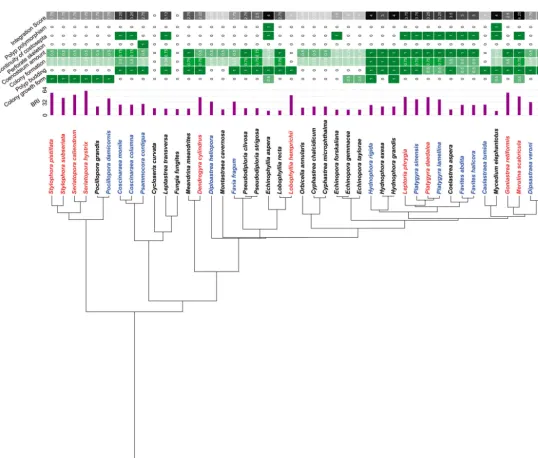
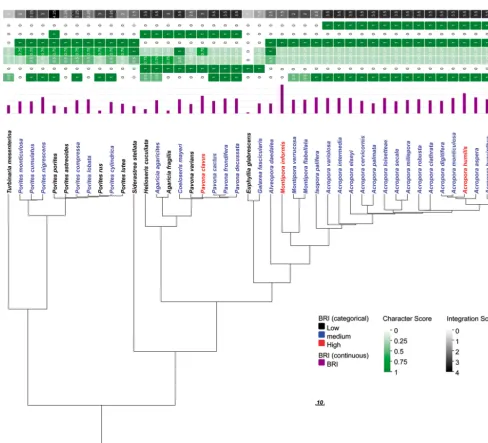
Colony integration index scores ranged from 0 for the solitary corals Cycloseris curvataand Fungia fun-gites to 4.25 for the meandroid coral Merulina sca -briculaand perforate Porites porites, out of a possible
range of 0−7 (Fig. 1). Mapping the 7 colony integra-tion characters onto the phylo geny demonstrates moderate to low homoplasy values (RI = 0.54−0.91, Table 1) for each of the characters (Fig. 1), indicating that variation in these char acters generally mirrors the phylogeny and that closely related coral species are likely to have similar character states.
Values for coral species-specific bleaching responses (BRI) ranged from 2.75 (for phaceloid Euphyllia glab -res cens) to 72.85 (for plocoid Montipora informis) out
of a possible range of 0−100 (Fig. 1). Mapping the BRI values onto the phylogeny demonstrated high homo-plasy in bleaching response (RI = 0.33; Fig. 1), indica-ting that variation in bleaching response does not generally mirror the phylogeny and that closely re -lated coral species are unlikely to have similar bleaching responses. High homoplasy of bleaching responses facilitates the detection of significant cor-relations with the skeletal characters. For example, the relationship between corals with polyp polymor-phism (RI = 0.88) and those with perforate skeletons (RI = 0.91) may be entirely explainable through the evolutionary relationships among species be cause the characters so closely reflect evolutionary history. Phylogenetically corrected regression (PIC) revealed a significant inverse relationship between BRI and colony integration (Pearson product-moment
Corre-lation Coefficient, PCC = −0.22, p = 0.04, n = 88, best-fit ML model = pure phylogenetic/equal). This rela-tionship and its significance are not detectable through ordinary least squares linear regression (r2=
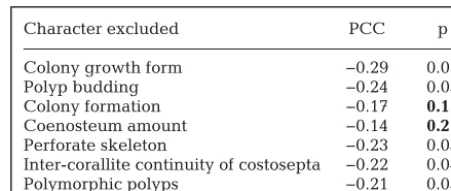
0.02, p = 0.17, n = 88), nor are they highly sensitive to individual character exclusion. Exclusion of a single character in a step-wise reanalysis of integration resulted in the same trends with similar fits (PCC ranged from −0.13 to −0.29) and significance values at or below the 5% threshold for all but 2 excluded characters (colony formation and coenosteum amount; Table 2). Additionally, phylogenetically corrected lo -gistic regression analyses of the presence of a perfo-rate skeleton (Z = 0.75, p = 0.45, n = 88, phylogenetic signal p < 0.001) or branching colony growth form (Z = −0.58, p = 0.56, n = 71, phylogenetic signal p < 0.001) are not significantly related to bleaching response when considered independently of other colony integration characters.
DISCUSSION
Coral colonies exhibit a continuum of physiological integration among modules, ranging from phaceloid species with no tissue connections between polyps, to hydnophoroid species with little separation be -tween polyps embedded in a continuous coenosarc that maintain adjoining gastrovascular cavities (Coates & Oliver 1973). Baird & Marshall (2002) observed heightened bleaching responses among some antho-zoan taxa with high levels of physiological integra-tion, in particular Acroporaspp., soft coral Sinularia
spp., and hydrocoral Milleporaspp. They
hypothe-sized that highly integrated coral colonies were more susceptible to bleaching because communicating polyps were incapable of isolating damage, or the products of damage, to stress-affected areas of the colony. Our reexamination of the relationship be
-Character excluded PCC p
Colony growth form −0.29 0.01
Polyp budding −0.24 0.03
Colony formation −0.17 0.11
Coenosteum amount −0.14 0.21
Perforate skeleton −0.23 0.03
Inter-corallite continuity of costosepta −0.22 0.04
Polymorphic polyps −0.21 0.05
Table 2. Sensitivity analysis results for Phylogenetic Inde-pendent Contrasts (PIC) analysis of integration against bleaching response. PCC: Pearson Product-moment Corre-lation Coefficient. Bold values indicate change in significance
[image:5.612.311.537.140.235.2]tween inferred colony integration and bleaching response indicates that, contrary to the observations of Baird & Marshall (2002), lower physiological inte-gration (as inferred by the 7 characters in our analy-sis) is significantly associated with in creased bleach-ing response among the targeted 88 coral species (Fig. 1).
There are multiple, non-mutually exclusive, poten-tial explanations for the detection of opposing pat-terns between the work of Baird & Marshall (2002) and this study. Much of the basic data collection (bleaching, mortality, growth, and reproduction after a single event vs. parameterized indices of historical bleaching and mortality response), taxon selection Fig. 1. Coral phylogeny of 88 species, modified from Huang (2012), with colony integration characters thought to indicate the physiological integration among coral polyps within a colony. Coral species are color coded for species-specific historical bleaching response (Bleaching Response Index [BRI; Swain et al. 2016c]; black = low, blue = medium, red = high bleaching re-sponse). Heat maps in green are the per-character scores (0−1) for the 7 characters indicating increasing colony integration (darker colors); heat map in greyscale is the integration score (sum of the character scores) indicating increasing colony inte-gration (darker colors). Lower colony inteinte-gration values are associated with increased bleaching response (Pearson
Product-moment Correlation Coefficient [PCC] = −0.224, p = 0.036)
(4 coral species and Alcyonacea and Milleporidae vs. 88 coral species), geographic and temporal con-straints (1998 bleaching event in the Indo-Pacific vs. the mean of events collected pan-tropically between 1982 and 2006), and data analysis (observation vs. phylogenetically corrected statistical analyses) differ dramatically between the 2 studies. The work pre-sented here is both an expansion and refocusing of the original concept to critically assess the resulting hypothesis on the potential mechanisms of stress management across differential colonial integration. Along with the expansion in scope, this study also highlights the importance of phylogenetically cor-recting cross-species analyses. The characters of
[image:7.612.48.537.78.521.2]cally corrected analysis was able to tease apart simi-larity due to relationships among species (evolution) from similarity due to relationships among character states (potential mechanisms).
A recent assessment of a similar set of field obser-vations and hypotheses (using broad data and cor-rection for evolutionary relationships) led to a similar conclusion. McCowan et al. (2012) reassessed the long-standing hypothesis that coral species with branching colony forms are more susceptible to bleaching and bleaching-related mortality than spe-cies with massive forms. Their field data—compiled from all targeted species—supported the conclusion that branching and tabular corals bleached signifi-cantly more than massive corals, but when those corals were grouped into higher taxa (families), the pattern became obscured. For example, among the Faviidae, branching species bleached less than mas-sive species, but the opposite trend was observed among the Acroporidae and Poritidae. McCowan et al. (2012) suggest that the disparity between the field observations and the results of their analyses is due to the heightened susceptibility of certain taxonomic groups of coral species and that those taxa also hap-pen to be predominantly branching species (i.e. the observation of increased bleaching response among branching corals was the result of phylogeny). Our phylogenetically corrected as sessment of diverse branching and massive species reported here is similarly unable to identify a significant relationship be -tween colony growth form and bleaching response.
The inverse relationship between colony integra-tion and bleaching suggests that the response to moderate thermal stress may be akin to moderate pre dation, injury, or disease, where integration among modules may contribute to the effectiveness of the colony-wide response by permitting unaffec ted polyps to aid those in distress or to selectively isolate damage and reallocate resources from non-vital life history functions (Pearse & Muscatine 1971, Rinke-vich & Loya 1983, Fang et al. 1989, Gladfelter et al. 1989, Oren et al. 1997, Fine et al. 2002, Roff et al. 2006). Lesion induction has been shown to activate directional transport of photosynthates toward the injured tissue from modules up to 10 cm away, and to reduce reproductive investment up to 15 cm away from the lesion (Oren et al. 1997, 2001, Roff et al. 2006). Disease has been shown to activate directional transport of photosynthates away from the affected area, as if to reduce nutrient availability to the infect-ing pathogen and restrict resource loss to polyps that cannot be saved (Roff et al. 2006). Bleaching that reduces Symbiodinium densities by as little as 40%
is capable of halting inter-module translocation of photosynthates altogether, effectively isolating each polyp to fend for itself during stress events (Fine et al. 2002). Our results are consistent with the observed responses to other stressors where physiological inte-gration aids in the stress response.
The integration characters applied here are an indirect indication of physiological integration, and direct measurements or selection of different charac-ters or differential weighting of characcharac-ters may alter the results. Our sensitivity assessment of the analysis reported here resulted in the same trends at similar fits, although the exclusion of either colony formation or coenosteum amount resulted in the loss of statisti-cal significance, and the exclusion of colony growth form strengthened the observed relationship (Table 2). This strengthened relationship is likely due to the lack of correlation between colony growth form and bleaching response that we observed through the phylo log regression. Addi tionally, direct measure-ments have demonstrated, through directional intra-colony translocation of photosynthetic assimilates to adjacent injured polyps, energy integration in the absence of structural characters that would indicate integration (Brickner et al. 2006). Pairing direct measurements of chemical translocation with physi-cal indi cations of communicating pathways may improve precision of assessments of the effects of physiological integration on stress resistance and on the mechanism by which integration may contribute to an improved stress response.
We have focused here on the relationship between coloniality and bleaching response, linked through the potential intermodule communication and co -ordination, but other possible mechanisms stem from skeletal architecture and could affect bleaching resistance. For example, skeletal light scattering can increase light availability to in hospite Symbiodinium
symbiont characters such as phylotype- specific ther-motolerance; Berkelmans & van Oppen 2006, Swain et al. 2016a) are properly weighed against the observed bleaching patterns.
Acknowledgements. We thank R. Bieler and J. Gerber of the Field Museum of Natural History for expertise and access to the FMNH museum collections and S. Cairns and T. Coffer of the National Museum of Natural History for expertise and access to the NMNH museum collections. Special thanks to D. Huang for providing us with the tree files for his compre-hensive phylogeny of corals. This research was supported by the U.S. National Science Foundation (EFRI-1240416 and CBET-1249311) and U.S. National Institutes of Health (EB 003682). Additional funding came from 108 contributors to a crowdfunding campaign, and the Coral Reefs Challenge Grant, via Experiment.com.
LITERATURE CITED
Baird AH, Marshall PA (2002) Mortality, growth and repro-duction in scleractinian corals following bleaching on the Great Barrier Reef. Mar Ecol Prog Ser 237: 133−141 Baker AC, Glynn PW, Riegl B (2008) Climate change and
coral reef bleaching: an ecological assessment of long-term impacts, recovery trends and future outlook. Estuar Coast Shelf Sci 80: 435−471
Barbeitos MS, Romano SL, Lasker HR (2010) Repeated loss of coloniality and symbiosis in scleractinian corals. Proc Natl Acad Sci USA 107: 11877−11882
Berkelmans R, van Oppen MJH (2006) The role of zooxan-thellae in the thermal tolerance of corals: a ‘nugget of hope’ for coral reefs in an era of climate change. Proc R Soc B 273: 2305−2312
Brickner I, Oren U, Frank U, Loya Y (2006) Energy integra-tion between the solitary polyps of the clonal coral Lobo-phyllia corymbosa. J Exp Biol 209: 1690−1695
Brown BE (1997) Coral bleaching: causes and consequen -ces. Coral Reefs 16: S129−S138
Budd AF, Stolarski J (2011) Corallite wall and septal micro -structure in scleractinian reef corals: comparison of molec-ular clades within the family Faviidae. J Morphol 272: 66−88
Coates AG, Jackson JBC (1987) Clonal growth, algal sym-biosis, and reef formation by corals. Paleobiology 13: 363−378
Coates AG, Oliver WAJ (1973) Coloniality in zoantharian corals. In: Boardman RS, Cheetham AH, Oliver WAJ (eds) Animal colonies: development and function through time. Dowden, Hutchinson and Ross, Stroudsburg, PA, p 3−28
Enríquez S, Méndez ER, Iglesias-Prieto R (2005) Multiple scattering on coral skeletons enhances light absorption by symbiotic algae. Limnol Oceanogr 50: 1025−1032 Enríquez S, Méndez ER, Hoegh-Guldberg O, Iglesias-Prieto
R (2017) Key functional role of the optical properties of coral skeletons in coral ecology and evolution. Proc R Soc B 284: 20161667
Fang LS, Chen YWJ, Chen CS (1989) Why does the white tip of stony coral grow so fast without zooxanthellae? Mar Biol 103: 359−363
Farris JS (1989) The retention index and the rescaled
consis-tency index. Cladistics 5: 417−419
Felsenstein J (1985) Phylogenies and the comparative method. Am Nat 125: 1−15
Fine M, Oren U, Loya Y (2002) Bleaching effect on regener-ation and resource translocregener-ation in the coral Oculina patagonica.Mar Ecol Prog Ser 234: 119−125
Frankowiak K, Kret S, Mazur M, Meibom A, Kitahara MV, Stolarski J (2016) Fine-scale skeletal banding can distin-guish symbiotic from asymbiotic species among modern and fossil scleractinian corals. PLOS ONE 11: e0147066 Freckleton RP, Harvey PH, Pagel M (2002) Phylogenetic
analysis and comparative data: a test and review of evi-dence. Am Nat 160: 712−726
Frieler K, Meinshausen M, Golly A, Mengel M, Lebek K, Donner SD, Hoegh-Guldberg O (2013) Limiting global warming to 2 degrees C is unlikely to save most coral reefs. Nat Clim Chang 3: 165−170
Gladfelter EH, Michel G, Sanfelici A (1989) Metabolic gradi-ents along a branch of the reef coral Acropora palmata. Bull Mar Sci 44: 1166−1173
Harvey PH (1996) Phylogenies for ecologists. J Anim Ecol 65: 255−263
Hemond EM, Kaluziak ST, Vollmer SV (2014) The genetics of colony form and function in Caribbean Acropora corals. BMC Genomics 15: 1133
Hoegh-Guldberg O, Mumby PJ, Hooten AJ, Steneck RS and others (2007) Coral reefs under rapid climate change and ocean acidification. Science 318: 1737−1742
Huang DW (2012) Threatened reef corals of the world. PLOS ONE 7: e34459
Huang DW, Benzoni F, Fukami H, Knowlton N, Smith ND, Budd AF (2014) Taxonomic classification of the reef coral families Merulinidae, Montastraeidae, and Diploastrae -idae (Cnidaria: Anthozoa: Scleractinia). Zool J Linn Soc 171: 277−355
Hughes TP, Kerry JT, Álvarez-Noriega M, Álvarez-Romero JG and others (2017) Global warming and recurrent mass bleaching of corals. Nature 543: 373−377
Ives AR, Garland T (2014) Phylogenetic regression for binary dependent variables. In: Garamszegi LZ (ed) Modern phylogenetic comparative methods and their application in evolutionary biology. Springer-Verlag, Berlin, p 231−261
Ives AR, Helmus MR (2011) Generalized linear mixed mod-els for phylogenetic analyses of community structure. Ecol Monogr 81: 511−525
Jokiel PL (2004) Temperature stress and coral bleaching. In: Rosenberg E, Loya Y (eds) Coral health and disease. Springer-Verlag, Berlin, p 401−425
Jones RJ (2008) Coral bleaching, bleaching-induced mortality, and the adaptive significance of the bleaching res -ponse. Mar Biol 154: 65−80
Kühl M, Cohen Y, Dalsgaard T, Jorgensen BB, Revsbech NP (1995) Microenvironment and photosynthesis of zooxan-thellae in scleractinian corals studied with microsensors for O2, pH and light. Mar Ecol Prog Ser 117: 159−172
Lee CH, Blay S, Mooers AO, Singh A, Oakley TH (2006) CoMET: A Mesquite package for comparing models of continuous character evolution on phylogenies. Evol Bioinformatics 2: 183−186
Mackie GO (1986) From aggregates to integrates: physio-logical aspects of modularity in colonial animals. Philos Trans R Soc Lond, B 313: 175−196
Madin JS, Anderson KD, Andreasen MH, Bridge TCL and others (2016) The Coral Trait Database, a curated data-base of trait information for coral species from the global oceans. Sci Data 3: 160017
Marcelino LA, Westneat MW, Stoyneva V, Henss J and oth-ers (2013) Modulation of light-enhancement to symbiotic algae by light-scattering in corals and evolutionary trends in bleaching. PLOS ONE 8: e61492
McClanahan TR, Weil EJ, Cortes J, Baird AH, Ateweberhan M (2009) Consequences of coral bleaching for sessile reef organisms. In: van Oppen MJH, Lough JM (eds) Coral bleaching: patterns, processes, causes and conse-quences. Ecol Stud 205: 121−138
McCowan DM, Pratchett MS, Baird AH (2012) Bleaching susceptibility and mortality among corals with differing growth forms. Proc 12thInt Coral Reef Symp 9A: 1−6
Midford PE, Garland T Jr, Maddison WP (2010) PDAP pack-age. http: //mesquiteproject.org
Muscatine L (1990) The role of symbiotic algae in carbon and energy flux in reef corals. In: Dubinsky Z (ed) Coral reefs, 25. Elsevier, Amsterdam, p 75−87
Oakley TH, Gu ZL, Abouheif E, Patel NH, Li WH (2005) Comparative methods for the analysis of gene-expres-sion evolution: an example using yeast functional genomic data. Mol Biol Evol 22: 40−50
Oliver JK (1984) Intra-colony variation in the growth of Acropora formosa: extension rates and skeletal structure of white (zooxanthellaefree) and browntipped bran -ches. Coral Reefs 3: 139−147
Oren U, Rinkevich B, Loya Y (1997) Oriented intra-colonial transport of 14C labeled materials during coral
regenera-tion. Mar Ecol Prog Ser 161: 117−122
Oren U, Benayahu Y, Lubinevsky H, Loya Y (2001) Colony integration during regeneration in the stony coral Favia favus.Ecology 82: 802−813
Pearse VB, Muscatine L (1971) Role of symbiotic algae (zooxanthellae) in coral calcification. Biol Bull 141: 350−363
Revell LJ (2010) Phylogenetic signal and linear regression on species data. Methods Ecol Evol 1: 319−329
Revell LJ (2012) Phytools: an R package for phylogenetic comparative biology (and other things). Methods Ecol Evol 3: 217−223
Rinkevich B, Loya Y (1983) Oriented translocation of energy in grafted reef corals. Coral Reefs 1: 243−247
Roff G, Hoegh-Guldberg O, Fine M (2006) Intra-colonial response to acroporid ‘White syndrome’ lesions in
tabu-lar Acroporaspp. (Scleractinia). Coral Reefs 25: 255−264 Santos SR, Toyoshima J, Kinzie RA III (2009) Spatial and temporal dynamics of symbiotic dinoflagellates ( Symbio-dinium: Dinophyta) in the perforate coral Montipora capi tata.Galaxea 11: 139−147
Soong K, Lang JC (1992) Reproductive integration in reef corals. Biol Bull 183: 418−431
Stambler N, Dubinsky Z (2005) Corals as light collectors: an integrating sphere approach. Coral Reefs 24: 1−9 Swain TD, Chandler J, Backman V, Marcelino L (2016a)
Consensus thermotolerance ranking for 110 Symbio-dinium phylotypes: an exemplar utilization of a novel iterative partial-rank aggregation tool with broad appli-cation potential. Funct Ecol 31: 172−183
Swain TD, DuBois E, Gomes A, Stoyneva VP and others (2016b) Skeletal light-scattering accelerates bleaching response in reef-building corals. BMC Ecol 16: 10 Swain TD, Vega-Perkins JB, Oestreich WK, Triebold C and
others (2016c) Coral bleaching response index: a new tool to standardize and compare susceptibility to thermal bleaching. Glob Change Biol 22: 2475−2488
Terán E, Méndez ER, Enríquez S, Iglesias-Prieto R (2010) Multiple light scattering and absorption in reef-building corals. Appl Opt 49: 5032−5042
van Woesik R, van Woesik K, van Woesik L, van Woesik S (2013) Effects of ocean acidification on the dissolution rates of reef-coral skeletons. PeerJ 1: e208
Wangpraseurt D, Larkum AWD, Ralph PJ, Kühl M (2012) Light gradients and optical microniches in coral tissues. Front Microbiol 3: 316
Wangpraseurt D, Larkum AWD, Franklin J, Szabo M, Ralph PJ, Kühl M (2014) Lateral light transfer ensures efficient resource distribution in symbiont-bearing corals. J Exp Biol 217: 489−498
Wangpraseurt D, Holm JB, Larkum AWD, Pernice M, Ralph PJ, Suggett DJ, Kühl M (2017) In vivomicroscale meas-urements of light and photosynthesis during coral bleaching: Evidence for the optical feedback loop? Front Microbiol 8: 59
Yost DM, Wang LH, Fan TY, Chen CS, Lee RW, Sogin E, Gates RD (2013) Diversity in skeletal architecture influ-ences biological heterogeneity and Symbiodinium habi-tat in corals. Zoology 116: 262−269
Zhang HK, Gao SH, Lercher MJ, Hu SN, Chen WH (2012) EvolView, an online tool for visualizing, annotating and managing phylogenetic trees. Nucleic Acids Res 40: W569−W572
Editorial responsibility: Peter Edmunds, Northridge, California, USA