NATIONAL INSTITUTE OF SIDDHA
Tambaram sanatorium,
Chennai – 600 047AFFILIATED TO THE TAMIL NADU DR. M.G.R. MEDICAL UNIVERSITY CHENNAI - 600 032
A STUDY ON
(DISSERTATION SUBJECT)
VATHA KARAPPAN
For the partial fulfillment of the
requirements to the Degree of
DOCTOR OF MEDICINE (SIDDHA)
BRANCH III – SIRAPPU MARUTHUVAM
CERTIFICATE
Certified that I have gone through the dissertation submitted by Dr.C.THILAGAVATHI
ARIYANATCHI a student of final M.D(Siddha) Branch-III Sirappu Maruthuvam, National Institute of Siddha, Tambaram sanatorium, Chennai-47, and the dissertation work has been
carried out by individual only. This dissertation does not represent or reproduce the dissertation
submitted and approved earlier.
Place: Chennai-47, Head of the Department
A
ACCKKNNOOWWLLEEDDGGEEMMEENNTT
I take this opportunity to express my gratitude to Prof.Dr. S.
Boopathi Raj, M.D. (S)., Director, National Institute of Siddha, Chennai – 47 for giving permission to utilize the facilities available in this institute to complete my dissertation work.
I express my sincere thanks to Prof. Dr.K. Manickavasakam, M.D. (S).,
Dean, National Institute of Siddha,Chennai.
I would like to express my profound sense of gratitude to Dr. R. S.
Ramaswamy, M.D. (S)., Associate Professor and Head of the Department,
Sirappu Maruthuvam, National Institute of Siddha, Chennai for his valuable guidance and support through out the project.
I take this opportunity to express my deep sense of gratitude, to Dr. G.
Thiagarajan, M.D. (S)., Reader and Head, Department of Sirappu
Maruthuvam, Government Siddha Medical College, Chennai – 106.and Dr. T.
R. Siddque Ali, M.D. (S), AMO, PHC, MEDAVAKKAM for their valuable guidance and suggestions in this work during their tenure (on deputation)at NIS.
I express my sincere thanks to Dr. N. J. Muthu Kumar, M.D. (S)., and
Dr. V.Mahalakshmi, M.D. (S)., Lecturers, Department of Sirappu Maruthuvam, National Institute of Siddha, Chennai – 47 for their guidance and support extended to me during my project work.
I express my sincere gratitude to Mr.P.Jayabal, M.Sc., for his guidance
during his tenure as Assistant Professor of Statistics at National Institute of
Siddha, in statistical analyses.
I wish to thank Mrs. Maragatham, M.Sc., (Bio-chemistry) Lecturer,
National institute of Siddha, for her valuable support in this work.
I express my sincere thanks to Dr.M.Logamanian, M.D.(S)., Ph.D.,
Hospital Superintendent, and Dr. Velayutham,M.D. (S)., Deputy
Superintendent, Dr.Mohana Sundaram, M.D. (S)., Medical officer, Ayothidoss
CONTENTS
I. INTRODUCTION 1
II. AIM AND OBJECTIVES 4
III. REVIEW OF LITERATURE 5
a. SIDDHA ASPECTS 5
b. MODERN ASPECTS 17
IV. MATERIALS AND METHODS 37
V. OBSERVATION AND RESULTS 39
VI. DISCUSSION 58
VII. SUMMARY 63
VIII. CONCLUSION 63
IX. ANNEXURES 64
1. PREPARATION AND PROPERTIES OF THE TRIAL DRUGS 64
2. BIO CHEMICAL ANALYSIS 79
3. PHARMACOLOGICAL ANALYSIS 81
4. PROFORMA 88
INTRODUCTION
"¸í¨¸º¨¼ì ¸É¢ó¾Àà ɣýÈ ¾ó¾¢ì
¸½À¾¢Â¢ý È¡û Å½í¸¢ì ¸ÕòÐû¨ÅòЧ¾
¦Âí¸ûÀ¢Ã¡ý §ÅøÓÕ¸ý À¡¾õ §À¡üÈ¢
¦Â¨É¡Ùõ Àáºì¾¢ ¢վ¡û §À¡üÈ¢
Áí¸ÇÁ¡ó ¾òÐÅá Ä¡Ôû §Å¾
Á¡ãÄ¢ Å¡¸¼í¸ Ç¡öóÐ §¿¡ì¸¢
Âí¸ÓÚ Á¢óá¨Ä źÉÁ¡¸
ŨÉÅ÷¸Ù ÁÉÁ¸¢Æ ŨÃÌ §Å§É”
-
¯Â¢÷¸¡ìÌõ
º¢ò¾ÁÕòÐÅõNature cures everything
- Hippocrates Siddha system of medicine, well known for its simplicity and credibility has been evolved by spiritual scientists called siddhars.
“Health is Wealth”
Of all the wealth Man can gain, the most precious is being free from disease.
Health is defined by the World Health Organization as the “State of complete physical, mental and social well being and not merely the absence of disease and infirmity”.
The siddha system has been serving the mankind from time immemorial by providing remedy to diseases of all system of the human body.
"¦º¡øÄ¢¼§Å §¾Å¢ìÌî º¾¡º¢ÅýÈ¡ý
¦º¡øħŠ§¾Å¢Ôõ ¿ó¾¢ìÌî ¦º¡øÄ
¿øÄ¢¼§Å ¿ó¾¢¾ý Åó¾¢Ã¢ìÌî ¦º¡øÄ
¿ÂÓ¼ý ¾ýÅó¾¢Ã¢ ÂÍÅÉ¢ìÌî ¦º¡øÄ
«øÄ¢¼§Å ÂÍž¢Â¡ó §¾Å÷ ¾¡Óõ
«¸ò¾¢Â÷ì ̨Ãò¾¢¼§Å ÂõÓ É£ó¾¢Ãý
ÒøÄ¢¼§Å ÒÄò¾¢Â÷ì ÌÀ§¾ º¢ì¸
ÒÄò¾¢ÂÕõ §¾¨ÃÂüÌô Ò¸ýȢ𠼡§Ã"
- 丢¨Åò¾¢Â º¢ó¾¡Á½¢ ±ñßÚ
The above verse reveals the history of siddha medicine. Our system of medicine is closely related to religion.
“Science without religion is blind and Religion without science is lame”
- Albert Einsteen
Siddha medicines are very effective in treating chronic diseases and particularly skin diseases. That’s why I have selected one of the skin diseases ‘vatha karappan’ as my dissertation topic.
In Yugi Munivar Vaidhya Chindhamani, Karappan is classified into 7 types. Vatha karappan comes under this classification.
Skin is one of the components of Prithvi (earth) and this is indicated in sathakanadi.
"§ºÃôÀ¡ º¼Á¡îÍ Áñ½¢ý ÜÚ
¦ºÈ¢Á¢÷ §¾¡ø ±ÖõÀ¢¨È ¿Ãõ¨Àó¾¡Ìõ"
- º¾¸¿¡Ê
§¾¡ø = Áñ + §¾Ô
Man highly reflects his surroundings. The components of pancha pootha that constitute the universe are the same components which constitute human body. This is indicated by siddhars as given below;
"«ñ¼ò¾¢Öûǧ¾ À¢ñ¼õ
À¢ñ¼ò¾¢Öûǧ¾ «ñ¼õ
«ñ¼Óõ À¢ñ¼Óõ ´ý§È
«È¢óо¡ý À¡÷ìÌõ §À¡§¾"
- ºð¼ÓÉ¢ »¡Éõ.
Skin acts as a linking media between our body and the outer world. The skin is the first organ affected by any change in the universe.
Because the skin is closely related to the mind, even the slightest distress (or) strain of the mind will be reflected by skin, in the form of itching and so on.
"§Å÷ À¡Õ ¾¨ÆÀ¡Õ Á¢ïº¢É측ø ¦ÁøÄ ¦ÁøÄ
ÀüÀ ¦ºóàÃõ À¡§Ã"
Herbs are astonishingly accurate and safe. They also reduce the recurrence of attacks. So the author has selected a herbal drug for vatha karappan.
The author hopes that this work on “Vatha Karappan” would
provide better information by the clinical trial with selected drugs. This is only a preliminary study.
Drugs of choice:
1. Internal Use :
Vatha Karappan Chooranam 1-2 gm (Twice a day Morning & Evening with palm jaggary).
2. External use :
The aim of this dissertation is to study the effect of the drugs, ie,vatha karappan chooranam (Internal) amanakku ennai (External)
on the course of the disease “Vatha Karappan’.
To know about the incidence of disease in people of different
age, life style, occupation, socio-economical status, family history and also the impact of seasonal variations.
To know how the disease alters the normal conditions with
reference to Mukkutram, Poripulangal, Envagai thervugal, Ezhu udar kattugal, Neerkuri and Neikuri.
“Several tons of theory can not equal an ounce of practice”
– Swami Sivanandha.
To do the bio-chemical analysis, pharmacological and micro
biological studies of the trial drugs.
To use the modern parameters to confirm the diagnosis and
follow the prognosis of the disease.
To produce an awareness among the people about the
SIDDHA ASPECTS
Neha; ,ay;: (Definition)
§¾¡Ä¢ø ¾¢Á¢÷ ÌÕ, Òñ, ¾ÊôÒ ¬¸¢Â ÌÈ¢Ì½í¸¨Ç ¯¨¼Â À¨¼¸¨Ç ¯ñ¼¡ì¸¢,
«ùÅ¢¼í¸Ç¢ø Å£ì¸õ, ¦¸¡ôÒÇí¸û ¸ñÎ «øÄÐ ¦º¾¢ø §À¡ýÚ §¾¡ø ÍÃÍÃôÀ¡¸¢, §¾¡Ä¢ý
þÂü¨¸ ¿¢Èò¨¾ §ÅÚÀÎò¾¢ º¢Ä§Å¨Ç ¦ÅÊôÒñ¼¡ì¸¢ ¿£÷ ¸º¢¾ø ¬¸¢Â ÌÈ¢Ì½í¸¨Ç
¸¡ðÎõ §¾¡üÀ¢½¢¨Â ¸ÃôÀ¡ý «øÄÐ ¸ÃôÀý ±ýÚ ÜÚÅ÷.
Neha; tUk; top: (Aetiology)
‘Vohd fug;ghdpd; cw;gj;jpf; Nfsha; Vw;wkha; khkprq;fs; Grpf;ifahYk;>
$ohd fk;Gjpid tuF rhik
nghbjhd fpoq;Ftif aUe;jyhYk;> ghohd ngz; khia jd;dpw; rpf;Fk;
ghq;fhd tpufj;jhy; Kaw;rpahYk; jhohd gz;lq;fs; rikj;Jj; jpd;dy;
jhf;FNk fug;ghd; jd; rhay; jhNd
rhayha;j; jdf;Fj; jhd; %j;j ngz;izj; jhtpNdhh; jho;r;rpahQ;rhjp jd;dpy;
fhayha;f; fye;Jz;Nlhh; fyfk; nra;Njhh; fw;Gila kq;ifaiuf; fUjpNdhh;fs; thayha; tho; kuj;ij ntl;bNdhh;fs;
kUj;Jth;fs; tz;zhh; ehtpjh;fs; $ypf; $ayha;f; nfhlh Njhh;fs; FUepe;jpj;j
nfhLk;ghtp fug;ghdpw; Fwpf; nfhs;thNu”
- A+fp itj;jpa rpe;jhkzp (fug;ghd; Nuhf epjhdk;)
Excessive intake of fish, meat, cereals like ragi, maize, rhizomes.
Excessive sexual indulgence.
Anti social activities which ultimately end in psychic
disturbances leading to Karappan.
tuF fhUld; thioapd; fhNahL ciunfhs; ghfy; nfspw;W kPd; cz;bby;
tphpt jha;f;fug; ghDkp Fe;jNj”
- rpj;j kUj;Jtk; rpwg;G
This verse given above specifies the food items consumption of
which can produce or aggravate karappan that is, bitter gourd, ragi, maize, unriped banana, fish items.
‘rq;ifapy; tp\ fug;ghd; tUkhNwJ rhuKld; fpUkp tpOe;jd;ikNaJ cl;bzNk mjpfk; tUkpe;jphpa Nghfj;jh
YoWJUfp aj;jpapNyNtT nfhz;L el;lzkha; nte;j njhU kr;ir jd;dpy;
ehl;lkpl;l fpUkpaJaZFk; NghJ kl;LlNd fpUkpnay;yhk; gwe;jq;Nfwp
tifAlNd khq;fp\j;ijj; Jisj;J NkTk;” ‘jpl;lKld; tpl fug;ghd; gwe;J NkNy
jpdTlNd guguj;Jr; nrhwpAz;lhNk gay;nkhopapu; Njfj;jpy; fpUkpjhNd
gue;JVtp Fl;lk;Nghy; Gs;spfhZk; kayJTq; fpUkpAe;jhd; ele;J Gf;fpy;
NkdpaJ rurnud ntbj;Jg; Gz;zhw; fay; ngUFk; Foy; kltPh; nrhy;yf; Nfsph; fufuj;Jr; nrhwp ngUFq; fug;ghd; jhNd”.
- FU ehb E}y;
Excessive Sexual indulgence aggravates Azhal thathu which in turn affects the “ Kozhupphu” and “ Thasai” of the seven udal kattugal. The micro-organisms enter through these affected thathus and cause Karappan.
NwJ thy;ntsp thy;kpb ahtpdh; Nfhij ahuba ghh;itah; thw;Fsph;
Ngj ephpit ahYd NgRNfs; Ntff; fhw;wjpdh; gid nty;yj;jhy;
ghf kpf;fyhd; Nkjpg; ghnta;ayhy; jhfkhdp tUf;f jprhh;jyhy;
Nghf thio tOjiy Ks;spf;fha; fhAk; gy;yplj; jhw;Ruj; jhw;fspy;
vAk; tz;nlyp ahy;tUNk Jntsp Fb ey;ywpthd vUtpdhh;
ad khd fug;ghd; tiffNs”
- guuhr Nrfuk;; ... rpuNuhf gFjp
Living in torrid climate and cold weather.
Excessive sexual indulgence.
Drinking contaminated water.
Airborne infection.
Excessive intake of palm jaggery and brinjals, plantain etc.,
Poisonous bites
are the predisposing factors.
Neha; vz; (Classification)
‘vz;gJ fug;ghd; jd;id apak;gpLkhW NfsPh;
ez;gpLk; thjk; gpj;jk; eyk;nfl;Lj;jhdk; tPq;Fk; Gz;gLk; fuq;fs; re;J Giye;Jly; fLj;J NehFk;
td;ikAld; ntbj;J R+iy tUtJ uzkPnjd;Nd”
- mfj;jpah; uz E}y;
mlq;fhj thjj;jpd; fug;ghNdhL fhnkd;w fz;lkhq; fug;ghdhFk;
fUfpa Njhh; twl;rpahq; fug;ghNdhL Njnkd;w jpkph;thj fug;ghd; ehYk;
rpurpdpNy ngUq; fghyf; fug;ghd; Nfhnkd;w gpj;jkhq; fug;ghNdhL nghpa Nrl;Lkf; fug;ghd; ngah;jhNd”
- A+fp itj;jpa rpe;jhkzp
As per the verse of yugi given above, karappan is classified in to seven types.
1. thj fug;ghd; ( vatha karappan) 2. gpj;j fug;ghd; (pitha karappan)
3. fg fug;ghd; (kaba karappan)
4. jpkph;thj fug;ghd; (Thimirvatha karappan)
5. fz;l fug;ghd; (kanda karappan)
6. fghyf; fug;ghd; (kabala karappan )
7. twl;rp fug;ghd; (Varatchi karappan)
“nrg;Gthjf;fug;gd; Nrh;tul;rpf;fug;gd;
ntg;GWk;ngUq;fug;gd; tpuw;wpkph;thjnkd;Dk; fg;GWfug;gNdhL fghyj;jpw;Nrh;fug;gd;
jg;gWtp\ghfj;jpw; rhh;e;jpLq;fug;gdhNk.
fug;GWGilfug;gd; fue;Jnfz;ilf;fug;gd; Jug;GWnrhwpfug;gd; J}q;fpLfug;ghNdhL epug;gptPq;Ff;fug;gd; ePz;bLntbf;fug;gd;
mhpg;GWfug;ghNdhL mlh;fhzhf;fbf;fug;gd;
fbj;jpLnrq;fug;gd; fUJ%yf;fug;gd;
mLj;jRFzpfug;gd; mow;Wnfhs;spf;fug;gd; Jbj;jnfhg;Gsf;fug;gd; Njhd;Wfz;lf;fug;gd;
neLj;jfw;fug;gNdhL ePs;nghj;jpf;fug;ghdhNk
thFWFzq;fNshL kUtpLkUe;JQ;rpq;ifr; NrfuhhpaNfhdhd nrfuhrNrfud;wd;
XifNrh;e;jpLtjw;fh Ayfpdh;f;Fiuj;jjhNk.
- nrfuhrNrfu itj;jpak; 1. thj fug;ghd;
2. twl;rp fug;ghd; 3. ngUq; fug;ghd; 4. jpkph;thj fug;ghd; 5. fghyf; fug;ghd; 6. tp\ghf fug;ghd; 7. Gilfug;ghd;
8. nfz;ilf; fug;ghd; 9. nrhwp fug;ghd; 10. J}q;F fug;ghd; 11. tPq;Ff; fug;ghd; 12. ntbfug;ghd;
13. mhp fug;ghd;
14. fhzhf;fbfug;ghd; 15. nrq; fug;ghd; 16. %y fug;ghd; 17. mRFzp fug;ghd; 18. nfhs;spfug;ghd; 19. nfhg;Gsfug;ghd; 20. fz;lfug;ghd; 21. fw; fug;ghd; 22. nghjpfug;ghd; 23. fhjpw; fug;ghd;
fug;ghd; Nehapd; nghJf;FwpFzq;fs;
(General Signs and Symptoms)
"±ñÀÐ ¸ÃôÀ¡ý ¾ý¨d¢ÂõÀ¢Î Á¡Ú §¸Ç¢÷
¿ñÀ¢Îõ Å¡¾õ À¢ò¾õ ¿Äõ¦¸ðÎò ¾¡Éõ Å£íÌõ
ÒñÀÎí ¸ÃôÀ¡ý ºóÐ Ò¨ÄóJ¼ø ¸ÎòÐ §¿¡Ìõ
Åý¨ÁÔ¼ý ¦ÅÊòÐî Ý¨Ä ÅÕÅРýÁ£¦¾ý§É"
"¯¨ÉïͧÁ Å¢ھ¡ý º£¾í¸¡Ïõ
¯‰½Á¡ö ãò¾¢Ãó¾¡ ÓÕí¸¢ Å£Øõ
«¨ÉïͧÁ Âí¸¦ÁøÄ¡õ ¦º¡Ã¢Ôñ¼¡õ
¦À¡Êô¦À¡Ê¡ö Íñ½¡õÒì ¸ü§À¡ø Å£Øõ
¸¨ÇïͧÁ ¿£§Ã¡Î ÁÄÓQ;º¢ìÌõ
¸º¢Ô§Á ¸ÃôÀ¡É¡õ"
- «¸ò¾¢Â÷ Ţýáø
Swelling all over the body.
Pain in the joints of the body.
Body temperature rises.
Abdominal discomfort with dysentry and burning
micturition.
Appearances of papules, vesicles which burst leads to
ulcer formation.
Oozing from the lesion.
Itching all over the body.
thj fug;ghd
; nghJf;FwpFzq;fs;‘clk;ngyhk; ntJk;gpnehe;J cise;Jfhy;re;Jiff splq;fspw;Rue;JtPq;fp apUe;Jgpd;Dthjpahfp Klq;fpNatuz;LNjhd;wp Kw;wpNantbj;Jg;Gz;zhk;
,lq;nfhlhf;fug;gd;thj Fzkpnjd;wpak;gyhNk”
‘re;Jjhs;nkhopnghUj;Jj; jhdq;fSise;JtPq;fp te;Jjhd;Gz;Nghw;fhak; tUe;jjpNaapUe;Jthb nehe;Jjhd;fdj;Jtw;wp NehTld;nrhwpAz;lhFk;
,e;jNeha;jhDk;thj fug;gndd;wpak;gyhNk.”
‘,Ue;njOe;jpUf;Fk;NghJ kpaw;Wq;fhy;fuq;fs;re;J
tUe;jplj;jpkph;j;JtPq;fp tuz;bby;ntbj;Jg;Gz;zhk; jpUe;jpatq;fe;jhDk; nrakwg;nghUKkhfpy;
tUe;Jkpf;Fzq;fs;fz;lhy; thjkhq;fug;gdhNk.”
‘nehe;Jfd;wpajyj;jpy; NehTilGz;fs;jd;dpy; te;Jty;yhAjq;fs; tYTwj;ijj;jlj;jpy; re;Jjhs;nkhopnghUj;Jj; jhdq;fsjpNyahfpy;
te;Jjhd;njhLf;Fnka;apy; thjkhq;fug;gdhNk.”
‘fz;Ze;J}q;fpeLTe;jp fdj;Jr;Rue;JntJk;GKly;
ez;Ze;JilAq;fdjpkpuha; iee;NjjiyAq; fpWfpWf;Fk; kz;zpw;gpwe;Njhh; jq;fsplk; te;NjtUe;jkaf;fpLfpy;
vz;zpthjfug;gndd ,JTk; Ngryhnkd;whh;”
‘tPq;Fq;Fj;Jk;kpfTisAk; tplhkw;wpkph;j;JtPq;fpepw;Fk; Vq;fg;Gz;zpw;ryk; tpOj ypJTe;jpdT nrhwpTnra;Ak; ePq;fpr; nrt;NtjPuhJ neLehl;gl;Nl krfpepw;Fk;
Njq;fr;Rl;Lg;Gifj;Jtplj; jPUk;thjfug;gdpNj.
The body temperature rises.
The lesions start as dry vesicles and later become exudative in
nature leading to ulcer formation with secondary infection.
The lesions are highly Itchy in nature.
Pain and swelling in the affected areas of flexures of upper
and lower limbs (like wrist Knee, ankle joints, etc.,).
Difficultly in walking due to swelling in the joints.
In severe cases extreme drowsiness, oedema of lower
abdomen.
The lesions show recurrence.
" ¦¸¡ûǧŠ¯¼õ¦ÀøÄ¡õ ¦ÅÐõÀ¡ö ¦¿¡óÐ
̨¼óЧÁ Á¢¸î RÃóРţì¸Á¡Ìõ
Å¢ûǧŠ§¾¸¦ÁøÄ¡õ Òñ§À¡ø ¦¿¡óÐ
¦ÅÊòЧÁ Òñ½¡Ìõ Å¢Ãø¸û ºóÐ
ÓûÇ§Å Ó¼í¸¢§Â ¿ÃõÒ ¸¡Ïõ
¦Á¡Æ¢¸û Àì¸Á¢ì¸ þ¼Á¢¸ ¯Ä÷óÐ
ÁûǧŠNkdpaJ tuz;L fhZk;
thjkhq; ¸ÃôÀ¡ýÈý Åd;¨Á¾¡§É"
- 丢ÓÉ¢ ¨Åò¾¢Â º¢ó¾¡Á½¢
That is,
Excessive body heat
Pain and swelling all over the body
Appearances of vesicles, exudates
Formation of ulcers
Difficultly to use affected limbs due to pain and
swelling
Prognosis of Karappan (º¡ò¾¢Âõ - «º¡ò¾¢Âõ)
"ã÷ì¸Á¡õ º¡ò¾¢Âò¨¾ ¦Á¡Æ¢Âì §¸Ç¡ö
¦Á¡Æ¢¸¢ýÈ Å¡¾ ¸ÃôÀ¡ý Èý§É¡Î
°÷ì¸Á¡õ À¢ò¾ ¸ÃôÀ¡ÛÁ¡ Ìõ
¯Â÷¸¢ýÈ ÅÈðº¢Â¡í ¸À¡Äì ¸ÃôÀ¡ý
¾÷ì¸Á¡ apп¡Öï º¡ò¾¢ÂÁ¡õ
¾Ùì¸¡É ¾¢Á¢÷Å¡¾ì ¸ÃôÀ¡ý ¸ñ¼õ
¿£÷ì¸Á¡ï §ºðÀ ¸ÃôÀ¡ýÈý §É¡Î
¦ºôÀ¢Â§¾¡÷ þÐ ãýÚõ «º¡ò¾¢ÂÁ¡§Á"
- 丢 ¨Åò¾¢Â º¢ó¾¡Á½¢
º¡ò¾¢Âõ(curable)
1. Å¡¾ ¸ÃôÀ¡ý(vatha karappan)
2. À¢ò¾ ¸ÃôÀ¡ý(pitha karappan)
3. ÅÈ𺢠¸ÃôÀ¡ý(varatchi karappan)
4. ¸À¡Ä ¸ÃôÀ¡ý(kabala karappan)
«º¡ò¾¢Âõ (incurable)
1.¾¢Á¢÷Å¡¾ ¸ÃôÀ¡ý(Thimirvatha karappan)
2.¸ñ¼ ¸ÃôÀ¡ý(kanda karappan)
3.§ºòÐÁ ¸ÃôÀ¡ý(setthuma karappan)
gj;jpak; kw;Wk; czT Kiw
‘gj;jpaj;ij NehiaaD ghdj;ij yq;fzj;ijg; gj;jpaj;ij Kd;kUtd; gz;zypw;nfhs; - gj;jpaj;ij Vfkh ahHj;jhY Nkwhr; nrtptopNghNdha;
Vfkh ahHj;jhY nka;”
-Njud; akf ntz;gh
fug;ghd; Nehapid cz;lhf;ff;$ba kw;Wk; mjpfg;gLj;jf;$ba czT tiffis ePf;f Ntz;Lk;. mitahtd
Nrhsk; - Sorghum Vulgare
‘Nrhsnkdg; NghH gilj;j NrhWfspdhYk; clypy; kPshr; nrhwprpuq;F tpHj;jpahFk; ehSq; fug;ghDk; cz;lhk; fdkUe;Jk; ghohk;
gug;gida fz;khNj! ghH”
nfhs; - Dolichos Biflours
‘Fly;thjq; Fd;kKz;lhq; nfhs;kUe;Njh ehrk; mlNyW gpj;jkpf MFq; - fLfLj;j thj ePNuw;wnkhL kd;DFspH fha;r;rYk;NghQ;
rhjp eWq; nfhs;Sf;Fj; jhd;”
ghfy; - Memoridica Charantia
‘kUe;Jfspd; ew;Fzj;ij khw;Wk; m/jd;Nwh
jpUe;jtyp thjj;ijr; NrHf;Fk; - nghUe;Jgpj;jq; $l;Lkjp gj;jpaj;ijr; nfhz;bUf;Fk; td;fug;ghd;
fhl;Lf; nfhk;Gg;; ghfw; fha;”
gpj;jnkhL thjg; ngUf;if kpf cz;lhf;Fe; je;J fug;ghidj; jUtpf;Fk; - gw;wp uj
jhu ghlhze; jik Kwpf;Fe;j jg;ghJ fhuty;ypahk; ghfw;fha;
‘kapwp Fwit tuhy; Njsp
kw;Wk; Fwit eha;f; nfspW mapiu rd;id gj;jpakhk;
Mfh kPd;fs; ,dpf;NfSk; caUk; this ,why; $dp
Xq;F nfspW tpyhq;F nfz;il faNyhbitfs; Mfhthq;
fhuhH FoNy fz;LiuNa’
nfha;ah - Psidium Guajava
jphpNjh\k; nrd;dpj; jpUg;g kNuhrp
ngUke;jk; the;jp nghUky;; - fug;ghDk; nka;aha; guT kyk; nkj;jtUk; NghfKz;lhq; nfha;ah goj;jpdhw; $W
Kl;il -Gallus Domesticus
thjgpj;jQ; NrHg;gpf;Fk; td;Nwhlk; Gz;zhf;Fe; jhJit nkj;j jiog;gpf;F - NkhJ
fgj;ij alf;Fq; fug;ghDz;lhf;F kpgj;ijAWq; NfhopKl;il nad; cg;G
nrhl;il eiu jpiu Jl;lePH gk;G Gz;
kl;lw;w ehtwl;rp thjuj;jk; - Fl;lKz;lhk; Njftd;ik NjAk; jpUNtjpdk; mjpf
khfTg;ig Az;lhff; fwp.
fj;jhp - Solanum Melogena
gz;L khz;l fpue;jpiag; ghjpf;Fk;
cz;l iff;Fe; jpdit Az;lhf;fptpLk; ez;L fl;Lq; Fuq;nfd ehSkhq;
jpd;whw; wpdntLf;Fe; jPgdk; Nghk; neQ;nrhpthk; md;Nw tpopNeha; mlUq;fhz; - Ed;wpkpf thjfug;ghDk; td; fpue;jpAk; ngUFQ;
#jf; fdpapd; Rfk;.
Gsp - Tamarindus Indica
Gj;jpAk; ke;jkhFk; nghUkpNa clY%Jk;
gj;jpak; jtWk; re;jp ghjkhk; Ruq;fs; tPWQ; rHj;jpAk; gpj;Je; jPUk; jDntDk; thj NkWk;
kj;jpae;j jhJG\;b tUe;jpiu eiu Gspf;Nf
,tw;Wld; fk;G> tuF. fhuhprp> thiof;fha;> jbaq;fha; ,tw;iwAk; ePf;f Ntz;Lk;.
- gjhh;j;j Fz rpe;jhkzp
vspjpy; rPuzpf;Fk; czT tiffis vLj;Jf; nfhs;sy; eyk;.
kuf;fwp czT> ghy; kw;Wk; ghy; nghUs;fs;> rj;Js;s czTfs; cl;nfhs;syhk;.
krhiy nghUs;fs; (Spicy Foods) kzg; nghUl;fs;> Nghijg; nghUl;fs;> fhug; nghUl;fs; ePf;f Ntz;Lk;.
ECZEMA
Definition
Dermatitis and eczema is non contagious inflammation of the skin characterized by erythema, scaling, oedema, vesiculation and oozing.
Eczema has been used as a descriptive term since the sixth century.
Eczema is a Greek word (Ec-means “out”, zeo-means “boil”). The whole word implies “boil out”.
Eczema is a specific type of allergic cutaneous manifestation of antigen-antibody reaction.
Aetiology
Basically, two factors cause dermatitis and eczema.
Firstly, all allergic or sensitive skin. Secondly, exposure to an irritant.The dermatologist Darier has correctly said that,
“There is no eczema but an eczematous patient” The general predisposing causes are
Age
Eczema sometimes occurs in infancy, at puberty and at the time of menopause.
Genetic & familial predisposition
There is usually a personal or family history of allergy, viz asthma, eczema and hay fever.
General debility
By lowering resistance of the individual predisposes to eczema.
Climate
Climate extremes like heat and severe cold.
Local factors
Xeroderma or ichthyosis, a greasy skin hyperhidrosis, varicose veins. Direct contact with pet and domestic animals (especially their saliva or fur) and indirect contact with animal dander.
Rough, scracy, tight clothing, especially clothes made of wool (or) stiff fabrics.
The frequent use of soaps and cleaning products that tend to give lack of normal shiny of the skin.
FOOD AS ALLERGENS a) Animal sources
Cow’s milk – Casein and β lactoglobulin are known to be the major allergen. Egg white is the allergising factor.
Any species of fish can responsible for allergic reactions
Meats of all kinds –It has been observed that in cases of hypersensitiveness to the meat of a certain animal, the liver, pancreas, kidney and brain.
b) Plant sources
Wheat flour – allergic reaction due to wheat gluten
Some workers in glue factories using soya flour as an ingredient of glue, develop severe allergic symptoms.
Peas, beans and lentils have been reported to produce allergic reactions in some individuals.
Consumption of edible mushrooms sometimes may cause allergic reactions.
The vegetables which have been found to produce allergic reactions in some individuals are carrot, spinach, cabbage, onion, garlic, sweet potato, cauliflower and pumpkin.
Among the fruits, strawberries, bananas, oranges, grapes and apples are the principal offenders.
Occasionally allergic reactions can occur due to consumption of pears, cherries, plums, gooseberries.
Citrus fruits and tomatoes may cause atopic allergy.
Beverages
Allergic actions are due to traces of foreign substances derived from food materials employed in the preparations or clarifying the beverage, such as
¾ Barely malt and yeast in beer
¾ Rye corn and wheat in whisky
¾ Fish, glue, egg white or yeast in cheap white
wine and champagne
Food contaminants as allergens
For example preservations, insecticides and insect excreta or fragments may act as allergens.
Nor dihydroguairetic acid (NDGTA) is an antioxident used in food facts.
- Dietetics 4th edition B. Srilakshmi Cosmetics
Clothing
Rubber chappals, spectacle, resins, frames, furs, nylon, synthetic dyes. Most buttons are formaldehyde resins, epoxy resins are all common sensitizers.
Medicaments
This include Sulphonamides, Penicillin, Streptomycin, Cocaine, Tincture, Benzoin, Detol, Phenergon cream & Sticking plaster etc.
INDUSTRIAL AND OCCUPATIONAL AGENTS Occupational
Agriculturists - Plants, weeds, fertilizers
Automobile - Oil, petrol, solvent, grease, paints
Building workers - Cement, lime, paints, insecticides,
Chemical and
Pharmaceutical industries - Dyes, Chemicals, explosives,
solvents, disinfectants, detergents
Coal miners - Mechanical injuries
Dentists - Cocaine and its derivatives
Engineering industries - Cutting oils, solvents
Housewives - Soaps, detergents, vegetables,
fruits, nickel , polishes, artificial flavours
Nurses and Doctors - Iodine,streptomycin, chlorpromazine,
tincture , benzonin
Photographers - Hardeners, solvents, glass,
cellulose esters
Rubber workers - Additives like TMT, MBT, dyes,
glues, oils
Tannery workers - Chromate, formaldehyde, arsenic,
alkalies, acids.
Ten common allergens come across in practice
1. Paraphenylene diamine
2. Nickel sulpahte
3. Pottasium dichromate
4. Parthenium hysterophorus
5. Nitrofurazone ointment
6. Neomycin sulphate
7. Formaldehyde
8. Turpentine
9. Garlic
10. Epoxyresin
EXACERBATING FACTORS
Irritants - Physical, chemical or electrical
Sensitizers - Plants, clothing, cosmetics,
medicaments, infection, diet and focal sepsis.
External infections - Streptococci, Staphylococci,
fungus.
Diathesis - Allergic, Xerodermic,
hyperhidrotic or seborrhoeic
Drugs - State of local or general nutrition
Climate - Temperature and humidity
Mental and emotional conflicts.
Internal septic focus shedding toxins or causing
bacteraemia
Scratching, Chemical trauma, Climate, Stress and Strains
It is still controversial whether the endogenous factors like diet, emotional strain and stress, focal sepsis, state of digestion, nutrition are more important than exogenous factors like infection, irritants and sensitizers (or) vice versa.
In practice mixed eczemas are much more common than pure entities. History and clinical observation are very important in establishing the exact etiological diagnosis.
Immunology
Immunology is a science which deals with the body’s response to antigenic challenge.
This mechanisms are involved in the protection of the body against infectious agents but periodically they can also cause damage.
Sensitization develops when a different clone of T-lymphocytes is activated. The sensitized T-lymphocytes yield two sub populations of lymphocytes.
1. Memory cells that are responsible for the persistence of
contact allergy.
2. Effector cells that initiate the allergic response when
appropriately challenged.
PATHO PHYSIOLOGY Allergy & hypersensitivity
Both terms are synonyms.
The concept of hyper sensitivity was first introduced by Portier and Richet.
The term allergy was first used by Von Pirquit (1874 - 1929) to denote changed reactivity of the body to outside chemicals.
substance known as ‘Allergen’ for this first time, but changes the nature of its reaction when it is exposed for the second and subsequent times. This change is due to proteins known as antibodies.
The moment, the allergen IgE combination stimulates the mast cells which unload their chemical contents into the surrounding tissues. These chemicals (mediators of allergy) cause the manifestations of allergy such as erythema, wheal and flare reaction. Flare is due to dilatation of arterioles by local axon reflex and the liberation of vasodilator substances like histamine and its by products like serotonin, bradykinin, acetylcholine from the injured cells like mast cells and basophils etc., The manifestation of hypersensitivity may be immediate (or) delayed type.
Cutaneous Allergy
In the skin there are two important but different allergic reactions occur.
Dermal reaction
Dermal reaction is commonly seen in urticaria.
The causuative antigen reaches the skin through ingestion,
inhalation or injection of protein substances and the reacting antibodies, circulate in the serum.
Allergic reaction takes place in the dermis
Intra dermal tests (scratch) shows reactivity
Epidermal reaction
It is seen in allergic dermatitis or eczema.
The causative substance reach the skin by contact, Intra
dermal allergic tests are negative.
Allergen + Epidermal protein – Antigen formation (probably in lymph glands)
Circulation - Fixed in epidermal cells on next occasion
Allergen + Antibodies – Eczematous reaction (In epidermis)
A severe local reaction may result in auto-intoxication &
dissemination of eczematous reaction to distant parts.
Status Eczematicus
It is believed that in case of severe allergic states, a state may develop when the patient becomes hypersensitive to even unrelated substances resulting in status eczematicus comparable to status asthmaticus in practice of internal medicine.
Reaction time
It is the time taken by a sensitized individual to manifest a clinical reaction following contact with a known sensitizer.
It is usually 12-24 hours but may vary from one hour to 120 hours.
Dissemination reaction
It is a fleeting erythematous macular reaction involving the face and flexures, caused by the escape of lymphokines in the circulation resulting in vasodilatation at distant site.
Cause of recurrence
Further it must be realised that Dermal or epidermal sensitization affects the entire integument and this sensitization once acquired is life – long. According to some, a degree of bloating in reactivity may be seen with the passage of time
CLINICAL FEATURES
Eczema is a specific type of allergic subcutaneous manifestation of antigen antibody reaction. It is characterized by superficial inflammatory oedema of the epidermis associated with vesicle formation. Itching varies from mild to severe paroxysms which may even interfere with work and sleep. The natural history of eczema is represented as follows
HISTORY OF ECZEMA
Erythema
Papules with oedema
Vesicels
Weeping, crusting, pustules Lichenification
Scaling
CLASSIFICATION
There are two groups of eczema.
Exogenous Endogenous
Irritant Atopic Allergic Seborrhoeic Photodermatitis Discoid
Asteatotic Gravitational Neurodermatitis
Infectious eczymatoid
Exogenous Eczema Irritant eczema
Detergents, alkalies, acids, solvents and abrasive dusts are common causes. Irritant eczema accounts for the majority of industrial cases and work loss.
The elderly, those with fair and dry skin and those with an atopic background are especially vulnerable. Napkin eczema in babies is common and due to irritant ammonical urine and faeces.
Strong irritants elicit an acute reaction at the site of contact where as weak irritants most often cause chronic eczema, especially of the hands after prolonged exposure.
Allergic contact dermatitis Definition
Aetiology (Allergens)
They are classified into two groups
Non proteins - Dyes, oils, resins, coal for derivates,
rubber, cosmetics and chemicals.
Proteins - Bacterial products, fungi and parasites are
included in this group.
Persons may be exposed to allergens for years before finally developing hypersensitivity. The sensitized area although usually generalized may be strictly localized.
Eg: Eczema of the ear lobes wrists and back due to contact with nickel in costume jewellery.
Some common allergens
Nickel Jewellery, Jean stuels, bra clips
Dichromate Cement leather, matches
Rubber chemicals Clothing, shoes, tyres
Colophony Sticking plaster, collodion
Paraphenylene diamine Hair dye, clothing
Balsam of peru Perfumes, citrus fruits
Neomycin, benzocaine Topical applications
Parabens Preservative in cosmetics and creams
Wool alcohols Lanolin, Cosmetics, creams
Epoxy resin Resin adhesives
Photo dermatitis
Dermatitis in this condition, is confined to the exposed parts of the body viz, face, neck, “v” of the chest, hands and external surfaces of the fore arms and dorsum of foot and the adjoining parts of legs.
The common causes of photo dermatitis are,
Drugs like sulphonamides, chlorpromazine, Promethazine,
declamycin, terramycin, chlorthiazide, diuretic, different hypotensive and anti diabetic drugs.
Foods like figs and buck wheat.
External application of bithionol etc.,
Plants and their products like parsnips, cow parsnips
meadow grass mustards, lime oil, psoralea, bergmot oil etc.,
Endogenous eczema
There is no evidence of external irritants or allergens in endogenous eczema part of the body becomes sensitized to internal body products, toxins from focal sepsis, metabolites that are products of digestion (or) elements of diet and drugs with or without familial predisposition to this list should be added psychosomatic influences.
Atopic eczema
It is also called asthmatic eczema syndrome
Atophy (out of - place - ness) is a genetic predisposition to form excessive IgE which leads to a generalised and prolonged hypersensitivity to common environmental antigens.
Aetiology
The inheritance of atopic eczema is controversial. The disorder is concordant in 86% of monozygotic twins but in only 21% of dizygotes.
Atopic diseases show maternal imprinting i.e., they are inherited more often from the mother than from the father.
Distribution and character of rash Infancy
The eczema is often acute and involves the face & trunk. The napkin area is frequently spared.
Childhood
The rash, settles on the back of the knees, front of the elbows, wrists & ankles.
Adults
The face and trunk are once more involved lichenification is common.
Diagnostic criteria
♣ Itchy skin and at least three of the following.
♣ History of itch in skin creases (or cheeks if < 4 years)
♣ History of asthma / hay fever (or in a first – degree relative if
< 4 years)
♣ Dry skin (Xeroderma)
♣ Visible flexural eczema (cheeks, forehead, outer limbs if < 4
years)
Seborrhoeic Eczema
This condition which is characterised by a red scaly rash classically affects the scalp (dandruff) central face, nasolabial folds, eyebrows and central chest.
It is due to pityrosporum ovale infection of the skin.
In its milder forms it is the same as dandruff where as when severe it may resemble psoriasis.
Sebum may be permissive for the development of the rash. Seborrhoeic eczema is a feature of AIDS and can be very severe in this condition.
Discoid eczema
Synonym : Nummular eczema
This is a common form of eczema recognised by discrete coin-shaped lesions of eczema seen on the limbs of young men associated with alcohol excess, and of elderly men.
It can occur in children with atopic eczema and tends to be more stubborn to treat.
Aetiology
• Psychogenic stresses
• Focal sepsis
• Food allergies
• Alcohol
• Debility and drugs
A dry skin and cold weather may be associated with it.
Sometimes it may be associated dyshidrosis of palms and soles, and discoid patches of keratoderma.
Asteatotic eczema
Gravitational (stasis) eczema
Persistent inflammation of the skin of the lower legs commonly associated with venous in competency.
The eruption is usually localized to the ankle, where oedema, erythema, mild scaling and brownish discoloration occur. Secondary bacterial infection and eventual ulceration may occur. The cause is mainly due to perivascular fibrin deposition and abnormal small – vessel vaso constrictive reflexes.
Neuro dermatitis
Synonym : Lichen simplex chronicus Affecting more commonly neurotic people.
Definition
This condition may be defined as the lichenification process resulting from chronic scratching and rubbing of the skin under stress and anxiety.
Clinical features
The skin become thickened, infiltrated and pigmented. The criss cross markings become more prominent. Margins are irregular & usually well defined.
Common sites
The nape of the neck, arms, ano-genital area, back of knees, legs and ankles.
Pompholyx (dyshidrotic eczema)
Recurrent vesicles and bullae occur on the palms, palmar surface of the fingers and soles.
Provoking factors
• Heat
• Stress
• Nickel ingestion
But is often idiopathic.
Infectious eczematoid dermatitis
Synonym: Infective eczema
This results from sensitization to certain organisms like streptococci, staphylococci, dermatophytes and yeast organisms.
Clinical features
Characterised by their slow development no vesiculation is usually evident a crust is formed instead. The patch or patches are sharply defined and there is no erythematous halo.
Sites: Body folds, hair follicles.
Sub divisions
1) Post traumatic infective eczema
It starts with a crack in the integrity of the skin brought on by an injury, a blister an insect bite or exposure to a cold wind etc.
Eczematization secondary to acute tinea, particularly tinea pedis is frequently seen. It starts from digital spaces and spreads to the dorsum of the foot or the soles.
2) Follicular infective eczema
3) Flexural infective eczema
The flexures are the sites of predilection. It starts with a crack in the depth of the fold and two opposing surfaces are equally affected. The inner part looks moist and red only at the periphery is crusting clearly evident.
Infantile eczema
This occurs in children between the ages of three months and two years. It usually starts on the cheeks, spreading slowly to forehead, chin, scalp, arms, trunk, legs, buttocks and in the groins, napkin rash like dermatitis may develop.
Etiology
Dietetic allergies may play an important role in the causation
Clinical features
Characterized by erythema, vesicles, exudation and crusting pruritus is a prominent symptom, it comes in spasms. To start with the infants are usually plump.
Types
1. With high familial predisposition to an allergic disease – The atopic variety
2. Without familial predisposition – Simple variety
Investigation of Eczema Patch test
Patch tests detect type IV (delayed or cell-mediated ) hypersensitivity.
The sites are then examined for a positive reaction 24 hours later and possibly again a further 24 hours later.
The positive test is revealed by the development of an eczematous patch with erythema swelling and vesicles at the site of application.
Patch test reaction is graded in the following degress
+ - Only redness
++ - Marked redness and swelling
+++ - Marked redness , swelling and papules
++++ - redness, oedema and vesicles
Specific IgE
Specific IgE levels to antigens can be measured in serum by a specific radio allergic sorbent test (RAST)
These are occasionally performed to support diagnosis of atopic eczema and to determine specific environmental allergens, eg. pet dander, horse hair, house dust mite, pollens and foods.
Prick tests
Prick tests are a way of detecting cutaneous type I (immediate) hypersensitivity to various antigens such as pollen, house dust, mite or dander.
Bacterial and viral swabs for microscopy and culture
Hints of diagnosis for all eczemas
1. Nature of the lesions- size, shape, itching, number of
papules, pustules, erythema etc.,
2. Distribution – sites of lesion.
3. History of occupation.
4. History of exposure to allergens – i.e. Chemicals, plants,
soap, etc.,
5. Personal and family History of such diseases – e.g atopic or
allergic eczemas.
6. Climate – eg: Dyshidrosis occurs at the change of seasons
particularly in spring, summer.
7. Patch tests ( allergy test) in allergic/ atopic eczemas.
8. Biopsy in rare cases when the lesions do not respond to
treatment.
Prognosis of eczema
Dermatitis and eczema are as rule curable conditions. Eczema are ineffective except when they are leave scars. The patient needs reassurance of these points.
It must be remembered that epidermis is an ectodermal structure and so takes time to heal. Energetic treatment is to be strongly discouraged.
Acute eczemas heal readily in about 1-4 weeks with treatment.
Chronic eczemas in which anatomical and functional changes set in take time to disappear.
Disseminated and generalized eczemas are not only slow to heal, but are accompanied by ill health. Infantile and atopic eczemas are trouble some and uncomfortable.
Psychogenic stresses climate extremes and poor health aggravate eczema. The cure of these conditions is retarded in tropical countries by heat, humidity and the prevalent unhygienic conditions.
- Roxburgh’s common skin diseases – Ronald Marks
- Practice of Dermatology – Dr. P.N. Behl (Ninth Edition).
MATERIALS AND METHODS
The clinical study on Vatha karappan was carried out in the
inpatient ward of Ayothidoss Pandithar Hospital of National
Institute of Siddha, Chennai – 47.
Approach towards the patients was made according to the signs and symptoms of Vatha karappan as mentioned in siddha literature.
Selection of cases
For this clinilal study 30 cases were selected from both sexes of varying age groups.Out of 30 patients selected 19 were admitted in the in patient ward and treated, and 11patients were from o.p. department.
Evaluation of clinical parameters
During admission a detailed clinical history with details of family history, allergic history, aggravating factors, occupation, socio–economic status, dietary & personal habits and associated history such as bronchial asthma and hay fever was taken from the patients. The cardinal signs & symptoms like itching, erythema, vesicles, oozing, pain, oedema, crusting, scaling and ulcers were taken as criteria for the Vatha karappan cases.
Diagnostic aspects of Siddha
Separate individual case sheets were prepared on the basis of siddha methodology i.e. poriyal arithal, pulanal arithal, vinathal, envagai thervugal, ezhu udal kattugal, thinai, paruva kaalam, etc., .
The clinical investigations
The modern diagnostic investigations such as Blood tests for TC, DC, ESR, HB, sugar and urine analysis for sugar.
Pharmacological analysis of the trial drug was conducted at
the pharmacology department, A.J College of pharmacy,Chennai
-119.
Management
“Viresanathal vatham thazhum” ie, purgation lowers vatham and so the patients were advised to take Meganatha Kuligai 1-2 Tablets with hot water (early morning in empty stomach) before starting treatment with trial drug.
Trial Drugs
1) Vathakarappan chooranam - 1-2 gm twice a day (morning and evening) with palm Jaggary.
s2) Amanakku ennai – Applied externally over the affected
OBSERVATION AND RESULTS
Results were observed with respect to the following criteria:
• Sex distribution
• Age distribution
• Kaalam distribution (life span)
• Occupational status
• Socio economical condition
• Diet
• Seasonal
• Thinai (land and place)
• Gunam (characters)
• Mode of onset
• Aetiological
• Clinical features
• Associated history
• Duration of the illness before treatment
• Distribution of Uyir thathukkal
• Ezhu (seven) udar kattugal
• Envagai thervugal
• Neerkuri and Neikuri
SEX DISTRIBUTION
Out of 30 patients selected for the clinical study 63% were males and 37% were females.
Sl.No .
Sex No. of cases
Percentag e
1. Male 19 63%
2. Femal e
11 37%
Male 63% Female
37%
AGE DISTRIBUTION
Out of 30 cases selected for clinical trial, 10 were above the age of 50.
Sl.No. Age No. of cases Percentage
1. 2. 3. 4. 5. 6. 7.
< 20 21-30 31-40 41-50 51-60 61-70 71-80 1 2 3 8 10 4 2 3.3% 6.6% 10% 26.6% 33.3% 13.3% 6.6% 0.00% 5.00% 10.00% 15.00% 20.00% 25.00% 30.00% 35.00%
< 20 21-30 31-40 41-50 51-60 61-70 71-80
AGE DISTRIBUTION
KAALAM DISTRIBUTION
30 cases of different age groups were treated and 70% of them were in the pitha kaalam, 20% in kapha kaalam and 10% in vatha
kaalam.
Sl.No. Kaalam No. of
cases
Percentage
1. 2. 3.
Vatha Kaalam (0-33) Pitha Kaalam (34-66) Kapha Kaalam (67-100)
3 21 6 10% 70% 20% OCCUPATIONAL STATUS
Occupation is closely associated with vatha karappan which is evident from the table given below:
Sl.No. Nature of work No.of.cases Percentage
1. 2. 3. 4. 5. 6. Farmers Coolies
Workers in chemical industries House Wives Employees of stressfuloccupations Others 8 4 2 5 8 3 26.6% 13.3% 6.6% 16.6% 26.6% 10%
From the table above, it is learned that farmers and employees of
SOCIAL, ECONOMICAL CONDITIONS
The incidence of the disease was found to be higher in lower economic groups
Sl.No. Socio-economic status No. of cases Percentage
1. 2. 3.
Poor Middle
Rich
14 13 3
46.6% 43.3% 10%
DIET
Cases were enquired of their dietary habits and it was noted that 96.6% cases were non-vegetarian and only 3.3% were vegetarian.
Sl.No. Diet Habit No. of cases Percentage
1. 2.
Vegetarian Non-vegetarian
1 29
3.3% 96.6%
10.00% 20.00% 30.00% 40.00% 50.00% 60.00% 70.00% 80.00% 90.00% 100.00%
Paruva Kaalam(Season)
Out of 30cases the highest incidence was during Koothir kaalam followed next by Munpani kaalam
Sl.No. Paruva Kaalam No. of cases Percentage
1. 2. 3. 4. 5. 6. Kaar Kaalam Koothir Kaalam Munpani Kaalam Pinpani Kaalam Elavenil Kaalam Muthuvenil Kaalam - 11 9 5 5 - - 36.6% 30% 16.6% 16.6% - THINAI (Land)
100% of cases reported from the Neithal Thinai.
GUNAM
All the 30 cases were of Rajo gunam.
MODE OF ONSET
Out of 30 cases 80% of cases were found to be chronic sufferers.
Sl.No. Mode of Onset
No. of
cases Percentage
AETIOLOGICAL FACTORS
When the 30 cases taken for study were observed, occupation, stress and insect bite were the main causative factor for the disease. The incidents were as follows;
Sl.No. Aetiology No. of cases Percentage
1. 2. 3.
Occupational status Stress induced
Insect bite
13 12 5
43.3% 40 % 16.6 %
0 5 10 15 20 25 30 35 40 45
Occupational status
Stress induced Insect bite
CLINICAL FEATURES
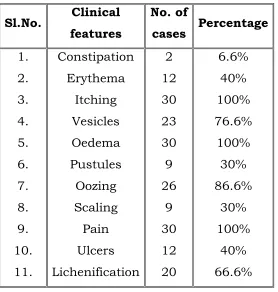
Sl.No. Clinical features
No. of
cases Percentage
[image:50.612.178.456.86.378.2]1. 2. 3. 4. 5. 6. 7. 8. 9. 10. 11. Constipation Erythema Itching Vesicles Oedema Pustules Oozing Scaling Pain Ulcers Lichenification 2 12 30 23 30 9 26 9 30 12 20 6.6% 40% 100% 76.6% 100% 30% 86.6% 30% 100% 40% 66.6%
Table shows that itching, pain and oedema were present in all the 30 cases
ASSOCIATED HISTORY
Since vatha karappan is an immunological disorder other associated condition such as bronchial asthma, Urticaria and hay fever were noted in all cases.other commenly encountered conditions like hypertension and diabetics were also noted as shown below.
Sl.No. History No. of cases Percentage
DURATION OF THE ILLNESS BEFORE TREATMENT
Sl.No. Duration in months
No. of
cases Percentage
1. 2. 3. 4. 5. 1-3 months 3-6 months 6 months – 1
year 1 – 2 years more than 2
years 5 10 6 5 4 16.6% 33.3% 20% 16.6% 13.3%
DISTRIBUTION OF UYIR THATHUKKAL
The derangement of Thathu in Vatha Karappan is tabulated
as follows
DERANGEMENT OF VATHAM
Sl.No. Vatham No. of cases Percentage
DERANGEMENT OF PITHAM
Sl.No.
Pitham No. of
cases Percentage 1. 2. 3. 4. 5. Anar pitham Ranjagam Sathagam Alosagam Prasagam 2 30 - - 30 6.6% 100% - - 100%
DERANGEMENT OF KAPHAM
Sl.No. Kapham No. of
cases Percentage
1. 2. 3. 4. 5. Avalambagam Kilethagam Pothagam Tharpagam Santhigam - - - - 13 - - - - 43.3%
EZHU (SEVEN) UDAR KATTUGAL
The seven udar kattugal which account for the normal body structure, get affected in pathological conditions. They are tabulated below
Sl.No.
Types of udar kattugal affected
No. of
cases Percentage
ENVAGAI THERVUGAL
In the siddha system of medicine eight investigative procedures were followed for clinical approach and diagnosis. These methods were strictly followed in all the cases and observations noted.
Sl.No. Type of
investigations
No. of
cases Percentage
1. 2. 3. 4. 5. 6. 7. 8. Naa Niram Mozhi Vizhi Malam Moothiram Naadi
a) vatha pitham
b) vatha kapam
Sparisam - 30 - - 2 - 21 9 30 - 100% - - 6.6% - 70% 30% 100% NEERKURI, NEIKKURI
Sl.No. Type of test No. of
cases Percentage
RESULTS AFTER TREATMENT
Out of these 30 cases 20 cases were showed good relief.
Sl.No. Results No. of cases Percentage
1. 2. 3.
Good relief Moderate relief No relief
20 9 1
66.6% 30% 3.3%
0 10 20 30 40 50 60 70 80
GOOD RELIEF MODERATE RELIEF
LIST OF IP PATIENTS
S.NO IP.
NO NAME AGE SEX / D.O.A D.O.D NO.OF DAYS TREATED
RESULT
1. 979 Gopal 77/M 02.12.07 07.01.08 37 C 2. 991 Alphonse 55/M 11.12.07 04.01.08 25 C 3. 992 Subibiramani 45/M 12.12.07 12.1.08 31 I 4. 1135 Kanniyapan 66/M 20.2.08 27.3.08 36 I 5. 1125 Ethiraj 55/M 18.02.08 8.03.08 23 I 6. 1164 Jyothi 46/M 5.3.08 29.3.08 25 C 7. 1082 Arjun 45/M 31.01.08 25.02.08 26 C 8. 1169 Ravi 39/M 10.3.08 9.4.08 30 I 9. 1173 Adaikalam 60/M 10.3.08 29.3.08 20 C 10. 1212 Mani 19/M 27.3.08 5.5.08 40 C 11. 1221 Chinnasamy 45/M 31.3.08 27.4.08 28 N.C. 12. 1254 Subbiramani 65/M 10.4.08 10.5.08 31 I
13. 675 Vasanthi 24 / F 29.12.07 24.01.08 27 C 14. 693 Kanniyamma 60 / F 10.01.08 06.02.08 27 I 15. 716 Sobitham 47 / F 24.01.08 21.02.08 28 C 16. 745 Radha 60 / F 12.02.08 05.03.08 22 C 17. 759 Vijayalakshmi 37 / F 18.02.08 08.03.08 20 C 18. 725 Rani 61 / F 29.01.08 27.02.08 30 C 19 711 Anjala 57 / F 23.01.08 08.02.08 16 I
C – Cured
NC – No Change I – Improved
LIST OF OP PATIENTS
S.
NO OP NO NAME AGE / SEX D.O.A D.O.D NO.OF DAYS TREATED
RESULT
1. AD 7211 Thabitha 25 / F 21.11.07 29.01.08 48 C 2. 21651 Elisabeth 47/ F 21.11.07 12.01.08 51 C 3. 4427 Vasanthi 44 / F 28.11.07 20.12.06 48 C 4. AD 9933 Dean Samuvel 42 / M 5.12.07 31.01.08 48 C
5. AB 976 Pulli Narayana Samy 71 / M 17.11.07 31.03.08 48 C
6. AA 9122 Jayaraman 60 / M 07.12.07 19.12.07 48 I 7. AE 5607 Godhandam 59 / M 09.02.08 27.03.08 48 C 8. AG4693 Muniyamma 55 / F 06.02.08 25.03.08 48 C 9. AE 7968 Christopher 49 / M 04.02.08 23.03.08 48 I 10. AE 9599 Subbiramani 65 / M 17.12.07 24.01.08 48 C 11. AC 7731 Shankar 36 / M 12.12.07 29.01.08 48 C
C-cured; I-Improved
Clinical laboratory investigations-I.P
Haematological investigations
SI
NO IP
NO
TC(Cumm) DC (Cumm) Hb
(mg/dl)
Blood Sugar
(mgs%)
ESR (mm)
BT AT BT% AT% BT AT BT AT BT AT
P L E M P L E M F PP F PP 1/2hr 1hr 1/2hr 1hr
1. 991 8400 4000 52 42 6 - 53 44 5 - 12.2 14.2 86 100 70 111 13 28 6 12
2. 979 8000 7000 54 40 6 2 50 42 6 2 9.3 8.2 74 110 85 107 40 60 30 60
3. 992 7800 6200 55 42 2 1 50 43 6 1 12.4 12 81 111 68 107 36 70 20 40
4. 675 7600 9000 53 42 4 1 50 43 5 2 12 9.7 67 111 88 104 16 36 45 90
5. 711 5200 7000 50 42 6 2 54 40 4 1 9.7 10.0 96 116 90 100 17 35 10 20
6. 1135 5900 8000 60 38 2 - 54 40 4 2 10.6 12.5 88 154 61 111 9 18 2 4
7. 1173 7000 8000 55 40 5 - 54 42 4 2 13.2 13.0 90 143 62 134 8 16 10 20
8. 1169 6200 8600 56 38 5 1 65 30 5 - 13.6 15 96 153 90 150 2 4 6 12
10. 1082 8000 8400 54 40 6 - 50 42 6 - 12.00 12.2 98 100 90 110 20 30 8 12
11. 1125 6800 7800 52 46 2 - 62 36 2 - 12.2 14.4 89 180 72 107 2 4 3 6
12. 1212 7200 7000 56 42 2 - 50 42 4 2 14.5 14.6 60 87 86 116 2 4 10 20
13. 1221 7400 8600 61 31 8 - 56 39 5 - 13 15.5 99 123 94 122 24 48 22 44
14 1254 7600 6600 52 41 7 - 54 43 2 - 11 10 87 153 132 188 22 44 6 12
15. 693 7700 7600 50 38 5 1 50 46 3 1 12.6 12.1 108 166 104 230 30 44 10 22
16. 716 7600 7800 60 35 4 1 53 32 3 1 9.7 10 76 96 90 100 10 25 3 8
17. 725 7600 9600 52 40 6 2 58 38 4 - 12.1 11.4 64 136 90 206 15 32 10 20
18 745 7600 7200 57 38 5 - 56 40 4 - 12.1 12.5 118 254 98 236 20 42 9 20
19 759 7400 8000 54 40 5 1 56 30 2 - 12.1 14.4 70 155 79 110 30 60 40 80
BT-Before treatment ; AT-After treatment; P-Polymorphs; L-Lymphocytes; E-Esinophils; M-Monocytes; F-Fasting; PP-Post prondial.
Anemic-3cases;
Blood sugar level is increased in 4cases; TC level is increased in 12 cases;
Clinical laboratory investigations-O.P
Haematological investigations
I NO
OP NO
TC(Cumm) DC (Cumm) Hb (mg/dl)
Blood Sugar (mgs%) ESR (mm)
BT AT BT% AT% BT AT BT AT BT AT
P L E M P L E M F PP F PP 1/2hr 1hr 1/2hr 1hr
1. AD7211 8100 8600 50 45 05 - 50 45 5 - 11.9 12.5 - 108 - 110 6 15 7 14 2. Z1651 6600 8600 46 48 06 - 38 50 08 - 11 11.1 77 116 100 - 30 40 28 54 3. 4427 7600 7400 57 40 03 - 54 40 06 - 12.5 9.2 92 - 75 - 7 6 12 24 4. AD9933 9800 8600 54 43 02 01 50 40 02 - 16.5 16 85 - 100 - 12 25 8 6 5. AB976 7600 7300 50 42 06 - 48 50 02 - 7.3 9.2 71 - 78 - 12 24 3 7 6. AA9122 7400 5900 52 42 05 - 56 40 04 - 12.2 11 79 100 81 108 30 60 18 20 7. AE5607 5900 7800 50 48 02 - 58 37 05 - 11.7 11.6 66 136 98 - 2 5 6 12 8. AG4693 7900 8200 52 46 02 - 50 48 02 - 12 13.7 74 114 80 110 12 26 6 10 9. AE7968 6200 7600 54 40 4 - 60 40 03 - 12.1 12.4 108 - 110 - 7 16 7 10 10. AE9599 6300 9000 49 46 04 01 60 36 03 - 14.5 12.1 81 111 72 136 4 8 10 20 11. AL7731 8700 6900 59 38 03 - 50 47 03 - 15.5 15 91 - 74 - 2 4 2 6
Urine analysis - OP
SLNO OPNO BEFORE TREATMENT AFTER TRTEATMENT
SUGAR SUGAR FASTING POSTPRONDIAL FASTING POSTPRONDIAL
1. AD 7211 NIL NIL NIL NIL
2. 21651 NIL NIL NIL NIL
3. 4427 NIL NIL NIL NIL
4. AD 9933 NIL NIL NIL NIL
5. AB 976 NIL NIL NIL NIL
6. AA 9122 NIL NIL NIL NIL
7. AE 5607 NIL NIL NIL NIL
8. AG4693 NIL NIL NIL NIL
9. AE 7968 NIL NIL NIL NIL
10. AE 9599 NIL NIL NIL NIL 11. AC 7731 NIL NIL NIL NIL
Urine analysis - IP
SLNO IPNO BEFORE TREATMENT AFTER YTRTEATMENT SUGAR SUGAR
FASTING POSTPRONDIAL FASTING POSTPRONDIAL
1. 979 NIL NIL NIL NIL
2. 991 NIL NIL NIL NIL
3. 992 NIL NIL NIL NIL
4. 1135 NIL NIL NIL NIL
5. 1125 NIL NIL NIL NIL
6. 1164 NIL NIL NIL NIL
7. 1082 NIL NIL NIL NIL
8. 1169 NIL NIL NIL NIL
9. 1173 NIL NIL NIL NIL
10. 1212 NIL NIL NIL NIL 11. 1221 NIL NIL NIL NIL
12. 1254 NIL NIL NIL NIL
13. 675 NIL NIL NIL NIL
14. 693 NIL NIL NIL NIL
15. 716 NIL NIL NIL NIL
16. 745 NIL NIL NIL NIL
17. 759 NIL NIL NIL NIL
18. 725 NIL NIL NIL NIL
DISCUSSION
For this dissertation study out of 30 patients selected by the author. 19 patients were admitted in the inpatient ward of Ayothidoss Pandithar Hospital of National Institute of
Siddha,chennai. Case sheets were prepared and maintained
individually for all the 19 inpatients.
The triggering factors like the climate influences, psychological disturbances, etc., were also studied. Daily observations were made before, during and at the end of the study. The observations are discussed as follows.
Sex distribution
In the study among the 30 cases, 19 were males and 11 were females. According to the siddha literature, there is no apparent sex predilection in vatha karappan.
Age distribution
During this entire study, the prevalence of Vatha karappan was a very common one affecting the adult age group mainly above 50 years.
Kaalam (Life Span) distribution:
Out of 30 patients
70% of the patients belonged to pitha kaalam 20% of the cases belonged to Kapha kaalam 10% of the patients belonged to vatha kaalam
Occupational status
Occupational hazards play an important role in causing or aggravating the disease vatha karappan.
Socio – economic condition
Out of 30 patients, 14 were belonged to poor economic conditions, Majority of them were ignorant in personal hygiene. Malnutrition, prolonged & persistant exposure to polluted atmosphere, lowered immune responses made them prone to this type of disease.
Diet
According to siddha literature the non-vegetarian diet accounts much more for the occurrence of the vatha karappan. Here during the study 96.6% of patients were Non-vegetarians . Again some food stuffs like raggi, bitter guard, brinjal, maize, tomato and fish items can also be causative factors for the vatha karappan. So they were advised to avoid such food items.
Paruva kaalam(Season)
Thinai (Land and place)
100% of cases belonged to Neithal nilam. This may be due to the environmental pollution caused by the advancement of science & technology, life style and the use of too much of pesticides and chemicals.
Gunam
Thirty cases had Rajogunam. From this inference character is very much important in developing disease. This was clearly stated in the siddha system. So control of mind and restoration of normal life style can lead to reduction in the incidence of disease.
Mode of onset
During the study 80% cases were observed to be the chronic . Incomplete treatment, failure to follow medical advice and dietary restrictions, psychological strains and changed life style were observed to be the reasons for this disease to become chronic.
Aetiology
All types of aetiological factors were observed during the study. Here no positive family history was found. Occupational relevance was observed in 13 cases.
Insect bite (5 cases) and psychological stress and strain (12
cases) were also noted.
Mukkutram a) Vatham
b) Pitham
Among 30 cases, Anarpitham was affected in 2 cases (loss of appetite, indigestion) Ranjagam and Prasagam was affected in all cases (due to dryness, roughness and hyperpigmentation of the skin).
c) Kapham
Santhigam (joint pain) was affected in 13 cases.
Ezhu (seven) Udar Kattugal
Among the 7 udar kattugal, saaram was affected in all cases (depression, anhidrosis, etc) senneer was affected in 100% of cases (papules, vesicles, lassitude, anemia). Oon and kozhuppu were affected ( ulcers, joint pain) in 13 cases.
Envagai Thervugal
Among 30 cases, niram and sparisam were affected in all cases. In Naadi nadai, vatha pitham was found in 21 cases and vatha kapham was found in 9 cases.
Mode of action
Each and every drug contains five kinds of actions i.e suvai (ͨÅ), gunam (̽õ), veeriyam (ţâÂõ), pirivu (À¢Ã¢×) and mahimai (Á¸¢¨Á). All these five are based on five elements (pancha boothas) which are present in the drug.
19 patients were admitted in the inpatient ward to facilitate frequent supervision. All the patients were treated with vatha karappan chooranam (internal) and aamanakku ennai (external) for an average of 20 days. The improvement was observed from the third day onwards in acute and 8-10days in chronic cases. The number of days taken for complete disappearance of the symptoms varied from case to case.
In this study, vatha karappan chooranam (internal) and aamanakku ennai (external) were found to be more effective clinically.
Pharmacological analysis of Vatha karappan chooranam shows
Significant anti- histamine action.
Moderate acute and chronic anti- inflammatory action.
Mild analgesic action.
The patients who had hypertension (one case) and diabetes (2 cases), were already under going allopathic treatment for hypertension and diabetes and were advised to continue the treatment, during the admission period.
SUMMARY AND CONCLUSION
The trial drugs were selected from “Agasthiar Ayul vetham”
Clinical trial was conducted in 30 cases from both sexes of different age groups.
Before starting the treatment careful detailed history was
taken.
They were treated with ‘Vathakarappan chooranam’
internally and ‘Amanakku ennai’ externally.
Along with medication the patients were advised to follow a
dietary regimen and to practise pranayama.
History, clinical findings, laboratory results, Envagai
thervugal and uyir thathukkal were used for the diagnostic purpose.
The general improvement in the condition of the patients
were observed from the end of the first week itself. On an average of 20 days of treatment, all the patients showed satisfactory relief generally.
Most of the patients showed encouraging results.
The drugs were found to be free from adverse effects during
the entire course of treatment.
The herbs are available in almost all season and
preparation of medicine is very simple.
Finally the ingredients of this trial drugs are cost effective and this will be helpful in promoting large scale manufacture of the drugs, latering to medical needs of large number of patients.
ANNEXURES
Preparation of the Trial Drug ( Internal)
thjfug;ghd; R+uzk;
NrUk; kUe;Jfs;:
J}Jtis NtH
Xhpjo; NtH
vUf;F NtH
nfhbNtyp NtH
fLf;fha; rkmsT
fUQ;rPufk;
fhl;Lr; rPufk;
Rf;F
Vyk;
mKf;fpuh
nra;Kiw:
Nkw;fz;l ruf;Ffis Rj;jpj;J ,bj;Jr; rypj;J R+uzpj;Jf; nfhs;sTk;
msT: 1-2 fpuhk; fhiy> khiy ,UNtis cs;Sf;F
mDghdk; : nty;yk; (rkmsT)
jPUk; Neha;: thjfug;ghd;
Mjhuk; - mfj;jpaH MAs; Ntjk;.
Preparation of the Trial Drug ( External)
Mkzf;F vz;nza;;
NrUk; ruf;Ffs;
nea;
ey;nyz;nza;
Mkzf;F vz;nza;
Ntg;ngz;nza;
Njq;fha; vz;nza;
kQ;rs; nghb – rpwpjsT
Nkw;fz;l vz;nza;fs;> nea;iar; NrHj;J fha;r;rp gpd; mjpy; kQ;rs; nghb NrHj;J
Mwpa gpd; tbfl;bf; nfhs;sTk;.
gad;:
ntspg;gpuNahfkhfg; gad;gLj;.j thj fug;ghd; jPUk;.
Mjhuk; - mfj;jpaH MAs; Ntjk;.
PREPARATION OF TRIAL DRUGS
thjfug;ghd; #uzk;
INCREDIENTS OF VATHA KARAPPAN CHOORANAM Calotropis gigantean (L) R.Br Solanum trilobatum. Linn
Terminalia Chebula. Retz Nigella Sativa
Withania Somnifera Zingiber officinale.
Properties of the Trial Drug
J}Jtis:jhtutpay; ngaH : Solanum trilobatum. Linn
gad;gLk; cWg;G : NtH
Rit - rpWifg;G> fhHg;G
jd;ik - ntg;gk;
gphpT - fhHg;G
nra;if - ntg;gKz;lhf;fp> Nfhioafw;wp> cukhf;fp
nghJf;Fzk; :
J}JNt isiaAzj; njhf;fpdpw; nwhf;fpa
Ntijah Nehnayh nka;iatpl; lfYNk
(NjiuaH fhg;gpak;)
gad;fs;:
J}JNtisia> fw;gKiwahfNtDk;> fwpahfNtDk; cl;nfhz;L tu clypy; Vw;gl;l Neha;fs; ahTk; ePq;Fk;.
,J xU fw;g kUe;J.
Constituents:
The major glyco alkaloid present in the plant β Solamarine