JOURNALOFVIROLOGY, Dec. 1993,p. 6979-6988 0022-538X/93/126979-10$02.00/0
Copyright© 1993, American Society for Microbiology
Eleven Loci
Encoding trans-Acting
Factors Are
Required
for
Transient Complementation
of
Human
Cytomegalovirus
oriLyt-Dependent
DNA
Replication
GREGORY S. PARIt AND DAVID G. ANDERS*
Laboratoryof Virology, The Wadsworth Centerfor Laboratories anld Research, and Department of Biomedical
Sciences, SchoolofPulblicHealth, State University ofNew YorkatAlbany, Albany, New York 12201-0509
Received 7 July 1993/Accepted 12August 1993
Recentlywedescribed theuse of human cytomegalovirus (HCMV) cosmid clones inacotransfection assay
ofHCMV oriLyt replication (G. S. Pari, M. A. Kacica, and D. G. Anders, J. Virol. 67:2575-2582, 1993). We have
nowused this assaytoidentify 11 distinct required loci encoding trans-acting factors sufficient for transient complementation oforiLyt-dependent DNA replication. This set includes all of the virus genes essential to initiate and perform DNA synthesis together with the virus genes required to express these replication
functions from their nativepromoters. Six of theidentified locispan openreading frames (ORFs) that encode homologsor probable homologs of herpes simplex virustype 1 replicationgenes,consistent with predictions based on sequence similarities and biochemical properties. These include the DNA polymerase UL54 and polymerase-associated protein UL44, thesingle-stranded-DNA-binding protein UL57,and proposed subunits ofa helicase-primase complex, UL70, UL105, and UL11-102. Frameshift mutations in any one of these essentialORFsabrogated complementationof DNAreplication. Three required loci, UL36-38, IRSI (orTRS1), andIE1/1E2, encode knownregulatory proteins. The remainingtwoloci spanORFsUL84andUL112-113and encodeearly temporalclassnucleus-associatedproteinsof unknownfunction. Neither of thesegeneshave been implicated previously in DNAreplication or inregulating geneexpression, norhavecounterparts in herpes
simplex virus type I or Epstein-Barr virus been described. The results presented here will facilitate
investigation of the mechanisms and regulation of HCMV lytic-phase DNA replication.
After entering permissive cells and uncoating, the linear humancytomegalovirus (HCMV) genome isthought to circu-larize(42) and thentoreplicate in the nucleus byamechanism
producing "endless" concatemeric products that are
subse-quently cleaved and packaged during virion assembly (59). Although the overall scheme appears similar to that of other herpesviruses, the details of this process are not well estab-lished. HCMV contains one identified origin of lytic-phase
DNAreplication (oriLyt),which directs in cis the initiation of DNA synthesis (5, 7, 34, 47). However, few of the proteins essential for oriLyt-mediated replication have been defined, and our current models of HCMV DNA replication derive largely from comparison with the prototype herpes simplex virustype 1 (HSV-1).
Consistentwith extensive geneticanalyses by many labora-tories (reviewed in reference 62),sevenHSV-1 genesthatare necessaryand sufficient for DNAreplicationwereidentifiedby using anovel transient-transfection method(10, 11, 66). Can-didate HCMV homologs of five of these HSV-1 replication
genes were identified bysequence similarityand by biochem-ical studies(12); these encodeaDNApolymerase (UL54) and
a polymerase accessory protein (UL44) (24, 25), a single-stranded-DNA-binding protein (UL57) (3, 4, 6, 40), and predicted helicase and primase proteins (UL105 and UL70,
respectively) (12, 46). In addition, open reading frames
(ORFs) UL101 and UL102were notedas positional counter-partsof the essential HSV-1genesUL9 and UL8,respectively (12). Nevertheless, with the exception of the DNApolymerase,
*Correspondingauthor.
t Present address:HybridonInc., Worcester, MA t)1605.
there has been little evidence that these candidate homologs
are actuallycomponentsof the HCMVreplication apparatus. Traditionalgenetic approaches haveprovendifficulttoapply to HCMV because of its inherentslowgrowth in culture (59) and because of the lack, until very recently (15), of an
immortalized cell line that would allow the generation of viruses containing null mutations in essential genes. The inability to readily generate conditional mutants necessitates alternative approaches to identifying essential genes, such as
thoserequired for DNAreplication. To provide agenetictest of the role of candidate HCMV homologs in viral DNA synthesis and as a means to identify other essential loci, we
developed a complementation assay, based on the strategy devised by Challberg (10), using HCMV cosmids to supply trans-acting factorsnecessarytoreplicate cloned oriLyt (50). In
ourassay,fivecosmidsareneeded forcomplementation.Initial experiments confirmed that this assayprovidesavalidgenetic
test, and we used it to define essential loci in two of the required cosmids. The loci established in those experiments
are UL44 and two known activators of gene expression, UL36-38 and IRS1, orits terminal repeat counterpart, TRSI.
The major immediate-early (IE) regionwas also needed.
Herewepresentresultslocating the remaininggenes
essen-tial for transient complementation of HCMV oriLyt-depen-dentDNAreplication. Thecomplete setcomprises 11 distinct
loci. These experiments provide genetic evidence consistent with requirements for the previously identified candidate HCMVreplicationgenesand in addition demonstrate require-ments for UL84 and ULI12-113, which have not previously been implicated either in HCMV DNA replication or in regulation ofgene expression.
6979
Vol. 67, No. 12
on November 9, 2019 by guest
http://jvi.asm.org/
6980 PARI AND ANDERS
MATERUILSANDMETHODS
Cells and virus. Human foreskin fibroblast cells were used for all experiments and cultured in Dulbecco's modified Ea-gle'smediumsupplemented with 10% (vol/vol) fetal calfserum (32). HCMV strain AD169 (ATCCVR-538) was maintained
asfrozenstocks. Infectionwasdone atan approximate multi-plicity of infection of 10.Nucleotide sequencecoordinates are
from thepublished DNAsequencedata(12) (GenBank acces-sion numberX17403).
Plasmid constructs. The replication reporter pSP50,
de-scribed previously (7), contains HCMV oriLyt as a 5.6-kbp
PvuII-KpnI
fragment.pDGA33 contains CMVstrain ColburnoriLyt and the
single-stranded-DNA-binding
protein geneand has beendescribed before (7). HCMV cosmid clones (30) werekindly supplied byA.Colberg-Poley with the permission
of B. Fleckenstein. pSVH contains HCMV immediate-early regions 1 and 2 (IE1 andIE2) (58) and was a gift from R.
Stenberg. pPSV, which contains ORFs UL112 and UL113
underthe control of the HCMV IE enhancer-promoter
(65),
was agift from D. Spector. pZP3contains theORFIRS1,and theconstruction of this clonewasdescribed previously (50).All subclones were made by excising fragments from a low-melting-point agarose gel and ligating them into pGEM7Zf(-) (Promega, Madison, Wis.) at the appropriate restriction endonuclease site within the polylinker region by
standardprocedures (53), asdetailed below.
(i) Subclones of pCM1029. pZP34 contains the 20.3-kbp
HindIll F fragment, pZP35 contains the 22.8-kbp HindIII D
fragment, and pZP27containsthe7.3-kbpEcoRI fragmentM
extending from nucleotides (nt) 74117 to 81435. pZP33 was
made by cleaving pZP27 with Sacl and EcoRI, filling in the
resulting SacI-EcoRI fragment extending from nt 76642 to 81435 with Klenow fragment, and ligating it into the
pGEM7Zf(-) SmaI sitetomakepZP33NA. The UL54 ORF
was then excised from pZP33NA by treatmentwith HindIII
andXbaI,and the resulting 4.8-kbp fragmentwasligated into
pRC/RSV (Invitrogen) in the correct orientation to supply a
polyadenylation signal for UL54, making pZP33. pZP37
con-tains the 14.3-kbpSphI fragment extending from nt78262 to 92576. pZP28 was made by ligating the 12.6-kbp SphI-DraI fragment extending from nt 78262 to 90842 into SphI- and
SmaI-treatedpGEM7Zf(-). pAZP28 thenwasmadeby cleav-ingpZP28 with BsiCI,removing thesegmentextendingfromnt
82228to85965, filling in the BsiCI ends withKlenow fragment, andreligating. This manipulation ispredictedtoremoveall but
14codons of ORFUL56aswellas421 amino-terminalcodons
from UL55 (a homolog of HSV-1 gB), giving aproduct with
484 amino acids of the carboxyl-terminal half. pZP30
con-tains the 14.6-kbpBamHI fragment extending from nt93513 to 108088. pZP29 was made by cleaving pZP30 with KpnI
andStul andligating the resulting 4.1-kbp fragment extending
from nt 99700 to 103827 into
KpnI-
and SmaI-treatedpGEM7Zf(-). A frameshift mutation inUL54 wasmade by
cleavingpZP33 withAgeI at nt 79414, filling in with Klenow fragment, and religating to make pZP33FR. A UL57 frame-shift was made by cleaving pAZP28 with AscI at nt 89039,
filling in with Klenow fragment, and religating to produce
p/ZP28FR.Aframeshift in UL70wasconstructed by cleaving
pZP29 withDraIIat nt103013,filling in withKlenowfragment,
andreligatingto make pZP29FR.
(ii) Subclones of pCM1039. pZP9 contains the 15.9-kbp EcoRI Dfragment, pZP10 contains the 12.5-kbp XbaI frag-mentextending fromnt 117485to130010, pZP31 contains the
11.2-kbp
KpnI
fragment extending from nt 133232to 144435, and pZP32 contains the 16.6-kbp XbaI fragment extendingfrom nt 130010 to 146605. pZP11 was made by excising from pZP10 the 10.2-kbp NsiI-EcoRI fragment extending from nt 119499 to 129744 and ligating into the corresponding pGEM7Zf(-) sites. pZP12 was made by subcloning from pZP11 the5.2-kbpAatIl fragment extending from nt 120502 to 125708. pZP13 was made by subcloning from pZP12 the 2.9-kbp AatII-FspI fragment extending from nt 120502 to 123363 and ligating it into AatII- and SmaI-treated pGEM7Zf(-). pZP14 was made by subcloning from pZP10 the4.6-kbp
Sacl
fragment extending from nt 122947 to 127507. Aframeshift mutation in UL84 was made by cleaving pZP13 withMunI at nt 122665, filling in with Klenow fragment, and religating to make pZP13FR.(iii) Subclones of pCM1058. pZP15 contains the 13.1-kbp
HindIII-EcoRI
fragment extending from nt 142993 to 156125. pZP16 was made by subcloning from pZP15 the 8.0-kbpSacl
fragment extending from nt 143128 to 151125. pZP17 was made by cleaving pZP16 with
SmaI
at nt 144928 and in the polylinker region of pGEM7Zf(-), deleting the intervening 1.8 kbp, and religating. pZP18 was made by cleaving pZP16 with SphI at nt 146036 and in the polylinker region of pGEM7Zf( -) to delete the intervening 2.9-kbp fragment and religating. pZP19 was made by subcloning from pZP18 the 3.6-kbp SphI-HindIII fragment extending from nt 146103 to 149645. pZP39 was made by cleaving pZP19 with SphI and AscI at nt 146036 and 146384, respectively, removing the resulting 348-bp fragment, filling in the ends with Klenow fragment, and religating. pZP21 contains the 6.2-kbpHindlIl
T fragment. pZP20 was made by excising from pZP21 the 4.8-kbp Stul-Smal fragment extending from nt 150312 to 155121 and ligating it into thepGEM7Zf(-)SmaI
site.pZP38contains the 20-kbp
HindIll
fragmentE.
pZP22 was made by cloning frompCM1058
the 9.1-kbpHindII-KpnI
fragment extending from nt 156251 to 165326. pZP26 contains the 11.5-kbpKpnI-HindIll
fragment extending from nt 165326 to 176844 ligated into the corresponding pGEM7Zf( -) sites. pZP23 was made by subcloning from pZP22 into pGEM7Zf( -) the 4.4-kbpSphI-SacI fragment extending from nt 159669 to 164152. pZP24 was made by cleaving pZP23 withMscI
at nt 163028 and 163950,removing the 922-bp fragment, andreligating.pZP25 was made by subcloning from pZP23 the 1.8-kbp EcoRIfragment extending from nt 162053 to 163835. Aframeshift mutation inUL102
wasmade bycleaving pZP19 withKpnI
at nt 147618, filling in with Klenow fragment, and religating to make pZP19FR.UL105
was frameshifted by treatingpZP20
withAgeI at nt 152349, filling in with Klenow fragment, and religating to makepZP20FR.
Transfection and replication assay. The modified CaPO4 transfection procedure (13) and the assay for detection of replicated products were performed as described previously (50). Transfections were performed in duplicate and done at least twice. Total-cell DNA extracted from transfected cells wastreated with 10 U ofDpnI and 25 U of EcoRI in a volume of 50 ,ul at 37°C for 4 to 16 h, subjected to electrophoresis through a 0.8% agarose gel, and transferred to a Zeta-probe nylonmembrane(Bio-Rad, Richmond, Calif.) by the alkaline transfer methodaccording to themanufacturer's instructions. Hybridizations were carried out with a 32P-labeled random primer-generated pGEM7Zf(-) probe with an approximate specific activity of
109
cpm/,ug. Filters were hybridized with S ng ofprobe in 10 ml ofhybridization buffer (1.5 x SSPE [1 x SSPE is 0.18 MNaCl, 10 mM NaPO4, and 1 mM EDTA (pH 7.7)], 7%[wt/vol]
sodium dodecyl sulfate [SDS], 10% [wt/vol] polyethylene glycol) for 16 h at 68°C in a hybridization oven (RobbinsScientific).Posthybridization washes were performed with 2 x SSC (1 x SSC is 0.15 MNaCl plus 0.015 M sodiumJ.VIROL.
on November 9, 2019 by guest
http://jvi.asm.org/
trans-ACTING FACTORS NEEDED FOR HCMV DNA REPLICATION 6981
100
125
onLyt
150
UL101-102 UL105
175
200
2251
kbp
IRS1
.44
UL36-38 UL44
l Z^ 9s<Oii
ai-.:
UL54 UL57
UL70
_LII
l~
20
-....-....
.p..2i,..X.::: :
1I 'CMOI
I
0IY
NI
J 'IM
I F I DI
L IU'aI
IP
I S I R I TI E I G'X'ViWi
HUll
IIIG "II
KIIYISIQII
I EIMIP
Vi
I I A I D10
BIR''
I jlal
0 F I CITIX1
Nhf ig c bZ de
HindIII
EcoRI
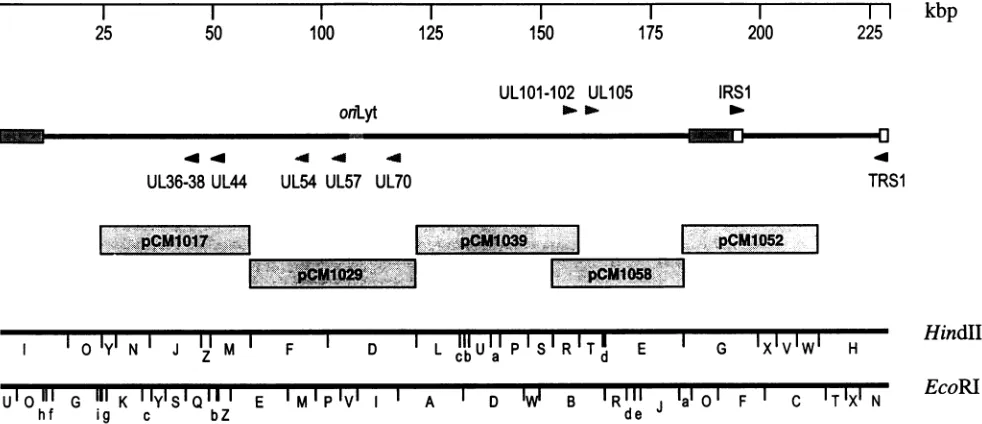
FIG. 1. HindIII and EcoRI physical maps of HCMV AD169 (12, 49), and HCMV cosmid clones used to establish the cotransfection complementationassayfororiLyt-dependentDNAreplication. Drawntoscale isarepresentation of the HCMVgenome,indicatingaslandmarks the positions of theinverted repeatsand oriLyt. Indicated above and below thegenome arethe positions and orientations of candidate HCMV replicationgenehomologs (shaded arrowheads) and ORFs previously showntoberequired for transient complementation of DNA replication (solid arrowheads) (50). Theruler(top)indicatesgenomic position in 25-kbp units.
citrate)-0.1% SDS twice for 15mineachatroomtemperature and then with 0.1x SSC-0.1% SDS twice for 45 min eachat
68°C. Southern blots were then exposed to X-Omat AR
(Kodak) X-rayfilmat -80°Cfor 24 h. RESULTS
UL54, ULS7,andUL70arerequiredforcomplementationof
origin-dependent DNA replication. In previous experiments establishing the transient complementation assay, we
demon-strated that five cosmids could express all of the functions
necessaryfor DNAreplication (50)and identified theessential loci intwoof therequiredcosmids. One of theremainingthree
uncharacterized cosmids,pCM1029 (Fig. 1),spansthreeORFs
that were previously identified as likely homologs of HSV-1
DNAreplicationgenes:the HCMVDNApolymerase (UL54),
thesingle-stranded-DNA-binding protein (UL57), andoneof the subunits for thehelicase-primase complex(UL70) (12).To test whether these ORFs are indeed needed to complement
DNA synthesis, as predicted from their similarity to HSV-1 replication functions, and to determine whether this region
contains other essentialgenes, weused thepublishedsequence
of HCMVas aguidetoconstructsubclonesfrompCM1029so
that they could be individually omitted. Each of the cotrans-fections for this series ofexperimentscontained theindicated subclones ofpCM1029 plus pCM1017, pCM1039, pCM1058, pZP3, pSVH, and thereplication reporter plasmidpSP50.
Initially we found that pCM1029 could be replaced with
three plasmid subclones, ZP34, ZP37, and ZP30 (Fig. 2A),
each spanning the predicted transcript forone of the
candi-datesnoted above. Subclones of each of these plasmids then
weretestedtoestablishthe essential ORFs(Fig. 2B, C,andD). pZP34,whichspansORFs UL48toUL55 (Fig. 2A), including
the DNA polymerase, replaced pCM1029 when subclones
pZP28 and pZP30 were also included in the transfection
cocktail (Fig. 2B, lanes 3 and4). pZP27,whichcontains only
ORFsUL53 andUL54, also complemented replication,
indi-catingthat allother ORFspresentinpZP34weredispensable (Fig. 2B, lanes 7 and 8).
The transcript reported to express the DNA polymerase (UL54) is about5 kb in size (41),andacandidate
polyadenyl-ation signal is located within the UL53 codingsequence. To confirm that UL54 is the only pZP34 ORF required and to ensure efficient expression of the UL54 gene product, we
eliminated UL53 and replaced the deleted polyadenylation signal byligatingthe UL54ORF, alongwith itspromoter,into the expression vector pRc/RSV to make pZP33. pZP33
effi-cientlyreplacedsubclonepZP27 (Fig. 2B, lanes 9 and 10). In this regard, wealso note thata subclone containing only the UL54 ORF and its promoter,with no polyadenylation signal,
failed to complement replication (51). Finally, when
UL54-expressing plasmids were omitted from the cotransfection (e.g., Fig. 2B,lanes 5 and6),orwhenUL54wasreplacedwith
the UL54 frameshift mutantpZP33FR (Fig. 2B, lane 11), no replicationwas detected.
The transcript encoding the single-stranded-DNA-binding protein UL57 is 10 to 12 kb long (40) and continues far downstream of UL57 (51), which extends from nt 90326 to 86577. Consistent with theseobservations,HindIII-D(pZP35),
which containsthecompleteUL57 ORF and itspromoterbut
only limited downstream sequence, didnot complement
rep-lication (Fig. 2C, lanes 3 and4). Therefore,westarted with a
subclone containing the 14.3-kbp SphI fragment extending
from nt 78262 to 92576 (pZP37; Fig. 2A) and spanning the entire predicted UL57 transcription unit; this clone
comple-mented replication (Fig. 2C,lanes 1 and 2). SubclonepZP28,
which retainsORFs UL55throughUL57but eliminates UL58 and UL59, was the smallest undeleted subclone supplying
UL57 thatwetested whichcomplemented replication (Fig. 2C,
lanes 5 and6).
We note that all of the essential components oforiLyt are
deleted inpZP28 (5).To determine whether UL55and UL56 arerequired,wemadedeletion constructs. Subclone pAZP28,
which removesfrom the predictedpolypeptide sequences all
0
25 50M p
T4
TRSI
VOL.67, 1993
on November 9, 2019 by guest
http://jvi.asm.org/
[image:3.612.61.552.81.293.2]6982 PARI AND ANDERS
pCM1
02964,521
F D
rZP34
pZP27
pZP35
pZP33
L11
pZP28
pZP30
pZP37
JpZP29
pAZP28
54 55 -56 - 57 59 69 70 72
-4
4--548-
4-52 53 58 71
10, t~A,
o 'J
-
-10
C2
po1
2 34 5 6 7 8 9ipo
r
1--
I--
x
__
I-N-
-^
1~~~~~
2 3 4 S6,
Cdbp r-- -T 7
amW
-IV,
DUL70 1 2 3
DUUL70 1
-
-8
11-78 9lO lt 12
l--F l IXXX
11 12
-S
'fm. O
13 14 15
a.
_
0
Q~ NZ
4 5
FIG. 2. CosmidpCM1029contains three locirequiredfor
comple-mentation oforiLyt-dependent DNA replication. (A) Physical map
depictingHindlIl fragmentswithincosmid
pCM1029,
thepositionsofotherfragmentsthatweresubcloned and used incotransfections,and
the locationsof predicted ORFs. Transient-complementation experi-mentswerecarriedoutasdetailed inthetext.Southerntransfers ofthe
DpnI-treatedtransfected-cell DNAwereexposedtofilm for about 24
hat -80°C.Presentedherearetheresultingautoradiograms; onlythe
region in which DpnI-resistant products are located is shown. All
positivecontrols for theseexperiments included
pCM1029,
pCM1017,
pCM1039, pCM1058, pZP3, pSVH, andpSP50 in the cotransfection
cocktail. (B) Evidence that the HCMV DNA polymerase UL54 is
required for complementation of oriLyt replication. Cotransfection
cocktailsfor lanes3to11 wereidenticaltothepositivecontrolsexcept
that cosmid pCM1029 was replaced by pZP28 and
pZP30
plus theplasmid indicated above each lane. (C) Evidence that the HCMV
single-stranded-DNA-binding protein UL57 is required for
comple-mentationoforiLytreplication. Cotransfection cocktails for lanes 1to
13 and lane 15 were identical to the positive controls except that cosmidpCM1029wasreplacedbypZP30 andpZP27 plus theplasmid
indicated above each lane. (D) Evidence that the putative HCMV primase activity UL70 is required for complementation of oriLyt
replication.Cotransfection cocktailsfor lanes1 to4wereidentical to
the positive control except that cosmid pCM1029 was replaced by pZP27andpZP28 plustheplasmid indicated above each lane.
but 14 codons of the ORF UL56 and 421 amino-terminal
codonsofUL55, complemented DNAreplication, albeit at a
reducedlevel (Fig.2C, lanes 7and8), arguing that UL57 isthe
onlyORFrequired from pZP28. Further evidence that UL57
is the
only pZP28
gene
required
is that
a clone expressing theCMV strain
Colburn
single-stranded-DNA-binding
protein(pDGA33 [7])
can
replace
HCMV
pZP28
inthe
replication
assay
(Fig.
2C,
lane
15).
Finally,
when
UL57
was omitted (Fig.2C,
lanes
11
and
12)
or
replaced
witha clone
containing aframeshift mutation in UL57
(pAZP28FR),
no replication
wasdetected (Fig. 2C, lane 13).
The third
proposed
replication
gene
homolog
within
pCM1029
is HCMV
UL70,
supplied
in
initial experiments bypZP30
(Fig.
2A).
To test whether
UL70
was sufficient toreplace
pZP30,
we made
a subclone
(pZP29)
which contains
only
UL70
and found that it
replaced
pZP30
in thecomple-mentation
assay (Fig.
2D,
lane
3).
Cotransfection cocktails
omitting
clones
containing
UL70
produced
no signal
(Fig. 2D,lane
1),
nor
did cocktails
substituting
a frameshift
mutant ofUL70
(Fig.
2D,
lane
4).
Together,
these results
indicate thatUL70
is essential
for
complementation
of DNA replication.
We concluded from
this
series of
experiments
that three
subclones,
pZP33,
pLZP28,
and
pZP29,
which
contained
UL54, UL57,
and
UL70,
respectively,
are necessary
tocom-plement
DNA
replication
and that
these three
alone
aresufficient to
replace
cosmid
pCM1029
in the replication
assay.
pCM1039
contributes ORF UL84.
Cosmid
pCM1039
wasalso
required
for
origin-dependent
DNA replication
(Fig. 1).This cosmid
extends from nt 107677 to 149645
and
includes
HindIII
fragments
L, c, b, U,
a, P,
S,
and
R (Fig.
3A). ORFs
UL101
and
UL102,
which were noted
as
positional
counter-parts
of HSV-1
replication
genes
UL9 and UL8, respectively
(12),
are
present
both in this cosmid and in
another
required
cosmid,
pCM1058.
However,
a subclone of
pCM1039
contain-ing
the
UL101-102
region
alone failed to replace
pCM1039
incomplementing
replication
(51).
Therefore, we constructed
aseries of
pCM1039
subclones
(Fig.
3A)
and determined
which
ones could
replace
pCM1039.
Transfection cocktails
for
these
experiments
included
cosmids
CM1017,
CM1029,
CM1058,
pZP3, pSVH,
and
pSP50
plus
either
pCM1039
(positive)
ortheindicated
substitute(s)
for
pCM1039
(Fig.
3B
and
C).
Cotrans-fecting
either
pZP32
plus
pZP9
or
pZP31
plus
pZP9
in
place
of
pCM1039
produced
a
positive
replication
signal
(Fig.
3B,lanes
5 to
8). pZP31
plus
pZP32
failed
to
replace
pCM1039
(Fig.
3B,
lanes 3 and
4).
However,
either pZP9,
which spans
ORFs
UL84 to
UL92,
or
pZP10,
which spans
UL82
to UL86,
substituted for cosmid
pCM1039
in the
replication
assay
in theabsence of
pZP31
and
pZP32
(Fig.
3B,
lanes 9 to
12), defining
an essential
region
spanning
UL83
to UL86.
Subsequently,
wefound
that
pZP11,
which includes ORFs UL84 to
UL86,
alsocomplemented replication
(Fig.
3C,
lanes 11 and
12), whereas
pZP14,
which
spans
ORFs
UL85 and UL86,
failed
to
comple-ment
(Fig.
3C,
lanes
3
and
4).
Another subclone,
containing
only
UL84 and UL85
(pZP12),
was
also sufficient
to
replace
pCM1039
(Fig.
3C,
lanes
5 and
6).
Finally, a subclone
that
contained
only
UL84
(pZP13)
complemented
replication
whether alone or in combination with
a clone
spanning
UL85
(pZP14; Fig.
3C,
lanes 7 and
8).
Thus,
UL84
alone
wassufficient to
replace
pCM1039
in the complementation
assay
(Fig.
3C,
lanes 9 and
10).
Omitting
UL84 from
transfections
(Fig.
3C,
lanes
1
and
2)
or
replacing
it with a
clone containing
a frameshift mutation
in
UL84
(Fig.
3C,
lane 15) abrogated
complementation.
pCM1058
contributes four loci essential for transient
complementation
of DNA
synthesis.
The
last required
cosmid
that
we
characterized,
pCM1058,
includes
UL105,
a
candidate
homolog
of the essential HSV-1
DNA helicase
UL5
(12, 46);ORFs
UL101
and
UL102,
which
were
noted
to
be "positional"
counterparts
of HSV-1
replication
genes
UL9
and
UL8,
re-spectively;
and
the
major
immediate-early
region
(Fig.
1).A
J.
VlIROL.
on November 9, 2019 by guest
http://jvi.asm.org/
[image:4.612.66.297.79.437.2]tratns-ACTING FACTORS NEEDED FOR HCMV DNA REPLICATION 6983
pCM1
039
L
cb
U
a
P
pZP9
pZP1
0
pZP
1
pZP12
S
4964
R
pZP31
pZP32
--
pZP13
-
pZP14
-C
g-.-
G--2 83 G5
A
R
T
pZP15
pZP16
pZP17
pZPl
8
pZPI
9
pZP20
pCM1 058
E
pZP22
PZP23.
pZP26
pZP24
pZP25
.4- .4- -c
1. *4.
13/~~~~~~~~~~(
2
2 (3 36 8
_ TI
A76
a
-90to
II
:,I X-;l
(3 (3 (3
A 7
B
Q,I 4> ,
T
--I
__ X~~W
FIG. 3. Cosmid pCM1039 contributes UL84. (A) Physical map
depicting HindIII fragments within cosmid pCM1039 and other sub-cloned fragments that were used in cotransfection experiments de-tailedinthe text. Also shownare thepredicted ORFs located in this region. (B and C) Transient-complementation experimentsweredone
asdescribed in thelegendtoFig.2. Allpositivecontrols(B,lanes1and
2; C, lane 16) for these experiments included pCM1029, pCM1017,
pCM1039, pCM1058, pZP3, pSVH, and pSP50in the cotransfection cocktail. Presented are photographsof theDpnI-resistant portion of
the Southern transfers. Cotransfections for all lanes contained the substitution(s) forpCM1039indicatedabove the lanes plus pCM 1017, pCM1029, pCM1058, pZP3, pSP50,andpSVH.
Therefore, wefirstattemptedtoreplace pCM 1058 by cotrans-fecting a large subclone, pZP15, encoding ORFs UL99 to UL106 (Fig. 4A) plus pSVH; this combination failed to complement replication (Fig. 4B, lane 1). Subsequently, we
replaced pCM1058 withtwo plasmids, pZP15 and asubclone
containing the HindlIl E fragment (pZP38). This combination complemented DNA replication (Fig. 4B, lanes 2 and 3), suggesting that a second HindIII-E locus, in addition to the major immediate-early region, was needed. Therefore, we
constructed additional subclones of HindIII-E (Fig. 4A). Co-transfections which included subclones pZP15, pZP22, and pZP26 in place of cosmid pCM1058 yielded replication (Fig. 4B, lanes 8 and 9). Moreover, pSVH replaced pZP26, showing that no pZP26 ORFs outside of the major immediate-early
region are neededto complement DNA replication (Fig. 4B, lanes 10 and 11) and that pZP22, comprising ORFs ULI1O to
ULI17 (Fig. 4A), contains a distinct essential function (Fig. 4B, compare lane 1 with lanes 10 and 11).
To establish essential loci in the left halfofpCM 1058, we
constructed subclones of pZP15 containing ORFs UL100 to
FIG. 4. Cosmid pCM1058 contains multiple essential loci. (A) PhysicalmapdepictingHindIlI fragments within cosmid pCM 1058 and
fragments that were subcloned and used in cotransfections. Also indicatedarethe ORFs located within thisregion. (B) Autoradiogram
ofaSouthern transfershowing DpnI-resistant oriLyt-containing prod-ucts from cotransfection experiments.Transfections werecarriedout
as described in Materials and Methods. All transfection cocktails containedpCM1017, pCM1029,pZP13, pZP3, and pSP50plus either
pCM1058 or the plasmids indicated above the lanes in place of pCM1058.
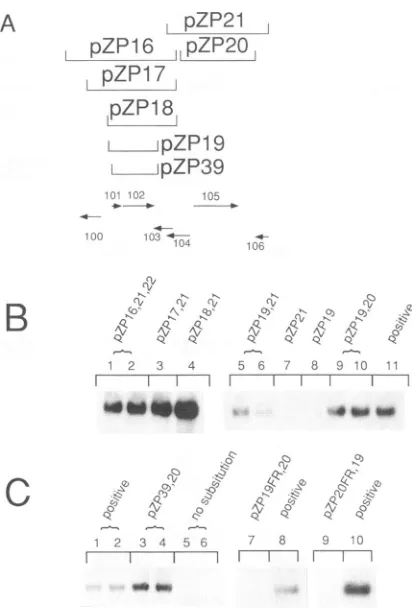
UL103 (pZP16) and UL105 and 106 (pZP21). These con-structs together, in cotransfection experiments that also
in-cludedpZP22andpSVH, replaced pCM1058 (Fig.SB, lanes 1
and 2). Smallersubclones ofpZP16 (pZP17 and pZP18; Fig. 5A) ruled out the possibility that ULIOO is needed for
repli-cation (Fig.5B, lanes 3 and4). The construct pZP19, lacking
the ORFUL103,stillcomplemented replication (Fig.5B,lanes 5and6).FinallypZP39, which extends only 7 nt upstream from the putative ATG ofULIOI and about 470 nt 3' with respect
to the putative translational stop of UL102, also comple-mentedreplication (Fig.5C,lanes 3 and4), arguingthat not all of ULIOI may be required for replication because any
up-stream promoter region needed for ULIOI expression is
missing. However, a construct in which most of the ULIOI
ORF was deleted failed to complement replication (51).
pZP20, whichcontainsonlyUL105,couldreplace pZP21 (Fig. SB, lanes 9 and 10). Transfection mixtures omitting either UL101-102(Fig.5B,lane7)orUL105(Fig.5B,lane8)orboth (Fig. 5C, lanes 5 and 6) showed no detectable replication.
Incorporating frameshift mutations either in UL102
(pZP19FR) or in UL105 (pZP20FR) also abrogated comple-mentation (Fig.5C,lanes7 and9, respectively). Thus, regions
containing ORFs UL101-102 and UL105were necessary and
sufficient to replace pZP15.
A
76.4o.4
pSVH
B
ZI
-
cI
'3.^v (-- S
Voi..67, 1993
d
C, 171,
4.-.
->-.4-. X< .Ilf
.. I-
4..+
on November 9, 2019 by guest
http://jvi.asm.org/
[image:5.612.324.557.74.363.2] [image:5.612.68.298.79.399.2]6984 PARI AND ANDERS
A
pZP21,
I
pZP16
pZP20O
LpZPZ
89L
IpZP19
_ipZP390- 102 105
*_._ *t~~~~~~~10
1 00 103( 1o4
B
Cl,
3-'C"
,,-,(C
1 2 3 4
F
iO6
_ _
5 6 7 8 9 10 11
I I I I I '1
~~~~~~~~40W N
__
Cw,
.*_12 3 4 5 6 7 8 9 N0
FIG. 5. Evidence thalt UL1()I-102 alnd UL1()5 alre requircd. (A)
PhysicallmalpofpZP15 subclones usedincotrcansfection experiments shownbelow alnd thecorrespondingORFs.(BatndC)Autoratdiogralm
ofaSouthern transfershowingDpni-rcsiistatntotiLyt-contalining prod-ucts from cotralnsfection mixtures conta1ining pCM1017, pCM1()29, pZP13,pZP3, pSVH, pZP22,cand pSP5() plusthe indicattedplassmids
substitutedforpZP15.
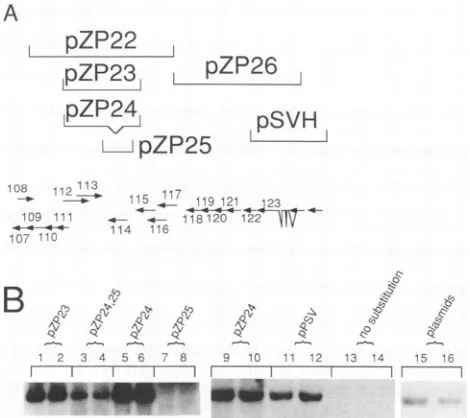
To establish the required components in the right half of pCM 1058, we made subclones of pZP22. Cotransfections substituting pZP23, whichspansonly ORFs ULI 12toULI 14, forpZP22complemented replication (Fig. 6B, lanes 1 and 2).
To determine which of these genes was required, we
con-structed twosubclones ofpZP23: pZP24, which lacks ULI 14, and pZP25, which contains only ULI 14. pZP24was sufficient to replace pZP22 (Fig. 6B, lanes 5 and 6), whereas pZP25
alonedidnot(Fig. 6B,comparelanes 3 and 4 with lanes 7and
8). Thus, ORFsULI 12 and ULI 13werethe onlypZP22 ORFs
required. Also, pPSV (65), which expressesonly the
transcrip-tion unit spanning ORFs ULI 12 and ULI 13, replaced pZP24 (Fig. 6B,lanes 11 and 12). Finally, whensubclones containing
ULI 12-113wereomitted fromtransfection cocktails,no signal
wasdetected (Fig. 6B, lanes 7, 8, 13, and 14). We concluded
from the results summarized in this section that cosmid pCM 1058 supplies four essential loci, containing ORFs
UL1O1-102, UL105, ULI12-113, and IEI and IE2.
The above-described experiments identified eight required loci (see Fig. 7) in addition to the three that were described
[image:6.612.75.281.73.377.2]previously. In all, 11 distinct loci wereneeded tocomplement DNAreplication in thecotransfectionassay, assummarized in
Table 1. Tosimplify thetransfection mixtures for experiments defining the essential components of individual cosmids, we
alwaysincluded cosmid clonestoprovidesomeof theessential
loci. Because of the possibility that other nonessential genes
might contribute toDNAreplication,we determinedas afinal
test whether the defined set of 11 plasmid clones supplying
only individual essential loci could support complementation.
As shown inFig. 6B, lanes 15 and 16, when only the definedset of 11 lociwerecotransfected, oriLyt replicationwasobserved.
DISCUSSION
Transient complementation withcotransfected cloned frag-ments provides a genetictest ofthe role ofpreviously identi-fiedcandidate replicationgenes,aswell as ameanstoidentify other functions required for DNA synthesis (10, 29, 50). Moreover, because in our experiments essential replication
functions are expressed via their native promoters, it also provides an approach to defining genetic requirements for
TABLE 1. Summary ofessential HCMV lociandherpcsviruscounterparts
oiferpcsvirus
counterpartCYosmidi IICMV Prediicted function
HSV-I Epstein-Barr virus
pCM1017 UL44 UL42 BMRF1 polaccessory
UL36-38
__"
RegulatorypCM1029 UL54 UL30 BALF5 DNApolymerase
UL57 UL29 BALF2 Single-stranded-DNA-binding protein
UL70 UL52 BSLF1 Primase
pCM1058 UL105 UL5 BBLF4 DNAhelicase
UL1t)1-1t)2
UL8' BBLF2/3' Primase-associated factorULI12-113 " " Unknownearlyprotein
IE1/IE2 Regulatory
pCM 1052 IRSI - Regulatory
pCMlO39 UL84 __ Unknown earlyprotein
"HSV-Itransactivators arcniotrequiredtocomplement DNAreplication intransicuitassays.
/'ThrecEpstein-Barrvirustr-ansactivators.Z, R, and M,arcniccdcdtocomplementoriLytrcplication in atranlsient aissay;howevcr, thesegeniesarcnotobvious homologs of tlleessenitialHC1MVtransactivators.
Probableliomologsdisplayingminimal scquencesimilarity.
dNo
couLnterparts
ofthcseHCMVearly temporal-classproteinshavebeenfound.J. VIRO)L.
on November 9, 2019 by guest
http://jvi.asm.org/
trans-ACTING FACTORS NEEDED FOR HCMV DNA REPLICATION 6985
pZP22
IpZP231
P26
pZP24
pSV
LI
pZP25
pZP33
76,905
Sad
r
TATA
(81 ,039) 80,631 EcoRI UL54
86,577
H,
_
pAZP28
108 -!!i13
i--p-'115 117 11912' 123 109 11i = - 118120 122
o-1--4- 114 116
107 110
pZP29
B
I>t
ie
qt
RnE
gE
/
1 2 3 4 5 6 7 8 9 10 11 1.2 I3 14
7 l
-_ _
l .@
15 I6
1
r
pZP13
SpM
UL57
4..
Kpnl 100,537 14
UL70
POLY A
(121,180)
Aafll 121,312
11
1UL84
FIG. 6. CosmidpCM1058 also contributes UL112-113. (A)Map of pZP38 subclones usedin cotransfection experiments and the
corre-sponding ORFs. (B)Transient-complementation assayscarriedoutas
described in Materials and Methods. Shown are autoradiograms of resultingSouthern transfers, showing DpnI-resistant oriLyt-containing products. Cotransfection mixtures for lanes 1 to 12 contained
pCM1017,pCM1029,pZP13,pZP3, pZP19,pZP20,pSVH, and pSP50 plus the indicated plasmids substituted for pZP22. Transfection
mix-turesfor lanes15 and 16containedpZP3,pZP6, pZP7, pZP33, pZP28, pZP29, pZP13,pZP39, pZP20, pZP24, pSVH, andpSP50.
normal expression. We previously showed that UL44, UL36-38, and IRS1/TRS1 are required to complement HCMV oriLyt-dependent DNA replication when the required genes are expressed from their native promoters (50). The results
presented here identify the remaining essential loci. As dia-grammed in Fig. 7 and detailed below, these additional loci span ORFs UL54, UL57, UL70, UL84, UL101-102, UL105,
ULl12-113, and the majorimmediate-early regions IEl and
IE2.Thus, altogether, 11distinct lociarerequired fortransient complementation of HCMV origin-dependent DNA
replica-tion.
Replicationgenes.Six of the essential locispanhomologsor probable homologs ofHSV-1 replication genes, encodingthe DNApolymerase (UL54)andapolymerase-associated protein (UL44), the single-stranded-DNA-binding protein (UL57),
and proteins that may form a helicase-primase complex (UL105, UL101-102, and UL70). Constructs with frameshift mutations within each of these ORFs individually failed to
complement replication.Our resultsthereforeprovide genetic
evidence consistent with a requirement for the proteins
en-coded by HCMV genes previously identified by nucleotide
sequencesimilaritytoHSV-1replicationgenes.Thisfindingis notsurprising giventheestablishedsequence and biochemical
similarities to HSV counterparts (4, 6, 12, 24). Candidate
homologsofthese proteinshave been identifiedinall herpes-virusessequenced todate(1,8, 12, 18, 48), and itislikely that
these enzymes constitute a characteristic herpesvirus lytic-phase replicativeapparatus. Supportingthis isthefindingthat
Epstein-Barr virushomologs of HSV-1 replication genes are
also essentialforcomplementationoflytic-phaseDNA
synthe-sis (29).
HCMV UL54 encodes a DNA polymerase that shows
sequencesimilaritytoavarietyofalpha-likeDNApolymerases
pZP39
pZP20
pZP24
AscI 147,128
L
UL1 01
149,140 HindII
I
UL102
TATA
StuA (151,611) 151,850
UL1 05
161,392 161,301
Sphl 160,589 I
POLY A
(1 54,973)
154,793159 Smal
lj
162,797
Sad UL1 12 UL113
FIG. 7. HCMV fragments defining essential loci. The fragment
presentin each essentialplasmid described in thetextis drawn.The predicted essential ORFsareindicated, with hatchedarrowsshowing
thedirection oftranscription. Other partial ORFs alsopresentinthe fragments and deleted ORFsareshownassolid boxes. Wherepresent,
TATA andpolyadenylationconsensussequences arealso marked.The
majorimmediate-early region, contributed inmostofourexperiments by pSVH (58), isnotshown.
(61)and is thetarget ofcurrently availablechemotherapeutic
agents (14, 60). Thecoding assignment initiallywasbasedon
sequence similarity to HSV-1 pol (37, 41). Earlier studies identified and characterized a DNA polymerase activity
present in HCMV-infected cells (38, 39). Cloned and ex-pressed UL54demonstrates DNApolymerase activityinvitro
thatcorrespondstotheinfected-cellenzyme(24,25).Northern
(RNAblot) analysis, nuclease protection, and primer exten-sion assays suggested that the primary transcript expressing HCMV UL54isaroughly 5-kb early species whosecapsite is morethan 380nt upstreamof the probable initiation codon (41)andthat apolyadenylation signal lyingwithin UL53at nt 76330 is utilized. Ourresults areconsistent with these obser-vations. The smallest testedfragment supplyingUL54 extends about 800bpupstream of thepredicted translation initiation codon (Fig. 7, pZP33) andjust over400 bp upstreamof the
experimentallydeterminedcapsite(41), demonstratingthata
fibroblast-competentpromotersufficienttodriveexpressionof UL54 is situated between nt 81011 and 81435. Deletions downstream of UL54 which eliminated the UL53 ORF also
A
TATA (90,330)
90,281
>
l"'
Dral103,373 StA
TATA
(123,110) 123,0701 Fspl
-.M
VOL.67, 1993
Iz,
:_0
on November 9, 2019 by guest
http://jvi.asm.org/
[image:7.612.59.294.79.288.2] [image:7.612.313.551.86.436.2]6986 PARI AND ANDERS
removed the candidate polyadenylation signal, and these con-structs failed to complement replication unless another poly-adenylation sequence wassubstituted, as in pZP33. Thus, the previously noted signal is probably important for normal expression in vivo.
HCMV UL57encodes asingle-stranded-DNA-binding pro-tein homologous to the HSV-1 majorDNA-binding protein (3, 40). The transcript expressing UL57 is a 10- to 12-kb early species(40). The5' end of this transcript and its promoter are to the left of the DraI site at nt 90842, as defined by the smallestcomplementingclone, although the in vivo cap site has not been determined. There is nodownstream polyadenylation
consensus sequence between UL57 and UL54. We found that in order to obtain complementation, extensive downstream sequence was required (pZP28). However, two lines of evi-dence indicate that UL57 is the onlyessential gene within this
fragment. First, deletions in ORFs UL55 and UL56 did not
eliminate complementation, in contrast todeletions or frame-shift mutations within UL57. Second, we found that clones containing HCMV UL57 could be replaced by a clone express-ing its CMV strain Colburn counterpart, which does not contain these downstream ORFs (2, 3).
UL70 encodes a homolog of HSV-1 UL52. UL52
contrib-utes an essential primase activity to the HSV-1 three-subunit helicase-primase complex (16, 17, 22, 23). HCMV UL70 extends from nt 103373 to 100536 and is not flanked by
consensus TATA or polyadenylation signals. In Northern blots, anapproximately 4-kb transcript is detected (51), but the cap site has not been determined. The finding that pZP29
expresses UL70 also shows that theupstream boundary ofthe UL70 promoter mustlie to the left of nt 103827,within about
450 bp of the predicted translation initiation codon. UL105,
which extends from nt 151856 to 154793,encodes a homolog of HSV-1 UL5. Unlike UL70, UL105 is flanked by TATA and polyadenylationconsensus sequences at nt 151611 and 154976,
respectively. Within UL105 are characteristic helicase motifs
similar to those noted in the corresponding helicases of HSV-1, varicella-zostervirus, andEpstein-Barr virus (46, 67). UL105 was supplied in our complementation assay by the subclone pZP20, which includes the candidate TATA and polyadenylation signals. This is the only ORF present in this
clone. The HSV-1 counterparts of HCMV UL70 and UL105 associate with another HSV-1 gene product, UL8, to form a heterotrimeric helicase-primase complex (9, 17, 22, 23, 55). It remains to be determined whether HCMV UL70 and UL105 associate to form a similar complex.
The HCMV ORFs ULIOI and UL102 were noted on the basis of flanking homologies to be positional counterparts of
HSV-1 UL9 and UL8, respectively, although alignments with
these counterparts were not obviously significant (12). In our assay, aconstructspanningULIOI and UL102 wasrequired for complementation (Fig.5C, lanes 1to6).NoobviousTATA or polyadenylation sequences are present in this fragment, and the transcription unit(s) is not well defined. UL102 must encode all or part of an essential function, because frameshift
mutationsin HCMVUL102 abrogated complementation (Fig. 5C, lane 7). cDNAs obtained by a polymerase chain reaction method (31) locate candidate 5' ends of UL102 transcripts
clustered around nt 146850, about 270 nt upstream of the predicted UL102 initiation codon (12). Only 7 nt 5' with respect to the putativetranslational start of
ULIOI
are present in the smallestcomplementing fragment tested (pZP39), and it seems unlikely that a transcript spanning ULIOI is efficiently expressed. However, constructs in which the ULIOI codingregion is eliminated failed tocomplement replication, andtwo different frameshift mutations in the C-terminal portion of
ULlOI,both well upstream of the candidate UL102 cap site, abrogated complementation (51). These constructions may
have ablated promoterelements required for efficient expres-sion ofUL102 in fibroblasts,but we have notruledout other
possibilities.
In this regard we note that results obtained with the
GeneticsComputer Group programTESTCODE(21), which
searches forperiodic base composition bias(28), are suggestive
of protein-coding capacity in the region upstream ofUL102 (51). Moreover,thisTESTCODE peakisapproximately
coin-cident witha222-bp ORF, overlapping UL1O0,which begins at nt 146520and is situated in thesamereading frame as UL102.
Interestingly, the termination codon ending this ORF is the
onlynonsense codon lying between it and UL102. The
corre-sponding Epstein-Barr virus region, spanning BBLF2 and BBLF3, also was shown to be needed to complement DNA replication. These ORFsapparently are expressed via aspliced
transcript to forma single protein (26), andparallel complex-ities may beobserved in the corresponding HCMV ULIO1-102 region. It was suggested that Epstein-Barr virus BBLF2/3 encodes a UL8 homolog, and a small domain, conserved in HCMV UL102,was described (29).
Other required loci. A reasonable hypothesis is that the above-described six HCMV homologs of HSV-1 replication genes, shown in this report to be required for complementa-tion, encode proteins thatparticipate directly inDNA synthe-sis. Indeed,the onlyremainingunidentifiedormissingHCMV homolog of required HSV-1 replication genes is UL9. How-ever, several other loci also were required in our assay. As in
Epstein-Barr virus and distinct from HSV-1, three viral
trans-activators are needed for transient complementation of HCMV DNA replication. The finding that the major immedi-ate-early locusis required for complementation is not surpris-ingbecause expressionof atleast three ofthe above-described essential genes is upregulated by major immediate-early pro-teins(56-58). IRS1/TRSL also activates expression ofrequired proteins, in cooperation with major immediate-early proteins
(57). Whether the required transactivators play other roles in regulating, initiating, orperforming DNAsynthesis remainsto be determined.
An important emerging story concerns the rolesof transac-tivators in regulating initiation of DNA replication. It is well established that origin usage in many eukaryotic and viral systems is augmented or controlled by elements that also regulate transcription (for reviews, see references 19 and 20),
including HSV-1 and Epstein-Barrvirus (33, 54, 63).
Comple-mentation of HSV-1 replication does not require any of the virus-coded transactivators (11), but HSV-1
ori,
activity isaugmented byflankingpromotersequences (63).In contrast to HSV-1, complementation of Epstein-Barr virus
oriLyt-medi-ated replication requires three knownviraltransactivators(29,
52). One of these transactivators, Z, binds specifically to elements (ZREs) inthe promoters of BHLF1 and BHRFI that overlap oriLyt (27, 44, 45). The BHLF1 promoter, including
the ZREs, is an essential component oforiLyt (52, 54).
The mechanisms by which transcriptional regulators influ-ence origin activity are not established, but accumulating
evidence suggeststhat, in some cases,activation is mediatedby specific protein-protein interactions betweentranscription fac-tors and replication proteins (36, 43). That there are both general and specific structural similarities between the
lytic-phase origins of Epstein-Barr virus and HCMV (5, 47, 54)
suggests that one or more of the HCMV transactivators may participate inactivatingHCMV oriLyt. Now that the complete
set of genes required for complementation has been estab-lished, it should be possible to distinguish whether individual
J. VIROL.
on November 9, 2019 by guest
http://jvi.asm.org/
trans-ACTING FACTORS NEEDED FOR HCMV DNA REPLICATION 6987
transactivatorsare required forinitiation by placing the
essen-tial genes under the control of a heterologous constitutive
promoter.
Finally, the functions of two other loci encoding early
proteins required in the complementation assay, spanning
ORFsUL84 and ULl 12-113, are not known; neither UL84 nor
ULI 12-113 has been implicated previously in HCMV DNA
replicationor inregulating gene expression. UL84 codes for an
early temporal class, nuclear, 65-kDa protein (35). Its 2.0-kb
transcriptis detected as early as 2.5 h postinfection, but not in
cycloheximide-treated cells. Peak expression occurs later, be-tween 72 and 96 h postinfection. The cap site is located
immediately upstream of the translational start codon and just
downstream from a TATA-like element at nt 123110. A
polyadenylation signal is located downstream of UL84 at nt 121180. Both of these elements are present in pZP13, the
smallest complementing clone tested. The complex transcrip-tion unit spanning ORFs ULI 12 and UL113 encodes at least
four early temporal class, nuclear phosphoproteins of 34, 43,
50, and 84kDa by differentialsplicing (64, 65). cDNA analysis has shown that 2.1- and 2.2-kb RNAs express the 50- and 43-kDa proteins, respectively, and that a 2.5-kb RNA expresses a 84-kDa protein; the 34-kDa protein is derived from an
unspliced RNA. The promoter for these transcripts lies be-tween -323 and - 7 bp relative to the transcriptional start site
and is activated by proteins originating from immediate-early
regions 1 and 2 (56).
Homologsof UL84 and ULI12-113 are not apparent in the genomes of the alpha- or gammaherpesviruses sequenced to
date (1,8, 18,48), butmoderate-stringencyhybridizations with
the UL84 and UL112-113 loci as probes detect specific frag-ments in the simian CMV-like strain Colburn (51). It is
tempting tospeculatethat one or both of these loci replace the
missing UL9 function, but it is equally plausible that these
proteins supply additional transactivating functions or play someother unanticipatedrole. Finally, because we cannot rule out the possibility that the requirement for these proteins
results from the transient-transfection assay used to identify
them, it willbenecessarytoconfirm the roles of these proteins
byothergenetic and biochemical approaches.
In summary, this study provides genetic evidence that, as
expected, HCMV homologs of HSV-1 replication genes are
essential forDNAreplication.LikeEpstein-Barrvirus, HCMV
evidently does notencode a homolog of HSV-1 UL9. Also as
in Epstein-Barr virus, transient complementation of HCMV
lytic-phase DNAsynthesis requires three virus-coded
transac-tivators. However, unique to HCMV is the apparent require-ment fortwo additional early loci, UL84 andUL112-113. The
results presented here lay thegroundworkfor future studies to
define the roles of individual components in regulating,
initi-ating, and performing DNA synthesis.
ACKNOWLEDGMENTS
We thank Deborah Spector, Rich Stenberg, Ed Mocarski, and Annie Colberg-Poley for their generous gifts of recombinant plasmids and Mary Beth Coy and Marc Antonyak for invaluable technical assistance.
Thiswork was aided by Public Health Service grantsA131249and A133416from NIH.
REFERENCES
1. Albrecht,J.-C., J.Nicholas, D. Biller, K. R. Cameron,B. Biesinger, C. Newman, and S. Wittman. 1992. Primary structure of the herpesvirus saimiri genome. J. Virol. 66:5047-5058.
2. Anders, D. G. 1990. Nucleotide sequence of a cytomegalovirus single-strand DNA-binding protein gene: comparison with
alpha-and gammaherpesvirus counterparts reveals conserved segments. J. Gen. Virol. 71:2451-2456.
3. Anders, D. G., and W. Gibson. 1988. Location, transcript analysis, and partial nucleotide sequence of the cytomegalovirus gene encoding an early DNA-binding protein with similarities to ICP8 of herpes simplex virus type 1. J. Virol. 62:1364-1372.
4. Anders, D. G., A. Irmiere, and W. Gibson. 1986. Identification and characterization of a major early cytomegalovirus DNA-binding protein. J. Virol. 58:253-262.
5. Anders, D. G., M. A. Kacica, G. S. Pari, and S. M. Punturieri. 1992. Boundaries and structure of human cytomegalovirus oriLyt, a complex origin for lytic-phase DNA replication. J. Virol. 66: 3373-3384.
6. Anders, D. G., J. R. Kidd, and W. Gibson. 1987. Immunological characterization of an early cytomegalovirus single-strand DNA-binding protein with similarities to the HSV major DNA-DNA-binding protein. Virology 161:579-588.
7. Anders, D. G., and S. M. Punturieri. 1991. Multicomponent origin of cytomegalovirus lytic-phase DNA replication. J. Virol. 65:931-937.
8. Baer, R., A. T. Bankier, M. D. Biggin, P. L. Deininger, P. J. Farrell, T. J. Gibson, and G. Hatfull. 1984. DNA sequence and expression of the B95-8 Epstein-Barr virus genome. Nature (London) 310: 207-211.
9. Calder, J. M., and N. D. Stow. 1990. Herpes simplex virus helicase-primase: the UL8 protein is not required for DNA-dependent ATPase and DNA helicase activities. Nucleic Acids Res. 18:3573-3578.
10. Challberg, M. D. 1986. A method for identifying the viral genes required for herpes DNA replication. Proc. Natl.Acad. Sci. USA 83:9094-9098.
11. Challberg, M. D. 1991. Herpes simplex virus DNA replication. Semin. Virol. 2:247-256.
12. Chee, M. S., A. T. Bankier, S. Beck, R. Bohni, C. M. Brown, R. Cerny, and T. Horsnell. 1990. Analysis of the coding content of the sequence of human cytomegalovirus strain AD169. Curr. Top. Microbiol. Immunol. 154:125-169.
13. Chen, C., and H. Okayama. 1987. High-efficiency transformation of mammalian cells by plasmid DNA. Mol. Cell. Biol. 7:2745-2752.
14. Coen, D. M. 1992. Molecular aspects of anti-herpesvirus drugs. Semin. Virol. 3:3-12.
15. Compton, T. 1993. An immortalized human fibroblast cell line is permissive for human cytomegalovirus infection. J. Virol. 67:3644-3648.
16. Crute, J. J., and I. R. Lehman. 1991. Herpes simplex virus-I helicase-primase. Physical and catalytic properties. J. Biol. Chem. 266:4484-4488.
17. Crute, J. J., T. Tatsuya, L. Zhu, S. K. Weller, P. D. Olivo, M. D. Challberg, and E. S. Mocarski. 1989. Herpes simplex virus 1 helicase-primase: a complex of three herpes-encoded gene prod-ucts. Proc. Natl. Acad. Sci. USA 86:2186-2189.
18. Davison, A. J., and J. E. Scott. 1986. The complete DNA sequence of varicella-zoster virus. J. Gen. Virol. 67:1759-1816.
19. DePamphilis, M. L. 1988. Transcriptional elements as components of eukaryotic origins of DNA replication. Cell 52:635-638. 20. DePamphilis, M. L. 1993. Origins of DNA replication in metazoan
chromosomes. J. Biol. Chem. 268:1-4.
21. Devereux, J., P. Haeberli, and0.Smithies. 1984. A comprehensive set of sequence analysis programs for the VAX. Nucleic Acids Res. 12:387-395.
22. Dodson, M. S., J. J. Crute, R. C. Bruckner, and I. R. Lehman. 1989. Overexpression and assembly of the herpes simplex virus type 1 helicase-primase in insect cells. J. Biol. Chem. 264:20835-20838.
23. Dodson, M. S., and I. R. Lehman. 1991. Association of DNA helicase and primase activities with a subassembly of the herpes simplex virus 1 helicase-primase composed of the UL5 and UL52 geneproducts. Proc. Natl. Acad. Sci. USA 88:1105-1109. 24. Ertl, P. F., and K. L. Powell. 1992. Physical and functional
interaction of human cytomegalovirus DNA polymerase and its accessory protein (ICP36) expressed in insect cells. J. Virol. 66:4126-4133.
VOL.67, 1993
on November 9, 2019 by guest
http://jvi.asm.org/
6988 PARI AND ANDERS
25. Ertl, P. F., M. F. Thomas, and K. L. Powell. 1991. High level expression ofDNApolymerases fromherpesviruses.J.Gen.Virol. 72:1729-1734.
26. Farrell, P. J.1989. Epstein-Barr virusgenome.Adv.ViralOncol. 8:103-132.
27. Farrell, P. J., D. T. Rowe, C. M. Rooney, and T. Kouzarides. 1989. Epstein-Barrvirus BZLF1 trans-activator specifically binds to a consensus AP-1site and isrelated toc-fos. EMBO J.8:127-132. 28. Fickett, J. W. 1982.Recognitionof protein-coding regionsin DNA
sequences. NucleicAcids Res. 10:5303-5318.
29. Fixman, E. D., G. S. Hayward, and S. D. Hayward. 1992. trans-Acting requirements forreplication of Epstein-Barrvirusori-Lyt. J. Virol.66:5030-5039.
30. Fleckenstein, B., I. Muller, and J. Collins. 1982. Cloning of the complete human cytomegalovirusgenome in cosmids. Gene 18: 39-46.
31. Frohman, M. A., M. K. Dush, and G. R. Martin. 1988. Rapid productionoffull lengthcDNAs fromraretranscripts:
amplifica-tion using a single gene-specific oligonucleotide primer. Proc. Natl. Acad. Sci. USA85:8998-9002.
32. Gibson, W. 1981. Structural and nonstructural proteinsofstrain Colburncytomegalovirus. Virology 111:516-537.
33. Hammerschmidt, W., and B. Sugden. 1988. Identification and characterization of oriLyt, a lytic origin of DNA replication of Epstein-Barrvirus. Cell 55:427-433.
34. Hamzeh, F. M., P. S. Lietman, W. Gibson, and G. S. Hayward. 1990. Identification of the lytic origin of DNA replication in humancytomegalovirus byanovelapproachutilizing ganciclovir-induced chain termination. J. Virol.64:6184-6195.
35. He, Y. S., L. Xu, and E.-S. Huang. 1992. Characterization of humancytomegalovirusUL84 earlygene andidentification of its putative protein product.J. Virol. 66:1098-1108.
36. He, Z., B. T.Brinton, J.Greenblatt, J.A.Hassell,andC.J. Ingles. 1993.The transactivatorproteinsVP16and Gal4bindreplication factorA. Cell 73:1223-1232.
37. Heilbronn, R., G. Jahn, A. Burkle, U.-K.Freese, B.Fleckenstein, andH.zurHausen. 1987.Genomiclocalization, sequence analy-sis,andtranscription of the putativehumancytomegalovirusDNA polymerasegene. J. Virol.61:119-124.
38. Huang, E.-S. 1975. Humancytomegalovirus.IV.Specificinhibition of virus-induced DNApolymeraseactivityand viral DNA
replica-tionby phosphonoacetic acid.J. Virol. 16:1560-1565.
39. Huang, E.-S. 1975. Human cytomegalovirus. III. Virus-induced DNApolymerase.J. Virol.16:298-310.
40. Kemble, G.W.,A. L.McCormick,L.Pereira,and E.S. Mocarski. 1987. Acytomegalovirusproteinwithpropertiesofherpessimplex
virus ICP8: partial purification of the polypeptide and map positionof the gene. J.Virol. 61:3143-3151.
41. Kouzarides, T., A. T. Bankier, S. C. Satchwell, K. Weston, P. Tomlinson,and B. G. Barrell. 1987. Sequence andtranscription
analysisof the humancytomegalovirusDNApolymerasegene. J. Virol. 61:125-133.
42. LaFemina, R. L., and G. S.Hayward.1983. Replicativeformsof human cytomegalovirus DNAwith joined termini are found in permissivelyinfected human cells butnotinnonpermissive Balb/ c-3T3mousecells. J. Gen. Virol. 64:373-389.
43. Li, R., and M. R. Botchan. 1993. The acidic transcriptional
activation domainsof VP16andp53 bind thecellularreplication
protein A and stimulate in vitro BPV-1 DNAreplication. Cell 73:1207-1221.
44. Lieberman, P. M., J. M. Hardwick, J.Sample,G. S.Hayward,and S.D.Hayward. 1990. The Zta transactivator involved in induction oflytic cyclegeneexpression inEpstein-Barrvirus-infected lym-phocytesbindstoboth AP-1 and ZREsites in target promoter and enhancerregions.J. Virol. 64:1143-1155.
45. Lieberman, P. M., M. Hardwick, and S. D. Hayward. 1989. ResponsivenessofEpstein-BarrvirusNotIrepeat promotertothe Z transactivator is mediated in a cell-type-specific manner by independent signal regions. J.Virol.63:3040-3050.
46. Martignetti, J. A., and B. G. Barrell. 1991. Sequence of the HindIIITfragmentof human cytomegalovirus,which encodes a DNAhelicase. J. Gen. Virol. 72:1113-1121.
47. Masse,M.J. O., S. Karlin, G.A.Schachtel,andE.S. Mocarski.
1992. HumancytomegalovirusoriginofDNA
replication
(oriLyt)
resideswithinahighly complex repetitive region.Proc.Natl. Acad. Sci. USA 89:5246-5250.
48. McGeoch,D.J.,M.A.Dalrymple,A.J.Davison,A.Dolan,M.C. Frame, D. McNab, and L.J. Perry. 1988. The complete DNA sequence of the long
unique region
in the genome ofherpes
simplexvirustype 1.J.Gen. Virol. 69:1531-1574.
49. Oram, J. D., R. G. Downing, A. Akrigg, A. A. Dollery, C. J.
Duggleby, G. W.Wilkinson, and P.J.Greenaway. 1982. Useof recombinantplasmids toinvestigate thestructureof the human
cytomegalovirusgenome.J. Gen. Virol.59:111-129.
50. Pari,G. S.,M. A.Kacica,and D.G. Anders. 1993.
Open
reading
framesUL44,IRS1/TRS1,andUL36-38arerequiredfor transient
complementation of human
cytomegalovirus oriLyt-dependent
DNAsynthesis.J.Virol. 67:2575-2582.
51. Pari,G. S.,M. A. Kacica,and D.G. Anders. 1993.
Unpublished
results.
52. Ryon,J. J.,E. D.
Fixman,
C.Houchens, J. Zong,P. M.Lieberman,Y.-N.Chang,G. S.Hayward,andS. D.Hayward.1993.The
lytic
originofherpesvirus papioishighly homologousto
Epstein-Barr
virusori-Lyt: evolutionaryconservation of
transcriptional
activa-tion andreplication signals.J.Virol.67:4006-4016.53. Sambrook, J., E. F. Fritsch, and T. Maniatis. 1989. Molecular
cloning:alaboratory manual,2nd ed.Cold
Spring
Harbor Labo-ratory,ColdSpring Harbor, N.Y.54. Schepers, A.,D.Pich,J.Mankerz,and W.Hammerschmidt.1993.
cis-Actingelements in the
lytic origin
ofDNAreplication
Epstein-Barrvirus.J. Virol. 67:4237-4245.
55. Sherman, G.,J. Gottlieb,and M. D. Challberg. 1992. The UL8 subunit of the herpes simplexvirus
helicase-primase complex
isrequiredfor efficientprimerutilization.J.Virol. 66:4884-4892. 56. Staprans,S.I.,D. K.Rabert,and D.H.
Spector.
1988.Identifica-tion ofsequence
requirements
andtrans-acting
functions neces-sary for regulated expression ofa humancytomegalovirus early
gene. J.Virol. 62:3463-3473.
57. Stasiak, P. C., and E. S. Mocarski. 1992. Transactivation ofthe
cytomegalovirus ICP36genepromoter
requires
theotgeneprod-uctTRS1 in additionto
IEl
and IE2. J. Virol.66:1050-1058. 58. Stenberg,R. M.,J. Fortney,S.W.Barlow,B. P.Magrane,J.A.Nelson, and P. Ghazal. 1990.
Promoter-specific
trans activation and repression by humancytomegalovirus
immediate-early
pro-teins involves common andunique
protein
domains. J. Virol. 64:1556-1565.59. Stinski, M.F. 1991.
Cytomegalovirus
and itsreplication,
p. 929-950. In B. N. Fields and D. M.Knipe
(ed.),
Fundamentalvirology,
2nd ed. RavenPress,NewYork.
60. Sullivan, V.,K. K.Biron,C.Talarico,S.C.
Stanat,
M.Davis,
L. M.Pozzi, and D. M. Coen. 1993. A
point
mutation inthe humancytomegalovirus DNA polymerase gene confers resistance to ganciclovirand
phosphonylmethoxyalkyl
derivatives.Antimicrob.AgentsChemother. 37:19-25.
61. Wang,T. S.-F. 1991.
Eukaryotic
DNApolymerases.
Annu. Rev. Biochem. 60:513-552.62. Weller,S. K. 1991. Genetic
analysis
ofHSV genesrequired
for genomereplication,p. 105-135. In E.Wagner
(ed.),
Herpesvirus
transcription and its
regulation.
CRCPress,
BocaRaton,
Fla. 63. Wong,S.W.,and P. A. Schaffer. 1991. Elements in thetranscrip-tionalregulatoryregion
flanking herpes simplex
virustype 1oriS stimulateoriginfunction. J. Virol. 65:2601-2611.64. Wright, D.A.,and D. H. Spector. 1989.
Posttranscriptional
regu-lation of a class of humancytomegalovirus
phosphoproteins
encodedbyan
early
transcription
unit. J. Virol. 63:3117-3127. 65. Wright, D. A., S. I. Staprans, and D. H.Spector.
1988. Fourphosphoproteins with common amino termini are encoded
by
human cytomegalovirusAD169. J.Virol. 62:331-340.66. Wu, C. A., N. J.Nelson, D.J.
McGeoch,
and M. D.Challberg.
1988.Identification ofherpes
simplex
virustype1genesrequired
for
origin-dependent synthesis.
J. Virol. 62:435-443.67. Zhu, L.,and S. K. Weller.1992. Thesix conserved helicase motifs of theUL5gene
product,
acomponent oftheherpes
simplex
virus type 1helicase-primase,
are essential for function. J. Virol. 66:469-479.J. VIROL.