Use of Online Discussion Groups to Increase Student Understanding of
Global Social and Technical Issues
Ron Ayers
University of Southern Queensland, Toowoomba, Australia
Abstract
Most engineering programs at University of Southern Queensland are offered in both on-campus and distance education modes. The Faculty of Engineering and Surveying student cohort has consisted of approximately 25% on-campus and 75% distance education students for more than a decade. In recent years, the proportion of international students has increased markedly and now approximately 30% of students in both modes are from a non-Australian background. This paper describes how the national and cultural diversity of the student cohort has been utilized in an engineering course to increase student awareness and understanding of global social and
technical issues. The method employed has been to use a component of the assessment scheme to require students to participate in an on-line discussion group where they share local information about issues relating to transport, a commodity which all students use in one form or another. The information the students are asked to research and share is factual knowledge drawn from their own experience and web research of local sites. The method was introduced after finding that many students in both modes of study had a fairly restricted understanding of many of the social and technical issues outside their own direct experience. The method has been well received by students and could be used in a variety of other courses where the student cohort features a range of social and cultural backgrounds.
The Need for an Understanding of Social, Cultural, Global and Environmental Issues
Engineers Australia describes the role of a professional engineer, in part, as including
“understanding the requirements of clients and of society as a whole; working to optimize social, environmental and economic outcomes over the lifetime of the product or program; interacting effectively with other disciplines, professions and people involved; and ensuring that the
engineering contribution is properly integrated into the totality of the undertaking” 1. In order to ensure a graduate engineer can undertake this role, the Stage 1 Competency Standard for
Professional Engineers in Australia 1 includes “PE2.2 Understanding of social, cultural, global, and environmental responsibilities and the need to employ principles of sustainable
development”.
The emphasis on requiring an understanding of social, cultural, global and environmental responsibilities by new graduates has become more marked in the last decade, and was probably first clearly enunciated on a broad scale in Australia in the 1996 review of engineering education sponsored by Engineers Australia, the Academy of Technological Sciences and Engineering, and the Australian Council of Engineering Deans 2. The question can be asked as to why this
century graduates than for graduates in former times. A glib answer would be that the modern era is one of “globalization”, but what exactly is meant by this term? A useful approach to
understanding the term is presented by Magrath 3 who identifies 8 drivers that are moving us towards globalization:
1. economic interconnectedness among nations
2. world shift towards democracy and, especially towards market mechanisms 3. emergence of consumerism
4. significant restructuring of national and international organizations and government systems
5. move towards flatter organizational structures, joined with the breaking down of discipline lines
6. awareness of global ecological issues 7. emergence of global multicultural values
8. global interconnectedness, characterized by the internet and the world wide web.
In engineering, the impact is that the modern engineer must operate beyond the level of pure technology and must consider relevant social, economic, environmental and cultural issues in the local, regional, national and global environments. Today, being a ‘technical’ engineer is no long enough for effective professional engineering practice. As De Graaff and Ravesteijn 4 have noted “a new kind of engineer is needed, an engineer with a solid foundation in basic sciences and construction, who on top of that is fully aware of what is going on in society and who has the skills to deal with those societal aspects”.
The challenge for engineering education is how do we move our students towards a deeper understanding of the issues involved in a globalized world? As Johnston 5 has pointed out, globalization should be approached in a positive way as a “celebration of rich diversity, not as a recipe for an essentially neo-colonial domination”. He goes on to explain the challenges faced in achieving a global appreciation in students and some of the techniques used by University of Technology Sydney. Importantly, he also points out that in a university context the emphasis needs to be on the education not training of students, and that this means the development of knowledge, not simply the learning of information. He describes knowledge as something “that each individual needs to construct for him or her self, using his own head and body” and concludes that “I do not see a focus on training as anything like preparation for the rapidly changing world into which these graduates will be emerging or re-emerging”.
Thompson and Sterkenburg 6 detail a number of areas where they consider that education of technology students needs to be changed to provide a global outlook. These areas include such things as an appreciation of cultural differences, international rules and regulations, foreign government processes, foreign business practices and foreign language. They point out that producing a graduate competent in all these areas is unrealistic but that exposure to them is necessary for a technology graduate to be able to effectively operate in an international business environment.
and additional attributes developed by the Faculty of Engineering and Surveying. Each attribute is then detailed by a series of elements and each element has assessable objectives designated by Performance Criteria. In regard to issues relating to social, cultural, economic and environmental responsibilities of graduates, two core capstone courses are undertaken by all students of the Bachelor of Engineering program: ENG2002 Technology and Society and ENG3003 Engineering Management. Several other courses within the programs are however designated as assisting in the development of these graduate attributes.
Use of Online Discussion Groups
There is little doubt that one of the most significant changes in educational technology in the last decade has been the utilization of the world wide web. Web courses and web instruction are now reasonably common place and are used for children commencing their schooling through to university post-graduate courses.
Brooks et al P
8
P
identified 6 characteristics of web teaching that developed over the period 1996 to 2001 and these points are considered to be a good summary of the major recent developments and directions:
• Course management software (e.g. WebCT, Blackboard) has emerged and been strongly embraced by educators;
• The application of web teaching has broadened considerably in regard to content areas;
• Studies indicate that the results from web taught courses are often comparable to the same courses taught by traditional methods;
• Studies indicate that there are no strong learning gains from web teaching compared to traditional teaching;
• Web enhancement of traditional courses tends to promote better student learning when the enhancements are used;
• Very few educators have found time efficiencies as a result of developing a web presence.
Most large educational institutions now use commercial computer management software for their e-education activities. Such software is designed to support the range of activities normally associated with teaching – syllabi, provision of instructional materials, assessments, student interaction, etc. The University of Southern Queensland currently uses WebCT Vista as its computer management software for instruction. Anecdotal evidence suggests that about 50% of Australian universities currently use WebCT, and most of the other universities are using Blackboard, another proprietary system.
Interaction between the instructor and students, or between groups of students, can be carried out in real time (synchronous communication or chats) or by participants coming and going at times which suit them (asynchronous communication or discussion groups). The management software enables discussions to be organized into coherent threads and subthreads and this proves to be an extremely useful tool to keep track of the discussions on a day to day basis.
Faculty’s programs directly after secondary school but take up their engineering studies after previous courses and/or several years in the workforce. These students are typically in their mid to late twenties and are often married. Consequently these students need to balance work, family, study and other commitments in their busy lives. The scheduling of a suitable time for organized synchronous discussion is therefore often extremely difficult to achieve and most staff in the Faculty now prefer the use of asynchronous Discussion Groups.
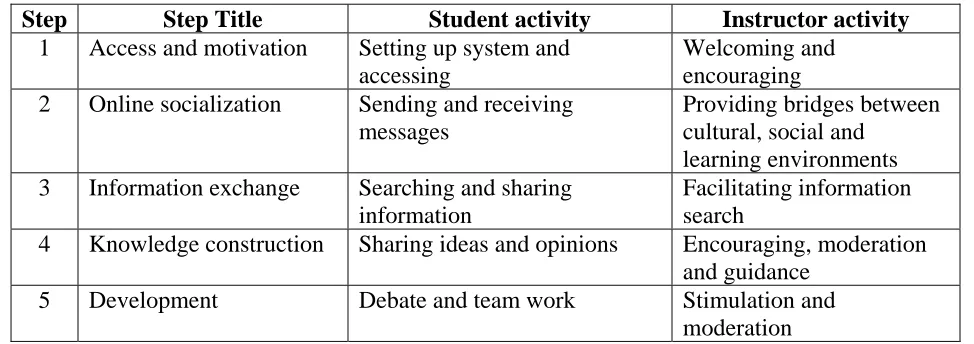
Salmon 9 has devised a useful 5 step model of teaching and learning through online networking. The model shows how discussion group participants can benefit from increasing skill in the use of the technology, and how instructors can assist in the learning process. Table 1 shows a development of Salmon’s model which incorporates the stages found to be appropriate in online discussion group activities for engineering students.
[image:4.612.60.547.276.448.2]
Table 1: Five step model of teaching and learning online (after Salmon 9)
Step Step Title Student activity Instructor activity
1 Access and motivation Setting up system and accessing
Welcoming and encouraging 2 Online socialization Sending and receiving
messages
Providing bridges between cultural, social and
learning environments 3 Information exchange Searching and sharing
information
Facilitating information search
4 Knowledge construction Sharing ideas and opinions Encouraging, moderation and guidance
5 Development Debate and team work Stimulation and
moderation
The initial setting up of a discussion group involves an assessment of the prior knowledge of the student with regard to the technology. It has been found that the majority of students usually have some previous exposure to the technology but that almost inevitably there will be some students who have only a meagre knowledge.
Step 2 involving online socialization allows students to share their own cultural and social experiences with others and can be an effective way of starting to address the graduate attributes previously discussed. The information exchange of step 3 can continue this process using
The Course
The course CIV3703 Transport Engineering has been offered by the Faculty of Engineering and Surveying for many years. The course is offered in on-campus and distance education modes, and for some years (1999-2004) was offered online, although the enrolments in the online mode were very small. In a typical year the course attracts about 65 students, consisting of about 20 on-campus and 45 distance education students. A decade ago almost all the students were Australian but gradually the proportion of international students has increased to the current situation where approximately 30% of the students in both modes are international. The distance education cohort has always been fairly diverse in characteristics, including students from most Australian states (but predominantly Queensland), and a range of age groups from school leavers to people in their 50’s. As with most civil engineering enrolments the majority of the students are male and only about 10% of the class is female. The great majority of distance engineering students in the course are in related engineering employment.
Traditionally the assessment for the course has consisted of a large design assignment (about 30% of the total marks) and an end of semester examination (70%). The course had a voluntary online discussion group for about 5 years. It was found that few students posted discussion messages although usage statistics for the site revealed that the majority of enrollees accessed the site on a regular basis to check on discussion activity and read the messages that had been posted. For the 2004 offering of the course, the decision was made to change the assessment scheme for the course to include compulsory use of the online discussion forum and to allocate a small amount (10%) of the assessment marks to this activity. The change was instituted with the following objectives:
• To encourage students to work on the course materials throughout the semester, instead of structuring their study around the assignment and the examination;
• To increase the interaction between students, particularly between on-campus and distance education students;
• To help distance education students to feel more a part of the student group studying the course;
• To facilitate the interchange of information which would allow the students to gain a broader perspective of social and technical issues impacting on transport in other cultures; and
• To provide a wider range of examples of transport design and operational issues than could be included in the written study materials for the course.
The Online Discussion Group Assessment Item
week 14 of the semester. The award of marks for the assessment was based on satisfactory participation in the online discussion groups, the quality of the postings, and the quality and timeliness of the final report.
The group allocation of students and the requirement for each topic were notified to students via the online discussion forum. The student requirements for each topic were posted to the
discussion group on the first day of the 3 week discussion period. The topic sequence was structured so that the first topic eased the student into the use of the system and did not require either extensive research by the student or discussion by other students. This first topic only required the student to relate some information about themselves and their environment, and their use of transport systems in the past fortnight. Further topics were then related to the subject content of the course. Most of the topics (i) related to the student’s immediate geographical area, (ii) required the students to carry out some research to determine factual information, (iii)
involved the students in reading and understanding the postings made by other students in their group, but (iv) did not involve the students in a large amount of interaction with other students. The final topic attempted to engage the students in a more interactive debate with their peers by asking them to research and comment on a quotation taken from a recent expert report dealing with the behaviour of young drivers.
Each student was expected to read all other postings to their allocated group. Postings from the total class were accessible to all students but the final brief student report consisted of a
commentary on certain aspects of the postings for the student’s group.
The Class
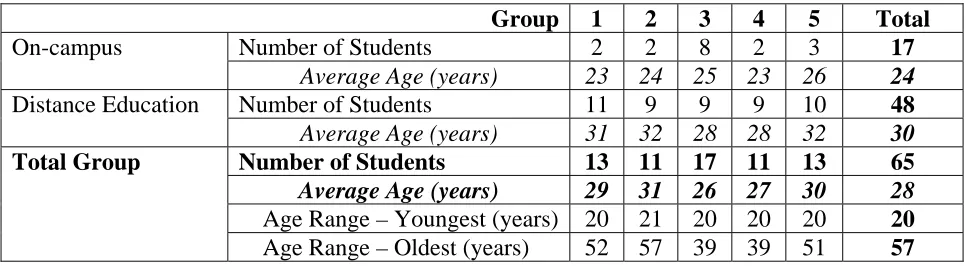
[image:6.612.65.548.497.630.2]In 2004 there were 75 students enrolled at the commencement of the course. The class was divided into 5 groups for the purpose of the online discussion group. Table 2 shows the group numbers and the age characteristics of the groups.
Table 2: Group Characteristics
Group 1 2 3 4 5 Total
Number of Students 2 2 8 2 3 17
On-campus
Average Age (years) 23 24 25 23 26 24
Number of Students 11 9 9 9 10 48
Distance Education
Average Age (years) 31 32 28 28 32 30
Number of Students 13 11 17 11 13 65
Average Age (years) 29 31 26 27 30 28 Age Range – Youngest (years) 20 21 20 20 20 20 Total Group
Age Range – Oldest (years) 52 57 39 39 51 57
the beginning of semester. This meant that group allocation was done prior to the addition of late student enrolments and before some students had cancelled their enrolment. The final group sizes were therefore a little unbalanced and the total class size reduced to 65 students. Typically the external student cohort in a class tends to be older than the on-campus cohort and this is also shown by the figures in table 2.
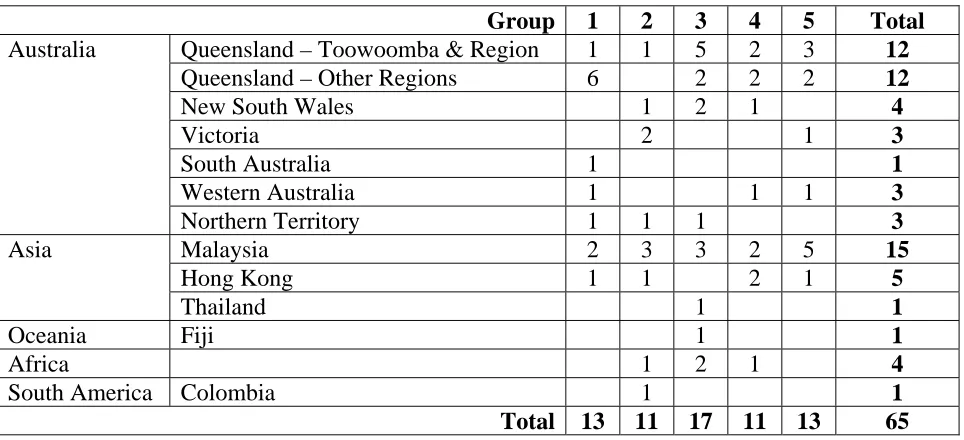
[image:7.612.67.549.220.440.2]The geographical location (for distance education students) or derivation (for on-campus students) for each student is shown in Table3, related to the student’s group and the total class.
Table 3: Geographical location of students
Group 1 2 3 4 5 Total
Queensland – Toowoomba & Region 1 1 5 2 3 12
Queensland – Other Regions 6 2 2 2 12
New South Wales 1 2 1 4
Victoria 2 1 3
South Australia 1 1
Western Australia 1 1 1 3
Australia
Northern Territory 1 1 1 3
Malaysia 2 3 3 2 5 15
Hong Kong 1 1 2 1 5
Asia
Thailand 1 1
Oceania Fiji 1 1
Africa 1 2 1 4
South America Colombia 1 1
Total 13 11 17 11 13 65
Participation in the Discussion Group
Most students appeared to have little technical trouble accessing the discussion group and
meeting the requirement for regular postings to the discussion. If a student experiences discussion group access problems they contact another area of the university, not the examiner of the course, so no statistics are available on access problems. Only one student reported to the examiner that he had experienced difficulties and requested a time extension for posting submissions. The majority of the students enrolled in the course had been enrolled at USQ for some semesters and had previously used the WebCT facility.
Table 4 shows the performance of students in regard to completing the requirements for the number of postings, and the timeliness of those postings.
Table 4: Timeliness of postings
On-campus Distance Educ Total
All postings completed and on time 12 (71%) 32 (66%) 44 (68%)
All postings completed but one or more late 1 (6%) 8 (17%) 9 (14%)
The overall non-completion rate (18%) is considered high as this aspect of the course assessment was not considered onerous by the examiner, or by other students that the examiner spoke to during the duration of the course. Those who did not complete the discussion group assessment generally performed poorly in the major assignment (due for submission in week 7) and/or in the final examination. The question then arises whether (a) these students realized they were
performing badly in the course and did not regard it as worthwhile to put much effort into the other assessment items for the course, or (b) poor participation in the discussion group is indicative of a likelihood of poor participation in the course as a whole (whether this be for academic or other reasons such as time pressures). The overall pattern of final grading in the course was fairly similar to that which had occurred in previous years (before the introduction of the compulsory discussion group) and it is therefore concluded that poor participation in the discussion group is a likely (and early) indicator of at-risk students in the course.
Example of Discussion Group Postings
Topic 4 asked for information on a major road construction or maintenance work currently being carried out in the student’s area. For external students the “area” was considered to be the
geographical area in which they lived and worked, whereas for on-campus students it could either be the Toowoomba area (where they were currently living whilst studying) or the area where they were living prior to their on-campus studies. As an example, the postings for Group 3 included descriptions of works as follows:
• Roadworks for seniors units at Fannie Bay, Northern Territory (approx $100,000)
• Widening of a rural connector road, south of Toowoomba (approx $ 500,000)
• Major intersection upgrade, Mackay, Queensland (approx $2M)
• Pacific Highway realignment, Kempsey NSW (approx 3.5M)
• Fly Over, Puchong Jaya, Malaysia (approx $1M)
• 40 km of rural highway, Malaysia (approx $150M)
• 35 km road upgrade, Botswana (approx $18M)
• Road tunnel, Kuala Lumpur, Malaysia (approx $2.5B)
For the final report students in the group had to select which posting they found the most interesting, and justify their selection (but students were not permitted to nominate their own posting). Many students nominated the Malaysian road tunnel posting, not necessarily because of the scale of the project but because the integration of a storm water management scheme with the tunnel made it an unusual and interesting project.
Students were usually very interested in presenting their own local projects in good detail and many of the postings made very interesting reading. The examiner as well as the students found that the studying of the diverse range of postings provided a broad perspective on the scale and types of projects being undertaken in several parts of the world.
Academic Performance Related to Discussion Group Participation
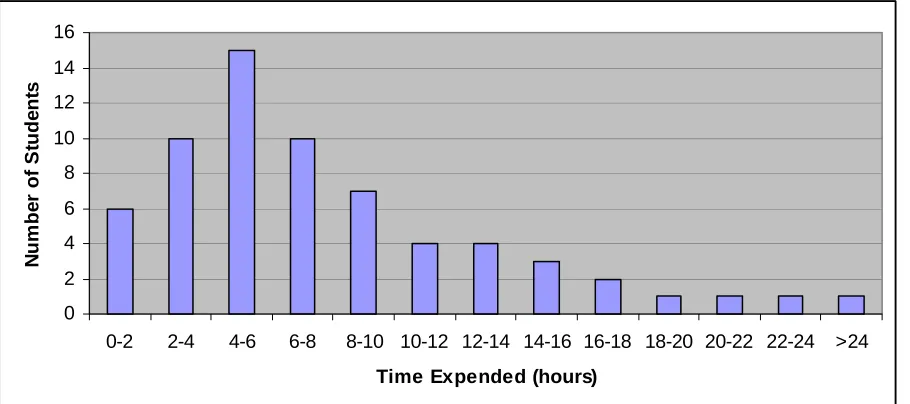
of web usage. The time expended in the discussion group varies widely between students. The smallest participation was one session with a total time of 18 minutes, the most number of sessions 162, and the greatest amount of time invested almost 34 hours. On average, students spent 7 hours and 52 minutes on the system, read 250 postings, and posted 4.8 messages.
0 2 4 6 8 10 12 14 16
0-2 2-4 4-6 6-8 8-10 10-12 12-14 14-16 16-18 18-20 20-22 22-24 >24
Time Expended (hours)
N
u
m
b
e
r o
f S
tude
nt
[image:9.612.75.530.143.345.2]s
Figure 1: Participation time of student in online discussion
There appears to be little correlation between activity in the discussion group and the final grades of students. As would be expected, many of the students who spent less than 2 hours in the discussion group performed poorly, although one student received a credit grade. On the other hand, active participation in the discussion group sometimes corresponded with a high grade, although one student spent over 23 hours in the discussion group and failed the course. The majority of very good grades (high distinctions and distinctions) were generally received by students who spent between 3 and 8 hours in the discussion group.
Effectiveness of the Discussion Groups
The objectives for the introduction of a compulsory discussion group forum in the course were met. Increased interaction occurred between students, and the requirement for students to meet a number of milestones throughout the course seemed to encourage the students to work on the course materials throughout the semester. The interchange of information between students of different cultural and geographic backgrounds provided all students with a broader perspective of the social and technical issues impacting transport. The postings provided a wider range of examples of transport issues than could be provided in the formal study materials.
enjoyed the format of the discussion group, and (b) found the description of transport issues in other geographical areas and cultural settings interesting.
Conclusions and Recommendations
The first time incorporation of a compulsory discussion group into the course offering has been stimulating and interesting for both the students and the course examiner. The discussion group appears to have achieved the objectives intended for it and students, in general, have enjoyed the broad expanse of subject areas able to be covered. It is considered that this exercise has
demonstrated that the use of on-line discussion groups incorporating a sharing of student
experiences can be very useful, especially when the student cohort consists of a wide diversity of geographical and cultural backgrounds. The method is recommended as a means of improving understanding of cultural and technical diversity for engineering students.
References
1. Engineers Australia, 2005, National Generic Competency Standards – Stage 1 Competency Standard for Professional Engineers, Document No. P05, Accreditation Management System, Engineers Australia, Canberra.
2. IE Aust, 1996, Changing the Culture: Engineering Education into the Future, Vol 1, Review Report, and Vol 2, Task Force Reports, IE Aust, Canberra
3. Magrath, C. Peter, 2000, Globalization and its Effects on Higher Education Beyond the Nation-state, Higher Education in Europe, Vol XXV, No 2.
4. De Graaff, Erik and Ravesteijn, Wim, 2001, Training complete engineers: global enterprise and engineering education, European Journal of Engineering Education, Vol 26, No 4, pp 419-427.
5. Johnston, S.F., 2001, Towards culturally inclusive global engineering, European Journal of Engineering Education, Vol 26, No 1, pp 77-89.
6. Thompson, Raymond E. and Sterkenburg, Ronald, 2001, Going Global – A Methodology for Shaping Students for the Global Workplace, Proceedings of the American Society for Engineering Education Annual Conference and Exposition, Session 3460.
7. USQ, 2004, Attributes of a USQ Graduate, USQ Calendar, Section 4.2 (http://www.usq.edu.au/resources/4-2.pdf )
8. Brooks, David W., Nolan, Diane E. and Gallagher, Susan M., 2001, Web Teaching: A Guide to Designing Interactive Teaching for the World Wide Web, 2nd edition, Kluwer Academic / Plenum Publishers, New York.
9. Salmon, Gilly, 2002, e-tivities: the Key to Active Online Learning, Kogan Page, London.
RON AYERS