Theses Thesis/Dissertation Collections
4-2018
Application of Convolutional Neural Network
Framework on Generalized Spatial Modulation for
Next Generation Wireless Networks
Akram Marseet
Follow this and additional works at:http://scholarworks.rit.edu/theses
This Thesis is brought to you for free and open access by the Thesis/Dissertation Collections at RIT Scholar Works. It has been accepted for inclusion in Theses by an authorized administrator of RIT Scholar Works. For more information, please [email protected].
Recommended Citation
Framework on Generalized Spatial Modulation
for Next Generation Wireless Networks
by
Akram Marseet
A Thesis Submitted in Partial Fulfillment of the Requirements for the Degree of Master of Science in Electrical Engineering
Supervised by
Dr. Ferat Sahin
Department of Electrical and Microelectronic Engineering Kate Gleason College of Engineering
Rochester Institute of Technology. Rochester, New York April 2018
Approved by:
Dr. Ferat Sahin, Professor
Thesis Advisor, Department of Electrical and Microelectronic Engineering
Dr. Gill Tsouri, Associate Professor
Committee Member, Department of Electrical and Microelectronic Engineering
Dr. Sohail A. Dianat, Professor
Committee Member, Department of Electrical and Microelectronic Engineering
Dr. Sohail A. Dianat, Professor
Rochester Institute of Technology Kate Gleason College of Engineering
Title:
Application of Complex-Valued Neural Network on Generalized Spatial Modulation for Next Generation Wireless Networks
I, Akram Marseet, hereby grant permission to the Wallace Memorial Library to
repro-duce my thesis in whole or part.
Akram Marseet
Dedication
Acknowledgments
I am greatly thankful to my thesis advisor Dr. Ferat Sahin for his supporting and guiding
me during my research. It was great honor and privilege for me to be one of his graduate
students, and I will be his PhD student.
I would like to give special thanks to my colleague Tuly Hazbar for her continuous
support and encouragement.
I would like to thank my friend Celal Savur for his feedback about my thesis.
I am thankful to my sponsor; the ministry of High education of my home country
Abstract
Application of Convolutional Neural Network Framework on Generalized Spatial Modulation for Next Generation Wireless Networks
Akram Marseet
Supervising Professor: Dr. Ferat Sahin
A novel custom auto-encoder Complex Valued Convolutional Neural Network
(AE-CV-CNN) model is proposed and implemented using MATLAB for multiple-input-multiple
output (MIMO) wireless networks. The proposed model is applied on two different
gen-eralized spatial modulation (GSM) schemes: the single symbol gengen-eralized spatial
mod-ulation SS −GSM and the multiple symbol generalized spatial modulation (MS-GSM).
GSM schemes are used with Massive-MIMO to increase both the spectrum efficiency and
the energy efficiency. On the other hand, GSM schemes are subjected to high
computa-tional complexity at the receiver to detect the transmitted information. High computacomputa-tional
complexity slows down the throughput and increases the power consumption at the user
terminals. Consequently, reducing both the total spectrum efficiency and energy efficiency.
The proposed CNN framework achieves constant complexity reduction of 22.73% for
SS-GSM schemes compared to the complexity of its traditional maximum likelihood detector
(ML). Also, it gives a complexity reduction of 14.7% for the MS-GSM schemes compared
to the complexity of its detector. The performance penalty of the two schemes is at most 0.5
dB. Besides to the proposed custom AE CV-CNN model, a different ML detector0s formula
ML detector with a complexity reduction of at least 40% compared to that of the traditional
ML detector. In addition, the proposed AE-CV-CNN model is applied to the proposed ML
detector,and it gives a complexity reduction of at least 63.6% with a performance penalty
of less than 0.5 dB. An interesting result about applying the proposed custom CNN model
on the proposed ML detector is that the complexity is reduced as the spatial constellation
size is increased which means that the total spectrum efficiency is increased by increasing
List of Contributions
• Convolutional Neural Network framework for modeling the receiver of wireless MIMO
communication system.
• Developing a novel and custom feed forward complex valued convolutional neural
network (CV-CNN) for the detection process on wireless MIMO systems.
• Implementation of the joint detection of the spatial and constellation information on
generalized spatial modulation schemes based in CNN framework.
• Modeling the estimation of the wireless channel coefficients as the learning process
of the weights of the proposed neural network.
• Developing a new maximum likelihood detector for M-ary Phase Shift Modulation
schemes (MPSK) with lower computational complexity compared to the traditional
maximum likelihood detector.
• Implementing the proposed CNN model with extracted features from the proposed
ML detector for further reduction of the computational complexity.
• Publication: Accepted and presented(On print)
A. Marseet and F. Sahin, "Application of Complex-Valued Convolutional Neural
Net-work for Next Generation Wireless NetNet-works," 2017 IEEE Western New York Image
Contents
Dedication . . . iii
Acknowledgments . . . iv
Abstract . . . v
List of Contributions . . . vii
1 Introduction . . . 1
2 Overview of MIMO Wireless Networks . . . 4
2.1 Modulated Signals . . . 4
2.1.1 M-arry Phase Shift Keying . . . 5
2.1.2 M-arry Amplitude Phase Shift Keying . . . 7
2.2 Gray Encoding . . . 7
2.3 Wireless Channel Model . . . 9
2.4 MIMO Systems . . . 10
3 Generalized Spatial Modulation . . . 13
3.1 Introduction . . . 13
3.2 Spatial Modulation . . . 14
3.3 Generalized Spatial Modulation (GSM) . . . 16
3.3.1 Spatial Model for GSM System . . . 16
3.3.2 Spatial Channel Matrix . . . 17
3.3.3 Single Symbol Generalized Spatial Modulation(SS−GSM) . . . . 17
3.3.4 Multiple Symbol Generalized Spatial Modulation . . . 19
3.4 Optimal Detection . . . 21
3.4.1 ML Detection for SS-GSM schemes . . . 21
3.4.2 ML Detection for MS-GSM schemes . . . 22
3.5 Computational Complexity . . . 23
3.5.2 Complexity of MS-GSM . . . 24
4 Deep Learning . . . 26
4.1 Introduction . . . 26
4.2 Artificial Neural Network . . . 27
4.3 Convolutional Neural Network . . . 29
4.4 Autoencoder Neural Network . . . 30
4.5 Related Work . . . 30
5 PROPOSED AUTO-ENCODER BASED COMPLEX-VALUED CNN . . . . 33
5.1 Introduction . . . 33
5.2 System Model . . . 34
5.2.1 Encoder Model . . . 34
5.2.2 Receiver Correlation Layer . . . 34
5.2.3 Supervised learning for Channel coefficients . . . 35
5.2.4 Features Extraction Layers . . . 35
5.2.5 Activation Layer . . . 36
5.2.6 Maximum Pooling . . . 37
5.2.7 Loss Function . . . 37
5.2.8 Classification Layer . . . 38
5.3 Computational Complexity . . . 39
5.3.1 Traditional SS-GSM . . . 39
5.3.2 Proposed SS-GSM . . . 40
5.3.3 Complexity of MS-GSM . . . 41
6 Results . . . 42
6.1 Computational Complexity . . . 42
6.2 Performance . . . 46
6.2.1 SS-GSM system . . . 46
6.2.2 MS-GSM system . . . 53
7 Conclusion . . . 57
8 Future Work . . . 58
List of Tables
2.1 Gray Encoding forM =4. . . 8
2.2 Gray Encoding forM =8. . . 8
2.3 Gray Encoding forM =16. . . 9
3.1 Spatial Coding for 2×8M I MOSM scheme. . . 15
3.2 Spatial Coding for 2×5M I MO GSM scheme. . . 17
4.1 Common Activation Functions. . . 27
6.1 SS-GSM Spatial Complexity Reduction Ratio forM = 8. . . 43
List of Figures
2.1 QPSK Signal Constellation . . . 6
2.2 16QAM Signal Constellation . . . 8
2.3 Multipath Propagation . . . 10
2.4 Block Diagram ofM I MO wireless network. . . 11
3.1 Block Diagram of SM for 2×5 M I MOscheme. . . 15
3.2 Block Diagram of SS-GSM for 2×5M I MO scheme. . . 18
3.3 Block Diagram of MS-GSM for 2×5M I MO scheme withNa= 2. . . 19
3.4 Total Spectrum Efficiency for Nt = 16 andM =8. . . 20
4.1 Single Perceptron Layer Artificial Neural Network. . . 27
4.2 Multilayer Perceptron Artificial Neural Network [33] . . . 28
4.3 Multilayer Perceptron Artificial Neural Network [36] . . . 29
5.1 Block Diagram of the proposed AE-CNN . . . 33
6.1 SS-GSM Computational Complexity Comparison versus Spatial size for Nr =2. (a)M = 8 andNcis variable. (b)Nc= 8 and Mis variable. . . 43
6.2 SS-GSM Comparison of Computational Complexity in terms of real valued multiplications: Nr=2, M=8 . . . 44
6.3 MS-GSM Comparison of Computational Complexity in terms of real val-ued multiplications: Nr=2, M=8 . . . 45
6.4 SS-GSM Confusion Matrix for the QPSK transmitted Symbols. . . 47
6.5 SS-GSM Bit Error Rate. . . 48
6.6 Scatter plot of the received signals at SNR of 18dB. . . 49
6.7 SS-GSM Scatter plot of the projection of the received vector on the learned channel using CNN(Traditional ML) at SNR of 6dB and 8dB . . . 49
6.8 SS-GSM Scatter plot of the projection of the received vector on the learned channel using CNN(Traditional ML) at SNR of 16dB and 18dB . . . 50
6.10 SS-GSM Scatter plot of the projection of the received vector on the learned
channel using CNN(Proposed ML) at SNR of 16dB and 18dB . . . 51
6.11 Confusion Matrices for the applied AE-CV-CNN: (a) Traditional ML ex-tracted features, (b) Proposed ML exex-tracted features. . . 52
6.12 Confusion Matrices for the applied AE-CV-CNN: (a) Traditional ML ex-tracted features, (b) Proposed ML exex-tracted features. . . 52
6.13 MS-GSM Confusion Matrix for the QPSK transmitted Symbols. . . 53
6.14 MS-GSM Bit Error Rate. . . 54
6.15 MS-GSM Spatial Confusion Matrices for the applied AE-CV-CNN. . . 55
Chapter 1
Introduction
The demand on wireless communication services is dramatically increasing [1] while the
physical resources of wireless networks are limited. The physical resources of wireless
communications are the allocated spectrum and the transmission power [2]. The huge
demand on cellular wireless services is not only due to the mobile phone services, but also
because of machine-to machine communication and the Internet of things (IoT) where there
will be billions of devices connected to the Internet [3]. The evolution for next-generation
wireless networks is to support the high data rates up to 10 Gbps at lower time delay[4].
Multiple-input multiple-output (MIMO) networks is the key technology of current wireless
cellular networks [5] where the term "multiple-input" refers to the use of multiple antennas
at the transmitter which are considered as the inputs to the channel, and the term
"multiple-output" refers to the use of multiple antennas at the receiver which are considered as the
outputs of the channel.
Current wireless networks are called 4G wireless networks which are based on
orthog-onal frequency division multiplexing (OFDM) for the down link transmission. OFDM is
a multi-carrier transmission technique where the allocated bandwidth is subdivided into a
due to frequency selective fading channels [6]. Long term evolution LTE is the most
spec-trum efficient MIMO wireless technology that is able to support data rates up to 1Gbps
[7]. However, to catch up the increasing growth on wireless communication services, next
generation must be able to support up to 10Gbps[8].
Besides the lack of current wireless MIMO networks to achieve the high speed data
communications, another issue is the low energy efficiency [9]. Because of the multiple
transmissions on traditional MIMO systems such as vertical Bell Labs layered space time
(VBLAST), multiple Radio Frequency (RF) chains including power amplifiers are required
at the base station which causes the operating costs of wireless networks [10]. In addition to
the low energy efficiency of current MIMO systems, there are other issues such as system0s
performance degradation due to the the inter-channel interference (ICI) that is resulted
because of the simultaneous transmissions over the same carrier frequencies [11].
Further-more, precise synchronization between all transmit antennas is mandatory to achieve the
maximum spectrum efficiency [12].
The transmission bandwidth is measured inH zand the transmission energy is measured
in joules per bit. The more number of transmitted bits per second perH z, the more spectrum
efficient transmission system. The lower consumed transmission power per bit, the more
energy efficient scheme. Spatial modulation is a transmission scheme that depends on
both the transmitted signals and the channel characteristics to convey the information [13].
Because of the extra information that are conveyed by the wireless channel without any
cost on the bandwidth or the transmitted power, spatial modulation is the most spectrum
systems is the computational complexity at the receiver. This complexity comes due to the
joint detection of the spatial and modulation information [14].
In [15] , inspired by the principles of neural Networks, the Wireless MIMO network can
be modeled as an auto-encoder convolutional neural network. Since the wireless channel
and the receiver noise introduce a distortion to the transmitted signal, the received signal
is different from the transmitted signal. In other words, the transmitted information are
encoded. To detect the transmitted bits, it is necessary to estimate the channel coefficients
to perform the decoding process. The estimation of the transmission channel coefficients
is similar to learning weights that the machine learning model is trained to learn these
weights.
The purpose of this thesis is to apply the concept of deep learning and especially the
con-cept of auto-encoder convolutional neural network to detect the transmitted information on
the high spectrum and energy efficient wireless scheme which is known as generalized
Spa-tial Modulation (GSM). The proposed model of the custom convolutional neural network
is used for the joint detection of the spatial and signal constellation information at lower
Chapter 2
Overview of MIMO Wireless Networks
Current Multiple Input Multiple Output (MIMO) wireless networks are considered as a 2D
transmission schemes where the transmitted information are conveyed by the 2D
transmit-ted signal. The transmittransmit-ted signal is called the modulatransmit-ted signal.
2.1
Modulated Signals
Modulated signal is used for the transmission of digital information. Basically, modulation
process involves the change of either amplitude, phase, frequency, or any combination of
these parameters of a carrier signal according to the information signals to be transmitted.
If the amplitude , phase, or both are changed, the resulted modulated signal is 2D signal.
Mathematically, the 2D modulated signal can be expressed as a complex number. A 2D
signal is can be constructed from two orthogonal signalsψ1(t)andψ2(t). Theψ1(t) −ψ2(t)
space is known as the signal constellation where the signal component on theψ1(t)
dimen-sion is called the in-phase component and the signal component on the ψ2(t) dimension
is called the quadrature phase component. The two most common modulation schemes
(also called constellation) are the M-array phase shift keying (M PSK) and the M-array
amplitude-phase shift keying(M APSK)which is commonly known as(MQ AM). The
It represents the number of unique symbols that are used for mapping a certain sequence of
information bits with a length ofl.
2.1.1 M-arry Phase Shift Keying
In MPSK, the transmitted information are conveyed by the phase of the transmitted
mod-ulated signal. MPSK signal has a constant symbol0s power and called constant envelope
signal. The MPSK modulated signalsm(t),m =1,2, ...M is given in Eq. 2.1.
sm(t)= pEs[cos(φm)p(t)cos(2πfct) −sin(φm)p(t)sin(2πfct)] (2.1)
where Es is the symbol0energy, φm is the symbols0phase, fc is the carrier frequency, and
p(t)is the signal of the transmitted symbol. The phaseφm of themt h symbol is given by:
φm = (2m−1)π
M (2.2)
Since the M PSK signal is a 2D signal, equation (5) can be written as:
sm(t)=SmIψ1(t)+SmQψ2(t) (2.3)
whereSmI is the in-phase component given in (8) andSmQ is the quadrature phase
com-ponent given in Eqs. 2.4 and 2.5.
SmI = pEscos(φm) (2.4)
SmQ = pEssin(φm) (2.5)
The signalsψ1(t)andψ2are given by:
ψ2(t)=−p(t)sin(2πfct) (2.7)
In MPSK, the modulation spectrum efficiency(l)is related to the modulation order(M)
as given in Eq.2.8.
l = log2(M) (2.8)
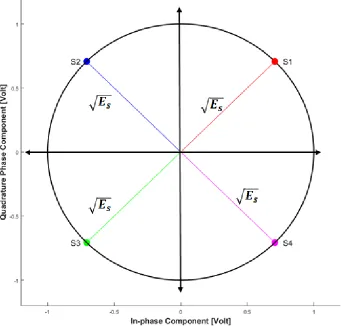
Figure 2.1 shows the signal constellation diagram for the 4PSKsignals which is also know
[image:20.612.137.478.274.600.2]asQPSK.
2.1.2 M-arry Amplitude Phase Shift Keying
InM APSK which is also known as MQ AM, the information bits are mapped into symbols
that are grouped based on different amplitudes and phases. In other words, a subset of the
MQ AM symbols have the same amplitude but with different phases. The general MQ AM
signal is as described by Eq. 2.9.
sm(t)=[Am ∗cos(φm)p(t)cos(2πfct) −Bm∗sin(φm)p(t)sin(2πfct)] (2.9)
where the two amplitudes Am and Bm represent the MQ AM constellation0s components.
One common MQ AM scheme is that has a square constellation as given by Eq. 2.10.
Si,j =
s
3Es 2(M −1)
h
2i−1− √
M
+ j
2j−1− √
M
i
(2.10)
∀i = 1,2, ...
√
M, j = 1,2, ...,
√
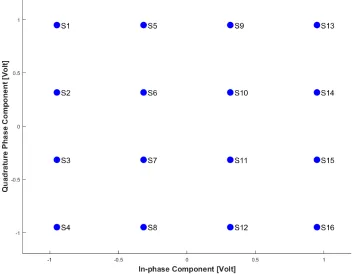
M. The signal constellation of squareMQ AM is shown
in figure 2.2.
The modulation spectrum efficiency of square [16]MQ AM (lMQ AM)is given by:
lMQ AM =
√
M (2.11)
In this thesis,M PSKmodulation scheme is used for the transmission of the information.
2.2
Gray Encoding
The mapping from bits to symbols is based on Gray encoding such that for each two
adja-cent symbols, there will be a change in one bit only [17]. This type of encoding will reduce
Figure 2.2: 16QAM Signal Constellation
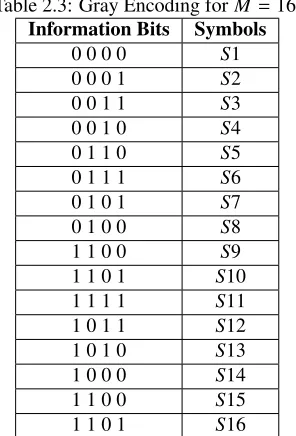
M =8, andM = 16 respectively.
Table 2.1: Gray Encoding forM =4.
Information Bits Symbols
0 0 S1
0 1 S2
1 1 S3
1 0 S4
Table 2.2: Gray Encoding forM =8.
Information Bits Symbols
0 0 0 S1
0 0 1 S2
0 1 1 S3
0 1 0 S4
1 1 0 S5
1 1 1 S6
1 0 1 S7
Table 2.3: Gray Encoding forM=16.
Information Bits Symbols
0 0 0 0 S1
0 0 0 1 S2
0 0 1 1 S3
0 0 1 0 S4
0 1 1 0 S5
0 1 1 1 S6
0 1 0 1 S7
0 1 0 0 S8
1 1 0 0 S9
1 1 0 1 S10 1 1 1 1 S11 1 0 1 1 S12 1 0 1 0 S13 1 0 0 0 S14 1 1 0 0 S15 1 1 0 1 S16
2.3
Wireless Channel Model
Wireless transmission systems are classified into two categories as: Line of sight (LOS)
and Non-Line of sight (NLOS) [18]. MIMO systems are NLOS wireless transmission
schemes that are based on multi-path propagation [19]. In multi-path propagation, the
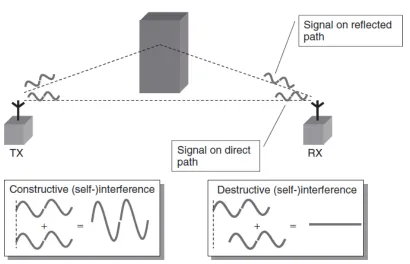
transmitted signal arrives the receiver from different paths due to reflection, diffraction,
and scattering. This means that multiple copies of the same signal arrive the receiver.
These multiple signals can create either constructive interference or destructive interference
[20] as illustrated in figure 2.3. One of the models for wireless MIMO channel is the
complex Gaussian random process having zero mean and varianceσ2. This model is called
the Rayleigh model which is used in this thesis. The probability density function of the
magnitude of the Rayleigh channel is described by [21] as given in Eq. 2.12:
p(|h|)= h
σ2exp
−h2
2σ2
Figure 2.3: Multipath Propagation
The phase of the channel response is uniformly distributed between−πandπ.
2.4
MIMO Systems
MIMO system is based on the use of anNt antennas at the transmitter, and anNr antennas
at the receiver. The notation Nr × Nt M I MO is used to define the size of the MIMO
system. For maximum spectrum efficiency, traditional M I MO technologies are based on
the multiple-symbol transmission where each transmit antenna has its own RF chain to
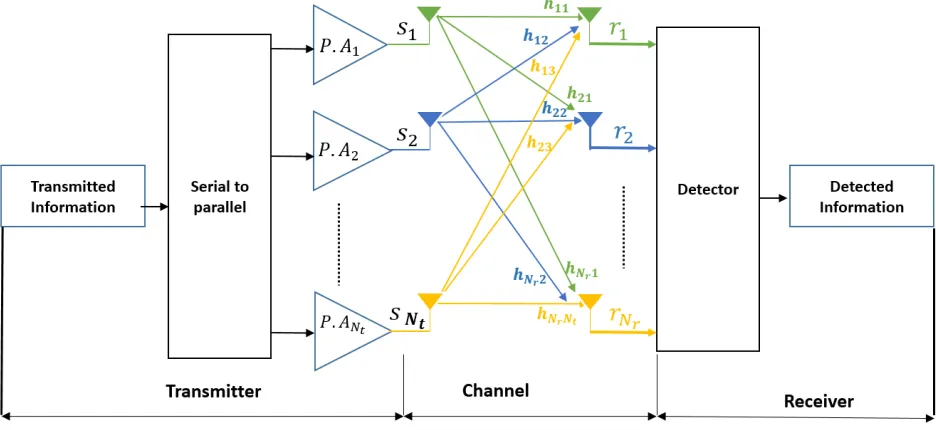
transmit a different symbol. This requires that the number of receive antennas has to be
equal or greater than the number of transmit antennas. Figure 2.4 shows the general block
diagram of traditional M I MO scheme. Channel matrix H is an Nr × Nt complex valued
Due to the simultaneous transmissions in M I MO systems, each receive antenna receives
Figure 2.4: Block Diagram ofM I MOwireless network.
signals from all the transmit antennas. The receiver signals at the input of the detector are
given by [22]:
r1 r2 ... rNr =
h11 h12 h13 . . . h1Nt
h21 h22 h23 . . . h2Nt
... ... ... ... ...
hNr1 hNr2 hNr3 . . . hNrNt
s1 s2 ... sNt + n1 n2 ... nNr (2.13)
Equation 2.13 can be written in a simple form as given in Eq. 2.14:
whereris the vector of the received signals, s, is the vector of the transmitted signals, and
nis the vector of the noise, andHis the M I MOchannel matrix given by.
H =
h11 h12 h13 . . . h1Nt
h21 h22 h23 . . . h2Nt
... ... ... ... ...
hNr1 hNr2 hNr3 . . . hNrNt
(2.15)
There are several issues in conventionalM I MO schemes [23,24,25] such as:
• Inter-Channel Interference (ICI) due to simultaneous transmissions.
• High receiver complexity to reduce the ICI.
• Each transmit antenna has its own RF equipment.
• Singularity of the channel matrix in the case of large number of receive antennas.
• The capacity of MIMO systems is limited by themin(Nr,Nt).
The next chapter includes the spatial modulation schemes and shows that it is a useful
Chapter 3
Generalized Spatial Modulation
3.1
Introduction
Spatial modulation is a 3D constellation transmission scheme that has been proposed by
[26] and achieves both the highest spectrum and energy efficiencies amongst all the
exist-ing wireless MIMO schemes. The main idea of spatial modulation is that the transmitted
information are conveyed implicitly by the wireless channel (spatial constellation) and
ex-plicitly by the transmitted modulated signal (signal constellation). The spatial constellation
is implemented by the selection of the active antennas that are used for the transmission of
the constellation signals. This means that the incoming bit stream is split into two blocks
named the "spatial bits" and the "constellation bits". Based on the sequence of the spatial
bits one or more transmit antennas will be chosen for the transmission of the
constella-tion signal. Spatial modulaconstella-tion is classified into three categories [13,27,28] based on the
number of active antennas and the number of symbols to be transmitted as follows:
• Spatial Modulation (SM).
• Single Symbol Generalized Spatial Modulation (SS-GSM).
3.2
Spatial Modulation
In Spatial Modulation (SM), only one transmit antenna is used to transmit the constellation
signal per each transmission. This requires that the number of the antennas at the
transmit-ter has to be a power of 2 [13]. Since one antenna is selected out of an Nt antennas, the
number of possible combinations that represent the size of the spatial constellation(Nc)SM
is calculated as in Eq. 3.1.
(Nc)SM = Nt (3.1)
For anNr×Nt M I MOscheme, the spatial spectrum efficiencyηs for SM schemes is given
by Eq. 3.2.
ηs =log2(Nc) (3.2)
The modulation spectrum efficiencyηm is defined by:
ηm =log2(M) (3.3)
where M is the modulation order (also called constellation size). The total spectrum effi
-ciency is the sum of (3.2) and (3.3) and given by:
ηSM =log2(Nt)+log2(M) (3.4)
Figure 3.1 shows the block diagram of SM scheme for an 2×5M I MO. There is no specific
rule to select the active antenna, but table 3.1 shows the pattern of the spatial bits that
are used to activate the antennas which is based on the incremental order of the binary to
decimal bit mapping.
Figure 3.1: Block Diagram of SM for 2×5M I MOscheme.
Table 3.1: Spatial Coding for 2×8M I MOSM scheme.
Spatial Bits Active Antenna Index of Spatial Channel Matrix
0 0 0 1 H1
0 0 1 2 H2
0 1 0 3 H3
0 1 1 4 H4
1 0 0 5 H5
1 0 1 6 H6
1 1 0 7 H7
1 1 1 8 H8
maximum spectrum efficiency in comparison to the other two types of spatial modulation
[image:29.612.168.457.401.525.2]3.3
Generalized Spatial Modulation (GSM)
3.3.1 Spatial Model for GSM System
Generalized Spatial Modulation is based on that more one antenna are activated
simulta-neously for the transmission per each transmission period. The main advantage of GSM
over SM is that the spatial constellation size is larger. This means that to achieve the same
spatial spectrum efficiency, the number of transmitter antennas will be less than that for
the SM. In addition, GSM resolves the constrain in SM about the number of antennas at
the transmitter which is not necessary to be a power of 2. This means that GSM has more
degree of freedom than SM in terms of the number of antennas at the transmitter. However,
the constrain is that the spatial constellation size has to be a power of 2. Since there areNa
active antennas are selected out of anNt antennas, the spatial constellation sizeNcofGSM
is given by [13]:
Nc= 2blog2 h
(Nt Na)
i
c
(3.5)
The spatial spectrum efficiency ofSS−GSMis(ηs)which is the same forM S−GSM, and
it is given by:
ηs = blog2
Nt
Na c (3.6)
The maximum spatial spectrum efficiency is achieved when the number of multiple active
antennas is the floor of the half of the number of the transmit antennas.
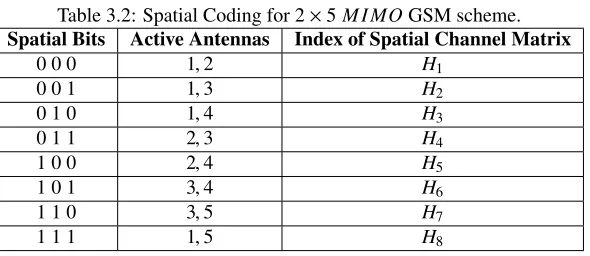
There is no specific rule for the spatial coding as in the case of SM. Table 3.2 explains
Table 3.2: Spatial Coding for 2×5M I MOGSM scheme.
Spatial Bits Active Antennas Index of Spatial Channel Matrix
0 0 0 1,2 H1
0 0 1 1,3 H2
0 1 0 1,4 H3
0 1 1 2,3 H4
1 0 0 2,4 H5
1 0 1 3,4 H6
1 1 0 3,5 H7
1 1 1 1,5 H8
3.3.2 Spatial Channel Matrix
The spatial channel matrix for GSM is a subset of the M I MO channel matrix with the
dimension of Nr × Na. The number of spatial channel matrices is equal to the size of
the spatial constellation which is the number of all possible combinations of the active
antennas. One of the tasks at the receiver is to detect which spatial channel matrix has been
selected for the transmission of the modulation bits.
3.3.3 Single Symbol Generalized Spatial Modulation(SS−GSM)
Single Symbol Generalized Spatial Modulation (SS − GSM) is the most spectrum and
energy efficient MIMO wireless technology. InSS−GSM more than one transmit antenna
are activated to transmit the same symbol at each transmission period. It keeps the same
property as the SM where only one RF chain is needed with the advantage of higher spatial
spectrum efficiency. The modulation spectrum efficiency of the SS−GSM is the same as
that of the SM. The total spectrum efficiency ofSS−GSM(ηSS)is as given in Eq. 3.7 [13].
ηSS = blog2
Nt
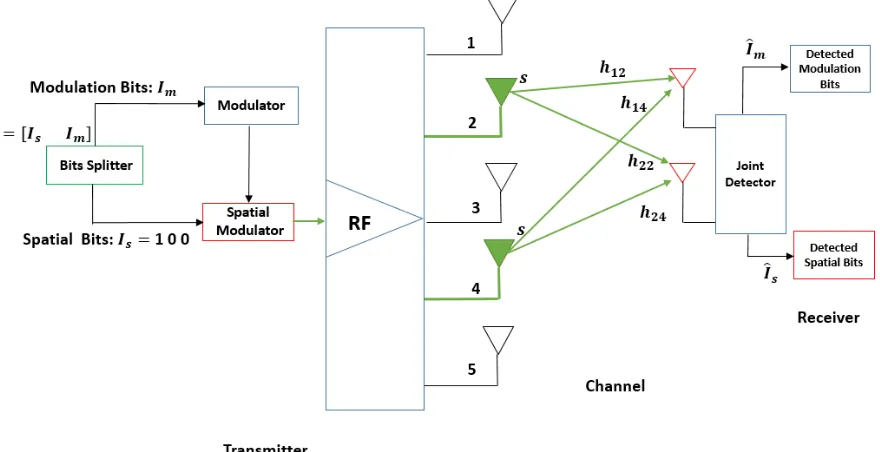
Figure 3.2 shows the block diagram of SS− GSM for an 2× 5 M I MO according to the
[image:32.612.103.543.147.373.2]spatial coding given in Table 3.2. As shown in Figure 3.2, when the spatial bits sequence
Figure 3.2: Block Diagram of SS-GSM for 2×5M I MOscheme.
is ”100”, antenna2 and antenna4 are activated to transmit the signal of the modulation bits.
The spatial channel matrix for this case is given by Eq. 3.8 as derived from (2.15).
H5 =
h12 h14
h22 h24
(3.8)
One of the main characteristics ofSS−GSM is that it offers transmit diversity. Beside to
the receive diversity ofM I MOschemes, a transmit diversity is implemented onSS−GSM
3.3.4 Multiple Symbol Generalized Spatial Modulation
Multi-symbol generalzed spatial modulation MS-GSM is based on the transmission of Na
different symbols instead of transmitting the same symbol from the Na active antennas to
increase the modulation spectrum efficiency [28]. However, compared to the SS-GSM,
MS-GSM is not energy efficient scheme where Na of RF chains are required at the base
station. In addition, there is no transmit diversity and there is an ICI at the receiver which
degrades the performance. As we will see, because of the high computational complexity
at the receiver, the throughput of the MS-GSM is less than than the SS-GSM even though
it has higher spectrum efficiency. Figure 3.4 shows the block diagram for MS-GSM with 2
[image:33.612.104.539.370.568.2]active antennas.
Figure 3.3: Block Diagram of MS-GSM for 2×5M I MOscheme withNa=2.
The use of two RF chains RF1 and RF2 decreases the energy efficiency. In addition,
The total spectrum efficiency of MS-GSM(ηM S)is calculated by Eq. 3.9.
(η)M S = blog2 Nt
Na c+Ns ∗log2(M) (3.9)
where Ns = Na is the number of different symbols to be transmitted from the Na active
antennas. For SS−GSM, Ns =1.
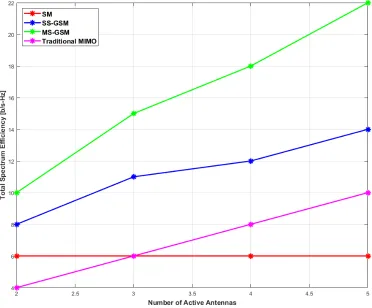
Figure 3.4 shows a comparison of the total spectrum efficiency versus the number of
[image:34.612.136.508.297.605.2]active antennas for the different wireless MIMO networks forNt =16 and M = 8.
Figure 3.4: Total Spectrum Efficiency forNt=16 andM =8.
compared to the spectrum efficiency on (3.7). However, and as will be explained latter, due
to the high complexity for the detection process, the data transfer rate on M S−GSM is
lower compared to the SS−GSM.
3.4
Optimal Detection
Detection process in communication systems is a classification machine learning problem
[29]. The task of the detector at the receiver is to classify the received signal0s symbol.
After that symbol to bit mapping is applied to reconstruct the original data. The most
common detection algorithm is the Maximum Likelihood (ML) detection algorithm that
minimizes the loss function. The minimum loss function leads to the lowest bit error rate
(BER). In SM,SS-GSM, or MS-GSM, the ML detection is a joint detection problem where
both the index of the spatial channel matrix ˆj and the index of the signal0s constellation
ˆ
q have to be estimated jointly. The ML detector is based on optimizing the mean square
error.
3.4.1 ML Detection for SS-GSM schemes
The received signals0s vectorrSS is given by Eq. 3.10.
rSS = Na
Õ
k=1
Hj(:,k)
!
∗sq+n (3.10)
whererSS ∈ CNr×1, Hj ∈ CNr×Na, j = 1,2, . . . ,blog2
h
Nt
Na
i
c is the spatial channel matrix,
I1×Na is a raw vector with all elements are equal to 1, sq is the transmitted symbol with
q∈1,2, . . . ,M,n ∈CNr×1is an AWGN vector. The elements ofH
For simplicity, the Na
Õ
k=1
Hj(:,k)is defined ashj as the spatial channel vector. The prob-ability density function (pdf) of the received signal0s vectorPr rSS\Hi,sq
conditioned by
Hj andsqwhich is given by:
Pr rSS\Hi,sq
= 1
(2π)Nr2 p|Í|
e−||rSS−hjsq|| 2
2Í (3.11)
The ML detector of (3.11) involves the joint estimation of the index of the spatial matrix
of the active antennas (j)and the index of the transmitted symbol (q) that maximize (3.11),
and it is given by Eq. 3.12 [13].
[j,q]SS = arg min j=1...,Nc
q=1...,M
||rSS−hjsq||2 (3.12)
3.4.2 ML Detection for MS-GSM schemes
The vector of the received signalsrM S for theM S−GSM is expressed as:
rM S =Hjxq+n (3.13)
wherexq ∈ CNs×1withq = 1,2, ...MNs. Each element onxq ∈ the signal constellation of (2.3) or (2.10).
The optimum detection of (3.12) is similar to that for (3.10) and it is given by Eq. 3.13
[28].
[j,q]M S = arg min j=1...,Nc
q=1...,MNa
3.5
Computational Complexity
The ML detectors of (3.12) and (3.14) involves the search over all the transmitter antennas,
receiver antennas, and the signal constellations. This increases the computational
complex-ity at the receiver, and therefore, increasing the power dissipation at the receiver and slow
down the data transfer rate. The computational complexity includes the number of
multipli-cations/divisions and summations/subtractions which is known in the field of deep learning
as the number of floating point operations (f lops). Researchers in the field of wireless
communication are more concerning about the number of real valued multiplications than
the number of summations.
The multiplication of two complex variables(x1+ jy1)and(x2+ jy2)involves four real
valued multiplications which are calculated as follows: [x1∗ x2,x1∗y2,y1∗ x2,y1∗y2]
and 2 summations which are calculated as: [x1∗x2−y1∗ y2,x1∗y2+ x2∗y1]. Based
on this concept, the computational complexity for the ML detection of SS − GSM and
M S−GSM are calculated as follows:
3.5.1 Computational Complexity of SS-GSM
• The multiplication ofhjsqhas 4Nrreal valued multiplication and 2Nr summations per one spatial channel matrix per one signal constellation.
• The subtractionrSS−hjsqhas 2Nr subtractions per one spatial channel matrix per one signal constellation.
• The Euclidean norm ||rSS −hjsq||2 has 2Nr multiplications and Nr summations per
Therefore, the total computational complexity of (3.12) has 6Nr multiplications and 5Nr
summations per one spatial channel matrix per one signal constellation. Since the spatial
size isNc and the constellation sizeM, the total computational complexity for SS−GSM
in terms of f lops (CSS)f lops and in terms of real valued multiplications (CSS)RV M are as
given in Eqs. 3.15 and 3.16 respectively.
(CSS)f lops =11Nr ∗ blog2 Nt
Na c ∗M (3.15)
(CSS)RV M =6Nr ∗ blog2 Nt
Na c ∗M (3.16)
3.5.2 Complexity of MS-GSM
• The multiplication ofHjxqin (3.14) has 4NrNareal valued multiplication and 2NrNa summations per one spatial channel matrix per one signal constellation.
• The subtractionrM S −Hjxqhas 2Nr subtractions per one spatial channel matrix per
one signal constellation.
• The Euclidean norm ||rSS −hjsq||2 has 2Nr multiplications and Nr summations per
one spatial channel matrix per one signal constellation.
Therefore, the total computational complexity of (3.14) has (4Nr∗ Na+2Nr)
multiplica-tions and(2Nr ∗Na+3Nr)summations per one spatial channel matrix per one signal
con-stellation. Since the spatial size is Nc and the constellation size MNa, the total
multiplications(CM S)RV M are as given in Eqs. 3.15 and 3.16 respectively.
(CM S)f lops =(6Nr ∗Na+5Nr) ∗ blog2 Nt
Na c ∗M
Na (3.17)
(CM S)RV M =(4Nr ∗Na+2Nr) ∗ blog2 Nt
Na c ∗M
Na (3.18)
Note that the computational complexity ofM S−GSMdepends exponentially on the spatial
Chapter 4
Deep Learning
4.1
Introduction
Deep learning is a machine learning based algorithm that can learn directly from data and
perform a set of desired tasks. Machine learning is categorized mainly into three categories:
• Supervised Learning.
• Unsupervised Learning.
• Reinforcement Learning.
Supervised machine learning tasks are classification and regression. Examples of
classifi-cation tasks include (but not limited) image classificlassifi-cation, object detection and recognition,
natural language processing, anomaly detection, and denoising [30, ch5]. Supervised
learn-ing is based on discriminant analysis which can be linear or nonlinear discriminant analysis
[30]. This thesis is focused on the use of supervised machine learning for the estimation
of the channel coefficients and the use of unsupervised learning for the detection process
of the received symbols. These are implemented using Convolutional Neural Networks
4.2
Artificial Neural Network
Artificial Neural Network is inspired from the human brain. The basic building block of an
artificial neural network is called the perceptron that has multiple inputs and one output. as
shown in Figure 4.1. Mathematically, the output of the neuron of figure 1 is expressed as:
Figure 4.1: Single Perceptron Layer Artificial Neural Network.
y= f D
Õ
i=1
wisi+w0
!
(4.1)
The activation function f (.) is a linear or nonlinear mapping function that finds the
[image:41.612.113.506.216.427.2]ac-tivation of each neuron based on threshold level [32]: A Neural network is a multilayer
Table 4.1: Common Activation Functions.
Activation Function Mathematical Model Range
Linear f(x)=a∗x (−∞,∞) ReLU f (x)=max(0,x) [0,∞)
tanh f(x)=tanh(x) (−1,1) Sigmoid f(x)= 1
1+e−x (0,1)
Softmax f (xi)= Kexi
Õ
i=1 exi
perceptron (MLP) that has more than one layer and each layer consists of one or more
neuron as shown in figure 4.2 where each circle represents the neuron of figure 4.1. Each
neuron is called the unit of the layer. The first layer is called the input layer while the
inter-mediate layers are called the hidden layer, and the output layer usually is used to determine
the classes. This output layer can be fully connected or partially connected to the previous
[image:42.612.153.467.252.495.2]layer.
Figure 4.2: Multilayer Perceptron Artificial Neural Network [33]
As the signals propagate from one layer to another, useful information (also called
fea-tures) are extracted. These features are used during the training of the NN0s model. Based
on how the information are propagated from the input layer to the output layer, ANNs are
classified as [34]:
• Feed Forward Neural Networks (FFNN).
In FFNN, the information are propagated from the input layer to the output layer in one
direction while in RNN, at least there is a feedback from one neuron to its input. In this
thesis, one type of FFNN which is called Convolutional Neural Network (CNN).
4.3
Convolutional Neural Network
Convolutional neural network (CNN) is the most successful type of FFNN used for deep
learning. It is based on the convolution operation in at least one layer for the extraction
of features. CNN are used for any size of data tensors. The basic architecture of CNN
consistes of the following layers and shown in figure 4.3:
• Convolution Layer
• Activation Layer
• Pooling Layer
Figure 4.3: Multilayer Perceptron Artificial Neural Network [36]
On both the convolution and pooling layers, the dimensions of the extracted features are
4.4
Autoencoder Neural Network
An Autoencoder is a feed forward neural network that is used for data retrieval and
dimen-sionality reduction [37]. The Autoencoder CNN consists of two main stages; the encoder
stage and the decoding stage [38]. In this thesis, a denoising autoencoder (DAE) is used
for the detection on wireless MIMO networks. The DAE is modeled by an encoder model
that accepts input data x and introduce a corruption process having certain distribution
to produce the corrupted information C(x) and perform the denoising process g(c(x))to reproduce ˆxwhich is a closer copy ofx[30. ch14].
4.5
Related Work
As mentioned earlier, detection process in communication systems is a multi-class
ma-chine learning problem that uses maximum likelihood detection algorithm to reconstruct
the transmitted information after processing and classifying the received signals. In
GSM-MIMO systems, there are two sets of classes. One set of classes belongs to the signal
constellation and the other set belongs to the spatial constellation.
Machine learning models are based on learning weights that minimize the cost
func-tion. Similarly, in wireless MIMO systems there are learning weight that can be learned to
increase the system0s performance. These learning weights can be classified as:
• Transmit Power level: It can be learned through a feedback loop. The learning of
transmit power level is usually known as automatic power control (AGC)
AGC requires a feedback from the receiver to the transmitter while CSI can be
imple-mented through closed loop feedback which is known as transmit channel status
informa-tion (TSCI) or it can be implemented without feedback so that it is known at the receiver
only and hence it is called receiver channel status information (RCSI). Detection process
can be also solved without CSI by two methods:
• Differential Non-Coherent Detection.
• Blind Detection.
In differential non-coherent detection, the channel is assumed to be constant for a block of
transmission and there is no need to estimate the channel coefficients. For the two above
methods, the loss function is high compared to the case of the CSI.
The application of neural networks and especially CNN in wireless MIMO- networks
is a recent application. The authors in [39] addressed the machine learning algorithms and
their possible applications for different tasks in next generation wireless networks such as
energy learning, MIMO channel learning, and device to device networking, but they did
not give a specific model about the detection process which is the fundamental task of any
communication systems. In [15], the authors proposed a novel deep learning model for
the physical layer of single input single output communication systems. They modeled
the physical layer as an autho-encoder CNN model and introduce the complex valued NN
because the communication signals can be treated as a complex valued signals. However,
their model is not applied for MIMO systems. The authors in [40] used auto-encoder
neu-ral network on conventional MIMO with full and partial CSI at the transmitter. In addition
the use of TCSI consumes more resources (bandwidth, power, and system complexity) at
the transmitter and the receiver. In [41], the authors propose an auto-encoder deep learning
detector for the detection of the transmitted signal in MIMO-OFDM. However, they did not
consider the complexity of their proposed model. From equation 14 in [41], the lost
func-tion is much computafunc-tional intensive than the complexity of the tradifunc-tional ML detector
with lower performance accuracy. In the literature review, there is no concern about
reduc-ing the complexity of the detection process or optimization on the resources consumption
Chapter 5
PROPOSED AUTO-ENCODER BASED
COMPLEX-VALUED CNN
5.1
Introduction
In this chapter, a novel and custom complex valued auto-encoder convolutional neural
network (CV-AE-CNN) model for wireless MIMO networks is proposed. This proposed
model can be used for the detection process for any wireless communication system such as
single input single output (SISO), traditional multiple input multiple output (MIMO),
SS-GSM MIMO, or MS-SS-GSM MIMO. In addition, a modified CV-CNN model is proposed for
the constant envelop signal constellation to reduce the computational complexity in terms
of the number of real valued multiplications. Figure 5.1 shows the main architecture of the
[image:47.612.108.520.530.628.2]proposed AE-CNN for any wireless MIMO systems.
5.2
System Model
The following subsections include descriptions of the layers of the proposed CNN model.
5.2.1 Encoder Model
MIMO wireless channel is a multipath channel. One common model for MIMO channels
is the Rayleigh fading model where the channel coefficients are assumed to be independent
and identical, distributed (iid) Gaussian random process having zeros mean and unity
vari-ance. The channel and the AWGN at the receiver represent the encoder part that changes
randomly both the amplitude and the phase of the transmitted signals. Unlike the
tradi-tional encoders which are bit level encoders and predesigned, channel and noise layers are
uncontrolled. This means that their effect can’t be avoided.
5.2.2 Receiver Correlation Layer
Receiver correlation layer is basically used to extract the in-phase and quadrature
compo-nents of the received signalsy. In practical systems, the complexed valued received signal
at the output of this layerrcan be obtained using correlation receiver, and it is given by Eq. 5.1.
r=
∫ T
0
y(t).ψ1(t)+ j
∫ T
0
y(t).ψ2(t) (5.1)
where y(t) is the time domain of the received signals andψ(t) is the time domain of the orthonormal signals that are given in Eqs 2.6 and 2.7. The time domain low pass equivalent
model of the received signals is given by Eq 5.2.
In simulation and to save the PC resources, equations 2.14, 3.10 or 3.13 are used instead of
Eq 5.2.
5.2.3 Supervised learning for Channel coefficients
The channel coefficienthikin the channel matrix given in (2.15) can be estimated by
trans-mitting a pilot symbol spfrom the kt h transmit antenna and received by theit h antenna for
i = 1,2, ...Nr. This pilot symbol is known to the receiver, and this process is commonly
known in the field of communications as channel estimation using pilot symbols while in
the field of machine learning is known as training the model. The channel coefficients are
learned as given in Eq. 5.3.
hi,k =
ri,k
con j(sp) (5.3)
wherek =1,2,Nt
5.2.4 Features Extraction Layers
In this layer, features are extracted from the pre-defined signal constellation and channel
coefficients. The output of this layer has the dimensionality ofNr ×Nc×M. For SS-GSM
schemes, two different Features extraction algorithms are used in this thesis. The first
algorithm is the traditional algorithm that commonly used in the literature and the second
algorithm is proposed to reduce the computational complexity in terms of the number of
real valued multiplications.
Traditional Features Extraction algorithm
The features extraction algorithm for SS-GSM(FSS)T is given by Eq. 5.4
∀i = 1,2, ...,Nr and∀j = 1,2, ...Nc, q = 1,2, ...,M, and hj is the spatial channel vector
which is given by Eq 5.5.
hj = Na
Õ
k=1
Hj(:,k) (5.5)
The features extraction algorithm for MS-GSM(FM S)T is given by Eq. 5.6
FM S =rM S−Hjxq (5.6)
∀i = 1,2, ...,Nr and ∀j = 1,2, ...Nc, q = 1,2, ...,MNa. The extracted features in Eq. 5.4
and 5.6 represent the different between the observed signals and the transmitted signals
multiplied by the channel coefficients. In other words, they represent the complex valued
error due to the noise components at the receiver.
Proposed Features Extraction Method
The proposed features extraction algorithm for SS-GSM(FSS)Pis given by Eq. 5.7.
(FSS)P = s∗qrSS
|sq| −hj (5.7)
From Eq.3.12, the maximum likelihood detection of the proposed features extraction in
Eq.5.6 is give by Eq. 5.8.
[j,q]SS(M L) = arg min
j=1...,Nc
q=1...,M
||s ∗
qrSS
|sq| −hj||
2 (5.8)
Note that the extracted features represent the complex valued error.
5.2.5 Activation Layer
The absolute value is chosen to be the activation function for this layer. This activation
The outputs of this layer are given by Eq 5.9 and 5.10.
AR = |< (F) | (5.9)
AI = |= (F) | (5.10)
whereFcan be as given by Eqs. 5.4, 5.6, or 5.7. The reason for choosing the absolute value
as an activation function that separately applied on the real and imaginary components is
that because the extracted features represent the error values in which one spatial channel
and one selected symbol give jointly the minimum error. The output of this layer is still a
3D space.
5.2.6 Maximum Pooling
As mentioned in chapter 4, maximum pooling is used for dimensionality reduction. In
the proposed model, the maximum pooling layer will select the maximum value of the
activation function of the real part and the imaginary part independently amongst all the
receive antennas. This means that the output of the maximum pooling layer is the maximum
absolute error on the in-phase and quadrature phase components. The output space of this
layer Mhas a dimensionality ofNc×M, and are given as shown in Eq. 5.11 and 5.12.
MR =max(|< (F) |) (5.11)
MI= max(|= (F) |) (5.12)
5.2.7 Loss Function
The proposed loss function is selected to be the first norm of the output of the maximum
part of the error and the maximum of the absolute value of the imaginary part of the error,
and it is given by:
L(j,q)=max(|< (F) |)+max(|= (F) |) (5.13)
In the case of traditional extracted features forSS−GSM, the loss function will be
(LSS)T = max |< rSS−hjsq
|
+max |= rSS−hjsq
|
(5.14)
For the proposed extracted features in Eq. 5.7, the loss function is given as:
(LSS)P =max
|<
s∗
qrSS
|sq| −hj | +max |= s∗
qrSS
|sq| −hj
|
(5.15)
ForM S−GSM, the loss function will be:
LMS= max |< rSS−Hjxq
|
+max |= rSS−Hjxq
|
(5.16)
5.2.8 Classification Layer
The classification layer will estimate jointly the spatial channel matrix ˆj and the index of
the symbol ˆq that minimize the loss function of Eq. 5.14, 5.15, or 5.16. Therefore, the
solutions of the above three optimization problems are given by equations 5.17,5.18, and
5.19 respectively.
[j,ˆ qˆ]SS =arg min j=1...,Nc
q=1...,M
max |< rSS−hjsq
|
+max |= rSS−hjsq
| (5.17)
[j,ˆ qˆ]SS =arg min j=1...,Nc q=1...,M
max
|<
s∗
qrSS
|sq| −hj | +max |= s∗
qrSS
|sq| − hj
[j,ˆ qˆ]M S =arg min j=1...,Nc
q=1...,M
max |< rM S−Hjxq|+max |= rM S−Hjxq | (5.19)
In other words, the de-noising CV-CNN is based on the minimum of the maximum error.
5.3
Computational Complexity
The computational complexity of the proposed CNN is calculated in a similar way for the
calculation of the computational complexity presented in section 3.5.
5.3.1 Traditional SS-GSM
The extracted features on Eq. 5.4 include the following mathematical operations:
1. The product hjsq has 4Nr multiplications and 2Nr summations per spacial channel
matrix per symbol with a search space ofNr× Nc×N.
2. rSS−hjsq has 2Nr summations per spatial channel matrix per symbol with a search
space ofNr×Nc×N.
3. The maximum pooling layer will output a search space ofNc× M.
4. The calculated loss function in Eq. 5.14 has one summation operation per spatial
channel matrix per symbol with a search space ofNc×M.
Therefore, the total computational complexity of Eq 5.16 in terms of the number of
float-ing point operations [(CSS)T]f lops is sum of the complexities in the above steps and it is
given by Eq. 5.20 while the computational complexity of Eq.5.17 in terms of real valued
multiplications[(CSS)T]RV M is given by 5.21.
[(CSS)T]f lops = (8Nr +1) ∗ blog2 Nt
[(CSS)T]RV M = 4Nr ∗ blog2 Nt
Na c ∗M (5.21)
5.3.2 Proposed SS-GSM
In a similar way to the previous subsection, the computational complexity of Eq.5.18 is
calculated as follows:
1. The product s
∗
q
|sq|2 is predetermined and does not cost any complexity during the
detec-tion process.
2. The product s
∗
qrSS
|sq|2 has 4NrM multiplications and 2NrM summations.
3. The subtraction s
∗
qrSS
|sq|2 −hj has only 2NrNcM summation operations.
4. The maximum pooling layer will output a search space ofNc× M.
5. The calculated loss function in Eq. 5.14 has one summation operation per spatial
channel matrix per symbol with a search space ofNc×M.
From the above explanation, the total computational complexity of the proposed feature
extraction layer[(CSS)P]f lops is the sum of the complexities in steps 2,3,and 5, it is given
in Eq.5.22.
[(CSS)P]f lops= 6NrM+(2Nr +1) blog2 Nt
Na cM (5.22)
The computational complexity on Eq. 5.18 in terms of the real valued multiplications
[(CSS)P]RV is given by Eq. 5.23.
[(CSS)P]RV =4Nr ∗M (5.23)
depend on the spatial dimension. This means that the total spectrum efficiency can be
increased without increasing the complexity.
To calculate the total complexity of the proposed ML detector of Eq.5.8, the complexity
of the norm operation which has 2NrNcM multiplications andNrNcM summations has to
be added to the complexities on steps 2 and 3. Therefore, the total computational
complex-ity of the proposed ML detector is as given in Eq 5.24
[(CSS−M L)P]=
6+5blog2 Nt
Na c
NrM (5.24)
5.3.3 Complexity of MS-GSM
The computational complexity for the proposed model for MS-GSM is calculating as
fol-lows:
1. The productHjxqis a multiplication of matrix of sizeNr×Nawith a vector ofNa×1. Therefore , the total complexity for this product has 4NrNamultiplications and 2NrNa
summations per one spatial matrix per one symbol0s vector.
2. The subtractionrM S−Hjxqhas 2Nr summations.
3. The loss function in Eq. 5.19 has one summation per one spatial matrix per one
symbol0s vector.
The total computational complexity is the sum of the complexities in the above three steps
multiplied by the spatial and constellation search spaces (Nc∗ MNa)and it is given in Eq.
5.25.
CM S =
6NrNa+2Nr+1blog2 Nt
Na c
Chapter 6
Results
6.1
Computational Complexity
A comparison between the computational complexity at the receiver measured in terms of
the total number of floating point operations versus the spatial efficiency (spatial
constel-lation size) at moduconstel-lation order of 8 between Eq 3.16 (Traditional ML detector), Eq. 5.20
(Proposed AE-CV-CNN of the traditional ML detector), Eq 5.24 (Proposed ML detector),
and Eq 5.22 (Proposed AE-CV-CNN of the proposed ML detector) is shown in figure 6.1
a. The same computational complexity comparison but versus the signal constellation size
(Modulation order) at a spatial constellation size of 8 is shown in figure 6.1 b. In the two
comparisons, the number of active antennas is 2.
From figures 6.1 a and 6.1 b, the computational complexity for the proposed AE-CNN
is lower than the complexity of the traditional ML detector. The two proposed models for
feature extraction give lower complexity. In addition, the proposed ML detector achieve
complexity less than the proposedAE−CV−CN N of the traditional ML detector. The
re-duction on the total computational complexity is decreased as the total spectrum efficiency
increased.
Figure 6.1: SS-GSM Computational Complexity Comparison versus Spatial size forNr=2.(a)M =8 and Ncis variable. (b)Nc=8 andMis variable.
to the complexity of the traditional ML detector for the above comparisons are given in
tables 6.1 and 6.2.
Table 6.1: SS-GSM Spatial Complexity Reduction Ratio forM =8.
Nc CNN(Traditional ML) Proposed ML CNN(Proposed ML)
4 22.73% 40.91% 63.64%
8 22.73% 47.73% 70.45%
16 22.73% 51.14% 73.86%
32 22.73% 52.84% 75.57%
Table 6.2: SS-GSM Modulation Complexity Reduction Ratio forNc=8.
M CNN(Traditional ML) Proposed ML CNN(Proposed ML)
4 22.73% 47.73% 70.45%
8 22.73% 47.73% 70.45%
16 22.73% 47.73% 70.45%
32 22.73% 47.73% 70.45%
64 22.73% 47.73% 70.45%
From tables 6.1 and 6.2, the achieved complexity reduction is quite significant for the
proposed ML detector and the CNN applied for it. An other feature is that the spatial
domain offers higher reduction than the constellation domain.
Figure 6.2 shows a comparison of the computational complexity in terms of real valued
[image:58.612.98.566.347.621.2]multiplications for the same system configuration of figure 6.1.
Since the computational complexity in terms of the number of real valued
multiplica-tions is independent on the spatial modulation, the complexity reduction is very high. In
other words, the relative complexity relative to the ML detector is very low as it can be
seen from figure 6.2.
For the MS-GSM systems, the computational complexity for the ML detector given by
[image:59.612.128.488.275.587.2]Eq. 3.18 and the proposed model given by Eq. 5.25 are shown in figure 6.3.
6.2
Performance
In this section, the performance of the receiver in terms of the accuracy, bit error rate,
scatter plots of the separable classes, and the confusion matrix are examined.
6.2.1 SS-GSM system Accuracy
The performance accuracy of the detection process for the SS-GSM is as shown in figure
6.4 where the modulation scheme is 8PSk and the Na = 2. The accuracy comparison
includes the computationally intensive traditional ML detector, the proposed CV-CNN for
the traditional ML detection, the proposed low cost ML detector, and the proposed
CV-CNN for the proposed ML detector.
From figure 6.4, the value of SNR=20 dB which represents the learned transmission
power level can be considered as the optimum transmission power level where the accuracy
is about 99.4%.
Bit Error Rate
The bit error rate which is the metric of the detector0performance is shown in figure 6.5.
The bit error rate is relatively high forSN R < 23dB. This is because of the learned channel
coefficients using lower transmission power. The data used for the learning of the channel
coefficients (analogy to training model) is extremely lower than the user data. Therefore,
higher transmission power(SN R >26dB)can be used for the channel estimation to reduce
the bit error rate. This provides the flexibility to reduce the transmission power during the
Figure 6.4: SS-GSM Confusion Matrix for the QPSK transmitted Symbols.
Scatter Plotting
In figure 6.6, the scatter plot of the received signals0 vector with out the learning spatial
channels at SNR of 18db. Without learning the channel status, the symbols0 classes are
overlapped, and it is impossible to detect the actual transmitted symbol.
Figure 6.5: SS-GSM Bit Error Rate.
learned spatial channel vectors given in Eq 5.5 using the proposed CC-CNN of the
tra-ditional ML detector for the learned transmission power levels corresponding to the SNR
values of 6,8,16,and 18 dB respectively.
Figures 6.9 and 6.10 shows the same as in figures 6.7 and 6.8 using the proposed
Figure 6.6: Scatter plot of the received signals at SNR of 18dB.
[image:63.612.140.478.381.604.2]Figure 6.8: SS-GSM Scatter plot of the projection of the received vector on the learned channel using CNN(Traditional ML) at SNR of 16dB and 18dB
[image:64.612.99.541.368.616.2]Figure 6.10: SS-GSM Scatter plot of the projection of the received vector on the learned channel using CNN(Proposed ML) at SNR of 16dB and 18dB
In the two proposed methods, as the transmission power is increased, the learned
chan-nel statues will produce separable classes which makes the detection process more accurate.
Confusion Matrices
The confusion matrix is applied separately on the detected spatial channel index and on the
detected signal constellation index for the proposed CNN for the two cases: the traditional
extracted features given by Eq. 5.4 and the proposed extracted features given by Eq. 5.7,
and the results are as shown in figures 6.6 and 6.7. The confusion matrix is applied to
the detected symbols instead of the detected bits. The system configuration is as follows:
Nr = 2,Nt =5, Na= 2,M =4, andSN R= 16dBfor the SS-GSM scheme.
Figure 6.11: Confusion Matrices for the applied AE-CV-CNN: (a) Traditional ML extracted features, (b) Proposed ML extracted features.
[image:66.612.99.544.394.618.2]6.2.2 MS-GSM system Accuracy
Figure 6.13: MS-GSM Confusion Matrix for the QPSK transmitted Symbols.
Chapter 7
Conclusion
The novel proposed auto-encoder complex valued convolutional neural network is
applica-ble for the physical layer of MIMO wireless netowrks and achieves significant complexity
reduction especially for single symbol generalized spatial schemes. The proposed model
is tailored to reduce the computational complexity for the detection process which is a cost
intensive on the existing detection algorithms. The minimum reduction of the
computa-tional complexity is 63.64% for single symbol generalization spatial modulation systems
using M PSK schemes. As a result, the power consumption at the receiver will be reduced
which means increasing the energy efficiency. In terms of the spectrum energy, as the
spec-trum efficiency is increased, the reduction on the computational complexity with respect
to the complexity of the maximum likelihood detector is increased. For example, for a
spatial size of 8 the computational reduction is 70.45% while for the spatial size of 16, the
computational reduction is 73.86%. With the use of spatial modulation, the spectrum effi
-ciency in terms of the number of transmitted bits per second per Hertz is increased without
Chapter 8
Future Work
To reduce the latency of the delivered data, the proposed model can be used as a complete
unsupervised machine learning without learning the channel coefficients. In other words,
the proposed model can be used for differential non coherent detection where the channel
status remains almost constant for a sequence of transmissions. In addition, the existing
orthogonal frequency division multiplexing radio access technique can be implemented on
top of the proposed model. Another possible implementation of the neural networks at the
air interface is for the detection of the modulation scheme. This is will be useful in the case
of using adaptive modulation schemes to increase the link robustness where the modulation
Bibliography
[1] K. Xiao, F. Wang, H. Rutagemwa, K. Michel and B. Rong, “High-performance
mul-ticast services in 5G big data network with massive MIMO," 2017 IEEE International
Conference on Communications (ICC), Paris, 2017, pp. 1-6.
[2] J. Akhtman and L. Hanzo, "Power Versus Bandwidth-Efficiency in Wireless
Commu-nications: The Economic Perspective," 2009 IEEE 70th Vehicular Technology
Confer-ence Fall, Anchorage, AK, 2009, pp. 1-5.
[3] R. I. Ansari et al., "5G D2D Networks: Techniques, Challenges, and Future Prospects,"
in IEEE Systems Journal,2017, vol. PP, no. 99, pp. 1-15.
[4] S. Yamaguchi, H. Nakamizo, S. Shinjo, K. Tsutsumi, T. Fukasawa and H. Miyashita,
“Development of active phased array antenna for high SHF wideband massive
MIMO in 5G," 2017 IEEE International Symposium on Antennas and Propagation &
USNC/URSI National Radio Science Meeting, San Diego, CA, USA, 2017, pp.
1463-1464.
[5] R. Hussain, A. T. Alreshaid, S. K. Podilchak and M. S. Sharawi, "Compact 4G MIMO
antenna integrated with a 5G array for current and future mobile handsets," in IET
Microwaves, Antennas & Propagation, vol. 11, no. 2, pp. 271-279, 1 29 2017.
Fading Channel in 4G Systems," 2015 Fifth International Conference on
Com-munication Systems and Network Technologies, Gwalior, 2015, pp. 421-424. doi:
10.1109/CSNT.2015.107.
[7] Q. Ma et al., "Power Allocation for OFDM with Index Modulation," 2017 IEEE 85th
Vehicular Technology Conference (VTC Spring), Sydney, NSW, 2017, pp. 1-5.
[8] M. Agiwal, A. Roy and N. Saxena, "Next Generation 5G Wireless Networks: A
Com-prehensive Survey," in IEEE Communications Surveys & Tutorials, vol. 18, no. 3, pp.
1617-1655, thirdquarter 2016.
[9] H. Q. Ngo, E. G. Larsson and T. L. Marzetta, "Energy and Spectral Efficiency of Very
Large Multiuser MIMO Systems," in IEEE Transactions on Communications, vol. 61,
no. 4, pp. 1436-1449, April 2013.
[10] D. Feng, C. Jiang, G. Lim, L. J. Cimini, G. Feng and G. Y. Li, "A survey of
energy-efficient wireless communications," in IEEE Communications Surveys & Tutorials,
vol. 15, no. 1, pp. 167-178, First Quarter 2013.
[11] B. Zheng, M. Wen, E. Basar and F. Chen, "Low-complexity near-optimal detector
for multiple-input multiple-output OFDM with index modulation," 2017 IEEE
Interna-tional Conference on Communications (ICC), Paris, 2017, pp. 1-6.
[12] B. Zheng, M. Wen, E. Basar and F. Chen, "Multiple-Input Multiple-Output OFDM
With Index Modulation: Low-Complexity Detector Design," in IEEE Transactions on
[13] A. Younis, N. Serafimovski, R. Mesleh and H. Haas, “Generalised spatial
modula-tion," 2010 Conference Record of