Theses Thesis/Dissertation Collections
6-2016
An Adaptive Algorithm for Range Queries in
Differential Privacy
Asma Alnemari
Follow this and additional works at:http://scholarworks.rit.edu/theses
This Thesis is brought to you for free and open access by the Thesis/Dissertation Collections at RIT Scholar Works. It has been accepted for inclusion in Theses by an authorized administrator of RIT Scholar Works. For more information, please [email protected].
Recommended Citation
Queries in Differential Privacy
by
Asma Alnemari
A Thesis Submitted
in
Partial Fulfillment of the
Requirements for the Degree of
Master of Science
in
Computer Science
Supervised by
Dr. Rajendra K. Raj
Department of Computer Science
B. Thomas Golisano College of Computing and Information Sciences
Rochester Institute of Technology
Rochester, New York
The thesis “An Adaptive Algorithm for Range Queries in Differential Privacy” by Asma
Alnemari has been examined and approved by the following Examination Committee:
Dr. Rajendra K. Raj Professor
Thesis Committee Chair
Dr. Carol Romanowski Associate Professor
Thesis Committee Co-Chair
Dr. Zack Butler Associate Professor
Dedication
Acknowledgments
First and foremost, I am grateful to God for the countless blessings that He has given me
in this life.
I would like to express my sincere gratitude to my advisor, Professor Rajendra K. Raj
for continually supporting my research and offering patience, motivation, and an immense
depth of knowledge.
In addition to my advisor, I would like to thank Professor Carol Romanowski for her
encouragement and insightful comments.
I also would like to thank Professor Zack Butler for acting as the observer for my
defense and for providing valuable suggestions to help me improve my work.
My sincere thanks also goes to Professor Hans-Peter Bischof and Rebecca OConnor
for the time that they both spent advising and assisting me in solving the issues that I faced
from the first through the very last day of my masters program.
A special thanks to my family. Words cannot express how grateful I am to my husband,
who always supports and motivates me. I am also so grateful to my sons, Abdullah and
Abdulaziz, for their smiles, which make my life much easier.
I would like express my appreciation for my great siblings, who surround me with love
and support all the time.
Last but not least, I want to thank my Uncle Mahmood and my Aunt Eman for all the
Abstract
An Adaptive Algorithm for Range Queries in Differential Privacy
Asma Alnemari
Supervising Professor: Dr. Rajendra K. Raj
Preserving privacy while publishing data for analysis by researchers is an issue which has
considerable attention recently. ε-differential privacy is a solution that guarantees the pri-vacy while publishing sets of data or some information about them. This work aimed
to develop a mechanism that answers a given workload of range queries efficiently
un-der differential privacy. Therefore, an algorithm was implemented during this project to
satisfy differential privacy by controlling the noise added to the answers according to the
input data and the given workload. The algorithm first produces two partitions of the data
domain. The first partition will be produced according to the relationships between the
input data while the second partition will be produced according to the ranges of the given
queries. When the domain is partitioned into buckets, the counts of each bucket are
calcu-lated privately and split among the vector’s positions to answer the given query set. The
performances of the proposed mechanisms were evaluated using different workloads over
Contents
Dedication. . . iii
Acknowledgments . . . iv
Abstract . . . v
1 Introduction. . . 1
1.1 Overview . . . 1
1.2 Background . . . 5
1.2.1 Differential privacy . . . 5
1.3 Related Work . . . 7
1.4 Problem and hypothesis . . . 9
1.5 Roadmap . . . 12
2 Design . . . 13
2.1 Laplace Mechanism . . . 14
2.2 Partitioning the counts’ vector based on the Data . . . 15
2.2.1 Cost function . . . 15
2.2.2 Greedy partitioning algorithm . . . 16
2.3 Partitioning the count’s vector based on the Workload . . . 18
2.4 Error function . . . 20
3 Implementation . . . 21
3.1 Preparing the Model’s Inputs . . . 21
3.2 Constructing Private Vectors . . . 22
3.2.1 The Laplace Mechanism . . . 22
3.2.2 The Partitioning Mechanisms . . . 23
3.3 Answering the Given Workload . . . 24
4 Analysis . . . 25
4.1 Approach . . . 25
4.2 Analysis . . . 28
4.2.1 The partitioning Mechanism based on the Data . . . 28
4.2.2 The partitioning Mechanism based on Workload . . . 34
4.3 Hypothesis Evaluation . . . 34
5 Conclusions . . . 36
5.1 Current Status . . . 36
5.2 Future Work . . . 37
5.3 Conclusion . . . 38
List of Tables
4.1 Table of the error rates of answering three workloads (V:very sensitive, S:sensitive, N:normal) under each mechanism over the vector that has large uniform regions. . . 30 4.2 Table of the error rates of answering three workloads (V:very sensitive,
List of Figures
2.1 Overview for The proposed model. . . 14 2.2 Overview and example execution for The Laplace Mechanism. . . 15 2.3 Overview and example execution for the Data Partitioning mechanism. . . . 18 2.4 Overview and example execution for the Workload Partitioning mechanism. 19
3.1 a sample workload matrix W consisting of 5 queries. . . 22
4.1 The vector that has many regions of density. . . 26 4.2 The vector that has large uniform regions. . . 26 4.3 Three workloads that are different in their sensitivity levels (a) is very
sen-sitive, (b) is sensen-sitive, and (c) is normal. . . 27 4.4 The true and private vectors produced by each mechanism of the proposed
model to answer the workload (b) shown in figure 4.3 over the vector pre-sented in figure 4.2. . . 29 4.5 Error rates of answering three different workloads over the vector that has
large uniform regions. . . 31 4.6 The true and private vectors produced by each mechanism of the proposed
model to answer the workload (a) shown in figure 4.3 over the vector pre-sented in figure 4.1. . . 32 4.7 Error rates of answering three different workloads over the vector that has
Chapter 1
Introduction
1.1
Overview
Maintaining individual privacy while making data available for statistical purposes are
ma-jor concerns for computer scientists. When some individuals have sensitive information
in particular datasets, there are many ways by which their privacy may be compromised.
Latanya Sweeney gave an example of how such datasets could threaten individuals’
pri-vacy when some datasets are joined to each other [8]. This observation encouraged her to
proposek-anonymity model as an attempt to prevent the re-identification of an individuals data contained in a dataset [8]. The main goal of k-anonymity is releasing a version of a particular dataset with scientific guarantees that any individual whose data is in the
orig-inal version cannot be re-identified while preserving the usefulness of the released data.
Therefore, according to Sweeney, ”A release of data is said to have thek-anonymity prop-erty if the information for each person contained in the release cannot be distinguished
from at least k −1 individuals whose information also appear in the release” [8]. How-ever, Machanavajjhala et al. [7] pointed out that k-anonymity is not enough to preserve individuals’ privacy in some cases, such as when an adversary has additional background
knowledge about a victim. Thus, there is a need to find a model to prevent adversaries
of inferring new information about individuals and maintain the usefulness of the data for
more accurate statistics.
The differential privacy model has received considerable attention recently [2]. This
knowledge that adversaries may have about some individuals. There have been many
dif-ferent attempts to find difdif-ferential private algorithms while considering the accuracy of
their outputs [1, 3, 5, 9]. However, no mechanism has yet been found to work without any
restrictions to preserve individual’s privacy because adversaries have a seemingly unlimited
number of ways to infer sensitive information about their victims. In situations where data
need to be analyzed statistically by researchers, such analyses may need to be restricted to
ensure better privacy. One possible way to apply differential privacy is to anonymize the
given datasets and then release them or apply some computations and release the results
of these computations for some statistical purposes. However, thisnon-interactive setting
is not likely to be used because when the dataset is released, control over privacy is lost.
The other way to enforce differential privacy is taking queries from the database users and
applying some computations over the real answers to anonymize them before giving them
to the users. This study focuses on this interactivesetting because it is more realistic and
restricts the usage of the data, thus providing more privacy than anon-interactivesetting.
To apply differential privacy over theinteractivesetting, users should not interact with
the private data directly. So, there should be a mechanism between the database and users
who issue queries. This mechanism would receive user queries and process them to ensure
that the answers to these queries do not lead to the release of sensitive information from the
database. Adversaries may expand their knowledge by asking multiple questions and using
the answers to infer what they aim to know about their victims. To prevent that, there are
two possible solutions. The first solution involves increasing the amount of noise added to
the answers gradually as the user continues to issue queries over the database. The second
solution is limiting the number of queries allowed to the database so users cannot continue
asking questions beyond a determined point. While these solutions decrease the chances of
inferring new information about the database’s individuals, the released information may
not be useful for the statistical purposes due to anonymization or the insufficient amounts of
information required to make good decisions. Such solutions present no trade-off between
One possible solution both to control privacy and provide more accurate answers
in-volves providing the queries as a workload. In this situation, a mechanism should study
the relationships between the given queries and the data to adjust the noise added to the
real answers according to the sensitivity of the data and the given queries. There have been
many attempts to find a mechanism that produces accurate results to workload queries
de-pending on the given queries. Li et al. [5] proposed the matrix mechanism, which uses
other query set called a strategy query and answers its queries by using the Laplace
mech-anism. The answers to the strategy query will be used to drive noisy answers to the given
workload. This mechanism can produce satisfactory results, but the optimal query strategy
of the given workload must be found to produce the best results. However, constructing
the optimal strategy query requires very complex computations. Therefore, Li et al. [5]
extended their work by finding a greedy algorithm that constructs a query strategy that is
very close to the optimal query strategy, and enhances the performance of the matrix
mech-anism [6]. They proposed DAWA, a mechmech-anism that combines many approaches so as to
be data dependent and workload aware at the same time. DAWA takes advantage of every
approach to produce more accurate answers as Li et al. claim [4].
DAWA is a ε-differential private algorithm for processing workload queries and duces better results than the current mechanisms in this domain according to results
pro-vided in [4]. The inputs of this algorithm consist of a workload of range queries and a
database represented as a vector of counts. The algorithm goes through three stages to
out-put a private estimate of the inout-put database. In the first stage, the domain of the attribute’s
values is partitioned into buckets so that the counts of every value are approximately the
same in every bucket. In the second stage, the count of every bucket is estimated privately
with the matrix mechanism and the estimated count of every bucket will be spread
uni-formly among the bucket positions to produce a private vector of the input data. The last
stage is using the produced private vector to answer the given workload queries and provide
these answers for the database user.
for each bucket of the domain partition could increase the error rates in some cases [4].
However, they did not specify why such a situation might occur or provide an explanation.
Moreover, they did not mention the limitations of their algorithm or the situations in which
this algorithm could produce worse results. Thus, this study investigates these issues to
produce an algorithm that takes the shortages of the DAWA mechanism into consideration
and corrects such issues to produce private answers for range queries. Because partitioning
the domain of the attributes’ values plays a considerable role in enhancing the results of
DAWA, as stated by Li et al. [4], I have built a greedy algorithm that efficiently partitions
the domain of the attributes’ values. The differential privacy is taken into consideration
to produce a partition that is quite close to the optimal partition. However, this algorithm
does not produce the optimal partition due to the amount of noise added to the results that
are used to partition the attributes’ domain. Therefore, every time the algorithm is run it
will produce a different partition. This is not a significant issue, however, because exact
answers will not be produced in all cases. This is because the privacy of the database is the
most significant issue that the algorithm seeks to preserve.
To capture the most sensitive areas on the vector of the values’ counts, I created an
algorithm to partition the domain of the value according to the given workload. This
tech-nique could reduce the chances of inferring new information from the answers of the given
workload. The algorithm extracts the regions involved in the set of queries and intersects
these regions to produce interval ranges. Thus, these ranges will be used to partition the
vectors into buckets so the count of every bucket will be anonymized and then divided
uni-formly among the bucket position during the next stage. This algorithm aims to preserve
the database’s privacy so that the rate of error in some situations will be higher than the rate
of error received when using the other technique to partition the counts domain.
To evaluate this studys efficiency, three approaches were used to answer a given
work-load query, and the squared error was computed for every set of answers to compare the
performance of every approach. In the first approach, Laplace noise will be added to the
of queries in the next step. The second approach is very similar to the approach used in
DAWA to partition the data vector. So, it will partition the domain of the attribute’s value
according to the counts of these values. In the third approach, the domain of the attribute’s
values will be partitioned according to the given workload. To study the performance of
each approach, the three mechanisms were run over different datasets to answer different
workloads with different values of the parameter. In every situation, both of the proposed algorithms were competing to produce better results as discussed in the fourth chapter.
1.2
Background
1.2.1
Differential privacy
Originally proposed by Dwork [2], the model of differential privacy ensures that the
pres-ence of an individual in a database cannot be discovered regardless of the background
knowledge that adversaries may have about this database or its individuals. To do so, the
outcome of any analysis will be almost the same after adding or removing any record from
the database [2]. Given an arbitrary query f with domainM and rangeP(f : M− > P) and two databases D and D0 that differ in one record, if Kf is a randomized function
used to produce the response to query f, then Kf gives ε-differential privacy if for any
s ⊆Range(Kf)
P r[Kf(D)∈s] =eεP r[Kf(D0)∈s]
Differential privacy assumes that a mechanism sits between users and the databases that
they query. The mechanism receives the queries and modifies their answers to ensure the
databases privacy before returning them to the users. Thus, the answers cannot be used
to learn new information about individuals involved in the database. The most common
method used to achieve differential privacy is adding noise to the real answers of the given
satisfy differential privacy. While adding noise to the real answers may protect individual
privacy, it may also affect the quality of the results and cause them to be useless. Therefore,
the amount of added noise must be adjusted carefully to ensure simultaneously individual
privacy and data utility. Dwork [1] suggested using Laplace distribution noise, in which
the noise is drawn from a Laplace distribution with mean 0and scale∆f /ε, where∆f is the maximum value for||f(D)−f(D0)||andεis the parameter used to control privacy (a smallerεyields more privacy and consequently less accuracy) [3].
Definition 1(The Laplace Distribution). The Laplace Distribution (centered at0) with scalebis the distribution with probability density function:
Lap(x|b) = 1 2b exp(
−|x|
b )
Definition 2(The Laplace Mechanism).Given any functionf, the Laplace mechanism is defined as:
L(x, f) =f(x) +Y
whereY is a random variable drawn fromLap(∆f /ε).
There are two possible settings to satisfy differential privacy: interactive and
non-interactive. In theinteractivesetting, a trusted server holds the database and allows users to
issue queries over this database. Then the server modifies the true answers to these queries
to ensure that the answers do not reveal sensitive information about the database and its
users. In thenon-interactivesetting, the data are anonymized and released, or some
statis-tics are computed and published over this data. Thus, users can use the data for any purpose
without the need to worry about the privacy of the individuals who have information
con-tained within these released data.
Counting Queries
Counting queries are queries that ask about the number of instances that satisfy specific
conditions. Such queries are important for statistical operations, whether in this pure form
or in another form such as fractional or linear queries [3]]. Dwork et al. [3] emphasized that
learning models in terms of information. Therefore, the answers to these queries should be
modified to decrease the chances of distinguishing individuals and recognizing their data.
However, because the amount of added noise to the real answers could affect the usefulness
of the results, this process should be carried out with caution.
Workload queries
Theinteractivesetting provides better privacy than thenon-interactivesetting because the
data remain under owner control and the answers to the given queries could be computed
depending on the nature of the data and the given queries. However, many sequence queries
issued over the database could cause information to be released if the answers are related.
More privacy could be preserved, in some situations, by either decreasing the parameterε
or increasing the query sensitivity. For example, according to the number of issued queries,
the amount of noise added to answers should be increased gradually to increase the
uncer-tainty in regard to individuals within the database. This process may affect the usefulness
of the results because the noise added to answers gradually increases according to the
num-ber of given queries. Therefore, giving the queries to the database as a workload would be a
better solution for this issue. If this is done, it will be easier to find a mechanism that
stud-ies the relationships between these querstud-ies and measure their sensitivitstud-ies to compute the
amount of the noise that should be added to the answers. This will produce more accurate
answers while maintaining the privacy of the database and its individuals.
1.3
Related Work
Dwork et al. [1] proposed a simple method to enforce differential privacy. This method first
involves calculating the frequency distribution of the records in the input data. Then a noisy
version of the distribution will be produced to be published. This method depends on the
frequency matrix and provides accurate results for the queries about individual entries in
this matrix because the amount of noise injected into every entry is very small. However,
entries [9]. Therefore, researchers have proposed many methods to solve these issues and
produce more accurate results.
Xiao et al. [9] proposed thePrivelettechnique using Wavelet transform to control the
noise added to the frequency matrix and improve the accuracy of the results when
answer-ing the given range queries. Similarly, Li et al. [5] proposed The Matrix Mechanismto
answer a counting queries workload. This mechanism requests noisy answers to a different
set of queries called aquery strategyto drive the noisy answers to the given workload. The
noisy answers to thequery strategywill be produced using a standard Laplace mechanism.
The produced answers to the given workload will vary according to thequery strategyused
to produce the noisy answers. Thus, to ensure better results, this mechanism requires very
complicated computations to find the optimal query strategy. This issue encouraged Li et
al. [6] to extend their research and develop a greedy algorithm to construct a query strategy
that is very close to the optimalquery strategyto produce the best possible results.
Since there are many kinds of datasets, the mechanisms that have been developed to
sat-isfy differential privacy are classified as either data dependent or data independent.
There-fore, according to the nature of the data, the performance of the mechanism that has been
chosen to satisfy differential privacy will be changed for better or worse. This observation
encouraged Li et al. to develop a mechanism that considers the nature of the dataset and
the given workload at the same time. Their algorithm, DAWA, produces an estimate of
the input data vector where the noise added to the real counts is adapted to the input data
and the workload [4]. The produced vector will then be used to answer the given workload
1.4
Problem and hypothesis
Problem statement
The aim of this work was developing a mechanism to answer a set of range queries
effi-ciently under differential privacy. Li et al [4] could come with a good mechanism ”DAWA”
to answer workloads of one-dimensional range queries. Their mechanism depends on
parti-tioning the domain of the attribute values into buckets, so the values’ counts in each bucket
are almost the same. The goal of this process is decreasing the amounts of the noise that
should be added to each count to preserve the database privacy which leads to more
accu-rate answers. According to the results that Li et al. presented in their paper [4], DAWA
produces outstanding results comparing to some current models. Li et al. emphasized that
the partitioning stage plays a considerable role in the model performance. However, they
did not mention the cases in which this model performs better or worse. While the
condi-tion of the particondi-tioning process is the closeness of the values’ counts, the authors did not
specify the maximum difference between the values’ counts to be in one bucket.
Further-more, they did not describe how DAWA will perform if the vector of the counts has many
regions of density. In this case, according to their approach, each position of the vector will
be a bucket. However, the next stage requires a set of computations over each bucket which
means consuming a lot of resources to produce an amount of noise to be added to each
values’ count that is represented as a bucket. In the other hand, Li et al. claimed in their
paper [4] that using Laplace Mechanism to produce noisy counts of the buckets increase
the error rates of results in some cases but they did not specify these cases, and they did not
provide good explanations to clarify the reasons for producing these results. In fact, there
is a need to investigate the factors that affect the Laplace mechanism even worse or
bet-ter because applying this mechanism is easier and does not consume too many resources.
These observations encouraged me to come with a model to study these situations to find a
suitable mechanism to solve these issues. So, I started by modifying the technique that Li
et al. used to calculate the cost of the partitions to choose the best partition for the counts
instead of generating all the possible partitions and choose the best one of them according
to their costs as Li et al. did in their work DAWA.
Most of the recent models that have been developed to answer sets of range queries
under differential privacy aim to decrease the amounts of the noise added to the results to
reduce the error rates. However, in some cases, we need to increase the amounts of added
noise to increase the privacy level of the produced results. Therefore, the sensitive
situa-tions should be recognized to be considered while generating the noise. One possible way
to recognize these situations and measure their sensitivity levels is studying the
relation-ships between the set of queries that have been given to the database because the answers
to these queries could be used together to infer new information about the database and its
individuals. This fact gave me the insight to come with a mechanism that partitions the
domain of the values’ counts according to the given workload. This mechanism captures
the sensitive areas of the vector because it intersects the ranges that the queries involve and
partitions the vector according to these regions. Thus, the regions that the most queries
focus on will be in separate buckets even if each bucket contains only one position of the
vector. Since there is an amount of noise to be added to each bucket count, as the bucket
contains fewer positions their counts will have larger amounts of noise which of course
increase the privacy levels of the produced results.
My focus during this work was on the significance of the partitioning process and how
it affects the efficiency of the produced results. Therefore, only the Laplace Mechanism is
used to generate the amounts of noise that are required whether to be added to the counts
of each bucket or to modify some results. This mechanism is differently private, and its
parameters can be adjusted to change the privacy levels. In some situations, where every
position is sensitive, the count of every position of the vector should have amounts of noise
to ensure better privacy instead of grouping the counts and adding an amounts of noise to
them. Therefore, this technique has been used in this work to be compared to the other
Hypothesis
The hypothesis underlying this thesis is that an adaptive algorithm can be developed to
efficiently produce an optimal partition of attribute values and answer range queries under
differential privacy with increased privacy levels. The partitioning process of the attribute
counts affects the performance of the model that uses to answer a set of range queries
under differential privacy. Moreover, the private greedy algorithm and the modified cost
function can produce the best possible partition of the vector of the values’ counts. Also, the
algorithm that partitions the vector of the values’ counts according to the given workload
can increase the privacy levels of the produced answers.
Privacy
The main goal of this work is maintaining the privacy of databases and their individuals.
Therefore, this concept is considered in every stage of the proposed model. This work
involves two techniques to partition the domain of the counts. The first technique depends
on the data itself, so the partitioning process preserves the privacy by adding an amount
of noise to the count of each bucket using The Laplace Mechanism, which is a differently
private mechanism. The second technique depends on the given workload and does not
require any information about the database instances. Thus, partitioning the vector of the
values’ counts using the second technique does not impact the privacy of the database.
However, the next stage of this work is estimating the count of each bucket, and that could
leak some sensitive information of course. Therefore, there should be an amount of noise
to be added to the count of each bucket. So, the Laplace mechanism is used to generate
these mounts on noise to preserve the privacy while producing the results of the second
stage of the proposed model.
Performance
The performance of the model is considered in each stage of this work. Therefore, a greedy
closeness of these counts. Moreover, the next stage requires generating an amount of noise
for each bucket which is a very simple process that does not consume a lot of resources.
So, whether the bucket has one bucket or more, the performance of the algorithm will not
be affected. Moreover, the mechanism of partitioning the count domain based on the given
workload consumes fewer resources because it depends on the given workload which is
much smaller that the data vector in most cases.
1.5
Roadmap
This thesis is organized in the following manner:
• Chapter 2 presents and explains the design of the proposed model in details.
• Chapter 3 explains how the proposed model and its components were implemented.
• Chapter 4 elucidates the details of the experiment and discusses the analysis of the
results.
• Chapter 5 discusses the conclusions from the research and outlines the anticipated
Chapter 2
Design
The main goal of the proposed model is developing an efficient mechanism to answer
work-loads of range queries under differential privacy. Since Li et al. [4] found that partitioning
the vector of the values’ counts could make a very considerable difference in the quality
of the results, this model answers the given sets of range quires over single attribute using
three approaches two of them partition the domain of the attribute values. That could
con-tribute to investigate how the partitioning process could improve the results and in which
cases it performs better than the other traditional mechanisms such as the Laplace
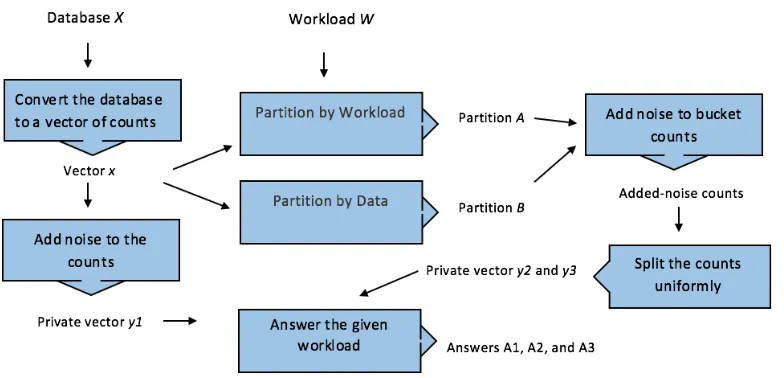
Mecha-nism. Figure 2.1 presents the proposed model and how it produces its results. As shown,
the first approach anonymizes the real counts of the values’ vector by adding noise that is
generated by Laplace mechanism. Thus, a private vector of the values’ counts will be ready
for the next stage of the model as shown in figure 2.2. The second and the third approaches
produce their results based on partitioning the vector of the values’ counts into buckets and
anonymize the counts of the produced buckets. Then, the count of each bucket will be
split uniformly among its positions to produce a private vector of the values’ counts. The
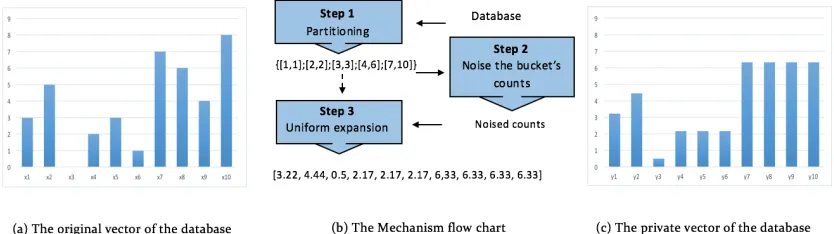
second approach partitions the vector according to the uniformity of its regions. Figure 2.3
overview of the mechanism that uses this approach with an example to clarify how it
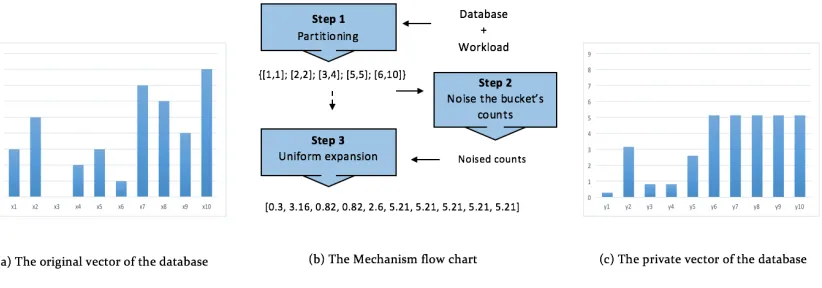
pro-duces its results. Similarly, the third approach partitions the vector according to the regions
that the given workload involves. This approach is also illustrated in figure 2.4. The last
stage of the model is taking the private vectors produced by the previous mechanisms and
Figure 2.1: Overview for The proposed model.
2.1
Laplace Mechanism
Laplace mechanism is an effective mechanism to enforce differential privacy. In her book [1],
Dwork proofed that this mechanism satisfies differential privacy and protect the
individu-als’ privacy in most cases. Therefore, it has been used as a part of the proposed model to
compare its results with the results of using the other mechanisms to recognize the
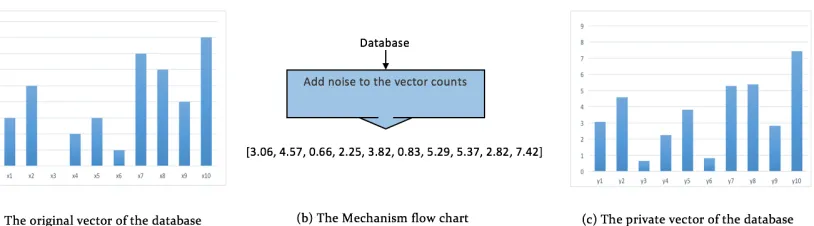
situa-tions in which using this mechanism produces the best results. Figure 2.2 illustrates how
the Laplace mechanism has been used in the proposed model to produce private answers to
the given workload. As shown, the database will be entered to the application as a vector
of counts, and then an amount of noise will be generated and added to each position of the
vector. Each amount of noise generated in this stage is drown from a Laplace distribution
Figure 2.2: Overview and example execution for The Laplace Mechanism.
2.2
Partitioning the counts’ vector based on the Data
The second approach used to answer a given workload in the proposed model requires
partitioning the domain of the values’ counts according to the uniformity of its regions.
That means the neighbor positions that have close counts will be grouped in one bucket.
To check whether a particular position should be in a bucket with its neighbors or not, a
function was built to calculate the cost of the bucket with this position and the cost of the
same bucket without this position. Then, according to these two costs, the position will
take a place in this bucket or not.
2.2.1
Cost function
This function was built similarly to the cost function that Li et al. used in their work
DAWA [4]. According to their observations in that work, after the partitionB ={b1, ., bn}
has been generated, an amount of noisez will be added to the counts of each bucket so the count of each bucket will beci = bi(x) +zi. After this process is done for each bucket,
the counts of each bucket will be split uniformly among the bucket positions. Thus, the
estimation forxrwherer∈biis:
yi =
bi(x)
|bi|
+ zi
|bi|
.
of estimation the bucket elementxr. That means, as the elementxr becomes close to the
mean of the bucket, the estimation ofxrbecomes more accurate [4].
As stated in [4], according to these observations, the deviation of the bucket bi from
being uniform is measured bydevas the following:
dev(x, bi) =
X
r∈bi
|xr−
bi(x)
bi
|
Using the only deviation functions to decide whether a particular position should be
in a particular bucket or not will not contribute to produce a good partition. That because
the deviation of the bucket which has only one element is less than the deviation of the
bucket which has many elements unless the bucket elements have the same counts. In other
words, using the deviation function alone to partition the vector will put each position of
the vector in a separate bucket and will not group the neighbor positions that have close
counts in one bucket unless they have the same count. Therefore, we should specify the
maximum difference between the vector positions’ counts to be in one bucket.
Further-more, since calculating the deviation of each bucket requires the counts of theses buckets,
these counts will be anonymized by adding Laplace noise to their values and then the rest
of the processes will be applied over these anonymized counts to enforce the differential
privacy while calculating the deviations processes.
2.2.2
Greedy partitioning algorithm
To reduce the consumption of the resources while partitioning the domain of the values’
counts, a greedy algorithm was developed as shown in Algorithm 1. The algorithm starts
by the first position of the vector and constructs a partition with a bucket which consists of
only this position and a partition with a bucket which consists of this position and the next
position to it. After that, the deviations of these two buckets will be calculated to decide
which bucket will be chosen as a part of the final partition. The process will be repeated
over all the positions of the values’ vector and after the loop is finished, the final partition
Algorithm 1The greedy algorithm for partitioning the counts’ domain based on the data
1: procedurePARTITIONINGBYDATA(X,)
2: // letmbe the maximum difference between the positions ofXto be in one bucket
3: // letfirstposbe the first position of the current bucket
4: // letlastposbe the last position of the current bucket
5: firstpos←1
6: lastpos←1
7: loop:
8: // if the loop reaches the last position ofX
9: iflastpos=The size of Xthen
10: part1 ←[f irstpos, lastpos].
11: // addpart1 to the partition
12: P ←P +part1.
13: // increase the last position
14: lastpos←lastpos+ 1.
15: else
16: part1 ←[f irstpos, lastpos].
17: part2 ←[f irstpos, lastpos+ 1].
18: dev1 ←Deviation(part1).
19: dev2 ←Deviation(part2).
20: ifdev1+m < dev2 then
21: // addpart1 to the partition
22: P ←P +part1.
23: // move to the next position
24: lastpos←lastpos+ 1.
25: f irstpos←lastpos.
26: else
27: // expand the currant bucket by adding the next position to it 28: lastpos←lastpos+ 1.
29: iflastpos<=The size of Xthen
30: gotoloop.
31: // return the partition
Figure 2.3: Overview and example execution for the Data Partitioning mechanism.
2.3
Partitioning the count’s vector based on the Workload
The third approach that has been used in the proposed model to answer a given workload
of range queries under differential privacy is partitioning the domain of the values’ counts
according to the given workload as shown in figure 2.4. As known, the given set of queries
may contribute to leak sensitive information about the database if they were answered
pre-cisely or if the amounts of the added-noise to their answers are not enough to hide the
private information. However, in some cases, a given set of queries involve big ranges, and
they are unrelated to each other which means, adding big amounts of noise to their answers
will decrease their quality with no need for that. In the other hand, we may have a set of
queries with big ranges, but when these ranges get intersecting, the focus of these queries
will be on very small and sensitive ranges. This observation was behind developing the
mechanism of partitioning the counts’ vector based on the given workload. This
mecha-nism aims to decrease the chances of inferring new information about the database using
the relationships between the set of queries and their answers. Therefore, this mechanism
takes a database represented as a vector of counts with a workload of range queries (Figure
3.1 shows an example of a workload of range queries with a description for each one). To
partition the given vector, the ranges of the workload queries will be intersected to
pro-duce interval ranges that will be transformed to buckets of the final partition. Moreover,
Figure 2.4: Overview and example execution for the Workload Partitioning mechanism.
them in separate buckets to treat them like the other buckets. That because in some cases,
adversaries may do not ask about the regions that they want to know their counts directly.
Instead, they may ask about the neighboring regions and use their counts to infer what they
want to know. Therefore, as these ranges become smaller, the amounts of the added noise
to their count will be larger since every region will be in a separate bucket. This process
decreases the chances of inferring some information from the answers to the given set of
queries. Algorithm 2 describes how this mechanism partitions a given vector of counts
according to a given workload.
Algorithm 2The algorithm for partitioning the domain based on the workload
1: procedurePARTITIONINGBYW(X,W) 2: foreach queryq ∈W do
3: // extract the range of the query q
4: r1, r2 ←ExtractTheRange(q).
5: // add the ranges to thepinrangesmatrix
6: pinranges←pinranges+ (r1, r2).
7: // sort thepinrangesand delete the repeated elements
8: pinranges←SortAndCheck(pinranges).
9: // construct interval ranges from thepinrangesmatrix
10: ranges←ConstructRanges(pinranges).
11: // add the interval ranges to the partition
12: P ←ranges.
13: // return the partition
2.4
Error function
To measure the efficiency of each approach of the proposed model, a function has been
developed to calculate the error of the produced answers by each mechanism. This function
was drown from the function that Li et al. built to calculate the workload error under the
Matrix mechanism [6]. For a given workload, the error of this workload is defined as the
root mean square error of its answers [6].
Definition 1. (Workload error).For each queryqin a given workloadW, letrqbe the true
answer to the queryq, pq be the private answer to the queryq produced by a mechanism
M, andnthe number of the queries in the given workload, the error of the given workload
W by the mechanismM is:
errorM(W) =
s
1
n(
X
i∈W
p
(ri−pi)2)
This function is a very significant part of the proposed model because it returns the
total error of the answers produced by each mechanism. Therefore, we can compare the
performance of each mechanism by comparing their answers’ error. Furthermore, we can
recognize the situations in which a particular mechanism can produce the better results to
Chapter 3
Implementation
To verify the thesis’s hypothesis, the proposed model, which answers a given workload
over a particular database, was implemented using MATLAB. This model goes through
four stages to complete its tasks and produces the final results. The first stage is preparing
its inputs to be suitable for the next stages. Then, a private vector will be returned by each
mechanism to answer the given workload. The final task of this model is computing the
workload error under each mechanism to compare their performances. In this chapter, the
implementation of the proposed model is elucidated including all of its stages.
3.1
Preparing the Model’s Inputs
Two inputs are required for the proposed model. The first one is the database that the
model’s users would query on. So, to prepare this input for the next processes, the attribute
that the model’s user queries on will be converted to a vector of counts. The second input
is a workload of range queries. To prepare this workload for the next processes, it will be
converted to a matrix of two dimensions according to the number of the possible values of
the attribute that the model’s user query on and the number of the queries that the given
workload has. Figure 3.1 shows an example of a workload that has been converted to a
Figure 3.1: a sample workload matrix W consisting of 5 queries.
3.2
Constructing Private Vectors
This stage is the most significant stage of the proposed model. It requires sequences of
processes to produce the private vectors that the model needs to answer the given workload.
Since many of the processes in this stage need to reach sensitive data, differential privacy
is considered and applied whenever the model needs to obtain any information from the
database. Furthermore, Since the model answers the given workload under three different
approaches, This stage returns three different private vectors. One of these vectors will be
produced using the Laplace mechanism while the other vectors will be produced using the
partitioning mechanisms.
3.2.1
The Laplace Mechanism
This mechanism takes the given vector produced by the previous stage and adds an amount
of noise to each count of its positions to anonymize them. Therefore, a function was built
to anonymize these counts. Furthermore, other function was built to generate and return
an amount of noise using Laplace distribution with mean 0and scale1/ε. Therefore, the noise-generation function will be called by the noise-addition function for every position
3.2.2
The Partitioning Mechanisms
The second and the third approaches that have been used in the proposed model construct
private vectors to answer the given workload based on partitioning the given vector to
control the amounts of the added-noise to the counts of this vector to increase the accuracy
of the produced results.
The Partitioning Mechanism Based on Data
To partition the given vector according to the data, algorithm 1 was implemented with
a function that computes the deviation of a given bucket. The deviation function should
enforce differential privacy during its work because it requires the total count of the given
bucket which violates the database privacy. Therefore, this function anonymizes the count
of the given bucket by adding Laplace noise to it at before giving this count to the next
processes.
The Partitioning Mechanism Based on the Workload
Algorithm 2 was implemented to partition the given vector according to the regions that
the given workload involves. As described in the previous chapter, a function is required to
take the input workload and extract the regions that the queries involve. Then, the extracted
regions should be intersected to produced interval regions that will be used to partition the
counts’ vector.
Anonymize the Bucket Counts
After partitioning the given vector to buckets, the counts of these buckets should be
pro-duced to be given to the next processes. Since these counts could contribute to leak some
sensitive information about the database, they should be anonymized to ensure the database
privacy. Therefore, the partitions will be sent to the noise-addition function to add an
Splitting the Buckets’ Counts Uniformly
After estimating the counts of the produced buckets, the count of each bucket will be split
uniformly among its positions to produced a private vector. Therefore, a function was built
to do this task by taking a particular partition as an input and applying these processes over
its bucket to return a private vector that will be given to the next stage of the proposed
model.
3.3
Answering the Given Workload
The proposed model requires implementing a function that takes a workload matrix with a
vector of counts and returns the answers to the given workload. Thus, as long we have a
workload over a vector of counts, we can use this function to answer this given workload
whether the given vector has true or private counts. So, this function was implemented to
be used to answer the given workload over each vector produced by each approach.
3.4
Computing the Workload Error
Computing the error of each workload under each mechanism requires finding the true and
the private answers to this workload. Therefore, a function was implemented to calculate
Chapter 4
Analysis
4.1
Approach
The proposed model aims to validate the thesis hypothesis and verify that the
partition-ing mechanisms improve the model’s performance and increase the privacy level of the
database. The models analysis aimed to demonstrate the ability of the developed greedy
algorithm to produce the optimal partition based on the distribution of the data, and the
ability of the partitioning mechanism based on the given workload to increase the levels of
the database privacy while producing satisfactory results.
The experiment was designed to measure and compare two significant factors of the
three different approaches developed as parts of the proposed model. Therefore, during
the experiment, there were three different set of answers for each given workload. The
firs set was produced by the Laplace mechanism, and the other sets were produced by the
partitioning mechanisms. Moreover, the workload error was computed over each set of
answers produced by each mechanism. This process contributes to measure the privacy
and the accuracy factors because the aim of the proposed model is improving these factors.
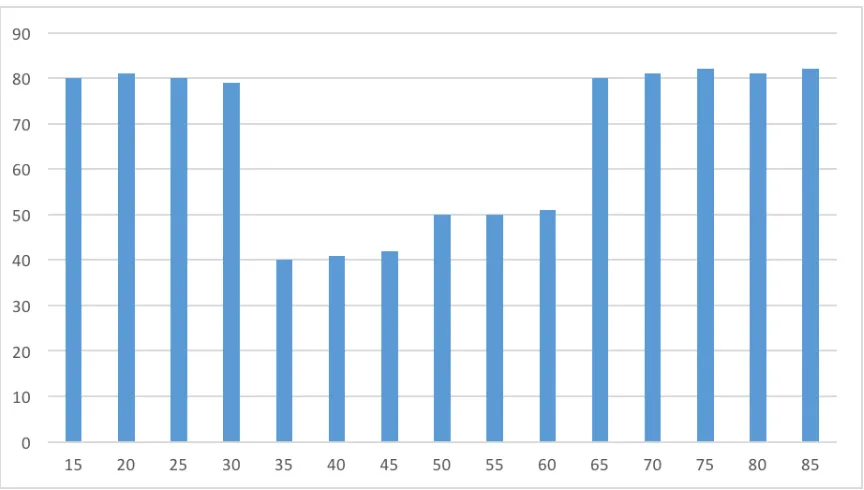
To measure the efficiency of the partitioning mechanisms, Two different vectors were
generated. The first vector has many regions of density as shown in figure 4.1. The second
vector has large uniform regions as shown in figure 4.2.
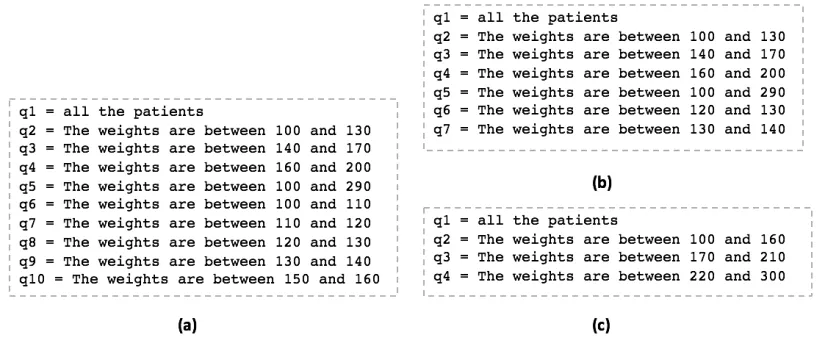
Since the individuals’ privacy is the main concern of this work, three different
work-loads were constructed to test the privacy levels provided by the proposed model to protect
Figure 4.1: The vector that has many regions of density.
[image:36.612.94.526.414.659.2]Figure 4.3: Three workloads that are different in their sensitivity levels (a) is very sensitive, (b) is sensitive, and (c) is normal.
proposed model. The first set of queries (a) is very sensitive because most of them ask
about very small ranges which could be used to learn some information about the database
individuals. The second set (b) is sensitive, and it has some queries that ask about small
ranges and some ask about big ranges. The third set (c) is normal because its queries ask
about big ranges which means their answers will be general and not sensitive.
Generating random noise from Laplace distributions has been used in different parts
of this work. Therefore, since the amounts of the generated noise depend on the values, which indicates to the privacy budget, the experiment was repeated four times over each
4.2
Analysis
4.2.1
The partitioning Mechanism based on the Data
The Experiment over a Vector that has large uniform regions
This experiment was done over a vector that has large uniform regions as shown in figure
4.2. Since the vector has some regions that have close counts, the partitioning mechanism
over this vector produces partitions with fewer buckets than the vectors that have many
regions of density. As the number of the bucket become fewer, the number of the positions
within each bucket will be more, so as the amount of the noise that has been generated for a
particular bucket will be divided between the buckets’ positions, each position would have
a small amount of noise to be added to its count. In other words, As the buckets have more
positions, the noise added to each position will be smaller and therefore this mechanism
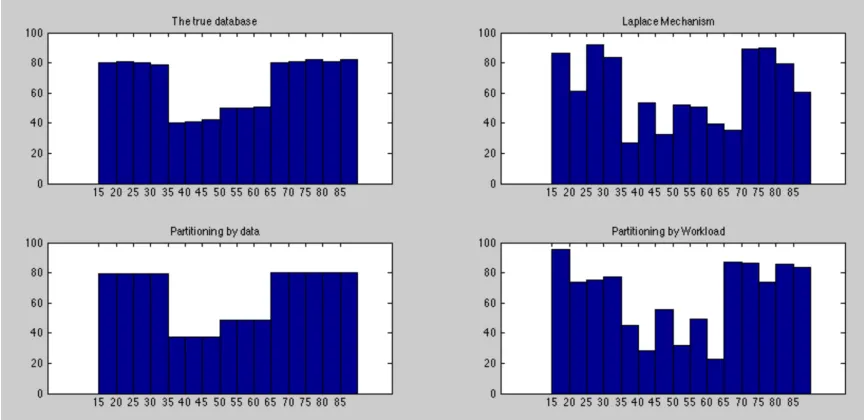
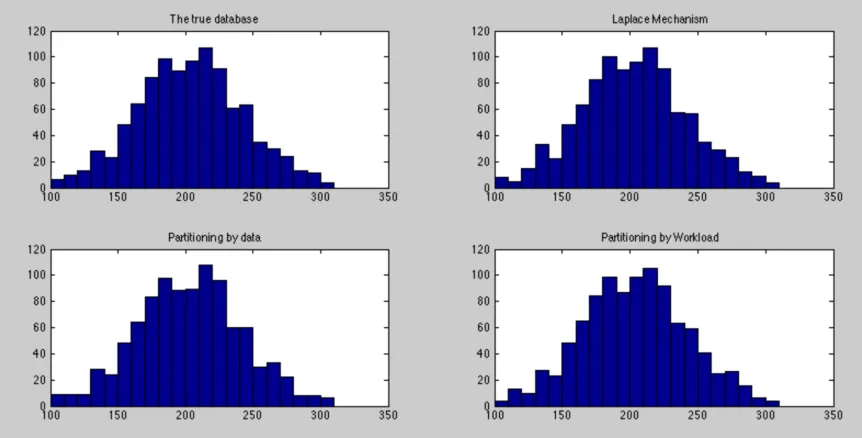
produces more accurate answers. For example: as illustrated in figure 4.4, to answer the
sensitive workload (b) that have been shown in figure 4.3 over the vector presented in
figure 4.2 by the partitioning mechanism based on the data, the vector of the counts was
partitioned to four buckets. Each bucket has at least three positions. So, the amount of the
added noise to each position will be divided at least by three which means less noise than
if the bucket has only one position or if the Laplace mechanism is used over these kinds of
vectors.
In these cases, the performance of the partitioning mechanism based on the data is better
than the Laplace mechanism because the error rates of its results are fewer than the error
rates of the results produced by the Laplace mechanism that generates an amount of noise
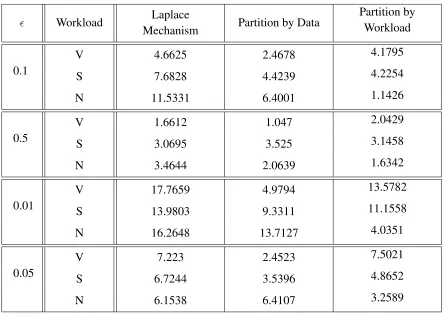
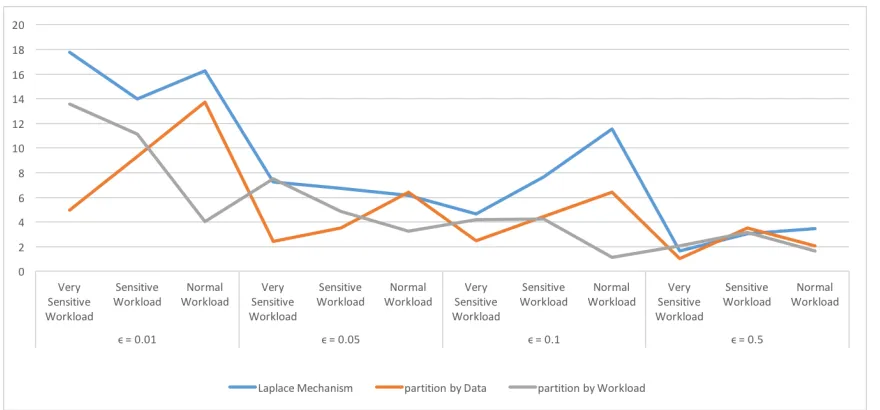
to be added to each position of the vector. Table 4.1 and figure 4.5 present and show that in
most cases the Partitioning mechanism based on the distribution of the data performs better
than the Laplace Mechanism over the vector that has large uniform regions.
Theparameter plays a role in the quality of the results produced by each mechanism. That because each mechanism requires generating amounts of noise from Laplace
Figure 4.4: The true and private vectors produced by each mechanism of the proposed model to answer the workload (b) shown in figure 4.3 over the vector presented in figure 4.2.
smaller, the amounts of the generated noise become larger. Therefore, the partitioning
mechanism would perform better than the Laplace mechanism as the values of this
param-eter become smaller while both mechanisms produce similar results as the values of the
Workload Laplace
Mechanism Partition by Data
Partition by Workload
0.1
V 4.6625 2.4678 4.1795
S 7.6828 4.4239 4.2254
N 11.5331 6.4001 1.1426
0.5
V 1.6612 1.047 2.0429
S 3.0695 3.525 3.1458
N 3.4644 2.0639 1.6342
0.01
V 17.7659 4.9794 13.5782
S 13.9803 9.3311 11.1558
N 16.2648 13.7127 4.0351
0.05
V 7.223 2.4523 7.5021
S 6.7244 3.5396 4.8652
N 6.1538 6.4107 3.2589
Table 4.1: Table of the error rates of answering three workloads (V:very sensitive, S:sensitive, N:normal) under each mechanism over the vector that has large uniform re-gions.
The Experiment over a Vector that has many regions of density
This experiment was done over a vector that has many regions of density as shown in figure
4.1. Since this vector has regions that have different counts, the partitioning mechanism
based on the distribution of the data produces partitions with a large number of buckets.
Therefore, as the number of the bucket become larger, the number of the positions within
each bucket will be fewer. So, since the amount of the noise that has been generated for a
particular bucket will be divided between the buckets’ positions, each position would have
[image:40.612.92.536.87.401.2]Figure 4.5: Error rates of answering three different workloads over the vector that has large uniform regions.
positions, the noise added to each position will be larger and therefore this mechanism
per-forms worse. For example: as illustrated in figure 4.6, to answer the sensitive workload (a)
that have been shown in figure 4.3 over the vector presented in figure 4.1 by the partitioning
mechanism based on the data, the vector of the counts was partitioned to seventeen buckets
most of them have only one position. So, the amount of the added noise to each position
will be divided by one for most of the buckets which means more noise than if the bucket
has more than one position like the situation described in the previous section.
In these cases, the performance of the partitioning mechanism based on the distribution
of the data is very similar to the performance of the Laplace mechanism because most of
the bucket has only one position because of the large differences between the vector counts.
Table 4.2 and figure 4.7 present and show that in most cases the Partitioning mechanism
based on the data performs as the Laplace Mechanism over the vector that has many regions
of density. Since both mechanisms behave similarly as the number of the buckets become
larger, the parameterwill not contribute to make the performance of any mechanism better than the other. However, the error rates of both mechanisms will grow gradually according
Figure 4.6: The true and private vectors produced by each mechanism of the proposed model to answer the workload (a) shown in figure 4.3 over the vector presented in figure 4.1.
[image:42.612.92.532.444.638.2]Workload Laplace
Mechanism Partition by Data
Partition by Workload
0.1
V 3.5149 2.9623 3.3561
S 4.1698 4.4906 3.7579
N 7.0058 6.9771 1.529
0.5
V 1.8849 1.4922 1.6113
S 2.4831 3.4746 4.3024
N 3.1787 4.0677 1.769
0.01
V 11.0294 11.3886 10.3697
S 19.306 19.1008 6.2201
N 6.2267 8.083 1.1806
0.05
V 4.5272 3.8292 4.2514
S 7.4267 6.0203 7.0993
N 9.1475 9.9998 4.4158
[image:43.612.91.536.226.515.2]4.2.2
The partitioning Mechanism based on Workload
The partitioning mechanism based on the given workload performs better than the other
mechanisms in most cases. Since this mechanism depends on the nature of the given
work-loads, its performance changes according to the kind of the given workload. As the given
workload become more sensitive, the mechanism produces worse results because the
sensi-tive workloads have more ranges with less number of positions than the normal workloads.
Therefore, each position of the count vector would have a larger amount of noise to be
added to its count as the given workload become more sensitive to preserve more privacy.
That, of course, would increase the error rates and impact the quality of the produced
re-sults to provide more privacy for the database. For example workload (b) and (c) shown
in figure 4.3 involve many ranges, and most of them are small. So, as illustrated in figure
4.4 and 4.6, the number of the buckets of the produced partition by this mechanism is very
close to the number of its positions. So, most of the produced buckets have only one
posi-tion therefore each posiposi-tion has an amount of noise to be added to its count to provide more
privacy.
The values of the parameter affect the performance of the partitioning mechanism based on the given workload because the amounts of the generated noise depend on this
parameter. So, as the values of this parameter become smaller, the error rates of this
mech-anism become larger according to the amounts of the generated noise as shown in figure
4.5 and 4.7.
4.3
Hypothesis Evaluation
The proposed model was designed to find an optimal partition of attribute values and
an-swer range queries under differential privacy. Therefore, two partitioning mechanisms were
developed based on the data itself and based on the given workload to investigate which
one would perform better while preserving the privacy of the database. The results
the accuracy of the produced answers to the given workload by the partitioning mechanism
based the data depends on the distribution of that data. Moreover, the partitioning
mech-anism based on the given workload considers the sensitivity of the given workload, so the
quality of the produced results will be based on that.
The partitioning mechanism based on the data produces better results than the Laplace
mechanism when most of the vector’s regions have close values because the positions of
each region will be grouped in one bucket. So, the noise added to each position count will
be small because of dividing the noisy count of that bucket uniformly among its positions.
Therefore as the number of the buckets become smaller, the number of the buckets’ items
become larger and therefore, the amounts of the added noise to each position’s count will
be very small. That means the error rates will be smaller. However, in some cases, the
given workload is very sensitive which requires more noisy answers to hide the individuals
information and prevent inferring new information about these individuals. This
observa-tion indicates that the partiobserva-tioning mechanism based on the data is not sufficient to preserve
the individuals’ privacy in some situations, and it needs to be improved to consider these
situations.
Partitioning the counts vector based on the given workload contributes to decrease the
error rates in most cases as shown on figure 4.5 and figure 4.7. Moreover, this mechanism
consumes fewer resources because it depends on the given workload which is smaller than
the data vector. The partitioning buckets are chosen based on the regions that the given
workload focuses on. Therefore, as the number of the given workload become larger and
the regions that these queries ask about become smaller, the buckets in the produced
parti-tion will be more. Thus, the error rates will be larger than if the given workload has fewer
queries and larger ranges. So, this mechanism provides more privacy as the given workload
has more sensitive queries. Therefore, this mechanism is better than the partitioning
mech-anism based on the data because it provides more privacy with fewer errors and consumes
Chapter 5
Conclusions
5.1
Current Status
The main goal of this work is verifying that the partitioning process of the data vector to
answer a set of range quires under differential privacy is more efficient than the Laplace
mechanism. Therefore, two different mechanisms were developed and tested to partition
the data vector according to the data itself and according to the given workload.
The idea of Partitioning the count vector based on the data was inspired based on Li et
al. approach [4]. To apply that, the vector of the values’ counts is divided into buckets so
within each bucket the counts of the positions are very close. Li et al. did that by generating
all the possible partitions and choose the one that has the least cost. The cost of each bucket
is calculated based on the bucket deviation and the noise that will be added to each bucket’s
count. However, instead of generating all the possible partitions, a greedy algorithm was
developed to partition the vector which reduces the resources consumption and produces
an optimal partition of the given vector. The algorithm takes each position of the vector
and the last bucket that was generated form the previous process (if there is no bucket
generated yet, a bucket that contains only the first position will be generated). Then two
temporary buckets will be generated according to this bucket. The first temporary bucket
contains the position that has been chosen by the algorithm with the positions that the last
bucket has while the other temporary bucket has the same position that the last bucket has.
The next step is calculating the cost of each bucket and the bucket that costs less than the
the algorithm tests all the positions of the counts’ vector.By the end of these processes, an
optimal partition will be generated as an output of this greedy algorithm.
Since a given workload may contribute to leak some information about the database if
its queries ask about narrow ranges. The second partitioning mechanism was developed
based on this observation. Therefore, according to the ranges that the given queries ask
about, the vector will be partitioned. The algorithm that was built to do this task starts by
the given workload and extracts the ranges of the queries and intersects them to see which
ranges that most of the queries focus on to partition the data vector according to these
ranges. So, the ranges that the given queries do not ask about will be in separate buckets to
be treated like the other buckets.
After implementing these mechanisms and testing their performances, we found that
the partitioning mechanism based on the given workload produce the best results in most
cases. Moreover, when we looked at the cases that this mechanism produces worse results
we found that the given workloads are very sensitive which means the amounts of the added
noise to the real answers are big compared to the other mechanisms. That considered as an
advantage of this mechanism because increasing the amounts of the added noise according
to the sensitivity of the given workload provides more privacy.
5.2
Future Work
Since the partitioning mechanism based on the given workload produces outstanding results
comparing to the partitioning mechanism based on the data and the Laplace mechanism, it
can be a starting point for new research. Because the amount of the generated noise grows
according to the sensitivity of the given workload, there should be a more sophisticated
mechanism that measures the sensitivity of the given workload and link that to the sensitive
ranges of the counts’ vector. That could contribute to control the amounts of the added
noise which provides more privacy and efficiency.
This work was done to answer workloads of range queries over single attribute.
contribute to make this model more realistic and provide more privacy since there are many
related attributes in a particular database, and they may be used to learn sensitive
informa-tion about the database and its individuals.
5.3
Conclusion
Partitioning the counts’ vector could enhance the performance of answering a given
work-load of range queries under differential privacy. The partitioning mechanism based on the
data could reduce the error rates unless the vector has many regions of density because in
these cases the partitioning mechanism would put each position in a separate bucket and
therefore it will behave exactly like the Laplace mechanism. The partitioning mechanism
based on the given workload could reduce the error rates in most cases unless the given
workload is very sensitive. That because the amounts of the added noise to the real counts
Bibliography
[1] C.Dwork, F. McSherry, K. Nissim, and A. Smith. Calibrating noise to sensitivity in private data analysis. InTheory of Cryptography, 2006.
[2] Cynthia Dwork. Differential privacy. In Michele Bugliesi, Bart Preneel, Vladimiro Sassone, and Ingo Wegener, editors,Automata, Languages and Programming. Springer Verlag, 2006.
[3] Cynthia Dwork and Aaron Roth. The Algorithmic Foundations of Differential Privacy. 2014.
[4] Chao Li, Michael Hay, Gerome Miklau, and Yue Wang. A data- and workload-aware algorithm for range queries under differential privacy. Proc. VLDB Endow., 7(5):341– 352, jan 2014.
[5] Chao Li, Michael Hay, Vibhor Rastogi, Gerome Miklau, and Andrew McGregor. Op-timizing linear counting queries under differential privacy. InPODS, 2010.
[6] Chao Li and Gerome Miklau. An adaptive mechanism for accurate query answering under differential privacy. Proc. VLDB Endow., 5(6):514–525, feb 2012.
[7] Ashwin Machanavajjhala, Daniel Kifer, Johannes Gehrke, and Muthuramakrishnan Venkitasubramaniam. L-diversity: Privacy beyond k-anonymity. ACM Trans. Knowl. Discov. Data, 1(1), mar 2007.
[8] Latanya Sweeney. K-anonymity: A model for protecting privacy. Int. J. Uncertain. Fuzziness Knowl.-Based Syst., 10(15):557–570, oct 2002.