A Web Site Sophistication Model Based on Value-Added Technology
Solutions and Services
Mustafa Ally, Aileen Cater-Steel, Mark Toleman School of Information Systems
University of Southern Queensland Toowoomba, Australia
Email: {allym, caterst, markt}@usq.edu.au
Abstract
This research reports on the development of a framework to be used to benchmark the readiness of e-Commerce websites. This model will be used in a follow up study relating customer trust and the maturity levels of websites. While several models of e-Commerce capability and maturity have been developed over the years most of them have identified the stages of growth in broad and/or strategic terms. With advances in technology, and the availability of software development tools and new ways of enhancing the customer’s shopping experience, it is possible to determine the maturity levels of websites in terms of these value added features. For this study, a list of website tools, technologies and services were placed in a common pool and subjected to classification by a selected panel of e-Commerce users who would determine which items should be assigned to which level of maturity. The objective was to determine which features, in the view of typical customers, suggested a certain level of maturity. The result is the establishment of a process for developing a general framework of e-Commerce maturity from a customer perspective based on the usage of currently available technology solutions and services.
Keywords
e-Commerce, maturity, sophistication, capability, model
Introduction
Companies, particularly small-to-medium enterprises (SMEs), can enter the e-Commerce arena at various levels of sophistication. We use the term sophistication to refer to the processes, structures and skills adopted by a company for facilitating the sale and purchase of goods/services over the Internet. Some companies enter as ‘brochure-ware’ sites, using the Internet as a first step in creating a web presence. Others use the Internet as a means of conducting business, taking sales orders online and processing payments offline. Yet others engage in relatively more complex operations such as offering online catalogues, receiving online orders and handling online payments. Recently websites have begun to employ newer technologies and features, such as blogs, RSS and alternate payment processes to enhance the shopping experiences of their customers.
Varian et al. (2002, p. 2) defined Internet business solutions in a broad way as “any initiatives that combine the Internet with networking, software and computing hardware technologies to enhance or improve existing business processes or create new business opportunities”, which, according to an e-Business Watch report (Berlecon Research GmbH 2002), is also a reasonable definition for e-Commerce tools.
These technological solutions and services are also used to enhance the shopping experience of the customer and, as such, can be evaluated through the ‘eye of the beholder’. Extending the assertion by Day (1997) regarding the concept of quality, we take a similar approach to determining the maturity level of a website, namely, that it is “whatever the customer says it is”.
Hwang 2001). A web site may be analysed based on these model descriptions and then classified as belonging to a particular type.
Various researchers have proposed phases or steps to represent the evolutionary adoption of e-Commerce by SMEs. PriceWaterhouseCoopers (1999) employed a categorization to examine the differences in perception between firms with different levels of e-Commerce capability. In an exploratory case study using the PriceWaterhouseCoopers staged model, Scupola (2003) concluded that the model did not take into consideration the changes in the company capabilities and business processes that have to take place in order to go from one level to the next of e-commerce capabilities.
Several other ‘stages of development’ models have also been formulated over the past few years to describe the increasing levels of IS/IT sophistication incorporated at each succeeding phase of the model. Amongst the ones identified by Prananto, McKay and Marshall (2003) are the E-Commerce Maturity Model (KPMG 1997), the Commitment-Implementation Matrix Model (Stroud 1998), the E-Commerce Levels (O'Connor & Galvin 1998), the Business Lifecycle Model (Berryman 1999), Intranet Maturity Model (Damsgaard & Scheepers 1999), E-Commerce Adoption Model (Daniel, Wilson & Myers 2002) and the Stages of Growth for e-Business (SOGe) model (Prananto, Marshall & McKay 2002). To classify a web site, its functionality is compared to those of the list and the level of growth incorporating the majority of its features is assigned to it. These capability levels recognize that firms typically evolve through successive stages of e-Commerce development, confronting different issues as they progress to higher levels of e-Commerce capability and activity.
Ho (1997) proposed a general framework to evaluate Web sites from the customer’s perspective of value-added. Using a three by four dimensional matrix the purpose of a commercial web site is classified into three categories (promotion of product and services, provision of data and information, and processing of business transactions) and four types of value creation (timely, custom, logistic and sensational). Web sites can be analysed in sufficient detail to identify all its value-adding features (for example, items on sale, special offers, product announcements, general database search, customized news report etc.) and then classified using the framework.
[image:2.595.217.379.451.605.2]Incorporating the above three levels of business process, Burgess and Cooper (2000) introduced the Model of Internet Commerce Adoption (MICA) on the premise that organisations typically start by initially establishing a ‘presence’ on the Web and then building on functionality over time as the level of technical skill/expertise in the use of Internet technologies increased. In addition, as Web sites grew in complexity, so would the number of the modules included into the site increase (Goi 2007). MICA was developed to explain how business Web sites develop to incorporate aspects of Internet Commerce incrementally (see Figure 1).
Figure 1: Model of Internet Commerce Adoption (MICA) (Goi 2007)
Research Justification
From the above it is clear that a framework of e-Commerce sophistication can serve a number of purposes:
1. To describes the practices, services, components and technologies that any organization must perform in order to improve its customer experience;
2. To provide a yardstick against which to periodically measure an organization’s level of sophistication and progress over time;
3. To establish a proven framework within which to manage the progression efforts.
An evaluation and assessment of an organization's website against a framework will determine the level at which the organization currently stands. It indicates the organization's maturity at a particular point in time and the practices on which the organization needs to focus in order to see the greatest improvement and the highest return on investment.
However, these models exhibit a number of shortcomings. They have largely been developed without a theoretical base and/or without adequate theoretical, psychometric, or empirical justification and therefore lacking in validity and reliability. For example, the empirical validation of the concept of ‘stages’ is limited (Prananto, McKay & Marshall 2003). There is also a lack of granularity of functionality in determining the various stages, and some have been critical for being too broad and simplistic to reflect the finer distinction between levels (Boon, Hewett & Parker 2000). As newer technologies emerge and new business services and processes are developed, existing models become increasingly inadequate in describing current reality. Also, those models that take a broad, strategic, organizational and backend business process perspective and emphasis are often difficult to operationalize.
No comprehensive instrument exists that describes actual website sophistication and development specifically in terms of available components, functionalities and technologies, and providing measures against the variety of perceptions of e-Commerce sophistication that exist. Furthermore, research to date has neglected consideration of functionality from the customer’s perspective.
The next section describes the process used to develop a preliminary customer-focused framework of web site maturity.
Research Design
The development of the survey instrument was carried out in two phases. The first phase was item creation, the purpose of which was to create a pool of items that reflect available website components, tools, technologies, business processes and services and other functionalities typically available for use in commercial web sites. The list includes items that were directly accessible and available to website customers and on which they could reasonably be asked to make a judgement.
As a starting point, an initial list was created using items described in existing stages of development models together with ones identified by the authors from their own experiences in the field of website analysis and design. A hand-picked group of 10 experts and academics in the field of e-Commerce was then asked to help populate and refine the list resulting in a final count of 41 items. This process also ensured the content validity of the instrument.
The experts were then asked to describe, in their own words using keywords and phrases, each of the levels of sophistication in relation to the essential characteristics that distinguished one level from the next. With the experts supplying their own labels and definitions a priori the potential for “interpretational confounding” was minimized. For the purposes of this study, these responses, together with ones (such as FAQs, email, and payments) taken from the literature study discussed above were used to arrive at a generalized definition for each of the five stages.
participants placed items within the intended stage. The higher the percentage of items placed in the target level, the higher the degree of inter-judge agreement across participants. Stages based on categories which have a high degree of ‘correct’ placement of items within them can be considered to have a high degree of construct validity, with a high potential for good reliability scores. It must be emphasized that this procedure is more a qualitative analysis than a rigorous quantitative procedure. There are no established guidelines for determining good levels of placement, but the matrix can be used to highlight any potential problems (Moore & Benbasat 1991).
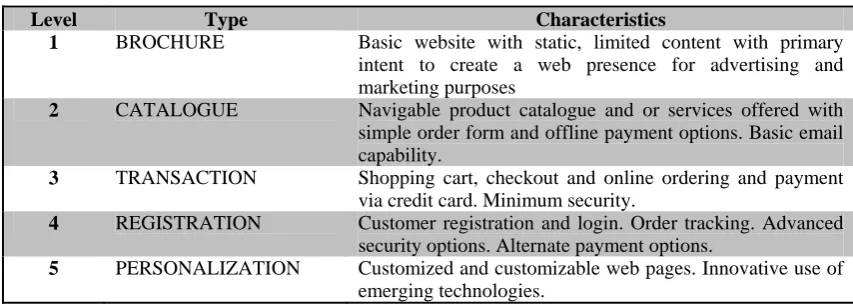
[image:4.595.83.510.194.348.2]The descriptions of the stages of development supplied by experts in phase one, together with those offered in the literature, were then analysed and consolidated into five levels (as shown in Table 1).
Table 1: e-Commerce sophistication level description (developed for this study)
Level Type Characteristics
1 BROCHURE Basic website with static, limited content with primary intent to create a web presence for advertising and marketing purposes
2 CATALOGUE Navigable product catalogue and or services offered with simple order form and offline payment options. Basic email capability.
3 TRANSACTION Shopping cart, checkout and online ordering and payment via credit card. Minimum security.
4 REGISTRATION Customer registration and login. Order tracking. Advanced security options. Alternate payment options.
5 PERSONALIZATION Customized and customizable web pages. Innovative use of emerging technologies.
Each level includes a list of distinguishing features and none of the functionalities of levels succeeding it. It is assumed that each level includes the characteristics of the lower/preceding levels. These levels were used in phase two of the research as a basis for typical e-Commerce customers to match against from the given list of website features, technologies and services. A number of additional items, for example, blogs and RSS, were suggested particularly in relation to their innovative use for business purposes and these were included in the final list. The full list of items and levels as determined in phase two of the research is shown in Table 2.
The survey instrument was then administered and the responses from the sample of customers were then checked before importing them from the survey tool to a spreadsheet to calculate the proportion of responses for each item according to the five levels.
Results and Discussion
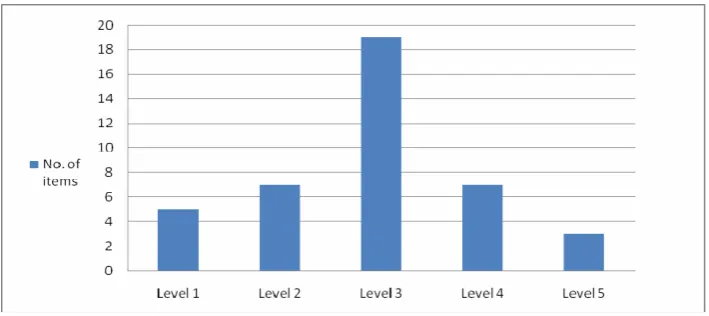
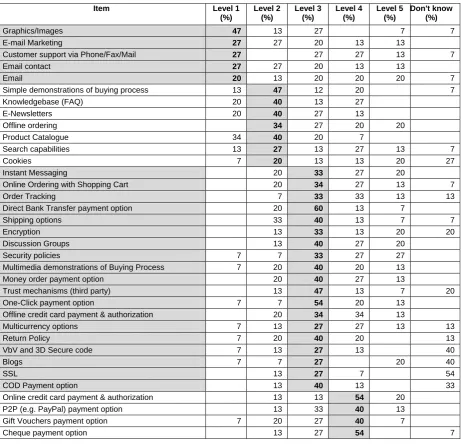
Adopting the strategy of accepting the highest percentage point at the lowest maturity level, the 41 items were clustered into the five levels as shown in Table 2. For some items, such as direct bank transfer payment, there was strong consensus on the level of sophistication. For other items, respondents did not appear to agree. For example, multi-currency options was equally ranked at levels 3 and 4; email was equally distributed to levels 1, 3, 4 and 5.
Figure 2: Item clusters and levels of sophistication
Despite the limitations imposed by a very severely restricted sample size, the results as shown in Table 2 arising out of the match of items with sophistication levels highlighted several issues:
• The high percentage of “Don’t know” responses associated with some of the more recent innovations (for example, Blogs, Buyer authentication credit card processing and RSS) indicate either a lack of awareness of certain emerging technologies and processes or an inability on the part of the survey participants to associate them with particular levels. While it is likely more the former in the majority of the cases, the survey instrument will need to be modified to cater for these two possibilities.
• The existence of some features, though in existence for some time now, might not have been obvious from the given descriptions. For example, the awareness of SSL functionality might have been through the https protocol or an icon. Alternate descriptions need to be incorporated into the survey where such ambiguity or uncertainty may arise.
• Certain items need to be further elucidated (for example, what is meant by email marketing) in order to avoid any possible confusion in terminology.
• The number of items at level 5 has the potential to expand as innovative features are realized to take fuller advantage of the Web and customers become more familiar with their usage over time.
Using this framework websites can then be rated both in terms of their use of e-Commerce tools and from the perspective of the customer, offering opportunities to further analyse websites by such characteristics as industry type, business model and trust mechanisms. The framework and survey instrument can also be extended to analyse customer perceptions of websites in terms of demographics such as age, experience and gender, and customer website behaviour like trust, satisfaction and adoption levels.
Research Limitations
It must be noted, however, that there are some serious limitations with regard to the survey sample size. The tables presented should therefore be only regarded as an initial presentation of figures. These will be largely complemented and, for the sake of a coherent methodology, substituted by a more representative survey. Also, whilst care was taken to ensure that the sample of students selected to make the assessments were studying the same course, and therefore assumed to be at a similar educational level, there are other demographic factors that need to be controlled as people with different backgrounds can interpret levels of website maturity or complexity or features in very different ways.
Further Research
The framework will eventually comprise three components: 1. The e-Commerce Sophistication model;
Summary and Conclusion
E-commerce websites undergo a number of stages of growth or levels of maturity in their evolution. While several models of e-commerce capability and maturity have been developed over the years most of them have identified the stages of growth in broad and/or strategic terms and typically from a merchant and/or business enterprise perspective rather than from that of the customer.
With advances in technology, and the availability of software development tools and new ways of enhancing the customer’s shopping experience it is possible to determine the maturity level of a website in terms of the specific features/technologies/services it offers.
This research highlighted the stages of e-Commerce deployment leading to various degrees of alignment with business and marketing objectives and the technology and approaches needed to support this. The framework developed for this study distinguishes ‘front office features’ and ‘back office functions’ as regards customer perceptions of maturity levels and could be a useful tool to benchmark the maturity of electronic businesses at various stages of growth.
[image:6.595.73.535.326.772.2]The aim was to provide a technique for categorising a website against a pool of possible website features with each level of sophistication representing an increased ability to offer enhanced online customer experience. It indicates the organization's maturity in the area concerned, and the practices on which the organization needs to focus in order to see the improved customer experiences.
Table 2: Inter-Customer Agreement on Level Placement (developed for this study) n=15
Item Level 1
(%) Level 2 (%) Level 3 (%) Level 4 (%) Level 5 (%) Don't know (%)
Graphics/Images 47 13 27 7 7
E-mail Marketing 27 27 20 13 13
Customer support via Phone/Fax/Mail 27 27 27 13 7
Email contact 27 27 20 13 13
Email 20 13 20 20 20 7
Simple demonstrations of buying process 13 47 12 20 7
Knowledgebase (FAQ) 20 40 13 27
E-Newsletters 20 40 27 13
Offline ordering 34 27 20 20
Product Catalogue 34 40 20 7
Search capabilities 13 27 13 27 13 7
Cookies 7 20 13 13 20 27
Instant Messaging 20 33 27 20
Online Ordering with Shopping Cart 20 34 27 13 7
Order Tracking 7 33 33 13 13
Direct Bank Transfer payment option 20 60 13 7
Shipping options 33 40 13 7 7
Encryption 13 33 13 20 20
Discussion Groups 13 40 27 20
Security policies 7 7 33 27 27
Multimedia demonstrations of Buying Process 7 20 40 20 13
Money order payment option 20 40 27 13
Trust mechanisms (third party) 13 47 13 7 20
One-Click payment option 7 7 54 20 13
Offline credit card payment & authorization 20 34 34 13
Multicurrency options 7 13 27 27 13 13
Return Policy 7 20 40 20 13
VbV and 3D Secure code 7 13 27 13 40
Blogs 7 7 27 20 40
SSL 13 27 7 54
COD Payment option 13 40 13 33
Online credit card payment & authorization 13 13 54 20
P2P (e.g. PayPal) payment option 13 33 40 13
Gift Vouchers payment option 7 20 27 40 7
Item Level 1 (%)
Level 2 (%)
Level 3 (%)
Level 4 (%)
Level 5 (%)
Don't know (%)
Customer Profile 7 27 67
Loyalty Program 13 20 27 7 34
Customer Registration 20 27 40 13
Customer Personalised Webpage 7 13 27 47 7
RSS 7 13 7 20 54
User Polls & Feedback 7 7 20 7 20 40
References
Berryman, E. 1999, Getting on with the business of e-business, PriceWaterhouseCoopers.
Boon, O., Hewett, B. & Parker, C.M. 2000, 'Evaluating the Adoption of the Internet: A Study of an Australian Experience in Local Government', paper presented to 13th International Electronic Commerce Conference June 18-21, Bled, Slovenia, June 18-21.
Damsgaard, J. & Scheepers, R. 1999, 'A stage model of intranet technology implementation and management', paper presented to 7th Conference on Information Systems, Copenhagen Business School, Copenhagen, Denmark, 23-25 June 1999.
Daniel, E., Wilson, H. & Myers, A. 2002, 'Adoption of e-commerce by SMEs in the UK: Towards a stage model', International Small Business Journal, vol. 20, no. 3, pp. 253-70.
Day, A. 1997, 'A Model for Monitoring Web Site Effectiveness', Internet Research, vol. 7, no. 2, pp. 109-15.
Goi, C.L. 2007, 'A Review of Existing Web site Models for e-Commerce', Journal of Internet Banking and Commerce, vol. 12, no. 1.
Ho, J. 1997, 'Evaluating the World Wide Web: A Global Study of Commercial Sites', Journal of Computer-Mediated Communication, vol. 3, no. 1.
KPMG 1997, Electronic commerce research report 1997, KPMG Management Consulting, London, UK.
Moore, G.C. & Benbasat, I. 1991, 'Development of an instrument to measure perceptions of adopting an information technology innovation', Information Systems Research, vol. 2, no. 3, pp. 109-222.
Novak, T.P. & Hoffman, D.L. 2001, Profitability on the Web: Business Models & Revenue Streams, viewed
December 2004 2004, <
http://elab-web1.owen.edu/Research/papers/pdf/manuscripts/ProfitabiltyOnTheWebJan2001.pdf>.
O'Connor, J. & Galvin, E. 1998, Creating Value through E-commerce, Financial Times Publication, London.
Prananto, A., Marshall, P. & McKay, J. 2002, 'Stages of growth of e-business: An analysis of the perceived usability of the stages of growth model in e-business progression', paper presented to 4th International Conference on Electronic Commerce (ICEC), City University of Hong Kong, Hong Kong SAR, China, 23-25 Oct.
Prananto, A., McKay, J. & Marshall, P. 2003, 'A study of the progression of e-business maturity in Australian SMEs: Some evidence of the applicability of the stages of growth for e-business model', paper presented to 7th Pacific Asia Conference on Information Systems, Adelaide, South Australia, 10-13 July.
Scupola, A. 2003, 'Adoption of E-commerce in SMES: Lessons from Stage Models', in K.V. Andersen, S. Elliot, P. Swatman, E. Trauth & N. Bjørn-Andersen (eds), Seeking success in E-business: a multidisciplinary approach, Kluwer Academic Publishers, Norwell, MA, USA pp. 291 - 308.
Stroud, D. 1998, Internet Strategies: A Corporate Guide to Exploiting the Internet, Macmillan Press Ltd., London.
Varian, H., Litan, R.E., Elder, A. & Shutter, J. 2002, The Net Impact Study – The Projected Economic Benefits of the Internet in the United States, United Kingdom, France and Germany.
Wen, H.J., Chen, H.G. & Hwang, H.G. 2001, 'E-Commerce Web Site Design: Strategies and Models', Information Management & Computer Security, vol. 9, no. 1, pp. 5-12.