A professional development framework
for technology integration
A dissertation submitted by
Thomas L Otto
Dip.Teach.(Prim.), Grad.Dip.Ed.Admin., Grad.Dip.Ed.(Exceptional Chn.), B.Ed., M.Ed., Ed.D.
For the award of
Master of Philosophy
Faculty of Education
University of Southern Queensland
Abstract
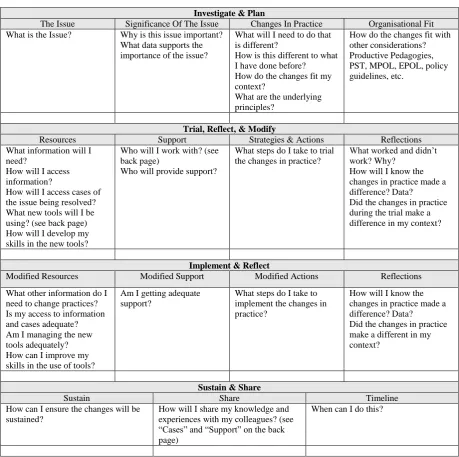
A professional development framework emerged in a project to support teachers and school administrators in the classroom implementation of ePortfolios. The framework is a checklist of questions to guide the design, evaluation, and sustaining of a constructivist learning
Certification of Dissertation
I certify that the ideas, analyses and conclusions reported in this dissertation are entirely my own effort, except where otherwise acknowledged. I also certify that the work is original and has not been previously submitted for any other award, except where otherwise acknowledged.
____________________________ ___________
Signature of Candidate Date
Endorsement
____________________________ ___________
Signature of Supervisor Date
Acknowledgements
Sincere thanks to my supervisor, Associate Professor Peter Albion. Besides providing timely advice, Peter helped make the journey to be meaningful and worthwhile. He encouraged me to publish my work in a book chapter, to be involved in the delivery of relevant tertiary courses, and to serve on the editorial board of the AACE journals. Peter‟s contacts and networking skills opened a new world of sharing and learning. This is the second doctoral dissertation that Peter has supervised for me, and I have enjoyed our conversations over the past eleven years.
I would also like to thank my associate supervisor, Dr Shirley Reushle, and Dr Henriette van Rensburg for reading the final drafts. I acknowledge and thank the Dean and members of the Faculty of Education, University of Southern Queensland for their encouragement.
I acknowledge and thank the many participants involved in the professional development projects reported in this study. The enthusiasm and commitment of these teachers and school administrators was energising, and their willingness to learn, experiment, and share their perceptions and achievements is evident throughout the dissertation.
I thank my wife, Joanne, for her patience, understanding, and support throughout the project. Thanks also to our parents and to our children, Ben, Elizabeth, Daniel, David, and Rebecca, who each contributed in their own way.
Dedication
In memory of my son Andrew Thomas Otto,
Table of Contents
CHAPTER 1: BACKGROUND TO THE RESEARCH PROBLEM ... 1
1.1 Professional Development for Technology Integration ... 1
1.2 Issue #1: What Constitutes Quality Professional Development? ... 3
1.2.1 Sustained and Rigorous with On-going Support ... 4
1.2.2 Promotes Collaboration ... 5
1.2.3 Meets Teacher Needs in a Specific Context ... 5
1.2.4 Supported by Supervisors ... 6
1.2.5 Multiplicity of Effects ... 7
1.3 Issue #2: Changing Teaching Practices and Improving Student Learning ... 7
1.3.1 Exemplary Teaching with Technology ... 8
1.3.1.1 Definition of knowledge ... 8
1.3.1.2 Traditional and constructivist-compatible approaches to teaching ... 9
1.3.2 Reconciling Constructivist and Objectivist Methods ... 10
1.3.3 Implications for Professional Development for Technology Integration ... 11
1.3.4 Student Outcomes ... 13
1.3.5 Measuring Change... 13
1.4 Issue #3: Changing Teachers’ Beliefs ... 14
1.4.1 Definition of Beliefs ... 15
1.4.2 Beliefs about Teaching ... 15
1.4.3 Teaching as an Ill-Structured Domain ... 16
1.4.4 Changing Teachers‟ Beliefs ... 18
1.4.5 Beliefs, Principles, and Practices ... 19
1.4.6 Self-Efficacy ... 19
1.4.7 Previous Study of Beliefs about Teaching with ICTs ... 20
1.5 Towards a New Approach ... 21
1.5.1 Constructivist Learning Environments ... 22
1.5.2 An ePortfolio Professional Development Project ... 23
1.6 The Investigation ... 23
1.6.1 Research Questions ... 24
1.6.2 Objectives of the Study ... 24
CHAPTER 2: LITERATURE REVIEW ... 25
2.1 Instructional-Design Theory ... 26
2.2 Constructivist Learning Environments ... 26
2.3 Instructional Design of the Project ... 28
2.3.1 Needs and Task Analysis ... 30
2.4 The Issue ... 31
2.4.1 ePortfolios ... 31
2.4.2 ePortfolios Defined ... 32
2.4.3 Old and New Pedagogies ... 33
2.4.4 Levels of Change in Teaching Practices ... 37
2.4.5 ePortfolios as a Continuum ... 39
2.4.6 ePortfolio Stages of Development ... 41
2.4.7 Authentic Pedagogy ... 44
2.4.8 Authentic Assessment ... 45
2.4.9 Computer Literacy and Computer Awareness... 47
2.4.10 Information Literacy ... 48
2.4.11 Multiple Intelligences ... 49
2.4.12 Content of ePortfolios ... 50
2.4.13 Hardware ... 51
2.4.14 Software ... 52
2.4.15 Evaluating ePortfolios ... 53
2.4.16 Issues with ePortfolios ... 54
2.4.17 Implementing ePortfolios ... 55
2.6 Performance Environment ... 57
2.6.1 Outcomes Approach to Education ... 57
2.6.2 The Queensland Curriculum ... 58
2.6.3 Essential Learnings ... 59
2.7 Community of Practice ... 60
2.7.1 Characteristics of Experts or Professionals ... 60
2.7.1.1 Innovativeness and openness to change ... 61
2.7.1.2 Motivation and self-regulation ... 61
2.7.1.3 Types of professional knowledge ... 63
2.7.2 The Role of School Administrators ... 63
2.7.2.1 Development and communication of a vision ... 64
2.7.2.2 Modelling the use of technology ... 64
2.7.2.3 Modelling the teaching of technology ... 65
2.7.2.4 Planning and implementation of policy... 65
2.7.2.5 Managing resources ... 65
2.7.2.6 Staff development ... 66
2.7.3 The Beliefs of Administrators ... 67
2.8 Representation of the Issue ... 67
2.9 Issue Manipulation Space ... 68
2.9.1 Metacognition and Reflection ... 68
2.10 Related Cases ... 70
2.10.1 Story ... 70
2.10.1.1 Stories in the workplace ... 71
2.10.2 Cases ... 72
2.10.3 A Case Library ... 73
2.10.4 Case-Based Reasoning ... 74
2.10.4.1 Case-based Reasoning in Education... 75
2.11 Information Resources ... 76
2.12 Tools ... 77
2.12.1 Cognitive Apprenticeship ... 78
2.13 Social and Contextual Support ... 79
2.14 Goals in the Experienced Cognition Framework ... 80
2.15 Similar Projects ... 81
2.16 Summary ... 82
CHAPTER 3: RESEARCH QUESTIONS AND METHODS ... 84
3.1 Research Questions ... 84
3.2 Research Plan for the Study ... 85
3.2.1 Similar Studies using the Learning Centred Evaluation Framework (LCEF) ... 86
3.3 Methodology ... 87
3.3.1 The Researcher as Participant ... 90
3.4 Data Collection ... 91
3.4.1 Instrumentation Description ... 92
3.4.2 Population and Sample ... 94
3.4.3 Data Collection Procedures ... 95
3.4.3.1 Surveys ... 96
3.4.3.2 Presentations and ePortfolios ... 96
3.4.3.3 Interviews ... 96
3.4.3.4 Online interactions ... 97
3.4.3.5 Documents ... 98
3.5 Data Analysis ... 98
3.5.1 Coding of the Data ... 100
3.5.2 Selection and Organization of Data ... 100
3.6 Controls for Threats to Internal Validity ... 102
3.7 Controls for Threats to External Validity ... 103
3.9 Summary ... 104
CHAPTER 4: RESULTS... 106
4.1 The Professional Development Framework ... 106
4.2 The ePortfolio Project... 108
4.3 ePortfolio Project Phase 1: Investigate and Plan Activities ... 108
4.3.1 The Issue ... 109
4.3.1.1 What is the issue? ... 110
4.3.1.2 Why is this issue important? ... 110
4.3.1.3 What data supports the importance of the issue? ... 112
4.3.2 The Changes ... 112
4.3.2.1 What are the new practices? ... 112
4.3.2.2 How are the new practices different from old practices? ... 113
4.3.2.3 How do the new practices fit the context? ... 113
4.3.3 The Learners ... 115
4.3.3.1 Who are the learners? ... 116
4.3.3.2 What beliefs do the learners hold? ... 116
4.3.3.3 What skills and experiences do the learners have and need? ... 118
4.3.4 Engaging the Learners ... 119
4.3.4.1 What is so compelling about the issue? ... 119
4.3.4.2 How will the learner be encouraged to engage with the issue? ... 119
4.3.4.3 How will learner engagement be sustained? ... 119
4.3.5 The Context of the Professional Development ... 119
4.3.5.1 Where will the learning take place? ... 120
4.3.5.2 What are the impacts of the learners‟ work places? ... 121
4.3.6 Related Cases ... 121
4.3.6.1 Woodcrest State College... 121
4.3.6.2 Pozieres State Primary School ... 122
4.3.6.3 Gatton State Primary School ... 122
4.3.6.4 Crow‟s Nest State P-10 School ... 123
4.3.6.5 Clifford Park Special School ... 123
4.3.6.6 Helidon State Primary School ... 124
4.3.6.7 Wilsonton State Primary School ... 124
4.3.6.8 Glenvale State Primary School ... 125
4.3.6.9 Centenary Heights State High School ... 125
4.3.6.10 Withcott State Primary School ... 126
4.3.6.11 How will learners access similar cases? ... 127
4.3.6.12 How will learners be encouraged to use Case-Based Reasoning? ... 127
4.3.6.13 How will the new cases be recorded, stored, and accessed? ... 127
4.3.7 Information Resources ... 128
4.3.7.1 What information will learners need? ... 128
4.3.7.2 How will learners access information? ... 129
4.3.7.3 What support will learners need to understand the information? ... 130
4.3.8 Tools ... 130
4.3.8.1 What physical tools will learners use? ... 130
4.3.8.2 How will learners develop skills in these tools? ... 132
4.3.8.3 What thinking tools will learners use? ... 132
4.3.8.4 How will learners develop skills in these tools? ... 132
4.3.8.5 What communication tools will learners use? ... 132
4.3.8.6 How will learners develop skills in these tools? ... 133
4.3.9 Social and Contextual Support ... 133
4.3.9.1 What factors will impact on implementation? ... 134
4.3.9.2 What support will learners need?... 134
4.3.9.3 Who will provide learner support? ... 134
4.3.10 Activity Planning... 134
4.4 ePortfolio Project Phase 2: Trial, Reflect, and Modify ... 135
4.4.1 Is the assessment of activities workable? ... 137
4.4.2 Are the activities workable and what changes need to be made? ... 137
4.4.2.1 Workshop sessions (after school and whole day) ... 138
4.4.2.2 Workshop evaluations ... 139
4.4.2.4 The Learning Place Project Room ... 143
4.4.2.5 All-in-One Sessions on ePortfolios ... 143
4.4.2.6 ePortfolio Playground ... 145
4.4.3 Will the activities achieve the desired learning outcomes?... 146
4.4.4 Is the assessment of learning outcomes workable? ... 146
4.4.5 Will the learning outcomes have the desired effect on practices? ... 146
4.5 ePortfolio Project Phase 3: Implement and Reflect ... 146
4.5.1 How effective was the project in changing practices? ... 146
4.5.2 How efficient was the project in changing practices? ... 148
4.5.3 What are the recommendations for planners of similar projects? ... 149
4.6 ePortfolio Project Phase 4: Sustain and Monitor ... 150
4.6.1 What needs to happen to sustain learning? ... 150
4.6.2 What needs to happen to sustain changes in practices? ... 150
4.6.3 What were the benefits to the organization? ... 151
4.7 Refining the Professional Development Framework ... 152
4.8 Success for BoysProject ... 153
4.8.1 The Issue ... 153
4.8.1.1 Design of the professional development ... 154
4.8.1.2 The context of the professional development ... 154
4.8.1.3 The changes... 155
4.8.1.4 The learners ... 156
4.8.2 Related Cases ... 156
4.8.3 Information Resources ... 157
4.8.4 Tools ... 157
4.8.5 Social and Contextual Support ... 157
4.8.6 Planning for School Projects... 158
4.8.7 Effectiveness of the Project ... 159
4.9 ICTs in Mathematics Project ... 160
4.10 Regional Professional Development ... 161
4.11 Summary ... 162
CHAPTER 5: CONCLUSIONS... 163
5.1 Research Question One ... 164
5.1.1 Issues with the Professional Development Framework ... 167
5.2 Research Question Two ... 168
5.3 Research Question Three ... 169
5.4 Conclusions about the Topics of the Projects ... 170
5.4.1 ePortfolios ... 171
5.4.2 Success for Boys ... 171
5.4.3 ICTs for Mathematics ... 172
5.5 Principles of Effective Professional Development ... 172
5.5.1 Principle 1: Content is Integrated with other Initiatives and Practices. ... 173
5.5.2 Principle 2: The Approach is Systematic ... 173
5.5.3 Principle 3: Teachers become Researchers ... 173
5.5.4 Principle 4: Teachers become Learners ... 174
5.5.5 Principle 5: Beliefs are Challenged... 175
5.5.6 Principle 6: The Focus is on Pedagogy ... 175
5.5.7 Principle 7: Learning is Contextualized ... 176
5.5.8 Principle 8: Learning Involves the Community of Practice ... 176
5.5.9 Principle 9: Technology is used ... 176
5.5.10 Principle 10: Learning is Undertaken in a Supportive School Culture ... 176
5.6 Features of the Research ... 177
5.6.1 The Researcher as Participant ... 177
5.6.2 Limitations of the Study ... 178
5.6.3 Significance of the Study ... 178
5.6.4 Implications for Leadership ... 178
5.6.5 Further Studies ... 179
References... 180
Appendix A: Sources of New Information to Confront Principals’ Beliefs ... 194
Appendix B: Professional Development Framework... 195
Appendix C: ePortfolio Project Instruments ... 202
Appendix D: ePortfolio Project Activities ... 205
Appendix E: ePortfolio Project Information Resources ... 250
Appendix F: ePortfolio Project Cases ... 271
Appendix G: Success for Boys Project ... 305
Appendix H: ICTs in Mathematics Project ... 316
Appendix I: Regional Professional Development Projects ... 319
List of Figures
Figure 1.1: Relationship between Professional Development and Improvements in Student Learning ... 3Figure 1.2: A Model of Teacher Change ... 3
Figure 2.1: Overview of the Project ... 30
Figure 2.2: The Case-Based Reasoning Cycle ... 74
Figure 3.1: The Complex Features of Design Experiment ... 88
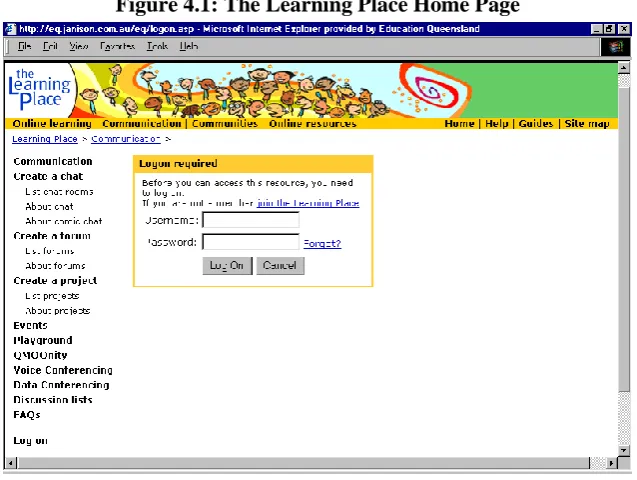
Figure 4.1: The Learning Place Home Page ... 129
Figure E.1: Opening page of HP Scanning software ... 259
Figure E.2: Preview page of HP Scanning Software ... 259
Figure E.3: Editable Text Options in HP Software ... 260
Figure E.4: Photos as they appear in thumbnail view in Windows Explorer ... 260
Figure E.5: Capture Screen in VideoStudio ... 261
Figure E.6: Edit Screen in VideoStudio ... 261
Figure E.7: Share Screen in VideoStudio ... 261
Figure E.8: Opening page in PowerPoint ... 263
Figure E.9: Working page in PowerPoint ... 263
Figure E.10: Extra Files Created in FrontPage ... 264
Figure F.1: Pozieres State Primary School Sample ePortfolio ... 275
Figure F.2: A Preschool ePortfolio ... 292
Figure F.3: A Year One ePortfolio ... 293
Figure F.4: A Year One ePortfolio ... 294
Figure F.5: A Year Two ePortfolio ... 295
Figure F.6: A Year Five ePortfolio ... 295
Figure F.7: FrontPage ePortfolio ... 298
Figure F.8: PowerPoint ePortfolio ... 298
Figure F.9: Personal Information and Samples of Work ... 299
List of Tables
Table 1.1: Preconditions for Success and Barriers ... 7
Table 1.2: Philosophy Index ... 9
Table 1.3: Fostering Knowledge Construction through Direct Instruction ... 11
Table 1.4: Well- and Ill-Structured Problems ... 16
Table 1.5: Principles of Learning in Complex and Ill-Structured Domains ... 17
Table 1.6: Implications for the Design of Situated Learning Environments ... 22
Table 2.1: Elements of a Constructivist Learning Environment ... 29
Table 2.2: Technology Supported Portfolios ... 32
Table 2.3: Views of Knowledge in Old and New Pedagogies ... 34
Table 2.4: Attributes of Traditional and Integrated Classroom Environments ... 35
Table 2.5: Instruction Types ... 35
Table 2.6: Level of Technology implementation (LoTi) ... 37
Table 2.7: Levels of Instructional Practices ... 38
Table 2.8: Changes in Instructional Strategies ... 39
Table 2.9: Positivist and Constructivist ePortfolios ... 40
Table 2.10: Deep Learning versus Surface Learning ... 41
Table 2.11: Levels of ePortfolio Implementation ... 41
Table 2.12: Developmental Stages of ePortfolios Designed with Generic Tools ... 42
Table 2.13: Portfolio and Multimedia Development ... 43
Table 2.14: Stages of ePortfolio Development ... 43
Table 2.15: Approaches to Learning ... 45
Table 2.16: ePortfolios to Support Assessment of and for Learning ... 46
Table 2.17: Levels of Technology Skills Required ... 47
Table 2.18: Multimedia Contribution to Gardener‟s Multiple Intelligences Theory ... 49
Table 2.19: Types of Evidence in ePortfolios ... 50
Table 2.20: Pedagogical Requirements of Paper-Based and Electronic Portfolios ... 51
Table 2.21: Applications of Software for ePortfolios... 53
Table 2.22: Levels of ePortfolio Software ... 53
Table 2.23: Evaluating ePortfolios ... 54
Table 2.24: Just Plain Folks, Student, and Practitioner Activity ... 56
Table 2.25: From Input-Driven to Outcome-Based Programs ... 58
Table 2.26: Types of Professional Knowledge... 63
Table 3.1: Evaluation Model ... 87
Table 3.2: Six Steps in the Analysis of Data ... 98
Table 3.3: Indexing Stories ... 102
Table 4.1: Phases of the Professional Development Framework ... 107
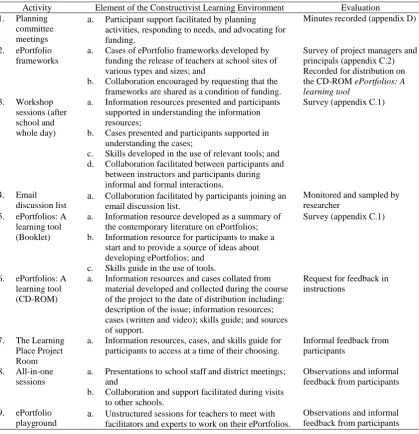
Table 4.2: Activities for Each Element of the Constructivist Learning Environment ... 109
Table 4.3: ePortfolios and System Imperatives ... 110
Table 4.4: Education Queensland ICT Pedagogical Framework ... 114
Table 4.5: Hardware ... 131
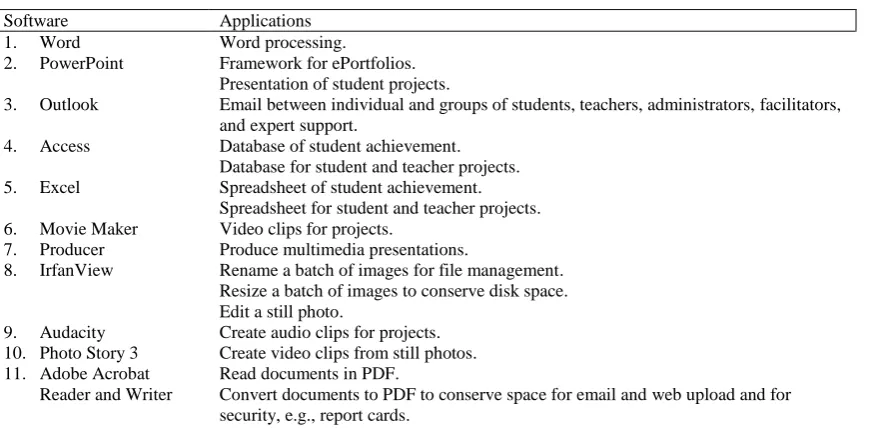
Table 4.6: Software ... 131
Table 4.7: Structure and Contents of the CD-ROM ... 142
Table 4.8: Success for Boys Resources ... 157
Table 4.9: Ten Principles of Effective Professional Development ... 161
Table A.1: Sources of New Information to Confront Principals‟ Beliefs ... 194
Table B.1: Facilitators Action Plan ... 195
Table B.2: Participant Action Plan ... 199
Table C.1: Workshop Survey ... 202
Table D.1: List of Named Participants ... 206
Table D.2: Workshop Evaluation Summary (October, 2004) ... 215
Table D.3: Workshop Evaluation Summary (February, 2005)... 230
Table D.4: Workshop Evaluation Summary (March, 2005)... 232
Table D.5: Workshop Evaluation Summary (April, 2005) ... 235
Table D.6: Workshop Evaluation Summary (August, 2005) ... 240
Table D.7: Workshop Evaluation Summary (October, 2005) ... 242
Table D.8: Funding Distribution ... 242
Table D.9: All-in-one Session Presentation ... 244
Table D.10: Darling Downs-South West Education Region Training Program ... 248
Table E.1: Philosophy Index ... 253
Table E.3: Positivist and Constructivist ePortfolios ... 255
Table E.4: Deep Learning versus Surface Learning ... 256
Table E.5: Portfolios to Support Assessment “of” and “for” Learning ... 256
Table E.6: Multimedia Contribution to Gardener‟s Multiple Intelligences Theory ... 257
Table E.7: Types of Evidence in ePortfolios ... 258
Table E.8: Requirements of Portfolios ... 259
Table E.9: Applications of Software for ePortfolios ... 262
Table E.10: Levels of ePortfolio Software ... 263
Table E.11: Levels of Portfolio Implementation ... 264
Table E.12: Developmental Stages of ePortfolios ... 265
Table E.13: Portfolio and Multimedia Development ... 266
Table E.14: Stages of ePortfolio Development ... 266
Table E.15: Evaluating ePortfolios ... 267
Table E.16: Structure and Content of the CD-ROM ... 269
Table F.1: Preschool Developmental Profile ... 293
Table G.1: Importance of Improving Boys‟ Success ... 310
Table G.2: Evaluation of the Plan of Action ... 311
Table G.3: Attendance at Elective Modules ... 312
Table G.4: Evaluation of the Workshop Presentations ... 312
Table G.5: Evaluation of the Workshop Venues and Meals ... 312
Chapter 1: Background to the Research Problem
Computers, digital cameras, printers, data projectors, the Internet, email, and Microsoft Word are common place in homes, and Global Positioning Systems (GPS) are a popular accessory in motor vehicles. Mass production and market competition has reduced the price of these technologies to fall within the budgets of the average family home, e.g., the Australian Bureau of Statistics (2008) reports that household ownership of computers has increased from 29% in 1998 to 73% in 2006-07. During the same period household access to the Internet has increased from 16% to 64%. The Queensland School Technologies Director says “most students have been immersed in technology since birth and are adept at using it, even before they start school” (Education Views, 2008, p. 16). Governments recognise that schools need access to the new technologies. The Queensland School Technologies Director goes on to say “computers are an integral tool of the trade for teachers. They help to engage with students and connect on a local, national and global level with other students and teaching professionals” (Education Views, 2008, p.16). Queensland schools are networked and teachers and students have access to the Internet, email, and data storage, and receive an annual Information and Communication Technology (ICT) grant. The Queensland Department of Education, Training and the Arts (DETA) maintains an online service for students and teachers called The Learning Place, which provides an access point for teaching resources and allows classroom teachers to set up online courses and project rooms for their students. Investment in these resources is on a large scale, e.g., the Queensland government has undertaken a $A70 million project over three years to provide all teachers with a laptop. The size of this project can be appreciated when it is reported that 13 400 laptops have already been disbursed, representing a little more than a quarter of the state‟s teachers (Education Views, 2008).
Such a large investment in technology and expectations about the impact of technology on teaching and learning requires assurances that technology is used effectively in the classroom (Guskey, 2000). Issues relating to the effective use of technology in schools concern the provision of resources and infrastructure, equitable student access, and the preparation of future teachers in teaching with technology (Lawless & Pellegrino, 2007). However, it is the issue of “retraining the current teaching workforce in the use of technology-based instructional tactics,” (Lawless & Pellegrino, 2007, p. 576) that is of particular interest to this study.
Retraining teachers is problematic in a number of ways. First, the range of technologies that can be used in the classroom may be overwhelming. Second, technology can be integrated in various ways, some more efficiently and effectively than others (Lawless & Pellegrino, 2007). Therefore, it cannot be assumed that just because a teacher is using technology, student
outcomes are being enhanced. Third, only the youngest of teachers would “have been immersed in technology since birth and [be] adept at using it” (Education Views, 2008, p. 16). Issues with integration can be addressed only if teachers are skilled and confident in using technology and their knowledge of what can be achieved with technology has been developed. Ropp (1998) says “for some teachers, the gap between their perceived technology competence and learning to use computers in their teaching is often threatening and overwhelming” (p. 894). These are only a few of the problems associated with professional development for technology integration, and further issues will be described in this chapter.
1.1 Professional Development for Technology Integration
The Technology in Schools Taskforce (2003) provides the following definitions. Professional development for technology integration refers to “learning activities of all kinds for school staff that prepare them to use technology in the school setting” (chap. 6, para. 6). This type of professional development “is an ongoing process that cannot be satisfied with one-time training in a particular technology” (chap. 6, para. 7), and activities may include:
1. familiarization with the operation of equipment and software;
3. the application of software and applications for the management of school activities, whether instructional or administrative; and
4. the integration of technology into teaching, learning, and administrative processes (chap. 6, para. 6).
School staff includes administrators, teachers, and administrative and support staff. Technology integration describes the use of ICTs and other technologies to support teaching and learning and is defined as “the incorporation of technology resourcesand technology-based practices into the daily routines, work,and management of schools” (chap. 7, para. 3). The resources that are used in technology integration include “computersand specialized software, network-based communication systems,and other equipment and infrastructure” (chap. 7, para. 3). Teaching practices associated with technology integration “include collaborativework and
communication, Internet-based research, remote accessto instrumentation, network-based transmission and retrievalof data, and other methods” (chap. 7, para. 3).
While one aspect of professional development for technology integration is to familiarize teachers with technology, according to a report commissioned by the Department of Education, Science, and Training (DEST) (2001), the primary goal is to support a “change process that deals with the full range of impediments to and facilitators of student and teacher learning” (p. 19) Lawless and Pellegrino (2007) agree:
Technology is often poorly integrated with other classroominstructional activities. Word processing and basic-skills practiceare the most frequent uses of computers in
instruction, whereasthe use of applications that engage analytical thinking andproblem solving through simulations and other media is relativelyinfrequent (p. 580).
Figure 1.1: Relationship between Professional Development and Improvements in Student Learning
(Guskey, 2000, p. 73)
The model of teacher change in Figure 1.2 goes one step further. This model suggests that if teachers participate in quality professional development and change their teaching practices, they will observe changes in student learning which in turn will change their attitudes and beliefs about teaching (Guskey, 2000).
Figure 1.2: A Model of Teacher Change
(Guskey, 2000, p. 139)
Each of the elements within Figure 1.2 raises issues that will be discussed in this chapter. That is, what constitutes quality professional development, what is exemplary classroom practice using technology and how is it measured, what are enhanced student outcomes and how are they measured, and how can teachers‟ attitudes, beliefs, and practices be changed?
1.2 Issue #1: What Constitutes Quality Professional Development?
Guskey (2000) notes in Figure 1.1 that it is not just professional development but the quality of professional development that contributes to teacher knowledge and practice and improved student learning outcomes. The design and facilitation of quality professional development for technology integration is a complex issue with multiple factors to be considered and addressed. Three principal references contribute to an investigation of this issue. First, a literature review undertaken by Lawless and Pellegrino (2007) summarizes what is known and not known about professional development for technology integration. Lawless and Pellegrino (2007) conclude “there are many principles offered, but the existing empirical evidence to support them is generally weak” (p. 577). Second, Williams (2005) presents a commissioned report on the models of professional development applied in projects in 2004 and 2005 funded by thePROFESSIONAL DEVELOPMENT
Change in CLASSROOM
PRACTICES
Change in STUDENT LEARNING
Change to TEACHERS‟ ATTITUDES &
Australian Government Quality Teacher Programme, with a focus on action learning. The pre-conditions for success and barriers to successful professional development listed by Williams (2005) demonstrate the complexity of the issue (see section 1.2.5). Williams (2005) concludes that while action learning is a simple concept it is difficult to sustain. Third, DEST (2001) funded a report (a) to measure the effectiveness of professional development for technology integration in terms of student and teacher outcomes; (b) to identify the various models applied; and (c) to list barriers and factors contributing to success. This report reaches the same
conclusion that “teacher development is a complex matter” (p. 3). The report suggests:
There is much evidence that traditional forms of professional development are not really effective in creating improvements in student learning . . . [and] the very nature of the teaching profession as being practice „behind closed doors‟ mitigates against moves to school-based collaborative teacher development (p. 3).
Professional development for technology integration therefore involves more than designing efficient programs for teachers to access information and improve their skills. Teacher resistance has to be addressed and teachers need to agree to be active participants (Williams, 2005). Cuban (1993) notes the “paradox of teachers being both the problem and the solution” (p. 274) and highlights the importance of teachers being central to any process of change. This is particularly relevant when the type of professional development required is “grounded in inquiry, reflection, and experimentation” (DEST, 2001, p. 19), which can only be achieved if teachers take responsibility for exploring the solutions to the problems in their domain. This type of professional development can be characterised as “participant-driven” (DEST, 2001, p. 19). Governments and central education authorities may coerce teachers to participate in professional development by applying “incentives and sanctions” (Cuban, 1993, p. 274), but this approach will never reach the level of commitment of teachers who are motivated to participate by their own recognition of the potential of technology.
1.2.1 Sustained and Rigorous with On-going Support
Quality professional development programs are sustained over an extended period of time (DEST, 2001). It takes time for teachers to become familiar with the technology they intend to use in the classroom. While reference to written guides may be a useful tool during the
development of skills and knowledge, the aim must always be to develop teachers‟ confidence so they can independently solve problems. Confidence can only be achieved with practice over time and in meaningful ways (Lawless & Pellegrino, 2007). A new set of issues arises when the teacher introduces the technology in the classroom. The teacher will need to simultaneously manage student behaviour, activity, and access to the technology, work to a curriculum, set up and manage not just their own computer but a room full of computers, and demonstrate their own perhaps limited technology skills. This period of experimentation will need to take place before the teacher can begin to consider the effectiveness of teaching practices and reflect on how those practices may be improved (King & Newman, 2001). The on-going support and follow up processes in a professional development program during this classroom
implementation process is critical (Williams, 2005).
Besides being sustained, professional development programs need to be rigorous and intensive (DEST, 2001). Working on a particular application once a week, for example, will never achieve the level of familiarity and competence that is required by a teacher who intends to use that application in the classroom. Quality professional development programs therefore require well established infrastructures “to promote and sustain teacher learning and instructional improvement over the long term in order to generate organisational changes and sustain teacher change” (DEST, 2001, p. 19). This is not always easy to achieve, and there are many reasons for failure either real or perceived. Teachers and mentors change schools, they lose interest, they are busy people and have other priorities, it all becomes too difficult and unmanageable, they may not have the resources to make the changes they want to make, and early failures and a lack of confidence may build resistance.
process. This may require “rethinking the work and working conditions of teachers, and their professional roles and responsibilities” (DEST, 2001, p. 19). For example, funds may be needed to pay for the teacher to be released from their normal classroom duties.
A sustained professional development program that provides teachers with feedback and support (King & Newman, 2001) demands a committed team that has a skilled manager and shared goals (Alexander & McKenzie, 1998). The teachers will also need access to the required hardware and software and on-going technical support (Alexander & McKenzie, 1998). The type of support and feedback that is most useful “integrates theory, models practice in situ and encourages teachers to move out of their comfort zones or improves the level of sophistication in thinking” (Williams, 2005, p. 40). These elements of a quality professional development program may cost money beyond the capacity of an individual school to provide (Alexander & McKenzie, 1998).
1.2.2 Promotes Collaboration
Quality professional development should “promotepeer collaboration and community building” (Lawless & Pellegrino, 2007, p. 579), “both within and outside their schools” (King &
Newman, 2001, p. 86). Collaboration and conversation needs to occur at a deep level, and there are a number of ways this can be achieved. Teachers may “host professional conversations, pose questions, mentor peers and participate in professional exchanges using protocols and similar activities” (Williams, 2005, p. 14). These strategies facilitate the sharing of knowledge (DEST, 2001). As well, “groups can solve more interesting and complex problems than an individual working alone. [Learners] working in groups need to articulate designs, critiques, and arguments to other group members, encouraging the kind of reflection that leads to learning” (Guzdial et al., 1996, p. 43). Collaboration needs to be both synchronous to support planning and brainstorming and asynchronous to support reflection and sharing of achievements and knowledge. Another important aspect of collaboration is the review of student work, which can generate high levels of professional dialogue and deprivatise practice (Williams, 2005). The “teacher talk” generated when discussing students‟ work may be a starting point for more open discussions about individual practices.
1.2.3 Meets Teacher Needs in a Specific Context
Quality professional development programs allow teachers to influence the content and process of the program so that it meets their particular needs (King & Newman, 2001). The program designer, leader, and facilitators need to understand teachers as learners and the generic and specific context in which they work, and incorporate a mechanism to respond to teacher sensitivities, feedback, and requests. “Modelling new „pedagogies‟ in non-specific and decontextualised ways has been demonstrated not to work” (DEST, 2001, p. 20). A context specific program contributes to the meaningfulness and relevance of activities so that teachers can more easily translate new learning into change (Lawless & Pellegrino, 2007). Furthermore, theoretical understanding and skills can be “connected to and derived from teachers‟ work with their students” (DEST, 2001, p. 20).
Phelps, Graham, and Kerr (2004) say:
Learning to use computers involves learning to adapt to change, to be flexible, intuitive and above all persistent, and learners who know how to be self directed and independent will be more successful than those dependent on structured routines or guidelines (p. 51).
While developing teacher skills may be an objective, this must be balanced with a need to focus “on teachers‟ approaches to learning, their beliefs, attitudes and metacognitive understandings” (Phelps et al., 2004, p. 51). In order to sustain their learning and experimentation, teachers need to develop as confident and empowered learners to “come to terms with the nature of
improvement (Esson, Johnson, & Vinson, 2002). Professional development programs therefore need to increase in sophistication from the development of skills to intellectual development and teacher leadership (DEST, 2001). At the same time, though, the anticipated outcomes of a program need to be realistic and within the scope of the facilitators to deliver and within the capacity of the teacher to achieve (Alexander & McKenzie, 1998).
Knowledge about teachers as learners will influence “the nature of engagement” (Williams, 2005, p. 40). For example, if teachers are to be encouraged to take an active role in their
learning, it will not be sufficient for them to create a lesson plan as an exemplar, unless that plan is implemented and becomes the focus of peer reflection (Heath, 2000, p. 653). This extension to the activity is not simple because it involves the deprivatising of practice and therefore requires the willingness of the teacher to participate. Supporting peers by reflecting with them about a lesson demands sensitivity and respect, and a mutual feeling of contributing to a life long learning journey (Williams, 2005).
A one-shot workshop is a common engagement strategy that is useful for demonstrating
equipment andsoftware. Though helpful for some people (Heath, 2000), Lawless and Pellegrino (2007) conclude this type of activity is too fragmented and disconnected from classroom
activity to be particularly useful in technology integration. More effective programs “are spread out overtime with opportunities for follow-up learning and feedback”(Lawless & Pellegrino, 2007, p. 594). There is also a risk of “information overload” (Heath, 2000, p. 654) in a brief workshop or disengaging participants in a long or boring workshop.
Lawless and Pellegrino (2007) believe a coaching model can support teachers through a period of change, with benefits for both the mentors and mentees. This type of activity depends on the development of personal relationships, which may not suit everyone, and one-on-one coaching may not be efficient in bringing about widespread change. In the train-the-trainer model, teachers are trained and then return to their schools or districts to train other teachers. A trained teacher as a facilitator may be more credible to their peers and understand the context in which teachers function (Lawless & Pellegrino, 2007). These are some of the strategies available to program designers, each with advantages and disadvantages.
A variable characteristic of teachers as learners is the basis for their participation, e.g., as volunteers in their own time, as a school, district, or systemic expectation undertaken in their own time, or as an expectation taken in paid time. Lawless and Pellegrino (2007) conclude that volunteers and non-volunteers have different needs and differ “in terms of their motivationto learn, their commitment to change, and their willingnessto be risk takers” (p. 580). A
professional development program that is successful with volunteers as participants may be not as successful for non-volunteers.
1.2.4 Supported by Supervisors
Quality professional development programs are supported by supervisors, and the achievements of the teachers are recognised by the education system (Alexander & McKenzie, 1998).
Supervisors and the education system provide authority to the project that contributes to a positive school culture, rewards risk takers, injects support when the new practice becomes difficult, and respects and values the work that the teachers are doing (Williams, 2005). There are many practical ways in which districts can actively support a professional development program, such as:
1. run awareness-raising programs;
2. inject new ideas into school environments, so that messages [are] reliably and clearly conveyed (not second hand) and teachers have access to ideas from outside of their everyday sphere of influence;
3. host action learning leaders programs;
4. co-manage some action learning projects with schools; 5. assist in the evaluation and review of action learning;
7. promote a positive culture for professional learning amongst schools; and
8. design and facilitate celebration events and provide audiences for teacher learning (Williams, 2005, pp. 15-16).
1.2.5 Multiplicity of Effects
The elements and variables in a quality professional development program are extensive. Williams (2005) demonstrates the multiplicity of effects in Table 1.1 which lists the
preconditions and barriers contributing to the success or failure of action learning in a school setting. The learning sets referred to in the table are groups of teachers who are working together on a learning project.
Table 1.1: Preconditions for Success and Barriers
Preconditions For Success Barriers
Structure 1. Following through on the whole cycle;
2. Project leadership; 3. Strong project designs;
4. Public celebration as an end point; 5. Subject matter;
6. Effective set meetings; and 7. Celebration of learning.
1. Keeping learning sets meeting;
2. Failing to stick at it and complete cycles; 3. Helping others understand the pedagogy of action
learning & adult learning; 4. Sticking to Learning Set protocols;
5. Documentation processes - needing to make and record observation; and
6. Actually doing projects amidst growing behaviour management problems.
Settings 1. Student focus – student learning as a buy in;
2. Staff with necessary subject matter expertise; 3. Group support;
4. Administration team support; 5. Budget for resources; and 6. Time.
1. Facilitators needing more skills; 2. Teachers need communication skills; 3. Not enough support;
4. Time when other priorities surface; 5. Time as a leader to make it happen; 6. Lack of finances or resources;
7. Outside influences other people impose; and 8. Changeover of staff.
Attitude 1. Independence to choose focus;
2. Teacher interest;
3. Willingness to ask questions, be questioned and change practice;
4. Teachers willing to take responsibility for their learning;
5. Relationships in teams and common ground; 6. Culture of the school - supportive risk taking and
supporting innovation;
7. Teacher planning processes akin to action learning; and
8. Getting positive buy in from peers.
1. Blockers and negativity;
2. Teachers not taking responsibility for their learning; 3. Teacher readiness to participate in the process; 4. People don‟t want to share;
5. People want to be told prescriptive solutions; 6. School culture is negative;
7. School culture is too active, too many new things every year add too much professional development; and
8. Giving teachers confidence to share is difficult.
(Williams, 2005, pp. 53-55)
As previously discussed, technology integration as the topic for professional development compounds the complexity of the issues involved. Quality programs need to be well designed, managed by a committed leader and support team, have the support of districts and the
education system, attract funding, meet the needs of teachers and students, and be sustained and rigorous. Measuring the impact of a professional development program in terms of changes to teaching practices and enhanced student outcomes introduces a new set of problems and is the topic of Issue #2.
1.3 Issue #2: Changing Teaching Practices and Improving Student
Learning
Quality professional development programs for technology integration measure outcomes in terms of the gains in teacher knowledge and skills, the changes they have adopted in practice, and the impact of those changes on student achievement (Guskey, 2000). Therefore the intended outcomes of a program need to be articulated and documented, and evaluation strategies
development evaluations reportedin the literature” (p. 580). Again, the nature of teaching and the complexities of professional development for technology integration create issues that make the measure of outcomes problematic, as discussed later in the chapter.
1.3.1 Exemplary Teaching with Technology
Part of the difficulty in designing and evaluating a professional development program is the need to define what is meant by exemplary pedagogy that integrates technology (Ertmer, Gopalakrishnan, & Ross, 2000). Gage (1985) defines pedagogy as the science of the art of teaching. In describing what a teacher does as an art, Gage (1978) uses terms such as “intuition, creativity, improvisation and expressiveness” (p. 15). Effective and reflective teachers are similar to artists because they are not bound by strictly laid down rules or processes (Gage, 1978), and adjust their repertoire in the midst of action (Schmidt, 2000). Similarly, the
integration of technology “for many teachers . . . is something they tackle „on the run‟ - making it up as they go along, grabbing ideas where they can find them” (Lankshear, Snyder, & Green, 2000, p. 23). Good teaching, with or without technology, is about:
Knowing when and how to intervene to encourage pupil autonomy and contributions that influence the quality of the learning experience for both child and teacher. Knowing when to stand back in order to allow children time to work through uncertainty to solu-tions; knowing when to provide new information or skills to equip the children in their task; knowing when to ask a question to challenge or divert; knowing how to balance guidance and sharing of expertise with providing opportunities for children to think and work things out for themselves - such knowledge implies „intelligent action‟ on behalf of the teacher. It is this intelligent action that lies at the heart of effective teaching skills, and which reflective teachers develop throughout their teaching careers (Loveless, 1995, pp. 150-151).
The difficulty in defining and measuring exemplary pedagogy that integrates technology can therefore be attributed to the intuitive and creative nature of teaching. Interactions with children are unpredictable and the teacher is continually adjusting and responding to the context. This “intelligent action” (Loveless, 1995, p. 151) by teachers creates innumerable variables.
1.3.1.1 Definition of knowledge
Technology facilitates different teaching approaches, “shifting the management and control of the activity to the children and computer, [and] varying the nature of the interventions according to the technical experience and cognitive needs of the children” (Loveless, 1995, pp. 150-151). Teachers using technology in the classroom may take on different roles other than the traditional didactic instructor, including that of “demonstrator, project manager, consultant, resource provider, questioner, explicator, observer, model learner and co-learner” (Loveless, DeVoogd, & Bohlin, 2001, p. 68).
To investigate why technology can facilitate different teaching approaches it is necessary to understand opposing definitions of knowledge at the foundation of “two approaches to teaching that represent different and somewhat incompatible models of good pedagogy” (Ravitz, Becker, & Wong, 2000, p. 3). In the first approach to teaching, knowledge is perceived as a “static, impersonal and unchanging entity” (Loveless et al., 2001, p. 74) that exists independent of a learner. A teacher holding this view is likely to perceive the purpose of teaching as helping children understand and retain “fundamental truths” (Tucker & Batchelder, 2000, p. 2467). Approaches to teaching associated with this view are the traditional transmission instruction theories of learning that suggest children learn most effectively by answering questions relating to teacher or text explanations, and children develop skills by practising sequential skills (Ravitz et al., 2000).
In the second approach to teaching, Tucker and Batchelder (2000) explain that knowledge is perceived as being constructed by learners and existing within learners, growing and changing as new understandings develop from prior knowledge. According to the constructivist
learning as an “active rather than passive” (p. 2469) process requiring “higher order or critical thinking skills” (p. 2467). Approaches to teaching associated with this view suggest children develop new understanding by relating new ideas to prior understanding and develop new skills as required while solving concrete problems. Brooks and Brooks (1999) are mindful that “constructivism is not a theory about teaching, but is a theory of learning that describes the central role that learners‟ ever-transforming mental schemes play in their cognitive growth” (p. 18). It is the principles that emanate from the constructivist perspective that informs educational practice. Cunningham (1992) summarizes the constructivist perspective by saying “there is so much knowledge in the world it would be impossible to teach them everything, in any event. What we are after is showing [learners] how to construct plausible interpretations of their own, using the tools that we have provided” (p. 41).
1.3.1.2 Traditional and constructivist-compatible approaches to teaching
Besides differing in perceptions of knowledge and ways to manage knowledge, traditional and constructivist-compatible approaches to teaching differ in the roles of teachers and learners (Ravitz et al., 2000). In traditional approaches, teachers plan activities around subject content. Independent work, for example homework, also reflects subject content and is designed to be efficient and to be completed with minimum errors. That is, children work through exercises to practise concepts taught by direct instruction. Approaches to teaching associated with
constructivist-compatible theories of learning base content on children‟s “interests, prior experiences, and current understandings” (Ravitz et al., 2000, p. 4), and these will vary from child to child. The teacher facilitates child directed effort, and mistakes, rather than being an indicator of a lack of understanding, are embraced as a motivator for engagement. Another difference lies in the “social structures for learning. Debates between students, cooperative group projects, and other activities involving the articulation of students‟ own ideas in concrete contexts are valued by constructivists” (Ravitz et al., 2000, p. 4). Becker (1998) illustrates these fundamental differences in Table 1.2.
Table 1.2: Philosophy Index
Constructivist Philosophy Traditional Philosophy 1. Knowledge is built through class and group
discussions;
1. Teachers describe and explain concepts, and students learn this content;
2. Students need to find answers to their own questions and problems;
2. A quiet classroom is important for learning;
3. Students construct concepts for themselves; 3. Acquiring basic content knowledge and skill [is] primary;
4. “Sense-making” and guided inquiry; 4. Teacher - not students - determine activities; 5. Authentic, integrated tasks; and 5. Instruction is built around problems with clear,
easily found, correct answers; and
6. Diverse classroom projects. 6. Teaching facts and skills provides the foundation for later learning.
(Becker, 1998, p. 17)
Jonassen and Land (2000) further explain that the traditional philosophy of instruction is based on the following premises:
1. Knowledge is transmitted from teachers (or technologies) to learners; 2. Instruction is based on a communications model of instruction;
3. Improving learning is a matter of more effectively communicating ideas to learners by improving the clarity of the message;
4. Teaching is a process of conveying ideas to students; and
5. Knowledge is an object that can be conveyed and owned by individuals, which assumes the student can come to know the world as the teacher does . . . [and] that students want to know the world as the teacher does (pp. iii-iv).
This approach “relies on the submission model of learning as well as the transmissive model of instruction” (p. iv). On the other hand, teaching practices associated with a constructivist philosophy include:
2. having students engage in collaborative group projects in which skills are taught and practised in authentic contexts rather than in a sequence of textbook exercises; 3. focusing instruction on students‟ understanding of complex ideas rather than on
definitions and facts;
4. teaching students to self-consciously assess their own understanding, in contrast to multi-choice testing; and
5. modelling learning, rather than presenting oneself as fully knowledgeable (Becker & Riel, 1999, p. 11).
Jonassen and Land (2000) believe learning from the constructivist perspective is “a process of meaning making” (p. v). They describe meaning making as “resolving the dissonance between what we know for sure and what we perceive or what we believe that others know” (p. vi). Dissonance is described as “puzzlement, perturbation, expectation violations, curiosity or cognitive dissonance” (p. vi), and engages learners and facilitates learners taking responsibility for their learning. The traditional philosophy “suggests that learners are often unable or
unwilling to assume greater personal responsibility for learning, so learning should be externally mediated by instructional interventions” (Jonassen, 1991, p. 13). Constructivists, on the other hand, argue that unless meaning making is a central part of the learning process, learners may take on knowledge as a consequence of instructional interventions but will not take on the meaning of that knowledge (Jonassen, 1991). That is, the learner will not be able to judge where that piece of knowledge fits with other pieces of knowledge, and therefore that piece of
knowledge will not contribute to any change in how we perceive the world and act within the world.
1.3.2 Reconciling Constructivist and Objectivist Methods
In an interview with Hunter (2000-2001), Luke voices a dilemma for teachers when he says “we as adults and participants in these cultures do know things that kids don‟t know that they need to know” (p. 138). That is, teachers who embrace child-centred learning and approaches to
teaching associated with constructivist-compatible theories of learning, at the same time have a responsibility to ensure certain knowledge and skills are taught. This highlights the “intuition, creativity, improvisation and expressiveness” (Gage, 1978, p. 15) required in the art of teaching in order to achieve a balance between old practices and new practices, and applications using high levels of technology and applications using low levels of technology (Luke in Hunter, 2000-2001). Nevertheless, there is an opportunity to change historical perceptions of teachers as experts and instructors, and to realize the “generational potential for changed social relations, changes of power relations, [and] changes of pedagogical relations around new technologies” (Luke in Hunter, 2000-2001, p. 139). Luke attributes this potential to the Internet in opening up the access to knowledge and learning to a wider proportion of society.
Tucker and Batchelder (2000) propose another consideration:
The reality of the situation is, teachers can find themselves in both the objectivist‟s camp and the constructivist‟s camp depending upon the objectives they are targeting. . . . The art of becoming a master teacher can be seen as an awareness of when to be in one camp or the other and an understanding of how to be effective no matter what camp one is in (p. 2468).
Table 1.3: Fostering Knowledge Construction through Direct Instruction
Constructivist Principle Values
1. Focusing on process as well as product
Value in considering what is going on the learner‟s head rather than considering only what is presented.
2. Enabling transfer as well as retention
Students should be able to use what they have learned rather than simply to be able to remember it.
3. Promoting how to learn as well as what is learned
Values knowing how to learn (and think and remember) as well as what to learn (and think and remember).
Cognitive Process Technique
1. Select Information Highlight most important information, use instructional objectives, provide a summary, eliminate irrelevant information.
2. Organize Information Structure of the text, outlines, headings, pointer words, graphic presentations. 3. Integrate Information Advance organizers, illustrations with captions, animation with narration,
worked out examples, elaborative questions.
(Mayer, 1999, p. 152-157)
Jonassen (1991) concludes that there are messages for teachers in both the objectivist and constructivist perspectives. In particular, teachers who understand the constructivist perspective will be encouraged to “look at the nature of the learning and the context in which it will occur” (p. 13), as well as how to “interpret the results of learning and how to design environments to support learning” (Jonassen, 1991, pp. 12-13).
1.3.3 Implications for Professional Development for Technology Integration
Ertmer et al. (2000) propose that although teachers may believe child-centered learning and constructivist-compatible practices are important, they may not implement those beliefs in practice. That is, “teachers adjust their constructivist practice to reflect real constraints and conflicting needs” (p. 28). Consequently there is a gap between what is philosophically regarded as exemplary teaching by teachers and the educational literature on the one hand, and teaching practices in classrooms on the other. From earlier discussions it is apparent that technology introduces a new range of constraints and needs, and that ultimately teachers will usetechnology in the classroom because they perceive benefits for their students. These arguments have implications for professional development programs for technology integration. What teachers say are their beliefs may not necessarily extend to what they do when teaching a class. That is, they may not have taken into account “real constraints and conflicting needs” (Ertmer et al., 2000, p. 28). Therefore evaluating the effectiveness of a program by measuring teachers‟ perceptions is not a guarantee there has been any change in teaching practices.
Ertmer et al. (2000) believe there is some indication that teachers who use technology in their classrooms may change their teaching strategies to be more aligned with approaches to teaching associated with constructivist-compatible theories of learning. That is, there is something inherent in the nature of working with technology that lends itself to teachers adopting child-centred approaches, and for learning to be more child-directed. Ertmer et al. (2000) note that other studies go so far as to define exemplary teaching with technology “in terms of the extent to which teachers‟ practices embrace a constructivist teaching philosophy” (p. 4). From their observations in the Apple Classrooms of Tomorrow (ACOT) project, Sandholtz and Ringstaff (1996) agree that technology may act as a catalyst in a gradual change in teaching behaviour. They attribute this change to conflict occurring between what a teacher experiences when using technology in the classroom and their beliefs, “prompting teachers to reexamine their beliefs about both teaching and learning” (p. 283). Teachers in the ACOT project were observed to be more learner-centred. They were less reliant on textbooks, children worked more collab-oratively, and learning was more active than passive. Because some children were skilled and knowledgeable in the use of technology, the teacher was not perceived to be the only expert in the classroom, and the roles of those children were enhanced as they supported others. These arguments speculate on the effects of the use technology on teachers‟ beliefs and practices, while conversely, Ravitz et al. (2000) comment on the effects of teachers‟ beliefs and practices on the use of technology:
constructivist pedagogy may actually be more likely as a result to seek out other teachers and become more professionally involved (p. 55).
Others, including Lawless and Pellegrino (2007), hold the view that technology will support both traditional and innovative practices:
Technology canmake it quicker or easier to teach the same things in routineways, or it can make it possible to adopt new and arguably betterapproaches to instruction and/or change the content or contextof learning. Decisions about when to use technology, what technologyto use, and for what purposes cannot be made in isolation oftheories and research on learning, instruction, and assessment(p. 581).
Lawless and Pellegrino (2007) argue it is not technology per se that initiates educational improvement, but the high-qualitystudent learning that “comes aboutthrough coherent
instruction and assessment” (p. 581). Cuttance (2001a) supports this view. After innovations in the use of technology had been implemented in classrooms during the Innovation and Best Practice Project (IBPP), teachers were observed to have changed their approach from “traditional „chalk and talk‟ to student-focused learning” (p. xviii). He also attributed this change in approach to changes in teachers‟ beliefs about teaching and learning.
Conclusions that can be reached from these arguments are that ineffective teachers will continue to be ineffective despite access to new technologies, and conversely, effective or exemplary teachers, while not necessarily totally adopting a constructivist-compatible approach to teaching, will enhance their teaching by incorporating these new tools. A case study of three teachers by Pierson (2001) supports this position. Steve had high levels of skills in technology, but because of his unimaginative and teacher-centered approach to pedagogy he was “unable to link his technology expertise to his teaching” (p. 425). Jill was a creative and well organized teacher. Because she “perceived technology use as a practice distinct from her teaching practices, Jill essentially slipped back into novice teaching habits when teaching with technology” (p. 425). Technology was used “pervasively” (p. 426) in Sheila‟s classroom and there was little “distinction between the ways she viewed planning, management and assessment of technology use and her comparable strategies for more traditional learning activities” (p. 426).
Loveless et al. (2001) argue that “technology doesn‟t change practice - people do” (p. 63). Therefore teachers will be influenced in their approach to teaching by their beliefs about the purpose of schooling, the role of technology in education, and what constitutes effective use of technology in the classroom, as well as their understanding of the capabilities of technology and the cultural, social, and economic impacts of technology (Loveless et al., 2001). The continual evolution of technology in terms of its capabilities and impact will create new opportunities for integration, but will also further complicate professional development and its evaluation (Lawless & Pellegrino, 2007).
Regardless of whether teachers change their practice as a result of using technology or because they have made a conscious decision to approach teaching differently, quality professional development programs for technology integration need to consider teachers‟ goals for teaching, their beliefs about how children learn, their current approach to teaching, and alternate
approaches to teaching. These fundamental and deeply engrained aspects of a teachers‟ daily function are difficult to influence as discussed in section 1.4.
1.3.4 Student Outcomes
The issue of what constitutes exemplary teaching with technology extends to the issue of what constitutes exemplary student outcomes. Guskey and Sparks (1991) provide one definition:
[Outcomes include] the entire range of cognitive and achievement variables, as well as affective and psychomotor indices of learning. Hence they might include measures of how well students learn, think, reason, and solve complex problems, as well as how they feel about themselves as learners or how they act as individuals (p.73).
Quality professional development programs will support teachers to develop a personal vision for student outcomes in consideration of the nature of technology and the future needs of children(Lawless & Pellegrino, 2007). The world is changing, and Conlon (2000) believes visions for education must be reconciled with those changes. For example, children should expect to change occupations and work with several companies, rather than work all of their lives for the same company doing the same job (Conlon, 2000). Their managers will offer them greater responsibility and empowerment than their parents experienced (Kerr, 1999), and value their ability to adapt to new situations and to develop new skills and practices (Conlon, 2000). Children will need to be self-motivated, self-directed, and able to access ongoing training and learning to be successful in a competitive job market (Grabe & Grabe, 1996; Conlon, 2000). They will need to know how to think and how to learn because learning information is now less important than the skills to access and manage information (Crane, 2000; Conlon, 2000).
In the context of a changing world, Conlon (2000) describes two visions for the purpose of education and the role of technology in learning. The first vision, paternalism, sees the purpose of education as preparing children to contribute to the national economy in a competitive international market place. People who hold this view argue that children should be taught about technology because technology skills are important in the new economy, and that children should be taught with technology because technology provides efficient tools for learning (Ross & Bailey, 1997). Children develop social cohesion by attending school, particularly if taught from a common curriculum. However, Conlon (2000) believes there are problems with this view. The technology skills children learn now will probably become redundant and at work they will follow instructions provided by their computer or become trained in specific tasks. A further problem is that unless the curriculum is appropriate for each community, the effect will be one of social alienation rather than social cohesion.
The second vision, libertarianism, sees the role of education as preparing children to be successful individuals in a new society (Conlon, 2000). People who hold this view argue that children should be taught about technology to empower them in a society and economy in which technology has a central role (Ross & Bailey, 1997). Children should be taught with ICTs because ICTs support a student-centred curriculum. A student-centred curriculum, as opposed to a common school curriculum, is seen as further contributing to the empowerment of children and their development as individuals (Conlon, 2000).
Goodson and Mangan (1996) provide an example of a view that is sceptical about the claims of an “inevitable future of marketplace automation” (p. 80). They believe such portrayals are “conditioning students to accept [technology] as part of their everyday lives . . . [and] to
encourage acceptance of forms of technology and automation which benefit employers” (p. 80). Goodson and Mangan (1996) believe that teaching with computers “must be combined with meaningful human interaction in order to further the development of complete human beings” (p. 80).
1.3.5 Measuring Change
Besides the difficulty in defining appropriate outcomes for students, there is the difficulty of measuring those outcomes and in establishing a relationship with teacher professional
development. For example, students learn from many sources and the influence of a particular aspect of professional development that led to a specific learning improvement would need to be isolated and identified. Establishing a relationship also depends on teachers maintaining changes in teaching practices and actually implementing the practices in the way intended by the
importance of understanding student outcomes, “nostudies identified in the review of recent literature examinedeven the short-term effects that technology professional development has on student learning or its relationship to achievement” (p. 607).
Difficulties also arise in measuring change in teaching practices as a result of professional development. Lawless and Pellegrino (2007) say “measuring perceptions of the activities, technologyintegration, and teacher confidence with technology are stilla common practice in the current literature on technology professionaldevelopment” (p. 596). The measurement of perceptions provides some useful but limited information in terms of teacher stress levels, their confidence in using equipment, and whether teachers liked the activities (Lawless & Pellegrino, 2007). For example, measuring improvements in skills on self-report rating scales simply measures the confidence of the teacher in using the equipment and not necessarily their actual skill levels. Some techniques employed in studies include the collection and analysis of lesson plans, interviewing teachers, conducting focus groups, and collecting classroom projects. However, no information is provided on how students are integrating technology across the disciplines or their skills in using the technology (Lawless & Pellegrino, 2007). Therefore, “we endup rarely knowing what impact the professional development activityhad on pedagogical change or student learning” (Lawless & Pellegrino, 2007, p. 579).
Case studies are able to provide information about the variables that need investigation, but “new and moreinnovative approaches to collecting evidence and measuring changeare desperately needed” (Lawless & Pellegrino, 2007, p. 601). The exploration of “complex and contingent relationships” (Lawless & Pellegrino, 2007, p. 608) creates information rich data that is inevitably challenging in the analysis and reporting phases. Lawless and Pellegrino (2007) conclude:
[There is] a great need to developa structured and theoretically grounded approach to evaluatingthe impact of technology-based professional development. Byand large, the use of systematic designs, driven by specificresearch questions, was a missing element in this literaturebase (p. 598).
1.4 Issue #3: Changing Teachers’ Beliefs
Brickner (1995 as cited in Ertmer, 1999), in an unpublished doctoral thesis, describes factors that inhibit the implementation of new teaching practices as either first or second order barriers to change. First order barriers to change refer to those factors that are “extrinsic to teachers” (Ertmer, 1999, p. 48). In technology integration, these factors include the support of the principal, access to equipment, and time for learning new skills and curriculum planning. Second order barriers to change refer to factors that are “intrinsic to teachers and include beliefs about teaching, beliefs about computers, established classroom practices, and unwillingness to change” (Ertmer, 1999, p. 48). Ertmer (1999) concludes that even if first order barriers are resolved, that is, principal support, equipment access, and planning and development time is provided; teachers are not likely to move beyond enhancing the efficiency and effectiveness of familiar practices. Meredyth, Russell, Blackwood, Thomas, and Wise (1999) support this conclusion and argue that too much emphasis has been placed on addressing first order barriers, for example, improving children‟s access to computers. This