Variable Frequency Microwave (VFM) Processing Facilities and Application in Processing
Thermoplastic Matrix Composites
H S Ku, Faculty, University of Southern Queensland, Australia; e-mail: [email protected]
F Siu, PhD Candidate, IRIS, Swinburne University of Technology (SUT), Henry Street, Hawthorn, VIC 3122, Australia.
E Siores, Professor and Executive Director, Industrial Research Institute, Swinburne, Swinburne University of Technology (SUT), Henry Street, Hawthorn, VIC 3122, Australia.
J A R Ball, A/Prof & Head, Electrical, Electronic & Computer Engineering, University of Southern Queensland (USQ), West Street, Toowoomba, 4350 Australia.
A S Blicblau, IRIS, Swinburne University of Technology, VIC 3122, Australia
Abstract
Microwave processing of materials is a relatively new technology advancement alternative that provides new approaches for enhancing material properties as well as economic advantages through energy savings and accelerated product development. Factors that hinder the use of microwaves in materials processing are declining, so that prospect for the development of this technology seem to be very promising [1]. The two mechanisms of orientation polarisation and interfacial space charge polarisation, together with dc. conductivity, form the basis of high frequency heating. Clearly, advantages in utilising microwave technologies for processing materials include penetration radiation, controlled electric field distribution and selective and volumetric heating. However, the most commonly used facilities for microwave processing materials are of fixed frequency, eg 2.45 GHz. This paper presents a state-of-the-art review of microwave technologies, processing methods and industrial applications, using Variable Frequency Microwave VFM) facilities. This is a new alternative for microwave processing
Keywords: Variable Frequency Microwave (VFM) facilities, characterisation, and fibre reinforced thermoplastic matrix composite materials, bulk heating and penetrating radiation.
Introduction
The word microwave is not new to every walk of life as there are more than 60 million microwave ovens in households all over the world [2]. On account of its great success in processing food, people believe that the microwave technology can also be wisely employed to process materials, eg cross-link polymers or sinter ceramics. Microwave processing of materials is a relatively new technology that provides new approaches to improve the physical properties of materials; alternatives for processing materials that are hard to process; a reduction in the environmental impact of materials processing; economic advantages through
energy savings,
space, and time; and an opportunity to produce new materials andmicrostructures that cannot be achieved by other
methods.
Microwave characteristics that are not available in conventional processing of materials consist of [2]: penetrating radiation; controllable electric field distribution; rapid heating; selective heating of materials and self-limiting reactions. Single or in combination, these characteristics lead to benefits and opportunities that are not available in conventional processing methods.
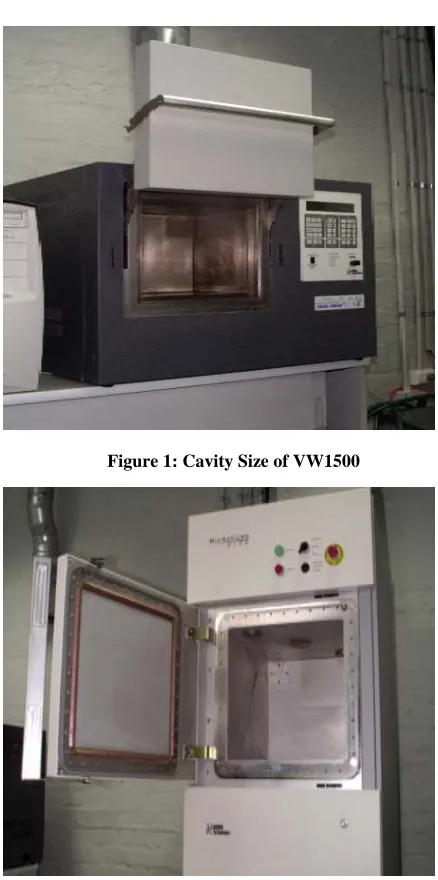
Figure 1: Cavity Size of VW1500
Figure 2: Cavity Size of Microcure 2100
dimension of VW1500 is 250 mm × 250 mm × 300 mm;while, Microcure2100 model 250 has a cavity size of 300 mm × 275 mm × 375 mm.
The VFM technique was based on the travelling wave tube principle, as shown schematically in Figure 3. Successful applications have been reported in the areas of joining fibre reinforced thermoplastic matrix composite materials, of curing advanced polymeric encapsulants, materials characterisation, curing profiles for various adhesives, structural bonding of glass to plastic housing, rapid treatment of automotive exhaust gas effluents and non-destructive test of quality using VFM [10-15].
However, there are a lot of factors that have to be considered before employing Variable Frequency Microwave (VFM) irradiation for processing materials. Not all materials are suitable for microwave processing and one has to match the special characteristics of the process. Blind applications of microwave energy in material processing will usually lead to disappointment. On the other hand, wise application of the technology will have greater benefits than has been anticipated. Successful applications of these modern facilities by the authors include the characterisation of glass or carbon fibre reinforced thermoplastic matrix composites, eg 33% by weight glass fibre reinforced low density polyethylene [LDPE/GF (33%)], of primers, eg two-part five-minute rapid araldite (LRA), and joining of the above mentioned composite materials with, or, without primers. Such applications will be detailed in this paper.
Microwave Fundamentals
Microwaves form part of a continuous electromagnetic spectrum that extends from low-frequency alternating currents to cosmic rays. Microwaves propagate through empty space at the velocity of light. The frequency ranges from 300 MHz to 300 GHz (NRC, 1994, Thuery 1992). Frequencies reserved for industrial applications consist of 915 MHz, 2.45 GHz, 5.8 GHz and 24.124 GHz. Amongst those bands, 2.45 GHz is the most commonly used in industrial applications. Industrial microwaves are generated by a variety of devices such as like magnetrons, power grid tubes, klystrons, klystrodes, crossed-field amplifier, travelling wave tubes, and gyrotrons [2]
At the customary domestic microwave frequency of 2.45 GHz, the magnetrons are the workhorse. Material processing falls into this category [2]. The material properties of greatest importance [3, 5, 16-22] in microwave processing of a dielectric are the complex relative permittivity = ε′ - jε″ and the loss tangent, tan δ = ε″/ ε′. The real part of the permittivity, ε′, sometimes called the dielectric constant, mostly determines how much of the incident energy is reflected at the air-sample interface, and how much enters the sample. The most important property in microwave processing is the loss tangent, tan δ or dielectric loss, which predicts the ability of the material to convert the incoming energy into heat. Ku et al. [17] showed that the reflection
coefficient of a material, ρ ε ε ≈ − ′ −
′ + (
( )
1
1 )
and the depth of
penetration of a dielectric,
δ ε ε μ
ω 0 0 tan
2
′ ≈
p
D .
Therefore, the larger the value of the real part of the complex permittivity, the more the incident energy will be reflected by a dielectric but the energy that enters the material will penetrate further than in a dielectric with the same ε″ but lower ε′.
Currently, in most industrial microwave processing operations, the frequency of the microwave irradiation is usually fixed. When microwave energy of a fixed frequency, eg 2.45 GHz was launched into a waveguide eg WR340, containing a piece of material, some areas of the material would experience higher electric field strength than the others. Those areas with higher electric field strength would be heated more, creating hot spots, which could even lead to thermal runaway. On the other side of the coin, the variable frequency microwave technique has several special features and it is capable of overcoming the non-uniformities in temperature and arcing associated with traditional microwave processing. A schematic diagram of the variable frequency microwave (VFM) facility system is shown in Figure 3. It utilises the sweeping frequency concept, which is based on parameters including central frequency, frequency bandwidth, and sweep rate. The total bandwidth, typically between 2.5 GHz to 18 GHz is divided into a few thousand points and during operation a computer cycles through these frequency points consecutively, with each cycle corresponding to a chosen sweep rate input, typically less than 0.5 seconds. For each frequency launched into the applicator, there exist standing wave patterns consisting of a number of modes. By cycling through the frequencies into the applicator, it is possible to generate thousands of different frequencies launched with each sweep cycle. The large number of frequencies excited during processing results in a uniform energy distribution throughout the applicator. The residence time of any given, established wave pattern, when thousands of frequencies are consecutively excited over a period of less than 0.5 seconds, is typically less than 0.2 seconds. During this short interval, a given load is exposed to an alternating electric field operating in the range of 2.5 GHz to 18 GHz.
Heating of suitable loads using microwave sources is substantially accelerated and propagates from “within” the
load outwards thus resulting in minimal thermal stress build up. Moreover, the process can be selective, especially in the case of variable frequency microwave based processing where different frequencies being operated can be varied by parameters like dielectric loss tangent changes and also by differential absorption that the load undergoes at elevated temperatures. This selectivity of heating characteristic also applies to components and structures.
As a general way of heat processing, variable frequency microwave techniques may have limited usefulness. However, in specialised applications such as processing of polymers and polymer-matrix composites the technology has distinct advantages over conventional processing methods which are mainly associated with factors such as timesaving, increased process yield and no heating of the load’s environment
Characterisation of Thermoplastic Matrix Composite (TMC) Materials Using VFM
The characterisation option of the VFM facilities was used to measure the characteristics of the cavity when a sample was loaded. The procedure followed was a sequence of operations whereby the user graphically sees how the cavity, with material loaded, would operate over the selected frequency range. The input power is selected on the basis of the estimated loss. During characterisation of the loaded cavity, temperature variations were obtained as well as incident power and reflected power levels from the cavity containing the sample via a monitor. The incident and reflected power levels versus frequencies together with the percentage of reflectance against frequencies were monitored and recorded. From this data, the bandwidth values most suitable for microwave processing were chosen.
The total operation bandwidth for VW1500 is from 6.5 GHz to 18 GHz. The output power for characterisation for 33% by weight glass fibre reinforced thermoplastic matrix composite materials, eg 33% by weight fibre glass reinforced polystyrene [PS/GF (33%)] was 125 W and the maximum temperature reached was 32°C. On the other hand, the output power for more lossy materials was 50 W and the maximum temperature reached was 65°C.
Considering that the reflectance is the ratio of the reflected power to the incident power, the lowest percentage of reflectance for 33% by weight carbon fibre reinforced low density polyethylene [LDPE/CF (33%)] was found to be between 8.5 GHz to 9 GHz and 10.7 GHz to 12 GHz, as depicted in Figure 4. The percentage of reflectance ranged from 0 to 15. The best frequency range to process the material was therefore from 8.5 GHz to 9 GHz and from 10.7 GHz to 12 GHz in the frequency range from 6.5 GHz to 18 GHz.
Another experimental setting was used and the frequency range of the machine (Microcure 2100 model 250) was from 2 – 8 GHz. Thirty three percent by weight carbon fibre reinforced low density polyethylene [LDPE/CF (33%)] was expected to have a relatively high loss tangent because of the carbon fibre contained in the matrix and thus a power level of 50 W was chosen. This was to ensure that the interaction of microwave energy and the sample was not too vigorous and that the facility could provide a complete sweep of frequency from 2 GHz to 8 GHz in a certain period of time without makingthe temperature in the cavity dangerously high. The temperature adjacent to the sample was monitored during the cavity characterisation process and the machine would be switched off once the temperature was over 105°C, which was not too far from the melting point of the matrix material, LDPE. Figure 5 illustrates the percentage of reflectance against frequencies. It was found that the percentage of reflectance was lowest in the frequency range of 6.5 GHz to 8 GHz. The percentage of reflectance ranged from 0 to 35. LDPE/CF (33%) was therefore best processed in this frequency range because it absorbed a greater proportion of the incident power. A summary of characterisation results for the above materials was shown in Table 1.
Table 1: Optimum Frequency Bands to process the 2 Materials in the Frequency Range of 2 GHz to 18 GHz
Materials Optimum Frequency Band
(GHz)
PS/GF (33%) 8.5 - 9.0 and 10.0 - 12.0
PE/CF (33%) 8.5 - 9.0 and 10.0 - 12.0
Ku et al. [6, 23] found that the dimensions of components processed using VFM remained stable and the temperature was under controlled through the on-line PC during the period of processing.
% OF REFLECTANCE for LDPE/CF (33%)
0 10 20 30 40 50 60 70
6.5
7.5248 8.5496 9.5743 10.599 11.624 12.649 13.673 14.698 15.723 FREQUENCY (GHz)
%
OF REFLECTANC
[image:4.612.323.549.112.266.2]E
Figure 4: Percentage of Reflectance against Frequency (6.5 GHz to 18 GHz) for LDPE/CF (33%)
% of REFLECTANCE of LDPE/CF(33%)
0 10 20 30 40 50 60 70 80 90
2.5
3.18616 3.87231 4.55847 5.24463 5.93079 6.61694 7.3031 FREQUENCY (GHz)
% o
f RE
F
L
E
CT
ANC
[image:4.612.323.547.313.460.2]E
Figure 5: Percentage of Reflectance versus Frequency (2.5 GHz to 8 GHz) for LDPE/CF (33%)
VFM Application in Automotive Industries
There is an increasing need for new polymeric materials and processes, which are cost-effective and environmental friendly. In the automotive industry, more and more metallic parts are being replaced by lightweight polymer composites in order to reduce vehicle weight. Assembly of such parts is achieved using different joining processes. Microwave technology can play a significant role as a competitive alternative to current processing methods and traditional practices.
single-mode resonant cavity applicators with feedback control to allow the resonant frequency to be changed as material properties vary during processing have been developed since the late 1980s. These allow more efficient coupling with composites. Feedback thermal control, which is critical in processing, is usually accomplished using infrared thermography. Heat generated within adhesives during microwave irradiation is due to resistive heating from conductive currents and/or dielectric loss heating from dipole polarization relaxation. The dielectric loss measurements of a given adhesive over the range of temperatures and frequencies of interest can provide the necessary feedback control for frequency selection during variable frequency microwave heating. In general, the loss tangent of an adhesive shifts to a higher value as its temperature increases, and as the processing frequency becomes higher. For this reason, there are definite advantages in using variable frequency microwave irradiation method since the processing frequency can be varied and tuned to the optimum conditions.
Conclusion
From the above discussions, it will be clear that there are a lot of factors that have to be considered before employing microwave irradiation, whether it is of fixed or variable frequency, for processing materials. In VFM processing, processing, users have to make sure that the power of the facility purchased is high enough for most of their applications and reseach. The power level of the VFM facilities in the authors’ workplace is considered inadequate in processing some materials, eg foodstuff [24]. However, the cost of a high power VFM facility is much higher than its low power counterpart, so a compromise of power level and cost should be made when acquiring a VFM facility. For an industrial scale application, it is likely that multiple single-frequency sources, eg magnetrons would be preferred as they are far cheaper and more powerful than amplified travelling wave tube devices [24].
References
[1] Sutton, W.H., Microwave Processing of Ceramics, Ceramic Bulletin, 68 (2) (1989) 376-86.
[2] National Research Centre (NRC), Microwave Processing of Materials, National Materials Advisory Board, Commission on Engineering and Technical Systems, National Academy Press, USA (1994) 1-7, 11-2, 100, 105.
[3] Metaxas, R.C. and Meredith, R.J., Industrial Microwave Heating, Peter Peregrinus Ltd., (1983) .5-6, 28-31, 43, 278.
[4] Siores, E., Microwave Technology for Welding and Joining, Materials World, 2 (10) (1994) 526.
[5] Ku, H.S., Siores E, and Ball J A R, Welding of Thermoplastic Composites Using Microwave Energy, Proceedings of CIPR International Symposium, Hong Kong, 21-22 August, 2 (1997) 612-9.
[6] Ku, H S, Siores, E, Ball, J A R,Microwave Facilities for Welding Thermoplastic Composites, and Preliminary Results, Journal of Microwave Power and Electromagnetic Energy, 34 (4) (1999) 195-205.
[7] Thuery, J., Microwaves: Industrial, Scientific and Medical Applications, Artech House, Inc., (1992) 159-380.
[8] Lambda Technologies Inc., Operator’s Manual for Microcure 2100, Models 250, and 700, (1998) 2.1-3, 3.1-3, 4.1-10, 4.15-24, 4.30-33.
[9] Liu, F,
Turner, I, Siores, E, Groombridge, P,
A Numerical and Experimental Investigation of the Microwave Heating of Polymer Materials Inside a Ridge Waveguide, Journal of Microwave Power and Electromagnetic Energy, 31 (2) (1996) 71 – 82.[10]
Wei, J B, Ngo, K, Tucker, D A, Fathi, Z, Paulauskas,
F L and Johanson, W G
, Industrial Processing via Variable Frequency Microwaves Part I: Bonding Applications, Journal of Microwave Power and Electromagnetic Energy, 33 (1) (1998) 10 – 17.[11] Anderson, B
, Ahmad, I, Tucker, D, Goldstein, S,
Fathi, Z, Ramamoorthy, A, Pal, S and Mead, P
,
Rapid Processing and properties Evaluation of Flip-Chip Underfills, http://www.microcure.com/papers.htm, undated, pp. 1 – 9.[12] Fathi, Z, Garard, R S, Clemons, J, Saltiel, C, Hutcheon, R M, DeMeuse, M, Characterisation and Numerical Modelling of Variable Frequency Microwave Processed Materials, undated, 1-8.
[13] Fathi, Z, Tucker, D, Ahmad, I, Yaeger, E, Konarski, M, Crane, L and Heaton, J, Innovative Curing of High Reliability
Advanced Polymeric Encapsulants,
http://www.microcure.com/papers.htm,
Proceedings of
NEPCON West,
(1998) 1 – 11.[14] Siroes, E, Siu, F, Destefani, C & Taube, A, Microwave Technology applications in the Automotive Industry, Society of Automotive Engineers Australia, Seminar on “Aus Top Tec”, (1999).
[16] Ku, H.S., Siores, E., and Ball, J.A.R., Weldability and Heat Affected Zone (HAZ) Evaluation of for High Energy Rate Joining of Thermoplastic Composites Using Microwave Energy, Proceedings of the Eleventh International Conference on Composite Materials, Gold Coast, Australia, 6 (1997) 55-64.
[17] Ku H S, Siores, E, Ball, J A R and Horsfiled, B, An Important Step in Microwave Processing of Materials: Permittivity Measurements of thermoplastic Composites at Elevated Temperatures, Proceedings of 1998 Pacific Conference on Manufacturing, Brisbane, Australia, August 18 - 21, (1998) 68-73.
[18] Ku, H S, Siores, E, Ball, J A R and Horsfiled, B, Microwave Processing and Permittivity Measurement of Thermoplastic Composites at Elevated Temperatures, Journal of Materials Processing Technology, Vol 89-90 (1999) 419-24.
[19] Ku, H S, Siores, E, Ball, J A R and Chan, P, Complex Permittivity of Low Loss Thermoplastic Composites Using a Resonant Cavity Method, Proceedings of ICCM-12 in CD ROM, Theme: NDT & Reliability; Others, Paris, France, 5th - 9th July, (1999).
[20] Ku, H S, Siores, E, Taube, A and Ball, J A R, Productivity Improvements Through the Use of Industrial Microwave Technologies, Proceedings of the 26th International Conference on Computers and Industrial Engineering, 15th – 17th December, Melbourne, Australia, (1999) 558-564.
[21] Ku, H S, Siores, E, Ball, J A R and P K H Chan), Loss Tangent of Low Loss Thermoplastic Composites, Science and Engineering of Composite Materials, 8 (3) (1999) 123-7.
[22] Ku, H.S., Ball, J.A.R., Siores, E. and Chan, P., Dielectric Loss for Low Loss Thermoplastic Composites Using a Resonant Cavity Method, Journal of Microwave Power and Electromagnetic Energy, (2003), (submitted for publication).
[23] Ku, H.S., Ball, J.A.R., Siores, E. and Horsfield, B., Permittivity Measurement of Thermoplastic Composites at Elevated Temperature, Journal of Microwave Power and Electromagnetic Energy,