City, University of London Institutional Repository
Citation
:
Habjan, A., Andriopoulos, C. and Gotsi, M. (2014). The role of GPS-enabled
information in transforming operational decision making: an exploratory study. European
Journal of Information Systems, 23(4), pp. 481-502. doi: 10.1057/ejis.2014.2
This is the supplemental version of the paper.
This version of the publication may differ from the final published
version.
Permanent repository link:
http://openaccess.city.ac.uk/id/eprint/15617/
Link to published version
:
http://dx.doi.org/10.1057/ejis.2014.2
Copyright and reuse:
City Research Online aims to make research
outputs of City, University of London available to a wider audience.
Copyright and Moral Rights remain with the author(s) and/or copyright
holders. URLs from City Research Online may be freely distributed and
linked to.
City Research Online:
http://openaccess.city.ac.uk/
[email protected]
ONLINE APPENDIX
Andreja Habjan, Constantine Andriopoulos, and Manto Gotsi (Forthcoming). “The role of
GPS-enabled information in transforming operational decision-making: An exploratory
study”, European Journal of Information Systems (EJIS), Forthcoming
THE ROLE OF GPS IN THE TRANSPORT PROCESS: EVIDENCE FROM THE
THREE CASE FIRMS
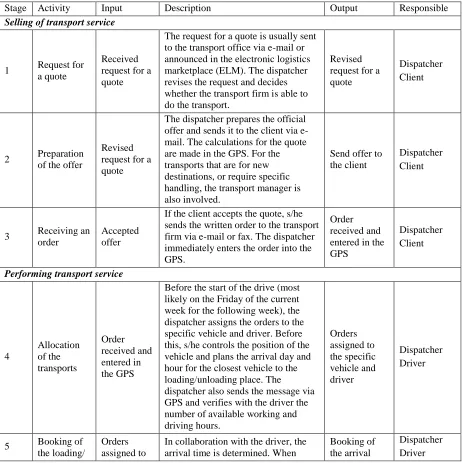
[image:3.595.67.531.287.749.2] [image:3.595.68.530.288.751.2]We started our investigation by building an understanding of how the three case firms used GPS in their transport process. The typical fleet-tracking GPS used by the case firms consisted of three parts: the GPS tracking devices, GPS tracking server and user interface (GPS software). The GPS devices were installed into the vehicles and captured GPS location information and additional vehicle information (distance travelled on a particular trip, vehicle mileage, speed, driving activity, the address of each destination, names of streets travelled, how long the vehicle remained at each location, fuel amount, engine temperature, altitude, reverse geocoding, etc.) at periodical intervals to a central server. The GPS tracking server received the data from the GPS tracking units, stored the data and provided this information on demand to its users. Information was disseminated through various media including Traffic Information Centers. Informants noted that GPS was used across all stages of the transport process. Table A1 provides a detailed description. The transport process usually began with receiving the request for a quote from the client and finished with the issuing of invoices when the transport was completed.
Table A1 The role of GPS in the transport process
Stage Activity Input Description Output Responsible
Selling of transport service
1 Request for a quote
Received request for a quote
The request for a quote is usually sent to the transport office via e-mail or announced in the electronic logistics marketplace (ELM). The dispatcher revises the request and decides whether the transport firm is able to do the transport.
Revised request for a quote
Dispatcher Client
2 Preparation of the offer
Revised request for a quote
The dispatcher prepares the official offer and sends it to the client via e-mail. The calculations for the quote are made in the GPS. For the transports that are for new destinations, or require specific handling, the transport manager is also involved.
Send offer to the client
Dispatcher Client
3 Receiving an order
Accepted offer
If the client accepts the quote, s/he sends the written order to the transport firm via e-mail or fax. The dispatcher immediately enters the order into the GPS.
Order received and entered in the GPS
Dispatcher Client
Performing transport service
4 Allocation of the transports Order received and entered in the GPS
Before the start of the drive (most likely on the Friday of the current week for the following week), the dispatcher assigns the orders to the specific vehicle and driver. Before this, s/he controls the position of the vehicle and plans the arrival day and hour for the closest vehicle to the loading/unloading place. The dispatcher also sends the message via GPS and verifies with the driver the number of available working and driving hours. Orders assigned to the specific vehicle and driver Dispatcher Driver
5 Booking of the loading/
Orders assigned to
In collaboration with the driver, the arrival time is determined. When
Booking of the arrival
unloading time
the specific vehicle and driver
needed, the dispatcher also makes a booking of the arrival time in the client’s information system or ELMs. Informing the customer and making the booking need to be completed at least one day in advance, or for urgent transports at least 4 hours in advance. When the dispatcher cannot do this, s/he needs to inform the client about the situation.
date and time Client
6
Sending information to the driver
Booking of the arrival date and time
When the booking is completed and the client is informed about all the details regarding the arrival time, the dispatcher sends the core information (information about loading/unloading time and address, information about goods, customs clearance, etc.) about the transport via GPS to the GPS device installed in the vehicle. All questions and clarifications are resolved with communication via GPS.
Information sent to the driver Dispatcher Driver 7 Driving to the loading destination Information sent to the driver
The driver heads to the
loading/unloading place, according to the dispatchers’ instructions. When driving, the driver follows the road laws and regulations in the specific country and regulation ES nr. 561/2006, regulating the maximum length of the driver’s working and driving hours. Throughout the drive the driver is monitored via GPS. If there are any issues on the road the driver immediately notifies the dispatcher via GPS.
Arriving to the loading/ unloading destination Driver 8 Loading / unloading the goods Arriving to the loading/ unloading destination
At the loading/unloading place the driver loads/unloads the goods. The driver is required to participate when loading/unloading is performed. If the driver is not able to participate and control the loaded/unloaded goods, s/he is required to enter a remark on the transport document. The driver also controls the quantity of the goods packed on the pallet, bags or any other kind of packing material. When needed, the goods are also fixed and secured in the vehicle with the risers and boards. Before leaving the loading/unloading place, the driver obtains signed documents (invoice for the goods, delivery note, MRN-import/export declaration, etc.).
Loaded / unloaded goods Driver Warehouse Manager 9 Informing the transport office Loaded / unloaded goods
After the loading/unloading is completed the driver confirms the status on the GPS tracking device and
Transport service completed
sends this information via GPS to the transport office. The status of the transport service is automatically updated into “ready for drive” or “completed”. After receiving this information the dispatcher informs the client about the status of the transport service. 10 Delivery of the documents Transport service completed
When the driver arrives to the head office, s/he is required to hand in the transport documents. The
administrator and dispatcher revise the documents and complete them with the transport order.
Revised transport documents Driver Dispatcher Administrator
11 Issuing out the invoice
Revised transport documents
The administrator enters the information about the transport into the information system for finance and accounting, where the invoice is issued out. The invoice is
automatically sent to the client via e-mail and a hard copy is also sent via post.
Issued invoice Administrator
Source: Interview transcripts
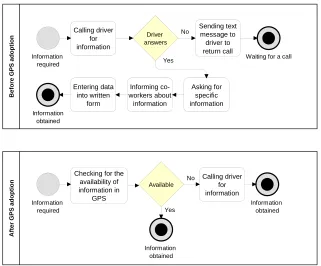
Informants explained that GPS significantly altered their transport process at least in three ways. First, the integration of GPS-generated information into vehicle fleet routing and scheduling enabled efficient vehicle routing plans (Repoussis et al., 2009). It, therefore, allowed better control of the process. The General Manager of Firm A explained: “In the past, we had to monitor all vehicles periodically…obtaining required information
[image:5.595.138.459.454.720.2]was, due to poor access, extremely complicated and lengthy. While GPS enables us to control the vehicle all the time”. Figure A1 below showcases changes in the control of the transport service after GPS adoption.
Figure A1 Change in the control of the transport service
B e fore GP S a do pt ion A ft e r GP S a do pt ion Information required Calling driver for information Driver answers Sending text message to driver to return call
Waiting for a call
Asking for specific information Entering data into written form No Information obtained Information required
Checking for the availability of information in GPS Available Calling driver for information Information obtained No Information obtained Yes Informing co-workers about information Yes
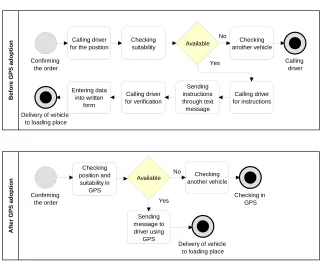
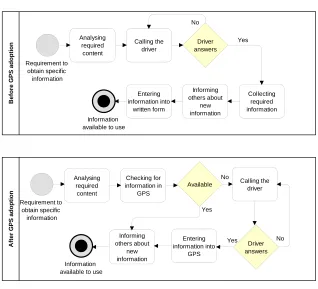
GPS adoption enhanced internal communication between the drivers and the dispatchers and this further improved efficiency in the transport process (see Figures A2 and A3). GPS enabled sending, receiving,
monitoring and archiving sent as well as received text messages. Obtaining information from the driver prior to GPS adoption was highly problematic. A Logistics Manager of Firm A argued: “We had to call the driver to
[image:6.595.137.460.244.506.2]find out the position of the vehicle. Many times either the driver did not answer the phone or we could not get through. This was very inconvenient, due to the short reaction time required by the customer. After the conversation with the driver, we put down the information into a form, discussed it with other co-workers and decided which driver is going to go in each direction. Then we called the driver again. If he or she did not answer we sent a text message or called him or her again”. After GPS adoption, dispatchers and other workers used GPS to obtain information required. Only in extreme situations (e.g. when a vehicle lost power, when a dispatcher needed detailed explanation about a certain problem) they actually now had to call the driver.
Figure A2 Change in sending information to the driver
B
e
fore
G
P
S
a
dopt
ion
A
ft
e
r
G
P
S
a
dopt
ion
Confirming the order
Calling driver for the position
Checking
suitability Available
Checking another vehicle
Calling driver
Calling driver for instructions Sending
instructions through text message Calling driver
for verification Entering data
into written form
No
Yes
Delivery of vehicle to loading place
Confirming the order
Checking position and suitability in
GPS
Available Checking
another vehicle
Checking in GPS No
Sending message to driver using
GPS Yes
Delivery of vehicle to loading place
Figure A3 Change in obtaining information from the driver
B
e
fore
GP
S
a
dop
ti
on
A
ft
e
r
GP
S
a
dop
ti
on
Requirement to obtain specific information
Analysing required content
Calling the driver
Driver answers
Collecting required information Informing
others about new information Entering
information into written form
No
Yes
Information available to use
Requirement to obtain specific information
Analysing required content
Available Calling the driver No
Informing others about
new information
Yes
Information available to use
Checking for information in
GPS
Entering information into
GPS
Driver answers
No Yes
Source: Interview transcripts
Second, interactions with trading partners and clients via GPS enabled supply chain partners to perform online transactions, share and exchange up-to-date information, provide customer service on request, manage logistics, transportation and inventory levels and routinely communicate shipment-tracking information to clients (Eng, 2006). Instead of relying on cell phones and sometimes fax machines, GPS was now used as the main medium for communication. A Logistics Manager in Firm C highlighted the benefits: “Sending information through
GPS is fast, easy and simple. We save time and money while expensive international calls are no longer needed”. Third, integration of GPS-enabled information with the transport firms’ transactional or ERP systems (spanning operational planning, statistics and personnel management) aided more accurate and timely
ASSESSING FIRM PERFORMANCE BEFORE AND AFTER GPS ADOPTION
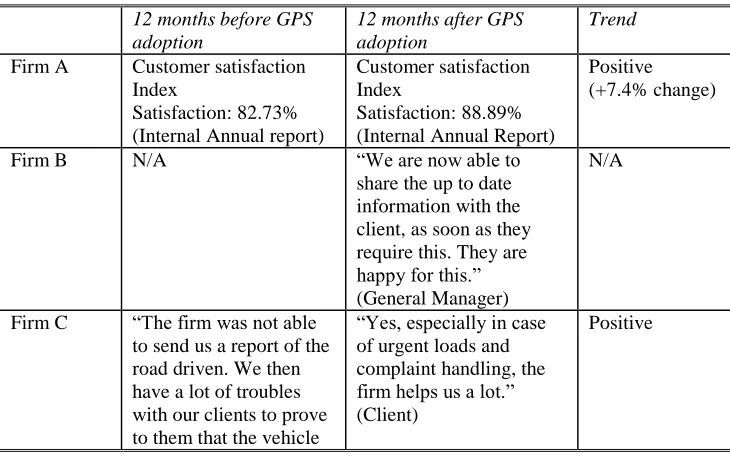
[image:8.595.71.500.253.445.2]To assess firm performance before and after GPS adoption for the three case firms, we initially compared Earnings/employee, Return on Assets (ROA), Total Profit (EBT) and customer satisfaction figures (where available) 12 months before and after GPS adoption. A comparison with the industry average was also obtained. As indicated by Tables A2 and A3, there were differences in performance after GPS adoption amongst the three case firms. Changes in Earnings/employee, ROA and EBT were significantly higher in Firm C compared to the other two case firms. Against this evidence, we classified Firm C as the strong performer in our sample. Firm A performed relatively better than Firm B, so we classified Firm A as the moderate performer and Firm B as the weak performer within our sample (note, however, that both Firms A and B exhibited better performance across various indicators than the industry average).
Table A2 Differences in Earnings/employee, Return on Assets (ROA) and Earnings Before Taxes (EBT) after GPS adoption
12 months before GPS adoption
12 months after GPS adoption
Change in the performance measure
Industry Average*
Firm A Earnings/employee 128,699 EUR 137,404 EUR + 6.76% 40,292 EUR
ROA 5.53% 6.08% +9.4% 0.04%
EBT 37,406 EUR 51,525 EUR +37.7% 48,134 EUR Firm B Earnings/employee 54,782 EUR 55,621 EUR + 1.53% 40,292 EUR
ROA 4.56% 4.72% +1.4% 0.04%
EBT 53,494 EUR 61,363 EUR +14.7% 48,134 EUR Firm C Earnings/employee 138,339 EUR 159,404 EUR + 15.22% 40,292 EUR
ROA 7.52% 9.39% +24.9% 0.04%
EBT 583,738 EUR 870,925 EUR +49.19% 48,134 EUR Source: Firms’ financial reports
* Industry averages for medium-sized transport firms (classified as H49.4 by the Agency of the Republic of Slovenia for Public Legal Records and Related Services) could only be obtained for 2011
Table A3 Differences in customer satisfaction after GPS adoption
12 months before GPS adoption
12 months after GPS adoption
Trend
Firm A Customer satisfaction Index
Satisfaction: 82.73% (Internal Annual report)
Customer satisfaction Index
Satisfaction: 88.89% (Internal Annual Report)
Positive (+7.4% change)
Firm B N/A “We are now able to share the up to date information with the client, as soon as they require this. They are happy for this.” (General Manager)
N/A
Firm C “The firm was not able to send us a report of the road driven. We then have a lot of troubles with our clients to prove to them that the vehicle
“Yes, especially in case of urgent loads and complaint handling, the firm helps us a lot.” (Client)
[image:8.595.114.479.526.753.2]was not late on the loading place.” (Client) Source: Interview transcripts
Informants in the three case firms associated these increases in ROA, EBT and Earnings/employee with increased sales and reductions in costs. They argued that GPS adoption contributed to these performance indicators by mobilizing:
(a) more control over drivers’ actions andimproved planning between the unloading of the transport and loading of the next transport. One of the major benefits of GPS was that the transport firms could now better monitor each driver’s actions, something that was not possible before the GPS was installed in all the vehicles. The General Manager of Firm A explained problems that occurred before GPS adoption: “If the driver
inadequately plans the route, s/he waits more and usually needs more time to come to the unloading place, and consequently makes less kilometers within the working hours allowed”. Drawing onagency theory, better monitoring capability via the GPS enabled close monitoring of the driver and the vehicle by the dispatcher and, therefore, led to cost savings and efficiency gains, such as minimizing the time from the loading to the
unloading place (Kraemer & Dutton, 1979). The annual management review report of Firm A noted: “The
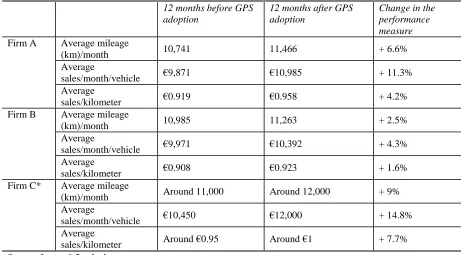
[image:9.595.65.526.355.610.2]productivity of the vehicle increased by 6.6%; this is particularly due to the use of GPS in transport planning and vehicle routing. The vehicles also on average made more kilometers and the average sales per month also increased”. Table A4below provides indicators of vehicle performance for the three firms that can be linked to improvements in sales and, therefore, contribute to increased performance measures.
Table A4 Additional indicators of vehicle performance
12 months before GPS adoption
12 months after GPS adoption
Change in the performance measure
Firm A Average mileage
(km)/month 10,741 11,466 + 6.6% Average
sales/month/vehicle €9,871 €10,985 + 11.3% Average
sales/kilometer €0.919 €0.958 + 4.2% Firm B Average mileage
(km)/month 10,985 11,263 + 2.5% Average
sales/month/vehicle €9,971 €10,392 + 4.3% Average
sales/kilometer €0.908 €0.923 + 1.6% Firm C* Average mileage
(km)/month Around 11,000 Around 12,000 + 9% Average
sales/month/vehicle €10,450 €12,000 + 14.8% Average
sales/kilometer Around €0.95 Around €1 + 7.7% Source: Internal firm’s data
* Estimates provided by Firm C informants
(b)real-time routingof the vehicles. On a daily basis, dispatchers were able to manage real-time dispatching, routing and re-routing of vehicles in response to changes in clients’ requests or urgent orders, travel time and drivers’ capabilities. With no real-time information, the transport firms were unable to give up-to-date
information about the availability of vehicles to perform a transport. The dispatcher of Firm B noted: “The GPS
really changed our routing habits. Now, we easily timely reroute the vehicle if our client has urgent load in the relation. Sometimes this is a matter of minutes”. GPS information also helped dispatchers to select the right
works. Anything more than this, means that the transport firm transports an extra pallet or two from other clients, which add into the sales volume on the same destination. This is impossible to do without current information about the position of the vehicle, working and driving hours, etc. obtained via GPS”.
(c) toll,fuel and other cost savings. After GPS adoption, the dispatcher was able to closely monitor and plan the route that the driver would take, to optimize toll costs and fuel consumption. A dispatcher in Firm Bexplained: “Before the start of the transport we give details about the route to the driver. Nevertheless, with constant monitoring, we might change the route if we see that the costs are too high, or the required delivery time cannot be reached”. To emphasize savings in fuel consumption, the General Manager of Firm A added: “The average consumption of all vehicles has also fallen from 34.5 liters/100km to 32.7 liters/100km after we implemented the GPS, meaning huge savings”. Other costs, such as phone and maintenance costs also decreased after GPS
adoption. Dispatchers did not need to spend that much time on the phone with drivers, as explained by a dispatcher in Firm C:“In many cases we do not use the phone to contact the driver. In around 95% the