City, University of London Institutional Repository
Citation:
Gould, N. J., Lorencatto, F., Stanworth, S., Michie, S., Prior, M. E., Glidewell, L.,
Grimshaw, J. M. and Francis, J. (2014). Application of theory to enhance audit and feedback
interventions to increase the uptake of evidence-based transfusion practice: an intervention
development protocol. Implementation Science, 9, p. 92. doi: 10.1186/s13012-014-0092-1
This is the accepted version of the paper.
This version of the publication may differ from the final published
version.
Permanent repository link:
http://openaccess.city.ac.uk/4804/
Link to published version:
http://dx.doi.org/10.1186/s13012-014-0092-1
Copyright and reuse: City Research Online aims to make research
outputs of City, University of London available to a wider audience.
Copyright and Moral Rights remain with the author(s) and/or copyright
holders. URLs from City Research Online may be freely distributed and
linked to.
S T U D Y P R O T O C O L
Open Access
Application of theory to enhance audit and
feedback interventions to increase the uptake of
evidence-based transfusion practice: an
intervention development protocol
Natalie J Gould
1*, Fabiana Lorencatto
1, Simon J Stanworth
2, Susan Michie
3, Maria E Prior
4, Liz Glidewell
5,
Jeremy M Grimshaw
6,7and Jill J Francis
1Abstract
Background:Audits of blood transfusion demonstrate around 20% transfusions are outside national
recommendations and guidelines. Audit and feedback is a widely used quality improvement intervention but effects on clinical practice are variable, suggesting potential for enhancement. Behavioural theory, theoretical frameworks of behaviour change and behaviour change techniques provide systematic processes to enhance intervention. This study is part of a larger programme of work to promote the uptake of evidence-based transfusion practice.
Objectives:The objectives of this study are to design two theoretically enhanced audit and feedback interventions; one focused on content and one on delivery, and investigate the feasibility and acceptability.
Methods:Study A (Content): A coding framework based on current evidence regarding audit and feedback, and behaviour change theory and frameworks will be developed and applied as part of a structured content analysis to specify the key components of existing feedback documents. Prototype feedback documents with enhanced content and also a protocol, describing principles for enhancing feedback content, will be developed. Study B (Delivery): Individual semi-structured interviews with healthcare professionals and observations of team meetings in four hospitals will be used to specify, and identify views about, current audit and feedback practice. Interviews will be based on a topic guide developed using the Theoretical Domains Framework and the Consolidated Framework for Implementation Research. Analysis of transcripts based on these frameworks will form the evidence base for developing a protocol describing an enhanced intervention that focuses on feedback delivery. Study C (Feasibility and Acceptability): Enhanced interventions will be piloted in four hospitals. Semi-structured interviews, questionnaires and observations will be used to assess feasibility and acceptability.
Discussion:This intervention development work reflects the UK Medical Research Council’s guidance on development of complex interventions, which emphasises the importance of a robust theoretical basis for intervention design and recommends systematic assessment of feasibility and acceptability prior to taking interventions to evaluation in a full-scale randomised study. The work-up includes specification of current practice so that, in the trials to be conducted later in this programme, there will be a clear distinction between the control (usual practice) conditions and the interventions to be evaluated.
Keywords:Audit and feedback, Blood transfusion, Implementation, Health services research, Study protocol, Health professional behaviour change
* Correspondence:[email protected]
1Centre for Health Services Research, City University London, London, UK
Full list of author information is available at the end of the article
Background
Blood components are scarce and costly resources that are used in almost every area of hospital practice. How-ever, unnecessary blood transfusion is associated with negative consequences and presents an unnecessary risk to patients. Examples of risk are transfusion infections, acute lung injury, and circulatory overload, which are as-sociated with increased morbidity and mortality [1,2]. National guidelines [3] provide a framework for defining unnecessary transfusions. For example, in the case of red cell transfusion, by specifying the pre-transfusion haemo-globin concentrations at which it is appropriate to transfuse a patient in different clinical settings [4-6]. Similar evidence to inform recommendations applies for other blood components [7].
Despite concerns about risks of transfusion [2], the practice of giving unnecessary transfusions persists. NHS Blood and Transplant (NHSBT) manage the provision of blood components for England and North Wales, and promote appropriate transfusion practice through tional audits on transfusion practice. Regional and na-tional audits have consistently demonstrated that at least
20% of the use of different blood components (i.e., red
blood cells, plasma, and platelets) falls outside national guideline recommendations [8,5]. There is thus the poten-tial to save costs without compromising patient outcomes by reducing the number of unnecessary transfusions.
Most quality improvement activity in blood transfu-sion has focused on improving safety of donated blood for transfusion. Increasing attention is now focusing on improving blood use by clinicians so that transfusion practice is more consistent with evidence-based recom-mendations [5]. This protocol describes the first stage of a programme of research that aims to specify current feedback practice and then develop and evaluate enhanced methods to promote the uptake of evidence-based trans-fusion guidelines and reduce the unnecessary use of blood components.
Implementation science has played a central role in developing and evaluating interventions that are designed to address the evidence-practice gap by targeting behav-iour change amongst healthcare professionals within the organisations and systems in which they work [9,10]. Audit and feedback (A&F) is a widely used intervention to improve the quality of health care, including blood transfusion practice through the NHSBT national audit programme. It is defined as any summary of clinical per-formance of healthcare over a specified period of time, to provide healthcare professionals with data on per-formance [11]. There is evidence that A&F interven-tions deliver modest, variable, but worthwhile effects, with the recent Cochrane review [11] indicating an overall 4.3% (IQR 0.5% to 16%) increase in compliance with desired practice as a result of A&F in a range of
clinical areas. The review investigated this heterogeneity and identified that A&F is more effective at changing practice when baseline performance is low, feedback is provided more than once, is delivered by a colleague or supervisor, is delivered in both verbal and written formats, and includes explicit targets and action plans. These find-ings contribute to the growing understanding of how A&F works by identifying its active ingredients and highlighting its potential mechanisms of action [12].
It has been argued that theory and emerging evidence about how best to design (and not to design) A&F inter-ventions should be incorporated into the development of future A&F interventions in order to identify how and when A&F works best, as such theoretical underpinnings are rarely reported in reviews of behavioural interventions [12-14]. Theories of behaviour change, used effectively in a wide variety of applied health research to explain and change behaviour [15,10], hold the potential to clar-ify mechanisms of action and to provide generalisable frameworks for understanding how interventions work [16,17]. They also offer practical and systematic methods to guide intervention development in relation to clinical practice [18].
However, there are a large number of behaviour change theories, often overlapping in their concepts, making it difficult to choose the most relevant to apply to a behav-iour [19]. To make theory more accessible, the Theoretical Domains Framework (TDF) [20] was developed, in which 128 constructs (key concepts) from 33 behaviour change theories were grouped into 12 theoretical domains includ-ing behavioural regulation, social influences, and beliefs about consequences. The framework has been used in a number of contexts within implementation research, and can be used to explore implementation problems, design interventions and understand behaviour change processes [19,21-26]. For example, the TDF has been applied to sys-tematically identify the theoretical domains of greatest relevance to explaining blood transfusion practice in
in-tensive care units, with‘behavioural regulation’ identified
as a key domain influencing practice [26]. Behavioural regulation, defined as the processes of goal selection and goal achievement, involves the techniques of goal setting, monitoring, and providing feedback [27]. Control Theory [27] is a theory of behavioural regulation which posits that individuals manage their behaviour by knowing
what they want to do or achieve (i.e. setting a goal or
standard), trying to do it (i.e.action), monitoring the
be-haviour (i.e. audit), assessing whether they are making
progress towards the goal (i.e.feedback, which informs
as to the nature and extent of any discrepancy between behaviour and goals), and adapting what they do in light
of the feedback (i.e. action planning). We propose that
Theories of behaviour change are potentially useful for optimising A&F by pointing to behaviour change tech-niques that may augment the effectiveness of receiving feedback about clinical practice [14,28]. The recent de-velopment of a comprehensive taxonomy of behaviour change techniques (BCTs) [29] provides a replicable and systematic method for identifying and describing inter-vention components that are consistent with Control Theory and that may enhance practice. BCTs are defined
as the“observable, replicable and irreducible components
of an intervention designed to alter or redirect causal
pro-cesses that regulate behaviour” (i.e. the proposed ‘active
ingredients’) [29]. The taxonomy includes BCTs that
en-compass strategies proposed in Control Theory; for
in-stance,‘goal setting,’ ‘feedback on behaviour,’ ‘discrepancy
between behaviour and goal,’and‘action planning’[29].
The current study uses Control Theory and the BCT Taxonomy to specify current A&F practice in blood transfusion and to inform the design of enhanced A&F interventions.
BCTs applied at the level of the individual, and use of the TDF to identify potential barriers to change
individ-uals’ behaviour, may not be the only approaches to
im-proving transfusion practice or optimising A&F in the hospital context. Behaviour change within a healthcare setting is a complex process, and due to the multi-level nature of healthcare organisations, elements of change in response to feedback may be outside the control of any individual healthcare professional [12]. Ferlie and
Shortell [30] propose four levels of change that should be considered in order to maximise the chance of suc-cess: individual, group or team, overall organisation, and wider system or environment. Developing this idea, the Consolidated Framework for Implementation Research (CFIR) [31] provides a framework for identifying what works where and why across different organisational levels within multiple settings.
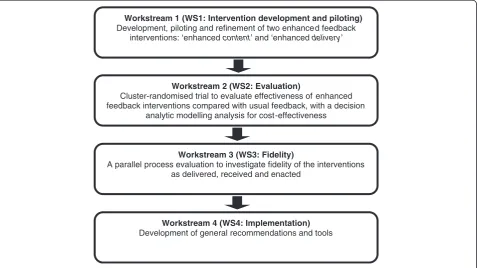
Based on the considerations outlined above, the current study is designed to gather evidence to inform the en-hancement of A&F practice, in ways that permit replication and continuing enhancement of A&F as an intervention to support clinical behaviour change in transfusion practice. This study is the first in the AFFINITIE Programme, funded by the UK National Institute of Health Research,
which comprises four interrelated ‘workstreams’ to be
conducted over five years (Figure 1).
The workstream structure draws on the systematic methodological approach recommended in the UK Med-ical Research Council (MRC) guidance for developing and evaluating complex interventions [32], which pro-vides a systematic approach to this work: intervention development, feasibility and piloting, evaluation, and implementation.
The current paper presents the study protocol for workstream one (WS1: Intervention development and piloting), which addresses the intervention development, feasibility, and piloting components of the MRC frame-work. Two enhanced interventions will be designed and
Workstream 1 (WS1: Intervention development and piloting)
Development, piloting and refinement of two enhanced feedback interventions: ‘enhanced content’ and ‘enhanceddelivery’
Workstream 2 (WS2: Evaluation)
Cluster-randomised trial to evaluate effectiveness of enhanced feedback interventions compared with usual feedback, with a decision
analytic modelling analysis for cost-effectiveness
Workstream 3 (WS3: Fidelity)
A parallel process evaluation to investigate fidelity of the interventions as delivered, received and enacted
Workstream 4 (WS4: Implementation)
[image:4.595.61.539.451.719.2]Development of general recommendations and tools
assessed for feasibility and acceptability. Theory will be applied to two key facets of A&F: the content of docu-ments providing feedback and the processes of feedback delivery (including how it is delivered and to whom it is delivered). The interventions developed during WS1 (Intervention development and piloting), will be evaluated in workstream two (WS2: Evaluation) in two replicated 2 × 2 factorial cluster randomised control trials (C-RCT) in the context of a National Comparative Audit of blood transfusion. The development of these two interventions, one focusing on feedback content and the other focusing on feedback delivery, will thus be informed by theoretical frameworks of clinical behaviour change applied at the in-dividual, team, and organisational levels. Development will also be informed by the early components of this study that will generate an evidence base from past A&F prac-tice and from multi-method studies in the hospital con-text. Clinical and behaviour change experts will have input into the enhancement of these interventions, which will additionally be informed by the systematic collection and analysis of feasibility and acceptability data.
The aims of WS1 (Intervention development and piloting) are to:
1. Use the evidence base relating to A&F and
behaviour change to describe current A&F practice relating to blood transfusion, focusing on two aspects of current practice: content and delivery. 2. Apply systematic methods and the evidence about
current practice to develop, pilot and refine two feedback interventions focusing on enhancing content and delivery of feedback.
Methods
Overview WS1: Intervention development and piloting
WS1 (Intervention development and piloting) consists of
three sub-studies: study A‘Investigation of content’; study
B‘Investigation of delivery’; and study C ‘Investigation of
feasibility and acceptability.’
Study A: investigation of content
Objectives
1. To describe how A&F for blood transfusion practice is currently operationalised and to analyse the components of existing feedback documents. 2. To systematically identify methods by which the
content of current feedback may be enhanced. 3. To develop an intervention guidance document and
training materials for preparing enhanced feedback content.
4. To prepare a prototype of a feedback document with enhanced content to be delivered as part of study C (Feasibility and acceptability).
Design
A structured content analysis of the key components of existing feedback documents, based on relevant evidence [11], current theories, and frameworks for understanding behaviour change.
Materials
Since its inception in 2002, the UK NHSBT has con-ducted a total of 19 A&F cycles examining different as-pects of blood transfusion practice. An A&F cycle
typically has a set of pre-specified‘audit standards’(e.g.a
pre-transfusion haemoglobin reading is taken in 100% of patients prior to transfusion). These standards are often based on existing, relevant clinical guidelines and evi-dence, and represent the specific transfusion-related
be-haviours being audited. Feedback recipients’ behaviour
will be compared against these standards. A&F cycles in the NHSBT audit generally consist of three distinct stages: Pre-Audit, in which hospitals are invited to par-ticipate in the audit; Audit, during which audit data are collected; and Feedback, in which results from the audit are fed back to the hospitals. Different types of docu-ments are utilised within each of these stages, and this study will specifically examine documents from the
feed-back stage (e.g. written reports, action planning
tem-plates, or PowerPoint presentations) (See Additional file 1 for an example of a current blood transfusion feedback report). To examine how current A&F is operationalised in the context of blood transfusion, such documents from previously conducted A&F cycles will be obtained from NHSBT and systematically examined using a com-prehensive coding framework (see below).
Procedure
Sampling of A&F cycles
Existing A&F cycles conducted by NHSBT will be sam-pled by two members of the research team in consult-ation with the clinical lead on the research team if they are:
1. a national comparative audit (i.e.not local or regional audit);
2. examine behaviours related to the decision to transfuse (i.e. notbehaviours related to blood quality or safety of administration);
3. represent current A&F practice (i.e.conducted within≤10 years of the present study);
4. for aspects of blood transfusion practice that have been audited more than once, the included cycle, be the most-recently conducted version (i.e.the most recent re-audit, not the original audit);
Inter-rater sampling agreement amongst reviewers
will be assessed using Cohen’s Kappa, with a minimum
Kappa value of 0.75 indicating an acceptable level of agreement [33].
Development and application of the coding framework
To conduct the structured content analysis, a compre-hensive coding framework will be developed and applied to describe the characteristics and components of the feedback documents. An established, reliable taxonomy of 93 BCTs [29] will be embedded within the coding framework to enable specification of BCTs comprising feedback content. Data will be extracted on the number and frequency of different BCTs identified within each document. The extent to which BCTs consistent with
Control Theory [27] (e.g. ‘goal-setting,’ ‘discrepancy
be-tween current behaviour and goal’) are included in current
feedback documents will be examined.
The coding framework will also include items to exam-ine the behavioural specificity of the audit standards. Be-havioural specificity will be examined according to the TACT Principal: Target, Action, Context, and Timeframe
[34]. For instance, the behaviour ‘referring patients with
back pain for lumbo-sacral spine x-ray’may be specified
using TACT as follows: Target,‘patient’; Action,‘referral’;
Context,‘clinical condition (back pain)’; and Timeframe,
‘(implicitly) during the consultation’ [35]. We propose to
extend the TACT principle to additionally specify the
audit standards in terms of the‘Actor,’ that is, who is
re-sponsible for performing the behaviour (e.g. physicians).
The percentage of audit standards in which the behav-ioural Target, Action, Context, Timeframe, and Actor is clearly specified will be examined. The extent to which audit standards are specified in the same manner across different documents pertaining to the same A&F cycle will be examined.
Findings from the Cochrane review of A&F [11] re-garding the effectiveness of different A&F strategies will further inform the development of coding framework items for assessing the characteristics of feedback con-tent. These will include: feedback provider and recipient;
level of data fed back (i.e.group vs individual); mode of
delivery (i.e. written vs graphical); whether or not the
feedback item is explicitly related to an audit standard;
recipients’baseline behaviour and actual behaviour or
at-tainment level; whether normative information is provided
about others’ behaviour; whether an explicit comparison
is made between the recipients’behaviour and a
compara-tor; if yes, the nature of the comparator (e.g. others,
clin-ical guidelines or standards, past behaviour); and whether or not feedback is presented in conjunction with action planning and/or goal-setting. The percentage of feedback items explicitly related to an audit standard will be computed. The TACT principle [34] will be applied to
examine the extent of behavioural specificity of each feedback item, as well as any accompanying action plans or goals set in response to feedback.
It is important that feedback documents are presented in a clear and comprehensible manner if their content is to be accessible and understood. Therefore, the layout and structure of documents will be examined using items from the Suitability of Assessment Materials framework [36], a validated framework for assessing the suitability of printed health information materials in terms of their layout, liter-acy demand, typography, and graphics.
The feedback documents will be analysed using the cod-ing framework by two members of the research team in
consultation with the research team’s clinical lead.
Inter-rater coding reliability will be assessed using Cohen’s Kappa
or percentage agreement as appropriate, with a desired minimum Kappa value of 0.75 or 75% agreement; indicat-ing an acceptable level of agreement [33].
Synthesis and intervention development
Possible enhancements of feedback content will be con-sidered concurrently with coding and this process will be conducted in two steps. First, the current content of feedback documents will be specified in terms of the BCTs that are included and the level of behavioural spe-cification. Second, members of the research team will examine this specification to identify aspects of the doc-uments that may be re-written or enhanced. This step will be guided by theory, such as Control Theory [27], and principles such as TACT-A. For example, if it is found that only a narrow range of BCTs consistent with Control Theory are currently featured in feedback docu-ments, enhancement could include re-writing the feed-back documents so that the omitted BCTs consistent with Control Theory are delivered (See Additional file 2 for an example illustrating the potential enhancement of feedback content to increase the delivery of BCTs con-sistent with Control Theory). Similarly, if for instance it is found that the timeframe is rarely or poorly specified in the audit standards, standards will in turn be re-written to clarify and increase behavioural specificity in
terms of timeframe (e.g. specifying whether the
acceptable from a clinician’s perspective, feasible from the perspective of trial design, and appropriate for the context at which they are aimed. Following this, the proposed interventions will be revised and refined as re-quired. It is possible that analysis of data from study B (Delivery; see below) will also inform the development of this intervention.
Anticipated outputs
A guidance document (i.e. intervention protocol) and
accompanying training materials describing the princi-ples of analysing and writing enhanced feedback content and a prototype set of feedback documents with enhanced content that will be piloted in study C (Feasibility and acceptability).
Study B: investigation of delivery
Objectives
This study will be conducted in parallel to study A (Content), with three main objectives:
1. Identify how delivery of feedback is currently operationalised in practice in the hospital context, and how this could be enhanced.
2. Identify who currently receives feedback (i.e.types of healthcare professionals and organisational levels), and who should receive feedback.
3. Develop an intervention protocol for enhancing the delivery of feedback to all relevant staff (identified from objective two), along with practical guidance for clinical teams on how to respond as a team to feedback, using appropriate behavioural strategies.
Design
The study will use a case study design involving semi-structured interviews and observations of transfusion re-lated meetings at four hospital sites in England.
Participants and sampling
Sampling of sites
Potential hospitals and Trusts (i.e. organisational units
within the National Health System in which hospitals or clinics are nested) will be identified through consultation with the clinical lead on the research team, and will be selected from those who take part in the NHSBT na-tional comparative audits of blood transfusion. A pur-posive sampling strategy will be used to identify hospital sites that are diverse in their infrastructure and level of
resources (e.g. role of Transfusion Practitioner) and to
include at least one teaching and one district hospital. These hospitals will be approached by a clinical member of the research team through their respective Trust Re-search and Development (R&D) Offices, with the first four to respond to be selected for study B (Delivery),
once diversity across the hospitals has been established, and the remaining four to then be approached for the sub-sequent study C (Feasibility and acceptability: outlined below).
Sampling of participants
A purposive sampling strategy will be used to identify five to eight healthcare professionals within each of the four study B (Delivery) hospitals who reflect the range of individuals involved in, or with influence over, transfusion decisions, or who are responsible for following practice
recommendations (e.g. clinical leads, senior clinicians,
haematologists, hospital transfusion committee mem-bers, junior doctors, regional transfusion professionals). Diversity of the sample will be monitored to ensure that interviews are conducted with a representative range of healthcare professionals from different organisational levels, and to establish how widely the current feedback is disseminated to and discussed by these professional groupings.
During R&D approval, a local transfusion contact will be identified to help identify potential interviewees and transfusion related meetings to observe. Details of rele-vant meeting to observe will determine the potential dates for the research visit to the site. Potential interview participants will be sent a recruitment email with an accompanying information sheet and consent form, to enquire if they are willing to participate in an inter-view, following informed consent an interview will be scheduled.
It is anticipated that there may be circumstances in which participants who are originally scheduled for interview are not available on the day due to the nature of their clinical responsibilities, and also that the list pro-vided from the clinical contact would not be exhaustive of the range of individuals involved in transfusion decisions. Therefore, a second opportunistic recruitment strategy will be employed whereby additional eligible healthcare professionals who are present at the hospital during the data collection period will be given the opportunity to vol-unteer for interview, with the same process of informed consent applied as to those approached ahead of the visit.
Materials
Two sets of study materials will be developed: interview topic guide and observation sheet:
processes. This will help to identify individuals who are involved in the transfusion decision-making process but who do not currently receive feedback, and may inform the potential target groups for enhanced interventions. The topic guide will include questions about Ferlie and Shortell’s [30] four levels of change for improving quality: the individual, group or team, organisation, and the larger system or environment. A wide range of potential methods of delivery and their acceptability will be explored in the interview. To explore the validity of the topic guide prior to conducting interviews, items will be double coded into TDF domains and CFIR
constructs by two researchers. Percentage agreement will be calculated as an indication of inter-rater reliability and consensus on coding will be achieved through discussion between coders. The schedule will be piloted with healthcare professionals to allow refinements of question wording and delivery. 2. If possible, we will observe key meetings
disseminating audit feedback to identify
organisational feedback processes. An observation sheet will be developed to record the observations. This will focus on elements such as the structure, function (e.g.,behavioural regulation, social influence, information provision), group processes, body language, and the content of A&F discussion within the key meetings.
Procedure
1. One-to-one, semi-structured interviews, based upon the topic guide and lasting a maximum of one hour, will be conducted face-to-face at the hospital at a time convenient for the interviewee. Interviews will be audio-recorded with permission.
2. Two researchers will attend each key meeting, with the consent of the Chair, and use a tailored observation sheet to record observations.
Analysis
1. Audio-recorded interviews will be transcribed verbatim and anonymised. Interview text will be coded into the relevant domains (TDF) and constructs (CFIR), and, in the manner reported by Pateyet al. [25], the first transcript will be coded concurrently by two researchers to develop a coding strategy for subsequent transcripts. Subsequent transcripts will be coded by one researcher, with 10% independently double coded. Cohen’s Kappa will be calculated to assess whether the same interview responses are coded into the same domains or constructs, with a minimum Kappa
value of 0.75 indicating an acceptable level of agreement [33]. Consensus will be reached through discussion, with a third independent coder asked to help resolve any outstanding disagreements. After responses have been coded using the theoretical frameworks, emerging themes within each domain or construct will be identified across the transcripts. The second coder will review the themes to verify an accurate representation of interview content. 2. To complement the data collected in the interviews,
organisational feedback processes will be identified from observational data,e.g., how feedback is discussed between individuals and teams within the meeting, and the potential group processes that influence feedback and decision making. These observations will allow researchers to explore whether such meetings would be an appropriate context in which enhanced feedback could be delivered to hospitals, through identifying individuals with key job roles and responsibilities related to the A&F process, and observing how these individuals could play a role in delivering feedback during the enhanced interventions (study C: Feasibility and acceptability).
Initially, each hospital will be analysed as a single case study in order to understand the feedback processes within the organisational structure. Findings from the four sites will then be compared and contrasted using a triangulation process [37,38] to identify common and contrasting themes across hospitals and within health-care professional roles.
Synthesis and intervention development
The constructs, domains and themes that emerge from analyses of the interview transcripts and meeting observa-tion will be used to identify ways in which the delivery of feedback could be enhanced (See Additional file 2). We have identified four potential approaches to enhan-cing feedback delivery processes:
1. Improve the‘reach’of the feedback documents. For example, if it is identified that key individuals involved in transfusion decisions are not typically receiving feedback from an A&F cycle (e.g.junior doctors), this group could be targeted by the enhanced delivery intervention.
are able to work towards a goal that they feel is achievable.
3. Incorporate direct suggestions by interview participants. Discussion of the potential feedback methods during the interviews will help identify ways in which feedback processes could be
enhanced;e.g., through the development of targeted action plans for clinical teams.
4. Identify, from analysis of the observational data from the observed clinical team meetings, any potential for enhancement;e.g., provision of support materials focusing on group processes could facilitate the dissemination of information and team-level discussion of responses.
The identified enhancements from the interviews and meeting observations will be integrated into an interven-tion protocol and set of supporting documents. It is pos-sible that analysis of data from study A (Content) will inform the development of this intervention.
Anticipated outputs
An intervention protocol for enhancing the delivery of feedback to relevant staff, along with practical guidance and support materials for clinical teams on how to re-spond as a team to feedback, using appropriate behav-ioural strategies.
Study C: investigation of acceptability and feasibility
Objectives
1. Integrate the enhanced interventions that are developed during study A (Content) and study B (Delivery).
2. Deliver the enhanced intervention to a pilot sample of four hospitals.
3. Assess the acceptability and feasibility of delivering such enhancements.
Design
The study will use a mixed methods design involving semi-structured interviews, observations and questionnaires at four hospitals in England.
Participants and sampling
Sampling of sites
The four hospitals identified during recruitment for study B (Delivery; see above) will be approached to par-ticipate. The participating hospitals will receive both of the developed interventions as part of an abbreviated NHSBT audit.
Sampling of participants for interviews
Purposive sampling will be used to identify up to 10 healthcare professionals who received the enhanced inter-ventions and are responsible for acting upon A&F and making, or influencing, transfusion decisions. Potential participants will be identified using the same procedure outlined for study B (Delivery).
Participants for questionnaires
Questionnaires will be sent to a representative range of healthcare professionals who are involved in decisions to transfuse at each hospital. Participants will be identified using a purposive sampling strategy, and with the help of the contacts within each hospital.
Interventions and materials
Prototype versions of the two enhanced feedback inter-ventions will be delivered to participants in the context of a re-audit of a recently conducted national blood transfusion A&F cycle. An interview topic guide will be developed to focus on the acceptability and feasibility of the enhanced interventions. Additionally, a brief ques-tionnaire will be developed to assess acceptability of the interventions.
Procedure
Semi-structured interviews following the delivery of the enhanced feedback interventions will focus on how en-hanced feedback is interpreted, whether it is discussed within the clinical team and how this happens, whether the team sets standards and develops team-level action plans, as well as any unintended consequences of the
re-vised feedback (e.g.reduced motivation). These interviews
will be conducted face-to-face and will last a maximum of one hour. Organised events or meetings where feedback is discussed will be observed, and researchers will aim to identify the group-level response to using the intervention materials through discussion with the clinical teams dur-ing this meetdur-ing. The brief acceptability questionnaire will be administered to a range of healthcare professionals who are involved in blood transfusion decisions within each hospital. This phase of WS1 (Intervention develop-ment and piloting) will also pilot data collection forms for later elements of the programme, such as the additional time and resources likely to be involved.
Analysis
et al. [39], fidelity of delivery has been defined as the ex-tent to which the intervention is delivered as intended; receipt as the extent to which the intervention recipient demonstrates understanding of the intervention and know-ledge of, and ability to use, the skills or recommendations learned in the intervention; and enactment as the extent to which the intervention recipient performs intervention-related behavioural skills and cognitive strategies in rele-vant real-life settings as intended. Fidelity of delivery will be assessed using a documentary analysis of the enhanced intervention materials, such as the feedback documents with enhanced content developed as part of study A (content), and the delivery support materials developed through study B (delivery). This analysis may include, for instance, an assessment of the extent to which the proposed methods of optimising the content of feedback
documents (i.e.by including BCTs consistent with Control
Theory or improving the behavioural specification of audit standards) features in the resulting, developed interven-tion materials. Fidelity of receipt and enactment will be examined via a content analysis of the semi-structured interview transcripts to assess the extent to which feed-back has been acted upon, for instance, through develop-ment of action plans to reduce any observed discrepancy. Observations of organized events or meetings where feed-back is discussed will provide an opportunity to objectively verify receipt and delivery.
Acceptability will be assessed in terms of the
interven-tion recipients’ perceptions of the quality and usability
of the enhanced feedback, as well as the perceived bur-den of the enhanced interventions. This will be exam-ined using content analysis of interview transcripts and by computing descriptive statistics from the question-naire data. Qualitative and quantitative findings will be compared and contrasted descriptively.
Anticipated outputs
Findings from this study will inform refinement (if required) of intervention protocols for the two enhanced feedback interventions, and recommendations on the delivery of the interventions in a trial context. Final versions of the intervention protocols will be adopted by the AFFINITIE trials team.
Ethics
Study A (Content) did not require ethical approval. Study B (Delivery) was approved by the Ethics Committee of City University London in October 2013 (Ref: Staff/13-14/09). Research & Development approval has also been obtained from all participating hospitals in study B. Ethical and R&D approvals will be sought for study C (Feasibility and acceptability) once sufficient detail about the enhance-ments has been developed.
Study status
Study A (Content)
Currently (Start of 2014) the A&F cycles and documents have been obtained from the NCA and are being sampled for inclusion. The coding framework is being developed and piloted on a sub-sample of feedback documents. Four healthcare professionals involved in blood transfusion, three experts in behaviour change, and a lay PPI member have been recruited for the intervention validation con-sensus panel.
Study B (Delivery)
The interview topic guide has been developed and vali-dated. Four participating hospitals have been recruited, and interviews with up to eight members of staff have been completed at two of these hospitals. Analysis of interview transcripts and feedback documents to inform intervention development has not yet commenced.
Study C (Feasibility and acceptability)
Recruitment of potential hospitals to participate in the piloting and the feasibility and acceptability assessments of the development interventions is currently underway.
Discussion
The AFFINITIE programme aims to develop and evalu-ate theoretically enhanced A&F interventions to promote evidence-based transfusion practice and reduce unneces-sary use of blood components. Workstream one (Inter-vention development and piloting) aims to identify how A&F is currently operationalised in the context of blood transfusion and to develop, pilot, and refine two enhanced feedback interventions, focusing on the content and pro-cesses around delivery of feedback, which will be evaluated in subsequent workstreams. Workstream one (Intervention development and piloting) will apply evidence [11], behav-ioural theory (Control Theory [27]), theoretical frame-works TDF [20], and CFIR [31], and BCTs [29] to develop the enhanced interventions and to pilot these to assess the feasibility and acceptability of the enhancements.
Clear specification of current A&F practice in the
con-text of NHSBT’s National Comparative Audit of blood
transfusion practice will inform the design of the C-RCT (WS2: Evaluation), by clearly describing the content of the control and intervention conditions. The interventions will be further informed by the feasibility and acceptability component of WS1 (Intervention development and pilot-ing). The extent to which fidelity is maintained in the con-text of WS1 (Intervention development and piloting) will provide an indicator of the extent to which the larger-scale evaluation of these interventions will be feasible; if it is demonstrated that fidelity cannot be maintained under
these‘ideal,’pilot conditions, it is unlikely that high fidelity
(Evaluation). The larger scale fidelity study (WS3: Fidelity), to be conducted in parallel will the C-RCTs, will compare the delivery of the intervention against the intervention as planned. Finally, the protocols developed for both inter-ventions will facilitate the generalisation of these proto-type enhancements to wider contexts outside of blood transfusion (WS4: Implementation).
The workstream structure of the AFFINITIE Programme directly reflects the UK MRC guidance on the development of complex interventions. WS1 (Intervention development and piloting) will apply a robust theoretical basis for inter-vention design. Feasibility and acceptability will be system-atically assessed before taking the interventions to formal randomised evaluation. Evaluation of effectiveness, in terms of outcomes, process, and cost effectiveness will be ad-dressed in workstreams two (evaluation) and three (fi-delity), with the final workstream four (implementation) disseminating the findings with a view to generalising the interventions beyond the blood transfusion context.
The multidisciplinary expertise from both behav-ioural and clinical areas will inform the intervention (the AFFINITIE research team includes haematologists, trialists, health psychologists, social scientists, statisticians, health economist,s and patient representatives). This is fur-ther strengthened through the contribution of the PPI panel.
The methods for intervention development described in this protocol nonetheless have a range of limitations. First, current practice is always improving and there is no guarantee that the specification of usual feedback practice based on past A&F cycles will precisely describe the control conditions in the proposed trials. Hence, the planned fidelity study will examine the control interven-tions as well as the enhanced interveninterven-tions. Second, even if the enhanced interventions are feasible to deliver in the context of clinical practice, they may not be feas-ible to deliver in the context of a time-constrained trial. Hence, there will be some constraints on intervention design. Finally, although we will attempt to recruit di-verse samples of hospitals for study B (delivery) and study C (feasibility and acceptability), it is possible that staff in hospitals that are willing to participate in these stages of the study will place transfusion practice higher on their agenda than other English hospitals. Of note is that fact that hospitals participating in study C (feasibil-ity and acceptabil(feasibil-ity) will not be eligible to participate in the trials (as they will receive the enhanced interven-tions in order to provide data about feasibility and ac-ceptability). Hence, it is possible that the feasibility and acceptability data will not be fully representative of all English hospitals. We accept these limitations as neces-sary restrictions, given the importance of checking feasi-bility and acceptafeasi-bility prior to full evaluation.
We believe that the methods presented in this paper dem-onstrate a theoretically robust, evidence-based, consultative
model of research as an example of good practice for inter-vention development and we offer these methods to the research community with a view to sharing good practice in the design of complex implementation interventions.
Additional files
Additional file 1:An example of a current feedback report. Additional file 2:Potential enhancement of feedback content.
Abbreviations
NHS:National Health Service; NHSBT: National Health Service Blood and Transplant; A&F: Audit and feedback; TDF: Theoretical domains framework; BCT: Behaviour change technique; CFIR: Consolidated framework for implementation research; MRC: Medical research council; C-RCT: Cluster randomised control trial; R&D: Research & development; PPI: Patient and public involvement.
Competing interests
The authors have no competing interests to disclose.
Authors’contributions
NG led the drafting of the manuscript and contributed to the development of study design and methods. FL contributed to the study design and development of the methods, and drafting of the manuscript. SS was the clinical lead, contributed to the development of study design and methods, and drafting of the manuscript. SM and MEP were advisors on the theoretical basis and methods, and participated in the drafting of the manuscript. LG provided PPI input and participated in the drafting of the manuscript. JMG holds a Canada Research Chair in Health Knowledge Transfer and Uptake, contributed to the study rationale, design, and drafting of the manuscript. JJF led the development of the methods and study design, and participated in drafting the manuscript. All authors read and approved the final manuscript.
Acknowledgements
This paper summarises independent research funded by the National Institute for Health Research (NIHR) under its Programme Grants for Applied Research Programme (Grant Reference Number RP-PG-1210-12010). The views expressed are those of the authors and not necessarily those of the NHS, the NIHR or the Department of Health. Aspects of this protocol have been discussed with the full AFFINITIE programme research team.
Author details
1
Centre for Health Services Research, City University London, London, UK. 2National Health Service Blood & Transplant, Oxford Radcliffe Hospitals, University of Oxford, Oxford, UK.3Centre for Outcomes Research Effectiveness, University College London, London, UK.4Health Services Research Unit, University of Aberdeen, Aberdeen, UK.5Academic Unit of Primary Care, Leeds Institute of Health Sciences, Leeds, UK.6Centre for Practice-Changing Research, Ottawa Hospital Research Institute–General Campus, Ottawa, Canada.7Faculty of Medicine, University of Ottawa, Ottawa, Canada.
Received: 16 May 2014 Accepted: 3 July 2014 Published: 29 July 2014
References
1. Bolton-Maggs PHB: InThe 2012 Annual SHOT Report.Edited by Poles D, Watt A, Thomas D, Cohen H, on behalf of the Serious Hazards of Transfusion (SHOT) Steering Group. 2013.
2. Stainsby D, Jones H, Asher D, Atterbury C, Boncinelli A, Brant L, Chapman CE, Davison K, Gerrard R, Gray A, Knowles S, Love EM, Milkins C, McClelland DB, Norfolk DR, Soldan K, Taylor C, Revill J, Williamson LM, Cohen H, SHOT Steering Group:Serious hazards of transfusion: a decade of haemovigilance in the
UK.Transfus Med Rev2006,20(4):273–282.
4. Cochrane Library Special Collection:Avoiding unnecessary transfusion.2012. http://www.thecochranelibrary.com/details/collection/2116331/Avoiding-unnecessary-blood-transfusion.html.
5. Murphy MF, Waters JH, Wood EM, Yazer MH:Transfusing blood safely and appropriately.BMJ2013,347:f4303.
6. Carson JL, Carless PA, Hebert PC:Transfusion thresholds and other strategies for guiding allogeneic red blood cell transfusion.Cochrane
Database Syst Rev2012,4:CD002042.
7. Estcourt L, Stanworth S, Doree C, Hopewell S, Murphy MF, Tinmouth A, Heddle N:Prophylactic platelet transfusion for prevention of bleeding in patients with haematological disorders after chemotherapy and stem cell transplantation.Cochrane Database Syst Rev2012,5:CD004269. 8. NHS Blood and Transplant:National Comparative Audit of Blood Transfusion.
http://hospital.blood.co.uk/safe_use/clinical_audit/National_Comparative/ index.asp.
9. Grimshaw JMG, Eccles MP, Lavis JN, Hill SJ, Squires JE:Knowledge translation of research findings.Implement Sci2012,7(1):50. 10. French SD, Green SE, O'Connor DA, McKenzie JE, Francis JJ, Michie S,
Buchbinder R, Schattner P, Spike N, Grimshaw JM:Developing theory-informed behaviour change interventions to implement evidence into practice: a systematic approach using the Theoretical Domains Framework.Implement Sci2012,7:38.
11. Ivers N, Jamtvedt G, Flottorp S, Young JM, Odgaard-Jensen J, French SD, O'Brien MA, Johansen M, Grimshaw J, Oxman AD:Audit and feedback: effects on professional practice and healthcare outcomes.Cochrane
Database Syst Rev2012,6:CD000259.
12. Ivers NM, Sales A, Colquhoun H, Michie S, Foy R, Francis JJ, Grimshaw JM:
No more‘business as usual’with audit and feedback interventions: towards an agenda for a reinvigorated intervention.Implement Sci2014,
9(1):14.
13. Foy R, Eccles M, Jamtvedt G, Young J, Grimshaw JM, Baker R:What do we know about how to do audit and feedback? Pitfalls in applying evidence from a systematic review.BMC Health Serv Res2005,5:50.
14. Gardner B, Whittington C, McAteer J, Eccles MP, Michie S:Using theory to synthesise evidence from behaviour change interventions: the example of audit and feedback.Soc Sci Med2010,70(10):1618–1625.
15. Michie S, Johnston M, Francis JJ, Hardeman W, Eccles M:From theory to intervention: mapping theoretically derived behavioural determinants to behaviour change techniques.Appl Psychol2008,57(4):660–680. 16. Michie S, Abraham C:Interventions to change health behaviours:
evidence-based or evidence-inspired?Psychol Health2004,19(1):29–49. 17. Michie S, Campbell R, Brown J, West R:ABC of Theories of Behaviour Change.
London: Silverback Publishing; 2014.
18. Michie S, Atkins L, West R:The Behaviour Change Wheel Guide to Designing
Interventions.London: Silverback Publishing; 2014.
19. Francis JJ, O’Connor D, Curran J:Theories of behaviour change synthesized into a set of theoretical groupings: introducing a thematic series on the theoretical domains framework.Implement Sci2012,7:35. 20. Michie S, Johnston M, Abraham C, Lawton R, Parker D, Walker A,
Psychological Theory Group:Making psychological theory useful for implementing evidence based practice: a consensus approach.Qual Saf
Health Care2005,14(1):26–33.
21. Cane J, O’Connor D, Michie S:Validation of the theoretical domains framework for use in behavior change and implementation research.
Implement Sci2012,7:37.
22. Duncan EM, Francis JJ, Johnston M, Davey P, Maxwell S, McKay GA, McLay J, Ross S, Ryan C, Webb DJ, Bond C, on behalf of the PROTECT Study Group:
Learning curves, taking instructions and patient safety: using a theoretical domains framework in an interview study to investigate prescribing errors among trainee doctors.Implement Sci2012,7:86. 23. Glidewell L, Boocock S, Pine K, Campbell R, Hackett J, Gill S, Wilkie M, on
behalf of the Yorkshire and Humber Shared Haemodialysis Care team:
Using behavioural theories to optimise Shared Haemodialysis Care: A qualitative intervention development study of patient and professional experience.Implement Sci2013,8:118.
24. Islam R, Tinmouth AT, Francis JJ, Brehaut JC, Born J, Stockton C, Stanworth SJ, Eccles MP, Cuthburtson BH, Hyde C, Grimshaw JM:A cross-country comparison of intensive care physicians’beliefs about their transfusion behaviour: a qualitative study using the theoretical domains framework.Implement Sci2012,7:93.
25. Patey AM, Islam R, Francis JJ, Bryson GL, Grimshaw JM, for the Canada PRIME Plus Team:Anesthesiologists’and surgeons’perceptions about routine pre-operative testing in low-risk patients: application of the Theoretical Domains Framework (TDF) to identify factors that influence physicians’decisions to order pre-operative tests.Implement Sci2012,7:52. 26. Francis JJ, Stockton C, Eccles MP, Johnston M, Cuthbertson BH, Grimshaw
JM, Hyde C, Tinmouth A, Stanworth SJ:Evidence-based selection of theories for designing behaviour change interventions: Using methods based on theoretical construct domains to understand clinicians’blood transfusion behaviour.Br J Health Psychol2009,14(4):625–646. 27. Carver CS, Scheier MF:On the Self-regulation of Behavior.Cambridge:
Cambridge University Press; 1998.
28. Brehaut JC, Graham ID, Wood TJ, Taljaard M, Eagles D, Lott A, Clement C, Kelly AM, Mason S, Stiell IG:Measuring acceptability of clinical decision rules: validation of the Ottawa acceptability of decision rules instrument (OADRI) in four countries.Med Decis Making2010,30(3):398–408. 29. Michie S, Richardson M, Johnston M, Abraham C, Francis J, Hardeman W,
Eccles MP, Cane J, Wood CE:The behavior change technique taxonomy (v1) of 93 hierarchically clustered techniques: Building an international consensus for the reporting of behavior change interventions.Ann Behav Med2013,46(1):81–95.
30. Ferlie EB, Shortell SM:Improving the quality of health care in the United Kingdom and the United States: a framework for change.Milbank Q
2001,79(2):281–315.
31. Damschroder LJ, Aron DC, Keith RE, Kirsh SR, Alexander JA, Lowery JC:
Fostering implementation of health services research findings into practice: a consolidated framework for advancing implementation science.Implement Sci2009,4(1):50.
32. Craig P, Dieppe P, Macintyre S, Michie S, Nazareth I, Petticrew M, Medical Research Council G:Developing and evaluating complex interventions: the new Medical Research Council guidance.BMJ2008,337:a1655. 33. Fleiss JL:Measuring nominal scale agreement among many raters.
Psychol Bull1971,76(5):378.
34. Fishbein M:A Consideration of Beliefs and their Role in Attitude Measurement, Readings in Attitude Theory and Measurement. New York: Wiley; 1967. 35. Francis J, Eccles MP, Johnston M, Walker AE, Grimshaw JM, Foy R, Kaner EFS,
Smith L, Bonetti D:Constructing questionnaires based on the theory of
planned behaviour. A manual for health services researchers.Newcastle upon
Tyne: Centre for Health Services Research, University of Newcastle upon Tyne; 2004.
36. Doak LG, Doak CC, Meade CD:Strategies to improve cancer education materials.Oncol Nurs Forum1996,23(8):1305–1312.
37. O'Cathain A, Murphy E, Nicholl J:Three techniques for integrating data in mixed methods studies.BMJ2010,341:c4587.
38. Moran-Ellis J, Alexander VD, Cronin A, Dickinson M, Fielding J, Sleney J, Thomas H:Triangulation and integration: processes, claims and implications.Qual Res2006,6(1):45–59.
39. Bellg AJ, Borrelli B, Resnick B, Hecht J, Minicucci DS, Ory M, Ogedegbe G, Orwig D, Ernst D, Czajkowski S:Enhancing treatment fidelity in health behavior change studies: best practices and recommendations from the NIH Behavior Change Consortium.Health Psychol2004,23(5):443.
doi:10.1186/s13012-014-0092-1
Cite this article as:Gouldet al.:Application of theory to enhance audit and feedback interventions to increase the uptake of evidence-based transfusion practice: an intervention development protocol.