City, University of London Institutional Repository
Citation
: He, Y., Jejjela, V. & Rodriguez-Gomez, D. (2012). Brane geometry and dimer
models. Journal of High Energy Physics, 2012(6), p. 143. doi: 10.1007/JHEP06(2012)143This is the accepted version of the paper.
This version of the publication may differ from the final published
version.
Permanent repository link:
http://openaccess.city.ac.uk/12875/Link to published version
: http://dx.doi.org/10.1007/JHEP06(2012)143
Copyright and reuse:
City Research Online aims to make research
outputs of City, University of London available to a wider audience.
Copyright and Moral Rights remain with the author(s) and/or copyright
holders. URLs from City Research Online may be freely distributed and
linked to.
City Research Online: http://openaccess.city.ac.uk/ [email protected]
Brane Geometry and Dimer Models
Yang-Hui He
1∗,Vishnu Jejjala
2†,Diego Rodriguez-Gomez
3‡1 Department of Mathematics, City University, London,
Northampton Square, London EC1V 0HB, UK;
School of Physics, NanKai University, Tianjin, 300071, P.R. China;
Merton College, University of Oxford, OX1 4JD, UK
2 NITheP, School of Physics, and Centre for Theoretical Physics,
University of the Witwatersrand, Johannesburg, WITS 2050, South Africa
3 Department of Physics, Technion, Haifa, 3200, Israel
Abstract
The field content and interactions of almost all known gauge theories in AdS5/CFT4 can
be expressed in terms of dimer models or bipartite graphs drawn on a torus. Associated with
the fundamental cell is a complex structure parameterτR. Based on the brane realization of
these theories, we can specify a special Lagrangian (SLag) torus fibration that is the natural
candidate to be identified as the torus on which the dimer lives. Using the metrics known in
the literature, we compute the complex structureτG of this torus. For the theories onC3 and
the conifold and for orbifolds thereofτR=τG. However, for more complicated examples, we
show that the two complex structures cannot be equal and yet, remarkably, differ only by a
few percent. We leave the explanation for this extraordinary proximity as an open challenge.
Contents
1 Introduction 2
2 Toric CFTs, five-branes, and SLags 5
2.1 Physical origin of the dimer . . . 5
2.2 R-charges and τR . . . 8
2.3 Special Lagrangian fibrations and τG . . . 9
3 Example: C3 11
3.1 An alternative point of view . . . 13
4 Example: the conifold 15
5 Orbifolds 16
6 Yp,q and La,b,c manifolds 17
6.1 Symplectic coordinates . . . 17
6.2 Warmup: Yp,q . . . . 18
6.3 La,b,c, an extraordinary puzzle . . . . 20
7 Conclusions and prospects 23
A Complex structures of tilted tori 26
B The four exponentials conjecture 26
1
Introduction
The story of D3-branes probing conical Calabi–Yau threefolds (CY3) giving rise to examples
of AdS5/CFT4 duality is a theme of central importance to modern physics during the last
two decades. The supersymmetric gauge theory lives on the worldvolume of the D3-brane
while the gravitational description is obtained by considering the background sourced by N
cones over a five-dimensional Sasaki–Einstein base B, and the tip of the cone is what the D3-branes probe. The near-brane region of the geometry is AdS5× B. This implies that the
gauge theory on the worldvolume of the branes is a four-dimensional superconformal field
theory generically withN = 1 supersymmetry.
To date, almost all known explicit pairs of AdS/CFT belong to a particular subclass of
non-compact Calabi–Yau manifolds, the so-called toricmanifolds, of which infinite families
have been constructed. The toric description facilitates the algebraic geometry, the
differen-tial geometry, as well as the physics: the geometry is encoded entirely into the combinatorics
of certain lattice polytopes and classes of explicit metrics have been constructed; so too can
the worldvolume physics be succinctly described in terms of a two-dimensional linear sigma
model. We will thus focus on toric Calabi–Yau threefolds.
Even though various techniques for constructing the dual worldvolume field theory given a
toric diagram have been developed using the tool of D-brane partial resolution of singularities
since the early days [1–3], it was not until [4–6] that it was realized that the most powerful
way of understanding AdS5/CFT4 for toric Calabi–Yau threefolds, is throughdimer models,
or, equivalently, brane tilings.
Using dimer models, the gauge theory of interest can be neatly encoded in a bipartite
graph drawn on a torus. This graph expresses the complete information about both the field
content and the interactions of the theory: the gauge groups are represented by polygonal
faces in the graph, the fields by edges, and the superpotential terms by vertices, which are
colored either black and white. Furthermore, it is possible to encode dynamical data such as
the scaling dimensions of the fields at the conformal fixed point in the infrared in terms of the
angles between the edges on the bipartite graph, which, in turn, fixes a particular shape for
the fundamental cell on the torus. Quite surprisingly, this shape for the torus — encoded by
the complex structure of the unit cell — is, upon the obvious action ofSL(2, Z), an invariant:
all the toric (Seiberg dual) phases of the theory have the same complex structure [7]. This
triggers the suspicion that the complex structure of the bipartite graph might be read off
directly from the geometry of the Calabi–Yau.
In order to test this hypothesis, one should identify in the CY3 geometry the dimer
itself. This is an open question, in the end related to the underlying reason for the coding
of scaling dimensions in terms of angles. In this letter, we take a first step toward realizing
this goal. Indeed, this small but crucial step will constitute the first investigation of dimer
models and tilings from the differential geometry of the bulk Calabi–Yau. In short, inspired
the SYZ prescription of mirror symmetry [8], we will attempt to find this torus explicitly.
Indeed, mirror symmetry [8] can be thought of as T-duality once we exhibit the CY3 as a
supersymmetric torus fibration. This suggests that we should regard the CY3 as a special
Lagrangian (SLag) torus fibration, identifying the U(1)2 with the relevant
T2 on which the
dimer lives. This suggests a way to metrically identify the torus, in particular allowing us
to compute its complex structure parameter.
On the other hand, as discussed above, field theory arguments suggest this complex
structure will take a certain value for eachN = 1 SCFT, namely the one determined by the R-charges in a so-called isoradial embedding of the dimer. It is thus natural to guess that the
complex structure of the T2 identified in the geometry, which we denote as τ
G, will match the complex structure computed in field theory, which we denote as τR. This comparison
will be the heart of our present investigation.
Indeed, we find the match τG=τR to be true for the spacesC3 and the conifold, as well
as for symmetric orbifolds of these spaces. Quite interestingly, this na¨ıvely expected
equal-ity of complex structures is not quite realized in general SCFTs as the geometrical torus
is slightly different from the field theoretic torus. This “not quite” is in fact remarkably
fascinating. We find that the Kleinj-invariants of the two tori are tantalizingly close
numer-ically. Given the extremely complicated nature of the j-invariant, this numerical proximity
is highly non-trivial. The two τ-parameters are bound not to agree due to the fact that the
field theory τR, can be argued to be, generically, a transcendental number using the four
exponentials conjecture while the geometricalτG, computed from the explicit metrics known
in the literature, can be shown to be an algebraic number. This leaves a very interesting
open question as for the origin of this small mismatch. In the remainder of the paper we will
further explain the above ideas, in particular showing explicitly the SLags in the geometry,
which is per se an interesting mathematical problem, and demonstrate how they fail by a
tiny amount to reproduce the field theory result.
This paper is organized as follows. We begin with Section 2, in which we briefly review
dimer models, their description in terms of branes and SLags. In Section 3, we then construct
the SLag forC3 corresponding to theN = 4 super-Yang–Mills theory and find thatτ
R=τG. We next do the same for the Klebanov–Witten theory on the conifold in Section 4, and
find agreement once again. Section 5 briefly comments on the concordance of τR and τG for
orbifolds ofC3 and the conifold. Section 6 examines the more general case ofLa,b,c and Yp,q
spaces. We again verify that for the spaces Yp,0 and Yp,p, the agreement between τ R and
the previous section. However, for La,b,a spaces there is a small mismatch between the two
τ parameters. Section 7 speculates on the origin of the mismatch and presents avenues for
further investigation.
2
Toric CFTs, five-branes, and SLags
As described in Section 1, the theories we are interested in are encoded as dimer models. In
a nutshell, dimer models are bipartite graphs drawn on a torus consisting on black and while
nodes linked in a certain way. Each face of the graph represents a gauge groupSU(N) of the
corresponding gauge theory. Links join black and white nodes and separate two faces; these
correspond to bifundamental fields charged under the gauge groups associated to the faces
that they separate, with the definition of fundamental and antifundamental defined by the
orientation of the genus one Riemann surface. We number the links to label the fields. The
dimer models reflect the toric character of the theory expressed in a superpotential that can
be written as W =W+−W−, where each field appears exactly once in each of W+ and W−.
In the dimer, vertices correspond to the superpotential terms. Going around the black nodes
clockwise, the fields label a monomial whose trace appears in W+. Going around the white
nodes counterclockwise, the fields label a monomial whose trace appears inW−. In this way,
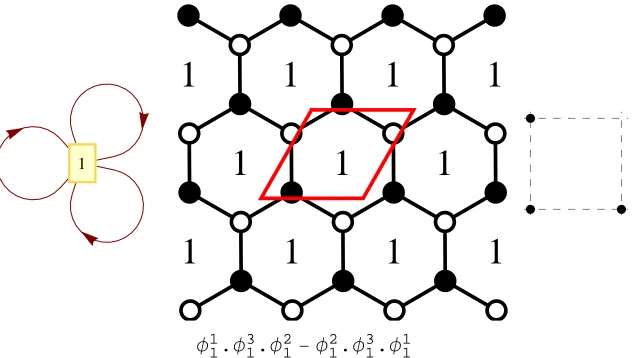
we capture the field content of the N = 1 SCFT and the terms in the superpotential. The canonical example of N = 4 super-yang-Mills theory is, in fact, representable as a dimer model. In Figure 1, we illustrate the above rules diagrammatically with this important
case. The “clover quiver” with the three adjoints φ11,2,3 is shown at the far left (the subscript
1 is to emphasize that all these three fields are charged under the group corresponding to
face “1” in the dimer model, shown in the middle. To the right, we include the planar
toric diagram for C3 for completeness. Below the diagrams we show the famous trivalent
superpotential. To this theory and many more we shall shortly return.
2.1
Physical origin of the dimer
The existence of an underlying torus may at first seem mysterious and was initially forced
upon us by the curious fact that for all toric quiver gauge theories we have
Out[7]=
1
1
1
1
1
1
1
1
1
1
1
1
Φ11.Φ 1 3.Φ
1 2- Φ
1 2.Φ
1 3.Φ
[image:7.612.153.469.71.250.2]1 1
Figure 1: The quiver, dimer and toric diagram forN = 4super-Yang-Mills theory in 4-dimensions, corresponding to the toric Calabi–Yau threefold C3.
HereNW is the number of monomials in the superpotential, NE is the total number of fields,
and NG is the total number of gauge group factors. In the dimer, these are, respectively,
the number of nodes, edges, and faces in the fundamental region. Of course, we recognize
this as the Euler relation for a genus one Riemann surface, whence the torus. The physical
motivation of the dimer construction, whereby explaining why AdS5/CFT4 should obey this
topological condition was expounded in [6]. The answer turns out to be mirror symmetry.
We know that upon mirror symmetry, the original IIB setup of D3-branes at the tip of the
Calabi–Yau coneMgets mapped to a system of intersecting D6-branes on the mirror Calabi– Yau W. The mirror W is given by the following complete intersection in C[x, y, u, v, z]:
u v =z , P(x, y) =z , z ∈C , (2.2)
where P(x, y) is the Newton polynomial of the toric diagram of the M. This polynomial is constructed starting from the toric diagram of the CY3, which we recall is a collection of
lattice two-vectors{(pi, qi)} ∈C2. Then the Newton polynomial is given by
P(x, y) = X
{points in toric diagram}
aixpiyqi , (2.3)
where the ai are complex numbers parameterizing the complex moduli of W, and hence the K¨ahler moduli of the originalM.
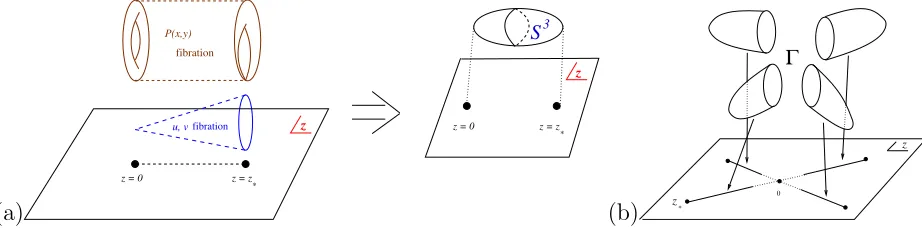
to{u, v} → {ei θu, e−i θv}; obviously this U(1) collapses at z = 0. The surface Σ
z develops singularities at some critical points z∗ = zicr where ∂xP = ∂yP = 0. At these points zcri , a one-cycle of Σz pinches off. Hence, over the segment on the z-plane joining z = 0 and zicr
there is a U(1)2, which is pinching off at the ends in a certain way. This is topologically
anS3 where the D6-branes are wrapped. There will be one S3 for each critical point of Σ
z, which meet at the point z = 0. This is illustrated in part (a) of Figure 2. The dimer itself
is then the intersection of these S3 cycles at the origin of the z-plane, as some finite graph
Γ; this is shown in part (b) of the figure.
(a)
z = 0
S3
z = z *
z = z *
u, v z
z fibration
P(x,y)
fibration
z = 0
(b)
z Γ
0 z
[image:8.612.75.536.233.347.2]*
Figure 2: (a) The mirror of the Calabi–Yau threefold as a double fibration over C. (b) The S3
cycles meet at the origin in the z-plane on a finite graph, which is the dimer model.
From the expression of the Newton polynomial P(x, y), it is clear that each monomial on
P specifies a U(1) as (x, y) →(e−i qiθx, ei piθy), which can be seen as follows. The critical
points (xcr, ycr) satisfy
dP(x, y)|(xcr,ycr)= 0 =⇒
X
i
aipiycrxpcriycrqi = 0 ,
X
i
aiqixcrxcrpiyqcri = 0 . (2.4)
Thus, for each monomial we can find a critical point by setting −qixcr +piycr = 0, hence finding on the (x, y) plane a complex line with a slope given by (pi, qi). Since x and y
are complex variables, there is a T2 associated to their phases in the natural way (x, y) =
(rxei θx, ryei θy) → (θx, θy). Each monomial therefore defines a one-cycle winding on T2 as specified by (pi, qi), and this one-cycle serves as base for a cylinder which develops around
each critical point of P.
As discussed above, the critical points in turn correspond to D6-branes. This thus serves
as a natural way to identify their winding on Σ0. In fact, recalling that the so-called (p, q
)-web is the graph dual to the toric diagram, as it was realized as far back as [9], Σ0 is nothing
but the thickened (p, q)-web associated to the CY3. In the language of [6], the (p, q)-web is
natural to consider their projection to the T2 defined by (θ
x, θy). This defines the so-called alga map, and it indeed shows the dimer in an explicit way [6].
It was later understood [10] that the construction in [6] can be related to a brane tiling
of aT2. This can be heuristically understood starting with the original IIB configuration of
N D3-branes probing a toric CY3 and performing two T-dualities along two coordinates of
the toric fiber. As the toric fibers shrink somewhere on the base, these T-dualities produce
a certain arrangement of NS5-branes winding around the torus. In turn, the D3-branes will
map into branes wrapping the torus. However, as is well-known, NS5-branes and
D5-branes must join into (p, q) five-branes running at certain angles in the web plane so as to
preserve supersymmetry. Thus, the system of NS5-branes and D5-branes become a tiling of
the T2. It turns out that the (p, q) five-branes separating diverse regions of the tiling do
form the (p, q)-web of the CY3.
Indeed, these two pictures above are related by T-duality: byT-dualizing the collapsing
S1 in the {u, v} plane in the construction of [6], the D6-branes get mapped to D5-branes.
But, as the S1 is collapsing,T-duality produces a configuration of NS5-branes following the
(p, q)-web, thus recovering the picture in [10]. For excellent reviews with further details we
refer the reader to [11, 12]. As described in [12], the gauge theory can be read off from the
brane system directly.
2.2
R-charges and
τ
ROur discussions above identify the dimer topologically as living on a T2 part of the T3
fibration in mirror symmetry. We can further fix this torus, and this distinguishes the
so-called isoradial embedding of the dimer.
Now, the R-charges of the fields in the theory are determined through the standard a
-maximization procedure [13]. First of all, we demand that the sum of the R-charges of fields
that appear in a monomial in the superpotential is two; this is just so that the Lagrangian
is well-defined when written as a superspace integral:
X
around each vertex
Ri = 2 . (2.5)
Secondly, associated to each face of the dimer is a gauge group, whose β function is
βG =
3N
2(1− g82πN2)
2−
X
around each face
(1−Ri)
and which vanishes for conformality. The Ri in the expression is an R-charge of a field
in fundamental or antifundamental representations of G.∗ Subject to these constraints, we maximize the central charge
a = 3 32 3
X
i
(Ri−1)3−
X
i
(Ri−1)
!
, (2.7)
whereby fixing the values of all the R-charges of all the fields in the gauge theory.
With these R-charges, we can fix the dimer (and hence the torus). First, we draw lines
drawn from the center of each face to a vertex to be of unit length. This is called anisoradial
embedding because now each face is inscribed by a unit circle. There is a moduli space of
such embeddings.
Now, the R-charge of a field, which is an edge in the dimer, is geometrically interpreted
as the angle at the origin of each unit circle subtended by the equilateral triangle defined by
the edge: θi =πRi. In this way, condition (2.5) is just that as we circumnavigate any of the
vertices the angle sum is 2π, and thus the dimer is truly planar. Similarly, condition (2.6)
dictates that lines joining all centers of faces prescribe rhombi and we have a rhombus tiling
of the plane. Furthermore, the length of an edge is easily seen as 2 cosπ2Ri.
WithRi being the R-charge of the associated field as determined by a-maximization, we
select a particular dimer from the moduli space of the isoradial dimers [14]. The complex
structure parameter of the dimer drawn in this way is τR. We will hence forth use this
particular complex parameter from the field theory.†
2.3
Special Lagrangian fibrations and
τ
GThe object of our investigation is to explicitly identify the T2 on which the dimer lives.
As briefly reviewed above, this T2 is topologically identified with the complex structure of
the Newton polynomial in the mirror, or, equivalently, with the T2 where the brane tiling
lives. In order to make the identification more precise, let us focus on the mirror symmetry
transformation of [6].
As described in [8], mirror symmetry on toric Calabi–Yau threefolds can be understood
∗As usual, adjoints are regarded as both a fundamental and an antifundamental field and counted twice. † A bipartite graph on a torus
T2 can be encoded in terms of a Belyi pair, consisting of an elliptic curve
Σ1 together with a holomorphic map β : Σ1 → P1 branched over three points on the P1 [15]. The elliptic
curve that is the source for this map has its own complex structure parameterτB. ForC3 and the conifold
as fiberwise T-duality on the original CY3.‡ Following this inspiration, in our non-compact
setup, we are instructed to regard the CY3 as a special Lagrangian (SLag) fibration. Recall
that the SLag cycleLin a CY3is a middle-dimensional manifold (i.e., a three-cycle) satisfying
Im (PL[Ω] ) = 0 , PL[ω] = 0 , (2.8)
where Ω and ω are, respectively, the holomorphic three-form and the K¨ahler form of the
CY3 and PLdenotes the pull-back onto the SLag cycle. It is then natural to regard the CY3
itself as a fibration
f : CY3 →R3 (2.9)
over R3 such that each fiber is a SLag cycle.
Our geometries, being toric, admit the action of an U(1)3. However, only a U(1)2
sub-group will leave invariant Ω and ω. It is then natural to concentrate on SLag fibrations
invariant under this U(1)2. Then, we can piece together the pictures of [6] and [10]: T
-dualizing this U(1)2 will lead to the brane tiling of [10], while a further T-duality will be
analogous to mirror symmetry and take us to the picture in [6]. This is in fact summarized
in Figure 82 of [12]. This further suggests that the U(1)2 defining the SLag also defines the
T2 on which the dimer lives, the object of our primary interest.
Due to the U(1)2 invariance, we can be more precise in defining our SLag fibration, which
is defined in terms of the moment maps µi of the twoU(1) actions as f = (f0, µ1, µ2)∈R3.
The f0 is a “generalized moment map” for Ω, appropriately chosen so that it ensures that
the fibration is SLag; we will define this more precisely for explicit examples later.
The U(1)2 defining the SLag will generically collapse in a certain way onR3. The generic
fiber over a collapsing locus is topologically R+×T2. Seen on
R3, these form a set of lines
supported on a R2 (on the plane x
1 = 0 in R3) that in fact coincides with the (p, q)-web
on the Calabi–Yau. The lines forming the web meet at a single point at the origin of R2,
where the fiber is in fact metrically a torus over T2. At this point, the collapsing torus
coincides with the U(1)2, which leaves the SLag invariant. Hence, it is the point we will be
most interested in understanding. ThisT2 is naturally identified with the elliptic curve that
supports the dimer. By pulling back the CY3 metric to thisT2, we will be able to compute
its associated complex structure, which we will call τG, and which we will use to compare
with the many field theory τR computed in [7].
‡ To the best of our knowledge, this is however still a heuristic picture in that its precise mathematical
characterization remains to be fully understood. Besides, our Calabi–Yau is non-compact, which adds a
In summary, given the toric CY3, we follow the following algorithm:
• find the metric where possible;
• explicitly identify the SLag from the coordinates;
• find the U(1)2-invariant part of the SLag from the moment maps; this should be the
torus on which the dimer lives;
• pull back the metric to this torus and compute its complex parameter τG
• compare with τR from the isoradial dimer.
3
Example:
C
3Let us begin with the simplest example, C3. The dimer model is that of N = 4
super-Yang-Mills, as described in Figure 1. In a physics related context, a detailed discussion can be
found in [17].
We now follow the prescription of [18]. Letting the complex coordinates of C3 be z 1,2,3,
the holomorphic three-form and the K¨ahler form are simply
Ω =dz1∧dz2 ∧dz3 , ω= i
2
3 X
i=1
dzi∧dz¯i . (3.10)
The U(1)3 toric fiber is generated by the rotations z
i → ei θizi. However, it is clear that only a two-dimensional subspace, namely a U(1)2, will leave invariant both Ω and ω. We
can choose
U(1)1 : (z1, z2, z3) → (ei θ1z1, z2, e−i θ1z3)
U(1)2 : (z1, z2, z3) → (z1, ei θ2z2, e−i θ2z3) (3.11)
as the U(1)2 action. Note that the fixed points of the U(1)2 are z
1 = z3 = 0, where U(1)1
collapses;z2 =z3 = 0, whereU(1)2collapses, andz1 =z2 = 0, whereU(1)1−U(1)2 collapses.
The moment maps associated to U(1)1,2 are, respectively,
µ1 =|z1|2− |z3|2 , µ2 =|z2|2− |z3|2 . (3.12)
Then, the SLag fibration reads
where the first entry has been chosen so that every fiber is SLag. Indeed, f maps the
non-compact CY3, here just C3, to R3 and the fibers are R×U(1)2.
Let us now look at the fixed loci, as mentioned above. These are the following:
• S1: U(1)1 collapses and the fixed loci are z1 =z3 = 0. Thus,
f = (0, 0, x) , x∈R+ ; (3.14)
• S2: U(1)2 collapses and the fixed loci are z2 =z3 = 0. Thus,
f = (0, x,0) , x∈R+ ; (3.15)
• S3: U(1)1−U(1)2 collapse and the fixed loci are z1 =z2 = 0. Thus,
f = (0, −x, −x), x∈R+ . (3.16)
Defining the set P Q = S1 ∪ S2 ∪ S3, we can readily construct the (p, q)-web for C3.
This is just given by the three directional vectors in the above, viz., (0,0,1), (0,1,0) and
(0,−1,−1). Indeed, this is just the planar graph dual to the toric diagram given in Figure 1, illustrating our discussion above that the collapsing cycles should give the spine of the
amœba.
Topologically, every SLag fiber is a cone over a T2. However, there is a special fiber at
the center z1 = z2 = z3 = 0 of the (p, q)-web which is metrically a cone over a T2. This
follows because at the origin of the webf = 0, a scaling symmetryf →λ f appears. As this is the point over which all legs of the web meet, this is the fiber whose T2 is the subject of
our investigation. As explained above, this is where the dimer should reside. Let us denote
this special fiber asL0. It is fairly easy to see explicitly.
Writing zi =rieiψi, the origin of the web is at
ψ1+ψ2+ψ3 = 0, π ; r1 =r2 =r3 =r . (3.17)
In order to manifestly exhibit the conelike structure, we now note that theC3 metric can be
written as
ds2 =
3 X
i=1
(dri2+ri2dψi2) . (3.18)
Introducing ρ=√3r and using (3.17), the pull-back of the metric toL0 is
ds2 =dρ2+1 3ρ
2hdψ2 1 +dψ
2
2 + (dψ1+dψ2)2 i
where the cone structure of C3 is now apparent: ρ is now the lateral side of the cone, and
the base is the T2 whose metric is
ds2
T2 =
1 3
h
dψ12+dψ22+ (dψ1+dψ2)2 i
. (3.20)
Our proposal, as discussed in the previous section, is that this T2 is where the dimer
lives. What is its complex structure? We can easily determine it and refer the reader to
Appendix A on how to find theτ-parameter in general. Our metric in (3.20) corresponds to
the case in the appendix whereA =B =C = 23 and we readily obtain the complex structure
τG= 1 2
1 +i√3=eiπ3 . (3.21)
Very nicely, this exactly matches τR from the isoradial embedding (cf. [15]).
3.1
An alternative point of view
In order to better understand the physics as well as the mathematics, let us do the same
computation forC3 in a slightly different language, which we will later use to compute more
complicated examples. The space C3 can be thought of as a cone over S5, which in turn is
a U(1) bundle over P2. In order to see this, let us introduce
z0 =r cosφ1eiχ , z1 =r sinφ1 cos φ2
2 e
i2χ+ψ+φ3
2 , z2 =r sinφ1 sinφ2
2 e
i2χ+ψ−φ3
2 , (3.22) so that 2 P i=0
|zi|2 =r2. The homogeneous coordinates on P2 are given by ˆz1 = zz10 and ˆz2 = zz20.
The range of the coordinates here is φ1 ∈ [0, π2], φ2 ∈ [0, π], and φ3 ∈ [0, 2π], while ψ ∈ [0,4π] and χ ∈ [0, 2π].
By substituting the angular expressions (3.22) into the standard expressions for the C3
metric, K¨ahler form, and holomorphic form it is straightforward to construct the
correspond-ing expressions in angular coordinates. Specifically, we have that
ds2 = (dχ−A)2+ds2P2 , (3.23)
where
A =−1
2 sin
2 φ1
dψ+ cosφ2dφ3
(3.24)
and
ds2
P2 =dφ 2 1+ 1 4 sin 2φ 1 h
cos2φ1
dψ+ cosφ2dφ3 2
+dφ22+ sin2φ2dφ23 i
Na¨ıvely, the relevant U(1)2 is given in terms of {∂
φ3, ∂ψ}. In fact, the center of the SLag
is now given by φ2 = π2, φ1 = 21 arccos13 and ψ =−3χ. Taking the pull-back of the metric
we find
ds2c = 1 6
dφ23+ 3dχ2 , (3.26)
which clearly does not yield the correct τ. This is due to somewhat subtle global issues that
we have not taken into account.
Let us first start by noticing that for fixedφ1, in theP2 base we find, using (3.25), locally
anS3. The T2 is written in terms of the ϕi angles defined by
ψ = 2ϕ1+ϕ2 , φ3 =ϕ2 , (3.27)
so that
∂ϕ1 = 2∂ψ , ∂ϕ2 =∂ψ+∂φ3 . (3.28)
See, e.g., Section 4 of [19].
Writing the zi as zi = riei ψi, the toric T3 is nothing but the three ψi coordinates. In
terms of the ϕi, the transformation reads
ψ1 =χ , ψ2 =χ+ϕ1+ϕ2 , ψ3 =χ+ϕ1 , (3.29)
or, in matrix form
ψ1 ψ2 ψ3 =M χ ϕ1 ϕ2
, M =
1 0 0
1 1 1
1 1 0
. (3.30)
Note that detM =−1, so this is an SL(3, Z) transformation.§ Thus, we see that the set of coordinates (χ, ϕ1, ϕ2) are a good global basis for the toricT3 as well as the T2.
In terms of these coordinates the metric at the center of the SLag is
ds2c = 2 9
dϕ21 +dϕ22+dϕ1dϕ2
, (3.31)
which leads to the expected τG=τR= exp(πi3).
§ The overall sign is just due to orientation. Upon simply sendingχ to −χ we would recover the unit
4
Example: the conifold
Encouraged by the success of the matching for the simplest case of C3, let us now look at
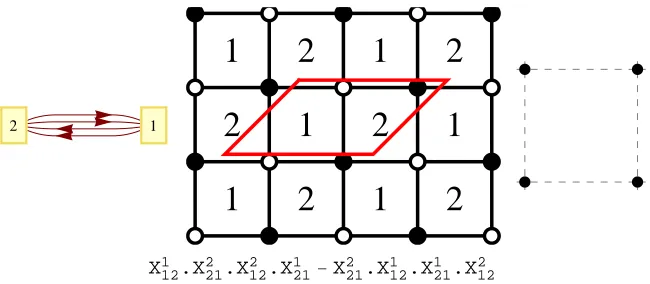
a more involved example, namely the conifold theory. For reference, the quiver, dimer, and
toric diagram are given in Figure 3.
Out[3]=
L111 HconifoldL
1 2
1
2
1
2
2
1
2
1
1
2
1
2
X121 .X 21 2 .X
12 2 .X
21 1 -X
[image:16.612.144.469.168.310.2]21 2 .X 12 1 .X 21 1 .X 12 2
Figure 3: The quiver, dimer and toric diagram for the conifold theory. The quartic superpotential is given underneath.
The metric for the conifold is the earliest known example for a (non-compact) Calabi–Yau
manifold [20]:
ds2 =dr2 +r
2 9 g 2 5+ r2 6 X
i=1,2
e2θi +e2φi, (4.32)
where we have defined
g5 =dψR−cosθ1dφ1 −cosθ2dφ2 , eθi =dθi , eφi = sinθidφi . (4.33)
Hereφi ∈ [0, 2π],θi ∈ [0, π], andψR ∈ [0, 4π]. By forming the following combinations
e1 =eiψR
dr+ir
3g5
, e2 = r
√
6
eθ1 +i eφ1
, e3 = r
√
6
eθ2 +i eφ2
, (4.34)
we see that the metric is just ds2 =P3
i=1
|ei|2, so that the K¨ahler and top holomorphic forms take the standard C3 form. In particular, the K¨ahler form is
ω = i 2
X
ei∧¯ei =
r
6
2dr∧g5+r eθ1∧eφ1 +eθ2 ∧eφ2
. (4.35)
Therefore, as we have done above, we can find the U(1)2 invariant part of the
T3 with
maps, which read
µφ1 =−
r2
6 cosθ1 , µφ2 =−
r2
6 cosθ1 . (4.36)
The SLag sits at µφi =xi, where xi are real constants. However, since we are interested
on the center of the (p, q)-web, we can set xi = 0, that is, θi = π2. Furthermore, we have
Ω ∼ ei ψR when substituting (4.34) into e
1 ∧e2 ∧e3. This just shows that ψR is identified with the field theory R-symmetry. The SLag condition demands that ψR= 0.
In summary then, we find, upon taking ψR = 0, dr = 0, andθ1 = θ2 = π2 both moment
maps vanish while Im Ω = PL[ω] = 0. Thus, this corresponds to the U(1)2-invariant SLag
at the center of the web where the dimer should live. The pull-back of the metric there is
ds2T2 =
r2
6
dφ21+dφ22 , (4.37)
which is just a square torus, so we find τG =i. Note that in this case there are no further
global issues, as{∂φi}do indeed cover a torus.
¶ Once again, the geometric complex structure
τGso obtained is the same as the complex structureτRof the isoradial dimer with edge lengths
fixed by the R-charges [15].
5
Orbifolds
An immediate consequence for the above examples is that we can directly compute the τG
for all their orbifolds. As the local form for the metric will be unaffected by the orbifolding
procedure, we can just borrow the study of the SLag submanifolds from the unorbifolded
geometries. However, the global analysis will be different, as orbifolding will change the
periodicity of the angles. The simplest example is the non-chiral orbifold of the conifold,
which corresponds to taking φ1 ∈ [0, π]. We can borrow the above result (4.37) provided
we redefine φ2 = ˜
φ2
2 so that ˜φ2 ∈ [0, 2π] so that we can use the formulæ in the appendix.
The metric is then
ds2T2 =
r2
6
dφ21+ 1 4d
˜
φ22, (5.38)
which leads to τG = 2i. This is precisely the expected result along the lines of [15, 16].
Moreover, from here, it is immediate that the orbifold pattern for τG will follow the dimer
¶ Strictly speaking, the globally well-defined Killing vectors are ∂
φi+∂ψR, but for our purposes we can
pattern forτR, and so if the unorbifolded space agrees, all higher orbifolds will also show the
τR=τG agreement.
6
Y
p,qand
L
a,b,cmanifolds
The examples above indicate that global issues should be relevant when tackling more
in-volved manifolds, such as theYp,q spaces constructed in [19] and theLa,b,cspaces constructed
in [19, 21]. Instead of considering local expressions for the metrics where in the above we
encountered subtleties involving the well-definedness and periodicity of the angular
coordi-nates, we will use the more powerful approach based on the symplectic structure of these
manifolds that was developed in [22].
6.1
Symplectic coordinates
The key observation is that, upon introducing suitable coordinates {yi, φi}, the metric can be encoded in terms of a symplectic potential G=G(y) such that
ds2 =Gijdyidyj +Gijdφidφj , (6.39)
where
Gij =
∂2G
∂yi∂yj . (6.40)
Furthermore, the K¨ahler form reads
ω =dyi∧dφi , (6.41)
while the top holomorphic form is
Ω = ei φ1· · · . (6.42)
We must set φ1 = 0 so that Im Ω = 0, while the U(1)2 will be generated by ∂φ2 and ∂φ3.
These are globally well defined, and the associated moment maps are µ2 =y2 and µ3 =y3,
respectively. The center of the web will sit at y2 =y3 = 0. Thus, in all, the U(1)2-invariant
sub-torus of the SLag at the origin will be given by the metric:
dsT2 =GIJ(y2 =y3 = 0)dφIdφJ , I, J = 2, 3. (6.43)
We are left with the rather non-trivial task of constructing the symplectic potentials G.
Luckily this problem has been solved in [22] and [23], where it is shown thatGcan be entirely
constructed from the toric data and must be of the form
G=Gcan+Gb+g , (6.44)
where Gcan is related to the canonical part of the metric as in [24], Gb is associated to
Reeb vector moduli described in [22], and g is a remainder function that is a homogeneous
and degree one rational function in the y coordinates. In particular, g satisfies a Heun
equation found in [23]. Note that for the geometric analog of a-maximization, viz. volume
minimization, the g drops out and plays no rˆole. As we shall see, however, in the case at
hand, it has crucial significance.
6.2
Warmup:
Y
p,qLet us begin with the simpler case of theYp,qspaces. The dimer model and hence the quiver
and superpotential are nicely given in [5] and the isoradial τR were listed for a few cases
in [7]. As one can see, the theories are already very complicated, and τR typically lives in
highly non-trivial field extensions of Q.
Let us now use the notation of [23] and use the toric diagram defined by the following
outward normal lattice vectors — one can check that these vectors are actually co-planar,
as required for a Calabi–Yau:k
{v1 = (1,−1,−p) , v2 = (1,0,0), v3 = (1,−1,0) , v4 = (1,−2,−p+q)}. (6.45)
Moreover, one defines the quantities
`= q
3q2−2p2+pp4p2−3q2 , B ={3,−3,−
3
2(p−q+
`
3)}, v5 =B−v1−v3, v6 =−v2−v4 , (6.46)
where B is the Reeb vector after Z-minimization.∗∗
kWe emphasize that we have given the normals rather than the actually vectors of the toric diagram,i.e.,
we are describing the (p, q)-webs.
∗∗As acaveat lector, we remark that in [22] the coordinates{(1,0,0),(1−, p−q−1, p−q),(1, p, p),(1,1,0)}
are used; we can see that the two are related by anSL(3;Z) transformation. The ones in (6.45) can be taken
to these by, for example,A=
1 0 0
−1 −1 1 0 q−p p−q−1
Using these data, we can readily determine the symplectic potential to be
G(y1, y2, y3) =
1 2
6 X
i=1
A·vi·(y1, y2, y3)T log
A·vi·(y1, y2, y3)
T
, (6.47)
where we have used the matrix A to rotate to [22]. We stress that this is the form for the
full symplectic potential as found in [23], including in particular the remainder function g.
The latter is associated to the v5 and v6 vectors, and so dropping them would only lead to
the Gcan+Gb piece.
From this, as explained above, we can find the metric of the required torus to be the
I =J = 2,3 submatrix of
GIJ =
∂G ∂yi∂yj
−1
y2=y3=0
. (6.48)
From this expression and Appendix A, we can determine the τG.
Let us tabulate some of the results below:
τG(Y1,0) = i , τG(Y2,0) = 2i , τG(Y3,0) = exp( 2πi
3 ) , τG(Y
4,0) = 2i , τ
G(Y2,2) = 2i
√
3 .
Comparing with the known results forτR, we find exact agreement. This should not surprise
us given our success in the previous sections. The spaces Yp,0 are simply
Zp orbifolds of the conifold, and Y1,0 is just the conifold. The space Yp,p are cones over lens spaces and are
simply the quotient C3/
Z2p. As orbifolds of the geometries that we have explicitly studied above, it is guaranteed that τG = τR. At this point, it is interesting to recall that for the
geometric counterpart of a-maximization the remainder function g does not play any role
and simply drops. On the contrary, in our case we generically do explicitly need the full
form of the symplectic potential — i.e., including g. More explicitly, while for the conifold
and its orbifolds, g plays no role, for the Yp,p spaces we find the correct result only upon
considering the full Gincluding g.
What about something non-symmetric like Y3,1? We find that
τG(Y3,1) = −1 + 13i
r
2 +
q 11
3 ,
τR(Y3,1) =−12i
1−2 cosq11 3π
+ 2 cos2q11 3 π
+ 2 cos √33π
csc √33π
.
(6.49)
These are glaringly different expressions. Can they be related to each other anSL(2;Z)
the Kleinj-invariant for both cases.†† We obtain that, numerically,j(τG(Y3,1))'8.3796 and
j(τR(Y3,1))'8.4126. These are rather close real numbers, and given the complicated nature of thej-invariant, and the agreement in the other cases, this can not be a mere coincidence.
Let us for now bear this discrepancy in mind and accumulate more data.
6.3
L
a,b,c, an extraordinary puzzle
The next infinite family of affine Calabi–Yau manifolds well-known to the AdS/CFT
com-munity is the La,b,c toric spaces [25, 26]. We again follow the nomenclature of [23]. The
symplectic potential can be computed starting with the outward pointing normal primitive
vectors forLa,b,c:
v1 = (1, 1,0) , v2 = (1, a k, b) , v3 = (1, −a l, c) , v4 = (1, 0, 0), (6.50)
wherek, lare integers such thatk c+b l= 1. The Reeb vectorB is found by the minimization
technique described in [22]; this is a vectorB = (3, b2, b3) which minimizes the functional
Z(b2, b3) =
1 24
4 X
i=1
det({wi−1, wi, wi+1})
det({B, wi−1, wi}) det({B, wi, wi+1})
, (6.51)
wherew1,2,3,4 =v1,2,3,4 and cyclically,w0 =v4,w5 =v1, and where the notation det({a, b, c})
means the determinant of the matrix constructed by arranginga, b, c as its rows.
The extremization will give some rather complicated quartics in b2 and b3, which we
solve. Finally, introducing
v5 =B−v1−v3 , v6 =B−v2−v4 , (6.52)
for the extremized B values, we obtain the full symplectic potential (6.44), including the
summand g, in terms of coordinates y = (y1, y2, y3),
G= 1
2hB, yi loghB, yi+ 1 2
3 X
m=1
hv2m−1, yi log|x¯−x¯m|+ 1 2
3 X
m=1
hv2m, yi log|y¯−y¯m|, (6.53)
where h·, ·istands for the usual Cartesian product and
¯
x1 =−
det({v1, v5, v6})
det({v3, v5, v6})
, x¯2 = 1 , x¯3 =−
det({v1, v5, v6})
det({v1, v3, v6})
, (6.54)
¯
y1 = 1 , y¯2 =−1 , y¯3 = β+α
β−α , (6.55)
††Strictly speaking, we compute Klein’s absolute invariant, without the conventional 1728 prefactor so
where
α= 1 + det({v2, v3, v4}) det({v3, v4, v6})
, β = 1 + det({v2, v3, v4}) det({v2, v3, v6})
. (6.56)
Finally, x and y are implicitly defined by the equations
hv2, yi=
hB, yi
2α (α−x¯) (1−y¯) , hv4, yi=
hB, yi
2β (β−x¯) (1 + ¯y) . (6.57)
Now, we have that La,a,a =Ya,0, the orbifolds of the conifold (the simplest caseL1,1,1 =
Y1,0 is just the conifold, where we recovered above the expected result τ
G =i). Indeed, for the highera cases, we also haveτG=τR. For these cases, as described above, the remainder
functiong does not play a rˆole, and in fact with justGcan+Gb, we can reproduce this result.
However, moving to the next simplest case Yp,p, the orbifolds of C3, we in fact have need
the functiong to match τR and τG. Indeed, once we know the SLag fibration structure for a
certain CY3, its non-chiral orbifolds immediately follow. By construction, these correspond
to changing the period of the T2 coordinates. Hence, we find that the complex structure
of the relevant T2 follows the same pattern as in [16]. As remarked above, knowing that
τG=τRforC3 and the conifold, it is not a surprise that the same applies to their symmetric
orbifolds.
Let us now move to a less symmetric and new example, namely that of L1,2,1, otherwise
known as the suspended pinched point (SPP). This corresponds to D3-branes on the
gen-eralized conifold with the defining equation xy = uv2. Using the procedure above, we find
that the geometric τG of SPP is
τG =− 1 2 +
i
2
q
3 (2 +√3) =⇒ j(τG)≈ −20.8416. (6.58)
Luckily the analytic expression for the complex structure of the isoradial dimer has been
computed from field theory [15]. It turns out that the La,b,a subfamily has fields with
R-charges [27]
R(u1) =R(y) =
1 3
b−2a+w
b−a , R(u2) =R(z) =
1
2R(v1) = 1 3
2b−a−w
b−a , (6.59)
where w=√a2+b2−ab. Defining χ
i = exp(iπ2R(ui)), we compute [15]
τR=
(χ1+χ−11)(1 +χ
−2 2 ) b(χ1+χ−11)χ
−2
2 −a(χ2+χ−21)χ1χ2−(b−a)(χ22+χ
−2 2 )χ1
. (6.60)
ForL1,2,1, we find
τR(L1,2,1) = 1 2i
i+ 2 tan
π
2√3
+ cot
π
2√3
and hence j(τR) ≈ −20.3559. Thus, once more we find the remarkable proximity between
j(τG) and j(τR).
We can at this point ask ourselves whether all this is due to numerical error. After
all, Klein’s invariant j-function is a complicated non-linear function of its argument. To
settle this matter, we recall the discussion in Section 7 of [15]. Making use of the four
exponentials conjecture, it was argued that τR for SPP arising from the dimer construction
is a transcendental number. For reference, we leave a detailed account of this proof for the
current case to Appendix B. On the other hand, it is clear from our discussion above that
whatever result we get from the geometrical construction, τG is going to be an algebraic
number simply because Gonly contains algebraic numbers and all subsequent manipulation
to find τG involve only algebraic (in fact, quadratic) functions. Now the j-invariant of two
complex numbers are the same if and only if the two numbers are related by an SL(2;Z)
M¨obius transformation τ 7→ aτ+b
cτ+d with ad−bc = 1 and a, b, c, d ∈Z. Therefore, clearly, an algebraic number can not have the same j-invariant as a transcendental one.
Thus, assuming the four exponentials conjecture is true — no counterexample to this
conjecture is known to exist and it is widely accepted in the mathematical community —
j(τG) and j(τR) cannot match in this case, and we exclude numerical errors. Nevertheless, it
is truly remarkable that the geometry gives a torus so close to the field theory one. Is there
a fundamental explanation for this discrepancy?
In order to quantify the difference between τG and τR, we focus on the L1,b,1 family. We
can prove analytically here that
Re(τG) =
b−1
2 , (6.62)
while Im(τG) lives in some high even-degree extension of Q. Nevertheless, (6.62) guarantees
thatj will at least be real.‡‡ By a further modular transformation, we can always put Re(τG) to 0 or 12. In turn, from the field theory side, τR will be very complicated transcendental
numbers. While the real part ofτ is of course not anSL(2,Z) invariant and therefore not in
itself a physically meaningful quantity, it may be convenient to set the real parts ofτRandτG
equal to each other via a modular transformation in order to facilitate a direct comparison of
the two. Quite surprisingly, theSL(2, Z) transformation with{a= 2, b= 1, c=−1, d= 0}
(plus repeated action with the T generator) brings the real part to the form
Re(τR) =
b−1
2 . (6.63)
‡‡ To see this, we need merely look at the Laurent expansion of thej-function in terms of q=e2πiτ. We
Hence, we are ensured that also the field theory j will also be real. Thus, we can, in
the precise sense described above, associate the discrepancy between τR and τG to a small
mismatch in their imaginary parts.
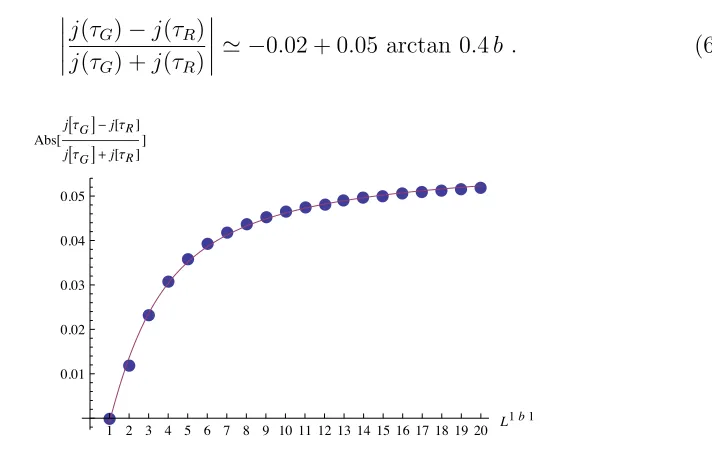
We can compare thej-invariant ofτG andτRforL1,b,1 for various values ofb. In Figure 4,
we plot the quantity of the absolute value of the ratio of differences and find a beautiful fit
to
j(τG)−j(τR)
j(τG) +j(τR)
' −0.02 + 0.05 arctan 0.4b . (6.64)
1 2 3 4 5 6 7 8 9 10 11 12 13 14 15 16 17 18 19 20 L
1b1
0.01 0.02 0.03 0.04 0.05 Abs@jA
tGE-j@tRD
jAtGE+j@tRD
[image:24.612.163.519.174.401.2]D
Figure 4: For the spaces L1,b,1, a measure of the difference between geometric torus, with
complex structure τG, and the QFT torus, with complex structure τR.
One interesting consequence is that the difference between τG and τR, at least for the
generalized conifold family under consideration, asymptotically saturates.
7
Conclusions and prospects
Dimer models have played a prominent role in the understanding of N = 1 SCFTs dual to D3-branes probing toric CY3 singularities. Their physical appearance was understood
in [6]. In particular, the torus where the dimer lives was identified. Our purpose in this
letter is to take this identification further and metrically identify the torus. Once the metric
is known, it is natural to compute the complex structure, which might be expected to match
the complex structure obtained from field theory considerations [7]. Indeed, this is the very
first step towards a full metric identification of the dimer from a geometrical perspective,
hoping for a deeper understanding of some of its still somewhat mysterious properties, such
In [15] the combinatorial properties of dimers were first explored. Since the dimer can
be encoded in a very economical way in three permutations — each capturing, respectively
black vertices, white vertices, and faces — through the Belyi theorem, it was argued that
all the information can in fact be encoded in a Belyi pair consisting on a “worldsheet” torus
together with a map from this “worldsheet” torus into a “target” P1 ramified only over
{0, 1, ∞} such that the ramification data reproduces in a specific sense the combinatorial structure. (For further details see [15].) The beauty of the Belyi construction is that the
existence of such map ensures that the worldsheet torus can be defined overQ. Furthermore,
this worldsheet torus is rigid, and so we naturally obtain, associated to each SCFT through
ths torus serving as worldsheet for its Belyi map, another complex structure parameter τB.
While in [15] it was speculated that τB might equal τR, it was further shown in [16] not to
be true. Thus, in view of our findings in this note, we have a triple of complex structures
assigned to each SCFT, namely{τR, τG, τB}. We have seen that, in a precise sense,τR∼τG. It remains to fully clarify the nature of this agreement/disagreement as well the hypothetical
connection to τB.
In our case, a very simple reasoning led us to propose a certain T2 arising from the
SLag fibration structure of the CY3 as that where the dimer lives. Indeed, for the simplest
cases we found the torus expected from the field theory arguments. Furthermore, we find
that this torus behaves in the appropriate way under orbifolding thus reproducing the field
theory patters for its complex structure. However, moving to generic geometries we found
this proposed torus to be almost but not exactly the expected one. Indeed, focusing on the
complex structure, we found that an “SL(2, Z) frame” exists where bothτR andτG have the
same real part, while the imaginary part differs by a very small amount. This is reflected
in a more SL(2, Z) invariant way in that the Klein j-invariants come to be surpassingly
close to each other. One must ask whether this discrepancy just signals that we have simply
identified the torus incorrectly. However, given the highly non-linear nature of the Klein
invariant, or the tiny discrepancy in only the imaginary part of the complex structure, it
would seem a cosmic coincidence to repeatedly have this almost matching purely by chance.
We note that the constructions in [6] and [10] lie, respectively, three and two T-dualities
away from the original IIB setup of D3-branes at the tip of the Calabi–Yau cone. This raises
the question as to which frame the T2 on which the dimer is drawn actually lives. Na¨ıvely,
two T-dualities would leave τ invariant up to an SL(2, Z) transformation, thus suggesting
that considering the original CY3 should be enough. In any case, this is the Calabi–Yau
to consider the original CY3 as it is only in this frame that we have an AdS5 space. Recall
that the complex structure of the T2 is fixed in field theory by the R-charges of the fields at
the SCFT point, which on the other hand matches volumes in the IIB geometry. However,
we stress that one possible reason for the disagreement might simply be that we are looking
to the wrong “duality frame.” At any rate, it is very surprising how close our “wrong torus”
comes. It is only slightly different in the imaginary part of the complex structure. This
demands an explanation.
Uncovering the nature of the reason for the small disagreement would be extremely
in-teresting. It seems one fundamental problem we face is that it is hard to find a “microscopic
quantification” of the disagreement. In other words, should we consider the Klein invariant
as we have done in the paper? Or should we rather consider some other modular invariant?
In fact, motivated by the fact that the τR comes in terms of transcendental numbers of
the form ei2π√3, one natural place to look for such corrections might be in terms of
instan-ton contributions. These would arise upon resolving the singularity at the tip of the cone
to introduce K¨ahler moduli. However, it is unclear what exactly those instantons would
contribute and what their exact nature is. We leave this very interesting problem open.
Acknowledgements
We wish to thank James Sparks for being generous with his time and offering important
insights into the geometric analysis. We are grateful to Amihay Hanany, Jurgis Pasukonis,
and Sanjaye Ramgoolam for collaboration on related topics. YHH would like to thank
the Science and Technology Facilities Council, UK, for an Advanced Fellowship and grant
ST/J00037X/1, the Chinese Ministry of Education, for a Chang-Jiang Chair Professorship at
NanKai University, as well as City University, London and Merton College, Oxford, for their
enduring support. YHH and VJ jointly acknowledge NSF grant CCF-1048082. The work of
VJ is based upon research supported by the South African Research Chairs Initiative of the
Department of Science and Technology and National Research Foundation. VJ as well thanks
Queen Mary, University of London and STFC grant ST/G000565/1 for supporting his work
during the early stages of this project. DRG is supported by the Aly Kaufman fellowship. He
also acknowledges partial support from the Israel Science Foundation through grant 392/09
and from the Spanish Ministry of Science through the research grant FPA2009-07122 and
A
Complex structures of tilted tori
Let us consider a generic T2. The most general form for its metric is
ds2 =A dφ21+B dφ22+C dφ1dφ2 . (A.65)
Massaging the expression converts this into
ds2 = 4A B−C
2
4B dφ 2 1+B
dφ2 + C
2B dφ1
2
. (A.66)
It is now convenient to introduce
ψ1 =
√
4A B −C2
2√B φ1 , ψ2 =
√
B φ2 (A.67)
whose identifications are ψi ∼ψi+ ∆i with
∆1 =
√
4A B−C2
2√B 2π , ∆2 =
√
B2π . (A.68)
In these coordinates,
ds2 =dψ12+dψ2+γ dψ1 2
, γ = √ C
4A B −C2 . (A.69)
This corresponds to a torus generated by
~
`1 = ∆1(1, −γ) , ~`2 = ∆2(0, 1). (A.70)
Hence,
τ = ∆1γ ∆2
(1 +i γ−1) . (A.71)
In terms of A, B, C we find
τ = C 2B
1 +i
√
4A B−C2 C
. (A.72)
B
The four exponentials conjecture
Thefour exponentials conjecture is one of the key consequences of Schanuel’s conjecture and
would constitute one of the most important results in number theory. It states that given
two pairs of complex numbers (x1, x2) and (y1, y2) such that each pair is linearly independent
over Q, then at least one of the numbers in the list
is transcendental.
Now, consider our case of L1,2,1. We have that
τR = 1 2i
i+ 2 tan
π
2√3
+ cot
π
2√3
= 1−3x
2
x4−1 , (B.74)
wherex= exp(i π
2√3). Noting that this is an algebraic (in fact, rational) function in the single
complex number x, it suffices to show that xis transcendental to imply that τR is also.
Let (x1, x2) = (1,2√13) and (y1, y2) = (πi,2πi√3), we form the list of three number (x
appears twice):
eπi =−1 , ei2√π3 =x , e πi 12 =
√
3 + 1
2√2 +i
√
3−1 2√2
!
. (B.75)
Now, the conjecture states that at least one of these must be transcendental and seeing the
first and last to be clearly algebraic,xmust thus be the transcendental one. Rewriting (B.74),
we have:
τRx4+ 3x2−(τR+ 1) = 0. (B.76)
If τR were algebraic, then x must be algebraic since Q is algebraically closed. Because x is
not algebraic assuming the four exponentials conjecture, the contrapositive applies and τR
must be transcendental.
References
[1] M. R. Douglas, B. R. Greene, and D. R. Morrison, “Orbifold resolution by D-branes,”
Nucl. Phys. B 506, 84 (1997) [hep-th/9704151].
[2] C. Beasley, B. R. Greene, C. I. Lazaroiu, and M. R. Plesser, “D3-branes on partial
resolutions of Abelian quotient singularities of Calabi-Yau threefolds,” Nucl. Phys. B
566, 599 (2000) [hep-th/9907186].
[3] B. Feng, A. Hanany, and Y. -H. He, “D-brane gauge theories from toric singularities
and toric duality,” Nucl. Phys. B 595, 165 (2001) [hep-th/0003085].
[4] A. Hanany and K. D. Kennaway, “Dimer models and toric diagrams,” hep-th/0503149.
[5] S. Franco, A. Hanany, K. D. Kennaway, D. Vegh, and B. Wecht, “Brane dimers and
[6] B. Feng, Y. -H. He, K. D. Kennaway, and C. Vafa, “Dimer models from mirror symmetry
and quivering amoebae,” Adv. Theor. Math. Phys. 12, 3 (2008) [hep-th/0511287].
[7] A. Hanany, Y. -H. He, V. Jejjala, J. Pasukonis, S. Ramgoolam, and D.
Rodriguez-Gomez, “Invariants of toric Seiberg duality,” Int. J. Mod. Phys. A 27 (2012) 1250002 [arXiv:1107.4101 [hep-th]].
[8] A. Strominger, S. -T. Yau, and E. Zaslow, “Mirror symmetry is T duality,” Nucl. Phys.
B 479, 243 (1996) [hep-th/9606040].
[9] O. Aharony, A. Hanany, and B. Kol, “Webs of (p,q) five-branes, five-dimensional field
theories and grid diagrams,” JHEP 9801, 002 (1998) [hep-th/9710116].
[10] Y. Imamura, H. Isono, K. Kimura, and M. Yamazaki, “Exactly marginal deformations
of quiver gauge theories as seen from brane tilings,” Prog. Theor. Phys.117, 923 (2007) [hep-th/0702049].
[11] K. D. Kennaway, “Brane tilings,” Int. J. Mod. Phys. A22, 2977 (2007) [arXiv:0706.1660
[hep-th]].
[12] M. Yamazaki, “Brane tilings and their applications,” Fortsch. Phys. 56, 555 (2008) [arXiv:0803.4474 [hep-th]].
[13] K. A. Intriligator and B. Wecht, “The exact superconformal R symmetry maximizes a,”
Nucl. Phys. B 667, 183 (2003) [hep-th/0304128].
[14] A. Hanany and D. Vegh, “Quivers, tilings, branes and rhombi,” JHEP0710, 029 (2007) [hep-th/0511063].
[15] V. Jejjala, S. Ramgoolam, and D. Rodriguez-Gomez, “Toric CFTs, permutation triples,
and Belyi pairs,” JHEP 1103, 065 (2011) [arXiv:1012.2351 [hep-th]].
[16] A. Hanany, Y. -H. He, V. Jejjala, J. Pasukonis, S. Ramgoolam, and D.
Rodriguez-Gomez, “The beta ansatz: A tale of two complex structures,” JHEP 1106, 056 (2011) [arXiv:1104.5490 [hep-th]].
[17] D. R. Morrison, “On the structure of supersymmetric T**3 fibrations,” arXiv:1002.4921
[math.AG].
[18] R. Harvey and H. B. Lawson, “Calibrated geometries,” Acta Mathematica 148, 47
[19] D. Martelli and J. Sparks, “Toric geometry, Sasaki-Einstein manifolds and a new infinite
class of AdS/CFT duals,” Commun. Math. Phys. 262, 51 (2006) [hep-th/0411238].
[20] P. Candelas and X. C. de la Ossa, “Comments on conifolds,” Nucl. Phys. B 342, 246 (1990).
[21] M. Cvetic, H. Lu, D. N. Page, and C. N. Pope, “New Einstein-Sasaki spaces in five and
higher dimensions,” Phys. Rev. Lett. 95 (2005) 071101 [hep-th/0504225].
[22] D. Martelli, J. Sparks, and S. -T. Yau, “The Geometric dual of a-maximisation for toric
Sasaki-Einstein manifolds,” Commun. Math. Phys. 268, 39 (2006) [hep-th/0503183].
[23] T. Oota and Y. Yasui, “Toric Sasaki-Einstein manifolds and Heun equations,” Nucl.
Phys. B 742, 275 (2006) [hep-th/0512124].
[24] V. Guillemin, “Kahler structures on toric varieties,” J. Differ. Geom. 40, 285, (1994).
[25] S. Benvenuti and M. Kruczenski, “From Sasaki-Einstein spaces to quivers via BPS
geodesics: L**p,q—r,” JHEP 0604, 033 (2006) [hep-th/0505206].
[26] A. Butti, D. Forcella, and A. Zaffaroni, “The Dual superconformal theory for L**pqr
manifolds,” JHEP 0509, 018 (2005) [hep-th/0505220].
[27] S. Franco, A. Hanany, D. Martelli, J. Sparks, D. Vegh, and B. Wecht, “Gauge theories