City, University of London Institutional Repository
Citation
:
Thurman, N. (2015). Journalism, Gatekeeping, and Interactivity. In: S. Coleman & D. Freelon (Eds.), A Handbook of Digital Politics. (pp. 357-374). Cheltenham: Edward Elgar. ISBN 9781782548751This is the accepted version of the paper.
This version of the publication may differ from the final published
version.
Permanent repository link:
http://openaccess.city.ac.uk/11850/Link to published version
:
http://dx.doi.org/10.4337/9781782548768Copyright and reuse:
City Research Online aims to make research
outputs of City, University of London available to a wider audience.
Copyright and Moral Rights remain with the author(s) and/or copyright
holders. URLs from City Research Online may be freely distributed and
linked to.
1
Journalism, Gatekeeping, and Interactivity
Neil Thurman, City University London
Gate-keeping is one of the most inclusive research traditions in the field of journalism
studies. In its investigations into the processes “by which the vast array of potential
news messages are winnowed, shaped, and prodded into these few that are actually
transmitted by news media (Shoemaker et al., 2001: 233) it accommodates political and
economic influences—as well as organizational routines and practices; the influence of
the audience, outside sources, and technology; and journalists’ individual characteristics
and collective professional values. However, changes in how technology and the
audience—individually and collectively—are taking on journalistic gate-keeping
functions; how established gate-keeping routines have changed in response to
information from the public and about their news consumption behaviour; and some of
the political and economic influences on gate-keeping in the online news environment
have not, yet, been fully reflected in the academic literature.
In this chapter I will discuss these technological and social influences on journalistic
gatekeeping by reflecting on my own research in these areas over the last decade or so.
The chapter begins with a review of the literature on gatekeeping as it applies to
journalism. I will then use the concepts of ‘adaptive’ and ‘conversational’ interactivity
to frame the discussions that follow on how technology and the audience are impacting
journalistic gatekeeping. The chapter concludes with a discussion of some of the
consequences of the full spectrum of forces—political and economic, as well as social
and technological—acting on contemporary, mainstream news producers; as well as
some suggestions for how they may better accommodate to those forces. Finally I give
some suggestions for future research in these areas.
Digital, networked media have made it possible for news publishers to give their
audiences a relatively high degree of control over the stories they consume and how
those stories are delivered and presented. Technology has also enabled publications to
2
unsupportable in the past. These technological affordances all come under the general
term, ‘interactivity’. It is useful, however, to distinguish between:
‘Navigational interactivity’, where the “user is allowed to navigate in a more or
less structured way through the site’s content” (Deuze, 2003),
‘conversational interactivity’ (Jensen, 1998), which allows the user to interact
with journalists and other users (Deuze, 2003), and
‘adaptive’ (Deuze, 2003) or ‘registrational’ (Jensen, 1998) interactivity, where a set of technological features adapt media content, its delivery and arrangement to
individual users’ explicitly registered and / or implicitly determined preferences
(Thurman, 2011).
This chapter will focus on the ‘conversational’ and ‘adaptive’ forms of interactivity.
Although the non-linear navigational structures of news websites and apps do change
the way audiences interact with journalism online, especially when compared with the
linearity of broadcasting, my own research has focussed—to a greater extent—on how
conversational and adaptive interactivity are influencing the gate-keeping processes that
determine whether information about an event will become a message, and whether an
audience member will pay attention to any resulting ‘news item’.
Journalistic Gatekeeping, an Overview
Kurt Lewin is credited with developing the concept of gate-keeping, initially in his work
on food consumption habits (1947). Lewin modelled the metaphorical ‘channels’
through which food travelled to reach the dining table, the ‘gates’ through which it had to pass (the ‘gate’ to the supermarket shelf, for example), and the ‘gate-keepers’ or ‘impartial rules’ that controlled those gates (such as supermarket buyers or personal dietary rules). Lewin’s theory included the concept of ‘forces’, which determine whether an item will pass through a gate. A positive force could be a food’s health benefits, a
3
Although Lewin suggested that gate-keeping could be applied to “the travelling of a
news item through certain communication channels” (1951), he did not live to apply his
concept in the domain of communication. That task fell, initially, to one of his former
research assistants, David Manning White, who analysed how a wire editor—whom he
called ‘Mr Gates’—decided which copy to include in the local US newspaper for which he worked. White found Mr Gates’ selection decisions to be “highly subjective” (1950:
386).
The investigation of possible psychological and cultural influences on such “subjective”
selection decisions has driven a number of subsequent gate-keeping studies. Galtung and
Ruge (1965), for example, famously proposed events were more likely to be
newsworthy to the likes of ‘Mr Gates’ if they had attributes such as: timeliness,
magnitude, clarity, cultural relevance, consonance with expectations, and novelty. A
considerable amount of work has also been undertaken on journalists’ personalities (see,
for example, Henningham, 1997) and backgrounds and how those characteristics might
influence the production of news content. Gans (1979), for example, suggested that
journalists practising in the US were guided by eight values including: ethnocentrism,
small town pastoralism, individualism, and moderatism; with information pertaining to
deviations from these values more likely to pass the gates than information that was
about behaviour consistent with the status quo.
Such personal characteristics are, of course, not the only ones that influence whether
‘information’ about an ‘event’ will become a ‘message’ or whether an audience member will pay attention to any resulting ‘news item’. Cognitive approaches have proposed that
communication that is concrete, emotionally interesting, and imagery-producing is more
likely to pass the gate (Nisbett and Ross, 1980: 45) and narrative structure—for
example, whether a news story is conventionally resolved (Bennett, 1988: 24)—may
also have an effect.
While White’s original study focused on a single “news processor”, later scholarship has
4
(Bass , 1969: 72)—such as writers, reporters, and local editors. And the early focus—by
White and others—on editors’ individual “subjectivity” has also been widened to
include organizational contexts and routines—including time pressures and production
constraints. Such routines have been shown to be a significant influence on gate-keeping
decisions, even trumping individual journalists’ characteristics (see, for example,
Cassidy, 2006). These “repeated practices” emerge, Shoemaker and Reese (1996) argue, from three sources: journalists’ sense of their audience, the newsroom culture and
organization in which they work, and their sources of news.
Audience volume and demographics should be important to gate-keepers in media
systems where the audience is a market and a product to be sold to advertisers.
However, some scholars have dismissed the notion that the audience could directly
influence gate-keeping decisions. Gieber (1960), for example, wrote that the selection of
news had “no direct relationship to the wants of readers”. News values have, Sumpter
(2000) and others have suggested, instead been influenced by journalists’ “construction”
of audience demand. Such views make some sense in light of the incomplete data
journalists have traditionally had about audience tastes, data which came from:
relatively small samples of TV and radio audiences, surveys based on readers’
(potentially fallible) recollections of what they had read, and circulation statistics that
relate to media artefacts in their entirety rather than the individual stories they contain.
Contemporary work—even that with the traditional media as its focus—has, however,
attributed the audience with greater influence (see, for example, Fahmy, 2005). And the
era of online news has ushered in new practices where websites are able to adapt to
audience demand in much more direct ways.
The second dimension in Shoemaker and Reese’s framework is newsroom culture and
organization. Factors here include ethical procedures, style guidelines, and the pressure
of deadlines. In relation to gate-keeping, deadlines, for example, have been shown to
influence what gets selected for inclusion (White, 1950) and the stories written by
reporters (Dunwoody, 1978). Journalists’ notions about their professional role may also
5
objectivity (Arant and Meyer, 1998) may have mitigated against the use of certain types
of sources—such as members of the public. Although the presence of other media in the
marketplace can in some circumstances lead to greater diversity, we have evidence
stretching back over 30 years of how media gate-keepers monitor and imitate one
another. Crouse wrote about this in 1972 in relation to political reporting, and
Boczkowski (2010) has described, in some detail, the culture of imitation in online
news. Such imitation may become more common as news organizations, their profit
margins falling and their news production moving online, decide to downsize (Paterson,
2001). The aspect of newsroom culture and organization that will be one of the two
main foci of this chapter is the technological change that has been taking place in news
detection, creation, packaging, and distribution. Whilst some—such as Williams and
Carpini (2004)—believe that such changes have prompted the “collapse of
gate-keeping” in the “new media environment”, others argue that there is a significant
continuity between the routines of online news sites and their print- or broadcast-parents
(Arant and Anderson, 2001).
Shoemaker and Reese’s third dimension is journalists’ sources. Although Bass (1969)
refined the gate-keeping concept by extending its scope beyond “news processors” to
“news gatherers”, his work did not, however, consider how what he termed “raw news”
came into existence. The role of sources—including the public relations departments of
corporations and governments—in providing such “news” in a form that appeals to the
“news gatherers” is now well recognized (see, for example, Gandy, 1982), with the
result that gate-keeping theory in the news domain has extended beyond the boundaries
of traditional journalistic institutions. There is now considerable journalistic scholarship
on news sources, usefully defined by Sigal (1973) as enterprise (such as investigative
reporting or direct witnessing), routine (such as public information and staged events),
and informal (such as other media or off-the-record briefings). Although studies have
consistently shown that journalists rely heavily on official news sources (see, for
example, Schiffer, 2006), online journalism may—some have suggested—be reducing
the media’s reliance on such sources (Williams and Carpini, 2004), including in crisis
6
This very brief summary of over six decades of research into journalistic gatekeeping
can only hint at how, over the last decade or so, members of the public—via processes
that this chapter classifies as conversational interactivity—have begun to change
journalists’ sense of their audience, their sources of news, and how they, collectively,
work. In order to explore these contemporary concerns more deeply I will, in the section
that follows, reflect on my own research over the last decade.
Conversational Interactivity
Back in 2004 when I first surveyed online editors’ attitudes to conversational
interactivity (Thurman, 2008), only one of the national news sites surveyed hosted real
blogs (those with comments enabled) and one national newspaper website had no
formats for readers to contribute at all. Where readers could contribute, editing or
pre-moderation were the norm, applied in 80 per cent of cases. In this sense, the media was
retaining a traditional gate-keeping role, with journalists acting as message filters.
Editors’ attitudes to conversational interactivity were mixed, with comments like this
from the then editor of Telegraph.co.uk:
This idea with blogs and particularly wikis that you can go in and edit stuff and all join
the party. It is a load of fun but it just detracts from what a traditional idea of journalism
is. I think we have to be quite careful (Thurman, 2008).
Editors were concerned about the ways non-professionally produced content challenged
journalism’s professional norms. They expressed particular concern over its news value;
standards of spelling, punctuation, accuracy, and balance; and the influence of blogs on
the mainstream media. There was, however, an understanding of the benefits of users’
submissions, although this was framed by editors within existing journalistic norms and
practices. Contributions from the public were seen as a source of stories, and as a way of
7
Perhaps unexpectedly, my study did not uncover any fundamental prejudice against user
media amongst editors, contrary to some of the hyperbole flying around at the time, such
as this quote from Dana Boyd (2004): “Blogging has terrified mainstream media for a
while now. Journalists want to know if blogs are going to degrade their profession, open
up new possibilities or otherwise challenge their authority”. Instead, my findings were consistent with Pablo Boczkowski’s view (2004: 4) that innovation in newsrooms unfolds in a “gradual and ongoing fashion” and is “shaped by combinations of initial conditions and local contingencies”. Specifically, my study found that time and
resources, the legal environment, the management and professional preparedness of
journalists, and news sites’ technical infrastructure (the “local conditions” referred to by
Boczkowski) were the key determining factors in mainstream sites’ adoption of
conversational interactivity.
About 18months after my first survey, a follow-up study (Hermida and Thurman, 2008)
revealed a significant increase in conversational interactivity. The number of blogs
recorded had jumped from 7 to 118 and there had been considerable adoption of
‘Comments on stories’ and ‘Have your says’. At this time the taxonomy developed in
my first study was expanded to include a new format, ‘Reader blogs’, introduced at the
website of Britain’s biggest-selling newspaper, The Sun. This format was a radical
departure from the traditional publishing model, as it sought to present ‘news’ and
comment on current events from the point of view of the audience. While news
organizations were providing more opportunities for participation, my second study also
found evidence that they were retaining a traditional gate-keeping role. Moderation and /
or registration remained the norm as editors’ concerns over reputation, trust, and legal
liabilities persisted. This said, editors were relatively open to conversational
interactivity. One described user media as a “phenomenon you can’t ignore”, another
said he “firmly believed in the great conversation”, and one editor explained he was “very interested in unlocking” information from his “very knowledgeable” readers (Hermida and Thurman, 2008). But there was a hidden agenda in news sites’ decisions
to open up to readers. Self-interest emerged as a strong motivator. Some editors were
8
staff a “piece of property on the Internet”, journalists might develop a community of
readers by blogging elsewhere (Hermida and Thurman, 2008). This follow-up study
confirmed both the desire of publications to get the “right user-generated content” that fitted their brand’s values (Hermida and Thurman, 2008), and the considerable resource
implications of moderation. It also questioned the extent to which readers wanted to
contribute—and whether that mattered.
My third study, based on a survey conducted in May 2008 (Thurman and Hermida,
2010), showed a continuing adoption of conversational interactivity and, perhaps
surprisingly, evidence of a more relaxed attitude to moderation. Despite ongoing
concerns, the websites of three national newspapers1 all published readers’ comments
without registration or pre-moderation. My study proposed that the shift away from
moderation was a result of the increase in opportunities readers had to participate. With
more choice, news websites perceived that readers were less likely to participate if
barriers to participation (like registration) existed, or if they didn’t get the immediate,
positive feedback provided by instant publication.
Although there was a continuing increase in opportunities for readers to contribute over
the three years of this work, textual contributions were in the main still limited to short
‘comments’ on subjects or stories determined by professional editors.2
There was little
in the way of longer-form contributions or opportunities for readers to set the agenda.
Therefore my final study suggested that the media was creating an architecture of
publication for material from the audience, rather than an architecture of participation.
Where opportunities for readers to set the agenda did exist (for example in readers’
blogs;3 or at message boards4) they often seemed to be part of what Bowman and Willis
(2003) described as “closed-off annex(es) where readers can talk and discuss, as long as the media companies don’t have to be involved”.
1 The Independent.co.uk, FT.com, and Mirror.co.uk. 2
Limits, where they existed, were between 60 and 300 words.
3 Such as those hosted at the websites of: The Sun, The Daily Star, and The Telegraph.
4 ‘Message boards’ were hosted by the websites of: The Daily Star, The Mirror, Financial Times, The
9
Attempts to create genuinely open spaces where readers can set the agenda were few
and far between. The Times’ ‘Your World’ travel site was one but, after initial external
investment to get it running (it was sponsored by BMW), the site atrophied without
ongoing support and management, and it was eventually taken down. A similar feature
at The Guardian—‘Been there’5—was and is a much more successful example of the
mainstream media allowing readers to set the agenda. Unlike at The Times, there are no
restrictions on length, and users can edit and update other submissions. Furthermore,
readers can aggregate other readers’ tips to create travel guides, hence performing a real
editorial role for the first time. Here, conversational interactivity has gone beyond
simply publishing material from users and instead emphasizes the sharing and remixing
of content. However, we must not forget that this feature was outside what most
journalists would consider to be ‘news’. In the softer area of lifestyle it was, perhaps,
considered more acceptable for publications to cede control.
Over the last decade, then, editors have, increasingly, been making gate-keeping
decisions on ‘information’ submitted by their readers. Interviews with some of those
editors have provided insights into their beliefs and motivations and helped explain their
actions as gate-keepers. My research has shown—in its quantification of the volume of
‘information’ that readers supply and how much of that ‘information’ is ultimately published as ‘news items’—that the public have, to a significant extent, supplemented
traditional sources. It has also shown, however, that such a change is not—as some have
suggested—a “collapse of gate-keeping” (Williams and Carpini, 2004), but rather, in the
prominence (or lack of) given to ‘news items’ that emerge from public sources and the
selection decisions that take place in the communication channel along which they
travel, there is significant continuity between the routines of online news editors and
their print and broadcast counterparts.
Adaptive Interactivity
My brief review of more than half a decade of journalistic gatekeeping literature shows
an almost exclusive concern with human gatekeepers and the psychological, cultural,
10
organizational, and technological influences on their behaviour. There is, by contrast,
very little research on how—via processes that this chapter defines as adaptive
interactivity—the audience, individually and collectively, are taking on journalisitic
gatekeeping functions as media content is automatically adapted to users’ explicitly
registered and / or implicitly determined preferences.
I have been researching such adaptive interactivity since 2007, surveying a range of
news websites and talking to their editors. My findings show that adaptive interactivity
is increasingly common with, at the time of my most recent survey (Thurman and
Schifferes, 2012), sites offering, on average, eleven different forms.
There is an important distinction to be made between those forms of adaptive
interactivity that are active and those that are passive. With the active form, users
register their own content preferences. The passive form infers preferences from data
collected, for example, via a registration process or via the use of software that monitors
user activity. My research shows that, since 2007, there has been a decline in the
category of adaptive interactivity that demands the most input from users what I call
‘MyPages’. By contrast, I found significant growth in some of the passive forms, in
particular what I call ‘Social Collaborative Filtering’. Indeed, although active forms of
personalization were still more common, passive forms grew faster in percentage terms
(Thurman and Schifferes, 2012). My taxonomy of adaptive interactivity shows the sheer
variety of approaches (eighteen in all), indicative of the on-going search among news
providers to find the most effective types of adaptive interactivity—balancing the need
for precise matching of content to users’ interests with the need to make the process of
setting up the active forms as easy as possible for the audience.
One of the most notable changes since 2007 has been the sharp increase in adaptive
interactivity that uses recommendations from social networking sites, what I call ‘Social
Collaborative Filtering’, for example the Facebook ‘Activity Feed’ plug-in through
which users receive recommendations from their Facebook ‘Friends’. A problem with
11
which content in these plug-ins updates, one reason being that the average Facebook
user posts an average of just 2–3 links to stories on news sites a year (Thurman and
Schifferes, 2012). It is clear then that the increasing use of social media is prompting
news websites to adopt new forms of adaptive interactivity at a rapid rate, but that such
developments are still in their early stages.
Over the years news providers have made considerable efforts constructing ‘MyPage’
functionality to allow users to assemble whole pages of news adapted to their
preferences. These ‘MyPages’ are, however, in decline dropped by the websites of the
Washington Post, the Sun, the Telegraph and being phased out by the New York Times
and the Wall Street Journal. It seems like the uptake of these relatively demanding
services has not been sufficient to justify their continuing existence. The editors I
interviewed in my research put this down to audience passivity and the difficulty users
have accurately predicting their content preferences in the dynamic news domain.
In contrast to ‘MyPages’, mobile editions that include some adaptive interactivity have
been growing. I found that, on average, news sites provided adaptive ‘apps’ for at least
two devices and over half had an adaptive mobile version of their site. This is not
surprising given the growing numbers of smartphone users. Indeed there are reasons
smartphones might be particularly good platforms for adaptive information delivery.
Firstly, due to their smaller screens and input devices, their browsing capabilities are
limited and, secondly, their locative capacity lends itself to content adaptation based on
place. It is surprising then that most mobile editions and ‘apps’ were relatively static in
nature, with a minimum of adaptive interactivity. On average, they offered barely one
and a half different forms of adaptive interactivity, compared with an average of over
twenty for news sites’ full web editions. This thirteen-fold difference may be explained by the fact that most of the ‘apps’ were first generation, but the notion that mobile
devices such as the iPad are better suited to passive consumption may also be a factor.
Staying with the idea of the passive user, I will end this section by moving on to rises in
12
recommendations’ and ‘aggregated collaborative filtering’. ‘Aggregated collaborative filtering’ is where selections of news stories or other content (such as readers’
comments) are automatically filtered by popularity. Variables include ‘most read’, ‘most emailed’, and ‘most commented’. This form of adaptive interactivity is almost universal,
popular with readers and editors alike. The reasons? Firstly it is passive, requiring no
effort from readers and secondly editors like it because it increases page views, but in
doing so usually reinforces their editorial judgement, as many of the stories
recommended have already been selected on the front and section pages. Another form
of passive adaptive interactivity has also been growing, what I call ‘Contextual recommendations’. This is where lists of links or aggregations of content are created
algorithmically, based on context. These developments are important because they are
indicative of a move away from the traditional concept of the journalist as gatekeeper,
deciding which news stories are presented to the public, when and with what priority. As
we have seen this gatekeeping role is increasingly being replaced by algorithms, users
and crowds. Algorithmic gatekeeping in particular raises questions about accountability
and transparency when some of the companies that offer the enabling technology
promise publishers that their recommendations can be skewed for commercial purposes.
Discussion
My own studies of conversational interactivity have shown that in the middle of the first
decade of the third millennium—with online news well established—gate-keeping, at
least in the mainstream media, was far from collapse. Although the public had joined
traditional sources as suppliers of ‘information’, their contributions were still subject to many of journalism’s long-established individual and organizational routines. Such routines limited, to a degree, the amount of ‘information’ from the public that eventually appeared as ‘news items’, as well as the visibility of those ‘news items’. However, in the
four years that followed, gate-keeping routines shifted. The channels down which
‘information’ from the public travelled were enlarged and began to carry increasing
volumes of material; and the gates within those channels became easier to penetrate.
13
1. Professional and personal influences on journalists, such as a desire to explore
new forms of practice, to meet audience expectations, and to integrate quality
content whatever the source.
2. Organizational influences, such as: internal politics, a desire to retain staff, fear
of market marginalization, and other editorial and commercial interests.
3. Wider societal developments in technology and media consumption patterns.
So, although gate-keeping routines have changed within the journalistic field, they have
done so relatively slowly as a result of the power of continuity within the institution
itself. Furthermore, the changes that have taken place cannot be ascribed to any single
political, economic, social, organizational or individual factor but result from the
complex interactions of all these influences.
My studies of adaptive interactivity have shown that between 2007–2010 there was a
significant and consistent growth in mainstream online news publishers’ deployment of technologies that adapt content to users’ explicitly registered and (in particular)
implicitly expressed preferences. This deployment not only allowed audiences to act as
gatekeepers in their own right, but also opened a strong feedback channel between
audiences and professional gate-keepers and gave computer programmes—often
developed and controlled externally—gate-keeping responsibilities.
However, as with the deployment of user-generated content initiatives, the adoption of
adaptive interactivity did not result in a collapse of gate-keeping in the mainstream
media. Rather, these mechanisms had been deployed in ways that provided a high
degree of continuity with existing editorial practices. Sites still offered, in the main,
edited selections of material with multiple opportunities for serendipitous discovery and
for journalists to demonstrate the ‘value’ their core editorial function provided
14
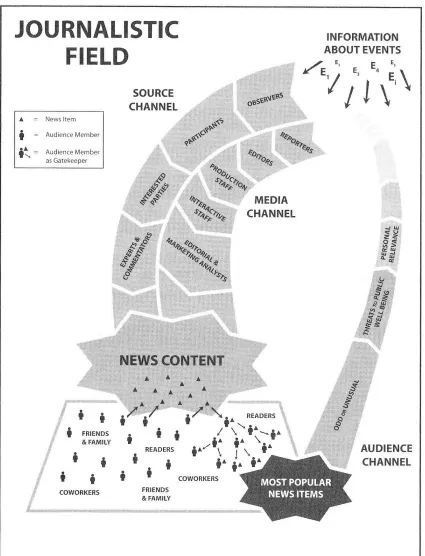
The principal conclusion to be drawn from these observations is that gate-keeping
models need revision. Shoemaker and Vos’ (2009: 125) model of gate-keeping
(reproduced as figure 1) is one of the most contemporary and reflects the ability
audiences now have to re-distribute news items among themselves and to act—
collaboratively—to filter news items into lists of the most popular and, as a result, give
15
Figure 1 Source, media, and audience channels in the gatekeeping process (Shoemaker
16
Shoemaker and Vos’ model does not, however, fully reflect the reality of contemporary
online news artefacts and how they are used. To do so the model would need to:
1. Show how the audience—by using Twitter, or subscribing to RSS feeds or email
newsletters—can influence which “observers, participants, interested parties, and
experts or commentators” they are exposed to via the ‘source’ channel.
2. Add a feedback loop between readers and the ‘media’ channel. This would
reflect how readers can influence the news content they receive by, for example,
customising ‘home’ or ‘my’ pages, changing their geographical location,
interacting with non-linear features, linking news sites with their social network
profiles, and interacting with content in particular ways.
3. Show how the gates in the ‘media’ channel are not—as the model currently has
it—mediated exclusively by human operators. The gate-keeping roles of
computer programs should be included in the diagram, and in such a way as to
show their common existence outside the media institution.
Changes in journalistic gate-keeping routines have, of course, taken place at a time
when traditional print and broadcast news providers were attempting to develop new
online services (Thurman and Lupton, 2008; and Thurman and Myllylahti, 2009),
expand into new geographical markets (Thurman, 2007; and Thurman, Pascal and
Bradshaw, 2011) and introduce new ways of charging for their services (Herbert and
Thurman, 2007). However, the introduction of these new services, the expansion into
new markets, and experiments with new ways of charging for these services, have not
resulted in a fundamental transformation of the financial fortunes of news providers.
We could say then that wider social, technological, political, and economic forces have
had a greater influence on the financial viability of, and audience appetite for, traditional
providers’ news products than any changes that have taken place in their professional
17
These technological, political, economic, and social forces—digitization, changing work
patterns, globalization, market liberalization, and so on—are well known. The
consequence for traditional news providers has been a slow erosion in the revenues they
receive, because of a failure to replace audience attention lost from their traditional print
or broadcast platforms with an equivalent amount of attention from their online
operations6, and because of structural changes in the advertising market that have
reduced the value of the space, and the audience, they sell.
I have fewer insights into possible solutions to the problems facing the journalistic field,
because many of the innovations to process and product that have been introduced by
the mainstream news media have failed to counter the external pressures they face. I do,
however, offer some suggestions. Many of the innovations that have taken place have, to
a large extent, being within existing organizational norms (Hermida and Thurman, 2008:
353; Thurman and Myllylahti, 2009), “tortuous” (Thurman and Hermida, 2010: 61), “subtle” (Thurman, 2011: 412) and “restrictive” (Thurman, Pascal and Bradshaw, 2011),
implying an unsustainable level of complacency and inertia. Instead established news
providers should ensure that they:
1. Focus on the specific needs of their audience.
2. Better adapt style and structure to the online medium.
3. Are more selective about how to innovate, basing decisions on evidence.
4. Continually evaluate commercial and technology partnerships to ensure they are
in the best interests of the organization.
5. Avoid token gestures and poor execution in favour of well-designed and
supported developments.
6. Invest in original content and on-going research and development.
6 Between 2004-2011 the total annual minutes spent reading by the aggregated UK print and online
18
Why though does it matter whether the institution we know as journalism is sustained?
Despite the potential of collaborative and open source news (as described, for example,
by Bruns, 2009), questions remain about its scope and scalability. The vast majority of
original news reporting—some 95 per cent (Pew 2010)—still emerges from traditional
news providers; and that percentage is undoubtedly even higher for investigative,
international, and other forms of news that are expensive to conduct. Furthermore,
although some successful collaborative and open source news channels have emerged—
Slashdot, Wikinews, NowPublic, Spot.us, Newsvine, Reddit, and so on—the limited
interest I have found that users had in actively interacting with the collaborative
publishing and selection tools provided by mainstream news providers prompts
questions over collaborative news’ scalability.
Some Priorities for Future Research
Research cited in this chapter has shown how computer algorithms are making decisions
on news prioritization and presentation. These mechanisms are difficult to detect and
describe because they operate without user involvement and use closely-guarded
proprietary algorithms, often outside the direct control of the news sites that host the
services they provide. The companies involved in providing some of the enabling
technology to news websites include: Daylife, Evri, Autonomy, Aggregate Knowledge,
Blogrunner, Digg, Loomia, Moreover, and OneSpot. The outsourcing and automation of
gate-keeping processes is worthy of further investigation. Further research should look
to reveal the logic behind the computer algorithms that are increasingly determining
how news is prioritized and presented. It should identify the sources used for the
contextual recommendations provided by many of these companies, and ask what
decisions have been made about classification and indexing. Such questions cannot be
answered by content analysis alone. In addition, representatives of the companies
involved would need to be questioned directly. The results of such an investigation
would inform important questions about bias and homogeneity in news output. Do, for
example, the mechanisms of adaptive interactivity increase content diversity in online
19
what biases are built into the automated systems of news prioritization and the systems
of classification and indexing on which they rely?
Gate-keeping literature on how media ownership and market forces influence media
content tends to assume the persistence of recent historical media models. The result has
been a focus on comparative studies looking at the differences between, for example,
market- and public- service orientated journalism (Beam, 2003) or between
chain-owned and independent media (Gaziano, 1989). The external pressures on newspapers
are now such that we are likely to see changes in strategy such as switching to
online-only publishing. Newspaper and magazines that have already made this decision include
Christian Science Monitor, Madison’s The Capital Times, Newsweek, the Seattle
Post-Intelligencer, SmartMoney magazine, and the Ann Arbor News. My own case study of
the Finnish newspaper, Taloussanomat (Thurman and Myllylahti, 2009), showed that
when the title went online-only it lost at least 75 per cent of its revenues. Staffing levels
dropped, initially by 40 per cent, later even further. The consequences were a shift to
popularism, an increase in utilitarian content, and a reduction in journalists’ use of
enterprise sources to the detriment of news quality and diversity. Gate-keeping scholars
could profitably build on my preliminary investigation into the effects of the online-only
model on media content, not where the online channel is part of a larger multi-platform
news operation, but where it is the only channel to market.
Further Reading
Anderson, C.W. (2012) “Towards a sociology of computational and algorithmic journalism”, New Media & Society, doi: 10.1177/1461444812465137
Barzilai-Nahon K (2009) ‘Gatekeeping Revisited: A Critical Review’, Annual Review
of Information Science and Technology 43: 433–78.
Lee, Angela M., Lewis, Seth C. and Powers, M (2012) “Audience Clicks and News
Placement: A Study of Time-Lagged Influence in Online Journalism”, Communication
20
PARISER, ELI (2011) The Filter Bubble, London: Penguin Books
Singer, Jane B. (2013) “User-generated visibility: Secondary gatekeeping in a shared media space”, New Media & Society DOI: 10.1177/1461444813477833
References
ARANT, M. DAVID and MEYER, PHILIP (1998) “Public and Traditional Journalism: A Shift in Values?”, Journal of Mass Media Ethics: Exploring Questions of Media
Morality, 13(4), 205–218.
ARANT, M. DAVID and ANDERSON, JANNA QUITNEY (2001) “Newspaper online editors support traditional standards”, Newspaper Research Journal, 22(4), 57–69.
BASS, ABRAHAM Z. (1969) “Refining the ‘Gatekeeper’ Concept: A UN Radio Case Study”, Journalism Quarterly, 46, 69-72.
BEAM, RANDAL A. (2003) “Content differences between daily newspapers with strong and weak market orientations”, Journalism & Mass Communication Quarterly,
80(2), 368-390.
BENNETT, W. LANCE (1988) News:The Politics of Illusion (2nd ed), New York:
Longman.
BOCZKOWSKI, PABLO (2004) Digitizing the news: Innovation in online newspapers,
Cambridge, MA: MIT Press
BOCZKOWSKI, PABLO (2010) News at Work: Imitation in an Age of Information
21
BOWMAN, SHAYNE and WILLIS, CHRIS (2003) “We Media: How Audiences are Shaping the Future of News and Information”, The Media Center, 21 September,
http://www.hypergene.net/wemedia/weblog.php, accessed November, 2006
BOYD, DANA (2004) “Demeaning Bloggers: The NYTimes is Running Scared”, Many
2 Many: a Group Weblog on Social Software, 26 July,
http://www.corante.com/many/archives/2004/07/26/demeaning_bloggers_the_nytimes_i
s_running_scared.php, accessed April, 2005
BRUNS, AXEL (2009) Gatewatching: Collaborative online news production, New
York: Peter Lang.
CASSIDY, WILLIAM P. (2006) “Gatekeeping Similar for Online, Print Journalists”,
Newspaper Research Journal, 27(2), 6-23.
CROUSE, TIMOTHY (1972) The Boys on the Bus: Riding with the Campaign Press
Corps, New York: Random House.
DEUZE, MARK (2003) “The web and its journalisms: Considering the consequences of
different types of newsmedia online. New Media & Society 5(2): 203-30.
DUNWOODY, SHARON (1978) “Science Writers at Work”, In Research report no. 7
Bloomington: Centre for New Communications, Indiana University.
FAHMY, SHAHIRA (2005) “Photojournalists’ and Photoeditors’ Attitudes and
Perceptions: The Visual Coverage of 9/11 and the Afghan War”, Visual Communication
Quarterly, 12 (3/4) 146-163.
22
GANDY, OSCAR H. (1982) Beyond Agenda Setting: Information Subsidies and Public
Policy, Norwood, NJ: Ablex.
GANS, HERBERT J. (1979) Deciding What’s News, New York: Pantheon.
GAZIANO, CECILIE. (1989) “Chain newspaper homogeneity and presidential
endorsements, 1972-1988”, Journalism Quarterly, 66(4), 836-845.
GIEBER, WALTER (1960) “How the ‘gatekeepers’ view local civil liberties news”,
Journalism Quarterly, 37(1), 199-205.
HENNINGHAM, JOHN (1997) “The Journalist’s Personality: An Exploratory Study”,
Journalism and Mass Communications Quarterly, 74(3), 615-624.
HERBERT, JACK and THURMAN, NEIL (2007) “Paid Content Strategies for News Websites: An Empirical Study of British Newspapers’ Online Business Models”,
Journalism Practice 1(2) pp. 208–226
HERMIDA, ALFRED and THURMAN, NEIL (2008) “A Clash of Cultures: The
Integration of User-Generated Content within Professional Journalistic Frameworks at
British Newspaper Websites”, Journalism Practice 2(3) pp. 343–356
JENSON, JENS F. (1998) “’Interactivity’. Tracking a new concept in media and
communication studies”. Nordicom Review 19(1): 185-204.
LEWIN, KURT (1947) “Frontiers in Group Dynamics II Channels of Group Life: Social Planning and Action Research”, Human Relations, 1, 143-153.
LEWIN, KURT (1951) Field Theory in Social Science: Selected Theoretical Papers,
23
NISBETT, RICHARD and ROSS, LEE (1980) Human Inference: Strategies and
Shortcomings of Social Judgement, New York: Prentice-Hall.
PATERSON, CHRIS A. (2001) “The transference of frames in global television”, in
Reese, Stephen D.; Gandy, Oscar H.; and Grant, August E. (eds), Framing public life:
Perspectives on media and our understanding of the social world (pp. 337-353),
Mahwah, NJ: Lawrence Erlbaum Associates.
PEW (2010) “How News Happens”, 11 January,
http://www.journalism.org/analysis_report/how_news_happens, accessed 23 May 2013.
SCHIFFER, ADAM J. (2006) “Blogswarms and Press Norms: News Coverage of the Downing Street Memo Controversy”, Journalism and Mass Communication Quarterly,
83(3), 494-510.
SHOEMAKER, PAMELA J. and REESE, STEPHEN D. (1996) Mediating the
Message: Theories of Influences on Mass Media Content (2nd ed.), White Plains, NY:
Longman.
SHOEMAKER, PAMELA, J.; EICHHOLZ, MARTIN; KIN, EUNYI; and WRIGLEY,
BRENDA (2001) “Individual and routine forces in gatekeeping”, Journalism & Mass
Communication Quarterly, 78 (2): 233-246.
SHOEMAKER, PAMELA J. and VOS, TIMOTHY P. (2009) Gatekeeping Theory, New
York: Routledge.
SIGAL, LEON V. (1973) Reporters and Officials: The Organisation and Politics of
Newsmaking, Lexington, MA: D.C. Heath.
24
THURMAN, NEIL (2007) “The Globalization of Journalism Online: A Transatlantic
Study of News Websites and their International Readers”, Journalism: Theory, Practice
& Criticism 8(3) pp. 285–307
THURMAN, NEIL (2008) “Forums for Citizen Journalists? Adoption of User
Generated Content Initiatives by Online News Media”, New Media & Society 10(1) pp.
139–157
THURMAN, NEIL (2011) “Making ‘The Daily Me’: Technology, Economics and Habit in the Mainstream Assimilation of Personalized News”, Journalism: Theory, Practice
and Criticism 12(4) pp. 395–415
THURMAN, NEIL and HERMIDA, ALFRED (2010) “Gotcha: How Newsroom Norms Are Shaping Participatory Journalism Online” in Sean Tunney and Garrett Monaghan
(eds.) Web Journalism: A New Form of Citizenship, Eastbourne: Sussex Academic
Press: pp. 46–62
THURMAN, NEIL and LUPTON, BEN (2008) “Convergence Calls: Multimedia Storytelling at British News Websites”, Convergence: The International Journal of
Research into New Media Technologies 14(4) pp. 439–455
THURMAN, NEIL and MYLLYLAHTI, MERJA (2009) “Taking the Paper out of
News. A Case Study of Taloussanomat, Europe’s First Online-Only Newspaper”,
Journalism Studies (10)5 pp. 691–708
THURMAN, NEIL and RODGERS, JAMES (2014) “Citizen Journalism in Real Time?
Live Blogging and Crisis Events” in Stuart Allan and Einar Thorsen (eds.) Citizen
25
THURMAN, NEIL and SCHIFFERES, STEVE (2012) “The Future of Personalization at News Websites: Lessons from a Longitudinal Study”, Journalism Studies 13(5), 775–
790
THURMAN, NEIL; PASCAL, JEAN-CHRISTOPHE and BRADSHAW, PAUL (2011)
“Can Big Media Do ‘Big Society’?: A Critical Case Study of Commercial, Convergent Hyperlocal News”, paper presented to the Future of Journalism Conference, 8–9 Sept
2011, Cardiff University, Wales
THURMAN, NEIL (2013) “Newspaper consumption in the digital age: Measuring
multi-channel audience attention and brand popularity”, Digital Journalism, 2(2), 156–
178
WHITE, DAVID MANNING (1950) “The ‘Gatekeeper’: A Case Study in the Selection of News”, Journalism Quarterly, 27, 383-391.
WILLIAMS, BRUCE A. and CARPINI, MICHAEL X. DELLI (2004) “Monica and Bill
All the Time and Everywhere: The Collapse of Gatekeeping and Agenda Setting in the