City, University of London Institutional Repository
Citation
:
Zachos, K., Maiden, N. & Levis, S. (2015). Creativity Support to Improve
Health-and-Safety in Manu-facturing Plants: Demonstrating Everyday Creativity. In: T. Maver & E.
Y-L. Do (Eds.), C&C '15 Proceedings of the 2015 ACM SIGCHI Conference on Creativity and
Cognition. (pp. 225-234). ACM. ISBN 978-1-4503-3598-0
This is the accepted version of the paper.
This version of the publication may differ from the final published
version.
Permanent repository link:
http://openaccess.city.ac.uk/14364/
Link to published version
:
http://dx.doi.org/10.1145/2757226.2757245
Copyright and reuse:
City Research Online aims to make research
outputs of City, University of London available to a wider audience.
Copyright and Moral Rights remain with the author(s) and/or copyright
holders. URLs from City Research Online may be freely distributed and
linked to.
City Research Online:
http://openaccess.city.ac.uk/
[email protected]
Creativity Support to Improve Health
-
and
-
Safety in Man
u-facturing Plants
: Demonstrating
Everyday Creativity
Konstantinos Zachos, Neil Maiden
City University London
Northampton Square, London
EC1V 0HB, UK
[email protected]
Sergio Levis
FCA Group
Via Nizza, 250, 10126
Turin, Italy
[email protected]
Kasia Camargo,
Gianluca Allemandi
CNH Industrial, Cranes Farm Road,
Basildon SS14 3AD, UK
[email protected]
ABSTRACT
This paper reports the development and deployment of digi-tal support for human creativity in a domain outside of the creative industries – health-and-safety management in man-ufacturing plants. It reports applied research to extend a risk detection and resolution process at a world-class manufac-turing plant that produces tractors with creativity techniques and new digital support for the plant employees to use these techniques effectively as part of the risk detection and reso-lution process. The development of the digital support was constrained by the plant’s processes, resources and manu-facturing culture, and the new digital support reported in this paper was designed for quick use across the plant with minimum training or management overhead. The paper reports the development, implementation and early evalua-tion of the creativity techniques and digital support in the plant as a demonstrator for the wider application of creativi-ty techniques and digital support tools.
Author Keywords
Creativity; health-and-safety; risk management; mobile
ACM Classification Keywords
D.5.2 [User Interfaces]: User-centered design, voice I/O
General Terms
Design, human factors
INTRODUCTION
The last decade has seen considerable advances in the use of digital support for human creative activities in arts and design – disciplines already recognized as creative such as music, and film and television. However, this focus on the creative industries has sometimes acted as a barrier to crea-tivity research to explore and develop support for human creativity in disciplines not generally perceived as creative. For example, there is little explicit teaching or uptake of creativity techniques and methods in engineering, although few would disagree that engineering practice necessitates creative problem solving. Other disciplines, however, are not even perceived to have a role for creative thinking, even
though the work undertaken in them seeks to produce out-comes that are novel, useful and surprising [23]. Examples include nursing and transport planning, and most of these disciplines provide no explicit support for human creativity, in spite of the potential benefits that could accrue from more creative thinking by their professionals. In this paper, we argue for and develop support to deliver human creativi-ty in one important activicreativi-ty not treated as creative – health-and-safety management in manufacturing plants – as a de-monstrator for the wider application of creativity methods, techniques and digital support tools.
Increasing the health and the safety of citizens continues to be an important aim for organisations and governments. In the United States, for example, there were 4,500 workplace deaths in 2010, 250,000+ work-related injuries and illnesses in 2011 [20], and in the European Union almost 2.5 million workplace incidents resulting in at least 3 person-days off work occurred in 2012 [9]. New legislation and manage-ment systems have resulted in improved worker health and safety through the introduction of systematic processes, however notable numbers of deaths and injuries continue to occur. Now, to reduce these numbers further, some organi-zations are exploring different approaches to complement systematic processes. One of these organizations is CNH Industrial, a global leader in the capital goods sector, and the new approach is creative thinking.
CNH Industrial’s current systems for occupational health-and-safety management and lean manufacturing involve all of its employees in the detection, reporting and resolution of health-and-safety risks. To support employees to think more creatively in this risk detection, reporting and resolu-tion process, the EU-funded COLLAGE project has extend-ed it with support for creative thinking about risk resolu-tions and, more significantly, developed new digital support for this creative thinking. This paper reports the develop-ment and piloting of digital creativity support for employ-ees in one CNH Industrial manufacturing plant outside of London that produces tractors. In particular, it describes how advanced natural language parsing and information retrieval techniques were combined to design new digital support for human creative thinking in an environment with little digital expertise and resources.
plant. Subsequent sections describe the creative risk resolu-tion process that was developed for use by plant employees, the digital solution implemented to support employees to undertake the process, and early results from pilot use in the plant of the process and digital support. The paper ends with first lessons for the uptake of creativity techniques and digital support tools outside of the creative industries.
RELATED WORK
Most research to develop digital support for human creativi-ty has been undertaken in industries in which people re-ceive creative skills and training. Examples of industries for which research was undertaken in the last ACM Creativity and Cognition conference include the performing arts, mu-sic, and film and television. However, beyond the creative industries, creativity support research has been limited. The science and engineering domains have been a focus of lim-ited digital support, for example with new tabletop visuali-zations to support biological discoveries [26], social media to support collaborative creativity in education [3] and inte-grations of creativity techniques into complex engineering processes [8]. Moreover, although business activities have been a common target for creativity and innovation re-search, most has sought to support human creativity through new problem solving methods (e.g. [12]), tech-niques (e.g. [17]) and creative collaboration spaces (e.g. 7]). Healthcare is one domain that has been the target of creativ-ity research. Creativcreativ-ity is often treated as an important pre-condition for technology innovation, for example to devel-op new medical devices [6] and assist stroke patients [5]. Some researchers have also made the case to treat healthcare as creative work, for example to encourage crea-tive problem solving by nursing administrators who set the tone in a work unit, and how others undertake creative work [2]. Houts et al. [11] proposed a prescriptive creative prob-lem-solving model to help family carers deliver care to people with chronic diseases discharged from hospital. The model was tailored to the healthcare domain from the Os-born-Parnes creative problem-solving model [19], and dis-tinguished situations in which creative problem solving could be used from situations in which advice needed to be sought from experts. More recently, care for older people with dementia has been framed as creative work, and new creativity support technologies have been developed for use by carers, and shown to be effective in care settings [15]. Digital support tools have also been produced to support medical volunteers to think creatively to resolve non-routine medical work during emergencies.
However, in general, little research to develop digital sup-port for human creativity outside of the creative industries has taken place, and we are unaware of applications of crea-tivity research to improve health-and-safety work.
RISK RESOLUTION IN MANUFACTURING
CNH Industrial employs more than 71,000 people in 62 manufacturing plants worldwide. Each of CNH Industrial’s brands focuses on one industrial sector, for example Iveco
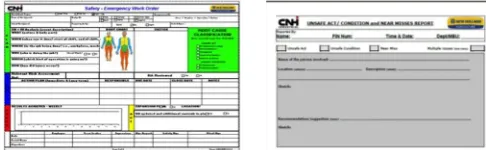
print-ing and placprint-ing it on health-and-safety notice boards such as the one in Figure 2.
Figure 1. Two forms from the current health-and-safety pro-cedures in the plant – the Safety Emergency Work Order form
(left) and Unsafe Act and Condition form (right)
Figure 2. A typical noticeboard for sharing risk resolution information amongst plant employees
In contrast, the plant management anticipated that new digi-tal technologies could not only increase employee engage-ment in the risk resolution process, but also increase cross-plant communication and creative collaboration and provide more effective management oversight of the process. There-fore, new research was undertaken to enhance the plant’s process with creativity support for risk detection and resolu-tion, and to design and implement a new form of digital support for human creativity as part of the process. The next sections describe the enhanced process and the digital support that was implemented.
CREATIVITY SUPPORT FOR RISK RESOLUTION
The plant’s manufacturing process imposed significant con-straints on our extension to the risk detection and resolution process with creativity support. It involved employees who work on the production lines in shifts and cannot stop their work on demand to undertake creative tasks. Moreover, due to shift rotations, even pre-planned time to participate in the process was limited to a maximum of 30 minutes per risk. In addition, most employees had little or no experience of using creativity techniques, the nature of most manufactur-ing work was repetitive and did not foster creative thinkmanufactur-ing, and the focus on the continuous manufacture of tractors generated a culture that was solution-oriented. This context, very different to most creative industries, provided several
challenging constraints on our development of effective new creativity support for risk resolution. The digital sup-port needed to be simple to learn and to use, not consume too much worker time, and deliver one or more candidate resolutions that could be implemented by the end of the process.
In response to these constraints a simple diverge-converge creative process to risk detection and resolution was devel-oped and provided as input to a user-centred design process that was undertaken by a small design team with stakehold-ers including the plant manager, health-and-safety captains and health-and-safety supervisor. At the start of the process the designers observed the plant’s risk detection and record-ing process and analyzed its paper-based and digital infor-mation artefacts, an analysis which led to the identification of a set of bottlenecks and potential barriers to creative thinking in the process. The designers, health-and-safety supervisor and some captains then collaborated in a simple co-design process to determine possible different digital interventions during risk detection and resolution processes that would be made using mobile devices available on the plant floor and desktop computers in offices. They rede-signed the process to remove duplicate information about risks, replace paper-based information flows with email document exchanges, and generate a new online risk reposi-tory to store these digital documents. Once these architec-ture decisions had been made, a series of increasingly so-phisticated prototypes of a new software application were developed and made available for formative evaluation by stakeholders. First versions of the prototype were demon-strated to the stakeholders for feedback in controlled set-tings, then later versions were made available to stakehold-ers for trial use in the plant over a period of week, to enable thorough testing and refinement through report-back ses-sions with the designers. The outcome of this user-centred design process was a functioning, usable and robust soft-ware application to provide support for creative thinking during risk detection and resolution processes.
[image:4.612.56.294.206.388.2]previous risks. Then, to converge from the set of new ideas about how to resolve the risk to one resolution to imple-ment, each team uses a third creativity technique that is a variation on the TRIZ method [1] adapted to the manufac-turing plant environment. The technique, called Creative Clues, defines a set of desirable characteristics and qualities of novel risk resolutions to risks. The team selects one clue at a time and seeks to generate and evolve new ideas into risk resolutions with the stated characteristic or quality. The resulting risk resolution is documented in the existing plant forms as part of the wider health-and-safety management procedures. The overall process, and its fit within this health-and-safety management process, is depicted graph-ically in Figure 3.
Figure 3. The new diverge-converge creative process for risk detection and resolution that was implemented in the plant
As part of the user-centred design process, a paper-based version of this creative risk resolution process was piloted in 2 one-hour training sessions at the CNH Industrial plant attended by a total of 18 team leaders and health-and-safety captains. During each session, researchers introduced the process and examples of creative problem solving in prac-tice, then presented a previous serious incident in which a worker received a superficial cut to the head when a duck-board, which he sat on in order to view the underside of a tractor to check for oil leaks, moved unexpectedly. The team leaders and health-and-safety captains were divided into teams of 3 and asked to generate new resolutions to the risk using the new process. In the diverge phase each team spent 15 minutes generating new ideas using the Superhe-roes technique supported by visual images of 12 superhe-roes. In the converge phase each team spent a further 10 minutes evolving the new ideas into a resolution to the risk using a small number of Creative Clue cards such as place one object inside of another.
The plant management deemed the training sessions a suc-cess – all team leaders and health-and-safety captains were able to use the techniques with limited training in a short period of time. Most of the teams identified the potential benefits of the use of these techniques to resolve risks, and most of the teams generated risk resolutions that were
no-ticeably different to the original resolution that was applied. For example, the use of the Superhero technique generated ideas such as raising the tractor in the air to avoid the need to lie down (superhuman strength), sensor devices beneath the tractor to automate the current manual check (x-ray vision), and coloring the oil so that it can be seen without going under the tractor (radioactive man). Likewise, use of the Creative Clues technique guided the teams to generate resolutions to the risk such as having workers wear hats during inspections (from the desirable characteristic of hav-ing one object inside another) and mixing oil with other liquids to make it more visible (from the desirable charac-teristic of mixing elements with liquid or air).
DIGITAL SUPPORT FOR CREATIVE RISK RESOLUTION
The user-centred design process sought to address 2 over-arching challenges to develop effective digital support for risk resolution. The first was to determine an effective means with which to deliver digital technologies to replace and enhance the paper-based risk recording on the produc-tion line. Desktop computers in fixed locaproduc-tions throughout the plant were rejected in favor of more mobile tablet com-puting devices that workers could take to the incident site and complete an online risk description form, equivalent to the previous Safety Emergency Work Order and Unsafe Act and Condition forms. The second was to determine how to implement effective digital support for each creativity tech-nique in an environment with limited digital expertise and no additional resource for knowledge management. To overcome this challenge we decided that each component of the digital support would need to be either a predefined software component that will not require plant resources to be managed or a software component that can automatically process the language of employee communication in the risk detection and resolution process – written natural lan-guage English.
implement-ed with a set of computational mechanisms developimplement-ed to make sense of, match and generate new creative content from the unmanaged natural language resource to present to employees to encourage creative thinking about resolutions to a current risk. And to implement the digital support for the Creative Clues technique, researchers codified the set of desirable characteristics and qualities of novel resolutions to risks so that employees using the Risk Hunting applica-tion receive automatically generated creative ideas that are both possible resolutions to the risk and guidance to discov-er the risk resolution.
Figure 4. Digital support for the Superheroes technique with the Bright Sparks application
The Risk Hunting Application
The Risk Hunting application was developed for use by health-and-safety teams in creative sessions lasting a max-imum of 20 minutes. It was implemented with the 4 soft-ware components: (1) a front-end web application that em-ployees interact with to describe a risk, receive creative guidance to resolve the risk and document new resolution ideas; (2) a digital repository of descriptions of previous risk-resolution cases; (3) a computational software service that automates the Seen-it-before technique to discover and retrieve creatively similar risks and their resolutions; and (4) a computational software service that automates the Creative clues technique to generate clues automatically from descriptions of detected risks and retrieved risk resolu-tions. One further component implements the Bright Sparks application as part of the Risk Hunting application, but it is not reported further in this paper.
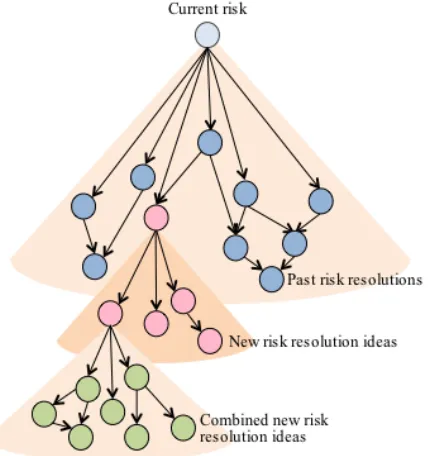
The application was developed to support human-centred creative cognition [13], an activity in which idea generation takes place concurrently with information finding. The ap-plication supports members of a health-and-safety team to search for and generate ideas in the 3 search spaces depict-ed graphically in Figure 5. The first search space is formdepict-ed by the 8000+ previous risk-resolution cases described in the digital repository, and the creative search service searches this space of cases automatically to discover similar
risk-resolution cases as part of the implementation of the Seen-it-before technique. The second space is the search space of possible new risk resolutions to be generated from each retrieved resolution. The application guides members of the health-and-safety team to undertake exploratory creativity to generate new ideas through information finding in this space. The third space is the search space of new risk reso-lutions that result from the combination of previous risk resolutions and the desirable qualities and characteristics of resolutions to risks in manufacturing plants codified in the Creative Clues technique. The creative clue generation ser-vice searches this space automatically in order to generate possible risk resolutions that the application presents to the team members to guide their idea generation process. As such, members of the health-and-safety team are directed to undertake a guided creative cognition activity through the search of 3 different search spaces in order to find relevant information and discover and generate new risk resolution ideas from it.
Figure 5. The spaces of previous risk-resolutions and resolu-tion ideas that creative search strategies support navigaresolu-tion of
[image:6.612.324.538.289.517.2]infor-mation about the moving duckboard risk, reported earlier in the paper is shown in Figure 6. As well saving or editing this new risk description, the team members can request the application to find similar risks.
Figure 6. Entering a natural language new risk description into the Risk Hunting application.
The team members then browse simple descriptions of pre-vious recorded risks that are retrieved by the application as similar to the detected risk and select one or more to review further. For each retrieved risk, the team members can re-view the original resolution(s) that were applied successful-ly to resolve the risk and request creative clues that the ap-plication generates automatically from retrieved infor-mation about risk resolutions. Examples of retrieved previ-ously-resolved risks shown on the left of Figure 7 include an oil leak from a tractor unit, an extractor fan that fell from its mounting, and an extruding object such as a bar axle. Some creative clues to resolve the current risk based on the previous risk resolution related to an extractor unit shown on the right of Figure 6 include think about deac-tivating the unit, think about either trying to put holes in the unit or to fill holes in the unit, and think about how to make the unit self-sustaining, so that it uses all of its waste. The team members can also request the application to generate creative clues from information that the team members en-ter directly about the detected risk. Examples of the creative clues that the application generates for the current risk ex-ample in the bottom right of Figure 7 include think about if it is possible to regenerate the leaks, think about whether you can balance the worker with something else, and think about doing the opposite of what is expected with the leaks.
[image:7.612.68.543.357.686.2]The team members might use these clues to generate ideas such as seeking to replicate and discover oil leaks with spe-cialist equipment in order to detect risks, develop a mecha-nism that takes the worker’s weight and support them to spot oil leaks in relative safety, and in response to doing the opposite of what is expected, postpone the detection of oil leaks until a later, more effective stage in the production process.
The Digital Repository of Risk Resolutions
The digital repository is implemented using eXist, an open source native XML database featuring index-based XQuery processing that the creative search service queries using XQuery, a query language designed for processing XML data. It stores natural language descriptions of previous risks and their resolutions in XML based on the structure of CNH Industrial’s Sharepoint database of risks. The current version of the digital repository implemented in the plant maintains a record of more than 8000 detected risks and their resolutions. Each risk-resolution case and its attributes are specified in 3 parts. The first part describes the detected risk and specifies attributes such as a natural language de-scription of the risk situation, employee body parts that were at risk, and details of the location of the risk. The se-cond part describes the resolutions that were applied suc-cessfully to resolve the risk, and specifies attributes such as corrective actions and future recommendations. The third part describes all other information about the risk-resolution and specifies a larger number of attributes that include the incident short code and persons involved in the incident. As reported earlier, no ontology or tags are specified to provide semantic information about each case.
The Creative Search Service
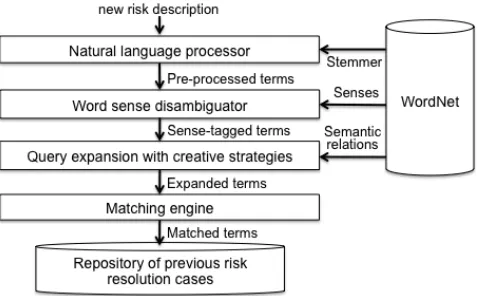
[image:8.612.319.559.64.212.2]The service was implemented to discover and retrieve risks and their resolutions that are similar to the current risk. To do this it implements 3 different creative search strategies to generate new content about: (1) objects or actions de-scribed in the new risk description, for example new resolu-tions associated to objects such as the duckboard or acresolu-tions such as slipping; (2) the wider classes of object or action described in the risk description, for example all classes of action in which someone or something falls over, and; (3) objects and actions that are indirectly associated with the original risk description, for example about accidents, an event that is indirectly related to the action slipping. The creative search service was developed to use natural lan-guage parsing and information retrieval techniques. It au-tomatically disambiguates each term in an entered risk de-scription with its most probable meaning, then extends que-ries generated from the risk description with additional terms based on the disambiguated meanings that implement each of the above creative strategies to match to terms in previous risk-resolution cases [27]. These creative search service capabilities are implemented in 4 software compo-nents shown in Figure 8.
Figure 8. The algorithm of the Creative Search Service
In the first component the detected risk description is divid-ed into sentences then tokenizdivid-ed, part-of-speech taggdivid-ed and modified to include each term’s morphological root (e.g. shifted to shift, leaks to leak) using the Brill Tagger [4]. In the second component the service applies increasingly so-phisticated procedures to disambiguate each term by dis-covering its correct sense and tagging each term with that sense using context knowledge from other terms in the que-ry (e.g. defining a leak to be an accidental hole that allows something (fluid or light etc.) to enter or escape rather than unauthorized (especially deliberate) disclosure of confiden-tial information). In the third the service implements the creative search strategies by expanding each term with oth-er toth-erms that have similar meaning according to the tagged sense to discover previous risk-resolution cases with differ-ent forms of similarity to the input risk description (e.g. the term leak is synonymous with the terms opening, gap and space which are then also included in the query based on the creative strategy). In the fourth the service matches all expanded and sense-tagged query terms to a similar set of terms that describe each case in the repository in 2 steps: (1) XQuery text-searching functions to discover an initial set of case problem descriptions that satisfy global search constraints, and; (2) traditional vector-space model infor-mation retrieval, enhanced with WordNet, to refine and as-sess the quality of the candidate risk-resolution case set. WordNet is an on-line lexical database based on psycholin-guistic theories of human lexical memory [22] that divides the lexicon into nouns, verbs, adjectives and adverbs. The meanings of words, called senses, for each are organized into synonym sets, or synsets for short, which represent concepts, and each synset is followed by its definition or gloss that contains a defining phrase, an optional comment and one or more examples. Senses are also structured using semantic relations between them to link concepts.
similar. Each strategy was designed to generate new content about an object or action described in the new risk descrip-tion, the wider class of object or action that is described in the risk description, or about objects and actions indirectly associated with the original risk description. To implement these directions, the service uses different types of ontolog-ical information from WordNet to discover semantically related terms to each term:
1. Synset expansion: each original term is replaced with its synset, for example the term shift is replaced with its synset for sense #2 [shift, dislodge, reposition]. As such, the strategy expands the query to retrieve then generate new content about each object or action described in the new risk description using synsets;
2. Hypernym expansion: each original term is augmented by its WordNet direct hypernym, for example the hy-pernym of leak is hole so the revised query includes both terms. This strategy expands the query to retrieve then generate new content related to the classes of each object or action described in the new risk description us-ing hypernyms;
3. Gloss words expansion: each term is augmented with all of the terms in its gloss specified in WordNet. For ex-ample the sense#1 definition of the term leak is an acci-dental hole that allows something (fluid or light etc) to enter or escape. Hence the terms hole, fluid, light, enter and escape are extracted and included in the extended query. This strategy expands the query to retrieve then generate new content related to each object or action us-ing the gloss definitions from WordNet.
The resulting query of expanded terms is transformed into a XQuery that is fired at the equivalent risks resolved previ-ously described in the digital repository. At the end of each invocation, the service returns an ordered set of the descrip-tions of the five highest-scoring cases that are presented to the employees, as shown on the left of Figure 7.
The Creative Clue Generation Service
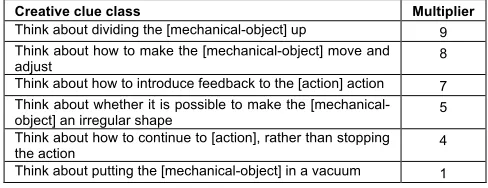
The creative clues technique is implemented as also shown in Figure 7 using a second computational service that auto-matically generates instances of creative clues based on the TRIZ method [1] with names of objects extracted from de-scriptions of detected risks and retrieved risk resolutions. The set of classes of creative clues was selected from a wider set of qualities and characteristics associated with creative outcomes developed as part of the TRIZ [1] crea-tive method. A total of 85 different classes were selected according to the relevance and feasibility of its quality and characteristic in the pilot CNH Industrial plant, then ranked by the paper’s authors for its perceived usefulness to crea-tive thinking about risk resolutions, and based on this rank-ing, a multiplier was attributed to that class to increase its presence in the creative clues that are generated by the ser-vice at run-time. A subset of the creative clue classes and their multipliers are listed in Table 1 to demonstrate the range and different forms of the classes. Some of the
clas-ses are specified to generate creative clue instances about mechanical objects named in risk and resolution descrip-tions, others about the actions and behaviours named in these risk and resolution descriptions. The service will, on average, generate an instance creative clue to think about dividing a mechanical object up 9 times more frequently than it will generate one about putting the mechanical ob-ject in a vacuum.
To generate each creative clue presented by the Risk Hunt-ing application, the service also parses the natural language descriptions of the risk and resolution descriptions to ex-tract (1) objects in the forms of nouns and proper place names; and (2) activities in the form of verb phrases deter-mining the active verbs and all text through to the next punctuation/conjunction word. To do this, the service’s algorithm splits the text into sentences and applies a part-of-speech tagging process to mark up words in each sen-tence as belonging to each lexical, part-of-speech category using information about both its definition and its context in the text. The algorithm then applies a natural language pro-cessing technique called shallow parsing that was devel-oped to generate machine understanding of the structure of a sentence without parsing it fully into a parsed tree form. The output of this shallow-parsing process is a division of the text's sentences into a series of words that, together, constitute a grammatical unit. Finally, to select candidate objects and actions from these grammatical units, the algo-rithm applies lexical extraction heuristics on a syntax struc-ture rule-tagged sentence to extract content words relevant for the generation of one or more objects. Returning to our example, the service returns the following objects: worker; walkway; leak; engine, and one activity: slip on a walkway due to a small oil leak from an engine. The service uses these identified objects and activity to automatically gener-ate creative clues.
Creative clue class Multiplier
Think about dividing the [mechanical-object] up 9 Think about how to make the [mechanical-object] move and
adjust 8
Think about how to introduce feedback to the [action] action 7 Think about whether it is possible to make the [mechanical-object] an irregular shape 5 Think about how to continue to [action], rather than stopping
the action 4
[image:9.612.315.559.477.571.2]Think about putting the [mechanical-object] in a vacuum 1
Table 1. Example creative clue classes and their attributed multipliers for creative clue generation
DEPLOYMENT AND EARLY EVALUATION OF THE RISK HUNTING APPLICATION
Figure 9. Use of the Risk Hunting application on mobile tablet devices in the tractor plant
Analysis of the data collected about application use over the first 21 working days of the summative evaluation reported in Table 2 revealed that team members using the applica-tion documented, on average, more than 2 new risks per day. Moreover, on average for each new risk, the team used the application to retrieve and select 4 different previous risks, selected 5 creative clues and document just over 2 new ideas with which to resolve each risk. The 6 health-and-safety captains and 2 supervisors documented most of these risks, while some production line supervisors ac-counted for the remaining documented risks.
Total numbers of …
new risks described
retrieved risks browsed
creative clues viewed
superheroes explored
resolution ideas gen-erated
[image:10.612.51.298.347.390.2]46 180 210 67 98
Table 2. Totals of use of different Risk Hunting application features over first 21 working days of summative evaluation
Some of the 46 resolved risks documented in the applica-tion revealed evidence of possible creative thinking. Two examples are presented in Table 3. The first reported the danger from boxes that might fall due a forklift truck driver placing them in the wrong place, and the documented reso-lution revealed some evidence of transformational creativity – rather than just have the boxes stocked correctly, use of the selected creative clues led to a resolution that proposed to rethink the space in which the boxes are stored.
Risk Risk description Risk resolution
1 Boxes from prop shaft kitting area have been stocked by the flt driver outside of the designated lines, so therefore overhang into agv buggy route location e8.
Make the boxes move and adjust-area needs to be moved around to insure all boxes are situated within the lines.
2 Risk of being struck by falling
object. Clear driveline of any excess parts prior transit to pedline.
Table 3. Two examples risks and their resolutions documented in the Risk Hunting application
However, other risks were given simple resolutions that revealed little or no evidence of creative thinking. For ex-ample the second risk in Table 3 reports a simple risk and resolution to avoid the risk of being struck by falling ob-jects. One reason given for such simple risk resolutions was that not all risks required creative thinking to resolve them – some risks had effective and known resolutions.
Furthermore, focus groups with members of the health-and-safety team revealed several barriers to use of the applica-tion as intended. As well as a small number of applicaapplica-tion usability problems to be overcome with small software re-designs and additional user training, these focus groups revealed that the teams considered that 20 minutes was too much time to find to think creatively and collaboratively about discovered risks. Therefore, to overcome this barrier, we redesigned the plant’s roles and workflow to encourage active involvement of new creativity champions who users will be able to approach to encourage creative thinking with the application during the resolution of a new risk. A se-cond change will be the running of 1-hour creative risk res-olution sessions, once a fortnight to review risks document-ed and resolvdocument-ed in that fortnight, that can be resolvdocument-ed more effectively – the team of health-and-safety captains will work collaboratively to re-resolve these risks as needed, to improve the risk resolutions, all using the application.
CONCLUSIONS AND FUTURE WORK
In this paper we argue for and report new digital support for human creative cognition in the management of health-and-safety in a world-class manufacturing plant as a demonstra-tor for the use of creativity techniques and digital support tools outside of the creative industries. A simple diverge-converge creative process that invokes the use of 3 different creativity techniques was developed and piloted in sessions with plant employees. Based on the success of the pilot sessions, new digital support for these creativity techniques was implemented to operate within the constraints of the complex, time-limited manufacturing environment. The Risk Hunting application was developed to support human-centred creative cognition through the navigation of 3 dif-ferent risk resolution search spaces. It provides deliberately simple forms of creativity support based on the outcomes of computational manipulation of untagged natural language descriptions of current and previous risks and their resolu-tions. The deployment and formative evaluation of the ap-plication in the plant has been successful – the employees are able to use the application, although the evaluation has revealed some socio-technical barriers that we are currently addressing through further training development and evolu-tion of the software. A second web applicaevolu-tion called Bright Sparks has been developed to support the use of the super-heroes creativity technique in the plant.
[image:10.612.56.297.523.603.2]support for human creative thinking in the many disciplines outside of the creative industries that have the potential to benefit from increased creative competences.
ACKNOWLEDGEMENTS
The research reported in this paper is supported by the EU-funded FP7 COLLAGE project 318536.
REFERENCES
1. Altshuller G., 1999, ‘The Innovation Algorithm: TRIZ,
Sys-tematic Innovation, and Technical Creativity’, Worcester, MA: Technical Innovation Center.
2. Arbesman M., Puccio G., 2001. Enhanced Quality Through
Creative Problem Solving. Journal of Nursing Administration 31(4), 176 -178.
3. Aragon C.R., Poon S.S. & Aragon A. M-H. D., 2009, ‘A Tale
of Two Online Communities: Fostering Collaboration and
Creativity in Scientists and Children’, Proceedings 7th ACM
conference on Creativity and Cognition, ACM Press, 9-18.
4. Brill E., 1992, ‘A simple rule-based part of speech tagger’,
Proc., Third Conference on Applied Natural Language Pro-cessing, ACL, Trento, Italy.
5. Correia de Barros A. & Duarte C., 2009, ‘Assistive Devices:
Stroke Patients' Design, Proceedings 7th ACM conference on Creativity and Cognition, ACM Press, 79-86.
6. Davidson J. & Jensen C., 2013, ‘Participatory Design with
Older Adults: An Analysis of Creativity in the Design of Mo-bile Healthcare, Proceedings 9th ACM Conference on Creativ-ity & Cognition, ACM Press, 114-123.
7. Doorley S. & Witthoft S., 2012, ‘Make Space’, Wiley,
Hobo-ken, New Jersey.
8. Eckert C., Wyatt D. & Clarkson J., 2009, ‘The Elusive Act of
Synthesis: Creativity in the Conceptual Design of Complex
Engineering Products’, Proceedings 7th ACM conference on
Creativity and cognition, ACM Press, 265-274.
9. Eurostat 2014, available at: appsso.eurostat.ec.europa.eu.
10.Hinsch M.E., Stockstrom C. & Lüthje C., 2014, ‘User
Innova-tion in Techniques: A Case Study Analysis in the Field of Medical Devices’, Creativity and Innovation Management 23(4), 484–494.
11.Houts, P.S., Nezubd, A.M., Magut Nezubd, C, Bucherc, J.A.,
1996, ‘The prepared family caregiver: a problem-solving ap-proach to family caregiver education’, Patient Education and Counselling, 27(1), 63-73.
12.Isaksen, S.G. Brian, K. Dorval, Treffinger, D.J. 2011, Creative
Approaches to Problem Solving: A Framework for Innovation and Change. Sage Publications, Inc; Third Edition.
13.Kerne, A., Koh, E., Smith, S. M., Webb, A., Dworaczyk, B.,
2008, ‘combinFormation: Mixed-Initiative Composition of Image and Text Surrogates Promotes Information Discovery’, ACM Transactions on Information Systems, 27(1), 1-45.
14.Lockerbie J. & Maiden N.A.M., under submission, ‘Using the
Bright Sparks Software Tool During Creative Design Work’, submitted to Collaboration in Creative Design, Springer-Verlag.
15.Maiden N.A.M., D'Souza S., Jones S., Muller L., Panesse L.,
Pitts K., Prilla M., Pudney K., Rose M., Turner I. & Zachos K., 2013, 'Computing Technologies for Reflective and Crea-tive Care for People with Dementia', Communications of the ACM 56(11), 60-67.
16.McCarthy D., Koeling R., Weeds J., Carroll J., 2004, ‘Using
Automatically Acquired Predominant Senses for Word Sense Disambiguation’, In: Proceedings of the ACL 2004 Senseval-3 Workshop Barcelona, Spain.
17.Michalko, M., 2006. ‘ThinkerToys: A Handbook of
Creative-Thinking Techniques’, Second Edition. Ten Speed Press, New York.
18.Miller K., 1993, ‘Introduction to WordNet: an On-line Lexical
Database’ Distributed with WordNet software.
19.Osborn A.F., 1953, ‘Applied Imagination: Principles and
Pro-cedures of Creative Problem Solving’, Charles Scribener’s
Sons, New York.
20. OSHA, 2014, ‘All about Occupational Safety and Health Administration’, US Department of Labor, accessible from https://www.osha.gov/Publications/all_about_ OSHA.pdf
21.Salton G., Wong A. and Yang C.S., 1975, ‘A vector-space
model for information retrieval’, Journal of the American So-ciety for Information Science 18,13-620.
22.Simpson, T., 2005,. Wordnet.net. opensource.ebswift.
com/WordNet.Net.
23.Sternberg, R. J. (Ed.), 1999, ‘Handbook of creativity’, New
York, Cambridge University Press.
24.Stevenson M., Wilks Y., 2001, ‘The Interaction of Knowledge
Sources in Word Sense Disambiguation’ Computational Lin-guistics, 27(3), 321-349.
25.Webb M. Linder R. & Kerne A., Lupfer N., Qu Y.,
Poffen-berger B. & Revia C., 2013, ‘Promoting Reflection and Inter-pretation in Education: Curating Rich Bookmarks as
Infor-mation Composition’, Proceedings 9th ACM Conference on
Creativity & Cognition, ACM Press, 53-62.
26.Wu A., Yim J.B., Caspary E., Mazalek A. Chandrasekharan S.
& Nersessian N.J., 2011, ‘Kinesthetic Pathways: A Tabletop Visualization to Support Discovery in Systems Biology’,
Pro-ceedings 8th ACM Conference on Creativity and Cognition,
ACM Press, 21-30.
27.Zachos K., Maiden N.A.M., Zhu X. & Jones S., 2007,