City, University of London Institutional Repository
Citation
:
Kerr, O. (2014). Comment on 'Nonlinear eigenvalue problems'. Journal of
Physics A: Mathematical and Theoretical, 47(36), p. 368001. doi:
10.1088/1751-8113/47/36/368001
This is the accepted version of the paper.
This version of the publication may differ from the final published
version.
Permanent repository link:
http://openaccess.city.ac.uk/17470/
Link to published version
:
http://dx.doi.org/10.1088/1751-8113/47/36/368001
Copyright and reuse:
City Research Online aims to make research
outputs of City, University of London available to a wider audience.
Copyright and Moral Rights remain with the author(s) and/or copyright
holders. URLs from City Research Online may be freely distributed and
linked to.
City Research Online:
http://openaccess.city.ac.uk/
[email protected]
Solutions to
y
0
(
x
) = cos [
πx
p
y
(
x
)
q
]
Oliver S. Kerr
Department of Mathematics, City University London,
Northampton Square, London, EC1V 0HB, U.K.
Abstract
The asymptotic behaviour of solutions toy0(x) = cos[πxpy(x)q] is considered. This is
a generalisation of the problem of the behaviour ofy0(x) = cos[πxy(x)] that was inves-tigated by Bender, Fring and Komijani [1]. We present a derivation of the asymptotic results that follows the approach used in Kerr [2].
1
Introduction
In Bender, Fring and Komijani [1] a detailed asymptotic analysis of the nonlinear initial-value problem
y0(x) = cos[πxy(x)], y(0) =a (1) was presented which focused on the solutions forx≥0. They showed that for a >0 solutions could be split into classes depending on the initial conditions such that solution with an−1 < a < an displayed an oscillatory region with n maxima before
decaying monotonically to zero. They then found the result that as n → ∞, an ∼
25/6√n. This result was subsequently derived using a different approach by Kerr [2].
Here we use this alternative derivation to obtain equivalent results to the generalisation of the original problem where we look for asymptotic solutions to
y0(x) = cos [πxpy(x)q], y(0) =a (2) wherepandqare positive integers1
Much of this derivation is essentially the same as that of Kerr [2]
2
Outline
The typical behaviour of solutions to (2) is essentially the same as the original problem and is shown by the solid lines in figure 1 (with p = q = 1). There is an initial oscillatory phase where the frequency increases and the amplitude decreases as the initial value, y(0), increases. These oscillatory solutions drift downwards until they undergo a transition to monotonic decay towards the horizontal axis.
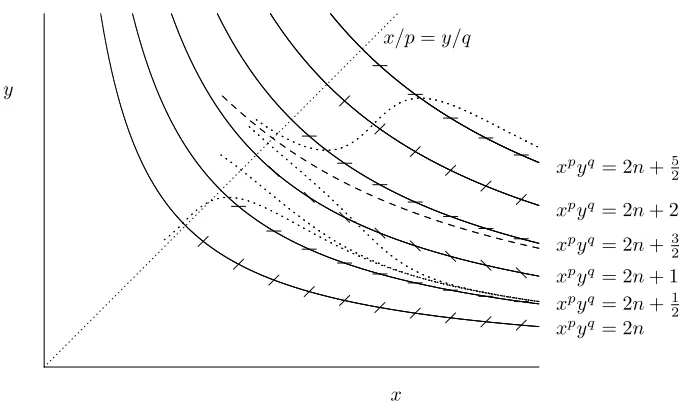
Some of the basic behaviour of the solutions of (2) can be understood by considering the lines in thex–yplane wherexpyqis constant. The situation is shown schematically
3 Solutions in the regionx/p > y/q 2
y
[image:3.612.161.443.153.350.2]x
Fig. 1: Plots of solutions to (2) with y(0) = 2,4,6,8 and p = q = 1. The dotted lines in x/p > y/q show the curves xpyq = C to which these converge asymptotically asx→ ∞. The dashed lines inx/p < y/qgive the estimate of the mean path of the oscillatory part of these curves.
in figure 2. The arguments here are essentially the same as those in section 3 of Kerr, except the region is now divided by the linex/p=y/qand the lines under consideration are lines of the formxpyq=c.
If we consider lines wherexpyq= 2nthen solutions will have gradient 1 where they intersect these lines, similarly whenxpyq= 2n+ 1 they will intersect with gradient−1,
and whenxpyq = 2n±1/2 they will intersect with gradient 0. The gradients of the solutions will have gradients with magnitude at most 1, while the linesxpyq =cfor constantschave gradients greater than 1 in magnitude forx/p < y/q, and less than 1 forx/p > y/q. In the regionx/p < y/qsolutions must cross the linesxpyq=cfrom left to right, with a maximum each time it crosses a linexpyq= 2n+1
2,n= 1,2,3, . . ..
In the regionx/p > y/qthis restriction no longer holds. This results in the solutions having intrinsically different behaviour above and below the linex/p=y/q.
3
Solutions in the region
x/p > y/q
This is essentially the same argunment as previously in Kerr [2].
Any solution that enters a region 2n+12 ≤xpyq≤2n+ 1 is trapped in this region as xincreases as the gradient of a solution on the lower boundary is 0, and on the upper boundary is−1. Indeed, in such a region any solution that is initially above a
3 Solutions in the regionx/p > y/q 3
y
x
x/p=y/q
xpyq = 2n
xpyq = 2n+1
2
xpyq = 2n+ 1
xpyq = 2n+32
xpyq = 2n+ 2
xpyq = 2n+5
[image:4.612.132.475.150.354.2]2
Fig. 2: Schematic plot for solutions in the regionx/p > y/q and the influences of the lines of formxpyq =c. The dotted lines show the trajectories of various solutions, while the dashed line shows the path of the separatrix dividing solutions that converge to xpyq = 2n+ 1/2 from those that converge toxpyq = 2n+ 5/2.
linexpyp= 2n+1
2 +will have a negative gradient of magnitude greater than sinπ
and so must eventually pass belowxpyq= 2n+12+, whose gradient tends to zero as
x→ ∞. Thus all solutions in this region asymptote to the linexpyq= 2n+1 2.
All solutions in the region 2n−1 2 < x
pyq <2n+1
2 will have positive gradients
and so will pass into the region 2n+12 ≤xpyq≤2n+ 1 from below, and will have one maximum in the regionx/p > y/q.
There is one solution in the region 2n+ 1< xpyq<2n+32 that stays in this region. Solutions initially below this curve will pass into the region 2n+1
2 ≤x
pyq≤2n+1 and
remain there, while those above it will end up in the region 2n+52 ≤xpyq≤2n+ 3. This curve is indicated by the dashed line in figure 2. By a similar argument to that given previously it can be shown that these seperatrices tend towards their asymptotes
xpyq = 2n+ 3/2 from below. We will denote the point where the separatrix crosses the linex/p=y/q as x/p=y/q=bn, and hence 2n+ 1< ppqqbpn+q <2n+ 3/2, or
(2n+ 1)1/(p+q)/(ppqq)1/(p+q)< bn<(2n+ 3/2)1/(p+q)/(ppqq)1/(p+q).
Clearly, any solution that ends up just above the curvexpyq = 2n+1
2 will have
crossedn lines given byxpyq = 12, 52, 92, . . .and so will have n maxima. Hence any solution that crosses the line x/p =y/q with bn−1 < x/p = y/q < bn will have n
4 Solutions in the regionx/p < y/q 4
4
Solutions in the region
x/p < y/q
As before, for large values ofy(0) the solutiony(x) will tend to oscillate quickly with small amplitude. The previous arguments hold here.
If lines of constantxpyq =care given locally by the lines x+αy =C then the
mean path of the oscillatory solution is given by dy
dx =
√
1−α2−1
α . (3)
The value ofαis determined by the curvesxpyq=c. On such curves
dy
dx =− pc1/q qx(p+q)/q =−
py
qx. (4)
Since the gradient of the lines x+αy=C is −1/α, we find α=qx/py and so the equation for the slope of the average curve is given by
dy
dx =
s
py qx
2
−1−py
qx. (5)
This has solutions
p
p2y2−q2x2+py
p
(p+q)y−pp2y2−q2x2
p+q
= 2pppqp+qy(0)2p+q. (6) The solution curves meet the linex/p=y/qat the pointx/p=y/q=βwhen
y(0) = (p+q)
p+q 2p+q
22p+qp
β (7)
If thean are the values ofy(0) which correspond to thebn, and so are solutions
withnmaxima then we would have here
an≈
(p+q)2p+qp+q
2
p 2p+q
bn≈
2p+q1 (p+q) p+q 2p+qn 1 p+q 2 p 2p+qp p p+qq q p+q . (8)
5
Conclusions
We have used alternative derivation of Kerr [2] to analyse the generalisation the proiblem considered by Bender, Fring and Komijani [1]. With luk I’ve got the co-efficients right.
References
[1] Carl M. Bender, Andreas Fring, and Javad Komijani. Nonlinear eigenvalue prob-lems. Accepted for publication inJ. Phys. A, 2014.
[2] Oliver S. Kerr. On “nonlinear eigenvalue problem”. Submitted for publication in